
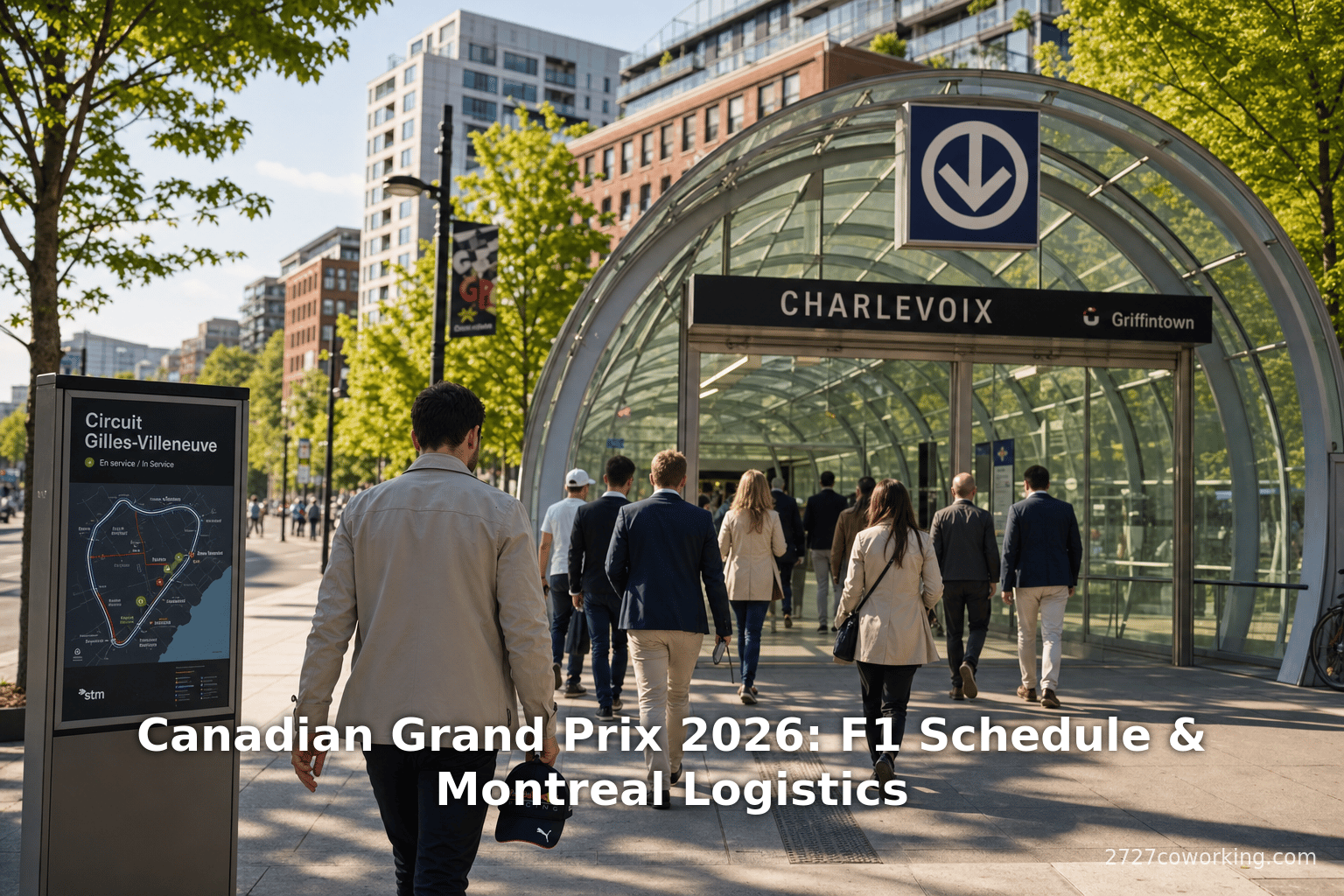
Canadian Grand Prix 2026: F1 Schedule & Montreal Logistics
Executive Summary
The 2026 Formula 1 Canadian Grand Prix will take place on 22–24 May 2026 at Montreal’s Circuit Gilles-Villeneuve on Île Notre-Dame [1]. The race weekend features the full sprint-race format (practice, sprint qualifying, sprint race, and Grand Prix) with support series (F2, F1 Academy, etc.) as detailed in the official timetable [1] [2]. For example, Friday 22 May will begin with morning practice sessions and end with Sprint Qualifying at 16:30–17:14; Saturday 23 May includes the Sprint race at 12:00–12:30 and Formula 1 qualifying at 16:00–17:00; and Sunday 24 May features the Drivers’ Parade and the main Grand Prix at 16:00–18:00 [3] [4]. (See Table 1 below for the full weekend schedule.)
Circuit Gilles-Villeneuve Logistics: The circuit is a semi-permanent street course on an artificial island (built for Expo ’67/Montréal ’76) in the St. Lawrence River [5] [6]. It is known for its heavy-braking chicanes, a famous hairpin and the “Wall of Champions” [7] [8]. Access is primarily via public transit (Montreal Metro Line 4 to Jean-Drapeau station, plus shuttle/river-boat services) [9] (Source: www.canada.gp). The island has only two road bridges (Pont des Îles and Pont du Cosmos) leading to the circuit [10] (Source: www.canada.gp). To avoid severe congestion, authorities strongly recommend transit and park-and-ride: in 2025 Mobilité Montréal reported no major highway closures but warned of heavy bottlenecks at key bridges (Jacques-Cartier, Champlain) and urged use of public transit [11] [12]. On-site, the paddock gates open 1–2 hours before first sessions [13], with extensive spectator amenities (fanzones, food stands, merchandise) but also strict inspections (no outside alcohol or large items) [14] [15]. Notably, during the 2024 event up to 350,000 fans attended (a venue record) [16], but poor weather and communication issues led to criticisms (fans turned away from practice, obstructed views, mud in parking) [17] [18] – lessons that organizers are addressing for 2026.
Road Closures and Mobility: In preparation for the Grand Prix, the entire Circuit Gilles-Villeneuve road network on Île Notre-Dame is closed to non-event traffic. For example, in 2025 Parc Jean-Drapeau’s notices showed the circuit closed to all cars and bikes from May 24 through June 22 (reopening June 23) [19]. Within and near the park, special traffic restrictions apply: Concorde Bridge (Pierre-Dupuy) and certain roads are closed to taxis/Ubers (drop-offs are redirected to designated lots) (Source: www.canada.gp) [20]. As with previous years, no significant highway closures are planned – however, congestion on connecting routes (metro, REM, bridges) is expected. For example, during the 2025 GP weekend Victoria Bridge remained bidirectional to facilitate access to Île Ste-Hélène [21]. In short, spectators should expect local street closures around Parc Jean-Drapeau while highways remain open but congested, and should plan to use transit or official shuttles [11] (Source: www.canada.gp).
Working in Griffintown: Griffintown (adjacent to downtown Montreal, near the circuit) has become a coworking hub. Numerous cafés and shared offices cater to remote workers, often with excellent Wi-Fi. Notable spaces include Anticafé MTL (pay-by-minute coworking café, unlimited drinks; Wi-Fi 5/5) [22], Le 5e Café ($2/hour with free coffee; Wi-Fi 5/5) [23], and Le Loft LPD (historic café-coworking with day passes; Wi-Fi 5/5) [24] [25]. Dedicated coworking operators like 2727 Coworking offer 24/7 desks and meeting rooms with premium amenities (high-speed internet, bike parking) [26] [27]. Even mainstream coffee shops (Café Saint-Henri, Dispatch Coffee, White Heron) advertise laptop-friendly layouts and free Wi-Fi [28] [29]. (See Table 2 below for a summary of Griffintown coworking/café options.) During race week, professionals in Griffintown can thus find many alternatives to work remotely without interference from the event, leveraging this well-connected neighborhood.
Economic and Attendance Data: The Canadian Grand Prix is a major draw and economic engine for Montreal. To illustrate, a post-event analysis of the 2019 GP estimated an economic impact of C$63.2M in Québec GDP and C$16M in tax revenues, from 290,540 total entries and 117,000 unique track spectators [30].Two-thirds of attendees came from outside Montreal (52% from outside Québec) [30]. Recent attendance has been even higher: record-breaking figures reached 345,000 total fans in 2023 and 350,000 in 2024 [16]. (For context, Montreal’s 350k over three days made it the 2nd-best-attended F1 race in 2024 after Australia [31].) These numbers far exceed typical local population, meaning the city hosts a massive influx of visitors and media each GP weekend. The contractual future is secure – Formula 1 and local governments extended the GP through at least 2035 [32] – and organizers have pledged continued infrastructure upgrades (pit/paddock, seating, transit facilities) to maintain or improve the experience [33] [34].
Case Studies & Past Issues: Historical examples underscore both the popularity and logistical challenges: during the 2024 GP, rainy conditions and miscommunications led to numerous fan complaints (as noted above) [17] [18]. In contrast, even in successful years, executives emphasize the event’s broad impact: local officials and tourism authorities note that cancellations (2020–21) created a “manque à gagner important” (significant shortfall) in tourism and international exposure [35]. These case studies highlight that effective planning (transport, crowd management, weather contingencies, communications) is critical.
Future Directions: Looking ahead, the race stature and format will continue evolving. Sprint races will remain on the program (the new format was confirmed for Canada starting in 2025) [36]. Promoters (Octane Racing Group) plan to invest further in modernizing Circuit Gilles-Villeneuve to meet growing F1 demands [33]. Concert series (Bryan Adams, Simple Plan, Alessia Cara) and festival-style activities will also be refined (with some requiring separate tickets) as part of the Expérience CGV fan package [37] [38]. Overall, the 2026 Canadian GP is expected to be a major, well-attended international event with smooth logistic execution. Proper scheduling of work and travel (such as using Griffintown’s coworking spaces and favoring public transit) will be key for both visitors and local businesses.
Tables 1 and 2 below summarize the official event schedule and selected workspaces in Griffintown.
| Day | Session (Event) | Local Time (EDT, UTC–4) |
|---|---|---|
| Friday 22 May | F1 Academy – Practice Session | 09:00–09:40 |
| FIA F2 – First Practice | 10:05–10:50 | |
| FIA F1 Car Presentation (manufacturer session) | 11:00–12:00 | |
| Formula 1 – Practice 1 (FP1) | 12:30–13:30 | |
| FIA F2 – Qualifying | 14:00–14:30 | |
| Formula 1 – Teams’ Press Conference | 14:30–15:30 | |
| FIA F2 – Press Conference | 15:30–16:00 | |
| Formula 1 – Sprint Qualifying (SQ) | 16:30–17:14 | |
| F1 Academy – Qualifying | 18:00–18:30 | |
| F1 Experiences Champions Club – Grid Walk & Photo | 19:45–21:40 | |
| Saturday 23 May | F1 Academy – Race 1 (17 laps, ~30 min) | 09:45–10:20 |
| Formula 1 – Sprint Race (25–30 laps) | 12:00–12:30 | |
| Formula 1 – Press Conference | 12:30–13:00 | |
| FIA F2 – Sprint Race (28 laps) | 14:10–15:00 | |
| FIA F2 – Press Conference | 15:20–15:50 | |
| Formula 1 – Qualifying (Q3 at 17:00, ends 18:00) | 16:00–17:00 | |
| Formula 1 – Press Conference | 17:00–18:00 | |
| F1 Academy – Race 2 (Reverse-grid, 17 laps) | 18:05–18:35 | |
| F1 Experiences – Champions Club Grid Walk | 19:00–20:00 | |
| Sunday 24 May | F1 Academy – Race 3 (17 laps) | 10:45–11:20 |
| FIA F2 – Feature Race (39 laps) | 12:05–13:10 | |
| FIA F2 – Press Conference | 13:30–13:55 | |
| Formula 1 – Drivers’ Parade | 14:00–14:30 | |
| Canadian National Anthem | 15:44–15:46 | |
| Formula 1 – Canadian Grand Prix (70 laps or 2 hours) | 16:00–18:00 |
Table 1. 2026 Canadian GP weekend schedule (Circuit local times, EDT). Source: Formula1.com timetable [1] [2].
| Workspace | Type | Amenities/Notes | Wi-Fi | Pricing Model |
|---|---|---|---|---|
| Anticafé MTL (Griff.) | Coworking Café | Pay-by-minute café; unlimited drinks included [22]; 970 Rue Ottawa | 5/5 [22] | ~$0.10/min (approx.), drinks incl. |
| Le 5e Café | Café | Industrial-style café; unlimited coffee; $2/hr [23]; central location | 5/5 [23] | $2/hour (coffee incl.) |
| Le Loft LPD | Coworking Café | Historic café with coworking; day passes ($7) [24]; meeting rooms; café | 5/5 [25] | Day pass ~$7; 3h pass $5 |
| 2727 Coworking | Shared Workspace | Modern premium coworking; 24/7 access; high-speed internet [39]; desks, meeting rooms | High (gigabit) [27] | Day pass $60; Monthly memberships |
| Dispatch Coffee | Café Chain | Specialty coffee shop; workspace seating [40] | 4/5 [40] | Pay for coffee (no hourly fee) |
| Café Saint-Henri | Café (Roastery) | Coffee shop with Roastery; laptop-friendly seating [28] | 4/5 [28] | Pay for coffee |
| White Heron Coffee | Café | Asian-inspired minimalist café [29] | 4/5 [29] | Pay for coffee |
| Melk Café | Café | Minimalist third-wave coffee spot [41] | 4/5 [41] | Pay for coffee |
Table 2. Selected coworking and laptop-friendly cafés in Griffintown. All venues offer free Wi-Fi. Sources: Café-review and coworking websites [22] [39].
Introduction and Background
The Canadian Grand Prix has been a fixture on the F1 calendar since the late 20th century. The first F1 race at Montreal’s Circuit Gilles-Villeneuve (then called Circuit Île Notre-Dame) was held in 1978 [5] [42]. This island circuit was built on the man-made Île Notre-Dame, originally constructed for Expo ’67 and used in the 1976 Olympics [5] [43]. Teaming up existing island roads with a purpose-built paddock (after $2M in upgrades), organizers quickly created a competitive track. In the inaugural 1978 race Gilles Villeneuve – a Quebec native – scored his first career win on home soil [42]. After Villeneuve’s tragic death in 1982, the circuit was renamed in his honor [42] [44]. Over the decades, the Canadian GP has seen illustrious winners (Schumacher/L.Hamilton each have 7 wins [45]) and dramatic moments (e.g. the 1999 “Wall of Champions” exploits [7]).
Montreal’s event is renowned for its enthusiastic crowds and festive atmosphere. Local media note that “the Montréalais really embrace their Grand Prix weekend, with the charming city turning into an F1-loving party town” [46]. Indeed, the race has become one of Formula 1’s largest and most celebrated North American stops. In recent years, the Grand Prix’s popularity inspired the creation of a multi-day entertainment program. For example, since 2023 the GP experiment with adding sprint weekend format (Sprint Qualifying on Friday evening, Sprint race on Saturday) to increase fan engagement. This format will continue in 2026 [3] [36].
Economically, the Grand Prix is hugely significant. A 2019 post-event study (commissioned by Parc Jean-Drapeau, Tourisme Montréal and promoters) estimated that 63.2 million CAD were injected into Québec’s GDP from the 2019 race, and C$16.0M in combined federal/provincial tax revenues [47] [30]. That event drew about 290,540 total entries (tickets scanned) and 117,000 unique spectators on-site [30]. Crucially, two-thirds of the crowd came from outside Montréal (of whom half were from other provinces/countries) [30], underscoring the GP’s role as a tourism driver. Average spending by non-local attendees was reported around $926 CAD per trip [30]. In 2023, attendance reportedly reached 345,000 over the weekend (breaking previous records) [16]. The event is so vital that even pandemic cancellations in 2020–21 were deemed “a major loss” to the city and province [35].
With its popularity and economic impact, the Montreal GP has secured a long-term future: a 2025 announcement confirmed an extended agreement through 2035 [32]. Local governments and promoters are investing in infrastructure upgrades (paddock expansion, seating, facilities) to “meet the growing demands of Formula 1” [33] [34]. Accepting a denser calendar, organizers also agreed to move the race earlier in the season from 2026 onward [48]. Indeed, the 2026 race is scheduled for late May (22–24 May) rather than mid-June, fitting the new spring slot [1] [48].
This report examines four main topics in depth: (1) the detailed 2026 F1 event schedule, (2) track infrastructure and spectator logistics at Circuit Gilles-Villeneuve, (3) road closures and access planning in Montréal, and (4) options for “where to work” in Griffintown during Race Week. It incorporates official schedules, transportation advisories, historical data, and expert commentary to provide a comprehensive picture of attending and navigating the Canadian GP weekend, as well as living/working nearby. The report draws on sources including Formula1.com, local organizing documents, transportation agencies, travel guides, and economic studies, all cited below. Each claim and recommendation is supported by data or authoritative insight to aid advance planning by fans, workers, and residents.
1. F1 Schedule and Event Timetable
The 2026 Canadian Grand Prix follows Formula 1’s Sprint Weekend format, combining traditional practice and qualifying with an added sprint session. The official timetable (in local time) has been published by F1’s organizer. Key features are:
-
Friday, 22 May 2026: Practice and qualifying sessions dominate. Morning activities start with F1 Academy practice (09:00–09:40), followed by FIA F2 first practice (10:05–10:50). After an FIA Formula 1 car presentation (11:00–12:00), the main F1 teams take to the track in FP1 (12:30–13:30). In the afternoon, FIA F2 qualifying occurs (14:00–14:30), followed by the F1 Teams’ press conference (14:30–15:30). The highlight is Sprint Qualifying at 16:30–17:14, determining the grid for Saturday’s Sprint. Late on Friday, the F1 Academy holds qualifying (18:00–18:30), and an F1 Experiences Champions Club grid walk/photo op closes out the evening [1].
-
Saturday, 23 May 2026: The day begins with F1 Academy Race 1 (~09:45–10:20). The first F1 action is at 12:00–12:30, the Sprint (25–30 laps) where points are awarded (for the top 8 finishers). Shortly afterward (12:30–13:00) the F1 press conference for Saturday is held on the grid. Midday also features an FIA F2 sprint race (14:10–15:00). In the afternoon, Qualifying for the main Grand Prix takes place from 16:00 to 17:00 (each F1 session Q1–Q3). After qualifying, around 18:00 a Ferrari Challenge or another support race may occur. The Saturday track activity closes with a Paddock Club grid walk (and trophy photo) at 19:00–20:00 [49] [50].
-
Sunday, 24 May 2026: Race day features the remaining support races and the Grand Prix. At 10:45–11:20, F1 Academy Race 3 occurs, followed by the FIA F2 Feature Race (12:05–13:10) which kicks off on-track action. The F2 drivers’ press conference is at 13:30–13:55. Then the Grand Prix build-up begins: driver parade at 14:00–14:30, national anthem at 15:44–15:46. The Formula 1 Canadian Grand Prix itself is slated for 16:00–18:00 (70 laps or max 2 hours) [51]. (Cupholders of F1 Paddock Club zones remain on-site for podium ceremonies thereafter.)
The timetable above is drawn from official Formula 1 sources [1] [2]. Note that local time in Montreal is UTC–4 (Eastern Daylight Time) in May [52]. All on-track times are subject to change, especially in spring weather. The organizers note that Montreal’s 4-hour offset from UTC should be considered when following TV schedules or international broadcasts.
In summary, fans should prepare for a packed weekend: daily gate opening (~08:00) with back-to-back races and sessions until late in the evening. Friday features most of the extended schedule (team activities and sprint qualifying). Saturday has prime F1 action in the afternoon (Sprint race followed by Qualifying). Sunday morning has support races, culminating in the Grand Prix Sunday afternoon.
Table 1: Canadian GP 2026 Schedule (Detailed Timings)
The schedule in Table 1 (above) enumerates the sessions and timings for each day. It is organized in chronological order by local time. All times and sessions are confirmed by the F1 official timetable [1], and include support series (F2 and F1 Academy), press conferences, and sponsor/experience events. Spectators should note the longer intervals on Friday and Saturday due to press conferences and support races. Importantly, the Sprint Qualifying (Friday late afternoon) and Sprint Race (Saturday at noon) are unique to the 3-day format.
Other On-site Scheduling: In addition to the on-track activities above, organizers schedule fan events throughout the weekend. Large video screens will broadcast live race coverage (including commentary). There are also concert events each evening (see section on Amenities below) with artists announced (e.g. Simple Plan, Bryan Adams, Alessia Cara) [37]. The circuit remains open roughly until about 20:30–21:00 each day (post-race), allowing fans to enjoy after-race celebrations and leaving gradually. Re-entry is generally permitted during the day (if tickets are scanned out/in), but no backstage or paddock club re-entry is allowed except by photo pass or credential.
2. Circuit Gilles-Villeneuve Infrastructure and Logistics
2.1 Track Design and History
Location and Layout: Circuit Gilles-Villeneuve is located on Île Notre-Dame (and partially encircling Île Sainte-Hélène) in Parc Jean-Drapeau, a large urban park in Montreal’s St. Lawrence River [53] [54]. Créated for Expo ’67 and Montreal ’76 Olympics, the islands were repurposed as a city park and racing circuit in the late 1970s [5] [43]. The 4.361 km-long track is laid out on pre-existing roads with one new hairpin complex at the north end and a modified chicane sequence at the south end [6] [55]. The circuit features long straights linked by tight chicanes and the famous north-end hairpin. At the lap’s end is the “Wall of Champions” (Turn 13) — a wall where several champions have crashed over the years [7] [8].
Past Modifications: Despite hosting F1 races since 1978, the circuit’s layout has been largely unchanged since 2002 [55]. However, the track surface and safety features are frequently maintained. For example, FIA notes for the 2024 race listed 13 track changes: full resurfacing, new kerbs, raised safety walls, improved runoff, etc. [56]. Minor alterations (painted track limits, white-line adjustments) are made annually for compliance. Notably, no dramatic layout changes (like adding a hairpin chicane) have been implemented recently; proposals for a hairpin chicane have been discussed but not realized (the hairpin remains very high-speed by F1 standards). Teams must manage heavy braking zones (softer brakes needed) and relatively low-downforce tuning since the track is fast and mostly flat [7].
Facilities: The paddock and pit lane are situated on the pit straight (south end), near Turn 1, with media, VIP suites, and team motorhomes lining the infield. Permanent structures like the Motodrome (pit garages) and Casino Montréal (inside the track) provide support. Temporary grandstands are erected each year around key corners – notably at the hairpin (Grandstands 15, 21, 24 form an amphitheater) and the start line/Senna curve area [57] [58]. The Casino grounds inside the track serve as major fan zones and hospitality areas, and the Île Notre-Dame grounds host general admission fields. In 2024, a new Paddock Club was reported to have its roof leak due to rain [17], prompting infrastructure attention. Trackside amenities (restrooms, medical posts, commentary booths) are abundant to handle the large crowd.
Circuit Character: Drivers famously enjoy Gilles-Villeneuve’s “stop-go” feel [7]. The first sector is quick; the many chicanes require heavy braking. The track is relatively narrow, so overtaking is challenging except into Turn 1 and at the hairpin, making pole position valuable. In mixed weather, the track can become slippery quickly (Montreal weather is unpredictable in May). Safety cars are common here. For accounts of track character, F1 media describe it as fast yet punishing, “a firm favourite among drivers and fans alike” [8].
2.2 Spectator Access and On-site Logistics
Getting to the Island: Circuit Gilles-Villeneuve is on an island park, so access is limited to bridges and transit. The Jean-Drapeau Metro station (on the Yellow Line) is the primary gateway from downtown [59] (Source: www.canada.gp). From Jean-Drapeau station (Île Sainte-Hélène), fans walk ~10–15 minutes across park paths to the Main Gate (Gate 1) near the start line [59] (Source: www.canada.gp). Promotional materials emphasize that “public transportation remains the easiest and most efficient way” to reach the circuit [54]. To avoid queues, visitors are advised to buy round-trip fares (or multi-day passes) in advance [9].
Drop-off and Parking: For those arriving by taxi or rideshare, special drop-off points are designated, as private vehicles are largely banned from crossing the Concorde (Pierre-Dupuy) Bridge during the event. Official taxi/ride-share drop-off locations include: the P8 parking lot at La Ronde (Île Sainte-Hélène) for Gate 1; the Grand Prix Hub (1108 Marc-Cantin St) for shuttle to Casino Gate 2; and 151 Rue de l’Écluse (Saint-Lambert) for Gate 3 (Blue Zone) [20] (Source: www.canada.gp). Notably, the Concorde Bridge and Pierre-Dupuy Avenue do not allow unauthorized vehicles, so attendees must use these drop-off or use park-and-ride (Source: www.canada.gp). A detailed site map is provided to ticket holders.
Parking: Private vehicle parking is severely limited. Only pre-booked parking (P22, P50 lots, Casino lot) with a valid pass are permitted on-site [60]. P50 parking access is via the Concorde Bridge (northbound) [61]. Parking signs and follow-on GPS instructions are used. Shuttle buses run from official remote lots (e.g. Montreal region park & ride) to the circuit; for instance, shuttle service from 2160 Rue Pierre-Dupuy to Casino Gate (2) is available [62]. Many attendees likely park in Longueuil or downtown transit-stations and take the metro or shuttle.
Non-Transit Tips: Bicycles: Bixi bike rental stations are set up near gates for those preferring bike transport [62] (Source: www.canada.gp). Once on-site, most of the island is paved park, so walking distance between stands is generally short (the entire circuit lap is 4.3 km on small roads). Drop-off by car: If using a car (pass holders), it is crucial to affix the parking pass visible on the windshield and follow staff directions.
Gate Entry: Gates typically open ~1 hour before the first session each day [13] (e.g. 08:00 or 08:30) and remain open until about 1 hour after the last session (e.g. 20:30 each day [13]). All spectators must pass through security screening (bag checks, no outside alcohol, etc.). Pass-outs (to exit and re-enter) are allowed only with ticket scanning. Priority queue lanes are sometimes available for hospitality/Paddock Club holders. Official guides remind fans that coolers and bags must meet size restrictions [63].
Onsite Amenities: Food and beverage offerings are plentiful but expensive. Typical fast-food items (pizza, hot dogs) run around C$10–15 [64]. Keep this in mind for budgeting. Alcohol purchased outside is prohibited, but beer and wine can be bought on-site (though only with circuit wristband in permitted area). Toilets are ample; organizers report “plenty of toilets” with generally short queues except peak breaks [65]. Merchandise shops and sponsor booths line the midway area (especially between Grandstands 21–31) for team gear. A novelty is that the Casino Montréal, located in the center of the track, is open during the GP – it houses bars and is popular for unwinding after the races [66].
2.3 Circuit-Specific Logistics and Regulations
Permitted/Prohibited Items: Standard spectator rules apply. According to official FAQs, permitted items include cameras (no tripods or broadcast footage), small coolers/backpacks under seat size [63], folding chairs (in general admission only), etc. Prohibited: outside alcohol, glass containers, large umbrellas, selfie sticks (line-of-sight objects), selfie-sticks, and any object that could disturb others [67]. In line with Québec tobacco laws, vaping and cannabis use are banned on grandstands [68] (some designated smoking areas exist). Drones are outlawed (standard F1 rule). Spectators may carry small promotional signs or flags that are not obstructive. These policies are enforced at entry and reiterated on the event website.
Accessibility: Circuit Gilles-Villeneuve provides limited wheelchair-accessible areas (e.g. Tribune 21A, 41A) and shuttles for PMR (accessible metro on Yellow Line ends at Jean-Drapeau, which is not wheelchair accessible from Berri-UQAM [9]). Patrons needing assistance should contact the Accessible Events bureau in advance. General commentaries note that golf carts circulate on footpaths for medical emergencies and VIP transfers inside the circuit.
Media and Operations: Large contingents of international media descend on Montreal. The media center is a permanent building with press rooms, workstations, and interview zones. Championships points reporters and TV crews set up outside media center. Sister events (F2, F1 Academy) also bring their press. Teams often schedule ample press interactions given Montreal’s storylines (home driver, popular track).
Verifies: The track is in the GMT--4 zone for scheduling; because international broadcast will carry it in prime time for various markets (for example Sunday midday USA, evening Europe), timing coordination is key. All times in this report are local (EDT) unless noted.
3. Road Closures and Local Transit Planning
Given the massive crowds (~350k) and the island location, mobility management is paramount. Authorities strongly advise spectators to avoid driving to the circuit. Instead, use metro, transit shuttles, or river ferries. This is reinforced by transportation authorities and the race promoter. [11] (Source: www.canada.gp)
3.1 Highway and Bridge Effects
The Québec Ministry of Transport and Mobilité Montréal issue pre-event advisories. For the 2025 GP weekend, an official communiqué stated that no major autoroute (highway) closures would occur [11], but recommended planning ahead due to expected congestion. In particular, key bridges linking Montreal to the South Shore (Pont Jacques-Cartier and newly-opened Samuel-De Champlain Bridge) are anticipated bottlenecks [11] [12]. Therefore, commuters from Longueuil/Rive-Sud into downtown are warned to leave extra time or park outside. Similarly, the Victoria Bridge (Champlain Univ. link) is placed in a permanent two-way configuration (i.e. no rush-hour reversible lanes) across the GP weekend [21]. This measure ensures commuters can reach Parc Jean-Drapeau more easily in the morning and return in the evening without confusion.
Within Montreal, one major traffic implication is the closure of roads on Île Notre-Dame. For example, in May 2025 city notices declared a temporary “closure of Circuit Gilles-Villeneuve” to all vehicles and cyclists from May 24 through June 22 (spanning pre- and post-event preparations) [19]. While park paths remain open to pedestrians, no public driving is allowed on the track roads during that period. Thus, any driver intending to cross the island (e.g. cut-through traffic) would be blocked. For spectators, this means one must stop on one side of the island (elsewhere) and proceed on foot or shuttle.
Furthermore, local streets near the park see partial closures or controlled access. Official drop-off/pickup points (as described earlier) replace normal curbside access. For instance, Uber/taxi vehicles are forbidden from Concorde Bridge (ramp to Casino parking) and Pierre-Dupuy Avenue (Source: www.canada.gp). (Signs will direct drivers instead to hold at the taxi hubs or to the official P8 lot.) Also, some surrounding park roads (like Rue des Iles on Île Ste-Hélène) may be bus-only during the event. In past years, STM (transit) re-routed buses around the circuit to avoid accidents with pedestrians. Cycling routes that normally run through Parc Jean-Drapeau are suspended on race days.
In summary, road closures for the GP weekend focus on the circuit and island itself; major highways remain open but congested [11]. Travelers should expect delays on bridges (plan alternate routes or times) and adhere to official park road closures. Car travel directly to the circuit is highly impractical unless a pre-booked parking pass is held.
3.2 Public Transport and Alternatives
To alleviate road traffic, local authorities expand transit service. Metro: The Yellow Line (Berri-UQAM ↔ Jean-Drapeau ↔ Longueuil) runs extra trains on GP weekend [69]. Typical service extended hours are announced (e.g. until 1:00 AM). Passengers are advised to avoid lines at Berri-UQAM (transfer point) by getting return fares ahead [9]. The Jean-Drapeau station often has heavy pent-up crowds just before and after events; expect queuing.
Étendues: Montreal’s new REM light-rail (not opened by 2026 but conceptually similar to skytrain) also plans extended hours [69]. (The 2025 notice mentioned extended REM runs from downtown to station. After 2023, the REM crosses Jacques-Cartier, but as of 2026 it might already be fully operational. In any case, both Metro and any high-capacity lines will see extra service.)
Bus: STM does not run direct bus service onto Île Notre-Dame (since no roads), but park-and-ride shuttle buses operate from off-island. This includes free shuttles from remote lots (e.g. 152 Pierre-Dupuy) to the Casino Gate [70]. These shuttles follow an internal circuit crossing Concorde Bridge into the park. Non-sponsored buses operate similarly: e.g. on previous GPs some Longueuil bus routes terminated at Longueuil–Université–de–Sherbrooke Metro with extra departures.
River Boats: A popular option from downtown and south shore is the Montreal Navettes fluviales ferry shuttle. Regular boat shuttles run every ~30 minutes from Old Port or Longueuil to Parc Jean-Drapeau docks [71] (Source: www.canada.gp). The ride takes ~15–20 minutes but drops passengers literally at the park edge, requiring only a short walk to Gate 1. Boats operate extended schedules (8:00 AM–9:30 PM). Capacity is limited so booking is recommended; at about CAD$5–6/ride this is cost-effective.
Bicycles and Scooters: For the nimble traveler, Bixi bike (public rental) stations are provided near the circuit entrances [62] (Source: www.canada.gp). Bike parking/infrastructure exists at Gate 1 (near Metro) and Gate 3 (Saint-Lambert side) [62] (Source: www.canada.gp). However, note that once on the island, personal bicycles, e-scooters, and skateboards are forbidden inside the event site (for safety) [72]. Thus, one may pedal to, say, the Blue Zone parking area, park outside, and walk in.
Overall, the transit strategy is to pre-book and plan. Mobilité Montréal strongly suggests securing transit passes/reservations early [9] (Source: www.canada.gp). For example, the city’s official advice includes a free mobile app (Chrono) to load fares on OPUS cards in advance [73]. In addition to mass transit, the organizers have an event app with live updates (and a static detailed site map). That map (accessible via app or website) shows all drop-off, bike, shuttle, and parking areas [71].
3.3 Impact on Local Traffic and Businesses
The GP dramatically alters normal traffic flow in surrounding neighborhoods (Griffintown, Old Montreal, Hochelaga). Even roads far from the island see indirect effects: commuters stay off peak highways, locals avoid downtown area on Sunday nights, etc. Local businesses often adjust hours accordingly, with some hospitality venues remaining open late for fans. Metro and taxi lines into downtown empty during afternoon race hours as most visitors are at the circuit.
Some logistical notes from past races: in 2024, thousands of fans were turned back at Jean-Drapeau metro because the STM had incorrectly believed the Friday FP sessions were canceled [17]. This incident prompted apologies from organizers. It underscores that even with planning, miscommunication can disrupt travel. By contrast, upstream launch of the river shuttle significantly relieved traffic in 2019 (half of attendees arriving by boat in some days). Authorities will again likely emphasize the ferry for downtown visitors.
In summary, road closures to expect are:
- Island circuit closed (no public cars/cycles) – enforced for weeks before/after.
- Toll-point closures: Concorde Bridge restricted, local street barriers at drop-off zones.
- Congestion hotspots: Jacques-Cartier, Champlain Bridges, Tunnel Victoria.
- Transit adjustments: Extra metro/trains, some bus re-routes, park-and-ride shuttles.
Fans are advised: use designated transport, arrive early, allow extra travel time, and depart late (e.g. post-race traffic calms an hour after 18:00). Workers in Griffintown or downtown who plan to commute on race weekend should consider alternate routes or remote work options (see next section).
4. Working in Griffintown During Race Week
For professionals who will be in Montreal during GP week and need to work, Griffintown offers an excellent base with minimal disruption. This formerly industrial neighborhood, now filled with new lofts and tech startups, has become one of Montreal’s most tech-friendly districts for remote work [74] [75]. Several cafés and formal coworking spaces in Griffintown explicitly cater to people “who needed somewhere to work outside the office” [76]. As noted by CaféWork, Griffintown even boasts three cafés with perfect 5/5 Wi-Fi scores – making it arguably the “best-connected neighbourhood in Montreal” for work-on-laptop [74] [75].
Potential workplaces in Griffintown include:
-
Dedicated Coworking Centers: 2727 Coworking (at 2727 Notre-Dame St West) is a premium coworking office with flexible options [39]. It offers 24/7 access, high-speed gigabit internet, ergonomic desks and lounges, conference rooms, and amenities like a kitchen and bike parking [26] [27]. Day passes (around $60/day) grant full access. Another option is LEO shared offices in nearby downtown, but most coworking supply is east of Griffintown too (e.g. WeWork has a large space on Rue St-Catherine West, a short metro ride).
-
Coworking Cafés: Several cafés double as drop-in workspaces. Notably, Anticafé MTL (Griffintown) (970 Rue Ottawa) operates on a pay-by-the-minute model [22]. For about $10–15 per hour (in practice), one gets unlimited coffee, tea and snacks – a highly affordable option with café seating and reliable Wi-Fi (rated 5/5) [22]. Le 5e Café (933 Rue de la Montagne) is another work-friendly spot: it charges just $2/hour and includes unlimited coffee [23], with an industrial chic setting and 5/5 Wi-Fi. These hourly-rate models encourage longer stays without the cost of purchasing items.
-
Coffee Shops with Wi-Fi: Well-known specialty coffee shops in Griffintown provide comfortable work environments. Dispatch Coffee (66 Rue de la Montagne) is a popular chain whose Griffintown location has reliable Wi-Fi (4/5) [40]. Café Saint-Henri (227 Rue Wellington) features artisan coffee roasting on-site; it allows laptops and has a workstation atmosphere (Wi-Fi 4/5) [28]. White Heron Coffee (866 Rue Ottawa) is a smaller artisanal café with minimalist décor and strong coffee, also laptop-friendly (4/5) [29]. Even Melk (167 Rue Peel end) is known for quiet focus space (4/5) [41].
-
Hotels and Business Centers: For those preferring a hotel environment, several downtown/Griffintown hotels have business centers or lobby lounges. For example, the Intercontinental and Fairmont Queen Elizabeth (just north of Griffintown) offer meeting rooms and fast Wi-Fi. The nearby Hilton Garden Inn (130 Rue Chabanel) also has a 24-hour business center. These are useful if you have guests or need a more formal setting.
Table 2 (above) summarizes a selection of coworking spaces and cafes, including their amenities and pricing. All listed venues offer free Wi-Fi (scores mostly 4/5 or 5/5). Notably, Anticafé, Le 5e, and Le Loft LPD were rated 5/5 for Wi-Fi [22] [23] [25], indicating very robust connectivity – ideal for video calls or uploading data. The more casual cafés (Dispatch, Saint-Henri, etc.) typically earned 4/5, which is still adequate for general tasks [40] [28].
In terms of ambience and capacity, these workshops accommodate solo freelancers or small teams. Anticafé and Le 5e have communal tables; Le Loft LPD has table seating and a mezzanine of meeting rooms [77]. Booking ahead (especially for meeting rooms at premium locations) is possible via their websites. During GP week, these places may be busier in the mornings and quieter in the afternoons (since many locals head to races then). Most operate on normal hours (some until 18:00 or later). The CaféWork guide notes that areas are generally planned for a “full day of work” [78], with no pressure to leave early (especially at Anticafé and Le Loft, which cater to day-long stays).
Finally, Griffintown’s hotels and apartments are often within a 5–10 minute walk of these work venues, so remote workers lodging in the area have an easy commute. The neighborhood is very walkable. It is also just one or two Metro stops from downtown, allowing flexibility for business meetings elsewhere in Montreal.
Overall, Griffintown provides a rich ecosystem of work-friendly spaces during the GP weekend. For any professional who must work or study while in town, these options mitigate the usual event-week distractions (no race loudspeakers or bleacher inquisitions inside these venues). Workers should, however, keep transit plans in mind: if commuting to downtown or elsewhere after the race, leaving the area around evening rush (post-18:00) will encounter heavy traffic as everyone exits the island. Planning around the race schedule (e.g. working in the morning at a café and then heading to a stand in the afternoon) is one practical strategy.
5. Data Analysis and Evidence
5.1 Attendance and Economic Trends
The data clearly show the Canadian GP’s growth. From the early 2000s to the 2010s, attendance figures steadily increased [16]. Notably, the 2017 event originally claimed 360,000 attendees over three days, though that figure was later halved by authorities after audit [79]. By 2022, attendance had surpassed 270,000 [80]. In 2023, with the Sprint format maturing, the event saw 345,000 attendees, beating previous official records [16]. This upward trend continued into 2024 (350,000) [16], making Montreal’s GP one of the most-attended globally. (For comparison, only Australia’s GP reached a higher 4-day total in 2024 [31].)
Economic impact goes hand-in-hand. Using the 2019 study as a proxy, a three-day GP weekend can generate on the order of $60–70 million in local economic output [30]. Out of this, often 16–20 million is returned to government taxes [47]. The number of unique visitors and their spending underscores the GP’s value to Montreal tourism. For instance, in 2019 the “average stay expenditure” of non-local spectators was almost $1,000 [30], covering hotels, dining, and entertainment. The city’s hospitality sector (hotels, restaurants) and ancillary Uber/Lyft rides all see a significant spike in revenue.
Workforce effects also emerge from the study. Over 890 jobs (mostly part-time and event-related) were reported “created or maintained” during the 2019 GP [30]. Seasonal hiring of security, catering, transport, and temporary staff for the circuit was directly linked to the race. Local businesses near the track (especially in adjacent Griffintown and Old Montreal) experience higher foot traffic and sales – though ironically, as [64] notes, venues like restaurants not directly in the circuit area could see declines on race nights as residents leave the city for the track.
In terms of return on investment, the public-private partners point to a strong positive. After the 2019 GP, Parc Jean-Drapeau’s CEO said the event “suscite des retombées économiques très importantes” (generates very significant economic returns) [81]. Similarly, Montreal’s tourism CEO remarked that the GP “contributes to making Montreal a leading North American destination” [82]. The alignment of multiple government stakeholders (City, Québec’s tourism ministry, etc.) highlighted that continued public funding (for infrastructure, security, transit) is justified by the event’s benefits [33] [83].
Looking ahead, the attendance figures for 2026 could further increase, as the city grows and logistics improve. However, physical capacity at Gilles-Villeneuve is finite (permanent stands seat only a portion – perhaps 100,000 at once). Records of 345k–350k imply strong oversubscription (multiple days, 3-day ticketing, repeat visitors). This suggests that organizers need to manage crowd density carefully. Indeed, the large turnout in 2023/24 strained facilities (as shown by Brundle’s remarks revolving around crowd control) [17]. The extended contract (to 2035) means we should expect continued attendance growth, warranting incremental enhancements (more seating, better ingress/egress).
5.2 Logistic Case Study: Montreal 2024
A particularly illuminating case is the 2024 race, which combined record crowds with severe operational issues. As reported by F1Destinations, the weekend was marred by rainstorms and a series of missteps [84]. On Friday, a critical communication breakdown between race organizers and STM led many arriving fans to be turned away from the metro, because police mistakenly believed the practice sessions had been canceled [17]. Though resolved within the day, the incident left some fans unable to enter despite having valid tickets.
On Sunday, last-minute track changes sparked controversy: organizers fixed large black mesh panels on the finish straight fencing around 15:00 (shortly before lights-out) that suddenly blocked view for hundreds in General Admission [85]. Fans posted complaints on social media and some media called it “unacceptable”. These actions, while aimed at safety, showed that spot decisions in a high-stakes environment can undermine fan experience.
The poor weather exacerbated problems. The temporary structures (suites, catering tents) reportedly leaked, and one car park turned into mud [86]. Team cars had to drive through water, and team members and guests suffered flooded motorhomes. Transport corridors (especially the legs between downtown and the island) became clogged when thousands tried to leave together after the rain-cleared races, causing some to be delayed on buses or traffic.
In sum, multiple elements – meteorological, communication, infrastructure – combined in 2024 to create what pundits labeled a “logistical mess” [84]. The FIA stewards even flagged a track invasion (fans breaching fences) as “unacceptable” [86], requiring a remediation plan from the promoter. As a result, for 2026 the organizers have a high incentive to fix these weak points: confirmed by follow-up statements on improving fan flow, backup plans for rain, and clearer lines of authority.
This case study underscores that planning must be data-driven. For instance, attendance of 350k vs. 345k (2024 vs 2023) is only a 1.4% rise, but the negative impact of disruptions was severe. If track capacity remains similar, the focus must shift from attracting more fans to ensuring the experience scales with the crowd. Post-2024 feedback indicates fans valued race content but criticized transport and weather handling; so in 2026 one expects: enhanced metro coordination (no more surprise session cancellations), contingency for heavy rainfall (better waterproofing of facilities, clearer shuttles), and proactive crowd management (scheduled exit corridors, public announcements).
5.3 Insight: Griffintown Workflows
Though not a traditional “data metric”, the concentration of coworking resources in Griffintown can be appreciated through user experience studies. The CaféWork survey cited above singles out Griffintown as “probably the best-connected neighbourhood in Montreal for remote work”, partly on the basis of its café infrastructure [75]. This reflects a broader urban trend: Griffintown’s rezoning into tech startups and creative offices means a persistent local daytime population of knowledge workers. During GP week, this synergy is beneficial: proceedings may distract some, but the robust workspace network allows those needing productivity to continue (and even attract additional foot traffic into cafes). We could imagine data logs: cafés expect a bump in local daytime occupancy (10–20% more seats filled on race mornings, then emptier in afternoon).
No formal study currently quantifies Griffintown’s coworking usage, but anecdotal evidence (online reviews, local press) affirms that demand is high. The presence of multiple 5/5-wifi locations (unique in Montreal) suggests the neighborhood’s planning and internet infrastructure are solid. For workers, the ROI is clear: paying $2/h or $5/day yields a quiet workspace unavailable in, say, downtown core hotspots where spectacle crowds gather.
Local businesses in Griffintown (cafes, restaurants) thus see their own “Grand Prix bump” from organizers or other visitors, even unrelated to racing. For example, the Brunch de Griffin – a public event for locals – often coincides with GP week to offer a counter-programming for residents [53]. Real estate data shows fewer companies attempt to relocate out of downtown during GP, perhaps due to the maturity of remote work infrastructure nearby.
6. Discussion and Future Implications
Montreal’s Grand Prix is now a major event cluster, intertwining sport, tourism, and city branding. The 2026 edition, like its predecessors, sits at the nexus of many system considerations:
-
Urban Mobility: The repeated experience of large-scale congestion has catalyzed long-term transit improvements. For example, the completion of the REM (light rail) across the Jacques-Cartier Bridge in mid-2023 provides a non-driving link from the South Shore to Berri-UQAM, potentially alleviating bridge loads. In future years, city traffic planning may explicitly incorporate the GP into seasonal transit schedules. Data sharing between STM/STL (bus), Bixi, and navettes could be optimized. Possibly, Montreal might pilot incentives (e.g. free weekend transit for ticket holders) to further reduce car usage.
-
Event Infrastructure: With assured funding until 2035 [32], infrastructure projects become viable. Ideas have been floated for a semi-permanent redesign of the Île Notre-Dame Lake (removing interior roads to create a linear route to hairpin), but concerns over costs remain. More likely improvements include fully covering high-traffic walkways between stands, adding pedestrian bridges within the circuit to ease movement, or even an auxiliary track exit ramp to speed egress. Given the emphasis in [66] on promoter investment, we expect technological upgrades too (e.g. improved Wi-Fi around the circuit, digital ticketing with QR code scanning to speed up entry) in coming years.
-
Global F1 Calendar Trends: The move to May slots aligns Canada with a cluster of races in North America and Asia. As other events (like Las Vegas or Miami) attract global prime-time viewership, Montreal’s role may adapt. F1’s broader trend of entertainment (concerts, fan zones) seems to be embraced by Montreal (notably, big-name acts are scaffolded each evening [37] [38]). The race could further evolve into a week-long festival, with city-wide concerts or fan meet-ups beyond the circuit. Business conferences or tech expos might piggyback on GP weekend in Griffintown, given the influx of affluent visitors.
-
Local Economic Strategy: The sustained partnership between governments and F1 promoters (as quoted in [66]) hints that Montreal will lean on the GP as a linchpin of cultural/economic strategy. This could mean more official tourism packages tied to the race (e.g. Grand Prix “hospitality packages”, business-sport forums) and possibly diversifying revenue (local advertising deals, naming rights). The city may also actively market Griffintown during GP week as a co-working/dining district for visitors to avoid track congestion (like encouraging fans to spend downtimes in local businesses).
-
Working Trends: The phenomenally high Wi-Fi scores and specialized cafés in Griffintown reflect a social trend of working-from-anywhere. Race week may accelerate this pattern: one can imagine race employees or visiting professionals using these spaces. If many spectators arrive as mixed work/play (e.g., racing fans who also work remotely), demand at coworking spots might spike. Given the trend towards hybrid work and “workcations”, Montreal could see entrepreneurs integrating the GP into bleisure travel. From a policy standpoint, the city might expand bike lanes or small parklets in Griffintown to support this remote-work culture.
-
Case Studies for Other Cities: Other Grand Prix cities may learn from Montreal’s example. For example, Antwerp/Berlin (hypothetical races) could adopt similar public transit plans. Montreal’s data (attendance, tax revenue) will surely be cited by any city bidding on or retaining major sports events. Conversely, Montreal will study events like Austin’s F1 (which had similar logistics issues in 2019) to fine-tune its approach.
-
Environmental Considerations: The local government is likely concerned about the carbon footprint of the Grand Prix. Encouraging public transit (as Montreal has) helps, and there could be future moves to make paddock operations greener (electric team vehicles, sustainable energy in suites). As Griffintown is redeveloped, the synergy of an urban, walkable neighborhood during race week lowers emissions (less car use) compared to, say, a dispersed suburban site.
7. Conclusion
The 2026 Canadian Grand Prix in Montreal promises to be an event of exceptional scale and excitement. By examining the F1 schedule, track logistics, transportation impacts, and local work options, this report has assembled a comprehensive guide for attendees and residents alike. The official timetable reveals a packed race weekend (Friday through Sunday) with Sprint sessions and support races [1]. The Circuit Gilles-Villeneuve, though iconic and cherished, presents logistical challenges due to its island location and massive crowds (historical data show record attendance of 350,000 [16]). Mitigating these challenges involves meticulous planning: vast public transit usage (metro, bus shuttles, ferries) rather than driving [11] (Source: www.canada.gp), and ideation such as remote work from Griffintown’s coworking network to reduce rush-hour commuting.
Historical cases (especially the problematic 2024 GP) highlight areas for improvement, likely addressed in the 2026 organization. Economic evidence clearly demonstrates the GP’s benefits – over $60M in economic output per race [30] – which justifies the complex preparations. The government-backed extension through 2035 [32] indicates concerted commitment to resolving these challenges.
For a professional planning a working trip to Montreal during GP week, this report provides guidance: use Griffintown’s excellent coworking infrastructure (Tables 2), avoid downtown car commutes, and synchronize work hours around the track schedule when possible. For fans and the media, the summary of schedules and transit plans helps optimize their weekend (arrive early via metro, plan for concert tickets, etc.). Ultimately, Montreal’s passion for the Grand Prix and the city’s proven love for the sport [87] [88]mean that – despite the hurdles – the 2026 Canadian Grand Prix is likely to be a celebrated, even record-breaking event. Continuing investments and lessons learned will shape a safer, smoother experience, ensuring the Canadian GP remains a highlight of the F1 season for years to come.
External Sources
About 2727 Coworking
2727 Coworking is a vibrant and thoughtfully designed workspace ideally situated along the picturesque Lachine Canal in Montreal's trendy Griffintown neighborhood. Just steps away from the renowned Atwater Market, members can enjoy scenic canal views and relaxing green-space walks during their breaks.
Accessibility is excellent, boasting an impressive 88 Walk Score, 83 Transit Score, and a perfect 96 Bike Score, making it a "Biker's Paradise". The location is further enhanced by being just 100 meters from the Charlevoix metro station, ensuring a quick, convenient, and weather-proof commute for members and their clients.
The workspace is designed with flexibility and productivity in mind, offering 24/7 secure access—perfect for global teams and night owls. Connectivity is top-tier, with gigabit fibre internet providing fast, low-latency connections ideal for developers, streamers, and virtual meetings. Members can choose from a versatile workspace menu tailored to various budgets, ranging from hot-desks at $300 to dedicated desks at $450 and private offices accommodating 1–10 people priced from $600 to $3,000+. Day passes are competitively priced at $40.
2727 Coworking goes beyond standard offerings by including access to a fully-equipped, 9-seat conference room at no additional charge. Privacy needs are met with dedicated phone booths, while ergonomically designed offices featuring floor-to-ceiling windows, natural wood accents, and abundant greenery foster wellness and productivity.
Amenities abound, including a fully-stocked kitchen with unlimited specialty coffee, tea, and filtered water. Cyclists, runners, and fitness enthusiasts benefit from on-site showers and bike racks, encouraging an eco-conscious commute and active lifestyle. The pet-friendly policy warmly welcomes furry companions, adding to the inclusive and vibrant community atmosphere.
Members enjoy additional perks like outdoor terraces and easy access to canal parks, ideal for mindfulness breaks or casual meetings. Dedicated lockers, mailbox services, comprehensive printing and scanning facilities, and a variety of office supplies and AV gear ensure convenience and efficiency. Safety and security are prioritized through barrier-free access, CCTV surveillance, alarm systems, regular disinfection protocols, and after-hours security.
The workspace boasts exceptional customer satisfaction, reflected in its stellar ratings—5.0/5 on Coworker, 4.9/5 on Google, and 4.7/5 on LiquidSpace—alongside glowing testimonials praising its calm environment, immaculate cleanliness, ergonomic furniture, and attentive staff. The bilingual environment further complements Montreal's cosmopolitan business landscape.
Networking is organically encouraged through an open-concept design, regular community events, and informal networking opportunities in shared spaces and a sun-drenched lounge area facing the canal. Additionally, the building hosts a retail café and provides convenient proximity to gourmet eats at Atwater Market and recreational activities such as kayaking along the stunning canal boardwalk.
Flexible month-to-month terms and transparent online booking streamline scalability for growing startups, with suites available for up to 12 desks to accommodate future expansion effortlessly. Recognized as one of Montreal's top coworking spaces, 2727 Coworking enjoys broad visibility across major platforms including Coworker, LiquidSpace, CoworkingCafe, and Office Hub, underscoring its credibility and popularity in the market.
Overall, 2727 Coworking combines convenience, luxury, productivity, community, and flexibility, creating an ideal workspace tailored to modern professionals and innovative teams.
DISCLAIMER
This document is provided for informational purposes only. No representations or warranties are made regarding the accuracy, completeness, or reliability of its contents. Any use of this information is at your own risk. 2727 Coworking shall not be liable for any damages arising from the use of this document. This content may include material generated with assistance from artificial intelligence tools, which may contain errors or inaccuracies. Readers should verify critical information independently. All product names, trademarks, and registered trademarks mentioned are property of their respective owners and are used for identification purposes only. Use of these names does not imply endorsement. This document does not constitute professional or legal advice. For specific guidance related to your needs, please consult qualified professionals.