2727 Coworking Article
Coworking accessible à Montréal : audit de l'entrée au bureau
Inside this article
- 01Sommaire
- 02Introduction et contexte
- 03Méthodologie : ce qu'accessible peut et ne peut pas signifier
- 04Avant la visite : preuves et arrivée
- 05L'audit de l'entrée au bureau
- 06À l'intérieur de l'espace de travail et participation aux réunions
- 07Planification des urgences et démarche d'accommodement
- 08Analyse des données et éléments de preuve
- 09Analyse des principaux groupes
- 10Conséquences et perspectives
- 11Foire aux questions (FAQ)
- 12Conclusion
Sommaire
On ne peut pas reconnaître de façon fiable un espace de coworking accessible à Montréal à partir d'un badge dans une annonce, d'un repère de métro à proximité ou d'une affirmation selon laquelle une entrée est sans obstacles. La décision pertinente consiste à déterminer si une personne donnée peut effectuer tout le parcours, du transport collectif, du stationnement ou du débarcadère jusqu'à l'entrée, au contrôle d'accès, au bureau, à la salle de réunion, aux toilettes, à la cuisine et à la sortie de secours. Cette distinction touche beaucoup de monde : en 2022, 27 % des Canadiens âgés de 15 ans ou plus, soit environ 8,0 millions de personnes, avaient au moins une incapacité limitant leurs activités quotidiennes [1]. Parmi les répondants ayant une incapacité, 72 % avaient rencontré au moins un obstacle à l'accessibilité et 56 % avaient relevé des caractéristiques des espaces publics, notamment les entrées, les sorties et les trottoirs [2] [3].
Ce rapport propose donc un audit de l'entrée au bureau, et non un classement. Il distingue trois niveaux de preuve. Premièrement, il faut déterminer les exigences des lois et des codes du Québec qui s'appliquent au bâtiment en question. La révision actuelle du chapitre I du code québécois est entrée en vigueur le 17 avril 2025, mais les exclusions, les usages mixtes et l'historique des transformations peuvent modifier les exigences applicables [4]. Deuxièmement, les normes publiées fournissent des critères de référence vérifiables, mais Normes d'accessibilité Canada précise que les normes ne deviennent exécutoires que si elles sont intégrées à des règlements [5]. Troisièmement, toute affirmation concernant un établissement réel doit être confirmée par l'exploitant et vérifiée sur place.
L'audit consigne des conditions observables plutôt que d'attribuer une note universelle. Les champs de référence utiles comprennent une largeur libre de porte de 950 mm, des commandes à une hauteur maximale de 1 100 mm et une aire de rotation de 2 500 mm, tous tirés d'une norme modèle fédérale plutôt que d'une règle de conformité montréalaise [6] [7] [8]. Un espace candidat est retenu uniquement si chaque exigence essentielle définie par l'utilisateur est vérifiée ou fait l'objet d'un plan d'accommodement daté dont la responsabilité est attribuée. Un élément essentiel non vérifié exige un suivi ; un élément essentiel non satisfait pour lequel aucune adaptation praticable n'existe est éliminatoire.
Avant de vous déplacer, vérifiez l'état des ascenseurs le jour même, un itinéraire de rechange, l'état des bordures et les conditions d'enneigement, la procédure de contrôle d'accès, le mobilier réglable, la configuration des toilettes, les mesures de soutien à la communication et un plan d'évacuation individualisé. La STM elle-même prévient que les renseignements sur les ascenseurs publiés en ligne peuvent ne pas refléter immédiatement les conditions sur place (Source: stm.info). Aucun concurrent, y compris 2727 Coworking, n'est certifié ici. Les pages des exploitants sont considérées uniquement comme des pistes pour une visite, jamais comme des preuves d'accessibilité.
Introduction et contexte
Les recherches d'espaces de coworking accessibles en fauteuil roulant à Montréal font souvent ressortir des annonces de bureaux ordinaires. Ces pages peuvent décrire les ascenseurs ou les commodités, mais elles documentent rarement le parcours continu qu'un professionnel en situation de handicap doit réellement effectuer. Une entrée utilisable ne prouve pas qu'un poste de travail l'est aussi, et les lignes directrices fédérales sur les réunions précisent justement qu'une entrée accessible ne garantit pas nécessairement l'accès à l'ensemble d'un établissement [9].
La portée dépasse la mobilité. Statistique Canada souligne que de nombreuses incapacités ne sont pas visibles [10]. Dans son enquête de 2022, 48 % des personnes ayant une incapacité avaient rencontré des obstacles à la communication, tandis que 37 % avaient rencontré des obstacles liés aux comportements, aux idées fausses ou aux suppositions [11]. Un audit sérieux doit donc couvrir l'accessibilité visuelle, auditive, cognitive, sensorielle et communicationnelle, ainsi que la circulation en fauteuil roulant.
Ce rapport est un outil d'aide à la décision pour les travailleurs autonomes, les fondateurs d'entreprise, les employés en télétravail et les gestionnaires de bureau. Il ne fournit pas d'avis juridique, ne certifie aucun immeuble et ne présume pas qu'une seule liste de vérification convient à tout le monde. Les éléments de preuve ont été examinés en date du 19 septembre 2026. Les caractéristiques des bâtiments, les interruptions de service du transport collectif, la neige, la disposition du mobilier et les besoins individuels peuvent changer ; la grille est donc conçue pour être mise à jour à chaque présélection et à chaque visite.
Méthodologie : ce qu'accessible peut et ne peut pas signifier
Trois niveaux de preuve
Le mot accessible doit être décomposé en trois propositions distinctes :
-
Minimum légal : Les dispositions qui s'appliquent réellement au bâtiment, à son usage, à sa transformation et à la relation de prestation de services. Le Québec décrit son code comme établissant les exigences minimales en matière d'accessibilité [12].
-
Critère de référence publié : Une norme mesurable ou un élément de lignes directrices pouvant orienter une meilleure conception. Le Conseil national de recherches du Canada décrit également les exigences du Code national du bâtiment comme des mesures minimales acceptables [13].
-
Fait concernant l'établissement : Une condition présente aujourd'hui dans un espace de coworking précis. Seuls un document à jour, une photographie datée, une démonstration en direct ou une mesure physique peuvent l'établir.
Ces niveaux ne doivent pas être confondus. La présentation de la norme CSA/ASC B651:23 aborde les incapacités physiques, sensorielles et cognitives [14], mais l'organisme fédéral décrit ses normes comme volontaires [15]. Ses dimensions détaillées constituent donc des références utiles pour l'audit, et non une preuve automatique de conformité au Québec.
L'application des règles québécoises dépend de l'immeuble
Le Québec précise que son Code de construction et son Code de sécurité ne s'appliquent pas uniformément à toutes les catégories de bâtiments [16]. Le guide actuel de la Régie du bâtiment du Québec mentionne une exclusion concernant les établissements d'affaires d'au plus deux étages, mais les bâtiments d'usage mixte peuvent tout de même être assujettis aux exigences du code [17] [18].
Lors de la transformation d'un bâtiment existant, la section 3.8 peut ne s'appliquer qu'aux installations touchées par les travaux [19]. Rendre accessible un élément transformé ne rend pas automatiquement l'ensemble du bâtiment accessible [20]. Une personne qui envisage de louer un espace devrait donc demander la classification de l'usage, les dates de construction et de transformation, les permis et les fondements professionnels de toute affirmation de conformité.
La Charte des droits et libertés de la personne du Québec protège expressément contre la discrimination fondée sur le handicap et l'utilisation d'un moyen pour pallier ce handicap [21]. La Commission des droits de la personne et des droits de la jeunesse indique que les fournisseurs de services peuvent être tenus de rechercher activement des solutions [22]. Cette obligation est distincte des dimensions prescrites par le code du bâtiment et peut nécessiter une démarche individualisée.
L'expression coworking accessible selon l'ADA à Montréal est juridiquement imprécise. L'Americans with Disabilities Act est une loi fédérale américaine sur les droits civils [23]. À Montréal, demandez quelles règles québécoises et municipales s'appliquent, puis utilisez les normes canadiennes comme critères de référence clairement identifiés.
Avant la visite : preuves et arrivée
Demander un dossier d'accessibilité à jour
Avant de réserver une visite, envoyez à l'exploitant une courte liste de questions fonctionnelles. Demandez des photographies ou une vidéo récentes, plutôt qu'une galerie promotionnelle non datée.
-
Parcours : Montrez le chemin depuis le débarcadère, la place de stationnement, l'arrêt d'autobus ou la sortie de station accessible choisis jusqu'à la porte.
-
Seuils : Fournissez les mesures des largeurs libres, des pentes, des hauteurs de seuil, de la force d'ouverture des portes et l'emplacement des dispositifs d'ouverture automatique.
-
Contrôle d'accès : Faites une démonstration de l'interphone, du lecteur de carte, du clavier et de la procédure d'accès en dehors des heures d'ouverture, en position assise et debout.
-
Déplacement entre les étages : Identifiez chaque ascenseur nécessaire, les dimensions de sa cabine et de sa porte, ses commandes, ses indicateurs sonores et visuels et la procédure en cas de panne.
-
Poste de travail : Confirmez la présence d'un bureau réglable, le dégagement pour les genoux, les options de fauteuil, l'accessibilité des prises électriques, les mesures de réduction de l'éblouissement et une solution de rechange au calme.
-
Toilettes et cuisine : Fournissez le parcours, l'espace de transfert, les barres d'appui, les appareils sanitaires, la hauteur des comptoirs, les commandes des appareils et le dispositif d'appel d'urgence.
-
Urgence : Fournissez le plan actuel concernant les alarmes, l'évacuation, l'assistance, les zones de refuge et les communications.
Les lignes directrices fédérales indiquent que des personnes ayant des incapacités semblables peuvent demander des accommodements différents [24]. Demandez à la personne qui utilisera l'espace de classer les exigences comme essentielles, adaptables ou non pertinentes avant que l'exploitant réponde.
Vérifier tout le parcours à Montréal
Le planificateur de déplacements de la STM permet de rechercher des itinéraires accessibles aux personnes en fauteuil roulant (Source: stm.info). Ses résultats comprennent uniquement les autobus munis d'une rampe avant, les arrêts accessibles et les stations de métro dotées d'ascenseurs (Source: stm.info). Malgré cela, la STM ne garantit pas l'accessibilité des portions qui empruntent le réseau routier (Source: stm.info).
Pour un espace de coworking avec ascenseur à Montréal, vérifiez chaque ascenseur du parcours, et pas seulement celui du bâtiment. Consignez l'entrée de la station, la ligne et la direction nécessaires, la correspondance, la sortie vers la rue, l'ascenseur menant à l'étage du bureau et un itinéraire de rechange sans marches. À Berri-UQAM, par exemple, la STM précise que seules les lignes orange et verte sont accessibles par ascenseur (Source: stm.info).
Les autres options d'arrivée exigent autant de précisions :
-
Transport adapté : Le service de la STM est offert de porte à porte, sur réservation [25]. Le dossier de réservation devrait préciser le point d'accès au bâtiment s'il diffère de l'entrée principale (Source: stm.info).
-
Stationnement : Une vignette de stationnement pour personnes handicapées du Québec appartient à la personne, et non à un véhicule précis [26]. La carte de Montréal n'indique pas si une place réservée est disponible en temps réel [27].
-
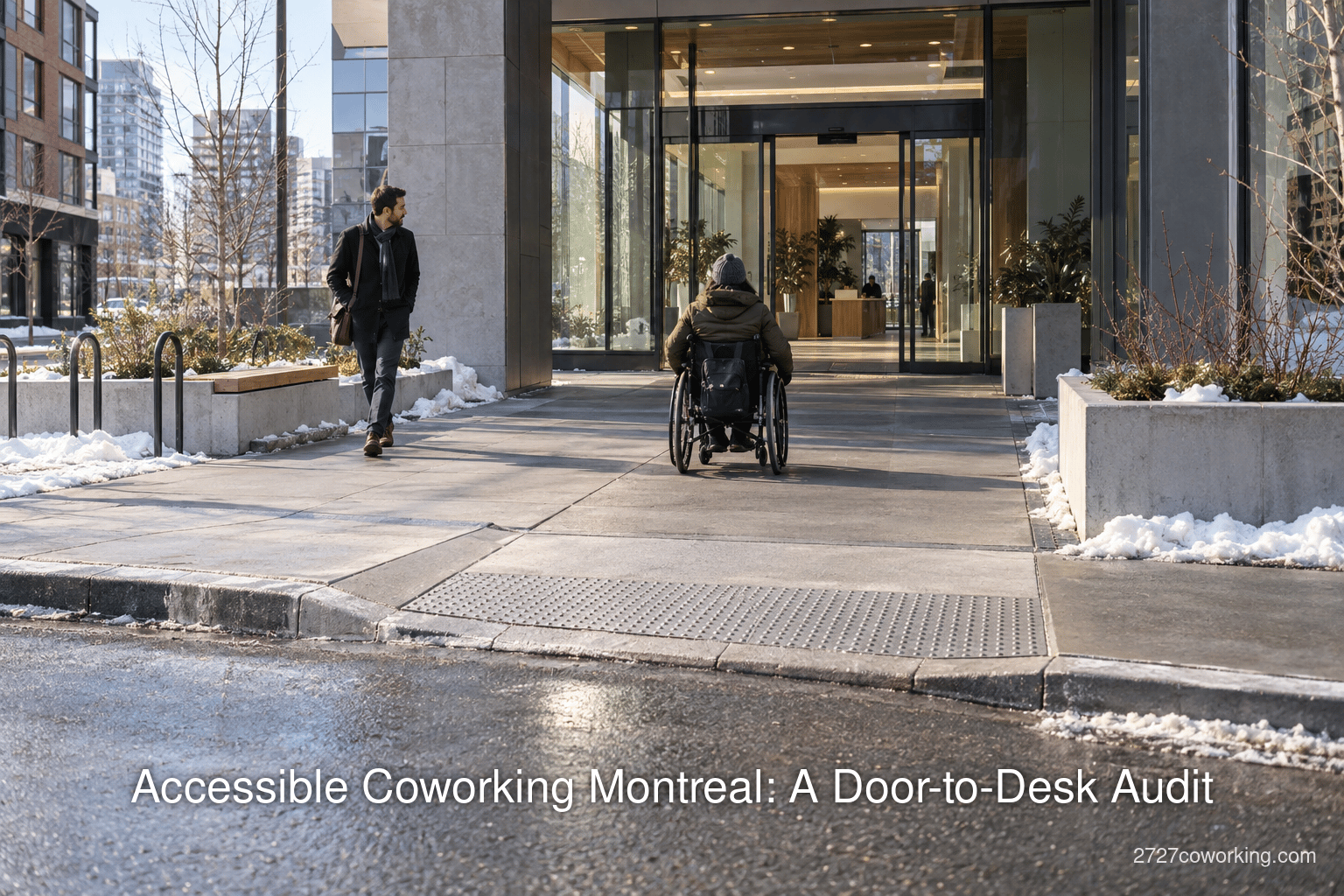
Débarcadère : Montréal permet de demander l'aménagement d'un débarcadère pour personnes handicapées près d'un domicile ou d'un lieu de travail, selon la procédure indiquée [28].
-
Hiver : Le déblaiement municipal commence dès qu'il y a 2,5 cm de neige, tandis que le chargement commence à 10 à 15 cm [29] [30]. Le déneigement d'un banc de neige sur une propriété privée, à une entrée ou dans une aire de stationnement, demeure la responsabilité du propriétaire [31].
Un parcours n'est validé qu'après un déplacement réel au moment et à la saison pertinents. Consultez la page officielle de Montréal sur les travaux et les entraves avant le départ [32], puis conservez un itinéraire de rechange dans la grille.
L'audit de l'entrée au bureau
L'audit utilise les états Validé, Suivi requis et Non satisfait pour qualifier les preuves, et non pour attribuer des notes de qualité. Validé signifie que l'exigence définie par l'utilisateur a été observée dans des conditions réalistes. Suivi requis signifie que l'élément pourrait convenir, mais qu'il faut un document, une mesure, une démonstration ou une mesure corrective datée. Non satisfait signifie qu'une exigence essentielle n'est pas remplie et qu'aucun accommodement praticable n'a été convenu.
Le tableau 1 constitue la principale comparaison des espaces candidats. Il comprend 2727 Coworking parce que l'éditeur offre directement des postes en coworking, des bureaux et des salles de réunion. La ligne consigne uniquement les preuves publiées et ne permet délibérément aucune déduction quant à l'accessibilité.
| Espace candidat | Preuves publiées | État des preuves d'accessibilité | Décision avant la présélection |
|---|---|---|---|
| 2727 Coworking | L'exploitant annonce des postes flexibles / hot desks, des postes attitrés, des bureaux privés, l'accès à une salle de conférence, une cuisine, une douche et un accès 24/7 [33] ; sa visite virtuelle décrit des bureaux pour des équipes de 1 à 10 personnes et des salles de conférence avec équipement audiovisuel [34]. | La disponibilité des produits est publiée. Aucune affirmation de ce rapport ne certifie le parcours, les dégagements, les commandes, les toilettes, les alarmes ou les voies d'évacuation. | Visiter et mesurer. Demander le dossier d'accessibilité complet et tester le parcours propre à l'utilisateur. |
| Tout autre espace de coworking candidat à Montréal | Inscrire les documents datés de l'exploitant et ses réponses directes. | Indiquer pour chaque point de contrôle : observé, non vérifié ou non fourni. | Visiter, adapter ou rejeter selon la même règle. |
La comparaison est volontairement asymétrique, puisqu'il ne s'agit pas d'un classement des fournisseurs. La liste publique de l'exploitant prouve que des espaces existent et peuvent être évalués, et non qu'ils répondent aux besoins d'accessibilité d'une personne donnée. Chaque espace candidat devrait être évalué à l'aide des mêmes champs de preuve.
Grille d'audit bilingue imprimable
Le tableau 2 est au cœur de l'audit de l'entrée au bureau en coworking à Montréal / audit porte-au-poste de travail. Imprimez-le en format paysage ou copiez-le dans un document partagé. Ajoutez des lignes pour les exigences propres à l'utilisateur.
| Point de contrôle / Point de contrôle | Condition observée / Condition observée | Référence officielle / Référence officielle | Photo ou question / Photo ou question | Responsable / Responsable | Date de correction / Date | Priorité de l'utilisateur / Priorité |
|---|---|---|---|---|---|---|
| Parcours et solution de rechange / Trajet et solution de rechange | Validé, suivi requis, non satisfait, sans objet | La STM prévient que l'accessibilité des portions en surface n'est pas garantie (Source: stm.info) | Cartographier les deux parcours ; chronométrer le déplacement réel | Utilisateur et gestionnaire de bureau | ____ | Essentiel / Adaptable / S. O. |
| Parcours extérieur et hiver / Parcours extérieur et hiver | Largeur, pente, surface, drainage, neige, éclairage | Les conditions météorologiques et l'équipement peuvent ralentir le déneigement [35] | Photographier la bordure, la traversée et le seuil | Gestionnaire immobilier | ____ | ____ |
| Entrée et contrôle d'accès / Entrée et contrôle d'accès | Largeur libre, force, seuil, portée, interphone | Critère de référence de la norme modèle : largeur libre de porte de 950 mm [6] | Mesurer le vantail actif ; tester en dehors des heures d'ouverture | Exploitant et propriétaire | ____ | ____ |
| Circulation intérieure / Circulation intérieure | Largeur, rotation, saillies, changements de mobilier | Critère de référence de la norme modèle : rotation de 2 500 mm [8] | Photographier le point le plus étroit | Exploitant | ____ | ____ |
| Ascenseur / Ascenseur | Porte, cabine, commandes, voix, signaux visuels, plan en cas de panne | L'exemple fédéral utilise des indicateurs visuels et vocaux [36] | Effectuer le parcours nécessaire ; poser une question simulant une panne | Propriétaire | ____ | ____ |
| Bureau / Poste de travail | Plage de hauteur, espace pour les genoux, fauteuil, portée, prises électriques, éblouissement | L'exemple fédéral utilise des surfaces et des étagères réglables [37] | Tester avec l'appareil et la tâche réels | Exploitant ou employeur | ____ | ____ |
| Salle de réunion / Salle de réunion | Parcours, rotation, sièges, microphones, sous-titrage, boucle d'induction | Le critère de référence de la norme modèle mentionne des systèmes d'aide à l'écoute au-delà de 75 m2 [38] | Effectuer un appel hybride et un test de sous-titrage | Exploitant et organisateur de la réunion | ____ | ____ |
| Toilettes / Salle de toilette | Porte, rotation, transfert, barres, lavabo, verrou, système d'appel | Considérer tous les équipements comme les maillons d'une même séquence | Photographier et mesurer avec le consentement de la personne | Propriétaire ou exploitant | ____ | ____ |
| Cuisine / Cuisine | Comptoir, évier, commandes des appareils, rangement, parcours | Critère de référence pour les commandes : hauteur maximale de 1 100 mm [7] | Tester la portée pour les objets couramment utilisés | Exploitant | ____ | ____ |
| Orientation / Orientation | Contraste, indications tactiles/en braille, langage clair, points de repère | Les lignes directrices de la norme modèle prévoient des indications tactiles et en braille aux endroits clés [39] | Se déplacer sans indications du personnel | Exploitant et propriétaire | ____ | ____ |
| Lumière, son, odeurs / Lumière, son, odeurs | Éblouissement, scintillement, bruit, zone calme, ventilation, produits | Le CCHST indique que les politiques sur les produits parfumés devraient aller au-delà des parfums [40] | Observer au moment où l'occupation est maximale | Exploitant | ____ | ____ |
| Alarmes et voies d'évacuation / Alarmes et évacuation | Signaux sonores et visuels, communication, assistance, refuge, sortie | Les lignes directrices de la norme modèle prévoient des dispositifs d'avertissement sonores et visuels [41] | Demander le compte rendu d'un exercice et une démonstration | Propriétaire et exploitant | ____ | ____ |
Il ne faut pas additionner les résultats du tableau. Une salle calme peut être essentielle pour une personne et non pertinente pour une autre. Des toilettes inaccessibles ou l'absence d'une méthode d'évacuation peuvent peser davantage que dix vérifications positives de commodités.
Encadré du parcours / Boîte du trajet
- Point de départ et mode principaux / Origine et mode principal : ____________________
- Sortie de station accessible ou débarcadère / Sortie accessible ou débarcadère : ____________________
- Parcours rue par rue / Parcours rue par rue : ____________________
- Entrée principale et entrée en dehors des heures d'ouverture / Entrée principale et hors heures : ____________________
- Parcours de rechange et élément déclencheur / Solution de rechange et déclencheur : ____________________
- Vérifications le jour même, heure et responsable / Vérifications le jour même : ____________________
À l'intérieur de l'espace de travail et participation aux réunions
Circulation, commandes et postes de travail
Un espace de coworking sans obstacles à Montréal doit être examiné dans des conditions normales de fonctionnement. Des fauteuils, des bacs de recyclage, des livraisons, des manteaux et des câbles temporaires peuvent rétrécir un parcours après la préparation d'un plan architectural. Mesurez le point le plus étroit en plaçant les portes et le mobilier dans leurs positions réelles. Testez les dispositifs avec les mouvements habituels de l'utilisateur ; ne déduisez pas leur facilité d'utilisation de leur apparence.
Au poste de travail, reproduisez une véritable séance de travail. Vérifiez l'accès, le transfert ou l'approche, la hauteur du bureau, le dégagement pour les genoux et les pieds, l'emplacement de l'écran, l'éclairage d'appoint, la portée jusqu'aux prises et le parcours vers l'imprimante, les casiers et les rafraîchissements. L'exemple de bureau du gouvernement du Canada indique un éclairage des voies de circulation d'au moins 100 lux au niveau du sol, mais il s'agit d'un exemple à examiner, et non d'une prescription universelle pour chaque personne [42]. Mesurez l'éblouissement et le contraste, ainsi que l'éclairement.
Salles de réunion accessibles à Montréal
Participer à une réunion exige davantage que de pouvoir entrer dans la salle. Le parcours depuis l'entrée du bâtiment jusqu'à la salle devrait être évalué [43]. Prévoyez de l'espace au sol pour les aides à la mobilité et les animaux d'assistance [44].
Pour la participation hybride :
-
Sous-titrage : Confirmez qu'il est visible simultanément pour les participants à distance et ceux présents dans la salle [45].
-
Fichiers : Envoyez directement des fichiers accessibles ; le partage d'écran ne devrait pas être le seul moyen d'accéder aux documents [46].
-
Audio : Testez les microphones depuis chaque siège, ainsi que toute boucle d'induction ou tout système infrarouge. Les lignes directrices du Royaume-Uni recommandent expressément de vérifier le fonctionnement de ces systèmes [47].
-
Éclairage : Évitez de présumer qu'un éclairage tamisé est inclusif. Il peut empêcher certaines personnes de participer, notamment celles qui lisent sur les lèvres [48].
-
Choix à l'avance : Informez-vous tôt des mesures de soutien nécessaires, comme le recommandent les lignes directrices fédérales [49].
Le Québec indique que les personnes accompagnées d'un chien d'assistance ont le droit d'accéder aux lieux publics [50]. La visite devrait permettre de repérer un endroit sûr où l'animal peut se reposer sans entraver la circulation, ainsi qu'un parcours pratique vers l'extérieur pour ses besoins, sans le traiter comme une commodité.
Planification des urgences et démarche d'accommodement
Distinguer l'accès quotidien des voies d'évacuation d'urgence
Un ascenseur peut permettre l'accès quotidien sans offrir de stratégie en cas d'urgence. Les lignes directrices fédérales préviennent que certaines urgences empêchent l'utilisation des ascenseurs [51]. Elles indiquent également que les plans d'évacuation doivent prévoir une solution pour les personnes utilisant des aides à la mobilité [52].
Le tableau 3 est une grille distincte pour l'évacuation d'urgence. Il devrait être rempli avec l'exploitant, le gestionnaire du bâtiment, l'employeur, s'il y a lieu, et la personne concernée.
| Champ relatif à l'urgence / Champ d'urgence | Réponse vérifiée / Réponse vérifiée | Preuve et responsable / Preuve et responsable |
|---|---|---|
| Modes d'alarme : sonore, visuel, tactile, message / Modes d'alarme | ____________________ | Date de la démonstration : ____ Responsable : ____ |
| Parcours de sortie accessible par étage / Parcours de sortie accessible | ____________________ | Version du plan : ____ Responsable : ____ |
| Scénario d'ascenseur indisponible / Ascenseur indisponible | ____________________ | Procédure écrite : ____ |
| Emplacement du refuge et communication bidirectionnelle / Zone de refuge et communication | ____________________ | Date de l'inspection : ____ |
| Assistance individuelle et consentement / Aide individuelle et consentement | ____________________ | Remplaçant désigné : ____ |
| Prise en charge de l'aide à la mobilité / Gestion de l'aide à la mobilité | ____________________ | Équipement et formation : ____ |
| Animal d'assistance / Chien d'assistance | ____________________ | Plan pour les besoins de l'animal et les retrouvailles : ____ |
| Point de rassemblement et vérification des présences / Point de rassemblement | ____________________ | Méthode de suivi des présences : ____ |
| Avis de panne ou de neige / Avis de panne ou de neige | ____________________ | Canal et délai : ____ |
| Exercice, révision et correction / Exercice, révision et correction | ____________________ | Prochaine date : ____ |
La grille doit préciser qui intervient et ce qui se passe lorsque la personne principalement responsable est absente. Les lignes directrices du gouvernement du Canada recommandent que les responsables des urgences et la personne ayant besoin d'assistance planifient la stratégie ensemble [53]. Les plans d'évacuation devraient indiquer les sorties, les points de rassemblement et l'équipement d'urgence [54]. Cette dernière recommandation est une pratique exemplaire provenant de l'extérieur du Québec, et non un énoncé du droit local.
Demander un accommodement sans fournir de détails inutiles
Formulez la demande en fonction de l'obstacle et du résultat fonctionnel recherché. Les exemples comprennent un lecteur de carte plus bas, un bureau réglable, une zone de circulation réservée, du sous-titrage en temps réel, une salle calme, la participation à distance pendant une panne d'ascenseur ou une autre entrée pendant le déneigement.
-
Décrire la tâche et l'obstacle : Par exemple, le lecteur de carte est hors de portée lorsque l'utilisateur est assis.
-
Préciser le résultat nécessaire : Pouvoir entrer de façon autonome en dehors des heures d'ouverture, sans divulguer de renseignements de santé sans rapport avec la demande.
-
Inviter à proposer des options : L'exploitant pourrait être en mesure de déplacer le dispositif, de fournir un autre moyen d'authentification ou de prévoir une procédure avec l'aide du personnel.
-
Consigner l'entente : Préciser la mesure, le responsable, la date du test, la solution de rechange en cas de panne et la date de révision.
-
Limiter les renseignements personnels : La Commission des droits de la personne et des droits de la jeunesse du Québec indique qu'un employeur ne peut pas exiger automatiquement un diagnostic [55]. Les lignes directrices fédérales sur la protection des renseignements personnels indiquent que les renseignements demandés devraient porter sur les limitations fonctionnelles et les questions de sécurité [56].
Cette démarche bénéficie à la fois au coworking pour les professionnels en situation de handicap à Montréal et aux petits employeurs qui cherchent un espace pour un membre de leur équipe. Elle rend la décision vérifiable sans exiger de la personne plus de preuves que nécessaire.
Analyse des données et éléments de preuve
Les données justifient un audit portant sur plusieurs obstacles plutôt qu'une liste de commodités limitée à la mobilité. Le tableau 4 résume les chiffres les plus pertinents pour la décision. Tous les chiffres de prévalence proviennent de l'Enquête canadienne sur l'incapacité de 2022 et concernent le Canada, sauf indication contraire.
| Mesure | Résultat | Incidence sur la décision |
|---|---|---|
| Canadiens âgés de 15 ans ou plus ayant une incapacité limitant leurs activités quotidiennes | 27 %, 8,0 millions [1] | L'accessibilité est un critère courant de sélection d'un lieu de travail. |
| Personnes ayant une incapacité qui rencontrent au moins un obstacle | 72 % [2] | Une étiquette dans une annonce a peu de valeur décisionnelle sans preuves portant sur chaque condition. |
| Obstacles à l'intérieur ou autour des espaces publics | 56 % [3] | L'audit doit commencer avant la porte d'entrée. |
| Obstacles liés à la communication | 48 %, environ 3,8 millions [57] | La technologie de réunion et les procédures du personnel doivent faire partie de la visite des lieux. |
| Deux types d'incapacités concomitantes ou plus | 71 % [58] | Une seule note pondérée peut masquer une exigence essentielle non satisfaite. |
| Au moins un besoin non comblé parmi les catégories de soutien étudiées | 66,1 % [59] | Ne pas présumer que l'utilisateur peut fournir personnellement toutes les mesures de soutien manquantes. |
| Besoin non comblé d'une aide ou d'un appareil fonctionnel | 22,7 % [60] | Demander quelle infrastructure l'espace de travail doit fournir. |
| Taux de réponse à la collecte de l'enquête | 61,1 % [61] | Considérer les estimations comme des résultats d'enquête, et non comme un dénombrement exact de tous les utilisateurs locaux. |
Ces chiffres ne mesurent pas l'offre d'espaces de coworking à Montréal et n'estiment pas la demande dans les recherches. L'enquête couvre les personnes vivant dans des logements privés, et non dans des établissements ou d'autres milieux collectifs [62]. Elle fournit donc un contexte sur la prévalence des obstacles, et non un taux de validation des établissements.
Il n'existe pas non plus de fondement solide pour réduire la liste de vérification à un pourcentage. Si un ascenseur essentiel, des toilettes, un mode d'alarme ou un espace de travail calme ne répondent pas aux exigences, une moyenne élevée pour des champs sans rapport serait trompeuse. Le résultat approprié est une matrice des exigences comprenant les preuves, les responsabilités et les dates.
Analyse des principaux groupes
Mobilité et personnes en fauteuil roulant
Pour une personne en fauteuil roulant, la chaîne décisionnelle comprend l'accès au véhicule ou au quai, l'abaissement de bordure, la surface, la pente, la porte, le lecteur de carte, la circulation, le déplacement entre les étages, l'approche du bureau, le transfert aux toilettes et l'évacuation. Un problème à n'importe quel endroit peut interrompre le déplacement. La définition même d'un parcours sans obstacles de la RBQ englobe les rampes, les ascenseurs ou les appareils élévateurs à plateforme [63]. Vérifiez aussi les conditions de déploiement des rampes d'autobus, puisque la STM précise qu'un chauffeur peut devoir utiliser un autre arrêt si le déploiement sécuritaire est impossible (Source: stm.info).
Accessibilité visuelle, auditive, cognitive et sensorielle
Pour une personne aveugle ou ayant une basse vision, vérifiez la constance des points de repère, le contraste, les renseignements tactiles et en braille, les indicateurs sonores des ascenseurs, les obstacles et l'aide du personnel à l'orientation. Pour une personne sourde ou malentendante, testez le sous-titrage, les microphones, les aides à l'écoute, les alarmes visuelles et la méthode de transmission des avis de panne. Pour l'accessibilité cognitive, vérifiez la prévisibilité de l'aménagement, la clarté des instructions, la cohérence de la signalisation et un parcours comportant peu de distractions. Une signalisation claire bénéficie aux visiteurs qui ne connaissent pas les lieux, ainsi qu'aux personnes ayant des troubles d'apprentissage [64].
Les besoins sensoriels peuvent entrer en conflit. Un éclairage plus intense peut faciliter la lecture sur les lèvres, mais accroître l'éblouissement ; un aménagement ouvert peut faciliter l'orientation, mais augmenter le bruit. Consignez la priorité de la personne et testez d'autres zones plutôt que de déclarer une configuration universellement accessible.
Petites équipes et responsables de l'approbation des bureaux
Un espace de coworking pour petites équipes à Montréal ajoute des questions organisationnelles. Qui reçoit la demande d'accommodement, qui peut autoriser le mobilier ou la technologie et qui communique avec le propriétaire ? Qui assure la présence à la réception en dehors des heures d'ouverture ? Une équipe devrait confirmer que l'adaptation accompagne la personne dans les salles de réunion, les aires communes et les procédures d'urgence.
Les tarifs de l'exploitant peuvent aider à définir le choix commercial, mais ne renseignent pas sur l'accessibilité. À la date de l'examen, 2727 Coworking affichait 300 $ par mois pour un poste flexible / hot desk, 450 $ pour un poste attitré et 600 $ pour un bureau fermé pour une personne [65] [66] [67]. La bonne comparaison porte sur le coût total permettant une utilisation réelle : l'abonnement, plus toute adaptation du mobilier, de la technologie, du transport ou du personnel, avec les responsabilités consignées avant la signature.
Conséquences et perspectives
Le marché des espaces de bureau accessibles à Montréal deviendrait plus facile à évaluer si les exploitants publiaient un dossier d'accessibilité daté comprenant des parcours mesurés, des photographies accompagnées de descriptions, les ascenseurs dont dépend le parcours, les détails des toilettes, les modes d'alarme et les procédures en cas de panne. Un parcours visuel peut rendre le chemin compréhensible avant le déplacement. Les National Archives du Royaume-Uni, par exemple, décrivent une photographie de l'approche avec une flèche indiquant le parcours vers l'entrée [68]. Il s'agit d'un exemple de documentation, et non d'une règle québécoise.
Les politiques continuent d'évoluer. L'ancien programme québécois Petits établissements accessibles a pris fin le 31 mars 2026 [69]. En janvier 2026, la province indiquait que les travaux se poursuivaient concernant l'accès aux bâtiments ouverts au public construits avant 1976 [70]. Ces faits renforcent la nécessité de mettre à jour les références aux programmes et aux codes au moment de la publication.
Les exploitants peuvent apporter des améliorations à court terme sans prétendre détenir une certification :
-
Publier les preuves : Utiliser des photos datées, des dégagements mesurés, des descriptions d'images accessibles et une personne-ressource désignée.
-
Tester le fonctionnement : Inclure l'accès en dehors des heures d'ouverture, le déplacement du mobilier, le bruit maximal, les produits d'entretien, la neige et les pannes d'ascenseur.
-
Prévoir des solutions de rechange : Offrir une autre entrée, un autre parcours, une autre salle, un autre mode de participation et un membre du personnel responsable en remplacement.
-
Recueillir les exigences tôt : Rendre le canal de demande d'accommodement visible avant le paiement ou la visite.
-
S'appuyer sur l'expérience vécue : Faire examiner l'audit par des utilisateurs en situation de handicap et un professionnel de l'accessibilité au Québec.
-
Vérifier de nouveau : Désigner des responsables et fixer des dates de correction plutôt que de laisser les éléments au stade de promesses permanentes.
Foire aux questions (FAQ)
Comment trouver un espace de coworking accessible en fauteuil roulant à Montréal ?
Commencez par un parcours accessible depuis le transport collectif, le stationnement ou le débarcadère, puis demandez des mesures et des photographies à jour couvrant chaque segment jusqu'au bureau, à la salle de réunion, aux toilettes, à la cuisine et à la sortie. Visitez les lieux avec l'aide à la mobilité réellement utilisée et vérifiez un parcours de rechange. N'acceptez pas une icône d'ascenseur comme preuve de l'accessibilité de tout le parcours.
Un ascenseur rend-il un espace de coworking montréalais accessible ?
Non. Vérifiez l'approche de l'ascenseur, sa porte, sa cabine, ses commandes, ses signaux sonores et visuels, les étages desservis, ses heures de fonctionnement, les avis de panne et le plan d'urgence. Un ascenseur de métro nécessaire et l'ascenseur du bâtiment sont deux éléments distincts dont dépend le parcours.
Que faut-il vérifier dans les salles de réunion accessibles à Montréal ?
Vérifiez le parcours vers la salle, les espaces de rotation et les places assises, l'approche de la table, l'éclairage, l'acoustique, les microphones, le sous-titrage, les aides à l'écoute, les fichiers accessibles, les commandes pour les réunions hybrides et les avertissements d'alarme. Effectuez un véritable test de réunion plutôt que de consulter une liste de commodités.
L'accessibilité selon l'ADA est-elle la bonne norme pour le coworking à Montréal ?
Non. L'ADA renvoie à une loi fédérale américaine. Demandez quelles obligations québécoises en matière de construction, de réglementation municipale, de droits de la personne et de services s'appliquent à l'établissement précis. Les normes canadiennes peuvent ensuite fournir des critères de référence clairement identifiés.
Comment un professionnel en situation de handicap devrait-il demander un accommodement en coworking ?
Décrivez l'obstacle, le résultat nécessaire pour le travail ou l'accès et toute contrainte de temps. Invitez à proposer des solutions, consignez la mesure choisie et son responsable, et ne demandez que les renseignements personnels nécessaires pour évaluer le besoin fonctionnel.
Quelle règle de décision appliquer après une visite ?
Classez chaque exigence comme essentielle, adaptable ou sans objet. Ne retenez un espace que si tous les éléments essentiels sont validés ou font l'objet d'un accommodement testé et daté, avec un responsable clairement désigné. Gardez les éléments nécessitant un suivi ouverts jusqu'à la réception des preuves. Rejetez un établissement lorsqu'une exigence essentielle n'est pas satisfaite et qu'aucune adaptation praticable n'existe.
Conclusion
Choisir un espace de coworking accessible à Montréal est un exercice de vérification, et non une recherche de l'étiquette d'accessibilité la plus convaincante. L'unité d'analyse défendable est le parcours complet de l'entrée au bureau, y compris le trajet de retour et un scénario d'urgence. Les exigences légales, les normes publiées et les conditions observées dans l'établissement répondent à des questions différentes et doivent demeurer distinctes.
La démarche pratique est simple : définir les exigences essentielles de la personne, demander un dossier d'accessibilité à jour, cartographier un parcours d'arrivée principal et un parcours de rechange, visiter les lieux dans des conditions réalistes, mesurer le parcours continu, tester la participation aux réunions, remplir la grille distincte d'évacuation et attribuer à chaque élément non résolu un responsable et une date. Le résultat final n'est pas une note universelle. Il est validé, suivi requis ou non satisfait pour chaque exigence qui compte pour l'utilisateur visé.
Aucun exploitant de coworking n'est certifié par ce rapport. Les descriptions publiques, y compris celles de 2727 Coworking, établissent seulement ce qu'un exploitant dit offrir. Une présélection ne devient défendable que lorsque les réponses directes, les conditions observées et les exigences de la personne concordent. Puisque les parcours, les pannes, la neige, les aménagements et les politiques changent, l'audit devrait être répété avant de s'engager et révisé après tout changement important.
Sources externes (70)
À propos de
2727 Coworking
Trouvez un lieu de travail pratique chez 2727 Coworking à Montréal. Découvrez les bureaux privés, les espaces à la journée et la salle de réunion, ainsi que les services d’adresse d’affaires et de boîte postale virtuelle pour votre entreprise.
2727 Coworking est un espace de travail et un fournisseur d’adresse d’affaires à Montréal. Nous accueillons les personnes qui ont besoin d’un endroit pour se concentrer, se réunir, gérer une petite entreprise ou établir une présence postale professionnelle. Notre site présente de l’information en français et en anglais sur les formules de travail et les services, en plus de ressources éducatives sur l’exploitation d’une entreprise au Canada.
Un espace qui s’adapte à la journée
Les formules comprennent des bureaux privés, des passes journalières et des postes de travail, ainsi qu’une salle de réunion. Ces formats permettent aux personnes et aux équipes de comparer un bureau dédié avec des façons plus souples de travailler ou de tenir une réunion. Les membres potentiels peuvent explorer la visite virtuelle, consulter les tarifs en vigueur et réserver une visite avant de choisir.
Adresses d’affaires et courrier
2727 Coworking offre des services d’adresse d’affaires et de boîte postale virtuelle. Nos ressources expliquent les documents et les questions pratiques en jeu, y compris pour les personnes établies à l’extérieur du Canada. L’admissibilité au service, les fonctionnalités incluses, la disponibilité et les modalités d’accès doivent être confirmées sur la page de service applicable ou auprès de notre équipe.
Ressources pour les PME canadiennes
Nous publions des guides, des recherches et des outils de planification sur les choix d’espace de travail, les adresses d’affaires et le démarrage d’une entreprise au Canada. Nos recherches sur l’incorporation couvrent les personnes établies au Canada comme à l’étranger, avec du matériel propre à chaque juridiction pour aider les lecteurs à cerner les prochaines questions à approfondir. Ces ressources éducatives complètent les services d’espace de travail et d’adresse; elles ne constituent pas un avis juridique, fiscal ou en immigration personnalisé.
Visitez ou contactez 2727 Coworking
Découvrez les bureaux privés, les passes journalières et postes de travail, la salle de réunion, les adresses d’affaires et les boîtes postales virtuelles. Réservez une visite ou contactez l’équipe pour discuter de vos besoins.
Une adresse d’affaires ne confère à elle seule ni résidence fiscale, ni statut d’immigration, ni approbation bancaire, ni admissibilité à un programme gouvernemental.
Avis de non responsabilité
Ce document est fourni à titre informatif uniquement. Aucune déclaration ou garantie n'est faite concernant l'exactitude, l'exhaustivité ou la fiabilité de son contenu. Toute utilisation de ces informations est à vos propres risques. 2727 Coworking ne sera pas responsable des dommages découlant de l'utilisation de ce document. Ce contenu a été généré avec l'aide d'outils d'intelligence artificielle, qui peuvent contenir des erreurs ou des inexactitudes. Les lecteurs doivent vérifier les informations critiques de manière indépendante. Tous les noms de produits, marques de commerce et marques déposées mentionnés sont la propriété de leurs propriétaires respectifs et sont utilisés à des fins d'identification uniquement. L'utilisation de ces noms n'implique pas l'approbation. Ce document ne constitue pas un conseil professionnel ou juridique. Pour des conseils spécifiques liés à vos besoins, veuillez consulter des professionnels qualifiés.