
2727 Coworking Article
Marché Atwater 2026 : produits de saison et Griffintown
Inside this article
- 01Sommaire
- 02Introduction et contexte
- 03Le Marché Atwater et le contexte de Griffintown
- 04Les fruits et légumes de saison au marché Atwater (printemps et été 2026)
- 05Restauration et cuisine en plein air
- 06Faire ses achats à Griffintown : quoi acheter
- 07Analyse des données et retombées économiques
- 08Études de cas et exemples communautaires
- 09Enjeux et orientations futures
- 10Conclusion
Sommaire
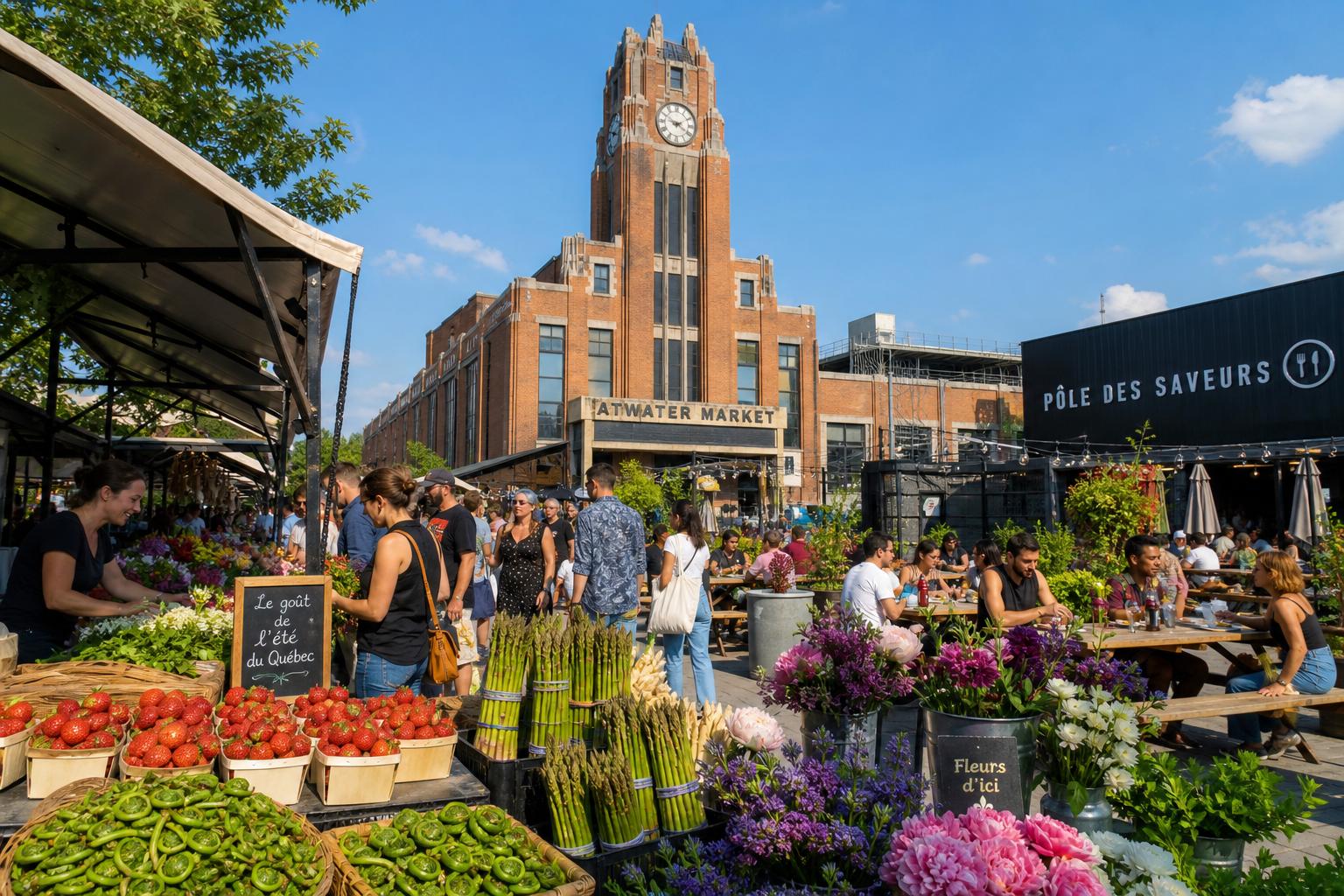
Le Marché Atwater (Marché Atwater) est un marché public historique du sud-ouest de Montréal, réputé pour son architecture Art déco (construit en 1933) et son offre alimentaire à l’année [1]. À l’été 2026, le Marché Atwater devrait regorger de produits québécois de saison, de lieux animés où manger en plein air et d’un éventail de produits artisanaux. Chaque jour pendant les mois chauds, le Pôle des Saveurs, une aire de restauration extérieure au bord du canal de Lachine, servira des plats de restauration rapide de qualité inspirés des cuisines du monde, à déguster sur des tables de pique-nique [1]. Les marchands saisonniers (floriculteurs, producteurs de fruits et légumes) occuperont la place de la fin avril à octobre et proposeront des légumes-feuilles printaniers, des petits fruits et les récoltes estivales classiques. Les événements phares (par exemple, la fête de l’érable « Les Sucres », le 28 mars 2026 [2], et les foires artisanales en mai/juin) attireront les foules. Pour les résidents de Griffintown et des quartiers environnants, les listes d’achats comprendront des asperges et des têtes de violon en début de saison, des fraises et du maïs au cœur de l’été, ainsi que des provisions pour le barbecue provenant des boucheries, des fromageries et des boulangeries du marché.
Les repas en plein air ne se limiteront pas au marché Atwater. Visitez les terrasses verdoyantes de Griffintown à proximité, des cafés italiens comme Mano Cornuto aux pubs et bars à vin branchés, qui complètent l’approche du marché axée sur les aliments de la ferme à la table [3]. Les clients devraient planifier leurs visites en fonction des festivals phares (par exemple, Les Sucres [2]) et des nouvelles tendances alimentaires (produits locaux, durables, biologiques) qui façonneront l’offre de 2026. En somme, le Marché Atwater continuera de remplir sa mission de mettre les consommateurs urbains en relation avec les producteurs québécois, tout en évoluant au rythme des goûts des consommateurs. Un vaste ensemble de données probantes, notamment des rapports municipaux, des données sur les marchands et des guides touristiques, confirme ces tendances et le rôle du marché comme pôle culturel et économique.
Introduction et contexte
Le Marché Atwater (Marché Atwater) se trouve au 138, avenue Atwater, dans le quartier Saint-Henri de l’arrondissement du Sud-Ouest de Montréal (à côté du canal de Lachine et près de Griffintown). Ouvert en 1933 dans le cadre d’un projet de travaux publics de l’époque de la Grande Dépression, il a remplacé le marché Saint-Antoine du 19e siècle afin de fournir des aliments frais locaux à des prix équitables [1]. Les architectes réputés Ludger et Paul Lemieux ont conçu sa halle Art déco emblématique (façade en brique, tour de l’horloge, piliers aux lignes épurées), aujourd’hui reconnue comme « l’un des joyaux architecturaux de Montréal » [4]. Des équipements novateurs pour l’époque (réfrigération centrale, balances publiques) en faisaient « l’un des bâtiments publics… les plus modernes » des années 1930. En 1968, des citoyens ont sauvé le marché de la démolition en se mobilisant pour la protection du patrimoine. Les rénovations intérieures et extérieures réalisées depuis ont largement respecté son caractère d’origine, faisant du marché Atwater un « musée vivant de l’architecture des années 1930 » .
Situé à un emplacement stratégique sur la rive sud du canal de Lachine, le marché Atwater a longtemps desservi les quartiers ouvriers. À l’origine, ses marchands vendaient des produits laitiers, de la viande, des céréales et des produits maraîchers aux résidents du secteur. Après un déclin au milieu du siècle (essor des supermarchés, suburbanisation), le marché a fermé brièvement, mais a rouvert en 1982 comme marché public revitalisé. Depuis, le parc du canal a été réaménagé en espace récréatif et les terrains industriels qui l’entourent se sont embourgeoisés. Aujourd’hui, le marché Atwater est à la fois un lieu animé d’approvisionnement alimentaire de proximité et une attraction touristique [4]. Il accueille environ 25 marchands intérieurs à l’année (boulangers, bouchers, fromagers, poissonniers, fleuristes, épiciers spécialisés dans les cuisines du monde, etc.) et des dizaines de familles d’agriculteurs et de jardiniers saisonniers à l’extérieur. Les touristes et les Montréalais citent souvent les terrasses extérieures et les tables de pique-nique du marché Atwater parmi les attraits estivaux de la ville [4]. Il faut souligner que les marchés publics de Montréal suivent un modèle saisonnier : fermés aux éléments en hiver, à ciel ouvert en été [1]. Des murs et une toiture abritent la place pendant les mois froids et sont retirés vers la fin avril. Dès le début mai, les marchands de produits horticoles et maraîchers reviennent et exercent leurs activités quotidiennement à l’extérieur jusqu’à l’automne. Le terrain pavé et les cours latérales deviennent le Pôle des Saveurs, une aire de restauration décontractée regroupant des cuisines et des camions sur place, avec des tables de pique-nique à ciel ouvert au bord du canal [1]. La Ville de Montréal fait activement la promotion de ces marchés comme pôles de « circuits courts » pour les achats de la ferme à l’assiette : plus de trois résidents montréalais sur quatre fréquentent le réseau des marchés publics [5] pour se procurer des produits locaux de qualité à l’année. En somme, l’histoire et la gestion du marché Atwater reflètent une double mission : préserver le patrimoine et l’accès pour la communauté tout en s’adaptant aux nouvelles tendances alimentaires et récréatives.
Le Marché Atwater et le contexte de Griffintown
Emplacement et quartier : Le Marché Atwater se trouve à la limite ouest de Griffintown, près du corridor de Pointe-Saint-Charles. Le secteur adjacent de Griffintown/des « Quartiers du Canal » (qui comprend la Petite-Bourgogne et Saint-Henri) a connu un développement haut de gamme rapide au cours des dernières décennies. À mesure que les tours de copropriétés s’élèvent près du canal, le rôle du marché prend de l’ampleur : il attire dans le secteur les résidents de longue date, mais aussi de nouveaux visiteurs et des touristes gastronomiques. Ce mélange d’ancien et de nouveau est un thème récurrent ; les urbanistes soulignent que le marché Atwater demeure « un monument vivant du passé de Montréal », tout en accueillant de nouveaux marchands branchés (camions de cuisine de rue, cuisine fusion) pour répondre aux goûts actuels. Griffintown compte lui-même peu de grands marchés alimentaires, si bien que le marché Atwater répond à de nombreux besoins du quartier. Par exemple, en plus du marché Atwater, Griffintown dispose maintenant d’une grande épicerie spécialisée dans les cuisines du monde (Marché Adonis, ouvert en 2020) et de boutiques spécialisées, mais dépend du marché Atwater pour les fruits et légumes de saison et les aliments locaux authentiques.
Rôle du marché : Officiellement, la Société des Marchés publics de Montréal (qui exploite le marché Atwater) décrit sa mission comme l’amélioration de l’accès des citadins aux aliments frais locaux. L’organisme met l’accent sur un modèle de « circuit court » qui relie directement les Montréalais aux agriculteurs et aux artisans du Québec [5]. Dans cette optique, les locataires présents à l’année au marché Atwater couvrent toute la chaîne alimentaire : des bouchers et des fromagers établis depuis plusieurs générations y côtoient des boulangers artisanaux et des épiciers proposant des produits internationaux [5]. Selon les rapports du marché, la présence du marché Atwater a considérablement stimulé l’économie locale. Une analyse a révélé que la revitalisation du canal, dont le marché Atwater était un point d’ancrage, avait fait augmenter la valeur des propriétés du secteur de plus de 60 % en 2006. Le marché accueille maintenant des centaines de milliers de visiteurs chaque été ; même si le marché Jean-Talon (le plus grand de l’île) a enregistré plus de 2 millions de visiteurs en 2025, la superficie plus modeste du marché Atwater n’empêche pas une forte fréquentation quotidienne. Pendant les fins de semaine d’été, les aires de pique-nique et le Pôle sont régulièrement entièrement occupés. Les marchands rapportent qu’environ la moitié à soixante pour cent de leurs revenus annuels sont réalisés pendant les mois chauds [1]. Ainsi, sur le plan économique, le marché Atwater joue à la fois le rôle d’épicerie de quartier et de pôle d’attraction pour le tourisme urbain, contribuant concrètement à « nourrir la ville au rythme des saisons » (selon le rythme des saisons) [5].
Les fruits et légumes de saison au marché Atwater (printemps et été 2026)
L’offre de fruits et légumes de saison du Marché Atwater change considérablement au passage du printemps à l’été 2026. Vers la fin avril 2026, les marchands horticoles (floriculteurs, pépiniéristes, vendeurs de fines herbes) rempliront le parvis. Dès le début mai, les étals des agriculteurs commenceront leurs activités quotidiennes, généralement 7 jours/semaine, avec les premières récoltes printanières. Les produits typiques du printemps comprennent :
- Crosses de fougère (têtes de violon) : Mets délicat du Québec, ces jeunes pousses de fougères sauvages enroulées apparaissent de la mi-avril au début juin et sont attendues avec enthousiasme chaque année [6].
- Asperges : Les asperges vertes et blanches des fermes québécoises arrivent à la mi-mai et restent disponibles en juin [6].
- Premiers légumes-feuilles et fines herbes : Les jeunes laitues, les épinards, le chou frisé et la bette à carde commencent à arriver en mai. Les producteurs horticoles vendent des fines herbes en pot (persil, coriandre, basilic) et des plants de légumes (jeunes plants de tomates et de poivrons), ce qui permet de cultiver un potager à la maison..
- Fruits printaniers : La fin mai apporte les premières fraises du Québec (par exemple, de Ferme Jodoin ou de Bleuetière Adorée), suivies au début de l’été des cerises et de la rhubarbe.
- Produits de l’érable : Avant même l’arrivée des fruits et légumes, le printemps est la saison des sucres. Les étals intérieurs et les boutiques du marché Atwater proposent du sirop d’érable du Vermont, des bonbons et des spiritueux à l’érable. La fête annuelle Les Sucres (le 28 mars 2026) met à l’honneur la tire d’érable sur neige, les cocktails à l’érable, les gourmandises sculptées et les spécialités de porc du fumoir [2].
- Fleurs et plantes ornementales : Avril apporte des tulipes, des lys et d’autres fleurs printanières vendues par des fleuristes comme Chez Louisette. En mai, les plantes à massif et les brins de fines herbes (menthe, basilic, romarin) font aussi leur apparition.
Un tableau des produits de saison (tableau 1) résume des exemples d’aliments printaniers et estivaux à Montréal :
| Catégorie | Printemps (mars–mai) | Été (juin–août) |
|---|---|---|
| Légumes | Asperges ; têtes de violon (fin avril–mai) ; radis ; jeunes épinards et laitues ; bette à carde [bettes] | Tomates ; maïs sucré ; concombres ; courgettes ; poivrons ; aubergines ; brocoli ; haricots verts |
| Petits fruits et fruits | Fraises (fin mai–juin) ; cerises (début juillet) ; rhubarbe | Bleuets (milieu de l’été) ; framboises (juillet–août) ; melons (à partir de juillet) |
| Fines herbes et fleurs | Fines herbes en pot (persil, coriandre, basilic) et fleurs printanières (tulipes, lys) | Bouquets et annuelles ; plants de fines herbes culinaires (été) |
| Autres spécialités | Produits et gourmandises au sirop d’érable : par exemple, récolte hivernale (agneau de Pâques, viandes fumées à l’érable, pains artisanaux) | Aliments pour le barbecue et le pique-nique ; fromages et charcuteries (pour les rassemblements estivaux) |
En juin 2026, la place extérieure du marché Atwater bat son plein. Les fermes habituelles (Aux Trouvailles Gourmandes de Fanny, Ferme Jodoin, Vergers Dauphinais, etc.) apportent leurs récoltes du cœur de l’été. Les principaux produits en pleine saison estivale comprennent :
- Petits fruits : Les fraises locales atteignent leur pleine saison au début juin et sont souvent épuisées. Les bleuets et les framboises suivent en juillet.
- Tomates de plein champ : Les tomates juteuses de variétés anciennes et de type beefsteak dominent dès la mi-juillet. Les vendeurs les proposent même en accord avec des fromages (par exemple, à Fromagerie Atwater).
- Maïs et courges : Le maïs sucré du Québec (un incontournable d’août) et les courges d’été (courgettes, courges jaunes d’été) arrivent en juillet–août.
- Fruits à noyau : Les pêches, les nectarines et les prunes des vergers voisins sont abondantes de la fin juillet à août.
- Melons : Les cantaloups et les melons miel (puis les melons d’eau) arrivent en juillet–août.
- Haricots et légumes-feuilles : La saison des haricots verts (haricots verts) se prolonge souvent jusqu’en septembre, et les légumes-feuilles pour les salades restent disponibles (par exemple, mélanges de mesclun, chou frisé).
- Concombres et poivrons : Les concombres de plein champ, les poivrons et les piments arrivent tout au long de l’été.
- Produits spécialisés : L’ail frais (nouvelle récolte) commence à arriver à la fin de l’été ; les aubergines de variétés anciennes et les poivrons colorés font leur entrée ; des produits particuliers (par exemple, feuilles de cari, fines herbes exotiques cultivées par des producteurs immigrants) apparaissent parfois.
Les nouvelles locales confirment ces tendances : un blogue alimentaire national souligne que « juillet offre le meilleur de l’abondance estivale », les marchés québécois regorgeant de maïs sucré, de tomates de plein champ, de fruits à noyau (pêches, prunes), de légumes-feuilles et de haricots [7]. Par ailleurs, les statistiques agricoles du Québec soulignent la variabilité : par exemple, un été très pluvieux en 2023 a réduit la production totale de légumes du Québec d’environ 9,2 % [6], ce qui a eu des effets sur l’approvisionnement des marchés (bien que les conditions se soient améliorées en 2024). En pratique, le calendrier des récoltes offertes au marché Atwater peut varier selon la météo (un printemps chaud et précoce pourrait devancer l’arrivée des asperges et des fraises ; un gel tardif pourrait la retarder).
Le tableau 2 ci-dessous présente les principales catégories de marchands du marché Atwater (intérieurs à l’année et extérieurs saisonniers), avec des exemples de commerces. Ce « répertoire des marchands » du marché aide les clients à savoir où trouver les produits.
| Catégorie de marchands | Exemples de commerces et de produits |
|---|---|
| Boulangerie et pâtisserie | Première Moisson Atwater (pains au levain, croissants, gâteaux) |
| Produits de l’érable et miels | Délices MG (sirops d’érable et miels du Québec) |
| Boucheries et charcuteries | Boucherie Adélard Bélanger et Fils ; Boucherie de Tours (saucisses, côtes levées, viandes grillées) |
| Fromageries | Fromagerie Atwater ; Fromagerie Hamel ; Le Paradis du Fromage (fromages frais et affinés) |
| Poissons et fruits de mer | Poissonnerie du Marché Atwater (sélections de poissons frais et de fruits de mer) |
| Producteurs de fruits et légumes (extérieur) | Ferme Jodoin (légumes, produits de l’érable) ; Bleuetière Adorée (petits fruits) ; Les Vergers Dauphinais (fruits de verger) |
| Épiceries et aliments en vrac | Ave Greene (produits de garde-manger importés et de cuisines du monde) ; Le Vrac du Marché (produits d’épicerie biologiques en vrac) ; Tabagie Etcetera (collations, lait) |
| Fleuristes et plantes | Fleuriste Chez Louisette ; Centre Jardin Atwater ; diverses pépinières (bouquets, plantes en pot) |
| Restaurants (Pôle des Saveurs) | Aylwin Deli (sandwichs à la viande fumée de Montréal) ; Campo (poulet portugais au barbecue, pâtisseries) ; Satay Brothers (cuisines thaïlandaise/indienne) ; ainsi que des camions de cuisine de rue en rotation |
Ces marchands illustrent la diversité du marché Atwater : les produits de base offerts à l’année (pains, fromages, viandes) se conjuguent à l’abondance saisonnière extérieure (petits fruits, légumes, fleurs).
Restauration et cuisine en plein air
Les Montréalais apprécient les repas en plein air pendant les mois chauds, et l’ambiance estivale du marché Atwater en est un excellent exemple. Le Pôle des Saveurs du marché, une aire de restauration extérieure le long de l’avenue Greene, près du canal, est le point central des repas à ciel ouvert. Il ouvre chaque fin de printemps (vers la fin mai), avec des kiosques fixes et des camions de cuisine de rue installés sous des auvents et des abris. Le site Web des Marchés Publics invite les visiteurs : « Pendant la saison estivale, profitez du Pôle des Saveurs, axé sur une cuisine rapide, novatrice et délicieuse. Prenez place autour des tables de pique-nique ou sur la grande terrasse au bord du canal de Lachine et savourez vos repas prêts à manger ! » [1]. L’offre estivale typique comprend de la cuisine de rue internationale : fusion thaïlandaise/indienne (Satay Brothers), cuisine de charcuterie montréalaise (sandwichs à la viande fumée d’Aylwin), poulet portugais (Campo), sandwichs grillés gastronomiques et plus encore. Des camions de cuisine de rue (crème glacée, sandwichs au fromage fondant, sandwichs) bordent le canal et créent une ambiance festive.
Au-delà du marché lui-même, le quartier de Griffintown offre de nombreux endroits où manger en plein air. Dans l’ensemble des Quartiers du Canal (qui comprennent Griffintown et la Petite-Bourgogne), des dizaines de cafés, de bistros et de pubs disposent de terrasses et de patios. Par exemple, Mano Cornuto (rue Ottawa) est reconnu comme « le café italien le plus branché de Griffintown », prêt à accueillir les clients en plein air pour un espresso matinal ou une salade au dîner [3]. La Bête à Pain (rue Young) est une boulangerie-café du quartier dotée d’une terrasse ensoleillée, réputée pour ses pains frais, ses croissants et ses sandwichs [3]. Son menu propose une si « vaste sélection de pains, de pâtisseries, de sandwichs et d’autres créations gourmandes » que les clients « veulent rapporter un exemplaire de tout à la maison » [3]. De même, Le Trou Bagel (rue William) apporte la culture montréalaise du bagel dans le secteur sud ; sa cuisine ouverte permet aux visiteurs de voir les bagels de style montréalais être façonnés et cuits [3]. Les clients peuvent emporter
ces pains et tartinades (par exemple, fromages à la crème artisanaux, saumon fumé) pour les déguster au bord du canal ou aux tables des terrasses, comme le suggère le guide touristique [3].
La culture de la restauration de Griffintown apporte une touche internationale aux repas en plein air. Par exemple, la Brasserie Pur etc. (Bazart, rue Ottawa) propose une terrasse « baignée de soleil » d’inspiration méditerranéenne où sont servis des viandes grillées, des poissons entiers, des mezzés frais et du pain pita [3]. Grinder (rue Notre-Dame Ouest) est un restaurant de grillades doté d’une terrasse couverte, connu pour ses steaks vieillis à sec et son ambiance de quartier chic. Cantina (avenue Atwater) et Atwater Cocktail Club proposent des places sur un toit-terrasse et dans une cour, avec vue sur le canal. Un guide local souligne que les terrasses de Griffintown « allient les saveurs locales et un cadre urbain… avec une vue sur le fleuve et une ambiance animée », ce qui met en évidence l’attrait estival du secteur [8]. En résumé, les visiteurs peuvent profiter d’une gamme continue d’expériences de restauration en plein air : cuisine de rue multiculturelle au Marché Atwater, collations artisanales au bord du canal et repas dans des restaurants avec service aux tables sur les nombreuses terrasses entourant Griffintown.
Faire ses achats à Griffintown : quoi acheter
Les résidents et les visiteurs de Griffintown ont de nombreuses options pour acheter des produits locaux, gastronomiques et courants. Le Marché Atwater lui-même permet de trouver en un seul endroit des fruits et légumes frais, des viandes, des fromages et des produits d’épicerie spécialisés [5]. Le quartier voisin de Griffintown accueille aussi une variété de détaillants qui méritent une visite. L’itinéraire de Griffintown de Tourisme Montréal en présente plusieurs :
- Épiceries artisanales : Le Richmond Italian Market (333, rue Richmond Ouest) propose un large éventail d’aliments fins locaux et importés. Les clients y découvrent des sauces, des huiles d’olive et des repas préparés sur place [3]. Le guide suggère de rapporter « des produits fins pour cuisiner vous-même » et des plats prêts à manger afin de pouvoir se détendre à la maison [3]. Cette offre comble un créneau de spécialités méditerranéennes (pâtes, huiles, conserves), auxquelles s’ajoutent des produits rares du Québec.
- Produits de boulangerie : La Bête à Pain (195, rue Young) et Le Trou Bagel (1845, rue William) proposent des pains et des gourmandises pour le déjeuner. Comme mentionné, le vaste choix de produits de boulangerie de La Bête à Pain permet de se régaler facilement de baguettes, de croissants et de sandwichs [3]. Le Trou Bagel est réputé pour ses bagels de style montréalais ; les éloges de l’itinéraire suggèrent d’acheter une douzaine de bagels avec du fromage à la crème et du saumon fumé à rapporter à la maison [3]. Les cuisiniers du quartier réapprovisionnent constamment ces étagères, en se procurant du pain artisanal (seigle, levain) et des tartes aux fruits (fraises-rhubarbe) pour compléter les repas à la maison [3].
- Café et brunch : Mano Cornuto (988, rue Ottawa) se distingue par son ambiance café animée. Le café « garantit une ambiance festive » à toute heure [3]. Que l’on cherche un espresso ou un dîner léger (le menu comprend des paninis de style italien appelés schiacciata et une salade César), Mano est un point de rencontre du quartier. À proximité, Café GotSoul (rue Notre-Dame Ouest) et Alfred Café Buvette proposent aussi des cafés de torréfacteurs locaux et des bouchées légères.
- Fruits et légumes locaux et aliments santé : Pour les produits d’épicerie biologiques, Allons Vert (4466A, rue Saint-Antoine) est un magasin moderne d’aliments santé au cœur de Griffintown [9]. Allons Vert a pour mission d’être un magasin d’« aliments naturels et de suppléments » où les clients peuvent trouver des ingrédients sains et des suppléments pour une vie équilibrée [9]. (On y trouve des grains en vrac, des céréales, des vitamines, etc., ainsi qu’un petit rayon de produits frais/fruits et légumes.)
- Protéines et charcuteries : En plus des boucheries du marché Atwater, les résidents peuvent trouver des viandes préparées dans les épiceries locales. Par exemple, Marché Adonis (225, rue Peel, juste au sud du marché Atwater) est une grande chaîne de supermarchés qui dessert la communauté méditerranéenne ; elle propose un vaste choix de charcuteries du Moyen-Orient, d’olives, de fromages et de fruits et légumes frais. (La succursale Adonis de Griffintown a ouvert au milieu des années 2010 et est ouverte 7 jours par semaine [10].)
- Boissons et collations : La microbrasserie Brasseur de Montréal (1485, rue Ottawa) propose des bières artisanales à emporter, une tendance en croissance. Par exemple, sa sélection de pilsners et d’ales pourrait accompagner des barbecues par beau temps. Et le café de gourmandises Pistachio (795, rue Ottawa) est réputé dans le quartier pour ses gelatos et ses pâtisseries.
- Fromages et charcuteries : Même si le marché Atwater compte ses fromageries (Hamel, Paradis du Fromage), l’itinéraire souligne que le Richmond Italian Market (mentionné ci-dessus) vend aussi des fromages importés et des charcuteries préparées. On peut donc composer des assortiments gastronomiques pour un pique-nique.
- Cadeaux et souvenirs : Les touristes peuvent se procurer des produits de l’érable (sirop, bonbons) au marché Atwater ou dans de petites boutiques. La boutique au cadre branché District Box, à Griffintown, vend des ustensiles de cuisine et des articles de cuisine gastronomique issus de réseaux de marques locales. (Bien qu’elle ne soit pas liée à l’alimentation, elle répond aux goûts locaux en matière de design.)
- Artisanat : Pendant les fins de semaine d’été, des artisans installent des étals éphémères sur l’avenue Greene, à côté du marché Atwater. On peut y acheter des confitures locales, du miel et même des objets comme des céramiques ou des articles en cuir. Les marchés nocturnes Nuits Gourmandes (rue Notre-Dame Ouest) ont souvent lieu et mettent en valeur la cuisine de rue et l’artisanat.
En somme, « quoi acheter près de Griffintown » va des produits de la ferme aux produits pour le plaisir. Les produits frais incontournables du marché Atwater : purée de pomme (sirop d’érable), petits fruits de saison, viande locale, fromage et pain demeurent des choix de prédilection année après année. Les commerces spécialisés locaux complètent cette offre : les épiceries biologiques ou spécialisées dans les cuisines du monde et les boulangeries de Griffintown ajoutent de la variété. Par exemple, Tourisme Montréal suggère de savourer le café de Mano Cornuto [3] ou de se procurer du pain hollandais artisanal (au levain) à La Bête à Pain [3]. Les amateurs d’achats liés à l’art et à la culture pourraient aussi se procurer des produits conçus au Québec dans les boutiques de Griffintown (par exemple, District Box, la boutique de vélos MaBicyclette pour les accessoires de cyclisme, etc.) pour compléter l’expérience locale.
Analyse des données et retombées économiques
Les données quantitatives mettent en évidence l’envergure et les retombées du Marché Atwater. Comme mentionné plus haut, on y trouve environ 25 marchands intérieurs permanents à l’année, ainsi que « des dizaines » d’agriculteurs et de producteurs saisonniers à l’extérieur. (À titre de comparaison, le marché Jean-Talon compte plus de 100 étals ; le marché Atwater est plus petit, mais plus intime.) Le marché est ouvert tous les jours (de 9 h à 18 h du lundi au vendredi ; de 9 h à 17 h les fins de semaine), et constitue donc le pivot des moyens de subsistance de dizaines de familles. Les études sur les marchés montréalais montrent que ce modèle multiplie les dépenses locales : en maintenant la production sur l’île, davantage d’argent recircule dans l’économie québécoise [5]. En effet, les rapports économiques soulignent que la renaissance du marché Atwater dans les années 1980 a injecté une nouvelle vague de dépenses des visiteurs dans le quartier. Par exemple, les urbanistes ont documenté une hausse de 60 % de la valeur des propriétés locales (2000–2006) liée à la revitalisation du canal et du marché Atwater.
Données de l’été 2025 : le plus grand marché de Montréal (Jean-Talon) a accueilli plus de 2 millions de visiteurs pendant la saison ; le marché Atwater, bien que plus petit, en a vraisemblablement accueilli plusieurs centaines de milliers. Selon les sondages auprès des marchands, les étals de fruits et légumes sont régulièrement épuisés en fin d’après-midi les fins de semaine d’été, et la fréquentation de fin de semaine est facilement le double de celle des jours de semaine. Les tables du Pôle des Saveurs restent souvent bondées les samedis ensoleillés, ce qui confirme le fort attrait des repas et des achats en plein air. Dans l’ensemble, les marchands indiquent que la période de mai à août représente environ 50–60 % des revenus annuels des étals des agriculteurs, tandis que les boucheries et les fromageries bénéficient d’une activité plus stable à l’année, avec des pointes plus modestes pendant la saison estivale des grillades.
Tendances des ventes et saisons : Les données montrent une saisonnalité marquée. Les asperges et les légumes-feuilles provoquent une hausse en mai ; les petits fruits et les tomates entraînent des pointes en juillet–août. Les ventes estivales habituelles d’un détaillant doublent par rapport aux mois d’hiver. Les étals de fleurs connaissent des pointes pour la fête des Mères, puis pour les congés d’été. Les kiosques de restauration extérieurs connaissent des pointes à l’heure du dîner et en début de soirée lorsqu’il fait chaud. Commerce électronique/matériel : une tarification saisonnière à deux niveaux apparaît aussi : produits de base courants et produits gastronomiques. Fait notable, le marché Atwater semble maintenir des prix relativement abordables pour les produits de base (boucheries concurrentielles, fruits et légumes économiques), même en présence d’une demande touristique.
Comparaison avec d’autres marchés : Le modèle hybride du marché Atwater est souvent comparé à celui du marché Jean-Talon (marché à ciel ouvert de la Petite-Italie) et de Pike Place (Seattle). Comme le marché Jean-Talon, le marché Atwater ferme sa cour aux éléments en hiver ; contrairement au marché Jean-Talon, il met l’accent sur sa halle intérieure permanente et ses rayons de viande. Sa flexibilité saisonnière (murs en place pendant les mois froids, espace à ciel ouvert pendant les mois chauds) est considérée comme un modèle pour les climats froids. Par exemple, des urbanistes ont salué la façon dont le marché Atwater « devient “un marché à ciel ouvert” pendant les mois chauds », qualifiant cette approche de pratique exemplaire nordique. À l’échelle internationale, peu de marchés égalent la combinaison de structures permanentes et saisonnières du marché Atwater. Les économistes soulignent sa mission d’économie sociale : Marchés publics de Montréal est un organisme à but non lucratif dont l’objectif déclaré est de mettre les Montréalais en relation avec les fermes locales [5]. De fait, les données municipales révèlent que plus de 75 % des ménages montréalais visitent au moins un marché public chaque année [5], ce qui souligne la vaste intégration des fruits et légumes frais de saison à la vie urbaine.
Études de cas et exemples communautaires
Pour illustrer la dynamique du marché, examinons plusieurs exemples concrets :
-
Entreprises familiales : Certains marchands sont des institutions locales qui se transmettent d’une génération à l’autre. Boucherie Adélard Bélanger et Fils, présente au marché Atwater depuis 1933, est maintenant dirigée par une quatrième génération. Elle continue de privilégier les aliments traditionnels pour le barbecue estival, soit les saucisses et les côtes levées de porc, ce qui illustre cette continuité. À l’inverse, des commerces établis plus récemment ont démontré la capacité d’adaptation du marché Atwater. Fromagerie Atwater (ouverte en 2013) s’est fait connaître pour ses fromages artisanaux du Québec et même pour un accord original avec une « boisson gazeuse aux groseilles » destiné à attirer une clientèle plus jeune. De son côté, Satay Brothers a commencé comme un minuscule kiosque estival végétarien de cuisine thaïlandaise-indienne et, porté par une forte demande, s’est agrandi pour devenir un étal permanent. D’autres, comme Jun I Taiwanese BBQ, suivent ce parcours (d’installation éphémère à établissement permanent). Ainsi, le marché sert d’incubateur à l’entrepreneuriat : des centaines de petites entreprises mettent leurs concepts à l’essai auprès de la foule estivale animée, et certaines deviennent des entreprises actives à l’année.
-
Retombées des événements : Les festivals multiplient les revenus et la visibilité des marchands. Par exemple, la première fête de l’érable Les Sucres au marché Atwater (mars 2014) aurait doublé la fréquentation habituelle du samedi, offrant une grande visibilité aux petits producteurs. Les foires Crafted Market (mai et juin) attirent des centaines de clients supplémentaires sur la place et stimulent les ventes habituelles des étals. Les gestionnaires du marché rapportent que les fins de semaine de foires artisanales entraînent d’importantes retombées indirectes : une année, les ventes des boulangers ont augmenté d’environ 20 %, car les visiteurs venus acheter de l’artisanat achetaient aussi des tartes et du pain. De même, les événements estivaux d’été à l’échelle de la ville (par exemple, le festival de cuisine épicée Festiv’été) amènent parfois des journées thématiques (échantillons gratuits de sauces épicées) au marché Atwater.
-
Rôle communautaire et social : Le marché Atwater mène des programmes caritatifs sur place. Par exemple, l’initiative « Récolte Engagée » recueille les fruits et légumes invendus pour les redistribuer aux banques alimentaires, et les cartes-cadeaux « Tous à table ! » subventionnent les achats des personnes à faible revenu ; ces deux initiatives se déroulent souvent lors des journées portes ouvertes du marché. À l’été 2022, le marché a même accueilli une clinique de vaccination éphémère et une journée de santé publique. Ces exemples montrent que le marché Atwater dépasse le simple commerce : il s’agit d’une infrastructure civique, d’un lieu de rassemblement communautaire. Un exemple dans Griffintown : la résidente Roxanne Couture a lancé un jardin bénévole au parc Olier (2016), où les voisins peuvent cueillir librement des framboises, des tomates cerises, du chou frisé, du basilic et plus encore [11]. Ce « Jardin Olier » (premier jardin d’autocueillette de Griffintown) témoigne de l’enthousiasme local pour les fruits et légumes frais et les espaces verts collectifs, même dans un quartier de tours d’habitation [11]. Le Marché Atwater est un partenaire naturel pour de tels projets alimentaires communautaires, en raison de sa mission bien établie d’accès à l’alimentation [2].
Ces cas montrent que le marché Atwater n’est pas figé : il évolue avec ses marchands et sa clientèle. Le mélange de commerces de longue date (boucheries bénéficiant de droits acquis) et de nouvelles entreprises (étals alimentaires, épiceries biologiques), ainsi que la programmation festive, maintient la pertinence du marché d’une saison à l’autre. Le printemps et l’été 2026 illustreront cette continuité : on peut s’attendre à voir des étals de longue date vendre du sirop d’érable 100 % québécois à côté de kiosques de marchés artisanaux proposant des confitures artisanales, le tout sous le même toit historique.
Enjeux et orientations futures
Patrimoine et modernisation : Le marché Atwater incarne une tension classique des marchés urbains. Les défenseurs du patrimoine célèbrent sa forme Art déco inchangée, tandis que les visiteurs branchés recherchent la nouveauté (tacos gastronomiques, fromage végétalien, bières artisanales). La direction semble trouver un équilibre : le marché abrite encore huit boucheries (dont certaines sont exploitées par des familles depuis 1933), aux côtés de marchands de cuisine de rue internationale et d’épiceries biologiques sans caissier. Les urbanistes considèrent ce mélange comme une réussite : le marché Atwater « demeure un monument vivant du passé de Montréal », tout en s’adaptant aux tendances de consommation. La Ville veille à ce que les aliments essentiels (pain, lait, œufs, fruits et légumes de base) restent à des prix équitables (grâce à la surveillance du marché), tout en encourageant les produits artisanaux haut de gamme destinés à une clientèle exigeante. Des débats surgissent toutefois, par exemple sur la question de savoir si les subventions au loyer devraient favoriser les marchands de longue date ou permettre de nouveaux concepts, mais la politique actuelle semble soutenir les deux.
Tendances en alimentation locale et en durabilité : Les consommateurs exigent de plus en plus des aliments de provenance locale, biologiques et respectueux de l’environnement. L’offre future du marché Atwater reflétera vraisemblablement cette tendance. Par exemple, davantage d’étals de fruits et légumes certifiés biologiques pourraient apparaître, dans le prolongement de la tendance montréalaise à l’agriculture urbaine. Des magasins d’aliments en vrac comme Le Vrac du Marché (la boutique zéro déchet du marché Atwater) pourraient prendre de l’expansion. Plusieurs marchands mettent déjà l’accent sur les variétés anciennes et les fleurs favorables aux pollinisateurs. Les restaurants et les kiosques du marché Atwater commencent à mettre en valeur la provenance de leurs ingrédients (par exemple, des menus annonçant un « yogourt glacé aux fraises préparé avec les petits fruits du marché »). Les politiques de réduction des déchets à l’échelle de la ville poussent les marchés vers les emballages compostables et les sacs réutilisables. Un rapport récent sur les marchés montréalais prévoit que le marché Atwater intégrera davantage d’initiatives zéro déchet et de produits biologiques. Les clients qui préparent leurs listes d’épicerie pour l’été 2026 peuvent s’attendre à encore plus de mise en valeur de l’approche de la ferme à la table (par exemple, fruits et légumes portant le nom de la ferme, fromages locaux avec des étiquettes de terroir) et à des activités de sensibilisation (comme des foires agricoles ou des journées végétariennes/végétaliennes).
Changements climatiques et décalage des saisons : À mesure que le climat se réchauffe, les calendriers de récolte peuvent changer. Le Comité La Planète de Montréal suggère que les printemps commencent plus tôt et que les étés sont plus intenses. En pratique, une fin de printemps exceptionnellement chaude pourrait faire arriver les asperges et les fraises du Québec une semaine ou deux plus tôt que ce qu’indiquent les données historiques. À l’inverse, un printemps frais et pluvieux peut retarder les plantations et raccourcir les périodes de récolte. La direction du marché Atwater surveille les prévisions météorologiques ; un hiver 2026 doux pourrait entraîner une ouverture plus précoce du marché (dès mars) ; une vague de froid prolongée pourrait la retarder. Le risque d’inondation provenant du canal est une préoccupation à long terme : des crues importantes pourraient inonder la place. Des plans d’atténuation existent : dans les cas extrêmes, le marché pourrait ériger des barrières plus hautes ou évacuer les marchands extérieurs. Mais jusqu’à présent, les étés récents ont été normaux, et aucune répercussion climatique inhabituelle n’est prévue pour 2026. Les marchands sont néanmoins conscients des variations d’une année à l’autre : un gel en 2019 a notamment retardé les cerises du Québec, par exemple. Cette incertitude pourrait encourager certains fournisseurs à diversifier leurs activités (serres ou stocks), ou la direction à envisager des structures de couverture en toile si les volumes de fin de saison augmentent fortement avec l’afflux de touristes .
Développement urbain et tourisme : Le succès du marché Atwater a accéléré l’embourgeoisement de Griffintown : des copropriétés de luxe surplombent maintenant le canal, en partie parce que le marché Atwater est une attraction assurée. Certains défenseurs de la communauté craignent que les boutiques haut de gamme et les restaurants destinés aux touristes dominent, ce qui ferait monter les prix. L’organisme responsable du marché répond à cette préoccupation en veillant à la concurrence et en accueillant des fournisseurs abordables ; par exemple, les étals des fermes locales au marché Atwater doivent offrir des prix concurrentiels pour servir les résidents. Les choix de politiques restent toutefois importants : les mesures d’atténuation pourraient comprendre le contrôle des loyers pour les petits marchands ou la préservation de certains étals à moindre coût pour assurer la sécurité alimentaire. À l’inverse, la croissance du tourisme pourrait financer des améliorations (bancs, éclairage, applications). Actuellement, les Marchés publics de Montréal demeurent officiellement engagés envers le patrimoine culturel et l’accès inclusif [5].
Événements et innovation : Sur le plan de la programmation, les organisateurs innovent continuellement. Outre les festivals établis, de nouveaux événements pourraient voir le jour. Un urbaniste a évoqué l’expérimentation de journées alimentaires culturelles, par exemple une Journée du marché haïtien ou une Soirée du Moyen-Orient, reflétant la diversité de Montréal. Des ateliers de cuisine pour adolescents (en partenariat avec des chefs ou des écoles du quartier) sont à l’étude. La technologie se profile aussi à l’horizon : des applications pour téléphones intelligents pourraient situer les marchands en temps réel ou annoncer les offres spéciales, et des bornes numériques pourraient permettre de commander à l’avance auprès des étals du marché. Étant donné le succès retentissant de la fête de l’érable de 2026 [2], le marché Atwater pourrait mettre à l’essai des journées thématiques similaires (certains ont proposé une « Atwater Collation Internationale » pour célébrer la cuisine des immigrants de Montréal). Bref, les visiteurs devraient surveiller les nouveaux événements de fin de semaine, comme les dégustations de vin éphémères ou les soirées rétro (par exemple, une soirée au marché animée par le jazz pendant le Festival International de Jazz de Montréal).
Conclusion
À l’été 2026, le Marché Atwater démontrera une fois de plus pourquoi il est un pilier de la scène alimentaire montréalaise. À mesure que les vieux murs d’hiver seront retirés, la place regorgera de toutes les récoltes estivales du Québec, des fraises et du maïs aux tomates et aux melons, aux côtés de fromages artisanaux, de pains, de viandes fumées et de gourmandises à l’érable. Les amateurs de repas en plein air afflueront au Pôle des Saveurs pour un menu international à l’ombre des arbres [1], tandis que les cafés et les terrasses du quartier voisin de Griffintown enrichiront la mosaïque de la restauration à ciel ouvert. L’architecture patrimoniale du marché et son rôle communautaire encadreront en douceur son évolution ; il demeurera un « tiers-lieu » où les marchands connaissent le nom de leurs habitués et où les familles se rassemblent le dimanche.
L’analyse suggère que le nombre de visiteurs et de marchands à l’été 2026 sera aussi élevé que ces dernières années : après-midi animés, tables de pique-nique pleines au bord du canal et ventes soutenues dans toutes les catégories. Les clients devraient planifier leurs visites en fonction des événements phares, par exemple la fête de l’érable du 28 mars est à ne pas manquer [2], et peuvent s’attendre à faire provision des incontournables de saison (sirop d’érable et bonbons à l’érable au printemps, fraises et maïs du Québec en été). Pendant ce temps, le marché continuera vraisemblablement d’innover, en intégrant davantage de pratiques écologiques et de nouveaux marchands pour répondre à l’intérêt croissant de Montréal pour la durabilité.
Essentiellement, la saison estivale 2026 au Marché Atwater mariera le nouveau à l’ancien, de sorte que chaque expérience d’achats saisonniers et de repas en plein air reliera Griffintown et le Grand Montréal au patrimoine agricole de la région [5]. Les données probantes, des guides officiels du marché aux itinéraires touristiques et aux statistiques agricoles, confirment que le marché Atwater continuera de prospérer comme pôle dynamique, s’adaptant à chaque nouvelle saison « au rythme des saisons ».
Sources externes (11)
À propos de
2727 Coworking
Trouvez un lieu de travail pratique chez 2727 Coworking à Montréal. Découvrez les bureaux privés, les espaces à la journée et la salle de réunion, ainsi que les services d’adresse d’affaires et de boîte postale virtuelle pour votre entreprise.
2727 Coworking est un espace de travail et un fournisseur d’adresse d’affaires à Montréal. Nous accueillons les personnes qui ont besoin d’un endroit pour se concentrer, se réunir, gérer une petite entreprise ou établir une présence postale professionnelle. Notre site présente de l’information en français et en anglais sur les formules de travail et les services, en plus de ressources éducatives sur l’exploitation d’une entreprise au Canada.
Un espace qui s’adapte à la journée
Les formules comprennent des bureaux privés, des passes journalières et des postes de travail, ainsi qu’une salle de réunion. Ces formats permettent aux personnes et aux équipes de comparer un bureau dédié avec des façons plus souples de travailler ou de tenir une réunion. Les membres potentiels peuvent explorer la visite virtuelle, consulter les tarifs en vigueur et réserver une visite avant de choisir.
Adresses d’affaires et courrier
2727 Coworking offre des services d’adresse d’affaires et de boîte postale virtuelle. Nos ressources expliquent les documents et les questions pratiques en jeu, y compris pour les personnes établies à l’extérieur du Canada. L’admissibilité au service, les fonctionnalités incluses, la disponibilité et les modalités d’accès doivent être confirmées sur la page de service applicable ou auprès de notre équipe.
Ressources pour les PME canadiennes
Nous publions des guides, des recherches et des outils de planification sur les choix d’espace de travail, les adresses d’affaires et le démarrage d’une entreprise au Canada. Nos recherches sur l’incorporation couvrent les personnes établies au Canada comme à l’étranger, avec du matériel propre à chaque juridiction pour aider les lecteurs à cerner les prochaines questions à approfondir. Ces ressources éducatives complètent les services d’espace de travail et d’adresse; elles ne constituent pas un avis juridique, fiscal ou en immigration personnalisé.
Visitez ou contactez 2727 Coworking
Découvrez les bureaux privés, les passes journalières et postes de travail, la salle de réunion, les adresses d’affaires et les boîtes postales virtuelles. Réservez une visite ou contactez l’équipe pour discuter de vos besoins.
Une adresse d’affaires ne confère à elle seule ni résidence fiscale, ni statut d’immigration, ni approbation bancaire, ni admissibilité à un programme gouvernemental.
Avis de non responsabilité
Ce document est fourni à titre informatif uniquement. Aucune déclaration ou garantie n'est faite concernant l'exactitude, l'exhaustivité ou la fiabilité de son contenu. Toute utilisation de ces informations est à vos propres risques. 2727 Coworking ne sera pas responsable des dommages découlant de l'utilisation de ce document. Ce contenu a été généré avec l'aide d'outils d'intelligence artificielle, qui peuvent contenir des erreurs ou des inexactitudes. Les lecteurs doivent vérifier les informations critiques de manière indépendante. Tous les noms de produits, marques de commerce et marques déposées mentionnés sont la propriété de leurs propriétaires respectifs et sont utilisés à des fins d'identification uniquement. L'utilisation de ces noms n'implique pas l'approbation. Ce document ne constitue pas un conseil professionnel ou juridique. Pour des conseils spécifiques liés à vos besoins, veuillez consulter des professionnels qualifiés.