2727 Coworking Article
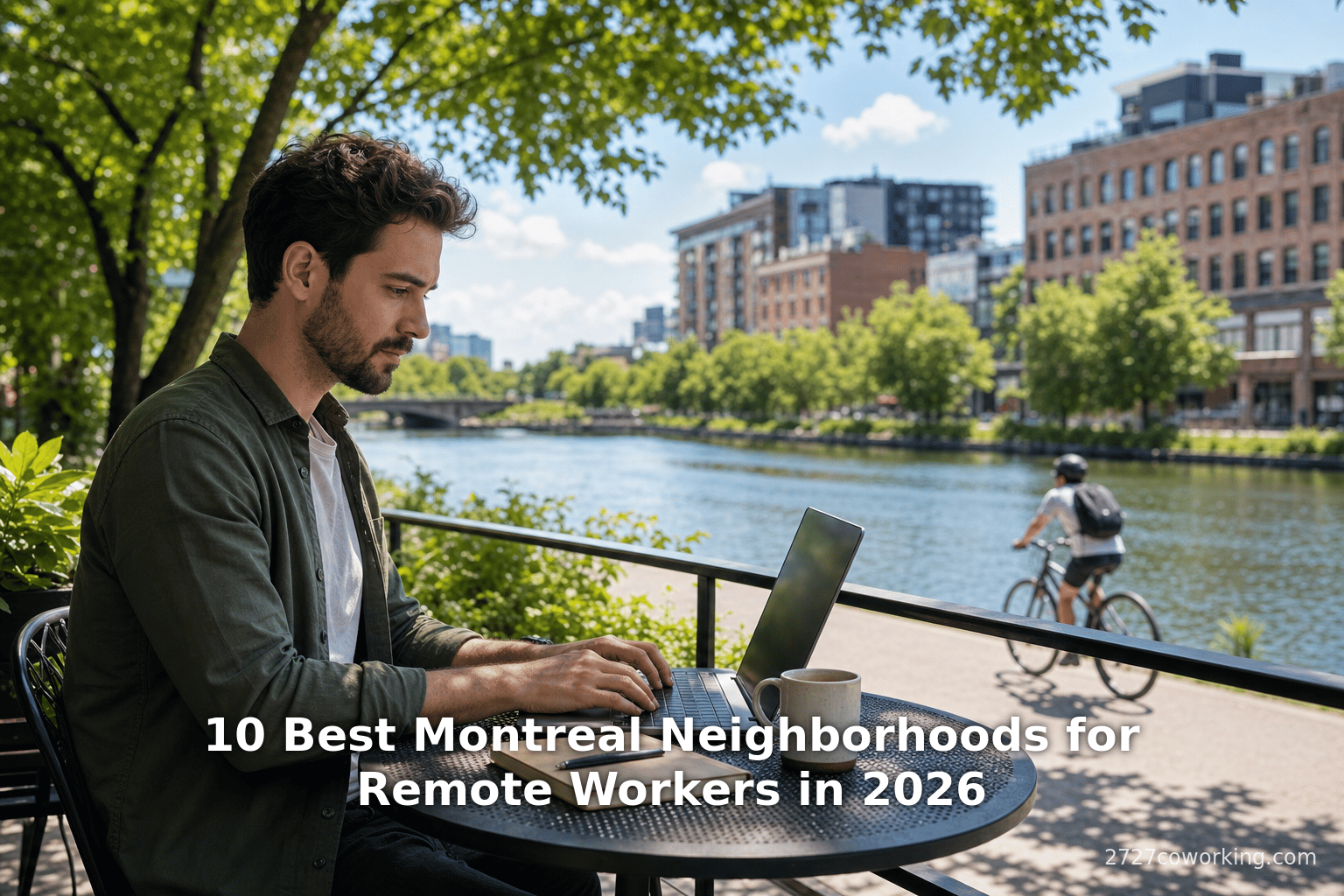
10 meilleurs quartiers de Montréal pour télétravailler en 2026
Inside this article
- 01Sommaire
- 02Introduction et contexte
- 03Méthodologie et critères du classement Ce classement repose sur quatre catégories pondérées qui reviennent systématiquement dans les priorités déclarées des télétravailleurs lorsqu’ils choisissent un quartier : infrastructures de travail (densité des espaces de coworking, tarifs et faisabilité du bureau à domicile), coût de la vie (loyer d’un appartement d’une chambre et dépenses quotidiennes), transport collectif et mobilité (proximité du métro, couverture du réseau de vélos en libre-service BIXI et facilité des déplacements à pied), et sécurité et caractère de la communauté (tendances rapportées par le SPVM et perceptions des quartiers recueillies de façon indépendante). Aucun indice publié ne note les dix quartiers selon une échelle numérique identique ; ce rapport fait donc la synthèse de données provenant de plusieurs sources plutôt que de présenter une formule propriétaire unique, une limite commune à toute analyse à l’échelle des quartiers qui couvre séparément les marchés de l’immobilier, les services policiers et les espaces de travail.
- 04Les 10 meilleurs quartiers de Montréal pour les télétravailleurs
- 05Espaces de coworking et bureaux virtuels par quartier
- 06Analyse des principaux segments
- 07Analyse des données et éléments probants
- 08Études de cas et exemples concrets
- 09Répercussions et perspectives
- 10Foire aux questions (FAQ)
- 11Conclusion
Sommaire
En 2026, Montréal offre aux télétravailleurs une combinaison particulièrement avantageuse de coûts peu élevés, d’une offre dense d’espaces de coworking, d’un solide réseau de transport collectif et de données sur la sécurité en amélioration, mais le « meilleur » quartier dépend largement du budget et des priorités liées au mode de vie. Ce rapport classe dix quartiers, Griffintown, Saint-Henri, le Mile End, le Plateau-Mont-Royal, Verdun, Rosemont–La Petite-Patrie, Villeray, le Vieux-Montréal, Notre-Dame-de-Grâce (NDG) et le centre-ville (Ville-Marie), en utilisant comme principaux critères la disponibilité et les tarifs des espaces de coworking, le loyer d’un appartement d’une chambre, l’accès au transport collectif et au vélo, ainsi que le sentiment de sécurité à l’échelle du quartier. En date de juillet 2026, Statistique Canada indique que 25,8 % des 2,1 millions de travailleurs de la région métropolitaine de Montréal travaillaient principalement à domicile en 2021, soit près de quatre fois le taux de 2016 [1], et les données géographiques de Robert Half pour le quatrième trimestre de 2025 montrent que les offres d’emploi à Montréal se répartissaient entre 8 % de postes entièrement à distance, 37 % de postes hybrides et 55 % de postes sur place [2], la plus forte proportion de postes hybrides parmi les grandes régions métropolitaines canadiennes.
Griffintown et le quartier voisin de Saint-Henri arrivent en tête du classement parce qu’ils réunissent le corridor de coworking au bord du canal le plus concentré de la ville et des loyers qui sont inférieurs d’environ 15 à 40 % à ceux du centre-ville de Montréal pour des espaces de travail flexibles équivalents, selon une analyse des quartiers publiée en 2726 par 2727 Coworking, qui exploite un espace au bord du canal à Griffintown [3]. 2727 Coworking affiche lui-même un poste flexible / hot desk pour une personne à partir de 300 $ par mois et des bureaux privés fermés de 600 $ à 3 000 $ par mois selon la taille, avec une tarification par abonnement plutôt qu’à l’heure [4]. Le Mile End et le Plateau-Mont-Royal suivent pour les professionnels des milieux créatifs et ceux qui privilégient la vie sociale ; Verdun, Rosemont–La Petite-Patrie et Villeray offrent le meilleur rapport qualité-prix aux télétravailleurs soucieux de leur budget ; NDG et le Vieux-Montréal complètent la liste pour les familles anglophones et les professionnels sensibles au patrimoine, respectivement. Le centre-ville (Ville-Marie) se classe dernier des dix quartiers pour le seul rapport qualité-prix en télétravail, malgré la plus grande concentration d’enseignes de coworking (WeWork, Regus/Spaces, Halte 24-7, Notman House, Crew Collective), parce que son loyer moyen d’environ 1 922 $ pour un appartement d’une chambre et son taux élevé d’inoccupation des bureaux en font l’option la plus coûteuse et la moins résidentielle [5].
En matière de coût de la vie, des outils indépendants de suivi destinés aux nomades numériques estiment qu’un budget mensuel confortable à Montréal s’établit à environ 1 228 $, soit environ 4 % au-dessus de la moyenne mondiale de 1 180 $, avec un loyer moyen de 740 $ par mois pour un appartement d’une chambre au centre-ville et un seuil d’environ 1 059 $ par mois pour les personnes soucieuses de leur budget [6], bien que le plus récent rapport de la Société canadienne d’hypothèques et de logement établisse le loyer médian à Montréal à 1 852 $ et indique une hausse des loyers de 7,2 % en 2025, la plus rapide enregistrée dans la province [7], un écart à signaler à quiconque établit un budget précis. Sur le plan de la sécurité, le Service de police de la Ville de Montréal (SPVM) a déclaré 31 homicides sur son territoire en 2025, soit le taux le plus bas parmi les grandes villes nord-américaines, à 1,16 pour 100 000 habitants dans le Grand Montréal, ainsi qu’une baisse de plus de 50 % des incidents de violence armée depuis 2021 [8]. Montréal s’est également classée au 19e rang sur 173 villes dans l’indice mondial de qualité de vie 2025 de l’Economist Intelligence Unit, avec une note de 93,8 [9].
Pour la connectivité, les données Speedtest d’Ookla pour le second semestre de 2025 établissent la vitesse médiane de téléchargement des connexions fixes à Montréal à 204,57 Mbit/s, la plus lente parmi les dix villes les plus peuplées du Canada, mais tout de même bien au-dessus du seuil nécessaire aux appels vidéo et au travail infonuagique, ainsi qu’une vitesse médiane de téléchargement mobile de 116,3 Mbit/s [10]. L’offre de coworking est dense et croissante : Montréal compte environ 80 à 100 espaces de coworking dans l’ensemble de la ville en 2026 [11], au sein d’un marché canadien du coworking que Mordor Intelligence évalue à 1,03 milliard de $ US en 2025 et qui devrait atteindre 2,03 milliards de $ US d’ici 2031 [12]. Ce rapport présente la méthodologie complète du classement, des portraits quartier par quartier, des données sur le coworking et les bureaux virtuels, une analyse des coûts et de la sécurité, cinq études de cas nommées et une foire aux questions portant sur les visas pour nomades numériques, les quartiers les moins chers dotés du Wi-Fi et les secteurs accueillants pour les expatriés.
Introduction et contexte
Le télétravail a transformé durablement les choix de résidence des travailleurs du savoir à Montréal. L’étude de Statistique Canada d’octobre 2024 sur la région métropolitaine de Montréal a révélé qu’un peu plus du quart, soit 25,8 %, des 2,1 millions de travailleurs de la région déclaraient travailler principalement à domicile en 2021, une proportion que l’organisme décrit comme « près de quatre fois la proportion observée en 2016 » [13]. Ce changement est inégal selon les groupes linguistiques de la ville : les travailleurs anglophones déclaraient travailler à domicile dans une proportion de 35,3 %, contre 23,9 % pour les francophones, un écart que Statistique Canada attribue en partie aux endroits où les travailleurs anglophones se concentrent dans la région métropolitaine [14]. Cette dispersion du travail à l’extérieur du quartier central des affaires a accru l’importance des infrastructures à l’échelle du quartier, de la densité des espaces de coworking, du parc de logements adaptés au bureau à domicile, de l’accès au transport collectif et au vélo, de la vie de quartier autour des épiceries et des cafés, ainsi que de la sécurité perçue, d’une manière qu’une réponse unique à la question « Montréal est-elle une bonne ville pour le télétravail ? » à l’échelle de la ville ne peut rendre.
Ce rapport répond directement à TARGET_QUERY (« meilleurs quartiers de Montréal pour les télétravailleurs ») en classant dix quartiers selon un ensemble cohérent de critères et en présentant les données sous-jacentes : tarifs des postes flexibles / hot desks et des laissez-passer journaliers en coworking, loyers des appartements d’une chambre, accès au métro et aux vélos en libre-service BIXI, et indicateurs de sécurité tirés du Service de police de la Ville de Montréal (SPVM), de Statistique Canada et d’outils de suivi indépendants. Il aborde également l’ensemble des questions connexes que les professionnels se posent lorsqu’ils déménagent ou choisissent leur lieu de résidence : quels quartiers conviennent aux jeunes professionnels, lesquels sont les moins chers tout en offrant un Wi-Fi fiable, lesquels sont les plus sûrs à l’approche de 2026, où les nomades numériques et les expatriés tendent à se regrouper, et où trouver une adresse de bureau virtuel à Montréal pour l’immatriculation d’une entreprise.
L’attrait de Montréal pour les professionnels travaillant à distance ou en mode hybride repose sur plusieurs facteurs structurels qui reviennent tout au long de ce rapport. La ville combine une main-d’œuvre bilingue et hautement scolarisée avec des loyers commerciaux qui demeurent nettement inférieurs à ceux de Toronto et de Vancouver, un écart chiffré dans la section Analyse des données ci-dessous. Montréal, Toronto et Vancouver captent ensemble 88 % des investissements canadiens en capital de risque, ce qui concentre dans ces trois villes la demande des jeunes entreprises et des travailleurs autonomes pour des espaces de travail flexibles [15]. Parallèlement, le taux élevé d’inoccupation des bureaux au centre-ville a poussé les entreprises locataires comme les exploitants indépendants vers le coworking de quartier, une dynamique examinée en détail dans les sections qui suivent. La suite de ce rapport présente la méthodologie, le portrait des dix quartiers classés, un examen consacré aux options de coworking et de bureaux virtuels par secteur, une analyse quantitative des données, cinq études de cas nommées et une discussion prospective sur l’évolution probable de la géographie du télétravail à Montréal au cours des prochaines années.
Méthodologie et critères du classement Ce classement repose sur quatre catégories pondérées qui reviennent systématiquement dans les priorités déclarées des télétravailleurs lorsqu’ils choisissent un quartier : infrastructures de travail (densité des espaces de coworking, tarifs et faisabilité du bureau à domicile), coût de la vie (loyer d’un appartement d’une chambre et dépenses quotidiennes), transport collectif et mobilité (proximité du métro, couverture du réseau de vélos en libre-service BIXI et facilité des déplacements à pied), et sécurité et caractère de la communauté (tendances rapportées par le SPVM et perceptions des quartiers recueillies de façon indépendante). Aucun indice publié ne note les dix quartiers selon une échelle numérique identique ; ce rapport fait donc la synthèse de données provenant de plusieurs sources plutôt que de présenter une formule propriétaire unique, une limite commune à toute analyse à l’échelle des quartiers qui couvre séparément les marchés de l’immobilier, les services policiers et les espaces de travail.
Les données sur le coworking et les espaces de travail ont été compilées principalement à partir des sites Web des exploitants, dont WeWork, Regus, Crew Collective and Cafe, Halte 24-7, Montreal Cowork et ECTO, puis recoupées avec une étude du marché du coworking à l’échelle de Montréal pour dégager les tendances tarifaires dans environ une douzaine de quartiers. Les chiffres sur les loyers proviennent de deux sources indépendantes qui divergent parfois : une enquête de novembre 2024 fondée sur les données de liv.rent et republiée par MTL Blog, couvrant quatre quartiers de référence, et le rapport de nesto de 2025 sur les quartiers les plus sûrs, qui présente la population, le prix médian des propriétés et le loyer moyen des appartements d’une chambre dans dix autres arrondissements [16]. Lorsque ces sources divergent, les deux chiffres sont présentés plutôt qu’une moyenne, puisqu’ils reflètent des méthodes d’échantillonnage différentes (loyers demandés dans les nouvelles annonces plutôt que moyennes couvrant un parc de logements plus large).
Les données sur la sécurité proviennent principalement des bilans de fin d’année du SPVM rapportés par La Presse Canadienne, des indices de gravité de la criminalité de Statistique Canada cités par nesto, et des perceptions à l’échelle des quartiers recueillies dans un fil de discussion sur la sécurité du forum Reddit r/montreal, qui sont explicitement traitées dans ce rapport comme des perceptions qualitatives, et non des faits statistiques. Les données sur Internet et la connectivité proviennent du rapport Speedtest d’Ookla sur la connectivité au Canada pour le second semestre de 2025, la référence publique la plus fiable pour la performance des connexions à large bande à l’échelle des villes [17]. Puisque 2727 Coworking est lui-même un exploitant montréalais d’espaces de coworking et de bureaux virtuels établi à Griffintown, ses données sont traitées dans ce rapport comme une source sectorielle de première main pour les tarifs et la description des quartiers, vérifiées lorsque possible à l’aide de pages d’exploitants indépendants et d’annonces concurrentes, et leur utilisation est divulguée de façon transparente chaque fois que ses chiffres orientent une décision de classement.
Les 10 meilleurs quartiers de Montréal pour les télétravailleurs
Le tableau 1 ci-dessous résume les dix quartiers évalués dans ce rapport, classés selon une appréciation globale de l’accès aux espaces de travail, des coûts, du transport collectif et de la sécurité. Les tarifs des postes flexibles / hot desks en coworking sont tirés des pages des exploitants citées dans les portraits des quartiers et dans le tableau 2 plus bas ; les portraits détaillés suivent ce tableau.
| Rang | Quartier | Tarif moyen d’un poste flexible / hot desk en coworking par mois | Loyer moyen d’un appartement d’une chambre | Accès au transport collectif | Convient le mieux à |
|---|---|---|---|---|---|
| 1 | Griffintown | 300 $ à 400 $ (voir le portrait) | ~1 943 $ (référence du quartier voisin de Saint-Henri) [5] | Ligne verte (Charlevoix), future station du REM | Professionnels des technologies et des jeunes entreprises |
| 2 | Saint-Henri | 215 $ à 350 $ (voir le portrait) | ~1 943 $ [5] | Ligne orange (Place-Saint-Henri), ligne verte (Charlevoix) | Professionnels des milieux créatifs, amateurs de gastronomie |
| 3 | Mile End | 250 $ à 350 $ (voir le portrait) | 1 600 $ à 2 200 $ [18] | Ligne orange (Laurier) | Développeurs de jeux, musiciens, jeunes entreprises |
| 4 | Plateau-Mont-Royal | 250 $ à 350 $ (voir le portrait) | 1 790 $ à 1 844 $ [19] | Lignes orange + bleue (3 stations) | Travailleurs autonomes sociables et axés sur la culture |
| 5 | Verdun | ~300 $ à 330 $ (voir le portrait) | 1 100 $ à 1 500 $ [20] | Ligne verte (De l’Église, LaSalle) | Personnes soucieuses de leur budget, adeptes de la vie au bord du fleuve |
| 6 | Rosemont–La Petite-Patrie | 200 $ à 300 $ (offre limitée) | 1 100 $ à 1 609 $ [21] | Ligne orange (Rosemont, Beaubien) | Familles, habitués des marchés, personnes à la recherche d’un bon rapport qualité-prix |
| 7 | Villeray | Offre limitée d’espaces dédiés ; formule hybride de café | 15 à 20 % de moins que sur le Plateau [22] | Ligne orange (Jarry, Villeray) | Télétravailleurs recherchant le calme et une vie communautaire |
| 8 | Vieux-Montréal | 300 $ à 675 $ (voir le portrait) | 1 400 $ à 2 000 $ [23] | Ligne orange (Place-d’Armes) seulement | Patrimoine, design, travail auprès de la clientèle |
| 9 | NDG (Notre-Dame-de-Grâce) | Offre limitée d’espaces dédiés | ~1 488 $ [24] | Ligne orange (Vendôme), ligne bleue | Familles anglophones, travailleurs à proximité de McGill |
| 10 | Centre-ville (Ville-Marie) | 199 $ à 500 $ (voir le portrait) | ~1 922 $ [5] | Les 4 lignes de métro + REM | Fonctions en contact avec la clientèle ou nécessitant une adresse prestigieuse |
La tendance qui se dégage du tableau 1 est constante : les quartiers situés le long du canal de Lachine ou à proximité (Griffintown, Saint-Henri, Verdun) et le corridor créatif du nord (Mile End, Plateau, Rosemont, Villeray) offrent des coûts d’espace de travail et de logement inférieurs de 20 à 45 % à ceux du centre-ville tout en conservant l’accès au métro, tandis que le centre-ville et le Vieux-Montréal renoncent à ces économies en échange d’une densité maximale de services et, dans le cas du centre-ville, d’une connectivité inégalée en transport collectif avec les quatre lignes de métro et le nouveau Réseau express métropolitain (REM).
1. Griffintown
Griffintown occupe la première place de ce classement parce qu’il combine la population résidentielle à la croissance la plus rapide de Montréal et l’offre d’espaces de coworking au bord du canal la plus concentrée. La population du quartier a augmenté de 642 % entre 2011 et 2021, le taux le plus rapide dans la région métropolitaine de Montréal, transformant une ancienne zone industrielle en ce qu’une analyse immobilière qualifie de quartier « en plein essor » [25]. L’arrondissement du Sud-Ouest, où se trouve Griffintown, a connu une croissance globale de 36,7 % entre 2011 et 2021, soit plus de quatre fois la moyenne de 8,6 % de la région métropolitaine de Montréal, portée principalement par les professionnels de 25 à 44 ans [26].
2727 Coworking, situé au 2727, rue Saint-Patrick, directement au bord du canal de Lachine, est l’exploitant phare d’espaces de coworking à taille humaine du quartier. Il offre des postes flexibles / hot desks à partir de 300 $ par mois, des postes attitrés à partir de 450 $ par mois et des bureaux privés fermés allant de 600 $ par mois pour une personne à 3 000 $ par mois pour une équipe de dix personnes, le tout sur la base d’un abonnement plutôt que d’une facturation à l’heure [4]. La visite virtuelle décrit l’endroit comme « l’espace de coworking de premier plan de Montréal, situé au cœur de Griffintown, tout près du magnifique canal de Lachine » et précise qu’il se trouve « à quelques pas du métro Charlevoix et du canal de Lachine » [27] [28]. De façon indépendante, il est confirmé que l’adresse de 2727 se trouve à 100 mètres du métro Charlevoix, avec un Walk Score de 88, un Transit Score de 83 et un Bike Score de 96, parmi les plus élevés pour une adresse de coworking dans la ville [29].
Les loyers de Griffintown ne sont pas publiés séparément dans la plupart des enquêtes, mais la référence d’environ 1 943 $ pour un appartement d’une chambre dans le quartier voisin de Saint-Henri est l’indicateur de substitution le plus proche disponible, et les tarifs des bureaux commerciaux du corridor vont de 22 $ à 28 $ le pied carré, contre 35 $ à 55 $ au centre-ville, soit une réduction de 15 à 40 % [3]. Les compromis comprennent une offre commerciale moins abondante que dans les quartiers établis (le marché Atwater est à dix minutes à pied) et une station Griffintown-Bernard-Landry du REM toujours retardée.
2. Saint-Henri
Saint-Henri, immédiatement au nord du canal de Lachine par rapport à Griffintown, offre une option plus abordable et davantage ancrée dans la vie de quartier, dont le corridor de restaurants de la rue Notre-Dame Ouest constitue le cœur. Les options de coworking comprennent IDEAL Coworking, installé dans le complexe historique du Château Saint-Ambroise, avec des tarifs parmi les plus bas du corridor du canal, et Le Tableau Blanc, qui se présente comme l’espace de coworking le plus créatif de la ville, avec une salle d’événements pouvant accueillir 200 personnes et de grandes fenêtres industrielles [30]. Le quartier attire surtout de jeunes professionnels dans la vingtaine et la trentaine, ce qui reflète l’attrait démographique plus large du corridor du Sud-Ouest décrit ci-dessus. La station Place-Saint-Henri, sur la ligne orange, dessert le cœur du quartier, et la station de correspondance Lionel-Groulx, où se croisent les lignes verte et orange, est facilement accessible à pied.
3. Mile End
Le Mile End est l’épicentre montréalais de la création et des jeunes entreprises ; il accueille le studio montréalais d’Ubisoft et une forte concentration de développeurs de jeux indépendants, de musiciens et d’artistes. Les estimations de loyers varient selon la source : expatlife.ai classe le Mile End dans la catégorie « haut de gamme », avec un loyer typique de 1 600 $ à 2 200 $ par mois pour un appartement d’une chambre [18], tandis que les données de nesto de 2025 indiquent un loyer moyen inférieur de 1 961 $ pour un appartement d’une chambre selon une délimitation différente du Mile End [31], et qu’un autre guide pour nomades numériques situe les loyers des studios et appartements d’une chambre à des niveaux aussi bas que 1 200 $ à 1 600 $ [32]. Compte tenu de cet écart, les lecteurs devraient considérer comme approximatif tout chiffre unique concernant les loyers du Mile End. Les infrastructures Internet sont solides, avec des connexions résidentielles par fibre optique de Bell Fibe et de Vidéotron offrant de 200 à 500 Mbit/s dans la plupart des immeubles, renforcées par la présence de jeunes entreprises technologiques dans le quartier [33]. Les options de coworking comprennent La Gare, fondée avec le soutien de Deloitte, d’Ubisoft et de Telus, qui offre des laissez-passer journaliers à 20 $ et des bureaux privés à partir de 275 $ par mois [34], la coopérative Temps Libre et l’exploitant à taille humaine Espace Mile End. Le sentiment de sécurité est fort ; expatlife.ai décrit le secteur comme « très sûr » en raison de la « coexistence paisible des communautés hassidiques et hipsters » et de rues animées où la circulation piétonne est constante [35].
4. Plateau-Mont-Royal
Le Plateau est le quartier résidentiel le plus emblématique de Montréal, avec environ 100 000 à 104 000 habitants et un âge médian de 34,1 ans, le plus bas de tous les arrondissements montréalais [3]. Les données de nesto établissent le loyer d’un appartement d’une chambre à 1 790 $, tandis que l’enquête MTL Blog/liv.rent le situe à 1 844 $ [36], un écart modeste qui reflète probablement des périodes d’enquête différentes. La coopérative ECTO domine l’offre de coworking. En activité depuis 2008, elle propose des laissez-passer journaliers à 15 $, le tarif le plus bas parmi les espaces montréalais établis, et des postes flexibles / hot desks à 250 $ par mois, ainsi qu’un réseau de plus de 200 membres à la suite d’une rénovation en 2023 [37]. Montreal Cowork, sur la rue Saint-Denis, indique offrir « 252 postes de travail » au « cœur du Plateau-Mont-Royal », avec des bureaux privés, des salles de réunion et des services de bureau virtuel pour les entrepreneurs nouvellement arrivés dans la ville [38]. Trois stations de la ligne orange (Sherbrooke, Mont-Royal, Laurier) et une station de la ligne bleue desservent l’arrondissement, et les notes WalkScore du quartier se situent généralement dans la catégorie « paradis des marcheurs », dans le bas ou le milieu de la tranche des 90.
5. Verdun
Verdun est passé d’un secteur résidentiel tranquille à l’un des quartiers abordables de Montréal dont on parle le plus, avec pour cœur les restaurants de la rue Wellington, qui, selon un guide de relocalisation, ont « attiré l’attention à l’échelle nationale », tandis que les loyers des appartements de quatre pièces et demie demeurent « plus accessibles, à 1 100 $ à 1 500 $ » [39]. Les données distinctes de nesto, qui échantillonnent un territoire et un ensemble de propriétés différents, indiquent un loyer moyen plus élevé de 1 681 $ pour un appartement d’une chambre, ainsi qu’un prix médian des propriétés de 1 050 000 $ [40]. Les options de coworking demeurent modestes par rapport aux quartiers centraux ; un espace répertorié sur Office Hub propose des postes flexibles « à partir de seulement 330 $ par mois » [41]. Le principal gain récent de Verdun en matière de transport est l’expansion du service de BIXI à l’année : la saison hivernale 2024-2025 a ajouté Verdun, Côte-des-Neiges–Notre-Dame-de-Grâce, Outremont et Westmount aux territoires desservis par les vélos en libre-service en hiver, rejoignant les sept arrondissements de l’année précédente [42]. Les stations LaSalle et De l’Église de la ligne verte desservent l’arrondissement.
6. Rosemont–La Petite-Patrie
Rosemont–La Petite-Patrie combine un caractère accueillant pour les familles avec des loyers inférieurs à ceux du Plateau, bien que l’offre d’espaces dédiés au coworking soit moins développée qu’à Griffintown ou dans le Mile End. Les loyers commencent autour de 1 100 $ pour un appartement de quatre pièces et demie, selon un guide de relocalisation [21], tandis que l’enquête distincte de nesto indique un loyer moyen plus élevé de 1 609 $ pour un appartement d’une chambre et une population de 139 590 habitants, la plus importante de tous les quartiers de ce rapport [43]. Le marché Jean-Talon, l’un des plus grands marchés publics de Montréal, est au cœur de la culture alimentaire du quartier. Les stations Rosemont et Beaubien, sur la ligne orange, desservent le secteur central.
7. Villeray
Villeray présente l’un des sentiments de sécurité les plus forts parmi les quartiers examinés dans ce rapport, ainsi que des loyers inférieurs d’environ 15 à 20 % à ceux du Plateau pour une ambiance comparable [22]. Dans un fil de discussion de Reddit r/montreal sur les secteurs les plus sûrs de l’île, un résident a décrit Villeray comme « un charmant petit village en pleine ville », ajoutant qu’il est « super sûr, avec beaucoup de familles ayant de jeunes enfants » et une forte « vie de quartier », tout en soulignant qu’il est « devenu assez cher pour louer ou acheter » par rapport à ses prix historiques [44]. Ce sentiment est corroboré par un autre commentateur qui a qualifié le quartier de « super sûr » et indiqué qu’il est « près d’un métro » [45]. L’offre d’espaces dédiés au coworking demeure limitée par rapport au Plateau ou à Griffintown, les cafés et les formules de travail hybride à domicile étant plus courants ; les stations Jarry et Villeray de la ligne orange constituent les principaux points d’accès au transport collectif.
8. Vieux-Montréal (Vieux-Montréal)
Le Vieux-Montréal offre sans doute le cadre de travail le plus spectaculaire de la ville sur le plan visuel, autour de Crew Collective and Cafe, qui occupe l’ancien siège social de la Banque Royale du Canada au 360, rue Saint-Jacques. La page d’abonnements de l’exploitant affiche un poste flexible à 300 $ par mois, un poste attitré avec accès 24/7 à 675 $ par mois, et des bureaux privés à partir de 6 000 $ par mois sur la mezzanine de l’immeuble, ainsi que des forfaits de bureau virtuel allant de 50 $ par mois pour une adresse postale à 105 $ par mois pour un forfait complet de services de direction [46] [47]. Le Centre d’Affaires du Vieux-Montréal (CAVM) offre une option moins coûteuse avec des laissez-passer journaliers tout inclus et des cartes de plusieurs jours pour les utilisateurs occasionnels. Les estimations de loyers d’un guide pour nomades numériques situent le loyer d’un studio ou d’un appartement d’une chambre entre 1 400 $ et 2 000 $ par mois, la fourchette la plus élevée parmi les dix quartiers étudiés ici selon cette source de données particulière [23]. L’accès au transport collectif est plus limité que dans le centre-ville proprement dit, le secteur étant desservi uniquement par les stations Place-d’Armes et Champ-de-Mars de la ligne orange, et l’affluence touristique constitue un compromis important, particulièrement en été.
9. NDG (Notre-Dame-de-Grâce)
NDG est le quartier familial montréalais classique à tendance anglophone, et les commentaires sur sa sécurité sont constamment favorables. Les données de nesto établissent la population de NDG à 67 475 habitants, avec un prix médian des propriétés de 1 128 000 $ et un loyer moyen de 1 488 $ pour un appartement d’une chambre [48]. Sur Reddit, une personne qui y habite depuis longtemps a écrit être « vraiment étonnée que personne n’ait mentionné NDG », le qualifiant d’« incroyablement sûr » et de « parfait équilibre entre la proximité de tout et un mode de vie détendu, axé sur la communauté », tandis qu’un autre commentateur a averti que « NDG au sud de Sherbrooke peut être peu rassurant » dans certains secteurs isolés [49]. expatlife.ai classe NDG dans la catégorie « milieu de gamme » et le décrit comme une « banlieue familiale à majorité anglophone à l’ouest du centre-ville », avec des « rues tranquilles, de bonnes écoles et une ambiance communautaire détendue » [50]. L’offre d’espaces dédiés au coworking est faible, et la plupart des télétravailleurs établis à NDG utilisent un bureau à domicile ou se déplacent vers Griffintown, le centre-ville ou le Mile End ; la station Vendôme relie les lignes orange et bleue et la future branche du REM.
10. Centre-ville (Ville-Marie)
Le centre-ville, centré sur l’arrondissement de Ville-Marie, se classe dernier des dix quartiers pour le seul rapport qualité-prix en télétravail, malgré des infrastructures inégalées. La population de Ville-Marie a atteint 104 944 habitants en 2021, en hausse de 18 % depuis 2016, selon le profil démographique de l’arrondissement publié par Centris [51], et le loyer moyen d’un appartement d’une chambre s’établit à environ 1 922 $, le plus élevé parmi les quatre quartiers du groupe de référence standard [5]. L’offre de coworking est la plus abondante de la ville : WeWork répertorie quatre immeubles montréalais en activité, dont le 1010, rue Sainte-Catherine Ouest et Place Ville Marie, et présente son forfait « WeWork All Access » comme un « abonnement mensuel à un espace de coworking près de chez vous, comprenant des postes flexibles / hot desks, des salons et des cabines téléphoniques » [52]. Regus, qui fait partie d’IWG, répertorie 20 emplacements montréalais répartis entre le centre-ville, Griffintown, le Mile End, Saint-Henri et les banlieues, et offre des « espaces de travail flexibles dans des secteurs commerciaux clés comme le centre-ville de Montréal et le Mile End », avec des postes attitrés en coworking à partir de 8 $ par personne par jour [53]. L’exploitant indépendant Halte 24-7, situé à la limite du Plateau et du centre-ville, propose un poste flexible à 249 $ plus taxes par mois et un poste attitré dans son espace ouvert à 399 $ plus taxes par mois, avec des bureaux privés « allant de 850 $ à 2 200 $ + taxes / mois » [54]. L’inoccupation des bureaux est la force contraire qui transforme le centre-ville : les chiffres de CBRE pour le quatrième trimestre de 2025 montrent que le taux d’inoccupation des bureaux de catégorie A au centre-ville de Montréal s’est amélioré de 90 points de base au cours du trimestre, dans le cadre d’une reprise nationale plus large où « l’inoccupation au centre-ville a diminué dans tous les segments au quatrième trimestre » [55], bien qu’elle demeure historiquement élevée par rapport aux niveaux d’avant la pandémie. Le centre-ville convient aux professionnels qui ont besoin de prestige auprès de la clientèle et d’un accès maximal au transport collectif, les quatre lignes de métro et la liaison du REM à la Gare Centrale y convergeant, mais il offre le rapport entre coût et qualité de vie le moins avantageux des dix quartiers de ce classement.
Espaces de coworking et bureaux virtuels par quartier
Le marché montréalais du coworking est devenu l’un des plus importants du Canada, avec environ 80 à 100 espaces répartis dans les quartiers en 2026, soit à peu près deux fois l’offre enregistrée cinq ans plus tôt [56]. À l’échelle nationale, le marché canadien des espaces de bureaux en coworking était évalué à 1,03 milliard de $ US en 2025 et devrait atteindre 1,15 milliard de $ US en 2026 et 2,03 milliards de $ US d’ici 2031, soit un taux de croissance annuel composé de 11,93 %, selon Mordor Intelligence [57]. Les technologies de l’information représentent 39,85 % de la demande canadienne de coworking par secteur, tandis que les entreprises, plutôt que les travailleurs autonomes, génèrent maintenant 50,42 % des revenus du secteur, ce qui reflète à quel point les espaces de travail flexibles sont devenus courants chez les employeurs établis [58].
Le tableau 2 ci-dessous regroupe les tarifs publiés directement sur les sites Web des exploitants pour les espaces les plus pertinents aux télétravailleurs qui évaluent les quartiers.
| Exploitant | Quartier | Laissez-passer journalier | Poste flexible / hot desk par mois | Poste attitré par mois | Bureau privé par mois |
|---|---|---|---|---|---|
| 2727 Coworking | Griffintown | 25 $ | à partir de 300 $ [59] | à partir de 450 $ | 600 $ à 3 000 $ |
| WeWork | Centre-ville/Vieux-Mtl | Variable | Forfait d’abonnement mensuel [52] | Communiquer avec l’exploitant | Communiquer avec l’exploitant |
| Regus/IWG | Centre-ville + banlieues | à partir de 49 $ | à partir de 8 $/personne/jour | Variable selon le centre | Variable selon le centre |
| Crew Collective | Vieux-Montréal | 20 $ à 30 $ | 300 $ [60] | 675 $ | à partir de 6 000 $ |
| Halte 24-7 | Plateau/Centre-ville | 32,50 $ | 249 $ [61] | 399 $ | 850 $ à 2 200 $ |
| ECTO (coopérative) | Plateau | 15 $ | 250 $ | 350 $ | à partir de 350 $ |
| Montreal Cowork | Plateau | S. O. | à partir de 255 $ | S. O. | Bureau virtuel offert [62] |
Ce tableau des tarifs illustre un écart d’environ vingt fois à l’échelle de la ville selon le type d’espace : un poste flexible chez Crew Collective dans le Vieux-Montréal commence à 300 $ par mois, soit un tarif proche de celui du poste flexible / hot desk de 2727 Coworking à Griffintown au même prix, tandis qu’un bureau privé de Crew Collective sur la mezzanine commence à 6 000 $ par mois pour une suite destinée à une équipe. Le poste flexible de Halte 24-7 donnant sur la place publique du Plateau, à 249 $ plus taxes par mois, coûte moins cher que la plupart des chaînes du centre-ville, ce qui illustre que le quartier influence moins le prix que la superficie et le niveau de service.
Les bureaux virtuels, soit une adresse commerciale et un service de gestion du courrier sans poste de travail à temps plein, sont largement offerts et concernent directement les télétravailleurs qui ont besoin d’une adresse professionnelle au Québec pour immatriculer une entreprise sans louer un espace de travail quotidien. Montreal Cowork, sur le Plateau, propose des services de bureau virtuel et d’adresse commerciale en plus de ses abonnements aux espaces physiques [62], Crew Collective, dans le Vieux-Montréal, offre un forfait de case postale à partir de 50 $ par mois et un forfait de services complets à partir de 80 $ par mois qui comprend des services de courrier, d’impression et de numérisation [63], et les exploitants d’espaces de coworking du corridor du Sud-Ouest, dont 2727 Coworking, « offrent des services de boîte postale virtuelle qui permettent d’utiliser l’adresse de l’espace de coworking pour immatriculer une entreprise auprès du Registraire des entreprises du Québec (REQ) » [64].
Analyse des principaux segments
Les quartiers de Montréal se répartissent clairement en trois catégories de coûts pertinentes pour le budget mensuel d’un télétravailleur. La catégorie supérieure comprend le centre-ville, le Vieux-Montréal et le Mile End dans le haut de sa fourchette de loyers publiée, avec des loyers d’appartements d’une chambre de 1 900 $ ou plus dans les secteurs les plus coûteux, ainsi que Westmount, le quartier le plus cher dans les données de nesto, avec un prix médian des propriétés de 1 985 000 $ et un loyer moyen de 1 471 $ pour un appartement d’une chambre (un loyer relativement modeste malgré le prix d’achat extrême, puisque le parc locatif de Westmount comprend surtout des logements plus anciens et plus petits) [65]. La catégorie intermédiaire comprend Griffintown, Saint-Henri, le Plateau-Mont-Royal et Rosemont–La Petite-Patrie, généralement de 1 600 $ à 1 850 $ pour un appartement d’une chambre. La catégorie économique, Verdun, Villeray et NDG, se situe entre 1 100 $ et 1 500 $ selon l’enquête, et demeure le point d’entrée le plus réaliste pour les télétravailleurs au budget plus serré qui souhaitent tout de même avoir accès au métro et à un espace de coworking à quelques minutes à vélo.
Sur le plan de la connectivité, deux ensembles de données divergent sensiblement et méritent tous deux d’être cités en toute transparence. Un outil de suivi destiné aux nomades numériques estime la vitesse Internet moyenne à Montréal à 59 Mbit/s en téléchargement et à 19 Mbit/s en téléversement, avec une note de fiabilité de 7,1 sur 10 [66], tandis que le rapport Speedtest d’Ookla sur la connectivité pour le second semestre de 2025, fondé sur des millions de tests de vitesse effectués par les consommateurs, établit la vitesse médiane de téléchargement des connexions fixes à Montréal à 204,57 Mbit/s, la plus lente parmi les dix villes les plus peuplées du Canada dans ce groupe de comparaison, mais tout de même bien supérieure aux besoins de toute utilisation en coworking ou en visioconférence, ainsi qu’une vitesse médiane de téléchargement mobile de 116,3 Mbit/s [10]. L’écart reflète probablement des méthodes de mesure différentes (estimations agrégées à des fins de marketing plutôt que tests de vitesse effectués par les consommateurs) ; les lecteurs qui établissent leur budget de télétravail devraient se fier au chiffre directement mesuré par Ookla plutôt qu’aux estimations agrégées des guides pour nomades.
Sur le plan de la sécurité, l’Indice de gravité de la criminalité de Montréal s’établissait à 63,2 en 2023, ce qui en faisait, selon l’analyse de nesto des données de Statistique Canada, « la 5e ville la plus sûre du Canada ayant une population de plus de 1 million de personnes » [67]. Les quartiers qui ont « historiquement connu des taux de criminalité plus élevés », selon cette même analyse, comprennent Hochelaga-Maisonneuve, Saint-Michel et Parc-Extension, par opposition aux secteurs où la criminalité est plus faible, dont Outremont, Westmount et le Plateau-Mont-Royal [68]. À l’échelle de la ville, la direction du SPVM a indiqué que les incidents de violence armée étaient passés de 214 en 2021 à 103 en 2025, et le chef de police Fady Dagher a déclaré que « nous sommes la grande ville ayant le plus faible taux d’homicides en Amérique du Nord, au Canada et aux États-Unis », citant un taux d’homicides de 1,16 pour 100 000 habitants dans le Grand Montréal [69]. Les enquêteurs ont résolu 25 des 31 homicides enregistrés sur le territoire du SPVM en 2025, soit un taux d’élucidation supérieur à 80 %, ainsi que huit autres dossiers non résolus, dont un remontant à 2008 [70]. Dagher a également reconnu une hausse réelle du sentiment subjectif d’insécurité des résidents liée à l’itinérance visible et aux crises de santé mentale dans les espaces publics, avertissant que « dans les espaces publics, nous constatons que le sentiment d’insécurité n’est pas seulement une perception, il est en hausse », même si les statistiques sous-jacentes sur les crimes violents s’améliorent [71]. Cette distinction entre la criminalité mesurée et la sécurité perçue importe pour quiconque choisit un quartier selon les opinions exprimées en ligne plutôt que selon les statistiques.
Analyse des données et éléments probants
Les données du marché locatif montréalais pour 2025 montrent une pression à la hausse importante dont tout télétravailleur prévoyant un séjour de plusieurs années devrait tenir compte dans son budget. Le plus récent rapport de la Société canadienne d’hypothèques et de logement (SCHL, CMHC en anglais) a révélé que le taux d’inoccupation des immeubles construits expressément pour la location dans la ville est passé de 2,1 % à 2,9 %, toujours en deçà du seuil de 3 % généralement considéré comme celui d’un marché sain, même si les loyers ont augmenté de 7,2 %, ce que la SCHL « attribue aux hausses de loyer records approuvées par le Tribunal administratif du logement (TAL) de la province » [72]. Le loyer moyen d’un appartement de deux chambres est maintenant de 1 346 $ par mois et celui d’un condo de deux chambres, de 1 826 $, avec un loyer médian de 1 852 $ à l’échelle de la ville [73]. Les logements ayant changé de locataire ont connu une hausse encore plus marquée de 17,2 %, ce qui constitue, selon le groupe de défense du droit au logement BAIL, une preuve que « les propriétaires augmentent illégalement les loyers entre les locataires » [74].
Comparativement aux autres villes canadiennes, Montréal demeure nettement moins chère tant pour le logement que pour les espaces de travail : un indice mondial des coûts pour les nomades numériques situe le budget mensuel confortable à Montréal, couvrant le loyer au centre-ville, les repas dans des restaurants de gamme moyenne et le transport, à environ 1 228 $, soit seulement 4 % au-dessus de la moyenne mondiale suivie de 1 180 $, avec un seuil de 1 059 $ par mois accessible à l’extérieur du centre-ville pour les personnes soucieuses du coût du loyer [75]. Un autre indice des villes pour nomades estime un budget mensuel montréalais plus large de 2 400 $, reflétant des dépenses présumées plus élevées pour le logement et le mode de vie lors d’un séjour plus court, d’un à trois mois [76] ; le large écart entre ces deux estimations destinées aux nomades, 1 228 $ contre 2 400 $, souligne à quel point les chiffres sur le « coût de la vie » sont sensibles aux hypothèses sur le mode de vie et au choix du quartier.
Les données sur l’adoption du travail à distance et hybride tirées de la ventilation géographique de Robert Half pour le quatrième trimestre de 2025 montrent que Montréal compte 8 % d’offres d’emploi entièrement à distance et 37 % d’offres hybrides, contre 55 % sur place, ce qui lui donne la plus forte proportion combinée de postes à distance et hybrides (45 %) parmi les neuf régions métropolitaines canadiennes suivies, devant Vancouver (37 % combinés) et Toronto (36 % combinés) [77]. À l’échelle nationale, la prévalence du travail à domicile s’est stabilisée à 18,7 % en mai 2024, « bien au-dessus du niveau de 7,1 % d’avant la pandémie », selon l’analyse de Mordor Intelligence des données fédérales sur le travail [78]. Les infrastructures montréalaises de transport collectif et de vélo soutiennent ce virage vers le travail dans les quartiers : le métro de Montréal s’est « étendu à 68 stations sur quatre lignes », totalisant 69,2 kilomètres de voies, selon le résumé de ses infrastructures sur Wikipédia fondé sur des références du secteur du transport collectif [79], l’exploitant du REM a confirmé avoir « inauguré les 14 nouvelles stations du REM lors d’une cérémonie officielle tenue à la station Deux-Montagnes » le 14 novembre 2025, avec le début du service au public le 17 novembre (Source: rem.info), et BIXI a enregistré 13 millions de déplacements en 2024, une hausse de 15 % par rapport à l’année précédente, avec un taux de satisfaction dépassant 90 % chez les utilisateurs sondés [80].
Études de cas et exemples concrets
Nomad Coliving : l’habitat partagé comme modèle de logement pour le télétravail dans le Village et Hochelaga-Maisonneuve
Nomad Coliving, fondée par Maria Kinoshita, exploite deux propriétés montréalaises conçues expressément pour les professionnels qui peuvent travailler de n’importe où. Noco, un immeuble de six logements réaménagé comptant 16 chambres sur la rue De Champlain, dans le quartier du Village, héberge de 18 à 20 résidents à la fois et comprend « des salles d’appel réservées aux réunions à distance et un grand espace commun de coworking » au rez-de-chaussée [81]. Une chambre individuelle coûte environ 1 000 $ par mois, ce qui comprend une buanderie commune, une petite salle d’entraînement, du café, de l’eau pétillante et le nettoyage régulier des aires communes [82]. Kinoshita décrit le modèle comme reposant sur une sélection délibérée des résidents : « Nous ne voulons pas que les gens viennent pour une chambre, mais pour la communauté » [83]. La deuxième propriété de l’entreprise, Nico, se trouve dans Hochelaga-Maisonneuve, un quartier que les données sur la criminalité de nesto signalent comme ayant historiquement connu une criminalité plus élevée, ce qui illustre comment un modèle d’habitat partagé bien géré peut offrir un lieu de résidence viable pour le télétravail, même dans un quartier ayant une réputation moins favorable sur le plan de la sécurité [84]. Les résidents y séjournent généralement de quatre à six mois, et un résident originaire d’Espagne a déclaré qu’à son arrivée au milieu de l’hiver, « avoir d’autres personnes dans la maison était formidable pour moi, parce que je ne me sentais pas isolé » [85].
2727 Coworking : un exploitant au bord du canal à Griffintown
2727 Coworking illustre comment un exploitant à taille humaine proposant une tarification par abonnement rivalise avec les chaînes du centre-ville qui facturent à l’heure. Situé au 2727, rue Saint-Patrick, directement au bord du canal de Lachine à Griffintown, l’espace est à 100 mètres du métro Charlevoix et ses propres documents décrivent des « commodités haut de gamme », dont un « accès 24/7, Internet gigabit et des douches », ainsi que des bureaux privés entièrement meublés et des salles de conférence dotées d’équipement audiovisuel [86]. Les tarifs vont d’un poste flexible / hot desk à 300 $ par mois à un bureau privé pour dix personnes à 3 000 $ par mois, le tout sous forme d’abonnement à prix fixe plutôt que de facturation à l’heure ou à la visite courante dans les chaînes comme Regus, dont les tarifs montréalais commencent à seulement 8 $ par personne par jour, mais augmentent avec les options supplémentaires [53].
Crew Collective and Cafe : la reconversion dans le Vieux-Montréal
Crew Collective and Cafe montre comment la reconversion du patrimoine a transformé le marché des espaces de travail du Vieux-Montréal. L’exploitant a repris l’ancien siège social de la Banque Royale du Canada au 360, rue Saint-Jacques, un immeuble de 1926, et a transformé son hall bancaire en un espace hybride de café et de coworking « sous ses plafonds dorés de 50 pieds » [56]. Le rez-de-chaussée demeure ouvert au public comme café, tandis que l’aire de coworking est réservée aux membres, et le site de l’exploitant met de l’avant une « cuisine entièrement équipée », avec des « appareils Breville et du café gratuit », ainsi que des salles de réunion privées pour six à huit personnes [87]. Ce modèle hybride de café et de coworking a fait de l’espace un exemple de la façon dont les immeubles historiques de catégories B et C du Vieux-Montréal peuvent être repositionnés pour le travail flexible plutôt que pour la location de bureaux conventionnels.
La Gare : le parcours du coworking à la jeune entreprise dans le Mile End
La Gare, au 5333, avenue Casgrain, dans le Mile End, illustre la fonction d’incubation des jeunes entreprises que le coworking remplit de plus en plus dans les quartiers créatifs de Montréal, dans un secteur où « l’immense studio d’Ubisoft dans le Mile End fait que le quartier regorge de développeurs de jeux et d’animateurs » [88]. L’espace, décrit plus haut avec des laissez-passer journaliers à 20 $ et des bureaux privés à partir de 275 $ par mois, illustre une tendance plus large dans les corridors montréalais du canal et des milieux créatifs, où les fondateurs passent d’un poste flexible / hot desk à des postes attitrés, puis à un petit bureau privé à mesure que leur équipe grandit.
Place Banque Nationale : les pressions de conversion des bureaux en coworking au centre-ville
La Banque Nationale a ouvert la Place Banque Nationale au centre-ville de Montréal en septembre 2024, décrite par Mordor Intelligence comme « le plus grand projet de bureaux de la ville en trois décennies », visant les certifications LEED v4 Or et WELL v2 Argent [89]. Le projet illustre la tension qui façonne l’économie du coworking au centre-ville : même si des tours haut de gamme certifiées en matière de durabilité comme la Place Banque Nationale affichent des loyers élevés, les données de CBRE pour le quatrième trimestre de 2025 montrent que le marché du centre-ville de Montréal se resserre dans toutes les catégories d’immeubles, une dynamique qui continue d’alimenter la demande pour les exploitants d’espaces flexibles comme Regus, dont le réseau montréalais d’environ vingt emplacements couvre le centre-ville et tous les principaux quartiers de coworking présentés dans ce rapport [53].
Répercussions et perspectives
Plusieurs tendances sont susceptibles de modifier ce classement des quartiers au cours des deux à trois prochaines années. Premièrement, la poursuite du déploiement du REM, dont la branche de Sainte-Anne-de-Bellevue est attendue au printemps 2026 et la liaison aéroportuaire d’ici 2027 [90], renforcera probablement davantage la position de Griffintown une fois que la station Griffintown-Bernard-Landry, longtemps retardée, ouvrira enfin, bien que la couverture de CBC confirme qu’« aucune date d’ouverture ferme n’a été annoncée pour l’une ou l’autre des stations » au moment de ce rapport [91]. Deuxièmement, l’inoccupation élevée des bureaux continuera probablement de pousser les propriétaires à convertir leurs locaux en espaces de travail flexibles dans le Vieux-Montréal et au centre-ville, ce qui pourrait réduire au fil du temps l’écart de prix entre ces secteurs haut de gamme et le corridor du Sud-Ouest, même si le guide du corridor prévient lui-même que « les avantages tarifaires... pourraient diminuer à mesure que le corridor poursuit sa maturation » [92].
Troisièmement, les obligations de retour au bureau dans certaines parties du secteur public, dont une exigence de présence cinq jours par semaine pour les employés provinciaux de l’Ontario à compter de janvier 2026, augmentent paradoxalement la demande de coworking de quartier plutôt que de l’éliminer, puisque les travailleurs qui doivent quitter leur domicile, mais ne veulent pas se rendre au centre-ville, choisissent de plus en plus un espace local. Quatrièmement, la hausse des loyers, soit une augmentation de 7,2 % à l’échelle de la ville pour la seule année 2025, signifie que les quartiers de la catégorie économique (Verdun, Villeray, Rosemont) subiront probablement une pression d’embourgeoisement continue, et que l’avantage actuel de 15 à 20 % de ces secteurs par rapport au Plateau pourrait se réduire d’ici quelques années à mesure que la demande s’étend à l’extérieur du noyau historiquement privilégié. Enfin, les atouts fondamentaux de Montréal en matière de sécurité et de qualité de vie, soit un 19e rang mondial pour la qualité de vie et un taux d’homicides que la direction du SPVM qualifie de plus faible parmi les grandes villes nord-américaines, offrent une base stable qui devrait maintenir la compétitivité de la ville par rapport à Toronto et à Vancouver pour les déménagements motivés par le télétravail, même si le classement de chaque quartier évolue avec la nouvelle offre de transport collectif et de coworking.
Foire aux questions (FAQ)
Où les nomades numériques devraient-ils habiter à Montréal ? Griffintown, le Mile End et le Plateau-Mont-Royal sont les trois quartiers les plus souvent recommandés aux nomades numériques, combinant une forte densité d’espaces de coworking, la facilité des déplacements à pied et des infrastructures propices à la vie sociale. Un guide pour nomades numériques décrit globalement Montréal comme une ville où « vous pouvez établir une routine hebdomadaire (la même boulangerie, le même circuit au parc, les mêmes journées de coworking) », et recommande un séjour d’un à trois mois pour profiter pleinement du caractère saisonnier de la ville [93]. Pour les personnes qui préfèrent un cadre social déjà en place, les exploitants d’habitat partagé comme Nomad Coliving offrent des chambres meublées avec un espace de travail commun à partir d’environ 1 000 $ par mois dans le Village et Hochelaga-Maisonneuve.
Quels sont les quartiers les moins chers de Montréal avec un bon Wi-Fi ? Verdun, Rosemont–La Petite-Patrie et Villeray offrent les loyers les plus bas parmi les dix quartiers de ce rapport, généralement de 1 100 $ à 1 500 $ pour un appartement d’une chambre, tout en se trouvant dans la zone de couverture du réseau de fibre optique montréalais. Les postes flexibles / hot desks en coworking dans ces secteurs coûtent de 200 $ à 330 $ par mois, et les données d’Ookla à l’échelle de la ville confirment que la vitesse médiane de téléchargement des connexions fixes à Montréal, supérieure à 200 Mbit/s, s’applique largement à la région métropolitaine plutôt que d’être concentrée uniquement dans les immeubles haut de gamme du centre-ville [10].
Quels sont les quartiers les plus sûrs de Montréal à l’approche de 2026 ? Selon l’analyse de nesto de 2025 fondée sur les données de Statistique Canada, Westmount, Ahuntsic-Cartierville, NDG, Outremont et Côte-Saint-Luc comptent parmi les secteurs où la criminalité est la plus faible, aux côtés du Plateau-Mont-Royal et du Mile End [94]. À l’échelle de la ville, les données du bilan de fin d’année 2025 du SPVM montrent un taux d’homicides de 1,16 pour 100 000 habitants dans le Grand Montréal et une baisse de plus de 50 % des incidents de violence armée depuis 2021, bien que la direction policière ait reconnu une hausse du sentiment d’insécurité dans la population liée à l’itinérance visible [8].
Où puis-je obtenir une adresse de bureau virtuel à Montréal ? Plusieurs exploitants d’espaces de coworking à Griffintown, dans le Vieux-Montréal et sur le Plateau offrent des services de boîte postale virtuelle et d’adresse commerciale utilisables pour l’immatriculation auprès du Registraire des entreprises du Québec (REQ), dont Montreal Cowork sur le Plateau [62].
Ai-je besoin d’un visa pour nomade numérique pour télétravailler depuis Montréal ? Le Canada n’offre actuellement aucun programme de visa consacré aux nomades numériques ; les ressortissants de la plupart des pays peuvent entrer comme visiteurs pour 30 à 90 jours, période pendant laquelle le télétravail pour un employeur étranger est couramment toléré, bien que cela ne constitue pas une autorisation officielle de travail et doive être confirmé selon les exigences d’entrée en vigueur pour votre nationalité [95].
Quel est le meilleur quartier de Montréal pour les jeunes professionnels ? Griffintown, le Mile End et le Plateau-Mont-Royal arrivent en tête de la plupart des classements destinés aux jeunes professionnels en raison de la vie nocturne, de l’accès au coworking et du transport collectif, tandis que Verdun et Rosemont–La Petite-Patrie offrent des options plus abordables avec une composition démographique semblable et un accès par le métro et les pistes cyclables [96].
Conclusion
En 2026, Montréal offre aux télétravailleurs un vaste choix de quartiers plutôt qu’une seule réponse évidente, et le bon choix dépend du compromis qui compte le plus : Griffintown et Saint-Henri offrent la meilleure combinaison de coworking au bord du canal, de dynamisme de croissance et de coûts modérés ; le Mile End et le Plateau-Mont-Royal conviennent aux professionnels qui privilégient une communauté créative et la facilité des déplacements à pied plutôt que les économies maximales ; Verdun, Rosemont–La Petite-Patrie et Villeray avantagent les télétravailleurs soucieux de leur budget qui sont prêts à accepter une densité d’espaces de coworking légèrement moindre en échange d’un loyer nettement plus bas ; le Vieux-Montréal offre un caractère architectural inégalé pour le travail auprès de la clientèle et axé sur le design ; NDG convient aux familles anglophones qui recherchent un lieu de résidence plus tranquille à proximité de McGill ; et le centre-ville demeure le choix par défaut pour les personnes qui ont besoin d’une connectivité maximale en transport collectif et d’une adresse prestigieuse, au coût le plus élevé des dix quartiers.
Dans tous les quartiers, les arguments structurels en faveur du choix de Montréal résistent à l’examen : un taux documenté de travail à domicile de 25,8 %, un marché du coworking dont les tarifs sont inférieurs de 15 à 45 % à ceux de Toronto et de Vancouver, un taux d’homicides que la direction du SPVM décrit comme le plus faible parmi les grandes villes nord-américaines et des vitesses de connexion fixe à large bande dépassant 200 Mbit/s selon des mesures indépendantes. Les personnes qui envisagent de déménager devraient mettre en balance les données précises de ce rapport, soit les tarifs de coworking, les loyers des appartements d’une chambre selon la source, les lignes de transport collectif et le sentiment de sécurité dans les quartiers, avec leur propre budget et leur façon de travailler, plutôt que de se fier à un seul titre désignant le « meilleur quartier », puisque l’écart entre les options les moins chères et les plus coûteuses présentées ici dépasse 800 $ par mois pour le loyer seulement. Pour la plupart des professionnels travaillant à distance ou en mode hybride qui déménagent à Montréal au second semestre de 2026, commencer les recherches le long du corridor du canal Griffintown–Saint-Henri ou dans le noyau créatif Mile End–Plateau, puis se tourner vers Verdun, Rosemont ou Villeray si le budget constitue la contrainte déterminante, demeure la démarche la mieux étayée par les conclusions de ce rapport.
Sources externes (96)
À propos de
2727 Coworking
Trouvez un lieu de travail pratique chez 2727 Coworking à Montréal. Découvrez les bureaux privés, les espaces à la journée et la salle de réunion, ainsi que les services d’adresse d’affaires et de boîte postale virtuelle pour votre entreprise.
2727 Coworking est un espace de travail et un fournisseur d’adresse d’affaires à Montréal. Nous accueillons les personnes qui ont besoin d’un endroit pour se concentrer, se réunir, gérer une petite entreprise ou établir une présence postale professionnelle. Notre site présente de l’information en français et en anglais sur les formules de travail et les services, en plus de ressources éducatives sur l’exploitation d’une entreprise au Canada.
Un espace qui s’adapte à la journée
Les formules comprennent des bureaux privés, des passes journalières et des postes de travail, ainsi qu’une salle de réunion. Ces formats permettent aux personnes et aux équipes de comparer un bureau dédié avec des façons plus souples de travailler ou de tenir une réunion. Les membres potentiels peuvent explorer la visite virtuelle, consulter les tarifs en vigueur et réserver une visite avant de choisir.
Adresses d’affaires et courrier
2727 Coworking offre des services d’adresse d’affaires et de boîte postale virtuelle. Nos ressources expliquent les documents et les questions pratiques en jeu, y compris pour les personnes établies à l’extérieur du Canada. L’admissibilité au service, les fonctionnalités incluses, la disponibilité et les modalités d’accès doivent être confirmées sur la page de service applicable ou auprès de notre équipe.
Ressources pour les PME canadiennes
Nous publions des guides, des recherches et des outils de planification sur les choix d’espace de travail, les adresses d’affaires et le démarrage d’une entreprise au Canada. Nos recherches sur l’incorporation couvrent les personnes établies au Canada comme à l’étranger, avec du matériel propre à chaque juridiction pour aider les lecteurs à cerner les prochaines questions à approfondir. Ces ressources éducatives complètent les services d’espace de travail et d’adresse; elles ne constituent pas un avis juridique, fiscal ou en immigration personnalisé.
Visitez ou contactez 2727 Coworking
Découvrez les bureaux privés, les passes journalières et postes de travail, la salle de réunion, les adresses d’affaires et les boîtes postales virtuelles. Réservez une visite ou contactez l’équipe pour discuter de vos besoins.
Une adresse d’affaires ne confère à elle seule ni résidence fiscale, ni statut d’immigration, ni approbation bancaire, ni admissibilité à un programme gouvernemental.
Avis de non responsabilité
Ce document est fourni à titre informatif uniquement. Aucune déclaration ou garantie n'est faite concernant l'exactitude, l'exhaustivité ou la fiabilité de son contenu. Toute utilisation de ces informations est à vos propres risques. 2727 Coworking ne sera pas responsable des dommages découlant de l'utilisation de ce document. Ce contenu a été généré avec l'aide d'outils d'intelligence artificielle, qui peuvent contenir des erreurs ou des inexactitudes. Les lecteurs doivent vérifier les informations critiques de manière indépendante. Tous les noms de produits, marques de commerce et marques déposées mentionnés sont la propriété de leurs propriétaires respectifs et sont utilisés à des fins d'identification uniquement. L'utilisation de ces noms n'implique pas l'approbation. Ce document ne constitue pas un conseil professionnel ou juridique. Pour des conseils spécifiques liés à vos besoins, veuillez consulter des professionnels qualifiés.