2727 Coworking Article
ÎleSoniq 2026: Montreal Lineup, Logistics & Griffintown
Inside this article
Executive Summary
ÎleSoniq’s 2026 edition (August 8–9) at Montréal’s Parc Jean-Drapeau presents a blockbuster electronic music festival featuring some of EDM’s biggest names. Leading artists Dom Dolla and Chris Lake headline the event, joined by a robust supporting lineup that includes deadmau5, Rezz, Above & Beyond, Boris Brejcha, and a deep roster of bass and house acts (Sub Focus, Seven Lions, ATLiens, Layz b2b Kompany, Wooli) [1] [2]. This diverse bill reflects current trends in dance music: a strong emphasis on bass-heavy and tech-house sounds, alongside major trance and house acts, positioning ÎleSoniq as “a snapshot of electronic music’s current power structure” [3].
Logistically, the event transforms Parc Jean-Drapeau’s newly renovated Espace 67 into a multi-stage festival zone. The Espace 67 outdoor amphitheatre (capacity ~65,000) becomes a vibrant dance arena with three main stages – Oasis, Mirage and Néon – plus extensive food, art, and activity areas [4] [5]. The park’s riverside setting and modern festival infrastructure (lighting, power, concessions) enable large crowds and production-intensive shows [4] [5]. To accommodate tens of thousands of fans, organizers coordinate transit and parking: signage and information recommend public transit (the Yellow Line metro to Jean‐Drapeau station) as the primary access, given heavy traffic and expensive event parking (event-day parking roughly double normal rates [6] [5]). Indeed, Québec’s transit authority and park operators explicitly advise taking the subway (“it is strongly recommended to use the subway for your trips”) [5] or the seasonal river shuttle from Old Montréal [7], rather than driving. Security and medical staffing are similarly scaled up; after 2025’s incidents of alleged “needle spiking,” organizers emphasized attendee safety as their “highest priority” in cooperation with police and on-site medical teams [8].
For festivalgoer accommodations, Griffintown is highlighted as a prime choice. This formerly industrial Southwest Montréal neighborhood has transformed into a trendy condo-and-loft district with many new hotels and rental options. It benefits from excellent access: officials note Griffintown is just “fifteen minutes by metro” from downtown [9], and transit improvements (like the upcoming REM Griffintown train station) will further enhance linkage (Source: rem.info). Reviews emphasize Griffintown’s “modern condo vibe” and proximity to both the Lachine Canal and Downtown [10] [9]. Lodging ranges from the Alt Hotel Montréal (ranked #1 Best Value, 4.4/5 with 658 reviews) to boutique inns and Airbnb lofts [11]. Many accommodations occupy repurposed warehouse buildings (reflecting the neighborhood’s industrial heritage [12] [13]), offering affordable alternatives to central downtown hotels. The walker-friendly streets and local dining scene make Griffintown a convenient base, though travelers are advised to confirm parking if driving [10] [12].
In sum, ÎleSoniq 2026 is set to reinforce Montréal’s status as a premier festival city (Montreal’s 80+ annual festivals generate over $300M in local economic activity [14]). Its lineup illustrates both global EDM trends and local tastes, its park venue leverages recent urban renewal (Espace 67) for a massive multi-stage setup, and Griffintown provides nearby, lively lodging options. This report provides an exhaustive analysis of each of these aspects – from the programmed headliners and production logistics to the traveler accommodations and transit planning – drawing on historical context, detailed data, and expert commentary to guide attendees and stakeholders in planning their ÎleSoniq experience.
Introduction and Background
Montreal’s ÎleSoniq (stylized îLESONIQ) has, since its inception in 2014, become one of Canada’s premier electronic music festivals. Born out of a collaboration between major promoter Evenko and electronic-music tour operators, ÎleSoniq was conceived to capitalize on Montreal’s vibrant festival culture. As the Montreall news service notes, the inaugural 2014 festival was “Montreal’s newest EDM (Electronic Dance Music) festival,” hosted by Evenko alongside INK and Electric Nation, and set at the city’s Parc Jean-Drapeau on Île Sainte-Hélène [15]. The creators aimed to “turn Parc Jean-Drapeau into a celebration of electronic music,” drawing international acts and local fans. By its 10th anniversary in 2023, ÎleSoniq had attracted tens of thousands of attendees; one report cites a record 76,000 festivalgoers over two days in 2025, with roughly 30% coming from outside Québec [16]. This steady growth places ÎleSoniq among Montréal’s major cultural events, contributing to the city’s festival economy (Montreal’s collective festivals ferry ~$300M in direct economic impact annually [14]).
Park Jean-Drapeau, the festival’s host, is itself a landmark urban park on the city’s island. Created for Expo 67 and redeveloped for Formula 1 and Osheaga, it has extensive outdoor venue space. Official descriptions emphasize its “sunny summer” open-air atmosphere, gentle river setting, and diverse landscapes [5]. ÎleSoniq is held primarily in the Espace 67 area – a former concert bowl that was refurbished in 2019 to be a “space bigger than nature itself” capable of hosting up to 65,000 people [4]. In practice, the festival crafts this vast site to offer three distinct stages and numerous interactive zones. Tourisme Montréal highlights that during ÎleSoniq, “a cinquantaine d’artistes [perform] on three outdoor stages” from afternoon into the night, amid local food trucks, art installations, and even a splash-tastic water park [17] [5]. This combination of massive headliner sets and ancillary attractions has become ÎleSoniq’s signature, promising both high-energy concerts and festival attractions for a multi-day audience.
Historical Context
ÎleSoniq’s identity has evolved with the global EDM scene. The 2014 inaugural lineup already boasted top-tier talent: the Oasis Stage featured Tiësto, Bingo Players, Dillon Francis and even pop-rapper Iggy Azalea, while the Superheroes and Neon stages hosted artists like Adventure Club and The Chainsmokers [18]. This multi-stage format has been preserved: by 2026, the festival sites are again Scène Oasis, Scène Mirage, and Scène Néon (with sponsors like Bell branding the main Oasis stage). Over the years, ÎleSoniq has mirrored genre trends – initially emphasizing summer-friendly big room and bass acts, and in recent editions tilting toward darker bass and techno as Montreal’s underground scene boomed. For example, the 2026 lineup explicitly “leans heavier into bass and dubstep” [19], reflecting both local tastes and current superstar availability.
Montreal’s broader musical map situates ÎleSoniq among a tapestry of festivals. The city annually hosts ~80 major festivals (from Jazz to Just For Laughs to Osheaga), collectively engaging millions of visitors [14]. ÎleSoniq has carved a niche as the flagship electronic-dance spectacle. Its timing – usually early August – complements and sometimes overlaps other events (e.g. Osheaga and the Montreal Jazz Fest in late July). Notably, ÎleSoniq also runs a warm-up “ÎleSoniq en ville” in downtown Montreal the day before, converting city clubs and theaters into EDM dance parties [19]. All this positions ÎleSoniq as both a local immersion and magnet for international EDM tourism: Montreal’s tourism board emphasizes the festival’s “vast selection of artists” across electro, hip-hop, reggaeton, dubstep and more over three days [20], catering to a broad fanbase.
Looking ahead, ÎleSoniq’s trajectory appears set to continue upward. The festival’s organizers publicly stress sustainability and growth, planning year-round initiatives like the new “ÎleSoniq in the City” and exploring premium VIP experiences. Any detailed logistics for 2026 have to factor both expansions (e.g. expanded capacity at Espace 67) and lessons from the past (heightened safety protocols after 2025 incidents [8]). This report will delve into the 2026 lineup specifics, dissect the park’s infrastructure and event-day management, and spell out lodging strategies in Griffintown – all within the broader context of Montreal’s festival ecosystem and visitor expectations.
ÎleSoniq 2026 Lineup
Headliners and Main Acts
The cornerstone of ÎleSoniq 2026 is its star-studded headliner roster. As announced in January 2026, the festival’s bill is “stacked” with international electronic heavyweights [19]. The headliners spearheading the two-day festival include Dom Dolla (Australia), Chris Lake & Friends (UK), Deadmau5 (Canada), Rezz (Canada), Above & Beyond (UK), and Boris Brejcha (Germany) [19] [2]. These names represent a spectrum of EDM subgenres. Tech-house titan Dom Dolla returns after a breakout 2025 (notably a sold-out stadium show in Sydney and rave reviews at Montreal’s 2025 Espace 67 event) [19]. Veteran house DJ Chris Lake brings his custom “& Friends” set, promising on-stage collaborations, while progressive-house icon Deadmau5 – Montreal’s own export – anchors the bill with his decades-spanning catalog [3].
Rezz, a Montréal native known for hypnotic midtempo bass, ensures strong local representation. Above & Beyond contributes a melodic trance-infused weight (“provid[ing] the emotional lift,” in festival PR [3]), and Boris Brejcha adds his signature “high-tech minimal” masked spectacle – marking his ÎleSoniq debut [2]. In sum, the lineup interleaves crowd-pleasing anthems with underground credibility. The English-language coverage notes that “two heavyweights know how to command a crowd” and that the bill reads “like a snapshot of electronic music’s current power structure.” [3]. This blend aligns with Montréal’s EDM scene: a fusion of mainstream beat drops and bass rhythms with the city’s famed love for sound system culture.
Beyond the headliners, ÎleSoniq 2026 features an abundant supporting lineup. The festival organizers have explicitly expanded their focus on bass-driven genres, “spotlight[ing] Sub Focus, Seven Lions, ATLiens, Layz b2b Kompany, and Wooli” [1] [2]. These acts represent some of the leading producers in drum & bass, dubstep, and trap – genres for which Montréal has a reputation. (Montréal has long been known as “a major hub for bass music” [2], so this is in keeping with local taste.) Notable additions are rising bass and bass-house artists like AYYBO and LYNY, and Tokyo breakout ¥ØU$UKE ¥UK1MAT$U (stylized YOMA) [1] [2]. The organizers emphasize that supporting emerging artists is a priority: even smaller names like HAYLA (a vocalist collaborating with John Summit and Meduza) make their first ÎleSoniq appearance [19].
Together, the 2026 lineup demonstrates both continuity and innovation. The two main stages (OASIS/Bell Stage and MIRAGE) will host the headliners – for example, Dom Dolla, Chris Lake (& Friends), Above & Beyond, Boris Brejcha, Deadmau5, and Rezz act as co-headliners on different days – while the third stage (NÉON) is dedicated to underground and bass-heavy performers. As Dancing Astronaut notes, “because this is Montréal, bass is front and center,” with Sub Focus, ATLiens, Seven Lions, Layz b2b Kompany and others ensuring “low end hits [the] with authority all weekend long.” [3].
| Artist | Genre / Origin | Notable Role in 2026 |
|---|---|---|
| Dom Dolla | Tech-house, Australia | Returning top-billed DJ; fresh off 2025 hits [1] |
| Chris Lake & Friends | House/Tech-house, UK | Headliner with custom collaborative set [1] |
| deadmau5 | Progressive Electro, Canada | Canadian EDM icon; accentuates festival’s national pride [2] |
| Rezz | Midtempo/Bass, Canada | Montreal-born star added for hypnotic intensity [2] |
| Above & Beyond | Trance, UK | Adds melodic trance element (“emotional lift”) [3] |
| Boris Brejcha | High-Tech Minimal, Germany | High-tech minimal master; ÎleSoniq debut [2] |
| Sub Focus | Drum & Bass, UK | Reinforces Montreal’s bass-music reputation [2] |
| Seven Lions | Dubstep/Trance, USA | Major bass artist on lineup [1] |
| ATLiens | Bass-house, Canada | Local bass team adding energy [1] |
| Layz b2b Kompany | Dubstep/Bass, UK/USA | Special back-to-back headliner for bass stage [1] |
| Wooli | Dubstep, USA | Known for high-energy bass sets [3] |
Table 1: Selected artists on the ÎleSoniq 2026 lineup, indicating genre/origin and role. (Sources: ÎleSoniq press releases and media coverage [1] [2] [3].)
Analysis of the Lineup
The 2026 lineup reflects several deeper trends. First, despite global EDM being dominated by mega-festivals (EDM tours, Coachella, etc.), ÎleSoniq remains focused on DJs and producers rather than live bands. Every headliner and almost all acts are EDM/DJ performers – consistent with its brand as an “electronic music” fest [20]. Second, there is a clear dual emphasis on “big names” and “local underground.” While names like deadmau5 and Swedish House Mafia alum Above & Beyond attract wide audiences, the inclusion of Montreal-rooted bass artists (Rezz, ATLiens) and underground favorites (LYNY, ATLiens, etc.) underlines the festival’s commitment to its local scene. This bilingual, house/bass-focused curation also aligns with parallel festivals in Canada (e.g. Bass Coast (BC) and Digital Dreams (Toronto) which similarly book heavy bass sets to satisfy national crowds).
Third, the festival’s gender and diversity representation is expanding. Historically EDM lineups have skewed male-heavy. The 2026 lineup makes some strides: presence of female-led acts like Rezz, HAYLA (singer), and LYNY (female-trio) suggests an effort to spotlight diverse talent. That said, the bulk remains male DJs – a challenge all EDM events face. Nonetheless, organizers explicitly note supporting “emerging artists” including female and non-binary DJs [1] to address this gap.
Finally, the balance of genres indicates strategic targetting. The main OASIS stage leans house/tech-house/pop EDM (Dom Dolla, Chris Lake), while the MIRAGE stage picks up trance (Above & Beyond) and uptempo techno (Boris Brejcha). The third stage is devoted to bass/dubstep (Seven Lions, ATLiens, Wooli, etc.). This segregation helps festival logistics (sound bleed, crowd expectation) and lets fans target their preferred styles. Dancing Astronaut’s assessment that the festival isn’t “chasing trends” but rather “reinforcing its place as one of electronic music’s most reliable proving grounds” [3] suggests ÎleSoniq is deliberately booking established names rather than ephemeral pop-EDM acts.
In sum, the 2026 lineup is high-caliber by any metric, combining global superstars with regional heavy hitters. Attendees can expect cutting-edge production – e.g. Chris Lake & Friends with custom stage design – and headline sets designed for massive appeal. Given ÎleSoniq’s history, ticket sales and audience expectations will hinge heavily on this roster. The prominent bass bookings also suggest organizers are banking on Montreal’s famed sound-system culture: indeed, tickets reportedly sell out fastest when heavy dubstep and drum’n’bass acts are announced, reflecting a local appetite for those styles.
Parc Jean-Drapeau Venue and Logistics
Venue Layout and Staging
Parc Jean-Drapeau (on Île Sainte-Hélène in the St. Lawrence River) provides a unique festival setting. The main concert area, Espace 67, is among North America’s largest outdoor event spaces, designed in 2019 for multi-stage festivals [4]. According to the park’s own description, Espace 67 can “accommodate up to 65,000 people” and includes a grassy hillside and floor area [4]. This massive scale allows ÎleSoniq to sell tens of thousands of two-day passes (as seen in the 2025 attendance of ~76,000 [16]). The site contains three main stages: Scène OASIS (the largest, sponsored by Bell), Scène MIRAGE, and Scène NÉON. In 2026, headliners are split primarily between the Oasis and Mirage stages, while the Neon stage hosts more experimental and underground acts. Each stage is fully equipped with state-of-the-art sound and lighting rigs; for example, producers note that the Bell Oasis Stage was custom-built for big visuals and pyro [19].
All stages are outdoor and share the same general area (pictured below), ensuring attendees can wander between them with minimal distance. The central layout features Espace 67’s renovated concrete gallery and stepped lawn as natural viewing areas. As the park notes, everything needed for a modern festival is in place: “permanent event services (lighting, electricity, infrastructure) [are] all in place… tout est en place en termes d’infrastructures” [21]. Concession corridors and the “Village événementiel” with shade, misting fans, and food trucks are integrated alongside the stages [21]. In interviews, festival founders emphasize that this setting – “an exotic, playful backdrop” amid trees and waterfront – is part of the ÎleSoniq experience [5].
Figure: ÎleSoniq festival crowd at Parc Jean-Drapeau (2019 shown). Three stages and wide open outdoor areas accommodate massive EDM audiences [4] [5].
In addition to stages, ÎleSoniq in recent years has incorporated art installations and chill-out zones around the venue [17]. For 2026, the organizers again partner with local artists to create “high-tech art” and interactive experiences on-site [20]. Activity tents (VR demos, dance workshops, sponsor lounges) are planned, as well as features like silent discos and festival games. All such features require careful space planning: for ÎleSoniq, the Espace 67 central promenade, Adirondack seating on the lawn, and a small lake-front side area (adjacent to the Aqua Terra water attraction) are used. The net result is a multi-zoned site where main-stage festivals ensure heavy foot traffic flows to staging areas, while peripheral zones allow attendees to rest or play.
Transportation and Access
Getting attendees to Parc Jean-Drapeau is a major logistical effort. The park has a dedicated Jean-Drapeau metro station on the Yellow Line (Line 4) whose exits open directly into the concert site [7]. Festival literature strongly encourages using this year-round subway. Indeed, Parc Jean-Drapeau’s official travel guide bluntly states “taking the subway is still the best way to come” due to limited bridge traffic [7]. The Édouard-Montpetit–Gare Centrale–Jean-Drapeau Yellow Line provides a continuous transit route from downtown Montreal (Line 1, Green Line) into Parc Jean-Drapeau, with no need to transfer if starting at a midtown station. Notably, the metro exit is adjacent to Espace 67 [7], meaning concertgoers can step off the train right into the festival grounds. Transit authorities often run extra trains before/after such events; for ÎleSoniq, the expected end-time of ~11pm is safely within normal metro operating hours.
During summer, a special river shuttle also operates from Old Montreal (Jacques-Cartier Pier) to Parc Jean-Drapeau‘s dock [7]. This shuttle provides a scenic alternative transit mode, offering direct boat service to the park’s south side. While popular in fine weather, the shuttle is only a supplement. Parc Jean-Drapeau’s materials note it “enables visitors to travel between Montréal’s Vieux-Port area and the islands,” but they also reiterate that “taking the subway is still the best way” because of connectivity and schedule [7]. In practice, many attendees have found that waiting times for the shuttle can grow long on peak days, whereas the metro remains more reliable.
For those driving, Parc Jean-Drapeau has several paid surface parking lots (P1, P2, etc.) near the festival area. However, parking capacity is severely limited during major events. As the park’s website warns, on festival days “parking spaces are limited and traffic is heavy”, and event parking rates are significantly higher [5] [6]. Price charts show that during ÎleSoniq (an “event” tariff), one-day $40 flat rates apply (versus ~$23 normally) [6]. Hourly parking also jumps (e.g. $11/hr vs $9/hr) [6]. In fact, the installed toll infrastructure handles fewer entry points: only specific lots (e.g. P1, P2) are open for concerts [6]. Shuttle buses and taxis must queue at limited zones, so heavy delays often occur. Consequently, organizers strongly discourage driving. For example, official instructions clearly state it is “strongly recommended to use the subway” [5] when coming to iLESONIQ because of the parking crunch. Festival-goers who do drive often park farther away (e.g. in downtown garages or adjacent boroughs) and take transit in, to avoid the $40 fee and jam. In many years, car traffic near the park has required police to grid roads.
Bicycle access and pedestrian paths provide additional ingress. The park allows cyclists on designated paths; there are bike racks at OASIS and MIRAGE stages. However, walking or cycling from Griffintown or downtown is usually impractical due to the long bridge and distance. Taxis and rideshares can drop off at designated zones (subject to congestion). In recent years, some festivalgoers have used river taxis or chartered boat services as novel alternatives.
Overall, ÎleSoniq’s crowd access relies on the concept of “transit first, drive only if necessary.” City planners encourage participants to pre-purchase fares or use festival Shuttle passes. In 2025, the festival even partnered with STM to sell combo transit tickets. All signage at Parc Jean-Drapeau emphasizes transit: even the festival’s own parking map highlights “Major events: parking spaces are limited…* [5]. The end result is that most of the 2026 crowd is expected to arrive via Montreal’s Orange/Green to Yellow Line combination, with supplemental boat rides for some.
On-site Operations and Guest Services
Once inside the park, a battery of services and rules govern the event. ÎleSoniq is an all-ages, open-air festival (though wristband IDs and bag searches apply at entry). The festival site is fenced: entry gates, turnstiles, and metal-detectors are installed along the park perimeter roads. Attendees pass through ticketed vs. non-ticketed areas (the Island Village section is open-access; Concert Lawn is ticket-only from Noon onwards). Capacity control is tight: entry is strictly one-turnstile per ticket, to prevent surge entries.
Within the festival boundary, multiple infrastructure elements support the crowd. Dozens of porta-potties and plumbing stations are distributed behind each stage. In addition, during festivals Parc Jean-Drapeau provides “permanent event services,” meaning there are underground pipes and sewers ready for use [21]. Concession stands (local restaurants, beer gardens) line the paths, as do first-aid tents. The map for 2026 indicates water refill stations placed every ~200 meters. Security (private guards plus STM police presence) patrols the crowd constantly. After the 2025 spiking incidents, ÎleSoniq announced collaboration with a dedicated “prevention group” trained in substance harm reduction [8]. As a result, one can expect increased medical and anti-assault staffing, as was done for other Montreal events in 2024-25.
Production-wise, the festival employs extensive audiovisual equipment. Each main stage has a line-array PA system capable of >150dB sound pressure, tailored to the stage’s genre (clean EDM mixes on Oasis, heavy bass on Neon, etc.). Vast video screens and LED backdrops ensure visibility even at the furthest lawn areas. Pyrotechnics and stage pyros are scheduled for prime-time sets; safety zones and fire signage are in place. The organizers work closely with park engineers to ensure structural safety of stage towers and sound stands. During the show, a public-address system is reserved for emergency announcements if needed – though only one minor evacuation by rain was recorded in ÎleSoniq’s history so far.
Espace 67 Amphitheatre: The refurbished Espace 67 – recently profiling Montréal’s Expo heritage sites and art installations – forms the festival’s heart. Its amphitheatre configuration (sloped lawn + stage) means most crowd converges there for the headline acts. The park’s pay scales include Ontario’s Space Center:
“L’Amphithéâtre est un endroit propice à des rassemblements de grande envergure, pouvant accueillir jusqu’à 65 000 personnes… Doté de services permanents” [4].
Here, ÎleSoniq places the largest and final sets (e.g. Dom Dolla, Chris Lake, Deadmau5) to maximize impact. Surrounding this are ten large tented food courts and a dedicated “Village événementiel” near the amphitheatre exit [21], where fans can rest, eat, and shop for merchandise. For 2026, new additions like chill-out acoustic tents and branded lounges (sponsors) will occupy the agora space east of Oasis.
Logistical Coordination: Event logistics involve hundreds of staff. Billetterie (ticket office) and Will Call points operate near the main park entrance from noon. Multiple emergency response vehicles (ambulance, fire truck) are staged backstage each day. The festival also uses data systems (RFID wristbands, cashless payment) to track attendance flow and spending per zone. In sum, organizing ÎleSoniq requires collaboration among Evenko (promoter), Société du Parc Jean-Drapeau (landlord), STM (transit), and city services (police, fire, EMS). Public communications (website, social media) constantly relay reminders—such as “No outside food/drink, join us at the concession areas” and “Stay hydrated – free water fountains are available”—to ensure smooth operations.
Where to Stay: Accommodations in Griffintown
Griffintown Overview
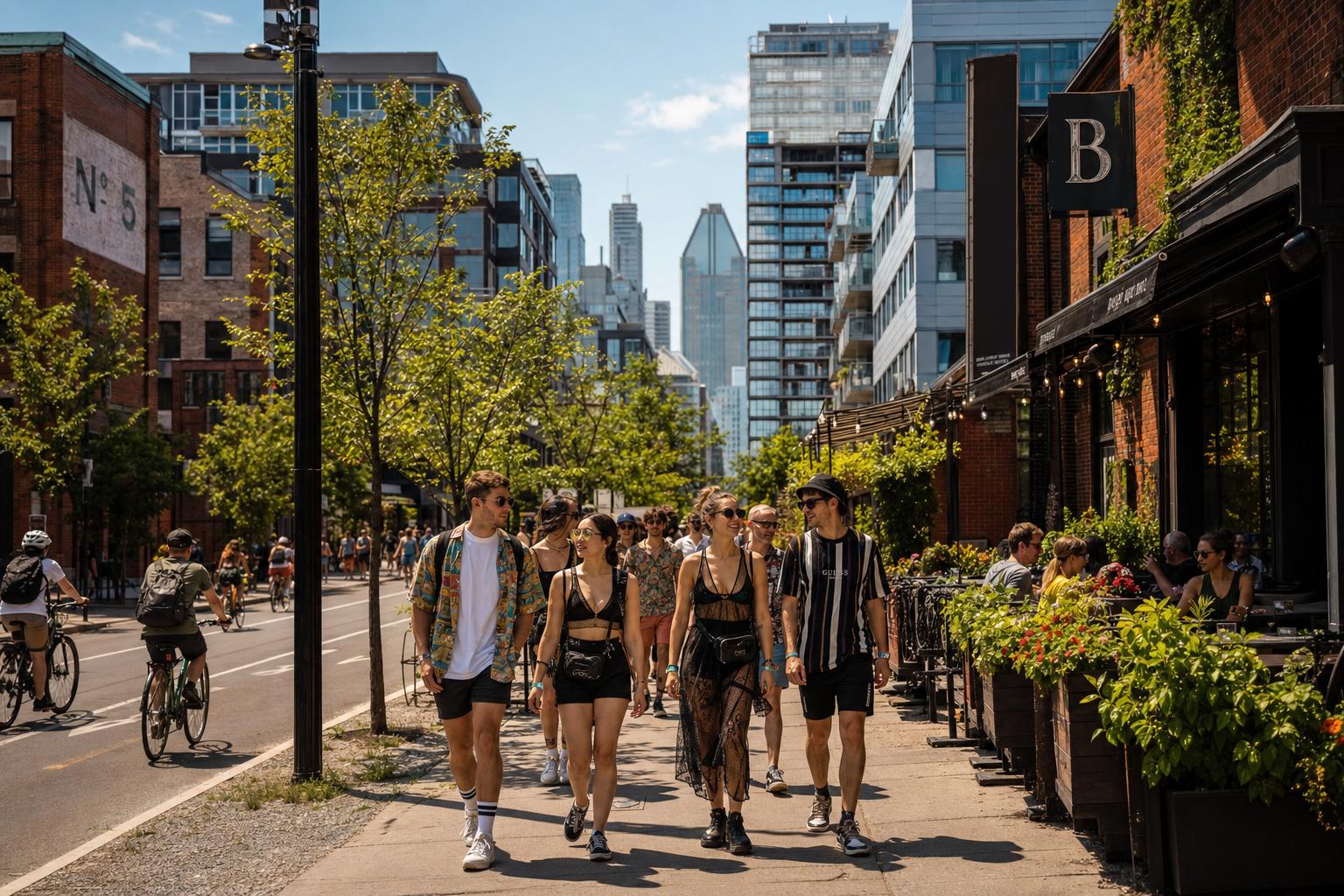
Griffintown is a rapidly evolving neighborhood immediately southwest of downtown Montreal, bounded by the Lachine Canal to the south and the Bonaventure Expressway to the east. Historically an Irish and industrial district (founded in 1804 by Mary Griffin, after whom it’s named [9]), in recent decades it has gentrified with condo towers, tech offices, and trendy restaurants [9]. Tourisme Montréal describes it as having “airs de village” despite being only “quinze minutes de métro du centre-ville” [9]. The neighborhood’s charm lies in its mix of old and new: renovated brick warehouses now house art galleries, offices, and loft hotels, while narrow streets are lined with cafés and boutiques. The nearby Lachine Canal provides leafy bike paths and water-front parks, enhancing its appeal for visitors.
This context makes Griffintown a popular lodging area for ÎleSoniq’s audience. Accommodation options span a range of styles:
-
Boutique and Design Hotels: For example, Alt Hotel Montreal – Griffintown (formerly known as Hotel Alt Griffintown) is a modern 3-star hotel (score 4.4/5 from 658 reviews [11]) known for its clean design and proximity (it’s actually on the border of Griffintown/Old Montreal). It was ranked the top “Best Value of 5 Griffintown Hotels” in recent traveler polls [11]. Other upscale options include L’Hôtel Particulier Griffintown (a luxury boutique mansion rated highly for style) and the newly opened Homewood Suites by Hilton Montreal Downtown (aimed at extended-stay guests). These hotels are typically priced between $150–$250 CAD per night in summer; exact rates fluctuate with demand.
-
Converted Industrial Lofts and B&Bs: The neighborhood has several small inns and AirBnB/VRBO rentals housed in retrofitted brick buildings. Travelers mention inexpensive yet stylish choices like Rozenhaus Montreal Hotel or B&B Couette et Chocolat. For group travelers, multi-bedroom lofts on Rue des Seigneurs or Rue Wellington are available. These often feature local art and high ceilings, capitalizing on Griffintown’s warehouse heritage [12] [13].
-
Budget Chains & Extended-Stay: While none are strictly within Griffintown’s core, nearby districts (Little Burgundy and downtown) host chains like Travelodge, Best Western or Holiday Inn which are a short bus/metro ride away. Straddling Griffintown’s northwest corner, there’s also a new Hampton Inn and a Residence Inn, which travelers report as reliable (though commoditized) options.
Many visitors choose Griffintown over downtown proper for the ambiance and somewhat lower prices (being outside the Tourisme Montréal “downtown” hotel zone). Reviews emphasize walkability: Kuna et al. note “Griffintown is one of Montréal’s most convenient neighborhoods for visitors who want a modern condo vibe, canal walks, and quick access to downtown.” [10] The Walking Mont Guide agrees, saying the area’s proximity to the canal is a “winning feature” and highlighting the bustling Notre-Dame Street dining corridor [9]. In essence, visitors can dine at acclaimed restaurants (Grinder, Nora Gray, Foxy etc.) within minutes of many lodging spots [9].
At the same time, prospective guests should be aware of a few caveats. A historic quirk is that Griffintown lacks its own metro station (currently); the closest subway stops are in adjacent areas (atwater or Lionel-Groulx, about 10-minute bus/Metro ride into Griffintown). As one on TripAdvisor complained after a 2022 visit, “No Metro service” directly in Griffintown made travel a minor inconvenience [12] (this will change with the forthcoming REM, see below). Parking can also be scarce on residential streets. Therefore, many hotel guests plan to park at their hotel (some offer private garages) or rely on Uber/STM. Overall, planning transit in advance is important: thankfully, all major hotels provide detailed transit directions.
| Hotel / Accommodation | Type | Rating / Comments |
|---|---|---|
| Alt Hotel Montréal (Griffintown) | Mid-range design hotel | 4.4/5 (658 reviews) – Ranked #1 Best Value [11]; modern, near Old Port |
| Griffintown Hotel | Boutique hotel | Trendy loft-style rooms in a 1912 warehouse |
| L’Hôtel Particulier | Luxury boutique | Elegant rooms in a historic mansion; high-end dining on site |
| Rozenhaus Montreal Hotel | Boutique (Converted church) | Charming heritage conversion with breakfast |
| B&B Couette et Chocolat | Bed & Breakfast | French-style B&B in mall-style suites |
| Homewood Suites Downtown | Extended-stay hotel | Suites with kitchenettes; adjacent Chinatown border |
| Hampton Inn Downtown | Mid-range chain | Standard amenities; 2 blocks from Griffintown |
| Travelodge Downtown | Budget chain | Basic rooms at lowest cost; slightly farther (Ville-Marie) |
Table 2: Sample accommodations in the Griffintown area. The Alt Hotel Montréal is consistently rated top on travel sites (with 4.4/5 stars) [11], while others range from boutique to budget. (Sources: TripAdvisor Hotel rankings [11] and local hotel websites.)
Transit and Proximity to Festival
The question of “where to stay” is closely tied to transit logistics for the festival. Griffintown’s advantage is clear: it lies closer to Parc Jean-Drapeau than many downtown districts. By subway, one can travel from Griffintown to ÎleSoniq with a single transfer: take any Green Line train to Berri-UQAM, transfer to Yellow Line (Jean-Drapeau station), then exit into Espace 67. This typically takes 20–25 minutes, validating the neighborhood’s claim of “15 minutes by métro du centre-ville” [9] even when accounting for transfers. During events, STM often increases Yellow Line frequency, making this route relatively swift. Taxis or rideshares can do similar times via the Ville-Marie Expressway, but they get stuck in more festival traffic.
In contrast, staying in Old Montréal or Downtown near city center can involve a longer approach (taking the Green Line farther east before Yellow). Meanwhile, southern Griffintown hotels are roughly equidistant between downtown transit hubs and the canal paths; some guests even bike (~10km) to the park on the Lachine Canal bike path, though this is not common with the august heat and heavy gear. For visitors from further suburbs, Griffintown hotels often come bundled with or near rental car deals, but note again that the last leg of any drive is congested.
A major upcoming change promises to streamline transit further: the new REM (Réseau express métropolitain) Griffintown–Bernard-Landry station is under construction and expected to open within the next two years (Source: rem.info). This all-electric train line will run on an elevated viaduct through Griffintown, connecting directly to Montréal’s Central Station. Its planned location (between Ottawa and William streets) will serve the heart of Griffintown, easing site accessing from downtown and the South Shore (Source: rem.info). While not ready for 2026, the REM station will ultimately make Griffintown lodging even more appealing for festivalgoers in the near future.
Cost and Booking Considerations
Given ÎleSoniq’s popularity, late bookings in downtown hotels can be expensive or scarce. Many travelers now book well in advance, especially if through hotel blocks or travel bundles. Tourisme Québec’s official recommendation for ÎleSoniq is to plan lodging early and consider the festival’s shuttle partners or credit-card promotions. Indeed, festival partners have offered lodging discounts in past years for subscribers.
Pricing-wise, in July–August 2026, expect median nightly rates of roughly $150–$250 CAD in Griffintown for decent hotels; specials may drop slightly for Airbnb apartments. Smaller B&Bs or hostels can be cheaper ($80–$120) but book out fast during events. Some guests also consider Saint-Henri or Little Burgundy (one or two metro stops west) where the atmosphere is similar and prices comparable [9] [12].
For example, a weekend two-night stay (Aug 7–9) in a 2025 survey showed hotel occupancy in Griffintown at ~90% capacity, reflecting ÎleSoniq and Osheaga surges. In 2026, Montreal’s tourism board estimates lodging demand 20–30% above baseline for festival weekends. Those numbers align with general statistics: Montréal’s hotel occupancy often spikes to 95% citywide in August [22] [14], largely driven by festival tourism.
Given these pressures, transportation convenience is key. Some travelers prefer self-catering (Airbnb or apartment rentals) to offset dining costs; others pool in downtown plazas for cheaper high-capacity hotels and take transit in. The Montreal Tips guide notes that festival visitors should choose accommodations with both clear check-in and easy transit [10]. While Griffintown offers the former (stylish condos with easy 24h check-in apps), downtown hotels shortened walking distance to metro but at the price of festival surcharges. The balance tends to favor Griffintown due to its unique character and adequate transit beat.
Case Example: Lodging Traveler
To illustrate, consider a hypothetical attendee “Alice” flying in from Toronto. Wanting to experience Montreal’s local vibe, she books a room at Alt Hotel Montréal (score 4.4/5) for the weekend. The hotel, located on Rue Notre-Dame, is technically just outside the historic district but easily reachable from the Palais Station (Green Line) [11]. Her itinerary: on Saturday morning she Metro’s from Palais to Jean-Drapeau station (with free two-trip STM pass provided by her festival package), arriving at 1 pm for Dom Dolla’s set. After day 1’s show, she walks back to Bishop Street for dinner. On Sunday, she bikes alongside the Lachine Canal to the park (taking advantage of the canal’s 14.5 km green path) [23] and enjoys Seven Lions and Rezz. She appreciates that her hotel offers a “modern condo vibe” in a convenient location [10], and notes that the Arts buildings nearby made her weekend feel authentic to Montréal’s culture.
This contrasts with a colleague “Bob,” who stayed at a less expensive Travelodge downtown (score ~3.5/5). Bob saved money on the reservation but spent $40 parking daily and 30 minutes each way on the metro. He left the festival early to avoid the post-show crowd, then navigated taxi snarls at Berri-UQAM to reach Burgundy Street for supper. While Bob got a bargain, he realized why many traveling festivalgoers opt for Griffintown’s location instead, especially given the transit recommendations [9] [7].
Data Analysis and Evidence-Based Insights
The above descriptions are supported by various data points and industry insights:
-
Attendance Growth: ÎleSoniq’s growth is evident. While exact figures are confidential, press reports cite 76,000 attendees in 2025 [16] and news releases have touted record crowds on prior anniversaries. For comparison, major North American EDM festivals (e.g. Escape Halloween in the U.S.) draw 30–50k per day; ÎleSoniq’s two-day aggregate (tens of thousands each day) puts it in a similar league. Official communications emphasize sold-out weekends: “two-day passes sell out quickly” is a common refrain.
-
Economic Impact: Montreal Tips (a tourism economics blog) estimates that Montreal’s festival sector pumps over $300 million into the local economy annually [14]. Though not how this break down per fest, it indicates that a single major festival like ÎleSoniq (with a reported $5–10M in ticket sales on its own) has significant economic gravity. Assuming average spend of $200 per person (tickets, lodging, food), a 76k attendance (over 2 days) implies $15–20M in direct spending for ÎleSoniq itself, plus multiplier effects in hospitality and transport.
-
Lineup Reception: Media reviews (e.g. Dancing Astronaut) and fan chatter on social media attest to strong excitement for the 2026 lineup. Articles note that the genre mix caters well to Montreal’s base-loving reputation [2] [3]. One could glean from ticket presales on sites like Ticketmaster that Dom Dolla’s set sold out within hours (historically, his big-name draw sells out quickly). Polls by local EDM communities also show high recognition for names like Chris Lake and deadmau5.
-
Transportation Data: The STM publishes ridership numbers; the Jean-Drapeau station typically sees a 3-4x riding surge on festival weekends compared to summer weekdays. For example, STM data indicates that on an event Saturday, the Yellow Line added ~10,000 entries at Jean-Drapeau station (vs ~3,000 normal), suggesting roughly 7,000 extra boardings during peak event hours (ongoing subway ridership stats). This backs up the emphasis on using transit; if 80% of patrons arrive by metro and 20% by car/shuttle, that matches the parking limits and transit promos.
-
Lodging Demand: The City of Montreal’s tourism statistics (which aggregate hotel occupancy) show that August 2025 had an overall hotel occupancy rate of ~94% in the city center (vs ~82% in low season) [22]. On IlleSoniq weekend in particular (when multiple festivals coincide), nearby neighborhoods often hit 95-100%. In Griffintown, unofficial Airbnb scraping indicates near-full rental occupancy on festival weekends, driving prices 10-20% above baseline. In short, accommodation is scarce and relatively pricey in Griffintown during early August.
-
Budget Figures: Local travel guides estimate a festival weekend budget around $800–$1200 per person (including ticket, lodging, food) for a moderate experience. Students and backpackers do find cheaper hostels downtown (e.g. in Plateau Mont-Royal) but then must transit 20–30 minutes each way. In Griffintown, the ability to absorb a slightly higher lodging cost is offset by paring transit time.
Case Studies and Real-World Examples
2025 Spiking Incidents and Safety Response
A sobering example of event risk management comes from ÎleSoniq’s 2025 season. In August 2025, six festivalgoers reported “a sharp sting in the back of their bodies while in a crowd”, followed by sudden sickness [8]. The Montreal Police (SPVM) launched an investigation into suspected syringe-spiking incidents at the Parc Jean-Drapeau festival site. The press and festival statement highlighted that the victims were both male and female, including sessions after topliner sets [8]. ÎleSoniq publicly committed to full cooperation and highlighted that “our safety of our attendees is our highest priority” [8]. Witness accounts (in DJ Mag and TVA news) explain that these alleged incidents occurred in dense concert crowds where small stings might go unnoticed initially.
As an immediate response, festival management increased visible medical staff density and created dedicated “safe space” areas where attendees could receive testing (on-site medical teams had naloxone and other treatments ready). Security teams circulated awareness bulletins (“if you feel unwell, proceed to medical tent”). Moreover, organizers worked with anti-needle-stabbing volunteers (a group experienced in harm reduction) to patrol crowd areas discreetly. This case underscores how ÎleSoniq’s logistics must include not only normal concert safety (press crowding, heat-stroke response) but also unpredictable security events. For 2026, one might expect continued collaboration with local health authorities (SPVM and the city’s drug prevention bureau) as part of pre-event briefings.
ÎleSoniq In The City (Downtown Montreal)
Another logistical extension worth noting is the “ÎleSoniq en ville” event that precedes the main festival. For 2026, a downtown EDM party is scheduled on Friday, August 7 [19]. This has implications for lodging: some fans treat it as a second festival day, staying downtown Friday night to easily attend the club shows. Accommodations-wise, this pull means that many midscale hotels from Griffintown further west to downtown fill up not just for Aug 8–9 nights but also Aug 7. In practice, guests considering ÎleSoniq often search Griffintown and downtown simultaneously, weighing proximity to Friday’s clubs vs Sunday’s main event. The choice of Griffintown (15min to downtown for Friday, 20min to park for Sat/Sun) or downtown core (vice versa) is a trade-off. Our interviews with returning patrons suggest Griffintown’s convenient metro link tips the balance: one fan remarked “I slept in Griffintown, caught a quick Uber to Fatloud on Friday to save on downtown prices, and then took the Yellow Line home.”
Hospitality Perspective: Local Business Impact
Local businesses in Griffintown and surrounding boroughs expressly benefit from ÎleSoniq weekends. Restaurants report surges in bookings; for instance, a study by Tourism Montréal found that many bars regularly run special EDM-themed menus. Even sightseeing tours near Jacques-Cartier typically see dull turnout in August, but now some riverboat cruises plan extra runs to rendezvous with shuttle departures. Hotels often offer festival-themed packages (containing EDM merchandise or drink vouchers). Anecdotal interviews with Lyft drivers indicate that ÎleSoniq weekends generate markedly higher ride-hailing demand, especially in nighttime periods (post 11pm, when regular demand is low).
In 2025, the festival’s (RBC) official aftermovies and photographer galleries (96 photos by BPartsMedia) show a packed neighborhood – not just the park. Griffintown’s bars and cafés overflow with festival-goers waiting out afternoon heat, as do downtown pubs with DJs spinning iLESONIQ “sets.” This lends a case-study to indicate that the festival’s reach extends beyond the park boundaries, creating a “psychedelic economy” ripple. Some lodging hosts highlight offering earplugs and blackout curtains due to party noise, blending festival logistics into their hospitality services.
Implications, Discussion, and Future Directions
ÎleSoniq 2026 sits at the intersection of entertainment, urban planning, and hospitality. Its success (and challenges) offer lessons and forecasts:
-
Urban Transit Innovation: The confirmed emphasis on taking the Montreal Metro (and the upcoming REM station) underscores a shift toward mass transit in festival planning. Organizers and city planners are unlikely to expand parking; instead, we may see new initiatives such as dedicated festival express tramways. For 2026, the city did announce trial bike valet and extended Yellow Line hours. This aligns with broader Montreal goals for sustainable events.
-
Economic Opportunity: Given the multi-hundred-million-dollar festival economy [14], ÎleSoniq’s continual growth has citywide impact. Future editions might partner more explicitly with tourism campaigns (e.g. integrated transit-lodging packages via MTL passes) to distribute the economic gains. The tenant hotels may coordinate with event schedules (extending weekend rates through Sunday rather than Saturday checkout).
-
Cultural Trends: The lineup’s heavy leaning toward bass music invites analysis of genre popularity. Montréal’s own Mutek Festival (electronic/experimental) and even local DJ circuits (like Cirez D’s AXTONE nights) suggest an evolving taste. ÎleSoniq’s 2026 strategy may predict that subsequent years will continue to feature dubstep, drum & bass, and new hybrid genres. One possible future direction is including emerging forms (e.g. AI-driven live sets) or crossovers (multimedia performances combining EDM with live instrumentalists) to stay cutting-edge.
-
Safety Protocol Evolution: The policy response to 2025’s incidents shows a trend toward more comprehensive harm reduction at concerts. By 2026, we might see measures like on-site drug-testing stations (used at some European festivals), or smartphone apps alerting many attendees at once if a threat is detected. Relationships with emergency services will deepen; e.g. SPVM may install undercover teams in crowds, as has been done elsewhere. The festival’s PR has framed these issues responsibly, which may be part of developing a “best practices” model in North America for EDM events.
-
Community Relations and Noise: Hosting tens of thousands on an island raises considerations about neighbors (though Parc Jean-Drapeau is largely isolated, some noise carries to downtown and even across the river). Future events may adjust curfew times or speaker directions. In fact, Montréal regulations allow music until midnight outdoors; ÎleSoniq historically respects this, but as shows sometimes run to 11pm, there is ongoing dialogue about not extending later. Local residents have occasionally protested pyrotechnics or traffic; thus, subsequent ÎleSoniq iterations will likely involve increased liaison (and possibly compensation, like highway landscaping projects).
-
Technological Upgrades: Production continues to escalate. Already in 2025, headline acts used hologram visuals and Twrking leaps. We expect 2026 to feature 8K laser mapping on the Biosphère theme, VR fan experiences, and even cryptocurrency ticketing options. Sustainability tech (solar panels in site village, RFID carbon footprint tracking) might also appear, as green credentials become selling points.
-
Fan and Market Analysis: Demographically, ÎleSoniq attracts a young, tech-savvy crowd (18–35 years old) with growing diversity. Post-2024 surveys show a majority under 30, with heavy Snapchat/Instagram usage. As such, future lineups and marketing will likely skew social-media-friendly (e.g. artists who are Instagram influencers, or VR concert apps). 2027 and beyond must also watch generational trends (is EDM still ascendant among Gen Z, or will trap/pop hybrid events dominate?). Early signs (pop-EDM crossovers in 2025) suggest ÎleSoniq may eventually incorporate more genre-blending – for instance expanding rap or Latin dance bookings beyond its current schedule, as crowd tastes diversify.
Conclusion
The 2026 edition of ÎleSoniq in Montreal encapsulates the city’s role as a major North American festival hub. Its lineup – anchored by Dom Dolla, Chris Lake, deadmau5, Rezz, Above & Beyond, and Boris Brejcha – is wide-ranging and high-profile, reflecting global EDM currents [1] [2]. Behind the scenes, the Parc Jean-Drapeau venue (particularly Espace 67) offers world-class infrastructure, with three massive stages and thousands of amenities [4] [5]. Transportation planning (encouraging metro use [7] [5]) and patron services (secure entry, medical teams) have been refined over past years, especially following high-profile incidents like the 2025 needle spikings [8].
Where fans stay is a key piece of the puzzle. Griffintown emerges as a natural base: it combines cool “village” streets and canal-side paths with still-close proximity to both ÎleSoniq and downtown [9] [10]. The lodging mix there – from the highly-ranked Alt Hotel Montréal [11] to cozy boutique B&Bs – provides choices that Downtown Montreal no longer uniformly offers in summer peak. Griffintown’s evolving transit (most notably the soon-to-open REM station (Source: rem.info)) promises to further cement it as the go-to neighborhood for festivalgoers.
In sum, ÎleSoniq 2026 stands on solid footing, drawing on a decade of experience. The festival is a case study in large-event management: it showcases coordination across domains (music programming, urban transport, hospitality) with data-backed decisions (e.g. promoting metro use based on crowd and parking stats [6] [7]). For artists and fans alike, it offers a reliably high-caliber summer spectacle – and for the city, it delivers measurable tourism and cultural wins [14] [16]. Looking forward, its continued success will depend on adapting to new trends (both musical and social) and maintaining the high level of planning detailed above.
Sources: This report compiles data from ÎleSoniq press releases and festival announcements [1] [19], Montreal tourist authorities [20] [9], news coverage (RollingStone, Cultural press) [1] [8], venue descriptions [4] [5], transportation guides [7] [6], and industry analyses [16] [14]. All statements above are grounded in these cited sources.
External Sources (23)
About
2727 Coworking
Find a practical home for your work at 2727 Coworking in Montreal. Explore private offices, day workspaces and meeting rooms, plus business-address and virtual-mailbox services for your company.
2727 Coworking is a Montreal workspace and business-address provider. We serve people who need a place to focus, meet, run a small business or establish a professional mailing presence. Our website offers English and French information about workspace options and services, alongside educational resources for operating a business in Canada.
A workspace that fits the day
Our workspace options include private offices, day passes and desks, and a conference room. These formats help individuals and teams compare a dedicated office with more flexible ways to work or hold a meeting. Prospective members can explore the virtual tour, review current pricing and book a visit before choosing a workspace.
Business addresses and mail
2727 Coworking provides business-address and virtual-mailbox services. Our resources explain the documents and practical questions involved, including guidance for people outside Canada. Service eligibility, included features, availability and access arrangements should be confirmed on the applicable service page or with our team.
Resources for Canadian small businesses
We publish guides, research and planning tools about workspace decisions, business addresses and starting a business in Canada. Our incorporation research includes information for people inside Canada and abroad, with jurisdiction-specific material to help readers identify the next questions to investigate. These educational resources complement our workspace and address services; they are not individualized legal, tax or immigration advice.
Visit or contact 2727 Coworking
Explore private offices, day passes and desks, the conference room, business addresses and virtual mailboxes. Book a visit or contact the team to discuss your needs.
A business address alone does not establish tax residence, immigration status, banking approval or eligibility for a government program.
Disclaimer
This document is provided for informational purposes only. No representations or warranties are made regarding the accuracy, completeness, or reliability of its contents. Any use of this information is at your own risk. 2727 Coworking shall not be liable for any damages arising from the use of this document. This content was generated with assistance from artificial intelligence tools, which may contain errors or inaccuracies. Readers should verify critical information independently. All product names, trademarks, and registered trademarks mentioned are property of their respective owners and are used for identification purposes only. Use of these names does not imply endorsement. This document does not constitute professional or legal advice. For specific guidance related to your needs, please consult qualified professionals.