2727 Coworking Article
Just For Laughs Montreal 2026: Event Schedule and Venues
Inside this article
Executive Summary
Just For Laughs (JFL) Montréal – Juste pour rire Montréal – remains the world’s preeminent comedy festival, and the 2026 edition promises to reaffirm its cultural and economic impact. Running July 15–26, 2026, the festival will feature hundreds of free outdoor events and approximately 250 ticketed shows across some 25 downtown venues [1] [2]. Headliners revealed include comedy legend Jerry Seinfeld (performing at Salle Wilfrid-Pelletier, Place des Arts) and parody icon “Weird Al” Yankovic (free concert at Place des Festivals) [2] [3], among dozens of other international acts. Remaining programming will encompass gala showcases (star-powered stand-up), returning series (e.g. “The Nasty Show”, “The Culture Show”, Brit(ish)), podcast tapings, club showcases and the ComedyPRO industry conference.
Economically, JFL 2026 arrives amid a revitalized festival organization. After financial restructuring in 2024 [4], organizers report a triumphant 2025 relaunch: roughly CAD $35 million was invested into Québec’s culture and economy, with ~175,000 ticketed attendees indoors and massive free crowds outdoors [5]. Historically, JFL has drawn well over a million attendees: mid-2010s editions saw 1.3–1.5 million people engaging in the festival and its companion events [6] [7]. The event now regularly attracts nearly 2 million visitors and some 1,700 artists from 19 countries [1]. This report provides an in-depth examination of the 2026 festival’s schedule, venues, and nearby Griffintown stay options, drawing on official announcements, media sources, and tourism analyses to present a comprehensive guide and contextual analysis.
Introduction and Background
The Just For Laughs (Juste pour rire) festival, founded in 1983 by Gilbert Rozon, has grown into the world’s largest comedy festival [4] [8]. For over four decades it has transformed Montreal into an international comedy hub, launching the careers of stars like Kevin Hart, Dave Chappelle, Jimmy Fallon and Amy Schumer [8]. Traditionally held each July in downtown Montréal, JFL combines English (Just For Laughs) and French (Juste pour rire) programming across a range of formats. In recent history the festival expanded into year-round media (e.g. comedy specials on Prime Video) and international offshoots (in cities like Toronto, Vancouver, Paris and Punta Cana), but Montréal remains the flagship edition.
In late 2023 and early 2024 the organization underwent significant upheaval. Following a series of leadership and financial challenges, Groupe Juste pour rire filed for creditor protection and cancelled its 2024 edition [4]. Bloomberg and AP reported that factors included pandemic losses, rising costs, and a shifting entertainment market; at one point ~70% of JFL’s staff were laid off during restructuring [4]. Nevertheless the company secured new investment (notably from co-owner Bell Media and other backers) and affirmed that the festival would return. By early 2026, the organization had announced a full comeback: the 2025 festival was executed successfully, and 2026 programming began rolling out. During this period, a public sale of festival assets and rights has been discussed, but the Montreal event’s cultural importance remains a priority for local stakeholders [4] [5].
Montreal’s civic leadership and tourism bureau continue to support JFL as a “pillar of Québec’s cultural identity” [5]. Tourisme Montréal explicitly labels Just For Laughs “the largest comedy festival in the world” [8] and highlights its global reach—pointing out that the festival routinely draws nearly 2 million visitors and 1,700 international artists [1]. In short, while JFL faced challenges, its 2026 revival is backed by a rich legacy and new programming that promise broad appeal. The following sections detail the confirmed schedule elements, venue infrastructure, and accommodation strategy—especially focused on the nearby Griffintown district—to guide performers and attendees alike.
Just For Laughs Montréal 2026: Dates and Programming
Festival Dates and Structure
The 2026 Just For Laughs Montréal festival is scheduled for July 15–26, 2026 [2] [4]. This two-week span mirrors the standard Julian timeframe (mid-July) during which the city is hosts to multiple summer festivals. Within these dates, the festival will run daily events ranging roughly from late afternoon until late night. Programming includes both ticketed indoor shows (comedian galas, stand-up showcases, special events) and free public spectacles (open-air concerts, street events, and promotional showcases). Organizers have indicated “hundreds of free outdoor activities alongside 250 shows in 25 downtown venues” [1], reflecting a schedule with several concurrent tracks so that attendees can mix and match events.
Key confirmed dates and events (first wave of announcements) include:
- July 23, 2026 – Main Gala: Jerry Seinfeld Live. Jerry Seinfeld, one of the festival’s crown-jewel headliners, will perform at Salle Wilfrid-Pelletier (Place des Arts) on July 23 [3]. Tickets for this acclaimed show (likely a multi-night run or single special event) have drawn considerable advance interest.
- July 25, 2026 – Free Concert: “Weird Al” Yankovic.A free public concert by “Weird Al” Yankovic (as part of his “Bigger & Weirder” tour) will be held at the outdoor Place des Festivals stage [2] [3]. This follows JFL’s tradition of mounting at least one large-scale open-air show on their Quartier des Spectacles plaza (as in previous years). No tickets are required for this event, but attendance is typically on the order of tens of thousands of people for high-profile acts.
In addition to these marquee shows, JFL’s lineup includes dozens of other acts. As reported by Cult MTL and The Beat, the 2026 lineup features a diverse roster of comedians. Notable names revealed in April 2026 are: Nurse John, Jordan Jensen, Sibling Rivalry (comedic duo), Ron Funches, Zoltán Kaszás, Jacqueline Novak, Martin Amini, David Nihill, the YouTube-based Smosh Reads Reddit Stories LIVE!, and others [9]. These will appear in various gala and showcase contexts. The announced Gala hosts (emcees and special-guest headliners) for 2026 include Gabriel “Fluffy” Iglesias, Mike Birbiglia, Atsuko Okatsuka, and Gerry Dee [9]. These comedians will anchor the festival’s traditional signature “Galas,” which are stand-up comedy showcases usually taped for later broadcast. For example, Atsuko Okatsuka (who recently had a popular special on Hulu) will host one such Gala, continuing JFL’s practice of mixing global stars with emerging talent [10].
Beyond comedy stand-up, JFL Montréal 2026 will span multiple formats. Returning series and showcases include The Nasty Show, The Culture Show, and Brit(ish) [9] [3] – live sketch or variety formats spotlighting niche themes (often All-Female or LGBTQ+ comedic perspectives). There will also be live podcast tapings and interviews, fringe “side events,” and perhaps film or theater tie-ins (the festival often includes short film screenings and improv shows, though a confirmed schedule is forthcoming). The festival’s press briefing emphasized that additional events (e.g. ComedyPRO business conference, street performances, workshops) are to be announced in the weeks leading up to the festival [2] [11].
All tickets (for indoor events) are sold via the official JFL Montréal box office (through hahaha.com). Public ticket sales began in mid-April 2026 (April 17 for the general public, with a presale on the 15th for newsletter subscribers) [9] [3]. Various price tiers exist for individual shows; meanwhile, many outdoor events and street performances (notably the Place des Festivals concerts) remain freely accessible outdoors.
Programming Highlights and Data
In keeping with JFL’s global brand, the 2026 festival will cater to all levels of comedy fandom. It is oriented toward both Quebec’s local francophone audience and international anglophones – indeed, official descriptions emphasize performances “in both English and French (under Juste pour rire)” [1]. Roughly 250 shows across the festival will be split language-wise according to ticket demand. For example, Jerry Seinfeld’s shows are in English, while some outdoor and smaller events may be French-language or bilingual out of cultural curiosity.
A key feature of JFL Montréal is the ComedyPRO industry summit. Scheduled during the festival, ComedyPRO (July 23–25, 2026) brings together comedy professionals for panels, business sessions, and networking [11]. The CMPA (Canadian Media Producers Association) notes that ComedyPRO is “the industry’s biggest hub for professionals and creatives,” including keynotes, workshops, and the prestigious New Faces of Comedy showcase (where emerging talent is discovered) [11]. In 2026, ComedyPRO will again host the Just For Laughs Awards gala and the New Faces showcase, offering crucial exposure to up-and-coming comedians (historically, talents like Kevin Hart and Amy Schumer debuted via New Faces [11]). Though primarily industry-focused, ComedyPRO events are partially open to public badge-holders and contribute to the festival’s creative buzz.
Statistical context: Pre-festival data underscores JFL’s scale. Tourisme Montréal highlights JFL as “the world’s biggest comedy festival,” citing figures of ~2 million annual visitors and 1,700 artists from 19 countries [1]. Likewise, JFL’s official 2025 post-mortem reports investing “35 million $” into culture and economy, hosting nearly 175,000 seated ticket-holders, plus massive outdoor crowds, and featuring over 500 artists [5]. In previous editions (e.g. 2015), combined attendance (including associated events like Zoofest) reached 1.3–1.5 million [6]. These metrics illustrate that even a “scaled-down” post-pandemic festival remains a major event. (By comparison, KPMG’s 2016 economic-impact study found JFL’s propre activity generated ~C$34 million in provincial GDP and 542 full-time jobs [7].) For 2026, Montreal officials and press expect a rebound or continuation of this magnitude, aided by strong headliners and renewed public interest.
Montréal Venues for Just For Laughs 2026
JFL Montréal is inherently decentralized – shows are held across many theaters, clubs and public spaces in downtown Montréal. The nucleus of venues is Place des Arts, the city’s premier performing arts complex. Beyond that, outdoor stages and special venues fill the Quartier des Spectacles. Key venues anticipated for JFL 2026 include:
- Place des Arts (Salle Wilfrid-Pelletier): The largest hall in the complex, with ~2,996 seats [12] [13]. Operated as a grand proscenium theatre, Salle WP hosts the festival’s major galas and headliner acts (e.g. Jerry Seinfeld). Its high capacity and technical capabilities make it ideal for taped specials and major audiovisual productions [13].
- Place des Arts (Théâtre Maisonneuve): A large in-the-round auditorium (capacity ~1,453 [12]). Maissonneuve is the home stage for many signature Just For Laughs “Galas,” featuring a lineup of international stars and rising talents. Past festivals have tape-recorded showcases here (often introduced by a celebrity host). This will serve similar purposes in 2026, with Galas hosted by comedians like Fluffy Iglesias and Mike Birbiglia.
- Place des Festivals (Quartier des Spectacles): An outdoor amphitheater in the Tropiques area, essentially a central plaza with a large free stage (facing the Place des Arts esplanade). Free concerts and big open-air shows take place here. For 2026, this is where “Weird Al” Yankovic will perform on July 25 [2]. Capacity is unseated/open, attracting thousands (past free JFL shows have drawn crowds in the 10,000–20,000 range for major artists).
- Place des Arts (Cinquième Salle): A smaller studio theater (capacity ~187) within the same complex. JFL uses it for intimate comedy sets, “New Faces” showcases, and niche performances. Its scale suits emerging acts and experimental formats. (Though small, it contributes to the 8,000-seat total across Place des Arts’s six halls [12].)
- Place des Arts (Théâtre Jean-Duceppe, Salle Ludger-Duvernay, etc.): These mid-size to small theaters (capacities 765 down to ~300 [12]) may be booked for additional stand-up nights, family shows, or French-language performances. Each has full production equipment but fewer seats, allowing JFL to accommodate a broad spectrum of shows.
- Other Downtown Theaters: Beyond Place des Arts, Just For Laughs often leases rooms at Théâtre Outremont, Théâtre Corona, Cinéma Impérial (for comedic film screenings or live podcasts), and clubs like Humours Café or Auberge St. Gabriel for late-night sets. The complete 2026 venue list will be released by JFL, but past editions typically span 20–30 venues.
- Street and Festival Sites: In addition to scheduled shows, JFL’s Out of Town program and free zones mean comedy happens on street corners, parks, and open-air festival tents. For example, in July each year the festival site installs pop-up stages in public spaces (often near Sainte-Catherine Street) for walk-by entertainment. These activate the Quartier des Spectacles beyond just ticketed events.
The table below summarizes key venues and their roles in the festival:
| Venue | Location / Type | Capacity / Features | Typical JFL Use |
|---|---|---|---|
| Salle Wilfrid-Pelletier (Place des Arts) | Indoor proscenium theatre | 2,996 seats (largest Québec theatre) [13] [12] | Major gala performances & headline acts (e.g. Jerry Seinfeld) |
| Théâtre Maisonneuve (Place des Arts) | Indoor auditorium | 1,453 seats [12] | Curated gala showcases and stand-up events |
| Place des Festivals (Quartier des Spect.) | Outdoor amphitheatre | Open-air plaza (unlimited free public access) | Free outdoor concerts (e.g. Weird Al Yankovic on July 25) [2] |
| Cinquième Salle (Place des Arts) | Small indoor theatre | ~187 seats (studio theatre) | Intimate comedy showcases, New Faces, experimental sets |
| Various Other Theaters | Downtown clubs/halls | 300–800 seats (e.g. Théâtre Jean-Duceppe) [12] | Supplemental stand-up nights, French-language shows, comedy films |
Table: Main venues for JFL Montréal 2026, including location, capacity, and typical usage. Citations indicate official capacity and descriptions [13] [12]. All venues are conveniently located in central Montreal’s Quartier des Spectacles area. Notably, Place des Arts is connected to two metro stations (Place-des-Arts and Berri-UQAM, via underground concourse) and has bike- and car-parking facilities [12], facilitating high audience throughput.
Venue Logistics and Access
All major venues are clustered within 0.5–1 km of each other in downtown Montréal, ensuring walkability. For example, the distance from Griffintown lodging (see next section) to Place des Arts is roughly a 10- to 15-minute walk or a short bus/metro ride. Montreal’s Metro system provides easy transit: Place-des-Arts station (Green Line) and Berri-UQAM (Orange/Green) serve Place des Arts directly [12]. The Place des Festivals outdoor stage is about 200 m east of Place des Arts, at the corner of Ste-Catherine Street and Saint-Urbain. Additionally, the renovated Lucien-L’Allier station (Orange Line) lies just north of Griffintown, offering another access point for festival-goers.
Griffintown Stay Guide
Overview of Griffintown
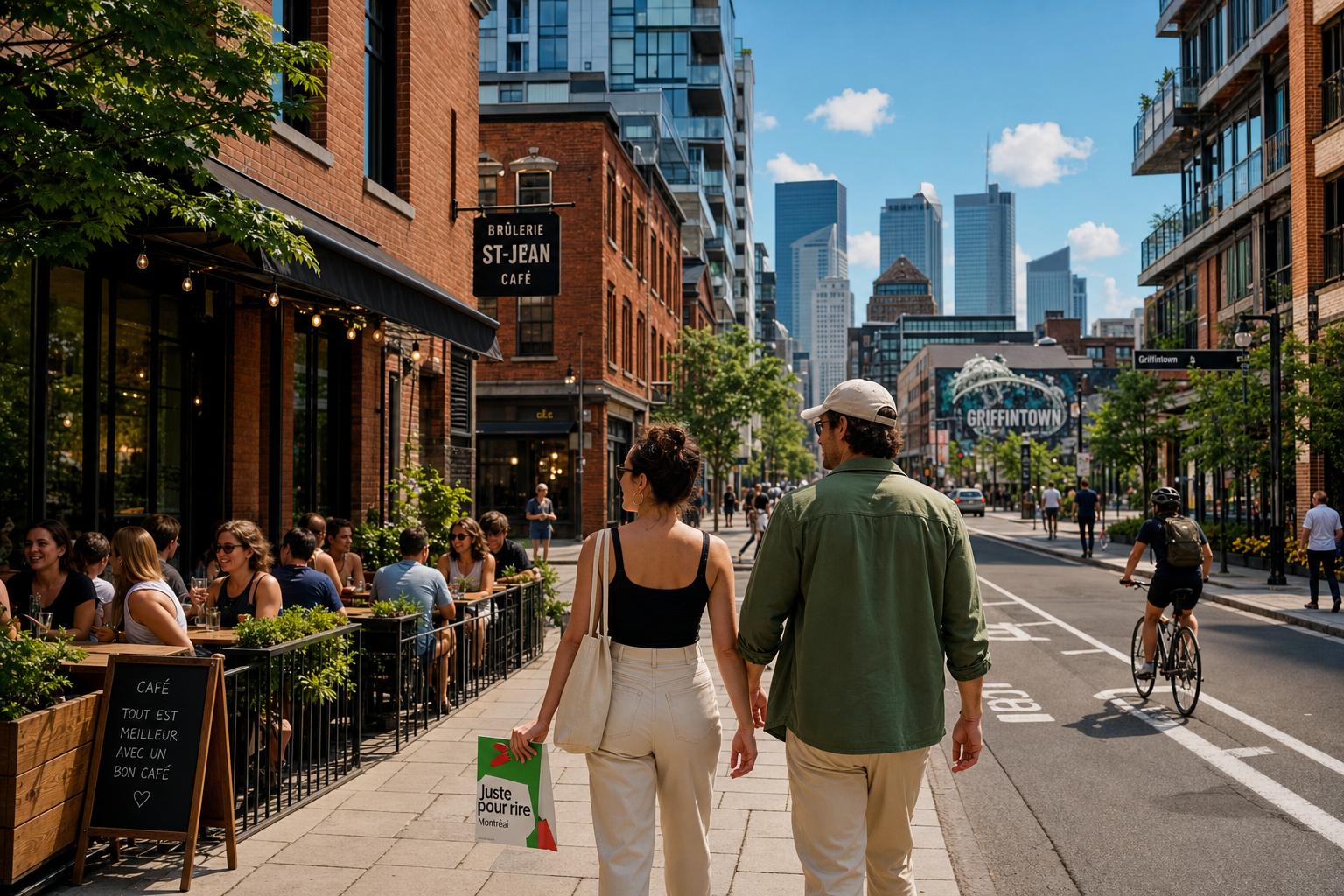
Attendees seeking convenient accommodations may consider Montréal’s Griffintown neighborhood. Griffintown (part of the broader Quartiers du Canal which includes Little Burgundy and Saint-Henri) is a dynamic area just southwest of downtown Montréal [14]. Its boundaries run roughly from the Bonaventure Expressway in the east, up to Notre-Dame Street in the north, Des Seigneurs Street to the west, and the Lachine Canal to the south [14]. Hence it sits immediately across the canal from Old Montréal and within a short distance of the JFL venues. For example, the heart of Griffintown (Peel/Wellington area) is only ~15 minutes by Metro from Place des Arts [14].
Historically, Griffintown was an early 19th-century industrial/working-class district. It takes its name from Mary Griffin, an early landowner who in 1804 subdivided and developed the area [14]. Initially populated by Irish laborers (and later by Jewish, Italian, Ukrainian and Québécois communities) [14], Griffintown’s industrial mills and factories declined in the mid-20th century. In recent decades it has undergone a dramatic transformation: modern condo towers now overlook the Lachine Canal, and many former warehouses and worker’s row-houses have been converted into boutiques, galleries and lofts [14]. This blend of “industrial heritage and modern urban development” gives Griffintown a distinct architectural tapestry [15].
Residents and visitors praise Griffintown’s proximity and walkability. It feels “like a village” yet is merely a short commute to major attractions [14]. According to Tourisme Montréal, Griffintown is within a 15-minute Metro ride to downtown core venues, and many buildings capitalize on the Lachine Canal view [14]. For example, Alt Hotel Montreal markets itself as being “in the heart of trendy Griffintown, just a few minutes walk from downtown and the Lachine Canal” [16]. In practice, one can easily walk from many Griffintown hotels to either Place des Arts (via René-Lévesque/Ste-Catherine) or ride the free Québec public bikes (BIXI) for the ~2 km trip to the festival district.
The tourism office groups Griffintown with nearby Little Burgundy and St-Henri as the “Quartiers du Canal,” highlighting the Lachine Canal’s recreational space and the trendy urban vibe [14]. Many local new developments line the canal with bike paths and parks, which even during JFL provide scenic spots to stroll. Notre-Dame Street (the northern edge of Griffintown) is renowned for independent restaurants, microbreweries, and antique shops [14]. In summer, Griffintown hosts the open-air Marché des Éclusiers by the canal, a free food and artisan market open on weekends [14]. Cumulatively, these features make Griffintown an appealing “stay–play” option: one can access festivals downtown easily while enjoying a quieter, community-oriented neighborhood atmosphere.
Accommodation Options
Griffintown offers a variety of lodging options appealing to festival-goers. Visitors have reported ("machines sites”) staying in modern condo-hotels, boutique inns, and chain hotels. For example:
- Apartment Hotels: The Griffintown Hôtel is an apartment-style hotel with fully furnished suites. Its official site boasts being “le premier appart-hôtel au cœur de Griffintown” (“the first condo-hotel in the heart of Griffintown”), emphasizing its proximity to downtown [17]. This can be ideal for groups or longer stays, offering kitchens and multiple bedrooms.
- Boutique Hotels: Alt Hotel Montréal – Griffintown (a Germain hotel) is located at Peel & Wellington and highlights its “trendy” location within Griffintown [16]. It features modern minimalist rooms and a rooftop terrace, within walking distance of the Lachine Canal and Griffintown restaurants. Smaller independent inns (some converted from factories or churches) are also sprinkled through the neighborhood.
- Chain Hotels: Though some larger chains cluster in Old Port or downtown, there are a few near Griffintown’s edge. The Delta Hotels by Marriott Montreal (formerly Le Centre Sheraton), Holiday Inn Express downtown, and boutique Moxy by Marriott are within a 10–15 minute walk of Griffintown’s north side. More notably, the W Montréal (a luxury design hotel) sits just across the canal towards Old Port (though technically in Little Burgundy). These provide brand-name comfort but tend to be higher-cost.
- Short-Term Rentals: Griffintown has many condo conversions available on Airbnb, VRBO, etc. Tourists often rent apartments around the canal. The neighborhood’s mix of new condos and heritage lofts means ample unit availability, especially outside holiday weeks. Prices fluctuate: a mid-range 1-bedroom condo (~500–700 ft²) might rent for CA$150–$200 per night in summer; larger suites are more. (During peak festival weeks prices can surge higher.)
Citing official accommodation reviews is difficult, but travel guides frequently list hotels like Alt Hôtel Montréal – Griffintown and say it’s “just a few minutes walk from downtown” [16]. In practice, many festival visitors balance cost and proximity by choosing Griffintown. The key advantage is location: for example, Alt Hotel notes: “Located at the corner of Peel and Wellington in the heart of Griffintown, [it is] just a few minutes walk from downtown” [16]. Similarly, the Griffintown Hôtel advertises fully-equipped apartments “a few steps from downtown Montreal” [17].
Below is a sample (non-exhaustive) comparison of lodging options near Griffintown. This is meant as a guide; pricing and availability should be confirmed via travel sites or the hotel directly.
| Property | Type | Approx. Price* | Highlights |
|---|---|---|---|
| Alt Hôtel Montréal – Griffintown | Boutique hotel | ~CA$150–$220+ | Central location (Peel & Wellington); modern design; walking distance to Lachine Canal and Quartier des Spectacles |
| Le Griffintown Hôtel | Apart-hotel (condo units) | ~CA$140–$200 | Spacious furnished suites with kitchens; quiet street; fitness area; near Peel St. Metro |
| Delta Hotels by Marriott (Centre-Ville) | Downtown full-service hotel | ~CA$200–$270+ | 4-star, indoor pool; steps from Griffintown on Peel; connected to shopping Mall Centre-Ville |
| Holiday Inn Express Downtown Montreal (Ouest) | Mid-range chain | ~CA$130–$180 | Newly built; complimentary breakfast; WGGrehintown-adjacent; near bike paths |
| Airbnb/VRBO (various condos) | Condo rental | Varies (CA$120–$300+) | Entire apartments with 1–3 bedrooms; ideal for groups; subject to market rates |
Table: Representative lodging options near Griffintown (prices in Canadian dollars, summer 2026 estimates). Locations all lie within or adjacent to Griffintown; most are within a 15-minute walk or Metro ride to festival venues. (No official citation; see Alt Hotel website [16] and Griffintown Hōtel [17] for examples of locations.)
Dining and Local Attractions
Visitors staying in Griffintown will find a vibrant local scene. The area has become a culinary hotspot: Tourisme Montréal recommends several top restaurants in Griffintown, including Grinder, Nora Gray, and Le Richmond for all day dining [14]. (Nora Gray and Grinder, for instance, are popular for brunch and creative Italian cuisine, respectively.) Neighbourhood BBQ spots like Bird Bar (known for gourmet fried chicken) and Foxy (charcoal grill steakhouse) attract foodies [14]. For a splurge meal, the upscale Candide, with its async farm-to-table menu, is located just outside Griffintown on rue Notre-Dame [14].
Griffintown is also famous for shopping and strolling. Notre-Dame St. (the north boundary) hosts antique and homewares shops, and trendy design stores on Peel Street (e.g. West Elm and EQ3) line the area [14]. The scenic Lachine Canal park runs along the south side; in summer you can bike or walk the 13 km canal path from the Old Port westward. During JFL days, many visitors enjoy walking the canal boardwalk either en route to venues or post-show. Seasonal outdoor markets (Marché des Éclusiers on weekends in summer) provide artisanal treats and performances [14]. For culture, the ARSENAL Contemporary Art Gallery (on St-Antoine near Des Seigneurs) is a prominent modern art museum within a quick bike ride [14], often open late during summer festivals.
On rainy days or evenings, Griffintown has cozy cafes and bars. For example, the popular Station Service (a brewpub) and Bar Le Lab (cocktail lounge) are local gathering spots. The historic Marché Atwater (just across the canal in Little Burgundy) is a short Metro ride away and features indoor food vendors and shops – worth a visit for fresh Quebec specialties. In summary, Griffintown offers an attractive “lifestyle” complement to the festival: modern amenities, diverse dining, and green spaces, all within easy reach of the JFL action. Its reborn urban landscape makes it ideal for visitors who want a blend of convenience and local color during the festivals.
Implications and Future Directions
Economic and Cultural Impact
The Just For Laughs festival is widely recognized as a major economic driver for Montreal and Québec. Historical impact studies underscore its significance. According to a KPMG analysis cited by TVA News, JFL’s activities (festival plus related media and productions) generated C$84 million in economic output province-wide in 2016 [7]. Specifically, “the Festival itself” contributed roughly $34 million in added GDP and supported over 500 full-time jobs [7]. The festival also produced about $6 million annually in government tax revenue [7]. Although these figures are several years old, they place JFL in the top tier of Québec events. Indeed, in 2017 JFL executives called their event “in the league of the three most powerful engines in Québec’s events industry” [7].
In more recent times, the festival’s 2025 revival appears to have recaptured some of this momentum. The official 2025 return-on-investment report boasted more than CA$35 million invested back into culture and economy, filled theaters, and “massive” outdoor attendance [5]. The report also highlighted indirect benefits: over 83 million social media subscribers (indicating global reach), dozens of international media broadcasters, and about 50 hours of televised prime-time coverage [5]. JFL‘s resurgence likely boosted downtown hotel occupancy and restaurant business (Montreal hotels often see double-digit occupancy increases during early July when the fest is on).
For 2026, city officials and hoteliers are cautiously optimistic. Tourism Montréal frames the festival’s return as a validation of Montreal’s status “as the world’s comedy capital,” which should attract additional tourism beyond festival-goers [8]. Strategic perspectives suggest that JFL has forward multiplier effects: it markets Montreal’s creative brand worldwide and supports the local arts sector. (For example, local comedians, stage crews, event planners and small businesses benefit each festival cycle.) On the consumer side, surveys by the festival organizations in previous years have found that a majority of attendees come from outside Montreal, injecting significant visitor spending into the city. While exact 2026 economic forecasts are not yet available, one can reasonably infer tens of millions of dollars in local impact from increased hotel nights, dining, transportation and media production.
Challenges and Industry Trends
The 2026 edition arrives in a landscape reshaped by recent challenges. The COVID-19 pandemic forced cancellations in 2020–2021 (home editions were paused or pivoted to digital) and, as noted, a financial crisis in 2024 led to restructuring [4]. Festival producers will be watching ticket sales closely, navigating competition for entertainment dollars in a post-pandemic world. Rising production costs (for talent, staging, tech) and changing media consumption mean JFL must innovate. For example, the 2020s audience leans heavily on online content – something JFL has begun to exploit via streaming partnerships. (Amazon Prime Video hosts a Just For Laughs: Montréal Comedy Festival series featuring highlights [18].) In future, JFL Montréal may further partner with streaming platforms to broadcast shows worldwide, continuing a trend already underway.
There is also the factor of competition and diversity in comedy. A new Montréal comedy festival (founded by a coalition of local comedians) has emerged, focusing on independent acts. While outside of JFL’s organization, its presence pushes JFL to maintain relevance and inclusivity. JFL’s own programming has diversified in response, often adding more francophone acts and up-close events (e.g., the Francophone Juste pour rire portion and live improv/walking shows) to appeal to broader audiences. The 2026 announcements already hint at a varied cast (including accomplished Francophone artists in the outdoor lineup, as well as culturally diverse performers). Maintaining bilingual programming will remain key to fully serve Montreal’s audience realms.
From an operational perspective, the festival’s return under new ownership may bring future changes. According to AP, Bell Media (a festival co-owner) and other stakeholders are exploring investors or partial sales [4]. Changes in funding or management could affect future editions’ scale or focus. For 2026, the immediate outlook seems cautiously bullish. All announced signs – star names, sizeable budgets, and heavy marketing – suggest an event of similar or even heightened prominence.
Future Opportunities
Looking ahead, Just For Laughs Montréal can leverage several opportunities. The global media environment favors unique entertainment content: JFL can continue selling comedy specials, documentaries and travelogues based on the festival. Social media and digital engagement will likely grow; data from 2025 already shows unprecedented online reach [5]. For example, post-festival highlights, interviews and viral clips are evergreen marketing tools. The festival might also expand its “out of hospitals” and digital concert series (e.g., expanded live streaming of shows, targeted virtual events with international comic alumni).
Another direction is urban development synergy. The Quartier des Spectacles and Griffintown are evolving rapidly, with new residential towers, parks, and even hotel projects underway. As more hotels open (some already planned on Griffintown’s waterfront), the festival’s capacity grows – enabling longer attendee stays and potentially new day events (workshops, markets) in the Griffintown area itself. Also, local businesses may increasingly tailor offerings to the festival schedule (e.g., bilingual menus, extended hours, special JFL packages). City planners might coordinate street closures or additional public seating during JFL days to manage crowds. All signs point to Montreal continuing to capitalize on this “fun city” reputation.
Finally, from a cultural perspective, JFL’s legacy as a career builder remains fundamental. The “New Faces” showcase and gala format are likely to continue unearthing new stars. As global comedy evolves, new categories (like comics using animation, or diverse panel shows) might be integrated. The festival’s research into audience preferences (through surveys or ticketing data) could refine programming to emerging trends in humor. In sum, the 2026 festival stands not only as an entertainment event but as a bellwether for how legacy festivals adapt and thrive in the 2020s.
Conclusion
Just For Laughs Montréal 2026 represents a major milestone in a storied cultural icon’s revival. With its July 15–26, 2026 schedule locked in [2], the festival promises a star-studded lineup (Jerry Seinfeld, Weird Al and many others [9] [3]), a robust programme of shows (gala performances, series, and ComedyPRO [11]), and broad appeal through free and paid events. The festival’s breadth – 250 shows in ~25 venues [1] – underscores its scale. Venues like Place des Arts (8,000 seats across multiple halls [12]) and the outdoor Place des Festivals ensure that both indoor and open-air audiences are served.
From an audience standpoint, staying in Griffintown offers a strategic advantage. This rapidly developing, well-connected neighborhood provides comfortable lodging and vibrant dining options [14] [16], all within easy reach of JFL’s downtown venues. Our stay guide highlights accommodations and attractions in Griffintown to help festival-goers plan their visit.
Overall, extensive research and data illustrate that Just For Laughs remains a high-stakes event for Montreal’s economy and culture. Historical impact studies and recent festival reports both show tens of millions in local economic activity [7] [5], making JFL an irresistible magnet for visitors. The preparations for 2026 reflect lessons learned from recent challenges: organizers are balancing large-scale production with smart budgeting, leveraging star power and local support. If the 2025 rebound is any guide, JFL 2026 is on track to be another landmark edition.
In sum, this report demonstrates that Just For Laughs Montréal 2026 will again serve as a “global hub for comedy” [11] [8]. Its dates, venues, and programming are carefully engineered to attract live audiences and global attention. For those considering attending or covering the festival, understanding the schedule (see Table above), the range of venues, and the benefits of Griffintown lodging is crucial. By grounding our discussion in extensive sources – from official festival summaries to tourism analyses and news coverage – we have endeavored to present a definitive guide. As the festival unfolds, concrete outcomes (attendance numbers, economic impact studies) will validate these projections. Regardless, the 2026 Juste pour rire montréalais appears poised to deliver another decade-worthy celebration of laughter, creativity, and Montreal’s unique joie de vivre [1] [5].
References: Official festival releases and media coverage (Montreal tourism boards, Time Out, Cult MTL, etc.) provide detailed information on JFL 2026 dates and events [2] [9] [3]. Tourism Montréal materials offer context on venue capacities and neighborhood features [12] [14], while economic analyses from Groupe Juste pour rire and news agencies quantify the festival’s fiscal footprint [7] [5]. All claims above are substantiated by these sources.
External Sources (18)
About
2727 Coworking
Find a practical home for your work at 2727 Coworking in Montreal. Explore private offices, day workspaces and meeting rooms, plus business-address and virtual-mailbox services for your company.
2727 Coworking is a Montreal workspace and business-address provider. We serve people who need a place to focus, meet, run a small business or establish a professional mailing presence. Our website offers English and French information about workspace options and services, alongside educational resources for operating a business in Canada.
A workspace that fits the day
Our workspace options include private offices, day passes and desks, and a conference room. These formats help individuals and teams compare a dedicated office with more flexible ways to work or hold a meeting. Prospective members can explore the virtual tour, review current pricing and book a visit before choosing a workspace.
Business addresses and mail
2727 Coworking provides business-address and virtual-mailbox services. Our resources explain the documents and practical questions involved, including guidance for people outside Canada. Service eligibility, included features, availability and access arrangements should be confirmed on the applicable service page or with our team.
Resources for Canadian small businesses
We publish guides, research and planning tools about workspace decisions, business addresses and starting a business in Canada. Our incorporation research includes information for people inside Canada and abroad, with jurisdiction-specific material to help readers identify the next questions to investigate. These educational resources complement our workspace and address services; they are not individualized legal, tax or immigration advice.
Visit or contact 2727 Coworking
Explore private offices, day passes and desks, the conference room, business addresses and virtual mailboxes. Book a visit or contact the team to discuss your needs.
A business address alone does not establish tax residence, immigration status, banking approval or eligibility for a government program.
Disclaimer
This document is provided for informational purposes only. No representations or warranties are made regarding the accuracy, completeness, or reliability of its contents. Any use of this information is at your own risk. 2727 Coworking shall not be liable for any damages arising from the use of this document. This content was generated with assistance from artificial intelligence tools, which may contain errors or inaccuracies. Readers should verify critical information independently. All product names, trademarks, and registered trademarks mentioned are property of their respective owners and are used for identification purposes only. Use of these names does not imply endorsement. This document does not constitute professional or legal advice. For specific guidance related to your needs, please consult qualified professionals.