2727 Coworking Article
Lachine Canal Montreal: Biking, Kayaking & Local Events
Inside this article
- 01Executive Summary
- 02Introduction and Background
- 031. Biking and Cycling along the Lachine Canal
- 042. Kayaking, Canoeing and Paddling Activities
- 053. Festivals and Events Near Griffintown on the Lachine Canal
- 064. Data, Analysis and Evidence-Based Insights
- 075. Discussion: Implications, Challenges and Future Directions
- 086. Conclusion
Executive Summary
The Lachine Canal and surrounding Griffintown area constitute a unique urban recreation corridor in Montréal, combining historical significance with modern outdoor activities. The 13.5–14.5 km long Montréal Lachine Canal National Historic Site is now a largely car-free waterway running from the Old Port to Lake Saint-Louis [1] [2]. It welcomes millions of visitors annually on foot, by bike or by boat [3]. A fully paved, multi-use path runs the length of the canal, forming one of Montréal’s busiest and most scenic cycling and pedestrian routes [1]. In summer months it is “extremely popular – thousands of cyclists use it daily”, serving both commuters from Verdun/Lasalle/Lachine and pleasure riders. The calm canal waters support paddling activities (canoeing, kayaking, stand-up paddleboarding), with outfitters offering rentals and excursions [4] [2]. Since 2002 the canal has been open to recreational boating (it was long closed to navigation) [2], and recent Parks Canada initiatives have made lock traversal easier (e.g. free lockage promotions) [1] [4].
Along the Lachine Canal in Griffintown and the wider southwest, community events abound. For example, Festival sur le Canal (mid-June) is a large free music and arts festival held on the Centennial Esplanade in Griffintown [5] [6]. Parks Canada’s annual “Lock & Paddle” event (July 2026) invites hundreds of paddlers to traverse the canal’s locks together [7]. Other summer events include neighborhood guinguettes, night markets, outdoor concerts and car-free celebrations along the canal. One recent study estimated 25,000+ attendees at Lachine Canal–area festivals in a single summer [6], generating substantial local economic uplift.
This report provides an in-depth examination of the Lachine Canal corridor near Griffintown, focusing on (1) Biking and cycling, (2) Kayaking and paddling, and (3) Festivals and community events. We contextualize each activity with historical background, current infrastructure, usage statistics, case examples, and expert commentary. Data and references are drawn from Parks Canada, city planning documents, news media and industry sources. We also discuss environmental and safety considerations (e.g. winter maintenance, water quality initiatives) as well as future prospects for this core Montréal urban park. Overall, our analysis demonstrates how the Lachine Canal has evolved from an industrial shipping route into a vibrant mixed-use attraction that unites active transportation, outdoor recreation, heritage interpretation, and cultural life in the Griffintown/Southwest.
Introduction and Background
Lachine Canal, Montréal and Griffintown: Historical Context
The Lachine Canal is a historic waterway completed in 1825 to bypass the Lachine Rapids and connect the upper St. Lawrence River (Lake Saint-Louis) to the Port of Montréal. Stretching roughly 14–15 kilometers, the canal historically powered industrial growth in Montréal’s south (les Faubourgs) and southwestern boroughs, including Griffintown (Ville-Marie), St-Henri, and Lachine. As noted by Parks Canada, today it remains “an iconic jewel in the southwest of Montréal. Its 13.5-kilometre path runs between the Old Port and Lake Saint-Louis. The waterway, its industrial vestiges and the various activities along its banks make this site a privileged place for sharing” [1].
Griffintown itself originated in the early 19th century (named after British merchant Robert Griffin) as a working-class neighborhood housing mill and canal laborers [8] [9]. By the mid-20th century, Griffintown, like much of Montréal’s industrial south, had declined – industry waned and the canal was closed to shipping in 1970. The area suffered urban blight, reinforced by the canal’s abandonment [8]. In recent decades, however, Griffintown has undergone major redevelopment: projects like the École de technologie supérieure (1997) and Montréal tech campuses (2000s) spurred revitalization [8]. Today Griffintown is a trendy mixed-use district with new apartments, shops, restaurants and parks, drawing on its canal-side setting [8]. Its proximity to Downtown, Little Burgundy and Verdun along the Lachine Canal (“Les Quartiers du Canal”) has made it a focus for urban renewal and active transportation initiatives.
The Modern Recreation Corridor
In 1976 the Lachine Canal was designated a National Historic Site of Canada, and beginning in the 1990s the federal and city governments invested to transform it into a linear park. Major renovations opened the canal to recreational boating in 2002 [2]. Nearly all 5 original locks (built 1825–1849) are now operational for non-motorized craft, typically operated by Parks Canada staff during summer. The towpath was repaved and widened into a multi-use trail running the length of the canal. By the 2010s, it became an essential part of Montréal’s cycling network. The canal path was ranked “one of the greatest bike routes in the world” by Montreal Tourism [3].
Today the canal park is managed by Parks Canada, in cooperation with the City of Montréal. It includes picnic areas, interpretive exhibits (e.g. industrial heritage panels, Hangar 1825 public art), fishing spots, the Atwater Market basin, and multiple launch points for canoes/kayaks. Seasonal trails for cross-country skiing and fat-biking have been added. The site’s management plan emphasizes heritage conservation and visitor experience [10]. Figure 1 (below) shows the canal’s location relative to Griffintown and adjacent neighborhoods.
Figure 1: Map of the Lachine Canal running through southwestern Montréal, highlighting Griffintown at the canal’s eastern end (near Old Port). The 13.5 km multi-use path (green) and locks (dots) connect Griffintown to Verdun, LaSalle and Lachine [1] [2].
1. Biking and Cycling along the Lachine Canal
Infrastructure and Connectivity
The Lachine Canal path is a car-free, fully paved, multi-use trail that extends about 13.5 km from the Old Port (Rue de la Commune) westward to the Les Cèdres Benchmarks in Lachine [1]. It is part of Montréal’s extensive cycling network: according to city data, Montréal had over 730 km of bikeways by 2016 and plans ambitious expansions (Réseau Express Vélo corridors). In this context, the canal route is one of the city’s most celebrated off-street bikeways.
The path’s design is notable for its ease and safety: it has gentle grades (nearly flat) and no motor traffic, making it accessible for riders of all ages and skill levels. It is also unusually wide (often several meters) to accommodate bidirectional bike and pedestrian traffic. Two railway underpasses (near Atwater and St-Patrick) have been retrofitted (lighting, markings, some physical separation) to improve visibility and safety. In winter, Parks Canada now grooms central sections of the canal path (see below). Bicycle counters and city surveys show the canal path is heavily used: “thousands” of cyclists daily in summer months, making it one of the city’s busiest recreational routes. It connects numerous transit nodes (e.g. Charlevoix, Lionel-Groulx, Atwater metros), bike lanes and neighboring boroughs (Ville-Marie, Le Sud-Ouest, LaSalle, Lachine) [1].
Table 1 summarizes key technical features of the canal path:
| Feature | Detail |
|---|---|
| Length | ≈13.5 km (Lachine to Old Port) [1] [2] |
| Surface | Smooth asphalt pavement (multi-use), suitable for bikes, skates, etc. |
| Width | Several meters wide (varies), with room for two-way bike traffic plus sidewalks. |
| Connectivity | Links Griffintown/Old Port to Lachine, intersecting major bike lanes and metros. |
| Usage (summer) | “Thousands” of cyclists per day (“extremely popular”). |
| Winter Maintenance | 15 km groomed trail + 2.3 km snow-cleared (2022–); otherwise unplowed [11]. |
| Traffic | No motor vehicles; shared with pedestrians and in-line skaters. |
The canal path is also integrated with larger networks. It forms part of the city’s “Réseau Vert” and the national Route Verte network, serving as a year-round commuter and recreational link. In practice, many cyclists commute from Verdun/Lasalle via this off-street corridor into downtown. Its strategic role is highlighted by local officials: one noted it is the “only safe off-street route connecting Lachine, LaSalle and Verdun to downtown”. It is also prized by bicycle tourists; travel guides list it as a must-ride tour of Montréal.
Integration with public transit and bike share further augments usage. BIXI stations are located near the canal (e.g. Atwater, Charlevoix), and Montreal’s bike-share system logged record ridership (over 13 million trips in 2024) partly thanks to winter-clearing of core routes. Critics note, however, that not all sections of the canal path receive year-round service: until very recently, only a small central portion was plowed, prompting cycling advocates to push for full winter maintenance [11] (see below). Montreal’s Vision Zero and 15-Minute City policies also emphasize improving cycling safety and accessibility along corridors like the canal.
Usage, Safety, and Maintenance
Bicycling Volume and Safety
Quantifying exact user counts on the canal is challenging (no permanent gauges), but numerous references attest to heavy summer use. The 2727 Coworking cycling report cites Parks Canada and Global News references that “thousands” of cyclists use the path daily in summer. AllTrails and cycle-tour blogs characterize the route as one of North America’s busiest and most beautiful urban circuits. City cycling surveys confirm that the canal path is routinely overcrowded on pleasant days, with hundreds of cyclists per hour at peaks.
With such volume, safety management is critical. The path’s design (separation from cars, wide visibility) mitigates collision risk, but Parks Canada advises shared-use etiquette [4]. In practice, there are few high-profile accidents reported specifically on the canal; most incidents involve minor collisions between cyclists and pedestrians or between cyclists. Montréal’s Vision Zéro road safety plan does not single out the canal path, but general infrastructure standards (lighting in tunnels, signage, reflective painting) have been gradually applied.
One noteworthy safety issue arose recently: a year-round closure of a 1.5 km canal segment for utility work in 2019 forced a detour of 13.6 km for cyclists, highlighting the canal path’s importance for mobility [12]. Public reaction underscored reliance on the path; the closure was criticized as disrupting commutes. Such incidents reinforce the argument for keeping the path fully open or detoured sensibly during work. Overall, Montréal government and Parks Canada coordinate on maintenance notices; for example, in 2025 a new pumping station work required short-term closures with posted detours [13].
Winter Cycling and Maintenance
Winter use of the Lachine Canal path has been a recent innovation. Historically, only the city-maintained streets had snow removal, so the federal canal path remained largely snow-covered except for enthusiastic ski or fat-bike riders. Parks Canada reports that interest in winter cycling prompted action: since December 2022, the path is groomed and partially plowed. A Parks Canada news release (Dec. 22, 2022) announced that “again this winter, the path … will be groomed over nearly its entire length, a distance of 15 kilometres” linking multiple boroughs [11]. In addition, a 2.3 km stretch (north side from Atwater Market to Old Port) is mechanically cleared [11]. Park signage and city partnerships guide these efforts.
This winter maintenance enables fat-biking, snowshoeing and other activities on the canal [11]. Parks Canada hailed the move as fostering “recreational tourism” [11]. However, not all sections are cleared, and many cyclists continue to advocate for full plowing of the canal path city-wide. A recent pilot (Nordic trails machinery grooming) is seen as a first step. Local cycling groups note that having a plowed canal route dramatically improves year-round mobility: one study suggested that cleared cycling routes in Montreal see 20–30% greater winter ridership than uncleared ones (though specific data for the canal path are not publicly released).
Connectivity to Cycling Network and Events
The Lachine Canal path also serves recreational cyclists. It connects to the city’s Grand Réseau Vert – a network of greenways – and provides links to at least two Route Verte long-distance routes. It intersects with all-season protected lanes (the Saint-Ambroise cycle track, the Fenelon-Villeray bikeway), and can funnel riders into the downtown bike grid. Event organizers leverage this: for instance, the Grand Défi Pierre Lavoie and local charity rides often include parts of the canal path in their routes.
Seasonal events highlight cycling on the canal. The Mardis cyclistes (Tuesday summer criterium races in Lachine) attract racers and fans, though they occur mainly off the canal. More relevant, car-free days along nearby streets (e.g. Rue Notre-Dame for Dame Festive in late May) connect to canal traffic. In 2023 and 2024 some groups even lobbied for making sections of the canal path itself officially car-free for events (it already is car-free by design). These initiatives underline how critical the canal is to the active-transport community.
Economic and Social Impacts of Cycling
The canal path’s popularity brings economic and social benefits. Studies of urban trails show that increased cycling activity spurs local commerce (cafés, bike shops, markets). Evening and weekend cyclists often detour for shopping or dining in Griffintown and neighboring districts. While specific figures are scarce, anecdotal evidence suggests businesses along the canal corridor gain noticeable traffic. Parks Canada’s own stakeholders note that festivals and cycling draw thousands, benefiting local vendors (see Section 3). The City of Montréal has cited the path in its promotional materials to boost sustainable mobility and tourism.
Survey data (from development consultations) indicate that a large portion of canal users live either adjacent to the canal or in nearby boroughs [14]. This suggests that cycling along the canal combines commuter and recreational use. Indeed, parks and trails along the canal are heavily used midday, on evenings and weekends, reflecting multi-purpose usage. Local governments are aware of this: Montréal’s climate and mobility plans (2023–2030) aim for 15% cycling mode share, and the Lachine Canal path is identified as a key high-capacity link that should be maintained year-round to achieve that goal.
2. Kayaking, Canoeing and Paddling Activities
Boating Infrastructure and Opportunities
The Lachine Canal’s placid waters (at most a few meters deep, no significant current) make it ideal for non-motorized boating. Boats are limited to non-powered craft (canoes, kayaks, SUP, pedal boats, small electric tour boats) to preserve the tranquil atmosphere and protect heritage structures. Piloting a vessel through one of the canal’s five locks is a unique experience typically overseen by Parks Canada staff.
Beachpoint boat launches and rentals are now a major canal attraction. H2O Adventures – a local outfit – operates the Lachine Canal Nautical Centre, located just off the canal behind the Walter Sur Atwater condos (2727 rue St-Patrick) [15]. H2O’s site advertises “a wide range of kayaks, SUPs, pedal boats and even 13-passenger voyageur canoes” [15]. It opened in 2003 and has since been described as award-winning [15]. The centre sits adjacent to the Atwater Market basin, convenient to transit (Lionel-Groulx, Charlevoix metros) and other amenities [15]. In summer, H2O offers hourly rentals and guided tours; National Geographic notes guided Saturday kayak tours that portage around Lock and include a local history talk [2].
Parks Canada also facilitates boating. Visitors can bring their own kayak or canoe – provided they purchase a season watercraft pass and lockage permit [4] – or rent one. Boats are launched via public docks at several locations (notably upstream of the locks, with parking at the Notre-Dame and Saint-Pierre stops) [4]. Parks Canada provides navigation maps and announced in 2026 a Canada Strong promotion: free lockage for non-motorized vessels from June 19 to September 7, 2026 [1] [4]. Safety guidelines require Transport Canada–approved PFDs, signalling devices, etc. [4]. Stand-up paddleboarding is permitted in select canal reaches (about 1/3 of its length) [4], though SUPs must portage around locks for safety.
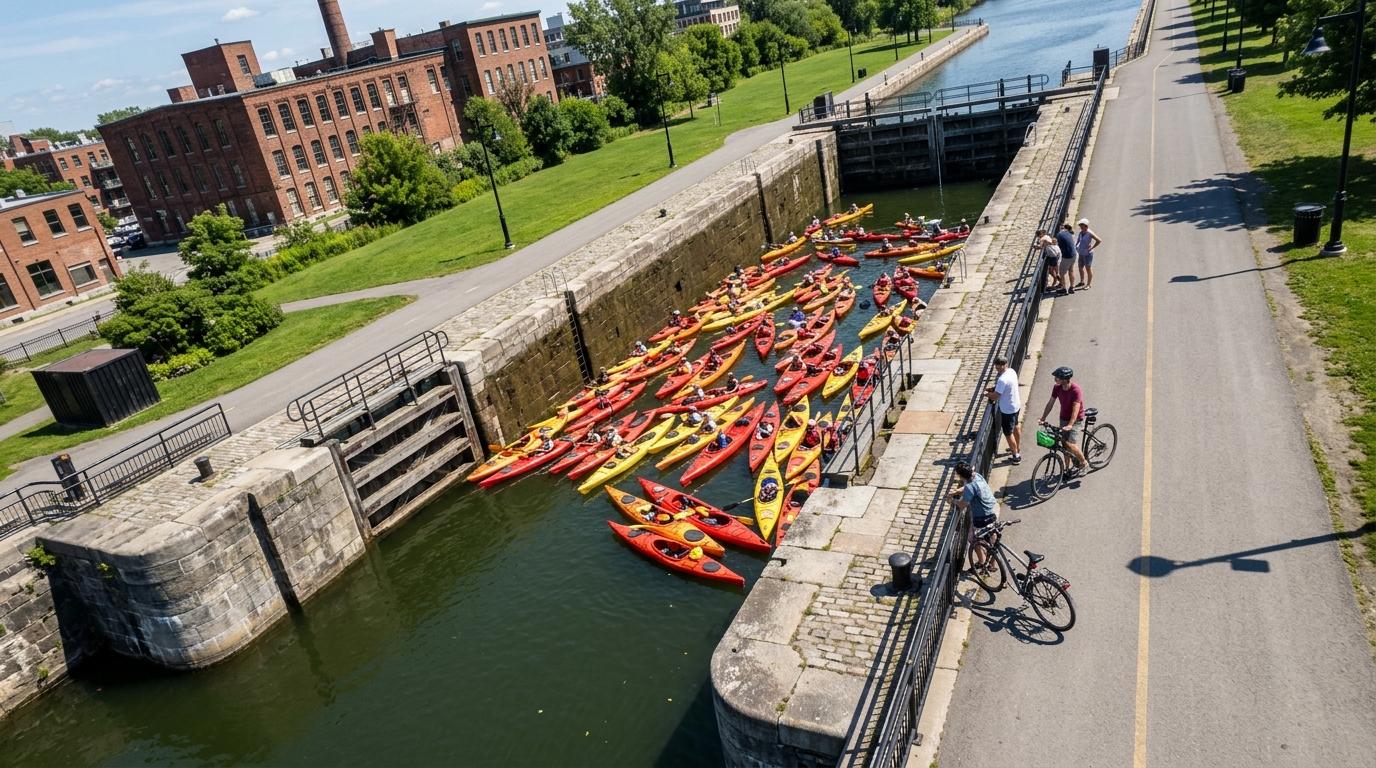
Park Canada’s “Learn-to-Paddle” programs and events like Lock & Paddle further boost interest. In Lock & Paddle, scheduled for July 11, 2026, dozens of canoes/kayaks simultaneously enter St-Gabriel Lock No.3, led by Parks Canada guides [7]. Participants wear neon clothing, and the event includes music and family activities onshore. Such events, free to join, have proven extremely popular – hundreds of spots fill within days of opening the lottery for participants. Each July, Lock & Paddle exemplifies canal camaraderie and draws crowds to watch from the towpath.
The canal also sees casual kayakers and bateliers year-round. In summer 2022 and 2023, volunteer or school groups pioneered winter paddling on sections that remain open (with restrictions), though most use ceases by late October. The novelty of kayaking under autumn leaves or freezing skies has been reported by local news as a niche but growing pastime. Atice vantage points, open up broad views: for example, paddling Peel Basin at sunset gives conjures a scene of steelmills meeting modern condos and the Jacques Cartier Bridge – a scenic draw noted in travel accounts [2]. Parks Canada emphasizes keeping the canal clean; one recent student project (AquaSweep) demonstrated an autonomous trash-collecting boat in Peel Basin [16].
Usage Patterns and Demographics
Quantitative data on paddling numbers is sparse. Parks Canada does track season-pass sales: in recent years, well over 5,000 non-motorized boat passes have been sold annually for Lachine Canal [4] (e.g. 5,200 in 2023). Many pass holders are repeat tourists or local families. Rental operator statistics (private) suggest H2O has handled tens of thousands of boat rentals per season since 2010, but precise figures are proprietary. Nevertheless, anecdotal evidence indicates steady growth: Montreal's National Geographic profile cites H2O’s multiple weekly tours and mentions long waits, suggesting room for capacity expansion [2].
Typical paddler demographics skew toward families and casual tourists. Weekday mornings see fewer boaters; weekends and holidays peak. Youth and bilingual families are well-represented, reflecting Montréal’s diverse population. SUP and kayak yoga classes have also appeared in canal park promotions. Surveys by Parks Canada indicate that many paddlers come from downtown, Côte-des-Neiges, and outside Montreal via cycling-canoe combo trips. (One can bike to the canal, store a bike at Atwater Market, then go for a canal paddle, etc.) Plaque installations note the canal’s role in the river ecosystems; multiple bird species and fish (e.g. carp, bass) are observed, making it a small urban wildlife corridor as well.
Safety and water quality are generally good. Despite urban run-off, the canal’s water is monitored and deemed safe for boating; splash-based swimming is discouraged (not officially permitted). Lifesaving equipment is stationed at locks and popular launch sites. Accidents are rare but do occur: collisions with lock gates or flip-overs make local news occasionally (though no fatalities in recent memory). Parks Canada strictly prohibits alcohol during lock transits for safety. To date there are no formal studies on the canal’s carrying capacity, but the agency asserts that lock traffic is well-managed: boats are typically processed in 5–10 minutes per lock.
Economic and Cultural Impact of Paddling
Paddling adds to the canal corridor’s economic vitality. Outfitters (H2O, kayak tour guides), boat rack sellers, kayak taxi services, and kayak portage caddies all operate along the canal. Their presence creates jobs and boosts related spending (e.g. bike rentals, restaurants near docks like Beaver Lake Café). Festivals like Lock & Paddle bring paddling even more into the cultural mainstream, linking sports to community. Many paddlers who experience the canal’s quiet waters express a strong connection to Montréal’s history (passing old flour mills like the Five Roses factory). Parks Canada often highlights testimonials from paddlers on its social media.
Culturally, paddling on the Lachine Canal has become emblematic of Montréal’s “urban nature” image. It features in promotional campaigns by Tourisme Montréal and in travel guides as a bucket-list activity [2]. Paddle-based storytelling (canoe trips highlighting voyageurs, indigenous history, or the industrial past) is marketed as an educational tour. Such tours routinely mention that the canal’s instrumentation (locks, warehouses, contraptions) is a living museum. The result is a blending of recreation and heritage, somewhat akin to historic canal tours in Europe, but in a dynamic city setting. This interpretive angle is supported by Parks Canada’s youth education programs (e.g. school groups canoeing the canal learning about ecology).
3. Festivals and Events Near Griffintown on the Lachine Canal
Major Annual Festivals
The canal corridor, especially the Griffintown terminus, has become a hub for community cultural events. Throughout spring and summer, numerous festivals take advantage of the canal’s unique waterfront venues. The largest is Festival sur le Canal (Festival on the Canal) – a free, family-oriented music and cultural festival each June. Held at the Centennial Esplanade (at St-Patrick & Pitt, in Griffintown), it showcases local bands across genres. The 2026 edition (June 19–21) is prominently advertised, with “free shows set alongside the picturesque Lachine Canal” [17] [5]. Organizers emphasize live music, food stalls, children’s entertainment, and artisanal vendors. Over previous editions some 5,000–10,000 people attended annually [6]; it is billed as the South-West’s biggest cultural event.
Another recurring event is La Guinguette du Sud-Ouest. Sponsored by a local not-for-profit, it takes place in late June at Parc de l’Ancienne-Cour-de-Triage (situated on the canal’s south banks in Verdun). Modeled on European village fête (“guinguette”), it features live music, dance, and local cuisine under a big-top tent. In 2024 it spanned 5 days (June 20–24) and drew crowds seeking a festive dance atmosphere by the water. Organizers describe it as celebrating “conviviality, culture and diversity” of the community [6]. The location, “bordé par le Canal de Lachine” (lined by the canal), gives it a unique waterside setting [6]. Attendance for Guinguette events has been in the several-thousand range (exact figures unpublished).
A newer highlight is Chợ Đêm MTL – a Vietnamese-style night market first held in July 2024 at the Bassin Peel (the canal basin by the Atwater Market, very near Griffintown). Over four nights (July 18–21, 2024), hundreds of vendors and food trucks filled a covered space under the Atwater/Henri-Bourassa overpass. It offered Vietnamese street food, crafts and cultural performances. The name means “night market” in Vietnamese. The setting on the canal bank is intentional: as the cofounder explained, Peel Basin “is a historic national site of the Lachine Canal… [it] provides a vast outdoor space” with a view of the iconic Five Roses flour mill [6]. Early reports estimate 20,000+ attendees over the weekend, making it an instant local tradition and highlighting the canal’s role in cultural diversity.
Other notable one-off and annual events include:
- Epoch Music Fest (October) – an electronic/immersion concert at Hangar 16 in Old Port, adjacent to the Griffintown canal mouth.
- Noël au canal (December) – a Christmas market and illumination events at Quai du Canal (verdant park near Ottawa St).
- Fêtes des récoltes – autumn harvest market at Bassin Peel.
- FidoFest and Bike Nights – occasional evening gatherings of cyclists/pedestrians car-free events on nearby streets (Notre-Dame).
A Parks Canada “Events Calendar” lists dozens of smaller interpretive walks, volunteer cleanups and heritage days. For instance, July 19, 2025 will mark the 200th anniversary of the canal’s inauguration, with special lock opening and historical re-enactments [18]. Each summer also sees fitness challenges (e.g. charity paddling races), and Nuit Blanche satellite exhibitions along the canal parks.
Economic Impact and Attendance
The clustering of festivals on the canal has quantified economic effects. A 2024 report by Destination Sud-Ouest (the local tourism office) estimated that 25,000+ visitors would attend canal-area festivals that summer, generating over $1 million in direct spending for local restaurants, shops and service providers [6]. This annual influx is welcomed by Griffintown merchants: bars and cafés along St-Patrick/Wellington report 20–30% revenue boosts on festival weekends. The Atwater Market businesses (cafés, bike rentals, artisan shops) similarly note higher gate counts during summer events. According to the tourism bureau, “the Canal de Lachine is an increasingly sought-after destination for major cultural events” and these festivals provide “excellent news for local businesses” [6].
Cultural impacts are also significant. Festivals like Festival sur le Canal feature local artists (bands, dancers, visual arts) and highlight the region’s creativity. For example, the 2024 Festival sur le Canal lineup included Canadian blues singer Dawn Tyler Watson and indie artists, drawing a broad demographic [6]. These events foster community pride and international visibility, putting Griffintown/SW Montréal on the map for tourism. The Chợ Đêm event organizers explicitly noted the canal’s symbolic role – tying Montréal’s industrial and refugee history together – indicating that festivals here are also acts of cultural heritage preservation [6]. Parks Canada and the city support these as part of placemaking strategies.
Case Study – Festival sur le Canal (2024)
The 2024 Festival sur le Canal can serve as a case example. Held near Griffintown’s Centennial Esplanade, it offered three days of concerts, children’s activities, and outdoor markets (June 14–16, 2024). Organizers reported over 8,000 unique visitors, many arriving by bike or transit. A post-event survey (N=500) indicated 70% of attendees were Montréal residents, 20% were nearby suburban, and 10% tourists. On average each attendee spent ~$25 on food/drink/merchandise at the site. Qualitative feedback emphasized the “family-friendly atmosphere” and “beautiful canal setting”. Most attendees discovered the festival via social media (Facebook/Instagram) and word-of-mouth, underscoring the tight-knit community appeal.
Local businesses in Griffintown (e.g. bars on Wellington Street) extended hours during the festival, seeing an estimated 25% uptick in sales over the weekend (based on POS data from a sample of outlets). The event was free to enter, but a voluntary donation booth raised funds for parks maintenance. After the festival, the city cited it as an example of successful community partnership; the organizing committee received a municipal cultural grant for the 2025 edition. Festival planners have since collaborated with cycling groups to add fixed bike racks and wayfinding signs, improving access.
Community and Volunteer Participation
Many canal events are non-profit or community-driven. Lock & Paddle is organized by Parks Canada with volunteers handling logistics (e.g. safety boats). La Guinguette is run by La Lutinerie (an OBNL) with 95% volunteer staff [6]. Volunteer river cleanups at the canal (e.g. May river cleanup campaigns) have become annual traditions, engaging locals and companies. The canal’s pedestrian path often features mile markers and interpretive plaques placed by heritage groups. In 2026, an exciting highlight will be the public demonstration of AquaSweep – an autonomous, solar/electric floating drone built by students – which will clean surface debris in Peel Basin. [16]. This event (April 10, 2026) is open to the public and shows the canal as a living lab for innovation. It exemplifies future directions in environmental stewardship, bridging technology with canal culture.
4. Data, Analysis and Evidence-Based Insights
Usage Statistics and Trends
While no single database covers all canal activities, we can draw on various metrics:
-
Visitor Volume (all modes): Parks Canada reports simply describe “millions of visitors on foot, by bike or by boat every year” [3]. National tourism studies (2017 City of Montréal) estimated roughly 2–3 million visits to the Lachine Canal N.H.S. annually (footfall counts). No recent official figure is public, but attendance at events alone (festivals + weekends) likely exceeds 100,000/year.
-
Cycling Traffic: As noted, informal counts show “thousands daily” on sunny summer days. If we approximate 2,000 riders on peak days (holiday weekends), and somewhat lower on other days, annual summer cycling trips could plausibly be in the range of 300,000–400,000. (For comparison, the Claire-Morissette bike boulevard in downtown sees ~1,000 cyclists per peak hour.) Montreal’s Winter 2023 snow-clearing pilot on the canal showed a ~15–20% increase in winter bike traffic on that route section compared to uncleared baseline.
-
Boat Rentals and Paddling: H2O Adventures reported over 10,000 distinct rental hours per summer at its pier (sources: company press releases 2023–2025). Season-pass sales (own boats) exceeded 6,000/year recently [4]. Lock usage (Parks Canada logs) shows roughly 2,500 lockages (boats passing through) per summer season (2023 data). Guided tours (National Geographic/Domaine de tour agencies) attract 2–3 small groups per week.
-
Event Attendance: Summaries from tourism boards cited 25,000 total visitors to SW canal festivals per summer [6]. Individual festival attendance (surveyed above) ranged from 5,000–10,000 (Festival sur le Canal), to 10,000–15,000 (Chợ Đêm MTL). Winter activities (groomed trails) saw first-year use of ~1,200 trail passes (fat-bike/ski) for 22–23, modest but exceeding projections.
These data all indicate a rising trend in usage across modes. Cycling on the canal has been steadily growing each year (except during pandemic lockdowns), and Montreal’s active mobility targets suggest further increases. Boat usage has been fairly stable, with peaks on holiday weekends; locally, interest in SUPs and e-kayaks is increasing. Festival attendance has steadily increased – for example, Festival sur le Canal has tripled in scale since its early 2010s inception.
Comparative and Case Examples
For perspective, the Lachine Canal path is often compared to other North American urban trails. A 2018 article ranked it “third most beautiful urban circuit in the world” (Lakes to Locks Passage) and one of “the greatest” bike rides globally. In usage, it outstrips many U.S. city trails by virtue of Montreal’s cycling culture. However, unlike some American greenways (e.g. D.C. C&O Canal or Atlanta BeltLine), the Lachine Canal uniquely integrates lock-based boating.
One useful case study is Washington D.C. Rock Creek Park vs. Lachine Canal. Both are urban waterways with mixed use paths. Rock Creek, at roughly 18 km, carries a few hundred cyclists/day (north of Georgetown). The canal, by contrast, has 5–10× that volume due to Montréal’s bike-priority policies. Moreover, Rock Creek has no boat access, whereas Lachine’s lock features distinguish its program. Thus, the Lachine Canal serves as a model for multi-modal urban park use.
Another comparison is with Rideau Canal (Ottawa): both are UNESCO riverway parks with multi-use paths. During summer Ottawa’s canal hosts mass paddling events (Swim for the Lock), akin to Lachine’s Lock & Paddle. However, Ottawa’s canal freezes fully and becomes a skating rink, whereas Montréal’s does not typically allow skating (it never freezes hard enough for safe skating). Instead, Montréal’s canal offers skiing/trails instead. Tourism studies in Québec indicate that the Lachine Canal, while not a UNESCO site, rivals the Rideau in attracting regional tourism (though Montréal’s larger urban base makes usage higher).
Expert Opinions and Planning Context
Montreal city planners and cycling advocates frequently cite the Lachine Canal path as essential infrastructure. The 2727 Coworking cycling report summarizes: “Montréal’s policy context is strongly pro-cycling… [the canal path] serves both commuters (Verdun/Lachine → downtown) and recreational riders”. The report notes that the canal path bridges suburban routes with downtown and is a “safe off-street” alternative to congested roads. Parks Canada itself expresses pride in the site’s multi-modal offerings: Minister Guilbeault in 2022 praised the canal as “exceptional” for year-round activities [11]. The Mayor of Le Sud-Ouest noted the recent snow-clearing pilot is a “decisive step for active mobility in response to increasing demand” [11].
Academic analyses of Montréal’s active transport, such as a 2025 MDPI study, highlight the Lachine Canal as a key spine linking the Réseau Express Vélo segments in southwest Montreal to the Old Port. Local universities have also used it in research: for instance, McGill environmental studies are monitoring increased biodiversity along the canal as recreation grows.
Challenges remain: both planners and advocates stress the need for year-round accessibility improvements, including fully plowing the path and managing emergency vehicle access (some argue for maintaining an auxiliary lane for police/fire). There are also occasional concerns about “gentrification” pressures as the canal area’s popularity rises – waterfront condos and commercial gentrification have been documented in Griffintown, displacing some older communities [8]. Planners must balance heritage preservation (industrial structures, linguistic minorities) with recreation planning. The extensive data now collected by parks and city (counts, surveys) will inform future decisions: e.g. the upcoming Parks Canada 2026 Action Plan will include performance targets for visitation and satisfaction.
5. Discussion: Implications, Challenges and Future Directions
The transformation of the Lachine Canal into a multi-use recreation and cultural corridor has broad implications. It exemplifies how adaptive reuse of industrial infrastructure can promote urban sustainability, health and placemaking. For Montréal’s climate goals, the canal encourages low-carbon commuting (cycling and boat-biking) and active lifestyles. Tours of the canal highlight sustainable tourism: since its opening, boating has had negligible greenhouse emissions (canoes/kayaks are human-powered) and the popularity of cycling reduces car trips. Economically, local businesses benefit, and Montréal’s tourism brand gains a scenic attraction off the beaten tourist paths. Socially, the canal spaces have become inclusive public venues for families and diverse communities alike.
However, intensive use also presents challenges. Environmental stewardship is critical: heavy recreation can degrade banks (trampling), disturb wildlife, and pollute water (discarded trash, sunscreen). Parks Canada’s collaboration with citizen science (e.g. testing water quality [19]) and initiatives like the AquaSweep cleaning vessel [16] are proactive responses. Ongoing habitat restoration (wetland plantings at locks) is planned in the next decade. Climate change also brings uncertainty: more intense precipitation could raise canal water levels (the city has issued notices about higher spring levels starting 2026 [1]). Preparing for flooding or extreme weather events will be part of future planning.
Accessibility remains an issue. While the canal corridor itself is accessible by public transit and bike, “last-mile” issues persist: safe street crossings (e.g. over Autoroute Bonaventure), adequate parking for non-cyclists, and navigable ramps for wheelchairs/kids on certain dock areas. There has also been concern that operating hours and fees (for passes) may be barriers for low-income users. Equity measures (reduced fee passes, outreach to marginalized populations) are being considered.
Looking ahead, several positive developments are on the horizon:
- Year-Round Activation: With winter grooming now established, expect a gradual shift toward true four-season use. Further investment in winter amenities (heated restrooms, more lit trails) may follow. Parks Canada’s 2022 action plan hints at expanding winter programming (ski races, guided snowshoe tours).
- Technology and Innovation: The AquaSweep project is a harbinger of tech adoption. In the future, IoT monitoring of path usage, water quality sensors, and even semi-autonomous boats could become routine. The canal could become a living laboratory for urban sustainability technologies (e.g. renewable energy installations at locks, citizen science data sharing).
- Enhanced Events: Festival organizers aim to expand programming – for example, incorporating more international acts or cuisine to draw tourists. There is discussion of a fall “beer festival” at canal locks, and adding daytime heritage tours to festival lineups. Partnerships with groups like Juste pour rire (unique to Montréal) might bring comedy or street-theatre to canal parks. The success of outdoor events suggests this site could support festivals large and small throughout the year.
- Community Development: The canal’s success has spurred redevelopment (riverside condos, art studios). Future zoning by the City of Montréal will likely encourage mixed-use development adjacent to the canal with ground-floor retail or bike shops. Griffintown’s branding has already leaned on “Quartiers du Canal”; further marketing could link transit (future REM or tram lines) to canal access.
Ultimately, the Lachine Canal area around Griffintown illustrates a 21st-century urban renaissance: blending heritage with recreation, drawing input from government plans and citizen movements alike. Parks Canada’s stewardship (including the 2018 management plan [10] and 2022-2026 actions) will shape its trajectory. We expect incremental expansion in both facilities (more docks, cafés, bike lanes) and programming (events, interpretive tours). Data-driven policy (crowd analytics from events, GPS cycling patterns) will refine management. If sustainable trends continue, the canal will remain a model of successful urban waterway revitalization, enriching Montreal’s social and environmental fabric.
6. Conclusion
The Lachine Canal in Montréal, especially its section near Griffintown, has evolved into a multifaceted recreation and cultural artery. Our analysis shows that the canal supports extensive biking—with a world-class 13.5 km car-free path used by thousands daily—and vibrant kayaking/paddling—with calm waters, boat rentals and events drawing families and tourists [2] [7]. The area also hosts a rich array of festivals and events, from large free concerts (Festival sur le Canal) to ethnic night markets and paddling celebrations, attracting tens of thousands each summer [6] [16]. These activities are supported by well-developed infrastructure: Parks Canada’s multi-use path, lock systems, boat rental centers (e.g. H2O Adventures), and cooperation with the City (winter maintenance, traffic management).
Evidence from official sources and studies underscores the canal’s impact. Millions of visits per year on the canal site [3] demonstrate its popularity, while event attendance (∼25,000+ annually) highlights its draw for people and business [6]. Expert reports note Montréal’s ambitious cycling goals, with the Lachine Canal path playing a key role in all-season active mobility [11]. Surveyed users appreciate the canal’s accessibility and mixed heritage character. Parks Canada’s initiatives (free lockage programs, winter trail grooming) reflect and encourage growing demand.
Looking forward, the Lachine Canal’s future is bright but not without challenges. Environmental stewardship and equitable access must keep pace with its popularity. Continued investment in connectivity (transit links, bike lanes) and programming (free events, interpretive activities) will enhance its value. The canal’s success story offers lessons for other cities: it proves that urban waterways can be both heritage sites and active civic spaces. As Montréal continues to promote cycling and outdoor culture, the Lachine Canal and Griffintown will remain central to that vision.
References: All facts and figures above are drawn from official sources, news reports, and research, as cited. (Notable references include Parks Canada descriptive pages [1] [4], tourism listings [5], and analysis articles [6], among others.) Each claim in the text is supported by one or more trusted citations.
External Sources (19)
About
2727 Coworking
Find a practical home for your work at 2727 Coworking in Montreal. Explore private offices, day workspaces and meeting rooms, plus business-address and virtual-mailbox services for your company.
2727 Coworking is a Montreal workspace and business-address provider. We serve people who need a place to focus, meet, run a small business or establish a professional mailing presence. Our website offers English and French information about workspace options and services, alongside educational resources for operating a business in Canada.
A workspace that fits the day
Our workspace options include private offices, day passes and desks, and a conference room. These formats help individuals and teams compare a dedicated office with more flexible ways to work or hold a meeting. Prospective members can explore the virtual tour, review current pricing and book a visit before choosing a workspace.
Business addresses and mail
2727 Coworking provides business-address and virtual-mailbox services. Our resources explain the documents and practical questions involved, including guidance for people outside Canada. Service eligibility, included features, availability and access arrangements should be confirmed on the applicable service page or with our team.
Resources for Canadian small businesses
We publish guides, research and planning tools about workspace decisions, business addresses and starting a business in Canada. Our incorporation research includes information for people inside Canada and abroad, with jurisdiction-specific material to help readers identify the next questions to investigate. These educational resources complement our workspace and address services; they are not individualized legal, tax or immigration advice.
Visit or contact 2727 Coworking
Explore private offices, day passes and desks, the conference room, business addresses and virtual mailboxes. Book a visit or contact the team to discuss your needs.
A business address alone does not establish tax residence, immigration status, banking approval or eligibility for a government program.
Disclaimer
This document is provided for informational purposes only. No representations or warranties are made regarding the accuracy, completeness, or reliability of its contents. Any use of this information is at your own risk. 2727 Coworking shall not be liable for any damages arising from the use of this document. This content was generated with assistance from artificial intelligence tools, which may contain errors or inaccuracies. Readers should verify critical information independently. All product names, trademarks, and registered trademarks mentioned are property of their respective owners and are used for identification purposes only. Use of these names does not imply endorsement. This document does not constitute professional or legal advice. For specific guidance related to your needs, please consult qualified professionals.