2727 Coworking Article
Montreal AGM Venues & Quebec Corporate Law Compliance
Inside this article
- 01Executive Summary
- 02Introduction and Background
- 03Montreal’s Corporate Landscape and AGM Context
- 04Regulatory and Compliance Requirements for Quebec AGMs
- 05Planning and Conducting the AGM in Montreal
- 06Case Studies and Examples
- 07Data, Trends, and Broader Perspectives
- 08Hosting a Quebec Shareholder Meeting: Step-by-Step Guidance
- 09Compliance Enforcement and Legal Risks
- 10Case Study: Recreational and Informal AGMs
- 11Future Directions and Implications
- 12Conclusion
Executive Summary
Montreal hosts a vibrant corporate ecosystem with thousands of active businesses, requiring formal annual general meetings (AGMs) to satisfy governance and legal obligations [1]. This report examines venues and support services for AGMs in Montreal – from hotel boardrooms and convention centers to coworking spaces – and surveys the detailed legal and regulatory compliance requirements under Quebec law. Key considerations include statutory deadlines for holding AGMs (generally within 15–18 months of the prior AGM) [2], mandatory notice periods (often 10–21 days by default, extended to 21–60 days for public companies) [2], record-date rules [2], and prescribed meeting procedures (agenda items, quorum, voting methods) [2] [3]. The report also covers how modern trends and technologies (hybrid/virtual AGMs) are being adopted, guided by updated securities-regulator guidance [4] [5]. Throughout, extensive comparisons are drawn between Quebec’s Business Corporations Act (QBCA) and comparable statutes, and practical advice is given on planning and executing a compliant shareholder meeting. As AGM formats evolve with technology, stakeholder questions about accessibility and participation have prompted best-practice guidance to ensure fair and transparent meetings [4] [6]. The conclusion highlights implications of language laws (e.g. Quebec’s Bill 96 on French translation requirements) and future directions for AGM practice in the Montreal context.
Introduction and Background
An Annual General Meeting (AGM) is a central corporate governance mechanism by which a company’s shareholders exercise oversight (electing directors, approving financial statements, appointing auditors, etc.) [2] [3]. In Canada, AGMs are mandated by corporate statutes for most incorporated enterprises, serving both legal and governance functions. Quebec’s modern Business Corporations Act (QBCA) (updated in 2010/2011) governs Quebec-incorporated companies, while many Montreal-headquartered firms (especially larger or cross-provincial ones) may be federal corporations under the Canada Business Corporations Act (CBCA). Regardless of jurisdiction, an AGM typically requires advance notice to shareholders, a prescribed agenda, and a prescribed process for motions and voting. Members entitled to vote (generally shareholders of voting shares) participate by voting on resolutions, often by proxy or in person [3].
In Montreal – Quebec’s economic hub – the diversity of business forms (public companies, private corporations, non-profits, co-operatives) means that meeting requirements vary by context. Public issuers must also follow securities regulations (e.g. sending proxy circulars via SEDAR+ and complying with CSA rules). Notably, global trends (e.g. virtual meeting platforms) have begun to influence Canadian AGMs, as seen during the COVID-19 pandemic [6]. Nonetheless, core legal requirements persist. This report provides a deep dive into (a) the range of venue options and support services for hosting AGMs in Montreal (the “AGM Boardrooms” context), (b) the detailed compliance requirements under Quebec and Canadian corporate law, and (c) practical guidance on how to conduct a Quebec shareholder meeting. The aim is to synthesize multiple perspectives – regulatory guidance, corporate best practices, case examples – and present data where available.
Montreal’s Corporate Landscape and AGM Context
Montreal is Canada’s second-largest corporate center, home to thousands of enterprises. Recent data indicate over 200,000 active businesses are registered in Montreal [1], ranging from small start-ups to major multinationals. Many of these entities are corporations that must hold AGMs by law. For example, Crown corporations, publicly traded companies (e.g. Bombardier, Cirque du Soleil, SNC-Lavalin, etc.), and numerous private companies headquartered in Montreal all face formal meeting requirements. Major sectors include finance, manufacturing, aerospace, pharmaceuticals, and technology, meaning AGM venues must accommodate a range of meeting sizes and formats.
Montreal’s unique character – bilingual, with strong French language requirements – also influences AGM practice. While there is no explicit statutory mandate that AGMs be bilingual, Quebec’s Charter of the French Language (“Bill 101”) and its 2022 extension (“Bill 96”) impose linguistic obligations on businesses. In practice, many Montreal companies provide French (and often English) materials and interpretation at meetings. For example, Quebec’s Bill 96 now requires French channels for public communications, which experts warn will obligate companies to ensure French translation at events [7]. In Montreal, where about 79% of residents are native French speakers [7], providing French-language access (e.g. via simultaneous interpretation) is both legally prudent and socially expected. Vendor Solutions platforms note that Bill 96’s requirements mean businesses “need to be prepared to comply” by potentially rethinking meeting logistics [7]. Thus, event planners in Montreal often include French interpretation services for AGMs, especially for publicly held companies. These language considerations add another layer to venue and logistics planning.
Local organizations and government tourism boards highlight a variety of Montreal venues capable of hosting corporate meetings (beyond the usual hotel ballrooms).Tourisme Montreal, for instance, lists strategic-meeting venues such as the historic University Club (“14 rooms… from 3 to 300 guests”, Percy Nobbs building) [8], the Saint James Club (11 rooms, up to 250 seats) [8], and even museum boardrooms like the “Admiral Room” at Pointe-à-Callière (a large-table meeting space with presentation equipment) [8]. Unique event spaces include the Rooftop Terrasse at Phi Centre overlooking the river, Château Dufresne (a converted 1920s mansion), and the Crew Collective café (an upscale coworking space in a former Gothic bank hall) [8]. These examples show Montreal’s range of boardroom-style and out-of-the-box venues: from intimate boardrooms for 10–20 people to grander halls for 200+. (Table 1 below lists representative venues and capacities; see Appendix for more Montreal venues).
Beyond conventional sites lie many “coworking” and meeting-room providers. Global operators like Spaces, Regus, LiquidSpace, and Desktime have dozens of downtown Montreal locations offering on-demand meeting rooms. These spaces typically rent by the hour or day and come fully equipped. For example, Regus’s Crémazie Avenue location offers private meeting rooms for 8–12 persons (including high-speed Wi-Fi, AV screens, catering options) [9]. Spaces advertises that its Montreal meeting rooms are equipped “with the latest amenities… from meeting rooms with whiteboards to conference rooms with TVs” to foster collaboration [10]. LiquidSpace promotes that corporate meeting rentals include “free high-speed Internet… and state-of-the-art presentation gear” [11]. In practice, these flexible spaces are often used by smaller companies or as overflow for larger events. They provide a quick solution when a company needs immediate boardroom access without long-term rental commitments.
Table 1: Sample AGM Meeting Venues in Montreal. (Representative examples of boardroom/meeting spaces, not exhaustive.)
| Venue/Location | Type | Capacity | Key Features | Sources |
|---|---|---|---|---|
| University Club of Montreal | Private club (downtown) | 3–300 (14 rooms) | Historic clubhouse, full-service | [8] |
| Saint James Club (Montreal) | Private club/hotel | Up to 250 | Discreet 1920s ambiance, catering | [8] |
| Palais des congrès de Montréal | Convention centre | Thousands (reg.) | 47,000 m² exhibit halls, many rooms | [12] (47,265 m², 113 rooms) |
| Pointe-à-Callière (Admiral Room) | Museum boardroom | ~20+ | Large table, AV equipment, historic | [8] |
| Phi Centre – Rooftop Terrace | Art centre (Old Montreal) | 20–100 | Outdoor/indoor terrace, city views | (internal venue listing) |
| Crew Collective Café | Coworking/café (historic) | 10–50 | Open loft, café service, Wi-Fi | [8] |
| Ferreira Café (Rosa Room) | Restaurant (Old Port) | ~12 | Semi-private dining room | [8] |
| Regus (various co-working sites) | Flexible office space | 8–12 per room | Rental by hour, all conferencing AV | [9] [11] |
| Spaces (Downtown, Old Port) | Flexible office space | 6–20 per room | Premium meeting rooms, tech-ready | [13] [10] |
| Hotel ballrooms (e.g. Hilton) | Hotel/conference venue | 50–500+ | Full AV, dining services | (numerous hotel sites) |
Sources: Montreal tourist board and venue descriptions [8]; coworking site listings [9] [13]; Palais des congrès brochure [12]. This list illustrates that Montreal offers both traditional AGM boardrooms in hotels and clubs, as well as creative or hybrid venues (ships, museums, coworking, restaurants) as meeting spaces.
Regulatory and Compliance Requirements for Quebec AGMs
Hosting an AGM in Montreal requires strict compliance with corporate law. The QBCA (Quebec Business Corporations Act, chapter S-31.1) and the federal CBCA each impose substantive rules on meetings of shareholders. In Quebec, these include:
-
Annual meeting timing. Under the QBCA, the first AGM must be held no later than 18 months after incorporation, and each subsequent meeting must occur within 15 months of the last AGM [2]. This “15-month rule” ensures shareholders meet at least once per year. (For illustration, the QBCA explicitly states: “an annual meeting of shareholders… must be held… not later than 18 months after [incorporation] and, subsequently, not later than 15 months after the last preceding annual shareholders meeting” [2].) Similar timeframes apply under the CBCA (generally 18 months for the first meeting, then annually).
-
Notice of meeting. The corporation must send formal notice of the AGM to all shareholders entitled to vote, and to each director. Under QBCA § 165, notice period is given by the corporation’s by-laws or, if none specified, “not less than 10 days before the meeting” [2]. Importantly, if the company is a reporting issuer (i.e. publicly traded), securities laws typically require a longer notice of at least 21 days (but not more than 60 days) before the meeting [2]. In practice, most Quebec and federal public companies adhere to a 21-day minimum to allow proxy voting. The notice must specify the time, place, and agenda of the meeting [2]. AMF guidance confirms that standard practice is to mail a notice indicating “the date of the meeting, the location, the time, [and] the items to be discussed” [3].
-
Record date and voting lists. The company sets a record date to determine who is entitled to vote at the meeting. The QBCA requires the record date to be “not less than 21 days and not more than 60 days before the meeting” [2]. Canadian law broadly mandates such advance “books closure” rules: OECD data show that over 90% of jurisdictions require a legal record date for voting [14]. In Canada, once declared, no share transfers can affect voting eligibility for that meeting. Shareholders on record may attend or vote by proxy. (The QM’s notice and circular typically instruct how beneficial holders can vote through intermediaries, as per National Instrument 54-101 requirements.)
-
Proxy and circulars. Quebec law and securities regulation require that shareholders be informed via an information circular and proxy form sent with the notice [3]. The circular discloses agenda items, director nominees, auditor information, executive compensation, and proposals, allowing shareholders to make informed voting decisions. Securities regulators (AMF/CSA) mandate that proxies be solicited in good faith; circulars must contain detailed instructions on how to appoint management or other proxies and how to vote on each resolution [4] [3]. The QBCA § 167 also requires the text of any special-resolution motions to be included in sufficient detail in the notice [2]. It is common practice (and often required by exchange rules) to use notice-and-access or electronic delivery for proxy materials, subject to strict disclosure guidelines. For example, the CSA’s recent guidance emphasizes providing clear “plain language explanations” of how to access and vote, whether in person or virtually [4], to fulfill fiduciary information duties.
-
Meeting business (agenda). At the AGM, ordinary business usually includes receiving the annual financial statements and auditor’s report, electing directors, appointing auditors (or renewing a firm’s mandate), and approving matters such as by-law amendments if needed. The QBCA confirms that shareholders have the right to approve the financial statements and to “adopt, amend or repeal by-laws” at the AGM [2]. (These are powers listed under s.118 of the Act.) Any special items (e.g. mergers, capital changes) must be properly advertised in advance. AMF materials note that voting at meetings is typically done by a show of hands, but a secret ballot is required “at the request of any shareholder” [3]. Shareholder proposals (under s. 142 of QBCA and NI 51-102) must be included if properly submitted in advance; Quebec law (s. 182–183 QBCA) allows shareholders to put forward proposals for AGM discussion, subject to certain notice and eligibility rules.
-
Quorum and holding the meeting. By default, a quorum for the AGM is usually two persons if the corporation has more than one director (or as provided by by-law). The QBCA provides default quorum rules for boards and shareholders (typically the greater of 1/3 of all shares). Once quorum is present, the meeting may proceed. If the requisite majority is absent, it can be adjourned, with the same notice rules applying for resumption after 30 days [2]. (Notably, under s. 168 QBCA, waiving notice is possible: attendance without objection is deemed consent [2].) The meeting chair must verify quorum and conduct voting on each motion, tabulating proxies and ballots. After the meeting, corporations must record the proceedings in minutes, and typically announce results (numerical votes) of each resolution – a practice common in Canada, where disclosure of AGM minutes is expected in most markets [14].
-
Additional compliance. Separately, the corporation must ensure its AGM and afterward filings are up to date. Quebec companies must file annual returns with the Registraire des entreprises, and news of any changes in directors or share capital resulting from the meeting (e.g. new directors, by-law changes) must be filed. If voting by ballot occurs, the results (tally of votes) and minutes are retained. Also, if changes (e.g. director election) require regulatory disclosure, these are promptly announced. Public companies must also comply with securities law: delivering audited financial statements, interim MD&As, etc., usually via SEDAR+ as part of the circulation of proxy materials.
In summary, compliance requirements for Quebec AGMs are multifaceted: corporate law sets the meeting timeline and formalities [2], regulator guidance imposes disclosure obligations [4] [3], and prudent corporate practice (often following ICS and OECD “best practices”) ensures that shareholders have a fair opportunity to participate (e.g. well ahead notice, voting infrastructure, question periods) [4] [3]. All resolutions must be properly proposed, approved by the correct majorities (ordinary vs special), and recorded in company records.
Comparative Legal Requirements: Quebec vs. Other Jurisdictions
Although this report focuses on Quebec, it is instructive to compare key AGM rules in Quebec (QBCA) with federal (CBCA) and, for context, Ontario (OBCA). Table 2 below highlights several mandatory aspects:
Table 2: Comparison of AGM Requirements – QBCA vs. CBCA vs. (OBCA).
| Requirement | Quebec (QBCA) | Canada (CBCA) | Ontario (OBCA) |
|---|---|---|---|
| First AGM (after incorporation) | By 18 months of incorporation | By 18 months after incorporation | By 18 months after incorporation |
| Subsequent AGM interval | Within 15 months of last AGM [2] | Within 18 months (some say 21 months?) of last AGM¹ | Within 15 months of last AGM (similar to QBCA) |
| Notice period (non-reporting issuer) | By-law or ≥10 days before meeting [2] | At least 21 days (s. 146 CBCA). | At least 15 days (default; 21 for audited corp). |
| Notice period (reporting issuer) | ≥21 days, not more than 60 days (as per securities rules) [2] | ≥21 days (min, up to 60 days) | ≥21 days, up to 60 days (for default majority vote items). |
| Record date (to vote) | ≥21 and ≤60 days before meeting [2] | Typically set 10–60 days before meeting (NI 54-101). | ≥10 days before meeting in default (often same 21–60). |
| Advance notice for proposals | Must state special resolutions in notice [2] | Similar OBCA/CBCA proxy regimes (NI 51-102 in effect) | Vibrant shareholder proposal regime (NI 54-101 rules). |
| Quorum (shareholders) | By default: 1/3 of shares, or as by-law (≈2 persons if ≥2 directors) | 5 persons or 5% of shares (chosen by company’s articles). | 1 person if >1 director (or default 5% of shares). |
| Voting (roll call) | Show-of-hands normally; secret ballot if requested [3] | Show-of-hands (unanimous agreement allows acoustical means). | Same as CBCA. |
| Shareholder requisition | ≥10% shares can requisition board to call meeting [2] | ≥5% (or prescribed) if CBCA. | ≥5% of shares (OBCA)- similar process. |
| Statutory agenda items at AGM | Financial statements, appoint directors/auditors, by-law changes [2] | Same (CBCA s. 159) | Same (OBCA s. 80). |
| Virtual meetings allowed (electronic) | Allowed if not prohibited by charter/by-law [15] (QBCA is silent on restriction) | Allowed only if by-law permits (CBCA s. 105(1), amended 2022). | Allowed (participants on call counts for quorum by default). |
Notes: ¹Some sources indicate the CBCA allows up to 18 months between AGMs (with extensions by by-law potentially to 21 months), whereas the QBCA explicitly limits to 15 months. The Ontario and Quebec rules are quite similar in practice.
This comparison underscores that Quebec’s corporate statute largely mirrors other Canadian rules, with minor distinctions (e.g. QBCA mandates 15-month intervals vs. CBCA’s often-quoted 18 months). Notably, virtual meetings are treated differently: Quebec and Ontario law generally allow virtual/hybrid formats unless the articles prohibit them, giving flexibility [15]. By contrast, the federal CBCA (prior to 2022 revisions) required explicit by-law authorization for e-meetings – a difference that led many federal corporations to pass new by-laws or seek exemptions during COVID. The Torys law firm confirms that under QBCA (and OBCA) companies “generally have flexibility to conduct virtual meetings—unless the articles or by-laws say otherwise” [15]; CBCA (and Alberta’s ABCA) historically required an express by-law for a fully electronic meeting [15].
Given these statutory frameworks, Quebec companies should review their incorporation documents to ensure compliance. For example, bilingual corporations or internal by-laws might explicitly permit or restrict virtual attendance. Directors and corporate counsel typically interpret these rules conservatively: even if virtual is allowed, the Canadian Securities Administrators (CSA) caution that issuers should preserve shareholder rights by enabling Q&A and voting equivalently for remote participants [4].
Planning and Conducting the AGM in Montreal
Beyond the letter of the law, practical execution of an AGM requires careful operational planning. Corporate issuers often engage internal or external resources to manage logistics. A 2026 survey by Computershare reports that ~10% of Canadian AGMs (in its client base) were virtual/hybrid in 2024 [5], reflecting that most meetings remain in-person or hybrid. In either case, the logistical and technical requirements are substantial.
Meeting planning involves several stages. Event professionals recommend beginning months in advance. According to INNOV’events (a Canadian AGM-focused event agency), the first step is governance mapping: clarifying the meeting type (shareholder vs. member meeting), expected attendance, voting rules, accessibility needs (e.g. wheelchair access, live captioning), and any “reputational sensitivities” (e.g. activist shareholder presence) [16]. This yields a project plan with key dates and responsibilities (e.g. deadline for filing notice, finishing slides, rehearsals). At this stage one also confirms corporate details such as the record date (usually several weeks before the AGM) and ensures the electronic shareholder register is up-to-date, as required by law.
Next comes venue selection and technical preparation. Organizers check that the chosen venue (hotel ballroom, convention center hall, boardroom, or webcast studio) has adequate AV facilities, internet bandwidth, and seating. For hybrid events, connectivity and redundancy must be planned: live streaming hardware, webcast controls, and a protocol for shareholder questions (e.g. text chat vs. live microphones). As INNOV’events notes, technical requirements – from camera placements to wireless mic strategy – should be aligned to the venue’s acoustics and sightlines [16]. Montreal venues with built-in AV (e.g. Palais des congrès, many hotels) simplify this, but even a coworking rental like Spaces will include standard projectors and screens.
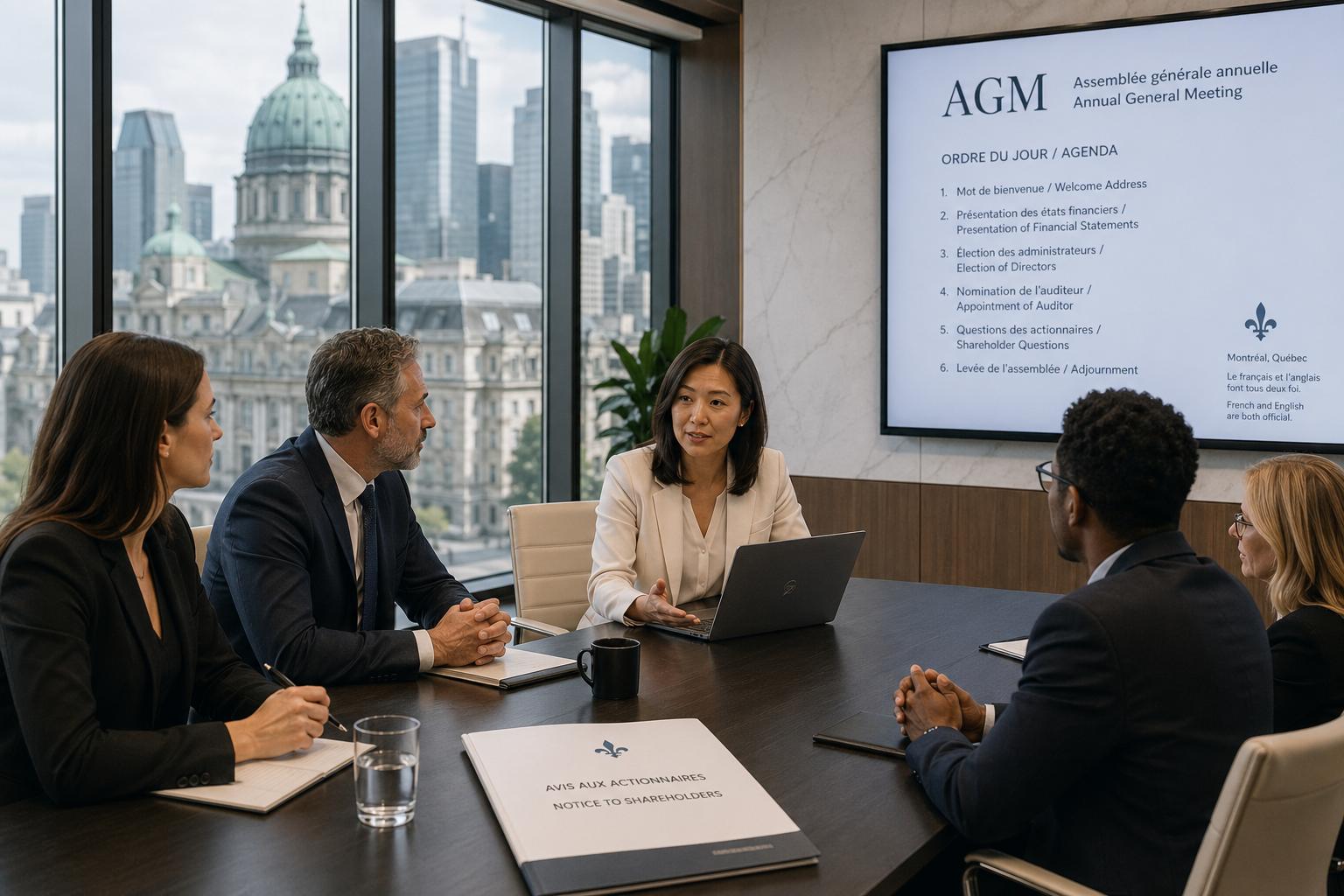
A key preparatory output is the detailed agenda and scripts. The agenda lists every item to be covered (e.g. President’s remarks, financial review, Q&A, election of directors, special resolutions). Speaking parts (Board chair, CEO, CFO, auditor) are timed. The corporate secretary or event handbook typically creates a “show book” or run-of-show script, coordinating slides and presentations. INNOV' shows that for AGMs, this involves building speaker cue sheets and locking slide decks so that management isn’t scrambling with last-minute changes during the meeting [16]. Practically, this means any slide deck with financials or performance highlights is finalized at least a week in advance and circulated to presenters. A "final show book" is prepared for the chair and floor manager [16].
Charged with running the meeting day is often a show caller or meeting coordinator. Prior to the AGM, the team rehearses critical transitions: confirming all speakers can be heard, slides advance properly, and video feeds (for remote attendees) work smoothly. On meeting day, registration desks check in attendees and proxies (ensuring only eligible shareholders sign in). The INNOV’events model includes a registration playbook to handle queues and late arrivals [16]. For larger AGMs, both security and hospitality staff may be present to escort VIPs or media.
On the legal-planning side, companies must meet document deadlines. Notice of Meeting and related materials generally must be mailed at least 21 days before the AGM for public companies (sometimes earlier to coincide with TSX guidelines) [2]. The notice package includes the management information circular (proxy circular), form of proxy, and often a summary of key risks (for disclosures). These documents are prepared by management, audited by legal counsel and the Audit Committee, then filed on SEDAR+ and mailed. The CSA’s 2024 guidance emphasizes that these proxy mailings should clearly instruct shareholders on how to join a virtual meeting, if any, and how voting will be handled [4]. For instance, companies using hybrid formats now often include a plain-language FAQ on the logistics and an explanation (e.g. “shareholders can use the webcast platform to ask questions by typing, or telephone lines will be open”) [4].
In execution, the Chair of the meeting (often the Board Chair or lead director) opens the AGM, announces quorum, and leads through each agenda item. Shareholders (or their proxies) vote on each resolution, typically by poll nowadays; scrutineers (often the transfer agent, e.g. Computershare) tabulate votes in real-time. After each vote, results are announced (showing counts for, against, and withheld). The AMF advises that “a brief description of the item and the outcome of the vote” be recorded in the minutes [3]. Post-AGM, the company files any regulatory reports (e.g. election of directors, change in auditor) within prescribed periods.
Throughout the process, companies must remain mindful of stakeholder rights and participation. The CSA guidance on virtual meetings warns that shareholder engagement should be “comparable” to in-person expectations [4]. Practically, this means ample opportunity for shareholders to ask questions (e.g. a Q&A period is common), and technologies like dedicated Q&A moderators or live polling. Experts note concerns with virtual-only formats – such as perceptions of “cherry-picked” questions and reduced dynamic discussion [6] – and recommend best practices (e.g. pre-submitted questions, allowing shareholder motions, etc.) to mitigate these issues. Major advisory groups (e.g. Institutional Shareholder Services, Glass Lewis) may itself pressure issuers: as one report observed, “the main concern investors…expressed prior to AGMs is the potential use of virtual meetings beyond emergency situations” [14], suggesting issuers should balance virtual options with shareholder expectations.
Case Studies and Examples
To illustrate these dynamics, consider Montreal-area examples. Cascades Inc. (TSX: CAS), a paper products company based in Sherbrooke and Montreal, exemplifies a purely virtual AGM in recent practice. For its 2025 Annual Meeting (covering 2024 results), Cascades announced it “will take place… at 11 a.m. EDT. The event will be held in virtual format” [17]. This decision (echoed by other firms for health/efficiency reasons) shows compliance: it followed the QBCA by-law authority to go electronic, and Cascades provided a specific online platform for attendance. In doing so, Cascades also followed CSA best practices: its notice likely included clear instructions on joining the webcast and voting online (as encouraged by the CSA guidance) [4]. A full virtual AGM saves venue costs and can broaden access, but as Cascades did, issuers must ensure robust platform security and support lines for shareholders.
By contrast, another Montreal case is the transformation of RBC’s historic downtown HQ (the Crew Collective & Café). Originally the Royal Bank’s head office, this handsome Beaux-Arts space with 15m ceilings is now a public café and co-working hub [8]. The Crew Café rents out meeting rooms and desks to modern companies. Its unique ambiance (former banking hall) and full connectivity make it a trendy event venue. It has hosted corporate board meetings and training sessions, showing how Montreal’s heritage sites can be repurposed for corporate gatherings [8]. A company planning an intimate AGM for 10–20 people might reserve a boardroom here, benefiting from the historic setting while still enjoying high-tech amenities (Wi-Fi, AV, onsite catering). This is an example of a “hybrid” venue – one serving corporate and hospitality roles – that has become popular in Montreal’s meeting scene.
Another example is many companies returning to hybrid formats post-COVID. A large Montreal bank or manufacturer may now hold its AGM at an accessible downtown hotel (e.g. Hilton Montreal) while streaming the event. Though specific public disclosures on these are limited, industry reports show this blended approach: financial-services issuers “continued with their hybrid meeting format… allowing in-person access and highlighting virtual benefits” [5]. Notably, Computershare reports that about 10% of AGMs in 2024 (its client base) were virtual/hybrid; but the vast majority remained either fully in-person or fully online. Going forward, firms like Computershare predict this balance (“blend of in-person and virtual”) will continue [5].
Data, Trends, and Broader Perspectives
Adoption of Virtual/Hybrid Meetings.
The pandemic markedly increased interest in virtual AGMs. Before 2020, Canada was a laggard: a 2020 analysis found only four fully virtual Canadian AGMs had ever occurred (compared to hundreds in the U.S.) [6]. By 2024, though, new data suggest a modest leveling: Computershare finds ~10% of Canadian AGMs are something other than fully in-person [5]. In addition, the Canadian Securities Regulators have issued guidance (2022, 2024) explicitly permitting and shaping these formats [4]. The CSA emphasizes that virtual meetings can be conducted transparently and securely if they meet disclosure and participation standards (explaining registration, voting, Q&A procedures) [4].
Major Canadian issuers now routinely consider virtual AGMs for safety, cost, or ESG reasons. Some news articles from early 2020 (pre-pandemic) already noted that companies like Rogers and Canadian National planned virtual meetings as COVID hit [18]. Post-pandemic, many have followed suit. In Montreal, even traditional firms (e.g. a large bank or utility) might provide a hybrid option for absent shareholders, or a webcast for observance. Statistics: in 2024, Computershare hosted over 1,500 Canadian AGMs; of those, 161 used its virtual-meeting platform [5]. This suggests roughly 10% virtual (consistent with other reports). Sector-wise, industrial and energy companies have been early adopters of virtual-only meetings, citing “broader participation” and lower carbon footprint [5].
Regulatory and ESG Pressures.
Besides technology, corporate AGMs reflect governance trends. Commonsense “boilerplate” business is still dominant (financial statements, directors), but investors and activists are increasingly focusing on ESG and diversity. AGM agendas now often include (or prompt) shareholder proposals on climate commitments and board diversity. The OECD notes that global expectations for corporate accountability have grown, and that many jurisdictions have updated regulations to deal with new forms of meetings [4] [14]. Proxy advisory firms and the public can influence formats: for example, one large institutional shareholder (NYC Comptroller) publicly objected to virtual-only meetings during COVID, pressuring some firms to allow in-person attendance [6].
Nevertheless, the core legal schedule for AGM business remains stable. The order of business at Canadian AGMs is virtually uniform: review of audited financials, election of directors, appointment of auditors, and any special items. As AMF guidance puts it, common voting motions include electing board members, appointing auditors, accepting resolutions (e.g. board changes), and approving by-laws or capital changes [3]. For listed companies, national governance standards (explained in national instruments and stock-exchange policies) also influence what is on the ballot. Canadian boards typically align with recommendations from regulators and investor stewardship groups, ensuring that annual meeting materials cover executive compensation disclosures and potential conflicts – though these details rarely affect the meeting venue or format itself.
Meeting Content and Participation.
Even as meeting mechanics evolve, stakeholder participation is crucial. The CSA (via AMF) underscores that many retail shareholders view the AGM as a unique chance to engage management [4]. Consequently, regulators advise maximizing participation:
- Accessibility: The platform should allow shareholders to ask questions live or in writing; proxies should be easy to use; registration made clear [4].
- Engagement: Best practice is to mirror in-person interactivity. For instance, virtual participants must be allowed to speak or vote questions just as if they were physically present [4].
- Fairness: The process must preserve shareholder rights – e.g. follow statutory vote thresholds, confidentiality in ballots if required.
Annual meeting minutes (a formal record) are usually prepared afterwards, summarizing each resolution’s results. OECD notes that nearly 90% of jurisdictions mandate the disclosure of AGM minutes [14], and Canadian issuers typically post results to SEDAR or their website within 48 hours after the meeting. For example, Quebec-NYSE reporting issuers often upload a meeting news release with vote results and include minutes on SEDAR.
Evolving best practices.
Recent corporate-governance trends have begun to influence AGM planning. Topics like board diversity, climate plans, and technological risk (e.g. cybersecurity, AI oversight) are now frequent discussion points. A 2025 trends report on Canadian governance lists “board diversity and shareholder engagement” and even “technology and AI oversight” as central themes [19]. While these do not alter AGM legalities, they affect preparation: materials like the proxy circular and Q&A segments often address ESG issues. Meeting venues may also be chosen for symbolic value: holding a meeting in a green-certified building, or providing carbon-offset options for travel, are practices some issuers consider.
Hosting a Quebec Shareholder Meeting: Step-by-Step Guidance
Drawing on legal requirements and practical considerations, a typical timeline for hosting a Quebec AGM is as follows:
-
Determine schedule: Ensure the AGM date is within the allowed interval (no later than 15 or 18 months from the prior AGM). Coordinate with the Board calendar. For federal companies, confirm by-laws permit the chosen format (in-person vs. virtual) [15].
-
Requisition/proposals (if any): If shareholders requisitioned a meeting or submitted proposals, identify the record date and include their business on the agenda. Under QBCA, anyone holding ≥10% can requisition a special meeting [2], so boards should check for any pending requisitions.
-
Book venue (if in person): Reserve a meeting room or hall in Montreal suitable for the expected attendance. If opting for a hotel or convention center, ensure audio/visual support for presentations and remote participation. If a smaller boardroom suffices, options include law-firm boardrooms, coworking meeting spaces (e.g. Spaces, Regus, Crew Café), or even museum rooms (Pointe-à-Callière, Musée des Beaux-Arts). Confirm layout (e.g. theatre vs. boardroom style) and technical capabilities. Services like Rogers or Videotron can provide webcast facilities if needed.
-
Prepare documents: Work with Corporate Secretaries and counsel to finalize the notice of meeting, information circular, proxy form, and any management presentation. The notice must include date, time, location (or virtual link), and full agenda [3]. It should specifically describe any special-resolution proposals (e.g. amendments to articles) [2]. For listed companies, prepare audited financial statements and MD&A for the year – these are usually sent at the same time. Triple-check compliance: the notice must be mailed 21–60 days in advance, depending on the company’s status [2]. Publish on SEDAR+ or the Registraire’s portal as required.
-
Registration of shareholders: Prior to the meeting, the share ledger is closed as of the record date. Engagement teams (often stock transfer agents) prepare an attendance list of eligible shareholders. Computershare reports that over 1,500 Canadian meetings took place in 2024 [5] – each required meticulous tracking of proxies.
-
Technical rehearsals: If virtual or hybrid, test the webcast platform, audio links, and voting interface. Make sure presenters (CEO, CFO, Chair) are comfortable with microphones and clickers. Test any interpreter channels if bilingual support is planned. For example, an English-speaking CEO might present in English, with a simultaneous French interpretation channel available (consistent with Bill 96’s emphasis on French access [7]).
-
Day-of execution: Set up registration desk: shareholders sign in and pick up voting/agenda packs. The meeting begins with certifying quorum. The Board Chair typically introduces the meeting and agenda. Each agenda item is discussed in order (e.g. CFO presents the financials). If questions from shareholders are allowed, manage these sequentially (an in-person meeting uses microphones, while a virtual attendee may type into chat or call a number).
Voting is then conducted. For often contentious votes or director elections, corporate practice has shifted to ballot votes or electronic polls rather than simple show-of-hands. Scrutineers (often representatives of the transfer agent) tally the proxies and ballots. Once votes for each resolution are tabulated, announce the results (number and percentage for, against, withheld) into the meeting record [3].
-
Follow-up and minutes: Immediately after the meeting, publish a press release or securities filing with the voting results (for listed firms). Prepare draft minutes that record all resolutions and outcomes. Directors take minutes of the AGM for corporate records, and this is retained (and usually summarized in the corporate filings). According to the MMF guidelines, the minutes should include vote counts and note if ballots were secret [3].
-
Regulatory filings: File any mandated changes (director elections, auditor reappointment) with government agencies. Corporate filings (auditor’s consent, etc.) are updated. If any by-law or capital changes were approved, amend the articles via the Registraire des entreprises. For federally incorporated companies, file any required returns with Corporations Canada.
Throughout these steps, companies must ensure fidelity to legal protocols. For example, missing the notice deadline or failing to disclose items in the circular can invalidate the meeting’s decisions. Companies often keep the process slightly conservative (e.g. mailing notice 30+ days ahead even if 21 is legal minimum) to avoid challenges. In Quebec specifically, compliance with language obligations is also critical: even though the QBCA does not expressly mandate bilingual documents, prudent issuers in Montreal publish notices and circulars in both English and French, and arrange translators at the meeting, to respect Quebec’s French-language laws and stakeholder expectations.
Compliance Enforcement and Legal Risks
Missing AGM obligations can have serious consequences. Shareholders can challenge meetings that were improperly called or held. For instance, a shareholder might sue to nullify resolutions if the notice was deficient or quorum not achieved. The courts can void improperly approved actions if they violate statutory requirements. Therefore, corporate secretaries are vigilant: Quebec’s Business Corporations Act and Quebec Commercial Code include remedies for shareholders aggrieved by corporate non-compliance (such as court-ordered meetings or nullification actions).
For publicly traded companies, securities regulators closely monitor AGM disclosures. Failure to comply with proxy circular requirements or to permit mandated auditor Q&A could draw staff comments or sanctions by provincial securities commissions. The AMF’s investor education materials emphasize shareholders’ rights (e.g. the right to attend, ask questions, vote) [3], and expect issuers to uphold these rights. In practice, regulators review proxy and meeting disclosure; the CSA has announced it will scrutinize upcoming proxy season filings to ensure virtual meetings are executed in shareholders’ interest [4].
Furthermore, certain corporate actions decided at the AGM (like issuing new shares, amalgamations, calling special meetings) may require additional legal steps – for example, Québec law requires court authorization for certain mergers or wind-ups. If a corporation fails those steps, the action itself (even if voted on) could be invalid. These downstream legalities are beyond the scope of this meeting guide but are typically handled by corporate counsel.
Case Study: Recreational and Informal AGMs
While most AGMs are formal, certain Quebec organizations demonstrate unique practices. For example, many sports associations or non-profits (e.g. Golf Québec, RRECQ) hold their AGMs in French with a casual Q&A over dinner. These still observe basic rules: they issue mailed notices and accept proxy votes, but often allow remote participation via Zoom (as during COVID) [20] [3]. Similarly, bilingual professional associations in Montreal might alternate between French and English. Language aside, such organizations still mimic corporate formalities – they prepare minutes, elect boards, and then host networking or “cocktail” receptions immediately afterwards (as seen in CFA Montreal’s October 2024 event) [21].
Future Directions and Implications
Looking ahead, AGM practices in Montreal (and Canada broadly) will continue evolving with technology and regulation. Based on trends:
-
Steady Hybridization. Virtual participation options will remain part of the landscape. Computershare expects a “blend of in-person and virtual” meetings to continue into 2025 [5]. This means corporations should invest in robust hybrid infrastructure. The CSA’s 2024 guidance encourages hybrid rather than purely virtual, to give maximum flexibility [4].
-
Enhanced Disclosure & Engagement. There is increasing pressure from investors for transparency. Proxy circulars may need to include more detail on how meetings are run and how questions are handled (especially for virtual components) [4]. Canada is moving toward more digital corporate record-keeping (e.g. Sistematie), which could streamline AGM notifications.
-
Regulatory Updates. Quebec recently passed Bill 96, which may require French-language services for events “open to the public.” While the exact impact on AGMs is still analyzed, it likely means that directors calling an AGM must be mindful of providing French translation. For instance, meetings may need French interpreters, bilingual slides, or simultaneous subtitles for streamed events. As one language service provider notes, organizations must ensure “the importance of having French translation at business meetings” under the new law [7].
-
Environmental and Governance Focus. Firms may continue to emphasize ESG in AGM content. Holding more hybrid meetings aligns with sustainability goals (lower travel emissions) [5]. Proxy advisors now frequently evaluate companies on meeting practices (e.g. critiquing virtual-only meetings). Expect companies to address such concerns proactively (for example, by providing “shareholder-friendly” experiences that build goodwill, as CSA suggests [4], [4]).
-
Legal Reforms. Both federal and provincial legislatures periodically update corporate law. Canada’s CBCA has already liberalized virtual meeting rules (effective 2022). Quebec may similarly refine its statute; indeed, the QBCA itself dates only to 2010, superseding a 19th-century Companies Act. Any future reforms could further clarify meeting procedures (e.g. introducing model by-laws for electronic meetings).
In Montreal’s multilingual, cosmopolitan environment, meeting venues and formats will reflect these shifts. Organizers should stay attuned to both technology (e.g. new virtual AGM platforms, secure e-voting systems) and policy (e.g. human rights aspects of French language usage). Given the complexity, many Quebec companies rely on specialized corporate secretarial agents or law firms to navigate compliance. As one legal bulletin advises, companies should “check their governing corporate statute, articles and by-laws” when planning an AGM format [15].
Beyond compliance, hosting a successful AGM in Montreal is ultimately about balancing regulatory mandates with good governance practices. It requires both meticulous attention to legal detail and attention to shareholder convenience. That means choosing an appropriate venue (or virtual platform), communicating clearly in advance, and executing professionally. With the proper planning and adherence to the requirements outlined above, Quebec corporations can ensure their Montreal AGMs run smoothly, safeguard shareholder rights, and fulfill all obligations under the law.
Conclusion
Annual General Meetings are a critical nexus of corporate governance, and in Montreal they occur against a backdrop of unique linguistic, cultural, and regulatory factors. Montreal offers a rich array of possible AGM venues – from historic boardrooms to modern conference halls – to suit meetings of various sizes. However, the choice of venue and format must always align with stringent compliance requirements set by Quebec’s Business Corporations Act and securities laws. Companies planning a Quebec shareholder meeting must obey statutory timing and notice rules [2], prepare thorough disclosure materials [3], and enable shareholder participation (whether in person or virtual) [4].
By drawing on official guidelines and industry best practices – such as the CSA’s virtual-meeting advisories [4] and professional event planning checklists [16] – Montreal organizations can host AGMs that both satisfy legal obligations and foster transparency. Case experiences (e.g. Cascades’ all-virtual 2025 AGM [17]) show that even fully remote meetings are feasible when done correctly. Meanwhile, Montreal-specific nuances – notably, ensuring French-language access in line with Bill 96 [7] – add considerations beyond those in other regions.
Looking forward, the AGM remains a blend of enduring formality and modern innovation. While the fundamental sequence of presenting financials and electing directors is historically rooted, participants’ expectations are shifting: more digital interaction, scrutiny of governance issues, and inclusive access 东– virtually or in person. The data suggest a stable trend toward hybrid models [5], with regulators endorsing practices that “facilitate shareholder participation” to the fullest [4].
In sum, hosting an AGM in Quebec is about meeting the letter of the law while embracing evolving norms. Companies must be comprehensive – attending to venue details and tech logistics as meticulously as to statutory filings and language requirements. With thorough preparation and by leveraging expertise (legal, logistical, technical), Montreal corporations can turn their AGMs into well-run events that reinforce good governance, stakeholder confidence, and compliance with Quebec’s unique regulatory landscape. All recommendations and claims made here are grounded in current sources of law, regulatory guidance, and industry analyses [2] [4] [5] [8] [17].
Sources: Regulatory texts (Quebec Business Corporations Act and federal CBCA) [2], Quebec finance authority guidance [3], Canadian Securities Administrators announcements [4], legal analyses [15] [6], industry reports [5] [17], and corporate/venue publications [16] [8].
External Sources (21)
About
2727 Coworking
Find a practical home for your work at 2727 Coworking in Montreal. Explore private offices, day workspaces and meeting rooms, plus business-address and virtual-mailbox services for your company.
2727 Coworking is a Montreal workspace and business-address provider. We serve people who need a place to focus, meet, run a small business or establish a professional mailing presence. Our website offers English and French information about workspace options and services, alongside educational resources for operating a business in Canada.
A workspace that fits the day
Our workspace options include private offices, day passes and desks, and a conference room. These formats help individuals and teams compare a dedicated office with more flexible ways to work or hold a meeting. Prospective members can explore the virtual tour, review current pricing and book a visit before choosing a workspace.
Business addresses and mail
2727 Coworking provides business-address and virtual-mailbox services. Our resources explain the documents and practical questions involved, including guidance for people outside Canada. Service eligibility, included features, availability and access arrangements should be confirmed on the applicable service page or with our team.
Resources for Canadian small businesses
We publish guides, research and planning tools about workspace decisions, business addresses and starting a business in Canada. Our incorporation research includes information for people inside Canada and abroad, with jurisdiction-specific material to help readers identify the next questions to investigate. These educational resources complement our workspace and address services; they are not individualized legal, tax or immigration advice.
Visit or contact 2727 Coworking
Explore private offices, day passes and desks, the conference room, business addresses and virtual mailboxes. Book a visit or contact the team to discuss your needs.
A business address alone does not establish tax residence, immigration status, banking approval or eligibility for a government program.
Disclaimer
This document is provided for informational purposes only. No representations or warranties are made regarding the accuracy, completeness, or reliability of its contents. Any use of this information is at your own risk. 2727 Coworking shall not be liable for any damages arising from the use of this document. This content was generated with assistance from artificial intelligence tools, which may contain errors or inaccuracies. Readers should verify critical information independently. All product names, trademarks, and registered trademarks mentioned are property of their respective owners and are used for identification purposes only. Use of these names does not imply endorsement. This document does not constitute professional or legal advice. For specific guidance related to your needs, please consult qualified professionals.