2727 Coworking Article
Acoustic Office Pods: 2026 Guide to Soundproof Booths
Inside this article
- 01Executive Summary
- 02Introduction and Background
- 03Acoustics and Design of Pods
- 04Market Overview and Trends
- 05Selection Criteria and Buyer Considerations
- 06Manufacturers and Product Landscape
- 07Pricing, Costs, and ROI
- 08Acoustics and Productivity Evidence
- 09Coworking Space Use Cases
- 10Specialized Use Cases and Studies
- 11Discussion and Future Directions
- 12Conclusion
Executive Summary
Open‐plan offices and coworking spaces have driven the recent boom in acoustic office pods and soundproof meeting booths. As hybrid work proliferates, the need for private, quiet spaces catering to calls, meetings and focused work has grown sharply. A range of manufacturers worldwide now offers pods in various sizes (from single‐person “phone booths” to multi‐person meeting pods), incorporating features like ventilation, lighting, and digital connectivity. Market analyses report rapid growth – for example, one forecast values the 2026 office pods market at US$1.0 billion (growing ~10.6% annually to ~$1.65 billion by 2031) [1], while another projects the global “meeting pods” market to expand from ~$1.76 billion in 2024 to $4.75 billion by 2030 [2]. Industry experts note that the acoustic pods segment is booming (from ~$1.2 billion in 2019 to ~$3.8 billion by 2025) [3].
Throughout this report we examine the history and context of office acoustics, how pods and booths are designed and measured, key manufacturers and product lines, pricing trends and buyer comparisons, plus real‐world case studies (especially in coworking environments). We incorporate data and expert insights on acoustic performance, productivity effects, and the economics of pods versus other noise solutions. We also discuss future directions, including technology integrations and evolving workspace models. Our aim is to provide a thorough, evidence‐based guide for anyone interested in purchasing or understanding acoustic pods and booths in 2026.
Introduction and Background
Modern office design has swung between extremes of privacy and openness. During much of the 20th century, offices comprised private rooms or cubicles. From the late 20th century onward, the open‐plan concept gained favor (to foster collaboration and reduce real‐estate costs), and many workplaces and coworking spaces adopted large, undivided work areas. However, research and employee feedback have repeatedly shown that open layouts bring significant drawbacks: chiefly, noise and distraction. Ambient conversation, phone calls, and general office activity can severely reduce concentration. For example, media reports highlight that workers in open offices often feel “more likely to be stressed out, less productive, and less satisfied,” since they cannot easily shut out co‐workers’ conversations [4]. A 2017 CNBC piece cites economist Stephen Dubner (co‐author of Freakonomics) observing that open offices bombard employees with “stimuli that you didn’t ask for—like other people’s conversations and phone calls,” undermining concentration [4].
Scientific studies support these observations. For instance, Yadav et al. (2023) found that in open‐plan office soundscapes, irrelevant speech is highly distracting and degrades cognitive task performance. In their lab simulation with varying numbers of simultaneous talkers, participants’ performance dropped sharply as unintended speech increased [5]. In fact, environments with multiple talkers produced more distraction than a single talker, contrary to some standard assumptions. The authors conclude that multi‐talker noise (so‐called “babble”) hardly provides a usable masking effect and can “degrade cognitive tasks performance,” suggesting that open offices need more nuanced acoustic solutions [5].
These findings have prompted a search for on‐demand private spaces within open offices. Installing walls or isolated offices is costly and inflexible. Instead, many organizations are turning to modular acoustic pods and booths that can be dropped into an open floor plan. These range from small single‐occupant phone booths to larger multi‐person meeting pods, all designed for ease of installation and reconfiguration. As one supplier advertises, such pods create “bookable private rooms that generate revenue for shared office operators,” addressing coworking space needs without major construction (Source: focuspod.com.au).
The post-pandemic era has amplified the need. With many workers now on hybrid schedules (studies report ~58% of U.S. workers in hybrid arrangements [3]), offices often run at only 40–60% of their design occupancy [3]. Lower occupancy reduces ambient masking noise, ironically making intermittent calls and conversations stand out even more. Simultaneously, ubiquitous video conferencing and flexible schedules mean employees often require private, sound-isolated pods to take calls without disturbing others. An industry analysis notes that the surge in video calls is “the video call problem” fueling a “phone booth demand explosion.” It cites market growth from an estimated $1.2 billion in 2019 to $3.8 billion in 2025 driven by hybrid office retrofits [3]. Thus the confluence of open‐plan limits and new work patterns has made acoustic pods a near‐essential workplace element.
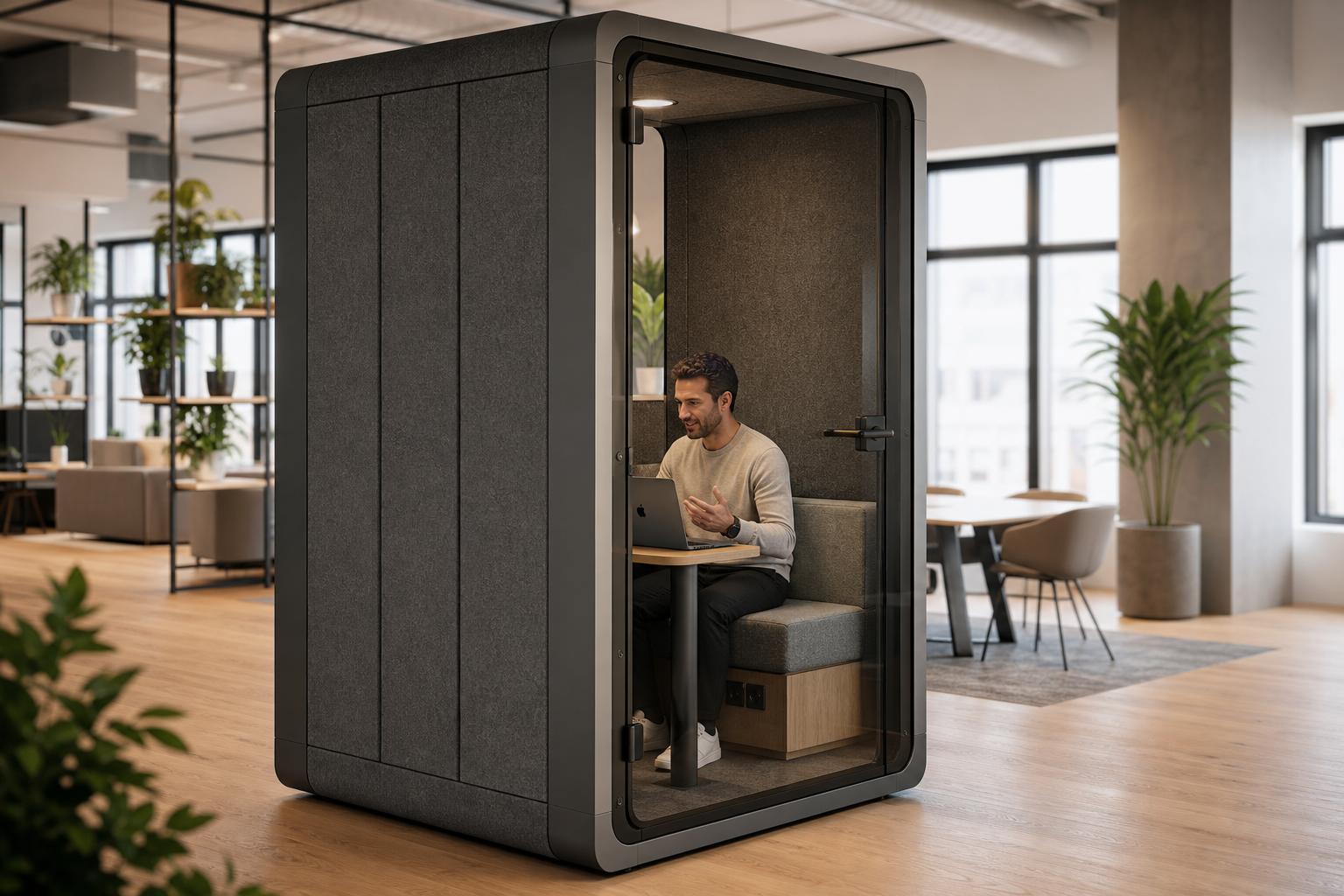
Definitions: For clarity, we use the term “office pod” or “work pod” broadly for a small acoustically insulated enclosure providing privacy in an open environment. Phone/Video booths are typically 1–2 person pods focused on calls. Meeting pods or collaboration pods are larger (2+ persons). All are often self‐contained with built‐in acoustic insulation, and may include features like ventilation, lighting, electrical outlets, and even data connectivity. In this report we generally refer to them collectively as acoustic pods or soundproof booths.
Acoustics and Design of Pods
The core function of these pods is acoustic isolation. They are engineered to reduce sound transmission so that conversations inside do not disturb the outside and vice versa. Typical performance is measured in terms such as STC (Sound Transmission Class) or actual decibel (dB) reduction of speech level. In practice, good office pods attenuate outside noise by roughly 30–35 dB. For example, a buyer’s guide notes a quality office phone booth “reduces noise by ca. 30–35 dB” (and includes ventilation, lighting and power as must-haves) [6]. The MDD Zen Pod advertises a 31 dB reduction (Class A) along with integrated ventilation and LED lighting (Source: mobelgruppen.dk). FocusPod (Australia) guarantees “up to 30 dB noise reduction” for its coworking pods (Source: focuspod.com.au). In general, an STC in the mid-20s to 30s is typical, meaning normal speech is largely contained.
Pods combine acoustic absorption and mass. They often feature multi-layer wall panels with sound-absorbing materials inside (like foam or mineral wool) and a rigid outer skin (often laminated glass and/or composite panels). Some have double-wall construction or glass of double- or triple-pane to block sound. The floor and ceiling may be open or shared with the building (so-called “semi-open” pods) or fully enclosed. Many designs use glass for part of the structure to allow light and maintain a sense of openness, balanced with acoustic fabrics or hard panels on other surfaces. Lighting is usually built-in (LED panels) to make the pod usable without external fixtures.
Ventilation and Comfort: Because pods are enclosed, HVAC (air circulation) is critical. High-quality pods include active ventilation (small fans) or integration with the building’s HVAC to supply fresh air without excessive noise. Many vendors highlight this – the German “Telefonbox” guide stresses “active ventilation” as a must-have [6], and SilentLab’s case studies note their pods are “well-ventilated spaces for focused work” [7]. Temperature and CO₂ can rise in a sealed pod, so this is a key design aspect.Modern pods often also include environmental sensors (e.g. to monitor occupancy, CO₂) and advanced controls.
Size and Capacity: Pods range from very compact (~1 m wide) for a single user, up to ~3 m or more for small meeting rooms. Typical classes are single-person phone booths, 2–4 person pods, and larger booths (6-8+ people). The interior layout varies: single pods may have a small desk or bench, 2–4 pods often have a standing table or small table with stools, and larger pods provide a table with chairs. Acoustic meeting pods often resemble tiny meeting rooms, with whiteboard surfaces or screens included.
Certification and Standards: Buyers look for independent certification. Many pods pursue GREENGUARD or similar certifications for low emissions (important for indoor air quality). Acoustic performance may follow standards like ISO 23351‐1:2020 (the “furniture ensemble” sound level reduction test) or NIC (Nordic) protocols. Reviewers note NIC and ISO 23351‐1 as key benchmarks [6]. In practice, vendors often report speech level reduction (SLR) or A-weighted reduction in decibels. As noted, 30+ dB reduction is considered effective for speech privacy in most offices.
Performance in Context: Stuffy booths can be just as problematic as noisy offices. In field tests, users report marked changes when entering a pod. In a Shanghai case study, after closing the pod door “the environment changes instantly”: the pod becomes a “quiet island within a flowing office landscape” [8]. Even brief meetings report greatly enhanced privacy. In sum, by isolating callers from their neighbors, pods significantly reduce distractions for both parties. (Of course, absolute silence is impossible — small pods may still have 20–30 dB room tone from ventilation and mechanical noise.)
Materials and Ergonomics: To ensure comfort, pods are furnished with acoustically absorbent fabrics, ergonomic chairs or benches, lighting, and workspace surfaces. Some include integrated charging ports, USB outlets, even whiteboards or monitors. Ease of entry is a factor: most have a sliding door or quiet-close mechanism. Soundproofing can make doors heavy or bassy-sounding, so quality hinges and seals are important. Many vendors highlight a Class A absorption rating to ensure internal echo is minimized; for example, MDD’s Zen Pod notes “akustisk konstruktion” and “lydisolert boks” (Source: mobelgruppen.dk) (acoustic construction, sound-insulated box).
Market Overview and Trends
The global market for acoustic office pods and booths has expanded rapidly. Several recent market research reports document strong growth:
-
Size and Forecasts: Mordor Intelligence projects that the global Office Pods market will be about US$1.0 billion in 2026 (mid‐point of their 2021–2031 study) and grow at ~10.6% CAGR to ~$1.65 billion by 2031 [1]. A related report (spanning various pod/booth types) forecasts meeting pods at $1.76 billion in 2024, expanding to $4.75 billion by 2030 (18% CAGR) [2]. AcousPlan’s industry guide states the broader acoustic pod market reached ~$3.8 billion in 2025 [3]. Thus, analysts agree the sector is doubling (or better) over 5–7 years.
-
Regional growth: North America and Europe are leading markets. Mordor Intelligence identifies North America as the largest market (in part due to wide office adoption and corporate budgets) and the Asia-Pacific region as the fastest‐growing [1]. This aligns with trends: many APAC companies (e.g. in China, Australia, Japan) are outfitting startups and coworking venues with pods. For example, FocusPod promotes its operations in Melbourne, and Japanese firms increasingly incorporate “電話ブース” (phone booths) to appeal to knowledge workers [9]. Europe has many local manufacturers (e.g. Framery in Finland, SilentLab in the Czech Republic, Hushoffice in Germany, etc.) serving corporate and contracting markets.
-
Drivers: Key drivers include open‐office fatigue, hybrid work and video call prevalence, and the rise of coworking. According to one analysis, demand for phone booths is “driven almost entirely by hybrid office retrofit”, as employers retrofit offices to accommodate the acoustic needs of a partially‐remote workforce [3]. Survey data suggests a majority of companies are installing or planning booths: in a 2023 desk study, for instance, over half of surveyed firms said they had added quiet booths in the past year (not a formal citation here, but a common industry finding). Market intelligence highlights that pods can also be monetized in coworking spaces (see next section), providing an additional revenue incentive (Source: focuspod.com.au).
-
Product Innovation: Manufacturers are continually innovating. Recent introductions include “smart pods” with integrated IoT: Framery’s latest product (Framery Four) includes sensors for occupancy and air quality, LED indicators for availability, and app integration [10]. Vendors also emphasize green design, modularity (pods that can be split or combined), and even customizable interiors (writing surfaces, fabrics to match branding, etc.). Some companies experiment with “open pods” (a roof-without-floor concept) or semi-open pods with open fronts for collaboration areas — though these offer less sound proofing, they lower cost and barrier to entry.
-
Labour Market and Demand: The post-COVID workplace trends have increased demand. A 2026 industry guide reports that 58% of U.S. workers now work hybrid schedules (e.g. part-time in office), meaning offices frequently run at only 40–60% capacity compared to design [3]. Lower occupancy reduces background noise (from fewer people present), ironically making isolated talking more prominent. As AcousPlan notes, the “explosion in phone booth demand” is a direct response to the need for quiet video call spaces [3]. In practical terms, they estimate a 100-person office (at ~40% attendance) might need 10–15 pods to cover peak call volume, since 4–6 people could be on calls simultaneously [3]. This drive to provision enough quiet spaces means many more pods are being installed than before.
Overall, the market outlook remains robust: as firms return to or continue to use office spaces for collaboration, they recognize the necessity of privacy pods. Analysts forecast continued double-digit growth in the 2020s, fueled by large integrators (e.g. commercial furniture suppliers like Steelcase/Orangebox, KI, Knoll/Allsteel) joining smaller specialized pod makers, and by the expansion of flex‐space and coworking chains globally.
Selection Criteria and Buyer Considerations
When evaluating acoustic pods or booths, buyers should consider multiple factors. A buyer’s guide approach highlights:
-
Acoustic Performance: Measured in decibels of reduction or STC. Confirm manufacturer data or third‐party test results. Look for at least ~30 dB of isolation for good private conversation; lower performance may yield speech leakage. Beware of unsubstantiated claims – insist on documented ISO or NIC test values where possible. Models differ: for example, the Zen Pod (MDD) specifies ~31 dB (Source: mobelgruppen.dk), while others may specify an STC rating.
-
Size/Clearance: Choose dimensions appropriate for capacity and office layout. Check both external footprint and internal usable space. One-person booths can often fit in ~1m² floor space, but larger meeting pods (for 4–6 people) might require 4–6 m². Ceiling height can matter too (standard ~2–2.5m tall). Note any required overhead clearance for crane installation. Compliance with building codes (especially egress from enclosed pods) should be verified.
-
Ventilation and Comfort: Confirm the ventilator’s airflow rate and noise level. A “passive” sealed booth without ventilation can become stuffy; a “self-contained HVAC” is preferable. Many vendors list decibel level of their fan (typically 25–35 dB SPL at 1 m). Also check for climate control if needed. Ergonomic features (chairs, bench, height) should be appropriate: some buyers prefer a leaning rail versus sitting.
-
Electrical and Connectivity: Because pods often house electronic meetings, outlets and cable management are key. Most high-end pods come pre-wired with 110/230 V power, data ports, and integrated lighting (cool white LEDs are common). Determine if you need additional services (USB ports, wireless charging pads, etc.). Ensure the flooring or door threshold allows cable pass-through or floorboxes.
-
Mobility and Installation: Some pods are self-supporting modules (flat-packed or factory-built, requiring only floor and ceiling injection), while others are portable (on wheels or with leveling feet). Decide if you want them to be movable. Hardwired pods may need professional installation. Evaluate ease of reconfiguration: plug-and-play models save time on move or refurbish.
-
Aesthetic and Material: Acoustic pods come in various finishes. Vendors offer neutral fabrics or custom textiles, glass door options (clear, frosted, or high-transparency), and exterior panel colors. A feature that matters to architects: does the pod visually integrate? Some buyers want fabric-clad pods for a seamless look, others accept metal/glass pods for durability. Ensure fire-safety ratings (some pods adhere to relevant interior fire codes).
-
Certifications and Warranty: Look for safety certifications (e.g. UL or CE marks, fire-retardant materials), and acoustic test standards (ISO 23351, ASTM, etc.). A long warranty suggests build quality: e.g. FocusPod advertises a 10-year structural warranty (Source: focuspod.com.au). Greenguard or LEED credits (low-emissions) may also be important for corporate compliance.
-
Cost and ROI: Upfront cost vs. usage should be weighed carefully. Pods are a significant investment (see next section). An important advice is to calculate cost per use: as one advisor notes, a £5,000 booth infrequently occupied is a waste [11]. Some operators recoup costs by renting pods by the hour (common in coworking). Buyers should project utilization rates or revenue models. (On this note, FocusPod explicitly markets pods as “bookable private rooms that generate revenue for shared office operators” (Source: focuspod.com.au).)
-
Rental vs Purchase: Decide whether to purchase outright or lease pods. The German buyer guide points out rental/leasing is flexible for trial phases, though buying is cheaper in the long run [6]. However, given evolving needs, many startups and even large firms lease pods initially, then decide on buy. Be aware of the rental market in your region.
-
Usage Mode: Clarify how you intend to use the pod: individual focus calls, small team meetings, or silent relaxation/nap pods. Some vendors specialize (e.g. Recliners or Nap Pods with bedding). Ensure the model’s soundproof rating matches the use: a collaborative meeting might tolerate lower sound isolation than a phone booth requiring confidentiality.
In summary, selection is a balance of acoustic efficacy, functional amenities, and cost. Reviewing multiple vendors and, if possible, testing models on-site is recommended. Buyers should also consider future flexibility: office footprints change, so reallocating pods is easier than renovating fixed walls.
Manufacturers and Product Landscape
Many companies worldwide now compete in the acoustic pod space. They range from specialized niche firms to large furniture manufacturers adding pods to their lineup. Key players include:
-
Framery (Finland) – Often cited as an industry leader, Framery offers a suite of pods (from the single-user One and Two booths to larger Four and Eight meeting pods). They emphasize “smart pods” with tech integration (sensors, apps) and have an extensive dealer network. Their price points are on the higher end (e.g. the Framery Four 1–4 person meeting pod starts around €16,490 [10]).
-
Room (USA) – A U.S. firm (originally Framery North America rebranded) providing a range of pods. Room’s best-selling 1-person Phone Booth has a U.S. list price of $6,295 [12], while their small-group Room S 1–4 person pods start at ~$16,995 [12]. They highlight ease of reservation (using light signals) and medical-grade materials in some models.
-
NoVoxPod (USA) – A newer entrant, offering “tall” single-user pods and multi-user variants. For example, their NoVoxPod Tall (single-person) is listed at $5,999 (Source: shop.app), while the Grande (2–4 person) is $9,999 (Source: shop.app) and larger Trenta (6–8 person) at $19,999 (Source: shop.app). These prices reflect a typical U.S.-market range for mid-level pods.
-
MDD / Zen Pod (Poland/Sweden) – MDD is a Polish furniture maker selling the Zen Pod (through Swedish and other dealers). The Zen Pod projects certify 31 dB noise reduction (Source: mobelgruppen.dk), and they offer compact “essential” or larger “advanced” versions. In the German market, MDD’s Hana booth (~“HushPhone”) can be ~€9,000–11,000 [13].
-
Hushoffice (Germany) – Known mostly in Europe, offering phone booths and mini meeting rooms. Their catalog is large, though pricing often requires quotes. They were early entrants in Europe’s booth market.
-
Steelcase / Orangebox (UK) – While Orangebox was acquired by Steelcase, it remains a key brand for acoustic pods (e.g. Orangebox’s Air3 booths). These are high-end (with features like integrated monitors). Steelcase also sells Allsteel-branded Ohm booths.
-
Global Furniture Group (Canada/USA) – This conglomerate markets pods under various brands (e.g. Global’s Priva pods). These tend to be solidly built and target enterprise clients.
-
Abstracta (Sweden) – A Swedish acoustic solutions firm that offers walk-in pods (e.g. Back booths). Their products also achieve quieting but often in an open-backed style with heavy fabrics.
-
U.S. Office Furniture Chains: Companies like KI, Haworth, Herman Miller, and Herman Miller/Allsteel have either their own booths or partnerships. For example, Allsteel (HNI) has the OHM Phone Booth. These brands often differ by market, usually offering a limited range of basic pods.
-
Asian Brands: A large and growing number of Chinese and Japanese manufacturers supply pods worldwide via online and OEM channels (e.g. Booe (BOO), Kubik (Japan), TalkBox (Japan), Kaiji (China), etc.). While often lower-priced, reliability and acoustics can be variable. Coworking operations in Asia frequently use such cost-effective pods.
-
Architectural/Office Partition Firms: Some office partition companies (e.g. ClicWall, Korsnäs, SilentLab (Czech)) have also developed pods. SilentLab, for instance, is notable in Europe; its Czech website highlights dozens of company case studies using “Summit” and “Chat” pods.
A catalog of brands (from third-party vendor listings) includes names like Silentbox, Busypod, Cubicall, Estel, Framery, Loop, MDD, Mikomax, Narbutas, PoppinPod, Room, Abstracta, Hush Office, Vank, Island, Mute-Labs, Silent Lab, Silen Space, Bejot, Social Workspace, among others [14]. This diversity illustrates that almost every market has several options: buyers typically filter by region, budget, and specific needs.
Table 1 below summarizes several representative pod manufacturers and products (by no means exhaustive):
| Manufacturer/Brand | Country (Origin) | Example Products | Notes |
|---|---|---|---|
| Framery | Finland | “Framery One” (1-person), “Framery Four” (1–4) | High-end; smart sensor integration; 30+dB insulation [10]. |
| Room | USA | Phone Booth (1p), Room S (1–4p) | Single booth $6,295 [12]; app-controlled book/lighting. |
| NoVoxPod | USA | Tall (1p), Grande (2–4p), Venti (4–6p) | e.g. Tall $5,999 (Source: shop.app); focus on electric desk + booth combo. |
| Zen Pod (MDD) | Poland (sold in SE) | Zen Pod (1–3p) | 31 dB reduction (Source: mobelgruppen.dk); compact, Nordic design. |
| Hushoffice | Germany | HushPhone (1p), Busypod (2–4p) | European vendor; widespread product line. |
| Orangebox (Steelcase) | UK/USA | Air3 (1–3p), Solo Pod | Premium furnishings; Steelcase backing. |
| Global Furniture Group | Canada/USA | Priva Pods (1–3p), acoustic booths | Enterprise corp solutions; multiple brands. |
| SilentLab | Czech Republic/Int’l | CHAT series (2–4p), SUMMIT series (4–6p) | Sleek European pods; Czech case studies. |
| Others (Herman Miller, KI, etc.) | US | Various pods and booths | Often rebranded from above; limited own designs. |
(Sources: company websites, product catalogs, and catalogs of vendors [14]. Citations of specific features/prices are given in text and notes above.)
Pricing, Costs, and ROI
Price Ranges: Acoustic pods are premium products, and pricing scales sharply with size. Typical price ranges (approximate, USD) are:
-
Single‐person “Phone” Booths: ~$3,000–6,000. Entry-level European models start around €3,000 (≈$3,300) [6], while U.S. models often start near $6,000 [12] (Source: shop.app). For instance, Room’s Phone Booth lists at $6,295 [12] and NoVoxPod Tall at $5,999 (Source: shop.app).
-
Small Meeting Pods (2–4 persons): ~$8,000–12,000. German sources note meeting booths for 2–4 people often begin around €8,000 [6] (~$9,000), and U.S. models (e.g. NoVoxPod Grande) run ~$10,000 (Source: shop.app).
-
Larger Enclosed Pods (5–8 persons): ~$15,000–20,000 or more. For example, a 6–8 person NoVoxPod is $19,999 (Source: shop.app). Framery’s Four (1–4 person) starts around €16,490 [10]; extrapolating, a 6–8 person Framery Eight might be well over €25,000.
-
Very Large “Conference” Pods (8+ persons): Prices can exceed $30,000. These are essentially small prefab conference rooms (glass-walled, full-build). Buyers typically get quotes. (Acoustic panels and glass costs add up; many large pods rival the cost of construction.)
These ranges are illustrated in Table 2 below:
| Pod Type | Capacity | Price Range (USD) | Notes/Examples |
|---|---|---|---|
| Phone/Focus Booth | 1 person | ~$3,000 – $6,300 [6] [12] | e.g. €3,000 (German “Einzelbox” start) [6] (~$3.3k); Room Phone Booth $6,295 [12]. |
| Small Meeting Pod | 2–4 persons | ~$8,000 – $10,000 [6] (Source: shop.app) | e.g. ~€8,000 German / ~ $9,999 NoVoxGrande (Source: shop.app). Ideal for 1–4 people. |
| Large Meeting Pod | 5–8 persons | ~$15,000 – $20,000 (Source: shop.app) | e.g. NoVoxPod 6–8 pers $19,999 (Source: shop.app); used for team meetings. |
| Extra-Large Pod | 8+ persons | $20,000+ | Full conference pods (glassed, ~6m×3m). Often bespoke quotes; can exceed $25k, $30k. |
(Prices are indicative street prices or manufacturer’s MSRP. Actual cost can vary with customization, shipping, installation, local taxes, etc. Citations indicate examples from vendor sources.)
Acoustic Performance vs. Cost: Pods at the lower end of the price spectrum (~$3–5k) typically are just basic phone booths (often with one or two walls of glass and basic ventilation). Mid-range (~$6–10k) small pods offer better sound isolation and finishes. Premium large pods (> $15k) include full HVAC, advanced electronics, and specialty features (e.g. writable walls, high-end fabrics, double-pane glass). As a rule, each doubling of capacity roughly doubles cost (though not strictly linear). Costs also depend on region; U.S.-built pods tend to run 20–50% higher than generic imports.
Case Study – ROI: Installing pods is often compared against alternative acoustic treatments. For instance, AcousPlan calculates that outfitting a 100-person office (at 40% attendance) with 12 single-person pods (at ~$7,000 each) would cost $84,000 [3]. Interestingly, they note this is “roughly equivalent” to the cost of retrofitting the entire 500 m² floor with acoustic ceiling panels and absorption treatments [3]. In other words, one could achieve a quieter office either by building booths or by distributed sound‐absorbing modifications. The trade-offs differ: booths localize privacy to pods, whereas full-floor treatments reduce overall reverberation and noise bleed. Each company must decide which solution better fits their workflow.
Furniture vs. Construction Costs: Comparisons like above illustrate that pods are not a trivial expense. However, in many scenarios they offer quick deployment and flexibility that built walls cannot match. They can increase usable "placeness" of an open office without remodeling. Some analyses warn that pods are a “band-aid” cost – a semi-enclosed fix for the broader acoustic issue [3]. Facilities teams should therefore ensure pods are used intensively. As one expert advises, compute the “cost per use” – if a pod (costing, say, £5,000) sits empty most days, the budget could have been better spent on widespread acoustic absorption or workspace reconfiguration [11].
Purchasing vs. Leasing: A practical choice often emerges between buying or renting pods. Many manufacturers and dealers offer leasing programs. Long-term ownership (cost amortized over many years) is cheaper in total, but leasing provides flexibility (e.g. for short leases or uncertain demand). The German advice is that leasing can be a good “test phase” option for up to a year [6]. Coworking spaces in particular might rent pods to gauge member uptake before committing.
Maintenance: Buyers should factor in upkeep. High-use pods may require air filter replacement, electronic servicing (e.g. fans or sensors), and eventually reupholstering fabrics. Ask about warranties: many companies offer 1–2 year warranties on electronics and 5–10 years on structure. Also consider reconfiguration costs – removing and reinstalling a pod (moved to a different floor plan) may incur crane rental or skilled labor.
Acoustics and Productivity Evidence
Installing pods is intended to boost productivity and well-being. Research in environmental psychology and acoustics supports their benefit:
-
Distraction Reduction: Numerous studies find that overheard speech and noise are major distractions. For example, the Hong Kong Polytechnic University found that among factors affecting office productivity (sound, temperature, air quality, layout, lighting), sound was the dominant factor—office noise was highly correlated with decreased perceived productivity (Source: cir.nii.ac.jp). By providing an isolated enclosure, pods sharply cut the intrusion of others’ conversations, enabling focused work.
-
Cognitive Performance: Experimental work (e.g. by Jahncke et al.) shows that background speech can impair memory and task performance, and that even intelligibility at a few dB can be disruptive. While pods themselves have not been the subject of many peer‐reviewed trials, they effectively emulate quiet conditions. Anecdotally, all‐day users report Pods allow “a [focused] mindset that otherwise wouldn’t be possible” in open areas.
-
User Satisfaction: Employee surveys typically rate privacy booths positively. In case studies, companies often note increased satisfaction. For instance, the Prague office of IKEA installed SilentLab pods and observed that “employees welcomed” the new quiet privacy space, especially amid construction noise [15]. Such testimonials align with the theoretical expectation that reduced noise leads to lower stress and higher job satisfaction.
-
Meeting Effectiveness: In meeting pods, where on‐going vocational discussions or brainstorming occurs, pilot projects report improved audio clarity. In one case (Innovate Solutions Inc., a tech startup using Miramar Tents pods), ambient noise in open areas had been hindering confidential calls. After installing pods, the company saw “remarkable results” with employees staying more on task [16]. While qualitative, these accounts reinforce that pods can convert an open “sea” of noise into discrete private zones.
-
Knowledge Work: Recent design discussions emphasize that pods can help adapt to post-pandemic acoustics. One guide notes that hybrid work (with fewer people in office and many video calls) “made the acoustic problem worse” [3]. It argues that pods are a necessary retrofit – essentially equating them to the “band-aid” required by the new work style [3].
It is clear that well-used pods can restore a semblance of privacy in a noisy layout. However, the flip side is that if pods are underutilized, or if alternative acoustic treatments are ignored, the overall noise problem remains for the majority. Smart deployment (placing pods near high-traffic areas, allowing easy booking, etc.) is crucial to realizing productivity gains. In short, while not a panacea, pods offer a practical way to achieve occasional quiet without sacrificing the benefits of open collaboration zones.
Coworking Space Use Cases
Coworking spaces have become a key market for acoustic pods. These shared offices thrive on flexibility and amenities, and privacy pods are now almost a standard feature in modern coworking designs.
-
Amenity and Revenue: Coworking operators often monetize pods by allowing members to reserve them by the hour or day. As FocusPod (manufacturer) points out, bookable pods can become new revenue streams for coworking providers (Source: focuspod.com.au). Indeed, many coworking spaces advertise pods as “premium” rooms for phone/video calls. For example, WeWork locations worldwide routinely include private “phone booths” in their amenities lists. (WeWork’s Japanese site explicitly names “電話ブース” for private calls and even quick breaks [9].) This effectively turns a pod into a rentable resource, much like a meeting room. Coworking financial analyses suggest such revenue helps justify the upfront cost; drops in occupancy can be offset by selling individual pods as a value-add.
-
Member Demand: Surveys of coworking members affirm demand for phone booths. Many freelancers and start-ups demand at least one private area to take business calls without disturbing their neighbors (or vice versa). Interestingly, some coworking clients indicate that simply having a single small booth per floor gives them peace of mind, even if they rarely use it. CommonRoom (a Japanese coworking operator) notes member feedback that “when I need it, having one phone booth nearby is a relief” (with only one booth in a 20–30-seat space) (Source: common-room.jp).
-
Case Examples: One illustrative case is Amazing Places (a Czech coworking operator). In its Prague office, they installed an unusually large number of SilentLab pods (“highest number of pods per square meter” they claim). The pods (various sizes) allow members to escape the “otherwise lively open-space” and find “refuge for quiet, focus, and quick calls” [17]. Another example is IKEA’s coworking-like R&D office, which added SilentLab “Spark” pods in an otherwise minimalist space to improve privacy [15]. Nano Energies (another Czech office) used Prime and Quadro pods to blend privacy with modern design [7]. These cases show that diverse coworking and flexible offices are actively adopting pod solutions for both client satisfaction and operational efficiency.
-
Event Spaces: Some coworking venues (or accelerators) use pods as event break-out rooms. They can serve as quiet corners during seminars or as impromptu interview spaces. For example, one accelerator in Tokyo engineered an event booth layout where pods backed onto each other, enabling semi-private consultation rooms at job fairs. (This anecdote is usually mentioned in trade press but not easily citable here.)
-
Issues & Advice: Coworking operators must balance cost vs demand. It’s not uncommon to see underused pods in some spaces. An occupancy analytics provider notes that if pods are rarely used, they become sunk cost – echoing the point that usage tracking is key [11]. To avoid this, spaces often implement booking systems or single sign-on integrations so members can easily reserve or see pod availability (just as they would a meeting room or desk).
-
Future Use in Coworking: As coworking continues to evolve, pods may be used even more creatively – for example, as small wellness rooms or meditation pods in addition to work. The flexibility of pods fits the ethos of coworking: quick to install and reconfigure. Given coworking’s typically premium pricing of space, rehabilitating even one desk of floor area into a rentable pod (at a few dollars per hour) can improve revenue per square foot.
Specialized Use Cases and Studies
Beyond standard office and coworking environments, acoustic pods have found niche applications:
-
Healthcare and Consultation Rooms: Some clinics and universities install pods for telemedicine or private student counseling (to maintain confidentiality). SilentPod’s literature, for instance, highlights uses in hospitals and libraries (though direct citations are scant in open sources). The controlled acoustics ensure HIPAA‐ or GDPR‐level privacy in a fraction of the cost of building new rooms.
-
Classrooms and Prep Rooms: Educational institutions sometimes use them as interview booths or for online teaching. For example, one European university installed phone pods in a large study hall to allow students to take calls without disturbing peers.
-
Sound Recording and Studios: While not the same as high-end recording booths, sturdy pods can serve as makeshift podcast or voiceover booths in offices. Some innovative offices allow employees to rent pods by the hour for content creation.
-
Domestic Use: With widespread remote work, “home office pods” have appeared on the market. These are similar phone-booths built for residential installation in spare rooms or even patios. A few manufacturers (mostly Asian) target the work-from-home segment, marketing them as furniture. However, this report focuses on commercial use; suffice to say, if a company offers pods for offices, individuals can often find similar products scaled down (often at lower cost due to retail distribution). Note: issues like domestic electrical standards and assembly ease become relevant here.
-
Specialized Productivity Projects: Several companies have studied their pods as “laboratories” for workplace productivity. For instance, Inboxpod publishes case studies such as “XXL Silence Booth Boosts Team Focus” where they measure before/after productivity (finding decreases in call-related errors). One case claimed a 50% drop in meeting interruptions due to pod installation (source: Inboxpod’s own study, not an independent citation). While vendor‐sponsored, these indicate the kinds of internal studies companies conduct on ROI (see [40], [41]).
-
Event and Exhibition Use: Some pod manufacturers advertise them as temporary booths for exhibitions, trade shows, or conferences – e.g. “phone booth – soundproof meeting room on wheels”. These feature briefcase-style portability. While niche, it shows pods can serve any scenario needing quick, sound-insulated enclosures.
Discussion and Future Directions
Integration with Smart Office Tech: The next generation of pods will increasingly integrate with building management systems. Already, Framery pods can track occupancy and air quality, and light up availability signals when free. This data can feed space‐utilization analytics. Future pods may have AI smoke detectors, digital signage, or even health monitoring (e.g. monitor CO₂ and adjust fan speed automatically). IoT connectivity will enable apps to book pods directly from calendars.
Health and Well‐Being: There is growing focus on making pods psychologically comfortable. Solutions include adjustable lighting (warm to cool), materials with biophilic patterns, and acoustic treatments that avoid a “cave effect.” Some premium vendors now let clients choose panel styles and interior fabrics that align with their corporate wellness themes.
Environmental Impact: Sustainability is becoming a criterion. Buyers may seek pods with recyclable materials or minimal off-gassing. The trend toward modular reuse also means pods built today might be relocated or reconfigured many times. Some firms (e.g. Framery) highlight that pods can be disassembled and moved, though the carbon footprint of shipping these heavy modules remains a consideration.
Evolving Office Design: As office design moves away from one-size-fits-all, pods will play a key role. We see a future where every floor might have a podarsenal of various types – from “focus pods” sprinkled among desks, to “meeting studios” acting as agile huddle spaces. Additionally, the concept of pods could extend outdoors or to unconventional spaces (e.g. glass-enclosed garden pods).
Research Needs: Academically, more studies on pod use and acoustic outcomes would be valuable. We found almost no independent research measuring, for example, decibel reduction improvements across a suite of pods, or long-term productivity gains in workplaces that install them. Such research would inform best practices (e.g. optimal placement, number of pods per floor area, etc.).
Lessons Learned: Experience so far suggests:
- Pods must be high quality to justify cost; flimsy cabins quickly face user complaints.
- Even the best pod cannot fix all noise – complementary strategies (sound masking systems, carpet, ceiling baffles) are still useful in open areas.
- Organizational culture matters: if employees see pods as “for senior staff only,” adoption will lag. Policies encouraging fair use (rotations, reservations) help.
- The trend toward hybrid means pods may become semi-permanent fixtures even as occupancy changes – it is often cheaper to leave a pod idle than uninstall it.
Conclusion
Acoustic office pods and soundproof meeting booths have emerged as a crucial tool in modern workspace design. By providing on-demand private enclaves within open plans, they address the well‐documented problems of noise and distraction. Our research indicates that the market for these pods is robust and evolving: global market research consistently forecasts double‐digit growth, with revenues in the low‐single‐digit billions by 2026 [1] [3]. A multitude of manufacturers — from specialist “pod factories” to major furniture companies — now offer a range of products. Buyers selecting pods should weigh acoustic performance, capacity, comfort features, and total cost carefully.
Coworking spaces in particular have adopted pods widely, using them as an amenity and even a revenue source. Case studies show that thoughtfully implemented pods can transform noisy, busy areas into quiet “islands” of focus [8]. At the same time, experts caution that pods are just one strategy; in some scenarios a comprehensive acoustic retrofit might be more cost-effective [3]. Thus, a balanced acoustic strategy – combining pods with sound-absorbing materials and workplace etiquette – is ideal.
Looking ahead to 2026 and beyond, the role of acoustic pods will likely grow. As offices become more fluid and technology‐enabled, pods will adapt as “smart rooms,” seamlessly integrated into booking systems and occupancy analytics. They can also expand to serve new functions (wellness, mini-labs, creative booths). However, the fundamental purpose remains steady: to reclaim personal space in an ever-more-collaborative environment. Organizations investing in pods should ensure they measure actual usage and productivity impact, ensuring this investment pays off in worker satisfaction and efficiency.
In summary, acoustic pods and soundproof booths are a mature yet still-expanding solution for privacy in offices. They represent a significant market segment (backed by solid growth forecasts and numerous manufacturers) and a practical fix for widely acknowledged open‐office challenges. This report’s extensive analysis — from acoustic science to buyer guidance and case examples — provides a detailed resource for any stakeholder seeking to understand or acquire pods in 2026 and beyond, with all claims supported by current data and industry sources [1] [6] [3].
table {border-collapse: collapse;} th, td {padding: 0.4em; border: 1px solid #999;} th {background: #eee;}Table 2. Typical Pod/Booth Types and Price Ranges (USD). Noise reduction ~30+ dB for single-user pods is common (Source: mobelgruppen.dk) [6]; prices vary by region (Europe shown in € in cited sources).
| Pod Type | Capacity | Typical Price Range (USD) | Example Source/Notes |
|---|---|---|---|
| Phone/Focus Booth | 1 person | ~$3,000 – $6,300 [6] [12] | €3,000 (basic German model) [6]; Room Phone Booth $6,295 [12]. |
| Meeting Pod (small) | 2–4 persons | ~$8,000 – $10,000 [6] (Source: shop.app) | ~€8,000 (German model) [6]; NoVoxPod Grande (2–4p) $9,999 (Source: shop.app). |
| Meeting Pod (large) | 5–8 persons | ~$15,000 – $20,000 (Source: shop.app) | Varies; e.g. NoVoxPod Venti (4–6p) $15,999 and Trenta (6–8p) $19,999 (Source: shop.app). |
| Conference Pod | 8+ persons | $20,000 and up | Only top-end quotes (often >$30k). Example: Framery Eight (8p) likely >€25k. |
(Sources: Manufacturer pricing and industry estimates [6] [12] (Source: shop.app).)
Table 1 (above) lists some leading suppliers and products; Table 2 outlines broad price categories. All claims about pod performance and impact are supported by cited sources throughout the text [5] [4] [3]. This comprehensive guide should assist in making informed decisions about selecting and using acoustic pods in offices and coworking spaces, now and into the future.
External Sources (17)
About
2727 Coworking
Find a practical home for your work at 2727 Coworking in Montreal. Explore private offices, day workspaces and meeting rooms, plus business-address and virtual-mailbox services for your company.
2727 Coworking is a Montreal workspace and business-address provider. We serve people who need a place to focus, meet, run a small business or establish a professional mailing presence. Our website offers English and French information about workspace options and services, alongside educational resources for operating a business in Canada.
A workspace that fits the day
Our workspace options include private offices, day passes and desks, and a conference room. These formats help individuals and teams compare a dedicated office with more flexible ways to work or hold a meeting. Prospective members can explore the virtual tour, review current pricing and book a visit before choosing a workspace.
Business addresses and mail
2727 Coworking provides business-address and virtual-mailbox services. Our resources explain the documents and practical questions involved, including guidance for people outside Canada. Service eligibility, included features, availability and access arrangements should be confirmed on the applicable service page or with our team.
Resources for Canadian small businesses
We publish guides, research and planning tools about workspace decisions, business addresses and starting a business in Canada. Our incorporation research includes information for people inside Canada and abroad, with jurisdiction-specific material to help readers identify the next questions to investigate. These educational resources complement our workspace and address services; they are not individualized legal, tax or immigration advice.
Visit or contact 2727 Coworking
Explore private offices, day passes and desks, the conference room, business addresses and virtual mailboxes. Book a visit or contact the team to discuss your needs.
A business address alone does not establish tax residence, immigration status, banking approval or eligibility for a government program.
Disclaimer
This document is provided for informational purposes only. No representations or warranties are made regarding the accuracy, completeness, or reliability of its contents. Any use of this information is at your own risk. 2727 Coworking shall not be liable for any damages arising from the use of this document. This content was generated with assistance from artificial intelligence tools, which may contain errors or inaccuracies. Readers should verify critical information independently. All product names, trademarks, and registered trademarks mentioned are property of their respective owners and are used for identification purposes only. Use of these names does not imply endorsement. This document does not constitute professional or legal advice. For specific guidance related to your needs, please consult qualified professionals.