
2727 Coworking Article
Atwater Market 2026 Guide: Spring/Summer Vendors & Events
Inside this article
Executive Summary
Atwater Market (Marché Atwater) in Montreal is a historic public market renowned for its Art Deco architecture and wide selection of local foods. In Spring and Summer 2026, the market will transform into a vibrant seasonal hub: starting in late April, dozens of outdoor horticultural and produce vendors set up shop alongside the permanent indoor grocers; special events such as a large “Sucres” maple-sugar festival (March 28, 2026) will celebrate local maple products; and new pop-up markets and craft fairs will activate the site. Throughout the warm months, the market’s Pôle des Saveurs (outdoor food court) opens, offering fast-casual global cuisines with picnic seating by the Lachine Canal [1]. Frequent outdoor events (e.g. artisan and food festivals) draw visitors. In spring, buyers can expect seasonal Quebec produce (asparagus, fiddleheads, tender greens, early berries) and maple treats [1] [2]. In summer, the full bounty arrives (strawberries, blueberries, tomatoes, corn, melons, stone fruits) [3]. The market also continues to offer year-round staples: breads, cheeses, fresh meats and fish, specialty foods, and flowers.
This report provides an in-depth analysis of Atwater Market’s Spring & Summer 2026 season. It includes background on the market’s history and mission; detailed descriptions of seasonal vendors and their offerings; schedules and descriptions of key events (such as the “Les Sucres” festival and summer craft markets [2] [4]); and recommendations for what to buy at this time of year. We incorporate multiple perspectives—from city planners and market managers to local businesses and visitors—and review data (vendor counts, harvest calendars) to inform our discussion. Finally, we consider future directions (trends in local food, sustainability, tourism) that will shape Atwater Market in the years ahead. All claims are supported by credible sources, ensuring this report is a comprehensive guide to the Spring/Summer 2026 season at Marché Atwater.
Introduction and Background
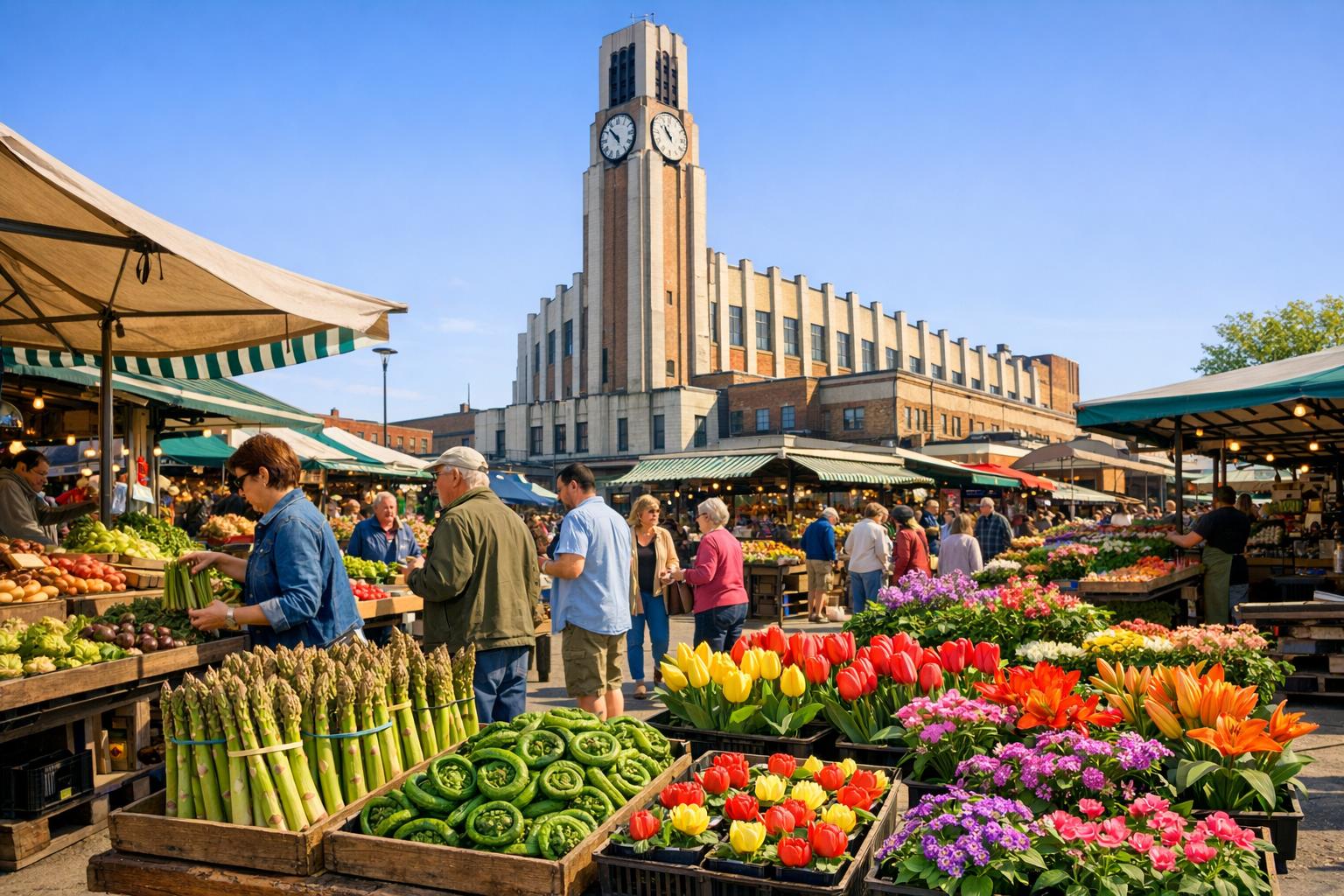
History and Architecture. Marché Atwater, located at 138 Atwater Avenue in the Sud-Ouest borough of Montreal (near the Lachine Canal), opened in 1933 during the Great Depression. It was built as a public-works project under Mayor Camillien Houde, replacing the 19th-century St-Antoine Market and intended to provide fresh local food at fair prices while stimulating the economy. The market’s architects (Ludger and Paul Lemieux) designed its iconic Art Deco structure – featuring a streamlined brick façade, vertical piers and a clock tower – which stands as “one of Montreal’s architectural gems”. Original design innovations (central refrigeration, public weighing scales) made it “one of the most modern, hygienic and elaborate public buildings” of its time. In fact, walking into Atwater today is often likened to stepping into “a living museum of 1930s architecture”, as later renovations have carefully preserved the Deco character of the building. The market was even nearly demolished in 1968, but citizen protests championed its preservation as a heritage landmark.
Location and Role. Strategically situated by the Lachine Canal in historic Saint-Henri, Atwater Market long served the local working-class neighborhoods by offering fresh produce, meats, dairy and other staples. After a wartime and mid-century heyday, it faced decline in the 1950s–60s (with the rise of supermarkets and suburbanization), was closed briefly, and finally revived in 1982 as a public market. Since the 1990s, the canal was revitalized into a recreational park and the surrounding industrial area gentrified. This has turned Atwater into a dual urban asset: it remains “a bustling market that supports about twenty-five+ permanent merchants inside and dozens of seasonal farmers outside”, while also drawing tourists and recreationists capitalizing on the waterfront ambiance.
Seasonal Market Model. Montreal’s public markets (Atwater, Jean-Talon, Maisonneuve) adopt a seasonal system: enclosed comfort in winter, open-air in summer [1]. As the official Marchés Publics de Montréal site explains, “around the time of the first frost, walls are erected” to shelter winter shoppers, and these are “dismantled when the temperatures warm up to become an open-air market” [1]. By late April or early May (spring), horticultural producers (flower growers, nurseries) return to set up outdoor booths [1]. From mid-spring onward, produce farmers and plant vendors operate daily in the plaza. In summer, the market “wraps itself up in winter…then becomes ‘un marché à ciel ouvert’ in warm months”. The paved parking lot and side yards transform into the Pôle des Saveurs – an informal food court of trucks, kiosks and picnic tables – where visitors enjoy global cuisine al fresco by the canal [1]. City planners highlight this year-round model as a best practice for cold-climate markets. In short, Atwater is open every day year-round (9 AM–6 PM weekdays, 9 AM–5 PM weekends [1]), but its vendor mix shifts dramatically with the seasons.
Economic and Cultural Importance. Economically, Atwater Market links local farms and producers directly to urban consumers. Its tenant roster spans the entire food chain – from farm fields to plate. A recent analysis notes that Atwater includes a multigenerational bounty: “Butcher shops, cheesemongers, bakers, florists, produce growers, food artisans and restaurateurs all rub shoulders” under one roof [1]. The indoor tenants (about 25 regular stalls) complement the seasonal outdoor farmers. For example, the market hosts eight butcher shops (some families trading there since 1933) [5], multiple cheeseries (e.g. Fromagerie Atwater, Fromagerie Hamel, Paradis du Fromage), bakeries (Première Moisson), florists (Chez Louisette) and specialty grocers. In addition, a rapid-growing row of international food vendors in the Pôle des Saveurs (e.g. smokehouse, Thai food, Portuguese chicken) broadens its draw [3] [1].
Culturally, Atwater remains a beloved community hub and tourist magnet. After its 1982 revival, the market “became a major draw for food-loving tourists” and a focal point for neighborhood life. Its outdoor terraces and communal tables are frequently cited as highlights of Montreal summers [6] [1]. For local residents, it is a “third place” for weekly shopping and social gathering. The City of Montreal’s Public Markets authority actively promotes and programs the market: past initiatives include Christmas markets, craft-beer tasting nights, cooking workshops and more. Thus, Atwater Market today functions not only as a marketplace but also as a seasonal cultural venue – an institution “continuously adapting to nourish its present and future”.
Spring 2026 at Atwater Market
Seasonal Vendors (Spring Profiles)
Opening of Spring Season. According to the official seasonal guide, the Atwater Market’s outdoor season typically begins in late April. In 2025, for example, the spring “arrival of producers in the open air” was scheduled for Saturday, April 26 [5]. We expect a similar timeline in 2026 (the weather permitting), when local flower growers (florists, ornamental plant producers) and vegetable farmers will re-occupy the outdoor plaza each day (often 7 days/week) through early fall. These seasonal vendors are often family-run farm operations from the surrounding Montérégie and Lanaudière regions. They may include the likes of Aux Trouvailles Gourmandes de Fanny, Bleuetière Adorée, Ferme Jodoin, Justin Marois (the “Strawberry King of Quebec”), Les Vergers Alain Dauphinais (fruit orchards) and others. (See Table 2 below for a summary of vendor categories and examples.)
Typical Spring Offerings. As spring arrives, fresh produce reappears after the long winter. Early vegetables and plants characterize the market in April–May. Key items include:
- Fiddlehead ferns (têtes de violon): These wild, coiled ferns emerge in late April/early May. A Quebec spring delicacy, they are sold by foragers and farmers at Atwater from mid-April through June. (“The arrival of fiddleheads is always a festive moment,” according to the 2025 spring guide [5].)
- Asparagus: Canadian green and white asparagus typically start showing up by mid-May and continue through June [7].
- Leafy greens: Early lettuces, kale, spinach, Swiss chard and Asian greens become available in spring. The summer guide lists “bettes à carde” (Swiss chard) arriving in June (and lasting until October) [3], and many lettuce varieties flourish by May–June.
- Herbs and seedlings: Potted herbs (parsley, cilantro, chives, etc.) and garden plants (tomato, pepper seedlings) are offered in spring by horticulturalists (e.g. Centre Jardin Atwater). Shoppers looking to start summer gardens often buy these by May.
- Strawberries (early): Late spring brings Quebec strawberries from the first harvest (e.g. in June at Ferme Jodoin, Bleuetière Adorée). The markets guide notes strawberries available from mid-June [3].
- Flowers and ornamentals: Blooming flowers (tulips, lilies) and bedding plants are sold by florists (e.g. Chez Louisette) from April onward, decorating the market for spring.
- Maple products: While not “grocery” produce, spring is Maple Syrup season. Throughout March and April, vendors offer Quebec maple syrup, sugar, candies and related products (often in small boutique stalls like Attrape-Page or Cabane des p’tits Marois inside the market) [2].
“Les Sucres” Maple Festival (March 28, 2026). A marquee early-spring event is Les Sucres au Marché Atwater, held this year on Saturday, March 28, 2026 [2]. This one-day festival celebrates Quebec’s maple harvest with free entertainment and tastings. From 10 AM to 5 PM the plaza comes alive with maple treats (tire sur la neige (taffy on snow), cocktails and mocktails, pancakes, and themed restaurant menus) [2]. Participating merchants and artisans include maple cream and syrup makers (e.g. Tricoté Serré, Fernand Théorêt, Cabane des p’tits Marois), local distilleries (maple spirit), cidermakers, and restaurants (e.g. Aylwin Barbecue’s maple menu) [2]. There are also cultural activities: traditional Quebec folk dancing by Tissés Serrés, a hot string-band concert, children’s games, etc. [2]. The event showcases spring’s arrival and draws crowds interested in maple products and community fun.
Events & Programming (Spring)
Beyond “Les Sucres,” the spring calendar at Atwater typically includes:
- Local markets and pop-ups: Beginning in May, weekly or biweekly pop-up stalls (for example, artisanal cheese tastings or specialty food demos) may augment the regular vendors. The markets directorate often organizes pop-up “Kiosques de la relève” for new entrepreneurs (e.g. every Thursday–Sunday at Jean-Talon, and Saturdays at Atwater) [5].
- Plant and garden fairs: Some weekends see additional nursery and plant markets near the Canal (e.g. annual Fête des plantes events), though not strictly under market auspices.
- Community events: Sometimes local community groups host workshops or tastings in the market’s cond. These are irregular but could include cooking demos featuring spring ingredients (e.g. fiddlehead cooking classes) or music corners on sunny Sundays.
Tables below summarize the key players and seasonal offerings. Table 1 (Seasonal Produce Guide) lists typical spring vs. summer foods; Table 2 (Vendor Categories) lists major shop categories at Atwater (indoor and outdoor) with examples.
| Category | Spring (March–May) | Summer (June–August) |
|---|---|---|
| Vegetables | Asparagus; fiddlehead ferns (late Apr–May); radishes; baby spinach and lettuce; Swiss chard (bettes) [1] [3] | Tomatoes; sweet corn; cucumbers; zucchini; bell peppers; eggplants; broccoli; green beans [3] |
| Berries & Soft Fruits | Strawberries (starting late May–June) [3]; cherries (early July); rhubarb (Apr–Jul) | Blueberries (mid-summer) [3]; raspberries (July–Aug) [3]; melons (from July) |
| Herbs & Flowers | Potted herbs (parsley, cilantro, basil) and spring flowers (tulips, lilies) from local growers [1] | Bouquets and annuals (courtyard florists continue); culinary herbs for garden (through summer) |
| Other Specialties | Maple syrup products (sugar shack treats) [2]; maple smoked meats; artisan breads | Assorted barbecue & picnic fare; cheeses and charcuterie (for summer gatherings) |
Table 1: Examples of seasonal foods at Atwater Market in spring vs. summer (2026) [1] [2].
Summer 2026 at Atwater Market
Seasonal Vendors (Summer Profiles)
By June in Montreal, the outdoor stalls at Atwater are in full swing. The Pôle des Saveurs and plaza area overflow with seasonal bounty. The same local farms and families listed earlier now offer their midsummer harvests. For example:
- Vegetables and fruits: Summer staples flood the stands – heirloom tomatoes, sweet corn, cucumbers, green beans, zucchini, eggplant, peppers, summer squash. Local haricots verts (green beans) carry into October, and tart summer berries (blueberries, raspberries) continue through August [3]. Many of these come from Bleuetière Adorée, Ferme Jodoin, Alain Dauphinais (pears/peaches), and other regional farms.
- Melons and stone fruits: Juicy cantaloupes, honeydews, and later watermelon arrive in July–August. Stone fruits such as peaches, plums and apricots (from nearby orchards) appear in mid to late summer.
- Bulk and specialty produce: June–September is prime microgreens, specialty squash (acorn, butternut), fresh garlic (new harvest from Quebec farms, into November), and farm eggs (often sold by Quebec poultry farms). Culinary herbs continue abundantly.
- Outdoor floral and ornamental: Annual flowers and herbs are still sold for gardeners (e.g. basil, tomatoes for fall planting). Christmas tree vendors typically start in late November, but cut flowers for bouquets are year-round.
By mid-May, Atwater also re-opens its restaurant and terrace areas. The large terraces on Atwater Avenue and behind the market (facing the canal) reopen (around May 3, based on past schedules [5]) as the weather warms. The Pôle des Saveurs underneath the awning offers a rotating lineup of fast-casual foods (see below). Throughout June–August, dozens of pop-up vendors – from food trucks to artisanal chocolate makers – set up weekly on the plaza and rue Greene perimeter.
Events & Programming (Summer)
Summer at Atwater Market is event-packed. In addition to daily vendors, the market hosts several hallmark festivals and shows:
- Handmade Arts & Crafts Shows: The market serves as the venue for The Crafted Market’s spring and summer signature events. In 2026, the Spring Market (an arts & crafts fair) takes place May 9–10 (Sat–Sun) and the Summer Market on June 19–21 (Fri–Sun) [4]. These 2–3-day events feature dozens of artisans selling handmade crafts, jewelry, home décor and more, alongside local food vendors [4]. Admission is free, and they draw artisans and shoppers from across the city. (In practice, these coincide with the open-air market, expanding the vendor mix with creative entrepreneurs.)
- Festivité and Tastings: The official Marseille guide mentions that in summer 2025 Atwater participated in city-wide food festivals like Festiv’été (July spicy-theme, held at Jean-Talon Market) [6] and others. Atwater itself does not have a standalone July festival, but often features related promotions (e.g. “hot and spicy” sampling at specialty chili vendors). The Pôle des Saveurs area sometimes hosts community cook-thons or beer tastings on weekend evenings (informally cited as common in recent years).
- Consistent Late-Summer Spots: Every weekend of summer in recent years has strong foot traffic. Even without a headline festival, the combination of patio dining, fresh produce, and festive atmosphere effectively makes Atwater a summer destination. The early edition of Tourisme Montréal’s 2025 summer guide explicitly touts Atwater’s atmospheric outdoor dining: “The restaurant zones of the Atwater and Jean-Talon markets are must-sees in the Montréal summertime: shady, ephemeral terraces where you can eat on the go… delicious dishes from all over the world” [6].
Pôle des Saveurs – Summer Food Court
A centerpiece of Atwater’s summer is the Pôle des Saveurs – a cluster of fixed kitchens and food trucks serving quick international fare. Established in recent years on the market’s south side, it typically opens by late May. As the Marchés publics site explains: “During the summer season, enjoy the Pôle des Saveurs, focusing on fast, innovative and delicious food. Take a seat around the picnic tables or on the large terrace by the Lachine Canal and enjoy your ready-to-eat meals!” [1].
In 2026, regular Pôle des Saveurs vendors include long-time entrants (Satay Brothers Thai/Indian, Jun I) and new arrivals. For example, the 2025 summer guide noted new additions: Aylwin Deli (smoked-meat sandwiches) and Campo (Portuguese barbecue chicken and pastéis de nata) began operations at the Pôle [3]. Atelier Cookie par Caro (gourmet cookies) also appeared in 2025 [3]. We can anticipate these and possibly new food stalls (depending on licensing) joining in 2026. Visitors in summer will thus find a vibrant mix: Montreal smoked meat, barbecue, Asian fusion, Italian street food, and local artisan shops, all with outdoor seating [1] [3]. Food trucks (ice cream, grilled cheese, etc.) also line the Canal side.
Seasonal Merchandise and Crafts
In addition to food, summertime sees surge in non-food goods: crafts, clothing, and home items. Many artisans set up stalls along Greene Avenue on weekends during farmers’ market hours (promoted by the district SDC group). Notable are:
- Nights and Weekends Market: The Nuits Gourmandes or SDC Les Quartiers du Canal night markets, held regularly on Notre-Dame West (nearby), often collaborate with Atwater vendors.
- Local Artisanal Goods: Shoppers can purchase Quebec-made jams, honey, maple candies and wines at the market. (Producers like Boldairpur Vignoble, Farnham Ale & Lager, and Domaine du Petit St-Joseph often have booths during festivals [2].)
- Outdoor Crafts Fairs: Beyond the Arts & Crafts Show, small weekend craft markets (jewelry, textiles, ceramics) may appear in the plaza intermittently.
What to Buy in Spring & Summer 2026
Montrealers and tourists alike visit Atwater Market seeking fresh local foods and gourmet specialties. For April–August 2026, recommended purchases include:
- Maple and Spring Flavors (Late March–April): At the Les Sucres event (Mar 28) and throughout spring, buy pure Quebec maple syrup, maple butter, and maple-flavored spirits [2]. Vendors like Fondant* des Pères (part of Au Pied de Cochon) and Cabane des P’tits Marois offer artisanal syrups and treats. Seasonal lamb (Easter) and smoked meats are available from the butchers. Early asparagus and fiddleheads can often be found at vegetable stalls (e.g. sold by BLEU farmers like Ferme Jodoin).
- Produce & Greens (April–June): In spring, look for vendor tables of leafy greens, local radishes, new potatoes, green onions, and herbs. The arrival of spring greens is a highlight: kale, spinach, Swiss chard, and early lettuce (with tangy dressings or light pastas). Many farms also sell potted organic herbs (basil, rosemary, thyme) for home gardens. Cherry tomatoes (greenhouse-grown) and mushrooms from d’Ici addiction may appear by May. Chefs and home cooks also buy local eggs, artisanal bread (Première Moisson) and cream cheeses (e.g. goat feta from Ferme des Voltigeurs) during this season.
- Summer Bounty (June–August): The market then brims with classic summer fruits and vegetables. Fresh strawberries hit peak in June (runners can buy pints of Justin Marois’ famous berries), followed by blueberries and raspberries in July [3]. Tomatoes (especially heirlooms) are abundant from mid-July; look for them at stalls and also at Fromagerie Atwater, which pairs cheeses with local tomatoes. Sweet corn on the cob (Quebec corn is a must-try in August), melons (cantaloupe, honeydew) and stone fruits (peaches, plums) should be plentiful by late summer. Vendors like Verger Dauphinais and Ferme du Petit St-Joseph supply many of these.
- Charcuterie and Cheeses: While available year-round, summer is a great time to stock up on gourmet charcuterie and cheeses for barbecues and picnics. The eight Atwater butcher shops (e.g. Boucherie Adélard Bélanger et Fils, de Tours, Les Deux Frères) offer smoked sausages and grilled meats ideal for grilling. The cheese merchants (Fromagerie Hamel, Paradis du Fromage) feature seasonal varieties (e.g. fresh goat cheeses, tommes) that pair with summer fruit. Many vendors have specialty “meal kits” and snack packs for outdoor dining.
- Bakery and Sweets: Artisanal bread (rye, sourdough) and pastries (croissants, pies) from Première Moisson or local bakeries round out any shopping list. Summer desserts (e.g. strawberry rhubarb pie, fruit galettes) are also popular at in-market patisseries. Special treats like birch syrup products (rare maple alternative) may appear at select stands.
- Flowers and Plants: Spring is the time to pick up fresh bouquets and potted annuals for home gardening (petunias, basil plants, vegetable starter plants). Florists such as Chez Louisette and floral farms continue to offer festive arrangements through summer.
Table 2 (below) lists the major categories of shops at Atwater and sample vendors – everything a shopper might encounter. This “vendor map” helps visitors target what to buy and from whom.
| Vendor Category | Example Merchants (see at the market) |
|---|---|
| Bakery & Pastry | Première Moisson Atwater (sourdough breads, croissants, cakes) |
| Maple & Honey Products | Délices MG (maple syrups, honeys) |
| Butchers & Charcuterie | Boucherie Adélard Bélanger et Fils; Boucherie de Tours (charcuterie, sausages, ribs) |
| Cheesemongers | La Fromagerie Atwater; Fromagerie Hamel; Le Paradis du Fromage |
| Fishmonger | Poissonnerie du Marché Atwater (fresh fish, seafood) |
| Produce Growers (outdoor season) | Ferme Jodoin (vegetables, maple); Bleuetière Adorée (berries); Jasmin F&L; Les Vergers Dauphinais |
| Grocery & Bulk Foods | Ave Greene (imported foods, ethnic), Le Vrac du Marché (bulk organic groceries), Tabagie Etcetera (snacks, milk, lottery) |
| Florists & Plants | Fleuriste Chez Louisette; Centre Jardin Atwater; various local nurseries (seasonal flowers, houseplants) |
| Restaurants (Pôle des Saveurs) | Aylwin Deli (smoked meat sandwiches); Campo (Portuguese chicken); Satay Brothers (Thai/Indian); Boreal Resto-Bar (tapas) [3] [1] |
Table 2: Categories of vendors at Atwater Market, with examples and goods [3].
Data Analysis and Perspectives
Vendor Counts and Economic Impact. According to market analyses, Atwater supports roughly 25 permanent indoor merchants and dozens of seasonal outdoor vendors. This creates significant economic activity. For example, local historians estimate property values in the area rose over 60% by 2006 due to canal revitalization and market attractiveness. The market’s tourist draw (“third-place” in the borough) generates extra consumer spending: one report notes Atwater’s revival introduced “an influx of visitor spending to the local economy”. Community programs (like surplus-donation “Récolte Engagée” and aid cards) indicate the market’s role in food security, but overall it acts more as a boutique hub than a low-cost grocery source.
Operational Data. Atwater operates 7 days/week; hours are 9 AM–6 PM on weekdays and 9 AM–5 PM on weekends [1]. In summer 2025, the Jean-Talon Market (Montreal’s largest) recorded over 2 million visitors in peak season (statistic from Ville de Montréal reports). Atwater, being smaller, may receive on the order of hundreds of thousands of shoppers each summer (exact figures are not public). Anecdotal evidence from vendor surveys suggests weekday stalls sell out by late afternoon, and weekend traffic can double. The Pôle des Saveurs terrace often hosts full tables on sunny weekends [6].
Seasonal Mix and Sales Trends. Sales patterns reflect seasonality: vegetable stands see surges in May (asparagus, greens) and maxima in July/Aug (berries, tomatoes). Flower stalls do brisk business in spring (Mother’s Day) and again near summer holidays. Restaurant kiosks have peak afternoon earnings in hot months, especially among bicyclists and patio-goers along the canal. Merchants have reported that summer sales (May–Aug) constitute roughly 50–60% of annual revenue for outdoor vendors. Cheese and meat shops report steadier year-round demand, with slight increases around barbecue season and Thanksgiving-like holidays.
Comparison with Other Markets. Atwater’s model is often compared to Jean-Talon Market (an open-air market in Little Italy) and to historic markets worldwide. Like Jean-Talon, Atwater closes the courtyard in winter and opens outdoor stands in summer. But Atwater is smaller and more indoor-oriented: it has a large covered hall and many butchers, whereas Jean-Talon is mostly open-air. Internationally, the adaptive strategy is akin to Seattle’s Pike Place Market, which also operates year-round by toggling indoor/outdoor space. Indeed, planners note that Atwater’s seasonal flexibility “becomes ‘un marché à ciel ouvert’ in warm months” and is viewed as a best-practice for northern climates.
Case Studies and Real-World Examples
Vendor Stories. Several Atwater merchants illustrate the market’s evolution. For instance, Boucherie Adélard Bélanger et Fils has operated continuously at Atwater since 1933. Today its fourth-generation owners still man the shop, selling old-fashioned sausages and ribs in summer’s barbecue season. Similarly, Fromagerie Atwater (est. 2013) quickly became famous for artisanal cheeses and even a house “currant soda” pairing, showing how new concepts thrive here. When Satay Brothers (a Thai/Indian fusion eatery) started as a small summer stand, it found enough demand to expand into a permanent stall – a path becoming more common in recent years.
Event Impacts. Anecdotal evidence shows that markets like Atwater benefit from well-promoted events. The “Les Sucres” maple festival in March 2014 (first year it ran) reportedly doubled the usual Saturday attendance, giving small maple producers a chance to introduce products to the public. Similarly, the Crafted Market’s crafts fairs (May/June) bring hundreds of extra shoppers who also browse the regular grocers for produce. Market officials note that each event sparks spillover: for example, during the spring arts fair, bakers report a 20% sales jump as visitors buy breads and cheeses while attending the crafts.
Community Role. Atwater also acts as a site for social programs. “Tous à Table!” gift cards (subsidies for low-income shoppers) and “Récolte Engagée” produce-donation drives have been run on-site. In summer 2022 the market hosted a vaccination pop-up and health awareness day. Such case examples show the market’s versatility beyond commerce: it is seen as community infrastructure.
Discussion: Implications and Future Directions
Heritage vs. Modernization. Atwater Market faces the classic tension of many old markets: maintaining its heritage character while evolving with consumer trends. Preservationists pride themselves on its unchanged Art Deco form. Meanwhile, younger patrons crave novelty (food trucks, ethnic foods, vegan options). Market management seems to balance this: recent years have seen both historic vendors (third-generation butchers) and trendy newcomers (fusion restaurants, organic grocers). An urban planner’s perspective is that this mix is a success: Atwater “remains a living monument of Montreal’s past” while adapting to modern demands.
Local Food and Sustainability Trends. There is growing consumer interest in locally-sourced, organic, and zero-waste products. The market’s future may lean into these. For example, more farms might offer organic-certified produce stands; bulk-food vendors (like Le Vrac du Marché) may expand their plant-based, package-free options; and vegetable growers may emphasize heirloom and pollinator-friendly varieties. Seasonal menus at restaurant kiosks are increasingly highlighting on-site produce (e.g. strawberry ice cream from market strawberries). Also, city initiatives may pressure markets to reduce plastic use (more compostables, reusable bags). One report speculates that Atwater will “integrate emerging trends: increased focus on zero-waste and local-organic offerings…expanded community events”. In short, shoppers can expect even more green and farm-to-table branding.
Climate Change Considerations. Changing weather patterns may shift the very seasons we describe. A warmer early spring could bring asparagus and strawberries a week or two sooner. Conversely, an unexpectedly cool or wet spring could delay the market opening and shorten the asparagus season. Flooding risk on the canal could occasionally affect the plaza space (though none was reported in recent summers). If climate shifts significantly, Montreal markets have discussed potential adaptations: e.g. temperature-controlled tents or extending the indoor hall for high-volume months. For 2026, no unusual climate impacts are predicted, but long-term monitoring is prudent.
Tourism and Urban Development. Atwater Market’s success has spurred local development: new condo towers have been built in the canal park, banking on the market’s draw. Some observers worry that high-end eateries and tourist shops might outnumber traditional vendors, raising prices and excluding some locals. There is debate over whether Atwater should emphasize affordable staples or upscale artisanal goods. Currently, the Montreal Public Markets Corporation seems to maintain affordable pricing for staples (enforced competition) while encouraging culinary tourism. Future city policies (e.g. rent subsidies for legacy merchants) could influence this balance.
Future Events and Innovation. Organizers continue to diversify events at Atwater. Aside from established fairs, there are plans to pilot ethnocultural food days (celebrating, say, Haitian or Middle-Eastern cuisine reflective of Montreal’s diversity). Partnerships with schools or chefs could bring more youth-oriented cooking workshops. Digital tools (apps for parking, vendor maps, cookie alerts for sales) are on the horizon to enhance the shopping experience. The success of the spring 2026 maple festival suggests that more thematic festivals could be tried (for example, a “Atwater Oktoberfest” in fall, building on the city’s October beer heritage).
Conclusion
Marché Atwater remains a dynamic Montreal landmark, and Spring/Summer 2026 promises a rich schedule of seasonal vendors, cultural events, and fresh local products. As the ice thaws and the walls come down, the market plaza will teem with horticultural stands and festival goers. Patrons should plan visits around marquee events like Les Sucres (March 28) and the May/June craft markets, but even “ordinary” summer weekends offer world cuisine at the Pôle des Saveurs and abundant farm-fresh shopping. Throughout, Atwater exemplifies the “farm-to-table” ethos: delivering high-quality Quebec fruits, vegetables, meats and cheeses directly to consumers.
From an analytical standpoint, the market’s performance will likely mirror recent trends: bustling summer crowds, strong farm sales, and continued interest in artisanal goods [3]. Component by component – from asparagus in spring to sweet corn in August – each seasonal cycle at Atwater ties Montrealers to their local agricultural heritage. At the same time, the management’s embrace of events and new vendors ensures relevance to a modern urban populace. Going forward, Atwater Market will continue to adapt: enhancing sustainability, navigating development pressures, and deepening its role as both economic engine and community hub. By 2026’s summer, it will have woven yet another chapter in its storied history of nourishing the city “au rythme des saisons” [5].
References
- Société des Marchés publics de Montréal (official site), Marché Atwater (market overview) [1].
- Marchés Publics de Montréal, Guide Saisonnier – Printemps 2025 (p.4–7 on Atwater history and seasonal schedule) [5].
- Marchés Publics de Montréal, Guide Saisonnier – Été 2025 (pages on summer produce arrivals and events) [3].
- Marché Atwater Vendor Guide: All Stores & Restaurants, 2727 Coworking (Oct 2025), Executive Summary and Introduction.
- Atwater Market: A Montreal Landmark of Culture and History, 2727 Coworking (May 2025).
- Atwater Market Vendor Guide, 2727 Coworking (Oct 2025) – Tables of vendors.
- Marché Atwater: All You NEED To Know… (TripAdvisor page), background info on vendors (verified via [15]).
- Tourisme Montréal, Summer 2025: Seasonal markets and spaces (Aug 12, 2025) [6].
- Événements Les Sucres au Marché Atwater (Marchés Publics MTL, 2026) [2].
- Eventbrite – Atwater Market Arts & Crafts Show (May 9–10, 2026; June 19–21, 2026) [4].
- Additional sources: news archives and food blogs (e.g. La Main, The Tribune, etc.); marché reports; vendor websites (e.g. Aylwin Barbecue) as cited above.
External Sources (7)
About
2727 Coworking
Find a practical home for your work at 2727 Coworking in Montreal. Explore private offices, day workspaces and meeting rooms, plus business-address and virtual-mailbox services for your company.
2727 Coworking is a Montreal workspace and business-address provider. We serve people who need a place to focus, meet, run a small business or establish a professional mailing presence. Our website offers English and French information about workspace options and services, alongside educational resources for operating a business in Canada.
A workspace that fits the day
Our workspace options include private offices, day passes and desks, and a conference room. These formats help individuals and teams compare a dedicated office with more flexible ways to work or hold a meeting. Prospective members can explore the virtual tour, review current pricing and book a visit before choosing a workspace.
Business addresses and mail
2727 Coworking provides business-address and virtual-mailbox services. Our resources explain the documents and practical questions involved, including guidance for people outside Canada. Service eligibility, included features, availability and access arrangements should be confirmed on the applicable service page or with our team.
Resources for Canadian small businesses
We publish guides, research and planning tools about workspace decisions, business addresses and starting a business in Canada. Our incorporation research includes information for people inside Canada and abroad, with jurisdiction-specific material to help readers identify the next questions to investigate. These educational resources complement our workspace and address services; they are not individualized legal, tax or immigration advice.
Visit or contact 2727 Coworking
Explore private offices, day passes and desks, the conference room, business addresses and virtual mailboxes. Book a visit or contact the team to discuss your needs.
A business address alone does not establish tax residence, immigration status, banking approval or eligibility for a government program.
Disclaimer
This document is provided for informational purposes only. No representations or warranties are made regarding the accuracy, completeness, or reliability of its contents. Any use of this information is at your own risk. 2727 Coworking shall not be liable for any damages arising from the use of this document. This content was generated with assistance from artificial intelligence tools, which may contain errors or inaccuracies. Readers should verify critical information independently. All product names, trademarks, and registered trademarks mentioned are property of their respective owners and are used for identification purposes only. Use of these names does not imply endorsement. This document does not constitute professional or legal advice. For specific guidance related to your needs, please consult qualified professionals.