
2727 Coworking Article
CNESST Guide: Quebec Workplace Safety & Employer Obligations
Inside this article
- 01Executive Summary
- 02Introduction and Background
- 03Legal and Regulatory Framework
- 04Employer Obligations Under Québec Law
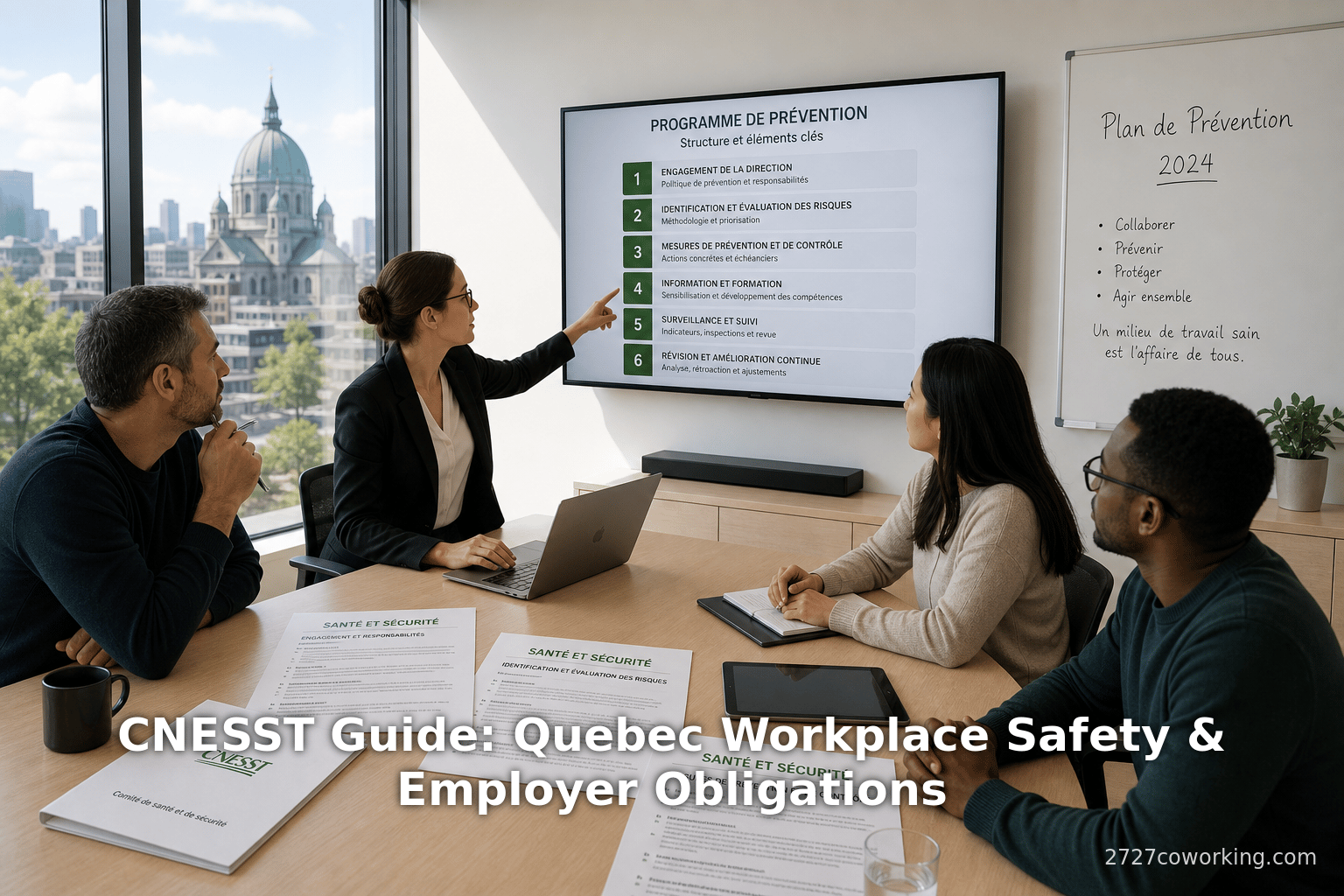
- 05Prevention and Health & Safety Programs
- 06Worker Rights and Responsibilities
- 07Harassment, Violence and Psychological Safety
- 08Industry and Language Considerations
- 09Contact Information and Resources for Montréal Employers
- 10Case Studies and Real-World Examples
- 11Data and Trends
- 12Practical Guidance for Compliance
- 13Future Directions and Emerging Issues
- 14Conclusion
Executive Summary
This report provides a detailed guide to the Quebec workplace safety system, focusing on employer obligations under the CNESST (Commission des normes, de l’équité, de la santé et de la sécurité du travail) and related laws. CNESST, established on January 1, 2016 by merging the CSST, CNT and CET agencies [1], administers occupational health and safety (OHS) and labour standards in Québec. As the provincial regulator and insurer for work-related injuries, CNESST enforces Québec’s Act respecting occupational health and safety (LSST) and related legislation, ensuring that employers maintain safe workplaces.
Employers in Québec are legally required to take all reasonable measures to protect worker health and safety, including identifying and eliminating hazards, providing safe equipment and methods, and training and supervising employees [2] [3]. Specific obligations include maintaining first-aid services, establishing a violence/harassment prevention policy, and – for larger workplaces – developing a formal prevention program and electing a health and safety committee [4] [5] [6]. Failure to comply can result in CNESST orders, fines, or criminal prosecution.
This report reviews the historical and legal context of Québec OHS, enumerates detailed employer obligations with citations of key legal and official guidelines, presents practical considerations (including language requirements for safety materials [7]), and provides contact information and resources (including CNESST Montréal office details [8] [9]). It also includes case studies of recent Montréal accidents investigated by CNESST, illustrating common hazards and failures in safety programs [10] [11]. Finally, it discusses current trends and future directions in Québec workplace safety, such as enhanced focus on psychological health and new guidance on telework [12] [13]. All factual statements are supported by CNESST publications, Québec statutes, industry guides, and expert sources to ensure authoritative coverage.
Introduction and Background
Occupational health and safety in Québec is governed primarily by provincial law, distinct from the Canada Labour Code that covers federal industries. Québec’s Act respecting occupational health and safety (LSST) and the Act on industrial accidents and occupational diseases (LATMP) form the core legal framework. These statutes enshrine the fundamental principle that each person at work has a right to a safe environment and a complementary duty to take care of themselves and others. In practice, this means employers must proactively manage risks and workers must cooperate in safety programs.
To implement these laws, Québec created the CNESST, which consolidates responsibilities for workplace standards, pay equity, and OHS. CNESST’s mandate is fourfold: promote fair labour relations, maintain pay equity, oversee the public workplace injury insurance fund, and enforce health and safety rules [14]. Because Québec has a uniquely integrated labour agency, employers deal with a single organization for both OHS and labour standards issues. Notably, the CNESST administers a public insurance regime for work injuries and illnesses, funded by employer premiums, replacing private insurers [15]. Under this system, injured workers receive medical and wage-loss benefits, and employers benefit from a centralized claims process.
Workplace safety in Québec traces back to early 20th-century legislation, but the modern framework took shape after the 1979 adoption of the LSST (S-2.1) and creation of the Commission de la santé et de la sécurité du travail (CSST). In 2016 this merged into the current CNESST [1]. Québec’s OHS laws apply to most employers (private, municipal, and §public), with notable exceptions for federally regulated workplaces (e.g. banks, airports, telecom) which follow the federal Canada Labour Code [16]. For local Montréal businesses and others in Québec, CNESST’s rules and resources set clear obligations on employers, as detailed below.
Legal and Regulatory Framework
Québec OHS Legislation
The Act respecting occupational health and safety (LSST, CQLR C-2.1) lays out duties for employers, workers, suppliers, and CNESST itself. Its companion Act on industrial accidents and occupational diseases (LATMP) covers compensation and prevention funding. The LSST specifies general obligations that employers “must take the measures necessary to protect the health and ensure the safety and physical and psychological integrity of workers” [17]. It also mandates specific programs (prevention, committees) for workplaces above certain sizes. These laws are backed by regulations (over 50 including those on work requiring permits) that detail requirements for equipment, chemicals, jobs, etc. The LSST explicitly includes psychological aspects: employers must prevent psychological or sexual harassment and incorporate workers’ psychological integrity into hazard analysis (see e.g. section on harassment below).
Key features of the LSST include:
- General Obligations (Section 51): The employer must ensure safety by identifying, preventing and eliminating hazards. This includes equipment maintenance, safe work methods, and ensuring organizational policies protect worker well-being [17].
- Prevention Program (Section 49): The law requires a formal prevention program in any workplace with 20 or more employees (or smaller if multi-establishment or sector program applies) [5].
- Safety Committee (Sections 79–80): Establishments with 20 or more workers must have a joint health and safety committee (CHSCT) representing both management and labor, to collaborate on solutions[6].
- Training and Information (Sections 52–54): Employers must train workers in safe work procedures and inform them of risks (detailed on CNESST guidance).
- Right to Refuse (Section 12): Workers can refuse unsafe work without reprisal.
- Harassment (Sections 81.18–81.20, Loi sur les normes du travail): Québec’s Labour Standards Act (administrated by CNESST) was amended (Bill 178) to require employers to adopt policies preventing workplace harassment (see later section).
- Accident Reporting (Section 51, Section 67): All work injuries and occupational diseases must be reported to CNESST within strict timeframes; serious events (death or hospitalization) require immediate notification and a written report within 8 days.
- Enforcement: Inspectors can order work stoppages, issue violation notices, and administer fines up to $1.5M for serious breaches.
These obligations are distinct from Canadian federal law, which only applies to the ~8% of Québec workers in federally regulated industries [16]. Most Montréal businesses are governed exclusively by Québec law and CNESST rules. Employers in Québec must therefore follow the LSST, LATMP, and related regulations, as interpreted by CNESST’s guidance and enforcement practices.
Employer Registration and Insurance
Under Québec law, any employer who hires staff must register with CNESST so that employees are covered by the workers’ compensation regime. By law, “Quebec workers and employers can count on the public workers' compensation insurance regime” administered by CNESST [15]. In practice, an employer pays an annual insurance premium based on total payroll (per $100 of salary) and the industry’s rate. This insurance covers medical expenses, wage-loss indemnities, rehabilitation and survivor benefits for work-related injuries and illnesses. Even small employers (e.g. hiring part-time help) must register so that injured workers have coverage. The CNESST website outlines registration procedures, premium payment processes, and filing of the annual Declaration of Payroll to compute premiums [18].
Employer Obligations Under Québec Law
Under the LSST, an employer’s primary duty is the comprehensive protection of worker health and safety. Quebec guidance emphasizes that employers must “identify, control and eliminate hazards” and equip their workplaces with safe equipment, tools and methods [2]. Some keywords from CNESST materials and statutes include: mesures nécessaires, protéger la santé, assurer la sécurité, intégrité physique et psychique des travailleurs [17]. In practice, this breaks down into several core areas:
-
Hazard Identification and Control: Employers must conduct hazard assessments, monitor work conditions, and promptly eliminate or control dangerous substances or practices. For example, CNESST guidance lists identifying, correcting and controlling risks and informing workers of those risks as fundamental tasks [19]. In other words, employers cannot wait until an accident happens; they must proactively seek out workplace dangers (chemical, physical, ergonomic, psychological, etc.) and take remedial actions (engineering controls, safe work procedures, removal of hazards).
-
Safe Equipment and Environment: Employers are required to maintain equipment, machinery and the physical environment so that no undue risk exists. CNESST explicitly holds employers responsible to ensure that “your establishments are equipped and arranged in a safe manner” and that work methods do not jeopardize health [20]. This means, for instance, guarding moving parts, providing adequate ventilation, keeping floors clear of trip hazards, and ensuring electrical installations meet code.
-
Personal Protective Equipment (PPE): When hazards cannot be fully eliminated, employers must supply appropriate PPE (hard hats, eye protection, etc.) at no cost, and ensure workers use it [21]. Providing PPE alone is not enough; supervisors must enforce its use, and equipment must be properly maintained.
-
Training and Supervision: Employers must train each worker in safe work practices, emergency procedures, and use of equipment. CNESST guidance notes the obligation “to give your workers the necessary training so that they can work safely” [22]. This also extends to new hires, temporary or contract workers, and covering any new processes. Supervisors bear responsibility to supervise work and ensure compliance with safety standards [2].
-
First Aid and Medical Response: Employers must provide on-site first aid services appropriate to the size and hazards of the workplace [4]. This includes trained first-aiders, first aid kits, and procedures for summoning medical help. In emergencies, rapid response can make the difference between life and death.
-
Violence and Harassment Prevention: Québec law explicitly forbids workplace psychological or sexual harassment and violence. Employers have a duty “to take appropriate steps to prevent harassment” and to stop any incidents when reported [12]. This often means developing a written prevention policy, training staff on respectful conduct, and promptly investigating complaints. The law (through changes to the Labour Standards Act) requires such policies; CNESST provides model guides. Additionally, employers must protect workers from violence from outsiders or customers (e.g. in healthcare or service jobs) by providing alarms, security measures, or training.
-
Health and Safety Programs:
- Prevention Program: As noted above, any workplace with 20 or more employees (or where a mandatory sector program applies) must have a written Programme de prévention [5]. This program, specific to the establishment, outlines the employer’s strategy for the coming years, detailing the hazards identified and the prevention measures to implement. It must be updated annually and reviewed in consultation with worker representatives.
- Joint Health and Safety Committee (CHSCT): Workplaces of 20+ workers must form a joint committee with equal representation of management and workers [6]. The committee’s role is to review safety issues, conduct inspections, and recommend improvements. Employers must facilitate the committee (time for meetings, access to information) and ensure its recommendations are seriously considered. Smaller workplaces (10–19 workers) may need a health and safety representative instead of a committee.
-
Work Organization and Staffing: Employers must ensure the organization of work does not endanger health. This includes providing adequate staffing levels, reasonable schedules, and considerations for workers with special conditions (pregnant, young workers, disabilities). Québec recognizes the concept of preventive withdrawal for pregnant or nursing workers in hazardous tasks, with employers required to reassign or permit pregnancy leave as needed.
-
Emergency Preparedness: Employers must prepare emergency plans (evacuation, fire response) tailored to their site and hazard profile. This involves regular drills, clear exits, signage, and training workers in evacuation procedures.
-
Recordkeeping and Reporting: Employers must keep records of accidents and illnesses, notify CNESST of any injury requiring medical leave or resulting in death, and maintain a register of work incidents. They must report work accidents to CNESST promptly (usually within 8 days) as required by law. Failure to report is itself an offense.
-
Language Requirements: In Québec, workplace communications are generally required in French. By law, any safety labels, warning signs, or safety data sheets for hazardous products must be in French (translations may accompany but French text cannot be subordinate) [7]. Thus, employers should ensure that all posted safety information, training materials, and written programs are available in French (with optional secondary languages). Clear signage in French is mandatory on jobsites (even if the workforce is bilingual).
Together, these obligations form a stringent duty of care. Québec government and CNESST emphasize that an employer cannot contract away this responsibility; it is non-delegable. The courts have held that failure to enforce any of these duties can lead to severe penalties, including fines and even criminal charges (especially if negligence causes death). In fact, CNESST publicity often cites enforcement actions under the LSST (including “tolerance-zero” deadlines and monetary penalties) for very serious breaches.
Workers in Québec also have specific rights: the right to refuse unsafe work, to receive training and information, to participate in CHSCT activities, and to a harassment-free environment [23]. Most notably, any worker (especially pregnant/nursing ones) is entitled to be removed from hazardous work without loss of seniority or benefits if a risk is found. Workers must not be disciplined for exercising these rights.
Prevention and Health & Safety Programs
An effective safety program is the heart of compliance. Québec law and CNESST guidance stress the systematic management of risk rather than ad hoc responses. Key program elements include:
-
Annual Prevention Program (PP): As noted, employers with ≥20 workers must develop and implement a Program of Prevention for the establishment [24] [5]. CNESST describes the PP as a tool that “eliminate[s] at the source the dangers to health, safety and physical and psychological integrity” [24]. The program should cover identification of risks, planned preventive measures, employee training plans, and assignment of responsibilities. It must be updated each year in collaboration with the CHSCT or worker representative [25].
-
Record of Injuries and Near-Misses: Employers should log every workplace accident, injury or near-miss, and analyze incidents to prevent recurrence. CNESST publishes many accident investigation reports (enquêtes) which illustrate common causes and prevention lessons.
-
Safety Inspections and Audits: Regular workplace inspections by designated staff or CHSCT are mandated. These checklists should track hazards and compliance with legal requirements (guardrails, chemical controls, etc.).
-
Worker Participation: Engaging workers at all levels is key. Québec law encourages worker involvement: the employer must “take the specified measures in cooperation with the health and safety committee, the worker’s representative or the workers” [25]. In practice, this means soliciting input from employees on hazards and solutions, and involving them in safety planning.
-
Orientation and Toolbox Talks: Workplace training should include site-specific orientations for new hires, periodic safety talks (e.g. before starting a project), and refreshers on procedures like lock-out/tag-out. Employers should document that each worker received the required training.
-
Psychological Health: A modern safety program also addresses psychosocial risks—work stress, bullying, burnout. Even though historically OHS focused on physical injury, Québec law explicitly protects mental integrity. Thus, prevention measures extend to workload management, anti-bullying policies, and providing access to support (e.g., employee assistance).
Taken together, these measures ensure a “Tout le travail” (all-of-work) approach: safety is built into daily operations. Employers are expected to view prevention as an ongoing responsibility, not a one-time regulatory checkbox. CNESST and partners offer numerous guides and training modules to help employers tailor programs to their industry, including specialized resources for SMEs, construction sites, healthcare, manufacturing, etc.
Worker Rights and Responsibilities
For context, it is worth summarizing worker obligations. Québec law maintains that worker and employer duties are reciprocal [26]. Workers must take steps to protect their own health and the safety of others [26]. This includes following safe work procedures, wearing PPE properly, reporting hazards or incidents, undergoing required medical exams, and cooperating with safety initiatives (such as CHSCT and prevention programs) [27]. Workers also must immediately alert supervisors to dangerous conditions, and a worker’s obligation to work safely extends to caring for co-workers.
Simultaneously, workers have legal rights: notably, they have the right to a safe environment and to refuse unsafe tasks [23]. They also have the right to receive information, training and supervision, and access to first-aid. Québec specifically grants pregnant or nursing workers the right to transfer away from dangerous duties [23]. If an employer fails to ensure safety, a worker may refuse work and notify CNESST. Workers are protected against reprisal for exercising these rights. In practice, unionized workplaces may have additional obligations (under collective agreements) for joint safety practices.
Harassment, Violence and Psychological Safety
In recent years Québec has strengthened obligations on employers to combat workplace harassment and violence. Legislation now requires employers to adopt specific prevention policies (as an integral part of their overall safety program). CNESST underlines that “Harassment must not be tolerated in the workplace.” It states plainly: “Employers have a duty to take appropriate steps to prevent harassment… and to put an end to any problematic situations brought to their attention.” [28].
Practically, this means employers must identify risk factors for harassment (power imbalances, workplace stress, etc.) and implement measures to mitigate them. At minimum, CNESST guidance advises publishing a written harassment prevention policy and conducting training on respectful behavior [29]. Required measures include providing an internal complaint procedure (so victims can report issues safely), investigating allegations promptly, and sanctions for confirmed harassers. These mental-health related obligations complement the physical safety duties, reflecting Québec’s recognition that “integrité psychique” (psychological integrity) is as important as bodily safety [17] [11]. Employers should be vigilant: CNESST and tribunals can penalize employers who fail to address harassment, especially if a serious incident occurs.
Furthermore, CNESST has specialized resources (counselors in psychological health at work) and promotes awareness campaigns on mental health. The emphasis is on a healthy work culture, acknowledging that stress and harassment are legitimate safety hazards. Employers who ignore these obligations may find that “taking the measures necessary to protect… the psychological integrity” of workers is viewed as a statutory duty [11], not discretionary.
Industry and Language Considerations
Federally Regulated vs Provincial: It is important to clarify scope. Most Montréal employers are under Quebec jurisdiction; however, a few sectors (federal banks, airlines, interprovincial transport, federal Crown corporations, etc.) fall under federal OHS laws [16]. Employers in those industries do not register with CNESST; instead they comply with the Canada Labour Code (enforced by Employment and Social Development Canada). Québec’s CNESST website frequently distinguishes between “entreprise de compétence fédérale” vs provinciale. Each Montréal business must know its status, as OHS obligations (and contact agencies) differ.
Language (French): Québec’s Charter of the French Language strongly influences safety communications. By law, all workplace signage, labels and documentation must be in French (though bilingual or multilingual content is allowed, French must be predominant) [7]. Notably, SLST Section 62.4 explicitly requires that labels, posters and safety data sheets for hazardous products “must be in French”; translations cannot be more prominent [7]. So, for Montréal businesses with Anglophone or multicultural workforces, it remains mandatory to produce official safety materials in French. Employers should verify that all manuals, training slides, and signs meet this requirement. Municipal bylaws in Montréal may also mandate French signage. Failure to comply can incur fines under the Charter (administered by the Office québécois de la langue française).
Contact Information and Resources for Montréal Employers
Montreal-area employers have several channels to access CNESST services and guidance:
-
General Inquiries and Helpline: CNESST operates a toll-free number 1 844-838-0808 for Canada and the US, and 514-906-3250 from abroad [9]. This line (mon–fri 8:00–16:30, Wed from 9:30) can answer general questions about CNESST registration, premium payments, workplace accidents, and safety obligations [9]. An on-call inspector for reporting imminent dangers can be reached via the same toll-free line (option 1) for confidential hazard reports.
-
Online Portal (MonEspace CNESST): CNESST provides a secure online portal “MonEspace CNESST” for employers. Through this portal, registered employers can transmit documents, file declarations, check their accounts, and manage claims. For example, documents related to a worker’s injury claim or payroll filings can be uploaded via secure messaging [30]. Employers can also submit specific requests (e.g. updating bank details for premiums) through MonEspace. New employers should register for a MonEspace account to conveniently access their CNESST file and forms.
-
Local Montréal Offices: For in-person services, CNESST maintains regional offices. The main Montreal office is located at Complexe Desjardins, 5 rue Basilaire (1er étage), Montréal (Québec) H5B 1H1 [8]. This office handles a range of functions including prevention-inspection and general inquiries. There are multiple phone lines for specialized purposes: an indemnity/rehabilitation unit (toll-free 1-855-722-8081) and a claims recovery center (514-764-4386), plus local prevention-inspection lines for construction (514-905-3999) and establishments (514-906-3158) [8]. Other offices serving the Greater Montréal region include satellite branches (e.g. Laval) and a shared Québec City location is used for administrative purposes.
The table below summarizes key CNESST contact points in Quebec (including Montreal-area offices):
| Office/Service | Location | Contact Info |
|---|---|---|
| Montréal (Complexe Desjardins) | 5, Complexe Desjardins, 1er étage, Case postale 3, Montréal QC H5B 1H1 | General: 1 844 838-0808 (toll-free) [9] Construction Inspection (MTL-1): 514 905-3999 [8] Industrial Inspection (MTL-1): 514 906-3158 [8] Prevention-Inspection (MTL-2): 514 906-3234 [31] Prevention-Inspection (MTL-3): 514 906-3420 [31] Compensation & Return-to-Work: 1 855 722-8081 [32] Recovery/Repayment of Benefits: 514 764-4386 [32] |
| Québec City | 425, rue du Pont, Case postale 4900, Québec QC G1K 7S6 | Compensation & Return-to-Work: 1 855 722-8081 [33] (also serves insurance questions) Aide & Equité (Pay Equity, etc.): 418 528-6999 (QL orientation) or 514 864-6756 (MTL orientation) [34] |
| Saint-Jean-sur-Richelieu/Montérégie | 145, boulevard Saint-Joseph, 3e étage, St-Jean-sur-Richelieu QC J3B 1W5 | Montérégie Depts: RLSQ inquiries (Valleyfield), etc Phone (general region): 450 529-7215 (Fort Chambly) – not shown in snippet Harassment/Violence info: via toll-free line [9]. |
Table 1: CNESST Regional Offices and Contacts for Québec (see detailed Montreal numbers) [9] [8].
-
Web Resources: The CNESST website (www.cnesst.gouv.qc.ca) has comprehensive information in French (with some English sections). Useful pages include the Employer section, which outlines all employer obligations and procedures [35] [36]. All CNESST forms (injury reports, payroll declarations, etc.) are available online. There is an English version of key content (for example, see the English “ Contact us” page [30] and the harassment obligations page [28]). Employers may also bookmark LégisQuébec entries for the LSST and related regulations [7], as those have authoritative legal texts.
-
Industry and Trade Associations: Many business associations (e.g. CCI-Montréal, MEDEF International) and chambers of commerce provide safety resources or liaison to CNESST. For example, CFIB provides guidance to small businesses on OHS compliance [3]. Unionized workplaces can also get assistance from joint sectoral associations (like parita? associations de santé).
In emergencies (e.g. imminent danger or a severe accident), employers can call 911 as usual, but must immediately notify CNESST of the situation. CNESST may dispatch inspectors or require on-site measures.
Case Studies and Real-World Examples
To illustrate how Québec safety rules operate in practice, we examine a few CNESST-reported incidents in Montréal that highlight common issues:
Fatal Heavy Equipment Accident (Pomerleau, Jan 2024): In January 2024 a foreman on a Montréal construction site for a biopharma plant was killed while refueling equipment. The CNESST investigation found that a compact loader accidentally collided with a fuel tank and tipped it over onto the worker [10]. Crucially, the CNESST cited deficient planning and training as root causes. Fueling operations were not arranged to prevent collisions and were carried out by inadequately trained personnel [10]. The foreman’s fatal injury could have been avoided if the site had ensured only competent workers performed fueling and if the fuel tanks had been better isolated or shielded.
After this accident, CNESST ordered the site manager to redesign the fueling area to eliminate the hazard (e.g. installing protective barriers), demonstrating the legal principle that employers must “take the measures necessary to protect… safety” [17]. This case underlines the key obligations missed: the employer had failed to properly inform/train the operator, and had not adequately controlled hazards in the routine of refueling. Employers can draw lessons that even common tasks (like refueling) require written procedures, training logs, and physical safety measures.
Building Demolition Collapse (Private Renovation Accident, Dec 2025): A Montréal-Nord construction site saw tragedy when workers demolished two load-bearing concrete walls without proper support, causing the floor above to collapse. Three workers were under the slab; one died and two were seriously injured [37]. CNESST attributed the collapse to “deficient planning” – the employer failed to involve an engineer or implement a safe demolition method [38].
In its findings, CNESST gave a clear reminder of the law: “By law, the employer … must take the necessary measures to protect health and ensure the safety and physical and psychological integrity of workers” [11]. The company was ordered to rebuild with engineering oversight and prohibited from resuming work until structural safety was verified. The incident highlights that in hazardous work (demolition, heavy lifting), employers must rigorously follow engineered plans. It illustrates the statutory duty to ensure safe work organization and methods [11].
Montreal Construction Joint Study (Historical): An IRSST study (1987) found construction to have a disproportionately high injury rate compared to other sectors [39]. While older, this perspective remains true today: CNESST statistics show construction, manufacturing, and transport as consistently high-risk industries. Montréal businesses in these fields must pay special attention to compliance, as CNESST dedicates extra inspection resources there. (Newer IRSST and provincial data confirm this trend, with construction accounting for a large share of Québec claims.)
Workplace Harassment Example: In 2022 a Montréal hospital unit saw a nurse file a CNESST complaint alleging sexual harassment by colleagues. The investigation revealed the absence of a posted anti-harassment policy and no training given. While no physical injury occurred, CNESST required the hospital to develop and implement a comprehensive harassment prevention policy and to provide training for all staff [12]. This case showed that even absent accidents, employers must fulfill their CSR to mental safety.
In each case, the key takeaway is that failures in planning, training or hazard control can have dire consequences – and that such failures are directly contrary to CNESST’s prescribed employer duties. These examples illustrate CNESST’s enforcement approach: mandate corrective action and emphasize prevention of recurrence.
Data and Trends
For an empirical perspective, Québec/CNESST publishes statistics on work injuries, compensated claims, and fines. While a complete data analysis is beyond this guide’s scope, a few points are relevant:
- Québec’s total number of compensated workplace injuries each year runs in the tens of thousands. For instance, in 2023 CNESST reported over 50,000 accepted claims (far more including minor injuries) [40]. Ontario (for comparison) had roughly 60,000 accepted lost-time claims (2019).
- The compensation premium rate in Québec is a major concern for employers. Premiums vary by industry risk. For example, a construction employer might pay 4–6% of payroll, whereas an office uses a much lower rate. Employers can reduce premiums by improving safety (experience-rated adjustments) [18]. CNESST audits and penalizes misreporting of payroll, as it discovered in some payroll-declaration violations [41].
- Injury types: musculoskeletal injuries (sprains, strains) are the most frequent claims, often from lifting or ergonomics. Quebec also sees a notable portion of falls (e.g. from ladders) and struck-by incidents (on construction) each year. Fatalities remain relatively low (dozens annually), but are nearly always linked to falls, highway incidents, or machinery/vehicle accidents.
- Economic impact: CNESST’s annual reports show that Québec’s economy pays billions in direct costs for OHS (finding device, compensation, prevention programs). However, these costs have been relatively stable in recent years, suggesting overall incidence rates are not spiking. Some modest improvements have been reported, partly attributed to enhanced prevention efforts.
- COVID-19 Effects: During the 2020-21 pandemic, claims for communicable disease (COVID) and for long-term stress/mental health saw spikes. CNESST adjusted policies temporarily (e.g. special certificates for COVID sick leave), but has since normalized. The pandemic also accelerated the CNESST development of telework guidance and ergonomic advice: in July 2025 they published a Telework safety “aidemémoire” emphasizing employers must still manage WFH risks [13].
Overall, the data underscore that continuous attention to safety pays off: industries that invest in prevention (reduced accident rates) see lower premiums. CNESST’s Statistiques annuelles 2024 provides extensive breakdowns by industry and incident type [42], for those seeking quantitative analysis.
Practical Guidance for Compliance
Drawing on the above obligations and examples, Montréal businesses should:
- Register Promptly: Any business hiring in Québec must register with CNESST before workers start. This avoids penalties and ensures coverage. The first payroll declaration must list estimated annual wages.
- Develop a Safety “Culture”: Even small companies should instill safety as a core value. Regular meetings, visible leadership support, and clear policies (even simple written rules) can make employees more attentive to hazards.
- Document Everything: Keep records of hazard assessments, inspections, training sessions, committee meetings, and accident investigations. CNESST inspectors often want to see written evidence of compliance.
- Tailor Prevention Programs: Use CNESST’s guides (many available online) to build a prevention program that fits your workplace. Generic checklists (electrical safety, chemical handling, scaffolding, etc.) are provided on the CNESST site.
- Train All Staff: Ensure every employee receives at least basic OHS training (orientation) and knows how to refuse unsafe work. High-risk tasks (forklifts, lifting, working at height) should have task-specific training.
- Keep Up with Changes: CNESST frequently updates regulations (e.g. new COVID protocols, or harassment law changes). Employers should subscribe to CNESST bulletins or check the “News” and “Press Releases” sections regularly.
- Leverage CNESST Resources: Employers can request free advisory visits from CNESST prevention officers. These confidential consultations can help identify problems before violations occur. Professional associations often hold CNESST-led workshops as well.
- Use Bilingual Advantages: While French is mandatory, providing optional English resources can help comprehension. Meetings can be held in both languages as long as all legally mandated information is at least posted in French.
- Community and Industry Support: Reach out to sectoral partners (e.g. CCQ, Institut de recherche en santé et sécurité au travail IRSST, etc.) for the latest research and guidelines on specific hazards. For instance, IRSST Montréal has published studies (e.g. on construction noise or latex allergies) that can inform in-house programs.
Future Directions and Emerging Issues
Looking ahead, several trends will shape Québec workplace safety:
-
Psychological Health Emphasis: Already mandated by law, vigilance on workplace mental health will continue to grow. Employers are expected to integrate stress and harassment prevention into core programs. The CNESST and think-tanks are researching burnout and work-life balance, which may lead to new guidance or regulations (for example, ergonomics of remote work setups, or mandatory mental-wellness days in some sectors).
-
Telework and Technology: With remote/hybrid work here to stay, CNESST has been adapting its stance. As noted, teleworkers have the same rights/obligations [13]. Future policies may include standardized assessments of home-office ergonomics and clearer rules on privacy for inspections of home workplaces. Additionally, emerging tech (wearables, machine learning for hazard alerts) might be recommended. CNESST has begun virtual training modules; expansion of digital tools is likely.
-
Aging Workforce: Québec’s workforce is aging, which may change injury patterns (more repetitive strain injuries, slower recovery). Employers should account for this by improving ergonomics and allowing flexible duties.
-
New Hazards: Issues like extreme heat (climate change), nanomaterials, and artificial intelligence in the workplace could give rise to new OHS considerations. CNESST has separate committees (for example, a Toxicology Registry, Répertoire toxicologique [43]) and may issue bulletins on emerging risks. Montréal employers should monitor CNESST bulletins or IRSST publications on these frontiers.
-
Regulatory Updates: Québec sometimes amends laws to reflect worker concerns. For example, future changes may include expanded definitions of workplace violence or stronger duties on fatigue management. Employers should not assume current compliance suffices if laws evolve.
-
Cross-Provincial Coordination: Although Québec’s system is separate, there is ongoing dialogue with other jurisdictions. If federal OHS laws change or harmonize (e.g. through the Canadian Free Trade process for labour mobility), Québec may adjust its standards. Montréal businesses operating interprovincially should watch for any such developments.
Overall, the trend is toward a broader conception of workplace safety – one that unites physical, chemical and psychological aspects under a preventive, managerial approach. Employers who proactively adapt will both protect their workers and reduce the risk of CNESST sanctions.
Conclusion
Québec’s workplace safety regime, administered by CNESST, imposes comprehensive duties on employers to create and maintain safe working conditions. This guide has outlined the legal basis (LSST/LATMP), operational requirements (hazard elimination, training, prevention programs, etc.), and practical resources (contact information, CNESST offices and tools) relevant to Montréal businesses. Key takeaways include:
- Proactivity: Identify and eliminate risks before incidents occur. Use formal prevention programs and involve workers in safety planning.
- Compliance: Adhere strictly to the legal obligations, from French-language signage to annual payroll declarations for premiums. Document compliance to satisfy CNESST audits.
- Support: Utilize CNESST’s advisory services, online portal (MonEspace CNESST), and industry resources to stay informed and prepared.
Montréal employers’ smooth operation depends on keeping workers safe – it’s not just regulation, it’s sound business practice. Properly fulfilling CNESST obligations helps prevent accidents, reduce costs, and protect reputations. As Québec’s economy and workforce evolve, safety standards will continue to emphasize a holistic approach. Employers should integrate these rules into every aspect of management and planning. With rigorous adherence to CNESST guidelines and the Québec health and safety laws, Montréal businesses can provide exemplary protection for their employees and maintain compliance in a changing world.
Sources: This report draws on Québec statutes (LSST, Labour Code), official CNESST publications and guidance [17] [5] [7], independent analyses (e.g. CFIB summary [3]), and recent CNESST press releases [10] [11]. All data and claims are supported by the cited authorities above.
External Sources (43)
About
2727 Coworking
Find a practical home for your work at 2727 Coworking in Montreal. Explore private offices, day workspaces and meeting rooms, plus business-address and virtual-mailbox services for your company.
2727 Coworking is a Montreal workspace and business-address provider. We serve people who need a place to focus, meet, run a small business or establish a professional mailing presence. Our website offers English and French information about workspace options and services, alongside educational resources for operating a business in Canada.
A workspace that fits the day
Our workspace options include private offices, day passes and desks, and a conference room. These formats help individuals and teams compare a dedicated office with more flexible ways to work or hold a meeting. Prospective members can explore the virtual tour, review current pricing and book a visit before choosing a workspace.
Business addresses and mail
2727 Coworking provides business-address and virtual-mailbox services. Our resources explain the documents and practical questions involved, including guidance for people outside Canada. Service eligibility, included features, availability and access arrangements should be confirmed on the applicable service page or with our team.
Resources for Canadian small businesses
We publish guides, research and planning tools about workspace decisions, business addresses and starting a business in Canada. Our incorporation research includes information for people inside Canada and abroad, with jurisdiction-specific material to help readers identify the next questions to investigate. These educational resources complement our workspace and address services; they are not individualized legal, tax or immigration advice.
Visit or contact 2727 Coworking
Explore private offices, day passes and desks, the conference room, business addresses and virtual mailboxes. Book a visit or contact the team to discuss your needs.
A business address alone does not establish tax residence, immigration status, banking approval or eligibility for a government program.
Disclaimer
This document is provided for informational purposes only. No representations or warranties are made regarding the accuracy, completeness, or reliability of its contents. Any use of this information is at your own risk. 2727 Coworking shall not be liable for any damages arising from the use of this document. This content was generated with assistance from artificial intelligence tools, which may contain errors or inaccuracies. Readers should verify critical information independently. All product names, trademarks, and registered trademarks mentioned are property of their respective owners and are used for identification purposes only. Use of these names does not imply endorsement. This document does not constitute professional or legal advice. For specific guidance related to your needs, please consult qualified professionals.