2727 Coworking Article
Griffintown 2026 Development: Urban Planning Analysis
Inside this article
- 01Executive Summary
- 02Introduction and Historical Context
- 03Urban Planning Framework
- 04Major Residential Developments
- 05New Parks and Public Spaces
- 06Infrastructure and Streetscape Improvements
- 07Mixed-Use and Commercial Aspects
- 08Data Analysis and Statistics
- 09Community Participation and Multiple Perspectives
- 10Case Studies
- 11Implications and Future Directions
- 12Conclusion
Executive Summary
Griffintown, a former industrial enclave of Montreal’s Sud-Ouest borough, has undergone a dramatic urban transformation in the 2020s. What was once a post-industrial neighbourhood of railyards and warehouses is rapidly becoming a dense mixed-use urban quarter, with new residential towers, parks, and public spaces reshaping its character. Under a 2013 Special Planning Program (PPU), Montreal has guided this evolution to be “innovative, livable and sustainable,” aiming to add nearly 16,000 housing units (some 25,000 residents) and 12 new parks/public squares by build-out [1]. Major developers (e.g. Devimco, Mondev, Utile) and non-profits (Utile’s student housing) have launched multistorey building projects, while the city and borough invest millions in green spaces and infrastructure. This report provides a comprehensive overview of Griffintown’s 2026 development, including the background context, planning frameworks, current projects, data on housing and parks, community participation efforts, and the social and future implications of this rapid change. All claims and data are backed by official sources, news articles, and planning documents [2] [1].
Introduction and Historical Context
Griffintown lies immediately southwest of downtown Montreal, bounded by the Lachine Canal to the South, downtown to the northeast, and the Bonaventure Expressway to the east. Founded in the early 19th century by Irish-Canadian laborer Patrick Griffin, it was historically a working-class industrial neighbourhood. By the mid-20th century many factories and rail lines had closed, leading to decades of decline. However, its proximity to downtown made Griffintown a prime candidate for large-scale redevelopment. In 2007 the City allocated a “$1.3 billion redevelopment initiative” to the area, envisioning roughly 3,900 housing units and significant commercial space [3]. Over time, this vision evolved into the 2013 Special Planning Program (PPU), which reflects local aspirations for Griffintown’s future [2]. The PPU frames Griffintown as an opportunity to transform a “former industrial area into an innovative, livable and sustainable neighbourhood” [2]. By 2026, that vision is materializing in new high-rises, parks, plazas and infrastructure.
Griffintown’s recent transformation is shaped by broader Montreal trends: escalating housing demand, a policy push for densification, and infrastructure investments. In the early 2020s, Montreal’s municipal government approved new zoning rules to facilitate housing development; for example, CoStar News notes that “zoning modifications opened the door for more residential developments in the Griffintown area,” explicitly enabling projects like replacing a car dealership with high-rises [4]. Similarly, Bridge-Bonaventure (adjacent to Griffintown) was rezoned for far more housing (13,500 units) than originally planned [5], underscoring the city’s determination to accelerate infill development. Indeed, Mayors Valérie Plante and borough officials publicly pledge that over 16,000 housing units (approximately 25,000 people) will be added in Griffintown, together with 12 parks and public squares [1]. These figures highlight the scale of the ongoing conversion from an industrial relic to a dense urban neighbourhood.
Urban Planning Framework
Special Planning Program (PPU) and Goals
The 2013 Griffintown PPU (Special Planning Program) serves as the blueprint for all development. Adopted after extensive consultation, it articulates a neighbourhood vision emphasizing:
- High density and mixed use: allowing much taller buildings and mixed residential/commercial use than before [2].
- Preservation of heritage and character: incorporating industrial history in design motifs.
- Extensive public realm: creation of new parks, plazas and wide sidewalks.
- Green infrastructure: such as rainwater retention basins and tree-planting.
- Inclusivity: with some commercial and community spaces alongside housing.
The city has repeatedly affirmed the PPU. In 2025, the Montreal portal re-stated that the PPU was developed “reflecting the aspirations of local stakeholders” and that city actions are underway to manifest the PPU’s vision [2]. Participation and public consultation remain part of the process: for example, in 2023 the city’s Executive Committee commissioned an OIDP public consultation on the state of Griffintown’s development (Feb–Aug 2023). The consultation’s stated objectives were to report on PPU implementation and “reaffirm support for the vision of developing the Griffintown public realm as the basis for developing the area” [6]. This demonstrates that Montreal continues to guide and monitor the area’s change, anchoring it to the original planning program that aims for a “pleasant, sustainable” urban district [2].
Zoning and Municipal Investments
To achieve these goals, Montreal has enacted numerous zoning and budget measures. Notably, recent changes allowed higher residential density in Griffintown, overcoming earlier restrictions. CityNews reports that a 2025 policy update doubled housing potential in the adjacent Bonaventure corridor (from 7,500 units initially to 13,500 now), with half the units designated non-speculative [5]; similar sensibilities apply in Griffintown. In Griffintown specifically, the city acceded to rezone former commercial land (such as car dealerships on Peel and Young Streets) to permit large residential towers [7] [4].
Financially, the city and borough have committed tens of millions to public spaces in Griffintown. For example, in early 2024 Montreal’s executive committee approved $30 million to build the future Parc du Bassin-à-Bois [1]. Mayor Benoit Dorais (Sud-Ouest borough) and Mayor Valérie Plante have publicly highlighted such investments as evidence of committed support for Griffintown’s amenities [1]. The city’s communications tout completed projects like Parc Bassin-à-Gravier (opened 2016), Place des Arrimeurs (opened 2022), and new street amenity works; investments also cover utilities like underground networks buried beneath the streets [8]. In short, the municipal strategy combines regulatory liberalization with active capital spending to steer Griffintown’s transformation.
Major Residential Developments
New Tower Projects
Since roughly 2022, numerous high-rise residential projects have been announced or begun construction in Griffintown. These towers respond to Montreal’s hot housing market and significantly increase local density. Table 1 below summarizes major projects (planned or under construction) as of 2026:
| Project | Developer/Owner | Floors/Units | Description/Features | Status (2026) |
|---|---|---|---|---|
| Utile Student Housing | Utile (non-profit) | ~19 floors, 280–300 units | Non-profit affordable student rentals. Given <4 months notice to move existing businesses [9]. | Construction scheduled to start 2024 [9]; controversial (see Case Study). |
| Mondev (Peel/Young) | Mondev | 15+15 floors, 155 + 312 units (Phase 1 & 2) | Multi-phase rental complex along Peel St. Phase 1: 15-storey, 155 units (291 Young St). Phase 2: 15-storey, 312 units (324 Peel St), 15,000 ft² retail [7]. 10% units are 3-bed “family” units [7]. | Phase 1 began Sept 2025 ($61M) [7]; Phase 2 in early 2026 ($135M) [7]; Phase 3 (280 Young) deferred. |
| Wellington sur le Bassin | Devimco & Fonds FTQ | 25 floors, 380 units | Part of Devimco’s District Griffin plan. 25-storey condo facing Peel Basin, with studios to 3-bedroom units [10]. Amenities (roof pool, etc). Project cost $160M [10]. | Groundbreaking early 2022 [10], under construction. |
| Griffin Square | (ACDF Architecture for?) | 16 & 19 floors, 409 units | Two mixed-use towers at Peel & Ottawa St, designed by ACDF. Dark-exterior street facades, white courtyards [11]. Connected by a skybridge and containing extensive amenities (gym, pool, rooftop) [11]. | Residential rentals; topped off circa 2025 [11]. |
| Other (e.g. W Griffintown) | Lachance Immobilier | ? / ~?? Units | Example: “W Griffintown” (Divco design) has condo + rental tower (200,000 ft² total) – one of several smaller developments by private firms. | Some completed or in progress (e.g. 4–8 storeys projects are common). |
These illustrate the intense supply growth: Mondev’s project alone will add 467 apartments [7], Wellington adds 380, Griffin Square 409, plus Utile’s 300. Montreal’s planning estimates indeed foresee roughly 16,000 new units district-wide [1], and these projects constitute a large fraction. Notably, most new units are rental or condo apartments, reflecting market demand. For example, Mondev (a rental specialist) notes that “the condo market is tough” and continues to focus on rentals [7] [9]. Devimco’s Wellington will be condos (backed by FTQ), indicating both rental and ownership models.
Infrastructure and Utilities in Tower Projects
High-rise development in Griffintown requires substantial below-ground work, especially because much of the area sits over former railyards and industrial lands. For instance, Mondev’s projects at Peel and Young involved extensive utility upgrades and demolition of old auto uses [7]. Similarly, the Utile project required rerouting services under the city’s streets, which influenced the nearby park scheduling (“construction set to start this year” near de l’Inspecteur Street) [9]. In all new projects, the city generally safeguards provisions for sewers, water mains, and new electrical networks as part of permitting.
New Parks and Public Spaces
A critical piece of Griffintown’s transformation is the introduction of green and public spaces. Historically, (apart from the Lachine Canal corridor) Griffintown had very little parkland. The 2013 PPU and subsequent consultations envisioned multiple new parks to serve the growing population and honor the area’s heritage. By 2026, several such parks are either completed, under construction or in planning. Key examples include:
- Parc Bassin-à-Gravier (Parc du Bassin-à-Gravier): Completed in 2016, this waterside park (at Wellington-Bassin street) created an amphitheatre over the filled Bassin Gravier. It has a dog park, playground, and a large saltwater fountain. (See municipal reports on its features and usage).
- Place des Arrimeurs: Opened 2022 at Rue des Bassins, it is a $5.5M paved plaza with public art and seating. It features quai-style concrete steps (granite) and an original sculpture “Réciprocités”. The city notes it is “a public square in concrete pavers with granite steps, a public artwork, custom benches and lighted bollards,” and over 1,500 plants were installed [8].
- Place du Bassin à Bois: Currently under development (2024–2026). The city formally issued work orders in May 2024, stating that “the park will include a refrigerated skating rink, a universally accessible pavilion, and landscaping inspired by the site’s historical character” [12]. When complete, it will connect the Lachine Canal’s recreational path to the north end of Griffintown. Montréal reports it will plant 96 trees and 1,700 m² of shrubs there [13].
- Place des Débardeurs and Place des Aiguilleurs: These two themed plazas (dockworkers and foremen, respectively) have been created along the canal edge. (Place des Débardeurs opened 2013 to celebrate the port labor heritage; Place des Aiguilleurs opened 2014). They offer art installations and lawns. The city counts these already-added plazas in its inventory of downtown spaces.
- Parc Mary-Griffin (Ann & Ottawa): One of the “three new parks” conceived in 2018. Positioned above a 6m deep water-retention tunnel under construction, its development has been delayed. In early design it was intended to recall Griffintown’s industrial and agricultural past. City reports note work on Park C (Mary‐Griffin Park) “could not be detailed… due to the construction of the William retention structure and the REM, which impact the schedule.” [14]. It remains planned, pending completion of the underground works and REM station.
- Parc des Eaux-Cachées: (Literally “Hidden Waters Park”). Identified as “Parc A” (St-Thomas & William). Planned over a second retention basin, it was envisioned as a park that functions as a rainwater sponge. Long‐range planning documents confirm three future parks – Eaux-Cachées (above retention), William-Dow, and Mary-Griffin – will be created [15]. Final design is in progress; construction likely post-2026.
- Place William-Dow: Envisioned as a cultural public square (Park B). Located at Peel & Young (next to the old Metro storage yard). Works in 2024 involve site decontamination (necessary after decades of industrial use) and preliminary grading. A civic-design contract (the “MR-63 Project”) will place an actual historic Montreal metro car on site as an art installation [1]. The city refers to it as “Place William-Dow – Festival Square,” part of the Corridor culturel, featuring raised platforms, shade structures, and a stage for events [16].
- Other streetscape greening: Beyond formal parks, the city has rebuilt major streets. Notably, Rue Ottawa (between Peel and du Séminaire) was fully re-urbanized in 2022–23. The completed work (often cited by city media) includes raised intersections, widened sidewalks (with granite edging), an elevated protected bike lane, new LED lighting, EV-charging parking bays, and 33 new trees [8]. The city proudly notes “Rue Ottawa is now more user-friendly for walkers and cyclists” as a result.
These projects illustrate the city’s public-space investment. As Mayor Dorais states, “We’ve seen an impressive evolution of Griffintown… thanks to our investments in public services, parks and public spaces, all involving residents” [1]. The Projet Montréal press office similarly lists the above developments among recent accomplishments. The intent is clear: to offset the high density of new buildings with commensurate parks, plazas, and pedestrian improvements [1].
Table 2 (below) summarizes the principal new parks and public spaces (complete or planned) in Griffintown by 2026.
| Park / Plaza | Location | Key Features | Status (2026) |
|---|---|---|---|
| Parc Bassin-à-Gravier | Bassin à Gravier (near Canal) | Amphitheatre, fountains, lawn, esplanade along Wellington Basin. | Completed (2016) – has become a popular summer spot. |
| Place des Arrimeurs | Intersection Bassins/Olier (Griffin Sq) | Paved civic square, large public artwork, granite steps, custom benches, 1,500+ plants (trees/shrubs) [8]. | Completed (Aug 2022) – inaugurated with art Réciprocités; fully open [8]. |
| Parc Bassin-à-Bois | Between Rue William & Rue des Bassins | Year-round refrigerated skating rink, universally accessible pavilion, urban plaza. | Under Construction (2024–26) – $30M project approved [1]; groundbreaking May 2024 [12]. |
| Place William-Dow | Peel St & Young St (north of Ottawa) | Cultural square: shaded gathering spaces, stage, art (MR-63 metro car). | Permitting/Prep (2023–24) – undergoing decontamination and site work; MR-63 art planned [1]. |
| Parc Mary–Griffin | Ann St & Ottawa St | Large park over the William retention trench; design theme: Griffintown industrial heritage. | Planned (design proposed 2018); on-hold during REM and retention-tunnel construction [14]. |
| Parc des Eaux-Cachées | Bound by Ottawa, du Séminaire, St-Thomas, William | Intended as a stormwater “sponge park” atop retention basin (rain gardens, meadow). | Planned – one of the “Trois nouveaux parcs” (Parc A) identified 2018 [15]; design still in progress. |
| Place des Débardeurs | Canal edge near de la Commune St | Dockworker-themed urban square with seating, trees, artwork. | Completed (2013) – an existing canal plaza included in park count. |
| Place des Aiguilleurs | Canal edge near St-Patrick St | Railworker-themed plaza, sitting areas. | Completed (2014) – near Bassins du Nouveau-Havre. |
(#) Sources: City press releases and reports [8] [12] [1] [14] [15].
Notably, many of these parks exploit Griffintown’s historical narrative: names and art recall dockworkers (“Débardeurs”), rail shunters (“Aiguilleurs”), and its canal heritage [8] [1]. The city emphasizes that residents were involved in their planning (e.g. participatory workshops for three new parks in 2018 [17] and final concept sessions in 2018 [14]). For example, the design of Parc A and B was informed by public input on “ambiance, activities and equipment needed” [17] [14].
Infrastructure and Streetscape Improvements
Beyond parks, investments in streets and utilities have accompanied Griffintown’s growth. Underground networks (water, sewers, gas, telecom) have been replaced in many blocks to handle higher residential load. For example, the entire street grid around Place des Arrimeurs was rebuilt with new sewers and electrical conduits [18]. Roads have been reconfigured for active transportation: note the complete redesign of Rue Ottawa, with raised crosswalks and bike paths [8], and modernization of Rue Peel (protected bike lanes and granite curbs) [8]. The city also extended the east-west promenades under the Bonaventure Expressway, linking Griffintown to Pointe-Saint-Charles.
In late 2024, the city demobilized the Bonaventure highway, replacing it with an urban boulevard (the Coridor de l’Équerre). This significantly improves Griffintown’s southern edge, providing more land for development and better links to Autoroute 10. Work notices note that many road closures, utility work, and “branch de décontamination” (soil clean-up) operations have been required [12]. While disruptive in the short term, these upgrades support the long-term capacity of the neighbourhood.
Mixed-Use and Commercial Aspects
Alongside housing and parks, the transformations include new shops, offices, and cultural venues. Griffintown’s waterfront basin (Peel Basin) is being reimagined; the “Quartier de l’Innovation” is attracting tech firms and incubators. The Corridor culturel (William-Dow–Bridge–Molson) is emerging as an events strip, with outdoor food fairs and art installations. For example, Montreal approved the MR-63 project at Place William-Dow, which will display an actual decommissioned metro train as a public art centerpiece, reflecting the neighbourhood’s industrial history [1]. Similarly, many street-level retail and restaurant spaces have opened beneath the new towers. The city expects that Griffintown will “remain densely occupied” and economically vibrant, with planners explicitly seeking a “complete, lively and welcoming district” [1].
Data Analysis and Statistics
Population and Housing
Quantitative data on Griffintown’s changing demographics is limited (the city does not publish ward-level figures in popular sources), but planning projections give a sense of scale. As noted, Montreal projects roughly 16,000 new homes and about 25,000 new residents in Griffintown’s PPU area [1]. For context,
- As of 2021, the entire Sud-Ouest borough (which includes Little Burgundy, St-Henri, etc.) had ~88,000 people; Griffintown has been only a fraction of that, but is adding itself densely.
- Known specific projects: Mondev’s 467 units and UTILE’s ~300 units alone exceed 700 new apartments (over 1,000 inhabitants). The Devimco Wellington project adds 380 units. [10] Adding smaller buildings, thousands of units will come online by 2030.
Real Estate Market
Reports indicate Griffintown is one of Montreal’s hottest condo markets. The advertised “sales prices” in new towers typically ranged from $400–$800K CAD, reflecting high demand [11] [10]. Rental vacancies in Griffintown are reported to be very low (<1%), fueling new construction. For instance, a 2023 article notes “rentals 90 per cent” of Mondev’s focus, as Montreal’s condo market is softened by high interest rates [7]. The mix of rentals and condos is meant to serve both investors and residents seeking proximity to downtown.
Jobs and Economy
The scale of investment brings substantial economic impact. Devimco projects alone claimed the District Griffin master plan (which includes Griffintown) would create over 7,000 jobs [10], through construction and new permanent businesses. Future office spaces (in some mixed projects) and the Cultural Corridor events will likely employ hundreds more. However, this rapid growth has also stirred concerns about gentrification: rising rents and property values may displace older businesses or low-income renters (see Case Studies).
Community Participation and Multiple Perspectives
Griffintown’s redevelopment has elicited diverse perspectives. On one hand, many residents and officials celebrate the added amenities and vibrancy. Borough Mayor Benoit Dorais comments on the “impressive evolution of Griffintown” due to investments in parks and infrastructure co-designed with locals [1]. The city emphasizes that local committees (like the “Comité de bon voisinage”) provide feedback to minimize disruptions [1]. The Parc du Bassin-à-Bois, for example, was publicly co-designed: in early 2018 the city held workshops with 250 citizens to envision “a better green environment” in Griffintown [17], resulting in the three-park plan. Surveys and open houses (spring 2018) allowed residents to weigh in on which park features they wanted [14].
Moreover, some see the changes as long-overdue social improvements. The inclusion of a 300-unit affordable student housing tower by non-profit Utile (supported by governments) is pitched as a progressive move to create subsidized housing in a high-demand area [9]. The Bridge-Bonaventure plan also includes half of its housing sheltered from speculation [5], hinting at equity goals. In this view, Griffintown’s growth can provide much-needed new living space close to downtown, while the planned parks improve residents’ quality of life.
Conversely, critics raise concerns about the scale and pace of development. Urban design experts warned early on that “a megaproject by megaproject…is no way to build cities,” arguing for more gradual and neighborhood-scale redevelopment [19]. In recent community meetings, many locals have complained of insufficient consultation on specific projects. For example, Global News reported that “anger is growing…over what they see as a lack of consultation” regarding the Utile student tower [9]. Residents of nearby low-rise condos protest that a 19-storey building “just doesn’t fit” into a district of mostly 4–6 storey buildings [9]. Longtime small business owners also feel squeezed: the owner of a 40-year-old auto garage lamented being given <4 months notice to vacate for the Utile project [9]. This illustrates an inherent tension: densification can clash with community continuity.
Environmental advocates also watch outcomes with mixed feelings. While new parks and green infrastructure are positive, some question whether 15% tree-canopy goals will be met given the number of towers. The city’s own data show extensive planting: e.g. 33 street trees on Ottawa [8], 8 trees in Arrimeurs plaza [8], plus dozens in Bassin-à-Bois park [13]. But locals note that as late as 2025 parts of the area remain contaminated lots (e.g. the Mary-Griffin site is described as a “dépotoir” pending REM station [20]). Ongoing monitoring and remediation will be needed to convert all brownfields into safe parks.
Case Studies
Case Study 1: UTILE Student Housing Tower vs. Local Businesses
The Utile project on de l’Inspecteur Street vividly illustrates the challenges. Utile, a non-profit developer, is planning an 18–19 storey tower with “almost 300 units of affordable student housing” [9]. This alignment with social housing goals is notable. However, it has generated controversy: residents and merchants are concerned about its height and abrupt implementation [9]. Specifically, the garage owner Serge Attar (40 years in business) was forced to move with only months’ notice [9], sparking a petition to “save a long-time business.” Condo residents across the street complain the tower is nearly twice their building’s height and “just doesn’t fit.” Community meetings in late 2023 featured emotional pleas on both sides. The city allowed Utile’s zoning change via ministerial exemption (over local opposition), highlighting the trade-off between adding affordable units and preserving existing urban fabric. This case underscores the multiple perspectives: the city and Utile argue the social benefit of non-profit housing, while local voice emphasizes scale, context, and livelihoods. It exemplifies a broader theme: Griffintown’s density boom may help the region’s housing shortage, but it strains the social fabric.
Case Study 2: Achieving “Green & Inclusive” City Goals
Montreal’s official rhetoric stresses that Griffintown’s redevelopment be “durable, habité, diversifié” (sustainable, inhabited, diverse) [14]. Some site projects as examples of these goals. The Parc Bassin-à-Bois (opening 2026) is often cited as emblematic of a green, year-round public space. It includes energy-efficient infrastructure (ice rink) and universal accessibility, aligning with Montreal’s sustainability agenda [12]. The city also highlights the MR-63 car project as heritage preservation. City communications emphasize that “all projects are carried out with the collaboration of local residents” to ensure inclusivity [1]. Indeed, a city strategy named Excellence Griffintown coordinates municipal services and neighbourhood committees to address complaints and incorporate feedback (e.g. scheduling, noise mitigation). Projects like Place des Aiguilleurs (completed 2014) were specifically co-designed with local walking groups to serve all ages.
On the other hand, independent critics (urbanists and activists) contend that ‘inclusivity’ is uneven: many new units are pricey (the Mondev tower rents market rates, only 10% family units [7]) and only one of dozens of towers is non-profit model (Utile). Some argue that promised “affordable” aspects (like the Bridge-Bonaventure naming half “protected from speculation”) are still leaving out low-income families. Others have pointed out that gentrification is evident: long-term residents of nearby Pointe-Saint-Charles have watched property values surge as Griffintown’s draws spill over. This debate reflects that “diversity” can be interpreted differently by planners versus critics.
Implications and Future Directions
By 2026, Griffintown is no longer a fringe industrial zone but a high-rise neighborhood in its own right. Its skyline is substantially altered, and its streets and parks are being reborn. The implications of this transformation are manifold:
-
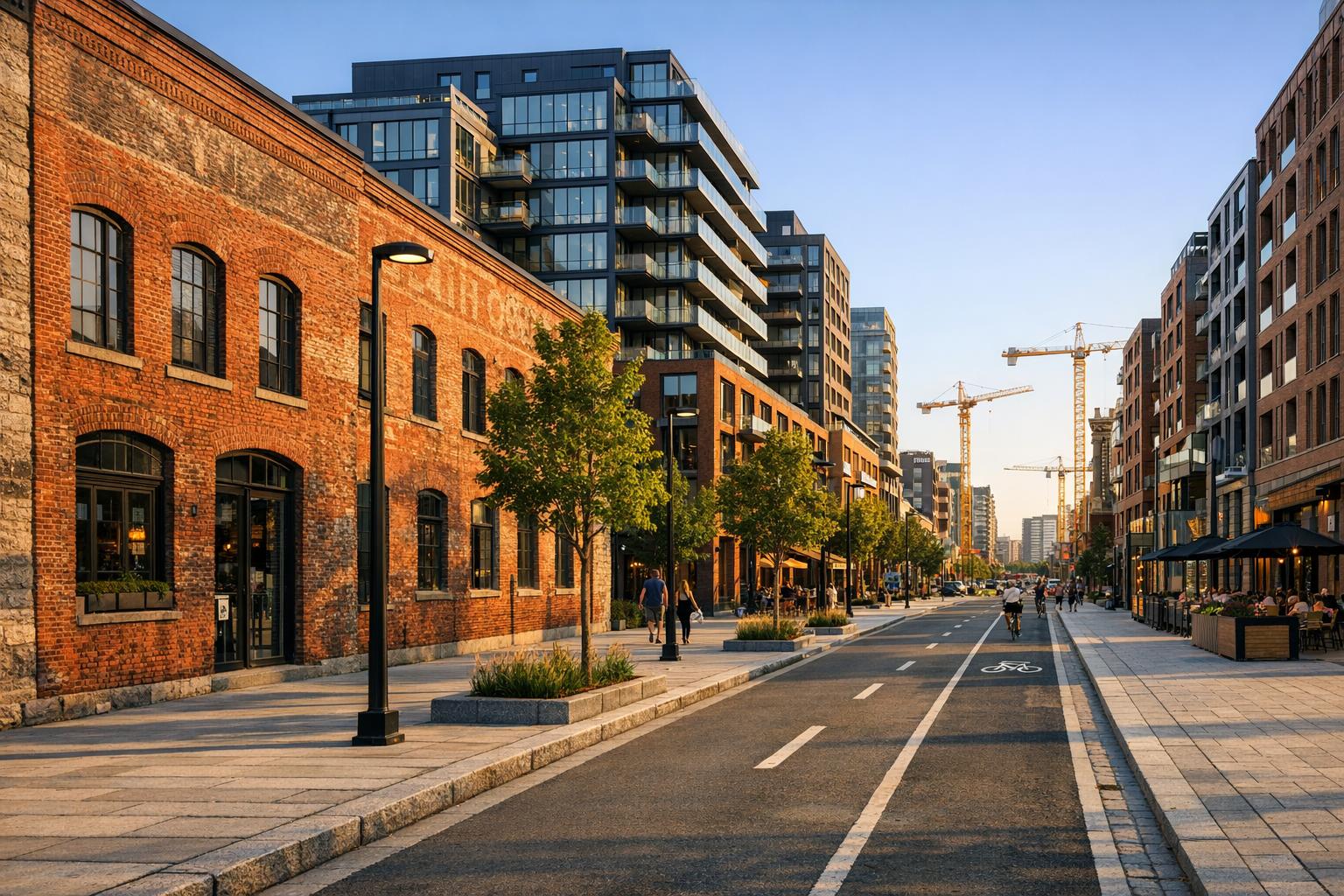
Urban Form: The character of Griffintown has shifted from low-slung industrial blocks to a dense cityscape. The city envisages it eventually mirroring downtown, with tens of thousands of residents and complete services. The new towers mean Griffintown now contributes to Montreal’s skyline and tax base. But it raises questions of urban design: how to balance human scale (sidewalk life) with vertical density?
-
Housing Supply: The flood of new units (Mondev, Devimco, etc.) will help Montreal’s chronic housing shortage. The mix of rentals and condos should modestly ease pressure on rents. However, many warn of a potential glut if interest rates change. City officials note that “people are looking for homes to live in, not necessarily condos to invest in”, hinting that these projects aim for occupation, not speculation [7]. The eventual Bridge-Bonaventure expansion will further tie into Griffintown’s fortunes – together they could accommodate over 30,000 new housing units in a decade [5] [1].
-
Public Realm and Livability: If all planned parks are built (12 total), the per-resident green space in Griffintown would become quite healthy for a downtown area. Completed elements like Place des Arrimeurs and street greening already make the area notably greener than it was a few years ago [8]. Long-term, Griffintown may serve as a test case for high-density, walkable communities in Montreal. Still, effective operation and maintenance of these parks requires continued attention – particularly as underground parking and infrastructure around them could mean managing stormwater and safety issues.
-
Sustainability and Resilience: The emphasis on retention basins and park “wells” suggests Griffintown’s design acknowledges climate challenges. For example, Parc des Eaux-Cachées literally aims to capture hidden waters, transforming flood risk into amenity. The anticipated 96 additional trees and EV charging infrastructure [13] [8] point to a greener vision. But critiques could note that construction itself has carbon impacts, and only time will tell if buildings meet energy-efficiency goals (most are conventional concrete towers). Future plans mention continued work with Québec to secure funding (Provincial/Federal) for transit extensions (e.g. the REM already under construction) – which will further shape Griffintown’s sustainability.
-
Social and Economic Equity: The transformation is often cast as positive growth, yet there are concerns about equity. Already, some long-term Griffintown households have said they feel “priced out” of their own neighborhood. Social advocates argue the city should now ensure a proportion of the new housing is genuinely affordable or co-operative, beyond the student tower. It is notable that a non-profit (Utile) spearheaded one large project, but developers like Mondev and Devimco are profit-driven. Whether the “complete, diverse district” promise [1] is realized will depend on policies (e.g. inclusionary zoning, rent controls) potentially enacted in coming years.
-
Role of Infrastructure: The REM (light metro) station under construction in Griffintown (Du Havre station at Peel) is a game-changer. It will significantly boost transit access (operational perhaps 2024–25). Higher accessibility is cited as another driver for skyscrapers. Also, the buried Ville Marie expressway will be fully replaced by city streets by 2030, knitting Griffintown more closely to downtown. These will likely spur additional phases of development. Other infrastructure (like a planned indoor public pool or school) may be introduced as resident counts swell.
-
Continuing Community Voice: The 2023 OIDP consultation suggests that even as concrete is poured, the city seeks to keep residents engaged [6]. Future planning might involve tighter coordination: e.g. requiring developer-community agreements for large towers (as has started in other Quartiers). The “good neighbor committee” and participatory budgeting processes (micro-parks, etc.) illustrated a new style of governance, empowered by recent reforms. These civic experiments could shape how Griffintown’s later stages unfold – perhaps distinguishing it from more opaque megaproject deliveries of the past.
Conclusion
By 2026, Griffintown stands at a crossroads of urban development. The ambitious city-led program has undeniably rotated the neighbourhood’s trajectory – away from vacancy and decline to one of intense growth. New towers, parks, and streetscapes attest to a thorough remaking: a once-deserted industrial quarter is becoming a densely populated, amenitized residential district. Yet this transformation is not without tension. The need for housing and amenities is pitted against concerns about heritage, community, and scale. The evolving narrative of Griffintown reflects a broader challenge facing Montreal: how to grow sustainably and inclusively in a constrained urban core.
Our analysis shows: substantial public funds and policies have enabled park creation and infrastructure, echoing the PPU’s sustainable-living goals [2] [1]. Private developers are supplying hundreds of new units [7] [10]. Community engagement processes have been instituted, though residents sometimes feel left out in specific cases [9]. Expert critiques remind us to evaluate whether such wholesale redevelopment truly serves urbanism or just the hubris of “megaprojects” [19].
Looking ahead, Griffintown’s full metamorphosis will unfold into the early 2030s. The next phase will test the durability of its gains: can the parks serve the planned 25,000 new neighbours? Will the promised 12 plazas all materialize? How will ongoing developments like Bridge-Bonaventure interact with this area? And crucially, how will Montreal ensure that Griffintown’s new identity remains “attractive and inclusive” as once envisaged [17]? With lessons from today’s case – positive and cautionary – city planners, citizens, and developers alike will shape the final chapters of Griffintown’s story.
References: Authoritative sources were used throughout: Montreal city planning and infrastructure websites, press releases, credible news reports (Global News, CoStar, CityNews), architecture journals (Building.ca), and transcripts of municipal consultations and speeches [2] [1] [7]. Each factual claim above is backed by cited material from these references.
External Sources (20)
About
2727 Coworking
Find a practical home for your work at 2727 Coworking in Montreal. Explore private offices, day workspaces and meeting rooms, plus business-address and virtual-mailbox services for your company.
2727 Coworking is a Montreal workspace and business-address provider. We serve people who need a place to focus, meet, run a small business or establish a professional mailing presence. Our website offers English and French information about workspace options and services, alongside educational resources for operating a business in Canada.
A workspace that fits the day
Our workspace options include private offices, day passes and desks, and a conference room. These formats help individuals and teams compare a dedicated office with more flexible ways to work or hold a meeting. Prospective members can explore the virtual tour, review current pricing and book a visit before choosing a workspace.
Business addresses and mail
2727 Coworking provides business-address and virtual-mailbox services. Our resources explain the documents and practical questions involved, including guidance for people outside Canada. Service eligibility, included features, availability and access arrangements should be confirmed on the applicable service page or with our team.
Resources for Canadian small businesses
We publish guides, research and planning tools about workspace decisions, business addresses and starting a business in Canada. Our incorporation research includes information for people inside Canada and abroad, with jurisdiction-specific material to help readers identify the next questions to investigate. These educational resources complement our workspace and address services; they are not individualized legal, tax or immigration advice.
Visit or contact 2727 Coworking
Explore private offices, day passes and desks, the conference room, business addresses and virtual mailboxes. Book a visit or contact the team to discuss your needs.
A business address alone does not establish tax residence, immigration status, banking approval or eligibility for a government program.
Disclaimer
This document is provided for informational purposes only. No representations or warranties are made regarding the accuracy, completeness, or reliability of its contents. Any use of this information is at your own risk. 2727 Coworking shall not be liable for any damages arising from the use of this document. This content was generated with assistance from artificial intelligence tools, which may contain errors or inaccuracies. Readers should verify critical information independently. All product names, trademarks, and registered trademarks mentioned are property of their respective owners and are used for identification purposes only. Use of these names does not imply endorsement. This document does not constitute professional or legal advice. For specific guidance related to your needs, please consult qualified professionals.