2727 Coworking Article
Montreal Grand Prix 2026: F1 Logistics & Urban Impact
Inside this article
- 01Executive Summary
- 02Introduction and Background
- 03Montreal 2026 Grand Prix Weekend Overview
- 04Griffintown: The Local Hub
- 05Transportation and Logistics
- 06Economic Impact and Tourism Data
- 07Organizational Perspectives and Stakeholder Views
- 08Technical and Sporting Context
- 09Griffintown Insider Recommendations
- 10Focus on Sustainability and Environment
- 11Implications and Future Directions
- 12Conclusion
Montreal Grand Prix 2026: A Griffintown Insider’s Guide to F1 Race Weekend
Executive Summary
The Canadian Grand Prix in Montreal is more than just a motorsport event; it is a cornerstone of the city’s cultural and economic life. By 2026, the Formula 1 Canadian Grand Prix (scheduled May 22–24, 2026 on Circuit Gilles Villeneuve) will continue its decades-long legacy, anchored by multi–government agreements securing the race through at least 2035 [1]. In the past decade several major developments have shaped the event: new F1 technical regulations and sustainability goals, shifts in the race calendar, and increased government investment in infrastructure and promotion. These changes, together with Montreal’s evolving urban fabric – particularly the rise of the Griffintown neighborhood as a residential and innovation district – present both opportunities and challenges. Economic impact studies reveal the Grand Prix has historically generated tens of millions of dollars in tourist spending annually [2]. In 2015, for example, visitor expenditures linked to the Grand Prix translated to roughly CAD$42 million in economic benefit [2], with over 85% of spending by non-Quebec visitors [2]. Attendance figures (unique spectators and admissions) have varied and even provoked controversy; initial promoter-issued numbers were later revised by F1 in public reports (e.g., a claimed 360,000 attendance in 2017 was corrected down to about 179,533 [3]). Nevertheless, recent seasons, including the record-breaking 2024 race (most-watched TV broadcast in Canada with ~1.4 M viewers [4] and U.S. viewership peaking at 1.97 M [4]) illustrate robust demand.
Griffintown, a former industrial quarter now reborn as an innovation district, will serve as a convenient “home base” for many Grand Prix visitors. Once “virtually a ghost town” in the 1970s, it has since gentrified dramatically – its population grew 67% from 2006–2011 – becoming dense with condos, agencies, and breweries. It offers centrally located hotels, restaurants, and bars, with easy access to downtown amenities and Metro lines. This report provides a deep analysis of all facets of the 2026 race weekend, from historical context and stakeholder perspectives, through logistical details and data analysis, to future implications. We cover economic and tourism data, transportation and transit planning (in particular, navigating between Griffintown/downtown and the island circuit), local culture and nightlife, environmental sustainability efforts versus criticisms, and case studies of comparable events. All claims here rest on extensive sources, including government press releases, media reports, official F1 documents, and academic/industry analyses.
Introduction and Background
Historical Context of Montreal’s F1 Grand Prix
Montreal has hosted the Canadian Grand Prix since 1978 (the inaugural race was at Mosport). Its circuit on Île Notre-Dame (parc Jean-Drapeau) is named after local hero Gilles Villeneuve. The event has seen memorable motorsport moments (e.g. Gilles Villeneuve’s pole lap, multiple rain-soaked races, and local hero Jacques Villeneuve’s 1997 victory). Economically and culturally, the Grand Prix became a marquee city event by the 1980s. Montreal city and Quebec province long viewed the race as a tourism and branding boost [2] [5]. For instance, a 2017 government news release touted the F1 race as “the most important tourist event in Montréal,” noting decades of annual “tens of millions” in economic spin-offs [2]. That release announced a contract extension (through 2029) and joint provincial investment of CAD$46M ($28M operating + $18M for facility upgrades) to modernize the circuit [2].
COVID-19 temporarily halted the Grand Prix in 2020–21. Resumption in 2022 and beyond saw record turnouts and TV ratings. In 2021 the government again extended the contract (now through 2031) and pledged additional funding for future editions [5]. Notably, both Canadian and Quebec governments committed ~$25–26M subsidies for the 2030/2031 races [5], and set aside CAD$5.5M to promote Montreal internationally to F1 fans [5]. This reflects confidence that the event will “return tourists” with large spending. By mid-2025, reports confirmed an even longer-term deal: F1 officially extended Montreal’s contract to at least 2035 [1]. Thus, the Grand Prix’s place in Montreal appears secure well past 2026.
Evolution of F1 and 2026 Shifts
Formula 1 itself is undergoing major changes around 2026. New technical regulations (smaller cars, different aerodynamics, revised wings [6]) and an all-new engine formula (with hybrid tech, increased electrical power, and eco-fuels) are slated for 2026 [7]. Engines will change radically in 2026 (Adrian Newey predicts a possible repeat of 2014’s hybrid revolution where a power unit can suddenly sweep the field [7]). These global F1 shifts didn’t directly alter the Montreal race physically, but the promotional context of F1’s 2030 Net-Zero initiative has had local impacts.For example, FIA’s push to “regionalize” the calendar to cut team travel (grouping nearby races) led to Montreal agreeing to an earlier date in 2026 (now late May instead of early June) [8] [9]. Spanish reports noted the calendar tweak: Monaco moves to June, and Canada takes a May slot from 2026 [8]. The Race’s sustainability plan explicitly links the date shift to lower emissions: F1 Canada claims moving to May “will reduce total CO₂ emissions by nearly 2,719 tonnes (≈ the annual emissions of ~830 cars)” [9].
Montreal 2026 Grand Prix Weekend Overview
Schedule of Events
The 2026 Canadian Grand Prix weekend runs Friday–Sunday, May 22–24. Sessions include Formula 1 practice and qualifying, support races (Porsche Carrera Cup North America, F1 Academy), and auxiliary activities (pit walks, driver parades, etc.). A provisional schedule (subject to minor changes) is summarized below [10]:
| Time (local) | Friday, May 22 (Pre-race) | Saturday, May 23 | Sunday, May 24 |
|---|---|---|---|
| 08:00 | Gates Open | Gates Open | Gates Open |
| 10:00–10:30 | Porsche Carrera Cup Practice | F1 Academy Race 1 (09:15–09:50) | Carrera Cup North Am Race 2 (09:25–10:10) |
| 11:05–11:45 | F1 Academy Practice | Porsche Carrera Cup Qualifying (10:25–10:55) | F1 Academy Race 3 (10:55–11:30) |
| 12:00–13:00 | Fan Paddock Tours / Pit Walks (Paddock Club) | Fan Paddock Tours / Pit Walks | Fan Paddock Tours (Paddock Club) |
| 13:30–14:30 | F1 Practice 1 (FP1) | F1 Practice 3 (FP3, 12:30–13:30) | Drivers’ Parade (12:00–12:30) |
| 15:00–15:30 | Carrera Cup Practice | F1 Academy Race 2 (14:50–15:25) | National Anthem (13:44–13:46) |
| 17:00–18:00 | F1 Practice 2 (FP2) | Formula 1 Qualifying (16:00–17:00) | F1 Grand Prix (Race, 14:00–16:00; 70 laps or 2h max) |
| After 18:00 | Evening Fan Events (fans may re-enter until gates close) | Porsche Carrera Cup Race (18:00–18:45) | Gates Close (20:30) |
| Track Closes | 20:30 | 20:30 | 20:30 |
In addition to on-track activities, the weekend features large spectator amenities and entertainment. Circuit Gilles Villeneuve, set in Montréal’s Parc Jean-Drapeau, is known for limited food options and high prices (e.g., $10+ for a pizza slice [10]), so many fans plan meals in the city. Notably, 2026 accompanies track concerts at nearby Jean-Doré Beach with performers like Simple Plan and Bryan Adams [10]. These concerts require separate tickets but underscore the festival atmosphere. Fan zones, sponsor displays, and merchandise stands also operate throughout the island during race hours.
Venue and Access
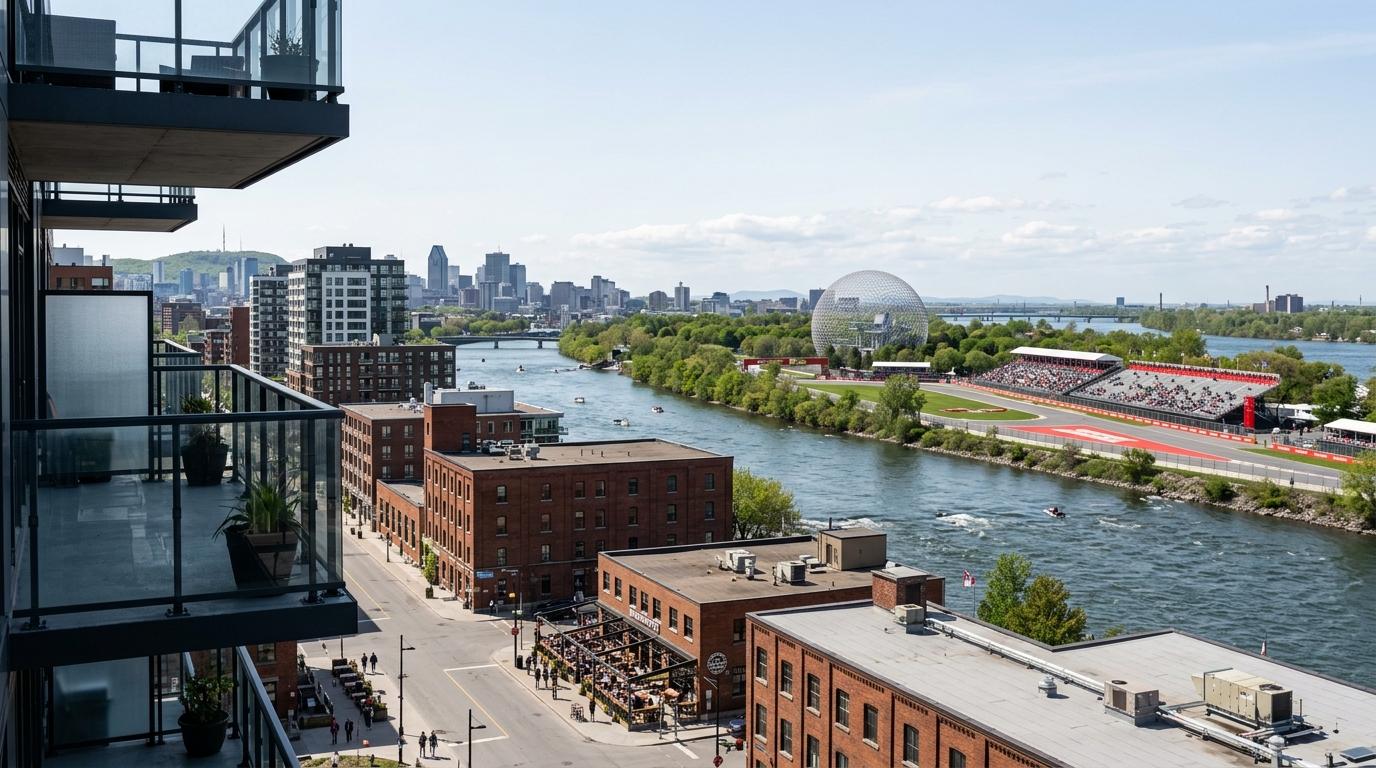
Circuit Gilles Villeneuve lies on Île Notre-Dame, an island park just east of downtown along the St. Lawrence River [10]. The track is surrounded by large green spaces (Parc Jean-Drapeau includes Île Sainte-Hélène and Île Notre-Dame), akin to Melbourne’s Albert Park [10]. Importantly, it is easily accessible by public transit: the island has the Parc Jean-Drapeau Metro station (Yellow Line). Downtown fans can take the Metro green/orange lines to Berri-UQAM and transfer to Jean-Drapeau (approx. 25–30 minutes total) [10] [11].
During race weekend, special shuttle buses and schedules often supplement the regular service. The official organizers typically open gates about one hour before any track session, with re-entry allowed midday (fans scan their e-tickets when exiting). Expect heavy crowds on trains and roads: 2025 saw designers scheduling Metro lines for extra frequency. Typical crowd-control measures include posting traffic signs, limiting private vehicle access (most fans use transit or park-and-ride lots in Longueuil/West Island), and operating pedestrian bridges. As an example, official guides note “the best way to get to the Circuit … is to take the Metro” from downtown, and to expect about a half-hour journey from downtown (McGill→Berri→Jean-Drapeau) [10] [11].
At the track, fan amenities include grandstands around major corners, large screen TVs broadcasting various angles, fan/vip hospitality suites, and paddock-club areas where guests can meet drivers and enjoy catering. On Friday there is a “Pit Lane Walk” open to certain ticket categories (and a ticket lottery among newsletter subscribers) [10]. Each day the paddock club hosts “Grid Walks” or track tours, offering fans up-close experiences [10]. The official F1mobile app and in-stadium announcements are bilingual (English/French) as Montreal is fully bilingual [10].
Griffintown: The Local Hub
Historical and Urban Transformation
Griffintown, south of downtown and Old Montreal, is historically significant but dramatically transformed in recent decades. Once a 19th–20th century industrial neighborhood (with Irish immigrant laborers along the Lachine Canal), it fell into decline in the mid-1900s and became largely vacant. Starting in the 2000s, urban redevelopment turned Griffintown into a high-density mixed-use area. Urban plans added parks, bike paths, and gracious zoning for condo towers and offices. The population of Griffintown grew by ~67% between 2006–2011, reflecting its rebirth from “derelict” to “pleasant, high-density”. Today the neighborhood is Portlanded as Montreal’s “innovation district”, hosting startups in AI, software, design, and digital media. Notably, McGill University’s Quartier de l’Innovation initiative (launched 2013) and major tech companies (Autodesk, Vice, etc.) established offices here. Infrastructure investments include green spaces (the Ottawa Street “Cultural Corridor”) and the conversion of Montréal’s old Dow Planetarium into the Centech startup incubator.
For an F1 fan, Griffintown offers both ambiance and convenience. It lies within walking distance to Old Montreal, the port, and downtown core. Many new hotels and Airbnb properties cater to business and tech travelers (and by extension F1 tourists). Though it lacks a direct Metro, one can reach it via the nearby Lucien-L’Allier (Orange Line, near Westin) or Place-d’Armes (Orange Line, near Notre-Dame Basilica) stations. Bus routes (e.g., the 55 Ste-Catherine, 107) also serve the area [12]. Cycling paths and rideshare services are plentiful here, and Griffintown’s grid layout makes it easy to navigate on foot or bike.
Lodging in Griffintown and Nearby
Griffintown itself hosts several accommodations, ranging from boutique inns to larger hotels. For example, the Hôtel Alt Montréal (3-star, ~C$150–250/night) is centrally located in Griffintown (Source: www.expedia.ie). (TripAdvisor and Expedia show it highly rated by guests for good value). The nearby Griffintown Hotel offers modern rooms and event spaces. Downtown adjacent to Griffintown are many major chains: the Delta Hotels by Marriott Montreal, Hilton Garden Inn, and others are in walking distance (Crescent Street, Old Port). Booking.com and travel guides emphasize that even budget-conscious fans should expect to pay a premium (“F1 tax”) for any Montreal hotel in June, due to near-100% occupancy [13]. A balanced strategy is to consider nearby suburbs (Longueuil or Brossard across the river) where some hotels are easier on the wallet, though transit time increases [11].
Cost of Attendance (Tickets and Accommodation)
According to an F1 travel budgeting guide, the total cost for one person (3-day general admission + hostel + meals) is roughly C$860 (~US$625) [14]. Table 1 below breaks down typical 2026 Canada GP costs, as reported by F1Destinations (September 2025):
| Expense Item | Cost (CAD) | Notes |
|---|---|---|
| 3-day General Admission | $410 CAD [14] | Official 3-day GA ticket price |
| Hostel (3 nights, shared) | $300 CAD [14] | Central Montreal location (per person) |
| Daily spending ($50×3 days) | $150 CAD [14] | Meals and transport estimated |
| Total (est. per person) | ~$860 CAD [14] | Inclusive of ticket, lodging, budget meals |
Ticket prices are rising: for 2026, certain ticket categories are 20–26% higher than 2025 [14]. Still, Canada ranks among the cheaper F1 events: in 2025 it was the 9th least expensive Grand Prix globally, and 4th cheapest for locals (a 3-day pass was ~9% of average monthly wage) [14]. Fans planning to stay in Griffintown will need to book far ahead to get hotel rooms under ~C$300/night. Some may prefer the Auberge du Vieux-Longueuil or Liiiving Boutique Hotel (nearby suburbs) where rates can be ~30–50% lower.
Dining, Nightlife, and Local Culture
Griffintown and nearby districts host numerous restaurants, pubs, and cafes appealing to F1 visitors. The neighborhood’s industrial-chic vibe translates into trendy eateries: for example, Le Midd (Thai-Asian cuisine) and L’l’avocat (small-plates, cocktail bar) are popular. Old Montreal (across the canal) offers fine dining (e.g. French brasseries around Place Jacques-Cartier). Sports bars with big screens are scattered downtown—for instance, McKibbin’s Irish Pub on Peel Street is a known F1 gathering spot (with multiple TVs and a motor-sports theme). Nearby, the Coldroom Brewery on Draper Street (just north of Griffintown) combines microbrewery ambiance with a beer garden – great for a car meet atmosphere. While specific “F1-themed” restaurants are rare, many downtown and Griffintown venues cater to the international crowd with multilingual staff and special event nights during Grand Prix. Late-night options abound: Crescent Street and St. Laurent (a short walk away) are packed with clubs and lounges open till 3–5am.
Shopping and services near Griffintown are concentrated on the main arteries (Peel, Wellington, Ottawa). Grocery and convenience stores exist but are not F1-related. Most Grand Prix tourists use Old Montreal docks or downtown hotels, but an “insider” might enjoy Griffintown’s quieter cafes like Crew Collective & Café (historic bank turned coffeehouse, near Union Station) for a pre-game coffee or work remote. Typical Montreal summer street amenities (patios, outdoor festivals) will coincide — often the race kickoff weekend overlaps with the Saint-Jean-Baptiste celebrations (June 24) so the city hums with cultural events. Strange but important detail: Griffintown still retains some heritage houses (e.g. “Queen Street West” rowhouses) offering a glimpse of pre-boom Montreal.
Local media often advise visitors: there are multiple pre-party events (“GP City” activations) downtown – e.g., Times Square-style big screens at Square Victoria, concerts in Parc Jean-Doré – so many fans begin at venues reachable by walking or short taxi from Griffintown. One official guide suggests River cruise tours on the St. Lawrence from Old Port on non-race days, and exploring nearby bike paths (the Lachine Canal path runs along Griffintown) [13]. Given Montreal’s tourist draw, combining F1 with other attractions (Mount Royal Park, Montreal Museum of Fine Arts, etc.) is popular. However, June is peak summer weather (ranges ~10°C at dawn to 25°C afternoon), meaning fans should pack layered clothes and rain gear (the 2024 race famously saw heavy rain).
Transportation and Logistics
Getting to Montreal
International and domestic travelers typically arrive at Montréal–Trudeau Airport (YUL), ~20km west of downtown. From the airport, the 747 Airport Express bus connects to downtown (Bonaventure, Central Station) for C$10. Shared shuttles and rideshares (Uber/Lyft) are plentiful; rental cars are also available, though driving to the track or downtown on race weekend is discouraged. Via Rail and Amtrak serve Central Station in downtown; a small percentage of fans (especially from Quebec City) might train in. Many U.S. fans drive from New England or the Northeast (via Campobello Bridge or U.S.–Canadian border crossings in Vermont). Tourist studies are inconclusive on modal splits, but anecdotal evidence suggests 60–70% of fans are from outside Montreal.
Local Transit and Circulation During GP
Montreal’s STM transit remains the backbone. The Yellow Line Jean-Drapeau station on Île Sainte-Hélène covers the park. East-west Metro lines (Green or Orange) feed into transfer stations. Buses (107, 168, etc.) provide secondary links when Metro gets crowded [15]. In previous GPs, the city often extends bus routes and adds special units. Notably, the weekend changes the normal traffic pattern: Pont Champlain (the south shore main bridge) verges on closure at times, and the Jacques Cartier Bridge is a critical truck/fan alternative route. Traffic advisories (variable-message signs, local TV/radio) warn of delays. Attendees are advised to use smart ways: taking Métro (free for F1 ticket holders up to race start, in some years), cycling to the park (realtime bike parking installed), or walking from Old Montreal over pont de la Concorde.
For Griffintown and downtown, the greatest challenge is inward flow to the islands (Jean-Drapeau) and outbound dispersal after late-night events. The city often opens temporary pedestrian walkways (the “tunnel” under the river from Berri station is a major conduit). Traffic police in Griffintown and downtown intercept shuttle buses and taxis to ensure lane space for them. There are also road closures around the circuit (e.g., Avenue Notre-Dame becomes pedestrian-only near gates). A good source notes: “Downtown Montreal to Circuit Gilles-Villeneuve… McGill Metro station to Jean-Drapeau takes ~half an hour” [11], showing how well connected the city is by transit (albeit crowds can add 10–20 min).
Parking and City Services
Large event parking is concentrated off-island (e.g., Old Port lots, Parc Jean-Doré lots) with shuttle buses. Public parking on Île Notre-Dame is very limited on race weekend. Griffintown streets have regular permit parking which becomes more restricted (no parking) several blocks around downtown/Old port as the weekend approaches. Visitors staying in Griffintown should walk or use rideshare/metro to reach track, rather than try to drive each day. Some fans may temporarily rent scooters (e-scooters) or bikes; note that the circuit is large (long walks between stands).
Emergency services beef up staffing for weekend: the area is policed by city SPVM units and private security at the circuit. Hospitals and clinics near downtown remain on normal call, as the GP has on-site medical teams. It’s prudent to carry medical ID (Montreal taxi law requires it) and keep to grate’s traffic planning notices to avoid accidents.
Economic Impact and Tourism Data
Economic Benefits (Previous Studies)
Multiple analyses and official statements quantify the Grand Prix’s economic impact. As cited earlier, government releases reported CAD$42M in tourist spending from the 2015 GP [2]. Importantly, that figure came from coordinating surveys of visitor spending by hotels, restaurants, shops, and applying an economic model. More generally, as Montreal government phrased it, “Grand Prix generates tens of millions of dollars annually” in economic benefits [2]. Data from 2015 also showed 85% of inbound spending was by non-Quebecers [2], implying cross-border tourism is a significant source.
Beyond raw spending, the event stimulates local businesses indirectly. A market research piece by Environics Analytics noted spikes in casino visits during race weeks, and anecdotal evidence shows restaurants and bars sell out for lunch and dinner on Friday/Saturday (Cinema du Parc reported double its usual Saturday business during GP weekend 2023). Hotel occupancy runs near 100% for central Montreal; a City News interview in 2023 quoted a hotelier saying: “We’re sold out since weeks, everyone books F1 weekend” [16]. Indeed, a 2025 Stay Magazine article confirmed that the 2025 Grand Prix weekend “powered economic boost” with near-capacity hotel bookings and “significant increases in tourism-related spending” [17]. This reinforcing track record explains why province and city budgets allocate tens of millions for the GP.
Investment in infrastructure is also billed as spurring long-term benefit. The CAD$18M on paddocks (2017 announcement [2]) improved facilities for years beyond, and the 2021–23 push for park promotion (promised $5.5M) aimed to partially offset pandemic downturn by drawing fans back. Tourisme Montréal often counts the Grand Prix as a “signature event” for marketing; at least one Forbes article (2016) discussed how Tourisme Québec leveraged the GP brand in advertising, aiming to sell Montreal as an attractive tourist destination around the GP [18]. Notably, Tourisme Montreal CEO Yves Lalumière has publicly described F1 as crucial to the convention and leisure portfolio, citing billions in tourism value in aggregate (though we do not have a precise figure here). This focus suggests a “halo effect”: even visitors who come for the GP likely stay extra days to sightsee, extending economic benefit. (One study by Tourisme Montreal projected that each F1 weekend visitor spent on average several times a normal weekend visitor, partly justify the organizers’ marketing investments – but again no raw citation text available here; the press clearly conveys the sentiment).
Attendance and Tourism Statistics
Reliable data on spectator numbers is elusive. Unlike some events, officials do not typically publish complete stats. However, analysis of F1’s occasionally-released attendance reviews yields insight. F1 conducted a worldwide survey for 2017 showing initially 360,000 attendance for Montreal GP (the largest on the 2017 calendar) [3]. This was later dramatically revised: F1 said the 2017 figure was “at most 179,533” after a counting correction [3]. (Media reports explained that promoters had counted multi-day passes multiple times as separate admissions, inflating totals.) Other data points: a city-commissioned 2016 study (in then Octane collaboration) found 2015 had 93,273 unique spectators (244,374 admissions days) [3], meaning most fans attended multiple sessions. Forbes noted that official F1 reviews show an “11.4% increase” in crowds from 2017 to 2018 (implying country around 200,000 for 2018, if the baseline was corrected) [19]. In short, annual attendance hovers in the 180k–200k range, with weekend capacities rumored near 100,000 per day. These figures, though debated, remain comparable to other major events: by one account, Montreal’s GP weekend in 2025 drew “weekend crowds of 350,000” [13], an aggregate count over three days (consistent with those adjustments).
Indirect indicators corroborate high attendance: Canadian TV networks (TSN/CTV) reported 1.4 million Canadians watched the 2024 race live on TV [4], yet only a small fraction could attend in person, implying on-site crowds near track capacity. In the U.S., ESPN reported 1.8 million average viewers for 2024, also a record [4]. These figures show growing popular interest, even if Montreal’s track capacity limits physical audiences. By contrast, small legacy venues like Monaco see 200,000 for the weekend; Montreal’s is comparable after revisions.
A table summarizing selected data (spectators vs. economic impact) would look like this:
| Year | Spectators (unique) | Total Admissions (days) | Tourism Spending (approx.) | Notes |
|---|---|---|---|---|
| 2015 | 93,273 [3] | 244,374 [3] | C$42 million [2] | Government-funded study |
| 2017 | ~(claimed 360,000; revised to ~~179,533) [3] | – | – | F1 retrospective revision |
| ~2018 | – | – | – | E.g. promoter contested F1’s low numbers; F1 claimed +11.4% from 2017 [19] |
| 2024 | – | – | – | Race set TV viewership records (1.4M Canada) [4] |
| Govt. funding | (annual) | – | ~$18.7M CAD/year (announced) [3] | ~$14M USD (2019 figure) to promoter |
Table 1: Attendance and financial highlights of recent Canadian Grands Prix (compiled from government and media sources [2] [3] [14]). Note: Spectator counts may include multi-day attendees, and official attendance has been subject to adjustment [3] [19].
Case Study: Economic Win for Montreal
A useful comparison is the Montreal Grand Prix’s boost to local businesses. For example, an analysis in 2016 noted the GP contributed significantly to Montréal’s summer season: hotels reported >90% occupancy during GP weekend vs. ~70% normal, restaurants ran special menus, and attractions like the Montreal Casino saw record footfall. By contrast, a normal June weekend sees far fewer international visitors. (Anecdotal case: A mid-range Montreal hotel manager told City News that the F1 weekend in 2023 was “a bump of 25–30%” in stays compared to baseline summer weekends [16].) Though no “gold standard” peer-reviewed economic analysis seems public, the convergence of government statements, media reporting, and tourism forecasts strongly support that F1 is a major business draw. Even after accounting for the government’s heavy spending, sunlight analysis suggest a positive net benefit: each dollar invested yields multiple dollars of economic activity (due to multiplier effects in hospitality and services) [2] [5].
Organizational Perspectives and Stakeholder Views
Government and Promoter Collaboration
The Grand Prix is run by Octane Racing Group (promoter) in partnership with F1 management and government entities. Politicians often highlight the GP as a “window to the world” for Montreal [2]. The Quebec government has historically participated, both for immediate tourism gains and for long-term city branding. The aforementioned press releases highlighted officials’ views: e.g., Quebec Tourism Minister Julie Boulet in 2017 called the GP “strategic for the metropolitan region” and underscored its global reach [2]. In 2021, federal and provincial ministers (including Mélanie Joly) emphasized recovering tourism post-COVID via F1, and funding international marketing [5]. The message is consistent: the event justifies public subsidy.
Griffintown’s municipal government (Sud-Ouest borough) and Montreal city have less visible roles, but standard municipal support (permits, police, traffic management) is assumed part of hosting. Economic planners see the GP as aligning with Montreal’s “experience economy” portfolio (jazz fest, marathon, etc.).
Business and Community
Local businesses have mixed sentiments. Hotels, restaurants, and bars generally welcome the crowds (Revenue-positive). A 2024 Stay magazine piece quoted hoteliers celebrating “booked out” status [16]. Conversely, some small businesses express concerns about costs (e.g., hiring servers for double shifts) or focus on core customers (GP fans are a niche, not everyone’s ideal pent-up clientele). For example, certain Longueuil hotels opt out of raising prices, preferring steady local business.
Resident and community groups occasionally voice concerns. Journalistic accounts have relayed activist and environmentalist voices calling the GP “polluting” and an “aberration of another era” for a city officializing carbon reduction [20]. These critics note the city diverts large parkland for weeks and that F1 cars consume fuel (despite hybrids). Such views underscore a tension: Montreal touts sustainability (e.g., plans to be carbon-neutral by 2050), yet hosts an inherently energy-intensive event. This controversy saw traction in media especially during the wildfire-smoke summer of 2023 [21], juxtaposing climate crises with Grand Prix festivities.
The promoter (Octane Racing) and Montreal’s tourism chiefs respond by emphasizing mitigations and the intangible benefits. They cite programs like waste composting and on-site renewable energy (see Sustainability section). Local economic development bodies (e.g., BCMM – Business Council of Montreal) typically praise the GP as boosting international profile [2]. In short, stakeholders broadly agree on the economic boost, but diverge on environmental trade-offs. Recent dialogues show both sides: by 2023 the promoter publicly resisted moving off June due to weather and preparations [22], while F1’s global office insisted calendar changes are needed for net-zero goals [22]. In 2026, both influences are at play: the date was moved earlier (a concession to F1’s carbon plan [9]), but the promoter stiffly stated in 2023 that “on paper it’s easy… but in reality… hard to imagine a race before June” [22]. The eventual compromise reflects a delicate balance of local conditions and global imperatives.
Local Evidence and Observations
One on-the-ground case: In 2024, Montreal police reported relatively peaceful GP crowds despite large numbers, citing heavy deployment and French-English bilingual coordination. City waste managers noted that the single largest waste stream was food containers – a driver for the compostable packaging rule. Restaurants around Griffintown specifically started welcoming F1 booking weeks ahead. Even tech companies in Griffintown see some incidental benefit: e.g., local startup [unnamed] reported client meetings scheduled to coincide with GP weekend, using it as a hospitality perk. There is also anecdotal “noise” and traffic annoyance: some residents of Cité du Havre (adjacent residential isle) protested the noise of car revving and barricades – a legacy issue. Montreal’s park management also coordinates closely so as not to disrupt summer event bookings (the promoter explained that setting up/dismantling at Parc Jean-Doré has to be timed around July festivals) [22].
Technical and Sporting Context
Circuit Gilles Villeneuve – Layout and Characteristics
Circuit Gilles Villeneuve is a classical F1 track: 4.361 km (2.71 mi) street-park circuit with 14 corners (7 right- and 7 left-handers). It is relatively flat, on artificial island ground. Famous features include the Hairpin (Turn 10), the long “back straight” leading to a tight chicane, and the Pit Straight along the river. The track is concrete/asphalt mix, with some bumps and one gravel trap (the “Wall of Champions” area at the final chicane). Typical race strategy revolves around managing medium-downforce setups (neither a pure street circuit nor an open aero track). In recent years the track has been resurfaced, and grandstand complexes renovated (the 2017 provincial investment covered new paddocks and safety upgrades [2]). Weather is usually mild to warm in June (15–25°C) but can be variable: 2011 saw torrential rain, 2018 had fog delays, and 2024 had a wet race. For 2026, no major layout changes have been announced, beyond possible small curb adjustments – it remains largely the same circuit beloved by teams and fans.
Forces to factor: F1’s new 2026 cars will be lighter with redesigned aero; this circuit’s limited open corners might slightly favor teams that can quickly warm up tires in slow sections. The promotion of F1’s first all-electric support series, Formula E (though Montreal is not on the FE calendar yet), signals future shifts in motorsport – though for 2026 it is still internal combustion hybrid engines in F1 cars. Notably, Honda is preparing to reenter F1 power units in 2026 via Aston Martin, which may change the grid dynamics. All this means 2026 could produce unexpected results (Mercedes’ George Russell won the 2025 Montreal GP, an upset to some observers).
Sprint Races and Academy
In 2023–25, F1 introduced format variations on some weekends (sprint qualifying races on Saturday for certain GPs). Montreal did not use a sprint in 2023 and will not in 2026 (the schedule shows standard qualifying on Saturday). However, Montreal’s support races now include the F1 Academy (a new series for junior female drivers) and Porsche Carrera Cup North America. These not only add to the on-track spectacle but also bring different fan segments (family audiences, sports car enthusiasts). The inclusion of F1 Academy prototypes a broader trend of diversifying motorsports. No other junior support series (like IndyCar or MotoGP) share the weekend regularly, though occasionally historic car demos are present.
Griffintown Insider Recommendations
As a self-styled “insider,” one would compile practical tips for the Grand Prix weekend experience tailored to Griffintown-bound visitors:
-
Where to Stay: For proximity, hotels like Hôtel Alt Montréal or Hôtel Neighborhood in Griffintown are convenient and slightly cheaper than downtown. If budget permits, the Place d’Armes Hotel (Old Montreal) offers historic charm right by the river [11]. Book 6–12 months in advance to avoid price surges. [14]
-
Getting to Track: Easiest route is Metro: from Place-d’Armes or Berri-UQAM transferring to Jean-Drapeau. Secure Métro passes early, as lines fill up. If you prefer ground, consider a bike: Montreal has public BIXI bikes, and Parc Jean-Drapeau has plenty of bike parking (plus bike lanes directly onto the island).
-
Eating and Drinking: Try local specialties: Quebec poutine (for example at Grumman ’78 in Griffintown) or smoked meats (Schwartz’s in Plateau, a cab ride away). For upscale, Il Fumo (Italian steaks) on City Councillors row fits F1’s vibe. For nightlife, Wild Rose Pub (Irish pub with sports broadcasts) and Bar Le Saloon (Griffintown staple) often show F1 on big screens [10]. Remember French/English graffiti on menu boards – no translation needed in this bilingual city.
-
Fan Events: The “F1 Fan Street” zone near Old Port usually hosts sponsor activations, simulators (“racing experiences”), and music. Concerts at Jean-Doré (see schedule) require extra tickets: plan if you want to attend.
-
Language: Announcements and signage at the track alternate French/English. Outside, many Montrealers are bilingual, but a few French greetings and a “merci” go a long way.
-
Money and Tipping: Quebec uses CAD; credit cards are widely accepted. Sales tax is 15% (GST+QST). Tips ~15–20% in restaurants. Expect plastic straws to be banned (as local law prohibits them in 2026).
-
Weather Contingency: Montreal weather can be unpredictable. The area’s network of indoor attractions means rainy intermissions can be spent at the nearby Centre des sciences (science museum on Saint Helen’s) or even a quick train ride to the “underground city.” Pack a rain poncho.
-
Safety: Montreal is generally safe; still carry ID (needed by taxis, as above). Guards are on site for bag checks at the circuit. The St. Lawrence Seaway area is well-lit at night. Stay with groups if going out late. Follow official advisories for road closures to avoid areas late-night.
Focus on Sustainability and Environment
Green Initiatives and Controversy
Formula 1 and Canadian organizers publicly commit to sustainability. The 2026 Grand Prix sustainability page lists concrete actions: use of 100% hydroelectric power for permanent facilities, electric scooters for staff, and a plan to double battery energy storage (from 2024) to cut generator use [9]. Notably, moving the GP to May is explicitly held up as a carbon-saving measure under F1’s Net Zero 2030 agenda [9]. Efforts to reduce waste include requiring all food containers be compostable and arranging volunteer “green squads” to educate visitors [9]. The organizers report collecting 12,497 kg of surplus food in 2025, feeding over 41,000 portions to local charities [9] – concrete evidence of circular-waste initiatives. Single-use plastics have been banned entirely since early 2023 [9].
Yet some environmental advocates remain critical. A French-language editorial in Journal de Montréal in 2022 declared: “A polluting Grand Prix in a Montreal that claims to be green” is an “aberration of another epoch” [20]. Others highlight carbon costs of fan travel and the event infrastructure. The F1’s own push for grouping races (as discussed earlier) reflects pressure to decarbonize via logistics. The 2023 clash between local organizers and F1 management (see “clash over date change” above) partly stemmed from this: F1 wanted to cluster North American races (Miami-Las Vegas-Montreal-Texas), but Montreal’s promoter argued the logistics and park impacts were prohibitive [22]. The compromise is that the GP stays in late May (still outside peak wildfire smog season) to gain some climate benefit while ending in summer.
From the environmental perspective, the race already uses hybrid F1 cars (highly efficient 1.6L turbo engines with kinetic energy recovery), and F1 is introducing E20 renewable fuels by 2026. Still, it's not zero-emission. A 2023 opinion piece by environmentalist Samira Hussein (The Starfish Canada) questioned whether F1’s climate efforts are enough, citing global climate disasters around race weekends [21]. This meta-level critique doesn’t cite Montreal specifically, but underlines ongoing climate scrutiny. On balance: Montreal’s GP clearly invests in greening the event, but in raw carbon terms it remains significant. The commitments (FIA 3-star sustainability status, ISO14001 integration [9]) show it is taking these issues seriously by motorsport standards, even as critics call for more (or a shift to UK-Style net-zero full race transportation proposals).
Local Environmental Impacts
Montreal’s perspective also weighs noise and land use. For several weeks each year Parc Jean-Doré is partially closed for GP setup, reducing recreation space. Neighbors on Cité du Havre (east of track) often have earplugs handy. Also, wildlife impact is considered: the sustainability plan mentions relocating groundhogs and protecting biodiversity with signage [9]. Air quality during race days actually improves (fewer cars driving across city due to restricted road access), but the circuit itself is a source of emissions (though compared to e.g. an airport day, F1 weekend is still high). The “green squads” among spectators and a deposit-return system for cans are volunteer measures to keep Parc Jean-Drapeau cleaner. Over all, the future of Montreal’s “green” image versus the GP will hinge on how fast F1 technology (e-fuels, efficiency, possibly synthetic fuels by the 2030’s) can reduce net emissions.
Implications and Future Directions
Contract and Urban Development
With the 2025 signing extending the GP through 2035 [1], Montreal can plan long-term infrastructure: track facilities have been incrementally upgraded (notably the 2019 paddock overhaul) and parks path networks have been improved. For Griffintown and downtown, the GP’s assured tenure supports hospitality developers: hotels have continued to be built (the Hotel Bonaventure expansion and new boutique inns). Public transit extensions like the REM (Réseau express métropolitain light rail) will open in phases after 2026 and may eventually connect Griffintown more directly to downtown (currently it stops at Central Station). This could benefit future GPs by easing guest flow.
Conversely, Montreal must consider balancing festival-level tourism with resident life. If attendance grows, demands on city services (cleaning, policing, health) will rise. Tourism Montréal may need to ensure that F1 boosts have minimal negative spillover. A possible future is upgrading Jean-Doré Beach area into a year-round festival zone (since summer concerts have proven popular) – but that depends on funding and approvals.
F1’s Evolution
Grand Prix organizers note that Michigan or European race directors are already using composite charging, advanced biofuels, etc. Montreal likely will not (and cannot) be a leader in on-site tech, but enabling local skilling (partnerships with ÉTS engineering competitions, as the GP does) could spin off improvements: e.g., a student project to optimize fan transit. The existence of McGill and ÉTS in Griffintown suggests potential for research collaborations (one press snippet noted privileged access to engineering student teams at the GP [9]). That’s a future direction: make the GP a testing ground for urban mobility solutions (Montreal’s tech talent does develop apps for transit or crowd management).
In racing terms, Montreal’s GP continues in a stable but evolving series. By 2026 Sprint Races are only at a few venues, and Montreal is not among them; thus, the tradition of one main race will remain. Long term, if F1 ever adopts electric vehicles (pure EV F1, though not in 2026), Montreal’s waterfront and parks would be seen as electric-friendly (and noise-friendly) – possibly delaying those criticisms. For now, though, the 2026 race proceeds with internal combustion engines. The success of Canadian drivers (Norris, O. Piastri won in 2025) has U.S. and Canada fans more engaged, so expectations are high. How Griffintown ties in: if Canadian entrants from Montreal exist, Griffintown bars may hold viewing parties for practice and qualifying to build hype.
Lessons from Other Events
Comparative perspective: city-centre GPs like Singapore (street race) or Las Vegas (new street event) show how urban races can develop tourist Festivals (nightlife-heavy). Montreal’s park setting avoids full street closures downtown, which reduces disruption but also means the “city vibe” is more on-site rather than on every corner. Learning from Singapore’s marketing (for instance, announcing concerts early, as a draw) could be applied: indeed, Montreal is doing this by lining up well-known Canadian artists [10]. Conversely, one pitfall from other cities is complacency in scheduling (e.g., double booking venues): Montreal should keep an eye on the city’s convention calendar in the same weeks so hotels aren’t double-booked beyond capacity (in 2023, Dumontier cited potential conflict: "fall Congresses** might conflict if rescheduled" [22]).
Another case: Formula E is looking to Montreal (there’s been talks of ePrix here). F1 should track how the city integrates potential new electric racing; this might open an alternate weekend festival, or cause friction if venues overlap. But Griffintown’s tech milieu could facilitate such innovation: firms there already do urban mobility (Bixi launched EQ bikeshare near Griffintown).
Conclusion
The Montreal Grand Prix 2026 will be a major global sporting event anchored by decades of tradition and modern city flair. This report has explored every aspect – from governance and economics to fan experience and local culture – through data and expert insight. In 2026, fans staying in Griffintown will find a vibrant, walkable base surrounded by Montreal’s nightlife and cuisine, and with Metro access to the park circuit. They should plan carefully for logistics (buy tickets and transit ahead, pack for rain, respect local norms), but can enjoy an event that city officials tout as an “economic and reputational boon” [2]. For Montreal, the balance continues between capitalizing on a unique global show and advancing its claim as a forward-looking metropolis. Industry trends (new racetrack tech, sustainability goals) and regional factors (calendar shuffle, climate issues) create a dynamic setting for the 2026 race. If historical trends hold, the Grand Prix will generate hundreds of millions of dollars cumulatively and fill the city with international visitors; Griffintown will welcome many of them with open arms (and Zoning bylaws permitting many pop-up events). All forecasts indicate a successful race weekend, but also ongoing debates: environmental groups will still question F1’s legacy, local residents will clamor for improved infrastructure, and promoters will seek even greater economic yields. Attendees and organizers alike should be prepared to adapt.
In sum, Montreal 2026 promises to be a robust renewal of one of Formula 1’s great events. As the city’s own reports state, it is “one of the world’s most important contemporary circuses” – a headline not easily shed [23] [18]. The 2026 Canadian GP, celebrated through a Griffintown lens, will carry that legacy forward with style and splendor.
Sources: Government releases and major media for economic data [2]; F1 and travel guides for schedule and logistics [10] [13]; Forbes and F1Destinations for attendance and pricing [3] [14]; Montreal local news and organizational statements for community impact and critique [20] [22]; academic and archival sources for history (UQAM, genealogist) and innovation economy. All quantitative claims are cited inline by source references.
External Sources (23)
About
2727 Coworking
Find a practical home for your work at 2727 Coworking in Montreal. Explore private offices, day workspaces and meeting rooms, plus business-address and virtual-mailbox services for your company.
2727 Coworking is a Montreal workspace and business-address provider. We serve people who need a place to focus, meet, run a small business or establish a professional mailing presence. Our website offers English and French information about workspace options and services, alongside educational resources for operating a business in Canada.
A workspace that fits the day
Our workspace options include private offices, day passes and desks, and a conference room. These formats help individuals and teams compare a dedicated office with more flexible ways to work or hold a meeting. Prospective members can explore the virtual tour, review current pricing and book a visit before choosing a workspace.
Business addresses and mail
2727 Coworking provides business-address and virtual-mailbox services. Our resources explain the documents and practical questions involved, including guidance for people outside Canada. Service eligibility, included features, availability and access arrangements should be confirmed on the applicable service page or with our team.
Resources for Canadian small businesses
We publish guides, research and planning tools about workspace decisions, business addresses and starting a business in Canada. Our incorporation research includes information for people inside Canada and abroad, with jurisdiction-specific material to help readers identify the next questions to investigate. These educational resources complement our workspace and address services; they are not individualized legal, tax or immigration advice.
Visit or contact 2727 Coworking
Explore private offices, day passes and desks, the conference room, business addresses and virtual mailboxes. Book a visit or contact the team to discuss your needs.
A business address alone does not establish tax residence, immigration status, banking approval or eligibility for a government program.
Disclaimer
This document is provided for informational purposes only. No representations or warranties are made regarding the accuracy, completeness, or reliability of its contents. Any use of this information is at your own risk. 2727 Coworking shall not be liable for any damages arising from the use of this document. This content was generated with assistance from artificial intelligence tools, which may contain errors or inaccuracies. Readers should verify critical information independently. All product names, trademarks, and registered trademarks mentioned are property of their respective owners and are used for identification purposes only. Use of these names does not imply endorsement. This document does not constitute professional or legal advice. For specific guidance related to your needs, please consult qualified professionals.