2727 Coworking Article
Meeting Room Rental Montreal: Hourly Rates and Options 2026
Inside this article
- 01Executive Summary
- 02Introduction and Background
- 03Hourly and Per-Session Meeting Room Rates
- 04Day Passes, Half-Day Packages, and Membership-Inclusive Access
- 05Comparative Context and Market Positioning
- 06Technology, Location, and Choosing the Right Room Format
- 07Data Analysis and Evidence
- 08Case Studies and Real-World Examples
- 09Implications and Future Directions
- 10Frequently Asked Questions (FAQs)
- 11Conclusion
Executive Summary
Montreal's meeting room rental market in 2026 spans roughly $20 to $170 per hour, with most professionally equipped rooms in coworking spaces and business centers clustering between $35 and $80 per hour before tax [1] [2]. International serviced-office operators such as Regus and Spaces, both owned by IWG, advertise Montreal meeting rooms "from $35 per hour" [3] [4], while independent centers such as CAVM (Centre d'affaires Montreal) in Old Montreal start as low as $20 per hour [5]. At the premium end, heritage venues such as Crew Collective & Café in Old Montreal charge $125 per hour for their 12-plus person conference room [6], and aggregator platforms such as Deskpass list rooms across the city ranging from $30 to $170 per hour depending on location, capacity, and finish level [7].
Pricing is driven by three variables: location (Old Montreal and downtown command a premium over Griffintown, Saint-Henri, Rosemont, and Villeray), room capacity, and technology or amenity level (screens, video conferencing hardware, whiteboards). Full-day and half-day bookings typically carry automatic discounts of 30 percent versus the hourly rate at large operators, as detailed below, and Quebec's combined sales tax of 14.975 percent (5 percent GST plus 9.975 percent QST) applies on top of every quoted hourly rate [8].
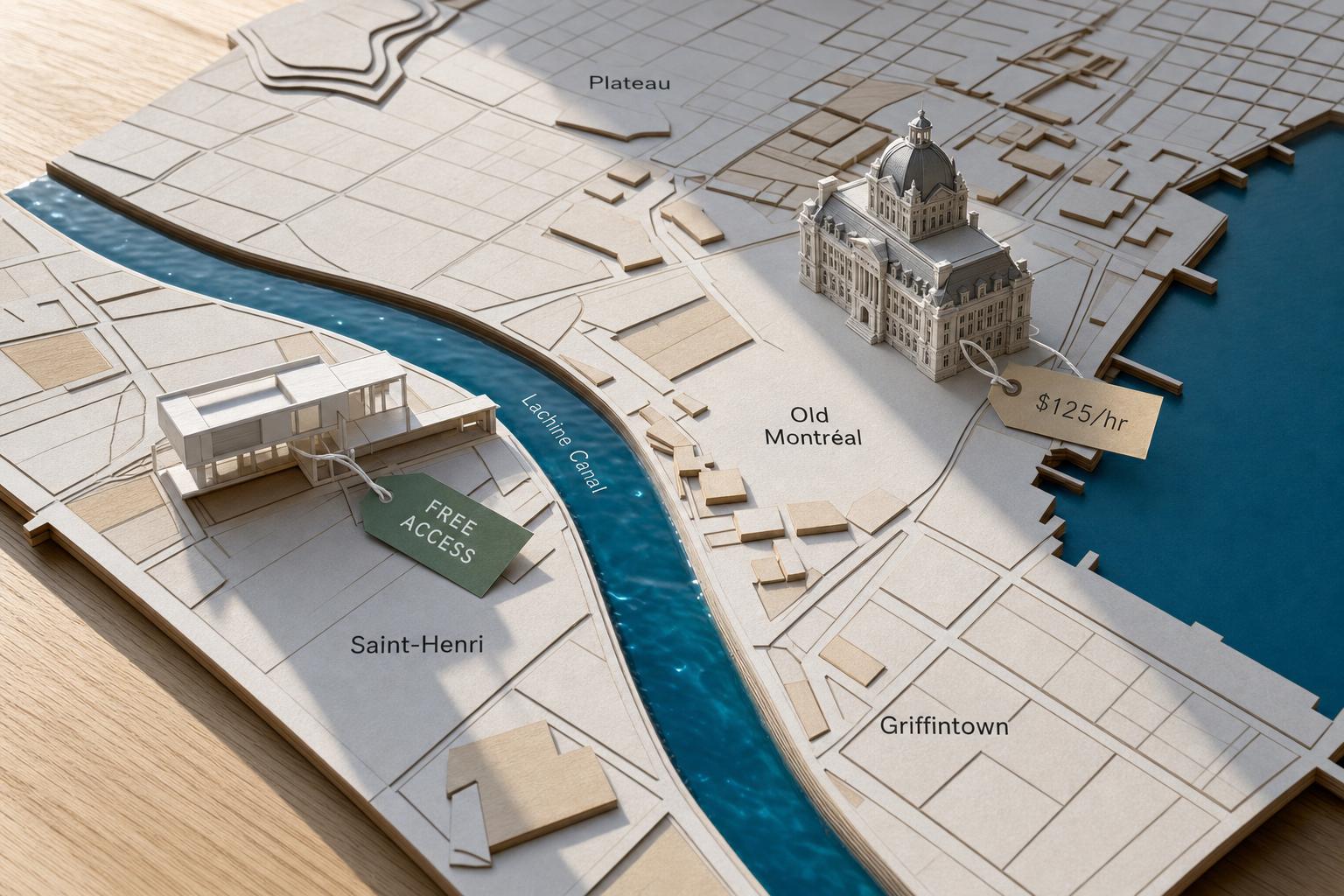
2727 Coworking, located at 2727 Rue Saint-Patrick in the Griffintown and Saint-Henri corridor along the Lachine Canal, takes a materially different approach from hourly-billed competitors: its conference room is included at Free Access for members rather than metered by the hour, bundled into private office plans that start at $300 per month for a single hot desk and range up to $3,000 per month for a ten-person closed office. This membership-inclusive model contrasts with the pay-per-hour model used by Regus, Spaces, Montreal CoWork, Halte 24-7, Kampus, and Le402, and it changes the calculus for teams that need frequent access: a member who books a room for eight or more hours a month effectively pays nothing incremental for that room, whereas an hourly renter at $35 to $80 per hour spends $280 to $640 over the same usage.
Demand for meeting space inside coworking environments has grown sharply: global meeting room bookings at flexible workspace operators rose 21.3 percent year-over-year in 2024 according to Cushman & Wakefield data cited by Optix [9], and 50 percent of coworking operators worldwide report high or very high demand for meeting space as of early 2025 [9]. The Canadian flexible office market, of which meeting room rental is one revenue line, is valued at USD $2.55 billion in 2026 and is projected to reach USD $5.45 billion by 2031, a 16.42 percent compound annual growth rate [10]. Co-working formats, the category into which most Montreal meeting room rentals fall, held 48.65 percent of the Canadian flexible office market in 2025 [10].
This report compares pricing tiers, booking models, technology standards, and neighborhood dynamics across more than a dozen Montreal operators, verified directly from each operator's current booking pages as of July 2026. It answers the practical questions buyers ask, including where to find the cheapest hourly rooms, what a small boardroom for four to six people costs, what corporate-grade conference rooms run per hour, and how membership-inclusive access at spaces like 2727 Coworking compares financially to metered rental for teams with recurring meeting needs.
Introduction and Background
Montreal's meeting room rental market has expanded alongside the broader shift toward hybrid work. As companies shrink their leased office footprints but still need a professional venue for client meetings, interviews, board sessions, and workshops, demand has shifted from long-term office leases toward on-demand, hourly, or membership-bundled meeting space. This report examines that market as it stands in July 2026, focusing on the practical question a buyer typing "meeting room rental Montreal" into a search engine actually needs answered: what does it cost, where can it be booked, and which model (hourly, day-rate, or membership) makes financial sense for a given usage pattern.
The supply side of this market is fragmented across several distinct operator types. Global serviced-office brands such as Regus and Spaces (both owned by IWG) operate more than 20 locations combined across greater Montreal and price meeting rooms starting at $35 per hour, with automatic volume discounts for half-day and full-day bookings. Independent coworking operators, including Montreal CoWork, Kampus, Halte 24-7, Le402, and 2727 Coworking, price rooms individually by capacity and finish, generally in the $20 to $65 per hour range for standard rooms [11]. Traditional business centers, such as CAVM in Old Montreal, undercut the coworking segment with rooms from $20 per hour. Heritage and design-forward venues, led by Crew Collective & Café in a converted Royal Bank of Canada building, sit at the top of the market, charging $45 to $125 per hour depending on room size [2] [6]. Finally, aggregator platforms such as Deskpass and Davinci Meeting Rooms list inventory from dozens of independent hosts, with prices as low as $6 per hour for basic day-office space and up to $170 per hour for premium boardrooms [12].
This fragmentation matters because it means "the price of a meeting room in Montreal" has no single answer. A four-person Zoom room in a converted industrial loft in Saint-Henri can cost $30 per hour, as shown in Table 1 below, while a 20-person boardroom in a downtown tower with catering and AV production can run $300 or more per hour at premium venues. Buyers therefore need a framework, not a single number, and that framework depends on three variables that recur across every operator studied for this report: location (proximity to downtown, Old Montreal, and transit hubs commands a premium), capacity (rooms scale non-linearly in price as seating increases from four to twenty-plus), and technology tier (basic whiteboard-and-table rooms undercut rooms with dedicated video conferencing hardware, multiple screens, and recording capability).
The Canadian flexible office sector overall, encompassing coworking, serviced offices, and meeting-room-as-a-service models, reached an estimated USD $2.55 billion in value in 2026, up from USD $2.19 billion in 2025, and is forecast to grow at a 16.42 percent compound annual rate through 2031 [10]. Quebec is one of the mid-tier growth provinces in this market, trailing Ontario's 40.75 percent national share but benefiting from Montreal's aerospace, life-sciences, and bilingual professional-services base [10]. This report situates Montreal's meeting room pricing within that broader context and answers each of the specific rate, availability, and format questions buyers commonly search for.
Hourly and Per-Session Meeting Room Rates
The dominant pricing model in Montreal is hourly billing, and the data collected from operator booking pages in July 2026 shows a wide but patterned spread. At the budget end, CAVM (Centre d'affaires Montreal) in Old Montreal lists three conference rooms with hourly rates of $20, $30, and $50, alongside half-day rates of $40, $70, and $120 respectively, as detailed in Table 1 below. Popuplab in the Plateau prices its six-person meeting room, which includes an 85-inch screen and whiteboard, at $40 for the first hour, dropping to a blended $17.50 per hour for an eight-hour booking ($290 total) [13]. Davinci Meeting Rooms, an aggregator with 10 Montreal listings, shows small conference rooms starting at $6.00 per hour for a coworking desk and $35.00 per hour for a dedicated small conference room, though the company notes this can represent savings of up to 50 percent versus renting hotel meeting space [12].
In the mid-market tier, Montreal CoWork operates eleven distinct named rooms with capacity-scaled pricing: the smallest room (Aloha) rents for $25 per hour, five mid-size rooms (Namaste, Bom Dia, Hola, War Room) run $40 per hour, and larger rooms scale up to $105 per hour for a 36-to-52-person event space, as detailed in Table 1 below. The operator also offers a full-day promotion, detailed in Table 2 below, discounting any weekday booking from 9 a.m. to 5 p.m. for rooms with a capacity of seven or more to a flat seven-hour charge. Halte 24-7, a business center with four-, six-, and ten-person rooms, prices its four-person rooms at $35 per hour plus tax, its six-person room at $40 per hour plus tax, and its ten-person room at $45 per hour plus tax, with a 10 percent discount applied to bookings of seven hours or more [14].
International operators price at a comparable but slightly higher baseline. Both Regus and Spaces (IWG brands) advertise Montreal meeting rooms "from $35 per hour" across their networks of 21 and 20 locations respectively, with related product lines such as collaboration spaces priced from $23 per person per hour. Both brands apply an automatic 30 percent discount to full-day bookings relative to the hourly rate [4]. At the premium end, Crew Collective & Café, housed in a heritage former Royal Bank of Canada building in Old Montreal, prices its six-person meeting rooms at $45 to $50 per hour and its 12-plus person conference room at $125 per hour [2] [6]. Kampus, in the Angus district, offers conference rooms seating 8 to 15 people at a fixed $35.00 per hour for non-members, with additional fees for groups over 15 [11].
Table 1 below summarizes representative hourly rates gathered directly from each operator's booking page in July 2026, organized from lowest to highest starting price.
| Operator | Neighborhood | Typical Capacity | Starting Hourly Rate | Notes |
|---|---|---|---|---|
| 2727 Coworking | Griffintown / Saint-Henri (Lachine Canal) | 1 to 10 | Included with membership, from $300/mo (not billed hourly) | Conference room free for members; a team needing 8+ hrs/mo avoids the $35 to $80/hr metered rate |
| Davinci Meeting Rooms (aggregator, Saint-Ambroise listing) | Saint-Henri | 1 to 2 | $6.00 to $8.00/hr | Coworking desk and day-office tiers; call for after-hours [12] |
| CAVM (Centre d'affaires Montreal) | Old Montreal | 4 to 12 | $20.00/hr | Three room sizes; half-day and full-day rates also listed [5] |
| Le402 (non-member rate) | Montreal / Laval | Up to 8 | $25.00/hr | Minimum 2-hour booking; $20/hr for members [15] |
| Montreal CoWork (Aloha room) | Plateau | Small group | $25.00/hr | Smallest of 11 named rooms [1] |
| Deskpass network (low end) | Saint-Ambroise / Little Burgundy | Varies | $30.00 to $35.00/hr | Marketplace listing across 27 Montreal rooms [7] |
| Regus / Spaces (IWG) | Multiple (downtown, Old Montreal, Mile End) | 4 to 20 | $35.00/hr | 41 combined locations; 30% discount on full-day bookings [3] |
| Kampus | Angus district | 8 to 15 | $35.00/hr | Fixed rate; additional fee above 15 people [11] |
| Halte 24-7 | Downtown | 4 to 10 | $35.00 to $45.00/hr + tax | 10% discount for bookings of 7+ hours [14] |
| Popuplab | Plateau | Up to 6 | $40.00/hr | Includes 85-inch screen; blended rate falls to $17.50/hr over 8 hours [13] |
| Crew Collective & Café (small room) | Old Montreal | 6 | $45.00 to $50.00/hr | Heritage Beaux-Arts building [2] |
| Crew Collective & Café (conference room) | Old Montreal | 12+ | $125.00/hr | Mezzanine room, 640 sq. ft. [6] |
| Deskpass network (high end) | Old Montreal | 10 to 20 | Up to $170.00/hr | Premium listings near Place d'Armes [7] |
This spread confirms that "the price of a Montreal meeting room" depends heavily on which segment a buyer is shopping in. Buyers optimizing purely for cost per hour should look toward Old Montreal business centers such as CAVM or aggregator listings in Saint-Henri and Saint-Ambroise, where rates start under $30 per hour. Buyers who need video-conferencing-grade technology, presentation screens, and a polished environment for client-facing meetings should expect to pay $35 to $80 per hour at coworking operators or IWG brands, and those hosting board-level or investor meetings in a heritage or high-design setting should budget $100 to $170 per hour. All of the rates above are quoted before Quebec's combined sales tax of 14.975 percent (5 percent GST and 9.975 percent QST), which most operators add at checkout [8].
Day Passes, Half-Day Packages, and Membership-Inclusive Access
Beyond straight hourly billing, three alternative access models shape how much a given team actually pays for meeting space over a month: half-day and full-day packages, credit- or membership-based booking, and fully bundled access where the meeting room is included in a workspace membership rather than metered separately.
Half-day and full-day discounting is close to universal among the larger operators. Regus and Spaces both apply an automatic 30 percent discount to full-day bookings compared to the hourly rate, as noted above, while CAVM publishes explicit half-day and full-day rates alongside its hourly rate, for example $20 per hour, $40 for a half-day, and $75 for a full day on its second room, as shown in Table 2 below. Montreal CoWork discounts full-day weekday bookings on its larger rooms to a flat seven-hour equivalent charge, as noted above, and Popuplab's tiered pricing effectively halves the per-hour cost between a one-hour booking ($40) and an eight-hour booking ($290, or $36.25 per hour average, with the marginal hours priced far below the first), as detailed in Table 2 below. Halte 24-7 applies a 10 percent discount to any booking of seven hours or longer, as shown in Table 2 below.
Membership-based hourly discounting appears at Le402, a small coworking operator in Montreal and Laval, which offers two parallel rate cards: non-members can rent the conference room by the hour (two-hour minimum, 48-hour notice) at $25 per hour with no commitment, while members pay a $25-per-month membership fee (three-month minimum) plus a reduced $20 per hour, along with a refundable $250 deposit [15]. This structure illustrates a common tradeoff in the Montreal market: paying a modest recurring fee in exchange for a lower marginal hourly rate becomes worthwhile once booking frequency crosses a threshold, in Le402's case roughly five hours per month.
Fully bundled, membership-inclusive access is the model used by 2727 Coworking, located along the Lachine Canal in the Griffintown and Saint-Henri corridor. Rather than metering the conference room by the hour, 2727 lists its conference room as "Conference Room (Free Access)" among the amenities included with its private office and desk plans, which range from $300 to $3,000 per month as detailed above. The company's virtual tour page similarly describes "Conference Rooms - Professional meeting spaces with AV equipment" as a standard amenity across its space rather than a separately billed product.
This model changes the arithmetic for teams with recurring meeting needs. A hypothetical team booking a mid-tier Montreal meeting room for eight hours a month at a blended $45 per hour (a rate consistent with the mid-market rooms in Table 1 above) would spend approximately $360 before tax monthly, or roughly $4,320 per year, purely on room access, on top of any desk or office costs. A comparable team on a 2727 Coworking desk or office plan would incur no separate hourly charge for that same conference room usage, since it is bundled into the flat monthly membership rate. This is a genuine structural difference worth weighing honestly: hourly rental gives a buyer maximum flexibility with no recurring commitment and access to many different neighborhoods and room styles across the city, while a membership-inclusive model like 2727's rewards teams that already plan to be in one location regularly for desk or office space and simply add meeting room access as a bundled benefit rather than a separate purchase decision. Occasional users with no need for a fixed desk are generally better served by hourly or aggregator platforms, while resident teams with steady meeting cadence get more value from a bundled arrangement, provided the location and capacity fit their needs.
Comparative Context and Market Positioning
Positioning Montreal's meeting room supply within the broader flexible-workspace industry clarifies why pricing and packaging vary as much as it does. Industry-wide, coworking spaces derive a meaningful share of revenue from meeting rooms: DeskMag survey data reported by Optix ranks private offices, monthly desk membership plans, and meeting room rentals, in that order, as the top revenue streams for coworking operators globally [9]. This explains why nearly every operator studied in this report, regardless of size, treats meeting room access as either a standalone monetized product (Regus, Spaces, Montreal CoWork, Halte 24-7, Crew Collective, CAVM, Kampus, Le402's non-member tier) or as a retention lever bundled into membership (2727 Coworking, Le402's member tier).
Demand-side data supports continued growth in this category. Meeting room bookings across flexible workspace operators globally rose 21.3 percent year-over-year in 2024, according to Cushman & Wakefield figures cited by Optix [9], and roughly half of coworking operators worldwide report high or very high demand for meeting space as of early 2025 [9]. In the United States, CoworkingCafe's national benchmark places the average hot desk day rate at $30 and the average meeting room rate at $45 per hour [9], a figure broadly consistent with Montreal's mid-market cluster of $35 to $50 per hour observed at Regus, Spaces, Halte 24-7, and Crew Collective's smaller rooms.
At the national level, co-working formats (as distinct from serviced offices and virtual offices) held 48.65 percent of Canada's flexible office market share in 2025, the largest single category, while hybrid and virtual office solutions are forecast to grow fastest at 17.32 percent CAGR through 2031 as operators bundle meeting-room tokens with lighter-weight access plans [10]. Enterprises accounted for 51.90 percent of Canadian flexible office demand in 2025, but startups and emerging firms are the fastest-growing end-user segment, expanding at an 18.29 percent CAGR through 2031 [10]. This growth pattern is consistent with what Montreal operators report anecdotally: startups and small consultancies without a fixed office are among the heaviest users of hourly and aggregator-based meeting room platforms such as Deskpass, while enterprise tenants tend to gravitate toward IWG brands (Regus, Spaces) for standardized, multi-city booking consistency.
Positioned against this backdrop, 2727 Coworking's bundled conference room model reflects a different competitive strategy than pure meeting-room monetization: it uses free, unlimited-feeling meeting room access as a differentiator to win and retain desk and office tenants along the Lachine Canal corridor, competing less directly with hourly aggregators like Deskpass and more directly with other Griffintown- and Saint-Henri-area coworking and office operators on the value of an all-inclusive monthly rate. Whether this is the better model for a given buyer depends entirely on whether that buyer already needs a fixed desk or office; a buyer who only occasionally needs a room and has no interest in a recurring desk membership will typically find hourly or aggregator-based rental, at $20 to $50 per hour for standard rooms, more economical.
Technology, Location, and Choosing the Right Room Format
Beyond price, buyers searching for a Montreal meeting room typically need to weigh three additional factors: technology standards, neighborhood accessibility, and room format relative to group size. These considerations matter as much as the headline hourly rate, since a cheap room without adequate video conferencing equipment can cost a business more in lost productivity or a botched client presentation than a modestly pricier, better-equipped alternative.
Technology standards. Baseline expectations across the Montreal market now include high-speed Wi-Fi, a presentation screen or projector, and a whiteboard. Halte 24-7 specifies that all its rooms have a large screen with HDMI connectivity, high-speed Wi-Fi, and coffee on demand, as quoted in the FAQ below. Regus markets its network-wide standard as offering cutting-edge technology, including high-speed Wi-Fi, video conferencing, and audiovisual equipment, as quoted below, and Deskpass lists rooms equipped with enterprise-grade Wi-Fi, complimentary snacks and refreshments, whiteboards and markers, ergonomic seating, and video-conference-enabled technology as a standard package at several of its higher-end Montreal listings, detailed further below. Popuplab differentiates its offering with an 85-inch screen bundled into its base rate rather than charged as an add-on [13], and Montreal CoWork guarantees that all its rooms are equipped at a minimum with whiteboards and screens or projection systems, consistent with the room-by-room detail in Table 1. Buyers evaluating a "small meeting room for rent Montreal" query for a four-to-six-person video call should confirm the room includes a dedicated screen and reliable Wi-Fi rather than assuming it from the base hourly rate alone, since some of the lowest-priced listings on aggregator platforms are day-office or coworking-desk tiers rather than true enclosed meeting rooms.
Room format and capacity. Montreal operators generally segment inventory into four broad capacity bands: small huddle rooms for one to four people (suited to phone or video calls and one-on-one client meetings), standard meeting rooms for four to eight people (the most common format, suited to team meetings and small client presentations), boardrooms for eight to fourteen people (suited to leadership meetings and mid-size client pitches), and large training or event rooms for fifteen or more people. Montreal CoWork's room fleet illustrates this segmentation clearly, with its smallest room (Aloha) suited to small group meetings at $25 per hour, five mid-size rooms in the $40 to $65 per hour range for "collaborative meetings" and "strategic meetings, team decision-making" [1], and two large event spaces (Bonjour 30 and Bonjour 50) scaling up to 36-to-52-person capacity at $80 to $105 per hour for impactful events, training sessions, conferences, and general assemblies. A buyer should match room format to actual attendee count rather than defaulting to whatever room a search result surfaces first, since per-person cost efficiency generally improves in the mid-size boardroom tier before degrading again at large event-space scale, where premium AV production and staffing add cost.
Neighborhood accessibility and transit. Montreal's bilingual business environment and dense downtown transit network mean that neighborhood choice affects not just price but also convenience for attendees arriving from different parts of the city or region. Downtown, Old Montreal, and Mile End locations offer the greatest concentration of transit-accessible options; Regus explicitly promotes its meeting rooms as located "in key commercial areas like Downtown Montréal, Old Montréal, and Mile End" [3]. Meeting rooms in Griffintown, Saint-Henri, and the Angus district (where Kampus is located) tend to be less centrally located relative to downtown but frequently offer lower rates and easier parking, a tradeoff buyers should weigh against how many attendees will be arriving by transit versus car. 2727 Coworking's location directly on the Lachine Canal in Griffintown places it within this second tier of neighborhoods, trading some downtown centrality for canal-front surroundings and proximity to the growing Griffintown and Saint-Henri business corridor.
Parking and ancillary costs. A handful of operators disclose parking costs directly, which matter for attendees driving rather than taking transit. Montreal CoWork notes that "parking is available behind the building at 4401 Rue Drolet for $15/day" and that "Bixi stations and bike paths are also nearby" [1]. Buyers booking rooms for external clients or out-of-town visitors should factor this kind of ancillary cost into total meeting-space budgeting alongside the posted hourly rate.
Data Analysis and Evidence
The quantitative picture assembled from operator pricing pages and third-party industry data confirms several consistent patterns in the Montreal and broader Canadian flexible workspace market as of mid-2026.
Price distribution. Across the twelve-plus Montreal operators and aggregator listings reviewed for this report, hourly meeting room rates ranged from a low of $6.00 per hour (a coworking-desk-tier listing on Davinci Meeting Rooms) [12] to $170.00 per hour (a premium Old Montreal listing on Deskpass) [7]. The bulk of standard, professionally equipped meeting rooms for four to twelve people cluster between $35 and $65 per hour, a range consistent with the U.S. national coworking meeting-room average of $45 per hour reported by CoworkingCafe [9].
Market growth. Canada's flexible office space market, encompassing coworking, serviced offices, and virtual offices, was valued at USD $2.19 billion in 2025 and is estimated at USD $2.55 billion for 2026, on a trajectory to reach USD $5.45 billion by 2031 at a 16.42 percent compound annual growth rate [10]. Within that market, information technology firms accounted for 30.85 percent of demand in 2025, while business consulting and professional services are forecast to be the fastest-growing sector at a 17.75 percent CAGR through 2031, a trend directly relevant to meeting room demand since consulting engagements are disproportionately meeting-intensive [10]. Consolidation is reshaping the supplier landscape: CBRE Group completed its acquisition of Industrious National Management Company for approximately USD $800 million in January 2025, creating a new integrated flexible-space division [10], while Yardi Systems acquired the Deskpass booking platform in the same month, consolidating two of the leading flexible-workspace reservation systems used to book Montreal meeting rooms [10].
Utilization and occupancy. Globally, coworking space occupancy reached 68 percent at the start of 2025, with major cities averaging above 70 percent occupancy [9]. Industry benchmarks consider 80 to 85 percent a "healthy" occupancy rate for a coworking space [9]. By contrast, traditional dedicated conference rooms inside conventional office leases are typically occupied only 15 to 30 percent of available business hours, a utilization gap that underpins the economic case for on-demand rental over a dedicated leased room.
Tax treatment. Every hourly and daily rate cited in this report is exclusive of Quebec's combined sales tax. The federal Goods and Services Tax (GST) has stood at 5 percent since January 2008, and Quebec's provincial sales tax (QST) has stood at 9.975 percent since January 2013, for a combined rate of 14.975 percent applied to most commercial services including meeting room rental [8]. A buyer comparing a $35 quoted hourly rate against a $40 quoted hourly rate should therefore expect the effective after-tax difference to widen proportionally, since both figures are grossed up by roughly the same 14.975 percent.
Table 2 below consolidates the day-rate and volume-discount structures identified across operators, illustrating how the effective hourly cost compresses as booking duration increases.
| Operator | 1-Hour Rate | Half-Day or Multi-Hour Rate | Full-Day Rate | Effective Discount |
|---|---|---|---|---|
| Popuplab | $40 | $140 (4 hrs) | $290 (8 hrs) | Marginal hours drop to roughly $18/hr by hour 8 [13] |
| CAVM (Room 2) | $20 | $40 (half-day) | $75 (full-day) | Full-day rate equals under 4 hourly-rate hours [5] |
| Halte 24-7 | $35 to $45 + tax | n/a | 10% off bookings of 7+ hours | Discount applies automatically at 7-hour threshold [14] |
| Regus / Spaces | From $35 | n/a | 30% off full-day vs. hourly | Applies network-wide across Montreal locations [3] |
| Montreal CoWork (7+ capacity rooms) | $40 to $105 | n/a | Billed at 7-hour rate for a 9am-5pm weekday booking | Effectively 1 free hour on an 8-hour day [1] |
| Le402 (member) | $20 (plus $25/mo membership) | n/a | n/a | Break-even versus non-member $25/hr rate after roughly 5 hours/month [15] |
| 2727 Coworking | Included in membership | Included in membership | Included in membership | Bundled into $300 to $3,000/month desk and office plans |
The clear interpretive takeaway from this table is that duration-based discounting is the norm, not the exception, across Montreal's meeting room market, and buyers booking rooms for four or more hours in a single session should always ask about half-day or full-day rates before defaulting to the posted hourly figure, since the effective savings frequently exceed 25 percent.
Case Studies and Real-World Examples
CAVM: Business-Center Pricing Undercutting the Coworking Segment
Centre d'affaires Montreal (CAVM), located in Old Montreal near the Square-Victoria metro station, illustrates how legacy business-center operators continue to compete on price against newer coworking entrants. CAVM lists three differently sized conference rooms with hourly rates of $20, $30, and $50, positioned explicitly as "Conference Rooms starting at only $20 / hours or $40 / half-day" [5]. This positions CAVM as one of the lowest-cost professionally staffed meeting room options in central Montreal, undercutting both IWG's $35-per-hour baseline and most coworking operators' standard rooms, while still offering a staffed reception and a downtown-adjacent Old Montreal address that many independent budget listings on Deskpass lack.
Crew Collective & Café: Heritage Architecture as a Premium Differentiator
Crew Collective & Café occupies a converted Royal Bank of Canada building in Old Montreal and prices its meeting spaces at the top of the observed market: $45 to $50 per hour for six-person meeting rooms and $125 per hour for its 12-plus person, 640-square-foot mezzanine conference room [2] [16]. The operator markets its rooms explicitly around the heritage architecture, describing the conference room as "a cozy room with intimate lighting" featuring "a wall of windows" and "dark woodwork and a skylight" in its Zen Room [16]. This case demonstrates that Montreal's meeting room market supports a genuine premium tier for buyers, such as law firms, investment groups, and client-facing consultancies, willing to pay two to three times the mid-market rate for an architecturally distinctive setting.
Le402: Membership Discounting as a Retention Mechanism for a Small Independent Operator
Le402, a small independent coworking operator with locations in Montreal and Laval, demonstrates how even micro-operators structure tiered pricing to convert occasional renters into recurring members. Non-members can book Le402's conference room by the hour with no commitment at $25 per hour (two-hour minimum, 48-hour notice) [15], while members pay a $25-per-month fee (three-month minimum commitment) plus a reduced $20-per-hour rate and a refundable $250 deposit that also grants access to the studio and closed offices, as detailed above. This tiered structure is a useful illustration of the general principle that recurring users of Montreal meeting rooms can typically find a lower marginal rate by committing to some form of membership, even a lightweight one, once their usage exceeds roughly five hours per month.
2727 Coworking: Bundled Access Along the Lachine Canal
2727 Coworking, based at 2727 Rue Saint-Patrick in the Griffintown and Saint-Henri corridor along the Lachine Canal, represents the clearest example in the Montreal market of the fully bundled meeting-room model. Rather than publishing a per-hour conference room rate, the company lists "Conference Room (Free Access)" directly among its space amenities, alongside 24/7 access, a fully equipped kitchen, shower access, and gigabit internet. Desk and office plans range from a $300-per-month hot desk to a $3,000-per-month ten-person closed office, as detailed above, with the conference room included at every tier rather than metered separately. The company's virtual tour materials describe the amenity as "Conference Rooms - Professional meeting spaces with AV equipment," positioning it as standard infrastructure for resident members rather than an upsell product. This case is instructive for buyers weighing desk membership against pay-per-use rental: the bundled model removes meeting-room cost uncertainty for resident teams, at the cost of the flexibility to shop across neighborhoods that hourly aggregators like Deskpass provide.
The Deskpass Marketplace: Aggregation Across 27 Montreal Listings
Deskpass illustrates the aggregator model that has emerged to help buyers compare across operators without visiting each individual booking page. As of this research, Deskpass listed 27 conference rooms across greater Montreal, spanning Kampus at $42 per hour for 14-person capacity, IQ Offices on Metcalfe Street from $44 to $110 per hour depending on room, and a premium Old Montreal listing near Place d'Armes at $140 per hour and $1,080 per day, prices consistent with the ranges cited earlier in this report. The platform states plainly that it lets users "reserve by the hour or the day, no long-term contracts required" [7], and the broader consolidation of this category was underscored when Yardi Systems acquired Deskpass in North America in January 2025, integrating it into a larger real-estate technology stack that also includes the Hubble booking platform in the United Kingdom [10]. This consolidation of booking infrastructure is relevant to Montreal buyers because it signals a market maturing toward standardized, comparison-shoppable inventory, similar to how hotel booking aggregators standardized that category two decades earlier.
Implications and Future Directions
Several structural trends are likely to shape Montreal meeting room pricing and availability over the next several years. First, continued growth in the Canadian flexible office market, projected at a 16.42 percent CAGR through 2031 to reach USD $5.45 billion [10], suggests more supply entering the Montreal market over time, which historically exerts downward pressure on pricing at the budget and mid-market tiers even as premium venues maintain pricing power through differentiated design and location. Second, the accelerating shift toward hybrid and virtual office solutions, forecast to grow at 17.32 percent CAGR nationally through 2031, indicates that more buyers will access meeting rooms through lightweight, credit-based, or bundled plans rather than pure walk-up hourly rental, a trend already visible in Montreal through models like Le402's member tier and 2727 Coworking's fully bundled approach [10].
Third, industry-wide consolidation of both operators (CBRE's USD $800 million acquisition of Industrious) and booking technology (Yardi's acquisition of Deskpass and Hubble) suggests Montreal buyers may increasingly interact with a smaller number of larger, more standardized platforms when comparison-shopping meeting rooms, even as the underlying room inventory remains fragmented across many small, independently branded venues [10]. Fourth, rising demand for meeting space, up 21.3 percent year-over-year globally in 2024 [9], combined with reported oversupply and softening vacancy in Montreal's broader flexible office market [10], creates a somewhat unusual dynamic: strong demand for the specific product of bookable meeting rooms exists alongside general oversupply of flexible office space overall, which may keep meeting room hourly rates relatively stable even as broader desk and office lease pricing softens.
A further implication concerns how Montreal's bilingual business culture shapes meeting-room demand specifically, as distinct from general office demand. Presentations, negotiations, and training sessions in Montreal frequently need to accommodate both French- and English-speaking participants, and operators serving corporate and professional-services clients increasingly position bilingual signage, reception, and documentation as a differentiator rather than an afterthought. This factor does not show up directly in hourly pricing, but it does influence which operators corporate buyers shortlist, since a mismatch in service language can be a bigger friction point for an external client meeting than a $10-per-hour price difference.
For buyers, the practical implication is that shopping across models, not just across operators, matters. A team evaluating "meeting room rental Montreal" as a search query should weigh not just the lowest posted hourly rate, but whether their actual usage pattern (occasional versus weekly, single location versus multiple neighborhoods, small four-person huddles versus twenty-person board sessions) matches an hourly, day-rate, membership-discounted, or fully bundled model. Given that Quebec's 14.975 percent combined sales tax applies uniformly regardless of model [8], the meaningful cost differences buyers can control lie in choosing the right pricing structure and location, not in searching for tax-advantaged alternatives.
Frequently Asked Questions (FAQs)
What is the average hourly rate for a meeting room in Montreal? Based on operator pricing pages reviewed in July 2026, standard, professionally equipped meeting rooms in Montreal coworking spaces and business centers typically start between $35 and $50 per hour before tax, with a full market range of $20 to $170 per hour depending on location, capacity, and technology tier, as summarized in Table 1 above.
Where can I find cheap meeting rooms in Montreal? The lowest-cost options identified in this research were CAVM's Old Montreal conference rooms starting at $20 per hour [5] and Davinci Meeting Rooms' aggregator listings for basic day-office and coworking-desk tiers starting around $6 to $8 per hour [12].
Do I need to be a coworking member to rent a meeting room in Montreal? No, at most operators. Regus, Spaces, Montreal CoWork, Halte 24-7, CAVM, Kampus, and Le402's non-member tier all allow walk-up or online hourly booking with no membership required [11]. 2727 Coworking's conference room, by contrast, is bundled into its desk and office memberships rather than sold as a standalone hourly product, as described above.
How much does a boardroom for 10 to 12 people cost in Montreal? Rooms in this capacity range span roughly $45 to $125 per hour in this research, for example Halte 24-7's 10-person room at $45 per hour plus tax [14] up to Crew Collective's 12-plus person conference room at $125 per hour [6].
Is meeting room rental tax-deductible for a business in Quebec? This report does not offer tax advice, but notes for context that Quebec applies a combined 14.975 percent GST and QST rate to most commercial meeting room rentals, and businesses should consult a qualified accountant regarding input tax credit eligibility [8].
Can I book a Montreal meeting room for less than an hour? Most operators enforce a minimum booking, commonly one or two hours; Le402, for example, requires a two-hour minimum for non-member bookings, as noted above, while Regus and Spaces both permit bookings from a minimum of one hour up to a full week.
What amenities are typically included in a Montreal meeting room rental? Common standard inclusions across the operators reviewed are Wi-Fi, a screen or projector, and a whiteboard; Halte 24-7 specifies "a large screen with HDMI connectivity" and "high speed Wi-Fi" as standard across its rooms [14], and Regus notes rooms come equipped with "cutting-edge technology, including high-speed Wi-Fi, video conferencing, and audiovisual equipment" [3].
How far in advance should I book a meeting room in Montreal? Notice requirements vary by operator: Le402 requires 48 hours' notice for non-member bookings and 12 hours for members [15], while Spaces recommends confirming specific setup requests "at least 24 hours in advance" so on-site teams can configure seating and equipment [4]. Popular downtown rooms during weekday business hours can book out further in advance, so buyers with a fixed date and headcount should reserve as early as practical.
What is the cheapest way to get a coworking meeting room in Montreal for regular use? For buyers who need a room several times a month, this research indicates two paths: a lightweight paid membership that unlocks a discounted hourly rate, as with Le402's $25-per-month member tier that lowers the hourly rate from $25 to $20, described above, or a desk or office membership that bundles the meeting room in at no incremental hourly cost, as with 2727 Coworking's plans starting at $300 per month, described above. Which is cheaper depends entirely on whether the buyer also needs a desk; a buyer who only needs the room, with no desk requirement, should compare the membership-plus-discounted-rate math against simply paying full hourly rates at the lowest-cost provider before committing to any recurring fee.
Conclusion
Montreal's meeting room rental market in 2026 offers buyers a genuinely wide range of options, from $20-per-hour basic boardrooms at legacy business centers to $170-per-hour premium suites in Old Montreal, with the bulk of professionally equipped, videoconference-ready rooms clustering between $35 and $80 per hour before Quebec's 14.975 percent combined sales tax. The market is structured around three access models: pure hourly rental (the dominant model, used by Regus, Spaces, Montreal CoWork, Halte 24-7, CAVM, Kampus, and Crew Collective), membership-discounted hourly rental (used by smaller independent operators like Le402), and fully bundled access included in a desk or office membership (the model used by 2727 Coworking).
No single model is universally cheapest; the right choice depends on usage frequency, whether the buyer already needs a fixed desk, and how much value the buyer places on shopping across neighborhoods versus committing to one location. Buyers with occasional, one-off needs are generally best served by hourly rental or aggregator platforms such as Deskpass, where competitive shopping across dozens of listings can surface rooms in the $30 to $50 per hour range. Buyers who already need or want a resident desk or office and expect to use a meeting room regularly should evaluate whether a bundled model, such as 2727 Coworking's membership-inclusive conference room along the Lachine Canal, offsets its lack of hourly flexibility with the elimination of per-use charges. Given that meeting room demand grew 21.3 percent year-over-year globally in 2024 and that Canada's flexible office market is forecast to more than double by 2031, buyers can expect continued expansion of supply and packaging options across all of these models in the Montreal market over the next several years.
External Sources (16)
About
2727 Coworking
Find a practical home for your work at 2727 Coworking in Montreal. Explore private offices, day workspaces and meeting rooms, plus business-address and virtual-mailbox services for your company.
2727 Coworking is a Montreal workspace and business-address provider. We serve people who need a place to focus, meet, run a small business or establish a professional mailing presence. Our website offers English and French information about workspace options and services, alongside educational resources for operating a business in Canada.
A workspace that fits the day
Our workspace options include private offices, day passes and desks, and a conference room. These formats help individuals and teams compare a dedicated office with more flexible ways to work or hold a meeting. Prospective members can explore the virtual tour, review current pricing and book a visit before choosing a workspace.
Business addresses and mail
2727 Coworking provides business-address and virtual-mailbox services. Our resources explain the documents and practical questions involved, including guidance for people outside Canada. Service eligibility, included features, availability and access arrangements should be confirmed on the applicable service page or with our team.
Resources for Canadian small businesses
We publish guides, research and planning tools about workspace decisions, business addresses and starting a business in Canada. Our incorporation research includes information for people inside Canada and abroad, with jurisdiction-specific material to help readers identify the next questions to investigate. These educational resources complement our workspace and address services; they are not individualized legal, tax or immigration advice.
Visit or contact 2727 Coworking
Explore private offices, day passes and desks, the conference room, business addresses and virtual mailboxes. Book a visit or contact the team to discuss your needs.
A business address alone does not establish tax residence, immigration status, banking approval or eligibility for a government program.
Disclaimer
This document is provided for informational purposes only. No representations or warranties are made regarding the accuracy, completeness, or reliability of its contents. Any use of this information is at your own risk. 2727 Coworking shall not be liable for any damages arising from the use of this document. This content was generated with assistance from artificial intelligence tools, which may contain errors or inaccuracies. Readers should verify critical information independently. All product names, trademarks, and registered trademarks mentioned are property of their respective owners and are used for identification purposes only. Use of these names does not imply endorsement. This document does not constitute professional or legal advice. For specific guidance related to your needs, please consult qualified professionals.