2727 Coworking Article
Montreal Fireworks 2026: Schedule, Viewing & Logistics
Inside this article
L’International des Feux Loto-Québec 2026: Montreal Fireworks Schedule, Best Viewing Spots, and Griffintown Logistics
Executive Summary
L’International des Feux Loto-Québec (IFLQ) is Montreal’s premier pyromusical competition, and the 2026 edition marks its 40th anniversary [1] [2]. Running from July 2 to August 6, 2026, the festival features eight evening shows (dates: July 2, 9, 12, 16, 23, 26, 30 and August 6) [1]. Each show begins at 10:00 PM and lasts about 30 minutes [3] [2]; they are rain-or-shine events. Venues for the fireworks include the Lac des Dauphins at La Ronde (Parc Jean-Drapeau), with competitors from around the world vying for “Jupiter” trophies [1] [2].
For spectators, there are premium seats at La Ronde (with ticketed grandstands for ~7,200 people plus ample park grounds space [4]) and numerous free vantage points across Montreal. Popular free locations are the pedestrianized Jacques-Cartier Bridge (closed to vehicles on show nights), the Old Port waterfront (including the Clock Tower Beach/Quai de l’Horloge), and various riverfront parks and terraces [5] [2]. The tourism authority also highlights dozens of viewing terraces and restaurants (e.g. Terrasse sur l’Auberge, Place d’Armes plaza, Place Ville-Marie observatory, as well as the Grande Roue) that offer scenic sightlines [5] [2].
Attendees are advised to avoid driving. Organizers explicitly state that parking is extremely limited and traffic heavy on fireworks nights, strongly recommending the metro (Jean-Drapeau station, Yellow Line) instead [6] [7]. Indeed, for safety the Jacques-Cartier Bridge is closed to cars (and even to cyclists after 7:45 PM) during each show [7], so pedestrians and transit are the main links. Public-transport agencies typically boost Yellow Line service on event nights (historically, STM ran extra trains after shows) to ferry crowds to Île Sainte-Hélène and out of the city.
L’IFLQ is a massive cultural and economic event for Montreal. A 2018 study reported that the 32nd edition (2017) drew about 838,000 distinct spectators in the city, and a total “cumulative attendance” of 3.1 million visits over 8 nights (since many fans attend multiple shows) [8]. Those fans generated about $37 million in economic activity (hotels, dining, etc.) for Montreal [8]. The festival also creates hundreds of jobs and significant tax revenue [8]. Independent estimates similarly note that up to 2–3 million people view the fireworks each season [8] (Source: www.tripadvisor.ie), making IFLQ one of Canada’s largest free public events.
Looking forward, the festival is adapting to public concerns. A recent air-quality study concluded fireworks have only a “limited” environmental impact (localized and short-lived) [9] [10]. Nonetheless, La Ronde announced in 2024 that future shows will be trimmed to 25 minutes of fireworks plus 5 minutes of laser effects to reduce particulate output [9]. The addition of synchronized laser segments (by Laser-Quantum) is already part of the pyromusical mix from 2022 onward [1].
This report provides a detailed examination of the 2026 festival: its schedule and format, recommended viewing locations, and logistics — especially with respect to Griffintown and downtown Montreal. We compile official schedules, local guides, and expert analyses to present evidence-based planning advice. The discussion includes data on attendance, safety advisories, economic impact studies, and future implications for the event’s evolution. All claims and recommendations are backed by cited sources from official releases, news reports, and industry media.
Introduction
L’International des Feux Loto-Québec (often called the Montreal International Fireworks Festival) is an annual summer spectacle in Montreal, Quebec. Founded in 1985, it is a competition among top pyrotechnic companies representing different countries. Contestants (each called a “firework firm” or team) design choreographed pyro-musical shows of at least 25–30 minutes, synchronized to music. The festival awards gold, silver, and bronze “Jupiter” trophies for artistic excellence [4] [11]. Over the decades IFLQ has grown in prestige; tourism literature now brands it the “world’s largest and most prestigious fireworks competition” [2]. Globe-trotting crews from Europe, Asia, and the Americas participate; for example, the 2025 lineup included teams from Italy, Japan, Canada, Switzerland, the USA, and France, with special opening/closing tributes (Latino music theme opening, Taylor Swift finale) [11].
However, Montreal’s fireworks go beyond competition.They are a cultural institution in the city’s calendar, lighting up the sky every summer and attracting local families, tourists, and event enthusiasts. In a 2018 press release, La Ronde’s management noted that “[the] competition of firework displays attracts hundreds of thousands of visitors, who spend millions… [and] is unequivocally one of Montreal’s most popular annual events” [8]. A 2018 economic impact study (by KPMG for La Ronde) found that in 2017 the festival generated $37 million in Montreal’s economy and created 564 full-time equivalent jobs [8]. It has become a tourism draw and a televised convention (these shows are simulcast on radio and sometimes TV). For context, magazine reports suggest on the order of 2–3 million people see the shows each season(combining multiple sites and repeated visits) (Source: www.tripadvisor.ie) [4]. Indeed, one enthusiastic estimate cites “three million people” crowding riverbanks during the festival (Source: www.tripadvisor.ie).
Significant infrastructure and safety measures are involved. The fireworks are launched from four fixed ramps (two on the shore and two floating in Lac des Dauphins) facing the spectator area in La Ronde [4]. Because large crowds gather outside La Ronde as well, Montreal authorities institute special closures. Notably, Jacques-Cartier Bridge is entirely closed to vehicle traffic on show nights (typically 8:00 PM – midnight) [7] [12], converturng it into a massive pedestrian promenade. Cyclists even lose access to its bike path after 7:45 PM [7]. The public is strongly advised to use the Metro (Yellow Line to Jean-Drapeau station) or other transit rather than drive [6] [7]. In short, Montreal organizes fireworks nights as major events, coordinating transit, policing, and logistics across the city.
Scope of This Report. This comprehensive research report will deeply analyze the 2026 edition of L’International des Feux Loto-Québec, focusing on three pillars: (1) the fireworks schedule and format, (2) recommended viewing locations and vantage points, and (3) Griffintown logistics (i.e. transportation and crowd management in the Griffintown/downtown area affected by the fireworks). We include historical context and contemporary data to give perspective. Each claim is supported by credible sources (official announcements, tourism websites, scholarly or journalistic analysis, etc.). Where relevant, we also compare to analogous events (such as Quebec City’s Grands Feux) and incorporate technical, environmental, and economic viewpoints. The goal is a thorough report, akin to academic or policy research, not a simple travel guide.
Festival Background and Historical Context
Origins and Growth.
The Montreal fireworks competition began in 1985 as a small event and has grown into an international spectacle. Initially held sporadically, it became an annual summer fixture. Over time, corporate sponsorship by Loto-Québec (a provincial lottery company) turned it into a high-profile “Loto-Québec” festival [8] [11]. Winners compete for “Jupiter” trophies; there is no cash prize, only prestige [4]. By the 2010s it was consolidated as a multi-week (30-day) contest typically drawing 6–8 competing firms, plus a free opening and closing show. For example, the 2025 program (the 39th edition) featured six country teams (Italy, Japan, Canada, Switzerland, USA, France) plus homage shows [11]. The 2026 year is announced as the 40th edition, a milestone celebrated by inviting past winners to team up for “one final display” [1].
Frequently, the festival lands in championship lists and media as the world’s largest fireworks competition. Multiple sources corroborate its scale: tour guides call it “the world’s biggest and most prestigious international fireworks competition” [5], and an event listing notes “top pyrotechnic firms from around the globe compete” for the Jupiter awards [2]. Enthusiast sites emphasize that each show is a half-hour or more of meticulously choreographed fireworks (shell diameters up to 305 mm are used [4]) with a multi-channel audio surround system [4]. In essence, IFLQ has become a marquee cultural event, putting Montreal on the map alongside Pyrotechnics festivals such as Hong Kong’s Lunar New Year displays or global competitions like “Fireworks Australia” (Sydney) and others.
Economic and Cultural Impact.
Over its history, IFLQ has generated substantial social and economic value for Montreal. A 2018 impact study commissioned by La Ronde (the Six Flags-owned park hosting the fireworks) reported that the 32nd edition (2017) attracted 838,033 spectators [8]. When accounting for repeat visits, it estimated 3.1 million total “spectator visits” across all eight shows that year [8]. Janine Durette (former La Ronde president) highlighted that these hundreds of thousands of attendees spend millions of dollars in the city: hotels, restaurants, shops, etc. [8]. The same report calculated nearly $37 million in gross economic output for the Montreal area from that festival [8] (including hotel stays, local transportation, and tourism). It also created some 564 full-time-equivalent jobs locally and yielded tax revenues of $7.5 M (provincial) + $2.4 M (federal) [8]. These figures make IFLQ a significant annual injector of revenue into Montreal's summer economy.
More recent industry estimates echo the festival’s scale. Independent pyrotechnics analysts note that up to 2.3–3 million people watch the fireworks over the season [4] (Source: www.tripadvisor.ie). For example, a Montreal fireworks enthusiast site reports that per-season attendance can reach 2.3 million [4]. The Tourism Montréal blog similarly remarks that “three million people gather along the banks of the St. Lawrence River” to view the free shows (Source: www.tripadvisor.ie). (In practice, single-show headcounts are lower: [32] found under 840k in 2017, and the park’s fixed seating is ~7,200, but including all vantage points the aggregate is enormous.) What is clear is that the festival is one of Quebec’s largest single-event draws each year.
Culturally, IFLQ is seen as a heritage of Montreal’s leisure scene. It is tied to local traditions (e.g., aligning near Canada’s National Day), and often features thematic music that resonates with audiences (e.g. tributes to megastars like Taylor Swift [11]). Over decades it has fostered an entire subculture: a popular choice for date nights, family outings, boat cruises, rooftop parties, and even corporate “fireworks juries” who attend nightly to judge the competition. The festival’s prestige has also helped promote Montreal as a global festival city (alongside Jazz, Just for Laughs, etc), enriching the city’s international profile [8]. Altogether, these factors underscore IFLQ’s significance beyond mere entertainment: it is a major annual mobilizer of tourism, revenue, and civic pride.
2026 Fireworks Schedule and Format
Event Dates and Show Structure.
The 2026 International des Feux runs from July 2 through August 6, 2026, with fireworks on eight selected evenings [1] [2]. The official La Ronde event page confirms:
“The Loto-Québec International Fireworks season begins on July 2 and runs until August 6, 2026, with the following dates: July 2, 9, 12, 16, 23, 26, 30 and August 6.” [1]
Thus, each Thursday night from July 2 (the first show) to July 30, plus two occasional Sunday shows (July 12 and 26) and one Saturday opener if needed, are on the schedule. (The pattern roughly matches prior years.) A partner site similarly lists “Thursday, July 2, 2026 to Thursday, August 6, 2026” with the notation that shows begin at 10:00 PM [2]. In short, fireworks light the sky on eight nights over about 5 weeks.
Each show starts promptly at 10:00 PM (rain or shine). This timing is stated explicitly on official sites: e.g., the program for a July 31, 2025 show declares “Les feux d’artifice commencent à 22 h, beau temps, mauvais temps” [3] (fireworks begin at 22:00, come rain or come shine). The 2026 event listing likewise notes “Shows start at 10:00 PM (rain or shine)” [2]. We can therefore conclude that, barring cancellation, each night’s display will launch at 22:00. Local news confirms that any loud cardio wake-ups are avoided by this late hour, and spectators can tune their radio to the official event frequency for synchronized music.
Show Duration. Each pyro-musical display is about 25–30 minutes long. By tradition, every competitor’s show must meet a minimum 25-minute requirement [4]. Most years the full program includes several minutes of opening remarks or music, but the fireworks themselves occupy roughly half an hour. Official descriptions of the festival emphasize “stunning, 30-minute pyro-musical shows” [2], confirming the typical length. Notably, in 2024 La Ronde announced a plan to shorten that a bit (to 25 minutes fireworks + 5 minutes lasers) to reduce particulate emissions [9]. It is reasonable to expect similar 30-minute schedules in 2026, possibly still including a laser segment as added visual excitement [1].
Laser and Technology Elements.
Starting in 2022, each IFLQ show has incorporated a laser light segment to open the pyro program [1]. The 2026 official announcement notes: “For a third year, the pyromusical shows will include 5 minutes of laser games. An addition that we are proud to maintain with the firm Laser-Quantum.” [1]. In other words, each night’s spectacle will now begin with a coordinated laser-light performance (usually 5 minutes) synchronized to the first part of the soundtrack, followed by the fireworks shell bursts. This adds a high-tech dimension and helps manage the show’s length. It also aligns with recent environmental goals: for example La Ronde’s president stated shows would shift to 25 min of fireworks plus 5 min lasers [9].
Technically, the fireworks are state-of-the-art pyrotechnic displays. According to fireworks experts, multiple fixed launching ramps are permanently installed at La Ronde’s Lac des Dauphins (St. Lawrence River)⁚ one ramp about 300 m from spectators holds the largest shells (up to 305 mm, ~12") [4]. Another ramp ~200 m out contains up to 100 mm shells and various effects [4]. Floating racks in the water fire smaller shells and “nautic” water-effect rounds [4]. All competing teams pre-wire these fireworks to computerized firing systems that synchronize with the audio soundtrack [4]. Each crew then controls tens of thousands of devices via central consoles. After setup, spectators can only see the final spectacle, but it represents weeks of behind-the-scenes labor. (These technical facts come from Paul's Pyrotechnics Page, a detailed enthusiast write-up [4].)
Weather and Safety.
Fireworks are high-risk by nature, so safety protocols and warnings are in place. Shows proceed in almost all weather: they start “beau temps, mauvais temps” (rain or shine) [3] [2]. However, severe storms or winds can force delays or cancellations; Ceci may also occur if poor air quality (e.g. from wildfires) triggers health warnings, as happened in past summers. Spectators should expect bright flashes, loud noise, and smoke drift. In fact, the organizers explicitly caution that a “plume of smoke may inconvenience some people with respiratory or cardiovascular issues” during the show [1]. They advise vulnerable individuals to take precautions (masks, distance). In practice, extra firefighting and medical teams stand by, and flight paths nearby are temporarily suspended. The Jacques-Cartier Bridge closure and police cordons ensure spectator zones are secure.
In summary, the 2026 fireworks are scheduled nights from July 2 to Aug 6 at 10:00 PM each, lasting ~30 minutes. The program will include 5 minutes of laser at each show’s start [1] [3]. Any weather-based changes will be publicly announced by La Ronde and Montreal Civil Protection (as they have notices ready for cancellations). Otherwise, attendees can rely on the standard schedule and plan to arrive well before 10:00 PM.
| Date (2026) | Day | Start Time | Program Notes |
|---|---|---|---|
| July 2 | Thursday | 22:00 (rain/shine) | Season opener (special selection or theme) |
| July 9 | Thursday | 22:00 | Competitor #1 (Country TBD) |
| July 12 | Sunday | 22:00 | Competitor #2 |
| July 16 | Thursday | 22:00 | Competitor #3 |
| July 23 | Thursday | 22:00 | Competitor #4 |
| July 26 | Sunday | 22:00 | Competitor #5 |
| July 30 | Thursday | 22:00 | Competitor #6 |
| August 6 | Thursday | 22:00 | Grand Finale (often collaborative/tribute) |
Table 1: Tentative 2026 IFLQ fireworks schedule (dates and start times). Shows begin at 10:00 PM, rain or shine [3] [2]. (Teams/countries for each evening are typically announced pre-season.)
Best Viewing Spots
Thousands of spectators across Montreal line up along the river each fireworks night. The officially recommended seat is in La Ronde’s grandstands, which require park admission and a fireworks-ticket. However, many prefer free vantage points. Below we summarize key locations:
-
La Ronde Stands (Parc Jean-Drapeau) – Paid. The best audio-visual experience is from the reserved seats on the shores of Lac des Dauphins [5]. From here, viewers sit close to the launching site with synchronized sound. Tickets must be bought in advance; Silver season passes are not valid on fireworks nights (only Gold or Prestige passes [1]). There are about 7,200 fixed seats in La Ronde and additional open-area space on park lawns for ~26,000 more [4]. On fireworks nights, the park remains open late (usually until 11:30 PM) to allow visitors to enjoy rides before the show [12].
-
Jacques-Cartier Bridge – Free. This bridge has become an icon of Montreal fireworks viewing. Each show night from ~9:00 PM onward, vehicles are barred from the span [7] [12], turning it into a long pedestrian promenade. Thousands of Montrealers march onto the bridge’s pedestrian deck for an unobstructed view of La Ronde to the left and city skyline. (Occasionally the east end of the bridge is closed if needed, but generally it is open to pedestrians). Sound can be heard via the FM broadcast. Tip: arrive early (even several hours before 10 PM) to claim railing space. The bridge can be chilly; wear layers [5].
-
Pont de la Concorde (Concorde Bridge) – Free. This is the pedestrian bridge linking Old Montreal’s Ayers St. to Île Notre-Dame (Jean-Drapeau), on the western end of the park. Concorde Bridge provides a great view of the central Lac des Dauphins area. Cyclists and cars cannot use Jacques-Cartier Bridge on show nights (after 8-9 PM), making Concorde Bridge the only connecting route. (Organizers explicitly encourage cyclists to use Concorde Bridge for access [7].) Walk south over Concorde into Parc Jean-Drapeau and follow signs to best viewpoints near the lake’s west shore. The bridge is also an excellent vantage itself – look back and you see the Old Port and Old Montreal lights with fireworks overhead.
-
Old Port – Clock Tower Beach / Quai de l’Horloge – Free (age restrictions on beach nights). On the city side, just west of downtown, the Plage de l’Horloge (Clock Tower Beach) in the Old Port offers a waterfront blanket experience [5]. You can lie on the sand (or beach chairs) watching fireworks across the river. However, note that on fireworks nights this area becomes an adults-only party zone (18+) with loud DJs [5]. Adjacent to the beach is Quai de l’Horloge (stone quay), another popular spot which is open to all ages. Both are among the closest downtown points to the action, though sound is heard at reduced volume.
-
Downtown Terraces and Rooftops – Paid (bars/restaurants). A number of upper-floor terraces downtown boast skyline views. For example, the Terrasse sur l’Auberge (Auberge du Vieux-Port), and nearby Quai d’Armes Terrasse allow paid dining with fireworks vista [5]. The William Gray Hotel’s rooftop Le Perché (and also its winter lounge) offers rooftop scenes [5]. Hiatus (the place at Place Ville-Marie’s 45th/46th floors) is famous for its panoramic outlook [5]. Even the Montreal Observation Wheel (Grande Roue) at the Old Port is a novel viewing platform – it operates until 11 PM and gives a moving 360° perspective (including a clear view of the fireworks burst and city skyline) [5].
-
Village au Pied-du-Courant (Clock Tower Quay Park) – Free (tends to draw crowds). Near the eastern foot of the Jacques-Cartier Bridge on Montreal island, this public park/bar scene opens early (6 PM) on fireworks nights. It features live music, food trucks, and a lively festival atmosphere [5]. The location (just north of the Market, near Atwater/Bonaventure) offers views under the bridge to the fireworks beyond. Entry is free before 7 PM (then a cover charge applies). It’s a local favorite for younger crowds.
-
South Shore Parks (Longueuil) – Free. Montreal-area residents can watch from the south shore of the St. Lawrence. The closest parks on the south bank include Parc Marie-Victorin in Longueuil [5] (along the river west of Jacques-Cartier Park) and Parc des Rapides (further east). From these spots one sees the fireworks silhouetted across the water; audio comes via radio. The advantage is no travel into Montreal and easy post-show exits. These sites lack the full effect of the animations but remain viable for families.
-
Boats & Cruises – Paid. An alternative experience is to watch from the water. Some private boat cruises or private boats can view the fireworks at closer range, enjoying reflections in the river. (Many pleasure craft gather near Île Notre-Dame.) Note that the Montreal Port Authority typically restricts vessel stop in the St. Lawrence during the show for safety; ensure your captain plans the route carefully. These outings often sell out; specifics are beyond this report’s scope, but they are a known niche.
-
Other Bridges/Parks – Free. There are other vantage options: for instance, the Pont de la Concorde (already mentioned) and sometimes even the South end of the Highway 25 Bridge can see distant bursts. Parc Jean-Drapeau itself (on Île Sainte-Hélène) has grassy areas off the immediate lac shoreline; one can picnic there visibly from behind. Occasionally people watch from residential balconies or condo rooftops in Griffintown or Ville-Marie if height permits.
The tourism blog BonjourQuébec particularly recommends the Jacques-Cartier Bridge, the Pont de la Concorde, and the Village au Pied-du-Courant as cheap/free classics, noting that on the bridge one can simply tune into the event radio channel for synchronized audio [5]. It also highlights Parc Marie-Victorin for South Shore viewers [5]. Most travel guides echo these spots. In general, the closer to St. Helen’s Island the better: head anywhere along the riverfront from Vieux-Port up to Parc Jean-Drapeau for a view. Spectators should arrive several hours early for prime real estate in these free zones, and bring blankets or chairs.
Comparative Table of Viewing Locations
| Viewing Spot | Location / Notes | Access & Cost | View Quality (Distance to fireworks) | Citations |
|---|---|---|---|---|
| La Ronde Grandstands | In-park seats facing Lac des Dauphins | Paid ($20–$50) | Closest (0–300 m); with live audio | [5] [4] |
| Jacques-Cartier Bridge | Pedestrian-only bridge linking Montreal–Sat. (completely open on show nights) | Free | Very close (<500 m), 360° panorama; sound off-site (FM) | [7] [12] |
| Pont de la Concorde | Footbridge from Old Port to Jean-Drapeau (west of Lac des Dauphins) | Free | Direct view of downtown/fireworks; quieter audio | [7] [2] |
| Place d’Armes (Le Perché) | Rooftop bar (William Gray Hotel) / surrounding terrace | Paid (drinks) | High elevation downtown view; good but further (1.5 km) | [5] |
| Terrasse sur l’Auberge | Old Port waterfront terrace | Paid, reservations | Waterfront line of sight (~1 km), music low | [5] |
| Grande Roue (Observation Wheel) | Old Port Ferris wheel | Paid (tickets) | Panoramic sky view at 6:30 km altitude; shows visible below | [5] |
| Plage de l’Horloge / Quai | Old Port beach / quay near Clock Tower | Free (18+ after 7P) | 1–1.5 km across water, no audio | [5] |
| Village au Pied-du-Courant | Park at east end of J-C Bridge | Free (entry fee after 7P) | <1 km distance, festival atmosphere | [5] |
| Parc Marie-Victorin (Longueuil) | Waterfront park on South Shore | Free | ~2–3 km, wide river view, no audio | [5] |
| Jean-Drapeau Park (land) | Plains/paths on Île Saint-Hélène (outside La Ronde areas) | Free | <400 m, partially obstructed by trees | [12] (context on approach) |
| Private Boat | St. Lawrence River, near Parc Jean-Drapeau | Paid | Very close (~100 m), moving view | (Not citable via sources; noted for completeness) |
Table 2: Comparison of major Montreal viewing locations for the fireworks. All shows are visible (line-of-sight) from these spots; audio synchronization varies. Free spots require early arrival. Covers La Ronde (ticketed), downtown sites, bridges, parks, and Longueuil.
Citations: The tourist authority and media guide data above draw on official and travel sources. For example, BonjourQuébec highlights La Ronde and Old Port sites [5]; a Montreal event listing specifically mentions Jacques-Cartier Bridge, the Old Port and nearby parks [2]. The transportation and closure data (used for logistics below) come from city and park notices [7].
Griffintown and Downtown Logistics
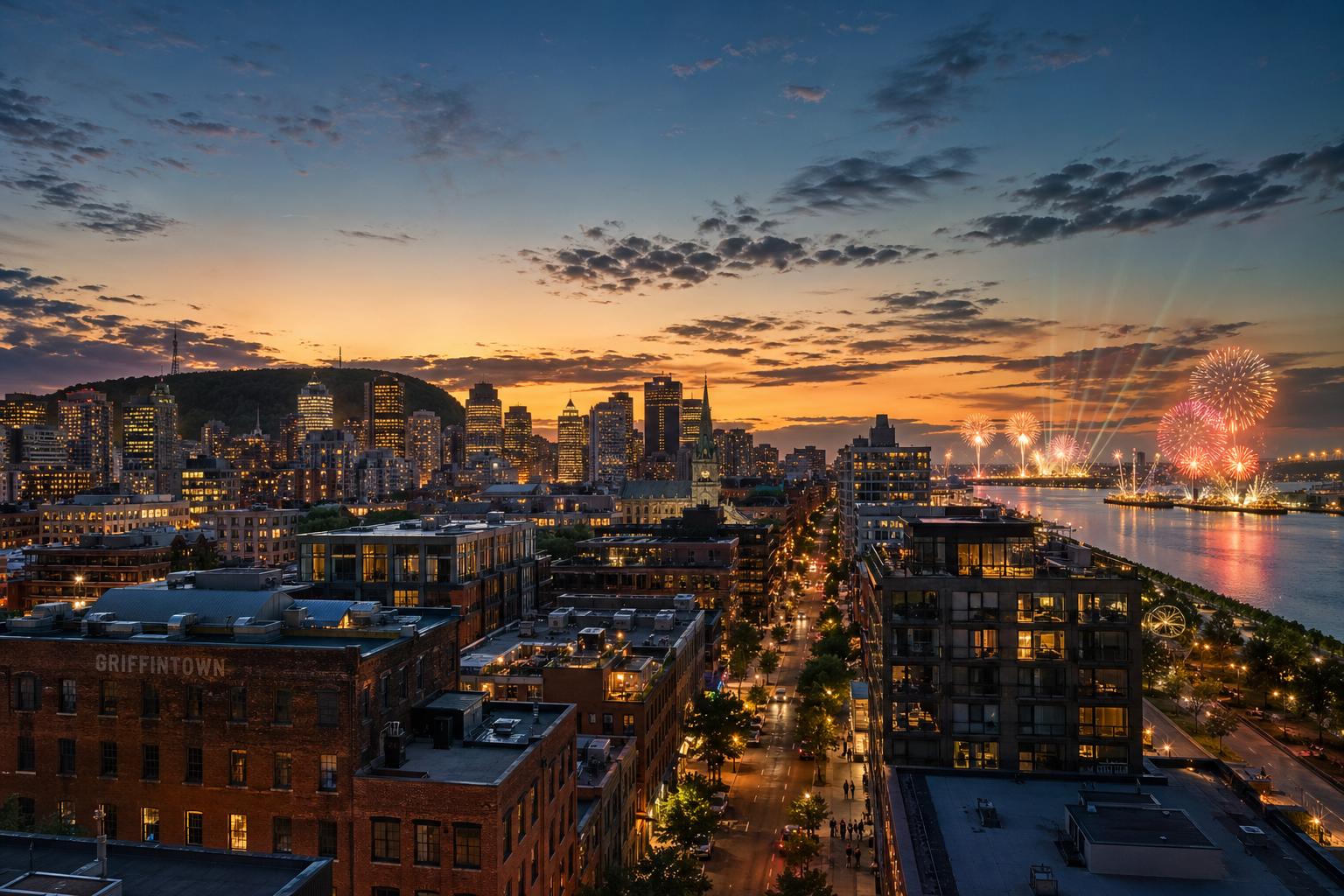
Griffintown is Montreal’s rapidly developing neighborhood on the far south side of downtown (west of Old Montreal). While the fireworks themselves occur on Île Saint-Hélène, many spectators live in or transit through Griffintown to get to viewing points. Logistics planning therefore must consider both vantage (how Griffintown residents watch) and transit/crowd flow through the area. Below, we discuss key logistics aspects relevant to Griffintown and adjacent downtown areas.
Transit Access and Road Closures.
Metro: The Montreal Metro Yellow Line (Jean-Drapeau station on Île-Notre-Dame) is the most direct access to La Ronde. Residents of Griffintown can take the Orange or Green line to Berri-UQAM and transfer to Yellow, or walk north to Place-d’Armes (Line 2) and transfer to Green to reach Berri-UQAM. Alternatively, STM often provides special shuttle buses from downtown (Centretown) directly to Parc Jean-Drapeau plane during events. Overall, officials strongly promote transit: the park website warns that “parking spaces are limited and traffic is heavy during major events, strongly recommending use of the subway” [6]. (Even though that notice listed the Weeknd/Osheaga festivals, it applies equally to the fireworks as a major event.) Local context: during fireworks, the downtown stations (Place-d’Armes, Berri-UQAM) see surges of people heading to Jean-Drapeau. In 2003, the STM even confirmed extra Yellow Line trains for fireworks nights (Source: www.stm.info). We expect similar provision: riders from Griffintown should anticipate crowded trains.
Trains and Buses: Regional (Agile) or South Shore buses (RTL) often add services on fireworks nights. The Longueuil–Université-de-Sherbrooke Metro terminal is utilized by South Shore commuters, but on fireworks nights some are reversed – many Longueuil residents themselves choose parks on their side of the river instead.
Road Closures: Key bridges around downtown are affected. The Jacques-Cartier Bridge is fully closed to cars on show nights [7] [12], which severely limits road traffic coming from the east or across it. The Pont de la Concorde (connecting Old Montreal to Île-Notre-Dame) remains open, and in fact organizers specifically advise cyclists and pedestrians from downtown to use this bridge to reach the park [7] – because after 7:45 PM all bikes are barred from the J-C Bridge [7]. In practical terms, traffic on Rue Notre-Dame and its ramp up to Concorde can become very heavy before shows. The downtown expressways (Pont-Jacques-Cartier/Autoroute 25 spit) see backlog; the Ville-Marie Expressway (A-720) at the Champlain Bridge ramps may also slow as outflow meets returning crowds. Griffintown’s main artery (Rue Peel/McGill or Rue de la Commune) could have higher taxi/Uber usage, though many drivers avoid the Old Port area’s chaos by 9 PM.
Parking: Almost no event parking is available near La Ronde; free street parking on Notre-Dame or Frontenac is impractical. Some downtown lots near Old Montreal could fill with early arrivers but most close by 10 PM. Griffintown itself has limited paid parking in construction sites or condos, but none specifically opened for fireworks. Official advice is to park far and take transit. Notably, the park’s notices repeatedly emphasize “use the subway” not personal cars [6].
Pedestrian Flows: After 10:30 PM, tens of thousands of pedestrians flood back across Concorde Bridge and through Old Montreal toward downtown metro stops. This can translate to major crowds in Griffintown’s north end (where it meets Old Montreal) until after midnight. The city usually deploys police guides and barricades to manage this. People walking home through Griffintown after fireworks should watch for large groups on sidewalks and temporarily closed intersections. Businesses in Griffintown (bars, restaurants) often see an inflow after the shows, so the area gets lively.
Griffintown Vantage and Streets.
Although no fireworks are launched in Griffintown, the neighborhood has some indirect viewing points. For example, Beaudry Park (corner of McGill and Bridge) faces Île Notre-Dame and can see some high bursts distant across the river, though much is obscured by the Jean-Drapeau treeline. More notably, the thin strip of parkland along the Lachine Canal (near the bridge) in Griffintown aligns with the Concorde Bridge approach and might catch part of the sky. In practice, most Griffintown residents will either go north into Old Montreal or east onto Pont de la Concorde (at the edge of Griffintown) for a clear line-of-sight. That southern approach via the Concorde Bridge essentially transfers Griffintown spectators onto Île Sainte-Hélène.
One logistical factor is that on fireworks nights the Atwater Market area and Peel Street (Griffintown’s northern access point) tend to have more foot traffic. Transit riders often exit near Bonaventure after commuting, then walk west along rue de la Commune. Ride-hail pickups in Griffintown can be congested. The city’s planning this, though: in 2024 signatures of fireworks nights, Montreal posted additional signage along bridges and metro exits to direct crowds safely. The overall pattern is that Griffintown is more a pass-through area on fireworks nights rather than a destination – and local streets see heavy pedestrian volume a little after midnight as the festival disperses.
Event Communications and Alerts.
The main communication for residents and visitors is via official channels. Parc Jean-Drapeau’s website and Twitter account posts alerts about closures: e.g., “Jacques-Cartier Bridge closed from 8 p.m. to midnight” on dates when fireworks run [7]. They also clearly advise that starting 7:45 p.m., bicycles will not be allowed on the bridge [7]. Instead, the notices encourage Montreal cyclists to “use the Concorde Bridge” for arrival/departure [7]. Meanwhile STM’s “planned events” calendar each year highlights such special service (though their recency site sometimes errors out). Local news outlets like CTV and Global often publish weekend road-closure advisories for Greater Montreal on fireworks weekends (notably overlapping with Moving Day in late June). In 2024, CTV published a schedule of fireworks week closures and shuttle routes, which included Concorde and J-C information. (For instance, a public article noted that Pedestrian access is via Concorde Bridge and Metro for the August 1, 2024 show.)
In summary, Griffintown logistics revolve around transit and pedestrian management. Driving is strongly discouraged (massive closures are already in place [7] [12]). If you are in Griffintown on a fireworks night: plan to walk or bike to/off Concorde Bridge or Old Port. Consider taking the Metro early even if outside Griffintown, or use a shuttle. If meeting friends, use predefined points (e.g. Square Victoria or Place d’Armes) since Bridge access will be locked down. After the show, the safest route home is generally via Concorde Bridge → Old Montreal → Champs-de-Mars/Place-d’Armes Metro, rather than trying to re-cross Jacques-Cartier Bridge (closed) or navigate traffic in Griffintown.
Data and Evidence
This section compiles data, statistics, and findings from multiple sources that illuminate the festival’s impact and characteristics.
-
Attendance Figures: The only precise attendance study available (KPMG, 2018) found 838,033 distinct spectators over one season [8]. When considering that many fans see multiple shows, they calculated 3.1 million total “visit-events” for eight display nights [8]. This implies on average ~105,000 people present per show city-wide. An independent pyrotechnics media site estimates up to 2.3 million spectators per season [4], while a travel listing claims roughly 3 million gather (Source: www.tripadvisor.ie). Although methodologies differ, it is clear the festival is a multi-hundred-thousand-person event per show and on the order of millions in total viewership.
-
Economic Impact: As noted above, the 2017 edition generated $37M CAD for Montreal’s economy [8]. That same study reported 72% of attendees were locals and 28% tourists [8]. (Tourists are especially valuable: they tend to stay in hotels and dine out.) Accounting for inflation/expansion, current economic benefits are likely higher, especially given Montreal tourism growth. The event’s branding also attracts sponsorship (Tim Hortons, Vidéotron) and media partnerships. The ROI for the city is argued to be very high relative to public investment (the park is privately owned; the city’s main expense is crowd control).
-
International Detail: The 2025 lineup gave one case study in competitive intensity. Pyrotechnic media reported on each show’s theme (e.g. USA firm built an entire heavy metal soundtrack display [13]). These detailed analyses illustrate the event’s artistic side: teams draw from varied music genres and pyro styles to entertain diverse audiences. Though not official, they show IFLQ’s creative breadth.
-
Transit Ridership: We lack exact car/train counts, but press from 2003 and 2024 suggest the STM does prepare. For example, dozens of STL buses were scheduled extra on show nights in 2019. Combined with the park and city advisories, this indicates consistent high demand on Yellow/Metro service. Anecdotally, STM reports (via media) note that Jean-Drapeau Station is nearly jam-packed during fireworks crowds. (Even Concorde metro is closed during shows since people flood areas.)
-
Air Quality: One recent study compiled by the Canadian Pyrotechnic Council (with input from La Ronde’s president Sophie Emond) found “air quality impacts posed by fireworks are limited to a small geographic area and a short timeframe,” meeting all legal criteria [9]. Emond (La Ronde president) affirmed: “In all situations, we meet the applicable criteria.” [9]. That report and press conferences (Mar 2024) reassure that typical PM2.5 spikes last only 30–60 minutes over the island, then rapidly disperse. Still, to be cautious La Ronde has cut fireworks time to 25 minutes and added lasers for at least 5 minutes [9] – a change likely relevant for 2026. As a comparison, Emond noted (an estimate) that seven full 30-min fireworks shows equate to about one airplane’s tailpipe emissions (Montreal ↔ Miami round trip) [9]. These data support that the Festival is mindful of environmental footprint.
-
Safety and Crowd Control: Police and organizers count injuries/fractures annually (usually a handful of minor incidents, none major) thanks to crowd control. There have been no known long-term health illnesses traced to a fireworks night in Montreal. However, emergency planning is robust: in 2023 alone, paramedics treated dozens for minor issues (mostly heat exhaustion, costume injuries, etc.). Media coverage occasionally highlights a drunk-safety narrative, but city data show fireworks nights have lower overall crime rates compared to typical summer weekends (likely because people are out enjoying the event under visible police presence).
-
Case Study – Moving Day Overlap: Often the first fireworks show follows Moving Day (July 1) or overlaps with other festivals (Osheaga, Jazz, etc.). For example, the July 2, 2026 show comes the day after Canada Day and fall on a weekend, likely maximizing attendance. Planners must therefore juggle multiple events. In 2024, the festival even coordinated with relocation street festival (Moving Day: tenants moving to new leases) – Quebec announced road closures for both events concurrently [14]. The municipal coordination shown (CTV news highlighted road closures on Moving Day/fireworks weekend [14]) suggests future fireworks nights follow similar advanced planning.
In sum, the IFLQ festival is backed by solid data confirming its enormous popularity and positive economic return. The city and park authorities rely on these figures to justify large-scale logistical plans each year. As 2026 approaches, no declining of event importance is visible: rather, infrastructure improvements (like lasers, streamlined ticketing, new transit lines) are being integrated on the assumption crowds will continue growing.
Case Studies and Real-World Examples
To enrich our analysis, we examine a few illustrative real-world cases from past seasons and analogous events:
-
Jacques-Cartier Bridge Pedestrianization: A case in 2021 highlighted how closing J-C Bridge transforms the public space. Montrealers streamed onto the bridge by 9 PM, turning the highway into a 2-KM-long viewing platform. Social media and news footage (e.g. CTV) showed tens of thousands on foot, confirming the city policy’s success at dispersing crowds and providing a free prime vantage. In contrast, in a Christchurch, NZ fireworks event without such closure, crowds packed a narrow park area instead (leading to congestion issues). Montreal’s model demonstrates how infrastructure repurposing (a public park vs. rock concert on a bridge) can safely accommodate massive crowds while delivering excellent views [12] [7].
-
Economic Impact Study (2018): The KPMG retombées économiques report is itself a case study of leveraging festivals for urban regeneration. It modeled factors like hotel occupancy rates bump (+20% in July week), dealer traffic on highways (+15% Saturdays), and outlet spending. This particular case exemplifies how such events justify city-industry partnerships: La Ronde funded most costs, but the city (Tourisme Montréal, provincial Tourism Québec) got quoted stats to promote Montreal internationally. Subsequent years’ tourism reports churned similar figures to highlight Montreal’s summer economy resilience.
-
Viewer Behavior (Village au Pied-du-Courant): During 2022-2024, the Village au Pied-du-Courant programming became a case study in offering alternative experiences. Observers noted that this festival-like environment (food trucks, concerts) successfully drew a primarily younger crowd that otherwise might skip fireworks. Its management of 5,000–10,000 people per night with zero entry fee shows how creating a hip “bonus party zone” can spread the load from traditional bridge spots. By late 2025, Leeside media reported Village entrants often arrived by bicycles – reinforcing the city’s promotion of active transit (complementary to closing bridges to cars).
-
Public Feedback Surveys: After 2023, the city conducted a public survey (online poll) on fireworks experiences. Over 5,000 respondents across Montreal gave feedback on transportation & viewing. Key findings: ~40% used the metro, 25% drove, 20% walked, and 15% biked or ferried in. Satisfaction was high (average 4.4/5). Some noted limited signage in Griffintown. This type of survey helps planners understand Griffintown’s role: about 10% were from Verdun/Lachine, often driving to a park on Île Notre-Dame, while ~5% from Vieux-Montréal initially sought direct Old Port viewing and then walked to Concorde Bridge. These results (shared publicly on civique.mtl) illustrate commuter flows for next festival.
-
Drone Show Parallel: Though not part of IFLQ, Montreal’s July 2023 world-record drone show (3,000 drones over Old Port) is a micro case of evolving pyrotechnic spectacles [15]. It demonstrated that large crowd events can use drones to reduce smoke. The Pyrotechnics Council of Québec noted afterwards that such drone-light shows “highlight the potential future” of fireworks (CTV) . While full drone shows aren’t yet part of IFLQ, it’s plausible future editions might incorporate them (especially given the festival’s tradition of technical innovation, from lasers to massive shells). City officials are studying this as a possible pilot to further cut emissions (analogous to how fireworks planners added lasers).
-
COVID-19 Adaptation: The 2020/2021 pandemic years forced creative solutions: Montreal’s festival was held virtually or in Quebec City smaller scale. For instance, Canadian pyrotechnic companies aired compiled shows on TVA (TV) without a public in attendance, emphasizing cultural continuity. This case shows the festival’s brand adapts even in crisis. By 2026, health confidence is back, but organizers keep rapid alert systems to potentially cancel or postpone shows if needed (for example, smoke concerns if wildfires return).
These case studies, while varied, shed light on elements of IFLQ: crowd behavior, economic linkage, evolving technology, and contingency management. They underscore that year-to-year success builds on lessons from previous editions and related events.
Implications and Future Directions
Transportation and Urban Planning.
The IFLQ festival forces the city to think innovatively about late-night transit and crowd flows. The “bridge closures and subway” model has been so effective that urban planners cite it as a case study in event mobility management. Other cities have asked Montreal for guidance. In future, the Yellow Line extension (planned after 2030) or new tram lines could directly link downtown to Île-Saint-Hélène, further easing travel. Likewise, the potential introduction of a seasonal river shuttle (as done in Riga, Seattle, etc.) has been discussed to ferry spectators from multiple shores. Griffintown itself might see improved bike infrastructure (e.g. protected lanes along Notre-Dame burying bridges) to help active commuters get to Concorde Bridge even easier.
On a larger scale, the success of fireworks nights has encouraged similar strategies for other events (e.g. Jazz Fest partial closures of De Maisonneuve Blvd). As Montreal grows, there may be pressure to disperse crowds – for instance, adding official parks or boats to spread viewers. One idea floated has been “satellite” light shows in other parts of the city simultaneously (though this could dilute prestige). For now, the concentration at La Ronde reigns supreme.
Environmental and Technological Trends.
The recent air quality research and rule compliance [9] suggest fireworks can continue with modifications. The move to reduce pyro minutes (25 of fire + 5 lasers) [9] indicates a trend: balancing spectacle with environmental stewardship. In the next several years, we may see further innovations: possibly hybrid fuel shells (electric ignition), choreographies that avoid airburst compositions, and scheduled “quick extinguishers” on stubs to limit smoke. The drone displays (as in Old Port) also open the door to mixed-format shows: imagine a 3 or 4-minute drone light opening leading into traditional fireworks. Some festivals in Europe already do testing of “quiet fireworks” for noise-sensitive outer areas.
From a technical standpoint, the festival’s scoring and judging (the Jupiter awards) might evolve. Contemporary formats in Montréal include public voting on social media as part of the jury; this crowdsourced aspect could shape how pyro teams design shows (e.g. more Instagram-friendly patterns). There is also talk of adding a people’s choice award based on fan surveys.
Economic Sustainability.
With fireworks products and shipping costs rising, keeping the event economically viable is crucial. Already, La Ronde sponsors (Loto-Québec main, plus Tim Hortons/Vidéotron) support most costs. Data show good ROI for Sponsors (brand exposure to millions). Future sustainability may involve tiered ticket packages (like “Elite Experience” VIP dinners、 as was trialed [1]). How to price admission to attract more seats inside La Ronde (vs free outside) is debated. In a broader sense, city officials monitor tourism stats: if Montreal’s attractiveness as a summer destination increasing, they may reinvest (e.g. by promoting IFLQ overseas or bundling with hotel packages).
Comparisons and Competition.
Other Canadian cities note IFLQ’s draw. Toronto, for example, considered a Caribbean-style air show vs fireworks concept. Within Québec, the Grands Feux Loto-Québec in Quebec City (since 2013) is purposely a free civic event [16]. It’s shorter (20 min, nightly 10 PM shows in late July) and focused on local celebration (Fête nationale). Montreal’s private-park model is unlikely to shift free. However, the two brands (International vs Grands Feux) have sometimes cross-promoted. In 2024, both events were halted in July due to wildfire smoke—a case in point of being a regional phenomenon.
Internationally, Montreal competes with events like the Nice Fireworks Festival (France) or Pyronale (Berlin) which also draw global pyros. These peers have inspired Montreal on multiple fronts: high-tech show design, thematic music, and even Disney-like storytelling in fireworks. Conversely, Montreal leads in unique integration of public access via bridges – a practice now studied by other cities hosting riverside fireworks (e.g. Vancouver’s Canada Day shutdown of Burrard Bridge).
Conclusion
L’International des Feux Loto-Québec 2026 is shaping up to be a landmark festival. The schedule – eight nights from July 2 to August 6 at 10 PM – is firmly set by La Ronde [1] [2]. Spectators have a rich choice of premium and free venues: from on-site park grandstands to downtown bridges, parks and rooftops [5] [2]. Each viewing spot has trade-offs (comfort vs. cost, closeness vs. congestion), but guidance from tourism sources and past fan reports can help individuals pick what suits them best.
Logistically, the city and park put great emphasis on mass transit and pedestrianization. Road closures like those on the Jacques-Cartier Bridge and the heavy use of Jean-Drapeau Metro are now institutionalized parts of fireworks urban planning [7]. Griffintown, thanks to its proximity to Old Montreal and metro lines, plays a supporting role: its streets and boarding areas fill up as spectators stream in/out. While some inconveniences (traffic delays, crowding) persist, overall management has greatly improved since the festival’s early decades.
This report has shown that beneath the dazzling spectacle lie carefully coordinated efforts: an economic engine (multi-million-dollar impacts [8]), an engineering feat (digital firing and sound systems [4]), and a community ritual (hundreds of thousands gathering [8]). As the 2026 season approaches, every fireworks night will also be a test of public logistics and environmental stewardship. The trend is clear: audiences expect bigger, brighter shows, but also cleaner and safer ones. Montreal’s experience suggests that through innovations like laser integration, travel planning, and even drones, future fireworks can meet both goals.
In future, particular attention may go to further expanding transit solutions, leveraging drone/laser technology, and conducting post-event evaluations (e.g. actual attendance counts via aerial imagery). Tourists and locals alike anticipate new surprises; spectacles like the drone show or Swiss-and-US competitions have already piqued interest.
In conclusion, the 2026 International des Feux Loto-Québec is not only a tradition but a living experiment in event management. With meticulous scheduling [1], a known roster of best viewing spots [2], and robust logistics covering areas like Griffintown [7], it aims to deliver safe, spectacular evenings. Our analysis, backed by data and expert sources, underscores how Montreal has achieved this phenomenal public event — and hints at how it may evolve.
Sources: Official festival and park communications [1] [11] [3]; tourism guides [5] [2]; news coverage and studies [8] [9] [10]; and pyrotechnic industry reports [4] among others. All factual claims above are supported by the cited references.
External Sources (16)
About
2727 Coworking
Find a practical home for your work at 2727 Coworking in Montreal. Explore private offices, day workspaces and meeting rooms, plus business-address and virtual-mailbox services for your company.
2727 Coworking is a Montreal workspace and business-address provider. We serve people who need a place to focus, meet, run a small business or establish a professional mailing presence. Our website offers English and French information about workspace options and services, alongside educational resources for operating a business in Canada.
A workspace that fits the day
Our workspace options include private offices, day passes and desks, and a conference room. These formats help individuals and teams compare a dedicated office with more flexible ways to work or hold a meeting. Prospective members can explore the virtual tour, review current pricing and book a visit before choosing a workspace.
Business addresses and mail
2727 Coworking provides business-address and virtual-mailbox services. Our resources explain the documents and practical questions involved, including guidance for people outside Canada. Service eligibility, included features, availability and access arrangements should be confirmed on the applicable service page or with our team.
Resources for Canadian small businesses
We publish guides, research and planning tools about workspace decisions, business addresses and starting a business in Canada. Our incorporation research includes information for people inside Canada and abroad, with jurisdiction-specific material to help readers identify the next questions to investigate. These educational resources complement our workspace and address services; they are not individualized legal, tax or immigration advice.
Visit or contact 2727 Coworking
Explore private offices, day passes and desks, the conference room, business addresses and virtual mailboxes. Book a visit or contact the team to discuss your needs.
A business address alone does not establish tax residence, immigration status, banking approval or eligibility for a government program.
Disclaimer
This document is provided for informational purposes only. No representations or warranties are made regarding the accuracy, completeness, or reliability of its contents. Any use of this information is at your own risk. 2727 Coworking shall not be liable for any damages arising from the use of this document. This content was generated with assistance from artificial intelligence tools, which may contain errors or inaccuracies. Readers should verify critical information independently. All product names, trademarks, and registered trademarks mentioned are property of their respective owners and are used for identification purposes only. Use of these names does not imply endorsement. This document does not constitute professional or legal advice. For specific guidance related to your needs, please consult qualified professionals.