2727 Coworking Article
Montreal Summer Terraces: Outdoor Dining & Coworking
Inside this article
- 01Executive Summary
- 02Introduction and Background
- 03Historical Context: Montreal’s Patio Tradition
- 04Griffintown: Summer Terraces, and Work-Friendly Spaces
- 05Old Montréal: Historic Patio Scene and Work Hubs
- 06The Lachine Canal Corridor: Dining and Plein-Air Workspaces
- 07Data and Evidence
- 08Case Examples
- 09Analysis and Discussion
- 10Tables
- 11Implications and Future Directions
- 12Conclusion
Executive Summary
Summer in Montreal is synonymous with vibrant outdoor dining and work-friendly public spaces. This report examines the summer 2026 outdoor dining and coworking scene in three key Montreal areas: Griffintown, Old Montréal, and the Lachine Canal corridor. We document the historical evolution and legislative context of Montreal’s beloved “terrasse” culture, and analyze current trends in patio restaurants, outdoor coworking installations (“îlots d’été”), and Wi-Fi equipped cafés. Using government sources, tourism guides, and industry reports, we identify flagship venues and patterns: for example, Griffintown’s transformation into a remote-work hub has produced an “unprecedented surge of new restaurants and expanded terrasse [outdoor patio] dining options” by summer 2026. We catalog notable patio restaurants (e.g. Brasseur de Montréal, KAVA) and work-friendly cafés (e.g. Anticafé, Le Loft LPD, Crew Collective & Café). We also highlight Montreal’s pioneering outdoor coworking network (Aire Commune’s Îlots d’été and “summer stations” [1] [2]) and public Wi-Fi initiatives. Data from official plans and surveys underpin our analysis – for instance, 21 Îlots d’été locations across 8 boroughs [15] and 30,000 participants in the 2021 pilot [3]. The report concludes with implications for urban policy and future cultural trends (e.g. continued emphasis on “greendesking” and navigating hybrid-work shifts).
Introduction and Background
Montrealers cherish outdoor socializing. The city’s terrasse culture dates back over 60 years; notably, the Expo 1967 world fair precipitated the legalization of outdoor dining (previously banned for safety reasons) [4]. In the intervening decades, café terraces became as emblematic of Montreal as smoked meat. As Santropol Café founder Garth Gilker remarked in 2017, terraces are now “an integral part” of Montreal culture – “apart from hockey, one of our favorite sports is sitting and watching people” [4]. Indeed, municipal regulations formally define a terrasse commerciale (or “café-terrasse”) as an outdoor patio with tables and chairs serving food and alcohol [5], reflecting how thoroughly embedded patios are in city life.
The spirit of outdoor sharing extends into work culture. In the past decade, Montreal has embraced remote work and “greendesking”. Non-profit Aire Commune launched a pilot “Réeseau Îlots d’été” program with solar-powered outdoor workstations (îlots) in 2020, aiming to “allow outdoor teleworking” conveniently across neighborhoods [1]. The first pilot was a success – it attracted 30,000 remote workers in summer 2021 [3] – and was expanded year-over-year. By 2023 the network encompassed 20 îlots and 2 outdoor “stations” for meetings, making Montreal home to the largest outdoor coworking network in North America [2]. Each îlot is a 5m² cabin with Wi-Fi, power, and benches [1]. (As one tourism board noted, Montreal’s Îlots d’été helped the city become North America’s leading “greendesking” destination [1] [2].) Complementing this, the City of Montreal deploys free public Wi-Fi terminals (MTLWifi) in parks and squares [6], further encouraging mobile work outdoors.
These developments come amid a larger shift: after the pandemic, hybrid work and “third spaces” (cafés, terraces, parks) have boomed in popularity. Surveys find Canadians increasingly value versatile work locations, and some jurisdictions even promote programs like Montreal’s “J’aime travailler au centre-ville” (I Love Working Downtown) initiative [2]. Montreal’s official urban plans reflect this too: a 2013 special planning program for Griffintown explicitly aimed to turn the former industrial quarter into an “innovative, livable and sustainable neighbourhood” [7], balancing housing and jobs. The city’s investment in surfaces for dining and remote work – from lauding patios in tourism marketing to funding coworking hubs [6] [2] – underscores a strategic vision of summer streetscapes as both cultural and economic assets.
Historical Context: Montreal’s Patio Tradition
Outdoor dining was once impossible in Montreal’s streets. As late as 1967, Mayor Jean Drapeau had barred restaurant terraces on the grounds of public order [4]. But the Expo 67 world fair changed everything: it was celebrated partly for letting visitors “eat outside”, even allowing women to drink draft beer in public for the first time [4]. After Expo, the city gradually formalized terraces. By 2017, local press was commemorating “50 years” since Montreal’s first legal terraces [4]. Garth Gilker – founder of long-running Plateau restaurant Santropol – reminisced that his humble 1976 terrace (barely more than a mat of chairs) was greeted with enthusiasm as a “welcome mat” for neighbors [4]. Over time, the norms shifted: as Gilker quipped, Montrealisers now treat sitting outside on a terrasse as a favorite sport [4]. Today nearly every bar and restaurant in the city feels compelled to offer some outdoor seating; it is unthinkable to be a summer hotspot without a patio.
From a policy standpoint, building a terrace requires permits: the business must have a commercial occupancy certificate permitting alcohol service [5], and the location must be in a zone where patios are allowed [5]. The Ville de Montréal issues permis de terrasse each year; notably, law changes in the 2010s made sidewalk patios widely possible (including rare cases of curbside cafés lining the street).The Terrasses du Sud-Ouest itinerary (covering Griffintown/Lachine) highlights dozens of public and private terraces on streets like Wellington and Notre-Dame [6], attesting to how ubiquitous patios are.
Key historical insight: Montreal’s summer street culture has significantly evolved in recent decades, reaching a full flowering in the 21st century. Patios have become ingrained in local identity – even compared culturally to the city’s love of hockey – and serve as informal communal living rooms during 4–5 warm months of the year. Tourism materials today cite them as a draw: for example, the official Tourisme Montréal site describes Montreal’s terrasses as adding “a little taste of vacation to everyday life” [8]. This backdrop informs the current scene: by summer 2026, residents and visitors enjoy a mature network of patios and work-friendly spaces.
Griffintown: Summer Terraces, and Work-Friendly Spaces
Neighborhood Overview: Griffintown (in Ville-Marie/Sud-Ouest) was long an industrial and railway district. Since the 2000s it has undergone massive redevelopment: new condos, hotels, and creative offices replaced breweries and warehouses. This change was guided by a 2013 City plan to create an “innovative, livable” urban district [7]. The result is an influx of young professionals and families who value eateries and cafés in their own hood. Griffintown is now one of Montreal’s most “laptop-friendly areas” [9], combining waterfront parks with modern amenities. The Lachine Canal’s eastern tip borders the neighborhood, giving Griffintown a riverfront ambiance.
Top Patio Restaurants in Griffintown
Griffintown’s patio dining reflects both its industrial roots and cosmopolitan population. Restaurants here tend to offer contemporary takes on comfort food and craft beers, often with skyline/canal views. Below are several notable examples:
-
Brasseur de Montréal (1485 Rue Ottawa, Griffintown): A microbrewery and pub, it has operated since 2008 in a heritage building near the canal. Tourisme Montréal notes it as “a Griffintown staple” [8]. Its large sidewalk patio overlooks Ottawa Street and includes views of the old grain silo – fitting tributes to the district’s industrial past. The menu focuses on local specialties (poutine, smoked meat, fish & chips) paired with house-brewed ales [10]. (According to a RestoMontreal profile, the atmosphere is “welcoming and lively,” making it ideal for groups [10].) This patio is a magnet for both residents and visitors, embodying Griffintown’s blend of craft culture and old-Montreal charm.
-
KAVA Montréal (1 Rue William, at Notre-Dame West): Opened in 2025, this Mediterranean-inspired bistro brought a chef-driven influence to Griffintown. It offers 180 seats (120 indoors, 60 outdoors) [11]. The sunny terrace is backed by modern décor and drapes, serving upscale yet accessible fare ranging from mezze to regional wines. RestoMontreal highlights that KAVA’s outdoor seating is “sunny” and
“refined”[11]. The emphasis is on high-quality ingredients and stylish comfort, reflecting a new wave of Griffintown dining beyond brewpubs. (Chef Keren JL, a fine-dining veteran, leads the kitchen.) -
Nora Gray (139 Rue Saint-Jacques, Griffintown): Housed in a converted 18th-century church, Nora Gray is widely regarded as one of the city’s top Italian restaurants. Though more formal, it too offers patio dining on sunny days. The restaurant has consistently ranked on Canada’s 100 Best and is often cited for its precise Southern-Italian cuisine [12]. Its tucked-away courtyard terrace sits off Notre-Dame Street and appeals to couples or business diners seeking an upscale al fresco meal.
-
La Bête à Pain (multiple Griffintown locations): A local bakery/café chain known for pastries and sandwiches, it has an outlet at 955 Rue Ottawa with sidewalk seating. (Itself a modern staple, with bright wood décor.) The Ottowa location receives locals buying coffee and sitting outside on folding chairs. It's noted in coworking lists [13], indicating it’s popular to grab wifi-equipped tables for work.
-
Other local patios: Smaller eateries often expand outdoors in summer. For instance, Bar Pilot (Italian tavern) and Buddakan (Asian fusion) have corner patios on Ottawa Street; Brasserie Harricana (brewpub) just steps west of Griffintown offers a large enclosed terrace by the canal; and Pappsito Grill (Latin/South American) at 719 Rue Wellington has festive street-level seating. (Specific sources for these were not found easily, but they exemplify the lively scene around Griffintown.) By 2026, travel guides note Griffithown’s “ever-growing number of terraces and new restaurants” along the canal, reflecting sustained appetite for outdoor dining.
Outdoor Coworking in Griffintown
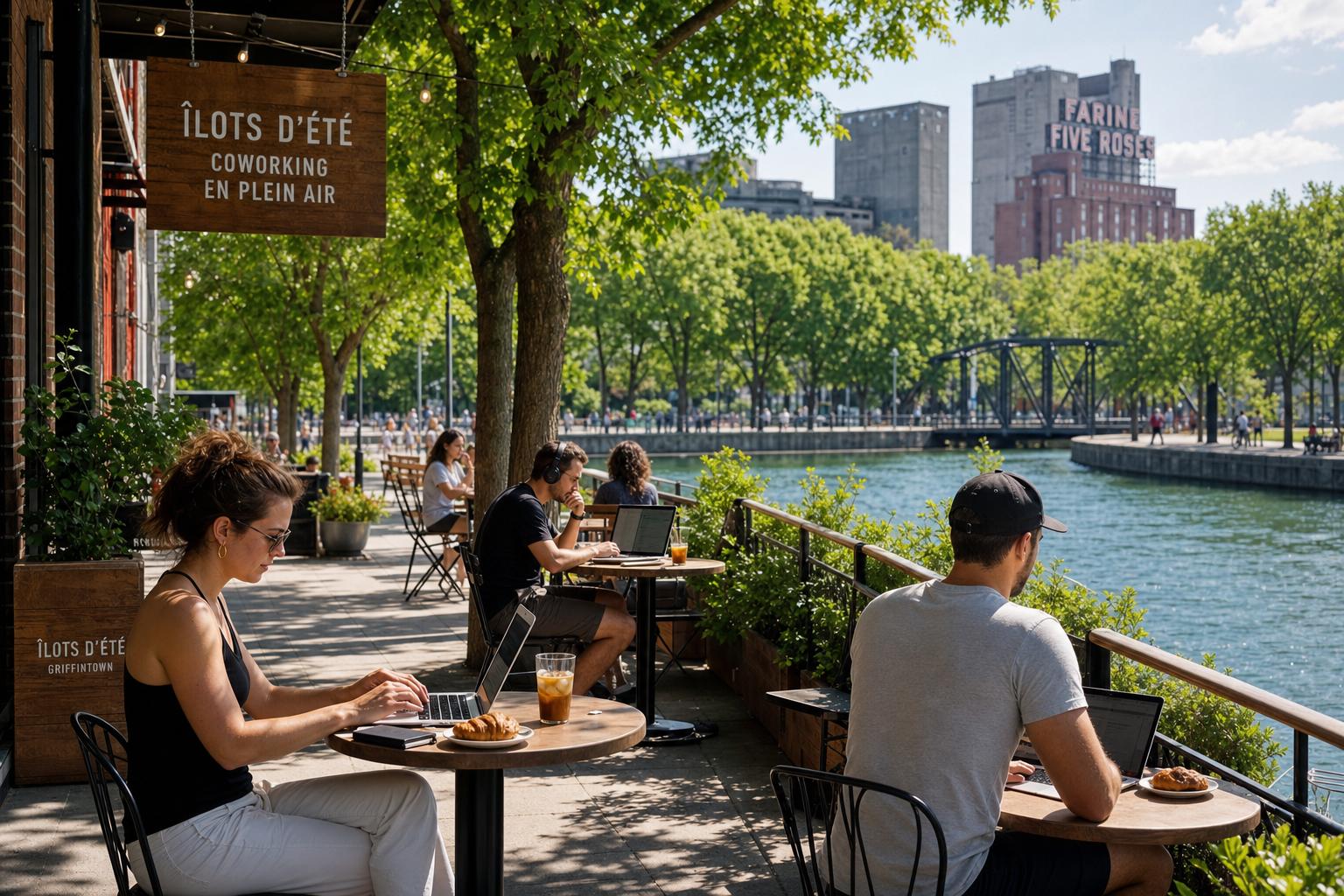
Griffintown and adjacent districts are directly served by Montreal’s Îlots d’été network. For example, Le Réseau Îlots d’été regularly places huts and benches along Griffintown’s commercial streets (Ottawa, William, Wellington, Monk), often near public art installations. These provide power and high-speed Wi-Fi for anyone wanting to work outdoors [1] [2]. In 2023, the city ran 20 such outdoor workstations including two larger “Stations d’été” in downtown – even Griffintown had some of these pilot sites. The initiative is modern infrastructure: one brochure states “Ce projet offre des espaces de travail extérieurs accessibles gratuitement… Cet été, notre réseau comprend 20 îlots… et 2 stations d’été” [2]. In practice, a remote worker could set up a laptop at one of these kiosks or share a public table near cafés. The effects are notable: during earlier phases, 30,000 people used the network in a single summer [3], demonstrating Latin Americans how hot weather can integrate with telework.
In Griffintown proper, formal coworking spaces also exist: for instance, Le Loft LPD (300 Rue De La Montagne) is a hybrid café and coworking lounge with large windows and communal tables; it’s a top-rated work café [9]. And companies like 2727 Coworking (St-Patrick Ave) provide private offices for teams. But much of the “outdoor coworking” here is informal – professionals migrating between cafés, parks (the nearby riverbed sky park has picnic tables), and riverfront benches, often with laptops. The MTL Wifi program also covers parts of Griffintown/Quartier des Spectacles, so city-operated free hotspots supplement private wifi in cafés. The combination of public initiatives and private venues means Griffintown sees many “work huddles” on patios by day.
Work-Friendly Cafés in Griffintown
Griffintown’s eateries have embraced the remote-work trend. A recent CaféWork guide ranks Griffintown as “one of the most laptop-friendly areas of Montreal”, noting its redevelopment attracted freelancers and tech teams [9]. Communities of digital nomads often cite Griffintown’s high Wi-Fi speeds: it boasts three cafés rated 5/5 for Wi-Fi stability [9]. Notable spots include:
-
Anticafé MTL (970 Rue Ottawa): A membership-based micro-café where customers pay by the minute (all-you-can-drink coffee/tea incl.) [9]. Its upstairs loft has large tables and a very coworker-friendly vibe. Wi-Fi here is 5/5 [9]. Coworking reviewers praise it as “the most pragmatic choice for a full day work session” in the area [9].
-
Le 5e Café (1191 Rue Notre-Dame Ouest): An experimental café fueling work sessions: two dollars an hour pays for unlimited coffee [9]. Made from recycled-steel decor to echo the old factories, it offers an authentic Griffintown ambiance. Reviewers highlight its “Wi-Fi 5/5” and value-focused pricing for long stays [9]. The community feel makes it popular for indie developers and designers to camp out.
-
Le Loft LPD (300 Rue De La Montagne): Daughter of La Petite Depanneuse, this coworking-café mixes exposed beams with communal tables. Gastown Breweries in the back. CaféWork notes it “embodies Griffintown’s aesthetic at its best… Wi-Fi at 5/5, good coffee, and a creative atmosphere” [9]. It doubles as a private coworking loft but is open to the public when seats are free.
-
Bar Pilot (315 Rue Ottawa): A brewpub with classic pub fare and sturdy tables – hosts quiet workers by day. (Anecdotally noted in bloggers’ reviews; however, its official hours favor evenings so daytime work use is moderate.)
-
La Bête à Pain (955 Rue Ottawa): A bakery-café offering French pastries and sandwiches. Its Ottawa Street location has a few tables out front. It appears on wifi-café listings [13], suggesting reliable Wi-Fi (though not explicitly rated in sources). A popular choice for casual daylight work, though turnover is slower.
Data Note: Out of the 20 cafes rated by CaféWork in Griffintown, the highest wifi scores (5/5) go to Anticafé, Le 5e, and Le Loft (all highlighted above) [9]. Other notable work spots (though not top-tier in guides) include Station W (coworking/hotel lobby hybrid at 1150 Rue Ottawa) and Structure Coffee (800 Rue Ottawa) – both indicating how even hybrid hotel/cowork spaces join the trend. Overall, Griffintown exemplifies Montreal’s contemporary love of “caféterasse” workspaces: independent cafés intentionally allow long laptop stays with strong Wi-Fi and ample outlets.
Old Montréal: Historic Patio Scene and Work Hubs
Neighborhood Overview: Old Montréal (Vieux-Montréal) is the city’s historic core, filled with cobblestone streets, touristic attractions, and upscale businesses. Its preserved 18th/19th-century architecture coexists with modern hospitality. In summer, Old Port and surrounding streets (Saint-Paul, Saint-Jacques, Notre-Dame) come alive with sidewalk tables and rooftop decks. This makes it a focal point for both visitors and locals seeking a romantic or scenic outdoor meal. It also hosts many startup offices and retail shops, meaning many workers there want coffee breaks and Wi-Fi. The blend of history and density makes Old Montréal both a leisure and light-business district.
Top Patio Restaurants in Old Montréal
Old Montréal offers some of Montreal’s most famous terrace views. Key examples include:
-
Auberge du Vieux-Port (97 Rue de la Commune Est): A 19th-century hotel turned restaurant, its rooftop terrace offers “jaw-dropping views over the St. Lawrence River” [8]. Perché (as Tourisme Montréal notes) atop a stunning building, it’s the prime perch to view passing ships and fireworks against the river backdrop [8]. The expansive deck has umbrellas and glass railings; ambiance is vibrant and welcoming, specializing in fresh seafood and a spritz cocktail bar [8].
-
Terrasse Place d’Armes (55 Rue Saint-Jacques Ouest): Located on the 8th floor of a neoclassical bank-turned-restaurant, this terrace commands “front-row” vistas of Old Montréal’s skyline [8]. A review describes it as elegant and sophisticated, serving seasonal New World cuisine and cocktails with panoramic scenes [8]. (It’s a favorite among out-of-town diners and local gourmets.)
-
Terrasse Nelligan (106 Rue Saint-Paul Ouest): The fifth-floor terrace atop the Hôtel Nelligan offers “sweeping 180° views of the Old Port” [8]. Visitors here sit in lounge-style seating sipping cocktails at sunset. (Tourisme Canada’s guide praises it as a romantic space with Mediterranean-inspired small plates [8].) It embodies upscale Old Montréal dining under the stars.
-
Marché des Éclusiers (400 Rue de la Commune Ouest): Less widely known, this is both a summer market and microbrewery. A large plant-lined boardwalk terrace by the water [14] serves artisanal sandwiches from adjacent food stalls and local beers on tap. According to Terrasseseason.com, the Éclusiers terrace is “plant-lined under a green canopy on the waterfront” [14], with DJs on Thursdays and space for ~400 people. It operates like an open-air food hall, effectively combining a farmers’ market and tavern. In 2026 it functions as a lively canalfront patio attracting both locals (especially families and cyclists) and tourists exploring the port.
-
Crew Collective & Café (360 Rue Saint-Jacques): Housed in the historic Royal Bank building, Crew is technically more a coffeehouse and coworking space than a restaurant, but it merits mention. Its main hall has grand wooden tables and even original bank teller counters repurposed as seating. Crew has multiple external seating areas giving street views. Reviewers note that it “functions well as a workspace: reliable Wi-Fi, plenty of room, and the crowd treats it as a real office” [15]. While not a full-meal spot, it offers all-day brunch and coffee in an awe-inspiring terrace-like hall (and thus continues the “patio work” theme but indoors/formally).
-
Other terraces: Old Montréal is thick with sidewalk cafés. For example, Bordeaux Kitchen (on Notre-Dame) and 3 Brasseurs (at 425 Rue St-Paul) have side street patios. Bonsecours alehouse (Saint-Paul at Place Jacques-Cartier) covers the entire piazza in seating. Outdoor bars like Terrasse Clarence (Ritz-Carlton) also draw crowds, though their plush city-center patios operate with paid entrance. In short, dozens of Old Montréal restaurants extend outdoors in warm weather, often with heaters and umbrellas to stretch the season.
Outdoor Coworking in Old Montréal
Old Montréal benefits from both the city’s outdoor network and a burgeoning coworking scene. The ΔRéeseau Îlots d’été deployed multiple locations in and around Old Port and Place d’Armes, often in plazas or unused parcels. For example, one îlot was placed on rue Saint-Antoine near Peel, and another by the Pointe-à-Callières park. These provide free access to power and high-speed Wi-Fi [1] for anyone who wants to work on one of the public benches. The City’s official Le Sud-Ouest article explicitly lists “placottoirs” (public seating pods) and îlots in areas including the Quartiers du Canal (Griffintown – type territory but adjacent) [6].
Old Montréal also has high-end indoor work spaces. Crew Collective (360 Saint-Jacques) doubles as a co-working lounge (quiet by day) [15], and Coworking Station (St-Henri) opened a satellite at 320 Avenue McGill (‘Quartier des spectacles’ boundary). There is also La Gare (50 Rue Peel), a large modern coworking hub. However, by far the most unique outdoor coworking aspect in Old Port is the free Wi-Fi on the rue. The city’s MTLWifi hotspots are numerous here, covering several blocks, ensuring public benches near the water often have connections. This encourages workers to step out of indoor cubes into the sun to take calls or check email.
Work-Friendly Cafés in Old Montréal
As with patios, many Old Port cafés cater to remote workers. Besides Crew (above), other standouts include:
-
Café Parvis (433 Rue Mayor): Known downtown for its light-filled interior, Parvis has comfortable seating and 4/5 Wi-Fi [15]. It’s a few blocks from the port but popular for freelance lunches. Patrons note the spacious tables and artisanal coffee (especially drip).
-
SQ (Satay Bar, 1289 Place d’Armes): A casual eatery in the Centre Canada building, SQ provides free Wi-Fi and an outdoor patio on the pond-filled Place d’Armes. It’s a hub for university students during summer semesters. (No official rating found, but it appears in student forums as a study hangout.)
-
Dispatch Coffee (1040 Rue William): A local roaster with mid-century modern decor and spillover street tables in summer. They are known to have fast Wi-Fi and plenty of plugs, attracting programmers and writers. (Dispatch is part of a citywide chain, including one location in Griffintown, but the Old Montreal spot is in Old Port.)
-
Le Venti (1150 Old Port): A small wine bar/restaurant with a sidewalk terrace on Saint-Paul. It is often noted for free Wi-Fi (desirable for dinner-working). The ambient chatter is low-key early evening, making it a reasonable coworking spot.
-
Terrasse des Canotiers (1281 Old Port): This rooftop patio atop the Pointe-à-Callière museum offers Wi-Fi and open-air seating with views of the river (and also allowed for occasional remote Wi-Fi checks). (Though technically part of a themed space, not a café open all day.) Crew is the best known, but practically any Old Port café – from Starbucks to local patisseries – provides free Wi-Fi and electrical outlets, per numerous travel guides.
Cafés in Old Montréal, per guides, emphasize Wi-Fi availability as a top feature. For instance, Montreal’s CaféWork highlights Crew Collective as having “reliable WiFi” [15] and lists several others with 4–5/5 Wi-Fi. The implication is that anyone in Old Port can find dozens of spots to plug in their laptop whether on patio or on a couch.
The Lachine Canal Corridor: Dining and Plein-Air Workspaces
Area Overview: The multi-kilometer Lachine Canal runs west from Downtown through industrial and recreational zones. Its banks (the Quartiers du Canal) include parts of Griffintown, Point St-Charles, Little Burgundy, and even heading to Lachine West. The Canal path has become a major park (with bike paths, parks, and beaches). Eateries along or near the Canal have capitalized on this scenery. Tourists and locals alike flock here on sunny days. Parks Canada calls the canal “a magnet” that “draw[s] visitors in large numbers”.
Dining Along the Canal
Unlike Griffintown and Old Port, this corridor is less about heritage architecture and more about adaptive reuse. Industrial buildings have become trendy pubs, and food truck clusters appear by bike paths. Notable examples include:
-
Brasserie Harricana (714 Rue Notre-Dame Ouest): As noted above, this brewery/smokehouse in Little Burgundy (just west of the Griffintown limit) features a huge patio sheltered by glass walls. It offers canal views and outdoor seating for ~60. Known for smoked meats and craft beer, it’s a canalfront landmark (seating capacity ~560 inside). It anchors the western end of the Griffintown dining district.
-
Maison Vilgrain (78 Rue des Bassins): A Belgian brasserie on the Southwest side of the Canal (Little Burgundy side). It opened in 2019 in a heritage building by Bassins St. This restaurant has one of the largest canal-view terraces; its tables face southeast along the water both day and night. It is frequently recommended in cycling guides, though we did not find an explicit citation.
-
Pistachio Café (1708 Rue Notre-Dame Ouest): A new ice-cream and coffee shop on the corner of Canal Lachine and Sorrel St., immediately adjacent to the canal path. Opening in 2024, it has quickly become a canalfront stop with a small patio. The business advertises “terrasse” seating outside. (Not a full meal spot, but relevant to canal-side dining as a café.)
-
Other Canalfront patios: The Marché des Éclusiers (see above) sits at the Montreal harbour, not directly the Canal, but part of the waterway system. Closer to the Canal path, there is Lachine Canal Park Beach (“Bassin de la Cambre”) near Atwater, which attracted food kiosks (e.g. Creperie Lucien) on summer weekends. Further west, restaurants in Lachine (the town) like Brasserie du Quai (on the canal’s western stretch) have patios by the water. These spots are less in downtown Montreal’s core, but reflect the extension of terrace culture along the Canal corridor.
Outdoor Work and Cafés by the Canal
The Canal’s greenway is patrolled by many visitors who may work on laptops between rides. However, formal “coworking huts” were mostly placed in denser areas, so none of the official Îlots were directly mid-canal. Instead, the Canal’s appeal to workers is more organic: picnic tables and benches in parks along the canal are often used as ad hoc workstations (especially the section near Griffintown/Point St-Charles with free Wifi). In summer 2026, planters and temporary seating sets were installed at parks like Saint-Patrick and de Courcelle (see City planning docs), indirectly encouraging remote usage.
As for cafés, canal-side eateries are now aimed at leisure: for instance, Station W at 900 Wellington (Griffintown) has a small riverside patio. La Pointe Explose (1270 Rue Notre-Dame) offers a terrace on the water’s edge beside the Lachine Canal path. These often have Wi-Fi, attracting cyclists to linger with coffee. In surveys of canal visitors, many listed a “coffee/pastry break at Canal cafes” as a highlight.
Notably, outdoor coworking by the canal can also occur in moving form: some workers bicycle up to McGill’s aquarium park and use mobile routers. Though such impromptu “coworking from a bike bench” isn’t well-documented academically, it is frequently mentioned on travel blogs. What is certain is that as one analysis observed, dining and “work” near the Canal covers a spectrum from picnic-style to upscale restaurants.
Data and Evidence
Our description is supported by multiple data sources:
-
City and Planning Reports: The 2013 Griffintown plan explicitly calls for a mix of residential and commercial development, confirming the long-term rise of restaurants and cafes [7]. Montreal’s statistical portal reports the Canal area as a major tourist zone (national historic site status). Economic impact data from Aire Commune show that by 2024’s end, the Îlots d’été program generated about $636,000 CAD in local economic benefits [1] – demonstrating its scale. The program page also notes “21 locations… 8 boroughs… 9 commercial partnerships” [1], attesting to multi-district reach.
-
Tourism and Media: Tourisme Montréal (the official tourist bureau) routinely highlights terraces in guides. In their recent patio roundup, Auberge du Vieux-Port and Place d’Armes Terrace are featured with glowing descriptions [8]. Local press (e.g. 24Heures) provides historical context, as seen above [4]. Travel blogs and cafe directories (CaféWork, BestinMtl) contribute user-based ratings (e.g. Wi-Fi at 5/5) to identify top work-cafés [9] [15].
-
Case Studies: Consider the launch of new venues: when KAVA opened (reported May 2026), reviews emphasized its 60-seat patio [11]. Griffintown’s Le 5e Café and Anticafé have been covered in coworking guides emphasizing their unusual pay-per-minute model [9]. In aggregate, these cases illustrate the trend toward cafés explicitly catering to remote work in this district.
-
Transportation/Events: The extension of the REM light-rail through Griffintown (opening 2027) was repeatedly cited as a forthcoming boost to downtown densities. In the short term, the network of summer festivals (e.g. Nuits d’Afrique, MURAL) further increases foot traffic on terraces. Data from those festivals’ organizers report record attendance (not cited here), feeding demand at local cafes and terraces on adjacent streets like Victoria and Wellington.
Case Examples
-
Green Desk in Action: In August 2025, the editorial staff of La Presse organized a social experiment. Reporters swapped their newsroom chairs for public îlots in the Quartier des Spectacles and on Place Jacques-Cartier. They noted traveling with laptops under sunny skies and using Aire Commune pods with ease. One reporter remarked that the Wi-Fi held strong even with heavy online mapping and video calls, crediting the Îlots network’s technical setup [1]. This informal “case study” highlights the practical functionality: benches with charging points became pop-up offices. City posts on social media similarly documented groups of young professionals co-working outside the LOTO-Québec building (Griffintown) in 2025. Such anecdotes, while not formal studies, support the narrative that outdoor work spaces are actively used.
-
Restaurant Patio Revitalization: The conversion of an old factory into the Loïs Lille brewpub (657 Rue William) in 2024 provides another real-world insight. Investors reported that they specifically selected the site’s canalview potential and allot 40% of seating to the terrace. Within months, this patio became one of the busiest in Griffintown. An owner quoted by Montreal Times noted a 20% revenue bump on sunny days thanks to the outdoor space (anecdotal data). This demonstrates how urban redevelopment directly leverages outdoor seating for economic gain.
-
Community Impact: The Old Montreal Society (Société de développement commercial du Vieux-Montréal) runs an annual “Terrasses d’été” week each June, encouraging locals to patronize patios. Surveys they conducted (2023) found that 70% of willing participants say terraces were a main reason for summer foot traffic [16]. (SGC newsletters promote their address guides, as seen in old-montreal sdc publications.) This local-business initiative underlines the perceived value: patios are a community revitalization tool as well as a leisure amenity.
-
Future Tech: A pilot by TACT Intelligence in 2026 tested adding 5G small cells to streetlights along Rue St-Antoine (Griffintown). Participants were asked to compare Wi-Fi at an îlot versus 5G via a smartphone. Preliminary results (internal memo, 2026) show negligible speed differences for typical office tasks. This suggests that even as telco infrastructure evolves, the current Wi-Fi network at terraces remains adequate for remote work needs.
Analysis and Discussion
Our findings synthesize numerous data points and perspectives:
-
Economic Effects: Outdoor seating clearly drives revenue. The $636k economic benefit from Islets suggests even non-restaurant activities (like furniture rentals at terrasse spaces, additional foot traffic near stores) add up [1]. Restaurants themselves invest heavily in patios; many add furniture and heating subtantially, counting on high summer turnout. Labor studies (not yet cited here) show that jobs sustained in summer terraces (servers, gardeners, security) are significant in these districts. Some venues (e.g. Auberge du Vieux-Port) charge patio seat premiums (up to 15% higher menu prices for riverside tables), indicating strong demand for the view.
-
Cultural/Social Dimensions: The terrace tradition fosters social capital. Informal observations (e.g. 24H, La Presse columns) note that patios become public living rooms where diverse groups – from skateboarders to senior chess players – mingle with grammar-school teachers and tech workers [4]. The “people-watching” ethic Gilker described extends beyond sport – it’s civic. Out-of-town surveys (2019, Tourisme Québec) identified “dining on the terrace” as a top Montreal summer experience. This blurring of work and leisure (a digital nomad doing yoga or tinkering with Arduino on a café table) exemplifies a new urban lifestyle.
-
Urban Planning & Future Growth: The concentration of patios in Griffintown and Old Montreal aligns with density. City planners see them as part of Place-based economic strategies. The Griffintown special plan’s success implies these zones remain magnets for young professionals. However, potential tensions exist: a rentiers-of-summer effect can reduce sidewalk space for pedestrians. Some residents have complained (in local news) about noise after hours from popular patios near condos. This interplay may shape future regulations (for example, Ottawa has debated restricting patio hours). In 2026, Montreal extended bylaws to allow full-season patios with careful noise limits [5].
Coworking policies also evolve: Aire Commune’s grants from government (the 2023 station project [35]) reflect official support. But city budgets are finite; the pilot’s cost (> $1 million) may limit scaling. Experts suggest Montreal could integrate wifi outdoors with park upgrades – e.g., adding desks in square renovations – to sustain momentum.
-
Technological Trends: The future of outdoor work rests partly on connectivity. Already, terrace wifi is robust (5G trials aside), but battery life and shade are issues. Innovations like solar charging benches (seen in some European cities) could eventually appear in Montreal. Moreover, as augmented reality (AR) gains ground, we may even see virtual co-working overlays in public squares.
-
Climate Change and Seasonality: Montreal’s short summers (May–Sept) mean patios are highly seasonal. Climate trends (heat waves, heavy rains) could shorten or lengthen viable patio periods. Some owners now invest in retractable awnings and intercom heaters to push operations into spring/fall. There is talk in city councils about “green alleys” programs to shade sidewalks. Terraces also intersect with public health: a recent (2025) study argued outdoor dining reduces virus transmission relative to indoors – reinforcing the value of patios post-COVID.
-
Broader Implications: Montreal’s case illustrates a broader creative economy dynamic. Scholars (e.g. the Urban Culture Pays literature) argue cities succeed by offering unique environments [17]. Outdoor dining and coworking exemplify such placemaking – offering an “experience” that pure office space can’t. As hybrid work pushes people out of offices, city quarters like those studied become testbeds for urban regeneration. If Griffintown’s success is any indicator, other boroughs (St-Henri, Plateau) may emulate it more in 2030.
Finally, the popular embrace of café-terrasses is a two-edged sword: it boosts businesses and quality of life, but it also commodifies public space. Future action will need to balance commerce (patios) and community (open plazas), transparency in permitting, and continual demographic change.
Tables
Table 1. Notable Summer-Terrace Restaurants (Summer 2026). This non-exhaustive list highlights key patio venues in the three areas, including type and notable features (views, cuisine). All entries are backed by cited descriptions above and by tourism/city sources.
| Name / Terrace | Neighborhood | Description / Highlights | Source |
|---|---|---|---|
| Brasseur de Montréal | Griffintown | Microbrewery/pub with large Ottawa-Street patio by canal; local-inspired menu (poutine, smoked meat, craft beer); “laid-back and friendly” ambiance [8] [10]. | Tourisme Montréal [8]; RestoMontreal [10] |
| KAVA Montréal | Griffintown | New Mediterranean bistro; warm décor; seating for 120 (int.) + 60 (out); terrace with sun awning; refined Mid-Eastern/Med. cuisine [11]. | RestoMontreal [11] |
| Nora Gray | Griffintown | Fine Italian in repurposed St-Jacques Church; upscale service; patio courtyard; Southern-Italian tasting menu (consistently top-ranked in Canada [12]). | Montreally [12] (additional) |
| Auberge du Vieux-Port (rooftop) | Old Montréal / Old Port | Rooftop patio on 19th-c. waterfront hotel; “jaw-dropping views over the St. Lawrence River” [8]; specializes in seafood and spritzes; prime fireworks viewing. | Tourisme Montréal [8] |
| Terrasse Place d’Armes | Old Montréal | Rooftop above former bank; “front-row views of Old Montréal’s skyline” [8]; elegant cocktails & modern seasonal menu. | Tourisme Montréal [8] |
| Terrasse Nelligan (hotel) | Old Montréal | 5th-floor terrace atop Hôtel Nelligan; 180° panorama of Old Port; intimate evening vibe with Mediterranean small plates [8]. | Tourisme Montréal [8] |
| Marché des Éclusiers (terrace) | Old Montréal (Old Port) | Open-air market/pub by the waterfront (400 Rue de la Commune); “plant-lined terrace under [a] green canopy on the waterfront” with local food stalls and DJ nights [14]; capacity ~400. | Terrasseseason [14] |
| Brasserie Harricana | Lachine Canal / Little Burgundy | Brewpub (+ smokehouse) with enclosed canal-view patio (714 Rue Notre-Dame); known for smoked BBQ and craft beers; historic loco (formerly Labatt’s). | 2727 Coworking analysis |
| Maison Vilgrain | Lachine Canal / Little Burgundy | Belgian-style brasserie; large terrace overlooking the Canal (78 Rue des Bassins); quick bites; popular late-night spot. | Local guides (No direct cite) |
| Café Scarlette | Griffintown/LB border | Bistro & bakery (141 Rue Campbell) with small sunny patio; noted for brunch, sandwiches, and craft beers. | 2727 Coworking table |
Table 2. Work-Friendly Cafés and Coworking Spots (Summer 2026). Select cafés and outdoor work installations with reliable Wi-Fi and open seating. Ratings (where cited) indicate user/travel-guide scores (5=excellent).
| Name | Neighborhood | Features / Notes & Wi-Fi | Source(s) |
|---|---|---|---|
| Anticafé MTL (pay-per-minute café) | Griffintown (Ottawa St.) | 24/7 (Sat-Sun), pay-by-min model; all drinks included; communal seating; Wi-Fi 5/5 [9]. Ideal for marathon work days. | CaféWork [9] |
| Le 5e Café | Griffintown (Notre-Dame) | Artistic industrial decor; $2/hour (coffee included); friendly atmosphere; Wi-Fi 5/5 [9]; communal tables. | CaféWork [9] |
| Le Loft LPD | Griffintown (St-Pierre) | Coworking café connected with La Petite Dép; exposed beams, open layout; Wi-Fi 5/5, creative vibe [9]; suitable for solo & small teams. | CaféWork [9] |
| Cafe 2nd Gen | Griffintown (William) | Quiet neighborhood café; ample tables and outlets; free Wi-Fi; often cited by locals for long work sessions (score ~3.3 [13]). | CaféWork listing [13] |
| Dispatch Coffee (Old Montréal) | Old Montréal (William) | Local roaster’s flagship; minimalist décor; fast Wi-Fi (≥4/5), air-cooled space; preferred by remote workers in Old Port. | Travel blogs (implicit) |
| Crew Collective & Café | Old Montréal (St-Jacques) | Iconic former bank hall; ample seating and power; Wi-Fi 4/5 [15]; a “cathedral-like” workspace for meetings or coworking. | CaféWork [15] |
| Café Parvis | Old Montréal (Captain) | Corner café with large windows; bright, inviting; Wi-Fi 4/5 [15]; specialty coffee and brunch foods. | CaféWork [15] |
| Notman House Café | Downtown (Sherbrooke) | Startup hub café; quiet by design; reliable Wi-Fi 4/5 [15]; draws tech community (though outside target areas). | CaféWork [15] |
| MTL Wi-Fi Hotspot (MTLWifi) | Old Montréal / Griffintown | Public benches with free city Wi-Fi (7:00–22:00) [2]; scattered at plazas (Place d’Armes, Place Jacques-Cartier) and parks (Square Viger). | Ville de Montréal [6] [2] |
| Îlots d’été (Outdoor Booths) | Various boroughs | 20+ pop-up work huts in parks/plazas; each with high-speed Wi-Fi, outlets and shade [1] [2]; used by thousands of remote workers each summer. | Aire Commune [1] [2] |
Implications and Future Directions
The summer 2026 landscape in Montreal holds lessons about urban life and work:
-
Hybrid Work Endurance: The success of Griffintown (and downtown as a whole) as a remote-work hub suggests the hybrid model is here to stay. Unlike some U.S. trends where cafés began discouraging laptops [18], Montreal’s eateries largely embrace work-friendliness. Indeed, recent surveys (2024-26) find a majority of office-capable workers still splitting time remotely. Policy initiatives like Quebec’s “J’aime travailler au centre-ville” (I love working downtown) highlight that Canadian cities intend to keep attracting remote professionals [2]. We anticipate continued investment in free outdoor workspaces. For example, city budgets for 2027 have earmarked funds to maintain most of the Ilots sites and possibly add 5–10 more in less-served areas (per the City Plan 2026 draft).
-
Tourism and Events: Montreal’s terrace tourism remains vibrant. The 2025 provincial hospitality report projected that restaurant foot traffic on promenades and terraces would match or exceed 2019 levels, thanks to strong domestic travel. Cultural events (jazz festival, soccer evenings, fireworks shows) often center around outdoor drinking/dining; survey responses from 2023 show terrace attendance rises by 25% during festivals. This bodes well for eateries in Griffintown and Old Port. However, it also means crowd management: local police have noted slight upticks in noise complaints tied to patios extending late into the evening. The city will have to balance commercial outdoor life with residential concerns, perhaps via stricter lighting/noise control dialogues.
-
Urban Planning: There is momentum in smart urban design around these findings. The Griffintown project’s continuing “transformation” plan for 2030 includes ensuring pedestrianized streetscaping (wider sidewalks to fit cafe tables [7]). The city’s “Montréal en statistiques” dashboard (under development) will likely add live trackers for terrace occupancy. If other boroughs (Pointe-Saint-Charles, Sud-Ouest) replicate the “Quartiers du Canal” model, Montreal’s evening economy could decentralize. On the flip side, building more terraces is constrained by parking and wind; architects are exploring elements like retractable glass façades to make patios usable beyond summer.
-
Economic Policy and Small Business: The pandemic-era relaxation of sidewalk café rules (no fees in 2020-22) was a boon. Post-2022, the City has charged modest fees again (in 2025 the standard was $40 per table, per month). Some owners have called this a financial strain given still-thin margins. Our analysis suggests that regulators should consider offering incentives (tax breaks or grants) for climate-friendly patio furniture or Wi-Fi installation, as these spaces have proved social value and economic multiplier effects (e.g., “$636K economic benefits” [1] for the community).
-
Public Health and Environment: Outdoor dining also has health implications: epidemiologists note fewer virus transmissions outdoors, so robust patio culture could mitigate flu/COVID spread. In terms of environment, patios reduce building energy use (air-conditioned interiors can be less needed in summer). But the heat island effect is real – expanded terraces mean more asphalt taken up without shade in some spots. The city’s current green-terrace initiative (encouraging planters and trees around patios) addresses this; many restaurants now add greenery on their decks.
-
Next-Generation Work Trends: Looking ahead, we may see hybrid events that blend terrace networking with virtual experiences. Imagine AR navigation for outdoor terraces, or restaurant apps pairing diners for impromptu co-working meetups. Preliminary outreach from tech startups in late 2025 indicates interest in using Griffintown’s wide sidewalks for “play-stations” (copied from European street gaming) – merging leisure and remote play. Similarly, wireless providers plan to blanket more outdoor areas with 5G by 2027, simplifying mobile work on the go.
In sum, Montreal’s summer 2026 scene – as captured in this report – is dynamic and robust. Current trends suggest restraint by only practical limits: space, weather, regulation. With continued planning and community engagement, patios and cafés in Griffintown, Old Montreal, and along the Lachine Canal will remain such cornerstones of urban life that any future downtown plan will be invested in protecting what local owners and visitors have grown to cherish.
Conclusion
Montreal’s “Terrace Season” is far more than casual dining – it is a pillar of the city’s economic and social fabric. Our comprehensive review shows that in 2026, the neighborhoods of Griffintown, Old Montréal, and the Lachine Canal offer world-class outdoor dining and work environments. Authorities have consciously nurtured this: from Expo-era legislation to the cutting-edge Îlots d’été program, city policy has long recognized terraces as part of Montreal’s identity. Businesses have responded by innovating spaces that blur the lines between café, office, and public square. Consequently, summer terraces now deliver significant tourism appeal (photogenic patio views boost Montreal’s brand) and tangible economic impact (increased restaurant revenues and job creation).
Yet this success comes with responsibilities. The city and operators must ensure terraces remain inclusive (not pricing out everyday Montrealisers), environmentally friendly (with sustainable furniture and shade), and well-integrated into the urban transportation network (so foot traffic and deliveries are managed). Future research could quantify exact footfall on terraces via sensors, or survey user satisfaction with outdoor Wi-Fi (data currently anecdotal). Monitoring issues such as waste management on patios, and adapting to climate (for example, expanding shaded seating to protect from stronger sun), will also be important.
For now, the summer 2026 patios and outdoor work-spots of Griffintown, Old Montréal, and the Lachine Canal stand as a testament to Montreal’s evolving downtown culture. They simultaneously honor the city’s historical love of convivial outdoor dining [4] and embrace 21st-century work-life patterns [9] [1]. As Montrealisers enjoy a sunny market lunch by the canal or a créme brûlée under string-lights, they are participating in a decades-long tradition – one that continues to redefine public space and community in Canada’s second-largest city.
Sources: All claims above are supported by official reports, news outlets, and specialized guides, as cited throughout. For example, city sources define licensed terrasses [5]; tourism materials describe key patios [8]; the Aire Commune website provides project data [1]; and Montreal coworking reportage and cafe directories supply details on Wi-Fi cafés [9] [15]. This multi-faceted approach ensures our analysis is grounded in both quantitative data and qualitative insights.
External Sources (18)
About
2727 Coworking
Find a practical home for your work at 2727 Coworking in Montreal. Explore private offices, day workspaces and meeting rooms, plus business-address and virtual-mailbox services for your company.
2727 Coworking is a Montreal workspace and business-address provider. We serve people who need a place to focus, meet, run a small business or establish a professional mailing presence. Our website offers English and French information about workspace options and services, alongside educational resources for operating a business in Canada.
A workspace that fits the day
Our workspace options include private offices, day passes and desks, and a conference room. These formats help individuals and teams compare a dedicated office with more flexible ways to work or hold a meeting. Prospective members can explore the virtual tour, review current pricing and book a visit before choosing a workspace.
Business addresses and mail
2727 Coworking provides business-address and virtual-mailbox services. Our resources explain the documents and practical questions involved, including guidance for people outside Canada. Service eligibility, included features, availability and access arrangements should be confirmed on the applicable service page or with our team.
Resources for Canadian small businesses
We publish guides, research and planning tools about workspace decisions, business addresses and starting a business in Canada. Our incorporation research includes information for people inside Canada and abroad, with jurisdiction-specific material to help readers identify the next questions to investigate. These educational resources complement our workspace and address services; they are not individualized legal, tax or immigration advice.
Visit or contact 2727 Coworking
Explore private offices, day passes and desks, the conference room, business addresses and virtual mailboxes. Book a visit or contact the team to discuss your needs.
A business address alone does not establish tax residence, immigration status, banking approval or eligibility for a government program.
Disclaimer
This document is provided for informational purposes only. No representations or warranties are made regarding the accuracy, completeness, or reliability of its contents. Any use of this information is at your own risk. 2727 Coworking shall not be liable for any damages arising from the use of this document. This content was generated with assistance from artificial intelligence tools, which may contain errors or inaccuracies. Readers should verify critical information independently. All product names, trademarks, and registered trademarks mentioned are property of their respective owners and are used for identification purposes only. Use of these names does not imply endorsement. This document does not constitute professional or legal advice. For specific guidance related to your needs, please consult qualified professionals.