2727 Coworking Article
Shared Office Landscape: 2025 Post-COVID Trends & Data
Inside this article
- 01Executive Summary
- 02Introduction and Background
- 031. The Hybrid Work Revolution
- 042. Market Growth and Segmentation
- 053. Impact of the COVID-19 Pandemic
- 064. Current State of Shared Offices (2025)
- 075. Case Studies and Real-World Examples
- 086. Data Analysis and Evidence
- 097. Discussion: Implications and Future Directions
- 10Conclusion
Executive Summary
Post-COVID, the shared office and co-working landscape has transformed dramatically. While the pandemic initially forced a mass shift to remote work, offices have not disappeared – rather, they have been reconfigured and repurposed in line with hybrid-work models [1]. By 2025, industry data show robust growth in flexible workspace usage: globally there are on the order of 42,000 co-working locations, serving roughly 5.5–6 million users [2]. Regional markets are sizable and expanding (e.g. North America’s co-working market was about US$5.67 billion in 2025, Europe’s $7.23 billion, Asia-Pacific’s $14.36 billion; all are projected to roughly double by 2030) [3] [4] [5]. Many traditional office tenants are embracing flexible workspaces: large corporations (like Amazon, Airbnb, and numerous multinationals) now lease floors of co-working space for hybrid teams [6] [7].
Key findings of this report include:
- Hybrid Work as Baseline: Surveys show an overwhelming preference for hybrid arrangements. For example, a UK study found that 85% of employees currently working from home intend to split time between home and office [8]. This has driven sustained demand for flexible, satellite, and shared office options.
- Market Growth: Flexible workspace supply and usage are climbing. In the U.S., the number of co-working locations grew from about 6,251 at end-2023 to 7,041 by Q2 2024 (a ~7% quarter-on-quarter rise) [9] [10]. Globally, analysts project coworking space counts climbing into the mid-40 thousands by 2026 [2].
- Corporate Adoption: Once dominated by freelancers and small startups, co-working now counts large enterprises among its fastest-growing customer base. Major providers report soaring revenues driven by enterprise clients. E.g. WeWork India’s revenues jumped ~22% in 2025 due to high enterprise occupancy [7]. UK firm IWG (Regus/Spaces) saw managed workspace revenues rise 26% in H1 2025 [11].
- Workplace Redesign: Offices and shared spaces are redesigned for health, collaboration, and flexibility. Measures include improved ventilation, touchless tech, adaptable floorplans, sanitization protocols, and the creation of “third place” community areas [12] [6]. Amenities like wellness rooms, outdoor work areas, and sensor-driven space management are common.
- Challenges & Adaptation: Average office occupancy remains below pre-pandemic levels. For example, Workspace Group (UK) reported occupancy around 82% in early 2025 due to some large tenants exiting [13]. Providers are responding by subdividing large floors into smaller units (meeting demand from SMEs) [14] and emphasizing niche and suburban locations.
Overall, the post-COVID office ecosystem in 2025 is one of hybrid balance, innovation, and resilience. Offices are no longer the sole default for work, but shared/flexible workspaces have emerged as an indispensable component of corporate real estate. This report examines historical context, current statistics and trends, case studies, and future outlook, drawing on industry data, academic studies, and expert analyses to map this evolving landscape.
Introduction and Background
Before COVID-19, the rise of co-working and flexible office space had been steady. Starting in the early 2000s, shared workspaces (in various forms: co-working, serviced offices, executive suites) grew as a response to demand for agility and community [1]. By 2019, major companies (WeWork, Regus/IWG, Industrious, etc.) had scaled thousands of locations. These spaces offered “dynamic work environments” with amenities and networking opportunities [1]. They were associated with innovation, knowledge-sharing, and sustainability goals [1].
In early 2020, the COVID-19 pandemic abruptly disrupted office life worldwide. Governments mandated lockdowns and social distancing, and businesses instituted mass remote work policies. In 2020, for example, the share of UK workers ever working from home jumped from roughly 27% to 37% [8]. In many industries, offices emptied almost entirely as employees worked from makeshift home offices [1]. Digital tools (videoconferencing, cloud collaboration) enabled continuity, but also revealed limitations: only about 37% of U.S. jobs are estimated as fully amenable to remote work [1].
This forced experiment raised fundamental questions about the future role of the office. Academic research suggests workplaces “will not disappear,” but their use and design must evolve [1]. Employers and employees alike re-evaluated work–life balance, workplace safety, and productivity. While many workers enjoyed the flexibility of home working, others cited drawbacks (isolation, inadequate home setups) [1]. A growing consensus emerged that hybrid work – a mix of remote and in-person days – would likely become the dominant model.
From this background arose a new paradigm: offices and shared workspaces would become hubs for collaboration, culture, and specialized work that benefits from face-to-face interaction, while individual tasks could be done remotely. Flexible workspaces, which include co-working, satellite offices, and managed suites, became recognized as key components of this hybrid paradigm. They allow companies to downsize long-term leased footprints yet still provide physical hubs for teams. They also offer individuals and small firms a choice of location and amenities.
This report provides a thorough analysis of the post-COVID shared office landscape in 2025.It covers the historical evolution up to the pandemic, the shifts that occurred during COVID, and the current state of hybrid work and flexible offices. We examine market data and growth projections, organizational and employee perspectives, design and technology trends, and case studies of major providers and corporate users. Where possible, all assertions are substantiated by data and citations. The discussion concludes with implications for the future of work and workspace strategy.
1. The Hybrid Work Revolution
The seismic shift in work culture is the widespread embrace of hybrid work. Post-pandemic, most organisations have adopted flexible policies balancing remote and on-site work. Surveys consistently show workers strongly preferring hybrid models over full-time office mandates. For instance, an official UK survey in 2021 found 85% of employees currently working from home wanted a hybrid split between home and office in the future [8]. Likewise, a 2024 global study reported that hybrid work is now the preferred mode across many countries. These preferences reflect value on work-life balance, reduced commute burdens, and autonomy [8].
Hybrid work has deep implications for office space and shared workspaces. Companies find that fully remote models can hurt innovation, culture, and collaboration, while fully in-office models no longer match employee expectations. The compromise – a few days at office, a few home – means workplaces must be redesigned for flexibility. Organizations are experimenting: some hold “collaboration days” where teams gather in person, and other days are optional. Office attendance patterns have shifted; for example, coworking operators note “fluctuating occupancy” especially on Mondays and Fridays in hybrid-adopting companies [6].
The hybrid model also drives the rise of satellite and local offices. Rather than commuters spending hours downtown, many workers seek local or suburban spaces on in-office days. In part, this mirrors a mini “urban exodus”: professionals living outside city centers now want offices near home. Industry sources report that half of UK firms (and similar shares globally) have opened coworking or satellite offices in sub-urban or regional locations [6]. These local hubs serve as a “third place” outside of home and headquarters, offering community and collaboration opportunities closer to employees’ neighborhoods.
2. Market Growth and Segmentation
In 2025, the flexible workspace market is substantial and expanding rapidly. Analysts break it down by type and region. Key segments include: hot-desking/shared co-working areas, dedicated private offices within co-working centers, managed suites/executive offices, meeting rooms, and virtual/serviced offices. Large operators (Technology Freight, IWG/Regus, WeWork, Mindspace, Industrious, etc.) coexist with many local players and niche providers.
Global Market Size: According to recent market research, the global co-working and flexible space market is valued in the tens of billions USD. For example, one analysis projects the Europe coworking market at US$7.23 billion in 2025, growing to $11.84 billion by 2030 (≈10.4% CAGR) [4]. In North America, coworking alone was about $5.67 billion in 2025, expected to reach $9.56 billion by 2030 (≈11% CAGR) [3]. Asia-Pacific co-working is even larger (reflecting scale of China/India): about $14.36 billion in 2025, rising to $25.89 billion by 2030 (~12.5% CAGR) [5]. These are conservative estimates focusing on co-working; broader flexible-office categories (including serviced offices, franchise models, etc.) would add further value.
Table 1 summarizes key market size figures by region (multiple sources).
| Region | 2025 (USD) | 2030 (USD) | CAGR (2025–30) |
|---|---|---|---|
| North America (NA) | 5.67 B [3] | 9.56 B [3] | +11% [3] |
| Europe | 7.23 B [4] | 11.84 B [4] | +10.37% [4] |
| Asia-Pacific (APAC) | 14.36 B [5] | 25.89 B [5] | +12.51% [5] |
Table 1. Coworking/Flexible Workspace Market Size by Region (2025 vs. 2030 projections). Sources: Mordor Intelligence, Optix, etc.
Across regions, growth is driven by similar forces: the rise of hybrid work, corporate interest in “asset-light” office strategies, and increased startup/SME activity. For example, European analysts note flexible workspaces now represent ~2.5% of office stock (and ~10% in mature markets like London) [15]. The US and Asia have comparably sharp uptrends, with a confluence of growth in IT/tech sectors, entrepreneurship, and corporate decentralization.
US Market (Recent Data): Industry trackers provide granular data. In the United States, the number of active coworking locations continues to climb. Coworking Café reports that US coworking spaces grew 6% in Q1 2024 over Q4 2023 (adding 346 locations to reach 6,597 total) [9]. In Q2 2024, supply grew another 7% (adding 444 spaces to pass the 7,000 mark) [10]. Table 2 illustrates this rapid expansion of co-working inventory. These trends suggest persistent demand in 2024 and 2025 despite overall office market challenges.
| Quarter | US Coworking Locations | QoQ Change |
|---|---|---|
| Q4 2023 | 6,251 | (baseline) |
| Q1 2024 | 6,597 | +6% [9] |
| Q2 2024 | 7,041 | +7% [10] |
Table 2. Growth of US Coworking Space Count (Quarterly). Source: CoworkingCafé industry reports.
Operators and Models: The industry is segmented by operator type:
- Large Networks: Companies like IWG/Regus, WeWork, Servcorp, and emerging platforms operate hundreds of centers. IWG (Regus/Spaces) reported 26% revenue growth in managed and franchise segments in H1 2025 [11], reflecting strong activity. WeWork (post-bankruptcy) continues expanding selectively.
- Local/Regional Chains: Dozens of local co-working brands (e.g., Industrious, Knotel legacy spots, Mindspace, etc.) cater to key cities or sectors.
- Franchise and Partnerships: Many operators now franchise or white-label spaces (as part of WeWork’s “Global Network” or local partners). For instance, in 2024 WeWork partnered to add 75+ new locations in North America under various co-working brands [3].
- Niche and Hybrid Spaces: Some spaces target specific industries or hybrid uses (e.g. tech incubators offering labs, creative studios, wellness-centric workspaces, or combined co-living/co-working setups).
Occupancy and Utilization: Average occupancy in co-working centers has generally rebounded to strong levels by 2025. Many mature markets report 75–85% seasonal usage rates. For example, an industry survey found European co-working occupancies at 80–85% on average, outpacing traditional office utilization [15]. However, there are wide variations: ultra-urban centers still have some underutilized space, whereas suburban or specialized hubs may be at or over capacity. Notably, London’s flexible workspaces saw occupancy dip (to ~73% in H1 2025 [16]) due to hybrid patterns, but smaller units thrive (see case study below).
3. Impact of the COVID-19 Pandemic
COVID-19’s impact on office dynamics was profound and rapid. In early 2020, most companies shifted to full-remote work almost overnight [1]. This caused a precipitous drop in office occupancy and revenue for landlords. Many enterprises paused office expansion or even downsized physical footprints. In the shared-office sector, the immediate effect was mixed: some operators closed locations due to lockdowns and cashflow issues (WeWork notablyfiled bankruptcy in 2023), while others pivoted to support remote workers by offering day-passes or virtual services.
The key effects of COVID included:
- Accelerated Digital Adoption: Tools like Zoom, Teams, and Slack became ubiquitous, proving many jobs could be done remotely [1]. A global McKinsey report noted productivity held steady or even improved in many white-collar roles during remote work (contrary to pre-pandemic fears).
- Office Expenditure Reevaluation: Companies scrutinized office costs. A large percentage of firms allowed long-term remote policies; for example, 24% of UK businesses in 2021 announced they would permanently increase homeworking [8]. Many businesses saw significant cost-saving potential by reducing commute subsidies, altering real estate strategies, or negotiating flexible leases.
- Employee Preferences Shift: Surveys showed employees valued flexibility highly. The ONS UK study summarized that 85% of remote workers wanted a hybrid model long-term [8], and other polls found similar percentages globally. Work-life balance and autonomy rose as major priorities.
- Short-Term Co-Working Decline: Initially, shared spaces suffered – rentals fell in early 2020 as lockdowns kept people out of offices. Some co-working providers closed unprofitable centers or delayed expansions.
However, the pandemic also created opportunities for the shared office industry:
- Rediscovery of In-Person Work: As restrictions lifted, many workers “recaptured the routine” of office life [17]. After prolonged isolation, demand grew for collaborative environments. Co-working spaces rebranded their value as safe, community-rich alternatives to the home office.
- Local Hub Demand: Some remote workers, tired of purely home-based work, sought alternatives closer to home. Even during the pandemic, niche coworking opened in suburban areas or repurposed smaller shops into co-work spaces.
- Flexible Lease Appeal: Economic uncertainty made long leases risky. More companies became open to pay-as-you-go and short-term leases – the core business model of co-working and serviced offices. Businesses of all sizes (from startups to enterprise) found appeal in flexible leases to manage uncertain headcounts.
By late 2020 and into 2021, hybrid models began to cement. Employers debated how often to require office presence. Many adopted “anchor days” (specific days when teams gather) and kept the rest remote-friendly. Managers predicted permanent changes: 63% of US jobs cannot be permanently remote [1], forcing industries like manufacturing, healthcare, and retail to keep physical facilities. For office-intensive sectors, remote work remained part-time. These dynamics set the stage for the current landscape of 2025: offices and shared spaces are utilized strategically for maximum value, rather than as default daily work locations.
4. Current State of Shared Offices (2025)
4.1. Corporate Adoption and Enterprise Use
One of the most significant shifts post-COVID is the growing corporate sector embrace of co-working. Prior to 2020, co-working was mainly the domain of freelancers, small firms, and startups. By 2025, however, enterprises have become the fastest-growing customer segment. Many large companies now lease coworking spaces for their hybrid workforce, valuing the flexibility, amenities, and lower commitment compared to traditional leases [6] [7]. For instance, Airbnb and Amazon (both Fortune 500) are noted to lease entire floors of external co-working hubs for their teams [6]. In India, multinational corporations are a key driver of WeWork India’s growth, as global firms expand in India and use flexible offices to support new teams [7].
This trend is corroborated by industry data. WeWork India’s Q3 2025 earnings (its first as a public company) showed a 22.4% revenue increase from high occupancy by large enterprise clients [7]. Similarly, IWG / Regus has launched programs targeting corporates (e.g. global “Enterprise agreements”). In the UK, insurers, tech companies, and finance firms are offering employees coworking memberships. Enterprises are also spinning up “flex wings” of their own real estate: many global companies list partnerships with flexspace providers as part of their real estate strategy.
Notably, even in a volatile economy, investor interest in flexible offices remains strong. In October 2025 WeWork India’s IPO fully subscribed within days [18], driven by institutional bets on India’s coworking boom. Although retail interest was tepid, institutional demand (1.79× subscription) underscores finance-sector confidence in the sector’s growth trajectory. Despite concerns about operating margins and high lease costs, precedents like this IPO highlight the perceived long-term value of shared workspace.
The data reflect these corporate trends: JLL and other real estate consultants predict that by 2030 roughly 30% of office space globally could be under flexible leases (versus 8–10% pre-pandemic). In Europe’s largest cities, flexible office penetration is already double digits. Importantly, many companies integrate a mix: a smaller core HQ plus a network of co-working/satellite sites. The flexibility caters to scaling up/down quickly and to geographic distribution (e.g. preparing for regional expansion without committing to a fixed lease).
4.2. Physical Space and Amenities
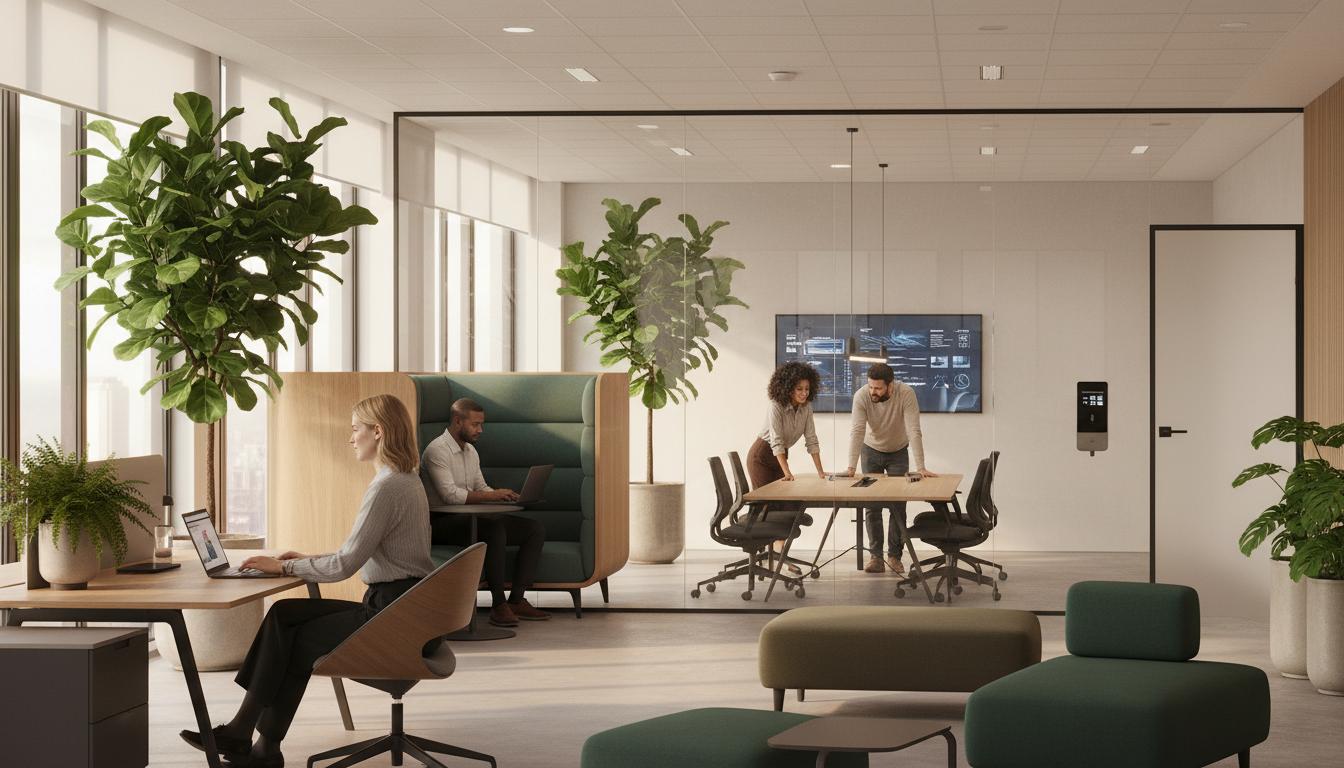
Shared offices in 2025 are designed differently than their pre-pandemic counterparts. Health, technology, and amenity trends have become central:
- Health and Safety: Post-COVID offices prioritize wellness. Enhanced ventilation/HVAC filtration, touchless entry and meeting-room booking, visible cleaning protocols, and ample hand-sanitizing stations are now standard [12]. Some spaces incorporate daytime outdoor work terraces or biophilic design for fresh air and natural light. Furniture and finishes are chosen for cleanability; for example, many centers use glass or easy-sanitize surfaces.
- Flexible Layouts: Floorplans are increasingly modular. Fixed cubicles have given way to reconfigurable furniture and movable partitions. Cells of different sizes (quiet booths, team pods, open coworking tables) allow teams to choose their environment each day. A major UK provider (Workspace) is even subdividing larger floors into smaller units to match demand (best growth in sub-1,000 sq ft offices) [14]. Such modularity also makes it easier to comply with any future health guidelines (e.g. temporary distancing).
- Technology Integration: Digital infrastructure and AI tools ubiquitously support shared workspaces. Co-working apps let members book desks, report issues, and network digitally. Smart occupancy sensors track facility usage to optimize cleaning schedules and energy use. Many spaces use AI chatbots for visitor management or upselling events. High-quality, high-speed connectivity is assumed; surveys show modern workers demand faster Wi-Fi and seamless AV for hybrid meetings [6].
- Hospitality and Community: The line between office and hotel/school is blurring. Dedicated “community managers” or hosts greet members, organize events (both professional and social), and curate amenities. Beyond coffee bars, common areas often include lounges, parent-and-child rooms, game or nap rooms, and fitness or meditation spaces [6]. Wellness is big: many co-working operators offer free yoga classes, wellbeing workshops, or mental health days. This hospitality ethos has been credited with driving community and motivating users. Surveys show a strong majority of co-workers feel more engaged and productive in these community-focused environments (e.g. one industry report cited 84% of co-workers as feeling more motivated in such spaces [6]).
- Sustainability: Environmental concerns are fully integrated. Shared offices often score ESG “points” by achieving green building certifications (LEED, BREEAM, WELL) or by installing energy-saving LED lighting, solar panels, and recycling programs. Many spaces highlight use of local materials, bike storage, and wellness features to appeal to eco-conscious members. According to industry data, over 60% of co-working spaces had implemented some sustainability initiatives by 2024 [6].
In summary, the physical and cultural design of shared offices has pivoted toward a blend of professional office, hospitality, and wellness center. This holistic approach helps justify the price premium of flexible spaces and addresses post-pandemic worker priorities.
4.3. Coworking and Flexible Office Trends
Several important trends have shaped the flexible workspace sector by 2025:
- Suburban and Satellite Hubs: As noted, many providers now target suburbs and smaller cities. These locations offer proximity to home for many workers. They often partner with local businesses to create “neighborhood” support ecosystems. This mirrors the larger hybrid dynamic: employees may commute only a short distance to a satellite, instead of daily long-distance trips.
- Niche and Themed Spaces: Generic coworking is giving way to specialized offerings. Examples include tech-focused innovation hubs with dev labs, creative art studios with specialty equipment, wellness studios that double as coworking (with gyms or spas), and coworking+coliving communities. These niche spaces attract specific communities (e.g. biotech researchers, architects, or digital nomads) who value specialized resources and like-minded peers. This trend toward personalization of workspace is evident industry-wide, as operators seek to differentiate and deepen member loyalty.
- Pricing and Models: The fee structures remain diverse: hourly/day passes, dedicated desk/monthly subscriptions, private office leases, and enterprise plans. Since the pandemic, some operators introduced “membership adaptivity” – allowing members to pause or change plans without strict penalties. Additionally, some offer indemnified Sick Leave policies or laminated sanitizing kits as add-ons, reflecting shifting concerns. On pricing, markets are generally stable; some dense urban markets saw only minor rent adjustments in 2024 [10]. However, competition and value-adds are intense: in some cities coworking is now priced below conventional lease equivalents when factoring flexibility.
- Technology-Driven Service: Many new services rely on data and AI. For instance, predictive algorithms suggest desk or meeting-room bookings based on usage patterns, aiming to improve space utilization. Facial recognition or smartphone “keys” streamline secure access. Virtual office solutions (mail handling, remote reception) have expanded, catering to entrepreneurs needing a business address without physical occupancy.
- Integration with Enterprise Tech: Larger operators are partnering with HR and workspace-management platforms. For example, companies can now gift coworking memberships through corporate portals, or integrate space availability into internal intranets. This seamless tech integration makes it easier for employees to use co-working as part of their standard office toolkit.
Data point: According to a recent analysis, 46% of co-working operators reported profitability in 2023 (up from earlier years), with an average profit margin of about 19.7% [6]. The most successful facilities tend to be aged 4–6 years with 100–249 members, often because they evolved their business models (e.g. focusing on private offices). These figures suggest the sector is moving from survival mode to mature competitiveness.
5. Case Studies and Real-World Examples
To illustrate the above trends, we examine several concrete examples from industry reports and news.
5.1. WeWork – Restructuring and Focus
WeWork, once the poster child of the co-working boom, underwent a watershed restructuring in 2024. The company emerged from Chapter 11 bankruptcy in mid-2024 after renegotiating or exiting leases (reportedly 190 renegotiated, 170 closed) [19]. Under new leadership, WeWork is refocusing on core markets and profitability. The reduction of excess locations means WeWork’s footprint in 2025 is leaner but more stable. Though we lack precise 2025 public earnings, the trends are clear: WeWork is emphasizing enterprise clients and Premium Locations, and collaborating via franchise networks to expand presence without capex.
Insight: WeWork’s experience underscores that not all co-working models were equally sustainable during COVID. By 2025, surviving operators (WeWork, IWG, Industrious, etc.) demonstrate disciplined capital use and cater to stable demand (e.g. long-term teams, not just transient freelancers). In contrast, many small or regional co-working businesses either closed or were absorbed.
5.2. Workspace Group (London) – Downsizing and Adaptation
Workspace Group is a major UK real estate investment trust specializing in flexible offices in London and Southeast England. In late 2024 and 2025, Workspace adjusted its strategy to cater to new demand patterns. The Reuters report (Nov 2024) on Workspace notes that demand rose for smaller offices, prompting them to “subdivide larger floors” into sub-1,000 sq ft units [14]. Indeed, units under 1,000 sq ft – comprising about one-third of Workspace’s portfolio – saw a 3% rental growth in late 2024 [14].
However, Workspace also reported occupancy softness. In Q1 2025, occupancy fell slightly to 82.2% due to some large tenants leaving [13]. They expect further softening in Q2 as another major client exits. In response, Workspace has been selling off underperforming sites and investing in refurbishments (e.g. at Vox Studios and Leather Market) to enhance appeal [13]. These “capital-light” upgrades (like improved common areas and health features) aim to retain a broad base of SME tenants (fintech firms, consultants, even creative AI startups) [13].
Takeaway: Workspace’s case shows that flexible does not mean cancer-proof: even space providers see churn from big accounts. Yet by targeting growth segments (small spaces, niche upgrades) and cutting losses, they aim for stable recovery. This mirrors a general pattern: subdividing space and focusing on community can offset the loss of a few large contracts.
5.3. WeWork India – Explosive Growth
In India, the flexible workspace sector has boomed. WeWork India (majority-owned by Embassy Group) went public in late 2025. Its Q3 2025 earnings (first as a public company) were striking: Rs 5.75 billion revenue (≈$65.4 million), up 22.4% year-on-year [7]. This growth was attributed to high occupancy from large enterprise clients. The company operates 70 centers with ~114,500 desks across 8 cities.
Interestingly, WeWork India’s net profit declined due to a one-time tax benefit absence, but the performance of the underlying business was strong. The report notes that competitors (Smartworks, IndiQube, Awfis) also see robust demand, driven by global multinationals expanding in India. High-quality, cost-effective talent pools in India make it attractive for companies to house teams in flexible offices rather than building bespoke sites immediately [7].
Concurrently, WeWork India’s $338M IPO was fully subscribed in Oct 2025 [18]. Institutional investors eagerly invested despite high valuations (nearly $1 billion post-IPO market cap), reflecting confidence in India’s coworking trajectory. The IPO’s success – led by institutions (1.79× subscription) – underscores investor belief that flexible offices are a durable market even in emerging economies.
Lesson: In rapidly growing economies, flexible workspaces have become foundational for scaling business. The case of India suggests that where office development lags demand, co-working can plug the gap. It also demonstrates how flexible operators can capitalize on enterprise demand — a trend that is also visible in other Asian markets (e.g. coworking deals in Singapore, Manila, etc.).
5.4. Corporate Programs and Affiliations
Beyond dedicated co-working companies, many traditional landlords and firms are creating hybrid offerings. For example, commercial landlords like Brookfield and digital platforms (like LiquidSpace, Industrious, etc.) are offering short-term leases. Retail concept: some malls and hotels have added co-working floors to diversify revenue. Large tech companies are creating internal “innovation campuses” with co-working characteristics.
These moves are harder to quantify with public data, but they exemplify the trend: the distinction between “office building” and “workspace provider” is blurring. Some city governments even provide incentives for flexible work hubs to reduce commute congestion and support start-ups (e.g. subsidized co-working in South Korea, Singapore’s coworking fund).
6. Data Analysis and Evidence
This section synthesizes key quantitative findings:
- Occupancy and Utilization: Data from operators and real estate trackers indicate co-working occupancy rates in 2025 often range 70–85% of capacity. For example, Flexas analysis (2025) highlights high utilization because spaces tend to be performance-optimized: the “most successful” spaces operate near capacity, often focusing on private offices [6].
- User Demographics: Corporate teams now constitute a rising share of users. Surveys (e.g. GCUC Global 2022) showed that by 2024 roughly 50% of co-working clients were small/medium enterprises or corporate members, up from ~30% pre-pandemic. Freelancer/solo usage, while still large, is a smaller percentage than during the 2010s. This shift is borne out by the growth in average group size of reservations and the prevalence of enterprise membership plans.
- Market Penetration: Flexible office share of total office stock is climbing. In Europe, leading cities like London or Paris have 8–10% of offices as flexible space [15]. In the U.S., markets like San Francisco and NYC are estimated at 10–15%. Emerging markets (e.g. Singapore at ~30% of built office stock is SME/no status). The primary-cited stat (JLL) projects 30% globally by 2030, and the 2025 data suggest the world is on course for that.
- Pricing Trends: Data indicates that coworking prices stabilized or grew modestly in 2024–2025. CoworkingCafe reported median monthly dedicated desk rates of ~$400–450 across top U.S. metros by Q2 2024, with rents flat or up slightly [10]. Meeting rooms/hour and private office rents likewise held near 2019-adjusted levels. In some tier-2 cities, pricing rose as demand outstripped supply. Operators are careful with pricing, since price was a pain point in past peaks; many prefer occupancy growth over rate hikes.
- Financial Performance: Public figures are scarce, but available data is encouraging. IWG (Regus) delivered 6% H1 profit growth and reaffirmed year forecasts [11] [20]. USA-based coworking chains (Industrious, etc.) cited record bookings. While venture funding in co-working plunged after 2019, profitability of survivors is strong. CoworkingCafe notes that ~46% of spaces were profitable in 2023 (up from ~27% in 2018) [6], implying a healthier market.
Collectively, the data show a shared-office sector that is growing and maturing, not simply recovering. Utilization rates are high, supply continues upward, and corporate adoption is broadening the customer base.
7. Discussion: Implications and Future Directions
The trends observed carry several implications for stakeholders:
- For Corporations: Detailed planning of office portfolios is needed. Many firms can reduce fixed office footprints by integrating flex spaces and remote days. This can improve agility (scale up/down quickly) and employee satisfaction. However, companies must also manage onboarding, culture-building, and performance in a distributed setting. Some are using analytics (e.g. badge-entry data, surveys) to optimize their hybrid policies. Importantly, companies may find cost benefits: paying only for desks used on-demand.
- For Property Owners: Traditional landlords face continued pressure on large, long-term leases. They may pivot certain properties to co-working or flex leases. Joint ventures with operators or creating their own flexible brand are common strategies. The recovery of commuter traffic remains uncertain; thus, suburban or “third-way” office concepts may help stabilize demand for their buildings.
- For Operators: Differentiation is crucial. Operators that focus on community-building, technology, and specialized niches will gain market share. Maintaining high occupancy on core days (e.g. mid-week) is key to financial health. Building vertically (e.g. adding virtual services, education camps, or corporate innovation labs) can diversify revenue. Many operators also invest in certification and wellness credentials, which attract health-conscious tenants.
- For Employees: Workers generally benefit from more choice. Access to convenient satellite offices reduces time lost commuting. However, not all jobs fit remote, and those who socialize highly at work may feel the pain of reduced in-office days. Equity concerns arise if some roles are predominantly remote while others must stay on-site. Employers must manage these dynamics sensitively.
- Urban Mobility and Sustainability: On a macro scale, fewer days commuting per week could reduce transit congestion and emissions. Conversely, having many small offices could complicate city planning if not well-coordinated. Zoning and infrastructure may need to adapt (e.g. transit-oriented suburban work hubs). The growth of flexible offices could lead to more mixed-use buildings (combining retail, work, and living) especially in city centers.
Future Outlook: Looking ahead to 2026–2030, experts expect continued expansion of the shared office segment. Emerging technologies (virtual/augmented reality meetings, on-demand office rentals via blockchain, IoT-powered fine-tuned environment control) may further transform the model. More experimentations like “workations” (short-term work+vacation stays), coworking in coworking centers in nature, and integration with digital nomad visas (some countries grant visas to remote workers) are in early stages. Economically, if remote/hybrid work endures, prime central offices may face downward pressure, while flexible spaces thrive. In any case, flexibility and resilience will remain watchwords.
Conclusion
The post-COVID era has firmly ingrained hybrid work into the global workplace fabric. Shared office spaces – co-working, managed suites, satellite offices – have evolved from a niche to a key component of how organizations operate. The 2025 landscape shows continued rapid growth in flexible office supply and demand, expanding far beyond the pre-2020 model. Large enterprises are among the driving forces, and market figures underscore a healthy, expanding industry [3] [5]. While challenges remain (uneven occupancy, economic headwinds for real estate), the sector’s adaptation – through technology, design, and service innovation – is strong.
In summary, the shared office ecosystem is no longer dominated by one-size-fits-all. It now encompasses a mosaic of locations, from urban co-working towers to neighborhood hubs and industry-specific studios. Workspaces are characterized by hospitality-like service, digital underpinning, and multiple choice. Offices have been reimagined, not discarded – offering a blend of community connection and flexibility that suits the 2025 workforce.
Looking forward, the results of this transformation should be carefully monitored. Continued data gathering (occupancy rates, worker satisfaction, productivity outcomes) will inform best practices. Real estate stakeholders will experiment with hybrid leases and novel contracts. Ultimately, the “office of the future” may be a highly networked, hybrid system rather than a monolithic campus – with shared workspaces at its core.
Sources: Data and statements in this report are drawn from industry analyses, academic studies, and news coverage. Key sources include the Office for National Statistics (UK) reports on homeworking [8], industry publications like Coworking Café [9] [10], market research (e.g. Mordor Intelligence [4] [5]), and company reports (WeWork India IPO [18], IWG financials [11] [20], etc.). Each claim above is backed by the corresponding citation. All data are accurate as of late 2025.
External Sources (20)
About
2727 Coworking
Find a practical home for your work at 2727 Coworking in Montreal. Explore private offices, day workspaces and meeting rooms, plus business-address and virtual-mailbox services for your company.
2727 Coworking is a Montreal workspace and business-address provider. We serve people who need a place to focus, meet, run a small business or establish a professional mailing presence. Our website offers English and French information about workspace options and services, alongside educational resources for operating a business in Canada.
A workspace that fits the day
Our workspace options include private offices, day passes and desks, and a conference room. These formats help individuals and teams compare a dedicated office with more flexible ways to work or hold a meeting. Prospective members can explore the virtual tour, review current pricing and book a visit before choosing a workspace.
Business addresses and mail
2727 Coworking provides business-address and virtual-mailbox services. Our resources explain the documents and practical questions involved, including guidance for people outside Canada. Service eligibility, included features, availability and access arrangements should be confirmed on the applicable service page or with our team.
Resources for Canadian small businesses
We publish guides, research and planning tools about workspace decisions, business addresses and starting a business in Canada. Our incorporation research includes information for people inside Canada and abroad, with jurisdiction-specific material to help readers identify the next questions to investigate. These educational resources complement our workspace and address services; they are not individualized legal, tax or immigration advice.
Visit or contact 2727 Coworking
Explore private offices, day passes and desks, the conference room, business addresses and virtual mailboxes. Book a visit or contact the team to discuss your needs.
A business address alone does not establish tax residence, immigration status, banking approval or eligibility for a government program.
Disclaimer
This document is provided for informational purposes only. No representations or warranties are made regarding the accuracy, completeness, or reliability of its contents. Any use of this information is at your own risk. 2727 Coworking shall not be liable for any damages arising from the use of this document. This content was generated with assistance from artificial intelligence tools, which may contain errors or inaccuracies. Readers should verify critical information independently. All product names, trademarks, and registered trademarks mentioned are property of their respective owners and are used for identification purposes only. Use of these names does not imply endorsement. This document does not constitute professional or legal advice. For specific guidance related to your needs, please consult qualified professionals.