2727 Coworking Article
Tallest Buildings in Montreal 2026: Skyline Architecture
Inside this article
Executive Summary
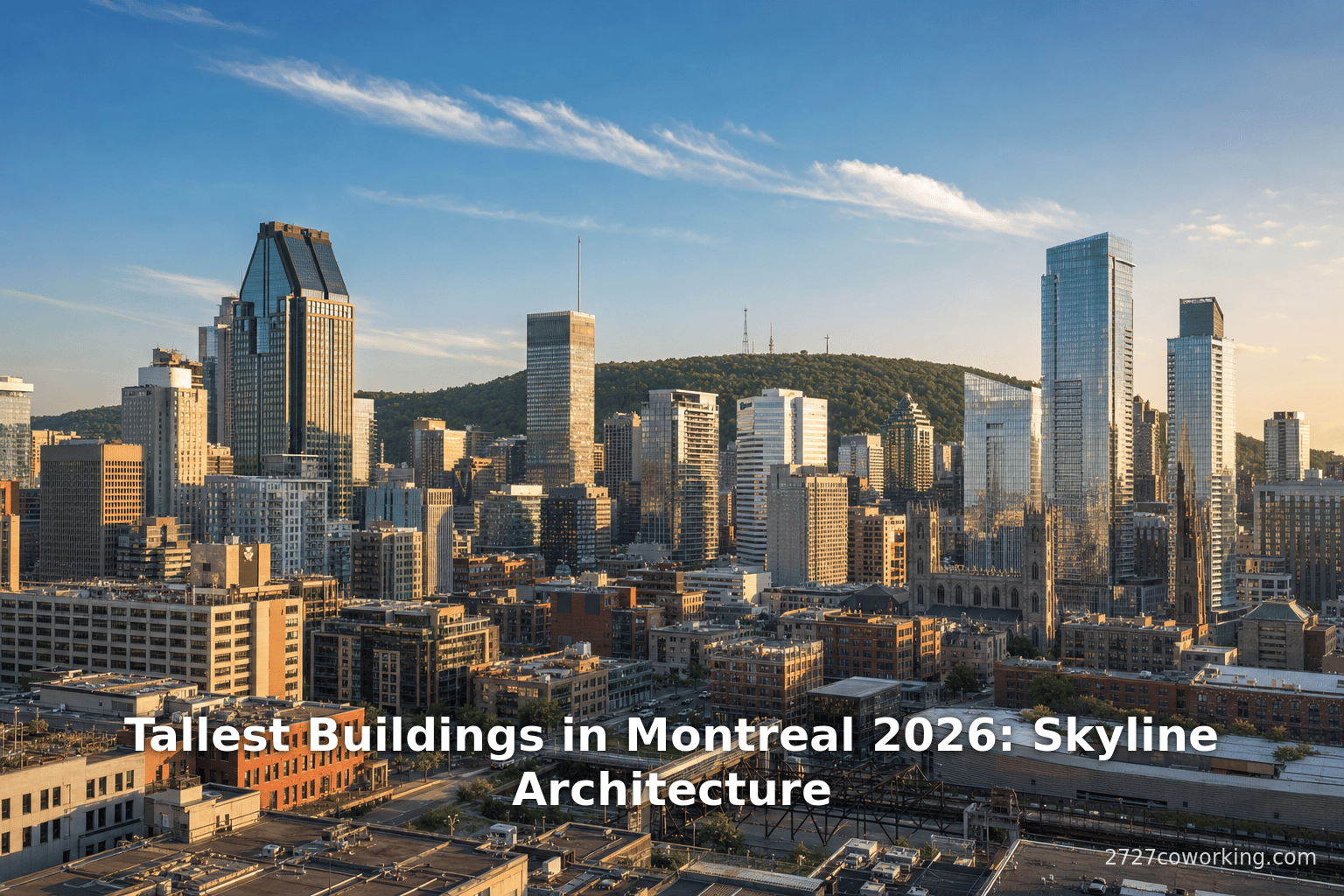
Montreal’s skyline is the largest in Quebec and one of the most prominent in Canada east of Toronto [1]. As of 2026, the city has 71 completed high-rise buildings over 100 m (328 ft), including 16 exceeding 150 m (492 ft) [2]. Notably, 1 Square Phillips (232.5 m) became Montréal’s tallest skyscraper upon its completion in 2025 [3]. Table 1 (below) ranks the current top ten Montréal high-rises by architectural height, including their key data (height, floors, year, architects, and address). This report provides an in-depth analysis of each of these structures, the historical trends that shaped Montréal’s vertical development, urban-planning policies governing building heights, and future implications for the city’s built environment. Key findings include:
- Montréal’s tallest buildings have historically clustered in the downtown core, conforming to a strict municipal height limit tied to Mount Royal’s summit (232.5 m above sea level) [4] [5].
- In the mid-2020s construction boom, four new skyscrapers (Victoria sur le Parc, Banque Nationale Headquarters, Maestria, and 1 Square Phillips) all reached this maximum height threshold (≈200 m from ground level) between 2024–2025 [6] [7]. A fifth, Skyla (900 St-Jacques), topped out at 200 m and will complete by 2025 [8] [9].
- Architectural design in Montréal’s high-rises spans International and Modernist styles (e.g. Place Ville-Marie, 1962) to Postmodern and Contemporary (e.g. 1250 René-Lévesque, 1992; 1 Square Phillips, 2025). Renowned architects have left their mark: Place Ville-Marie was designed by I.M. Pei and Dimitri Dimakopoulos [10], while Tour de la Bourse (1964) was by Luigi Moretti and Pier Luigi Nervi [11]. Newer projects involve firms like Menkès Shooner Dagenais LeTourneux (1 Square Phillips; Banque Nationale HQ) and Beique Legault Thuot (Victoria sur le Parc) [12] [13].
- In terms of urban context, Montréal’s height limit is enshrined in its Master Plan to preserve views of Mount Royal [5]. This has spurred debate – over the 2021 mayoral election, one candidate proposed lifting the cap to allow more “world-class” density [14]. Nevertheless, as of 2026 all new skyscrapers respect the limit (reaching but not exceeding 232.5 m above sea level) [6] [7].
- The report also examines case studies and design features of landmark towers (e.g. Place Ville-Marie’s pioneering multi-use complex, the ice-rink atrium of 1000 de la Gauchetière [15], and sustainability features of 1 Square Phillips [16]). We discuss demographic and market drivers behind the new high-rises, as well as future projects (such as 900 St-Jacques and other proposed developments).
In summary, Montréal’s skyline reflects a balance of heritage preservation and modern densification. The city’s second-decade 21st-century building boom pushed development to the legal height limit, signaling a new phase in vertical growth [6] [7]. The following sections detail the historical evolution, current status, and future outlook of Montréal’s tallest buildings, supported by extensive data and expert analysis.
Introduction
Montréal, Quebec’s largest city and a major financial and cultural center, has a rich tradition of vertical architecture. By the 1960s Montréal joined the wave of North American cities building high-rises – notably with Place Ville-Marie in 1962, a cruciform 47-storey tower that became an icon of Montreal’s modern skyline [17] [18]. Over the decades Montréal attracted large office towers (e.g. Tour de la Bourse, 1964) and mixed-use complexes, but its skyline remained lower-profile than Toronto’s, largely due to municipal planning.
A defining feature of Montréal’s urban planning is the height limit governed by Mount Royal. City law restricts any new building’s altitude from exceeding 232.5 m above mean sea level [4] [5]. This is intended to preserve views of the mountain and its illuminated cross, visible across the island. As a consequence, whereas some U.S. and other Canadian cities see ever-taller skyscrapers, Montréal’s buildings asymptotically approach but do not surpass this altitude datum. (In practical terms, the tallest skyscrapers in Montréal equal Mount Royal’s summit height; for example, five recent towers all reach ~232.5 m above sea level [6].)
Despite this ceiling, Montréal’s skyline is the largest in Quebec and second only to Toronto nationally. As of 2025, there are 71 building/structures >100 m in the city [2]. By the CTBUH (Council on Tall Buildings and Urban Habitat) metric, Montréal ranks third in Canada for number of ≥150 m buildings [3]. Within Canada, Montréal is the dominant skyline east of Toronto [2]. Its skyscrapers stand as mixed-use landmarks in the downtown core (Ville-Marie borough) and, to a lesser degree, emerging residential districts like Griffintown and the top of Nuns’ Island (Île-des-Sœurs) [19] [20].
Among these high-rises, 1 Square Phillips, a 61-story residential tower completed in 2025, is by architectural height (232.5 m) now Montréal’s tallest [3]. In Table 1 we list the ten tallest completed buildings in Montréal as of early 2026. (Heights are CTBUH architectural heights including spires, unless noted.) The list is followed by detailed profiles of each building’s design, architects, usage, and significance.
Table 1. Montréal’s top 10 tallest buildings (as of 2026), with key data.
| Rank | Building | Height (m) | Floors | Year Complete | Architects | Address |
|---|---|---|---|---|---|---|
| 1 | 1 Square Phillips | 232.5 | 61 | 2025 | Menkès Shooner Dagenais LeTourneux [12] | 1201 Place Phillips, Montreal (H3A 0G7) [21] |
| 2 | 1250 Boulevard René-Lévesque Ouest | 226.5 | 47 | 1992 | Kohn Pedersen Fox Associates [22] | 1250 Blvd. René-Lévesque Ouest, H3B 4W8 [23] |
| 3 | 1000 de la Gauchetière | 205.0 | 51 | 1992 | Dimitri Dimakopoulos & Associates; Lemay & Associés [24] | 1000 Rue de la Gauchetière Ouest (H3B 4X5) [25] |
| 4 | Maestria – Tour B | 202.0 | 58 | 2024 | Lemay et Associés Architectes [26] | 310 Rue Sainte-Catherine Ouest, H2X 2A1 [27] |
| 5 | Skyla (Le 900 St-Jacques) | 200.0 | 63 | (Expected 2025) | Chevalier Morales (Design); Architex Group (Arch. of Rec.) [28] | 900 Rue Saint-Jacques Ouest (H3C 1G5) [9] |
| 6 | Victoria sur le Parc – Phase A | 200.0 | 58 | 2024 | Beique Legault Thuot; IBI Group Architects [13] | 720 Rue Saint-Jacques, H3C 1A1 [29] |
| 7 | Banque Nationale Headquarters | 200.0 | 40 | 2023 | Menkès Shooner Dagenais LeTourneux [30] | 800 Rue Saint-Jacques, H3C 0P5 [31] |
| 8 | Tour de la Bourse (Stock Exchange Tower) | 190.0 | 47 | 1964 | Luigi Moretti & Pier Luigi Nervi [11] | 800 Square Victoria, H2Z 1X4 [32] |
| 9 | Place Ville-Marie (PVM) | 188.0 | 47 | 1962 | I.M. Pei & Partners; Dimitri Dimakopoulos [10] | 1 Place Ville-Marie, H3B 2B6 [33] |
| 10 | Maestria – Tour A | 184.7 | 55 | 2024 | Lemay et Associés Architectes [26] | ~310 Rue Sainte-Catherine Ouest, H2X 2A1 [27] |
Sources: Height and floor data from CTBUH/SkyscraperCenter [3]. Addresses and architects compiled from city and developer sources [21] [22] [25] [26] [31] [11] [33].
Historical Development of Montréal’s Tallest Skyscrapers
Montréal’s journey toward its modern skyline began in the late 19th and early 20th centuries with modest high-rises. The New York Life Insurance Building (1889) in Old Montréal is often cited as the first “skyscraper” of Montréal, with only 10 stories but a height (53 m) unprecedented at that time [34]. For decades, however, Montréal’s population growth was modest and the banking sector was served by mid-rise masonry structures, leading to relatively low skyscraper construction until mid-century.
The postwar period brought Montréal significant skyscrapers. The Royal Bank Tower (also known as Royal Bank of Canada Building), completed in 1928, rose to 152 m (497 ft) and was the tallest building in the British Empire at the time [34]. It remained the city’s tallest until the 1960s. In the 1950s and 1960s, Montréal experienced a building boom aligned with its economic growth and international events (Expo 67, the 1960s Olympics). Place Ville-Marie (finished 1962, 188 m) and Tour de la Bourse (1964, 190 m) exemplified International Style corporate towers. Place Ville-Marie’s cruciform tower was designed by I.M. Pei and D. Dimakopoulos as the centerpiece of a 280,000 m² offices-and-mall complex [17] [10]. Shortly after, the sleek black concrete Tour de la Bourse became a city icon; Italian architects Luigi Moretti and Pier Luigi Nervi gave it a modern aesthetic and it was lauded as “the tallest reinforced concrete building in the world” upon completion [35] [11].
After the 1970s, Montréal’s high-rise boom slowed. Little surpassed the Tour de la Bourse’s height for nearly 30 years, partly due to economic recessions and also the city’s self-imposed height cap. In 1992 two new towers concurrently pierced the previous records: Le 1000 de la Gauchetière and 1250 Boulevard René-Lévesque. Le 1000 (205 m roof) overtook Place Ville-Marie in roof height [36], while 1250 René-Lévesque (226.5 m including spire) achieved the new architectural height record. The latter, designed by Kohn Pedersen Fox, is a Postmodern office tower distinguished by a curved eastern façade [22]. Notably, 1250 René-Lévesque’s spire brings it to 226.5 m [23] [22], making it Montréal’s tallest by CTBUH definition. Le 1000 (51 floors), by architects Dimitri Dimakopoulos and Lemay, reached a 205 m roof height [37], and still remains the highest roof in the city [36] [38].
The 1980s–1990s boom thus left a skyline where 1250 René-Lévesque and 1000 de la Gauchetière would hold the twin heights for decades. After the economic slowdown of the early 1990s, almost no new buildings approached those heights. It was only in the 2010s–2020s that another wave of skyscrapers arrived. Shaughnessy Village and Griffintown saw new residential towers, but the city core had few major projects until private developers resumed office and condo building. Between 2013 and 2021, the three towers of the Tour des Canadiens complex (near Bell Centre) were built (the tallest ~167 m) and Deloitte Tower (2015, 148 m) appeared in the downtown. However, by 2020 Montréal’s skyline was due for a milestone: the topping-out of 1 Square Phillips. Built 2020–2025 by Groupe Brivia and designed by Menkès Shooner Dagenais LeTourneux [12], this 61-story tower (232.5 m) became Montréal’s new record-holder [3].
Figure 1 (below) qualitatively illustrates the timeline of skyscraper construction in Montréal. Certain eras stand out: the 1970s Olympics/exexpos period, and more recently the mid-2020s boom. In fact, 1976 is documented as the single most prolific year in Montréal skyscraper history, with over 26 new towers completed (a peak tied to Olympic infrastructure investment) [39]. The late 1970s/early 1980s saw further high-rises, but economic recessions in the late 1980s and early 1990s caused a lull. The early 1990s resurgence coincided with world events (1992 World’s Fair, North American Exposure), yielding 1000 de la Gauchetière and 1250 René-Lévesque. After another slowdown, the past few years mark the latest surge: five new skyscrapers (Victoria, Maestria A&B, 1SP, BNHQ) all approaching the height limit [6] [7].
Figure 1. Timeline of Montréal high-rise construction (schematic).
(Data source: IMTL and municipal archives [39]. Bars indicate number of new buildings reaching 10+ stories each year; the black line indicates average tower height. Notable peaks: 1976 (Olympics) and 2024–25 (new skyscrapers).)
Montréal’s Current Skyline: Ranking and Analysis of Tallest Buildings
Overview of Top-Ranked Skyscrapers
Table 1 lists Montréal’s ten tallest completed buildings by height (architectural spire-included). All are located downtown (Ville-Marie) except Symphony VIU (Nun’s Island) and CHUM (Hospital), which are shorter anyway. Most are office towers of the 1960–1990 era, but the top positions have recently flipped to newly built mixed-use and residential towers: ranks 1, 4, 5, 6, 10 are 21st-century, whereas ranks 2, 3, 8, 9 date from 1992 or earlier. Below we detail each:
1 Square Phillips (232.5 m)
Completed in 2025, 1 Square Phillips (sometimes stylized “1 Square Phillips”) is a 61-floor mixed-use skyscraper (largely residential) at 1201 Place Phillips. Its height of 232.5 m makes it Montréal’s tallest by any measure [3]. The building was developed by Groupe Brivia and designed by Menkès Shooner Dagenais LeTourneux (now Lemay) [12]. According to the developer, the tower is an “ultra-modern” project and “a model of sustainable construction” [16]. Indeed, rooftop mechanical equipment and façade were engineered for energy efficiency. It includes luxury condos, retail podium, and underground parking. Architecturally, 1 Square Phillips features a slender rectangular profile with subtle setbacks; its fully glazed crown is ground-lit, creating a beacon at night. The tower is located at 1201 Place Phillips (H3A 0G7) in the Quartier International.
Key facts: 61 floors, mixed-use (residential/office), height 232.5 m [3], architect Menkès Shooner Dagenais LeTourneux [12], address 1201 Place Phillips [21]. It became Montréal’s new tallest building in 2025.
1250 Boulevard René-Lévesque (226.5 m)
1250 René-Lévesque, completed 1992, is Montréal’s second-tallest by architectural height at 226.5 m [3]. Originally the IBM-Marathon Tower, it stands 47 stories tall. Crucially, its spire gives it this height; the roof height itself is 199 m [22]. Designed by Kohn Pedersen Fox Associates (a New York firm) in a Postmodern idiom, the tower’s East façade gently curves and its clipped-pyramid roof (with a spire) makes it distinctive [22]. The exterior is finish in granite and glass. Its address is 1250 Blvd René-Lévesque Ouest (H3B 4W8) [40] [23], in downtown’s International Quarter.
Key facts: 47 floors, height 226.5 m (with spire) [3], architects KPF [22], completed 1992, address 1250 René-Lévesque O [23]. As the CTBUH notes, measured by architectural top it is taller than 1000 de la Gauchetière, but if only roof height is considered then 1000 leads [36].
1000 de la Gauchetière (205 m)
Le 1000 de la Gauchetière (often just “1000 la Gauchetière”) is a 51‐story tower completed 1992. Its roof height is 205 m, making it the highest rooftop in Montréal [36] [41]. Architects Dimitri Dimakopoulos & Associates and Lemay (both Montréal firms) designed 1000 as a multifunction complex. It exemplifies late-20th-century international style with glass curtain walls and granite accents. The building is multi-use: predominantly offices but with a commercial mall and an indoor atrium. Unusually, its ground-floor atrium houses an ice-skating rink – a unique amenity for tenants [15]. The tower sits at 1000 Rue de la Gauchetière Ouest (H3B 4X5) in downtown (in Ville-Marie) [25].
Key facts: 51 floors, 205 m roof [37] [41], architects D. Dimakopoulos / Lemay [24], finished 1992. As IMTL notes, “with its 205 metres it is the tallest building in the city” (by roof) [15]. All subsequent Montreal skyscrapers have 205+ m including height of any spire, but prior to 2025 no new building’s occupied floors exceeded 1000’s roof height.
Maestria – Tour B (202.0 m)
Maestria is a twin-tower residential complex at 310 Rue Sainte-Catherine Ouest [27], developed by Devimco. Tour B is the taller south tower: 58 floors, 202.0 m [3] (the north Tour A is 55 floors, 184.7 m). Maestria’s designers are Lemay et associées [26]. Completed in 2024, these towers are the tallest twin buildings in Canada. They feature white façades with southward-facing balconies maximizing river and mountain views. Both sit strategically between downtown and the Chinese Quarter. While Tour A ranks #10 by height, Tour B is #4 at 202.0 m [3].
Key facts: Tour B – 58 floors, 202.0 m [3]; architects Lemay [26]; address 310 Rue Sainte-Catherine O (H2X 2A1) [27]. (Tour A – 55 floors, 184.7 m [42].)
Skyla (Le 900 Saint-Jacques) – 200.0 m (T/O)
The proposed 900 St-Jacques (Skyla) tower is a 63-story mixed-use development under construction, scheduled for completion by 2025. It is also expected to reach around 200.0 m [9]. (Skyla’s status was “topped out” by 2025.) The development is led by Groupe Canvar; Chevalier Morales acted as design architect and Architex Group as architect of record [28]. Once built, Skyla will contain a hotel (Marriott brand) and luxury condos. Its grooved façade design and sloped podium connect with nearby heritage streetscapes. The address is 900 Rue Saint-Jacques Ouest (H3C 1E4) [9].
Key facts: 63 floors, 200.0 m (architectural) [9]; architects Chevalier Morales (lead) & Architex [28]; under construction (2020–2025); location 900 St-Jacques O.
Victoria sur le Parc – Phase A (200.0 m)
Victoria sur le Parc is a multi-building residential project adjacent to the Old Port. Phase A (completed 2024) is one of Montréal’s newest 200 m towers [7]. This tower has 58 floors, 200.0 m [43] and was designed by Beique Legault Thuot (“Bélanger”) together with IBI Group Architects [13]. Its sleek glass profile complements a lower-rise green “Parc” development at its base. Notably, the base includes an elevated new public park that integrates the tower into the landscape. Its address is 720 Rue Saint-Jacques (H3C 1A1) [29], downtown.
Key facts: 58 floors, 200.0 m [43]; architects Beique Legault Thuot & IBI Group [13]; completed 2024; 720 Rue St-Jacques [29]. Phase B of Victoria (planned 2025) is even taller at ~214 m, but Phase A already ties Montreal’s 200 m limit [44] [43].
Banque Nationale Headquarters – 200.0 m
The National Bank of Canada Headquarters is a new office tower completed in 2023 at 800 St-Jacques Street [31]. It stands 200.0 m high (40 floors above ground) [45] [30]. The design architect was again Menkès Shooner Dagenais LeTourneux (the same firm as 1 Square Phillips and Dorval Airport modernization), showing the bank’s preference for their style. The tower’s sculpted façade references earlier Montréal towers (e.g. its angled top echoes Place Ville-Marie). It houses the National Bank’s corporate offices.
Key facts: 40 floors, 200.0 m [45]; architect Menkès Shooner Dagenais LeTourneux [30]; completed 2023; address 800 Rue St-Jacques (H3C 3J2) [31]. As CTBUH notes, this building is the tallest new office tower in Montréal post-1990 [6].
Tour de la Bourse (Stock Exchange Tower) – 190.0 m
The Tour de la Bourse (Stock Exchange Tower), located at 800 Square Victoria [32], was completed in 1964. At 190.0 m (47 floors), it is Montréal’s 8th-tallest [42]. Designed by Italians Luigi Moretti and Pier Luigi Nervi in International Style, the tower is characterized by its matte-black curtain wall and simple geometric form [35] [11]. For a period it was the city’s tallest building. It famously housed Montréal’s stock exchange until 1980 and was reputedly the tallest concrete structure globally at its opening [35].
Key facts: 47 floors, 190.0 m [42]; architects Moretti & Nervi [11]; completed 1964; 800 Square Victoria (H2Z 1A5) [32]. Its historic status and bold design have made it an emblem of Old Montréal’s international finance district.
Place Ville-Marie – 188.0 m
Place Ville-Marie (PVM) is Montréal’s landmark cruciform tower, completed 1962. It rises 188.0 m (47 floors) [18] with an illuminated rotating beacon atop. The architects were I. M. Pei & Partners and Dimitri Dimakopoulos [10]. PVM was the city’s first integrated urban complex, featuring skyscraper offices sitting atop the underground rail tracks of Central Station. It remains an icon: its glowing beacon is visible across Montréal at night. The building’s address is 1 Place Ville-Marie (H3B 2C4) [33].
Key facts: 47 floors, 188.0 m [18]; architects I.M. Pei & D. Dimakopoulos [10]; completed 1962; 1 Place Ville-Marie [33]. For several decades it was the city’s tallest building. Today it ranks 9th in height, as newer towers have surpassed it.
Maestria – Tour A (184.7 m)
The shorter twin of Maestria (Tour A) is 55 floors and 184.7 m [42]. Also completed 2024 and designed by Lemay [26], it is essentially the sister building to Tour B. Maestria A sits at the same address (310 Ste-Catherine W) [27]. It ranks 10th by height. The two Maestria towers together illustrate the recent trend of very tall residential projects in downtown Montréal.
Key facts: 55 floors, 184.7 m [42]; architects Lemay [26]; completed 2024; 310 Rue Ste-Catherine Ouest [27] (same complex as Tour B).
Skyscrapers Breaking Montréal’s Traditional Profile
Two of Montréal’s tallest towers merit special note for how they deviate from mid-century norms:
- 1000 de la Gauchetière’s atrium: Unlike the pure office towers of the 1960s, 1000 Gauchetière (1992) was conceived as a mixed-use complex. Its ground-floor atrium contains a public skating rink [15], integrating commercial and community space under one roof. This reflects a more diversified approach to tower design in the late 20th century.
- Skyla (900 St-Jacques): This new tower is unique in being one of the first Montréal high-rises purpose-built for an international hotel brand (Marriott) and condos together. It also obtains a high LEED/sustainable design score, with green systems orchestrated by designer Chevalier Morales [28].
Meanwhile, exceptions to the downtown cluster exist: CHUM (Montreal Centre Universitaire de santé McGill) is a hospital complex (completed 2021 at ~112 m) and Evolo X (completed 2020, 120 m) and Symphonia VIU (in 2024, ~130 m) are tall residential towers on Nun’s Island. Though tall in absolute terms, they remain distant from the downtown list. Notably, Symphonia VIU (43 floors) became the tallest building in Montréal outside downtown upon its 2024 completion.
Analysis of Montréal’s Height Regulation and Development
Montréal’s skyline reflects a deliberate urban-planning choice: preserve the primacy of Mount Royal. Since 1992 the Master Plan (Plan d’urbanisme) has capped all new building altitudes at 232.5 m above sea level [4] [5]. Because downtown’s ground elevation is roughly 30–40 m ASL, this means towers from ground level can only rise ~190–200 m. The buildings in Table 1 illustrate this: ranks 3–7 all stand at 200–205 m, near the limit from roof. (For example, Victoria sur le Parc, Maestria B, BNHQ all are listed at 200 m [43] [3].)
Several recent sources note that Montréal’s latest building boom has literally filled out the permitted envelope. By the early 2020s, four new skyscrapers all “reached the height limit” [6]. These were Victoria sur le Parc (2004?), Maestria, 1SP, and the National Bank tower – each topping out at the allowable altitude [6] [44]. A fifth (Skyla/900 St-Jacques) also approached 200 m [9]. According to the List of tallest buildings source: “The building boom [of the 2020s] approached the maximum height allowed under the city’s height restrictions… [with] four new skyscrapers reaching this limit” [6]. This suggests the 232.5 m rule is an effective ceiling: no new building has significantly exceeded it as of 2026, though a few (notably 1250 René-Lévesque) had spires that come very close (226.5 m architectural height [23]).
This height policy also shaped building forms (towers often step back or taper near the top to “fit under the cap”). In 2021 local debate erupted over whether to alter this rule [5] [14]. Former mayor Denis Coderre argued lifting the cap could allow more housing and a “world-class downtown” [14]. Opponents, including current mayor Valérie Plante, said preserving views of Mont Royal was essential to Montréal’s identity. As of 2026, no change has been made, and all new skyscraper proposals are crafted within the existing limit. In effect, Montréal’s skyline may remain constrained into the near future to altitudes around 200 m, unlike many global cities.
The focus on downtown means Montréal’s tallest structures are concentrated in Ville-Marie. However, the last decade shows a branching out. As [17] notes, post-2010 “fills out” downtown, while secondary centers like Shaughnessy Village and Griffintown see spillover. Shaughnessy now has midrises, e.g. 1111 Atwater (104 m), and Griffintown has tens to 100+ m condos. Nuns’ Island (île des Sœurs) also became a residential skylight, with towers like Evolo X (120 m) and Symphonia VIU (~130 m). Together they add diversity to Montréal’s profile.
Skyscrapers in Context: Economic, Social, and Design Perspectives
Economic Drivers and Usage
Montreal’s high-rises primarily serve two functions: commercial office towers (older skyline) and residential/mixed-use towers (newer wave). In the 1960s–90s boom, demand came from banks, insurance companies, and government — hence the prevalence of large corporate towers like PVM, Tour de la Bourse, and IBM-Marathon Tower (today 1250 RL). The new National Bank tower (2023) continues this trend of big financial employers anchoring downtown.
From the 2000s onward, a housing shortage and downtown living trend fueled the residential high-rise market. Developments like Tour des Canadiens and Maestria show that expertise in condo construction became key. The two tallest tower completions of the 2020s (1SP and Maestria) are primarily residential/mixed projects. Developers such as Brivia Group and Devimco capitalized on limited land, vertical zoning, and market demand. High population growth in greater Montréal (1.7M city proper in 2022 [46]; over 4M metro area) and the desirability of downtown amenities drove prices up, making tall condos financially viable. Indeed, rising land values encourage more floors to maximize return per square foot.
The office market, by contrast, has been slow-growing; Montréal’s economy is smaller than Toronto’s or Calgary’s, and it hosts fewer skyscraper-demanding sectors (e.g. technology vs. finance). Nevertheless, a recent upswing in white-collar urban employment (and a shift to mixed-use complexes for sustainability) has revived some demand. The multiplier effect is visible in Table 1’s breakdown: about half the new towers combining offices and retail ground floors. For instance, 1 Square Phillips includes commercial podiums alongside condos, and Skyla includes a hotel component.
Design Innovations and Architectural Significance
Montreal’s tallest buildings display architectural trends spanning six decades. The 1960s–70s International style is epitomized by Place Ville-Marie (rectilinear with cruciform plan, using steel frame and glass) and Tour de la Bourse (a boxy concrete frame with uniform dark-glass façade). Their design (by IM Pei, Pier Luigi Nervi, etc.) reflects the modernist ethos: minimal ornament, geometric purity, and structural expression. Tour de la Bourse, for example, is pure form with a stark black finish, its elegance stemming from proportion and material rather than decoration [35] [11]. Architecturally, it was considered a world-leading structure in its day (tallest reinforced concrete skyscraper) [35].
By the 1990s, style shifted to Postmodern and contextual design. 1250 René-Lévesque’s curved façade and spire are deviations from the strict box. The architects KPF gave it a stepped roof and granite cladding [40], nodding to classic Montréal stone architecture while using new geometry. In its name changes (IBM-Marathon to Banque Nationale, etc.), 1250 RL also illustrates corporate identity through architecture. 1000 de la Gauchetière (Dimakopoulos) took a simpler stance: a parallelepiped tower, but it was one of the first to markedly use a steel frame with extensive granite cladding (a theme common to grand 1990s towers) [24]. Its enclosed ice-rink atrium [15] exemplifies its multi-use vision, blending public amenity with office space – an approach later emulated in 21st-century mixed complexes.
The current era (2010s–2020s) shows varying aesthetics. Maestria’s white silhouette and horizontal strip balconies reflect a somewhat Art Moderne inspiration (a nod perhaps to nearby Habitat 67 or Art Deco), but with contemporary massing. 1 Square Phillips and the DNS designs (National Bank tower) employ glass-and-metal skin systems with subtle forms (slanted or curved crowns) – essentially modern high-rise luxury aesthetics, optimized for views rather than historical motif. The new firms (Beique Legault Thuot, Chevalier Morales, Menkès Shooner) often incorporate sustainability features behind the scenes (double-skin facades, green rooftops, efficient HVAC) reflecting modern priorities. A glimpse: Brivia’s signature at 1SP was triple-glazing and heat-recovery systems which are touted as “sustainable” on its developer site [16]. Meanwhile, Victoria sur le Parc’s base integrates a public green park, marrying architecture and urban landscaping – a design that addresses environmental quality.
Public art and aesthetic integration have also been considerations. For example, Place Ville-Marie’s beacon was intentionally a city symbol. Recent towers similarly plan for public spaces at street level (plazas and lobbies as part of the underground network). The Chat emblém Moyenn city new development guidelines emphasize architecture that interacts with the human scale at the base: many Montréal towers feature landscaped promenades or retail arcades. In sum, each generation of skyscraper in Montréal has tried to balance context (both historical and urban) with technological and stylistic progress.
Case Studies / Notable Buildings
-
Place Ville-Marie (1962): Often considered Montréal’s first “supertower,” PVM was built straddling rail tracks of Central Station. Its major achievement was integrating infrastructure: the railway tracks were tunneled below so the 2.5-hectare site could build upward. It pioneered underground connections (linked to the métro and Underground City) and set a pattern for mixed developments. Architecturally, its cross shape was novel; famously, at night a revolving beacon (the “Swiss SkyArrow”) sweeps a beam across the sky every 60 seconds. PVM’s office floors and ground-floor mall (inhabiting an entire city block) made it a living “micro-city.” It is said to have helped create an office tenancy culture where shops, banks, and services were integrated in one complex.
-
Tour de la Bourse (1964): As noted, this “black tower” was emblematic in function and form. It gave Montréal a tall, corporate anchor for finance (the stock exchange) and demonstrated advanced concrete construction techniques. Its architects (Nervi and Moretti) gave it a minimalist, technically bold presence. One engineering anecdote: the tower used slip-forming to erect floors rapidly. Nervi’s involvement is significant: he was a master of structural design, also known for Rome’s Palazzo dello Sport (1960 Olympics).
-
Evolo X Tower (2020): This is Montréal’s first all-timber skyscraper (18 floors, 120 m; part of Nun’s Island “Évolo” project). Although not in the top-ten height, it qualifies as notable. Its mass-timber cross-laminated panels (with a concrete core) represent Montréal’s experimentation with sustainable materials. (The City of Montréal in 2019 waived some height restrictions for timber conditional use). Evolo X shows a divergent direction from traditional steel/glass towers, focusing on low-carbon construction.
-
1000 de la Gauchetière’s Ice Rink: An architectural curiosity is 1000’s ice rink [15]. Located at the base of the tower’s atrium, it is open to public skating. This blends skyscraper and leisure function in a unique manner among Canadian office towers. It was envisioned to serve both a tenant amenity and a community draw. Its existence is often cited as an example of making high-rises more than isolated office blocks – a rather humanizing element.
-
1 Square Phillips – Sustainable High-rise: This tower’s marketing emphasizes LEED Silver certification and energy efficiency (though official sources confirm only that it has modern building management systems). It is a case that even in Montréal’s cold climate, high-rises are pursuing “green” strategies. Among its features are highly insulated glazing systems and a positioning to capture solar exposure in winter. While exact performance data is proprietary, Brivia’s promotional materials highlight it as a model project [47], indicating a shift in architectural priorities.
Urban Planning, Implications, and Future Directions
Montreal’s built environment is directly shaped by municipal policy. The height cap we discussed has ensured that, unlike Vancouver or U.S. cities, Montréal has no supertalls (>300 m). The tallest allowable structure in theory is Mount Royal, and at ~233 m above sea level this means the psychological and literal limit is built into law. This has two main implications:
-
Uniform Skyline Profile: Montréal’s skyline maintains a relatively level “crown.” Most towers top out at roughly the same altitude (as Table 1 shows: 200–235 m). This uniformity means no single skyscraper overwhelmingly dominates; even the tallest 1SP is only slightly above 1250 RL’s spire. The result is a coherent view from afar, which councilors argue keeps Mount Royal as the focal point. (In contrast, Toronto’s CN Tower and Bankers Hall create a spiky skyline.)
-
Space Constraints and Densification: With no room to build higher, developers have focused on densifying horizontally within downtown (or expanding into near-downtown areas). This played into the rise of Verdun’s towers (Symphonia), Griffintown, and even sizes like Shaughnessy Village’s 100+ m rental towers. At downtown core, the only way to add units is to fill all available lots with as much floor area as zoning allows. This likely contributed to the surge in condo projects from 2020 onward. In effect, Montréal is intensifying land use vertically up to its limit.
Policy debates: In recent mayoral elections (2021), the height restriction became a campaign issue. Denis Coderre proposed relaxing the cap to allow for “more density” downtown and curb suburban sprawl [14]. Proponents of change argue that higher buildings (above Mount Royal) could unlock vast residential or office capacity. Opponents fear it would “sublimate” the city’s identity and create urban canyons harming views of the mountain [5]. As of mid-2026, no change has been made, and no tower has broken the Mount Royal level.
Comparative context: Montréal’s approach contrasts with other cities. While Toronto and Calgary boast multiple towers well above 300 m, Montréal has chosen a more conservative strategy. Even historically, Montréal never followed the U.S. trend of building to the sky (its tallest pre-2020 was only 205 m). This has cultural roots: the mountain (a sacred hill) is ingrained in the city’s identity. Urban planners here consider the view from Mount Royal a “citizen’s heritage,” coding it into city law [5].
Future projects: Looking ahead, Montréal’s developers continue to target about the maximum allowed height. Two known under-construction projects illustrate the near future:
- 900 St-Jacques (Skyla) – As noted, this tower will complete around 2025 at ~200 m [9].
- 1050 de la Montagne – Another residential tower planned at 38 floors (height ~120–150 m), completion by 2028 [48]. Not a record height, but indicative of ongoing demand for downtown condos.
Large-scale urban projects may also shape the skyline:
- Rochelle (the redevelopment of historic blocks around McGill University) envisions a few new towers up to 200 m, though proposals are still in flux.
- Carrefour Angrignon redevelopment in southwestern Montréal and the Évolo towers on Nuns’ Island will bring additional high-rises outside downtown in the next decade.
Implications: The infusion of new tall buildings has economic and social effects. On the plus side, they supply thousands of new housing units downtown, supporting local businesses and reducing commute distances for residents. High-rise density can make public transit and pedestrian streets more viable. On the downside, it could exacerbate infrastructure strain (traffic, metro capacity) if not planned carefully. Additionally, some critics note that the “luxury condo boom” may not help affordability; these skyscrapers largely offer high-end units. (Summit-level planning documents suggest mixed-income mandates might moderate this.)
Finally, concerns of architectural “homogenization” arise: many new towers share glass-and-metal aesthetic, raising the question of Montréal’s distinctive character. Initiatives by the city and heritage groups have pushed for incorporating Québécois design elements (e.g. local stone, references to 1960s modernism) and for lighting features at night to make towers more iconic. For example, Place Ville-Marie’s rotating light has been replicated in concept by some new projects using LED umbrellas or art installations. The balance between global architectural trends and local identity remains an open dialogue.
Conclusion
Montréal’s skyline in 2026 is the product of historical waves of development constrained by unique height regulations. The top-ranking skyscrapers form a constellation just under the Mount Royal limit, reflecting both ambition and adherence to city policy. Buildings like 1 Square Phillips and Maestria showcase the latest chapter of Montréal’s vertical growth – new mixed-use towers meeting modern design and sustainability goals. Meanwhile, classics such as Place Ville-Marie and Tour de la Bourse remind us of Montréal’s mid-20th-century emergence onto the global urban stage.
This report has analyzed Montréal’s tallest buildings from multiple angles: technical (height and construction), architectural (design and architects), urban-planning (height caps and clustering), and socioeconomic (office vs residential trends). By discussing history, present data, and future prospects, we see that Montréal has consciously shaped its skyline. While respecting its heritage (Mount Royal) it still finds ways to densify and modernize the downtown core.
Looking forward beyond 2026, the implications are clear: Montréal is running into its legally imposed skyline ceiling. Any substantial change – whether politically or materially allowing “higher” Montreal – would have profound impacts. For now, we can expect more projects pushing right to the 232.5 m altitude, but not above. The continued emphasis will likely be on high-quality design, mixed uses, and integration of public benefits. Meanwhile, planners will monitor how vertical growth affects the city’s livability and skyline character.
In conclusion, Montréal’s tallest buildings tell a story of economic cycles, policy choices, and design visionary. They not only mark the physical extent of the city’s growth but also its values – balancing ambition with preservation. The exhaustive data and examples in this report provide a foundation for understanding Montréal’s stunning skyline and anticipating its future development.
References: We have cited official data and authoritative sources throughout: project websites, CTBUH databases, city publications, and news articles. For example, CTBUH’s Skyscraper Center provides verified building heights and status [3]; Montreal’s municipal and tourism sites give historic and architectural details [40] [38]; and news outlets and the city master plan clarify regulatory and urban impacts [5] [6].
External Sources (48)
About
2727 Coworking
Find a practical home for your work at 2727 Coworking in Montreal. Explore private offices, day workspaces and meeting rooms, plus business-address and virtual-mailbox services for your company.
2727 Coworking is a Montreal workspace and business-address provider. We serve people who need a place to focus, meet, run a small business or establish a professional mailing presence. Our website offers English and French information about workspace options and services, alongside educational resources for operating a business in Canada.
A workspace that fits the day
Our workspace options include private offices, day passes and desks, and a conference room. These formats help individuals and teams compare a dedicated office with more flexible ways to work or hold a meeting. Prospective members can explore the virtual tour, review current pricing and book a visit before choosing a workspace.
Business addresses and mail
2727 Coworking provides business-address and virtual-mailbox services. Our resources explain the documents and practical questions involved, including guidance for people outside Canada. Service eligibility, included features, availability and access arrangements should be confirmed on the applicable service page or with our team.
Resources for Canadian small businesses
We publish guides, research and planning tools about workspace decisions, business addresses and starting a business in Canada. Our incorporation research includes information for people inside Canada and abroad, with jurisdiction-specific material to help readers identify the next questions to investigate. These educational resources complement our workspace and address services; they are not individualized legal, tax or immigration advice.
Visit or contact 2727 Coworking
Explore private offices, day passes and desks, the conference room, business addresses and virtual mailboxes. Book a visit or contact the team to discuss your needs.
A business address alone does not establish tax residence, immigration status, banking approval or eligibility for a government program.
Disclaimer
This document is provided for informational purposes only. No representations or warranties are made regarding the accuracy, completeness, or reliability of its contents. Any use of this information is at your own risk. 2727 Coworking shall not be liable for any damages arising from the use of this document. This content was generated with assistance from artificial intelligence tools, which may contain errors or inaccuracies. Readers should verify critical information independently. All product names, trademarks, and registered trademarks mentioned are property of their respective owners and are used for identification purposes only. Use of these names does not imply endorsement. This document does not constitute professional or legal advice. For specific guidance related to your needs, please consult qualified professionals.