2727 Coworking Article
Canada Malting Silos: Montreal Industrial History & Reuse
Inside this article
Executive Summary
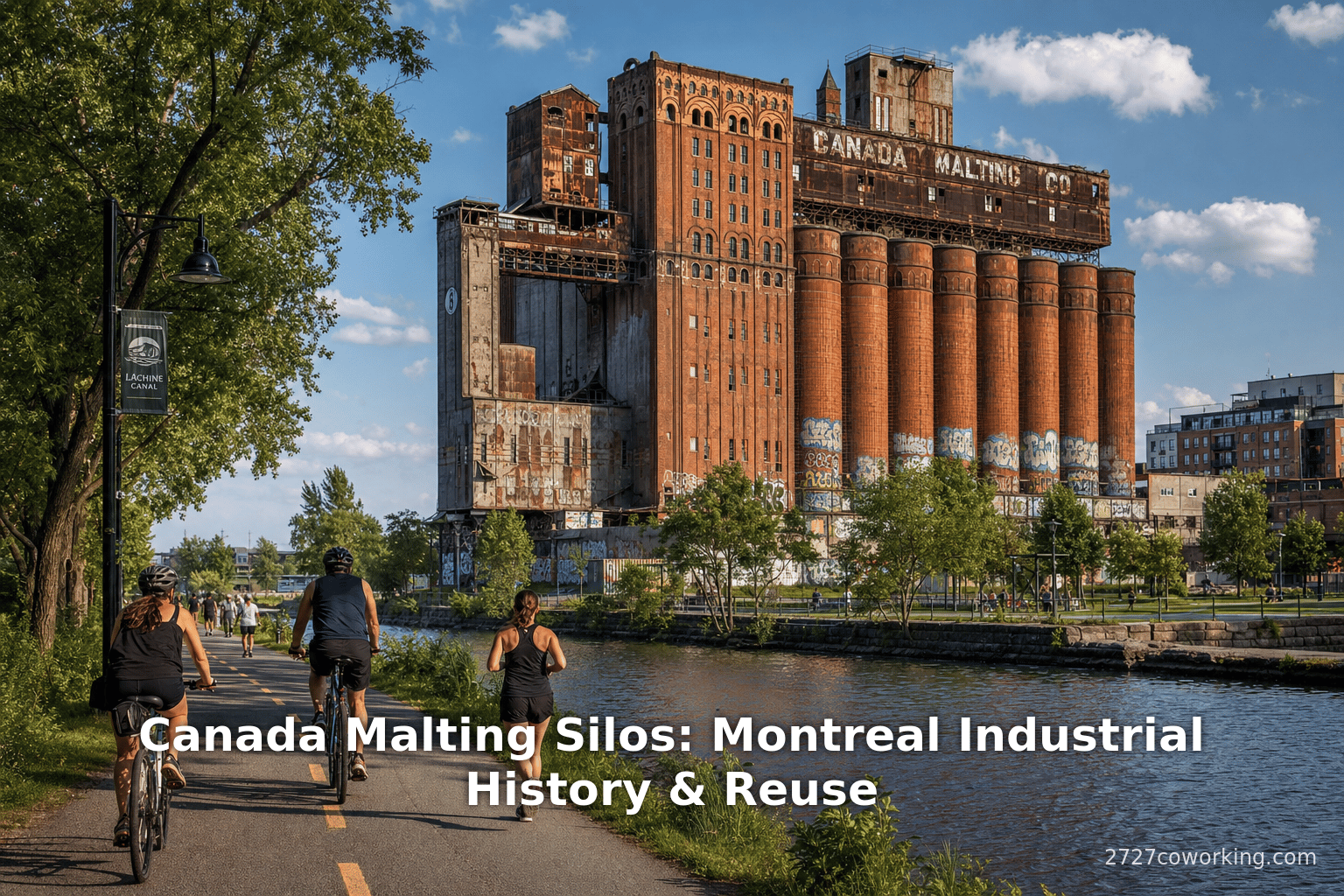
The Canada Malting Silos in Montreal’s Saint-Henri neighbourhood (along the Lachine Canal are an internationally notable industrial heritage landmark, built in 1905 by the Canada Malting Company as a massive barley malting factory. The site’s eleven 37-metre terracotta-clad grain silos (added to a five-storey brick malt house) were, by mid-20th century, the largest malting facility in Canada and second-largest in North America [1]. These silos are “the last of their kind” in North America [2] [3] and have been described as a “cathedral of industry” and even a “supervillain’s lair” by cultural commentators [4].
After the Lachine Canal was closed to shipping in 1970, the plant’s operations shifted to a new port facility, and by the early 1980s the Saint-Henri site had ceased malt production [5]. It was used briefly for other grains before being fully abandoned by the late 1980s [6]. The derelict complex is now fenced off, heavily vandalized and graffiti-covered, but remains a beloved local icon. Heritage advocates note its architectural distinction (neo-Roman brick detailing, terracotta modules from a Minneapolis prefab company) and symbolic weight in Montreal’s brewing history [2] [7].
In recent years there has been an intense debate over adaptive reuse of the site. Two divergent proposals have emerged: a private “Renwick” plan by a real-estate developer, and a community-driven plan by the group À nous la Malting (Solidarité Saint-Henri). Renwick’s proposal (revised since a 2013 concept) envisions mixed condo housing including affordable/social units (~30%), artist studios, childcare and community spaces [8] [9]. The community group’s plan seeks 100% non-market social housing (≈200–230 units) plus services (daycare, market, gardens, museum, etc.) on the site [10] [11]. The two visions have triggered mobilization, negotiations, and legal wrangling: as of 2024 the developer Renwick has acquired the property (via purchase from the long-time owner) [12], but disputes over payment and municipal approvals have stalled any project.
This report provides a comprehensive examination of the Canada Malting Silos site. It covers the historical evolution of the plant and its ties to Montreal’s canal era, detailed architectural and heritage analysis of the complex, the decay and threats facing the structures, and an in-depth look at the competing redevelopment plans – including their financials, community impacts, and legal status. We also compare this case with similar industrial heritage reuse efforts (both in Canada and abroad) and analyze broader implications for urban planning, housing policy, and sustainability. All claims and data are grounded in published sources, heritage studies, and expert commentary. The conclusion assesses future scenarios, emphasizing that urgent action is needed to save these silo structures or risk losing a “formidable witness to the brewing history” [7].
Introduction and Historical Background
The Lachine Canal and Montreal’s Industrial Boom
The Lachine Canal, completed in 1825, was a pivotal infrastructure project that transformed Montreal into the “principal gateway” to the North American interior [13] [14]. Before the canal, ocean‐going vessels could not bypass the rapids at Lachine. Construction began in 1821 and was completed in 1825, with seven locks allowing small flat-bottomed boats to reach Lake Saint-Louis [13] [15]. The canal was soon expanded (1843–1848, 1873–1885) to accommodate larger steamships, creating five newly enlarged locks [16] [17]. At its peak, the 14-km channel carried immense volumes of lumber, grain and goods to and from Montreal, spawning an “incredible innovation potential” along its banks [13] [18].
For over a century Montreal’s industrial heartland clustered along the canal, including brewing, grain, tobacco and manufacturing plants. As one city historian notes, “by 1851 the Lachine Canal…made Montreal the principal point of entry to the interior of the continent” [14]. Indeed, the canal’s success gave rise to numerous factories and worker neighborhoods (Saint-Henri, Griffintown, Lachine, etc.). However, by mid-20th century changes in transportation and the opening of the St. Lawrence Seaway (1959) greatly reduced canal traffic [19]. The canal ceased all commercial shipping by 1970 [19]. Within a few decades, most historic factories along the canal were closed or demolished, and the waterway was reimagined as an urban park. (Today the Lachine Canal is a National Historic Site, with recreational locks and trails [20] [19].)
| Year | Event | References |
|---|---|---|
| 1821–1825 | Construction of the Lachine Canal (7 original locks) to bypass Lachine Rapids [13]. | [13] [15] |
| 1843–1848 | First majorenlargement of canal (new locks for larger vessels) [13] [21]. | [13] [21] |
| 1851 | Lachine Canal becomes first link in a canal system to the Great Lakes, cementing Montreal’s role as trade gateway [14]. | [14] |
| 1873–1885 | Second canal enlargement (final lock size 82m, depth 4.3m) [17]. | [17] |
| 1959 | St. Lawrence Seaway opens; canal commerce begins to decline [19]. | [19] |
| 1970 | The canal closes to commercial shipping [6] [19]. | [6] [19] |
Founding of the Canada Malting Complex
The Canada Malting Company (originally an Ontario-based firm, founded 1902) chose a site at 5020–5070 rue Saint-Ambroise in Saint-Henri to build a new malt house in 1905 [22]. This site was then in the midst of the canal’s heavy industrial corridor. The plant’s purpose was to germinate barley and other grains used in beer brewing – making it a critical supplier to Montreal’s breweries [22]. The location was ideal: raw barley could be brought by ship or rail and processed malt sent elsewhere via the same routes [22].
The original 1905 construction was architecturally ambitious. The main plant consisted of a five‐storey brick malthouse and office building, along with eleven cylindrical silos built from precast terracotta clay (with stone foundations) [2] [3]. These silos – some 37 metres tall – were fabricated in modules by a Minneapolis company known for silo design [2]. The terracotta‐cladding (unusual on industrial buildings) and stylistic details (arched window openings, brick cornices with neo-Roman motifs) gave the complex a grand appearance [2] [23]. (Today local historians note this as an example of early 20th‐century “industrial architecture that combines the work of architects and engineers” [23].)
In 1963, the factory was expanded to meet growing demand: eighteen additional concrete silos were built on the eastern side of the complex [24] [3]. At its mid-century peak, the Montreal plant was said to process about 250,000 pounds (≈110 metric tons) of malt per year, “largely for the brewing industry” [25] [1]. By this time it was the largest malting facility in Canada and ranked second-largest in all of North America [26]. In short, Canada Malting’s Saint-Henri plant was a major pillar of Montreal’s brewing economy.
Architectural and Heritage Significance
Industrial Landmark in Saint-Henri
The Canada Malting silos are among the most iconic vestiges of Saint-Henri’s industrial era. Located at the corner of rue Saint-Ambroise and avenue Saint-Rémi, the complex dominates the landscape with its wall of cylindrical silos and flanking towers [4]. Heritage organizations have recognized its architectural and historical value. For example, Heritage Montréal describes the site as “formidable witness to the brewing history” of the city [7] and notes it was officially designated as heritage-worthy in 2012 by the municipal government [27]. Likewise, the National Trust for Canada (a non-profit heritage group) placed Canada Malting Co. on its 2024 Top 10 Endangered Places list, highlighting it as “one of the Lachine Canal National Historic Site’s most prominent landmarks” [1].
The silos and attendant buildings exemplify early 20th-century industrial architecture. The western section (1905) of the complex contains 11 terracotta-covered silos and brick structures [2]. These silos are noteworthy not only for their height (37m) and material, but for being “the last of their kind in North America” [2] [3]. The decorative arched windows and patterned brick cornices show craftsmanship not usually seen on factory buildings [2] [23]. The eastern section (1963) has 18 concrete silos, which in contrast have a plainer, modern appearance [2] [3]. Overall, the complex is “monumental” in scale, combining functional engineering with neo-Roman motifs [24] [23].
Unlike many other abandoned grain elevators that are bland or purely utilitarian, Canada Malting’s silos have a rare terracotta cladding. According to the Heritage Montréal site, this gives the plant “an unusual color for an edifice of this type” and suggests the owners intended a degree of prestige [28]. (At 45 metres above ground [28], the silos tower over the nearby cityscape.) The original architect of the 1905 plant was David Jerome Spence [29], further underlining that this was a carefully‐designed facility rather than an ad-hoc warehouse. In sum, the site’s architectural details and surviving industrial fabric make it an urban landmark.
Historic Role and Usage
During its operational life (1905–1980s), the Canada Malting plant played a critical economic role. It functioned as a “grain elevator” complex, germinating barley that would be shipped to breweries and distilleries across Quebec and beyond. Barley arrived (historically) by canal boat or rail, was steeped and dried in large wooden vats and silos, and the malted product was then conveyed out by the same routes. (In era before mechanization, workers manually raked barley on floor-heated slabs; later industrial fans and conveyor belts were used.) The iron fire escapes on the exterior and heavy timber framing inside reflect this industrial heritage.
As noted, peak output was on the order of 100+ metric tons of malt per year [25]. This made the plant vital to Montreal’s brewing economy. For context, one account remarks that “Canada Malting was once a key supplier to many distilleries and breweries” [30]. In the early 20th century, the company was one of the largest employers in Saint-Henri, and its presence anchored a neighborhood that housed workers, machinists and rail crews.
The plant’s fortunes, however, were tied to the waterway. When the Lachine Canal ceased commercial traffic in 1970, Canada Malting had to retool its logistics: it relied on rail service (Canadian National Railway) until the 1980s [6]. Ultimately, a new Malting plant was built by the company in the Port of Montreal (Bickerdike Pier) in the early 1980s. This modern facility (alongside upgrades to highway transport and seaway shipping) made the old Saint-Henri factory redundant. Operations at Saint-Henri were formally ceased by 1985 [5], and the plant’s equipment was dismantled and relocated. A grain wholesaler (Steve Quon’s firm, Quonta Holdings) purchased the site, but only used it briefly for storage (e.g. soya, corn) before abandonment [6] [31].
By the late 1980s the factory was fully inactive: rail service ended in 1989, after which the Canada Malting silos were simply left empty [6]. Over the ensuing decades they fell into disrepair. Montreal’s shift away from heavy industry left Saint-Henri much altered: the Lachine Canal was converted to parks and bike paths, and many former factories gave way to lofts or parking lots. Yet the Malting complex remained intact, standing as a ghostly monument to the working-class past. In the popular imagination it acquired a cult status: urban explorers clamber onto its roofs, graffiti artists cover its walls, and casual passersby stop to photograph its distinctive silhouette [32] [33]. As one local resident-author put it, the Malting “used to germinate and dry the barley… when the canal was closed… the building remains a huge part of the city’s industrial heritage” [34].
Decline and Current Condition
Today the Canada Malting silos are largely derelict. No malt has been produced here for over 40 years [35]. The structures are unheated, unmonitored, and exposed to weather. Heavy rains and freezing cycles have damaged mortar joints; vegetation grows in cracks; wild animals nest in cavities. Heritage Montreal reports serious water infiltration and structural damage, observing that “the former plant has deteriorated to such an extent that recovery seems impossible” if not stabilized [36]. Graffiti – from small tags to large murals – covers much of the exposed brick and concrete [32] [33]. There is broken glass, collapsed ancillary sheds, and rusting machinery scattered on the ground. Photographs show the tops of silos eroding and some comportment of terracotta tiles falling away. Visitors note a sinkhole where underground silos used to be, and reports have warned of potential collapse of unstable masonry.
Local heritage experts warn that the decay is accelerating. Dinu Bumbaru of Heritage Montréal emphasized an “urgent need to act” before the terracotta silos lose their tiles and structural identity [37]. Philemon Gravel (UdeM architecture researcher and heritage activist) has described the complex as “a machine-building” where the interior layout is completely unsuited for other uses, and suggested that “there was already nothing to do five years ago” given the loss of original machinery and the high costs to retrofit [38]. Indeed, surveys indicate that refurbishment would require extensive remediation: demolition of unsafe roofs, decontamination of rusting bins, replacement of corroded steel, and reinforcement of concrete hulls. The Southwest borough reports that even at its best, any redevelopment project must budget tens of millions for soil cleanup and stabilization. Renwick Development estimates a baseline expense of over $14 million to decontaminate and shore up the structures [39]; community architects dispute this, but all agree the costs are far from negligible [39] [40].
For over 30 years, then, the silos have been a rusting ruin. They are surrounded by chain-link fences (with “No Trespassing” signs), yet determined artists and thrill-seekers routinely ignore the barriers. An Atlas Obscura writer notes: “Despite being fenced off, the vacant factory has attracted street artists for decades. Many have climbed to vertigo-inducing heights to leave their mark…” [33]. Those scaling the frame face serious risk, as no safety gear or maintenance has been done. In September 2019 a group of artists even installed painted duct tape around the tallest silo as a stunt – which gained media attention as a symbol of both the site’s neglect and its power to capture imagination.
To summarize the present state: the Canada Malting complex is an empty shell, structurally fragile and under constant vandalism. It remains “one of the most prominent remnants of Saint-Henri’s grittier past” [32], yet it is in urgent need of either corrective action or adaptive reuse. Montreal’s urban fabric has largely transformed around it (modern condos, parks, trendy shops) but this locus has stubbornly tolled on. Every season’s freeze-thaw threatens to push the building closer to ruin. Heritage advocates and engineers alike warn that time is quickly running out to save the silos as a whole [37] [35].
Adaptive Reuse Plans and Development Proposals
After decades of abandonment, the Canada Malting site has become the focus of intense interest from developers, government officials, and community groups. Several formal proposals have been put forward, along with public debates and studies. Broadly, two opposing visions dominate the discussion: a private-sector mixed housing development led by Renwick Development, and a community-driven social housing project by the collective known as Solidarité Saint-Henri (À nous la Malting). We detail each plan’s outline, motivations, and status below.
The Renwick Development Proposal
Renwick Development (a Montreal real estate firm) first attracted notice here in 2013, when it announced a plan for 700 condos on the Malting site. That early luxury housing idea was quickly blocked by citizen mobilization and zoning issues [41]. In subsequent years, Renwick scaled back and redesigned its concept. Its current pitch (as of 2020) is for a mixed-income apartment complex of roughly 220-240 residential units, about one-third of which would be set aside as social housing. In Renwick’s own words, 30% of the units are designated “affordable/social” [8]. The remainder would be market-rate condos or rentals. The development would likely be a mid-rise block or blocks (6+ stories) built on and around the existing footprint, preserving some of the heritage structures in the process.
Key elements of Renwick’s plan include:
- Housing Mix: ~220 units total, approximately 65–80 of which are for affordable/social housing [8] [42].
- Community Amenities: The project proposes amenities such as a daycare center for autism-support services, a preschool, artist studio spaces (~60 studios), a children’s center for autism, and a community meeting room [9] [8].
- Green/Public Space: Plans include parks or pocket green spaces integrated into the site (e.g. nearby Chabot Park exists but would be connected).
- Design Heritage: Renwick has signaled interest in retaining “several features of the Canada Malting” building. Preliminary renderings and descriptions (monared by architects) show using the terracotta façade as a backdrop, keeping the brick office tower as a visual landmark, and marking the silo forms in the new design [8].
- Project Cost: The development cost is reported to be on the order of CAD$120 million [40]. (This figure includes land purchase, construction of residential buildings, decontamination, etc.)
This project is for-profit: Renwick and partner investors would sell or lease the market units, while relying on subsidies and city cooperation to finance the social units. In interviews Renwick’s leaders emphasize that their plan is not just another luxury condo building (30% social), and they challenge critics by noting that few other current projects include such a significant social component [9] [42]. They also highlight Renwick’s track record in rehabilitating old buildings versus standard developers. However, community advocates remain skeptical, viewing even Renwick’s “mixed housing” approach as primarily market-driven [9] [11].
The Solidarité Saint-Henri (“À Nous la Malting”) Proposal
À Nous la Malting (“Malting is Ours”) is a grassroots collective formed by Saint-Henri residents starting in 2013, initially to oppose the 700-condo plan. Led by community organizers and local advocates, the group has spent years developing an alternative vision for the Malting site centered on social justice and heritage preservation. Their proposal (publicly released in early 2020) can be summarized as follows:
- 100% Affordable/Social Housing: The plan calls for no market condos at all. It envisions roughly 200–230 family-sized rental units, all to be kept as permanently affordable/social housing for local residents [10] [11].
- Community Facilities: The site would host extensive social infrastructure– for example, a full-size public daycare, community gardens, a communal kitchen, a co-op café, and spaces for co-working. Notably, the plan includes an on-site museum or heritage center dedicated to the Lachine Canal’s industrial past and the workers of Saint-Henri, housed perhaps in the old brick tower [11]. The terraces of the silos are envisioned as greenhouses or rooftop gardens, providing urban agriculture [11].
- Design Philosophy: Architect Étienne Bourque-Viens (of L’OEUF) framed the scheme as “maximally reuse what is there.” For instance, the terracotta silos might serve novel purposes (the collective even floated ideas like converting them to data centers or culture venues, though engineering challenges abound) [11]. The brick office tower would become the heritage museum.
- Governance: It would be a 100%-community-run project, essentially a non-profit housing co-op model. The collective plans to incorporate as a social-housing enterprise, to raise funds from government sources (City, provincial/federal housing programs, even non-profits like Housing Montreal) to buy or transfer the land and carry out construction.
- Estimated Cost: The group has estimated a construction budget of about $45 million, plus roughly $30 million for environmental decontamination and demolition of unusable structures [40]. (They note that Renwick values the land alone at ~$16M, which the non-profit hope could be lowered due to the heritage mandate.) In total, they project needing on the order of $75–100 million when including all cleanup, which they plan to secure through a combination of city/provincial/federal grants, philanthropic support, and social finance.
A distinguishing feature is that every dollar invested would flow back into community services rather than profits. Solidarité’s spokesperson emphasizes that their aim is to prove it is “possible to develop our city differently,” without depending on profit margins [43]. They argue that building one-for-one luxury condos raises nearby land prices and accelerates gentrification, whereas 100% social housing would boost local affordability and keep long-time residents in place [43] [40].
Comparison of Major Proposals
The following table summarizes the key features of the two main redevelopment proposals for the Canada Malting site.
| Proposal | Proponent / Organizer (Year) | Housing (units, incl. social) | Key Features | Estimated Cost (CAD) | Status (2025) |
|---|---|---|---|---|---|
| “Renwick Plan” (c.2020) | Renwick Development (for-profit developer) | ~220–240 units total; ~65–80 units (≈30–33%) affordable social | Mixed condo/apartment tower block; 30% social housing; 60 artist studios; daycare/preschool; autism centre; green spaces/parks [8] [40]. Some renovation of heritage elements planned. | ≈$120 million [40] | Renwick acquired site (Aug 2023) but faces legal dispute (2024). Municipal approvals pending. |
| “À Nous la Malting” (2020) | Solidarité Saint-Henri (“À nous la Malting” collective) | ~200–230 units total; 100% social housing (no market units) | 100% affordable rental; includes family-sized units; full daycare; community kitchen; rooftop gardens; urban farm; market; heritage museum (in brick tower); emphasis on reuse of structures [10] [11]. | ≈$45M (development) + $30M (cleanup) ≈$75M [40] | Awaiting funding. Site under community reserve request. City has not committed purchase (Jul 2017: want $10M purchase by City [44]). |
Table: Summary of redevelopment proposals for the Canada Malting site (compiled from heritage briefs and news sources) [8] [40] [9].
Stakeholder Positions
These two proposals reflect a classic tension in urban redevelopment: profit-driven versus community-led agendas. Renwick’s vision is supported by its proponents as a way to reconcile preservation with new housing supply. Glenn Castanheira (spokesperson for Renwick) has defended that model, noting inclusion of 30% social housing and community spaces makes it more equitable than typical condo projects [9] [8]. The city’s officials (both borough and city hall) have indicated willingness to consider such integrated projects, especially since the Malting site is within broader Lachine redevelopment plans [45] [46].
By contrast, the community group argues that only a fully “non-market” project truly serves existing residents. They maintain that any market-based development ultimately drives up rents and displaces lower-income families [43] [40]. Councillor Fred Burrill (Solidarité heritage rep) has said there is nothing philosophically against a developer making a profit – “barbershops and cafés do that” – but housing should belong to “the people” [9]. The collective has lobbied local and federal elected officials for support. In July 2017, about 100 Saint-Henri residents held a rally at borough hall to demand the city reserve the Malting site for community use [47]. Their formal request was that the City of Montreal buy the site (quoted at ~$10M then [44]) and hold it “in reserve” for the non-profit development [44]. While Mayor Benoit Dorais afterward expressed verbal support for the 100% social project and even offered to introduce a council motion, he also cautioned that city budgets are limited. In 2020 he noted “we don’t have the means to buy [the land], and it wouldn’t be responsible to do so” [48]. He commissioned a technical report on the Malting building’s condition (meeting with the community group in early 2021) but no final decision was reached [49]. By 2023 the city has not yet committed to any acquisition, and the site remains in private hands (albeit contested).
Legal and Ownership Status
Part of the delay has been legal wrangling over ownership. For decades after the Malting closed, the site was owned by Quonta Holdings (associated with grain merchant Steve Quon) [31]. In 2019 the southwest borough decided to sell the land. By early 2020 two bidders emerged: Renwick Development and Luc Poirier (another land investor). Renwick won and finalized the purchase in August 2023 [12]. Thus Renwick is now the registered owner of the property. However, by mid-2024 a new dispute arose: Quonta Holdings (the seller) reportedly sued to nullify the sale, claiming nonpayment or contractual issues [12]. The current status (as of early 2026) is that Renwick holds title but the development is frozen pending resolution of this litigation. No building permits have been issued.
Meanwhile, community leaders have formally requested that the City place a conservation notice or “reserve” on the Malting site to prevent any demolition without review. Heritage Montréal has lobbied the city to enact a special advisory zone or heritage bylaw. In 2018 the City passed an annual resolution on industrial heritage calling out specifically Canada Malting Co. as an exemplar [50]. Despite these gestures, there is no binding heritage designation on the property (it is not municipally or provincially classified) and it formally remains a private development parcel. In practice, however, local officials have publicly declared that a raw condo-build would be politically unacceptable. Council members have signaled they would reject any simply-luxury conversion, insisting that some heritage elements be preserved and a significant portion of housing be affordable [41] [9].
Neighborhood Context and Public Opinion
The public debate has been vigorous. On one hand, many residents of Saint-Henri view the silos as a treasured landmark. A Montreal Gazette columnist (also a Saint-Henri resident) wrote: “the Malting plant… is an integral and much-loved part of St-Henri and Montreal history” [51]. Several local heritage societies have organized photo tours and petitions. Social media groups show hundreds of “silo selfies” by passersby. Annual open-studio events have even hosted art installations against the Malting walls. For these supporters, the plant evokes nostalgia, local identity, and the neighborhood’s industrial roots.
On the other hand, there is frustration that a prime waterfront site lies “wasted” on a crumbling ruin while the city faces a housing crunch. One editorial noted that Saint-Henri’s property values have surged in the 2010s, and that the Malting’s land could help provide desperately needed rentals or family housing [52]. Indeed, Montréal’s vacancy rate was only 1.5% in 2019 and rose to 2.7% by 2020 [53], indicating shortage; the South-West borough (which includes Saint-Henri) typically has the lowest vacancy in the city [48]. Housing advocates argue that building more dwelling units (even some luxury condos with partial inclusion) is better than preserving an abandoned building forever. For many younger residents, the debate is framed around urgent housing affordability versus heritage sanctity. The À Nous la Malting camp pushes the “fair-share” argument: Saint-Henri has already endured heavy industrial pollution, so now it should receive more social housing to offset gentrification pressures. The Renwick side counters that without a credible developer, the site could remain unused or be snapped up by purely private interests later (ex: 700-condo plan in 2013 before community action).
A July 2017 rally at borough hall summarized this divide. Hundreds of citizens attended, with some calling for immediate social-housing development and others expressing caution about costs [47] [38]. City media quoted the borough mayor as sympathetic but warning about “faramineux” (enormous) costs of cleanup and heritage retrofitting [49]. Local voices (both activist and property-sector) have been featured in press interviews on the site’s future. Overall, opinion in Saint-Henri remains mixed but engaged – everyone agrees something should happen, but there is no consensus on what.
International and Comparative Context
The Canada Malting Silos case is not unique: cities worldwide grapple with how to repurpose large obsolete industrial structures. Adaptive reuse of grain elevators and silos has precedent, often with creative outcomes. For example, in Toronto’s waterfront, the adjacent Canada Malting Silos (Bathurst Quay) have been integrated into a public-space project. Starting in 2017, the Toronto City and Waterfront Toronto agencies invested in stabilizing and repurposing two concrete silo buildings as part of the “Bathurst Quay Common” park [54]. The silos there are being structurally repaired and partly decontaminated while being converted to cultural uses: OCAD University will occupy offices in one silo, and the other is being left as an open art space (its interior reportedly filled with decades-old decomposed grain) [55]. The historic Corleck office building next door is being renovated into an event venue [54]. This ongoing Toronto project (part of waterfront revitalization) demonstrates both the technical challenges (hundreds of tonnes of sludge left in the silo, needing creative fixes) and the opportunities (creating new public recreational amenity) of such heritage interventions [56] [57]. Montreal’s Malting silos are similarly concrete/intact, though the Toronto silos had the advantage of established funding and municipal control.
Elsewhere, converted silos have been used as art galleries (Cape Town’s Zeitz MOCAA grain silo museum) or apartments (the Stackt shipping-silo complex in Toronto). In Quebec, the nearby former Molson Brewery complex (once breweries and ice plant) has been successfully redeveloped into the Old Port District and Griffintown lofts, preserving facades and key structures while adding new homes and offices [58]. That Molson site demonstrates that with strong political will and investment, heritage industrial zones can be transformed into mixed‐use neighborhoods.
Academic literature on adaptive reuse emphasizes that reusing old industrial fabric is often more sustainable than demolition/build-new, both economically (through tourism or branding) and environmentally (avoiding waste) [59]. The National Trust article explicitly notes that “adaptive reuse of heritage buildings is climate action,” urging Canadian governments to build expertise in transitioning such public assets [59]. This perspective could encourage policies or incentives (heritage tax rebates, green building grants) favoring rehabilitation over teardown. On the other hand, many economic analyses highlight the difficulties: expected high upfront costs, engineering complexity, and regulatory obstacles. A study by urban planners could quantify how much embodied carbon is saved by keeping a building above redevelopment; others might count how many contaminated industrial lands Montreal still has along the canal (as noted in the “Canal Lachine 4.0” initiative) [45].
The Canada Malting site also fits into broader discussions on urban equity and housing. Case studies from Europe or North America show that converting inner-city industrial land to mixed-use often forces a trade-off between profitability and affordability. Montreal’s own trio of Le Sud-Ouest’s former factories (e.g. the stores du Basement on Lachine) each had charitable or cooperative development models (e.g. Régie du bâtiment social at former Brewery St-Malo). In many ways Canada Malting is a microcosm of the city’s housing crisis: the city has one of the lowest supply of social housing among major Canadian cities, while vacancy rates hover near zero [53] [48]. The debate thus intersects with questions about how the city should evolve – whether market forces alone should dictate land use, or whether community values and long-term resiliency should guide redevelopment decisions.
Data and Analysis
While much of the discussion is qualitative (heritage vs development), there are some quantitative facts and figures to ground the analysis:
-
Site Size and Structure: The malting complex occupies approximately 45×100 metres of now-empty lot (an entire city block face plus corner) at Saint-Ambroise/St-Rémi. It contains 29 vertical silos (11 terracotta + 18 concrete) of 37m height [2], plus a 5-story brick office building. The total floor area of all existing buildings is on the order of 30,000–40,000 square feet (a rough estimate from aerial photos and comparable structures). (Exact area figures are not published, but Heritage Montréal’s documentation notes the height is 45m [28].)
-
Heritage Status: The site sits within the Lachine Canal National Historic Site (a federal designation since 1929 [60]) and the broader Southwest borough planning area. Municipal heritage status has only been advisory: Montreal’s 2018 resolution on industrial heritage specifically cites Canada Malting Co. as noteworthy [50], but the former plant has no formal protection order. Its buildings have thus not been legally conserved beyond normal building-code requirements.
-
Housing Context: The St-Henri district (part of Le Sud-Ouest borough) has about 52,000 residents as of 2021. The tenant-vacancy rate in Montreal surged to ~2.7% citywide in 2020 [53] due to the pandemic, but the Southwest borough historically has the lowest vacancy in the city [48]. Median rents in this neighborhood are above the city median (e.g. average 2-bedroom apt ~6–$700 in 2019; now ~$1000). Such figures illustrate high demand for the kind of housing (especially rentals) that both proposals aim to deliver. According to city data, the Southwest borough needs an additional ~2,000 housing units in the next decade to meet demand (as stated by Borough Mayor D. Anglade in 2020).
-
Development Economics: Real estate experts estimate the Malting site’s underlying land value around $5–6 million CAD [61]. This relatively low price reflects its “brownfield” status – significant cleanup required. By contrast, a nearby development parcel not requiring decontamination (e.g. the adjacent Lachine Canal parkland) would fetch far more per square foot. The Renwick proposal’s $120M budget encompasses land acquisition, construction of ~220 units, and major site prep. Spread over, say, 50,000 square feet of new housing (assuming 3,000 ft²/site floor area per unit), this implies a project cost of roughly $2,400 per foot² (including profit). For comparison, market luxury condos in central Montreal often start around $600–$800/ft²; the difference underscores the extra cost of heritage restoration and remediation.
-
Social Impact Estimates: The community model touts creating ~200 affordable apartments. If these serve families (say average household 2.5 persons), that could benefit ~500 people. Currently the Malting area neighbors thousands of lower-income households; adding 200 subsidized units would increase the borough’s social housing stock by ~5–10%. No precise target number exists, but with a city shortfall of ~10,000 social units across Montreal (per the City’s 2022 housing plan), the Malting project could make a small dent.
The above numbers illustrate the scale of the challenge. Converting 29 silo structures into anything useful is an engineering feat, and financing ~200 social apartments in new construction (without private profit) is uncommon in Montreal’s market. Yet cities worldwide view similar reuses as investments in cultural capital and inclusivity. For instance, the Toronto Bathurst project reported that their silo stabilization cost was partially funded by City and charitable contributions to offset the high rehabilitation expense [54]. If Montreal were to support either Malting scheme, it could consider grants, tax breaks or revenue-sharing models (e.g. lower cost of land) to make it viable.
Implications and Future Directions
Heritage Preservation vs. Housing Needs
The Canada Malting Silos sit at the crossroads of two critical urban concerns: preserving heritage and expanding housing supply. On the one hand, demolition of the silos would mean irrevocably losing a unique historic artifact. Heritage advocates warn that failure to act quickly will result in irreversible loss: “If the materials deteriorate too much... it will be lost,” says Heritage Montréal’s Dinu Bumbaru [37]. An expert on malting buildings lamented that waiting too long means only the facade might survive (facadism) as happened with other Montreal landmarks. The National Trust observed that this site uniquely encapsulates Montreal’s industrial past and warns that “time is running out” to save these structures [1] [35].
On the other hand, Montreal’s chronic housing shortage (especially affordable units) puts pressure on any developable land. The Malting site is in a near-downtown location with potential to deliver up to ~240 new homes, at least dozens of which would be below-market under either plan. From a purely housing-stock perspective, the land being vacant and fenced-off is a lost opportunity. Optimists note that a sensitive development could balance these needs: for example, integrating the old silos into new buildings could provide iconic architecture while adding density. (Similar ideas have been floated in design competitions, though none fully realized.)
Resolving this tension requires multi-faceted policy. Montreal’s recent Canal Lachine 4.0 initiative (announced 2023) exemplifies an integrated approach: it calls for redeveloping former industrial parcels along the canal into new jobs and neighborhoods, “respectful of existing residents and the heritage” [45] [46]. The city acknowledges the canal as a “jewel” around which a sustainable hub can be built [46]. For Canada Malting, that means any project should uphold both social equity (adding affordable units) and historic value (protecting key structures). The Vancouver example (Coal Harbour Centennial Museum is blanked though code pointer [54]) indicates that adaptive reuse is also a climate solution; this raises further impetus for preserving rather than bulldozing.
Planning and Governance
Municipal policy will heavily influence the outcomes. If the city were to declare the silos a protected heritage property (which it has not to date), any demolition or alteration would require review by a heritage commission. The borough’s refusal to entertain a pure condo plan suggests authorities will push for retention of at least the historic facades. Indeed, when a 2013 proposal was amended, part of the condition was that the developer preserve the main silo façade or restore it as part of any design. Borough planning staff have indicated that any rezoning of the site must include heritage impact measures. Furthermore, if the city designates part of the site for community housing (e.g. via a land swap or uncertainty clause), it could tip the balance in favor of one plan.
The financial model is also crucial. The Renwick proposal appears to plan a public-private partnership: the developer will build the project with private capital, but will require municipal approval and possibly incentives (such as permission to build more units or the city assuming some cleanup costs) in exchange for delivering social units. The Solidarité project would likely seek government funding (as a non-profit housing co-op), which might require the city to purchase or subsidize the land. At present, the city has not committed to either. One policy tool could be to use Montreal’s Affordable Housing Agreements (AHAs), where private developers in rezoned projects commit to a share of affordable units. Renwick’s 30% social contribution is unusually high by any standard, suggesting it may be counting on AHA-like offsets.
The ongoing legal battle adds uncertainty. If Renwick loses or delays possession, the site might revert to Quonta or enter flux, harming either plan’s feasibility. Meanwhile, if neither plan moves forward by, say, 2028, the building’s condition may degrade beyond repair. (A cautionary precedent is the NDG Empress Theatre, a vaudeville palace, which is now being partly demolished after 25 years of stalling [62].) Time is therefore of the essence; even Heritage Montréal has said “urgent action” is needed [37].
Future Scenarios
Several scenarios merit consideration:
-
Private redevelopment (Renwick or similar): If Renwick’s plan prevails and construction begins (perhaps by 2027), the silos would be partially preserved (at least externally) within a new apartment complex. Social housing units would be included (66–80 units), university-Aoi artist studios integrated, and public green space created. The outcome would likely be a mixed-income community. However, even retaining facades risks losing much of the silos’ interior. Technically, the terracotta silos could be left intact as a wall or repurposed as niches/parking, but converting them to usable interior space is extremely difficult and costly. Possibly only the base of the silos would enter the new building’s ground floor; the rest might remain as a sculptural element. Regardless, this scenario depends on complex engineering, and if the market deteriorates (high interest rates, etc.), the project might delay or downsize.
-
Community-run social housing: If Solidarité Saint-Henri or an allied non-profit eventually secures funding (from City, Quebec, federal committees or philanthropists) by 2028, it could proceed with a primarily social project. In this scenario, the old buildings would be adaptively reused as far as feasible. For example, the brick office tower could become the community museum as proposed, preserving that heritage core. The terracotta silos might be top-lit for community gatherings or left as art features (similar to the undisturbed Toronto silo being kept as a photogenic ruin [63]). The new apartment blocks would likely be built in the empty yard areas and possibly on top or beside the old structures. The cost sharing would be heavy on subsidies: even after a city “land reserve” or tax release, $75+M of external funds would be needed. If national affordable housing budgets allow, this could become a flagship co-op project in Montreal. It would deliver the maximum social benefit (affordable homes, services, museum) but little private profit, and it could become a model for grassroots design if successful.
-
Partial salvage and brownfield park: A less proactive possibility is that neither plan fully materializes, and the site remains in limbo. The city might then step in to simply “mothball” the building– stabilizing it minimally but not redeveloping, or even demolishing everything except facades to create an open park space. This has happened to some other Montreal factories (the Southern Cotton Mill ruins). While a park avoids new construction and preserves at least a silhouette, it forfeits housing supply. It also squanders potentially tens of thousands of square feet of developable land. Given the political pressure for housing, a pure park outcome seems unlikely unless both plans collapse.
-
Demolition and new build: Another dire scenario is that the city eventually agrees (perhaps after a long legal fight or structural failure) to raze the silos and allow a full build-out of new mid-rise or high-rise condos with minimal heritage integration. This scenario would maximize the number of new units (perhaps >300 if high density) and likely proceed with private financing. However, it would destroy a legitimate historic asset and likely provoke public backlash. It would also mark a shift toward prioritizing development over preservation. Given the high profile of this site, this “worst-case” would likely memorialize the Malting silos only in records and photographs, not in bricks.
Broader Implications and Lessons
The Canada Malting case raises larger questions. How should cities balance growth and gentrification with historical legacy? Montreal’s approach here may inform its attitude toward other industrial sites (e.g. Lachine Foundry, Empress Theatre, other canal-side plants). If a community-driven proposal were funded and built, it could set a precedent for cooperative redevelopment elsewhere. If only the private plan proceeds, it might signal to developers that heritage can be bent for more housing—with 30% affordable units as new norm.
The outcome will also affect the silent yet growing movement on adaptive reuse as climate action [59]. If Montreal can greenlight an innovative reuse of these silos, it will align with global sustainability goals (reduce demolition waste, preserve embodied carbon). On the other hand, if demolition occurs, environmental advocates would decry the waste. The site’s placement within the Lachine Canal corridor – already promoted as a mixed industrial-residential axis (Canal Lachine 4.0 [45]) – means it is a test case for reconciling heritage with growth.
Finally, the public process provides lessons in community engagement models. The solidarity campaign (“À Nous la Malting”), which generated grassroots mobilization, interviews, petitions and feasibility studies, has become a model cited in planning literature for bottom-up urban planning. Its merits are debated, but its existence forced the inclusion of social housing in the conversation. If the collective’s plans are shelved, activists may conclude that only legally binding mandates (rezoning conditions or expropriation) can secure community objectives. Conversely, if they succeed, other groups will be encouraged to sponsor wholly social development projects on future sites.
Conclusion
The Canada Malting Silos – a 1905 industrial beacon on the Lachine Canal – encapsulate a century of Montreal’s economic and social history. From barley-sprouting cornerstone of brewery supply to derelict urban ruin, this complex stands emblematic of old Saint-Henri. The debate over its future is equally portentous: Will it continue as a decaying relic, or be repurposed to serve new generations? Credible evidence from heritage organizations, engineering assessments, and community groups all suggest that preservation is possible but only with substantial intervention. As Heritage Montreal’s Dinu Bumbaru warns, there is an “urgent need to act” before the terracotta silos “are lost” [37].
The competing redevelopment proposals chart divergent paths. Renwick’s plan promises mixed-income housing with some preserved fabric [8], while the Solidarité collective champions a fully non-profit, all-affordable scheme [10] [11]. Both have good intentions, but each faces financial and political hurdles. Ultimately, the decision may hinge on broader policy: whether Montreal prioritizes maximizing housing or protecting heritage, or how it leverages funding for inclusive redevelopment.
Until a definitive project is approved, the silos remain a community touchstone and bargaining chip in Montreal’s urban planning. Whatever transpires, the future of the Canada Malting complex will likely be a bellwether. If redeveloped thoughtfully, it could become a celebrated case of industrial heritage giving way to 21st-century needs – complete with condos that still echo the silhouettes of the past. If left unaddressed, it risks succumbing to time, losing not just bricks but a chapter of Montreal’s story. As the National Trust succinctly puts it, this site represents “a tremendous opportunity to simultaneously revive one of Montreal’s industrial icons and address the city’s housing crisis,” but “after 40 years of abandonment… time is running out” [64]. This report has compiled the history, data, plans, and analyses relevant to that opportunity. The path chosen in the next few years will determine whether the Canada Malting Silos remain an industrial cathedral or become an empty field of memory.
External Sources (64)
About
2727 Coworking
Find a practical home for your work at 2727 Coworking in Montreal. Explore private offices, day workspaces and meeting rooms, plus business-address and virtual-mailbox services for your company.
2727 Coworking is a Montreal workspace and business-address provider. We serve people who need a place to focus, meet, run a small business or establish a professional mailing presence. Our website offers English and French information about workspace options and services, alongside educational resources for operating a business in Canada.
A workspace that fits the day
Our workspace options include private offices, day passes and desks, and a conference room. These formats help individuals and teams compare a dedicated office with more flexible ways to work or hold a meeting. Prospective members can explore the virtual tour, review current pricing and book a visit before choosing a workspace.
Business addresses and mail
2727 Coworking provides business-address and virtual-mailbox services. Our resources explain the documents and practical questions involved, including guidance for people outside Canada. Service eligibility, included features, availability and access arrangements should be confirmed on the applicable service page or with our team.
Resources for Canadian small businesses
We publish guides, research and planning tools about workspace decisions, business addresses and starting a business in Canada. Our incorporation research includes information for people inside Canada and abroad, with jurisdiction-specific material to help readers identify the next questions to investigate. These educational resources complement our workspace and address services; they are not individualized legal, tax or immigration advice.
Visit or contact 2727 Coworking
Explore private offices, day passes and desks, the conference room, business addresses and virtual mailboxes. Book a visit or contact the team to discuss your needs.
A business address alone does not establish tax residence, immigration status, banking approval or eligibility for a government program.
Disclaimer
This document is provided for informational purposes only. No representations or warranties are made regarding the accuracy, completeness, or reliability of its contents. Any use of this information is at your own risk. 2727 Coworking shall not be liable for any damages arising from the use of this document. This content was generated with assistance from artificial intelligence tools, which may contain errors or inaccuracies. Readers should verify critical information independently. All product names, trademarks, and registered trademarks mentioned are property of their respective owners and are used for identification purposes only. Use of these names does not imply endorsement. This document does not constitute professional or legal advice. For specific guidance related to your needs, please consult qualified professionals.