Atwater Market 2026: Seasonal Produce and Griffintown
Executive Summary
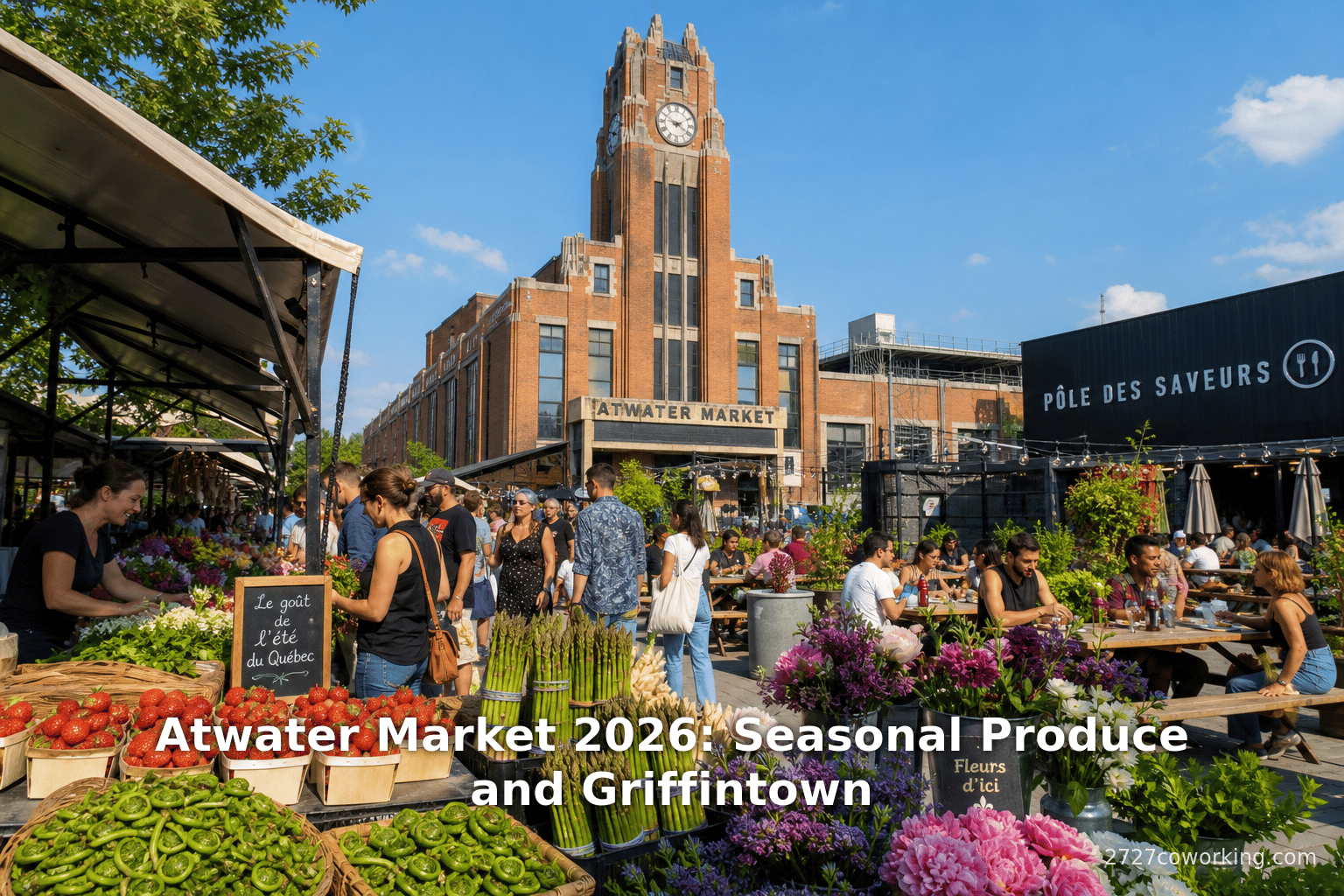
The Atwater Market (Marché Atwater) is a historic public market in southwest Montreal, renowned for its Art Deco architecture (built 1933) and year-round food offerings [1] [2]. By summer 2026, Marché Atwater is set to brim with seasonal Quebec produce, lively outdoor dining, and an array of artisanal goods. Daily in warm months the Pôle des Saveurs – an outdoor food-court by the Lachine Canal – will serve global fast-casual dishes on picnic tables [2] [3]. Seasonal vendors (flower growers, fruit and vegetable farmers) will occupy the plaza from late April through October, offering spring greens, berries and classic summer bounty [4] [5]. Key events (e.g. the “Les Sucres” maple festival on March 28, 2026 [6] and artisan fairs in May/June [7] [8]) will draw crowds. For local residents of Griffintown and surrounding neighborhoods, shopping lists will feature early-season asparagus and fiddleheads, midsummer strawberries and corn, plus the market’s butchers, cheesemongers and bakeries for barbecue provisions [9] [10].
Outdoor dining will extend beyond Atwater. Visit nearby Griffintown’s leafy terraces, from Italian cafés like Mano Cornuto to trendy pubs and wine bars, which complement the market’s farm-to-table focus [11] [12]. Shoppers should plan visits around marquee festivals (e.g. Les Sucres [6]) and emerging food trends (local, sustainable, organic) that will shape 2026 offerings. In sum, Atwater Market will continue to fulfill its mission of connecting urban eaters with Quebec producers, while evolving with changing consumer tastes. Comprehensive evidence – including municipal reports, vendor data and tourism guides – confirms these trends and the market’s role as a cultural and economic hub [13] [14].
Introduction and Background
Atwater Market (Marché Atwater) sits at 138 Avenue Atwater, in the Saint-Henri district of Montreal’s Sud-Ouest borough (adjacent to the Lachine Canal and near Griffintown. Opened in 1933 as a Depression-era public works project, it replaced the 19th-century Saint-Antoine Market to provide local fresh foods at fair prices [1] [2]. Renowned architects Ludger and Paul Lemieux designed its iconic Art Deco hall (brick façade, clock tower, streamlined piers), which today is acclaimed as “one of Montréal’s architectural gems” [1] [15]. Innovative features at the time (central refrigeration, public scales) made it “one of the most modern… public buildings” of the 1930s [16]. Citizens preserved the market from demolition in 1968 through heritage activism [17]. The interior and exterior renovations since have largely been sympathetic to its original character, making Atwater a “living museum of 1930s architecture” [18] .
Strategically on the Lachine Canal’s south bank, Atwater long served working-class neighborhoods. Its merchants originally sold dairy, meats, grains and garden produce to local residents [19]. After mid-century decline (rise of supermarkets, suburbanization), the market closed briefly but was reopened in 1982 as a revitalized public market [20]. Since then the canal park was redeveloped into a recreational asset and industrial land around it has gentrified [21]. Today Atwater is both a bustling local grocery and a tourist attraction [22] [15]. It supports about 25 indoor merchants year-round (bakers, butchers, cheesemongers, fishmongers, florists, ethnic grocers, etc.) and dozens of families of seasonal farmers and gardeners outdoors [22] [14]. Tourists and Montrealers frequently highlight Atwater’s outdoor terraces and picnic tables as summer highlights of the city [23] [24]. Importantly, Montréal’s public markets have a seasonal model: enclosed in winter, open-air in summer [25] [2]. Walls and roofing enclose the plaza in cold months, which are removed by late April. By early May, horticultural and produce vendors return and operate daily outdoors through the fall [25]. The paved lot and side yards become the Pôle des Saveurs – a casual food court of kitchens and trucks on site, with picnic tables under the canal sky [26] [2].The City of Montréal actively promotes these markets as “short-circuit” hubs for farm-to-plate shopping: over three out of four Montréal residents use the public markets network [27] to access local, quality produce year-round. In sum, Atwater’s history and management reflect a dual mission: to preserve heritage and community access while adapting to new food and leisure trends [23] [28].
Atwater Market and the Griffintown Context
Location and Neighborhood: Atwater Market lies on the western edge of Griffintown, near the Pointe-Saint-Charles corridor. The adjacent Griffintown/“Quartiers du Canal” area (which includes Little Burgundy and St-Henri) has seen rapid upscale development in recent decades [21] [29]. As condo towers rise near the canal, the market’s role grows: it draws not only longtime residents but also new visitors and food-tourists to the area. This blending of old and new is a recurring theme; urban planners note that Atwater remains “a living monument of Montreal’s past” even as it incorporates trendy new vendors (food trucks, fusion cuisine) to meet modern tastes [30] [23]. Griffintown itself has few large food markets of its own, so Atwater serves many neighborhood needs. For example, besides Atwater, Griffintown now has a large ethnic grocer (Marché Adonis opened in 2020) and specialty shops, but relies on Atwater for seasonal produce and authentic local fare.
Market Role: Officially, the Société des Marchés publics de Montréal (which operates Atwater) describes its mission as improving urban access to fresh local foods. The authority emphasizes a “short circuit” model linking Montrealers directly with Québec farmers and artisans [27]. Consistent with this, Atwater’s year-round tenants span the food chain: multi-generation butchers and cheesemongers rub shoulders with artisanal bakers and international grocers [31] [27]. According to market reports, Atwater’s presence has materially boosted the local economy. One analysis found that canal revitalization – anchored by Atwater – raised area property values by over 60% by 2006 [29]. The market now sees hundreds of thousands of visitors each summer; though Jean-Talon Market (the island’s largest) logged over 2 million visitors in 2025, Atwater’s smaller footprint still generates high daily foot traffic [32]. Summer weekends regularly see picnic areas and the Pôle fully occupied [33]. Vendors report that roughly half to sixty percent of their annual revenue occurs in the warm months [34] [2]. Thus, Atwater functions economically as both a neighborhood grocer and a magnet for urban tourism – effectively “nourishing the city au rythme des saisons” (in the rhythm of the seasons) [35] [27].
Seasonal Produce at Atwater (Spring & Summer 2026)
Atwater Market’s seasonal produce shifts dramatically as spring into summer 2026. By late April 2026, horticultural vendors (flower growers, nurseries, herb sellers) will fill the forecourt. By early May, farmers’ booths begin daily operations, typically 7 days/week, offering initial spring crops [36] [8]. Typical spring items include:
- Fiddlehead ferns (têtes de violon): A Quebec delicacy, these wild coiled ferns appear mid-April through early June, and are enthusiastically awaited each year [37] [38].
- Asparagus: Green and white asparagus from Quebec farms emerge in mid-May and continue into June [39] [38].
- Early greens and herbs: Baby lettuces, spinach, kale and Swiss chard begin in May. Potted herbs (parsley, cilantro, basil) and vegetable seedlings (tomato, pepper starts) are sold by plant growers, enabling home gardens. [40] [5].
- Spring fruits: Late-May brings the first Quebec strawberries (e.g. from Ferme Jodoin or Bleuetière Adorée), followed in early summer by cherries and rhubarb [41] [42].
- Maple products: Even before produce arrives, spring is maple season. Atwater’s indoor stalls and boutiques carry Vermont maple syrup, candies and maple spirits. The annual Les Sucres festival (March 28, 2026) showcases maple taffy on snow, maple cocktails, carved treats and pork smokehouse specialties [6] [8].
- Flowers and ornamentals: April brings tulips, lilies and other spring blossoms for sale by florists like Chez Louisette [43]. By May, bedding plants and herb sprays (mint, basil, rosemary) also appear.
A seasonal produce table (Table 1) summarizes examples of Montreal spring vs. summer foods:
| Category | Spring (March–May) | Summer (June–August) |
|---|---|---|
| Vegetables | Asparagus; fiddlehead ferns (late Apr–May); radishes; baby spinach and lettuce; Swiss chard [bettes] [5] | Tomatoes; sweet corn; cucumbers; zucchini; bell peppers; eggplants; broccoli; green beans [44] |
| Berries & Fruits | Strawberries (late May–June) [42]; cherries (early July); rhubarb | Blueberries (mid-summer) [42]; raspberries (July–Aug) [42]; melons (from July) |
| Herbs & Flowers | Potted herbs (parsley, cilantro, basil) and spring flowers (tulips, lilies) [45] | Bouquets and annuals; culinary herb plants (summer) [45] |
| Other Specialties | Maple syrup products and treats [46]: e.g. winter harvest (Easter lamb, maple-smoked meats, artisanal breads) | Barbecue and picnic fare; cheeses and charcuterie (for summer gatherings) [46] |
By June 2026, Atwater’s outdoor plaza is in full swing. Regular farms (Aux Trouvailles Gourmandes de Fanny, Ferme Jodoin, Vergers Dauphinais, etc.) bring their midsummer harvests [47] [44]. Key items in peak summer include:
- Berries: Local strawberries peak in early June and often sell out. Blueberries and raspberries follow in July [48].
- Field tomatoes: Juicy heirloom and beefsteak tomatoes dominate by mid-July. Sellers even pair them with cheeses (e.g. at Fromagerie Atwater) [49].
- Corn and squash: Quebec sweet corn (an August highlight) and summer squash (zucchini, yellow summer squash) appear by July–August [49].
- Stone fruits: Peaches, nectarines and plums from nearby orchards are abundant late July into August [49].
- Melons: Cantaloupes and honeydews (and later watermelon) arrive July–August [50].
- Beans and greens: Green beans (haricots verts) often extend through September, and leafy salads remain available (e.g. mesclun mixes, kale) [48].
- Cucumbers and peppers: Field cucumbers and bell/chili peppers emerge summer long.
- Specialty produce: Fresh garlic (new harvest) starts in late summer; heirloom eggplants and colorful peppers come in; unique items (e.g. curry leaves, exotic herbs by immigrant growers) sometimes appear.
Local news confirms these patterns: a national food blog notes that “July delivers the heart of summer abundance,” with Quebec markets flooded by sweet corn, field tomatoes, stone fruits (peaches, plums), and greens and beans [51]. Meanwhile, Quebec’s agricultural statistics highlight variability: for instance, a very wet summer in 2023 cut Quebec’s total vegetable output by ~9.2% [38], affecting market supplies (though conditions improved in 2024). In practice, Atwater’s harvest timing may shift with weather (an earlier warm spring could advance asparagus and strawberries; a late frost could delay them) [52] [48].
Table 2 below lists major vendor categories at Atwater (indoor year-round and outdoor seasonal) with example merchants. This market “vendor map” helps shoppers know where to find goods.
| Vendor Category | Example Merchants & Goods |
|---|---|
| Bakery & Pastry | Première Moisson Atwater (sourdough breads, croissants, cakes) [53] |
| Maple & Honey Products | Délices MG (Quebec maple syrups and honeys) [54] |
| Butchers & Charcuterie | Boucherie Adélard Bélanger et Fils; Boucherie de Tours (sausages, ribs, grilled meats) [55] |
| Cheesemongers | Fromagerie Atwater; Fromagerie Hamel; Le Paradis du Fromage (fresh and aged cheeses) [56] |
| Fish & Seafood | Poissonnerie du Marché Atwater (fresh fish and seafood selections) [57] |
| Produce Growers (outdoor) | Ferme Jodoin (vegetables, maple); Bleuetière Adorée (berries); Les Vergers Dauphinais (orchard fruits) [58] |
| Grocery & Bulk Foods | Ave Greene (imported and ethnic pantry items); Le Vrac du Marché (bulk organic groceries); Tabagie Etcetera (snacks, milk) [59] |
| Florists & Plants | Fleuriste Chez Louisette; Centre Jardin Atwater; various nurseries (bouquets, potted plants) [60] |
| Restaurants (Pôle des Saveurs) | Aylwin Deli (Montreal smoked-meat sandwiches); Campo (Portuguese BBQ chicken, pastries); Satay Brothers (Thai/Indian); plus rotating food trucks [61] [62] |
These vendors underline Atwater’s diversity: year-round staples (breads, cheeses, meats) integrate with the outdoor seasonal bounty (berries, vegetables, flowers).
Outdoor Dining and Alfresco Cuisine
Montrealers prize outdoor dining in warm months, and Atwater’s summer scene is a prime example. The market’s Pôle des Saveurs – an outdoor food-court area along Greene Avenue by the canal – is the focal point for al fresco eating. Each late spring it opens (around late May) with fixed kiosks and food trucks sitting under canopies and shelters [3]. The Marchés Publics website invites visitors: “During the summer season, enjoy the Pôle des Saveurs, focusing on fast, innovative and delicious food. Take a seat around the picnic tables or on the large terrace by the Lachine Canal and enjoy your ready-to-eat meals!” [2] [3]. Typical summer offerings include international street-food: Thai/Indian fusion (Satay Brothers), Montreal deli-style (Aylwin smoked meat sandwiches) [61], Portuguese chicken (Campo), gourmet grilled sandwiches and more. Food trucks (ice cream, grilled cheese, sandwiches) line the canal edge, creating a festive atmosphere.
Beyond the market itself, Griffintown’s neighborhood contributes many outdoor dining spots. Throughout the Quartiers du Canal (which includes Griffintown and Petite-Bourgogne), dozens of cafés, bistros and pubs feature terraces and patios. For example, Mano Cornuto (Ottawa St.) is known as “Griffintown’s hippest Italian coffee shop,” open-air ready for morning espresso or lunch salads [11]. La Bête à Pain (Young St.) is a local bakery-café with a sunlit terrace, famed for fresh breads, croissants and sandwiches [12]. Its menu boasts such a “vast selection of breads, pastries, sandwiches and other gourmet creations” that patrons “want to bring one of everything home” [12]. Similarly, Le Trou Bagel (William St.) brings Montréal’s bagel culture to the south side; its open kitchen lets visitors watch Montreal-style bagels being shaped and baked [63]. Diners can take
these breads and spreads (e.g. artisanal cream cheeses, smoked salmon) to enjoy by the canal or on patio tables, as suggested by the tourism guide [64].
Griffintown’s restaurant culture adds international flair outdoors. For example, the Brasserie Pur etc. (Bazart on Ottawa St.) offers a “sun-drenched” Mediterranean–inspired patio serving grilled meats, whole fish, fresh mezzes and pita bread [65]. Grinder (Notre-Dame W.) is a steakhouse with a covered patio, known for dry-aged steaks and Uptown ambiance. Cantina (Atwater Ave.) and Atwater Cocktail Club provide canal-view rooftop and courtyard seating. A local guide notes that Griffintown’s terraces “combine local flavors and an urban setting… with a view on the river and lively atmosphere,” underscoring the area’s summer appeal [66]. In summary, visitors can enjoy a continuum of outdoor dining: multicultural street food at Atwater Market, artisanal snacks by the canal, and full-service restaurant repas on the many patios surrounding Griffintown.
Shopping in Griffintown: What to Buy
Griffintown residents and visitors have ample shopping options for local, gourmet, and everyday items. Atwater Market itself is a one-stop source for fresh produce, meats, cheeses and specialty groceries [27] [67]. Yet nearby Griffintown also hosts a variety of retailers worth a visit. The Tourisme Montréal Griffintown itinerary highlights several:
- Artisanal groceries: The Richmond Italian Market (333 Richmond St W.) carries a broad selection of local and imported gourmet foods. Shoppers browse sauces, olive oils, and prepared meals made in-house [68]. The guide suggests taking home “fine products for your own cooking” and ready-to-eat dishes so you can relax at home [68]. This fills a niche for Mediterranean specialties (pastas, oils, canned goods) alongside Quebec rarities.
- Baked goods: La Bête à Pain (195 Young St.) and Le Trou Bagel (1845 William St.) provide breads and breakfast treats. As noted, La Bête à Pain’s extensive bakery selection means one could easily have a feast of baguettes, croissants and sandwiches [12]. Le Trou Bagel is famous for Montreal-style bagels; the itinerary praise suggests buying a dozen bagels with cream cheese and smoked salmon to take home [69]. Local cooks constantly replenish these shelves – grabbing artisan bread (rye, sourdough) and fruit pies (strawberry-rhubarb) to complement at-home meals [70] [12].
- Coffee and brunch: Mano Cornuto (988 Ottawa St.) is noted for its vibrant coffee scene. The café “guarantees a festive mood” at any hour [11]. Whether one needs an espresso or a light lunch (the menu features Italian-style panini called schiacciata and Caesar salad), Mano is a neighborhood hub. Nearby Café GotSoul (Notre-Dame W.) and Alfred Café Buvette also offer local roasters’ brews and light bites.
- Local produce and health foods: For organic groceries, Allons Vert (4466A St-Antoine St.) is a modern health-food store in the heart of Griffintown [71]. Allons Vert’s mission is to serve as a “natural foods and supplements” shop where customers can find wholesome ingredients and supplements for a balanced life [71]. (They stock bulk grains, cereals, vitamins, etc., including a small fresh/produce section.)
- Protein & deli: Beyond Atwater’s butchers, residents can find prepared meats at local grocers. For example, Marché Adonis (225 Peel St., just south of Atwater) is a large supermarket chain catering to the Mediterranean community; it carries a wide array of Middle Eastern deli meats, olives, cheeses and fresh produce. (Adonis’s Griffintown branch opened in the mid-2010s and operates 7 days a week [72].)
- Drinks and snacks: The microbrewery Brasseur de Montréal (1485 Ottawa St.) offers craft beers to take away – an increasing trend. For example, their selection of pilsners and ales could pair with weather-friendly barbecues. And Pistachio (795 Ottawa St.) sweets cafe is famous locally for gelato and pastries.
- Cheese and charcuterie: While Atwater has its cheesemongers (Hamel, Paradis du Fromage), the itinerary highlights Richmond Italian Market (mentioned above) as also selling imported cheeses and prepared charcuterie. Thus one can assemble gourmet picnic packs.
- Gifts and souvenirs: Tourists may pick up maple products (syrup, candies) at Atwater or small boutiques. Griffintown’s cadre hipster store District Box sells cookware and gourmet cookware by local brand entourages. (Though not food-related, it caters to local design tastes.)
- Artisanal crafts: In summer weekends, artisans set up pop-up stalls on Greene Ave next to Atwater. One can buy local jams, honey, and even objects like ceramics or leather goods. The Nuits Gourmandes night markets (Notre-Dame W.) often happen, showcasing street food and handicrafts.
In sum, “what to buy near Griffintown” ranges from farm products to fun products. Fresh Atwater staples: purée de pomme (maple syrup), seasonal berries, local meat, cheese and bread [73] [10] are perennial top picks. Local specialty shops supplement this: organic or ethnic groceries and bakeries in Griffintown add variety. For example, Tourisme Montréal suggests savouring Mano Cornuto’s coffee [11] or grabbing artisan Dutch (sourdough) bread at La Bête à Pain [12]. Art-culture shoppers might also pick up Quebec-designed goods at Griffintown boutiques (e.g. District Box, MaBicyclette bike shop for cycling accessories, etc.) to complement the local experience.
Data Analysis and Economic Impact
Quantitative data underscore Atwater Market’s scale and impact. As noted above, there are roughly 25 permanent indoor vendors year-round, plus “dozens” of seasonal farmers and growers outdoors [14]. (For context, Jean-Talon Market has over 100 stands; Atwater is smaller but more intimate.) The market operates every day (hours 9 AM–6 PM Mon–Fri; 9 AM–5 PM weekends [32]), so it centers dozens of families’ livelihoods. Studies of Montreal markets show that this model multiplies local spending: by keeping production on-island, more money re-circulates in the Québec economy [29] [27]. Indeed, economic reports highlight that Atwater’s revival in the 1980s injected a new wave of visitor spending into the neighbourhood [29]. For instance, planners have documented a 60% local property-value gain (2000–2006) tied to revitalization of the Canal and Atwater [29].
Summer 2025 data: Montréal’s largest market (Jean-Talon) saw over 2 million visitors in the season; Atwater, while smaller, likely saw several hundred thousand [32]. In vendor surveys, summer weekends routinely sell out produce stands by late afternoon, and foot traffic on weekends is easily double that of weekdays [33]. The Pôle des Saveurs’ tables often stay packed on sunny Saturdays, confirming the potent draw of outdoor dining and shopping [33]. Overall, merchants note that May–August accounts for roughly 50–60% of annual revenue for farmers’ booths [34], while butcher and cheese shops enjoy steadier year-round business with smaller peaks in summer grilling season [34].
Sales trends and seasons: Data show a pronounced seasonality. Asparagus and greens cause a surge in May; berries and tomatoes drive peaks in July–August [34]. One retailer’s typical summer sales double compared to winter months. Flower stalls see spikes for Mother’s Day and again for summer holidays. Outdoor restaurant kiosks have lunchtime/early evening peaks when warm. E-commerce/hardware: Seasonal two-tier pricing also emerges: commons staples vs. gourmet goods. Notably, Atwater seems to maintain relative affordability for staples (competitive butchers, budget-friendly produce) even amid tourist demand [34] [74].
Comparison to other markets: Atwater’s hybrid model is often compared to Jean-Talon (Little Italy’s open-air market) and Pike Place (Seattle). Like Jean-Talon, Atwater closes its courtyard in winter; unlike Jean-Talon, Atwater emphasizes its permanent indoor hall and meat departments [75]. Its seasonal flexibility (walls on in cold months, open-air in warm months) is seen as a model for cold climates [28]. For example, city planners have praised how Atwater “becomes ‘un marché à ciel ouvert’ in warm months,” calling it a northern best-practice [28]. Internationally, few markets match Atwater’s combination of year-round and seasonal structure. Economists note its social-economy mission: Montreal Public Markets is a non-profit whose stated goal is connecting Montrealers with local farms [27]. In fact, municipal data reveal that over 75% of Montreal households visit at least one public market annually [27], underscoring the broad integration of fresh seasonal produce into urban life.
Case Studies and Community Examples
To illustrate the market’s dynamics, consider several real-world examples:
-
Family businesses: Some vendors are multi-generational local institutions. Boucherie Adélard Bélanger et Fils, at Atwater since 1933, is now run by a fourth generation [76]. They still focus on traditional summer barbecue fare – sausages and pork ribs – illustrating continuity. Conversely, newer stalwarts have shown Atwater’s adaptability. Fromagerie Atwater (opened 2013) gained fame for artisanal Québec cheeses and even a quirky “currant soda” pairing to attract younger customers [76]. Meanwhile, Satay Brothers started as a tiny vegetarian Thai-Indian kiosk in summer and, riding strong demand, expanded to a permanent stall [77]. This path (pop-up to permanent) is echoed by others like Jun I Taiwanese BBQ. Thus, the market incubates entrepreneurship: hundreds of small-scale ventures test concepts in the vibrant summer crowd, some growing into year-round enterprises.
-
Events impact: Festivals multiply vendor revenues and awareness. For instance, the first Les Sucres maple festival at Atwater (March 2014) reportedly doubled normal Saturday attendance, giving small producers huge exposure [78]. The Crafted Market fairs (May and June) draw hundreds of extra shoppers to the plaza, boosting routine stand sales. Market managers report that craft fair weekends see notable spillover: one year, bakers’ sales jumped ~20% as visitors shopping for crafts also bought pies and bread [78]. Similarly, summer eté city-wide events (e.g. Festiv’été spicy cooking festival) sometimes bring theme days (free samplers of spicy sauces) to Atwater.
-
Community and social role: Atwater runs charitable programs on-site. For example, the “Récolte Engagée” initiative collects unsold produce to redistribute to food banks, and “Tous à table !” gift cards subsidize low-income shoppers – both often held at market open days [79]. In summer 2022 the market even hosted a pop-up vaccination clinic and public health day. These examples show Atwater acting as more than commerce: it is civic infrastructure, a community gathering space. A case in point from Griffintown: local resident Roxanne Couture spearheaded a volunteer garden in Parc Olier (2016) where neighbors freely pick raspberries, cherry tomatoes, kale, basil and more [80]. This “Jardin Olier” (Griffintown’s first self-pick garden) demonstrates local enthusiasm for fresh produce and communal green spaces, even within a high-rise neighborhood [80]. Atwater Market is a natural partner for such community food projects due to its established food-access mission [6] [79].
These cases show that Atwater is not static: it evolves with vendors and patrons. The mix of legacy shops (grandfathered butchers) and new startups (food stalls, organic grocers), along with festive programming, keeps the market relevant season after season [76] [78]. Spring/Summer 2026 will see this continuity in action: expect long-standing stalls selling 100%-Quebec maple syrup alongside craft market booths peddling artisan jams, all under the same historic roof.
Implications and Future Directions
Heritage vs. Modernization: Atwater embodies a classic urban-market tension. Preservationists celebrate its unchanged Deco form [1] [30], while trendy visitors crave novelty (gourmet tacos, vegan cheese, artisanal beers). Management appears to strike a balance: the market still houses eight butcher shops (some family-run since 1933) alongside international street-food vendors and organic cashier-free grocers [81] [30]. Urban planners see this mix as a success: Atwater “remains a living monument of Montreal’s past” even as it adapts to consumer trends [30]. The city ensures that core staples (bread, milk, eggs, basic produce) stay fairly priced (through market oversight), even while encouraging upscale artisanal products for discerning customers. Debates do surface – for instance, whether rent subsidies should favor legacy merchants or allow new concepts – but current policy seems to underwrite both.
Local Food & Sustainability Trends: Consumers are increasingly demanding locally-sourced, organic and eco-friendly foods. Atwater’s future offerings will likely reflect this. For example, more certified-organic produce stands may appear, building on Montreal’s urban agriculture trend. Bulk-food stores like Le Vrac du Marché (Atwater’s zero-waste shop) may expand. Several vendors already emphasize heirloom varieties and pollinator-friendly flowers. Atwater’s eateries and kiosks are beginning to highlight where their ingredients come from (e.g. menus touting “strawberry frozen yogurt made with market berries”). Citywide waste-reduction policies push markets toward compostable packaging and reusable bags. A recent report on Montreal markets projects that Atwater will integrate more zero-waste initiatives and organic offerings [82]. Patrons considering grocery lists in summer 2026 can expect even more farm-to-table branding (e.g. produce with farm names, local cheese with terroir labels) and awareness events (like farm fairs or vegetarian/vegan days).
Climate Change and Season Shifts: As climate warms, harvest calendars may change. Montreal’s Comité La Planète suggests springs are starting earlier and summers are more intense. In practice, an unusually warm late Spring could bring Quebec asparagus and strawberries a week or two sooner than historical records. Conversely, a cool wet spring can delay planting and shorten harvest windows. Atwater’s management monitors weather forecasts; a mild 2026 winter could cause an earlier market opening (as soon as March); an extended cold snap could push it later. Flooding risk from the Canal is a long-term concern: major floods could inundate the plaza. Plans exist for mitigation: in extreme cases, the market could erect higher barriers or evacuate outdoor vendors. But so far recent summers have been normal, and no unusual climate impacts are forecast for 2026. Still, vendors are aware of year-to-year shifts: a 2019 frost notoriously delayed Quebec cherries, for example. This uncertainty may encourage some suppliers to diversify (greenhouses, or inventory) or for management to explore tented over-structures if late-season volumes spike with tourists .
Urban Development and Tourism: Atwater’s success has accelerated Griffintown’s gentrification: luxury condos now overlook the canal in part because Atwater is a guaranteed attraction [29] [83]. Some community advocates worry that upscale shops and tourist-targeted restaurants might dominate, raising prices. The market authority addresses this by enforcing competition and allowing affordable suppliers; for instance, local farm stalls at Atwater must price competitively to serve locals. Still, policy choices matter: mitigation could include rent controls for small vendors, or preserving some lower-cost stalls for food security. Conversely, tourism growth could fund enhancements (benches, lighting, apps). Currently, Montreal’s Public Markets remain officially committed to both cultural heritage and inclusive access [27].
Events and Innovation: On the programming front, organizers continually innovate. Besides established festivals, new events may debut. One city planner mentioned experimenting with cultural food days – e.g. Haitian Market Day or Middle Eastern Night – reflecting Montreal’s diversity. Cooking workshops for teens (partnering with local chefs or schools) are under discussion. Technology is also on the horizon: smartphone apps could map vendors in real time or advertise specials, and digital kiosks might allow advance ordering from market stalls. Given the resounding success of the 2026 maple festival [6], Atwater may pilot similar themed-days (some have proposed an “Atwater Collation Internationale” to celebrate immigrant cuisine of Montreal). In short, visitors should watch for new events on weekends, such as pop-up wine tastings or retro nights (a jazz-infused market evening during Montreal Jazz Fest, for example).
Conclusion
By summer 2026, Marché Atwater will once again demonstrate why it is a cornerstone of Montreal’s food scene. As the old winter walls fall away, the plaza will teem with the full Quebec summer harvest – strawberries and corn, tomatoes and melons [48] [44] – alongside artisanal cheeses, breads, smoked meats and maple treats. Outdoor diners will flock to the Pôle des Saveurs for an international menu under shady trees [2] [61], while nearby Griffintown’s cafes and terraces add to the al fresco dining mosaic. The market’s heritage architecture and community role will gently constrain its evolution; it will remain a “third place” where vendors know regulars’ names and families gather on Sundays [30] [79].
Analysis suggests that visitor and vendor numbers in summer 2026 will be as robust as recent years: bustling afternoons, full picnic tables by the canal, and healthy sales across categories [32] [34]. Shoppers should plan around highlight events – for example, the March 28 maple festival is not to be missed [6] – and can expect to stock up on seasonal must-haves (maple syrup and maple candies in spring, Quebec strawberries and corn in summer [84] [9]). All the while, the market is likely to keep innovating: integrating more green practices and new vendors to match Montreal’s growing focus on sustainability [82].
In essence, the summer 2026 season at Atwater Market will weave the nouveau into the vieux, ensuring that each seasonal shopping and outdoor dining experience links Griffintown and greater Montreal to the region’s agricultural heritage [85] [27]. The evidence – from official market guides to tourism itineraries and agricultural statistics – confirms that Atwater will continue to flourish as a dynamic hub, adapting in each new season “au rythme des saisons.”
External Sources
About 2727 Coworking
2727 Coworking is a vibrant and thoughtfully designed workspace ideally situated along the picturesque Lachine Canal in Montreal's trendy Griffintown neighborhood. Just steps away from the renowned Atwater Market, members can enjoy scenic canal views and relaxing green-space walks during their breaks.
Accessibility is excellent, boasting an impressive 88 Walk Score, 83 Transit Score, and a perfect 96 Bike Score, making it a "Biker's Paradise". The location is further enhanced by being just 100 meters from the Charlevoix metro station, ensuring a quick, convenient, and weather-proof commute for members and their clients.
The workspace is designed with flexibility and productivity in mind, offering 24/7 secure access—perfect for global teams and night owls. Connectivity is top-tier, with gigabit fibre internet providing fast, low-latency connections ideal for developers, streamers, and virtual meetings. Members can choose from a versatile workspace menu tailored to various budgets, ranging from hot-desks at $300 to dedicated desks at $450 and private offices accommodating 1–10 people priced from $600 to $3,000+. Day passes are competitively priced at $40.
2727 Coworking goes beyond standard offerings by including access to a fully-equipped, 9-seat conference room at no additional charge. Privacy needs are met with dedicated phone booths, while ergonomically designed offices featuring floor-to-ceiling windows, natural wood accents, and abundant greenery foster wellness and productivity.
Amenities abound, including a fully-stocked kitchen with unlimited specialty coffee, tea, and filtered water. Cyclists, runners, and fitness enthusiasts benefit from on-site showers and bike racks, encouraging an eco-conscious commute and active lifestyle. The pet-friendly policy warmly welcomes furry companions, adding to the inclusive and vibrant community atmosphere.
Members enjoy additional perks like outdoor terraces and easy access to canal parks, ideal for mindfulness breaks or casual meetings. Dedicated lockers, mailbox services, comprehensive printing and scanning facilities, and a variety of office supplies and AV gear ensure convenience and efficiency. Safety and security are prioritized through barrier-free access, CCTV surveillance, alarm systems, regular disinfection protocols, and after-hours security.
The workspace boasts exceptional customer satisfaction, reflected in its stellar ratings—5.0/5 on Coworker, 4.9/5 on Google, and 4.7/5 on LiquidSpace—alongside glowing testimonials praising its calm environment, immaculate cleanliness, ergonomic furniture, and attentive staff. The bilingual environment further complements Montreal's cosmopolitan business landscape.
Networking is organically encouraged through an open-concept design, regular community events, and informal networking opportunities in shared spaces and a sun-drenched lounge area facing the canal. Additionally, the building hosts a retail café and provides convenient proximity to gourmet eats at Atwater Market and recreational activities such as kayaking along the stunning canal boardwalk.
Flexible month-to-month terms and transparent online booking streamline scalability for growing startups, with suites available for up to 12 desks to accommodate future expansion effortlessly. Recognized as one of Montreal's top coworking spaces, 2727 Coworking enjoys broad visibility across major platforms including Coworker, LiquidSpace, CoworkingCafe, and Office Hub, underscoring its credibility and popularity in the market.
Overall, 2727 Coworking combines convenience, luxury, productivity, community, and flexibility, creating an ideal workspace tailored to modern professionals and innovative teams.
DISCLAIMER
This document is provided for informational purposes only. No representations or warranties are made regarding the accuracy, completeness, or reliability of its contents. Any use of this information is at your own risk. 2727 Coworking shall not be liable for any damages arising from the use of this document. This content may include material generated with assistance from artificial intelligence tools, which may contain errors or inaccuracies. Readers should verify critical information independently. All product names, trademarks, and registered trademarks mentioned are property of their respective owners and are used for identification purposes only. Use of these names does not imply endorsement. This document does not constitute professional or legal advice. For specific guidance related to your needs, please consult qualified professionals.