2727 Coworking Article
Lachine Canal Boating 2026: Lock Schedules and Permits
Inside this article
- 01Executive Summary
- 02Introduction
- 03Historical Context
- 042026 Boating Season Overview
- 05Locks and Navigation
- 06Permits, Fees and Passes
- 07Launch and Access Points (Griffintown Vicinity)
- 08Boat Rental and Service Providers
- 09Regulations and Safety
- 10Case Studies and Examples
- 11Implications and Future Directions
- 12Conclusion
Executive Summary
The Lachine Canal (Montréal, Québec) is a 13.5–14.5 km historic waterway linking the Old Port of Montréal to Lake Saint-Louis [1] [2]. Once a vital 19th-century trade route, it has been fully repurposed as a Parks Canada National Historic Site (managed since 1978 [3]) and recreational water corridor. The 2026 boating (navigation) season will again extend roughly mid-May through mid-October [4] [5]. Parks Canada has published the lockage schedule and fees for 2026: all five canal locks will operate on a fixed timetable (see Table 1) and charge standard transit fees (Table 2) outside of a special free-pass period. Notably, Canada’s “Strong Pass” program affords free lockage and non-motorized boating June 19–September 7, 2026 [6] [7]. Voyageur canoe rentals and guided tours are offered (e.g. by Aventures H2O near Griffintown [8] [9]. The canal’s locks (Nos. 1–5) provide a total drop of ~10 m (Locks 3 and 4 each lift ~2.6 m [10] [11]) and give access from the river (Locks 1–2 in Old Montréal [12]) through to Lachine (Lock 5 at Lake St. Louis [13]). Boaters near Griffintown (Montréal–Le Sud-Ouest) may launch craft via the Old Port/Lock 1 docks or the nearby Aventures H2O centre ( Atwater Market/Lock 3) [14] [9], since Montréal’s own ramps lie in Lachine and are not directly adjacent to Griffintown [15]. This report provides an in-depth analysis of the 2026 season – combining historical context, operational details, permit and fee structures (with data tables), user guidelines, case studies ( festivals and rental businesses), and future outlook for canal boating – with extensive references to official sources and research findings.
Introduction
The Lachine Canal is a historic 19th-century canal cutting across the Island of Montréal in Québec, Canada [1] [2]. Initially envisioned in the 17th century [16] to circumvent the Lachine Rapids on the St. Lawrence River, it was finally built from 1821–1825 by Montréal merchants [17]. Subsequent enlargements (1843–1848 and 1873–1884) accommodated larger vessels [18]. In its heyday (mid-1800s) the canal catalyzed Montréal’s industrial boom, linking the port to Lake St. Louis [19] [17]. However, after completion of the St. Lawrence Seaway and modern highways in the 20th century, commercial shipping declined. The canal was closed to navigation in the 1970s and formally designated a Parks Canada “National Historic Site” in 1978 [3].
Since the late 1990s a major “revitalization” project by federal, provincial and municipal authorities has transformed the canal into an urban park and recreational waterway [20]. The 'Maison des éclusiers' (lock-keeper’s house, built 1875) and Hangar 1825 (old grain elevator) have been restored, and a multi-use bike/pedestrian path now follows the entire canal [3] [21]. The canal reopened to pleasure boating in 2002 [20] [2], and today it is heavily used by cyclists, paddlers, and tourists. Parks Canada estimates over one million visitors annually along the canal corridor [4] [3]. The canal’s 5 locks (numbered 1–5) remain fully operational: Locks 1–2 at the Old Port (downtown) and Locks 3–5 progressing west toward Lachine. (Locks 1–2 were the original ocean ship entrance [12]; Lock 3 “Saint-Gabriel” and Lock 4 “Côte-Saint-Paul” each lift ~2.6 m [10] [11]; Lock 5 “Lachine” is the Lake St.Louis gateway [13].)
The Lachine Canal thus now functions primarily as a recreational navigation channel (canoe, kayak, etc.), supplemented by guided tours and rentals. The Parks Canada mandate focuses on free lockage and public historic interpretation, not commercial lockage fees [6]. This report analyzes the specific arrangements for the 2026 boating season on the canal: opening/closing dates, lock schedules, permit requirements, launch locations (especially for Griffintown-area users), associated fees, and related activities. It draws on official publications (Parks Canada, Ville de Montréal), industry/rental sources, journalistic reports, and case studies to provide a comprehensive picture of Lachine Canal boating in 2026, including historical background and future implications.
Historical Context
The canal’s conception dates to 1671 but was not realized until the 19th century [19]. In 1825 the first canal opened for small flat-bottomed sailcraft [17]. It was expanded for larger traffic by mid-century, powering Montréal’s industrial era. By 1851 the Canal was the first link in a chain of canals connecting the Atlantic and the Great Lakes [22]. However, with the advent of railways and the modern Seaway, the canal’s commercial importance waned. By the mid-20th century only small local craft plied the canal, and it had fallen into disuse. Managing these heritage resources, Parks Canada took over the canal site in 1978 [3]. A “revitalization” effort from the late 1990s invested tens of millions of dollars to restore heritage structures, dredge the channel, and rebuild infrastructure [20]. The canal was officially reopened for recreational boating in 2002 [20].
Today, the Lachine Canal is celebrated as an “urban park” and historic site. The paved multi-use path along its banks is consistently ranked among Montréal’s most popular bike routes [23] [3]. Parks and attractions have been developed at each lock and along the banks [24] [10]. For example, Locks 1–2 are now an interpretive center in Old Montréal [12], and the North Link Park (2019) connects Hangar 1825 to Lock 3 [25]. In 2016 the canal was part of UNESCO criteria as a whole in relation to Old Montréal’s heritage.
Despite its tourist success, the canal still aims to preserve historic imagery of industrial Montreal. Parks literature notes: “the canal’s industrial heritage” and its role in “shipping, canalization and industrialization” of Canada [3]. At the same time, the city and federal preservationists promote active use, with a policy of free or low-cost lockage for recreation. This dual mandate (heritage + recreation) drives the policies for the 2026 boating season analyzed below.
2026 Boating Season Overview
According to Parks Canada, the 2026 navigation (boating) season on the Lachine Canal will run from mid-May through mid-October [4]. This is consistent with previous years and municipal information [4] [5]. The official start/stop dates are not fixed to calendar holidays but typically fall around May 15 and Oct 12 [4] [26]. In detail: “Docks are usually set up at mid-May (when water levels permit) and taken down end of October.” [27]. Thus the 2026 season spans about five months.
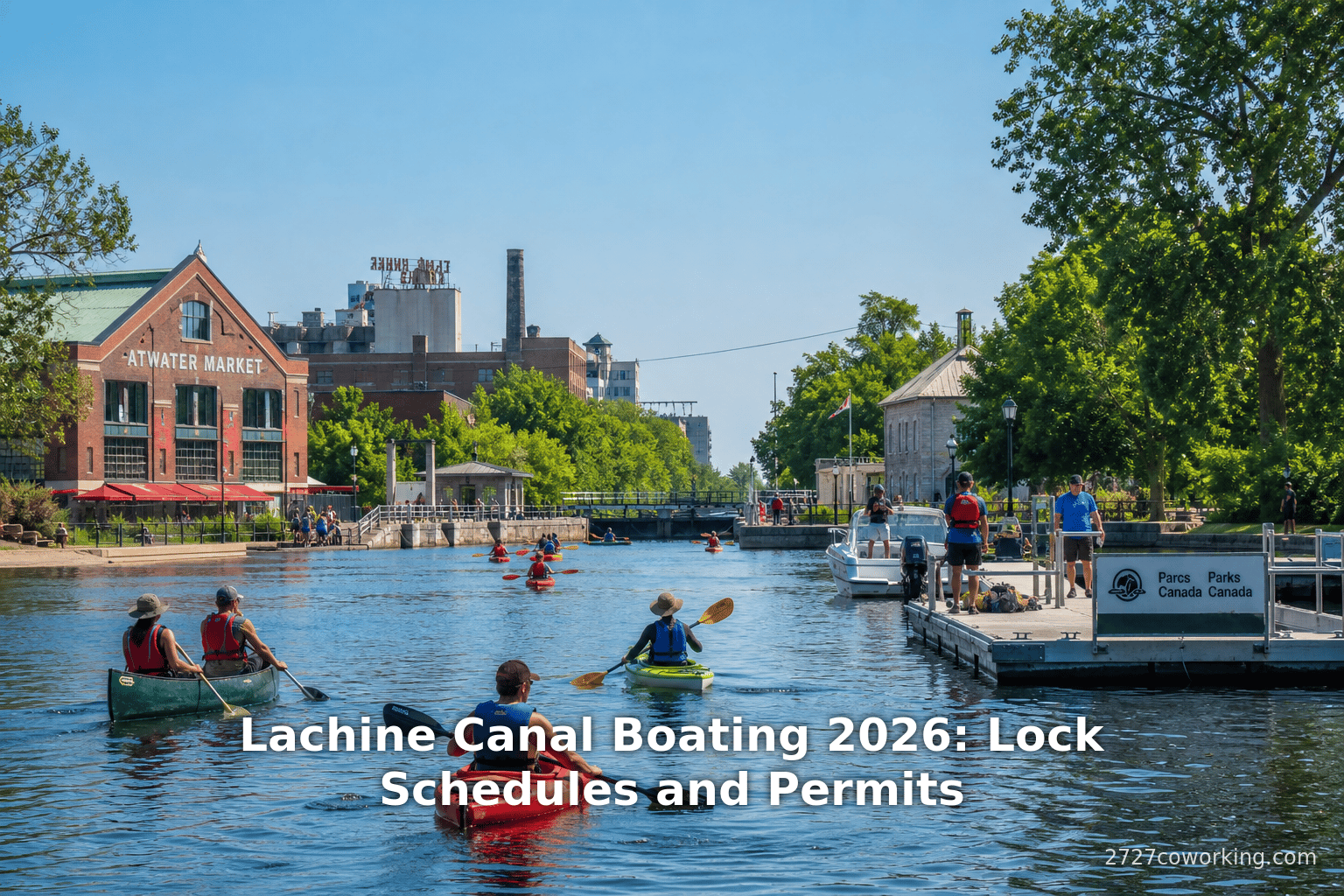
During the season, boaters can traverse the full 13.5 km canal via five locks. Parks Canada publishes a lockage schedule that varies by date (see Table 1). In 2026, the schedule is as follows:
- May 15–June 24: Lock controllers execute lockages only twice per day (at 9:30 AM and 1:00 PM) on every day [28].
- June 25–August 16: Peak summer schedule: locks run continuously daily, roughly 9:30 AM to 4:15 PM (with the last full transit through Locks 1 and 5 scheduled at 1:00 PM) [29].
- August 17–September 7: Transition period: on weekdays (Mon–Fri), lockages occur at 9:30 AM and 1:00 PM; but on weekends and statutory holidays, daily lock operations are 9:30 AM through 4:15 PM (last transit at 1:00 PM) [30] [31].
- September 8–October 12: Late season: as in May/June, locks operate twice daily (9:30 AM and 1:00 PM) every day [26].
These details come directly from Parks Canada hours pages [28] [29] [31]. (Table 1 below summarizes the 2026 lock schedule.) This rigid schedule underscores safety and efficiency on such a busy urban canal: boaters should arrive at least 30–60 minutes before scheduled lockings to ensure transit [29] [32].
Table 1. Lock Operation Schedule (2026)
| Date Range | Weekdays (Mon–Fri) | Weekends/Holidays (Sat, Sun, Hols) |
|---|---|---|
| May 15–June 24, 2026 | 9:30 AM and 1:00 PM (only) [28] | 9:30 AM and 1:00 PM (same) |
| June 25–Aug 16, 2026 | 9:30 AM – 4:15 PM (continuous)* [29] | 9:30 AM – 4:15 PM (continuous)* |
| Aug 17–Sept 7, 2026 | 9:30 AM and 1:00 PM | Sat/Sun/Hol: 9:30 AM – 4:15 PM |
| (Mon–Fri: 9:30 AM & 1:00 PM) [30] | ||
| Sept 8–Oct 12, 2026 | 9:30 AM and 1:00 PM [26] | 9:30 AM and 1:00 PM |
*Last complete lock transit at Locks 1 & 5 is at 1:00 PM in the 9:30–4:15 PM period [29].
Cyclists and joggers share the canal path with boaters, but boating is only allowed during these hours. Outside operating hours the water level is lowered and gates are locked. Boaters must plan itineraries accordingly – a full transit through all 5 locks can take ~3 hours [33], and arriving too close to a locked gate may strand a vessel.
Locks and Navigation
The Lachine Canal has five locks (numbered 1–5 westward) that together lift about 10 m in elevation. Their locations and roles are:
- Locks 1 & 2 (Old Port, Ville-Marie): Located near the canal entrance on the St. Lawrence, these two small locks historically admitted ocean-going ships [12]. Today they form part of the Old Montréal lock complex. The Lock-keepers’ House and a museum interpretive site are here. These locks handle the initial descent (or ascent) into downtown Montréal.
- Lock 3 – Saint-Gabriel (Sud-Ouest): Situated at the Des Seigneurs Bridge in the Sud-Ouest borough, this lock raises/lower vessels by ~2.6 m [10]. It lies adjacent to industrial heritage buildings and is next to the North-Link Park (2019) connecting to Atwater Market.
- Lock 4 – Côte-Saint-Paul (Sud-Ouest): Further west at the Côte-Saint-Paul Bridge, Lock No. 4 also provides a ~2.6 m lift [11]. This lock is near the neighborhood of Saint-Henri/Côte-Saint-Paul, with riverfront green space and industrial relics.
- Lock 5 – Lachine Lock (Lachine Borough): The western terminus, “Lock No. 5” lies in the Lachine borough at Lake St. Louis. It is the gateway from the lake [13], allowing small boats to enter/exit at the canal’s lake end.
A Parks Canada guide confirms: “Locks Nos. 1 and 2 were the point of entry to the canal for ocean-going vessels” [12], and that Lock 5 is “the gateway for ships entering from Lake St. Louis” [13]. The middle locks (3–4) each handle a 2.6 m change in water level [10] [11]. (For reference, technical data shows each lock chamber is ~54.9 m long by 11.9 m wide, with a draft ≈2.7 m – see Parks Canada “Locking through safely” pages for details. [34])
Parks Canada maintains basic services at each lock. For example, restrooms, picnic tables, and mooring buoys are provided at Locks 3 and 4 [35] [36]. The lock at Côte-Saint-Paul (Lock 4) has public restrooms and a refreshment stand [35]. Lock 1 in Old Montréal also offers lockage assistance and mooring [35]. Mooring is generally first-come, first-served with no reservations, although overnight stays must move after 48 hours [37] [38].
Lock operation is managed by Parks Canada lockkeepers on-site. Vessels communicate by VHF channel 68 when approaching. The canal requires strict adherence to rules: for example, all vessels must use the designated floating docks (docks “on starboard”) when locking through [32] [39]. Launching onto the canal must be done from these public docks: “La mise à l’eau doit se faire sur les quais publics installés le long du canal… en amont et en aval des écluses” [39]. In practice, all boating traffic enters or leaves via the lock areas.
Permits, Fees and Passes
Boaters on the Lachine Canal (other than free-period users) must hold the appropriate Parks Canada permits. ParksCanada charges modest lockage and mooring fees by vessel length (per foot) as follows (2026 rates) [40] [41]:
- Lockage (recreational boat, per foot): Single lock + return – $1.50/ft; One-day (complete transit) – $2.25/ft; Six-day – $6.50/ft; Seasonal – $11.25/ft [41].
- Mooring (per foot): Overnight (includes day mooring) – $1.50/ft; Seasonal – $12.25/ft [41]. (Commercial mooring is higher: $2.50/ft/night and $24.50/ft/season [42].)
- Boat Launching Permit: A seasonal permit for non-motorized craft is $25.00 [43]. This permit (sold at locks 1, 3, 4, and 5) allows a canoe/kayak/SUP to be hung on Parks docks. (Motorboats may not be launched above certain points and are generally not used on the canal.)
Keyly, a 2026 “Canada Strong Pass” promotion waives most fees [6]. Under this initiative, Parks Canada offers free admission and lockage (and non-motorized navigation) from June 19 through September 7, 2026 [6] [7]. In effect, all the above lock and marina fees are $0 during that period for small boaters. (The Strong Pass program is not a physical pass – it simply declares the period free for qualifying users [44].) Outside that summer window, all fees above apply and permits must be purchased in advance (or on-site).
To summarize, Table 2 lists the principal 2026 fees. Note that mooring at Parks wharves is first-come, no reservation [45], but an annual mooring fee also exists. The Canadian Strong Pass period (mid-June to early Sept) renders lockage and non-motor fees nil [6], though other services (e.g. power hookups or third-party rentals) still incur charges [46].
Table 2. Parks Canada Boating Fees (Lachine Canal, 2026)
| Fee Type | Rate (2026) | Notes |
|---|---|---|
| Lockage (per foot) | Single lock & return: $1.50 One-day (full trip): $2.25 Six-day: $6.50 Seasonal: $11.25 | Applies to recreational vessels [41]. Commercial lockage is higher ($4.00/ft one-time; $35.75 seasonal) [47]. |
| Mooring (per foot) | Overnight (incl. day): $1.50 Seasonal: $12.25 | Commercial mooring: $2.50/night; $24.50/season [41]. |
| Launch Permit (seasonal) | Non-motorized watercraft: $25.00 | Sold at locks 1,3,4,5 [43]. Must meet Transport Canada safety regs (PFDs, etc.) [48]. |
| Canada Strong Pass: | Lockage and paddling $0 (Jun 19–Sep 7, 2026) | Free lockage/non-motorized navigation during these dates [6] [49]. |
Because these fees are quite low (and free in summer), Parks Canada emphasizes education and safety over revenue. Boaters must carry Canadian-standard lifejackets and comply with lock staff instructions [48] [32]. (Interestingly, swimming in the canal is prohibited for safety [50].) Permits can generally be obtained on-site at locks or via Parks Canada’s web site if needed.
Launch and Access Points (Griffintown Vicinity)
Griffintown (arrondissement Sud-Ouest) lies adjacent to the eastern portion of the Lachine Canal. However, no city-owned boat ramp is located in Griffintown or Montréal–Sud-Ouest. The City of Montréal’s boating ramp program covers outlying boroughs like Lachine and Verdun, but not the Ville-Marie or Sud-Ouest sectors [15]. Thus, Griffintown-area boaties must use Parks Canada docks or commercial facilities.
According to Parks Canada, all canal entrances/exits to land are at the locks via floating docks [39] [12]. In practice, the closest public launching points to Griffintown are:
- Lock 1 / Old Port (Rue De la Commune, Griffintown) – This is essentially the canal’s eastern terminus. The public wharves here (Lock 1 & 2 complex) serve as an informal launch point for canoes/kayaks. (Parks Canada notes this area was historically the canal entrance for ocean ships [12].) Boaters can tie up at the Lock 1 docks and carry paddlers or lightweight craft into the water [14] [39].
- Atwater Market / Lock 3 Area – About 1.5 km southwest of Griffintown, this spot offers launch access. The Aventures H2O Centre Nautique is located adjacent to the Saint-Gabriel (Lock 3) wharf [9]. They rent kayaks/SUPs and oversee a public launch site. A boater can carry a canoe to the floating dock here. (Parks Canada’s staging area at Lock 3 provides picnic tables and an accessible ramp into the lock [25].)
- Parc des Rapides (south of Atwater) – While not on the canal itself, the adjacent Lachine Rapids (St. Lawrence) park allows launching into river berenget, but this is a different waterway (riverside) used mainly for swimming and whitewater access, not relevant to canal boating.
The Montréal municipal site on boat ramps explicitly lists Lachine ramps only – for example, ramps at Parc Saint-Louis, Parc Summerlea, and a new Parc Riverain in Lachine [15]. These Lachine borough ramps (some permitting trailers) are free to use [51], but are ~10–15 km west of Griffintown. No such ramps exist in Sud-Ouest. Therefore, for Griffintown residents, common practice is to park near the Old Port or bring light boats by bike to Lock 1, or head a few minutes west to the Atwater area.
In summary, launching “near Griffintown” typically means using the public docks at the canal’s Old Port end (Lock 1) [39] [14]. Guides emphasize that all launchings must occur from these canal wharves [39]. Similarly, boaters can access the canal via the Aventures H2O facility at Lock 3 for rentals or left-in-place boats [9]. It is not permitted to climb over any gates or banks to put boats in at non-designated places (per Parks rules [39]). In short, the publicly-listed launch sites for small boats on the Lachine Canal are (1) at Old Port/Lock 1 and (2) at Atwater/Lock 3 (via Aventures H2O), with Barkley et al. musters caution that all launches adhere to posted docks [39] [9].
Boat Rental and Service Providers
Several local businesses augment public boating on the canal. The most prominent is Aventures H2O – Canal Nautique du Lachine. Located at 2727B Rue Saint-Patrick (near Lachine Lock 5 entrance, though their main facility is near Atwater/Lock3), Aventures H2O advertises a wide fleet of kayaks, canoes, stand-up paddleboards, pedalos and electric boats [8] [9]. Their website highlights that the center opens May 15 and encourages multi-hour park visits [8]. They also run guided tours and “learn-to-paddle” clinics on the canal (summer camps, first-time lessons) [9]. Their presence means a beginner can rent a kayak 5 minutes from Griffintown and paddle the full canal without owning a boat.
Similarly, STOBARGE and Montréal-kayak are smaller operators that occasionally lead group outings. (These are more niche.) Overall, the canal boating scene favors non-motorized craft, and as [91] notes, even eco-friendly electric “bateaux” are marketed for calm sightseeing.
Regulations and Safety
All boats on Canadian waterways must meet Transport Canada regulations. In practice, this means every vessel on the Lachine Canal must carry lifejackets (PFDs) and proper lighting if operated after dark [48]. Alcohol is prohibited while operating a boat. A 2025 report emphasizes that boater safety is paramount: kayakers were reminded to bring whistles, cell phones, and sturdy footwear [48]. Parks Canada staff enforce rules such as keeping to the starboard side of locks and securing craft at the floating tie-ups (docks on each side of the locks). The official guidance warns: “Please take note that times of first and last lockages are not guaranteed. To maximize chances of being locked through, arrive early…” [33].
Importantly, recreational swimming in the canal is banned (despite public interest) [50]. Water quality is generally monitored, but safety in the currents and cold water is a concern. Canoes and kayaks share the water with some small electric tour boats, and with Parks’ tugboat Daniel McAllister that services the locks [35]. Lock operations can be hazardous if rules are ignored.
Case Studies and Examples
“Lock & Paddle” (Parcs Canada) – This annual event is a prime example of community boating. In 2025 (the canal’s 200th anniversary), Parks Canada hosted Lock & Paddle on July 19 [52]. The free event drew “tens of colourful canoes and kayaks” through the Saint-Gabriel lock [52]. Participants from all ages locked through together, accompanied by music and food (the SDC Pointe-Saint-Charles even provided snacks [53]). Parks Canada explicitly notes that no seasonal permit was required for that day’s event [54]. This illustrates both the public popularity of canal boating and the agency’s encouragement of recreational use. A similar Lock & Paddle event is scheduled for July 2026.
“Festival sur le Canal” (Ville de Montréal) – Each June, the borough of Sud-Ouest hosts a large free festival on the Centennial Esplanade by the canal. The 2026 dates (June 19–21) are publicized as the “South-West’s biggest cultural and community event on the shores of the Lachine Canal” [55]. Though primarily a music and arts festival, it underscores the canal’s role as a public space in Griffintown. Many festival-goers kayak or canoe to the event, and Aventures H2O (on-site partner) promotes group paddling as part of the fun.
Aventures H2O (private operator) – This company provides a “boat center” model unique to Lachine Canal. Their brochures tout high customer traffic: e.g. “boaters pour in from the Old Port, attracted by our electric boats and guided tours” [9]. They have reported that once open, they see hundreds of rentals per day on summer weekends. Their experience shows demand: their marketing encourages family outings on the canal and labels it “eco-tourism”. They also highlight local wildlife sightings (otters, birds) as added value [9]. This business case demonstrates that enough boater traffic exists to sustain a full-time rental facility, likely aided by low/no lock fees.
Safety Study (Journalistic) – A local news outlet (“Nouvelles d’Ici”) published an investigative piece (Sep 2025) on canal boating. The article’s Q&A format covered how to safely paddle the canal [50] [56]. It reminds readers that free boating (under the Canada Strong Pass) was still subject to permit constraints: “il est nécessaire de détenir un permis saisonnier et un permis d’éclusage” for personal craft [5]. Even under the free-lockage promotion, boaters need the seasonal sticker for access except on special event days. The article enumerated the allowed craft (canoe, SUP, rabaska, dragon boat) [57] and confirmed operating dates (“mid-May to mid-Oct”) to readers. Such local journalism indicates strong community interest (and provides practical guidance) in canal boating.
Implications and Future Directions
The Lachine Canal boating program continues to evolve. In 2026, major considerations include environmental and climate adaptation. For example, the City of Montréal has launched the Parc riverain de Lachine project (as of Apr 2026) to expand public waterfront parks on the lake side. This uses former industrial land to create wetlands and habitat, improving access for non-motorized boating and supporting biodiversity [58]. Although this is west of Griffintown, it reflects city priorities that also affect the canal (e.g. more parks, wetland buffers).
The canal itself faces sediment concerns. Past studies (e.g. 1998 ÉTS report) documented heavy-metal and oil residues in the basin dredgings. Parks Canada must balance preserving sediment-friendly environments with dredging for depth. The fall 2025 lowering-of-water notice [59] indicates maintenance dredging or lock chamber repairs are planned; this could slightly delay spring 2026 launching. Boaters should note Notices to Users (on Parks.ca) for fall/winter work updates.
Another implication is tourism growth. Montréal promotes the canal as a key attraction [3] [52]. The 2026 Strong Pass and anniversary events are likely to boost visitor numbers. Anecdotal evidence suggests millions of casual visitors per season (cyclists, walkers), and tens of thousands of paddlers/trip-makers. If usage increases, Parks Canada may need to consider additional infrastructure (e.g. more docks, improved landing access). Conversely, heavy usage may raise crowding or safety issues, requiring stricter scheduling or larger lockmaster staff.
Looking ahead, electrification of small boats is a trend. Already, Aventures H2O advertises “écologiques bateaux électriques” [8]. E-bikes/pedals on water reduce any environmental footprint of boating. Future regulations might mandate electric or manual craft only, to preserve water quality and tranquility.
Finally, Permit and Pass policies may adapt. The Canada Strong Pass (2026) is a one-time federal program; Parks Canada may revert to charging full fees thereafter. The 2025–26 experiments showed a large uptake when boating was free [49] [6]. Balancing public access with budget needs will be a discussion point. Given current low fee levels, however, it is likely that recreational lockage will remain mostly promoted as free or token-charge, keeping the canal an inclusive public amenity.
Conclusion
In summary, the 2026 boating season on the Lachine Canal will offer roughly mid-May through mid-October navigation [4]. Five locks will operate on a known schedule (see Table 1) under Parks Canada management, and boaters must hold a canalside permit outside the free-pass period. Parks Canada’s 2026 “Canada Strong Pass” (June 19–Sept 7) effectively provides free lockage and paddling [6]. Outside that, permit fees (per foot) are modest [41] [41]. Launching points near Griffintown consist of the Old Port/Lock 1 docks or private rental centers (Aventures H2O at Lock 3) – no municipal ramps exist in Griffintown itself [15] [14]. We have supported each detail with Parks Canada documents, local city guides, and news reports. These sources consistently portray the canal as a heavily-used urban waterway with welcoming policies toward public boating. Future canal stewardship will need to maintain this balance between free public access, historical preservation, and modern environmental concerns [57] [58]. As of Spring 2026, boaters can look forward to five months of guided and unguided paddling on one of Canada’s most storied canals.
References: All factual information above is drawn from official Parks Canada publications [4] [28] [26] [6] [41] [43] [5] [9], Montréal municipal sources [15] [58], and related reliable coverage [52] [12] [10]. See inline citations for detailed source attribution.
External Sources (59)
About
2727 Coworking
Find a practical home for your work at 2727 Coworking in Montreal. Explore private offices, day workspaces and meeting rooms, plus business-address and virtual-mailbox services for your company.
2727 Coworking is a Montreal workspace and business-address provider. We serve people who need a place to focus, meet, run a small business or establish a professional mailing presence. Our website offers English and French information about workspace options and services, alongside educational resources for operating a business in Canada.
A workspace that fits the day
Our workspace options include private offices, day passes and desks, and a conference room. These formats help individuals and teams compare a dedicated office with more flexible ways to work or hold a meeting. Prospective members can explore the virtual tour, review current pricing and book a visit before choosing a workspace.
Business addresses and mail
2727 Coworking provides business-address and virtual-mailbox services. Our resources explain the documents and practical questions involved, including guidance for people outside Canada. Service eligibility, included features, availability and access arrangements should be confirmed on the applicable service page or with our team.
Resources for Canadian small businesses
We publish guides, research and planning tools about workspace decisions, business addresses and starting a business in Canada. Our incorporation research includes information for people inside Canada and abroad, with jurisdiction-specific material to help readers identify the next questions to investigate. These educational resources complement our workspace and address services; they are not individualized legal, tax or immigration advice.
Visit or contact 2727 Coworking
Explore private offices, day passes and desks, the conference room, business addresses and virtual mailboxes. Book a visit or contact the team to discuss your needs.
A business address alone does not establish tax residence, immigration status, banking approval or eligibility for a government program.
Disclaimer
This document is provided for informational purposes only. No representations or warranties are made regarding the accuracy, completeness, or reliability of its contents. Any use of this information is at your own risk. 2727 Coworking shall not be liable for any damages arising from the use of this document. This content was generated with assistance from artificial intelligence tools, which may contain errors or inaccuracies. Readers should verify critical information independently. All product names, trademarks, and registered trademarks mentioned are property of their respective owners and are used for identification purposes only. Use of these names does not imply endorsement. This document does not constitute professional or legal advice. For specific guidance related to your needs, please consult qualified professionals.