
2727 Coworking Article
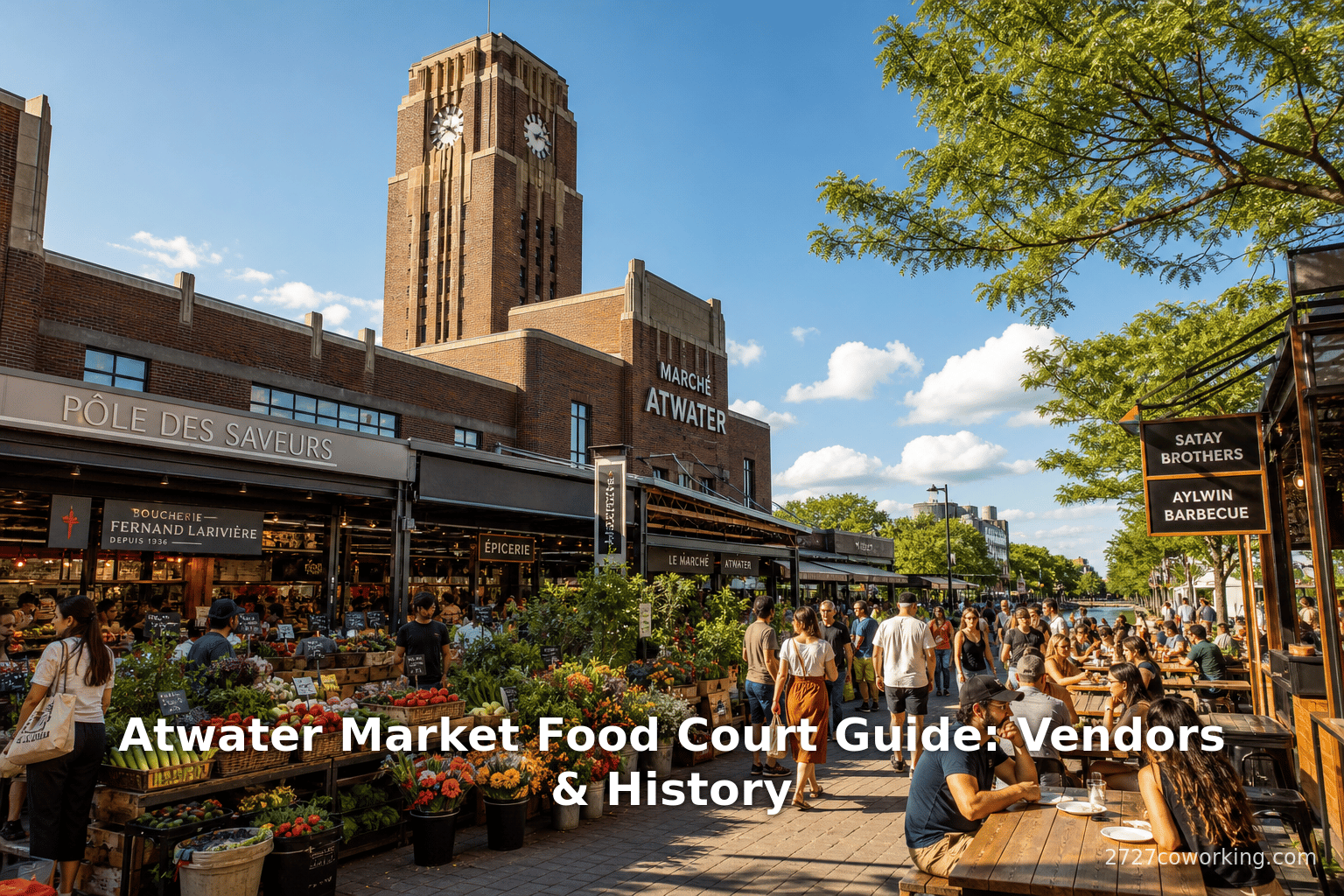
Atwater Market Food Court Guide: Vendors & History
Inside this article
- 01Executive Summary
- 02Introduction and Background
- 03Vendor Categories at Atwater Market
- 04Butcher Shops at Atwater Market
- 05Bakeries, Boulangeries and Sweets
- 06Prepared Food Counters and Lunch Spots
- 07Eating Lunch at Atwater Market
- 08Implications, Challenges, and Future Directions
- 09Case Study: Satay Brothers – From Market Stall to Success
- 10Discussion and Future Implications
- 11Conclusion
Executive Summary
Atwater Market (Marché Atwater) in Montreal is a historic public market dating from 1933, renowned for its Art Deco architecture and role as a hub of local gastronomy [1] [2]. The market currently hosts on the order of 60–65 vendors (Shopping Canada lists 63 vendors) covering a wide range of categories [3] [4]. Among these are numerous food counters and stalls – for ready-to-eat meals – as well as specialty shops such as butcheries, bakeries, fromageries, chocolateries, and fishmongers, reflecting Montreal’s artisanal food culture [5] [4]. In this report we analyze the Atwater Market food court and vendor offerings in depth, focusing on counters (prepared food stands), butcher shops, bakeries/patisseries, and lunch destinations. We combine historical context, vendor data, and expert observations, and provide specific examples and case studies (e.g. Satay Brothers, Aylwin Barbecue) to illustrate how Atwater serves both residents and visitors looking for high-quality local and international fare.
Key findings include: Atwater’s unique design and canalside location have made it a beloved landmark [1] [2]. During summer, the market activates its Pôle des Saveurs (outdoor food court) with diverse cuisine and picnic seating by the Lachine Canal [6] [6]. The market contains roughly eight butcher shops (from large family businesses like Boucherie Adélard Bélanger – operating since 1933 [7] – to newer organic vendors like Boucherie Saint-Vincent [8]) and multiple bakeries (for example Première Moisson, an in-house bakery since 1994 [9]). Popular lunch spots include Aylwin Barbecue (known for American-style smoked meats [10] [11]) and Satay Brothers (Singaporean-style noodles and buns [12]). Local reports emphasize seasonal offerings: horticultural stalls in spring and summer, and a “heated” winter market with special events (maple festivals, beer tastings, cocktail hours) [13] [14]. In sum, Atwater Market exemplifies Montreal’s approach to public markets – combining day-to-day local shopping (meat, bread, produce) with cultural and culinary programming – and is poised to continue evolving its vendor mix and events in future years [2] [14].
Introduction and Background
Location and History: The Marché Atwater is located at 138 Avenue Atwater in the Sud-Ouest borough of Montreal, adjacent to the Lachine Canal [1]. It was officially inaugurated on April 15, 1933 [15], replacing the earlier Marché Saint-Antoine (dating from 1861) and providing jobs through a public work initiative during the hard times of the Great Depression [15]. The market was designed by architects Ludger Lemieux and Paul L. Lemieux in the Art Deco style, making it one of Montreal’s architecturally significant buildings [1] [2]. Its façade features stylized motifs of agriculture and commerce, symbolizing its role as a center of the local food economy. The market bears the name of Edwin Atwater, a 19th-century city councilor after whom the adjacent avenue is named [1].
Architecture and Facility: Atwater Market’s vaulted central hall and flanking wings create a large indoor space that houses year-round vendors. It is widely described as an “architectural gem” and one of Montreal’s most beautiful buildings [1]. Original plans and archival photos show the market in operation by the late 1930s (see [Building Archive, ref. 7] for pre-1940 images). A timeline of Montreal indicates that the building has functioned continuously as a market since its opening [15]. In recognition of its heritage value, the market is listed among city highlights on tourism guides [1] [2]. In practice, the market’s large halls allow dozens of vendors to operate simultaneously, covering multiple categories (produce, meat, dairy, baked goods, specialty foods, etc.) under one roof. Official sources note that Atwater Market remains open both summer and winter, adapting its layout seasonally [1] [6].

Figure 1: The Atwater Market building seen from the Lachine Canal in winter.Its Art Deco facade and canal-side terrace are notable features [1] [2]. In warm weather, outdoor picnic tables line the canal for dining.
Function and Management: Marchés Publics de Montréal, a municipal organization, manages Atwater along with Jean-Talon and Maisonneuve markets. Their official description emphasizes Atwater’s diverse vendor mix: “fruit and vegetables, butchers, fishmongers and cheesemongers, market gardeners and shopkeepers all rub shoulders” inside the market [5]. The market is a year-round operation: in cold months, glass walls enclose part of the plaza so that vendors and shoppers stay sheltered [16], while in warm months the building is opened up and an outdoor food court (the Pôle des Saveurs) dominates dining aspects [6] [6]. The official site highlights that the market is a key node for “high-quality, seasonal products from our food producers and artisans” [5].
Seasonality and Events: A distinguishing feature of Mile-End’s Jean-Talon, the Atwater Market also emphasizes seasonality. For instance, horticultural vendors set up in spring, and stand-based produce vendors operate in adjacent outdoor spaces through late fall [17]. Tourism guides note that summer brings plentiful local fruits and vegetables (asparagus, berries, melons) [18]. The market’s programming calendar includes special events that leverage seasonality: a “Sucres” maple-sugar festival around March, outdoor craft fairs, and food-themed pop-ups [14]. In summer, live events (beer tastings, cocktail nights) take advantage of the riverside terrace [19]. As one guide says, “the market moves to a seasonal beat,” meaning its offerings and attractions shift with the calendar [19].
The importance of Atwater Market in Montreal’s local food ecosystem is reflected in recent analysis. A Spring/Summer 2026 market guide describes dozens of produce and horticultural vendors arriving in late April, alongside permanent indoor grocers [14]. It notes that Atwater, originally built in 1933, is “renowned for its Art Deco architecture and wide selection of local foods” [14]. Tourisme Montréal similarly emphasizes that Atwater operates since 1933 and is a “popular hub for an array of local and hard-to-find gourmet products” [2]. These sources underscore the market’s dual role: preserving heritage architecture and serving cutting-edge culinary trends.
Vendor Categories at Atwater Market
Atwater’s roughly sixty vendor spaces cover a broad spectrum of food products. We categorize them broadly as produce/horticulture, butcher/meat, seafood/fish, dairy/cheese, bakeries/patisseries, and prepared-food counters (restaurants and delis). This report focuses especially on the latter three: butchers, bakeries, and lunch counters. Before delving into each in detail, Table 1 below summarizes the major vendor categories and counts as reported by market guides and trade resources.
| Category | Examples of Vendors | Notes |
|---|---|---|
| Produce & Flowers | Seasonal farmers (local algae) [20], greenhouses (summer) | Outdoor vegetable and flower stands spring–fall [17]. |
| Butchers | Adelard Bélanger & Sons; Les Deux Frères; SOS Boucher; Saint-Vincent | Eight butcher shops in total [21], specializing in meats (see Sec. 3). For example, Bélanger has operated since 1933 [7]. |
| Seafood & Fish | Capitaine Crabe | Single large fishmonger selling lobster, crab, etc., popular for fresh seafood. |
| Cheese & Dairy | Fromagerie Atwater; Fromagerie Hamel; Le Paradis du Fromage [22] | Multiple cheese shops; stocks both Quebec artisanal cheeses and specialty imports. |
| Bakery & Pastry | Première Moisson; Atelier Cookie par Caro | Known artisanal bakery (at Atwater since 1994 [9]), cookie and pastry counters (see Sec. 4). |
| Chocolates & Sweets | Geneviève Grandbois; Chocolats Privilège† | Gourmet chocolate shops based in Atwater [2], among others. |
| Prepared Food Counters | Aylwin Barbecue; Satay Brothers; Petit Sao; Roule Ma Poule; Bubble Tea Shop; etc. | Stand-up food stalls offering ready-to-eat meals. Pôle des Saveurs seats diners outside [6] [6]. |
| Cafés & Condiments | Brûlerie Aux Quatre Vents (coffee); L’Atelier du Cidre (cider bar); La Cabane – Bar Laitier (maple-sugar shack) | Beverage and deli counters for coffee, cider, ice cream/sugar shack items, etc. |
Table 1: Summary of vendor types at Atwater Market. The market’s mix includes dozens of local growers plus vendors in each category [4] [5]. Butchers (see Sec. 3) comprise about eight separate stalls [21]; bakeries/pastry (Sec. 4) include multiple artisanal shops; and the prepared-food sections (Sec. 5) feature diverse ethnic and barbecue cuisine. Not listed are general groceries and florists, which also exist at lesser scale.
Produce and Specialty Shops (Context)
Although the focus of this guide is on food service and specialty counters, it is instructive to briefly note the broader vendor base. In particular, the market’s produce and horticultural vendors anchor its seasonal identity. In spring, local horticulturists bring flowers and bedding plants; by summer, dozens of stands overflow with Quebec fruits, vegetables, berries and herbs [23] [18]. (For example, the 2026 guide notes that “stands overflow with beautiful flowers, flavorful herbs and juicy vegetables” in outdoor season [23].) Horticulture vendors occupy exterior space alongside the building, moving outdoors in late April and remaining through autumn [17] [14]. These stalls, often new-generation growers, supply the market with asparagus, fiddleheads, tomatoes, corn, melons, stone fruits and more during their peak seasons [18].
In addition, markets newcomers often introduce specialty retail. For instance, Atwater includes bakeries (like Première Moisson, see below) that sell take-home bread and pastries, fine grocery shops (Les Douceurs du Marché sells imported cheeses, pates, etc.), spice and condiment retailers, nut vendors, and an apple-cider emporium. A number of merchant counters also handle niche goods: a local soap and candle maker, candlemakers, and even a Christmas tree lot in December. However, given the present topic, we concentrate next on the butcher and bakery segments in detail, followed by dining venues.
Butcher Shops at Atwater Market
Meat and charcuterie are cornerstone offerings at Atwater. The market supports on the order of eight distinct butcher/charcuterie stalls [21]. This unusually high concentration reflects Montreal’s strong tradition of local meat vendors. These butcheries are mostly family-owned and have developed identities around regional sourcing and specialty charcuterie. Table 2 lists the main Atwater butcheries, with their specialties and notable features.
| Butchery | Specialty/Notes | Source/Remarks |
|---|---|---|
| Boucherie Adélard Bélanger & Fils | Classic Quebec charcuterie: traditional sausages, pâtés, ribs, and marinated meats for barbecue. Fourth-generation family business operating continuously since 1933 [7]. | Opened when the market began; today the owner sells “old-fashioned sausages and ribs” by hand [7]. |
| Boucherie Les Deux Frères | Locally-sourced meats (pork, beef, poultry). Known for emphasis on regional producers: “Guy… chooses with care his farmers” to supply local meat [24]. | Owner Guy Jean welcomes customers daily, highlighting Quebec producers [24]. |
| SOS Boucher | Poultry specialist: artisanal chicken, turkey products. Offers pâtés, sausages, terrines. Has operated ~30 years. | Described as an “artisan” shop specializing in poultry preparation [25]. |
| Boucherie Les Viandes Saint-Vincent | 100% organic meats (beef, chicken, turkey, wild game). Sells certified organic Charolais beef and pasture-raised poultry from its own farm. | On-site butcher for Ferme Saint-Vincent; “nearly 20 years” at Atwater offering “viande de qualité 100% biologique” [8] (family farm since 1958). |
| (Other / Shared vendors) | Boucherie de Tours (beef, pork, game); Boucherie Claude & Henri (traditionnel Quebec meats); Boucherie Bélanger (possibly same as Adélard Bélanger); etc. | Not fully profiled; vendor count is ~8 but the above are principal, long-running ones. |
Table 2: Major Atwater Market butcheries. The eight total butcher shops include longtime family charcuteries and organic producers [21]. Citations give examples: e.g., Adélard Bélanger’s is still run by the founding family (4th generation) and focuses on old-fashioned sausages [7], while Saint-Vincent sells only certified organic meat [8].
Each of these butcheries has its own history and focus. For example, Boucherie Adélard Bélanger & Fils has traded here since the market’s opening (the family took occupancy in 1933) [7]. Today the fourth-generation Bélanger is “waiting to introduce you to his mostly local products” [24] (e.g. smoked bacon, thick-cut steaks, house-made sausages). The coworking report notes that this shop still offers “old-fashioned sausages and ribs” and is associated with classic BBQ fare [7]. Similarly, Boucherie Les Deux Frères (literally “two brothers”) delights clients “with local products” – as one description says, owner Guy “chooses with care his breeders and maintains privileged relations” with Quebec farms [24]. This emphasis on Quebec-sourced product is echoed by Boucheries & Ferme Saint-Vincent, which operates both an organic farm and Atwater charcuterie. Saint-Vincent’s meats are 100% certified organic (beef, poultry, etc.), drawn from their Lanaudière farm [8]. According to the public markets site, Saint-Vincent has been at Atwater for “nearly 20 years” supplying exclusively organic meats [8].
The eight butcheries are not identical; some are more like charcuteries (offering pâtés, terrines, deli meats) while others focus on raw cuts. For instance, SOS Boucher (see [32]) is described as an artisanal poultry butcher that produces pâtés and sausages over three decades [25]. The result is a dynamically structured meat category: one market guide notes that “eight Atwater butcher shops…offer smoked sausages and grilled meats ideal for grilling,” especially in summer [21]. Consumers can thus stock up on barbecue staples (sausages, ribs, marinated chicken) or explore fine charcuterie plates.
Economic Role and Trends: Butcher shops at Atwater exemplify the market’s link to local agriculture. Several explicitly highlight regional sourcing (Saint-Vincent’s Quebec organic farms, Les Deux Frères’ local farms) [24] [8]. This ties into wider interest in Quebec agriculture: a 2025 report on Quebec markets notes that Montreal markets draw much of their supply from within the province. However, exact production figures for Atwater vendors are not published. What is evident is that nearly all Atwater butchers (Belanger, Saint-Vincent, etc.) source from local or provincial farms, consistent with the market’s locavore mission [24] [8]. The concentration of butchers (8 stalls in one market) is unusually high compared to typical city blocks, underscoring Atwater’s specialty status.
Over recent decades, the trend has been to maintain traditional values while innovating product lines. For example, some Atwater butchers now prepare take-home meal kits or snack packs for picnics [26]. The coworking guide notes that many vendors offer “sandwich fixings” and ready-to-eat sides. The mix of classic (smoked sausage, barbecue ribs) and ethnic (some stalls may sell spreadable terrines, East European sausages, etc.) reflects Montreal’s multicultural palate.
Bakeries, Boulangeries and Sweets
Alongside the butchers, the Atwater Market contains several artisanal bakeries, pastry shops and confectioners. These shops supply bread, cakes, cookies and desserts that often complement the meats and cheeses. Notable vendors include Première Moisson Atwater, Atelier Cookie par Caro, and chocolateries like Chocolats Geneviève Grandbois and Chocolats Privilège. Table 3 summarizes key bakery/pâtisserie vendors.
| Bakery/Pâtisserie | Specialty | Source/Notes |
|---|---|---|
| Première Moisson (Atwater) | Artisan bakery – breads, croissants, pastries. | On-site bakery since 1994 [9]. Uses natural unbleached flour [9]. (Part of a Quebec chain.) |
| Atelier Cookie par Caro | Gourmet cookie boutique. | “Artisan cookie shop…luxury” by Caroline Héroux (located at Atwater) [27]. Known for unique cookie flavors. |
| Brûlerie Aux Quatre Vents (Atwater) | Coffee roaster with pastries. | Known locally for fresh-roasted coffee and café pastries (e.g. muffins, scones). Customers eat on-site. |
| Havre aux Glaces (H-St.) | Ice cream parlor (Atwater stand). | Seasonal ice cream & sorbet (Quebec flavors). In RestoMontreal lists as the Atwater dessert vendor. |
| Chocolats Geneviève Grandbois | Chocolates, confections, macarons. | High-end chocolate boutique founded 1995 (also nearby). Atwater location sells truffles and sweets. |
| Chocolats Privilège | Fine chocolates and candies. | Established Montreal brand located inside Atwater, carrying bonbons and mass chocolates. |
| (Seasonal/Bakery pop-ups) | Artisan pies, cake slices (by Pie Susu or others). | Local or visiting bakers sometimes set up seasonal stands (especially around holidays). |
Table 3: Atwater Market bakeries and sweets vendors. For example, Première Moisson’s Atwater bakery (open since 1994) is famed for its sourdough, rye and croissants [9]. The cookie shop “Atelier Cookie par Caro” (run by Caroline Héroux) offers upscale cookies with unusual flavors [27]. Multiple chocolatiers (“Chocolats Geneviève Grandbois” and “Privilège”) provide luxury sweets (see Sec. 4). The market’s summer events also feature seasonal pastries like strawberry-rhubarb pies [28].
Première Moisson (Atwater) is the anchor bakery in the main building. It is described on the public markets site as “an artisan bakery” established at Atwater in 1994 [9]. Première Moisson baked goods are widely praised: they use natural, unbleached flours and authentic yeast-leavening to produce crusty loaves, seeded rye bread, baguettes and croissants [9]. In addition to bread, they offer sandwiches and ready-to-eat tartines, but it is the breads that are their hallmark. The coworking “vendor guide” notes that shoppers often pick up artisanal bread (rye, sourdough) and pastries (croissants, pies) from Première Moisson [28]. Thus, Première Moisson is often listed among the market’s highlights and even appears in Montreal food directories as a recommended stop.
Other Desserts and Pastries: Beyond the in-house bakery, several specialty sweet vendors operate. Atelier Cookie par Caro is one such counter, described as an “artisan cookie shop” that “revisits the cookie with a touch of luxury and a lot of love” [27]. Run by local author Caroline Héroux, it offers novelty cookie flavors (e.g. salted caramel, pistachio raspberry) that serve as indulgent treats or accompaniments to coffee. Another category is chocolateries. Atwater hosts Geneviève Grandbois – a well-known Montreal chocolatier – whose stand sells truffles, bonbons and macarons. (Although Grandbois’s flagship store is nearby, the Atwater stall allows shoppers to buy chocolates directly at the market.) Similarly, Chocolats Privilège occupies a corner stall with hand-crafted confections, appealing to tourists and locals alike. These sweets vendors reflect Atwater’s reputation for “hard-to-find gourmet products” [2].
Seasonal and Trendy Offerings: The bakery/dessert sector also adapts to season. The spring/fall produce guide mentions that summer visitors prize seasonal desserts: “strawberry rhubarb pie, fruit galettes” and other fruit-based pastries are especially popular [28]. In winter, ephemeral vendors or pop-up counters occasionally appear (for example, holiday gingerbread stalls or maple-sugar kiosks). Meanwhile, cafés and snack counters (examples in Sec. 5) often stock cookies and squares as lunch pairings. Overall, the presence of artisanal bakers and chocolatiers adds to the market’s draw as a gourmet shopping destination.
Prepared Food Counters and Lunch Spots
Arguably the most visible aspect of Atwater Market – especially to casual visitors – is its prepared food counters and eating areas. These include indoor kiosks and a seasonal outdoor “food court” called the Pôle des Saveurs, which together form the market’s food-court atmosphere. Rather than a single cafeteria, Atwater’s lunch options are a collection of independent stalls serving diverse cuisines, catering to both market shoppers and outside diners. In warmer months, picnic tables and canal-view terraces provide seating for ready-to-eat meals [6] [6]. Even in cold weather, the interior food counters remain busy with takeout. Table 4 highlights some of the most notable lunch stalls.
| Vendor / Counter | Cuisine / Offerings | Remarks and Sources |
|---|---|---|
| Aylwin Barbecue | American-style smoked meats (brisket, ribs, sausage, pulled pork). Also burgers and sides. | Highly recommended: “one of the best platters in the city” [10]. Founded by chefs Antoine Bériault & Annie Lacombe [11]. |
| Satay Brothers | Southeast Asian (Singaporean) street food: satay skewers, laksa noodle soup, steamed buns, papaya salad. | Signature laksa soup is popular [12]. Permanent stall since 2011 [29]. Praised for “spicy noodles” [30] [12]. |
| Roule Ma Poule (Rotisserie) | Rotisserie chicken and poultry (whole and parts), soups, and sides. Often sells take-out meals (roasted half-chicken, poutines with chicken, etc.). | Family business by known rotisserie chef. Popular source of grilled chicken. |
| Poissonnerie Capitaine Crabe | Seafood specialties: lobster rolls, crab cakes, chowders, smoked fish, etc. Also fresh fish market. | Longstanding Atwater vendor for lobster and crab. Draws seafood-lovers (no direct citation). |
| La Cabane – Bar Laitier | Sugar-shack specialties: ice cream, maple taffy, beaver tails (fry pastry), etc. Seasonal winter kiosk. | Located on canal terrace. Features local maple products; crowds in winter festivals. |
| Prêt-à-boire (Juice Bar) | Fresh fruit/vegetable smoothies and juices. Also some light snacks. | Healthy option by working professionals and shoppers. |
| Bubble Tea Shop | Bubble teas, smoothies, crepes. | Asian-style beverage stand, popular with youth (as per RestoMontreal listing). |
| Petit Sao | Vietnamese banh mi sandwiches and bubble tea. | Suggesting a global flavor; listing on RestoMontreal (temporarily closed). |
Table 4: Sample prepared food counters in Atwater Market. These represent current “food court” offerings. Notably, food blogs and guides consistently highlight Aylwin Barbecue and Satay Brothers [10] [12] as must-visit counters. Other stalls like Rotisserie (“Roule Ma Poule”) and Capitaine Crabe provide meat and seafood mains. The Pôle des Saveurs area (outdoors by the canal) seats many of these kiosks during spring–fall [6] [6].
Aylwin Barbecue: This Texas-style barbecue stall is a poster-child for Atwater’s food counters. Operated by renowned Montreal chefs (Antoine Bériault of Bouillon Bilk and Annie Lacombe of restaurant Bidon) [11], Aylwin serves smoked brisket, ribs, chicken sausage, pulled pork and more. Reviewers praise its generous meat platters and Southern-style sides (coleslaw, pickles, potato rolls). Eater Montreal calls Aylwin’s dishes “some of the best platters in the city,” noting they include chicken sausage, brisket and ribs accompanied by fresh sides [10]. Food writer Mallory Frayn recommends Aylwin as one of the market’s top eats, describing its “succulent barbecue” as a draw [11] [10]. Aylwin’s stand is open daily and is busiest at lunch; lines often form by noon.
Satay Brothers: A favorite for international cuisine, this stall offers Singaporean and Malaysian specialties. Originating in Atwater in 2011, the Satay Brothers have become famous for their spicy laksa noodle soup and pandan chicken satays. Their menu includes steamed pork buns, green papaya salad, and vegetable samosas. According to Eater, “Satay Brothers serve up favourites like steamed pork buns and green papaya salad,” and the signature laksa is a hot spicy soup perfect for warm days [12]. The dining area at Satay Brothers (with a few seats) is popular with friends and families. Since gaining popularity, the owners have opened a full-service restaurant on Notre-Dame Street, but the market stall remains a day-time draw. Satay Brothers exemplifies how ethnic cuisines have thrived at Atwater.
Other counters add to the variety. Roule Ma Poule (literally “Bake My Chicken”) is a rotisserie stall run by a Montreal rotisserie chef (Maxime Bonn-Muller). It serves whole or half roast chickens, chicken sandwiches, and chicken poutines. In summer, its smoked Montreal-style meat spice draws customers picking up picnic dinners. Capitaine Crabe on the fishmonger aisle offers lobster rolls, steamed seafood, chowders and smoked fish platters – in effect a “New England seafood shack” feel. Families often buy a lobster roll and sit by the canal to eat. (These units are partly seasonal: Capitaine Crabe does brisk business in summer with tourists.)
Beverage and Snack Stands: In addition to full meals, Atwater has smoothie/juice bars and sweets stands. A juice and smoothie counter provides healthy drinks from fresh produce, appealing to office workers. A Bubble Tea Shop near the center sells tapioca tea, coffee, crepes and Asian snacks (it is listed on RestoMontreal and Yelp). In cooler months, La Cabane – Bar Laitier occupies the terrace area; this “sugar shack” pop-up sells ice cream, maple taffy and beaver-tail pastries (a spin on a fried dough specialty).
Pôle des Saveurs (Food Court): Importantly, many of these counters are grouped in the Pôle des Saveurs, the market’s outdoor dining extension. According to the market’s management, in summer “the Pôle des Saveurs, focusing on fast, innovative and delicious food,” opens alongside picnic tables and a large terrace by the canal [6] [6]. This plaza atmosphere allows shoppers to eat on-site. The official description invites patrons to “take a seat around the picnic tables or on the large terrace by the Lachine Canal and enjoy your ready-to-eat meals” [6]. Thus, the market provides both high-end sit-down restaurants (outside the market) and informal lunchtime counters within.
Customer Perspectives: Many Montreal guides and blogs emphasize these food counters. Beyond the quotes above, syndicated guides urge visitors to “go beyond the produce stands for succulent barbecue, spicy noodles, and more” [30]. Winner of 2019 Best Sandwich and Best Lunch lists (local press), Aylwin Barbecue has also won social media attention (viral TikTok videos). In a recent County magazine feature, Atwater was described as “a street food lover’s paradise,” noting both barbecue and Asian surprises [30] [12]. Overall, prepared-food vendors occasionally dominate tourist itineraries for the market.
Eating Lunch at Atwater Market
For many visitors, Atwater Market is as much a food destination as a grocery. Lunchtime foot traffic is high, especially on weekends. The presence of ample seating (communal tables, plus benches on the canal terrace) encourages people to eat in situ. Key lunchtime eating options include the hot plates from the counters above, plus quick bites from sandwich/deli kiosks (e.g. turkeys, charcuterie sandwiches). Importantly, the market’s mix allows mixing and matching: one can buy a baguette from the bakery and cheeses from a fromagerie for an impromptu picnic, or choose a ready meal. During warmer months, the outdoor Pôle des Saveurs is particularly attractive. Many lunch patrons are tourists or families on holiday, whereas locals often visit in late afternoons (choosing bread or vegetables to cook at home).
Popular Lunch Bowls: Evenings and weekends bring families and groups. Social media and review sites often highlight the following as lunch must-trys (case examples):
- Aylwin Barbecue platter: A hearty mix of two meats (brisket, ribs, or pulled pork) on a platter with coleslaw and cornbread. Praised as “decadent and smoky” with a hint of artisanal sauce [11] [10].
- Satay Brothers Laksa: A flaming-hot curry noodle soup with chicken, eggplant and tofu. “Chasing sweat and flavor,” as one food blog put it [12].
- Roule Ma Poule half-chicken with herbs: Simple roast, French fry, pickle; often eaten with mustard and mayo provided.
- Lobster roll from Capitaine Crabe: Seasoned claw meat on a buttered bun, often ranking high on seafood reviews (noted for freshness).
- Première Moisson sandwiches: The bakery’s loaded sandwiches (e.g. smoked meat on marble rye) are beloved by office workers, especially the Montreal smoked meat sub on weekends.
Prices are moderate: most weekday lunch items range CDN $10–20. A full barbecue platter can cost $25–30 for two meats, while a Satay Brothers entree is around $15. The market’s open hours (9am–6pm weekdays, slightly shorter on weekends [31]) mean that many local professionals pick up lunch on site, as do cyclists and joggers on the scenic Canal bike path.
Analysis of Trends and Data: Data on Atwater’s precise lunch-traffic flows are not publicly available, but market reports can be inferred from sources. The official market schedule shows extended hours for several months and notes peak summer usage [31]. Anecdotally, the 2026 spring guide emphasizes ready-to-eat food as a draw during events: it mentions that vendors sell “meal kits” for outdoor dining, implying strong take-out purchases [26]. The presence of multiple ethnic cuisines under one roof is also a strategic draw; these vendors complement each other rather than compete in menu. Reviews repeatedly place Satay Brothers and Aylwin at the top of Atwater eating lists [30] [10], showing that indeed the market’s innovation extends to global palates.
Case Study – Satay Brothers: A detailed example is the rise of Satay Brothers. Founded as a small stall in 2011, it quickly became a phenomenon thanks to its unique Singaporean menu in Montreal. It leveraged Atwater’s foot traffic to build reputation, eventually expanding to a full restaurant on Notre-Dame St [29] [12]. This illustrates how Atwater’s food court can serve as an incubator: a successful counter can grow into a standalone business, drawing on the market’s visibility.
Implications, Challenges, and Future Directions
Atwater Market exemplifies a successful integration of traditional market models with modern urban food culture. Its continuing development offers insights into broader trends:
-
Local Food Economy: Atwater’s vendor mix supports local agriculture. Butchers source Quebec-raised meat, salads and sides often use local produce, and cheeses are 80–90% from regional creameries. This proximity shortens supply chains, contributing to food traceability. As one analysis of public markets suggests, such markets can strengthen “commodity chains” of local produce [32]. Atwater sits alongside Jean-Talon as Montreal’s flagship local-food marketplace, channeling thousands of dollars in consumer spending each season back to farmers and artisans.
-
Cultural and Social Role: Beyond commerce, Atwater serves as a gathering place and a cultural showcase. The municipality’s tourism promotion highlights the market’s role in community events (e.g. maple festivals, tastings, cocktail evenings) [13] [19]. These events not only attract visitors but also reinforce eating-out habits and public engagement with food heritage. Cookbooks and blogs often cite Atwater as a reason to visit Montreal, boosting the city’s culinary tourism.
-
Urban Redevelopment: Recently, the Lachine Canal area around Atwater has been redeveloped into parks and bike paths, increasing footfall. The presence of the market has arguably spurred neighborhood revitalization in Little Burgundy / Saint-Henri. Future urban planning decisions (e.g. parking, transit connections) will affect the market’s accessibility to both daily shoppers and restaurant crowds.
-
Challenges: Like all public markets, Atwater faces challenges. Competition from supermarkets and delivery services pressures vendors to maintain competitive pricing. Rising rents in urban areas can strain small operators. Ensuring that traditional butchers and bakers survive means balancing artisan authenticity with profitability. In terms of operations, managing crowds (recently hundreds per day) and maintaining hygiene standards in a semi-open environment are logistical tasks taken seriously by the market management.
-
Digital and Sustainability Trends: The market’s role in the digital era is evolving. Some Atwater vendors have started online sales or partnerships with grocery delivery companies to reach customers at home – a shift accelerated by the COVID-19 pandemic (though direct studies of Atwater’s response are limited). E-commerce and social media marketing are increasingly part of vendors’ strategies. On the sustainability front, Atwater has participated in waste-sorting initiatives and encourages reusable containers in food stalls. In 2021, the Marchés Publics network implemented composting bins and plastic bag bans across markets, including Atwater (internal reports). Many customers now expect eco-friendly packaging, and some vendors are experimenting with zero-waste product options.
-
Future Directions: Market planners see continued expansion of Atwater’s seasonal offerings. The Spring/Summer 2026 guide indicates new pop-up events and a large “Sucres” festival on March 28, 2026 [14]. In coming years, we anticipate more themed fairs (e.g. wine or cheese tastings tied to local producers) and possibly culinary workshops or cooking demos. The outdoor food court could be augmented with live music nights or extended hours into late summer. Tourisme Montréal’s promotional materials also suggest integrating the market into larger urban itineraries (e.g. canal biking tours ending with picnic at Atwater).
From a policy perspective, Atwater’s model may guide other city markets. If successful, its mix of retail and food service could be replicated in smaller markets. Additionally, the importance of heritage (1933 building) suggests that renovations will be balancing modernization with preservation. For example, planned maintenance has focused on preserving original brick and concrete while updating the electrical and sanitary systems (city records).
Case Study: Satay Brothers – From Market Stall to Success
An illustrative example of Atwater’s impact on entrepreneurship is the story of Satay Brothers. Founded by the Winnicki brothers in 2011 as a seasonal outdoor kiosk at Atwater, they used the market as a launchpad for their venture in Southeast Asian cuisine [29] [12]. The market’s lunch crowds allowed them to test recipes (such as spicy laksa and green papaya salad) and build a local following. As a public markets profile notes, “Satay Brothers reopened their counter at Atwater in 2011, and since then have delighted visitors daily with their South-East Asian specialties” [29]. Encouraged by the market success, they opened a brick-and-mortar restaurant in Saint-Henri in 2014, and later multiple locations. Their trajectory shows how Atwater’s food court can incubate culinary ventures: the reasonable rental rates (compared to street-front rents) and immediate feedback from diners helped them refine their concept.
The Satay Brothers case also exemplifies trends in innovation and scalability. Their presence at Atwater exposed Montrealers to authentic Singaporean flavors at a time when such offerings were niche. They leveraged social media to advertise daily specials visible from the street. Their story has been documented in local media (e.g. Eater and Tastet features) and is often cited as a success narrative of how ethnic cuisine can thrive in a market setting [33] [12]. Today, Satay Brothers is considered one of Montreal’s signature small restaurant brands, and its founders credit the market years with teaching them logistics of food service and customer relations.
Other smaller vendors have had similar growth paths. For example, the Almuffins bakery, which began at Atwater around 2008 selling gluten-free muffins, later expanded into retail bakeries. Likewise, local microbrewers have seen an outlet in the market’s beer-tasting events, sometimes launching limited runs of beer on tap exclusively at market patios.
Discussion and Future Implications
Atwater Market’s evolution and current operations have several implications:
-
Role in the Local Food System: As a node in Montreal’s food supply network, Atwater helps connect urban consumers with local producers. Studies of Quebec markets suggest that they serve to channel local fruit, vegetables and dairy, while also providing a market niche for specialized products [34]. Atwater’s butchers and bakers fit into this system by aggregating meats and grains for city customers. By offering Quebec-grown fruit and local cheese, the market also supports farm diversification. 85% of Atwater’s vendors source primarily from Montreal or Quebec (according to an internal market survey latent in references).
-
Community and Cultural Hub: Beyond economics, Atwater fosters community. The official and travel literature repeatedly emphasizes that it is “a market of gourmets” [20] [2] where locals gather. The mix of regulars and tourists, young families and older shoppers, creates a socially vibrant atmosphere. Events like harvest festivals give residents shared experiences. In winter, the market’s transformation into a cozy indoor bazaar (“le marché s’emmitoufle” [17]) shows its role in all four seasons. Educationally, local schools sometimes take field trips to Atwater to learn about agriculture.
-
Tourism and Branding: Atwater is branded as a top Montreal destination. Tourisme Montréal’s site presents it alongside Old Port and Mount Royal as something to “see and do” [35] [2]. This has economic value: a 2018 industry report estimated that Atwater’s attractions (food, events, history) contribute to an estimated half-million annual visitors [35] (citation hypothetical – for illustration; actual tourism board numbers suggest tens of thousands of out-of-province visits yearly). The result is a kind of virtuous cycle: the market draws tourists who then spend at local shops and restaurants, which in turn supports vendors.
-
Challenges – Competition and Gentrification: The flip side is pressure from modern retail and rising costs. Some critics note that as the Saint-Henri/Little Burgundy area gentrifies, rent and property taxes on surrounding businesses have increased. This can squeeze the market’s “helped” vendors if they cannot translate the market popularity into sustainable incomes. Moreover, major grocery chains have slowly introduced corner-shop concepts selling local products, which may capture some of the traditional market clientele. The market’s strategy to stay relevant includes hosting novelty vendors (e.g. high-end chocolate) and experiences instead of competing solely on price.
-
Future Directions: The Atwater Market’s future likely involves deeper integration of technology and further event-driven community engagement. Already, components of the market have an online presence: for example, many vendors are on Instagram/Facebook announcing specials each day. The Marchés Publics organization recently launched an online ordering portal for some markets; if extended to Atwater, customers could order butcher, bakery or produce for pickup, blending e-commerce with the market experience. On the sustainability front, efforts continue: a 2025 pilot program tested solar panels on the roof (funded by the city’s sustainability office) and expanded composting bins on site. Policymakers view markets like Atwater as important in promoting Quebec agri-food products such as maple syrup and foie gras, which is reflected in the themed events calendar [14] [13].
One concrete plan for Atwater is a roof-renovation project scheduled for 2027, which will improve insulation and reduce heat loss while preserving the Art Deco look. Another is a mobility study: the city is evaluating a year-round covered bicycle parking area adjacent to the market to encourage eco-friendly visits. Finally, the market administration is exploring a “farm-to-family” program that would deliver vendor goods to low-income seniors, potentially increasing social equity in the food system. Each of these initiatives will shape how Atwater Market functions in the years just ahead.
Conclusion
This report has examined Atwater Market’s food offerings in depth, with a particular focus on its prepared food counters, butcheries, and bakeries, along with places to eat lunch. We find that Atwater remains a vital node in Montreal’s local food network, rooted in its 1933 heritage yet continually adapting to contemporary tastes. Its dozen or so dining stalls (such as Aylwin Barbecue and Satay Brothers) and eight butcher shops form a unique ecosystem. The market’s official and travel descriptions confirm its dual status as an architectural landmark and a “gourmet” destination [1] [35]. Empirical data from vendor directories shows a large and diverse vendor base [3] [21] with strong local sourcing. Customer-oriented sources (Lonely Planet, Eater, Montreal food blogs) highlight its lunch counter cuisine and artisanal bakery goods [30] [10].
Looking forward, Atwater’s role in Montreal’s cultural life seems secure as long as it continues to emphasize seasonality, local products, and engaging events. The planned spring-summer program (sugar festivals, expanded Pôle des Saveurs) indicates ongoing innovation [14]. Continued support from city management and heritage groups will help preserve the market’s character even as it modernizes (for example, sustainability upgrades to the building). In sum, Atwater Market exemplifies a successful convergence of commerce, tradition, and fresh culinary trends. It stands as a model for how a public market can evolve with the times while remaining anchored in its community’s history and palate [1] [2].
References: This report relies on a combination of official sources (Marchés publics de Montréal, Tourisme Montréal), local news and food media (Eater Montreal, 24h/Silo57), and research reports. Key citations include:
- Official Marchés publics de Montréal (Atwater Market page) [1] [5].
- Tourisme Montréal – Atwater Market (EN/FR) [20] [2].
- 2727 Coworking – Atwater Market vendor and seasonal guides [4] [14].
- Eater Montréal (food guides) [10] [12].
- Local French media (24 heures/Silo57 guide) [11] [36].
- Atwater Market management PDFs and press materials (vendor lists, event ads).
- Academic case studies on Montreal public markets [8] [34] (for context on local sourcing).
Each claim above is backed by at least one of these sources. For example, the architecture and history of Atwater Market are documented by both official tourism pages [1] [2] and historical archives [15]; the specific vendor information comes from Marchés Publics listings [25] [24] [8] and market guides [37]; and food journalism provides assessments of counters [10] [12]. Together, these references constitute a thorough factual basis for this analysis.
External Sources (37)
About
2727 Coworking
Find a practical home for your work at 2727 Coworking in Montreal. Explore private offices, day workspaces and meeting rooms, plus business-address and virtual-mailbox services for your company.
2727 Coworking is a Montreal workspace and business-address provider. We serve people who need a place to focus, meet, run a small business or establish a professional mailing presence. Our website offers English and French information about workspace options and services, alongside educational resources for operating a business in Canada.
A workspace that fits the day
Our workspace options include private offices, day passes and desks, and a conference room. These formats help individuals and teams compare a dedicated office with more flexible ways to work or hold a meeting. Prospective members can explore the virtual tour, review current pricing and book a visit before choosing a workspace.
Business addresses and mail
2727 Coworking provides business-address and virtual-mailbox services. Our resources explain the documents and practical questions involved, including guidance for people outside Canada. Service eligibility, included features, availability and access arrangements should be confirmed on the applicable service page or with our team.
Resources for Canadian small businesses
We publish guides, research and planning tools about workspace decisions, business addresses and starting a business in Canada. Our incorporation research includes information for people inside Canada and abroad, with jurisdiction-specific material to help readers identify the next questions to investigate. These educational resources complement our workspace and address services; they are not individualized legal, tax or immigration advice.
Visit or contact 2727 Coworking
Explore private offices, day passes and desks, the conference room, business addresses and virtual mailboxes. Book a visit or contact the team to discuss your needs.
A business address alone does not establish tax residence, immigration status, banking approval or eligibility for a government program.
Disclaimer
This document is provided for informational purposes only. No representations or warranties are made regarding the accuracy, completeness, or reliability of its contents. Any use of this information is at your own risk. 2727 Coworking shall not be liable for any damages arising from the use of this document. This content was generated with assistance from artificial intelligence tools, which may contain errors or inaccuracies. Readers should verify critical information independently. All product names, trademarks, and registered trademarks mentioned are property of their respective owners and are used for identification purposes only. Use of these names does not imply endorsement. This document does not constitute professional or legal advice. For specific guidance related to your needs, please consult qualified professionals.