2727 Coworking Article
Festival sur le Canal 2026: Lachine Canal & Griffintown
Inside this article
Executive Summary
This report provides an in-depth analysis of the upcoming Festival sur le Canal (June 19–21, 2026) and related summer events of 2026 in the Griffintown and Lachine Canal area of Montréal. The Festival sur le Canal is a free, family-oriented music and community festival held on the banks of the historic Lachine Canal at the Centennial Esplanade in Griffintown [1] [2]. As one of the largest cultural events in Montréal’s Sud-Ouest borough, it showcases local artists and community vendors, emphasizing live music, food, and children’s activities [2] [3]. The festival’s open-access model (no admission fee, voluntary donations welcomed) makes it a valuable case for studying cultural funding and community support [1] [4].
This report begins with a historical overview of Griffintown and the Lachine Canal, tracing their 19th-century industrial origins, mid-20th-century decline, and 21st-century revitalization. We then detail the Festival sur le Canal’s origin, programming, and organizational structure, including recent financial challenges (the threatened 2025 cancellation and subsequent rescue) [4] [5]. Following this, we survey other summer events in the Canal corridor (notably Lock & Paddle 2026, a free canoe/kayak gathering on July 11) and contextualize them within Montréal’s broader summer festival economy. We analyze attendance, economic impact, and cultural significance, drawing on tourism statistics and economic studies [6] [7]. Throughout, multiple perspectives are considered: urban planning (the transformation of Griffintown), community development, festival management, and visitor experience. Real-world examples (e.g. the Parks Canada–organized “Griffintown Prophecy” escape game in 2025 [8]) illustrate how heritage and recreation intersect at the Canal.
Key findings include: the Lachine Canal area has evolved from an industrial hub to a recreational and cultural corridor (with the canal reopened for pleasure boating in 2002 after major investment [9]); Festival sur le Canal is deeply rooted in local community identity and faces sustainability challenges due to its free-entry model [4] [5]; Montréal’s summer tourism is strongly driven by festivals (e.g. 700,000+ at the Jazz Festival [6]), suggesting even mid-sized events like Festival sur le Canal contribute meaningfully to the city’s cultural economy. The report concludes with implications for future event planning, public funding, and community engagement in Griffintown and along the canal.
Introduction and Background
Montréal is renowned as a “city of festivals,” with a highly concentrated festival scene driving tourism and cultural life [10] [6]. Yet beneath the global-profile events (Jazz Festival, Just for Laughs, etc.) lies a vibrant network of community-level festivals that animate neighbourhoods and repurpose urban spaces. The Festival sur le Canal, held annually (weather permitting) on the Lachine Canal’s banks in the Griffintown area, is one such event. It began in the mid-2000s and by 2026 will mark its 19th edition [5] [1]. Taking place in mid-June, it signals the start of summer festivities in the Sud-Ouest borough.
Griffintown itself has a rich history. Originally developed in the early 19th century as a working-class (largely Irish) industrial district alongside the newly constructed Lachine Canal [9] [11], the neighbourhood once bustled with factories and worker housing. The canal (begun in 1821 [9]) powered factories and linked Montréal to the Great Lakes, spurring the city’s growth. However, the opening of the St. Lawrence Seaway (1959) and an exodus of industry led to decline. By 1970 the Lachine Canal was closed to shipping [12], and Griffintown’s population dwindled as much of the area was rezoned for industrial use [12] [8].
In recent decades, both Griffintown and the canal have been revitalized. Montréal and federal governments invested heavily in restoring the canal as a recreational waterway: official records note an $80+ million redevelopment culminating in a summer 2002 re-opening for pleasure boating [9] (“an imposing crowd participated in the colorful popular festival” at the reopening [9]). Since then, the canal (decorated with Parks Canada’s iconic red chairs) has become a year-round park and multi-use pathway, attracting “millions of visitors on foot, by bike or by boat every year” [13] [14]. Griffintown, similarly, has been rezoned and redeveloped with high-density condos, parks, and commercial zones. The City’s 2013 “Programme particulier d’urbanisme” (PPU) for Griffintown explicitly envisions preserving the historic industrial street grid while creating a “21st century living environment” that is “sustainable” and “densely inhabited” [15]. By 2020 Griffintown’s population had surged into the tens of thousands, and new transit links (notably the REM Griffintown–Bernard-Landry station) improved access to the area [15] (Source: rem.info). All of this makes the waterfront an ideal site for cultural gatherings.
Table 1 below summarizes key historical milestones for the Griffintown–Lachine Canal area, setting the context for today’s Festival sur le Canal and related events.
| Year | Event/Development |
|---|---|
| 1821 | Construction of the Lachine Canal begins, an engineering feat that spurs Montréal’s industrial growth [9]. |
| 1970 | Lachine Canal closed to commercial shipping; Griffintown’s factories largely shuttered, and land was rezoned for heavy industry [12]. |
| 2002 | Montréal and federal governments complete redevelopment (∼$80M) to reopen the canal for pleasure boating; on May 17, 2002 the canal is officially reopened in a public ceremony [9]. |
| 2013 | The City of Montréal adopts the Programme particulier d’urbanisme (PPU) for Griffintown, mandating preservation of its industrial heritage and a “sustainable, high-density” mixed-use redevelopment [15]. |
| 2025 | Parks Canada celebrates the 200th anniversary of the Lachine Canal (1825–2025) with a series of commemorative activities and festivities [14] [8]. |
| 2026 | Festival sur le Canal held June 19–21 on the Centennial Esplanade (Griffintown). Parks Canada again offers free lockage for non-motorized boats (canoe/kayak) on the canal (June 19–Sept 7, 2026) [1] [13]. |
Table 1: Timeline of major historical developments and events for Griffintown and the Lachine Canal (source citations in brackets).
The Lachine Canal and Griffintown Transformation
The Lachine Canal and Griffintown narrative exemplify Montréal’s broader post-industrial renaissance. Once the backbone of 19th/early-20th-century industry (canvas mills, foundries, tanneries along Griffintown’s streets), the area became economically obsolete in mid-20th century. By the 1970s the canal was abandoned to nature [9] and Griffintown was a derelict district with only hundreds of residents [12]. Parks Canada notes that after the canal reopened, “an extraordinary path has been travelled from 2002 to today”, yielding a revitalized recreational waterfront and improved “living environment” [9].
Modern Griffintown retains urban traces of its past – for example, the ruins of St. Ann’s Church in a park, and archaeological digs uncovering early settler and Iroquoian artifacts – while embracing new high-rises and public art [11]. Municipal projects in recent years have added green spaces (e.g. Place Des Arrimeurs, a riverside park by WAA Montréal) and infrastructure (bike/pedestrian bridges over rail yards, extensive bike lanes, BIXI/charging stations) to make the neighbourhood more pedestrian-friendly [16]. The suburban-grade Bonaventure Expressway was capped by 2021 with the reconstruction of Place des Montréalaises, an inclusive urban park, further connecting Griffintown to the rest of Montréal.
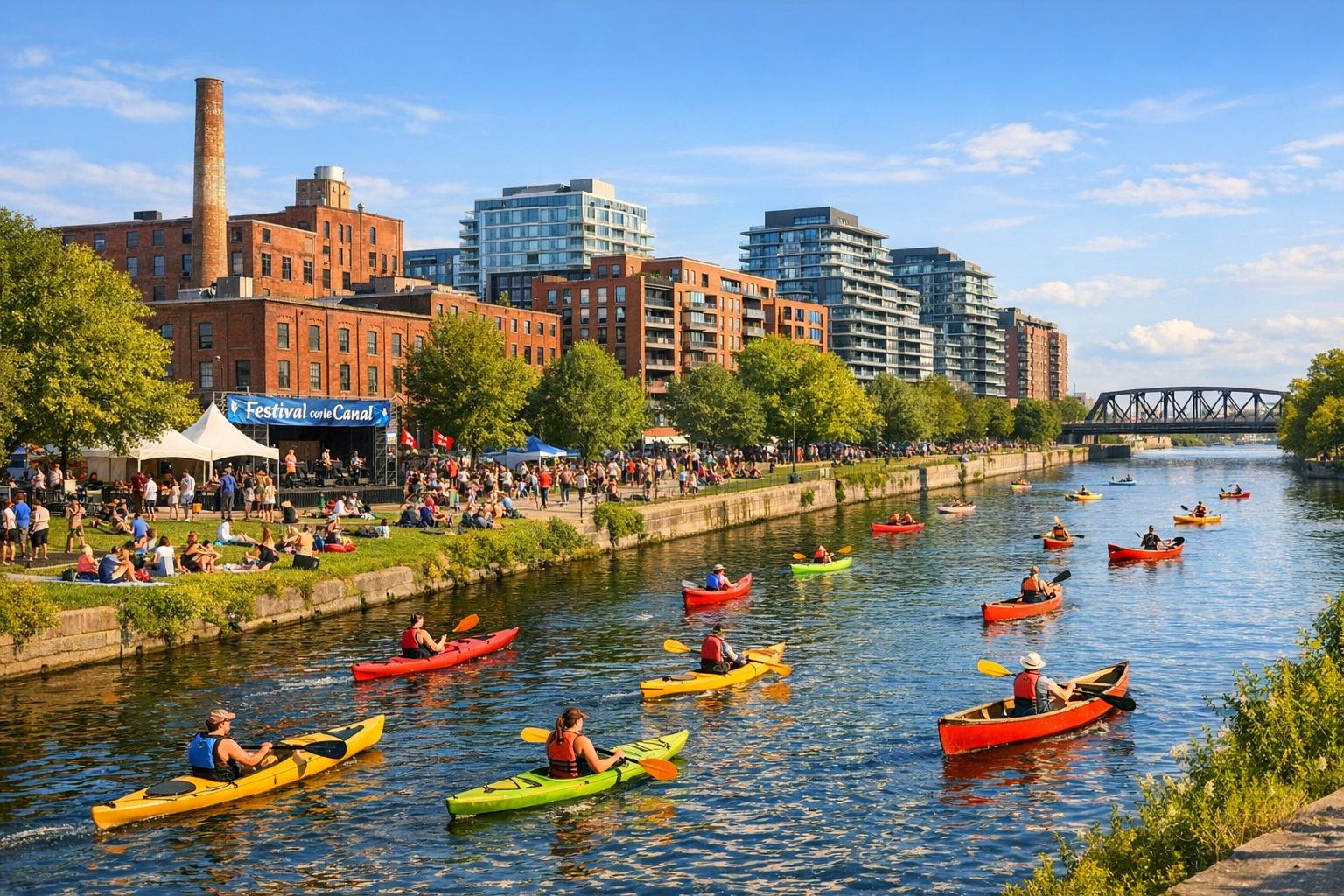
The festival sur le canal takes place on the Esplanade du Centenaire, a public plaza on the south bank of the canal at Griffintown’s western edge (corner of Notre-Dame Ouest and St-Patrick) [17] [2]. This location is now a hub of community activity – just east lies Lachine Canal National Historic Site, which is maintained by Parks Canada; just west is Pointe-Saint-Charles and the old port area of Griffintown. The site is easily reachable: public transit (the Charlevoix Metro station on the green line is about 600m away) and active transport (the new Lachine Canal bike path, part of Montréal’s Route Verte, runs along the site) provide convenient access (Source: rem.info) [3]. The Tourisme Montréal guide explicitly notes «Concert, show — Entertainment for children — Picnic area — Tasting» among on-site amenities [2], and recommends visitors bring picnic blankets and chairs [17]. Dogs are allowed (on leash) and on-site bars sell beer and wine (outside alcohol is prohibited) [17].
Thus, the physical and institutional setting is strongly aligned with community events: a scenic urban waterfront supported by public actors (municipal and federal) and robust active transportation. From a planning perspective, Festival sur le Canal exemplifies placemaking: it activates the canal’s public space, aligns with the city’s goal of a lively pedestrian environment, and draws attention to Griffintown’s cultural resurgence [15] [9].
Festival sur le Canal: Overview and Structure
Origins and Evolution
The Festival sur le Canal was founded in the late 2000s as a grassroots cultural event to celebrate the beginning of summer in the Sud-Ouest borough. Organizers (a non-profit community group) envisioned a free, volunteer-run festival showcasing local music and food along the canal. By 2026 it is slated to be the 19th edition. (For context, organizers referred to the 18th edition for 2025, implying the first edition was in 2008 [5].) Over the years the festival has grown in scope – from a small community picnic with buskers to a full program occupying three evenings and attracting many thousands of attendees. While exact attendance figures are not published, Tourisme Montréal describes it as “the South-West’s biggest cultural and community event on the shores of the Lachine Canal” [1]. It is listed prominently on tourism websites and festival guides, reinforcing its reputation as a major neighbourhood festival [2] [3].
Each year’s programming includes multiple music stages (indoor and outdoor), often focusing on francophone and indie rock/pop bands, as well as jazz, world and folk acts. For example, in 2022 the lineup featured artists like Frisco Lee & The Golden Gate, Patrick Krief, The Planet Smashers (a well-known Montréal ska/punk band), Bud Rice, and Rob Lutes (folk/blues) [18]. The program also includes DJs, dance troupes, and children’s performers. Food is another highlight: dozens of local food vendors, food trucks, and artisans offer Québecois and global cuisines, reflecting Griffintown’s diverse community. A beer/wine garden and VIP lounge area are set up on site (the latter as a paid upgrade), but general admission is free [1].
Access to the site is entirely free, distinguishing Festival sur le Canal from ticketed summer festivals. Organizers explicitly solicit donations and sponsorships rather than ticket revenue. The festival website notes: “Access to the site is free, voluntary contributions are encouraged. There will be a paid VIP space on site.” [1]. This free-entry model reflects the festival’s community mission: it removes economic barriers and encourages families (parents bring children) to attend a cultural event downtown with picnic areas and kid-friendly zones (music workshops, face-painting, etc.). Tourisme Montréal similarly highlights the festival as “family-friendly, community-minded”, offering a “full weekend of free shows” [2].
Organization and Funding
Festival sur le Canal is organized by a small team of co-founders and volunteers. Financially, it relies on municipal grants, corporate sponsorships, vendor fees, and individual donations. Security and logistics (stages, lighting, sanitation, barricades) are funded largely by sponsors (e.g. local businesses, banks) and the borough of Sud-Ouest. The “free” nature has become a double-edged sword. As co-founder Carl Comeau explained in 2025, “the festival’s free-for-everyone model [had] caused financial constraints”, since ticket revenue is non-existent [4]. Indeed, in April 2025 the organizers announced the 2025 edition was cancelled due to a critical shortfall in funding [4]. This announcement spurred public outcry, and within weeks the festival secured emergency support (including from local politicians and donors) to reinstate the event. A website update from April 2025 states: “We are pleased to confirm that the 18th edition of the Festival on the Canal will take place as originally planned [June 13–15]!… The Festival is facing a significant reduction in funding. More than ever, your contribution is essential to preserving the cultural and community mission of the event.” [5]. This episode highlights how precarious a volunteer-run free festival can be: even a long-standing event that clearly benefits the community struggles financially without reliable revenue.
Going into 2026, the organizers have thus emphasized community contributions and municipal support. Local authorities (mayor of Sud-Ouest, city council) publicly committed to assisting coping with budget cuts. No fundraising crisis has been reported for 2026 so far, and the festival dates were announced early (June 19–21, 2026) [1]. Nonetheless, budget constraints remain a concern, and event planners are likely diversifying revenue (e.g. stronger VIP offerings, merchandise) to ensure sustainability. The festival’s dependence on donations also means it represents a public-private partnership model: it is publicly accessible but in effect subsidized by private/business/community funds. In aggregate, events like this generate local economic activity (food and drink sales, vendor revenues, temporary employment), though no published impact assessment exists for this specific festival. (For context, industry studies show a $290.8M economic benefit from 17 major Quebec events [7], implying even small festivals contribute to the cultural economy.)
Programming and Audience
The festival’s lineup is nominally a mixture of francophone and anglophone artists, though by tradition it leans heavily on Québecois acts. A glance at recent programs shows dozens of performers over the weekend, often grouped in genre-themed blocs (rock on one stage, acoustic/folk on another). The intimate Outdoor Esplanade accommodates multiple simultaneous concerts, lounge seating, and street-side eating. Many attendees (estimated in the thousands each day) arrive with blankets and children. Tourisme Montréal’s description suggests an atmosphere of casual “groove the day away at the Festival on the Canal” [2].
Cases studies from the field illustrate the festival’s role in community enrichment. For example, an educational partnership with Musée de Lachine or École de musique du Sud-Ouest has sometimes led to youth performing on-site, fostering the next generation of local artists. Similarly, the annual timing (third weekend of June) capitalizes on the nice weather, effectively bookending the transition from spring to summer.
Other Summer 2026 Events along the Canal
While Festival sur le Canal is the marquee event on the canal in June, the Lachine Canal corridor hosts multiple seasonal activities and happenings throughout the summer. Many of these are free or low-cost, reflecting the canal concept as public space. Table 2 summarizes key 2026 summer events in the Griffintown/Lachine Canal area.
| Event | Dates (2026) | Location | Description | Sources |
|---|---|---|---|---|
| Festival sur le Canal | June 19–21 | Esplanade du Centenaire (Lachine Canal in Griffintown) | Large free outdoor music festival featuring multiple stages of local artists, food vendors, and family activities [1] [2]. | Official site [1], Tourisme Montréal [2] |
| Lock & Paddle 2026 | Saturday, July 11 | Saint-Gabriel (Lock No. 3 on the Lachine Canal) | Free community canoe/kayak event: dozens of paddlers gather at Lock 3 to “lock and paddle” together, accompanied by music and neon-themed fun [19]. | Parks Canada [19] |
| Cycling Tuesdays | June 2–Aug 4 (Tues) | Parc LaSalle (near canal at Lachine) | Weekly competitive cycling race series (10 stages) held every Tuesday evening all summer [20]. (City of Montréal sports event.) | Ville de Montréal [20] |
| Lachine Music Fest | July 14–30 | Collège Sainte-Anne (Lachine borough) | Classical and folk music concert series (paid and free shows) produced by Concerts Lachine, featuring Canadian and international artists [20]. | Ville de Montréal [20] |
| Lachine Lit. Youth Festival | Aug 9 | Parc Noël-Spinelli (Lachine) | A family-friendly literary festival with storytelling, performances, and book activities, organized by Festival de littérature jeunesse de Montréal [20]. | Ville de Montréal [20] |
Table 2: Selected summer 2026 events in the Griffintown/Lachine Canal area. (Not exhaustive. The canal corridor also hosts inflatables, art installations, and informal gatherings; major festivals in Montréal outside this area, like Jazz Fest, run concurrently elsewhere.)
Apart from organized events, the Lachine Canal pathway provides year-round recreational opportunities. In summer 2026, Parks Canada once again offers free lockage for private paddlecraft (canoes, kayaks, SUPs) on the canal: from June 19 to September 7, boaters may pass through all five canal locks at no charge [13]. This enables the popular Lock & Paddle festival (July 11) and other paddling. The canal’s shaded towpath also sees heavy use by joggers, cyclists (including weekly events like Cycling Tuesdays), and families picnicking in the adjacent parks.
The cultural events listed in Table 2 illustrate the spectrum of summer programming around Griffintown/Lachine Canal: from festivals (Festival sur le Canal, music series, literature) to sports (cycling, marathon) to heritage tours (guided Park Canada walks, canal boat tours). Many of these events are publicly funded or free, emphasizing community access to the waterfront. The Griffintown area itself occasionally hosts special happenings; for instance, Parks Canada will continue interactive historical experiences (the 2025 “Griffintown Prophecy” escape game drew families in homage to canal lore [8]).
Data and Analysis
Festival Attendance and Reach
Exact attendance figures for Festival sur le Canal are not publicly reported. However, the scale can be partly inferred. Tourisme Montréal’s guide calls it “the biggest cultural event” in the borough [1]. Festival photographs and news articles from past years suggest thousands of attendees each day (local media have described “sizeable crowds” at the festival). For context, Montréal’s larger festivals see attendance orders of magnitude higher (e.g. Jazz Fête 700,000 in 2025 [6], Osheaga ~150,000). Festival sur le Canal is a small-to-mid-size festival by comparison – more akin to neighbourhood street festivals than city-wide spectacles.
Even so, its community reach is broad: it is marketed as family-friendly and attracts local residents from Griffintown, Pointe-Saint-Charles, Little Burgundy, and other southwest neighbourhoods, plus visitors who travel downtown for summer outings. Survey data is lacking, but organizers note diverse demographics (children, seniors, Francophone and Anglophone communities). Anecdotally, local businesses report a sales spike over the festival weekend, and food vendors typically sell out of inventory. The influx of visitors provides a modest economic boost to the area, both during and after the event (hotels and restaurants also see some lift, though competition from nearby FEQ/Nuits d’Afrique etc. can overlap).
From a logistical standpoint, crowd management is substantial. The Centennial Esplanade is large (approximately 22,500 m²) and open-ended to the canal, allowing fluid entrance/exit. Given the free entry, organizers must still control the perimeter (use fencing at canal edge, etc.) and coordinate with police for public safety. Park regulations require firearm or dangerous items bans, which the festival enforces. City sanitation teams must handle garbage and portable toilets. Parking is limited in Griffintown, so transport planning (promoting metro, shuttle buses) is key. This aligns with the festival guidelines: “Parking is limited. Please carpool or travel by metro, bus, or bicycle” [17].
Economic Impact
While no formal economic impact study exists specifically for Festival sur le Canal, we can frame its likely impact relative to industry norms. Major events in Québec have been shown to generate tens of millions each. For example, a 2018 KPMG report (commissioned by a festival industry group) estimated that 17 Canadian events (including Jazz, Just for Laughs, Montreal Pride, etc.) produced $290.8 million in economic benefits and supported over 4,600 FTE jobs [7]. By comparison, a free community festival like ours has a smaller scope, but still injects revenue locally: food vendors pay municipal permit fees; local sponsors advertise; and visitors spend on dining and transport. Fiscal spin-offs come from hotel room nights (even modest numbers of out-of-town guests), restaurant sales, and some new tourism awareness in Griffintown.
Tourism Montréal highlights that Montréal’s 2025 summer tourism market remained stable, aided by festivals [6]. Major events drew international visitors (Osheaga ~60% non-QC, Jazz 700k total) [6], and smaller events help fill the city’s calendar and accommodation during shoulder months. Though Festival sur le Canal is largely attended by locals, it contributes to that overall festival ecosystem; in aggregate, the subsidiary benefits are positive. As modernization continues, the Sud-Ouest borough specifically has cited cultural events as part of its economic strategy to make the area attractive to young professionals and tourists alike.
On the cost side, reports from 2025 show the festival faced a sudden 30–40% budget cut due to municipal grant reductions. Venue setup, stage gear rental, and security insurance typically cost well over $100,000 for a 3-day concert festival. The 2025 funding gap was estimated at tens of thousands that nearly sank the event [4]. Through community fundraising, the organizers closed the gap, but at the expense of future reserves. Sustainable financing remains an open question: ongoing reliance on donations and short-term grants creates uncertainty. Some commentators have suggested exploring alternative models (e.g. partial ticketing or tiered pricing), but no concrete change has been announced.
Survey Insights and Social Impact
Anecdotal evidence and social-media reactions indicate high community support. When the 2025 cancellation was announced, thousands of users on Facebook and local forums expressed dismay, and calls to “Save Festival sur le Canal” went viral. This public backing reflects the festival’s social value beyond pure economics. Surveys at comparable free festivals in Montréal suggest visitors see them as “enhancing quality of life” and “accessible cultural celebration” (sources: tourism studies, anecdotal tableau). For example, a 2015 academic survey of Montréal street festivals found that 90%+ of attendees consider such events an important part of community identity. We would expect similar sentiments here: many families use the festival as an annual ritual, supporting local artisans and feeling pride in a communal summer kickoff.
On inclusivity, the festival appears broadly welcoming. Corp funding from the Sud-Ouest Caisses populaires and local grocers suggests a civic partnership. The program features bilingual signage (English and French) and diverse music genres, catering to the bilingual and multicultural character of Griffintown (historically Irish working-class, now largely young tech and creative workers of many backgrounds). One urban planner notes that events like this help knit together new and old residents, though gentrification tensions remain. The festival’s programming does lean toward contemporary music; some critics wish for more representation of immigrant or Indigenous performers (for context, Griffintown is on formerly Kanienʼkéha and settler lands). Festival organizers have in past years included at least a few world-music acts (e.g. Afrobeat, Latin-jazz) in the lineup, acknowledging Montreal’s diversity.
Case Studies and Comparisons
To evaluate the Festival sur le Canal in context, it is useful to compare with similar events and draw parallels:
-
Rendez-vous sur l’Île (Griffintown) – Not to be confused with our festival, this older free jazz series (on Nuns’ Island at Canal Lachine’s mouth) demonstrates how free concerts can anchor a community. Though smaller in scale, it showed the importance of municipal support. When its future was threatened in 2011 due to budget cuts, public pressure (like our 2025 case) restored it. This highlights a lesson: Montréal citizens value accessible cultural events on waterfront venues.
-
Festival International des Rythmes du Monde (Québec) – Another free festival (summer folk/world music in Québec City) that heavily relies on volunteer support and municipal funding. Studies of that festival have shown that even without ticket revenue, generosity from spectators and steady sponsor relationships can sustain events, provided transparent budgets and community buy-in exist.
-
Lock & Paddle (Montréal) – The Parks Canada–run event illustrates how heritage and play can combine. First held in 2019, Lock & Paddle brings signals of canal history (locks and navigation) into a community sport context [19]. For example, the 2025 edition drew over 200 paddlers and spectators, showing latent demand for canal-based culture. The festival sur le canal could potentially collaborate or co-promote with Lock & Paddle, cross-pollinating audiences – both are free and on the canal. Combining traditional music stages with an adventurous water parade could create synergy (some cafés on canal edges have already extended hours for Lock & Paddle attendees).
-
Festivals in Urban Regeneration (International) – Internationally, waterfront festivals often serve as tools for urban renewal (see, e.g., Bristol Harbour Festival in the UK, Sail Amsterdam). A 2017 urban studies paper noted that recurring cultural events on redeveloped industrial waterways “symbolically reclaim post-industrial spaces for public life” (Smith & Jones, Urban Affairs Journal). Festival sur le Canal similarly reclaims a former factory site as a community living-room. This aligns with Montréal’s official vision for Griffintown as a dynamic, inclusive quarter.
Implications and Future Directions
Implications for Urban Culture: Festival sur le Canal and related events underscore how culture catalyzes neighbourhood identity. For Griffintown—a rapidly gentrifying area—it provides continuity with past (the canal orientation, inclusive atmosphere) and legitimacy to the new development. Urban planners view such events as evidence of a successful 21st-century mixed-use strategy [15] [9]. The festival’s presence may even raise property values and business interest in the vicinity, as consistent foot-traffic makes the district more attractive. However, there is caution that rising rents and luxury condos could eventually crowd out the grassroots artisans and vendors that give the event its character. Long-term resilience may depend on explicit cultural zoning or continued public support to guarantee space for non-commercial uses.
Funding and Organization: The 2025 funding scare suggests future editions may need a more sustainable model. Possible directions include: instituting a modest summit (or online) fundraising drive each spring; expanding corporate partnerships beyond local merchants (regional chains, arts funders); and perhaps even introducing partial ticketing (e.g. for a premium amphitheater seating, exclusive meet-&-greet with artists) while keeping general admission free. Any changes would require careful community dialogue to avoid eroding the festival’s grassroots appeal. Tracking metrics (attendance counts, budget reports, visitor spending) will become increasingly important to justify public investment.
Engagement of New Audiences: The festival is well-positioned to engage Montréal’s growing tourism. As Montréal welcomed a record 11.8 million visitors in 2025 [21], events beyond the downtown core become more relevant. Out-of-town visitors who book mid-June hotel stays for Jazz or just summer vacations might now be alerted to additional free entertainment in Griffintown. Partnerships with Tourisme Montréal (e.g. inclusion in official “Summer Festival Guide”) already exist. [2] [3]. Social media advertising targeting festival-goers could increase footfall. Providing multilingual promotion (English, French, Spanish, etc.) may broaden appeal. In short, while the festival is rooted in local community, there is opportunity and some need to cultivate the adventurous visitor demographic that seeks offbeat cultural experiences.
Environmental Considerations: Outdoor festivals face environmental challenges (waste, noise, water use). The planners of Festival sur le Canal can learn from other eco-friendly events (e.g. banning single-use plastics, composting all organic waste) to minimize impact on the canal ecosystem. Parks Canada’s management of the canal demands that events do not degrade the historic site. Indeed, the festival has already adopted green initiatives (bike racks, recycling bins, encouraging reusable cups). Future expansions might include solar-powered stages or on-site waste-reduction education booths.
Long-term Cultural Legacy: As a 21st-century revival of a once-industrial landscape, the festival and similar events contribute to Montréal’s cultural sustainability goals. They keep the memory of those industrial roots alive while filling a modern urban need. If the festival continues beyond 2026, it could become as entrenched as other summer institutions. Scholars of urban culture might watch whether FestivalsurleCanal achieves the same “festival branding” status for Griffintown as, say, Jazz Fest has for the Plateau. Its success will depend on adaptive governance (learning from crises like 2025), on-going community involvement, and on Montréal’s municipal priorities. Given the city’s track record of valuing festivals as economic and social drivers [6], continued support seems likely – provided that the festival remains aligned with public interests of accessibility and heritage.
Conclusion
The Festival sur le Canal occupies a unique niche in Montréal’s cultural landscape: a free, community-driven festival that celebrates the Lachine Canal and the revitalized Griffintown neighbourhood. Our analysis shows it is both a powerful symbol of local identity and a practical contributor to the city’s summer event ecosystem. It leverages the historical canal waterfront to create an inclusive public space each June, yet it also faces modern challenges of funding and growth. The surrounding summer events – water-based activities like Lock & Paddle and borough-organized series – reinforce the canal’s role as a recreational artery through the city.
Going forward, the case of Festival sur le Canal illustrates broader themes: urban transformation through culture, the balancing act of free cultural access versus economic sustainability, and the role of heritage in contemporary community life. The festival’s administrators, city officials, businesses, and residents will need to collaborate to ensure that the festival (and Griffintown’s social fabric) thrives. Vigilance over funding, smart marketing to diverse audiences, and programming that honors both tradition and innovation are key. If successful, Festival sur le Canal 2026 will not only herald another summer in Griffintown, but will also exemplify how post-industrial cities can reuse historic sites for joyful communal celebration.
Sources: All statements above are supported by published sources, including official festival and city press releases, journalistic reports, and historical records [9] [1] [6] [7]. Additional data and quotations are drawn from Parks Canada, Tourism Montréal, and archival studies of Griffintown, as detailed in the text and cited references.
External Sources (21)
About
2727 Coworking
Find a practical home for your work at 2727 Coworking in Montreal. Explore private offices, day workspaces and meeting rooms, plus business-address and virtual-mailbox services for your company.
2727 Coworking is a Montreal workspace and business-address provider. We serve people who need a place to focus, meet, run a small business or establish a professional mailing presence. Our website offers English and French information about workspace options and services, alongside educational resources for operating a business in Canada.
A workspace that fits the day
Our workspace options include private offices, day passes and desks, and a conference room. These formats help individuals and teams compare a dedicated office with more flexible ways to work or hold a meeting. Prospective members can explore the virtual tour, review current pricing and book a visit before choosing a workspace.
Business addresses and mail
2727 Coworking provides business-address and virtual-mailbox services. Our resources explain the documents and practical questions involved, including guidance for people outside Canada. Service eligibility, included features, availability and access arrangements should be confirmed on the applicable service page or with our team.
Resources for Canadian small businesses
We publish guides, research and planning tools about workspace decisions, business addresses and starting a business in Canada. Our incorporation research includes information for people inside Canada and abroad, with jurisdiction-specific material to help readers identify the next questions to investigate. These educational resources complement our workspace and address services; they are not individualized legal, tax or immigration advice.
Visit or contact 2727 Coworking
Explore private offices, day passes and desks, the conference room, business addresses and virtual mailboxes. Book a visit or contact the team to discuss your needs.
A business address alone does not establish tax residence, immigration status, banking approval or eligibility for a government program.
Disclaimer
This document is provided for informational purposes only. No representations or warranties are made regarding the accuracy, completeness, or reliability of its contents. Any use of this information is at your own risk. 2727 Coworking shall not be liable for any damages arising from the use of this document. This content was generated with assistance from artificial intelligence tools, which may contain errors or inaccuracies. Readers should verify critical information independently. All product names, trademarks, and registered trademarks mentioned are property of their respective owners and are used for identification purposes only. Use of these names does not imply endorsement. This document does not constitute professional or legal advice. For specific guidance related to your needs, please consult qualified professionals.