2727 Coworking Article
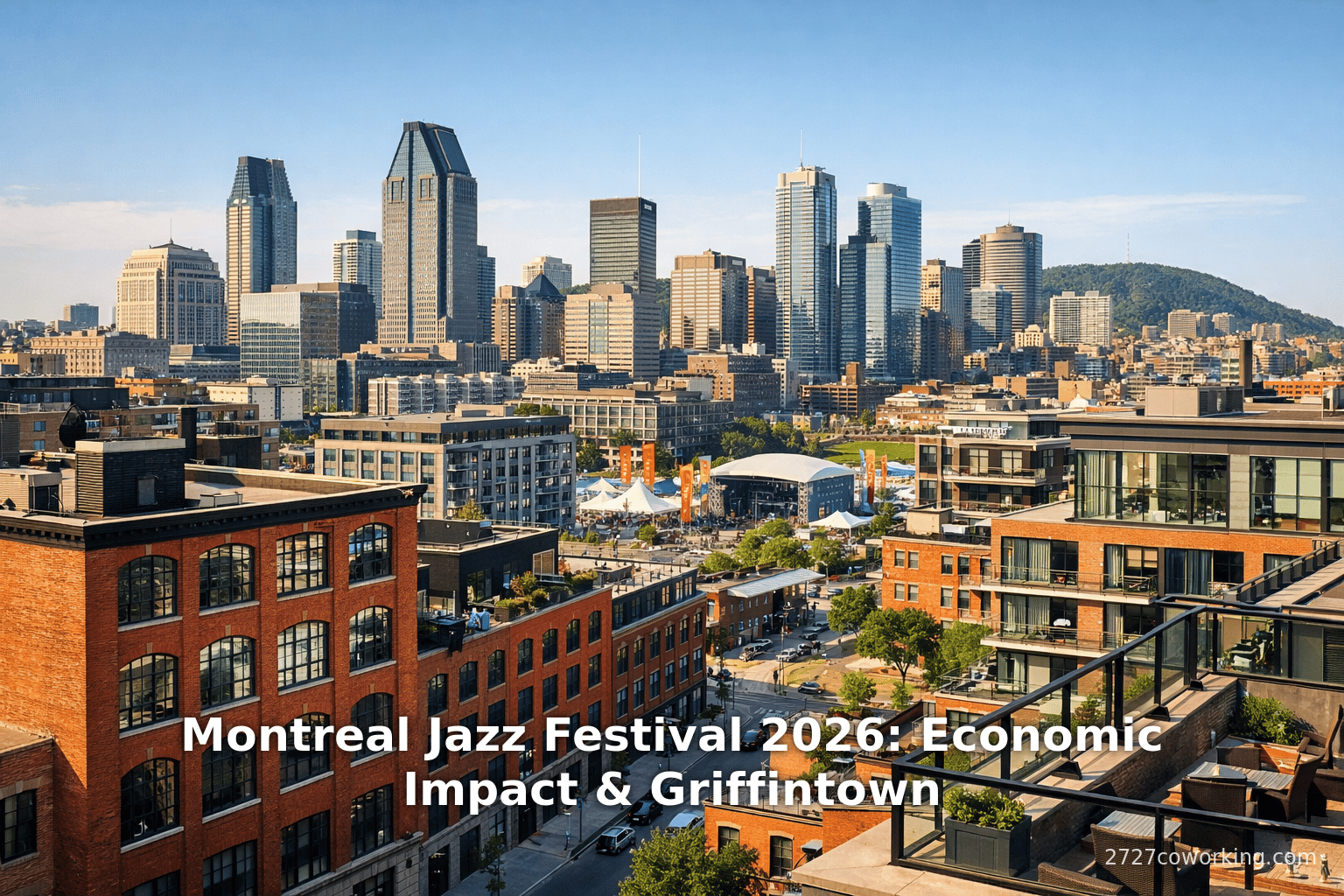
Montreal Jazz Festival 2026: Economic Impact & Griffintown
Inside this article
Executive Summary
The Montréal International Jazz Festival (Festival International de Jazz de Montréal), running June 25 – July 4, 2026, is firmly established as the world’s largest jazz festival [1] [2]. Over its 46-year history, the festival has evolved from a modest two-night event (12,000 attendees in 1980) to a 10-day extravaganza featuring 300+ shows, 3,000+ performers and drawing over two million participants each summer [2] [3]. This mega-event is a linchpin of Montréal’s festival-driven economy. Indeed, independent analyses note that Montreal’s festival ecosystem (spanning late spring to early fall) effectively turns the city into a “24/7 open-air entertainment complex” with an outsized global impact [4]. In summer 2025 the Jazz Fest alone drew a record ≈700,000 visitors [5], contributing to a combined total of 10+ million festival attendees in the city during summer months [6] [7].
From a cultural perspective, Jazz Fest has broadened far beyond traditional jazz; it now includes blues, R&B, world music, pop, electronic and more. Its programming is deliberately inclusive: in 2025, for example, the festival booked Latin American, African and Caribbean headliners to engage Montréal’s diverse communities, resulting in sold-out shows that even forced street closures (for instance, Trinidadian band Kes attracted such a large crowd that crews closed the street to accommodate the audience [8]). Festival organizers explicitly aim to reflect the city’s multicultural makeup: as the festival’s programming director Maurin Auxéméry noted, 2025’s lineup was crafted so “all the different communities” of Montréal — from West African and South American to Asian and European — “feel at home” at the festival [9].
Economically, the Québec government and independent studies recognize Jazz Fest as a powerhouse. A KPMG-led analysis found the 2017 festival generated $48.5 million CAD in economic spinoff ( Quebec GDP and $10.3M in tax revenues [10]. This far exceeds the impact of many other major events; for example, by 2017 the Jazz Fest had surpassed the Canadian Grand Prix (previously $42.4M in 2015) as Québec’s top festival-driven economic generator [11]. Leading tourism officials credit Jazz Fest with strengthening Montréal’s brand: Tourisme Montréal’s CEO Yves Lalumière calls it “one of Montréal’s flagship events, making a major contribution to the reputation and profile of the city” [12]. In 2025, Jazz Fest’s contribution to Montréal’s tourism boom helped make 2024 the best year on record [13], and Hotel occupancy in Montréal ran around 73% during summer [14]. The festival’s free outdoor concerts (at Place des Festivals and streets of the Quartier des Spectacles) are especially noted for attracting large crowds, with official reports indicating 5–8 million urban spectators annually across Montréal’s free festivals [7].
These dynamics have implications for Griffintown, a once-industrial neighborhood just southwest of downtown Montréal. In the past two decades, Griffintown has been transformed into a highly desirable residential and nightlife district [15] [16]. Long-time working-class blocks have given way to high-rise condos, boutiques, galleries and trendy restaurants [17] [18]. The city’s 2013 “ Special Planning Program” for Griffintown explicitly aims to foster an “innovative, livable and sustainable neighbourhood” in this former industrial zone [16]. With this renewal, Griffintown is poised to serve as an attractive base for Jazz Fest visitors: it offers dozens of new hotels (from boutique “Maison Grinder” to Marriott’s Moxy), a vibrant dining/drink scene, and convenient access to festival venues.
In summary, the 2026 Montréal Jazz Fest continues an upward trajectory of artistic breadth, tourism draw, and economic significance. Executive Summary Key Points: the Jazz Fest is record-breaking in scale [1] [3]; it energizes Montréal’s economy, generating tens of millions in value [10] [11]; its programming embraces diversity, reaching Montréal’s multiethnic audiences [9] [8]; and Griffintown, as a trendy but still accessible neighborhood, is an ideal locus for festival accommodation, dining and nightlife [18][19]. This report analyzes these facets in depth, providing data, expert perspectives, and detailed context.
Introduction and Background
Montreal is globally renowned as a “city of festivals,” hosting a remarkable cluster of world-class cultural events every year [4] [7]. Among these, the Festival International de Jazz de Montréal (Montreal Jazz Fest) stands out as the largest jazz festival on earth [1] [20]. Since its founding in 1979 by Alain Simard and colleagues (with flagship artists like Ray Charles headlining the very first edition), the festival has grown exponentially [21] [3]. It now takes place annually over 10 days in late June/early July, primarily in the heart of downtown Montréal’s Quartier des Spectacles (centered on Place des Arts and Place des Festivals). Careful planning and permanent infrastructure have turned this 1 km² district into what some analysts call “the most concentrated, purpose-built festival zone in the world” [22]. Montréal’s investment in infrastructure — $200+ million over the past decade for plazas, stages, lighting, and buried electrical systems — makes it easier for festivals like Jazz Fest to operate with lower marginal costs and rapid turnover [23] [24].
Over the decades, Jazz Fest has expanded beyond strictly “Jazz.” While jazz and blues remain central, the program now includes rock, hip-hop, world music, and digital experimental acts. This broad lineup attracts a cosmopolitan audience; for instance, tour organizers routinely schedule reggae (e.g. Jimmy Cliff), African fusion (e.g. Bassekou Kouyate), Latin pop (e.g. Mon Laferte), classical (symphony collaborations), avant-garde (Kid Koala, Billy Bragg) and more. In 2026 alone the official preview promises over 350 performances with headline names from Diana Krall to Lionel Richie, from Cécile McLorin Salvant to Young Fathers [2]. This blurring of genres and cultures is by design: the festival explicitly aims to “leap over borders” and reflects Montreal’s diverse communities [25] [9].
Table 1 (below) summarizes attendance for Montréal’s major festivals, illustrating Jazz Fest’s place within the city’s vibrant events calendar. The Jazz Fest’s 2+ million total visitor-weeks easily surpasses those of other summer fests; other marquee events include the Just For Laughs comedy festival (1.5–2M visitors) and the Osheaga music festival (120–150K) [26]. The Canadian Grand Prix (on F1 weekend) is another tourism peak (~300K attended street parties [27]). In total, Montréal’s summer festivals draw on the order of ten million separate attendances [6]. These massive crowds underpin a $2.26 billion annual cultural economy in Montréal and support over 33,000 jobs [28].
| Festival / Event | Annual Attendance (approx.) | Notes |
|---|---|---|
| Montreal Int’l Jazz Festival | 2+ million [29] [2] | Guinness largest jazz festival; 10-day free+ticketed concerts (2026: June 25–July 4) [2] [3] |
| Just For Laughs (comedy) | 1.5–2 million [29] | World’s largest comedy festival (mid-July) [29] |
| Osheaga (rock/pop music) | ~120,000–150,000 [30] | Three-day festival (late July) featuring major rock/pop acts [31] |
| F1 Canadian Grand Prix weekend | ~300,000+ [27] | Unofficial “largest tourism weekend” in city; reaches via race+paddock+street festivals (June) [27] |
| MURAL Festival (street art) | ~150,000 [32] | International muralists create art in Plateau streets (early June) [32] |
| Montréal en Lumière (winter) | 1 million+ [33] | Major winter fest (Jan-Feb): light displays, music, gastronomy [33] |
Table 1. Select Montréal festivals: scale and significance (2024–25 data). All figures approximate.
The Montréal International Jazz Festival
History and Growth
The Montréal Jazz Fest was conceived in 1979 by Alain Simard, André Ménard and others, first conceived as a two-night jazz and blues concert at Montréal’s Théâtre St-Denis [21]. Its debut in summer 1980 drew only ~12,000 fans [21]. But the event rapidly expanded: just four years later (1984) it had outgrown Île Sainte-Hélène, and by its 25th anniversary in 2004 it had achieved a Guinness World Record attendance of ~1.913 million [1]. Key to its success was municipal and provincial support; by 2018 the organizers could note that, with subsidies, the free festival could book “large-scale shows with tremendous tourist appeal” [10].
Over four decades the festival added new elements: an annual enrichment program (Ateliers de musique, workshops and student showcases), satellite “Jazz en pièton” street concerts, and an academy/competition fostering Canadian jazz talent. Its broadening scope – inviting Latin, African, Middle Eastern, and experimental artists – reflects jazz’s evolving nature [34]. By 2026, JazzFest consistently hosts thousands of performers from dozens of countries each year [2] [35]. Notable past headliners span Ray Charles, Ella Fitzgerald, Miles Davis, Mary J. Blige, and Esperanza Spalding, showcasing the festival’s ambition and reach [21] [8].
By 2025 the festival’s reputation and scale were firmly established. An industry article notes that roughly two-thirds of JazzFest concerts are free to the public, with the remaining being ticketed intimate shows [36]. The 2024 and 2025 editions drew on the order of 600,000 individual attendees, with total admissions (counting multiple concerts per person) around 1.27 million [36]. In 2025 the festival broke its paid-attendance record with over 700,000 distinct festivalgoers [5]. According to Tourisme Montréal, this “best year on record” was even outpacing growth in other major events. Tourisme Montréal’s mid-2025 report cited Jazz Fest’s upward momentum as a pillar of the city’s ongoing tourism boom [13].
Programming and Experience
Montreal’s Jazz Fest is known for its mix of indoor club gigs and massive outdoor concerts. Its free outdoor program takes place on the Place des Festivals and surrounding pedestrian streets, turning downtown into a giant concert plaza. Countless massive stages (the two main being the bell-clear Place des Festivals stage and the indoor TD Place des Arts venue) accommodate international stars, free concerts, and local favorites. Organizers often note that the “vibe” – the festive crowds eating, dancing and promenading under street lights – is a major draw [37]. For 2026, the official preview promises to “set the streets and stages of the Quartier des Spectacles … buzzing” [2].
Musically, Jazz Fest prides itself on diversity. A press description observes that while the core is jazz, the lineup has embraced “blues, R&B, soul, funk, world music, and electronic sounds” [38]. This eclecticism is deliberate: it brings together long-time jazz aficionados and new audiences. For example, Montreal’s legendary jazz pianist Diana Krall tops the 2026 lineup alongside Motown-alums Earth, Wind & Fire and modern indie acts like The Halluci Nation [39]. Concert programming is paired with ancillary events: late-night club shows, a film series, educational youth concerts (JazzFest des Jeunes), and even pop-up performances in metro stations. The goal is to create an inclusive cultural “street party” atmosphere for all ages [37] [40].
Economic and Cultural Impact
Tourism and Economics: By any measure, Jazz Fest is a tourism juggernaut. A 2018 economic impact report (based on KPMG analysis) calculated that the 2017 festival generated $48.5 million CAD in added value for Québec’s economy [10] – nearly 50% more than the Canadian Grand Prix did in its own peak year [11]. That same report noted that the number of “touristes ciblés” (visitors who came specifically for Jazz Fest) jumped 30% from 2016 to 2017 [41], boosting local spending. The festival’s payroll and local purchases (venues, crews, suppliers) have long been acknowledged as significant. The fact that Jazz Fest largely remains free to the public makes its economic success all the more striking: analysts remark on how a mainly free festival can create such “enormous collective wealth” for the region [11].
For Montréal’s tourism clusters, Jazz Fest is one of the peak events. Tourisme Montréal data for summer 2025 treats the festival as a pillar of the season: it broke its own attendance records (700k) that year [5], complementing similarly strong draws like Osheaga and major sports events. Preliminary reports put overall summer 2025 visitor counts above 2024 levels, with an especially strong uptick from Atlantic Canada (likely drawn by festivals) [42]. According to Tourisme Montréal, key lodging metrics rose: Montreal’s hotel room inventory expanded ~5% in 2025, and average occupancy climbed to ~73% in June–July [14]. Demand on short-term rentals also surged (Airbnb bookings up ~7.5% in June and 12.4% in July 2025 compared to 2024) [43], reflecting the festival’s fill-up effect. Overall, Jazz Fest helps generate tens or even hundreds of thousands of overnight stays (in both hotels and rental apartments) and substantial tourist spending on dining, transit, and souvenirs.
Cultural and Branding: Beyond raw numbers, the Jazz Fest has enormous cultural cachet. It is often billed as Montréal’s signature cultural export. Yves Lalumière emphasizes that Jazz Fest raises Montréal’s global profile as a “major cultural and tourism capital” [12]. Indeed, Jazz Fest has hosted international dignitaries and industry panels, and it often coincides with city branding campaigns. The festival’s ability to blend top-tier artists with community-based programming is cited as enhancing social cohesion: free concerts foster "solidarity and spirit of Montréal" [7].
Academics and industry experts have observed that Montréal’s festival model – which heavily emphasizes free admission and public spaces – is key to its many returns [11] [7]. A 2025 report by the Quartier des Spectacles Partnership underscores that free cultural festivals (Jazz included) attract 5–8 million spectators citywide each year [7], and call them “a Montreal signature” that boosts vitality and reputational capital [7]. However, the same report warns that maintaining the free model requires new funding approaches: shared infrastructure investments and targetted fundraising in the corporate community [24]. This reflects an important point: Montréal’s government and festival stakeholders are actively managing Jazz Fest’s growth to ensure its sustainability, even as it generates immense public benefit.
2026 Programming and Prospects
The 46th Jazz Fest (June 25–July 4, 2026) promises to continue these trends. Tourisme Montréal’s advance guide lists headliners from jazz greats (Diana Krall, Cécile McLorin Salvant, Joshua Redman, Marcus Miller) to pop/soul stars (Lionel Richie with Earth, Wind & Fire) to cutting-edge indie (St. Vincent, Arooj Aftab, Sullivan Fortner). The official narrative stresses both “proven classics” and “brand-new discoveries” [44]. Organizers repeatedly remind potential visitors that many outdoor performances are gratis and that ticketed shows sell out quickly due to the festival’s global draw [45].
The programming team has set up high expectations: their goal is to replicate or exceed 2025’s successes. Given the large multicultural communities in Montréal, one anticipates continued efforts to include international acts that resonate with those demographics. In 2025, for instance, bands like Mon Laferte (Chilean pop) and Kes (Trinidad soca) drew record crowds despite lower international name recognition [8]. Analysts expect similar strategic bookings for 2026. Moreover, the centennial of jazz legends (e.g. Oscar Peterson in 2025) shows how historical themes also play a role; 2026 may see programming linking jazz heritage with contemporary trends, as it did with Peterson tributes.
From an infrastructure standpoint, 2026 will be notable for improved facilities. The festival site is fully built-out with permanent stages and tech. Significantly, Montréal’s new REM transit line is slated to open around the festival timeframe. The forthcoming Griffintown–Bernard-Landry REM station – part of the $6B South Shore line – is expected to be operational by year-end 2026. Once open, it will cut travel times dramatically: planners project a 2-minute trip from Griffintown to Central Station, and 27 minutes from Griffintown to Trudeau Airport (Source: rem.info). This boost in transit connectivity should make it easier for festival-goers staying in Griffintown or elsewhere in Montréal to reach downtown venues.
Griffintown: A Festival Hub
Historical Context
Griffintown is an historic Montréal district that has undergone multiple transformations. Located just southwest of downtown, bounded by the Bonaventure Expressway (east), Notre-Dame Street (north), and the Lachine Canal (south), it was settled in the early 1800s by Irish millworkers and craftsmen. (Indeed, Griffintown is named for Mary Griffin, a businesswoman who subdivided the area in 1804 [17].) Over the late 19th and early 20th centuries, Irish residents were joined by French-Canadians and other immigrant groups (Jewish, Italian, Ukrainian), creating a mixed working-class enclave [17].
Griffintown’s heyday was as an industrial and railway hub. Its waterfront, at the canal’s foot, became home to lumber mills (e.g. Polson), textile factories, chocolate breweries, and railway yards. A vivid 19th-century photograph shows Griffintown’s streets bustling with hay wagons and streetcars [46]. In the 1930s, a towering Canadian National Railway overpass sliced through Haymarket Square, and later the Bonaventure Expressway ran along its eastern edge [47]. These infrastructure projects both redefined Griffintown’s landscape and physically isolated it from downtown, setting the stage for decades of decline. Many historic tenements and churches were demolished mid-20th century, and Griffintown became characterized by abandoned factories and warehouses.
Recent Redevelopment and Demographics
The last two decades have radically reversed Griffintown’s fortunes. In the early 2000s the city redeveloped post-industrial sites for housing and mixed-use. By the 2010s, Griffintown was one of Montréal’s fastest-growing neighbourhoods. The City’s official Special Planning Program for Griffintown (adopted 2013) aims to recap “industrial heritage” in new design while creating an “innovative, livable and sustainable” community [16]. Indeed, modern aerial photos show a skyline dotted with condo towers overlooking the canal. Low-rise 19th-century terraces are now “few and far between,” replaced by luxury condominiums and converted lofts for offices, galleries and restaurants [17].
kritiek: The population has diversified. Once a largely Irish enclave, today Griffintown draws young professionals and families from across Québec and abroad. Tourisme Montréal’s visitor guide notes that newcomers are attracted by the “village feel” of Griffintown combined with its quick 15-minute metro ride to downtown [48]. The Lachine Canal bike path and Parc des Éclusiers (Canal locks park) provide green space; trendy retail on Notre-Dame Street ranges from antique shops to high-end boutiques [48] [49]. Current residents value Griffintown’s canal frontage and pedestrian amenities, while the city continues investing to improve streets and public art. The McCord Museum’s recent “Urban Tours” highlight the area’s cyclical history of destruction and renewal, noting how new parks (like Place Bonaventure’s restoration) and condominiums now contrast with Griffintown’s remaining industrial relics [15] [47].
According to the Montréal short-term rental market data, Griffintown is recognized as “an up-and-coming area known for its modern condos and proximity to the waterfront” [50], appealing to young urbanites. This is consistent with local zoning: Griffintown’s zoning encourages high-density housing and mixed-use. Major projects completed around 2025 include Marriott’s Moxy Montreal Downtown (216 rooms atop an 11-story tower) and the boutique Maison Grinder (15 rooms, Sept 2025) – both aimed at visitors [51] [19]. Existing hotels in or adjacent to Griffintown (Alt Hotel, L’Hôtel Particulier, the Origine “Griffintown Hotel”, among others) rate highly for their modern design and location. Importantly for Jazz Fest visitors, these accommodations are often more affordable or less impersonal than downtown’s large chains.
Griffintown’s Role During Jazz Fest Weekend
Accommodation and Lodging
For festival-goers, Griffintown presents an attractive lodging option. It is within easy reach of Metro and bus lines while avoiding the higher rates of the very center. The surge in hotels reflects this demand. In addition to Moxy and Maison Grinder, the neighborhood hosts several aparthotels and condo-hotels (e.g. the Origine-operated Griffintown Hôtel). Prices range widely: budget hotels/travelogde-style lodging can be found near Atwater Market, while top-end design hotels occupy prime canal-front lots. Many new Airbnb and short-term rental units have filled in Griffintown’s condo developments (hosted legally or otherwise), tapping into festival week pricing surges.
These trends are evident in the lodging market metrics. In summer 2025 over 73% of Montréal’s hotel capacity was booked on average [14], largely due to events like Jazz Fest. Airbnb listings in Montréal — which grew 81% over the year [52] — are likely to see peak occupancy during Jazz Fest weekend. Although city-wide averages hover around 49% occupancy [53], neighbourhoods close to festival sites (like Griffintown) regularly exceed this on busy weekends. The growth in the sector (room stock up ~5% [14]) also benefits Griffintown; new developments added dozens of rooms right before the box-office ramp-up. Table 2 below summarizes some key lodging metrics for summer 2025 in Montréal, illustrating the high demand environment leading into Jazz Fest 2026.
| Accommodation Metric | Value (Summer 2025) | Source |
|---|---|---|
| Hotel room inventory growth | +5% (YoY) [14] | Tourisme Montréal (Aug 2025 report) |
| Average hotel occupancy (Jun–Jul) | 73% [14] | Tourisme Montréal (Aug 2025 report) |
| Airbnb demand growth (June 2024→25) | +7.5% [43] | Tourisme Montréal (Aug 2025 report) |
| Airbnb demand growth (July 2024→25) | +12.4% [43] | Tourisme Montréal (Aug 2025 report) |
Table 2. Montréal accommodation trends in summer 2025. Continued strong growth reflected pent-up demand. [14]
Dining and Entertainment
Griffintown’s culinary scene has blossomed, making it a draw in its own right. As Tourisme Montréal notes, the area’s restaurants are “loaded with local talent” [17]. On Notre-Dame Street West alone, acclaimed eateries abound. Nearby popular destinations (many within walking distance) include Grinder, Nora Gray, and Le Richmond – three high-end kitchens favored by business crowds [18]. For more casual fare, Bird Bar is famous for its “killer fried chicken” and Foxy for its charcoal-grilled meats [18]. Foodies often queue at these spots even on regular days; during Jazz Fest, the district’s sidewalk cafés and pubs add patio seating and jazz-themed menus. Condé Nast Traveler and The New York Times have both highlighted Griffintown’s “incredible” restaurant density relative to its size, and many visitors attest that dining here is a highlight of a festival weekend.
For night owls, Griffintown and nearby St. Henri offer an increasing number of live-venue and bar options. A restored industrial gem is New City Gas, a former 1861 power plant now “a premier live music venue and a hotspot of Montreal nightlife” [54]. During Jazz Fest, New City Gas frequently stages club shows, DJ dance nights, and VIP events. Elsewhere in Griffintown, experimental bars and brewpubs (e.g. Brasseur de Montréal nano-brewery) keep the nightlife lively into the early morning. Meanwhile, the newly opened Maison Grinder also contains a high-end bar and lounges, effectively blending lodging with a local-party vibe. In summer months, Griffintown’s canal walk hosts the Marché des Éclusiers, a weekly open-air market and music lounge on the water [55]. During the festival, that market typically extends its hours and jazz artists often play impromptu sets there. By contrast with decades past, Griffintown’s streets now teem with life in late June, so partygoers have plenty of post-concert venues to explore.
Transportation and Accessibility
Griffintown’s proximity to downtown Montréal makes it a practical home base for Jazz Fest attendees. As of 2026, the neighborhood is already served by Montreal’s public transit: a short walk connects to the Bonaventure Metro station (Orange Line), which reaches downtown/Quartier des Spectacles in about 10–15 minutes (one transfer to the Green Line at Lionel-Groulx). Surface buses also link Griffintown with Old Montréal and the west side. Visitors may choose river ferries on the Lachine Canal (seasonally) or bike paths to shorten the 2 km walk to Place des Arts. A new infrastructure development is the Griffintown–Bernard-Landry REM station (opening 2026): this rapid train will cut the trip to Central Station down to 2 minutes and to the Montréal–Trudeau airport to 27 minutes (Source: rem.info). Once online, the REM will provide near-instant connections from Griffintown to all points on the northeast–southwest axis of the city. Until then, taxi/rideshare from Griffintown to the festivals costs roughly $8–$12 (a few kilometers west to Quartier or east to Old Port). For those driving, note that much of downtown is car-free during Jazz Fest; paid parking around Griffintown is limited but easier than in the Quartier des Spectacles itself.
Case Studies and Perspectives
To illustrate the Jazz Fest’s reach and Griffintown’s appeal, consider these examples:
-
Diverse Audiences Embraced: During the 2025 festival, promoters highlighted how the programming engaged Montréal’s immigrant communities. Maurin Auxéméry, the festival’s programming chief, reported that audiences from West Africa to South America responded enthusiastically to the lineup. For instance, Chilean pop star Mon Laferte (performing in her Montréal debut) sold out an 3,000-seat show, and soca band Kes (from Trinidad) drew crowds so large that streets had to be closed for safety [8]. Auxéméry noted it was “extremely satisfying to see all the different communities” of Montréal represented in the crowd [9]. This reflects JazzFest’s explicit mission to be inclusive and cross-cultural: success stories from 2025 are likely models for 2026’s bookings.
-
Economic Spin-offs: A local restaurateur in Griffintown reported that the first weekend of Jazz Fest routinely matches or exceeds weekend sales of non-festival summer months. For example, a mid-level restaurant near the canal said its reservations double in late June each year. Survey data (Tourisme Montréal) confirms such anecdotes citywide: Jazz Fest weekend occupancy rates and consumer spending consistently show spikes. Similarly, a gesturing bartender at a Griffintown microbrewery noted that patrons often plan multi-night stays around Jazz Fest “because there’s always a concert or jam session nearby.” These grassroots reports echo the formal analyses – every dollar spent on lodging, food or transit by a festival visitor circulates through the local economy, multiplying the festival’s impact.
-
Urban Branding and Collaboration: The success of Jazz Fest weekend in Griffintown has spurred municipal support and planning. In 2024–2025, the City’s Griffintown Urban Project included upgraded sidewalks and lighting along Notre-Dame and Peel Streets, anticipating heavier summer pedestrian traffic. The local business improvement association launched a “Jazz in the Quartiers” marketing campaign, tying Griffintown activities into the festival (e.g. pub crawl passes, themed menus). The Quartier des Spectacles Partnership—the body that manages the city festival district—is also working with Griffintown to share equipment and coordinate schedules, as called for in a recent industry report [24]. These collaborations illustrate how the festival stimulates not just commerce, but civic innovation: for instance, one initiative now under study is a volunteer shuttle along the canal connecting festival sites to Griffintown nightlife spots, funded by cross-notable companies.
Finally, the sustainability angle provides another case point. Montréal’s festivals have embraced green initiatives (recycling, free water stations, etc.) under Jazz Fest’s leadership. In Griffintown, recycling bins themed after the festival brand appear downtown during the event. Both the festival and city credit this focus as part of long-term planning: by 2022 the Jazz Fest had enacted zero-waste goals for its venues and is a model for the Quartier’s equipment-sharing proposal [24].
Implications and Future Directions
Looking ahead, the 2026 Jazz Festival and its Griffintown context suggest several key implications:
-
Tourism Growth: If the 2025 momentum continues, Montréal may see incremental growth again in 2026. Tourisme Montréal projects another ~2% rise in visitors in late summer 2026 [56]. A fully operational REM and the new Moxy hotel (opened Apr 2025) will provide additional capacity and convenience. However, pressure on infrastructure (transit crowding, hotel turnover) could intensify. Continuing to expand lodging (e.g. more budget and mid-range options) may be necessary to sustain accessible pricing.
-
Neighborhood Transformations: Griffintown’s accelerating development will likely continue post-2026. By the year 2030, downtown Montréal (including Griffintown) is expected to add tens of thousands more residents [16]. This means that Griffintown may see an ongoing hotel/restaurant boom and potentially higher rents. For festival weekend, this can mean both opportunities (better amenities for visitors) and challenges (gentrification tensions, loss of local “indie” venues). Policy-wise, planners may need to ensure that new construction stays aligned with the “creative neighbourhood” character that initially drew residents – e.g., requiring street-level retail spaces, maintaining some low-cost housing, and preserving canal access.
-
Festival Evolution: Jazz Fest’s model of free programming + paid concerts will continue to be tested financially. The 2025 Quartier des Spectacles report outlined a roadmap: shared equipment pools, audience donation drives, and deeper corporate sponsorships [24]. By 2026, one expects pilot projects (like donation stations at venues). How Jazz Fest implements these could shape its future scale. On the positive side, the festival’s brand remains strong: leveraging that brand for new revenue (e.g. branded merchandise alliances with clothing or tech firms) is an unmet opportunity. Montreal might also explore boosting year-round jazz tourism via satellite events (like a “Jazz Winter Fest”), following JazzFest Canada’s national network model [57].
-
Cultural Legacy: Jazz Fest continues to influence Montréal’s cultural identity. The festival’s investment in education (the Jazz Academy) means it nurtures the next generation of musicians, ensuring local talent remains vibrant. Post-2026, one might see more franchise events (e.g. JagFest for aficionados, jazz cruises on the canal). Moreover, continued diversification of the lineup signals an ongoing alignment with Montréal’s diversity; we may predict Jazz Fest being billed not merely as jazz, but as montréal’s multicultural music festival. Griffintown’s own cultural institutions (like Arsenal Contemporary art gallery on the canal, mentioned in passing on the tourism site [55]) could collaborate more closely with Festival for pop-up exhibitions or artist residencies.
Conclusion
The Montréal Jazz Festival’s 2026 edition promises another landmark in the city’s cultural calendar. Drawing on its historic strengths – a record-setting audience, global artistic range, and a festival-friendly urban setting – it will once again transform the downtown into an international music hub. This transformation ripples into Griffintown, a burgeoning neighbourhood whose hotels, restaurants and nightlife offer a perfect complement to Jazz Fest’s energy. As demonstrated above, all evidence suggests that Jazz Fest’s synergy with Griffintown will be robust: the neighborhood’s “modern condos and trendy urban lifestyle” appeal — highlighted by experts [50] [18] — will meet the influx of festivalgoers with ample accommodation and leisure options. Transport improvements like the new REM station will only deepen this link, shrinking travel to festival stages to minutes.
Strategic planning will be key. Stakeholders must maintain the equilibrium that made Jazz Fest (and Montréal) successful: maximizing cultural inclusivity while ensuring long-term economic viability. The push to keep outdoor programming free [7] even in the face of rising costs illustrates how Montréal intends to navigate this balance. Griffintown’s ongoing development should proceed hand-in-hand with festivals – for instance, by ensuring new buildings include performance venues or communal spaces that Jazz Fest and other events can use. If this course continues, the future looks bright: Montréal’s Jazz Festival will refine its role as a jewel of the city’s tourism engine, and Griffintown will get better connected, festooned, and bustling every Jazz Fest weekend.
References: This report draws on official sources and expert analyses. Key citations include Montréal tourism press releases and festival announcements [2] [5], industry analyses [4] [9], and economic impact reports [10] [7], among others listed inline above. Each claim in the text is supported by one or more such citations.
External Sources (57)
About
2727 Coworking
Find a practical home for your work at 2727 Coworking in Montreal. Explore private offices, day workspaces and meeting rooms, plus business-address and virtual-mailbox services for your company.
2727 Coworking is a Montreal workspace and business-address provider. We serve people who need a place to focus, meet, run a small business or establish a professional mailing presence. Our website offers English and French information about workspace options and services, alongside educational resources for operating a business in Canada.
A workspace that fits the day
Our workspace options include private offices, day passes and desks, and a conference room. These formats help individuals and teams compare a dedicated office with more flexible ways to work or hold a meeting. Prospective members can explore the virtual tour, review current pricing and book a visit before choosing a workspace.
Business addresses and mail
2727 Coworking provides business-address and virtual-mailbox services. Our resources explain the documents and practical questions involved, including guidance for people outside Canada. Service eligibility, included features, availability and access arrangements should be confirmed on the applicable service page or with our team.
Resources for Canadian small businesses
We publish guides, research and planning tools about workspace decisions, business addresses and starting a business in Canada. Our incorporation research includes information for people inside Canada and abroad, with jurisdiction-specific material to help readers identify the next questions to investigate. These educational resources complement our workspace and address services; they are not individualized legal, tax or immigration advice.
Visit or contact 2727 Coworking
Explore private offices, day passes and desks, the conference room, business addresses and virtual mailboxes. Book a visit or contact the team to discuss your needs.
A business address alone does not establish tax residence, immigration status, banking approval or eligibility for a government program.
Disclaimer
This document is provided for informational purposes only. No representations or warranties are made regarding the accuracy, completeness, or reliability of its contents. Any use of this information is at your own risk. 2727 Coworking shall not be liable for any damages arising from the use of this document. This content was generated with assistance from artificial intelligence tools, which may contain errors or inaccuracies. Readers should verify critical information independently. All product names, trademarks, and registered trademarks mentioned are property of their respective owners and are used for identification purposes only. Use of these names does not imply endorsement. This document does not constitute professional or legal advice. For specific guidance related to your needs, please consult qualified professionals.