2727 Coworking Article
Shared Offices for Notaries in Montréal: Premises, Rules and Audits
Can a notary establish a notarial office in a shared office in Montréal? A matrix of sections 22 to 33 of regulation N-3, r. 17, a test visit and documents to obtain, 2026 edition.
Inside this article
- 01Executive Summary
- 02Introduction and Context
- 03What a Notarial Office Is and Which Practice Profiles Are Covered
- 04Feasibility Matrix: Sections 22 to 33
- 05Auditing the Consulting Room, Waiting Room and Entrance
- 06Files, Notarial Records, Repertory and Registers: The Storage Plan
- 07Safes, Vaults and Evidence of Their Specifications
- 08Comparing Configurations and Contract Terms
- 09Data Analysis and Evidence
- 10Test Visit, Documents to Obtain and Points to Confirm with the Chambre
- 11Implications and Future Directions
- 12Frequently Asked Questions
- 13Conclusion
Executive Summary
For Montréal notaries looking to reduce their premises costs, the question is a narrow one: can a shared office qualify as a notarial office under the regulation? The Règlement sur la tenue des dossiers et des études des notaires (CQLR, c. N-3, r. 17) defines a notarial office as « le local où le notaire rend des services professionnels » [1]. Its requirements include a consulting room « dans un local fermé, réservé en tout temps à l'exercice de sa profession » [1], an adjacent waiting room, a compliant entrance and, for original notarial acts, the repertory and trust accounting books, a fire-resistant vault or safe. The version consulted on October 27, 2026 is « À jour au 1er juillet 2026 » [1].
Applied to flexible workspace, these requirements produce different outcomes. A virtual address and a meeting room rented by the hour cannot provide a consulting room reserved at all times: they do not serve as a notarial office (the author's interpretation, to be confirmed with the Chambre). A private office in a coworking space is the only flexible workspace configuration that could, in theory, satisfy section 24, subject to written and measured evidence. The regulation provides an exception for premises where members of other professions governed by the Professional Code share certain services; nothing in the text extends it to a workspace operator that is not itself a professional.
The local context: there were 3,836 registered notaries as of March 31, 2026, including 1,073 in the Montréal region, or approximately 28% [2]. Office vacancy in Greater Montréal reached 17.3% in the third quarter of 2026 according to CBRE [3] and 16.7% according to Cushman & Wakefield [4], with an average gross asking rent of $36.21 per square foot [4]. Operators publish starting prices (private offices from CA$560 per month at WeWork [5]), without mentioning a certified safe or evidence of compliance.
Rules governing the maintenance of notarial offices are among the most frequent subjects of inspection recommendations [6]. This article provides a feasibility matrix (Table 1), a comparison of configurations (Table 2), a data grid (Table 3) and a test visit. No offering, including those of 2727 Coworking, is presented as compliant: only an on-site audit and an opinion from the Chambre des notaires can confirm that.
Introduction and Context
This article is for notaries responsible for their own offices (sole practitioners and small practices) who are considering sharing premises, renting a private office in a flexible workspace or using a business address.
Open data from the Office des professions counts 3,836 notaries as of March 31, 2026, including 1,073 in the Montréal region [2]; women account for 72.4% of the membership [7]. These figures describe the population concerned, rather than demand for premises, which remains unknown rather than zero.
There are nevertheless offerings on the market. As of October 27, 2026, the Chambre's website carried a classified ad headed « Bureau à louer » in Rosemère, described as ideal for a sole-practitioner notary [8], with a large reception area and two workstations for assistants [8]. An ad illustrates an available offering, not the number of notaries looking for an office; the Chambre also states that anyone can post an ad there [9].
The Notaries Act does not address the notarial office as such. Standards for maintaining premises arise from the regulatory power conferred by the Professional Code over « la tenue par un professionnel de tout cabinet de consultation et de ses autres bureaux » [10]. Regulation r. 17 provides the framework for the analysis. The version of the regulation consulted here is the one published on Légis Québec on October 27, 2026. The Chambre's 2024-2025 annual report lists this regulation among those slated for « modifications d'arrimage » [6], as regulations are being developed or revised following the assent to Loi 23, the designation used by the Chambre [6]. The requirements described here must therefore be reconfirmed with the Chambre before signing anything.
2727 Coworking operates workstations, private offices, meeting rooms, virtual offices and business addresses in Montréal. These categories appear in Table 2, without any finding of compliance. This report is a document-based analysis, not a legal opinion, and has not undergone professional review.
What a Notarial Office Is and Which Practice Profiles Are Covered
The Regulatory Definition
Chapter II of the regulation applies to the office where a notary practises, and defines the office as the premises where the notary provides professional services. The definition is functional: it depends neither on the sign, nor on the lease, nor on the declared address, but on where services are provided. Premises where a notary actually receives clients are therefore a notarial office and must comply with sections 24 to 29. This also applies to a room rented by the hour where clients are received: under the definition in section 22, it becomes a notarial office in its own right, subject to sections 24 to 29, unless the Chambre des notaires confirms otherwise in writing. Conversely, a location where the notary provides no services (a mailing address or virtual office) is not a notarial office, but neither does it serve as one.
Four Distinct Practice Profiles
Section 1 covers notaries practising « seul ou en société, à son compte ou comme employé » of a notary, a professional or a partnership or company [1]. Four profiles emerge.
- Self-employed sole-practitioner notary. The notary alone bears all the obligations associated with the office. The 2024-2025 annual report counts insured joint-stock companies for notaries practising alone, showing that a sole practitioner can also practise through a company [6].
- Notary who is a member of a partnership or company. The partnership or company must enable the notary to comply with applicable laws and regulations, including professional secrecy; the addresses of its head office and establishments are declared to the Order.
- Employed notary. Section 2 provides that, for a notary who is a member or employee of a partnership or company, a public body or a person, the files for service contracts entrusted to the notary « sont considérés être les dossiers de ce dernier » if the notary can enter the required information in them [1]. The exception concerns files; its effect on sections 22 to 33 for an employee practising at the employer's premises requires verification with the Chambre.
- Notary pursuing another activity or practising in a non-traditional setting. The public sources consulted do not specify how combining activities affects the office; the Chambre's practical guidance pages on this subject are restricted to members. This point remains unconfirmed.
Notarial Records, Files and Ordinary Business Correspondence
Three categories of documents must be distinguished. Notarial records consist of acts executed en minute; the law specifies that all notarial records include a repertory and an index. Files are those required under section 1 for each client; among other things, they contain « les notes et la correspondance relatives aux services professionnels rendus » [1]. Business correspondence unrelated to a file (operator invoices, advertising and general mail) does not constitute files.
The distinction matters for mail at a virtual office. If an envelope received at the business address contains a document intended for a client file, it becomes a file document upon arrival, and the third party receiving it becomes part of the confidentiality chain. A written agreement with the operator is then necessary, because its staff do not work under the notary's responsibility.
Feasibility Matrix: Sections 22 to 33
Table 1 sets out the obligations associated with a notarial office, their sources, the evidence to gather, whom to consult and a typical outcome for a private office rented in a flexible workspace whose operator offers no notarial services. The outcome is one of three: confirmed (the situation described is sufficient), requires verification (compliance depends on a fact or interpretation that must be established) or incompatible (the configuration cannot meet the requirement as written).
| Obligation | Source | Evidence to Gather | Whom to Consult | Typical Outcome |
|---|---|---|---|---|
| Premises where services are provided = notarial office | Sec. 22 | Written list of locations where the notary receives clients | Chambre des notaires | Requires verification: under the definition in sec. 22, a room rented by the hour where clients are received is a notarial office and must comply with secs. 24 to 29; its ability to do so is unlikely (the author's interpretation, to be confirmed with the Chambre) |
| Keeping notarial records, the repertory, index, trust accounting books and files in the office or elsewhere | Sec. 23 [1] | Storage plan; where applicable, written authorization from the secretary of the Chambre; restricted access to filing cabinets [11] | Secretary of the Chambre | Requires verification: no public authorization procedure was found |
| Enclosed consulting room, reserved at all times, where neither identities nor conversations can be perceived | Sec. 24 [1] | Clause granting exclusive use 24 hours out of 24; on-site acoustic measurement [12]; glazing plan | Operator; acoustician; Chambre | Requires verification for a private office (a related professional order requires a consulting room that is « individuel, insonorisé et pouvant être fermé à clef » [13]); incompatible for a virtual address or hourly room |
| Waiting room adjacent to the consulting room | Sec. 25 | Plan showing the waiting room and access to the consulting room | Operator; Chambre | Requires verification: a shared lounge may be neither « adjacent » nor reserved |
| Entrance opening onto the outside or a public circulation area | Sec. 26, para. 1 [1] | Access plan; building opening hours | Operator; Chambre | Requires verification: depends on the client's actual route |
| Exception: entrance opening onto the waiting room when members of professions governed by the Professional Code share services | Sec. 26, para. 2 | List of occupants and their professional orders | Chambre | Requires verification: the exception applies to professionals, not the operator |
| Permit displayed; Code of ethics and conciliation regulation in the waiting room | Secs. 27 and 28 | Written right to display materials in the shared waiting room | Operator | Requires verification |
| Absence of more than 15 days: inform people attempting to reach the notary of the length of the absence and the name and address of the designated mandatary | Sec. 29 | Written procedure with the operator's reception staff | Operator | Requires verification |
| Original notarial acts, repertory, index, trust accounting books, software and backups in a fire-resistant vault or safe | Secs. 32 and 33 [1] | Safe test report (the test furnace reaches 927 °C at one hour [14]); expert certificate on request | Manufacturer; expert; Chambre | Requires verification; incompatible if no safe is available |
| Computer data: separate database, password, backup | Sec. 16 | Data architecture; access policy | IT provider | Requires verification: the separate database and password can be confirmed if the data does not depend on the operator's network, but the backup copy is also subject to the storage requirement in section 32 |
| Declaration of practice locations to the Order | Notaries Act, sec. 25 [15] | Notice of change within 15 days | Chambre | Confirmed once notice has been sent |
This table shows that section 24 is decisive, because it determines whether the premises can qualify as a notarial office at all. Few rows are marked “confirmed” because the regulation describes conditions of use (« en tout temps », « adjacente », « réservé ») that depend as much on the contract and layout as on the address. Only the declaration of the practice location to the Order is independent of the configuration.
Auditing the Consulting Room, Waiting Room and Entrance
Exclusive Use of the Consulting Room
Section 24 combines three criteria: premises that are enclosed, reserved at all times for professional practice and arranged so that the identities of those present remain unknown and their behaviour and conversations cannot be perceived from outside. The expression « en tout temps » is the most demanding for a flexible workspace: an office used by another occupant on weekends, an office shared on a rotating basis or premises for which the operator retains a master key for general use are not « réservés » within the meaning of the text (the author's reading, to be confirmed). The contract should therefore provide an uninterrupted right of exclusive use, a list of keyholders and a prohibition on access without notice, except in an emergency.
Visual and Acoustic Confidentiality
The regulation does not set an acoustic rating: it specifies an outcome to achieve. Technical sources help establish a framework for demonstrating it. A National Research Council Canada bulletin (1977, reproduced on MIT's website) notes that, if speech must be inaudible, the required sound transmission class (STC) increases by 5 points [12], that the rating applies to the entire partition, including doors [12], and that a small leak limits the effective rating to approximately 30 [12]. Laboratory tests under ASTM E90 also represent an upper limit on what is measured in the field [16]; on-site tests follow method E336 [16].
For open-plan spaces, a 2024 study concludes that a face-to-face layout provides the least speech privacy [17]; a 2025 expert study notes that intelligible conversations can compromise confidentiality [18]; and a 2007 laboratory test failed to achieve sufficient privacy at low sound-masking levels (Source: research.utu.fi). These findings concern open-plan spaces, not private offices, but they support requiring a full-height partition, a solid door and an on-site speech test.
Other Québec professional orders set out similar requirements. The social workers' order's guide for independent practice calls for a consulting room that is « individuel, insonorisé et pouvant être fermé à clef » [13], that preserves the confidentiality of verbal exchanges [13], and addresses shared space only for public institutions and community organizations [13]. None of the texts consulted specifically addresses coworking for private practice; the analogy is useful, but it does not replace the Chambre's opinion.
An Adjacent, Shared Waiting Room
Section 25 requires a waiting room adjacent to the consulting room, intended to receive clients. The exception in section 26 allows the notarial office entrance to open directly onto the waiting room when the office is located on premises used by members of other professions governed by the Professional Code who share certain services, such as reception, a waiting room or a conference room. The text names professions governed by the Professional Code, not rental businesses: an operator's reception lounge therefore does not automatically qualify for the exception. It is necessary to establish who the occupants are and whether the space is reserved for the notary's clients.
The Code of ethics adds that a notary must avoid indiscreet conversations about a client and the services provided to that client [19]. A shared reception area where the operator's staff announce a notary's visitors' names aloud raises this kind of concern.
Entrance, Displays and Extended Absence
The notarial office entrance must open onto the outside or an internal circulation area intended for the building's public. An office whose door opens onto the floor's corridor satisfies the first paragraph in principle; an office accessible only through the operator's reception area falls instead under the second paragraph and its conditions. The permit must be displayed in public view (sec. 27), and copies of the Code of ethics and the conciliation regulation must be placed in public view in the waiting room (sec. 28): this requires a contractual right to display materials in the common area. An absence of more than 15 days requires informing people attempting to reach the notary of the length of the absence and the name and address of the designated mandatary; if the operator handles telephone reception, the response script must be agreed upon in writing.
Files, Notarial Records, Repertory and Registers: The Storage Plan
Where Documents Are Kept
Under section 23, a notary keeps notarial records, the repertory, index, trust accounting books and files in the office, or at any other location determined by the board of directors, unless the secretary of the Chambre gives written authorization to keep them elsewhere. The storage plan must therefore establish where each category is stored, who holds the keys, who may enter the premises and what written authorization would be needed for storage outside the office. No public page describing the procedure or authorization form was found; the process goes through the secretary. Rules for retaining notarial records, files and trust accounting documents are also among the most frequent subjects of inspection recommendations [6].
The regulation on trust accounting adds that the notary must ensure « la conservation, la confidentialité et l'intégrité » of trust accounting documents [20]. Backup copies must be kept in a different location from the originals; a single shared safe with no copy elsewhere would therefore be insufficient.
Who Holds the Keys
The underlying principle is professional secrecy: the notary « est tenu au secret professionnel » [19]. In a shared space, the key management plan should establish the following.
- Consulting room and storage keys: only the notary (and staff working under the notary's responsibility) holds a copy; at most, the operator retains a sealed emergency key, with a log of openings.
- Access by the operator's staff: cleaning and security staff enter the premises outside times when files are open, or under supervision.
- Storage outside the office: any shared locker or operator storage room requires the written authorization provided for in section 23.
- Access log: a dated list of people who have entered.
Measures to Protect Personal Information
Québec's Act respecting the protection of personal information in the private sector requires businesses to take security measures appropriate to protect that information [21]. The Commission d'accès à l'information specifies that the required robustness increases with the sensitivity and volume of the information [11], and lists physical measures including restricting access to premises or filing cabinets containing paper documents [11] and controlling access to offices [11]. The confidentiality incident register is retained for at least five years [11], and a business that entrusts information to a third party remains responsible for it [11].
The Commission also recommends including « bureau propre » principles in staff training [11]. For paper destruction, it suggests a shredder, preferably a cross-cut model [22], and calls for documents awaiting destruction to be secured until the service provider arrives [22]. In a shared space, a communal recycling bin or destruction without a written contract would be weaknesses.
Digital Files, Electronic Notarial Records and Mail
For computerized files, the regulation requires a database separate from any other and password-protected access. An operator's Wi-Fi network shared by several businesses does not, without a dedicated configuration, meet the requirement for a separate database (a reading to validate with the IT provider).
The framework for notarial records is in transition. The provisions on the Greffe central numérique are marked « Non en vigueur » in the version of the Act consulted, while the Chambre describes a gradual rollout under way on its provider page [23]. A Chambre newsletter dated July 23, 2026 specifies that paper acts remain possible in three cases [24], and the Chambre notes that signing at the notary's office remains the method offering the highest level of legal protection [25]. The physical office therefore retains its role. For communications, the Chambre recommends never using ordinary consumer email for confidential documents [26]. Finally, on September 22, 2025, it announced a mandatory cyber-risk endorsement for all insured members [27]; a notary changing premises should ask their insurer whether the move affects the endorsement's terms.
Safes, Vaults and Evidence of Their Specifications
What the Text Requires
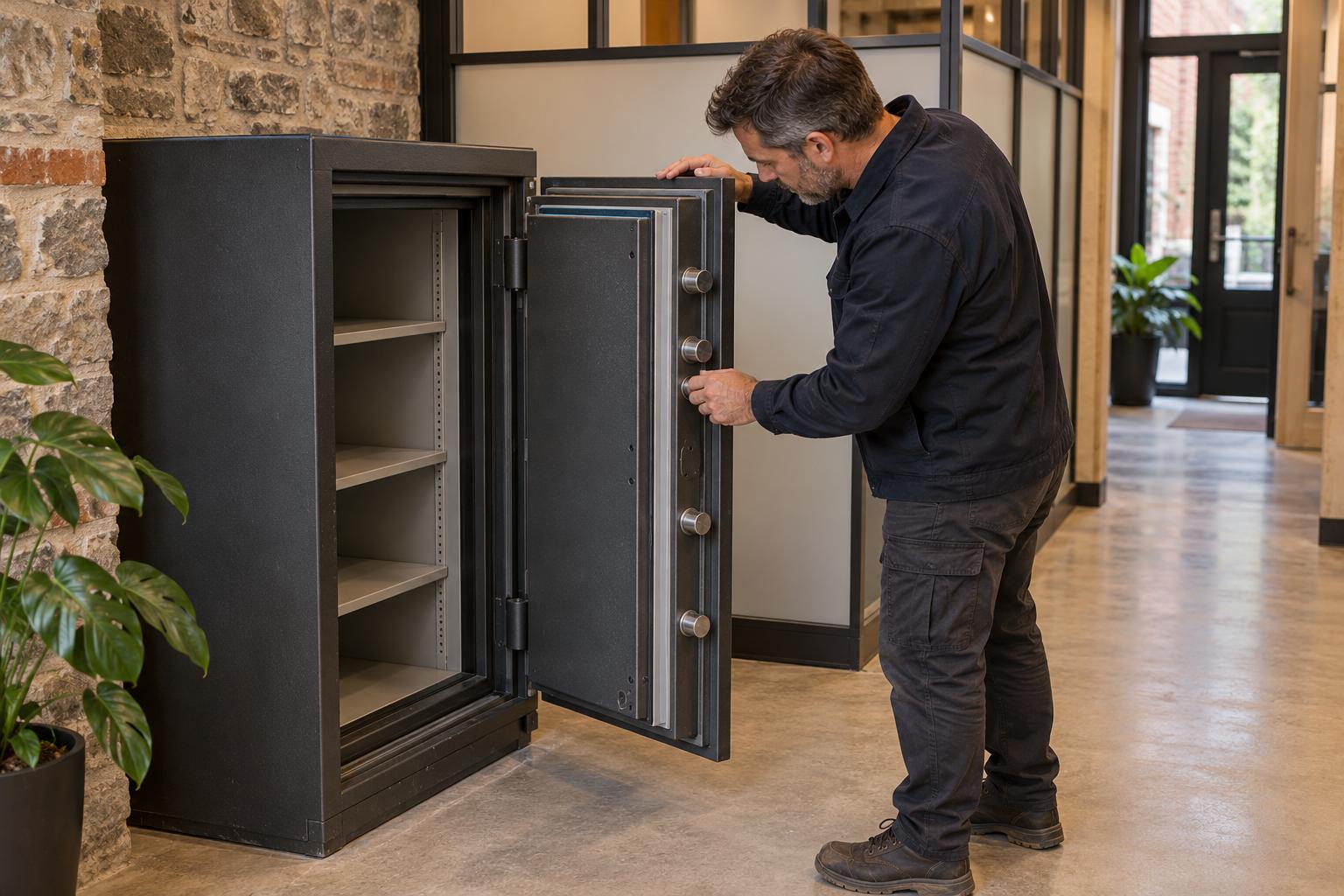
Section 32 requires original notarial acts, the repertory, index, trust accounting books, application software, updates and backup copies to be kept in a vault or safe guaranteed to resist fire at 927 °C for at least one hour. Section 33 provides that, at the request of the Order's authorities, the notary must provide an expert's certificate attesting to compliance. The burden of proof therefore rests with the notary, not the premises operator.
What the Test Standards Say
The figure of 927 °C corresponds to a point on the standard test curve: according to UL Solutions, at one hour the furnace temperature reaches 1,700 °F, or 927 °C [14], in a test where the sample is exposed to a standard fire at controlled temperatures [28]. For document containers, standard UL 72 covers Class 350 devices intended to protect paper records [29]. These texts describe tests; they do not determine equivalence with the regulatory wording. The only reliable approach is to obtain the test report for the specific safe, submit it to the expert and retain the expert's certificate.
Do Not Assume the Operator Provides One
None of the operator pages consulted (Hedhofis, WeWork, Regus, Walter, Montréal CoWork) mentions a fire-resistant safe, vault or service for regulated professionals. This absence proves nothing about their capabilities, but rules out making assumptions. As a reference point, the Chambre's Rosemère listing expressly mentions a « grande pièce voûte » [8], showing that this kind of equipment can be described in an offering. There are three scenarios:
- The notary's own safe, installed in the consulting room: possible if the lease permits it (floor loading, anchoring); the evidence consists of the test report and expert's certificate.
- The operator's vault room: requires a technical description, exclusive access control and, as applicable, written authorization under section 23.
- Storage elsewhere (a colleague's office, a specialized service): requires written authorization from the secretary and a safekeeping contract.
Comparing Configurations and Contract Terms
Table 2 compares five configurations. It does not rank offerings: it indicates what the regulation appears to allow, what must be obtained in writing and the typical outcome. The last row describes a product category that includes 2727 Coworking, without assessing any specific offering.
| Configuration | Reserved Consulting Room and Waiting Room (secs. 24-25) | Files and Safe (secs. 23, 32) | Contractual Questions | Typical Outcome |
|---|---|---|---|---|
| Independent notarial office (commercial lease) | Full control over the layout | The notary installs the safe and attests to its compliance | Lease; subletting subject to the lessor's consent | Confirmed if the layout complies |
| Sharing with another notary | A reserved consulting room for each requires verification; shared waiting room possible | Separate notarial records and separate keys to be provided | Sharing agreement; each notary's professional independence | Requires verification |
| Sharing with other professionals (Professional Code) | Exception under sec. 26, para. 2 for shared services | Same, with separate keys | Shared services agreement; confidentiality among occupants | Requires verification |
| Private office in a flexible workspace | Exclusive use « en tout temps » must be demonstrated; shared lounge must be assessed. One operator advertises enclosed offices « pour travailler en toute confidentialité » [30] | Safe to be provided; operator's storage premises require authorization | Service agreement or lease; term; notice | Requires verification |
| Flexible workspace operator: meeting room by the hour or business address (including offerings from 2727 Coworking) | No consulting room reserved at all times; rooms priced by the hour or by capacity, for example $10 per hour per person at Hedhofis [31] | No compliant storage can be assumed | Virtual office: address with mail handling, without a workstation [31] | Incompatible as a notarial office; requires verification as a declared address |
This table shows that the type of contract matters. The contract for a private office in a flexible workspace is often a service agreement rather than a lease: Regus states that its contracts are not rental agreements, leases or tenancies [32]. Section 24, however, requires enclosed, reserved premises, and thus a right of exclusive use. If the contract does not grant that right over the premises themselves, it must be added or an actual lease must be entered into; subletting then requires the head lessor's consent [33].
Clauses to Negotiate
- Term and notice: a notary committing for 12 or 24 months must be able to leave if the Chambre refuses an exemption. Hedhofis states that its memberships are monthly with 60 to 90 days' notice depending on the plan [31]; WeWork bases its prices on a 12-month commitment [5] while advertising terms ranging from month-to-month to longer commitments [5]; Regus bases its dedicated desk prices on 24-month contracts [32].
- Address and advertising: the practice location's address is declared to the Order, and any change must be reported within 15 days.
- Business address and registers: the Registraire des entreprises defines a natural person's professional address as their principal place of work or business [34] and a legal person's domicile as its head office address [34]. A virtual address can be used for mailing purposes; it does not, by itself, establish a notarial office.
- Confidentiality and outsourcing: confidentiality clause for the operator, prohibition on reading mail, destruction procedure.
- Inspection: the Chambre's right to inspect the premises; an inspection may take place at the professional domicile or any other location specified by the inspector.
Data Analysis and Evidence
Population and Market
Table 3 brings together this article's dated quantitative data. It contains no hypothetical prices: the only amounts are those published by third parties in their reports or on their own pages, consulted on October 27, 2026.
| Indicator | Value | Source and Date |
|---|---|---|
| Registered notaries in Québec | 3,836 as of March 31, 2026 | Office des professions, open data [2] |
| Notaries in the Montréal region | 1,073 (approximately 28% of the total) | Office des professions, March 31, 2026 [2] |
| Office vacancy, Greater Montréal | 17.3% (CBRE); 16.7% (Cushman & Wakefield); availability of 16.1% (Altus) | 3rd quarter 2026 [3] [4] [35] |
| Class AAA vacancy | 3.0% | CBRE, 3rd quarter 2026 [3] |
| Average gross asking rent | $36.21 per square foot | Cushman & Wakefield, 3rd quarter 2026 [4] |
| Private office, published starting price | Hedhofis: from $1,500 per month with no commitment [31]; WeWork: CA$560 per month for one person [5]; Montréal CoWork: $705 per month per workstation, plus taxes [36] | Operator pages |
This table calls for three cautious readings. First, the two brokers differ by 0.6 percentage points on vacancy (17.3% versus 16.7%); inventories, categories and rent bases differ, and the discrepancy is not reconciled here. Second, vacancy is low in Class AAA (3.0%) and higher elsewhere, leaving room for negotiation for a small tenant outside prestige buildings. Finally, according to CBRE, coworking rents tend to exceed conventional office rents [37]: the savings sought come mainly from flexibility and size, rather than a lower price per square foot.
What the Data Does Not Tell Us
No recent figure for flexible workspaces' market share in Montréal was found from a broker or official organization. The only data traceable to its originator is a Colliers study stating that Canadian flexible workspace accounted for 6.6 million square feet at the end of 2019 [38]; it is old and serves only as a historical reference point. As for office attendance, the Institut de la statistique du Québec reports a telework rate of 45% in the Montréal and Outaouais regions in 2022 [39]. None of the sources consulted quantifies the number of notaries in shared offices.
Comparative Costs: A Template to Complete Using Quotes
The cost of a compliant office is not its advertised rent. Four items must be added up using actual quotes: (1) the private office's monthly rent or fee; (2) exclusive use of the premises, including the adjacent waiting room if charged separately; (3) compliant storage, whether a safe or vault, expert assessment and certificate; (4) shared services (reception, mail, destruction, dedicated network). No amounts are proposed for items (2) to (4): the sources consulted do not publish them. The notary should ask each operator for an itemized quote for these four items before comparing.
Test Visit, Documents to Obtain and Points to Confirm with the Chambre
Room Layout to Validate on Site
The minimum layout is as follows: from public access (a building corridor or the street) to the adjacent waiting room, then the enclosed consulting room, with adjoining locked storage and safe, and a reception area with duties set out in writing. Each room must be dimensioned on the plan attached to the contract.
Test Visit: Nine Checks
- Speech test: one person speaks in a normal voice in the consulting room while another listens in the corridor, waiting room and neighbouring office.
- Glazing and doors: check interior windows, ventilation grilles and gaps under the door, because a leak limits the effective rating [12].
- Client route: walk the route from the street to the consulting room and note what other occupants can see.
- Waiting room: confirm that it is adjacent and is not shared with other clients at the same time, or that this is accepted in writing.
- Access hours: confirm exclusive use 24 hours out of 24, keys, master keys and cameras.
- Reception: listen to how visitors are announced.
- Storage and network: test locks, measure the space for the safe and confirm a dedicated network.
- Destruction: locate the bins and identify the destruction service provider.
- Displays: confirm the right to display the permit in public view (sec. 27), as well as the Code of ethics and the conciliation regulation in the waiting room (sec. 28).
Documents to Obtain Before Signing
- Contract or lease with an exclusive-use clause, list of keyholders and right of inspection.
- Dimensioned plan of rooms and the access route.
- Acoustic report or on-site test result.
- Safe test report and, at the authorities' request, the expert's certificate.
- Confidentiality agreement for the operator and its subcontractors.
- Absence procedure and reception script.
- Proof of insurance (operator's liability, notary's cyber-risk endorsement).
Points to Confirm with the Chambre
- Consulting room: can a private office rented in a flexible workspace qualify as a consulting room reserved « en tout temps »?
- Waiting room: can an operator's shared lounge serve as the adjacent waiting room, or is the exception in section 26 restricted to professionals?
- Storage: what procedure applies for written authorization from the secretary for storage outside the notarial office?
- Timeline: what changes related to Loi 23 will affect the regulation, and when?
- Profile: how do sections 22 to 33 apply to an employed notary or one pursuing another activity?
- Inspection: inspectors check the maintenance of the notarial office and files [40], and every new notary in private practice receives an inspector's visit [40]; the shared office must therefore be ready from the start of practice.
Implications and Future Directions
Three findings emerge. First, a notarial office is defined by the actual use of the premises, not the address. A virtual address may provide visibility, but it does not replace a notarial office; an hourly room where a notary receives clients is, under the definition in section 22, service premises subject to sections 24 to 29, unless the Chambre confirms otherwise in writing. Second, the most likely limiting factor is not price but evidence: certification of the safe, written exclusive-use rights and acoustic measurements are documents that few operators publish. Third, the framework is changing. The digital notarial records reform is being rolled out gradually [23], and regulation r. 17 is among those slated for « modifications d'arrimage » following Loi 23; the date of these changes is unknown.
The texts consulted contain no specific regime for shared workspaces for regulated professionals in Québec. For flexible workspace operators, including 2727 Coworking, the challenge is to document what each product does and does not provide for regulated professions: exclusive use of the premises, access plan, acoustics and storage. This work is valid only after an on-site audit and an opinion from the Chambre. A public Chambre information sheet on shared offices and authorization under section 23 would reduce uncertainty for everyone. Coworking rents also tend to exceed conventional office rents [37], so the benefit sought depends on flexibility rather than price.
Frequently Asked Questions
Can a Notary Have a Notarial Office in a Shared Office in Montréal?
Nothing in the text consulted prohibits it in itself, but the consulting room must be enclosed and reserved at all times, with an adjacent waiting room. A private office may therefore qualify if it meets these conditions; the Chambre's opinion is required.
Is Coworking Suitable for a Notary?
A workstation in a common area cannot provide an enclosed consulting room. A private office in a coworking space is possible, subject to the evidence described above; for private practice, a related professional order also requires an individual, soundproof consulting room [13].
Is a Shared Waiting Room Acceptable?
Section 25 requires a waiting room adjacent to the consulting room, intended to receive clients; section 26, para. 2, provides only that, on premises where members of other professions governed by the Professional Code share certain services (including the waiting room), the notarial office entrance may open directly onto the waiting room. For a workspace operator, this question must be put to the Chambre.
Who Keeps the Files and Protects Professional Secrecy in a Shared Office?
The notary, in the notarial office or at the permitted location, unless written authorization is obtained from the secretary. The operator does not become the custodian by default, and professional secrecy remains the notary's obligation, which the layout, keys and written agreements must enable the notary to fulfil.
Can a Notary Rent an Office in Montréal with Just a Business Address or Without a Safe?
An address where no services are provided is not a notarial office, and simply declaring a location to the Order does not make it one; the Registraire des entreprises describes a professional address as the principal place of work or business [34]. As for the safe, it is required for original notarial acts, the repertory and trust accounting books; the notary must therefore arrange for their own safe or authorized storage elsewhere.
Conclusion
A Montréal notary can consider a shared office, but only if the configuration allows compliance with each requirement of sections 22 to 33 to be demonstrated. A virtual address does not constitute a notarial office, and a meeting room rented by the hour, even if it becomes a notarial office when clients are received there, cannot meet the requirements for such an office, particularly a consulting room reserved at all times (the author's interpretation, to be confirmed with the Chambre). A private office in a flexible workspace is the plausible candidate, provided the notary obtains written rights to exclusive, continuous use, measured acoustic confidentiality, an adjacent waiting room, a compliant entrance, locked storage and a certified safe. Sharing with other notaries or professionals requires a separate agreement covering notarial records, keys and shared services.
The logical next step is a test visit, gathering the listed documents and requesting an opinion from the Chambre before signing. No offering, including those of 2727 Coworking, should be considered compliant without an on-site audit and an opinion from the Chambre des notaires du Québec.
External Sources (40)
About
2727 Coworking
Find a practical home for your work at 2727 Coworking in Montreal. Explore private offices, day workspaces and meeting rooms, plus business-address and virtual-mailbox services for your company.
2727 Coworking is a Montreal workspace and business-address provider. We serve people who need a place to focus, meet, run a small business or establish a professional mailing presence. Our website offers English and French information about workspace options and services, alongside educational resources for operating a business in Canada.
A workspace that fits the day
Our workspace options include private offices, day passes and desks, and a conference room. These formats help individuals and teams compare a dedicated office with more flexible ways to work or hold a meeting. Prospective members can explore the virtual tour, review current pricing and book a visit before choosing a workspace.
Business addresses and mail
2727 Coworking provides business-address and virtual-mailbox services. Our resources explain the documents and practical questions involved, including guidance for people outside Canada. Service eligibility, included features, availability and access arrangements should be confirmed on the applicable service page or with our team.
Resources for Canadian small businesses
We publish guides, research and planning tools about workspace decisions, business addresses and starting a business in Canada. Our incorporation research includes information for people inside Canada and abroad, with jurisdiction-specific material to help readers identify the next questions to investigate. These educational resources complement our workspace and address services; they are not individualized legal, tax or immigration advice.
Visit or contact 2727 Coworking
Explore private offices, day passes and desks, the conference room, business addresses and virtual mailboxes. Book a visit or contact the team to discuss your needs.
A business address alone does not establish tax residence, immigration status, banking approval or eligibility for a government program.
Disclaimer
This document is provided for informational purposes only. No representations or warranties are made regarding the accuracy, completeness, or reliability of its contents. Any use of this information is at your own risk. 2727 Coworking shall not be liable for any damages arising from the use of this document. This content was generated with assistance from artificial intelligence tools, which may contain errors or inaccuracies. Readers should verify critical information independently. All product names, trademarks, and registered trademarks mentioned are property of their respective owners and are used for identification purposes only. Use of these names does not imply endorsement. This document does not constitute professional or legal advice. For specific guidance related to your needs, please consult qualified professionals.