2727 Coworking Article
Pumping Breast Milk in Montréal Coworking Spaces: Rooms, Fridges, Bookings
A 2026 guide to pumping breast milk in Montréal coworking spaces: tour checklist, rooms and access, INSPQ storage guidance, the legal framework for self-employed workers and employees, and quotes before and after tax.
Inside this article
- 01Executive Summary
- 02Introduction and Context
- 03Defining Needs, Roles and Time Away from Home
- 04Which Rooms Work: Categories and Checks
- 05Access, Booking and What Montréal Spaces Document
- 06Milk Storage and Transport: Guidance, Differences Between Sources, Sharing a Refrigerator
- 07Legal Framework: Self-Employed Workers, Employees and Providers
- 08Putting It in Place: From the Tour to the Trial Day
- 09Analysis of Data and Evidence
- 10Implications and Future Directions
- 11Frequently Asked Questions (FAQ)
- 12Conclusion
Executive Summary
Pumping breast milk in a Montréal coworking space is first and foremost a matter of organizing your day: a room you can use at the right times, access you can count on, milk storage that follows current guidance, and a clear agreement with the people who make the decisions. This article offers a “needs, room, access, storage, workable day” checklist to use during a tour, without providing medical advice and with respect for all feeding choices. Among the six Montréal providers whose public pages were read in November 2026, only one offering describes a lockable room “pour nouveaux parents” ([1]); the other pages reviewed mainly mention booths, bookable rooms or a relaxation room, which proves nothing about what actually exists on site and needs to be confirmed in writing ([2]).
As for the data, the Mouvement allaitement du Québec consultation (report dated December 2023, conducted from April 10 to May 15, 2023) collected 1,336 responses ([3]). Asked about workplace arrangements, 123 respondents out of 767 (16%) reported having them ([3]); some had not needed them ([3]). This result describes that sample, not an unmet need of 84% or Montréal demand for offices. Among the 118 respondents who provided details about an arrangement, just over half (51%) had access to refrigerated storage ([3]).
On the legal side, no breastfeeding break was identified in the version of the Act respecting labour standards reviewed; the federal rule on unpaid breaks applies to federally regulated workplaces ([4]). The CNESST’s “Safe Maternity Experience” program addresses physical hazards at work, not office rentals ([5]), and excludes self-employed workers whose business is not a legal person ([5]). The Commission des droits de la personne describes accommodation as an individual, collaborative process ([6]). Any specific legal conclusion must be reconfirmed with a qualified professional.
For storage, the INSPQ (page updated February 17, 2026) reminds readers that storage times cannot be added together ([7]); the times published by the INSPQ, the Canadian Paediatric Society and the U.S. CDC differ ([8]) ([9]). For costs, 5% GST ([10]) and 9.975% QST give a combined multiplier of 1.14975 on a pre-tax price, or $316.18 for a flexible workstation advertised at $275 plus tax ([11]). The eight-step method runs from identifying your needs to a trial day.
Introduction and Context
For independent professionals, founders and employees on small hybrid teams, the practical question is whether a day away from home is compatible with pumping milk. The answer depends on a sequence: the need you have identified, the room actually available, access (key, card, booking, priority), milk storage and transport, then the schedule. This article treats it as an operational audit of a workspace rental.
It provides no medical advice, does not promote breastfeeding and covers neither Québec Parental Insurance Plan (QPIP) benefits nor outings with a baby. The QPIP is a benefits plan ([12]); income and benefits are a separate subject. All feeding choices are respected; the privacy described here reflects each person’s choice and never implies that direct breastfeeding should be hidden or restricted to a room.
The publisher of this article, 2727coworking.com, is a Montréal provider of workstations, private offices, meeting rooms, virtual office services and business addresses. It does not appear in Table 2: none of its spaces were audited for this article, no breastfeeding facilities or equipment are assumed, and its pages are not used as sources: all citations refer to third parties.
Two limitations frame this article: the only Québec study included is an online consultation with an unbalanced sample, and provider pages show what is advertised, not what happens at 14h on a Tuesday. The legal texts cited were displayed as current to October 15, 2026 ([13]).
Defining Needs, Roles and Time Away from Home
The Person Chooses Their Needs, Not a Formula
No universal pumping frequency is used here. Public health fact sheets discuss talking about schedules, rooms and refrigerator access before returning to work, rather than imposing a timetable. The CIUSSS de l’Estrie fact sheet encourages readers to contact their manager before returning ([14]) and lists a space for expressing and storing milk among the points to discuss ([14]), with an accessible refrigerator ([14]). The U.S. CDC suggests the same advance conversation (private space, storage, cleaning) ([15]).
The individual schedule in Table 1 therefore contains only the time slots chosen with a health professional. The Mouvement allaitement du Québec report also notes that several respondents did not need arrangements when they returned to work ([3]): for some, the solution lies in how the day is organized rather than in a room.
Three Roles, Three Decision-Makers
Needs are negotiated differently depending on status:
- Self-employed member: she chooses the space, negotiates with the provider and bears the cost; the Act respecting labour standards applies to a person who works for an employer and is entitled to a wage ([16]).
- Employee on a small hybrid team: the employer or manager decides on working hours and the workspace budget.
- Space provider: the provider controls the room, bookings, shared refrigerator, cleaning and access outside reception hours.
For each resource, the tour checklist records who decides and who can guarantee it; a resource that depends on a third party is the critical point.
Calculating Time Away from Home
The formula is simple: time away from home = outbound trip + time on site + return trip, plus the access and setup time observed during the tour (walking to the room, unlocking it, setting up equipment). It predicts nothing about physiology. To give a sense of travel time, Statistics Canada reports an average commute of 27.0 minutes in the Montréal metropolitan area in 2021 ([17]), a population average that does not replace the person’s actual trip; people who work mainly from home are not included ([18]).
(Hypothetical example) A freelancer plans to spend 8 hours on site (480 minutes) with a 27-minute trip each way: 27 + 480 + 27 = 534 minutes, or 8 hours 54 minutes away from home, before allowing for setup and moving around the building. The observed access time is added to each time slot; the calculation helps visualize the day, not assess a person.
Which Rooms Work: Categories and Checks
Five Types of Rooms, No Automatic Answer
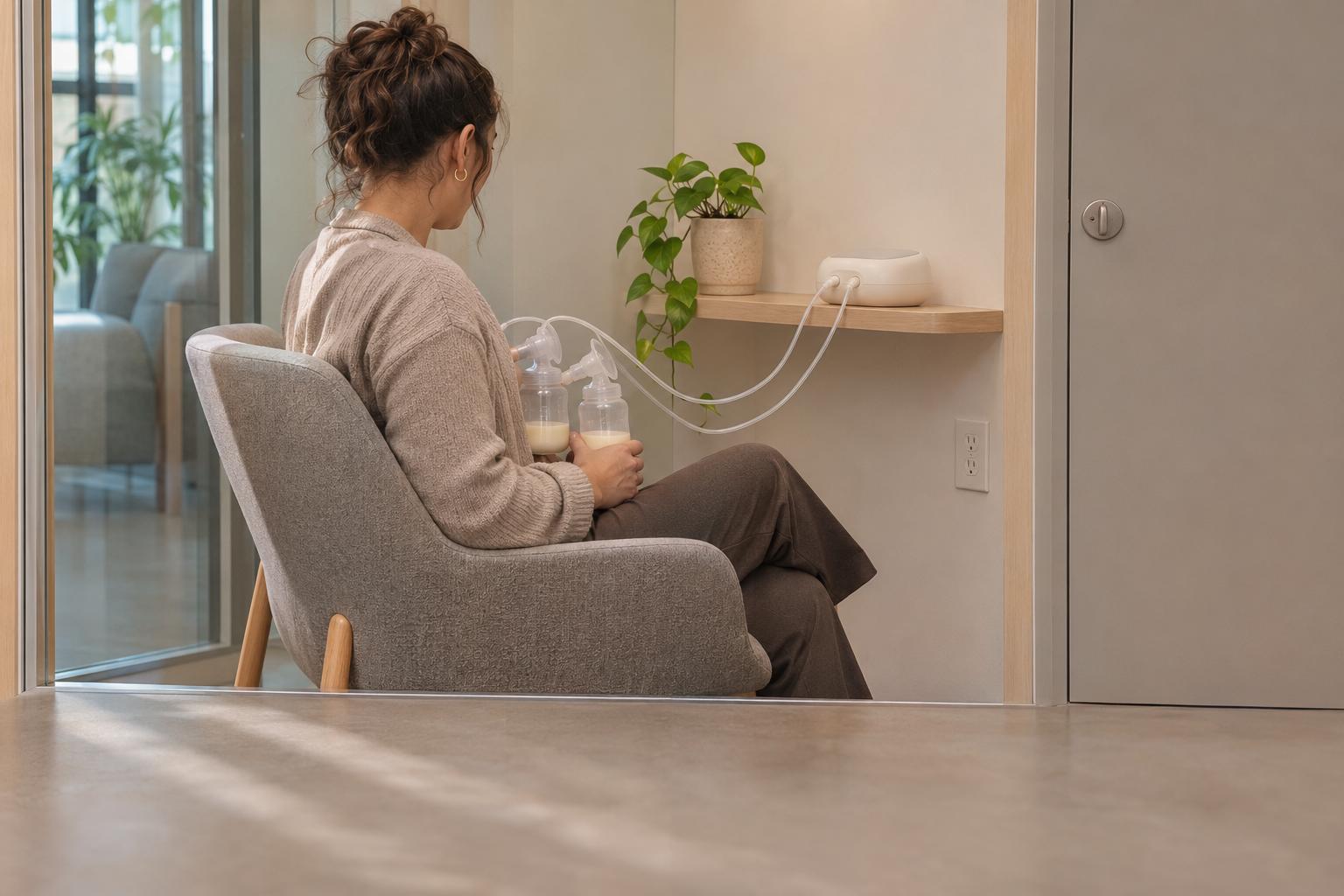
Five categories recur, and none should automatically be described as a suitable facility:
- Dedicated parents’ or lactation room: the category closest to the need. WeWork describes a designated, private, lockable space for new parents at one of its Montréal locations ([1]).
- Bookable meeting room: it may work if it is available whenever needed. The U.S. framework (which does not apply in Québec and is cited for comparison) allows this if the room is available every time ([19]).
- Phone booth: designed for phone and video calls; it is suitable for pumping only if it passes the checks below.
- Enclosed office: a private office may have a door, but some have glass partitions ([20]). A closed door therefore does not mean people cannot see through the glass.
- Washrooms: they are not an assumed solution. The U.S. framework specifies that a bathroom, even a private one, is not a permissible location ([19]), and York Region Public Health (Ontario) considers a washroom never appropriate ([21]).
A relaxation or nap room (for example, the “Zen Room” at an Old Montréal café-coworking space, described as a quiet room for taking a break ([22]) or a nap booth ([2])) is not equivalent to a room for pumping milk.
Eight Checks During the Tour
Each feature must be checked on site:
- Locking: a door that locks from the inside and an occupancy indicator; the American Institute of Architects recommends a lock with an indicator ([23]), and the U.S. framework calls for a lockable door or an “en usage” sign ([19]).
- Glass and cameras: look through the partitions, note any cameras and ask whether they can be blocked; the U.S. framework requires this during the break ([19]), but this is not a Québec rule.
- Risk of entry: frequent traffic, badge access available to third parties, cleaning staff.
- Seat and surface: a seat and a surface other than the floor ([19]).
- Electrical outlet: useful if the equipment plugs in ([19]); an Ontario employer includes one in its policy ([24]). The equipment instructions take precedence.
- Water access: a nearby sink makes cleaning easier ([19]).
- Cleaning: who is responsible? For a shared breast pump, the CDC recommends cleaning the controls, power switch and countertop ([9]).
- Priority and occupancy: a shared room calls for a booking system or a board outside the door ([23]).
Audit Checklist: Need, Room, Resource, Responsibility, Evidence, Backup
Table 1 below serves as a tour checklist: each row connects a chosen need to a resource, names who can guarantee it, identifies the evidence to obtain and provides a backup solution. The “Evidence” and “Backup” columns are methodological suggestions, not legal requirements.
| Chosen need | Resource to check | Person responsible | Evidence to obtain | Backup solution |
|---|---|---|---|---|
| Chosen level of privacy | Lockable door, occupancy indicator, glass, cameras | Provider | On-site observation; written confirmation | Another room or a reserved time slot |
| Room available at chosen times | Booking, priority, occupancy time | Provider (rules), individual (booking) | Written rules; calendar | Replacement room; another time slot |
| Comfort and setup | Seat, surface, outlet ([19]) ([19]) | Provider | Photo taken during the tour | Self-contained equipment used according to the manufacturer’s instructions |
| Cleaning | Water access, room cleaning ([19]) | Provider (room), individual (equipment) | Written description of cleaning | Spare parts; washing at home ([15]) |
| Milk storage | Shared refrigerator or cooler, discreet labelling ([14]) | Provider (fridge), individual (containers) | Fridge rules; access hours | Cooler with ice packs ([9]) |
| After-hours access | Badge, reception hours | Provider | Written access hours | Come during reception hours |
| Visitors and children | Separate rules for use without a baby ([25]) | Provider | Policy text | Written exception or another room |
| Work agreement (employee) | Hours, workspace budget, access | Employer ([6]) | Confirmation email | Review after the trial day |
A row without evidence remains an unresolved request, to be recorded on the tour checklist. Where the provider alone is responsible (privacy, glass), written confirmation carries the most weight.
Access, Booking and What Montréal Spaces Document
How Access Works Elsewhere
Educational institutions provide concrete examples of access mechanisms, with useful limitations to be aware of. UQAM’s student parent space is open without a booking during Bibliothèque centrale hours ([25]), offers a breastfeeding corner with an armchair and bottle warmer ([25]) and sets a maximum capacity of 4 adults and 4 children ([25]). It specifies, however, that a parent alone cannot use the space ([25]): the equipment exists, but eligibility is designed for parents accompanied by their children. This is neither a commercial solution nor a location recommendation: the example shows why equipment and eligibility must be checked separately.
HEC Montréal provides lactation rooms in each of its buildings ([26]). Toronto Metropolitan University uses registration followed by an access card ([27]), asks users to vacate the room when finished ([27]) and does not offer refrigeration there ([27]). Université Laval announced an annual form in 2016 ([28]). These mechanisms form a list of questions to ask, not a standard.
What Six Providers’ Public Pages Say
Table 2 summarizes what public pages reviewed in November 2026 advertise for six Montréal providers. It is not a ranking: an item absent from a page was not identified there, which does not prove it does not exist.
Table 2 below compares each provider’s published plans and prices, the relevant room or space mentioned, access and storage.
| Provider | Published plans and prices | Relevant room or space mentioned | Access and booking | Milk storage |
|---|---|---|---|---|
| WeWork (1010 Sainte-Catherine Ouest) | Private office for 2 people from $740 per month, with a 12-month commitment, plus tax ([1]) | Designated, private, lockable space for new parents ([1]) | Reception hours listed as 8h to 17h; members’ access outside these hours not specified on the page | Refrigerator and sink mentioned in the parents’ room description |
| Regus (Montréal) | Rates listed as “à partir de” dated November 2026 ([29]); 24-month commitment for a dedicated desk ([29]) | Private offices on demand ([29]); no lactation room identified in the excerpts read | Dedicated desk without advance booking ([29]) | Not mentioned on the page reviewed |
| ECTO (Plateau) | Flexible workstation at $200 per month over 6 months, including 4 hours of meeting room use (Source: ecto.coop)); day pass $30 | Phone booths (Source: ecto.coop)); room for 4 to 6 people (Source: ecto.coop)) | Fixed workstation with 24/7 access (Source: ecto.coop)); day passes Monday to Friday from 9h to 17h (Source: ecto.coop)) | Equipped kitchen mentioned; fridge rules not specified |
| Crew Collective & Café (Old Montréal) | Hot desk $300 per month, dedicated desk $675, private office from $6,000 ([22]); tax treatment not indicated | Quiet “Zen Room” ([22]); semi-enclosed rooms for calls ([22]); booths for 3 to 6 people ([30]) | 24/7 access for a dedicated desk ([22]); bookings to be confirmed with the provider | Furnished kitchen mentioned |
| Montréal CoWork (Plateau) | Flexible workstation from $275 per month plus tax ([11]); team office from $400 per workstation plus tax ([20]) | 20 soundproof booths with open access ([20]); nap booth ([2]); glass partitions in team offices | 24/7 badge access for private offices ([20]); different room rate outside reception hours ([31]) | Equipped kitchen area mentioned |
| Halte 24-7 | Open-plan workstation from $249 per month ([32]); enclosed office from $850 ([32]); taxes not specified | Conference room by the hour; no lactation room identified in the excerpts read | Access details to be confirmed | Not mentioned on the page reviewed |
The table is primarily a guide to questions. The pages read do not consistently publish booking windows or cancellation terms; these details must be obtained in writing. Prices, some before tax and others unspecified, make it necessary to put quotes on a common basis. Finally, 24/7 access to a workstation does not guarantee access to the room or refrigerator: two separate resources to confirm.
Questions to Ask About Booking and Priority
Once the room has been identified, the tour focuses on how things actually work:
- Booking window: how many days in advance, what durations, what daily limit?
- Priority: is the room reserved for pumping milk or shared with calls and meetings?
- Conflict or refusal: who decides if the room is occupied, and what alternative is guaranteed?
- Cancellation, buffers and access hours: terms if the day changes, travel and setup time, access outside reception hours.
- Visitors and children: a policy separate from the need to pump milk without a baby.
Milk Storage and Transport: Guidance, Differences Between Sources, Sharing a Refrigerator
What the Québec Source Says, and Its Limits
The INSPQ (page updated February 17, 2026) states that freshly expressed milk can be kept at room temperature for a limited time, with specific times depending on temperature and storage method ([7]). It warns that storage times cannot be added together: milk should not be kept for 4 hours at room temperature, then refrigerated for the full permitted period, then frozen ([7]). It specifies that the freezer must be cold enough to keep ice cream hard ([7]), that freshly expressed milk should be placed in the refrigerator while waiting to collect more ([7]), and that the date should be written on the tightly closed container ([7]). Milk for hospitalized babies is an exception: the page refers readers to staff recommendations ([7]). This article does not assess milk quality.
An optional temperature and transport log, based on current guidance, records the time, storage location (fridge, cooler) and return trip, without calculating cumulative storage time.
The Three Official Sources Do Not Say the Same Thing
Table 3 below compares the storage times for freshly expressed milk published by the INSPQ, the Canadian Paediatric Society (2020 handout) and the U.S. CDC (page updated August 14, 2026). The INSPQ values come from the table on its page; the others are those on the cited pages.
| Source | Room temperature | Refrigerator | Source date |
|---|---|---|---|
| INSPQ (Québec) ([7]) | 4 h at 26 °C | 8 days at 4 °C | Updated February 17, 2026 |
| Canadian Paediatric Society ([8]) | 6 to 8 h at 25 °C or below | Up to 5 days below 4 °C | August 2020 |
| CDC (United States) ([9]) ([9]) | Up to 4 h at 25 °C (77 °F) or below | Up to 4 days | Updated August 14, 2026 |
The table shows an actual range of 4 to 8 days for the refrigerator and 4 to 8 hours at room temperature. Times vary by source (the INSPQ gives the longest time for refrigeration but the shortest, tied with the CDC, for room temperature): the INSPQ remains the Québec reference, and individuals should confirm which times to apply with their health professional. The CDC itself acknowledges that it is difficult to recommend exact storage times for different locations ([33]), and the Canadian Paediatric Society reminds readers never to mix fresh milk with cold or frozen milk ([8]).
The Shared Refrigerator and the Trip
The CDC considers it unlikely that a shared refrigerator and washing parts in a common room pose a health risk if the equipment is cleaned, dried and stored in a clean place ([33]). It also states that expressed milk should not be treated as a biohazard ([33]) and can be stored alongside other foods ([15]), with the name and date on the containers. The instruction not to store milk in the door ([9]) echoes the Québec guidance regarding the freezer ([7]).
Three checks follow from this:
- Discreet labelling: name and date on the container, without exposing more personal information than necessary.
- A cooler with ice packs as a backup if the fridge is inaccessible ([9]); the Canadian Paediatric Society also recommends making sure milk can be refrigerated when daycare is involved ([8]).
- Cleaning equipment: if parts cannot be washed after each session, the CDC says they can be rinsed and then refrigerated for a few hours between uses ([34]), while noting that refrigeration does not stop bacteria from growing ([34]); another approach is to wash all the parts at home after work ([15]). The manufacturer’s instructions for the person’s equipment take precedence.
Legal Framework: Self-Employed Workers, Employees and Providers
This section describes legal texts and official pages; it does not constitute legal advice. Any specific conclusion must be reconfirmed in the legal texts and with a qualified professional.
Labour Standards: No Breastfeeding Break Identified in Québec
The Act respecting labour standards (LNT) defines an employee as a person who works for an employer and is entitled to a wage ([16]). The CNESST states that self-employed workers cannot seek recourse before it under the LNT ([35]), and Éducaloi notes that laws define self-employment in slightly different ways ([36]). In the text of the LNT reviewed, the only break identified is the thirty-minute unpaid meal break after five consecutive hours of work ([16]); no provision on pumping milk was identified, an observation of absence that requires validation.
The federal Employment and Social Development Canada page is a different matter: it states that a person is entitled to any break necessary to breastfeed or express milk ([4]), that these breaks are unpaid ([4]), and it applies to federally regulated workplaces ([4]). This rule does not automatically apply to a Québec SME or a self-employed worker.
Safe Maternity Experience: Physical Hazards, Not Office Rentals
The CNESST presents “Safe Maternity Experience” as a program that keeps pregnant or breastfeeding workers employed ([5]), with reassignment possible only if working conditions involve physical hazards to the breastfed child ([37]). It is not a subsidy to rent coworking space. The page excludes self-employed workers whose business is not a legal person ([5]), and the CNESST reiterates that self-employed workers are not covered ([35]). Eligibility is determined by the CNESST ([5]); the case of a self-employed worker whose business is a legal person is not resolved here.
The Charter and Accommodation: An Individual, Collaborative Process
Section 10 of the Charter of human rights and freedoms lists pregnancy among prohibited grounds of distinction ([13]); in the passage reviewed, it does not name breastfeeding. A 2008 INSPQ presentation citing the ministère de la Santé et des Services sociaux’s 2001 guidelines states that breastfeeding cannot be subject to discrimination under the Charter ([38]), and the Estrie fact sheet describes the right to breastfeed as protected by the Charter ([14]). The Commission, for its part, describes pregnancy as a ground encompassing everything related to it ([39]), without mentioning breastfeeding on that page. Whether pumping milk falls under a protected ground is an inference to be validated, not a claim made by this article.
The Charter also protects privacy ([13]) and prohibits a discriminatory refusal to enter into a juridical act concerning goods or services offered to the public ([13]). According to the Commission, each request is handled individually ([6]), the decision-maker has an obligation of means rather than results ([6]), the individual cooperates in good faith ([6]) and an accommodation is never developed unilaterally ([6]). Employers and service providers must actively seek a solution ([40]), and undue hardship limits the obligation ([40]). The outcome depends on the context: no free or dedicated room is promised.
For an employee, the cost of a workstation or room falls under the company’s hybrid work policy, which this article does not rewrite. For a self-employed worker, the provider is the contact for the room, and the negotiation is as much commercial as legal.
Putting It in Place: From the Tour to the Trial Day
An Eight-Step Method
The following method turns the checklist in Table 1 into a process. It applies to all three roles, with different decision-makers at each step.
- Define your chosen needs and hours away from home, without a universal medical frequency; time slots are those agreed on with a health professional.
- Separate the three roles (self-employed member, employee or employer, space provider) and record who decides and who can guarantee each resource.
- Tour a room that is actually available: access, chosen level of privacy, comfort, surface, outlets, cleaning; do not equate a closed door with the absence of glass or a camera.
- Check milk storage and transport against current INSPQ recommendations, your personal equipment and the baby’s particular requirements.
- Book the necessary time slots, allow for travel and setup, and arrange a solution if the room is occupied.
- Make a short written request, based on the resources needed, with personal disclosure limited to what is necessary.
- Compare options using actual quotes: a workstation with guaranteed access to the room, an enclosed office, a partial day or a different way of organizing the day.
- Do a trial day and reconfirm the arrangement when your schedule or needs change.
Tour before requesting, try before committing: providers often publish commitments of several months (6 months at one Plateau provider, 12 months for a private office at another, 24 months for a dedicated desk at a third), making a trial day particularly useful before signing (Source: ecto.coop)) ([29]).
The Written Request
The short request focuses on resources, not personal history. It includes the time, the resource and an acceptable alternative, and nothing beyond what the decision-maker needs to know. A neutral template:
Hello, I am requesting access, during the time slots [list], to an enclosed, lockable room with an outlet, as well as to the shared refrigerator or a space for a cooler. Please confirm in writing the availability, booking rules, access hours and procedure to follow if the room is occupied.
For an employee, it is addressed to the manager or employer, following the Commission’s approach: addressed to the relevant person, individual, collaborative ([40]) ([6]). Personal disclosure is limited to the resources needed, and the person chooses what to share.
Comparing Quotes: Before Tax, Tax Included, Options and Terms
Quotes can only be compared when they are put on a common basis. Each quote separates the room, booking, options, storage, transportation (parking, fares) and cancellation terms. GST applies at a rate of 5% to the selling price ([10]) and QST has been 9.975% since January 1, 2013 ([41]); applying each to the pre-tax price gives a combined multiplier of 1.14975 (1 + 0.05 + 0.09975). If every line in a quote is taxable (to be confirmed on the quote), the tax-included cost is calculated as follows: (rent + room + options + storage) × 1.14975.
(Hypothetical example) A flexible workstation advertised at $275 per month plus tax ([11]) gives $13.75 in GST and $27.43 in QST, for $316.18 including tax. A team office advertised at $400 per workstation per month plus tax ([20]) gives $20.00 in GST and $39.90 in QST, for $459.90 including tax. A hypothetical meeting room at $30 per hour before tax, booked for 2 hours in a day, costs $60 before tax, or $68.99 including tax. These figures illustrate the calculation; no average savings or productivity gains follow from them, and published prices may change.
The Trial Day
The trial checklist records the time needed to reach the room, its condition, availability at the chosen times, refrigerator access, equipment cleaning and any unanswered requests. The trial takes place on a day representative of the usual week; the arrangement is reconfirmed when the schedule or needs change.
Analysis of Data and Evidence
What the Mouvement allaitement du Québec Consultation Shows
The primary report is dated December 2023 ([3]); the online consultation, from April 10 to May 15, 2023 ([3]), collected 1,336 responses ([3]), with blank responses excluded and varying denominators. Asked about specific workplace arrangements, 123 respondents out of 767 answered yes (16%) and 644 answered no ([3]). Several respondents did not need such measures ([3]).
This observation cannot be read as an unmet need of 84%, a universal absence of support, growth in 2026 or demand for Montréal offices. The sample is unbalanced: respondents are 100% women ([3]), 72% report household income above $80,000 before tax ([3]), and only 5% are students ([3]). The report mentions entrepreneurs and self-employed workers ([3]) without separate figures: the survey does not support conclusions about freelancers.
The report’s operational categories are useful for the checklist, even though their figures cannot be extrapolated. Among the 118 respondents whose types of arrangements are detailed (a different denominator from the 123 “oui” responses), just over half (51%) had access to refrigerated storage ([3]) ([3]), 47% had a room set up for breastfeeding or pumping, and remote or hybrid work was available to a quarter of them ([3]). No separate “horaire” line appears in the list of arrangements in place. In the follow-up table on arrangements that would have helped, the numbers are very small (34 respondents) and the answer “Non” was not allowed ([3]).
Implications and Future Directions
For individuals, the shift is from asking “Is there a room?” to “Is this room available, enclosed and accessible at the chosen times?”; the tour becomes the decisive step.
For providers, publishing a room’s features (locking, glass, outlet, water access, booking, visitor policy, shared fridge) would reduce unnecessary tours; the institutional frameworks observed show that these rules fit into a few lines. The CCOHS employer directory lists resources on breastfeeding at work, including a sample policy ([42]).
For employers with small hybrid teams, clarity in the policy (who pays for the workstation, room, transportation) matters as much as the room.
Guidance, legal texts, prices and spaces change: an up-to-date checklist is more useful than a list of locations. The evidence remains limited: no study known to this article measures the availability of rooms for pumping milk in Montréal coworking spaces.
Frequently Asked Questions (FAQ)
Is There a Lactation Room in a Montréal Coworking Space?
Among the six providers whose public pages were read in November 2026, only one offering explicitly describes a private, lockable room for new parents ([1]); other pages mention booths, meeting rooms or a relaxation room (Source: ecto.coop)). The absence of a mention does not prove absence; written confirmation after a tour is the only useful evidence.
Do You Have the Right to Pump Milk at Work in Québec?
No breastfeeding break was identified in the version of the Act respecting labour standards reviewed, which provides for a thirty-minute unpaid meal break ([16]). The federal rule on unpaid breaks applies to federally regulated workplaces ([4]). The Charter and the individual accommodation process described by the Commission provide a framework for discussion ([6]), whose application to a specific situation should be validated with a qualified professional.
Where Should Milk Be Stored?
In a refrigerator or a cooler with ice packs according to the guidance, bearing in mind that storage times cannot be added together ([7]) ([9]). Official sources differ (Table 3); the Québec reference is the INSPQ, and the choice of storage times rests with the person and their health professional. The provider specifies the rules for the shared fridge and labelling.
How Do You Book a Private Room?
Ask about the booking window, priority, the solution if the room is occupied and cancellation terms. The provider pages read do not publish these details consistently; some providers require a quote for rooms outside reception hours ([31]).
What About Returning from Parental Leave with a Breast Pump?
The QPIP deals with benefits, not workspace ([12]). For the return, the Estrie fact sheet suggests discussing the space, schedule and refrigerator with the manager before resuming work ([14]) ([14]). Medical needs should be discussed with a health professional.
Can a Breastfeeding Mother Work in a Coworking Space Without a Dedicated Room?
It depends on her needs: some do not need any specific arrangement ([3]). For others, the checklist helps them choose between a workstation with guaranteed access to a room, an enclosed office or a different way of organizing the day.
Conclusion
Choosing a space for pumping milk in a Montréal coworking setting is an operational decision, to be documented through a tour and written confirmations. The checklist in Table 1 connects the chosen need to the room, access, storage and a workable day, separating the roles of the self-employed member, employee and provider. Table 2 reminds readers that public offerings do not promise a room’s actual availability, and Table 3 that storage times differ by source.
Three principles hold it all together. First, privacy is a personal choice, never an obligation to hide. Second, a booth, meeting room or washroom is not an assumed solution; each must be checked. Finally, a comparable quote is put on a common basis (before tax, tax included, options, cancellation) and a trial day comes before a commitment. Specific legal conclusions should be validated with a qualified professional, and the method should be revised when the schedule, needs or guidance change.
External Sources (42)
About
2727 Coworking
Find a practical home for your work at 2727 Coworking in Montreal. Explore private offices, day workspaces and meeting rooms, plus business-address and virtual-mailbox services for your company.
2727 Coworking is a Montreal workspace and business-address provider. We serve people who need a place to focus, meet, run a small business or establish a professional mailing presence. Our website offers English and French information about workspace options and services, alongside educational resources for operating a business in Canada.
A workspace that fits the day
Our workspace options include private offices, day passes and desks, and a conference room. These formats help individuals and teams compare a dedicated office with more flexible ways to work or hold a meeting. Prospective members can explore the virtual tour, review current pricing and book a visit before choosing a workspace.
Business addresses and mail
2727 Coworking provides business-address and virtual-mailbox services. Our resources explain the documents and practical questions involved, including guidance for people outside Canada. Service eligibility, included features, availability and access arrangements should be confirmed on the applicable service page or with our team.
Resources for Canadian small businesses
We publish guides, research and planning tools about workspace decisions, business addresses and starting a business in Canada. Our incorporation research includes information for people inside Canada and abroad, with jurisdiction-specific material to help readers identify the next questions to investigate. These educational resources complement our workspace and address services; they are not individualized legal, tax or immigration advice.
Visit or contact 2727 Coworking
Explore private offices, day passes and desks, the conference room, business addresses and virtual mailboxes. Book a visit or contact the team to discuss your needs.
A business address alone does not establish tax residence, immigration status, banking approval or eligibility for a government program.
Disclaimer
This document is provided for informational purposes only. No representations or warranties are made regarding the accuracy, completeness, or reliability of its contents. Any use of this information is at your own risk. 2727 Coworking shall not be liable for any damages arising from the use of this document. This content was generated with assistance from artificial intelligence tools, which may contain errors or inaccuracies. Readers should verify critical information independently. All product names, trademarks, and registered trademarks mentioned are property of their respective owners and are used for identification purposes only. Use of these names does not imply endorsement. This document does not constitute professional or legal advice. For specific guidance related to your needs, please consult qualified professionals.