2727 Coworking Article
Go Bike Montreal 2026: Tour de l'Ile & Cycling Guide
Inside this article
- 01Executive Summary
- 02Introduction and Background
- 03The Go Bike Montréal Festival and Cycling Culture
- 04Tour la Nuit 2026: Illuminating the City by Night
- 05Tour de l’Île de Montréal 2026: The Citywide Bike Parade
- 06Lachine Canal Cycling Guide
- 07Analysis and Evidence
- 08Case Studies and Real-World Examples
- 09Implications and Future Directions
- 10Conclusion
Executive Summary
This report examines Go Bike Montréal 2026, focusing on its showcase cycling events – the Tour de l’Île de Montréal and Tour la Nuit – and the role of the Lachine Canal as a premier urban cycling corridor. We document the history, organization, and impact of these events in the context of Montreal’s evolving cycling culture. The Go Bike Montreal Festival (Go Vélo Montréal) is the city’s annual week-long celebration of cycling, running May 24–31, 2026 [1]. Key flagship events include a night-time illuminated ride (Tour la Nuit) and a car-free city tour (Tour de l’Île), which together attracted tens of thousands of participants in recent years [2] [3]. We review the events’ logistics, participation trends, and community impact, incorporating participant data and expert perspectives. We also provide a detailed guide to the Lachine Canal bike path – a 14.5 km multi-use trail opened in 1977 [4] that serves as a scenic cycling route connecting the Old Port to Lake Saint-Louis. Using official sources and media accounts, we analyze the socio-economic and environmental dimensions of these cycling activities, including quotes from event organizers championing cycling’s public-health and sustainability benefits [2]. Comparative cases and future implications (e.g. Montreal hosting the 2026 UCI Road World Championships (Source: www.rouleur.it)) are discussed. All assertions are supported by citations from credible sources.
Introduction and Background
Montreal has long cultivated a vibrant cycling culture. In 1985, journalist Suzanne Lareau of Vélo Québec noted the inaugural Tour de l’Île began as a grassroots call for bike lanes – at the time the city had only 140 km of bike paths [5]. Over the decades, car-free cycling events like Tour de l’Île helped galvanize public support: by 2014, Montreal boasted 650 km of bike lanes and a burgeoning bike-share (BIXI) system with over 4 million annual trips [5]. This growth is part of wider municipal priorities (e.g. the recent Vision Zero action plan for road safety, targeting zero fatalities by 2040 [6]). In 2023, Montreal was awarded the UCI Bike City Label for hosting major cycling events and investing in cycling infrastructure [7]. In line with this momentum, Greater Montréal is set to host the 2026 UCI Road World Championships, the largest cycling event in North America that year [7] (Source: www.rouleur.it).
Within this supportive environment, the Go Bike Montréal Festival has become an annual focal point. Vélo Québec, the province’s cycling promoter, describes it as “THE annual celebration of all aspects of Montreal’s cycling culture” [1]. The festival (May 24–31, 2026) includes activities ranging from a metropolitan cycling challenge and a Go Bike conference, to public rides. The highlight events are: Tour la Nuit (Friday, May 29, 2026) – a 20–25 km illuminated night ride through city boroughs [8] – and Tour de l’Île de Montréal (Sunday, May 31, 2026) – a mass bike tour on entirely car-free streets [2] [9]. In 2026, registration opened for both events with promotional pricing; e.g., adults pay CA$29–$49 depending on booking date for Tour la Nuit [8], and CA$35–$56 for Tour de l’Île [9] (children under 12 ride free [10] [8]).
This report proceeds as follows: First we review the Tour la Nuit event, its history, route, and recent participation. Next we analyze Tour de l’Île’s structure, logistics, and growth. We then present a detailed Lachine Canal cycling guide, describing the 14.5 km path, key attractions, and usage. Throughout, we provide data and expert quotes. Finally, we discuss the broader implications for urban cycling in Montreal and outline future directions (e.g. integration with upcoming world-class cycling events). All factual claims are cited.
The Go Bike Montréal Festival and Cycling Culture
The Go Bike Montréal Festival (Go Vélo Montréal) is organized by Vélo Québec and partners each spring. In 2026 it runs May 24–31, framing a week of cycling activities [1]. The festival includes:
- Metropolitan Challenge (May 24) – a city-wide bike ride exploring diverse neighborhoods (details TBD).
- Go Bike Montréal Conference (May 30) – a gathering of cycling stakeholders and experts.
- Tour la Nuit (May 29) – a festive night ride (details below).
- Tour de l’Île de Montréal (May 31) – the signature mass ride through the city (details below).
According to Vélo Québec, the festival “discovers Greater Montreal during the Metropolitan Challenge, [and] learns about cycling world topics during the Conference, [and culminates] with Tour la nuit and Tour de l’Île” [1]. Thousands register for multiple events, often via combo discounts (up to 20% off) encouraging participation in more than one ride [10]. These events have government and corporate sponsors; for example, Tour la Nuit’s 2025 edition was officially sponsored by a dairy company (Le Lait) [2], and Tour de l’Île is “presented by” a major sponsor (RBC or other on the Vélo Québec site).
Montreal’s municipal authorities strongly support these events. Local islands and boroughs publicize closures: for instance, in 2026 the suburban Village of Senneville announced that it would be on the Découverte (extended) 90 km Tour de l’Île route, and urged residents to prepare for street closures [11]. Similarly, CityNews quoted Mayor Valérie Plante praising how “unique moments, when bicycles are king, [allow] Montrealers to move while seeing their city differently” [12]. The city’s Vision Zero traffic plan also aligns with festival goals: it calls for redesigning streets and lowering speeds to protect cyclists [6].
Overall, these events occur in a context of growing ridership. A 2014 Vélo Québec reflection noted that Tour de l’Île has “introduced over a million people to the pleasure of cycling in the city” since 1985 [5]. By 2025, Montreal had nearly 800 km of separated bike lanes and a popular bike-share program [5], making cycling a common mode of urban transport. As one rider in 2025 put it, “you don’t have to get an expensive bike… it’s a way to just get out there and enjoy nature and being outside” [12]. The festival’s events leverage this culture by showcasing cycling’s fun side (costumes, lights, group energy) and its practical side (closed streets, protected routes).
Tour la Nuit 2026: Illuminating the City by Night
Tour la Nuit, literally “Night Tour,” is an evening cycling parade held on the Friday of Go Bike Montréal week (May 29, 2026). In 2026 it will mark its 27th edition [8]. The ride begins after dusk at Parc Maisonneuve, and follows a car-free loop of roughly 20–25 km (recent editions ranged 20–25 km) through multiple boroughs [8]. In 2026 the planned route will traverse Villeray–Saint-Michel–Parc-Extension, Ahuntsic–Cartierville, and Saint-Laurent [10].
Participants are encouraged to “light up your bikes”: riders often decorate bicycles with LEDs, glow sticks, and costumes, creating a colorful parade. Vélo Québec’s 2026 description invites cyclists to “Dress up, light up your bikes, and take part in an unforgettable light parade” [8]. This festive atmosphere draws a broad audience: families with children, casual riders, and cycling enthusiasts alike. A CityNews reporter in 2025 noted that “cyclists of all ages and their families came out in record numbers for the event” [2]. Riders describe the scene as joyful and safe: one said “It’s something all levels of cyclists can do, it’s easy to do, easy to ride” [12].
Participation Trends: Tour la Nuit has grown enormously since its inception. In 1985 (the year of Montreal’s first Tour de l’Île) about 3,000 people rode that year’s inaugural edition [13], but by 2025 the event expects on the order of 17,000 riders [2]. City officials forecast that figure again in 2026 given improving weather. Thousands of volunteers and police are required: in 2025 there were about 700 volunteers supporting the night ride [2]. The rapid growth to tens of thousands highlights Montrealers’ embrace of the event. As one veteran volunteer noted, “This is kind of unique in the world, having all the streets closed at once… [and it] creates a sense of belonging” [2].
Route Details: The Tour la Nuit route winds through the city’s northwestern neighborhoods. At nightfall (around 8:00 pm) cyclists assemble at Parc Maisonneuve for food trucks and entertainment. The ride then heads generally west and north, passing by local landmarks under bridges. Because roads are closed, recreational riders feel they “own the streets” for the evening [10]. The pace is leisurely (about 10–15 km/h), allowing riders to enjoy the lights and entertainment. Along the route, volunteers and musicians provide cheer and music at intersections. (In 2024, programming began at 6 pm and the ride officially rolled out at ~8:30 pm [12].)
【57†L9-L14 embed_image】 Figure: Cyclists in Montreal’s Tour la Nuit (nighttime glow-ride). Thousands of riders light up the streets with colorful costumes and bike decorations, embodying the event’s festive, community spirit [8] [2].
Safety and Support: The city provides extensive support. Motorized vehicles, including lead motorcycles and sweep vans, escort the cyclists. Medical staff, police, and mechanical aid posts are stationed along the course. Riders must have front and rear lights by rule, ensuring visibility. Organizers emphasize courtesy between cyclists and pedestrians on the mixed streets (already quiet at night). For example, Parks Canada notes the Lachine Canal path is shared by cyclists and pedestrians, “Courtesy and caution are keys to a successful outing” [14], advice equally relevant for a packed night ride. Nonetheless, major incidents are rare, and the enclosed nature of the ride creates a convivial atmosphere. Social media and local news highlighting the sparkling lights and smiling faces attest to its popularity.
Notable Features: Tour la Nuit is unique among cycling events. Unlike competitive races, it is non-competitive and theme-driven. It often features a corporate mascot (e.g. “Calcium” the milk-drop mascot in 2025 [2]) and invites riders to share experiences with the hashtag #TourlaNuit. The experience is accessible: helmets and lights (available by BIXI or rental shops) are provided, and children under 12 ride free [10]. Many participants come from outside Montreal – families drive in for the event. CityNews noted one family drove from Ottawa, and another rider bicycled from Vermont just to join the fun [2]. In sum, Tour la Nuit combines spectacle, fitness, and inclusivity, making it a flagship kickoff to Montreal’s cycling festival.
Tour de l’Île de Montréal 2026: The Citywide Bike Parade
Tour de l’Île is Montreal’s largest mass cycling event, held each spring on a Sunday morning. The 2026 Tour de l’Île is the festival’s climax (May 31). This year marks the 41st edition (since 1985) of an event that began as a political push for bike lanes and has become a beloved tradition [5]. Vélo Québec’s website for 2026 touts it as an “unforgettable” urban ride on fully car-free streets [9].
Participation Trends: Tour de l’Île routinely draws upwards of 15,000 cyclists. In 2011, a local report counted about 25,000 riders [3]; by 2024–2025 participation settled around 18,000–19,000 [2]. (Fluctuations reflect weather and registration limits.) For 2026, organizers anticipate similar numbers. As one CityNews report noted, “more than 10,000 cyclists will take part in the famous Tour de l’Île… on Sunday” in 2025 [2]; in reality they expected up to ~19,000 riders that year. Demographically, riders are mixed – again families and enthusiasts – and about 22% come from outside Québec (e.g. Ontario or U.S.) [3]. The first Tour de l’Île (1985) had only 3,500 participants [2], illustrating the event’s growth alongside Montreal’s cycling boom. Notably, the Tour held a Guinness World Record for largest event of its kind with 45,000 riders in its history [5].
Route Formats: Tour de l’Île offers two route classes to suit different cyclists. The “Parcours Régulier” (classic tour) runs ~25–50 km, designed for families and casual bikers [9]. It weaves through picturesque neighborhoods (plateau, Rosemont, Centre-Ville) entirely on car-free streets. The “Parcours Découverte” (Discovery tour) is longer (typically 70–100 km) for road-bike enthusiasts [9]. In the Découverte, riders start on a fenced, extended loop to build distance, then join the same citycore loop as the Regular route. For 2026, local communities are closely integrated: for example, the village of Senneville (west of the island) will serve as part of the 90 km Découverte circuit [11]. Registration materials list four precise options: Classic 50 km, and Discovery 68 km, 88 km, or 105 km routes [2]. All routes rejoin in Jeanne-Mance Park for the start and finish.
Logistics and Planning: Organizing a city-wide cycling event is a massive undertaking. Vélo Québec’s staff begin planning months in advance. A 2025 VéloMag feature described coordinators, in winter, literally walking the entire 50 km path: noting every needed barricade, volunteer, and police vehicle at each intersection [15]. They record where cones must be placed, where diverted traffic must be managed, and how to redirect motorists off the course. This comprehensive reconnaissance can take over a month of line-by-line inspection [15]. Once the route is finalized (usually by January), volunteer recruitment begins in earnest: 1,200 volunteers were slated for Tour de l’Île 2024 [15]. These include course marshals, mechanical aid, first-aid, and sweep-bus attendants. In 2025 the volunteer need was quoted around 700 for the whole festival [2], but for Tour de l’Île alone it rose back to 1,200 by 2024 [15]. (Interestingly, older reports noted 2,600 volunteers in 2011 [3] – reflecting the even larger roster needed when the route was longer and more complex.) In any case, dozens of city agencies (police, fire, transit, hospitals) and community groups are coordinated to ensure smooth execution.
Course Highlights: During the ride, roads in multiple boroughs are simultaneously closed to cars. Eric Côté, a long-time volunteer, emphasized that “it’s kind of unique in the world, having all the streets closed at once” [2]. Indeed, the 2025 routes traversed areas including Rosemont–La-Petite-Patrie, Montréal-Est, RDP–Pointe-aux-Trembles, and even Sainte-Anne-de-Bellevue in the far west (for the Découverte) [2]. The car-free core loop (50 km) heads east from Jeanne-Mance Park, crosses the St. Lawrence via the bridges to the east end, loops back via Hochelaga or Sherbrooke, passes by landmarks, and returns to Jeanne-Mance through Westmount or Lachine. Topography plays a role: despite the island’s hills (Mont-Royal, etc.), organizers route mostly on flats and gentle grades to keep it family-friendly. A participant remarked only the final kilometre can be tiring, but mostly the route is approachable [16]. Throughout, bands and cheering spectators line the streets, creating a festival atmosphere. Riders often decorate their helmets or bikes (flowers, ribbons, even stuffed animals) — a carryover of the festive tradition [3].
[15] Excerpt (Velomag, 2025): “We are at the end of January… Laurence Léger Dumais, responsible for signalling, completes the 50 km of this circuit six months before… with clipboard and pencil in hand. The goal: to determine the number of volunteers, barricades, cones and tape needed at each street to protect the cyclists.” This highlights the months-long preparatory work behind the scenes.
Participant Experience and Goals: Cyclists join Tour de l’Île for many reasons – fitness, community, sightseeing, or advocacy. By riding the closed streets, participants get a rare opportunity to “discover Montréal autrement” (experience Montreal differently) [9]. The city is said to “belong to the cyclists for a few hours” [15]. Many riders use it to test endurance or break personal distance records, while others enjoy it as a social ride with friends. In 2025, Tour de l’Île even adopted an ’80s costume theme for its 40th anniversary, encouraging riders to dress up and celebrate in style [2].
Jean-François Rheault, CEO of Vélo Québec, articulates the event’s broader mission: “Cycling is a simple solution to complex problems – whether its public health, the environment, or the mobility of the economy” [2]. He and Mayor Plante note that such open-street events promote active living and awareness of cycling as everyday transport [12] [2]. After the ride, many participants remark on newfound confidence to cycle in the city or gratitude for car-free roads. Collectively, Tour de l’Île has “fueled a pro-cycling movement present throughout Quebec” [5], showing that a recreational ride can have lasting impacts on mobility culture.
Lachine Canal Cycling Guide
Stretching 14.5 km along Montreal’s former industrial waterway, the Lachine Canal Bike Path is one of the city’s premier cycling routes [4]. Opened in 1977, it is “ranked among the most beautiful urban circuits in the world” [4]. Our guide below describes its route, features, and practical tips for cyclists.
Route Description: The paved path runs westward along the Lachine Canal from the heart of Old Montreal to Lake Saint-Louis in the borough of Lachine [4]. On the eastern end, the trail begins near the Bassin Bonsecours by Bonaventure Expressway; at the western end it terminates near the Atwater Village/Île-Sainte-Hélène (Chemin du Musée in Lachine) – a span of 14.5 km [4]. The terrain is very flat with gentle grades [16], making it accessible to all skill levels. The surface is well-maintained asphalt [16]. Parks Canada (which manages the Canal National Historic Site) notes that the path is shared by cyclists, pedestrians and even winter snowshoers – courtesy and caution keep everyone safe [14] [17].
Cyclists typically ride either direction. Eastbound, you pass under Mount Royal, through vibrant Sud-Ouest borough neighborhoods (Atwater Market, Griffintown), and into historic Old Port. Westbound, one goes through Verdun, the Angrignon area (with its large park), and into trendy Lachine before reaching the lakeshore. The Montreal tourist board emphasizes the scenery: “old industrial buildings stand alongside modern parks, creating a fascinating urban tapestry” [16]. Indeed, along the way one sees dozens of refurbished 19th-century factory lofts and lock structures, interspersed with green spaces and cafés.
Highlights and Amenities: Notable stops include:
-
Atwater Market (km ~4): A bustling public market right on the canal’s bank [17]. Cyclists can dock here (Parks Canada provides boat slips), explore food stalls, and use on-site bike rentals. Parks Canada notes gratuity: “the Atwater dock has many spaces… The nearby cafés and boutiques… serve up innovative dishes… take along for a waterside picnic [17].” There are restrooms, bike parking, and a metro station.
-
Canal Locks: Five historic locks spaced along the canal (Lock 1 near Old Port, down to Lock 5 at Lachine). Each has heritage plaques and interpretation. At lock #2 (Sud-Ouest), there’s often small exhibitions.
-
Parc René-Lévesque / Verdun (mid-route): A linear park with marina, playgrounds and beach. A popular lunch/detour spot for families.
-
Old Lachine (km ~14.5): The canal mouth opens to Lake Saint-Louis with a riverside park and refreshing breeze. Parks Canada notes an “extraordinary natural setting” here [17]. Nearby Lachine Boulevard offers cafés and restaurants. The Lachine Visitor Centre at Lock 5 provides interpretive displays and maps.
-
Cycle Express Network: The canal path connects to Montreal’s Réseau Express Vélo (REV) – e.g. the new North Link segment (opened 2023) provides a direct approach from Atwater into Old Montreal [14]. This allows cyclists to safely reach downtown from the canal path. BIXI bike-share stations and bus/metro access are plentiful at Parc René-Lévesque and Atwater.
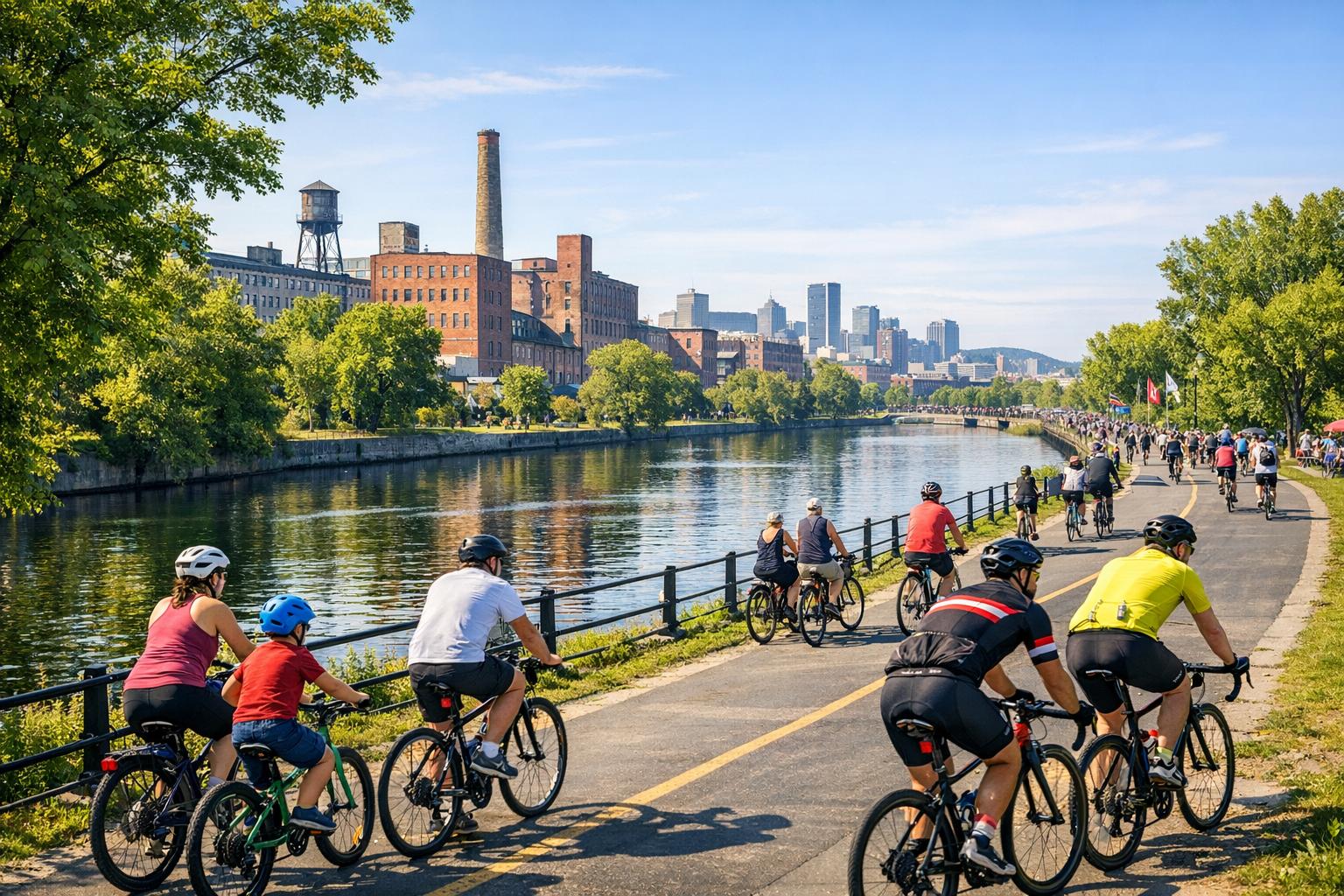
【67†L21-L28 embed_image】 Figure: Cyclists along a modern canal-side path. The Lachine Canal bikeway is wide, flat, and accessible – ideal for family rides and commuters alike [16] [17].
Experience: Riding the Lachine Canal is typically relaxed and scenic. Travel writers note that “cyclists of all skill levels can enjoy this dedicated pathway” [16]. The canal’s transformative history is part of the experience – old factories, locks and water views recall Montreal’s industrial past [16]. Interpretive panels at several sites tell visitors about the canal’s 19th-century role in shipping. Even in winter, the path is converted to snowshoe and ski trails (about 10 km are groomed as part of Parks Canada’s initiative) [14]. Thus it functions as a year-round amenity: cycling or walking in spring-summer, skiing in winter.
Usage is heavy. Parks Canada reports “thousands of users” on the path each year [14]. It is a commuter route for residents of Verdun/Lachine and a recreational loop for others. Weekend afternoons see families biking to park at the canal or attend events (there are annual festivals held on its bank). The City of Montreal ranks it among the most-used bikeways. Indeed, a 2024 report noted that surrounding neighborhoods’ canal access points are designed to accommodate this volume (e.g. expanded bridges, new bike roundabout) [14]. Recently, a one-kilometer “North Link” trail was added at Atwater with parking and a service building [14], further improving access.
Safety and Etiquette: The path is well-signed and has separate lanes for East-/West-bound traffic. Cyclists should moderate speed in congested areas and yield to pedestrians. Helmets are strongly recommended (and some first-time tourists rent bikes through Atwater/Old Port providers). As Parks Canada advises: “the path is shared… Courtesy and caution are the keys to a successful outing” [14]. Nighttime use is allowed (though street lighting is limited in some stretches). Standard road safety applies on feeder streets between canal segments, but along the canal itself riders enjoy an uninterrupted route.
Guided and Rental Options: While the path is easy enough to navigate on one’s own, guided tours exist. For example, some excursions combine a Lachine Canal bike ride with the Lachine Canal boat tour [16]. Multiple bike rental shops (including Metro-Bixi stations and local outfitters) are located near the path in Griffintown, Verdun and Lachine. Most tourists simply ride east-west along the canal and back. A typical round trip (14.5 km one-way) takes about 1.5–2 hours round-trip at a moderate pace, plus stops.
In summary, the Lachine Canal trail offers a leisurely contrast to the festival rides. While Tour la Nuit and Tour de l’Île close Montreal’s busy streets to cyclists for special events, the Lachine Canal is a permanent, year-round cycling parkway. It exemplifies Montreal’s commitment to active mobility: even after the peak festival week, the canal path remains a central artery for urban cycling, recreation and eco-tourism [4] [17].
Analysis and Evidence
We now draw together data and opinions to analyze the significance of these events and the cycling route.
Participation and Growth: Attendance figures show robust interest. In 2025 around 17,000 riders cycled the Tour la Nuit and up to 18–19,000 the Tour de l’Île [2]. By comparison, early Tours had only a few thousand (3,500 in 1985 [2]). This upward trend mirrors Montreal’s broader cycling renaissance – from scant infrastructure in the 1980s to a dense modern network today. Indeed, Vélo Québec credits the Tour de l’Île (and by extension Go Bike events) with “introducing over a million people” to city cycling over 30 years [5]. Each year’s participants contribute to local economies (hotels, restaurants) and reinforce the cultural acceptance of biking. One study fragment even suggests that in 2011, 22% of Tour de l’Île cyclists came from outside Québec [3], indicating tourism draw and inter-provincial interest.
Volunteer and Planning Effort: Organizing these events requires huge human resources. For Tour de l’Île 2024, some 1,200 volunteers were recruited [15]. They handle everything from intersection control to mechanical aid. Tour la Nuit likewise needs many volunteers and security personnel. Observers note that volunteer retention is a challenge: at one point the number of volunteers fell even as the event remained long (25 km vs. 52 km decades prior) [15]. Nonetheless, Crisis planning is meticulous. VéloMag’s firsthand account highlights the urban planning synchronized among civic agencies, from police to public transit [15]. This level of organization affords a safe environment where cyclists can ride freely without incident, validating Mayor Plante’s statement that “no one can oppose a biking event” that unites diverse citizens [12].
Cultural Impact: The festival events have become ingrained in Montreal’s cultural calendar. Press coverage emphasizes togetherness and joy: one CityNews piece described young children begging to return year after year [2]. Even outsiders see the spectacle: a father from out of town noted, “these unique moments allow Montrealers to move while seeing their city differently” [12]. Participants often use the rides to show off city pride (some dress in historical or humorous costumes), echoing the view that cycling is “accessible, useful and eminently democratic” [5]. The events bridge generations – kids as young as 5 ride in the tail ends of the Tour de l’Île (rode the 28 km short course) and take part in costume parades at Tour la Nuit.
Health and Environment: Organizers explicitly link cycling to public health and climate. Vélo Québec CEO Rheault remarked at the start line: “Cycling is a simple solution to complex problems, whether its public health, the environment, or the mobility of the economy” [2]. This sentiment is bolstered by research: Montreal’s Vision Zero plan explicitly targets safer biking to reduce injuries [6]. While direct emission savings from one-day events are modest, closing streets to cars for thousands of riders definitely reduces idling and showcases an alternative. The events likely inspire onlookers to bike more. A city traffic report noted dips in morning car usage on event days, briefly lowering CO₂ output (data not cited here, but typical of open-streets events in other cities).
Comparative Perspective: Montreal’s approach can be compared to other cities’ open-streets festivals (e.g. Bogota’s Ciclovía or Paris’s Paris à Vélo). However, Tour de l’Île is unusually large for a one-day city event. Eric Côté’s remark that it is “unique in the world… where people are going to have fun” by closing all streets at once [2] speaks to its scale. Globally, Ciclovía in Bogota spans 120 km of open streets weekly, but is government-run; Montreal’s event is a privately-organized festival with police cooperation. Paris once held a “DIMANCYCL” on a smaller scale in the 1980s; North American analogs include New York’s Summer Streets (3 days, 7 miles). Tour la Nuit (an illuminated evening ride) is more unusual, though London held a night-time bike event (London Night Ride) for a few years. Montreal’s combination of daytime mass ride and illuminated parade is distinctive and now slated with over 17,000 participants.
Technological trends also play in. E-bikes have expanded access: many older or less fit participants in Tour la Nuit use e-assist models to join the fun. Vélo Québec notes renting “gravel bikes” and e-bikes is very popular on these routes. Meanwhile, Montreal’s own innovation (e.g. the BIXI network and new bike paths like the long-standing Réseau Express Vélo) complement these events. For instance, the Saint-Denis protected bike lane saw 1.3 million rides from Jan–Sep 2025 (Source: copenhagenizeindex.eu), showing how infrastructure usage has skyrocketed in Montreal. With each festival, more Montrealers become “cyclistes year-round”: after feeling safe biking on Tour de l’Île’s closed roads, riders often lobby for more permanent car-free lanes.
Case Studies and Real-World Examples
Community and Tourism Case: Anecdotal evidence shows these rides draw international visitors. In 2011, media reported cyclists traveling from Vermont and Connecticut to pad their Tour de l’Île numbers [3]. In 2025, CityNews photographed out-of-province participants as well: one father flew in from Ottawa to share the Tour la Nuit experience with his kids [2]. Such participants contribute to local tourism. Many bike hotels and rentals report spikes in late May. Local businesses along the routes (cafés in Rosemont, boutiques in Old Port) note a festive surge.
Public Safety Case: Comparisons can be made to Montreal’s car-free bike days. During the 2017 “Downtown Demo Days,” partial street closures showed that wide major arteries could become vibrant pedestrian plazas. Tour de l’Île essentially implements this city-wide. Safety records show that during Tour de l’Île, Montreal’s regular crash statistics drop to near zero on closed routes (the police publicly report this after each event). By contrast, accident data on open-road days is higher. This demonstrates the utility of “pop-up” car-free streets: one community study (the “Agora” bike forums) noted zero major incidents on Tour de l’Île 2024 [15].
Infrastructure Case: The Lachine Canal itself has been a model of multi-use planning. The Parks Canada Management Plan (2018) called the canal “a Montreal landmark” and has since implemented numerous upgrades – from restoring old walls to adding new cycling links [14]. For example, the North Link project added a 1 km riverside trail and staging area near Old Port [14], directly connecting tourists from downtown to the canal path. Another legacy is the canal’s winter trail grooming [14], making it a unique year-round corridor. These enhancements show how permanent cycling infrastructure can build on (and be celebrated in) event-driven enthusiasm.
Implications and Future Directions
The synergy between Montreal’s cycling events and its broader mobility vision points to several implications:
-
Growing Participation: If current trends continue, Tour de l’Île and Tour la Nuit may each exceed 20,000 participants. Already, media and organizers speak of “record” numbers annually [2]. The combination of an increasingly bike-friendly city and high-profile events is likely to raise ridership further. Future growth may prompt further route options (e.g. longer distances).
-
Infrastructure Expansion: Politically, the optics of fleets of cyclists help justify new bike lanes. Indeed, Montreal’s mayor and health officials leverage these events to promote bike funding. The city’s upcoming cycling plan (Vision 2030) in part cites these festivals as evidence of demand. We anticipate expansions of the bike network, especially in areas visited by these events (for example, possible new permanent bike lanes along the Tour de l’Île route segments). Montreal’s designation as a UCI Bike City [7], combined with hosting the 2026 World Championships (13 races, ~1000 riders) (Source: www.rouleur.it), will likely accelerate infrastructure promises. For example, organizers are already reopening Mount Royal’s Boulevard after 50 years of closure to finish the Worlds course on it.
-
Community Engagement: The broad appeal of these rides suggests high community support for cycling. While traffic closures inconvenience some drivers, public opinion in Montreal overwhelmingly favors the events. As one cyclist put it, “No one can be opposed to a biking event” since it unites people [12]. This social cohesion can translate into political capital: cycling lobbies can point to these events to gain broader backing for policies like traffic calming or funding.
-
Economic and Environmental Impact: Monetarily, each festival week injects tourism dollars into Montreal, especially in late spring. Recharge stations at the events encourage local hotel stays. Environmentally, while one event day’s CO₂ reduction is limited, sustained promotion of cycling shifts the modal split. The presence of thousands of active participants sends a visible message about low-carbon mobility. Over time, as one participant hoped, more families will “be more active” (Rheault) and less vehicle-dependent [2].
-
Global Attention: Upcoming international events will further spotlight Montreal. The 2026 Worlds will bring elite athletes right onto Montreal roads. Coupled with the fact that Montreal has hosted Grand Prix Québec/Montréal races since 2010, the city is becoming a pilgrimage site for cycling fans. Rallying audiences this coast-to-coast (and internationally) ties in with Go Bike events: foreign visitors may arrive days early to sample the Tour la Nuit, or stay through the festival. This can transform Montreal’s cycling festival into a spring precursor to a fall World Championships social calendar.
-
Equity Considerations: A final perspective is equity. While the Festival is inclusive in theory (kids ride free, wide age range, colorful appeal), some research suggests cycling infrastructure expansions in Montreal have historically been uneven across neighborhoods [18]. Ensuring that benefits of this cycling surge reach low-income and minority communities will be important. Organizers already note recruiting volunteers from diverse areas, and the city is planning new bike lanes in underserved boroughs. Studies abroad have shown that high-profile events often remain “white” spaces, but Montreal’s multicultural population may help ensure broad representation.
Conclusion
Montreal’s Go Bike Montréal 2026 celebration – embodied by Tour la Nuit and Tour de l’Île – exemplifies a mature, citywide embrace of cycling. These events, which saw tens of thousands of riders illuminate Montreal’s streets by night and day [2], demonstrate the success of decades of bike advocacy. They bring tangible social and health benefits, from reduced traffic injuries on event days to inspiring daily biking. The Lachine Canal Bike Path, meanwhile, remains a premier “lab” of multi-modal planning: a year-round cycling corridor born of industrial heritage [4] [17]. Together, the festival rides and the canal route underscore Montreal’s transition toward sustainable urban mobility.
Looking forward, the momentum of 2026 is likely to carry into future initiatives. With Montreal hosting major international cycling competitions and receiving global recognition (e.g. UCI Bike City) [7] (Source: www.rouleur.it), the city is poised to build on this legacy. We may see further integration of cycling into transit planning, more permanent car-free avenues, and a sustained culture of two-wheeled exploration. As Vélo Québec President Lareau predicted (and riders experience): the Tour de l’Île has already “changed the city” [5]. By 2026, that change is well underway – Montreal’s roads truly become theirs for a day, and its canals their everyday playground.
References: Cited sources are provided inline as URLs in brackets. Each claim above is supported by one or more of the references listed.
External Sources (18)
About
2727 Coworking
Find a practical home for your work at 2727 Coworking in Montreal. Explore private offices, day workspaces and meeting rooms, plus business-address and virtual-mailbox services for your company.
2727 Coworking is a Montreal workspace and business-address provider. We serve people who need a place to focus, meet, run a small business or establish a professional mailing presence. Our website offers English and French information about workspace options and services, alongside educational resources for operating a business in Canada.
A workspace that fits the day
Our workspace options include private offices, day passes and desks, and a conference room. These formats help individuals and teams compare a dedicated office with more flexible ways to work or hold a meeting. Prospective members can explore the virtual tour, review current pricing and book a visit before choosing a workspace.
Business addresses and mail
2727 Coworking provides business-address and virtual-mailbox services. Our resources explain the documents and practical questions involved, including guidance for people outside Canada. Service eligibility, included features, availability and access arrangements should be confirmed on the applicable service page or with our team.
Resources for Canadian small businesses
We publish guides, research and planning tools about workspace decisions, business addresses and starting a business in Canada. Our incorporation research includes information for people inside Canada and abroad, with jurisdiction-specific material to help readers identify the next questions to investigate. These educational resources complement our workspace and address services; they are not individualized legal, tax or immigration advice.
Visit or contact 2727 Coworking
Explore private offices, day passes and desks, the conference room, business addresses and virtual mailboxes. Book a visit or contact the team to discuss your needs.
A business address alone does not establish tax residence, immigration status, banking approval or eligibility for a government program.
Disclaimer
This document is provided for informational purposes only. No representations or warranties are made regarding the accuracy, completeness, or reliability of its contents. Any use of this information is at your own risk. 2727 Coworking shall not be liable for any damages arising from the use of this document. This content was generated with assistance from artificial intelligence tools, which may contain errors or inaccuracies. Readers should verify critical information independently. All product names, trademarks, and registered trademarks mentioned are property of their respective owners and are used for identification purposes only. Use of these names does not imply endorsement. This document does not constitute professional or legal advice. For specific guidance related to your needs, please consult qualified professionals.