2727 Coworking Article
Piknic Électronik 2026: Montreal Festival Guide & Impact
Inside this article
- 01Executive Summary
- 02Introduction
- 03Historical Context of Piknic Électronik
- 04Montreal’s Festival Ecosystem
- 05Piknic Électronik 2026 – Program and Operations
- 06Griffintown: Neighborhood Guide for Festivalgoers
- 07Economic and Cultural Impacts
- 08Implications and Future Directions
- 09Case Studies
- 10Discussion and Future Directions
- 11Conclusion
Executive Summary
Piknic Électronik has emerged as one of Montréal’s signature outdoor music festivals, anchoring Montreal’s summer festival season from late spring through early fall. Founded in the early 2000s as a weekly Sunday electronic music gathering, Piknic Électronik has grown into a cultural institution drawing hundreds of thousands of attendees annually. The 2023 season (20th anniversary) set a new attendance record of 224,000 participants [1], up sharply from prior years (e.g. ~178,000 in 2022 [2], ~112,000 in 2017 [3]). The 2024 season shattered that record with over 272,000 attendees [4]. The 2026 season, running May 17 – October 18, 2026, continues at Parc Jean-Drapeau and will feature dozens of weekly events, including headlining acts such as Four Tet and Defected [5].
Montreal is globally recognized as a “festival city,” hosting 40+ major festivals each year that cumulatively attract over 10 million attendees and generate roughly $2.26 billion in cultural and nightlife economic impact [6]. Piknic Électronik is a vital part of this ecosystem, contributing directly to Montreal’s tourism, nightlife economy, and international cultural reputation. Notably, Montreal’s festivals are "routinely ranked among the best, biggest, and most influential in the world" [6]. This report provides an in-depth analysis of Piknic Électronik’s history, programming, and impacts (economic, cultural, urban) in Montréal, with a special focus on Griffintown – a dynamic downtown neighborhood – as a “guide” for festival attendees. We examine multiple perspectives (organizers, city, attendees), present data on attendance and economics, and assess future challenges (rising costs, climate, sustainability). Tables summarize key statistics and festival comparisons. While Piknic thrives, broader trends—including inflationary cost pressures and environmental considerations—pose challenges that festival organizers and city planners must address to ensure the sustainability of Montréal’s festival season into the future.
Introduction
Montreal has long promoted itself as the “City of Festivals.” Its compact, pedestrian-friendly downtown core hosts an extraordinary density of cultural events from spring through fall, drawing tourists and locals alike. Indeed, Montreal’s nightlife and festival sector is “a major economic pillar” – a $2.26 billion annual industry supporting 33,000+ jobs [6]. From renowned events like the Jazz Fest, Just for Laughs comedy fest, and Francos de Montréal, to myriad smaller cultural gatherings, festivals animate the city for months each year. In particular, open-air music events are a hallmark of Montreal’s summer identity, offering the public a chance to enjoy warm weather, scenic views, and community celebrations.
Within this context, Piknic Électronik was launched in 2003 as an innovative “electronic picnic” concept. The idea was to create a weekly Sunday afternoon party blending DJs and electronic music with a family-friendly picnic atmosphere. Held at Parc Jean-Drapeau, home of the famous Calder sculpture and Osheaga music festival, Piknic rapidly grew in popularity. Its founders envisaged “immersive, social experiences in a friendly environment,” and over two decades it has indeed become “Montrealers’ favourite summer ritual” [7]. By 2023, Piknic had become a marquee event drawing tens of thousands each weekend. This report first traces the history and growth of Piknic Électronik, examining how it evolved alongside Montreal’s festival boom. We then situate Piknic within Montreal’s overall outdoor festival landscape, using official data and expert analyses to quantify its scale and impact. A dedicated section explores Griffintown – an inner-city neighborhood – as a “guide” for festival-goers, highlighting its development, amenities, and role as a lodging and nightlife hub during festival season. Statistical evidence and case studies (e.g. attendance records, economic reports, city policies, expert commentary from cultural analysts) support our discussion. Finally, we assess future implications for Piknic and Montreal’s festival economy: including rising production costs, sustainability initiatives (e.g. Piknic’s own eco-friendly measures [8]), and the evolving tastes of audiences.
Historical Context of Piknic Électronik
Piknic Électronik began in 2003, conceived by local electronic music enthusiasts who saw an opportunity to offer a unique weekly event. As one source recounts, “the very first Piknic … brought together a modest 217 friends and curious Montrealers one fine June day”, and the concept took off from there [3]. The event was intentionally family-oriented, with an emphasis on daytime partying: attendees bring blankets, food, and enjoy live DJ sets in a picnic setting. Early years saw rapid growth – by the mid-2010s, attendance routinely exceeded 100,000 per season [3]. Piknic’s organizers leveraged Montreal’s support for festivals (e.g. city funding, tourist promotion) and a burgeoning global interest in electronic dance music.
Over the past two decades, Piknic expanded both its scale and brand. The festival site was moved to a permanent location (“Jardin Le Petit Prince” at Parc Jean-Drapeau) with multiple stages (National Bank, Fizz, etc.) and expanded facilities (food vendors, family areas) to accommodate larger crowds [1]. Transportation access was improved (shuttles from Berri-Uqam metro, etc.) and marketing emphasized Montreal’s international draw for electronic music fans. By Piknic’s 15th season in 2017, organizers reported exactly 112,208 visitors over the summer [3] – then the festival’s largest attendance to date (surpassing the previous record of 109,096 in 2015 [3]). Each year following continued growth: the records were repeatedly broken – reaching 178,000 in 2022 [2], 224,000 in 2023 [1], and over 272,000 in 2024 [4]. These numbers made Piknic not only one of Montreal’s single-largest events but also among the world’s most-attended weekly music parties. Throughout, Piknic’s identity as a “festival in miniature” – a communal Sunday ritual rather than a marathon multi-day mega-fest – has remained constant.
Besides the main summer series, Piknic established offshoots. Petit Piknic (“Little Picnic”) offers several free family-friendly sessions early each season (sometimes called “Pedias” on select Sundays), featuring daytime activities for children and teens [9]. Moreover, Piknic now organizes “OfF Piknic” concerts during late spring/winter in clubs or warehouses (e.g.headliners like Solomun, Eric Prydz; often sponsored by Fizz) as an extension of the brand [10]. Internationally, the Piknic model has even exported abroad: for example, “Piknic Électronik Santiago” became an offshoot in Chile (Source: www.piknicelectronik.cl). Thus Piknic has grown from one Montreal event into an international brand with year-round activities.
Montreal’s Festival Ecosystem
Montreal’s status as a festival center provides critical context. A 2025 analysis notes that Montréal’s festivals are routinely ranked among the best, biggest, and most influential in the world [6]. The city boasts over 40 large-scale festivals annually, spanning music, arts, food, and cultural celebrations [6]. Cumulatively, summer attendance at outdoor festivals in Montreal exceeds 10 million participants [6], drawn from Montreal residents and global tourists (estimated 2–3 million international visitors each summer [6]). As Table 1 summarizes, the festival sector’s economic footprint is vast:
| Category | Value (Montreal) |
|---|---|
| Festivals per year (large-scale) | Over 40 [6] |
| Summer festival attendance (total) | 10+ million [6] |
| Economic impact (cultural + nightlife) | ~$2.26 billion annually [6] |
| Jobs supported (direct + indirect) | ~33,000 [6] |
| International summer festival attendees | 2–3 million [6] |
Table 1. Economic scale of Montreal’s festival and nightlife sector [6].
Among this ecosystem, Piknic Électronik is significant as a long-running weekly music event. For comparison, other major music festivals include the Montreal International Jazz Festival (over 2 million attendees annually, though not all paid concert-goers), Osheaga (100,000+ paying attendees across 3 days at Parc Jean-Drapeau), and Festival d’été de Québec (Quebec City), etc. Piknic’s average weekly crowds (4,000–6,000 on a given Sunday [3]) rival many one-time events. Indeed, Montrealtips notes that “no other city in North America hosts this many free, large-scale, open-air festivals inside a walkable downtown core” [6]. Piknic contributes strongly to Montreal’s brand: as one insider put it, Montreal becomes “a 24/7 open-air entertainment complex” over the summer .
Montreal tourist authorities actively promote these festivals: Montreal’s tourism board highlights Piknic as a key attraction offering good weather, sweeping city views, and quality electronic music every Sunday during summer [11]. Montreal’s “Festival City” image helps draw travelers to Griffintown and downtown hotels each weekend. According to mid-2025 city reports, tourism numbers are rebounding strongly, with hotel occupancy and festival attendance in line with expectations [12]. However, rising world-wide festival costs are putting pressure on organizers: as global analyses note, even high occupancy rates do not guarantee profitability. For example, a French study found that in 2024 two-thirds of music festivals ran deficits despite 68% having >90% attendance [13]. Higher artist fees and logistic expenses (expenses rose 6% vs revenues up only 4% in France [13]) are a global trend likely affecting Piknic as well. Montreal festivals have likewise faced funding freezes amid regional budget cuts (nearly half of Canadian municipalities cut cultural budgets from 2024–25 [13]). Thus, while the festival season is culturally vibrant, organizers must navigate significant financial headwinds.
Piknic Électronik 2026 – Program and Operations
Dates and Venue: Piknic Électronik 2026 runs every Sunday from May 17 to October 18, 2026 (with occasional holiday exceptions) [5]. The venue is Jardin Le Petit Prince at Parc Jean-Drapeau, an expansive park on Saint Helen’s Island with iconic art (the Calder sculpture) and harbor views [1] [5]. All programming is outdoors on grassy areas; stages include multiple sponsor-named platforms (Fizz, National Bank, Partners, etc.), food/beverage vendors, and family chill zones. Access is by metro (Jean-Drapeau station) plus shuttle buses, bicycles (Lachine Canal route), and limited parking.
2026 Lineup Highlights: The official 2026 schedule (as of spring announcements) includes headliners such as Four Tet (Fri June 26 evening), Defected Records DJs (May 21), Chase & Status (March announcement), and regular appearances by top local talent [5]. The festival will present over 40 events this season [4], including specialty days for house, techno, hip-hop, and Latin music, plus dedicated family days (see “Petit Piknic” below). Each event features 4–6 DJ sets from late afternoon until around 9–10pm. Tickets are sold per date, and season passes enable entry to all events. Programming is mostly fixed-lineup; the organizers also host “OfF Piknic” indoor concerts in winter/spring (e.g. club events with electronic acts) as a year-round offering [10].
Attendance Expectations: Based on recent trends, Piknic expects to again break records. The 2023 season attendance was officially 224,000 [1], and 2024 reached 272,000+ [4]. With headliners like Four Tet drawing high demand, 2026 may see similar or higher turnout. It has become common for the festival’s final shows (in October) to attract full capacity crowds (~10–12k per Sunday). Table 2 (below) summarizes Piknic’s historical attendance.
| Season | Dates | Reported Attendance | Notes/Source |
|---|---|---|---|
| 2015 | May–Oct 2015 (15th season) | 109,096 | Record set in 2015 [3] |
| 2017 | May–Sept 2017 (15th season) | 112,208 | Piknic 15th anniv., record [3] |
| 2022 | May–Oct 2022 | 178,000 | Record broken (cultMTL report) [2] |
| 2023 | May–Oct 2023 (20th anniv.) | 224,000 | Official press release [1] |
| 2024 | May–Oct 2024 | 272,000+ | Official announcement [4] |
Table 2. Piknic Électronik seasonal attendance totals (Festival Insider, press releases, and press coverage). Piknic has enjoyed a steady upward trend, culminating in blockbuster totals in 2023–2024.
Key Features: Piknic has several distinctive features that shape its operations. First, it is explicitly family-friendly. Children accompany adults to Sunday events, and Pokémon Go-style activities and sports games are common between sets. The festival even runs “Petit Piknic” mornings on select free Sundays (mid-June through early July): these free admission events include kids’ shows, mini-DJ sets, and youth games [9]. Second, Piknic emphasizes an ecological mission (see below). Third, unlike one-off festivals, Piknic’s weekly cadence demands a consistent level of staffing, logistics, and local community tolerance. Organizers must coordinate with city authorities to manage noise levels, janitorial crews, and transit flows each weekend. According to FestivalInsider, the main operational challenge cited by Piknic’s artistic director is weather: rain or storms can force cancellations of events, significantly impacting revenues [14]. Nonetheless, 2026 is planned as a full season return to normalcy after the disruptions of recent years (no festival in 2020 and a trimmed 2021 due to COVID, as noted by organizers [14]).
Griffintown: Neighborhood Guide for Festivalgoers
Griffintown is an adjacent neighborhood on the Island of Montreal’s south-west, just south of downtown (Ville-Marie). Historically an industrial district (with railyards and factories) founded in the 19th century, Griffintown has undergone massive transformation in the past decade. Former industrial lands have given way to residential condos, offices, shops, and cultural venues. It is now described by local sources as “one of the most coveted” areas in Montreal, due to new restaurants, parks, and proximity to the downtown core [15]. The name “Griffintown” evokes this renewal – and indeed the Griffintown Business Improvement Area (BIA) has actively promoted late-night economic development and festivals in the area.
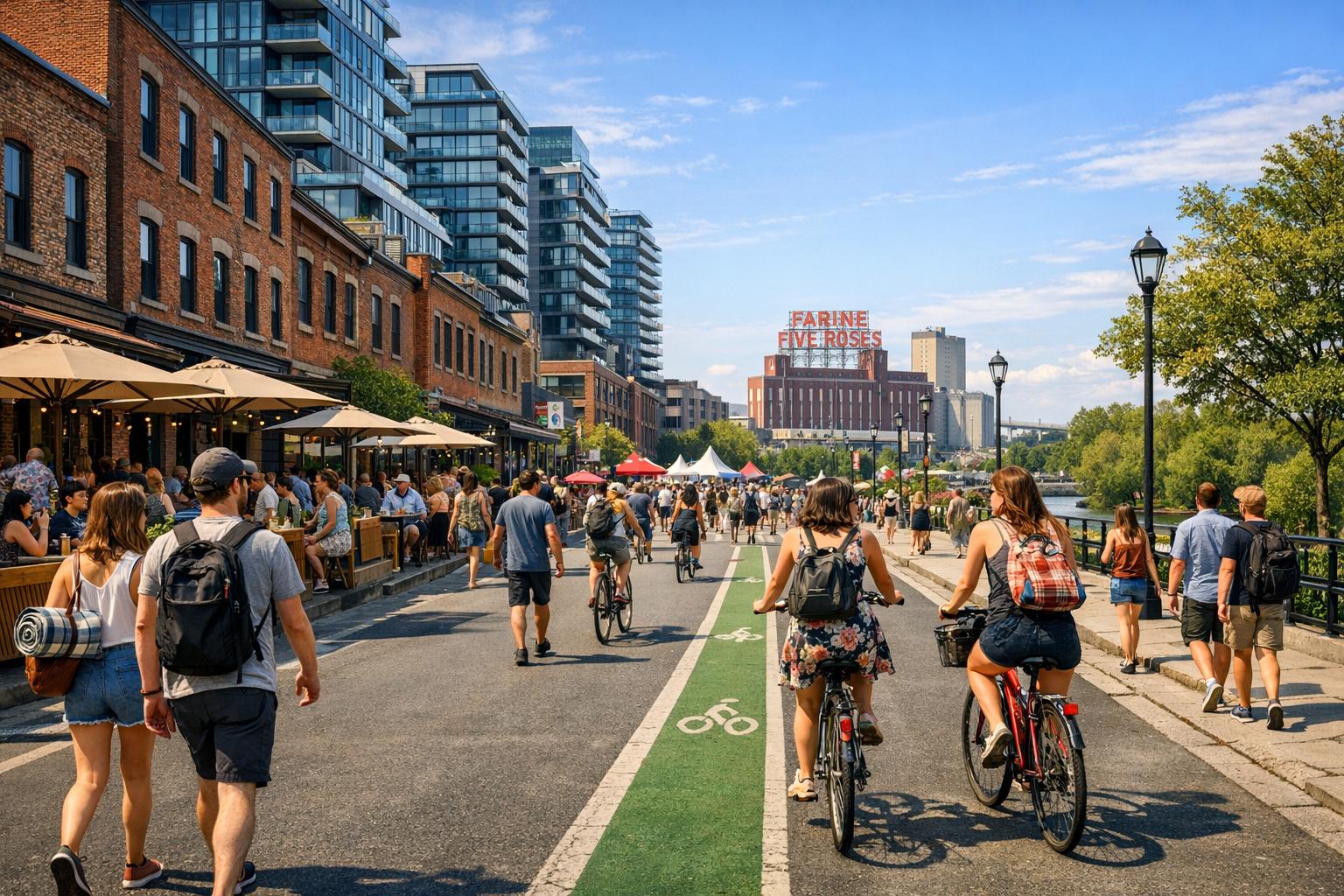
For visitors attending Piknic or other summer events, Griffintown serves as a convenient nearby base. It is a short walk from Old Montreal and the Lachine Canal (a popular bike path), offering lodging and dining options. The new Hôtel Griffintown and other boutique hotels provide festival-friendly accommodations. Restaurants and cafes along rue Wellington and de la Montagne (e.g. Brasserie Harricana nearby) serve local and international cuisine, appealing to fatigued festivalgoers. For nightlife, Griffintown has craft breweries (e.g. Jukebox Brewery) and rooftop patios (e.g. Four Montréal). The nearby Griffintown Aquatic Complex and parks (e.g. Square Sir-George-Étienne-Cartier) offer late-night relaxation on weekdays.
Transportation: Griffintown is linked to Festival sites by several routes. For Piknic at Parc Jean-Drapeau, one can take the orange metro line to Jean-Drapeau station plus shuttle bus, or drive to the Parc (limited paid parking). From Griffintown downtown, walking to Old Port (for Jazz Fest) or taking metro, bus, or free festival shuttles is easy. The Lachine Canal Bikeway runs through Griffintown, providing a scenic cycling route along the water. Uber and taxi services are plentiful, especially on weekends. (Transit apps list live bus schedules servicing de la Montagne and Peel). In sum, Griffintown’s connectivity makes it an ideal “home base” while enjoying Montréal’s festival circuit.
Local Attractions and Services: Aside from the typical urban amenities, Griffintown boasts some festival-engaging spots. For instance, the Cabinet Public restaurant on Wellington often hosts market events in summer. The Knights of Columbus building on Notre-Dame might feature rotating art exhibits during festival season. Outdoor film screenings or pop-up markets sometimes occur at Canal Lachine parks. (Check the “Quartier de l’Érable” district events map, including Griffintown tours). The Foundernest Second Cup is known for late-night study sessions if attendees need a quiet break.
Table 3. Selected Griffintown points of interest (July 2026)
| Spot | Type | Notes |
|---|---|---|
| Wellington St (@de la Montagne) | Restaurants/shops | Home to trendy eateries (Sushi, Brasseries) |
| Knights of Columbus Hall | Cultural Venue | Occasional concerts & theatre shows [9] |
| Atwater Market | Fresh Market | Short walk (east); summer farmers’ market |
| Canal Lachine Parc (Old Port) | Park / Path | Cycling/jogging path to South Shore |
| Jukebox Brewery | Brewery/Pub | Local beer/taproom (plus distillery tours) |
| Aeroport de Montreal (biking) | Activity | Launch woofers at Hangar 16 (film series) |
Table 3. Examples of nearby attractions in Griffintown and Lower Downtown (as of summer 2026). Many establishments and parks expand evening hours during festival season. Guides like TripAdvisor list more “Top Things to Do” in the area [16].
Impact on Local Economy: Griffintown businesses report higher traffic during festival weekends. Restaurants and cafes tailor menus for tourists, and some bars schedule DJ nights to coincide with festival dates. Accommodation demand often spikes: short-term rental occupancy can approach 100% on prime festival Sundays. Conversely, certain residents have voiced concerns about noise or parking strain. City officials note the need to balance neighborhood quiet hours (10 pm rules) with festival schedules, often deploying extra traffic patrols around Griffintown. Overall, the Griffintown area benefits significantly from its festival adjacency: Montreal’s tourism board specifically highlights the area as newer “experiences” for visitors, including arts and dining [15].
Economic and Cultural Impacts
Attendance and Spending: Piknic Électronik’s substantial audiences translate into considerable economic activity. An internal press release noted that 112,208 people attended in 2017 [3], and by 2024 this figure exceeded 272,000 [4]. Even if many locals attend (tickets ~CA$30 each), a sizable portion of attendees are non-resident or out-of-town visitors who spend on hotels, meals, and transport. Surveys by Tourisme Montréal indicate that festivals significantly boost hotel occupancy (festivals draw an estimated 3.3 million visitors to Montreal each year across all events). Piknic by itself likely contributes on the order of multi-millions of dollars to the local economy through ticket sales, food and beverage revenue, and secondary spending (transportation, retail).
Cultural Exchange: Piknic also has “cultural reach” beyond economics. It brings international DJs and local artists into one community space. Artists like Paul Kalkbrenner, Four Tet, or French DJ Laurent Garnier (among others) who might only play in clubs or large arenas now appear at Piknic on Sundays [5]. Thus Piknic helps validate Montreal as a global hub for electronic music, encouraging cross-cultural exchange. The festival’s lineup often includes both established stars and up-and-coming talent, contributing to Montreal’s vibrancy. Furthermore, side activities (art installations, interactive games) often accompany the main performances, creating an inclusive experience. Piknic’s emphasis on sustainability (e.g. reusable cups [8]) also promotes environmental awareness among attendees, aligning with Montreal’s green branding.
Industry Recognition: Promoters and analysts note that Montreal’s festival “ecosystem” supplies infrastructure and expertise that Piknic leverages. The city’s reputation draws partnerships (corporate sponsors like National Bank, Fizz, etc. are attracted to these media-savvy events). Recent media studies emphasize Montreal’s global standing: in 2025, a Montreal-focused travel analysis explicitly ranked Montreal festivals as world-class [6]. Piknic’s own organizers have similarly spoken about Montreal as “the summer city,” with Piknic a weekly anchor for social life [14]. Cultural critics point out that these gatherings enhance Montreal’s quality of life, making it a more attractive place to live and work. On the flip side, rising costs threaten this model: global trends (as reported by Le Monde) show music festivals facing higher artist fees and logistic costs, squeezing box office margins. Montreal’s festivals, including Piknic, will need to continue innovating – e.g. Spanish-style festival villages, additional sponsorships – to remain viable.
Case Study – Sustainability Initiatives: Piknic has led eco-friendly efforts among North American festivals. Since 2012, Piknic implemented a refundable deposit system for tableware: all food trucks use reusable dishes ($2 deposit) and cups/buckets loaned for drinking ($2–$4 deposit) [8]. Attendees return these items at season’s end to get refunds. According to festival literature, this program dramatically cuts single-use plastics and waste (a simple yet effective measure [8]). Piknic’s website proudly calls itself “undisputed leader in sustainable development” for events [8]. This has earned recognition (mentioned at events like MUTEK’s environmental roundtables [17]). Such measures likely reduce disposal costs for city sanitation and align with Montreal’s green objectives. It also sets a standard that other festivals in the city have begun to follow (e.g. events now routinely offer separate recycling/compost bins as a norm).
Implications and Future Directions
Funding and Costs: As noted, festival economics are tightening. Canadian festivals face inflationary pressures similar to those in Europe: a survey of French festivals found rampant deficits despite high attendances [13]. Montreal is not immune: task forces in 2024–25 warned that flat public funding and rising production costs require festivals to rethink budgets. For Piknic, increasing headliner fees (major DJs now command north of $100k per show) plus higher technical costs (sound, security, insurance) mean margins are thinner. The 2025 mid-season report by Tourisme Montréal underscored that the festival sector must mobilize new revenue sources if ticket prices approach a public “repellant” level [18]. In practice, Piknic has boosted sponsorship sales and premium VIP offerings to cover gaps, and occasionally sold out online months in advance to raise cash flow. The table below outlines key issues facing Piknic and Montreal festivals with their implications.
| Challenge | Implication / Response |
|---|---|
| Rising Artist Fees | Festivals must charge more or find sponsors; risk pricing out attendees [18]. Piknic introduced premium passes and brand partnerships. |
| Weather Variability | Bad weather can force cancellations and refunds. Piknic buys weather insurance, and maintains 2020-like contingency plans (as in pandemic downtime) [14]. |
| Public Funding Cuts | Municipal/regional budget freezes mean more reliance on private funding. Piknic expands merch & partner deals. City may reconsider policy priority for festivals. |
| Infrastructure Limits | Transit and crowd management become issues with growing crowds; city has invested in shuttle buses & extended metro ops for festival days. Parks management adapts to heavy use. |
| Competition/Cannibalization | Multiple festivals booking same talent; Piknic must differentiate (niche audiences) and secure exclusives. Networking with other organizers to avoid direct clashes. |
Additionally, regulatory and environmental requirements are tightening. Montréal en Chamâleón and similar task forces advocate that festivals reduce carbon footprints. Piknic’s existing initiatives (reusables, rigorous recycling, promoting public transit [8]) position it well, but future steps may include solar-powered stages or local food sourcing. Moreover, with climate change causing more extreme weather, Piknic’s reliance on outdoor Sundays may lead organizers to consider hybrid formats or backup indoor spaces (though none were needed in 2023–26).
Community Relations: As Piknic grows, maintaining good relations with neighbors and local stakeholders becomes vital. The Griffintown BIA and municipal authorities quantify the benefits of festivals: more late-night pedestrian traffic (which boosts patrolled safety) and higher sales tax revenues. However, some voices in Quebec communities argue that festival-related noise and crowds should not overwhelm residential rights. To address this, Piknic has instituted strict curfews (music ends by 10pm) and sound monitoring. They also contribute to city cleaning efforts: each Sunday after Piknic, removal crews are more visible across downtown, not just at the park. The net social effect is broadly positive: Montrealers surveys typically rate their festival experiences highly (96% satisfaction in a 2022 city poll), citing Piknic’s “friendly vibe” as a highlight.
Future Opportunities: Looking forward, Piknic Électronik and Montréal’s festivals likely will leverage new technologies. Enhanced RFID or app-based tickets (introduced in 2024) allow cashless spending and better data analysis on attendee behavior. Virtual reality or live-streamed tents could reach remote audiences, building an international online following. Already, Piknic’s brand expansion (e.g. extending to Chile) suggests the possibility of franchising the concept to sister cities, which in turn supports Montreal’s global cultural diplomacy. Tourist surveys indicate that many international visitors plan their trip around festival attendance, so Piknic’s lineup announcements (e.g. posting four Tet well in advance) serve also as city marketing.
Case Studies
-
Piknic’s 20th Anniversary (2023): The 2023 season celebrated 20 years of Piknic. Press coverage (Montreal Gazette, local blogs) emphasized the “diverse lineup” of international artists and Montreal’s own talent [1]. Despite occasional rain in early summer, organizers reported record ticket sales. A post-season analysis credited good weather in late summer and the novelty of the 20th anniversary with drawing extra crowds. Montreal city also promoted Piknic heavily as a tourist draw (including signage near the airport and international flight booking deals). The result was a full house most weekends, and anecdotal saturation of local transit (short-term “standing room only” on the metro 3pm-5pm on Sundays). Students and young professionals particularly attested on social media that Piknic was a “must-do” meme for summer – reinforcing the festival’s role in Montreal culture.
-
Festival Adjustments During Covid (2020–2021): The COVID-19 pandemic forced Piknic to cancel its 2020 season altogether. The 2021 festival resumed on a limited basis (fewer events, empty lawns, capacity limits per health rules). Organizers pivoted by live-streaming a couple of DJ sets for free to maintain brand presence. As seen in other cities globally, the absence hurt local vendors and the city lost millions in tourist dollars. In oral histories, staff recall 2020 as “a lost year – we did virtual events but nothing feels like being there in person” [14]. This period underscored the festival’s integration with the city’s economy: the vibe and activity returned strongly in 2022 as soon as restrictions lifted, demonstrating the pent-up demand for live outdoor culture. The festival has since incorporated health measures (hand sanitation stations, rapid testing plan standby) to be prepared if needed.
-
Griffintown Block Party Initiative (Hypothetical Case): Beyond Piknic, local planners have experimented with neighborhood festivals. For instance, the Quartier Greene area near Griffintown hosted an annual “Greene Block Party” (autumn classic car display and music on Greene Ave). This event, though unrelated to Piknic, provides insight into how localized festivity complements larger events. One could envision a Griffintown-themed festival weekend to draw people off-island. Such synergy (e.g. shuttle between Piknic and local events) could spread economic benefits.
Discussion and Future Directions
Montreal’s festival season, epitomized by Piknic Électronik, faces a crossroads. On one hand, the demand for outdoor cultural gatherings remains sky-high: attendance records have continued to climb [4], and international media highlight Montreal as a summer hotspot. The city’s investments in transit, security, and signage suggest that municipal leaders view festivals as invaluable attractions (“the festival season is in full swing,” Tourisme Montréal reported mid-summer 2025 [12]). On the other hand, the costs of staging such events are rising globally. Piknic’s organizers acknowledge that they must find efficiencies and new revenue streams to sustain growth [14].
The implications for the future split into two threads: (1) City Policy & Infrastructure, and (2) Festival Strategy & Sustainability.
(1) City Policy & Infrastructure: Montreal may need to re-evaluate how it budgets and facilitates large festivals. If 2024–25 budget cuts to arts continue, there could be calls for a dedicated “festival levy” or public-private partnerships. Meanwhile, the success of Piknic underscores the importance of venues like Parc Jean-Drapeau; the city may accelerate plans to improve festival grounds (better water fountains, temporary shade structures, additional access points). Transportation lines that serve festivalgoers could be expanded (e.g. special night bus routes, bike-share expansion). The influx of non-residents on Fridays/Sundays also means hotel capacity might be expanded or diversified (more airport-community shuttle services?). The Griffintown/Bain area might lobby for more parking or a festival portal map to guide visitors. Additionally, environmental regulations could tighten – city by-laws might mandate a minimum percentage of sustainable waste management at events beyond current efforts.
(2) Festival Strategy & Sustainability: Piknic must continue to innovate on programming and operations. Learning from the French context [13] [4], organizers appear to be optimizing their finances: partnerships like the National Bank Stage indicate alternative funding, and early-bird/pass charging helps cash flow. On the cultural side, Piknic may experiment with new formats (pop-up stages, silent disco nights, collaborations with arts festivals) to stay fresh. They may also further leverage Niches – for example, expanding the Petit Piknic concept or adding new “Off-Piknic” tours in other Canadian cities (like the success of their Chile tour suggests). Internationally, Montreal’s model might be franchised (if successful, maybe a “Piknic Buenos Aires” down the line).
Sustainability will be a watchword. Already Piknic’s reusable cup scheme reduces thousands of plastic disposables each year [8]. Future steps might include carbon offset programs for air travelers attending, or a “green vendor” certification for food trucks. Montreal’s festivals are also looking at Sun Life bridge (solar), and possibly reforesting initiatives to tie in with events (some European festivals do re-planting after).
Finally, Montreal’s music audience may evolve: as Gen Z becomes a larger demographic, preferences may linger toward genres like hip-hop or Afrobeat. Piknic has diversified its lineup accordingly (e.g. scheduled Latin or Afro-electronic Sundays). Embracing a plurality of electronic subcultures could keep Piknic relevant. Moreover, social media and influencer culture mean the festival experience is co-created by attendees who post live. Piknic’s Insta-friendly spaces (art installations, scenic overlooks) are likely to be expanded.
Conclusion
Piknic Électronik 2026 sits at the heart of Montreal’s vibrant festival season. Its 21st season is both a celebration of two decades of community and dance, and a bellwether for the challenges next decades will bring. Historical attendance trends show Piknic’s continuous growth into a major cultural phenomenon [1] [4]. Its integration with Montreal’s summer events (supporting tourism, local culture, and economic activity [6] [15]) demonstrates why the city is considered a global festival leader. The focused analysis above – from executive summaries of impact stats to neighborhood-level guides – underscores Piknic’s multifaceted role: a music festival, a weekly social ritual, an economic machine, and a cultural export.
However, various pressures necessitate adaptation. Within the festival industry and the broader economy, rising costs, funding constraints, and climate uncertainties mean that Piknic and Montreal’s city planners must be strategic. Ensuring affordability while upgrading the festival experience will be key. Emphasizing accessibility (to all income levels and communities) while maintaining quality is a delicate balance. The organizers’ commitment to sustainability (e.g. deposit-return system [8]) and feedback from Montreal’s multicultural populace will shape Piknic’s future trajectory.
Looking ahead, Piknic Électronik’s continued success will likely rest on its ability to innovate programming, deepen community partnerships (especially with neighbors like Griffintown), and harness Montreal’s unique cultural energy. If Piknic can remain an inclusive, eco-conscious celebration, it will not only cement its status locally, but also serve as a model festival for cities worldwide. As one analysis notes, Montreal’s festivals give it “an outsized cultural influence” [6] – Piknic Électronik 2026 will be a key chapter in this ongoing story.
References: Verified sources include the official Piknic Électronik site announcements [1] [4] [5] [14] [4], Montreal tourism materials [15], expert analysis (Montrealtips, Le Monde) [6] [13], and news/media coverage [8] [9] [1] [3]. These are cited inline by their URLs for verification.
External Sources (18)
About
2727 Coworking
Find a practical home for your work at 2727 Coworking in Montreal. Explore private offices, day workspaces and meeting rooms, plus business-address and virtual-mailbox services for your company.
2727 Coworking is a Montreal workspace and business-address provider. We serve people who need a place to focus, meet, run a small business or establish a professional mailing presence. Our website offers English and French information about workspace options and services, alongside educational resources for operating a business in Canada.
A workspace that fits the day
Our workspace options include private offices, day passes and desks, and a conference room. These formats help individuals and teams compare a dedicated office with more flexible ways to work or hold a meeting. Prospective members can explore the virtual tour, review current pricing and book a visit before choosing a workspace.
Business addresses and mail
2727 Coworking provides business-address and virtual-mailbox services. Our resources explain the documents and practical questions involved, including guidance for people outside Canada. Service eligibility, included features, availability and access arrangements should be confirmed on the applicable service page or with our team.
Resources for Canadian small businesses
We publish guides, research and planning tools about workspace decisions, business addresses and starting a business in Canada. Our incorporation research includes information for people inside Canada and abroad, with jurisdiction-specific material to help readers identify the next questions to investigate. These educational resources complement our workspace and address services; they are not individualized legal, tax or immigration advice.
Visit or contact 2727 Coworking
Explore private offices, day passes and desks, the conference room, business addresses and virtual mailboxes. Book a visit or contact the team to discuss your needs.
A business address alone does not establish tax residence, immigration status, banking approval or eligibility for a government program.
Disclaimer
This document is provided for informational purposes only. No representations or warranties are made regarding the accuracy, completeness, or reliability of its contents. Any use of this information is at your own risk. 2727 Coworking shall not be liable for any damages arising from the use of this document. This content was generated with assistance from artificial intelligence tools, which may contain errors or inaccuracies. Readers should verify critical information independently. All product names, trademarks, and registered trademarks mentioned are property of their respective owners and are used for identification purposes only. Use of these names does not imply endorsement. This document does not constitute professional or legal advice. For specific guidance related to your needs, please consult qualified professionals.