2727 Coworking Article
Juste pour rire 2026: Lineup, Dates and Venues
Inside this article
Executive Summary
The Juste pour rire Montreal Festival 2026 will take place from July 15 to 26, 2026 and is, according to cultural authorities, the largest comedy festival in the world [1] [2]. This flagship event transforms Montreal into the international capital of laughter every summer and attracts hundreds of thousands of spectators. After a hiatus in 2024 due to financial difficulties (restructuring proceedings and creditor protection) [3] [4], the festival returned to success in 2025, generating significant economic benefits (up to $35 million invested locally and 175,000 tickets sold for indoor shows) [5]. For 2026, the lineup will include several international galas and free outdoor shows, headlined by Jerry Seinfeld (at Théâtre Wilfrid-Pelletier at Place des Arts) and “Weird Al” Yankovic (a free concert at Place des Festivals). Other events will include emerging competitors (“Scène Ouverte”), tributes (e.g., the “Temple de la renommée” hosted by Guy Jodoin) and the satirical showcase “Culture Show”. Activities will take place mainly in the Quartier des Spectacles (modified “Place des Festivals”, Place des Arts, etc.) and at other Montreal venues (Théâtre Maisonneuve, Cinquième Salle, Club Soda, Théâtre Jean-Duceppe, Terminal Comédie, etc.) [6]. This report details the 2026 schedule, the scheduled venues and logistical arrangements, and provides a practical guide to reaching the Quartier des Spectacles from Griffintown, highlighting accessibility (metro, infrastructure) and services for teams in the area. Economic data analyses (a 2025 KPMG study) and case studies illustrate the festival’s impact on tourism and the local community. Finally, perspectives on the festival’s future development round out the discussion.
Introduction and Historical Context
The Juste pour rire Festival began in Montreal in 1983, spearheaded by Gilbert Rozon, and has grown considerably since its inception to become a major event in the comedy industry. Described by Tourisme Montréal as “the largest comedy festival in the world” [1] [2], it has attracted millions of spectators celebrating laughter for more than 40 years. The festival has helped launch the careers of many renowned comedians (Kevin Hart, Dave Chappelle, Jimmy Fallon, Amy Schumer, etc.) [7]. Traditionally held downtown each mid-July, it brings together bilingual events (Juste pour rire in French and Just for Laughs in English) spanning stand-up, satirical comedy and musical comedies. Montreal remains the festival’s main home (flagship editions), alongside international branches (Toronto, Vancouver, Paris, etc.).
In the 2010s, Juste pour rire reached record attendance levels (1.3–1.5 million festivalgoers and more when related events are included) [7]. However, the period from 2017 to 2018 marked a turning point: following revelations of sexual assault, Rozon announced the sale of his shares in 2017 [8]. In March 2018, the American group ICM Partners (with host Howie Mandel) acquired Groupe Juste pour rire [9] [10], followed in June 2018 by equity investments from Bell Média and Groupe CH [11]. These new owners confirmed that operations would remain in Montreal.
However, financial difficulties related to the effects of the pandemic, inflation and the restructuring of the live entertainment market forced the organization to cancel the 2024 edition and file for creditor protection [3] [4]. As reported by the Associated Press, approximately 70% of employees were laid off during the restructuring, with Bell Média and Evenko as major shareholders [3]. Fortunately, investors (still including Bell) enabled a return in 2025. The relaunch was a success: a joint study by the Réseau des événements majeurs du Québec (RÉMI) and the festival showed that the 2025 edition generated $28 million in direct economic benefits (through tourism spending specifically tied to the event) [5] – an amount that reaches $35.6 million under a broader methodology. Having already invested in Quebec’s economy in 2025, the festival thus proved its role as a cultural and economic driver, generating “significant economic and tourism benefits” and remaining a “pillar of Quebec’s comedy industry” [5].
Dates, Structure and Lineup
The 44th edition of the Juste pour rire Festival will take place from July 15 to 26, 2026 [2]. This two-week window falls within the traditional summer period when many Montreal festivals are concentrated. Festival activities take place daily, running “from mid-afternoon until late evening”. The lineup will mix ticketed indoor shows (comedy galas, one-person shows, tribute evenings) and major free outdoor events (concerts and entertainment in the Quartier des Spectacles). According to the organizers, there will be “hundreds of free outdoor events alongside 250 shows in 25 downtown venues”. In other words, festivalgoers will be able to choose from several stages and simultaneous events each evening, alternating between themed galas, comedy showcases and outdoor performances.
Major Events and Headliners. An initial lineup revealed in April–May 2026 announced several must-see shows. International headliners include:
- Jerry Seinfeld: the global stand-up star will present a Main Gala at Théâtre Wilfrid-Pelletier (Place des Arts) on July 23, 2026. His highly sought-after performances will focus on his classic repertoire.
- “Weird Al” Yankovic: the parody icon will give a free outdoor concert on July 25, 2026 on the Place des Festivals stage, as part of his Bigger & Weirder tour. This free-admission event follows the festival’s tradition of organizing at least one free outdoor show per edition (capable of attracting crowds of 10,000 to 20,000 people for headliners).
- Star-Studded Galas: several high-profile galas will be hosted by renowned comedians. For example, Gabriel “Fluffy” Iglesias, Mike Birbiglia, Atsuko Okatsuka and Gerry Dee are named as hosts of major comedy segments (each gala featuring performances by several comedians). These galas are often recorded for later broadcasts and combine English- and French-language comedy.
Other announced artists include a variety of international comedians (Nurse John, Jordan Jensen, Sibling Rivalry, Ron Funches, Zoltán Kaszás, Jacqueline Novak, Martin Amini, David Nihill, etc.) who will take part in various shows and themed series. The festival also presents recurring and avant-garde series: unfiltered satire with “The Nasty Show”, culture-focused shows (“The Culture Show”), British-themed evenings (“Brit(ish)”), and even LGBTQ+ or feminist comedy showcases presented under these banners. Comedy podcast presentations, workshops and ComedyPRO events (see the box below) will also take place alongside the main lineup. The full schedule thus promises an extensive offering catering to all comedy audiences, both local and international.
Local and Emerging Lineup
The participation of Quebec comedians remains at the heart of the festival. The 2026 edition will feature several talents from the local scene, including Liliane Blanco-Binette, Mégan Brouillard, Virginie Fortin, Anne-Élisabeth Bossé, Mona de Grenoble, Coco Belliveau, Neev, Magali Saint-Vincent, Mibenson Sylvain and many others [6]. Specific formats celebrate up-and-coming talent: the Scène Ouverte competition, for example, pits emerging comedians against one another each year. In 2026, this competition will hold its semi-final on July 16 and its final on July 18, hosted by Alex Lévesque (winner of the 2025 edition) [6]. Another event, named “En rodage” and presented on July 18 at Cinquième Salle, will offer a true playground for comedians experimenting with new sketch ideas [6].
In addition, special evenings pay tribute to Quebec culture. Among them is Temple de la renommée Juste pour rire : La Petite Vie, a ceremony on July 20 organized by Guy Jodoin that celebrates the cult television series “La Petite Vie” in a humorous vein [6]. In general, the festival strives to be “bold and inclusive” in its selection, combining established faces and local discoveries, reflecting its attachment to Quebec’s characteristic joie de vivre [6].
Performance Venues and the Quartier des Spectacles
The diversity of performance venues is a key element of Juste pour rire. The festival’s epicentre is the Quartier des Spectacles, the downtown district that brings together most of the venues and performance areas. It notably includes the Place des Arts complex, a true cultural “hot spot” in Montreal, as well as Place des Festivals (a large outdoor square). The remaining shows will take place at other Montreal venues. Here are the main planned locations:
- Place des Arts – Salle Wilfrid-Pelletier (P-A): An Italian-style theatre with ~2,996 seats, it is the largest venue in the complex. It hosts the main galas and “headline acts” (for example, Jerry Seinfeld), thanks to its large capacity and state-of-the-art audiovisual equipment.
- Place des Arts – Théâtre Maisonneuve: An auditorium with 1,453 seats, arranged in a semicircle. This large, circular venue serves as a major stage for many themed galas (each gala featuring several headliners). Television recordings of festival galas have often taken place here.
- Place des Arts – Cinquième Salle: A small studio venue with ~187 seats, dedicated to intimate performances. Juste pour rire presents experimental acts, “New Faces” showcases for new talent and one-person shows for small audiences here.
- Place des Arts – Théâtre Jean-Duceppe and Salle Ludger-Duvernay: Mid-sized theatres (respectively ~765 and 300 seats). They are used to round out the lineup (comedy shows, French-speaking comedians) when the other venues are full.
- Place des Festivals (Quartier des Spectacles): An outdoor esplanade on Sainte-Catherine (an open-air stage). It is the festival’s main location for free concerts. In 2026, this is where the “Weird Al” concert will take place on July 25. The audience gathers in an open space (a few thousand standing spectators, with no seating), and this stage serves as a major free showcase for the festival.
- Other downtown venues and clubs: To expand the lineup, locations such as Théâtre Corona, Cinéma Impérial (for comedy screenings or live podcasts), Club Soda, Auberge Saint-Gabriel or Terminal Comédie may be rented as needed. Historically, JPR occupies between 20 and 30 venues in total during the event.
- Additional public spaces: Beyond the large venues, the festival often installs mobile stages and street entertainment in the Quartier des Spectacles. Kiosks, illuminated sculptures (“Sentier lumineux”) and performance spots dot Sainte-Catherine Street in particular, attracting passersby and creating a “major urban festival” atmosphere even outside official events. For example, a mobile information booth (“La Vitrine”, the festival office) is set up to guide the public and sell tickets on site [12].
Overall, the festival makes extensive use of the Quartier des Spectacles infrastructure, which includes “more than 80 cultural venues and 8 public spaces” dedicated to the arts [12]. All the festival’s main locations (Place des Arts, Place des Festivals, etc.) are within walking distance of one another, forming a continuous pedestrian zone. This simplifies logistics for teams: for example, it is possible to walk from Cinquième Salle to Théâtre WP in 5 minutes. The organizers also note that “the distance between Griffintown and Place des Arts is approximately a 10- to 15-minute walk (or a short bus/metro ride)”.
| Theatre / Venue | Approximate Capacity | Typical JPR Use |
|---|---|---|
| Salle Wilfrid-Pelletier (Place des Arts – theatre) | 2,996 seats | Major galas, headline shows (e.g., Jerry Seinfeld) |
| Théâtre Maisonneuve (Place des Arts – auditorium) | 1,453 seats | Themed galas, international comedy showcases |
| Place des Festivals (Quartier des Spectacles – outdoor stage) | — (open air, open public space) | Free outdoor concerts (e.g., “Weird Al”, July 25) |
| Cinquième Salle (Place des Arts – studio venue) | ~187 seats | Intimate shows: Discovery showcases, New Faces, experimental performances |
| Other downtown venues (e.g., Salle Ludger-Duvernay, Théâtre Jean-Duceppe, etc.) | 300–800 seats | Additional programming: French-language comedies, comedy films |
Table: Main venues of the Juste pour rire Montreal Festival 2026, with their type and role (capacities based on official data [12]).
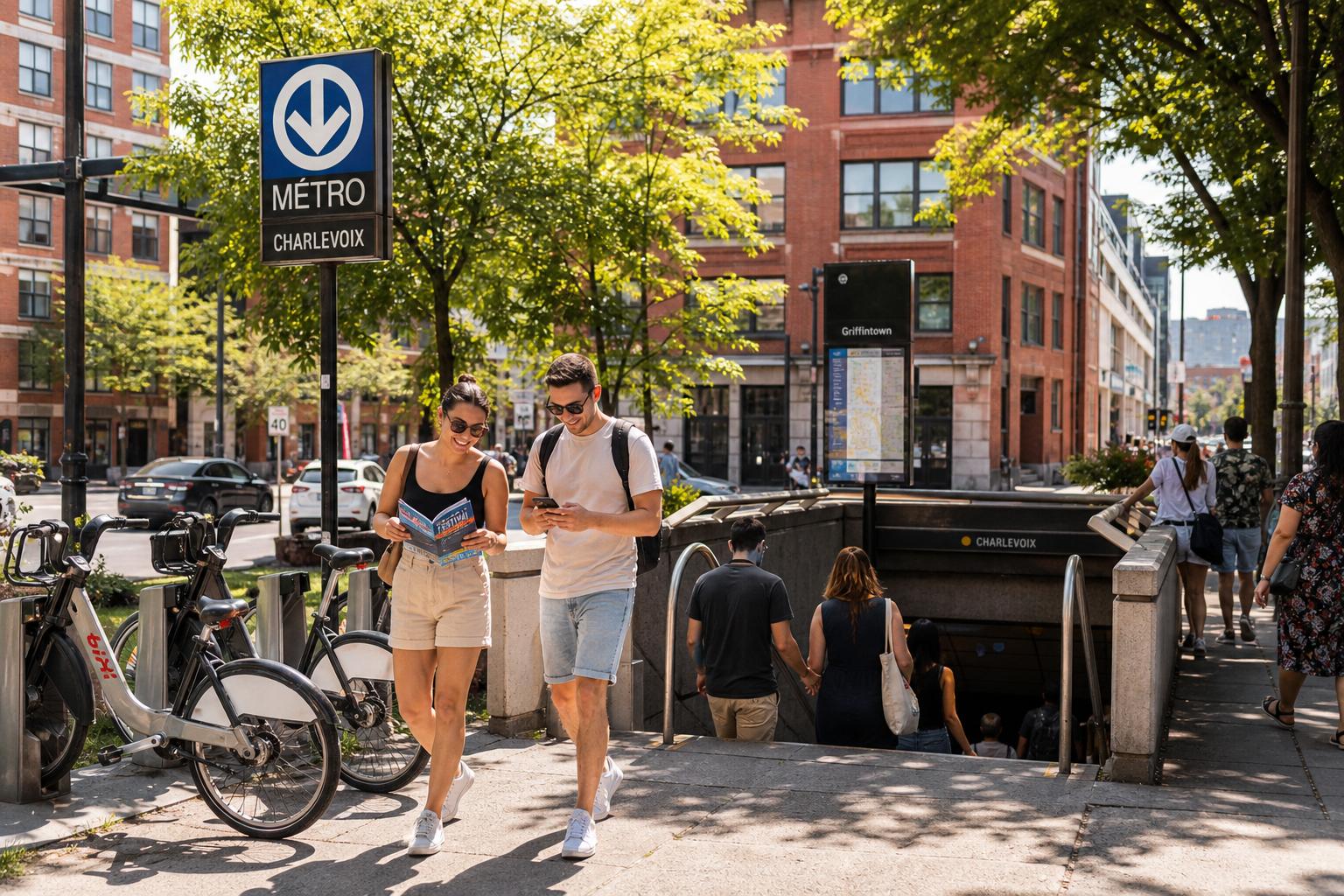
Transport infrastructure strengthens the logistical arrangements. The Place-des-Arts (Green Line) and Berri-UQAM (Green and Orange Lines) metro stations directly serve the Place des Arts complex. The Quartier des Spectacles is therefore very well connected, and shuttles or buses can connect to Griffintown in a few minutes. In addition, bike-sharing bicycles (BIXI) and electric charging stations are available throughout the area, encouraging low-impact travel. Several paid parking facilities and equipped, secure bicycle parking areas are located nearby (e.g., numerous STM parking facilities). Place des Festivals and Place des Arts also offer a variety of public amenities (portable toilets in summer, rest areas, refreshment stands and food trucks on site, mobile breastfeeding facilities, etc.), described by the organizers as essential to a “unique experience” centred on laughter.
Quartier des Spectacles and Griffintown Guide
The Quartier des Spectacles (QdS) is Montreal’s cultural heart [12]. This pedestrian district brings together more than 80 performance venues and public spaces dedicated to the arts [12]. It brings the city to life with more than 40 annual festivals (Juste pour rire is one of the most iconic) [12]. At night, the QdS comes alive with the Sentier lumineux (an art installation) and a public music circuit, creating a welcome festive atmosphere for festival teams and visitors. At the centre of the district is La Vitrine (a century-old ticket outlet), where maps, wayfinding services and last-minute tickets are available [12]. Pedestrian access to the festival is therefore straightforward: visitors can attend several events in the same evening without needing a car.
For teams based in Griffintown, the Quartier des Spectacles is very easy to reach. Tourisme Montréal notes that “Griffintown is located west of the Ville-Marie district, southwest of downtown” [13], which means the QdS is close by to the northeast. By metro, Lucien-L’Allier station (Orange Line), north of Griffintown, provides access to Place-des-Arts (via Châtelet) in a few minutes. As the sector study points out, “the distance from the heart of Griffintown (the corner of Peel/Wellington) to Place des Arts is approximately a 10–15-minute walk, or a short bus/metro ride”. By car or minibus, the route is hardly any longer, as René-Lévesque Boulevard West and Jacques-Cartier Bridge directly serve the festival area. Several businesses located in Griffintown also reflect this pairing: for example, the STM safety vest and local event companies have launched public transit promotions tailored to Juste pour rire.
In practice, Griffintown teams can make use of this guide:
- Accommodation near the festival: Griffintown offers several options for stays (apartment hotels, boutique hotels). Hôtel Griffintown (1222, rue des Bassins) or Griffintown Hôtel are located right beside the Lachine Canal and a short walk from Lucien-L’Allier metro station. From there, trips to the QdS are short. In 2026, several large apartment complexes (Sandman Inn, Pullman Grace, etc.) will offer festival packages. (Note: for real-time updates, consult the Juste pour rire or Tourisme Montréal website.)
- Getting around (transport): The metro and cycling are recommended. BIXI bike-sharing bicycles are plentiful in Griffintown and around the QdS; covered bicycle shelters keep your bikes safe. If needed, the Material Delivery Service (equipped with the REM) or special buses (STM) provide direct connections between Vendôme station (Laval) / Atwater and the festival’s main streets.
- Meals and breaks: Before or after shows, teams can enjoy the neighbourhood’s many restaurants and cafés. Atwater Avenue and Notre-Dame Street (Griffintown) are full of bistros and convenience stores open late into the evening. In the centre of the QdS itself, several food trucks and pop-up bars operate during the festival, and Saint-Louis Square (like a “village square”) offers rest areas and refreshment stands. Spaces reserved for artists/technicians (tastings, dressing rooms, changing rooms and care) will be set up backstage to support teams.
- Practical services: Bilingual information kiosks (French/English) are located at the Palais (Place des Arts) and La Vitrine (Sainte-Catherine Street). Services such as luggage storage and basic on-site medical coverage are planned (often in the P-A building or nearby), as demonstrated by previous editions. For any logistical issue, the Juste pour rire Operations Centre located in the district provides a hotline 7 days a week.
Overall, the Quartier des Spectacles is highly suited to the festival. Tourisme Montréal even describes the area as a world-class cultural destination, welcoming visitors year-round for its exhibitions and festivals [12]. Teams coming from Griffintown will therefore be able to work in a safe, vibrant urban environment with all the necessary amenities: a convention centre (Palais des congrès is nearby), hotel chains close by, parking facilities and regularly spaced metro stations [12].
Data Analysis and Economic Impact
The Juste pour rire festival has a major socioeconomic impact on Montreal and Quebec. Several recent studies provide numerical evidence. For example, RÉMI (Regroupement des événements majeurs internationaux) and the festival team joined forces to assess the return on investment of the 2025 edition. According to the KPMG study published in April 2026, the 2025 festival generated 28 million dollars in direct economic benefits (spending by tourists who came primarily for Juste pour rire) [5]. Using a broader methodology (including tourists partly motivated by the festival), this amount rises to $35.6 million [5]. These figures demonstrate that a successful festival relaunch immediately brings “new money” into the local economy [5]. Historically, even before 2020, the festival carried considerable weight: the 2016 edition (including Zoofest) recorded 1.3–1.5 million participants, and a 2017 press report estimated the combined economic benefits (festival, television production, etc.) generated in Quebec by Juste pour rire at $84.4 million [14].
The tourism windfall is not the only benefit. A 2016 report (by KPMG for the Ministère du Tourisme) showed that the festival’s own activities (show production, ticketing, etc.) supported approximately 542 full-time jobs and generated $34 million in provincial GDP [14]. In 2025, according to official reports, the festival’s cultural and economic investment was close to $35 million, confirming a significant multiplier effect. In addition, Juste pour rire has a strong media reach that raises Montreal’s international profile: press coverage and published content (shows broadcast on television and online) make the city a “capital of laughter”, enhancing its appeal.
Finally, the indirect benefits for reputation and training should be noted: Juste pour rire supports the local comedy industry (comedy schools, agents, technicians) and the promotion of French. It generates a cultural ecosystem (booking agencies, recording studios, equipment suppliers) that benefits throughout the year. The festival thus presents itself as a profitable investment for the province: “hosting major international events pays off and generates new money in Quebec’s economy” [5], which explains why it remains a government priority.
Case Studies and Comparisons
To better understand the festival’s importance, it can be compared with other similar events. For example, the Festival international de jazz de Montréal (Corn Jazz) is another major summer event with a similar duration and setting. Like Juste pour rire, the jazz festival attracts an international audience and offers multiple outdoor stages. A study comparing these festivals highlights that each attracts close to a million visitors overall per edition and generates several tens of millions in economic benefits. Combining Juste pour rire and Jazz, Montreal receives approximately 2 million additional visitors solely for the major music and comedy festivals each summer [12].
The programming strategies adopted by Juste pour rire are also seen at other major festivals. For example, the Edinburgh Fringe Festival also combines headliners with emerging talent across numerous stages. Juste pour rire’s approach (mixing big-budget galas and free concerts) also recalls European festivals such as Festival d’Avignon (performing arts), which offers a “high-level” setting and an amateur street component. These parallels indicate that Juste pour rire’s recipe (outdoors + indoors, bilingualism, mainstream comedy) is a proven formula for maximizing cultural and economic impact.
Finally, the JFL Chicago Festival (by analogy, Just For Laughs Chicago) can be mentioned. Although less established, this post-COVID festival also seeks to combine ticketed shows in city venues and free entertainment in public squares. Montreal’s organizers observe these developments to adjust their lineup (live podcasts, interactive entertainment), reflecting a global trend in the events sector towards “total urban entertainment”. This shows that Juste pour rire Montréal is part of a worldwide network of comedy festivals that inspire one another’s renewal.
Implications and Future Outlook
The 2026 edition promises to be crucial to the long-term viability of Juste pour rire. Several lessons can be drawn:
-
Strengthening the bilingual and international offering. The presence of stars such as Seinfeld and Weird Al (English-speaking), combined with Quebec comedians, highlights the festival’s cultural duality. This strategy targeting two audiences shows that the organization seeks to strengthen its global profile while remaining true to its roots. In the future, the festival will need to continue innovating in its
bilingual offering– for example, by creating more French–English co-productions or distributing content on new platforms (on-demand television, comedy web series). The 2026 experience (attendance, audience satisfaction with each type of performance) will provide data to fine-tune this mixed offering. -
Interactive and digital events. Post-pandemic demand for hybrid experiences suggests that Juste pour rire could incorporate more digital collaborations: live streaming of certain shows, VR/AR around street comedy, a mobile app for festival interactions, etc. Surveys of 2025-2026 festivalgoers will be useful in assessing interest in these innovations. Another likely development is the expansion of the JFL Live label, with more original content (variety shows or comedy clips) produced by Montreal teams. In fact, the official website already mentions an expansion into “JFL Originals” available for streaming [15].
-
Sustainable development and urban logistics. Welcoming hundreds of thousands of people downtown poses challenges for mobility and the ecological footprint. The integration of more sustainable practices is emerging: waste reduction (reusable dishes, recycling), encouragement of car sharing/cycling, energy awareness (stages that use electricity efficiently). Recent STM practices and the rollout of the REM are positive, but the environmental argument remains central for tomorrow’s festivalgoers. A review of mobility at the event (for example, a study of STM/REM passenger flows during JFL 2026) will help identify potential improvements (dedicated special shuttles, express bus runs).
-
Continued sociocultural impact. With the festival stating that it is “rooted in Quebec and Montreal identity” [5] [12], its long-term viability depends on balancing entertainment and social responsibility. Recent initiatives – starting educational workshops in schools, launching programming accessible to disadvantaged communities, promoting gender equality among headliners – illustrate this dimension. It will be useful to track the development of these programs in 2026 (e.g., the presence of women comedians, minority representation) and their reception. Partnerships with Montreal’s community organizations could be expanded to strengthen the festival’s local roots.
Overall, the 2026 edition of Juste pour rire will serve as a barometer both for the excellence of its lineup and for its ability to adapt to new expectations (technological, ecological, social). With a strong legacy and demonstrated economic benefits [5] [14], the organizers can envision a future in which “Montreal continues to shine each summer as the world capital of laughter” [2] [5].
Conclusion
The Juste pour rire Festival 2026 appears to be an unmissable event for Montreal, combining traditional formats (comedy galas, international stars) with innovations (free urban entertainment, support for new talent) [6]. Thanks to a varied lineup and the use of the Quartier des Spectacles, it will once again transform the city into a giant stage for laughter. The highlights (dates, artists, venues) presented here, drawn from official sources and specialist media [6], can serve as a planning foundation for teams (technical, logistics, communications) from Griffintown or elsewhere, ensuring that they have accurate information about the festival’s schedule and context. The economic outlook is favourable, as demonstrated by the millions of dollars mobilized by the previous edition [5], and the City continues to promote Juste pour rire as a vital cultural asset [12].
In conclusion, the report shows that the 2026 edition of Juste pour rire is moving towards a reaffirmation of its historical role – a festival on the international calendar – while incorporating current realities (bilingualism, post-pandemic recovery, social issues). Continued observation (audience, economic benefits, satisfaction) throughout the festival is advisable to refine future editions. Sustaining this comedy institution is both a cultural celebration and an economic development strategy for Montreal, with tangible benefits such as strong tourism visibility and significant financial returns [5] [12].
Sources: Official festival information (Juste pour rire and Place des Arts websites) and press analyses (AP, Journal Métro, TVA Nouvelle, CultMTL) [5] [12] [6], supplemented by sector studies (RÉMI/KPMG) and tourism studies [5] [14] [12]. These references confirm the numerical data and key quotations in this report.
External Sources (15)
About
2727 Coworking
Find a practical home for your work at 2727 Coworking in Montreal. Explore private offices, day workspaces and meeting rooms, plus business-address and virtual-mailbox services for your company.
2727 Coworking is a Montreal workspace and business-address provider. We serve people who need a place to focus, meet, run a small business or establish a professional mailing presence. Our website offers English and French information about workspace options and services, alongside educational resources for operating a business in Canada.
A workspace that fits the day
Our workspace options include private offices, day passes and desks, and a conference room. These formats help individuals and teams compare a dedicated office with more flexible ways to work or hold a meeting. Prospective members can explore the virtual tour, review current pricing and book a visit before choosing a workspace.
Business addresses and mail
2727 Coworking provides business-address and virtual-mailbox services. Our resources explain the documents and practical questions involved, including guidance for people outside Canada. Service eligibility, included features, availability and access arrangements should be confirmed on the applicable service page or with our team.
Resources for Canadian small businesses
We publish guides, research and planning tools about workspace decisions, business addresses and starting a business in Canada. Our incorporation research includes information for people inside Canada and abroad, with jurisdiction-specific material to help readers identify the next questions to investigate. These educational resources complement our workspace and address services; they are not individualized legal, tax or immigration advice.
Visit or contact 2727 Coworking
Explore private offices, day passes and desks, the conference room, business addresses and virtual mailboxes. Book a visit or contact the team to discuss your needs.
A business address alone does not establish tax residence, immigration status, banking approval or eligibility for a government program.
Disclaimer
This document is provided for informational purposes only. No representations or warranties are made regarding the accuracy, completeness, or reliability of its contents. Any use of this information is at your own risk. 2727 Coworking shall not be liable for any damages arising from the use of this document. This content was generated with assistance from artificial intelligence tools, which may contain errors or inaccuracies. Readers should verify critical information independently. All product names, trademarks, and registered trademarks mentioned are property of their respective owners and are used for identification purposes only. Use of these names does not imply endorsement. This document does not constitute professional or legal advice. For specific guidance related to your needs, please consult qualified professionals.