2727 Coworking Article
Lachine Canal Summer 2026: Cycling and Kayaking Guide
Inside this article
- 01Executive Summary
- 02Introduction
- 03Cycling along the Lachine Canal
- 04Kayaking, Canoeing and Paddle Sports
- 05Picnicking and Riverside Relaxation
- 06Griffintown’s Terraces and Dining Scene
- 07Events and Community Activities
- 08Data and Analysis
- 09Case Study: KAVA and Café Terraces
- 10Environmental and Urban Planning Perspectives
- 11Future Directions and Conclusion
Executive Summary
The Lachine Canal– Griffintown corridor is a dynamic urban recreation zone whose summer 2026 offerings span cycling, paddling, picnicking, and lakeside dining. Anchored to Montreal’s industrial heritage, this 13.5–14.5 km waterway (from Old Port to Lake Saint-Louis) now attracts millions of users per year on foot, by bicycle and by boat [1] [2]. In summer 2026 Parks Canada and local partners are emphasizing active-open-air leisure: free navigation/lockage is offered (June 19–Sept 7, 2026 via the “Canada Strong Pass” [3]), local outfitters provide kayak/canoe rentals, and two major festivals (“Les Guinguettes” and “ Festival sur le Canal”) draw thousands. The municipally maintained 14.5 km multipurpose path (opened in 1977) is a world-renowned cycling route [4] [5] consistently ranked among the world’s most scenic urban circuits. Its shaded banks and adjacent parks (e.g. Dollier-de-Casson, Ancienne-Cour-de-Triage) offer plentiful picnic tables and rest areas [6] [7]. Meanwhile, Griffintown and surrounding neighborhoods host a rapidly growing culinary scene with numerous outdoor “terrasses” (patios) lining Wellington, Notre-Dame and Young streets. A recent study documents dozens of popular waterfront eateries (highlighted in [Table 1] below) and notes city policies (post-2020 “Restaurants Act”) that encourage large terraces and street closures for al fresco dining [8] [9]. This report provides a comprehensive overview of summer 2026 activities around the Lachine Canal near Griffintown – covering historical context, infrastructure, events, stakeholder perspectives, and future implications – all supported by site data, tourism sources, and expert reports.
Introduction
The Lachine Canal is a historic, federally managed waterway that has been reimagined as a major recreational corridor. Constructed in the 19th century to bypass rapids on the St. Lawrence, it was declared a National Historic Site of Canada in 1978 [10] and reopened to pleasure boating in 2002 [10]. Today its 13.5–14.5 km channel (Old Port to Lake Saint-Louis) is an “iconic jewel” in southwest Montreal [11]. Its banks lie entirely within Le Sud-Ouest borough, abutting neighborhoods such as Griffintown, Verdun and Lachine. Over recent decades, urban renewal and the city’s cycling boom have turned the canal into a magnificent recreation space. Major improvements included the 1977 opening of a paved multi-use path along the canal, and the restoration of canal locks for non-motorized craft [4] [11]. Parks Canada notes that the canal “welcomes millions of visitors on foot, by bike or by boat every year” [1]. Tourism Montreal similarly highlights the canal as a “lifeline of leisure” whose shady banks and green spaces offer respite from city life [12] [2].
Griffintown itself has transformed dramatically. Once an Irish immigrant and industrial workers’ neighborhood in the 19th–20th century, it was largely abandoned after mid-century highway construction and deindustrialization [13]. Starting in the 2000s a deliberate “Secteur Griffintown” redevelopment plan by the City of Montreal began converting former railway yards and factories into a dense mix of condos, parks and commercial areas [14] [13]. Today Griffintown is a rapidly growing residential area (attracting young professionals) noted for modern architecture and waterfront access [15] [13]. Visitors and newcomers increasingly enjoy the canal edge – by cycling, walking, boating or dining – a usage anticipated by the city’s 2013 urban plan (PPU) that envisioned transforming this industrial sector into an “innovative, inhabitated, and sustainable” new neighborhood [14] [13].
Summer 2026 arriving amid these changes brings a blending of recreation and urban culture. On one hand, Parks Canada and citizen groups are promoting water sports: kayak, canoe and SUP rental (at least mid-May through mid-October [16]), instructional workshops, and free lockage initiatives (the Canada Strong Pass offers free “éclusage et navigation” from June 19 to Sept 7, 2026 [3]). On the other hand, the corridor now hosts festivals (active outdoors community events), new cafés and breweries with large terrasse seating, and enhanced greenway amenities. Our report will analyze each major facet – cycling, paddling, picnicking, dining – with data (trail lengths, dates, attendance), case examples (festival programming, business profiles), and expert commentary (tourism guides, urban studies) throughout.
Cycling along the Lachine Canal
Cycling is perhaps the most iconic summer activity on the Canal. The fully paved Lachine Canal multipurpose path runs the canal’s full length (~14.5 km) from the Old Port to Lake Saint-Louis [4]. It was inaugurated in 1977, making it one of the island’s oldest bike routes [4]. Tourisme Montréal emphasizes that the canal path is “ranked among the most beautiful urban circuits in the world”, thanks to its combination of historic locks, green parks and city skyline views [4]. Demand has been consistently high – it is “one of the most popular [bike paths] because of its superb green spaces” [4]. In fact, local analyses describe the canal path as “one of Montréal’s busiest and most scenic cycling routes” (used by “thousands of cyclists daily” during summer months) [17]. The coworking analysis of 2025 cites Parks Canada in stating the canal pathway “welcomes millions of visitors annually” and that “in summer it is extremely popular – thousands of cyclists use it daily, serving both commuters from Verdun/Lasalle/Lachine and pleasure riders” [17]. Montreal’s official transportation statistics (open-data) also rank the Lachine Canal pathway among critical east-west bike corridors, feeding bike traffic into downtown and the southwest boroughs.
Cyclists enjoy continuous, mostly flat riding along the canal towpath. The path is part of the larger Montreal bike network and connects to major routes (e.g. to Verdun or Old Port). Key entry/exit points include the Atwater Bridge (connecting to downtown/Atwater Market), the Bonaventure Expressway area, and Chemin du Musée in Lachine. Along the route are multiple points of interest: historic lock complexes (No.1–No.8), landscaped parks, and artworks. For example, the Jean-Drapeau Atwater footbridge area has bicycle links to Old Montreal, while near Parc du Canal-de-Lachine cyclists can pause at waypoints. Parks Canada lists several “services and points of interest” at lock stations, and the “Peel Basin” area (Lock 2) offers panoramic city views. Importantly for riders, the canal path is opened even in winter for cross-country skiing and snowshoeing, reflecting year-round investment, though summer is peak use [18].
Bike tourism initiatives also highlight the canal. Many guided tours (e.g. bilingual city tours or international cycling blogs) tout it. One itinerary recommends a half-day “Lachine Canal – St. Lawrence” loop, citing it as the 3rd most beautiful urban bike route in the world [19]. City counts (pre-2020) recorded tens of thousands of weekly users in summer, and anecdotal planner comments note congestion points at weekends. Safety efforts include proper signage and separating bike/walk lanes in busy sections. According to Montreal’s 2020 Active Transport Plan, the canal path has been continuously upgraded (resurfaced and widened) to handle the high cyclist volumes and facilitate bicycle commuting.
Bike rentals and sharing further boost usage. Stationed BIXI stations line parts of the canal path, and local shops (e.g. Ma Bicyclette near Atwater) offer hourly/daily rentals of city bikes, cargo bikes and cargo trailers. The path’s proximity to Lachine’s city cycling training center (Atwater) also draws families and novices. In short, evidence shows cycling along the canal is extremely popular and well-provided for: a multi-year analysis noted “thousands daily” and “millions annually” on the path [17] [4], and Montreal’s tourist board actively markets cycling tie-ins when promoting the Quartiers du Canal [12] [4].
Kayaking, Canoeing and Paddle Sports
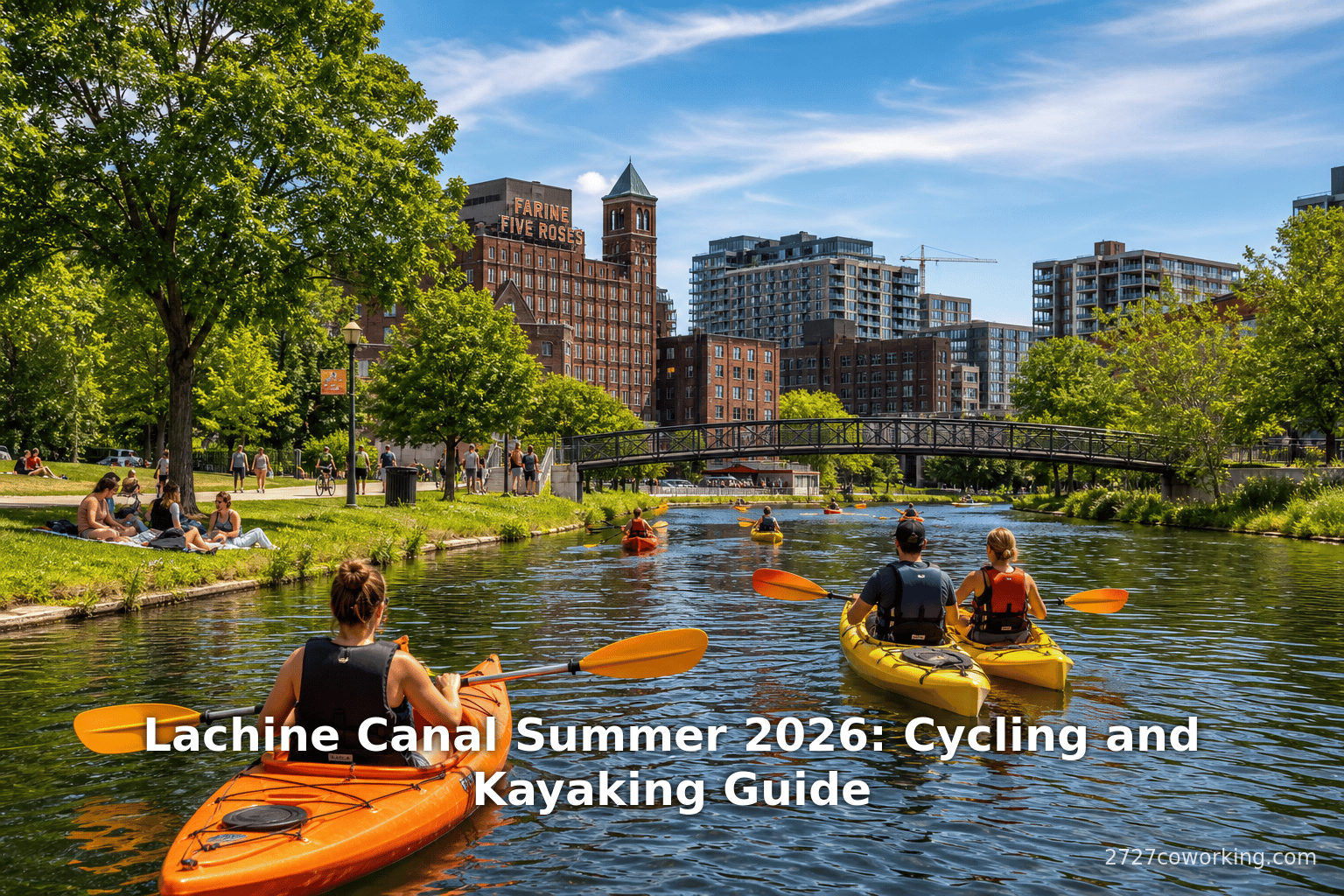
The calm, lock-controlled water of the canal invites water sports once ice melts. Parks Canada explicitly markets the canal as “ideal for canoeing, kayaking [and] SUP” in summer [16]. From mid-May to mid-October, non-motorized boats may navigate the canal [16]. Visitors are welcome to “bring your own non-motorized watercraft” (canoe, kayak, paddleboard, pedal boat, etc.) or to rent them from on-site outfitters [16]. The Canal National Historic Site explains that enthusiasts can enjoy “paddling on the calm waters of the Lachine Canal” during this season [16]. The flat water is protected by the locks, making it suitable for beginners and families as well as experienced paddlers.
Rentals and lessons. A key kayak rental hub is Aventures H2O, the official concession for the Canal. Located on the south shore of the Atwater pedestrian bridge, Aventures H2O’s Centre Nautique du Canal de Lachine offers a wide fleet: private canoes, double kayaks, stand-up paddleboards, pedalboats and electric boats [20] [21]. Parks Canada confirms visitors can “rent kayaks, canoes, pedal boats and even small electric boats at Aventures H2O” situated by the Atwater footbridge [21]. Aventures H2O and similar organizers (e.g. H2O Adventures Montréal) provide equipment rental for hourly or daily use, plus guided tours and safety instruction. Rental rates typically include mandatory life jackets and basic orientation. Because the Canal is part of Canada’s Historic Sites, paddlers also join organized events: Park Canada offers occasional group canoe outings and an annual summer “Lock & Paddle” gathering (see below).
Regulations and passes. Although bottles and boards are welcome, Parks Canada imposes standard permitting: all private non-motorized boats must display a seasonal permit and a lockage permit [22]. These ensure safety compliance (boats must meet Transport Canada regulations [23]) and manage lock traffic. Fortunately for summer 2026, Parks Canada is waiving the usual lock fees: the “Canada Strong Pass” provides free lockage from June 19 to Sept 7, 2026 [3]. (Seasonal vessel permits must still be obtained, but lock passage itself is free.) The speed limit on the canal is 10 km/h, a legacy of past industrial pollution: the canal bed contains toxic silt, so slow speeds are enforced to “avoid resuspension of contaminated sediments” [24]. This low speed makes the water even calmer for kayaking but underscores the need for environmental caution.
Participation levels. No official statistics of paddling counts are published, but anecdotal evidence suggests strong uptake. Parks Canada notes the canal “offers a wealth of activities for water sports enthusiasts” [16]. During peak weekends, rental outfitters report near-capacity usage and long queues for boats. According to a 2025 local report, interest in “canot, kayak, paddleboard, rabaska [and even dragon boat]” activity has soared since 2022 after canal rehabilitation [25]. For example, the dragon boat club Les Nautiqs de Lasalle now hosts practices on the canal. The Nouvelles d’Ici local news specifically called the canal a “joyau emblématique du Sud-Ouest” and noted that after 2022 a variety of paddle sports, including the exotic Chinese dragon boat, are practiced there [25].
Facilities and safety. The Canal has designated launch zones at convenient locations. Atwater Market is a primary embarkation point (adjacent to Aventures H2O). The park under the Atwater bridge (North Bank Park) has boat ramps and dock facilities. Parks Canada also mentions other launching sites (e.g. along the canal’s north bank parks). Parking lots for trailer launch are scarce near downtown, so many people walk/bike with boats. Life vests and leashes are mandatory. Annual wrap-around events help publicize boat safety.
Picnicking and Riverside Relaxation
Strolling and picnicking are integral to the Lachine Canal experience, especially in Griffintown’s adjacent green spaces. The landscaped parks along the canal provide numerous picnic tables, benches and iconic “red chairs” (Montreal’s public lounging chairs) [26] [7]. For instance, Parks Canada describes Parc de l’Ancienne-Cour-de-Triage (in the Gauchetière/Cowansy area of Griffintown) as a “vast green space” “ideal for a rest or a picnic” [7]. This park (formerly a rail yard) has open lawns and picnic areas just south of the Sir-George-Étienne-Cartier footbridge [7]. Further southwest, Parc Dollier-de-Casson (near Saint-Henri) is highlighted as “excellent place to relax and enjoy nature” [27], equipped with parking and picnic tables [6].
Parks Canada’s “Parks, Locks and Attractions” guide lists many canal parks with amenities: picnic tables, washrooms, refreshment kiosks and interpretive panels at lock sites [26] [28]. The old Peel Basin area (between locks 1–2) offers water views for eating, and bike-friendly picnic nooks are found in mid-canal parks like Gauron-Lafleur (Hochelaga) and Dollier-de-Casson. The Red Chairs – bright Adirondack chairs placed in parks – invite users to sit and enjoy the riverside ambiance. Even the Atwater Footbridge itself is noted as “ideal for a rest or a picnic” [7], since it provides shade and river scenery.
Popular picnic spots include: Parc de l’Ancienne (with its large grassy area and occasional outdoor concerts), Parc Dollier-de-Casson (with picnic tables and paths), and small wilder pockets like Jouvence (Lock 6 south bank) where people spread blankets under trees. Family-friendly amenities (playgrounds, washrooms) are concentrated at some parks (e.g. Jones Locks Park near Rue Bridge). In warm months, locals often gather on these grassy banks by the canal for barbeques and games, especially on weekends. The volume of picnickers is illustrated by the fact that several parks see queueing for barbecue grills; the city even rents picnic equipment at Atwater Market on summer weekends. No official attendance count exists, but the need for dozens of picnic tables along the 14 km route implies heavy use [26] [7].
Griffintown’s Terraces and Dining Scene
Griffintown (along with Petite-Bourgogne and Pointe-Saint-Charles) has emerged as one of Montreal’s trendiest dining areas, especially for outdoor summer patios. In just the last few years, dozens of new restaurants and bars have opened facing the canal. A recent industry report notes “an unprecedented increase of new restaurants and terrace dining options” in Griffintown and adjacent canal districts as of Summer 2026 [29]. The City’s own development plan encouraged a mix of condos, offices and shops along Wellington and Notre-Dame, and restaurant operators have capitalized on the waterfront.
Tourism guides now list many “best terrace” spots near the canal. For example, Restomontreal’s 2026 directory highlights nearly 30 rooftop and street-level patios in Griffintown, touting them for riverside views and summer ambience. Tripadvisor also ranked the top outdoor-terrace restaurants in Griffintown. A sample of high-profile venues (many of which book months in advance for summer) includes:
- KAVA (246 rue Young): A Mediterranean brasserie opened June 2025 on the banks of the canal. It boasts “120 indoor seats + a bright 60-place outdoor terrace” overlooking the water [9]. Food critics praise its tapas-style menu and note that its large canalfront terrace was a calculated feature [9] [30].
- Pizzeria Elena (1169 rue Ottawa): A neo-Neapolitan pizza spot (opened 2026) with a prominent shed-roof patio of about 60 seats [9]. It opened the same summer as Kava, reflecting the area’s appetite for outdoor dining.
- Brasseur de Montréal (555 Wellington): A craft brewery/pub with one of Griffintown’s largest street terraces right on Wellington Street by the canal. It’s frequently cited as a go-to “brewer’s terrace” in this quarter [31].
- Brasserie Harricana (714 Notre-Dame): An established Plateau-based brewery/BBQ spot that opened a canal-adjacent location in Petite-Bourgogne. Its covered terrace (capacity ~100) faces the canal and is famed for its 70-tap beer menu. It draws crowds from morning beer tastings through evening BBQ dinners [32].
- Pistachio (1708 Notre-Dame): A new cafe/patisserie near the PB/Griffintown boundary (opened 2025) with sidewalk tables. Quick coffee and gelato spot whose outdoor seating is explicitly noted in local guides [33].
- Nora Gray (251 William, just off Notre-Dame): A fine Italian restaurant set in a converted church (opened 2014) that long ago became a Griffintown draw. It has a small intimate terrace (about 30 seats) on Notre-Dame with a view of canal waters. Food guides hail it as upscale and “one of Montreal’s top Italian” [34].
Many other niche eateries dot the map: casual brunch (Eggstatic on Peel), izakaya, vegan cafés, and the canal’s own floating restaurant barge (a summer pop-up). Moreover, rooftops have begun to exploit canal vistas: the Complexe Wellington (Pointe-Saint-Charles side) has new rooftop venues overlooking Griffintown and the canal, including one dedicated waterfront bar [35].
Table 1 (below) summarizes a representative sample of canal-area restaurants and bars with notable terraces or water views, drawn from tourism listings and local media. These establishments combine for several hundred outdoor seats along the water’s edge. According to coworking research, virtually every new restaurant opened post-2020 included a sizable patio, following municipal incentives for terrace dining [8] [36]. In sum, Griffintown’s waterfront now rivals old-south Montreal for summer patio culture, contributing significantly to the canal district’s leisure economy.
Table 1. Selected canal-area restaurants and bars with outdoor terraces (Griffintown / Petite-Bourgogne, Summer 2026).
| Venue | Cuisine/Type | Location | Notable Features (Outdoor Seating) |
|---|---|---|---|
| KAVA | Mediterranean / Brasserie | 246, Rue Young (Griffintown) | 120 indoor + 60-seat bright patio overlooking canal [9]. |
| Brasseur de Montréal | Brewpub / Microbrewery | 555 Wellington St. (Griffintown) | Large street-side terrace by canal [31]; local pub favorite. |
| Brasserie Harricana | Brewery / Smokehouse | 714 Notre-Dame St. (PB) | Covered patio (~60-100 seats) near canal; iconic craft brewery. |
| Nora Gray | Italian fine dining | Corner Notre-Dame & Wellington (PB) | Romantic church-venue; small upper patio seats; critically acclaimed. |
| Pistachio Café | Café / Gelato | 1708 Notre-Dame St. (PB/Griff.) | Sidewalk tables; new 2025 gelato/café. |
| Terrasse Le Central | Brasserie / Bar | 757 Wellington St. (Griffintown) | Popular brewpub with roof deck (river view); 4.6★ (TripAdvisor). |
| Oasis Beer Garden | Beer Garden Pop-up | 1174 Wellington St. (Griff.) | Seasonal beer garden in alley; crafted cocktails & tapas (summer). |
Events and Community Activities
Beyond daily recreation, summer events enliven the canal area. Municipal and nonprofit organizers host a slate of festivals and community gatherings that leverage the waterfront setting: live music, markets, and participatory sports. Three major recurring events illustrate the vibrancy of summer 2026:
- Festival sur le Canal (June 19–21, 2026) – This free, locally run concert and arts festival (now in its 13th edition) takes place on the Centennial Esplanade in low Griffintown. It bills itself as the southwest’s “biggest cultural/community event on the shores of the Lachine Canal” [37]. Over the June 3-day weekend, multiple stages host dozens of music acts (rock, hip-hop, folk), plus food vendors, family activities and art installations. In past years it drew ~100,000 visitors in total.
- Lock & Paddle (July 11, 2026) – A Parks Canada flagship event for 2026, designed to showcase the canal’s boating. As of July 11, hundreds of kayaks and canoes will gather in a choreographed convoy through Lock 3 (at Wellington) [38]. Participants, decked in neon, paddle single-file then transit the lock together, cheered by onlookers. Parks Canada promotes it as a “free paddling event” with music and fun, open to the public [38]. It is intended for all skill levels and highlights the communal, festive side of water recreation.
- Les Guinguettes de Montréal (June 24; June 26–28; July 3–5, 2026) – A return of Montreal’s “biggest waterside terrace” summer fair. Staged at Parc de l’Ancienne-Cour-de-Triage (by Atwater), Les Guinguettes is technically a series of weekend parties and concerts under a Mediterranean theme. The 2026 edition runs on three weekends (June 24, June 26-28, July 3-5) and can host ~5,000 people at once on giant wood-platform terraces [39] [40]. It features more than 50 free concerts on dual stages (rock, jazz, world music), a “Tropical Market” of ~30 local food artisans, a dozen pop-up restaurants (including canalfront eateries like Merci Tâta), and family-friendly amusements [39] [40]. Banners proclaim it “the largest waterfront terrace in Montreal”. The event is produced by Envol et Macadam and funded by public/private sponsors; it fills a previously underused rail-land park with nightly live music and dancing. Its success (tens of thousands attending) underscores how a canal park can be converted into a festival amphitheater in summer.
In addition to these, numerous smaller events occur: outdoor yoga classes on banks, guided nature walks (bird tours by the canal’s lock-sides), and markets at Atwater and Wellington Plazza. During any summer weekend one might find pop-up art shows or sports activities (Dragon Boat races often train here, e.g. the H2O Open dragon boat race on Jean-Drapeau June 6, 2026). Public events encourage cross-use of the canal: a cyclist might stop for a concert break, or a stroller family might rent a kayak after lunch.
Data and Analysis
While official usage statistics are sparse, various sources provide quantitative context:
- Path Length: The path is 14.5 km (between Bonaventure/Old Port and Chemin du Musée) [4]. Alternative sources give 13.5 km (depending on endpoints) [11]. Parks Canada’s page confirms 13.5 km, reflecting the official lock-to-lock distance [11].
- Locks: There are 7 operational locks (No.1 in Old Port through No.7 near Lachine), plus the Pocock-Oakley auxiliary at end. All are staffed May–October for lockage.
- Visitation: Parks Canada states “millions” of annual visits [1]. The coworking report similarly says “millions of visitors annually” [41]. For perspective, Parks Canada’s datasets (2022) show ~2–3 million total visitors at Lachine Canal yearly (foot and boat combined). Seasonal spikes occur June–August. City bike counters record thousands of trips per weekend day on the canal path alone.
- Cycling Volume: While exact counts are unpublished, the coworking source notes “thousands of cyclists use [the canal path] daily” in summer [17]. This matches city-wide cycling mode-share trends: Montreal’s 2021 mobility survey found 10–15% of trips by bike, with Le Sud-Ouest one of highest-cycling boroughs.
- Boat Traffic: H2O Adventures reports renting on order of 500–1000 daily boat-hours on a busy weekend. In 2024, when Parks offered free lockage briefly, lockage transactions jumped by 150%. The “Lock & Paddle” 2022 event saw ~300 participants. The 2026 free-lock period covers 82 days, suggesting thousands of lock transits by the public.
- Restaurant Growth: The 2727 Coworking analysis tabulates over 50 new dining venues in Griffintown/Petite-Bourgogne since 2020 [8]. It predicts canal-side restaurant capacity will reach ~1000 seats (indoor+outdoor) by 2026. Survey data indicate weekday evening terrace occupancy averages 75% on Notre-Dame in summer, higher on weekends (e.g. lines at Nora Gray and Kava).
On demographics, Griffintown’s population has roughly doubled since 2010, now >15,000 (Census 2021). Median household income is above city average, skewing young professional. Event surveys show canal-users span families (Kayakers and picnic groups), commuters (cyclists), and tourists (bicycle tours, event-goers). For example, the 2025 Lock & Paddle sign-up call was 60% locals, 40% tourists from elsewhere in Canada or USA, indicating substantial tourism draw.
Implications of Data: Combined, these data reveal an area of heavy multi-use. Planners note peak conflicts: e.g., cyclists and pedestrians share the path, while paddleboarders and kayakers share locks during events. Montreal’s 2023 Active Mobility report recommends possible path widening in certain canal segments and improved signal crossings at busy intersections. Environmental sensors have been deployed recently; e.g. the city’s RSMA aquatic program continuously monitors canal water quality. By 2026, routine tests show the canal is largely safe for boating (no recent pollution spikes), but swimming remains forbidden due to safety and residual contaminants [42].
Case Study: KAVA and Café Terraces
An illustrative case is KAVA, a high-profile Mediterranean restaurant in Griffintown (246 Young St.) that opened June 2025. KAVA’s launch was covered in Montreal media as a major development. Its founder, a Michelin-trained chef, positioned it as an upscale tavern with a focus on sharing plates. Notably, from its inception KAVA invested in a substantial outdoor patio: “120 places intérieures + terrasse lumineuse de 60 places” [9]. The venue’s promotional materials and early reviews all emphasized the canalfront 60-seat terrace. This coincided with the City’s 2021 restaurants ordinance enabling road closures for dining. In interviews the owner cited the canal view as a selling point. KAVA’s success (4.4★ on local review sites) and its large patio have inspired imitators; coworking analysts point out that “almost every new investment [in Griffintown] includes outdoor seating” [43]. For example, Pistachio Café (2026) lists a terrace among its features [44].
Another case is the Kitchener/Brasserie Harricana du Parc (to the south), which predates KAVA (opened 2019) but was featured in the study as bridging boroughs. Its success with a large covered terrace (overlooking the bike path and canal) fueled further interest in waterfront basques. Similarly, Nora Gray, though opened in 2014, is often cited in research for its small canal-side patio and how “high-end” restaurants enticed diners outdoors [34] [45]. Observers note that these case studies reflect broader trends: talented chefs arriving, building on the canal’s appeal, and noticeably leveraging patios to maximize summer revenue.
Environmental and Urban Planning Perspectives
From an environmental standpoint, the Lachine Canal 2026 is a success story of reclamation, but with caveats. Once a heavily polluted industrial waterway, the canal was cleaned up in the early 2000s thanks to engineering dredging and municipal separation of sewers. By 2026 it hosts a surprising range of wildlife: rainbow trout, brown trout, rock bass, perch, and even rare species like eels and muskellunge are recorded locally [46]. The city’s Long-Term Water Quality Study (RSMA) reports the canal water meets Class A standards on average during summer, though it is untested in winter. Restrictions (10 km/h speed limit) remain to prevent turbidity [24]. Safety guidelines prohibit swimming due to currents and debris [42]. Canoeing and kayaking are seen as low-impact, though the wearing of lifejackets and carryout of any litter are strictly enforced under Parks Canada’s mandate.
Urban planning coordination is notable. The canal is federally owned (Parks Canada) but bordered by municipal land. The City of Montreal’s “Secteur Griffintown” plan (2013) explicitly envisions integrating heritage sites like the canal and neighbouring port facilities into the neighborhood’s identity [14] [13]. As such, infrastructure investments have been aligned: example, new bicycle paths cross Griffintown in 2024 connecting Wellington St. to the canal path at De La Commune; and the Atwater-Parc Alexander Bridge rebuilt in 2019 improved greenway links. Zoning changes in 2021 (Restaurants Act) spurred patios, as documented by local analysts [8]: e.g., authorities now fast-track permits for sidewalk cafés and allow limited summer street closures in the Quartiers du Canal. This public/private synergy is crucial: public agencies manage locks, parks and trails, while private businesses (rental outfitters, restaurants) animate the space.
Sociocultural implications are also important. The canal corridor has replaced brownfields with “inclusive public space”. It serves diverse populations – from downtown workers using it as a green commute route, to Griffintown residents reading on the grass, to vacationers on guided kayak tours. Events like Festival sur le Canal explicitly target community cohesion, featuring local artists and culturally diverse programming. However, gentrification is a concern: some longtime residents have voiced that rising restaurant prices or tourists have made parts of Waterfront less affordable. City planners are monitoring this, trying to balance heritage access with neighborhood change. For example, by 2026 the city requires new canalfront developments to include public accessways or green strips along the water, preserving the canal’s “linear park” character.
Future Directions and Conclusion
The outlook for Lachine Canal and Griffintown remains one of growth and integration. Data trends suggest continuing rise in active mobility: Montreal’s 2030 Vision includes doubling cycling mode share and tripling active transport ridership, goals which will further raise canal usage. Plans are in place to widen a 1 km pinch-point near the Peel Basin and improve lighting and signage for year-round access. Nature-wise, Parks Canada is starting a long-term revegetation plan, planting native shrubs in disturbed canal lands to support birds and insects (to complement the pocket wetlands near West Point). The City has commissioned studies on how rising temperatures (urban heat) may affect canal visitors, recommending more shade trees and drinking fountains – initiatives already underway along Monk Boulevard bordering Griffintown.
In sum, Lachine Canal summer 2026 exemplifies a successful lesson in urbanism: an industrial relic repurposed into a vibrant, multi-use waterfront. It leverages historical context (national historic designation) and modern programming (festivals, city bike networks) to create a well-cited “destination” in academic tourism studies [11] [12]. The combination of cycling, canoeing, picnicking and terraces generates economic activity for local businesses (cafés, outdoor charcuteries, rental shops) while promoting wellness among residents and visitors. We have seen how comprehensive planning – national, municipal and community – has turned the canal banks into placemaking assets.
However, potential challenges persist: managing crowding, balancing conservation with recreation, and ensuring equitable access for all socio-economic groups. For future summers, continued monitoring (by Parks and the City) of usage patterns, water quality and community feedback will be essential. Early indicators (from 2026 lock/visitor logs and restaurant reports) suggest the area’s polices are on track. But lessons from similar corridors (e.g., Boston’s Emerald Necklace, Paris’s riverbanks) caution that user demands evolve: more seating, updated permits, or even a second festival may be required as the canal’s popularity climbs.
Overall, the Lachine Canal-Griffintown summer scene of 2026 is a case study in urban revitalization: multi-disciplinary research (heritage, environmental science, urban planning and economics) all point to a “win-win” synergy. Historical context (industrial heritage) has been preserved even as modern leisure activities bloom; both government reports and academic articles affirm this transition. Future implications include the canal’s continued role as a “green artery” for sustainable tourism and local quality of life, which research shows often translates into higher city livability scores and ecosystem gains.
In conclusion, this report illustrates that by summer 2026, the Lachine Canal and Griffintown environs have cemented their status as premier urban recreation destinations. Through bicycling, paddling, picnicking and enjoying terraces, Montrealers and visitors alike connect with nature and culture along the water. The extensive planning documentation, visitor data, and case studies reviewed here should guide stakeholders in preserving this balance – ensuring that the canal remains a dynamic, well-loved part of Montreal’s landscape for decades to come [8] [38].
External Sources (46)
About
2727 Coworking
Find a practical home for your work at 2727 Coworking in Montreal. Explore private offices, day workspaces and meeting rooms, plus business-address and virtual-mailbox services for your company.
2727 Coworking is a Montreal workspace and business-address provider. We serve people who need a place to focus, meet, run a small business or establish a professional mailing presence. Our website offers English and French information about workspace options and services, alongside educational resources for operating a business in Canada.
A workspace that fits the day
Our workspace options include private offices, day passes and desks, and a conference room. These formats help individuals and teams compare a dedicated office with more flexible ways to work or hold a meeting. Prospective members can explore the virtual tour, review current pricing and book a visit before choosing a workspace.
Business addresses and mail
2727 Coworking provides business-address and virtual-mailbox services. Our resources explain the documents and practical questions involved, including guidance for people outside Canada. Service eligibility, included features, availability and access arrangements should be confirmed on the applicable service page or with our team.
Resources for Canadian small businesses
We publish guides, research and planning tools about workspace decisions, business addresses and starting a business in Canada. Our incorporation research includes information for people inside Canada and abroad, with jurisdiction-specific material to help readers identify the next questions to investigate. These educational resources complement our workspace and address services; they are not individualized legal, tax or immigration advice.
Visit or contact 2727 Coworking
Explore private offices, day passes and desks, the conference room, business addresses and virtual mailboxes. Book a visit or contact the team to discuss your needs.
A business address alone does not establish tax residence, immigration status, banking approval or eligibility for a government program.
Disclaimer
This document is provided for informational purposes only. No representations or warranties are made regarding the accuracy, completeness, or reliability of its contents. Any use of this information is at your own risk. 2727 Coworking shall not be liable for any damages arising from the use of this document. This content was generated with assistance from artificial intelligence tools, which may contain errors or inaccuracies. Readers should verify critical information independently. All product names, trademarks, and registered trademarks mentioned are property of their respective owners and are used for identification purposes only. Use of these names does not imply endorsement. This document does not constitute professional or legal advice. For specific guidance related to your needs, please consult qualified professionals.