
2727 Coworking Article
Montreal Commercial Rent Calculator: All-In Lease Costs
Summary
- 01Calculate rent from the documented rentable area and annual base and estimated additional rates, convert to monthly amounts, then add only services excluded from the quote.
- 02Rentable area can include allocated common space. Use it for billing calculations, and check the usable floor plan separately to confirm the premises suit the team.
- 03Additional rent is an estimate that may be reconciled against actual allocated costs. Confirm the cost pool, allocation, exclusions and adjustment procedure before comparing offers.
- 04Compare conventional and flexible offices with the same team capacity, privacy, required services and commitment. Individual desk prices do not establish a matching private-office price.
- 05Keep recurring pretax cost, invoice cash, setup spending and refundable deposit cash separate. Treat unconfirmed charges and tax recoveries as unknown rather than assuming savings.
Inside this article
- 01Executive Summary
- 02Introduction and Background
- 03Quick Calculator: Inputs and Monthly Conversion
- 04Rentable Area, Usable Area and Lease Labels
- 05Additional Rent: Audit the Estimate and Reconciliation
- 06Flexible Offices and Comparative Context
- 07Taxes, Deposits and Setup Cash
- 08Before Signing: Questions and Documents
- 09Data Analysis and Evidence
- 10Implications and Future Directions
- 11Frequently Asked Questions (FAQs)
- 12Conclusion
Executive Summary
A Montreal commercial rent calculator should start with the landlord's rentable area, multiply it separately by the annual base-rent and additional-rent rates, and divide each annual result by the months in a year. It should then add separately billed services and applicable invoice taxes. That structure reflects the distinction between base rent and incidental expenses; the measurement input must also account for allocated common space. [1] [2] The headline rate alone is therefore insufficient for an all-in office cost comparison.
In the Hypothetical Example used throughout this report, a four-person team considers a 12-month term, 1,000 rentable square feet (ft²), $24/ft²/year base rent, $12/ft²/year estimated additional rent, and $450/month of separate services. These are deliberately fictional inputs, not Montreal market benchmarks. The arithmetic produces $3,450/month before tax and $41,400/year. An assumed 20% increase in allocated additional costs adds $200/month and creates a $2,400 annual true-up. The distinction between an estimate and an annual adjustment is illustrated by the public commercial promise-to-lease specimen from the Organisme d’autoréglementation du courtage immobilier du Québec (OACIQ), Quebec's real estate brokerage regulator. [3]
For a fully taxable invoice, the general Goods and Services Tax (GST) rate is 5%, and the Quebec Sales Tax (QST) rate is 9.975%, calculated on the price excluding GST. [4] Applying those rates to the fictional monthly total produces $3,966.64 of invoice cash, rounded to cents. This is a derived illustration, not an accountant's assessment of a particular lease. Tax recovery depends on eligibility, commercial use and supporting documents; invoice cash and expense after recoveries should remain separate. [5] [6]
The decision is to compare the same capacity, privacy and commitment, then identify unknowns. Gross and net labels are not official fixed definitions, so contract wording controls. [7] Flexible-office operators also distinguish included services from optional charges. [8] As observed during this research, 2727 Coworking lists hot desks at $350/month and dedicated desks from $400/month on its homepage; those are individual seating prices, not a private-office quote for the example team. Before committing to Montreal premises, check that the intended activity is permitted. [9]
Introduction and Background
The practical question behind “Montreal commercial rent per square foot” is often whether a quoted premises can fit the team's cash budget. A conventional office proposal can separate the price of occupying the space from the expenses charged for operating the building. BDC lists property tax, insurance, utilities, maintenance, common area costs and repairs as possible incidental expenses. [10] A membership proposal may instead state a monthly charge with certain services bundled. Regus, for example, describes furnished offices with internet, cleaning, support and utilities included. [8]
Those two formats need a common worksheet. Comparing the annual square-foot rate directly with a monthly membership price compares unlike units. Comparing only payments to the landlord overlooks purchases from other suppliers. Comparing a shared desk with an exclusive room overlooks a different product. Spaces describes its coworking day pass as access to shared workspace, making the capacity and privacy distinction explicit. [11]
This report provides budgeting support for founders and small teams evaluating an actual quote. It does not interpret a particular lease or provide individualized legal or tax advice. The calculations are transparent arithmetic using reader-entered inputs. External evidence supports definitions, measurement principles, tax rules and document requests. All worked amounts are labeled fictional, and published asking-rent statistics appear separately from the worksheet assumptions.
The governing principle is quote normalization: establish what each payment covers, when it is due and whether it can change. National Bank explains that additional expenses can be allocated proportionately to occupied space. [12] Québec's business-finance guidance identifies the cash budget as a tool for managing cash flow. [13] A useful lease calculator consequently needs both a recurring-cost output and a cash-timing view. Neither should silently treat an unknown charge as included.
Quick Calculator: Inputs and Monthly Conversion
Build the recurring-cost worksheet
For a quote explicitly stated in Canadian dollars per rentable square foot per year, define the following inputs. Keep the currency, area basis and time basis beside every entry. A monthly square-foot quote needs a different time conversion; an annual assumption must never be inserted into an ambiguous proposal.
- A, rentable area: Enter the area on which the landlord charges rent, with its measurement document.
- B, annual base rate: Enter the base or minimum rent, excluding separately identified charges.
- C, annual additional estimate: Enter the operating-cost estimate, with its year and stated inclusions.
- U, separate monthly services: Enter only costs not already included elsewhere.
- T, committed months: Enter the actual commitment and renewal or notice conditions.
- D, refundable deposit: Record cash tied up separately from consumption of services.
- F, nonrefundable setup: Enter improvements, moving, installation and other startup purchases.
Using these definitions, annual base rent = A × B, monthly base rent = A × B ÷ 12, annual estimated additional rent = A × C, and monthly estimated additional rent = A × C ÷ 12. The divisor is the calendar conversion, not a sourced market assumption. The calculator's recurring pretax result is M = A × (B + C) ÷ 12 + U. Its cost categories correspond to the base-rent and incidental-expense distinction. [1]
Table 1 below is a copyable input worksheet. Its placeholders are fields for the reader, not estimates of Montreal prices.
| Input | What to enter | Evidence or question |
|---|---|---|
| Rentable area | Quoted ft² and measurement basis | Ask for measured area and common-space allocation; measurement standards support both. [2] |
| Base rent | Annual rate, currency and schedule | Ask whether the stated rate changes during the commitment. [12] |
| Additional rent | Estimated annual rate and included cost categories | Identify the estimate and adjustment process separately. [3] |
| Services | Monthly electricity, internet, cleaning and other exclusions | Confirm the meter arrangement before assigning electricity costs. [14] |
| Tax | Taxable invoice items and eligibility assumptions | Commercial-building rentals appear among taxable supplies. [15] |
| Deposit | Amount, due date and return conditions | Ask how the security deposit will be returned. [16] |
| Setup | Nonrefundable cash payments and timing | Identify who pays for improvements and what remains. [16] |
The worksheet prevents a common modeling error: adding a service again after an operator or landlord has already included it. It also exposes missing information. Use unknown, rather than zero, for an unanswered cost. Obtain written clarification before ranking a quote whose unknowns could change the result.
Keep multiple outputs
Show recurring pretax cost, invoice cash, setup cash and deposit cash as separate outputs. The public OACIQ specimen distinguishes a security deposit guaranteeing lease obligations from other payment arrangements. [3] A deposit can create a funding requirement without becoming an immediate expense. Record its return as a future cash movement only under the example's explicit assumptions or the actual agreement's confirmed conditions.
- 01Confirm the quote units
Keep currency, area basis and time basis beside each input. Confirm an ambiguous proposal before assuming annual rates.
- 02Calculate monthly rent
Multiply rentable area by the sum of annual base and estimated additional rates, convert to monthly rent and add excluded monthly services.
- 03Resolve missing costs
Avoid adding an included service again. Mark unanswered costs as unknown and obtain written clarification before ranking consequential unknowns.
- 04Separate the cash outputs
Show recurring pretax cost, invoice cash, setup cash and deposit cash separately so the funding requirement remains visible.
Rentable Area, Usable Area and Lease Labels
Which square footage belongs in the formula?
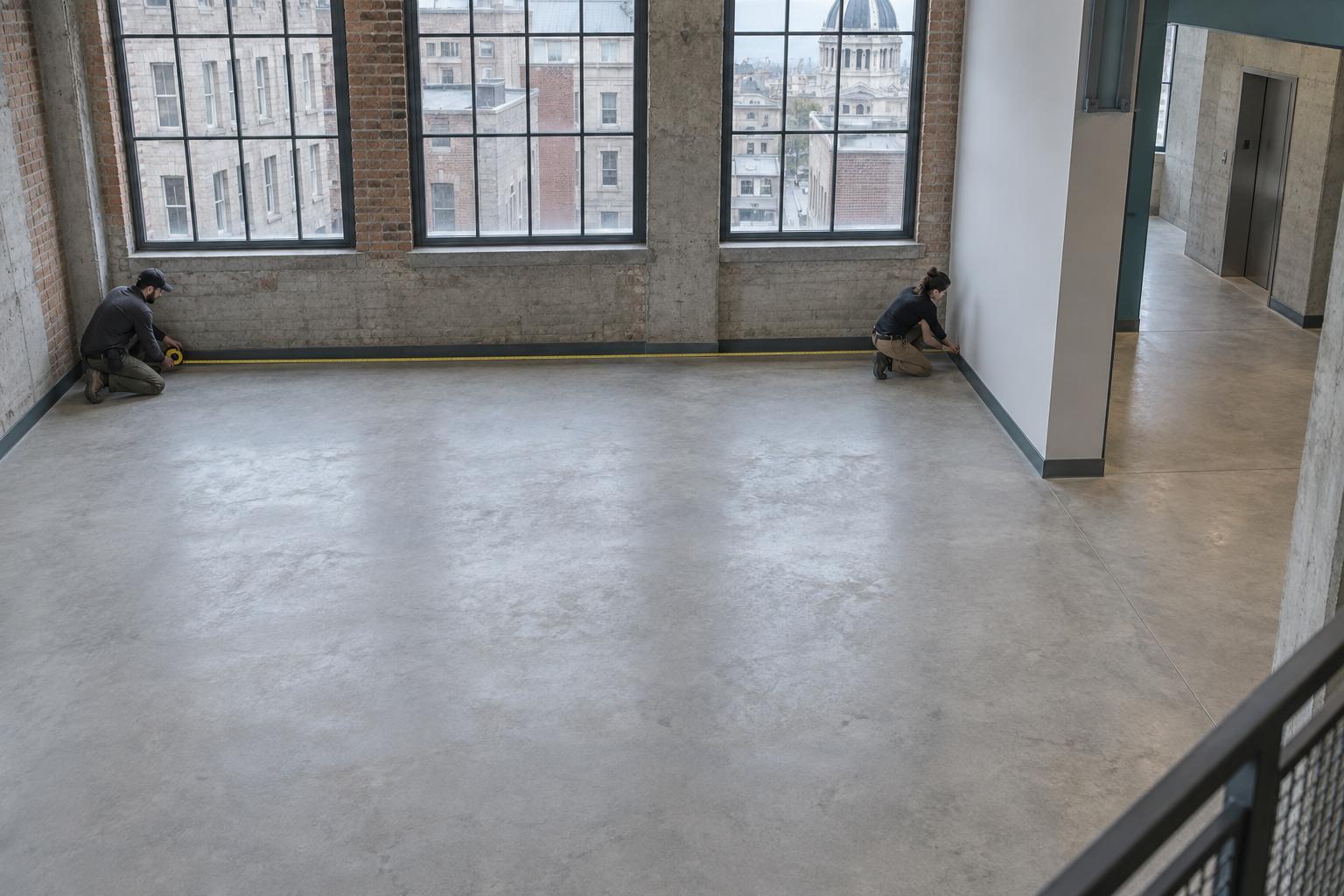
Usable area concerns the space physically used by the tenant; rentable area can include allocated common space. Colliers identifies hallways, lobbies, bathrooms and elevators among common areas. [17] The Building Owners and Managers Association (BOMA) describes calculation of rentable area as a primary purpose of its office standard. [18]
Use the landlord's documented billing area for rent arithmetic, then test the usable floor plan separately for team suitability. BOMA notes that usable area can inform space efficiency and cleaning costs. [19] The quote should identify the standard or method, its edition, the measured premises and any allocation. These are information requests, not assumptions that every Montreal building uses the same standard.
A reader can calculate an area uplift as rentable area ÷ usable area minus one when both inputs are established on comparable bases. This is a mathematical diagnostic. BOMA's guidance notes that load factors can affect final area calculations. [19] No Montreal load-factor benchmark is assumed here, and a calculated ratio does not certify compliance with a measurement standard.
Consider this additional Hypothetical Example: a proposal shows 1,000 rentable ft² and 850 usable ft². The calculated ratio implies an uplift of approximately 17.65%. Those figures illustrate the distinction identified in the measurement sources; they are not a local norm. [17] Applying a quoted rate to the usable area would understate payments if the contract bills the rentable area. The floor plan still determines whether the team can work effectively.
Gross, modified gross and net
Lease terminology is a first sorting tool. Éducaloi states that these definitions are not official and can mean different things in different leases. [7] Record both the label and the actual cost responsibilities.
- Gross lease: Often presents operating and maintenance costs as landlord-paid or included in rent. [7]
- Modified gross: Shares specified incidental expenses between the parties. [10]
- Net and double net: BDC describes single net as base rent plus property taxes, and double net as base rent plus two incidentals, such as taxes and insurance. Ask which categories the proposal actually assigns. [10]
- Triple net (NNN): Commonly shifts a broader group of taxes, insurance, utilities and operating costs. [10]
The double-net description is shorthand within the general gross/net framework, not a universal Quebec definition. [7] For every label, ask whether repairs, capital work, administration, utilities and common areas are included, excluded or adjustable. A gross label should not be converted into a promise that all business operating costs are covered. A net label should not be converted into an unlimited list of tenant obligations. Read and budget the allocation actually proposed.
- Can include allocated common space as well as the space the tenant uses.
- Use the landlord's documented billing area for rent arithmetic.
- Concerns the space physically used by the tenant.
- Check the floor plan to determine whether the team can work effectively.
Applying a quoted rate to usable area understates payments when the contract bills rentable area. Confirm the measurement basis and allocation.
The strongest decision may be to clarify a quote rather than choose immediately. An unknown repair obligation, unconfirmed utility allocation or missing renewal schedule can matter more than a small calculated monthly difference.
Additional Rent: Audit the Estimate and Reconciliation
Reconstruct the cost pool
Additional rent is the part of the comparison most likely to require supporting information. BDC lists common-area services such as snow removal, janitorial work, landscaping and property management. [10] Its budgeting guidance also flags a possible management fee. [20] The Retail Council of Quebec recommends clearly defining charges and their allocation in the lease. [21]
Ask the landlord to map each proposed category into the estimate. A clear audit can use these categories without assuming that every item is chargeable:
- Property and school taxes: Identify which bills, period and allocation the estimate uses.
- Building insurance: Separate the landlord's building costs from the tenant's own insurance.
- Utilities: Identify separately metered, bulk-metered and included consumption.
- Maintenance and cleaning: Distinguish inside-suite services from building services.
- Common areas: Identify the facilities and services included in the pool.
- Repairs: Ask which recurring repairs and major works can enter the calculation.
- Management and administration: Identify the fee base and any additional administration charge.
- Exclusions and credits: Ask how recoveries, reimbursements and agreed exclusions are reflected.
These are proposed review fields, not a declaration of the landlord's rights. Éducaloi says parties can negotiate services and costs. [7] It also recommends addressing repair responsibility; CQCD similarly calls for clarity about who performs the work. [7] [21]
Utilities deserve their own clarification. Hydro-Québec describes bulk metering as a building arrangement where the owner divides costs among occupants. [14] Its pricing explanation separates a fixed service amount from energy billing. [22] A tenant therefore needs the relevant meter arrangement and bills, rather than an invented electricity allowance per square foot.
Estimate versus actual allocated cost
For budgeting, write reconciliation = actual allocated recoverable costs minus estimated payments for the same period. A positive result represents additional cash required under the model; a negative result represents a modeled credit. Whether and when either is payable depends on the agreement. OACIQ's public specimen illustrates an annual adjustment of estimated additional rent. [3]
To test the statement, request the calculation in stages: permitted cost pool, contractual adjustments, allocation share, tenant allocation and payments already made. National Bank describes proportionate expense allocation, but that explanation does not establish the denominator in an individual lease. [12] A quoted rentable area and an operating-cost share are related inputs that still need separate confirmation.
Ask about vacancy adjustments, caps, exclusions, partial-year treatment, capital-cost allocation and review deadlines. These are recommended questions. OACIQ cautions that reference clauses must be adapted to the transaction. [23] For co-owned premises, its guidance also raises contingency-fund charges. [24] Do not assume those amounts belong in the rent pool merely because they appear on a building statement.
Flexible Offices and Comparative Context
Compare the same product and commitment
A fair comparison fixes the team, required privacy, service level, start date and commitment before comparing totals. JLL identifies small headcounts, short projects, occupancy speed and limiting upfront capital among reasons for choosing flexible space. [25] Those are possible decision criteria, not evidence that a flexible office will always cost less.
Table 2 normalizes the models. The first two rows are Hypothetical Example structures for the same four-person team and 12-month commitment. They are not offers from a Montreal landlord or operator. The named-provider rows describe published models and still require a matching written team quote.
| Option and price basis | Included or modeled as included | Excluded or separately modeled | Unknowns to clarify |
|---|---|---|---|
| Conventional net lease, Hypothetical Example: $3,000/month combined base and estimated additional rent | Exclusive premises and the fictional additional-cost pool | $450/month separate services, setup and deposit | Permitted cost pool, actual reconciliation, repairs and escalation |
| Serviced private office, Hypothetical Example: $3,200/month fee | Exclusive room, furniture and assumed routine services | $150/month selected optional services required by the example team (included in recurring cost), setup and deposit | Confirm identical capacity, privacy, term and service limits |
| 2727 Coworking: homepage hot desk $350/month; dedicated desk from $400/month; team private-office quote required. | Homepage lists heating, air conditioning and electricity as included. | Do not assign a savings value to listed amenities | Matching private-office availability, total price, taxes, term and booking limits |
| Regus: serviced-office model; location-specific quote required | Vendor lists furniture, internet, cleaning, support and utilities. [8] | Vendor identifies optional extras at an additional price. [8] | Same team capacity, commitment, extras and invoice conditions |
The table establishes what is comparable before declaring any option cheaper. The published individual desk rate is a different product from an exclusive team room. A provider's inclusion list also needs to be matched to the actual agreement, particularly where shared facilities have booking limits.
Normalize bundled services without inventing value
The 2727 Coworking virtual-tour page describes furnished private offices and meeting spaces with audiovisual equipment. Those descriptions identify features to check, not a monetary amenity value. For budgeting, use the homepage listing as an observed reference and obtain a written quote before treating any amount as binding.
The optional-extras field shows why an all-in claim needs a scope. List printing, meeting-room use, parking, storage, guest access and specialized connectivity only when required by the team, and mark their status. An unused included feature has no necessary cash-saving value. An excluded required feature belongs in the monthly cost.
JLL links pre-built spaces and membership agreements to rapid scaling. [25] That does not settle notice periods, renewal prices or the ability to reduce seats under a specific offer. Request those terms and compare the cash required over the same commitment. Compare a shorter cancellable product separately when its flexibility is the reason for choosing it.
Taxes, Deposits and Setup Cash
Invoice cash is not the same as expense
Revenu Québec lists commercial-building rentals among taxable supplies. [15] Its general rates are GST of 5% and QST of 9.975%, with QST calculated on the selling price excluding GST. [4] For a single fully taxable pretax amount P, the derived arithmetic is GST = P × 0.05, QST = P × 0.09975, and invoice cash = P × 1.14975, subject to invoice rounding.
Apply that shortcut only after confirming that the input is a common taxable base. Do not add tax again to an amount already tax-inclusive. Do not assume that a line described as a property-tax reimbursement avoids sales tax: the Canada Revenue Agency (CRA) describes recoveries forming part of taxable lease consideration as treated like basic rent, while distinguishing direct municipal liability. [1]
Input tax credits (ITCs) and input tax refunds (ITRs) can change the eventual expense, but they do not remove tax from the supplier invoice. Revenu Québec describes recovery as conditional and generally proportional to commercial use. [5] CRA requires sufficient documentation before claiming an ITC. [6] CRA also states that the quick method of accounting does not permit ITCs for operating expenses. [6]
No business-specific professional confirmation has been obtained for this worksheet. Before entering a recoverable-tax amount, ask the accountant to confirm the taxable base, registrations, commercial-use allocation, accounting method and documentation. Until confirmed, show invoice cash and treat recovery as unknown. This avoids turning a general rule into a promised refund.
Separate spending from cash tied up
A startup budget should distinguish refundable deposits, nonrefundable purchases and payment timing. Éducaloi confirms that a commercial landlord can request a security deposit. [7] CFIB recommends checking its return conditions. [16] A future return should not fund a current payment in the cash model.
Record these setup fields alongside the recurring worksheet:
- Improvements: Obtain a scope, price, payment schedule and responsibility for overruns.
- Furniture and equipment: Identify purchases still required after examining the furnished offer.
- Connections and moving: Include installation, transfer, transport and overlapping premises payments.
- Professional review: Enter quoted legal, accounting and measurement work.
- Allowances and reimbursements: Record eligibility and payment timing rather than deducting an unconfirmed promise.
- Insurance: Request a tenant-specific quote and identify insured improvements.
- Restoration: Ask what must be removed or left at the end of occupation.
BDC describes tenant-improvement allowances as landlord cash toward renovations and recommends budgeting for connection costs and legal advice. [10] [20] Desjardins includes tenant improvements among business property considerations and says premiums depend on several factors. [26] No standard Montreal insurance or fit-out allowance is inserted into this calculator.
Before Signing: Questions and Documents
The quote is ready for comparison when its main uncertainties have become documented inputs. BDC recommends requesting past bills when examining incidental expenses. [20] OACIQ's public specimen includes annual notice of additional rent and an adjustment framework, but the reader's actual agreement must supply the applicable procedure. [3]
Ask the landlord or operator for a written response to the following proposed checklist:
- Area evidence: What rentable area is billed, what usable area is delivered and which measurement basis applies?
- Rate schedule: Are base rent and additional rent annual rates, and when do quoted amounts change?
- Cost budget: Which categories are included, which are excluded and which remain estimates?
- Allocation: What share, denominator and adjustments produce the tenant's amount?
- Reconciliation: When is the statement issued, and what supporting documents can be reviewed?
- Repair scope: Who pays for ordinary work, equipment replacement and major building work?
- Service access: What utility arrangement, access hours and meeting-room limits apply?
- Deposit: How is it held, applied and returned under the proposed terms?
- Setup obligations: Who approves improvements, pays contractors and owns retained installations?
- Commitment: What notice, renewal, seat-change and restoration conditions apply?
- Taxes: Is each quoted amount before or after tax, and which invoice items are taxable?
- Permitted activity: Has the intended use been checked for this premises and operator?
The last question is a municipal checkpoint, not rent arithmetic. Montréal advises checking that an activity is permitted before renting or purchasing; its occupancy permit is attached to both the establishment and operator. [9] A previous occupant's use should therefore prompt a fresh check rather than an assumption.
A commercial lease lawyer or notary is useful when responsibility, allocation, guarantees, improvements or commitment remain unclear. National Bank recommends a specialist for contractual language. [12] An accountant addresses tax treatment and cash forecasts; a measurement specialist can resolve an uncertain area basis. BOMA BC identifies expense allocation and space-use analysis among measurement applications. [2]
There is no universal monetary threshold for review in this report. Compare the quoted review fee with the uncertainty in the actual commitment. If a plausible interpretation changes the payment schedule materially, resolve it before relying on the calculator's result.
Data Analysis and Evidence
Additional-cost sensitivity, Hypothetical Example
Return to the fictional four-person, 12-month comparison. Its conventional lease has 1,000 rentable ft², $24/ft²/year base rent, $12/ft²/year estimated additional rent, and $450/month in separate services. The resulting base rent is $24,000/year, estimated additional rent $12,000/year, and separate services $5,400/year. Total recurring pretax cost is $41,400/year, or $3,450/month. These are calculated model outputs, not sourced prices. The model implements the estimate-and-adjustment distinction in the OACIQ specimen. [3]
Table 3 varies only actual allocated additional costs. Base rent, services and allocation assumptions remain fixed. The percentage changes are mathematical scenarios, not forecasts of Montreal operating costs.
| Hypothetical additional-cost scenario | Annual additional rate / actual allocation | Monthly recurring pretax cost | Year-end reconciliation against $12,000 paid |
|---|---|---|---|
| 10% below estimate | $10.80/ft²; $10,800/year | $3,350 | $1,200 modeled credit |
| Quoted estimate | $12.00/ft²; $12,000/year | $3,450 | $0 |
| 10% above estimate | $13.20/ft²; $13,200/year | $3,550 | $1,200 additional cash |
| 20% above estimate | $14.40/ft²; $14,400/year | $3,650 | $2,400 additional cash |
The table shows why a monthly estimate and a final annual burden are different outputs. If only the quoted estimate was collected during the year, a later payment changes cash timing. Its contractual due date and tax treatment still need confirmation. Québec's budgeting guidance recommends a reserve for unforeseen costs. [13]
Same-team cost and upfront funding
Assume the fictional serviced private office charges $3,200/month plus $150/month for selected optional services required by the identical team for the same term. The modeled recurring cost includes these services. Its derived recurring total is $3,350/month, or $40,200/year, a $1,200 annual difference from the conventional estimate. If all monthly charges in both examples share the general taxable base, invoice cash is $3,966.64 for the conventional option and $3,851.66 for the serviced option. These are calculations using the official general rates, not tax-professional-confirmed invoices. [4]
Assume, additionally, nonrefundable setup of $10,000 and a refundable deposit of $6,000 for the conventional office, versus $1,500 and $3,350 respectively for the serviced office. Under those fictional assumptions, first-year recurring-plus-setup spending before tax is $51,400 versus $41,700. Adding deposits gives gross cash committed before tax of $57,400 versus $45,050. These totals assume deposits are separate from rent payments and exclude recoveries or returns during the year. They show a method, not typical landlord requirements.
Published asking data are separate evidence
CBRE's Q2 2026 Montreal report identifies Class AAA asking net rents from $33 to $42/ft². [27] This category-specific range is not an all-in offer for the fictional premises. It should not replace an actual small-team quote or supply an additional-rent estimate.
Scope matters beyond Montreal reports. CBRE's global prime tracker covers core locations attracting major occupiers, and its Americas asking rents concern available space. [28] None of these figures establishes the rent, operating-cost pool or concessions in a founder's actual proposal. Use published statistics to frame questions, then calculate from a documented quote.
Implications and Future Directions
A useful calculator makes uncertainty visible. The output should retain the quote date, currency, time unit, area basis, included categories and source document. Québec's budgeting guidance recommends realistic assumptions. [13] In practical terms, an input without supporting evidence should remain an assumption and should not acquire authority because a spreadsheet displays it to the cent.
The strongest decision may be to clarify a quote rather than choose immediately. An unknown repair obligation, unconfirmed utility allocation or missing renewal schedule can matter more than a small calculated monthly difference. Éducaloi's warning about variable lease definitions is the reason to preserve those uncertainties explicitly. [7] It is also the reason a calculator should not infer a complete cost pool from the letters NNN.
For a multiyear commitment, extend the worksheet only after obtaining an actual term and escalation schedule. BDC recommends examining increases in base rent and incidentals; National Bank recommends identifying the calculation method. [20] [12] Model each period separately, apply changes only to the relevant components, and retain one-time costs in the periods when they occur. This report omits a five-year table because no five-year contractual inputs were supplied.
Flexible-office evaluation benefits from a small practical check. JLL recommends testing operators, locations and deal structures before wider deployment. [25] For a small team, that can inform a visit or permitted trial, a floor-plan review and confirmation that meeting access and connectivity meet requirements. Such checks evaluate suitability without assigning speculative dollar savings to every amenity.
Keep the comparison auditable after occupation. Save the initial estimate, invoices, payment totals, final operating-cost statement and written clarifications together. The next budget should use the same definitions and update the changed inputs. A model that retains its evidence can explain why cash needs changed; a bare monthly total cannot.
Frequently Asked Questions (FAQs)
How is Montreal commercial rent calculated monthly?
When the quote is annual per rentable square foot, multiply rentable area by the sum of base and estimated additional rates, divide by the months in a year, then add excluded monthly services. Confirm the time basis first. Additional expenses are distinct from base rent. [1]
Is additional rent the same as operating costs?
It can cover allocated operating costs, but its contents depend on the agreement. Check categories, allocation and adjustment. Gross and net labels have variable meanings. [7] An operating-cost estimate is not automatically the final charge.
Does a gross lease include electricity and internet?
Request the inclusion list. Gross terminology often describes building costs included in rent, but it does not resolve every service the team needs. [7] Do not substitute a label for an itemized quote.
Is an all-in flexible-office quote cheaper?
Calculate a matching product and commitment first. Included furniture and services can reduce separately purchased items, while optional extras can add charges. Regus documents extra-priced options. [8] The fictional comparison is not a market-wide conclusion.
Can the team subtract GST and QST immediately?
Keep invoice cash separate from eligible recovery. Revenu Québec describes recovery as conditional, and CRA requires supporting documentation. [5] [6] Ask the accountant to confirm the business-specific treatment before budgeting a recovery.
Conclusion
The commercial-rent decision starts with a documented quote and a consistent unit of comparison. Rentable square footage, annual base rent and estimated additional rent form the recurring calculation. Separate services, taxes, setup payments and deposit cash then determine the funding requirement. A usable-area check establishes whether the premises can actually accommodate the intended work.
The fictional examples show how the same quote can produce several valid totals: the monthly estimate, annual recurring cost, potential reconciliation, invoice cash and first-year funding. Those totals answer different questions. Keeping them separate is more useful than compressing them into one apparently precise all-in number.
A fair office-versus-coworking comparison also holds team capacity, privacy, required services and commitment constant. Public individual desk prices can identify an option to investigate, but a matching private-office offer requires its own quote. Included amenities should be recorded as features, with required exclusions costed explicitly.
The next step is therefore an evidence check: confirm the area, time basis, cost pool, adjustment process, taxable items, deposit conditions and setup responsibilities. Resolve consequential unknowns through the landlord, operator and appropriate advisers before relying on the ranking. Once those inputs are established, the calculator supplies a reproducible budget that can be updated when invoices or operating-cost statements arrive.
External Sources (28)
About
2727 Coworking
Find a practical home for your work at 2727 Coworking in Montreal. Explore private offices, day workspaces and meeting rooms, plus business-address and virtual-mailbox services for your company.
2727 Coworking is a Montreal workspace and business-address provider. We serve people who need a place to focus, meet, run a small business or establish a professional mailing presence. Our website offers English and French information about workspace options and services, alongside educational resources for operating a business in Canada.
A workspace that fits the day
Our workspace options include private offices, day passes and desks, and a conference room. These formats help individuals and teams compare a dedicated office with more flexible ways to work or hold a meeting. Prospective members can explore the virtual tour, review current pricing and book a visit before choosing a workspace.
Business addresses and mail
2727 Coworking provides business-address and virtual-mailbox services. Our resources explain the documents and practical questions involved, including guidance for people outside Canada. Service eligibility, included features, availability and access arrangements should be confirmed on the applicable service page or with our team.
Resources for Canadian small businesses
We publish guides, research and planning tools about workspace decisions, business addresses and starting a business in Canada. Our incorporation research includes information for people inside Canada and abroad, with jurisdiction-specific material to help readers identify the next questions to investigate. These educational resources complement our workspace and address services; they are not individualized legal, tax or immigration advice.
Visit or contact 2727 Coworking
Explore private offices, day passes and desks, the conference room, business addresses and virtual mailboxes. Book a visit or contact the team to discuss your needs.
A business address alone does not establish tax residence, immigration status, banking approval or eligibility for a government program.
Disclaimer
This document is provided for informational purposes only. No representations or warranties are made regarding the accuracy, completeness, or reliability of its contents. Any use of this information is at your own risk. 2727 Coworking shall not be liable for any damages arising from the use of this document. This content was generated with assistance from artificial intelligence tools, which may contain errors or inaccuracies. Readers should verify critical information independently. All product names, trademarks, and registered trademarks mentioned are property of their respective owners and are used for identification purposes only. Use of these names does not imply endorsement. This document does not constitute professional or legal advice. For specific guidance related to your needs, please consult qualified professionals.