2727 Coworking Article
Hot Desk Cost Per Month in Montreal: 2026 Pricing Guide
Summary
- 01Hot desks in Montreal cost roughly $180 to $400 per month, with most independent operators clustering between $210 and $300 for unlimited weekday access.
- 02Dedicated desks cost more than hot desks, ranging from about $375 to $675 per month among Montreal operators surveyed.
- 03Montreal pricing runs materially below Toronto and Vancouver, where dedicated desks average roughly CA$339 per month and hot desks commonly reach CA$300 to CA$400.
- 04Hot desking is unassigned, first-come-first-served seating with no booking, while desk hoteling requires reserving a specific desk in advance, and desk sharing is the umbrella term covering both.
- 05Most hybrid organizations now plan around desk-sharing ratios of 1.2:1 to 2:1 employees per seat rather than a traditional one-to-one desk allocation.
- 06Greater Montreal Area office vacancy sits at roughly 17 to 18 percent, and Colliers notes no new downtown supply is expected for at least three years, supporting continued demand for flexible workspace.
Inside this article
- 01Hot Desk Cost Per Month in Montreal: 2026 Pricing Guide
- 02Introduction and Background
- 03Hot Desk Monthly Pricing by Montreal Provider
- 04Day Passes, Drop-In Access, and Usage-Based Pricing
- 05Dedicated Desks and Private Offices: The Next Pricing Tier
- 06Hot Desking vs. Desk Hoteling vs. Desk Sharing
- 07Comparative Context and Market Positioning
- 08Data Analysis and Evidence
- 09Implications and Future Directions
- 10Frequently Asked Questions (FAQs)
- 11Conclusion
Hot Desk Cost Per Month in Montreal: 2026 Pricing Guide
Executive Summary
A hot desk in Montreal costs roughly $180 to $400 per month as of August 2026, with most independent operators clustering between $210 and $300 per month for unlimited weekday access [1] [2] [3]. Operator-posted day passes in this survey run from $30 to $49.99 plus tax; marketplace listings included here reach $60 per day. 24/7 access plans tend to sit toward the top of the monthly range (Source: ecto.coop) [4]. This report surveys public pricing or availability information for fifteen brands with Montreal-area listings, including 2727 Coworking, WeWork, Crew Collective & Café, ECTO, Kampus, Metspace, Le Tiers Lieu, Nuage B, Walter, Espace Authentik, Espace Waverly, and the IWG brands Spaces, Regus, and HQ, to establish a benchmark for buyers comparing costs. Operator-posted prices are distinguished below from marketplace and aggregator listings.
Dedicated desks (a fixed seat reserved for one member) cost more than hot desks, ranging from about $375 to $675 per month among Montreal operators surveyed. Published entry-level private-office rates in the survey vary by operator and product, from $525 at Espace Waverly to C$540 at WeWork, and can scale into the thousands for larger teams [5] [6]. Montreal pricing runs materially below Toronto and Vancouver, where dedicated desks average roughly CA$339 per month and hot desks commonly reach CA$300 to CA$400, according to industry pricing trackers, reflecting Montreal's lower commercial rents [7]. Downtown Montreal Class AAA office rents ran $33.00 to $42.00 per square foot net in Q2 2026, per CBRE, underscoring why flexible desk memberships remain attractive against a backdrop of a Greater Montreal Area office vacancy rate of roughly 17 to 18 percent [8] [9].
The report also disambiguates three frequently confused terms: hot desking (unassigned, first-come-first-served seating with no booking), desk hoteling (reservation-based seating booked in advance, "like booking a hotel room"), and desk sharing (the umbrella practice that Wikipedia treats as effectively synonymous with hot desking) [10] [11] [12]. Hybrid work adoption is the underlying driver: roughly 60 percent of North American companies had adopted desk sharing or hoteling as of 2024, global office building utilization reached 53 percent in 2026, and CBRE recorded office occupancy at an all-time-high 111 percent of physical seating, evidence that most hybrid employers now run desk-sharing ratios above 1:1 [13] [14].
Canada's coworking market itself is growing quickly, though estimates of its size vary widely by methodology: Mordor Intelligence values the national coworking segment at USD $1.03 billion in 2025 growing to $2.03 billion by 2031, while IMARC Group puts the 2025 figure at just $197.7 million growing to $884.8 million by 2034, a reminder that market-sizing definitions differ considerably between research firms [15] [16]. For a buyer deciding between a hot desk, a dedicated desk, and a private office in Montreal, the practical takeaway is that hot desking remains the lowest-cost entry point into professional workspace, typically one-half to one-third the cost of a private office, while desk hoteling and structured desk-sharing ratios (commonly 1.2:1 to 2:1 employees per seat) let larger hybrid teams control real estate costs without eliminating flexible access altogether [17].
Introduction and Background
Montreal's flexible workspace market has matured considerably since the early coworking boom of the 2010s, and pricing now varies by a factor of two or more depending on neighborhood, access hours, and whether a seat is shared, hoteled, or dedicated. This report answers a narrow but frequently searched question, what a hot desk actually costs per month in Montreal in 2026, by compiling operator-posted prices and clearly labeled third-party listings for fifteen brands in the Montreal area, from large multinational chains to independent, member-owned spaces.
A hot desk is an unassigned workspace shared among multiple members on a first-come-first-served basis, with no reservation and no guarantee of the same seat twice [18]. It sits at the entry point of a pricing ladder that typically runs hot desk, then dedicated desk (a fixed seat reserved exclusively for one member), then private or closed office (an enclosed room for one or more people), then larger team suites. Because operators price each rung differently, and because some publish monthly rates while others publish daily or hourly rates, comparing "hot desk cost per month" across the market requires normalizing figures that are not always presented the same way.
This guide also addresses five related questions that buyers and workplace planners in Montreal frequently search alongside pricing: the difference between hot desking, desk hoteling, and desk sharing; what a reasonable desk-sharing ratio looks like for a hybrid team; how dedicated-desk and private-office costs compare with hot-desk costs; how Montreal pricing compares with Toronto and Vancouver; and how the whole flexible-workspace category compares with a conventional Montreal office lease. All figures below are current as of August 2026 unless otherwise dated, and every operator price is drawn directly from that operator's own published pricing page, supplemented by real estate and workplace-research data from CBRE, JLL, Colliers, Avison Young, Cushman & Wakefield, Statistics Canada, and academic-adjacent industry surveys.
Among the operators surveyed, 2727 Coworking, based in Montreal's Griffintown district, lists published monthly rates for a one-person hot desk, a one-person dedicated desk, and closed private offices ranging from a single occupant to a ten-person suite, providing a concrete anchor point for the pricing ladder detailed in Tables 1 and 2 below. Independent operators such as Crew Collective & Café, ECTO, and Kampus round out the comparison alongside multinational chains WeWork, Spaces, and Regus.
Hot Desk Monthly Pricing by Montreal Provider
Table 1 below summarizes hot-desk and day pass pricing for thirteen providers or listings in Montreal and Laval, current as of August 2026. Monthly prices are operator-posted where indicated; rows labeled "via marketplace" and the HQ aggregator listing are third-party figures rather than operator-posted rates.
| Provider | Neighborhood | Hot Desk (Monthly) | Day Pass | Access Model |
|---|---|---|---|---|
| 2727 Coworking | Griffintown | $300/month [3] | $55/day via marketplace [4] | Included with membership, 24/7 access [19] |
| Le Tiers Lieu | Laval | $269.99+tax/month [20] | $49.99+tax/day [21] | Non-dedicated seat, business hours |
| ECTO (cooperative) | Plateau Mont-Royal | $250/month member, $275 non-member(Source: ecto.coop) | $30/day (Source: ecto.coop) | Flexible open desk, cooperative membership |
| Kampus | Creative coworking | $210/month [1] | Marketplace day rate $48/day [22] | "Klassic" open-access plan |
| Metspace | Multiple | From $180/month (weekday), from $300/month (24/7 lounge) [2] | From $35/day [23] | Tiered by hours of access |
| Nuage B | Saint-Henri | $195 to $309/month across Silver/Gold/Platinum tiers [24] | Marketplace $25/day [25] | Three collaborative-space tiers |
| Crew Collective & Café | Old Montreal | $300/month ("Floating Desk") [26] | Not published | Heritage building, café-adjacent |
| Espace Waverly | Mile-Ex | $300+tax/month ("Solo") [27] | Not published | No fixed desk, open access |
| Espace Authentik | Villeray | $375/month per workstation [28] | Not published | Open-area workstation |
| Walter | Old Port | From $15/hour [29] | Marketplace $60/day [30] | Hourly, daily, or monthly billing |
| WeWork | Multiple | Not separately published for Montreal hot desks | From $25/day (On Demand, global rate) [31] | App-based drop-in access |
| Spaces (IWG) | Multiple | From $8/person/day (dedicated desk tier) [32] | Cowork Day Pass (price on request) [33] | Per-day pricing model |
| HQ (IWG, via aggregator) | 240 Saint-Jacques | From CA$390/month (Source: workin.space) | Not published | Booked via third-party aggregator |
Reading across Table 1, the tightest cluster of unlimited-access monthly hot-desk pricing sits between $210 and $300, with Kampus at the low end and 2727 Coworking, Espace Waverly, and Crew Collective & Café all converging on $300 per month [1]. Operators that price by the hour or by the day, such as Walter and Spaces, are harder to compare directly, but a rough monthly equivalent for daily-rate providers lands in a similar $250 to $400 band once a typical five-day working week is applied, consistent with the CA$200 to CA$400 range that industry pricing trackers report for Montreal generally [7]. Day passes, useful for occasional users who do not want a recurring membership, range from $30 at the cooperative ECTO space to $55 to $60 on marketplace platforms that resell access to 2727 Coworking and Walter (Source: ecto.coop) [4].
Day Passes, Drop-In Access, and Usage-Based Pricing
Not every Montreal coworking user wants a recurring monthly membership, and several operators sell access purely by the day or hour. WeWork's On Demand product, available through its mobile app at participating buildings including its Montreal locations, prices a coworking day pass starting at $25.00 and meeting rooms starting at $8 per seat per hour, a global rate structure that also applies in Canadian markets [31] [34]. Metspace prices its day pass from $35, while ECTO charges $30 for a single day and Le Tiers Lieu charges $49.99 plus tax [23] [21].
Third-party booking marketplaces add another layer of usage-based pricing on top of operators' own rate cards. Deskpass lists Walter Montréal at CA$60 per day, Kampus (listed as Espace Kampus Inc.) at CA$48 per day, and Nuage B at CA$25 per day, while Spacebase lists 2727 Coworking at $55.00 per day [30] [4]. Because these platforms take a commission, their published day rate is often somewhat higher than an operator's own walk-in price, but they remain useful for comparing casual, no-commitment access across many spaces at once. Hourly pricing, used by Walter, starts at $15 per hour, which can undercut a full day pass for short visits but exceed it for a full working day [29].
The IWG-owned Spaces brand structures its Montreal pricing entirely on a per-day basis rather than a flat monthly hot-desk fee: dedicated desks start at $8 per person per day, individual offices at $11 per person per day, and a business-address (virtual office) product at $3 per day [32] [35]. Regus, another IWG brand, sells virtual-office addresses across 21 Montreal locations from $3 per day, functioning as usage-based pricing for a mailing address and occasional day-office access rather than dedicated desk space [36]. For a buyer comparing "cost per month," usage-based providers require multiplying a daily rate by expected days of use, which typically makes an unlimited monthly membership the better value above roughly eight to ten days of use per month.
hot desking remains the lowest-cost entry point into professional workspace, typically one-half to one-third the cost of a private office
Dedicated Desks and Private Offices: The Next Pricing Tier
Table 2 compares the next rung up the pricing ladder, dedicated desks (a fixed seat reserved exclusively for one member) and private or closed offices, across the same set of Montreal operators.
| Provider | Dedicated Desk (Monthly) | Private Office, Entry Tier (Monthly) | Notes |
|---|---|---|---|
| 2727 Coworking | $450 [6] | $600 for one person, up to $3,000 for a 10-person office [37] | Membership-inclusive, 24/7 access |
| Crew Collective & Café | $675 [5] | Starts at $6,000 [38] | Heritage building, premium positioning |
| ECTO (cooperative) | $395 member, $425 non-member (Source: ecto.coop) | Not offered as a standard product | 24/7 fixed-desk plan |
| Le Tiers Lieu | $379.99 to $449.99+tax, by wing [39] | Not separately published | Two building wings priced differently |
| Nuage B | Not offered separately from open tiers | $750 for one person ("Le Solitaire"), $1,250 for up to three ("Le Trio") [40] | Plus an $85 activation fee on all private-office packages [41] |
| Espace Waverly | Not published | From $525 [42] | Closed private offices |
| Walter | Not separately published | From $840 [43] | Old Port location |
| WeWork | Not published | From C$510 for one person [44] | Nine private-office listings across three Montreal buildings [45] |
| Spaces (IWG) | From $8/person/day | Individual offices from $11/person/day [35] | Per-day pricing, not flat monthly |
The step from hot desk to dedicated desk in Montreal raises the monthly cost, and the jump to a private office is larger still. The table includes a 125% increase at Crew Collective & Café ($300 floating desk to $675 dedicated desk), so a 30-to-100% rule of thumb would understate some operators. Published entry-level one-person offices in the table range from $525 at Espace Waverly to C$540 at WeWork, while multi-person offices can reach $1,250 to $3,000 for three- to ten-person teams [46]. Buyers should also watch for one-time fees layered on top of the advertised monthly rate; Nuage B, for example, charges an $85 activation fee across all of its private-office packages in addition to the monthly rent [41]. CBRE's own commentary on the Montreal coworking market notes that flexible-space rents generally run steeper per square foot than conventional leased office rents, a tradeoff tenants accept in exchange for short-term commitments and fully furnished, serviced space [47].
Hot Desking vs. Desk Hoteling vs. Desk Sharing
The terms hot desking, desk hoteling, and desk sharing are frequently used interchangeably in casual conversation but describe meaningfully different booking mechanics, and buyers evaluating Montreal workspace options benefit from keeping them distinct.
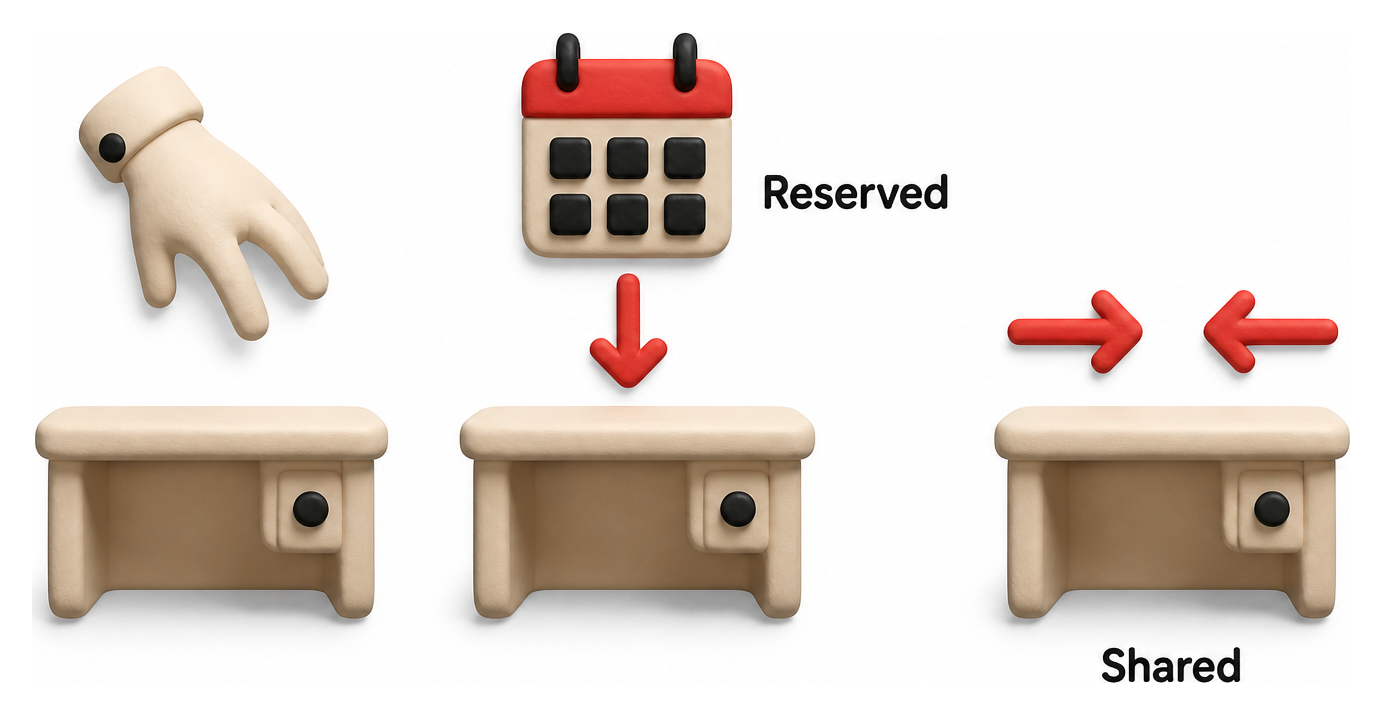
Hot desking is the practice of leaving desks unassigned so that any member can use any available desk on a first-come-first-served basis, with no reservation required; a worker simply "chooses a workspace upon arrival, rather than reserving it in advance" [18]. Workplace software vendor Appspace describes it as the "grab whatever's open" approach to seating [48].
Desk hoteling, by contrast, is reservation-based: employees book a specific desk in advance, much as they would book a hotel room, guaranteeing a known seat before they arrive [49]. Appspace frames it plainly as "reserving a specific desk ahead of time, like booking a hotel room" so a worker knows exactly where they will sit before showing up [11]. Workplace-booking vendor Skedda and trade publication BizTech Magazine both describe the same core distinction: hoteling requires advance reservations, while hot desking is strictly first-come, first-served [50] [51]. Workplace-experience platform Envoy summarizes the practical difference in tone: "hot desking is more casual and hoteling is more organized," since hoteling adds a booking step that hot desking skips entirely [52] [10].
Desk sharing is the broadest of the three terms. Wikipedia's entry on hot desking notes it is "sometimes called 'non-reservation-based hoteling' or 'desk sharing'," which means desk sharing functions in practice as an umbrella category that includes both hot desking and hoteling, rather than a third, wholly distinct booking method [12]. Appspace's glossary similarly treats "hot desking" and "desk hoteling" as the two operational models that most desk-sharing organizations choose between, describing hot desking as unassigned and first-come-first-served, and noting most hybrid organizations pick one of the two [53]. In practice, most Montreal coworking operators sell hot-desking-style access under a "hot desk," "open desk," or "flexible desk" label, while a smaller number of enterprise-focused providers, particularly larger occupiers managing their own hybrid offices rather than public coworking members, deploy desk-hoteling software to formally reserve seats.
The rise of desk sharing and hoteling in general is closely tied to hybrid work. Citing Bloomberg reporting, Wikipedia notes that assigned office seating fell from 95 percent of seats in 2019 to just 81 percent in 2022, with the remainder unassigned, "reflecting a trend towards more flexible workspaces" [54]. By 2024, CBRE's Americas Office Occupier Sentiment Survey found that around 60 percent of North American companies had adopted desk sharing or hoteling in some form, as cited by Wikipedia [13].
95 percent of office seats were assigned, with the remainder unassigned.
Assigned seating fell to just 81 percent of seats, with the remainder unassigned.
Around 60 percent of North American companies had adopted desk sharing or hoteling in some form.
CBRE recorded office occupancy at an all-time-high 111 percent of physical seating.
Comparative Context and Market Positioning
Montreal is consistently described as one of the more affordable major Canadian coworking markets. Industry pricing tracker Optix reports that Montreal hot desks average CA$200 to CA$400 monthly, and frames Canadian coworking rates generally as running 20 to 30 percent below equivalent U.S. major-city rates once converted to a common currency [7] [55]. For a national reference point, CoworkingCafe's Q4 2024 pricing tracker put the U.S. median monthly open-workspace (hot desk) subscription at $149 and the U.S. median dedicated-desk subscription at $300, both lower in absolute dollar terms than typical Montreal pricing but not directly comparable given exchange-rate and market-composition differences [56] [57].
Montreal's advantage over other large Canadian cities largely traces back to commercial real estate costs. Downtown Montreal Class AAA office space carried net asking rents of $33.00 to $42.00 per square foot in Q2 2026, according to CBRE, while Avison Young separately reported an average Greater Montreal gross asking rent of $39.74 per square foot (including $19.53 average net rent) in Q1 2026 [8] [58]. Office vacancy in the Greater Montreal Area sat at 17.2 percent in Q1 2026 per Colliers, and 17.9 percent per Cushman & Wakefield's Q2 2026 tracking, both broadly consistent with a national Canadian office vacancy rate that CBRE measured at 17.1 percent in Q2 2026, down from 18.7 percent a year earlier [9] [59] [60]. Colliers also noted that no new downtown Montreal office supply is expected for at least three years as of mid-2026, a tightening dynamic that could support continued growth in flexible-space demand as occupiers look for alternatives to long-term leases in a constrained market [61].
Nationally, the flexible-workspace category itself continues to expand, though estimates of its size differ sharply by research firm and methodology. Mordor Intelligence estimates the Canadian coworking office-space market at USD $1.03 billion for 2025, rising to $1.15 billion in 2026 and $2.03 billion by 2031, an 11.93 percent compound annual growth rate [15]. IMARC Group, using a narrower definition, put the 2025 Canadian market at just USD $197.7 million, forecasting growth to $884.8 million by 2034 [16]. A third estimate from Next Move Strategy Consulting valued the market at USD $285.1 million in 2023, projecting growth to $893.0 million by 2030 [62]. Readers should treat these figures as directionally consistent (strong growth is universal across all three) but not numerically reconcilable, since each research firm appears to scope "coworking" differently. Mordor Intelligence separately highlights Quebec and Montreal specifically as a growth market, citing large-scale developments such as National Bank Place as evidence that the city is attracting enterprise-scale flexible-space demand rather than remaining a purely small-business or freelancer market [63].
- Values the national coworking segment at $1.03 billion in 2025, growing to $2.03 billion by 2031.
- Projects an 11.93 percent compound annual growth rate, rising to $1.15 billion in 2026.
- Puts the 2025 Canadian market at just $197.7 million, forecasting growth to $884.8 million by 2034.
- The gap versus Mordor Intelligence reflects differing scope, not disagreement on direction of growth.
Strong growth is directionally consistent across firms, but the dollar figures are not numerically reconcilable since each research firm scopes coworking differently.
hot desking is more casual and hoteling is more organized
Data Analysis and Evidence
The shift toward hot desking, desk hoteling, and structured desk-sharing ratios is best explained by hybrid-work adoption and office utilization data rather than by coworking pricing alone. Statistics Canada found that the share of employed Canadians mostly working from home fell to 17.4 percent in May 2025, down from 18.7 percent in May 2024, the fourth consecutive annual decline, meaning more employees are physically commuting even as fully in-office, five-day mandates remain uncommon [64]. In the United States, Gallup's ongoing indicator on remote-capable employees found 52 percent working hybrid, 26 percent exclusively remote, and 22 percent fully on-site, with six in ten remote-capable employees stating a preference for hybrid arrangements [65] [66].
Because hybrid employees are not in the office every day, most organizations now operate with fewer desks than employees, a pattern reflected directly in desk-sharing ratio benchmarks. Workplace-analytics vendor PointGrab explains that a 1:1 employee-to-seat ratio means every employee has a dedicated assigned desk, while "hybrid organizations commonly use 1.5:1 to 2:1 ratios," equivalent to roughly 0.5 to 0.7 desks provisioned per employee [67] [68]. Desk-booking vendor Yarooms independently reports a similar range, finding that "most hybrid organizations land somewhere between 1.2:1 and 2:1" [17].
Real estate and workplace-strategy data corroborate that these ratios are now common in practice rather than purely theoretical. CBRE's 2026 Global Workplace & Occupancy Insights research found global average office-building utilization climbed to 53 percent, the highest level recorded since before the pandemic, and separately found that global office occupancy, defined as employees allocated against physical seats, reached an all-time high of 111 percent, meaning organizations now assign more employees to a building than they have desks for [69] [14]. CBRE separately reported that 80 percent of current office occupiers had adopted, and intended to sustain, hybrid work policies [70]. JLL's Global Occupancy Planning Benchmark Report 2026, surveying 84 organizations representing 716 million square feet of commercial real estate, found that 90 percent of organizations now apply utilization data directly to space-planning decisions, up sharply from 70 percent in 2025 [71] [72]. JLL's separate research on the flexible-office imperative found that global office utilization averages just 54 percent against an average corporate target of 79 percent, a 25-point gap, while noting that only 3 percent of large enterprises currently use flexible space for more than 10 percent of their overall real estate portfolio, suggesting substantial headroom remains for coworking and flex-desk adoption among large occupiers [73] [74].
Advanced Workplace Associates' Hybrid Working Index found average global office attendance of just 1.75 days per week, and found desk utilization rising to 48 percent of available desks, up from 33 percent a year earlier, as organizations right-sized their office footprints to match lower attendance [75] [76]. More recent survey data suggests in-office attendance has since risen: Owl Labs' 2025 State of Hybrid Work report found hybrid employees most commonly in the office three days (39 percent) or four days (34 percent) a week, both shares higher than in 2024, and Gensler's Global Workplace Survey 2026, covering more than 16,400 workers across 16 countries, found the average worker now spends more than half of the workweek in the office [77] [78].
In Canada specifically, a survey of Canadian employers conducted for International Workplace Group found that nearly three-quarters (74 percent) had reduced their office footprint by embracing hybrid work and allowing staff to use coworking spaces closer to home, generating reported savings of more than $400,000 per year for the average respondent [79]. A separate Colliers Canada survey of close to 400 employers found 62 percent were using a hybrid working model, with Colliers reporting elsewhere that flexible office space, including coworking, now represents approximately 8 percent of total Canadian office inventory [80] [81]. Table 3 below consolidates the key desk-ratio and utilization benchmarks referenced throughout this section.
| Source | Metric | Reported Figure | As Of |
|---|---|---|---|
| CBRE [14] | Global office occupancy (employees vs. seats) | 111% | January 2026 |
| CBRE [69] | Global average building utilization | 53% | January 2026 |
| JLL [72] | Organizations using utilization data for planning | 90% (up from 70% in 2025) | May 2026 |
| PointGrab [68] | Typical hybrid employee-to-seat ratio | 1.5:1 to 2:1 | Not dated |
| Yarooms [17] | Typical hybrid desk-sharing ratio | 1.2:1 to 2:1 | July 2026 |
| AWA [76] | Global desk utilization | 48% (up from 33%) | August 2023 |
| Gallup [65] | U.S. remote-capable employees working hybrid | 52% | Not dated |
| Owl Labs [77] | Most common hybrid in-office schedule | 3 to 4 days/week | September 2025 |
Table 3 makes clear that no single, universally agreed desk-sharing ratio exists; instead, benchmarks converge on a range of roughly 1.2 to 2 employees per desk, with the precise figure depending on an organization's specific attendance pattern. A Montreal employer averaging three in-office days per week per employee, consistent with Owl Labs' most common hybrid pattern, would sit comfortably within the 1.5:1 to 2:1 range that PointGrab and Yarooms both describe as typical, meaning it could plan for meaningfully fewer desks than headcount without regularly running out of seats [77] [68].
Implications and Future Directions
- 01Compare ECTO's plans
ECTO's $250 member plan equals about 8.3 day passes at $30 each, and the $275 non-member plan equals about 9.2 day passes.
- 02Compare Metspace's plan
Metspace's $180 starting monthly plan equals about 5.1 day passes at its $35 day-pass rate.
- 03Apply the breakeven rule
A monthly plan becomes less expensive after roughly five to nine days of use per month, depending on the provider and membership status.
A monthly membership is the better value.
A day pass remains cheaper for occasional use.
For an individual freelancer or remote employee choosing a Montreal coworking membership, compare each provider's monthly price with its own day-pass rate. At ECTO, the $250 member plan equals about 8.3 $30 day passes and the $275 non-member plan about 9.2; Metspace's $180 starting monthly plan equals about 5.1 $35 day passes; and Le Tiers Lieu's $269.99 monthly plan equals about 5.4 $49.99 day passes. A monthly plan can therefore become less expensive after roughly five to nine days of use per month, depending on the provider and membership status. A dedicated desk costs more than a hot desk and suits users who want a fixed, personalized setup without paying for an enclosed office. Private-office starting rates vary by operator and product; Table 2 includes published one-person rates from $525 at Espace Waverly and C$540 at WeWork. A private office may suit work requiring a dedicated room, such as confidential calls or a small team.
For hybrid employers deciding how many desks to lease or how much coworking capacity to book, the desk-sharing ratio data in Table 3 suggests that a starting assumption of 1.5 to 2 employees per desk is broadly consistent with current industry practice, though the CBRE occupancy figure cited above indicates many organizations are now pushing that ratio even further as attendance data matures and planning tools improve. JLL's finding that only 3 percent of large enterprises currently allocate more than 10 percent of their real estate portfolio to flexible space suggests significant room remains for corporate coworking adoption to grow, particularly in a market like Montreal where downtown vacancy remains elevated and new supply is constrained for at least the next three years [74] [61].
Montreal's continued price advantage relative to Toronto and Vancouver, combined with Mordor Intelligence's identification of the city as a growth market for enterprise-scale flexible space, suggests pricing could firm modestly over the next several years even as the broader Canadian coworking category continues to expand at a double-digit compound annual growth rate under most forecasts reviewed in this report [55] [63]. Buyers evaluating multi-year commitments should treat the price ranges in Tables 1 and 2 as an August 2026 snapshot rather than a fixed baseline, and should confirm current rates directly with each operator, since several of the smaller independent spaces surveyed adjust pricing more frequently than the larger branded chains.
Frequently Asked Questions (FAQs)
What does a hot desk cost per month in Montreal? Most Montreal hot-desk memberships fall between $210 and $300 per month for unlimited access, as shown in Table 1, with representative examples including Kampus at $210 and Le Tiers Lieu at $269.99 plus tax [1] [20].
What is the difference between hot desking and desk hoteling? Hot desking is unassigned and first-come-first-served with no booking, while desk hoteling requires reserving a specific desk in advance, similar to booking a hotel room [50].
What is the difference between hot desking and desk sharing? Wikipedia treats the two as effectively synonymous, describing hot desking as also being called "non-reservation-based hoteling" or "desk sharing," so in most usage desk sharing is the umbrella term and hot desking is one specific form of it [12].
What is desk hoteling? Desk hoteling is a reservation-based unassigned-seating model in which employees book a workspace before arriving, guaranteeing a specific desk rather than competing for open seating on arrival [49].
What desk-sharing ratio should a hybrid team use? Industry benchmarks from PointGrab and Yarooms both put typical hybrid desk-sharing ratios between roughly 1.2:1 and 2:1 employees per desk, equivalent to provisioning about 0.5 to 0.7 desks per employee [17] [82].
How much more does a dedicated desk cost than a hot desk in Montreal? Dedicated desks cost more than hot desks at the same location, but the premium varies materially by operator and plan. For example, the surveyed Crew Collective & Café rates rise from $300 for a floating desk to $675 for a dedicated desk, a 125% increase.
Is a private office or a hot desk better value in Montreal? A hot desk is the lower-cost option for individuals who need flexible access, while a private office, starting around $440 to $600 per month for one person, suits those needing confidentiality, a fixed enclosed room, or space for a small team [42].
Conclusion
Hot desk pricing in Montreal in 2026 spans roughly $180 to $400 per month across the operators surveyed in this report, with the largest cluster of independent and mid-sized providers landing between $210 and $300, a range that positions Montreal as one of Canada's more affordable major coworking markets relative to Toronto and Vancouver. Dedicated desks cost more than hot desks, with the premium varying by operator and plan; private-office entry rates also vary, including $525 at Espace Waverly and C$540 at WeWork for one-person offices. These figures sit against a backdrop of persistently elevated Montreal office vacancy, roughly 17 to 18 percent depending on the source, constrained new downtown supply, and a national hybrid-work environment in which most large employers now plan around desk-sharing ratios of 1.2 to 2 employees per seat rather than the traditional one-to-one desk allocation. Buyers comparing hot desking, desk hoteling, and dedicated or private office space in Montreal should weigh access model, not just headline price, since a provider's per-day, hourly, or monthly billing structure can materially change the effective monthly cost depending on actual usage patterns.
External Sources (82)
About
2727 Coworking
Find a practical home for your work at 2727 Coworking in Montreal. Explore private offices, day workspaces and meeting rooms, plus business-address and virtual-mailbox services for your company.
2727 Coworking is a Montreal workspace and business-address provider. We serve people who need a place to focus, meet, run a small business or establish a professional mailing presence. Our website offers English and French information about workspace options and services, alongside educational resources for operating a business in Canada.
A workspace that fits the day
Our workspace options include private offices, day passes and desks, and a conference room. These formats help individuals and teams compare a dedicated office with more flexible ways to work or hold a meeting. Prospective members can explore the virtual tour, review current pricing and book a visit before choosing a workspace.
Business addresses and mail
2727 Coworking provides business-address and virtual-mailbox services. Our resources explain the documents and practical questions involved, including guidance for people outside Canada. Service eligibility, included features, availability and access arrangements should be confirmed on the applicable service page or with our team.
Resources for Canadian small businesses
We publish guides, research and planning tools about workspace decisions, business addresses and starting a business in Canada. Our incorporation research includes information for people inside Canada and abroad, with jurisdiction-specific material to help readers identify the next questions to investigate. These educational resources complement our workspace and address services; they are not individualized legal, tax or immigration advice.
Visit or contact 2727 Coworking
Explore private offices, day passes and desks, the conference room, business addresses and virtual mailboxes. Book a visit or contact the team to discuss your needs.
A business address alone does not establish tax residence, immigration status, banking approval or eligibility for a government program.
Disclaimer
This document is provided for informational purposes only. No representations or warranties are made regarding the accuracy, completeness, or reliability of its contents. Any use of this information is at your own risk. 2727 Coworking shall not be liable for any damages arising from the use of this document. This content was generated with assistance from artificial intelligence tools, which may contain errors or inaccuracies. Readers should verify critical information independently. All product names, trademarks, and registered trademarks mentioned are property of their respective owners and are used for identification purposes only. Use of these names does not imply endorsement. This document does not constitute professional or legal advice. For specific guidance related to your needs, please consult qualified professionals.