2727 Coworking Article
NEQ in Quebec: A Guide to Business Registration
Inside this article
- 01Executive summary
- 02Introduction: context and origins of the NEQ
- 03Québec enterprise number (NEQ): definition and purpose
- 04Legal registration requirement
- 05Registration procedure
- 06Updates and annual obligations
- 07Practical cases and perspectives
- 08Data and statistics
- 09Implications and future directions
- 10Conclusion
Executive summary
The Québec enterprise number (NEQ) is a unique ten-digit identifier assigned by the Québec Enterprise Registrar (REQ) to every legal entity registered in the province [1]. It facilitates the identification of businesses by public bodies (Revenu Québec, CNESST, OQLF, etc.) and among business partners. In practice, an NEQ is obtained automatically upon initial registration in the Québec enterprise register. This registration is mandatory for almost all forms of business (business corporations, legal persons, partnerships, cooperatives, non-profit organizations and self-employed workers operating under a business name) [2] [3]. The only usual exceptions concern certain sole proprietors operating their business under their full legal name [2].
This report details the history and legislation governing the NEQ and registration, the practical steps for registering, and the requirements relating to the addresses that must be provided. It analyses the legal and administrative implications of the NEQ, examining updated obligations (declaration of ultimate beneficiaries, francization, etc.) and special cases (foreign businesses, workers crossing the Ontario–Quebec border). The following sections present contextual data (number of businesses, sector breakdown), concrete case studies and an examination of future trends (digitization of registers, interprovincial cooperation). All claims are supported by official sources and expert analyses.
Introduction: context and origins of the NEQ
In Quebec, the legal publicity of enterprises has been regulated since 1993 by the Act respecting the legal publicity of sole proprietorships, partnerships and legal persons (chapter P-45) [4]. Its purpose is to maintain a public register of businesses and merchants, ensuring transparency and the security of commercial transactions. The Québec Enterprise Registrar (REQ) assumes this role: it collects, verifies and publishes key information about businesses established or operating in Quebec. In this context, the NEQ was introduced as a permanent identifier for each registered file, to simplify exchanges with government.
The NEQ, introduced in the 1990s with the establishment of the provincial register, replaces or supplements older, separate numbers. Today, along with the federal business number (NEC/BN), it is one of the main official codes identifying a company. According to Mallette (an accounting firm), “the NEQ in Quebec is the equivalent of the federal business number (BN)” – the same business therefore generally has two numbers if it operates at both the provincial and federal levels [2]. In practice, when a business is created (or registered in the register), the REQ assigns it an NEQ eight times out of ten. This number appears on all official documents (registrations, contracts, invoices, notices from Revenu Québec, communications from the Registrar, etc.) [2].
Today, approximately 957,000 active businesses are listed in Quebec (December 2023) [5]. All those subject to registration (MOINS, cooperatives, SPAS, etc.) have an NEQ. It facilitates access to a freely searchable public database that lists the business's name, legal status, addresses, directors, etc. For example, consulting the enterprise register is free, and a simple search provides the NEQ [1] [6]. In other words, the NEQ is the administrative “birth certificate” of Quebec businesses, widely used by government bodies and lending credibility to the business with third parties [2] [3].
Registration in Quebec is mandatory for the vast majority of commercial entities. Under the law, any natural person operating a business under an assumed name, as well as all companies, partnerships, cooperatives, associations, etc., “is subject to the registration requirement” (see below). The only usual statutory exemptions concern self-employed workers operating under their own name without a distinctive element. However, even in this case, most choose to obtain an NEQ (Mallette thus considers registration “strongly recommended” even when it is not mandatory) [2]. In short, to start an economic activity “properly” in Quebec, it is almost universally required to register in the enterprise directory to receive an NEQ and comply with provincial requirements.
Québec enterprise number (NEQ): definition and purpose
The NEQ is a ten-digit numeric code – a unique sequence identifying each business registered in Quebec's register. Specifically, as soon as the Registrar validates a compliant declaration of registration, it “enters the registrant [the business] in the register and assigns it its Québec enterprise number” [4]. This number then appears in the business's statement of information [7] and serves to identify its file in all official exchanges.
The official website summarizes the NEQ's use: it “facilitates relations between businesses and the various departments and agencies of the Government of Quebec” [1]. For example, several public programs (Revenu Québec, Emploi-Québec, CNESST, etc.) require this number to register for services and track files [1] [2]. Similarly, the NEQ must be included on legal documents (official correspondence, invoices, contracts) to authenticate the business. As Mallette points out: “The NEQ serves as the business's official identity card with government authorities, business partners and the public” [2]. In addition, all public information about the business (status, capital amounts, directors, etc.) is linked to this NEQ in accessible registers.
The NEQ therefore also plays a role in transparency and security, similar to registers in other jurisdictions. It allows the existence and legal status of a company to be verified (as does, for example, the trade register in France). Clients or creditors can perform these same searches to verify that a business's registration is still active and confirm its legal representatives. The Registrar provides this search function (“Search the enterprise register”) free of charge, by name or number, displaying the details in the file [6]. In short, through the NEQ, information about a Quebec business is public and reliable, which strengthens its credibility and protects the market (for example, against fraud or entities that no longer exist).
NEQ structure and coding
The NEQ consists of ten digits, the first two of which indicate the entity's legal form [7] [2]. The table below summarizes these meaningful prefixes:
| NEQ (first 2 digits) | Associated legal form |
|---|---|
| 11 | Legal persons (business corporations, cooperatives, non-profit C. A., etc.) [7] |
| 22 | Natural persons operating a sole proprietorship (self-employed workers) [7] |
| 33 | Partnerships, associations, groups, etc. [7] |
| 88 | Public authorities (public enterprises or bodies) [7] |
Each NEQ therefore reveals the business category. For example, all NEQs starting with “22” belong to a sole proprietor (natural person) [7], while a number beginning with “11” identifies an incorporated company (legal person) [7]. This automatic coding makes the register easier to read and simplifies administrative processing.
The Registrar points out that a natural person (operating as a sole proprietorship) cannot hold several NEQs simultaneously [1]. In other words, if an entrepreneur ceases operations and resumes them later, they must reuse the same original NEQ (by reregistering) [8] [9]. Conversely, if a legal person (company) ceases operations and restarts, it also retains its original NEQ as long as the business has not been permanently struck off the register.
The NEQ is also used as a data key. Thanks to its fixed structure and public availability, all government authorities process business information in a unified way. For example, a merchant who registers has a file created under an NEQ that will then be automatically referenced in the records of Revenu Québec, the CNESST, the Office québécois de la langue française, etc. Thus, two sources record the same business information under the same number [1] [2], avoiding duplication and errors. The EU also recommends this level of interoperability for business registers to promote transparency and combat fraud [10].
Legal registration requirement
Natural persons (self-employed workers)
Under the law, every natural person operating a sole proprietorship in Quebec must register if they use a business name different from their own name [4]. The Registrar specifies that registration must take place within 60 days of the start of operations [4]. A statutory exception concerns regulated businesses: for example, a tobacco retailer or tanning salon must register within 30 days, even if operating under the owner's legal name [8].
When a natural person registers a sole proprietorship, the Registrar assigns their NEQ [8]. This number, starting with “22”, is linked to the person themselves rather than the brand or project. If this person stops operating and resumes later (even under another business name), they must reuse the NEQ already assigned to them [8] [9]. This continuity, provided for by law, avoids the unnecessary proliferation of numbers and keeps the history linked to an individual.
Registration takes place online through the Registrar's service (clicSÉQUR) [8]. The required information includes the owner's name, the business name (if applicable), the address and a description of the activity. The declaration of registration includes, among other things, “their name […] any other name [...] they use in business […] a statement that they are a natural person operating a business […] and their domicile” [4]. In other words, the owner must provide their personal residential address (their own domicile) as the head office of the sole proprietorship [7].
The associated fees vary according to the processing time selected: for example, for an initial declaration by a natural person, the basic fee is $41 ($61.50 for priority processing) [11]. The sole proprietor then pays $41 per year when filing the annual update [11]. When operations end, the declaration of cancellation is free ($20.50 for priority processing) [11]. The Registrar imposes substantial late penalties: up to 50% of the annual fees if the update is not filed on time, followed by an additional 5% per month overdue [11].
Legal persons and business corporations
A business corporation (SPA) incorporated in Quebec must be registered with the Registrar when its articles of incorporation are filed [4]. In practice, upon its creation, the certificate of incorporation (or certificate of revival) form is sent to the Registrar, which registers the corporation and assigns it an NEQ [4]. The assigned NEQ begins with “11” and is retained throughout the corporation's existence [7]. For example, the cost of filing a certificate of incorporation is currently around $397 ($595.50 for priority processing) [12].
Incorporated companies must also file an annual updating report (statement of information) with the Registrar each year. This formality, made mandatory by law [4], involves paying an annual fee (currently approximately $84 for an SPA※) [12]. This requirement aims to keep the information in the register up to date (addresses, directors, articles, etc.). Failure to do so exposes the corporation to penalties and, ultimately, cancellation of its registration by the Registrar.
In addition to Quebec corporations, certain corporations described as not constituted in Quebec (incorporated under federal or foreign legislation) that operate there must register as “outside Quebec”. This is a registration (entry in the register) as a foreign business operating in Quebec. The Registrar processes these files using dedicated forms. When a foreign corporation registers, the Registrar also assigns it an NEQ. These foreign businesses have the same annual updating obligations as Quebec corporations, subject to cancellation of their registration for non-compliance [9] [4]. In particular, they must provide a representative in Quebec to accept official communications (see below).
Partnerships, cooperatives and other entities
Partnerships include general partnerships (SENC), limited liability partnerships (SENC-RL) and all forms of association, such as groups and non-profit cooperative arrangements. Registration is required in principle for these entities when they carry on an economic activity in Quebec [4] [3]. When a partnership is formed in Quebec (e.g., a general partnership (SENC) or limited partnership (SEC)), a “constituting act” is filed with the Registrar, which enters the partnership in the register and gives it an NEQ with the prefix 33 [7] [4]. If the Quebec cooperative (often constituted under the Cooperatives Act) is a legal person, its NEQ will be “11”.
Associations or groups of persons (e.g., artists' associations, committees, trustees, etc.) are not always legally required to register. However, they may do so voluntarily and obtain an NEQ (prefix 33) through the simplified procedure (see next section). Registration fees for an association are also modest (e.g., $41) [13]. In summary, virtually any form of legal entity operating publicly in Quebec can – and often must – have an NEQ.
Table: Common legal forms and registration
| Legal form | Registration requirement | Deadline/Condition | Example NEQ (prefix) |
|---|---|---|---|
| Natural person (sole proprietorship)* under a business name | Mandatory (within 60 days) [8] [4] | 60 days after starting, 30 days for tobacco/tanning [8] | 22… (natural person) |
| Natural person operating under their full name | Not mandatory (strongly recommended) [2] [3] | N/A | 22… (optional) |
| Business corporation (Quebec) | Mandatory (upon incorporation) | Filing the certificate of incorporation | 11… (legal person) |
| Business corporation (federal/foreign) | Mandatory (upon operating in QC) | Declaration of registration within 60 days | 11… |
| Partnership (SENC, SEC, etc.) | Mandatory | Declaration of registration | 33… |
| Cooperative (Quebec) | Mandatory (under the law) | Declaration of registration | 11… |
| Non-profit organization / non-profit corporation (Quebec or federal) | Mandatory | Declaration of registration | 11… |
| Association / group (optional) | Voluntary | — | 33… |
- Self-employed workers who use an assumed name (e.g., “Boulangerie Artisanale Tremblay”) must register. If the person operates under their full legal name, registration is not required, although it is often undertaken.
For example, Marie Tremblay does not have to register, but Marie Tremblay Mdme X (business name) must do so [2] [3].
Registration procedure
General steps
The declaration of registration is filed online through the Registrar's portal (with clicSÉQUR authentication). The entrepreneur selects the service appropriate to the legal form (natural person, business corporation, partnership, non-profit organization, etc.), fills in the required fields and pays the fees. Electronic or PDF forms are available for each type of filing (initial registration, update, cancellation).
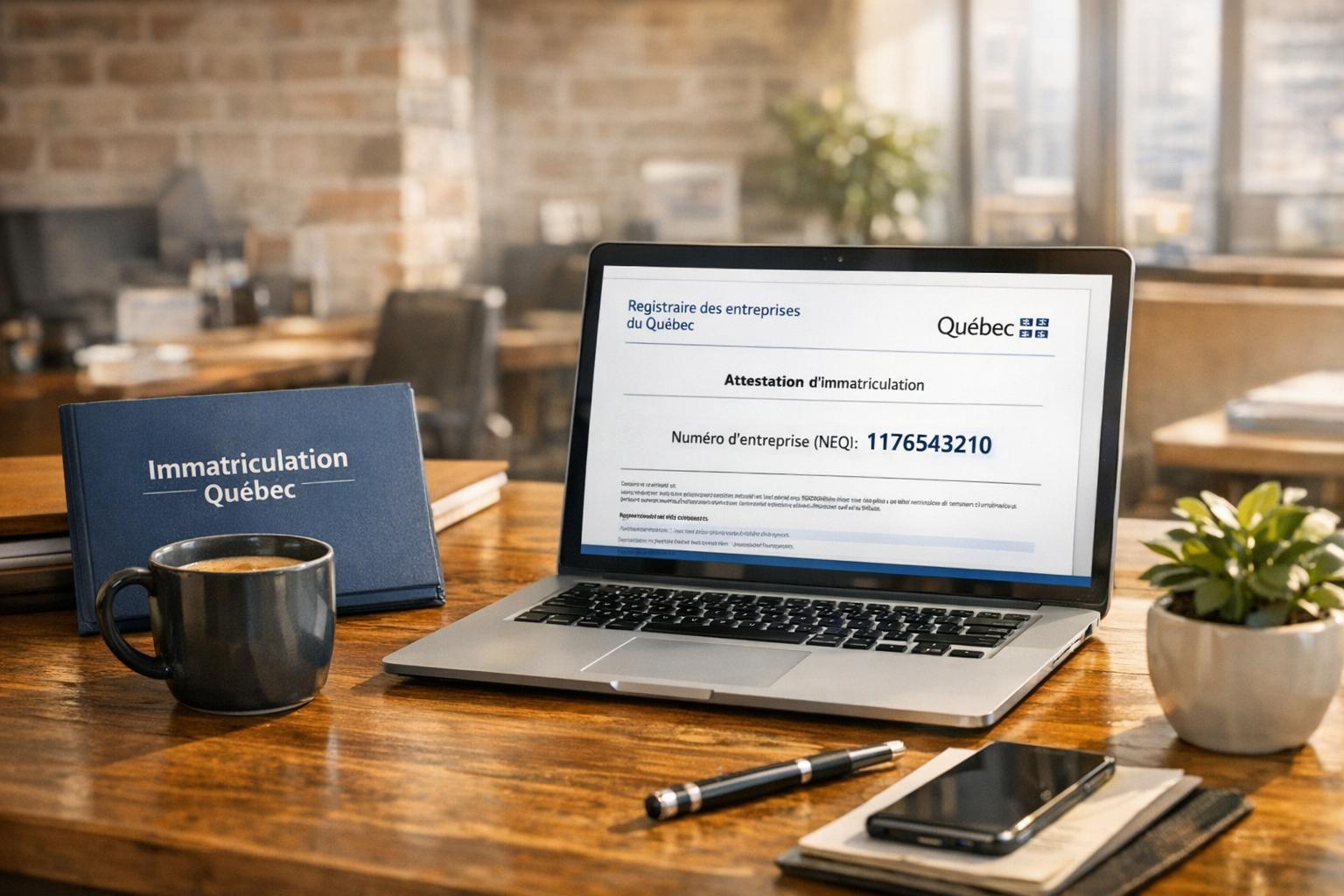
Upon receipt, the Registrar checks compliance: business names, addresses, associated persons, articles included if required, etc. If essential information is missing (city, postal code, status), registration is refused [4]. However, if everything is complete, the file is registered and the NEQ is issued [4]. The attestation of registration (official supporting document) is then provided to the business (in electronic or paper form), showing its NEQ, registration date and registered information.
Processing time is relatively short: according to a recent source, most registrations receive their NEQ within 24 to 48 hours of submission with payment [2]. The system even offers expedited service for an additional fee. An official receipt is provided immediately or by email after registration. Subsequently, any change (e.g., a change of address, name or directors) must be the subject of a new filing (a current or annual update [4]).
Required information and addresses
The law requires the declaration of registration to contain certain mandatory information [4]. This includes the business's full name (and its former names), its legal form, a reference to its incorporating legislation and the business's domicile address [4]. This “domicile address” has a distinct legal meaning depending on the type of entity (see the box below).
Domicile address – For a legal person, this is the address of its head office; for a natural person, the address of their personal domicile; for a partnership/association, the address of its principal establishment or operational headquarters. These distinctions (corporation/partnership/person).
In addition, the business may be required or wish to indicate:
- Elected domicile address: this is the address of a mandatary (a person or firm) designated to receive legal documents (summonses, notices) under the Act respecting legal publicity. In other words, the business's official address “for service” [7] [4]. The legislature provides for requesting the name and address of the attorney (mandatary) “for the purposes of this Act” [4].
- Business address: this is a natural person's principal place of work or business. It differs from their personal domicile. For example, a plumber would list the address of their workshop. The Registrar specifies that a post office box cannot be used as a business address [7].
- Other addresses: for public authorities (NEQs beginning with 88), the term used is their own head office. Associations may declare a head office or founding address, etc. In all cases, these addresses appear in the public file.
The table below summarizes these address definitions:
| Address type | Legal meaning |
|---|---|
| Domicile address | – For a legal person (business corporation, cooperative, etc.): head office – For a natural person (sole proprietorship): their personal domicile – For a partnership/association: principal establishment [7] |
| Business address | A natural person's business domicile: their principal place of business. P.O. boxes prohibited [7]. |
| Elected address | Address of a chosen mandatary (the elected domicile) for receiving the business's official documents/legal notices [7] [4]. |
| Head office | Term used for public authorities (NEQs beginning with 88) [7]. |
Entrepreneurs must provide a valid address for at least one of the items above. In particular, the domicile or head office address cannot be fictitious. If the business has no physical establishment in Quebec (neither a head office nor an office), the law requires the designation of a mandatary (“attorney” or “mandatary in Quebec”) who will act as a legal intermediary [8] [14]. This requirement came into force on April 1, 2026: thus, “any business that has neither a domicile address, nor a business address, nor an establishment in Quebec must declare […] an attorney who represents it in Quebec” [8]. The mandatary enters their address in the register (elected address). Note that this rule does not apply to construction contractors established in Ontario (Quebec–Ontario agreement), who are exempt from declaring an attorney [8] [14].
Requirements when there is no address in Quebec
| Special case | Address requirement |
|---|---|
| Business with no address in Quebec (domicile/business/establishment) | Must declare a mandatary (representative) in Quebec [8]. The mandatary's address serves as the official elected address. |
| Construction contractor (Quebec–Ontario) without a QC address | Exemption: does not have to declare a mandatary. Registers using a paper form [8]. |
| Foreign company operating in QC without a QC address | Must appoint a mandatary in Quebec [14]. |
In other words, every business active in Quebec must, subject to penalties, maintain at least one valid Quebec address (or a local representative) in the register. This requirement ensures that an entity can be legally contacted in the province. For example, recent case law (2024) confirmed the legality of these domiciliation rules to combat tax evasion and opacity surrounding beneficiaries [15].
Updates and annual obligations
Initial registration in the register is not a one-time formality: the law requires an annual update of the business's information [4]. Specifically, each year following registration, the business must file an updating declaration (electronically or on paper) containing any changes that have occurred (changes to addresses, officers, articles, etc.). This annual deadline is aligned with the business's income tax filing period [4]. Updating fees vary (generally in the same range as initial registration): for example, an annual declaration for a natural person also costs $41 ($61.50 for priority processing) [11], and an annual corporate report costs approximately $84 [12].
A late annual declaration can result in:
- A penalty equal to 50% of the annual fee if the update is filed after the statutory deadline [11].
- In addition, interest of 5% on the unpaid balance, followed by an additional 1% per month overdue (up to 12 months) [11].
- If no update is filed for several years, the business risks cancellation of its registration by the Registrar, which removes its NEQ and makes it illegal in the marketplace [4].
Furthermore, Quebec law strengthens transparency: since March 31, 2023, businesses have been required to declare their ultimate beneficiaries and submit various personal details (e.g., directors' dates of birth) in their annual or reregistration declaration [15]. For example, a business must now enter “all its ultimate beneficiaries” in the register and provide the Registrar with an identity document for each director [15]. This links the NEQ to a more complete information profile, strengthening its central role in administrative and tax checks.
Practical cases and perspectives
To provide concrete illustrations, consider two typical scenarios:
-
A self-employed worker: Jean Dupont opens “Services Dupont” in May. His activity operates under the business name “Services Dupont”, a commercial venture. He must register within 60 days or before the end of the year. He completes the declaration online (with his ne9 postal code) and obtains an NEQ such as 2212345678. With this NEQ, he pays the $41 fee and receives a certificate. He will include it on his invoices and use it for his bank accounts and provincial grant applications (assistance for self-employed workers, etc.) [2] [6]. When he employs an assistant in 2027, he will have to declare this hiring to the CNESST and the REQ using the same NEQ.
-
A foreign company: Imagine “TechSolutions Inc.”, an Ontario SME wishing to sell its software in Quebec. Although it is already making sales, it has no local establishment. Under the regulations, it must declare a representative (mandatary) in Quebec because it has no domicile address in the province [14]. TechSolutions Inc. therefore completes the “company not constituted in Quebec” form, declares its Quebec mandatary and pays the fees (e.g., $227 according to the official notice). The REQ assigns it an NEQ, for example “1123456789” (code 11 for a legal person). This NEQ is carried over into the Revenu Québec database for sales taxes, and the firm provides it to its Quebec clients and suppliers. If TechSolutions changes its address or mandatary, it will have to update its file so that these bodies remain informed.
These examples show the practical value of the NEQ: it centralizes administrative procedures. Official letters from Revenu Québec (notices of assessment, statements) and transactions with various stakeholders refer to it. A Bankeo study (2025) points out that this number “simplifies interactions with public and private institutions” [3]. Indeed, a search for a valid NEQ (through the REQ website) can be conducted even before formal incorporation, to avoid name conflicts. Entrepreneurs can verify that a business name is available and bring their project into compliance [6] [3].
Another perspective is comparative: the NEQ is analogous to the trade register in other jurisdictions, but has its own specific features. Compared with the Canadian government's federal business number (Business Number, BN), the NEQ relates to provincial obligations (provincial sales tax, QST, CNESST, etc.) [2]. A company in Quebec therefore potentially has two numbers: the NEQ for Quebec and the BN for the federal government. Moreover, unlike Ontario, for example (where a “Master Business Licence” is often used), Quebec does not issue a simple business certificate to a single individual – any person with a business name becomes registered and receives an NEQ [2] [3]. This difference reinforces the NEQ's predominance as a unique identifier in the province.
Data and statistics
According to the Institut de la statistique du Québec, as of December 2023, the province recorded 957,025 active businesses, of which 278,278 had employees [5]. Nearly 71.7% of these businesses with employees had only 1 to 9, highlighting the predominance of SMEs. This figure includes self-employed workers. Correspondingly, this means that several hundred thousand sole proprietors hold an NEQ for their activity.
The most widely represented sectors are construction (12.5% of businesses with employees), retail trade (11.6%), health care and social assistance (10.3%) and professional, scientific and technical services (10.0%) [5]. These data show the extent of the NEQ's use: from government contracts to grants and public procurement, all these settings rely on this number.
Implications and future directions
Centralization through the NEQ and registration provides a reliable legal framework: partners can “verify its existence and legal status” thanks to the digitization of the register [2] [6]. Growing obligations (beneficiaries, francization) illustrate a global movement towards greater transparency and tax compliance. For example, since June 2025, businesses with 5 to 24 employees have been required to declare the proportion of their employees who are not proficient in French [13] [9], a requirement linked to Quebec's language policies. Similarly, the declaration of ultimate beneficiaries (already in force since 2023) aligns Quebec with international anti-money laundering standards [15].
Looking more broadly, Quebec's ecosystem continues its digitization of business services. The Registrar is developing online platforms (“My Office”), allowing entrepreneurs to manage their file (registration, updates, payments) more efficiently. There is also a trend towards interprovincial harmonization: for example, Ontario–Quebec agreements simplify the mobility of construction workers [8]. In the longer term, initiatives such as a single federal business identifier could emerge, but for now each province (including Quebec) retains its central database, with the NEQ as the access key.
Conclusion
The “Québec enterprise number” is much more than a simple identifier: it embodies a business's place in Quebec's economic fabric and its compliance with provincial laws. This report has demonstrated that registration with the Registrar – its steps, obligations and address requirements – is central to a business's legal commitment. The NEQ, assigned during this registration, then serves as a tool for liaising with all government bodies while ensuring transparency towards the public and business partners. Official texts (laws, government websites) and expert analyses all attest that, once obtained, this registration and its number must be kept up to date annually [4]. In cases of negligence, the business faces penalties or cancellation of its registration by the Registrar.
Thus, for anyone starting a project in Quebec, this guide highlights the importance of carefully following registration procedures: choosing the right legal form, providing accurate address information, meeting the imposed deadlines and paying the corresponding fees. The NEQ is more than a number: it is the administrative thread that ensures both the business's legal visibility and its ability to operate in compliance with Quebec standards [2] [3].
References: this report draws on official Government of Quebec sources (Québec.ca and Légis Québec websites) as well as professional analyses (Mallette, Bankeo) [1] [2]. All factual claims, data and statutory citations are carefully supported by these references.
External Sources (15)
About
2727 Coworking
Find a practical home for your work at 2727 Coworking in Montreal. Explore private offices, day workspaces and meeting rooms, plus business-address and virtual-mailbox services for your company.
2727 Coworking is a Montreal workspace and business-address provider. We serve people who need a place to focus, meet, run a small business or establish a professional mailing presence. Our website offers English and French information about workspace options and services, alongside educational resources for operating a business in Canada.
A workspace that fits the day
Our workspace options include private offices, day passes and desks, and a conference room. These formats help individuals and teams compare a dedicated office with more flexible ways to work or hold a meeting. Prospective members can explore the virtual tour, review current pricing and book a visit before choosing a workspace.
Business addresses and mail
2727 Coworking provides business-address and virtual-mailbox services. Our resources explain the documents and practical questions involved, including guidance for people outside Canada. Service eligibility, included features, availability and access arrangements should be confirmed on the applicable service page or with our team.
Resources for Canadian small businesses
We publish guides, research and planning tools about workspace decisions, business addresses and starting a business in Canada. Our incorporation research includes information for people inside Canada and abroad, with jurisdiction-specific material to help readers identify the next questions to investigate. These educational resources complement our workspace and address services; they are not individualized legal, tax or immigration advice.
Visit or contact 2727 Coworking
Explore private offices, day passes and desks, the conference room, business addresses and virtual mailboxes. Book a visit or contact the team to discuss your needs.
A business address alone does not establish tax residence, immigration status, banking approval or eligibility for a government program.
Disclaimer
This document is provided for informational purposes only. No representations or warranties are made regarding the accuracy, completeness, or reliability of its contents. Any use of this information is at your own risk. 2727 Coworking shall not be liable for any damages arising from the use of this document. This content was generated with assistance from artificial intelligence tools, which may contain errors or inaccuracies. Readers should verify critical information independently. All product names, trademarks, and registered trademarks mentioned are property of their respective owners and are used for identification purposes only. Use of these names does not imply endorsement. This document does not constitute professional or legal advice. For specific guidance related to your needs, please consult qualified professionals.