2727 Coworking Article
Opening a CPA Firm in Montréal: Home, Coworking or Office
2026 guide to opening a CPA firm in Montréal: the April 16, 2026 regulation on organizations, locked records, addresses, and published rates from $35 to $2,200 per month for home, coworking or office options.
Inside this article
- 01Executive Summary
- 02Introduction and Context
- 03What to Confirm with the Order Before Signing a Contract for Premises
- 04Option 1: A Home Office
- 05Option 2: A Desk in a Coworking Space, with Meeting Rooms Rented as Needed
- 06Option 3: A Private Office and a Suite for 2 to 12 People
- 07The 2026 Regulation on Practice Within an Organization
- 08Recordkeeping, Confidentiality and Continuity: The Basic Assessment
- 09Comparison Matrix
- 10Data and Evidence
- 11Site Visit Checklist, Typical Weeks and Cost Worksheet
- 12Frequently Asked Questions
- 13Implications and Next Steps
- 14Conclusion
Executive Summary
A CPA (chartered professional accountant) opening a firm in Montréal chooses a workplace within a specific regulatory framework, with more to consider than rent alone. Even a member who works independently or as a consultant and provides services to third parties must notify the Québec CPA Order by updating their member file [1], and their insurance coverage must reflect their professional situation at all times [1]. The regulation on practice within an organization, which the Order says was adopted on April 16, 2026, replaces the former regulation on practice within a partnership or company [2] [3]. It does not apply to CPAs who provide professional services on their own account or through a sole proprietorship [2], but a CPA who practises, even alone, through a partnership, company or other organization covered by the regulation is subject to it: the organization must be declared when services begin, or reported before any new office opens [2].
As for the physical premises, the Règlement sur la tenue des dossiers requires records to be kept in a room or storage unit to which public access is restricted [4], and, according to the Registraire des entreprises, a post office box cannot serve as a professional address [5]. A virtual address alone therefore does not settle the question of where to practise. Working from home remains an option: the Order itself addresses the situation of a member who provides services from their residence [6], but, depending on the borough, the Ville de Montréal may require a certificate of authorization for use for a home-based professional office [7].
On costs, Montréal operators' published rates, recorded on November 2, 2026, range from $35 per month for a business address [8] to $399 per month for a dedicated desk [9], then from $750 per month for an enclosed private office for one to five people [10], before taxes. The traditional office market provides a point of comparison: overall vacancy in Greater Montréal reached 16.7% in the third quarter of 2026 according to Cushman & Wakefield [11] and 17.3% according to CBRE [12].
In practice, a solo practitioner who sees few clients can combine working from home with meeting rooms rented as needed, provided they address confidentiality, record retention and continuity. Someone who regularly meets with clients or employs staff will benefit from comparing a dedicated desk with a lockable storage unit against a private office. An organization of two to twelve people should first clarify with the Order what « nouveau bureau » means. This guide does not guarantee compliance: ambiguous questions should be put to the Order before signing.
Introduction and Context
This analysis is for Order members who want to start an accounting firm in Montréal, alone or with others, and are weighing three options: a home office, a desk in a coworking space (with meeting rooms rented as needed) and a private office. It also addresses related questions: opening a chartered accounting firm in Québec, choosing between a home office and coworking for an accountant, estimating the cost of a private office in Montréal, determining whether a virtual business address is enough for an accounting firm, and comparing office rentals for an independent professional in Montréal. The approach is an assessment of the physical workplace against the Order's rules, rather than a general guide to starting a firm.
The professional context is that of a large profession. The Order had nearly 42,000 members as of March 31, 2026 [13], and its annual report lists 1,274 CPAs practising through a company as its sole shareholder, with no employees; these members practise through a company, and therefore within an organization, and this category is neither an official count nor an indicator of practitioners working on their own account or through a sole proprietorship [13].
Three scenarios structure the sections that follow:
- Scenario A, solo practitioner working from home: few client visits, rooms rented as needed.
- Scenario B, solo practitioner in a coworking space or private office: frequent meetings, need for a storage unit or enclosed office.
- Scenario C, organization of 2 to 12 people: private suite, staff, organization declaration and the question of a « nouveau bureau ».
A note on methodology: regulatory statements come from the Order, LégisQuébec, the Gazette officielle or public bodies, and prices come from each operator's public pages, consulted on November 2, 2026. No benchmark rate has been invented. The website's publisher is itself a workspace operator in Montréal (desks, private offices, meeting rooms, business addresses) and appears in that capacity in the comparison table, without its rates being cited as a source. This text is no substitute for advice from the Order or a legal adviser.
What to Confirm with the Order Before Signing a Contract for Premises
Before making any commitment, the following list turns the Order's requirements into practical checks, whatever workplace you choose.
Obligations of a Member Opening a Firm
- Member file: a CPA who wants to provide services to third parties, on their own account or as a consultant, must update their professional information in their online file [1].
- Notice period: the Order's page on information provided to the Order requires a declaration at least 45 days before starting for a member who has never provided services to third parties or has not done so for more than five years, as well as for a public accountancy permit holder who has not participated in audit or review engagements for more than five years [6].
- Liability insurance: the declaration to the insurance fund must precede the offering of services, and coverage must reflect the member's professional situation at all times [1].
- Trust account: a CPA who intends to hold money or property belonging to third parties must open a trust account [1].
Address, Professional Domicile and Places of Practice
The Professional Code requires professionals to elect a domicile by informing the secretary of the Order [14], and to report all other places where they practise [14]. The current Code of ethics requires CPAs to notify the Order in writing without delay of any change to the address of the place or places where they practise [15]. Before declaring a shared business address as a place of practice, it is prudent to confirm with the Order that it corresponds to a place where the CPA actually practises.
The Registraire des entreprises adds its own definition: an individual's professional address is their principal place of work or business [5], and a post office box cannot serve as that address [5]. An individual may have only one professional address declared in the register [5]. The sources consulted contain no statement from the Order expressly approving or excluding a home office, coworking space or private office: the choice of premises is not regulated as such, but it must allow the CPA to meet the confidentiality, retention and continuity obligations described below.
Option 1: A Home Office
What the Rules Say
The Order itself gives the example of a member providing services to third parties from their residence: a declaration is required even if this is not their main activity [6]. Each client's file must be kept where the member practises [4], in a room or storage unit that is not freely accessible to the public and can be locked with a key or by an equivalent means [16]. At home, this means a lockable filing cabinet or office, or protected electronic storage, since the regulation allows both paper and electronic records [4].
The Ville de Montréal is the second level of authority to check with. An occupancy permit (called a “certificat d'occupation” or “certificat d'autorisation d'usage,” depending on the borough) is required to use part of a dwelling for professional purposes; the name and conditions vary, and you need to confirm with your own borough. The city's page mentions professional offices governed by the Professional Code [7]. The page consulted brings together wording that varies by borough: one version limits office space to the lesser of 50 m² or one-third of the dwelling [7]. These local conditions are not uniform, and the city advises checking that the activity is permitted before renting or buying [7].
Tax Treatment and a Public Address
For tax purposes, the Canada Revenue Agency allows the deduction of business-use-of-home expenses when the workspace is the principal place of business [17], or when it is used solely to earn business income and meet clients regularly [17]. The deduction cannot create or increase a business loss [17]. Revenu Québec applies equivalent conditions for input tax credits [18].
Working from home also has implications for privacy. If the professional address declared in the register becomes invalid and is not corrected, the home address is published [5]. Keeping a residential address out of the register therefore requires a valid professional address.
Strengths and Limitations
- Strengths: no cost for space, or a partly deductible cost, and flexible hours. About 45% of employed people in the Montréal and Outaouais regions worked remotely in 2022, according to the Institut de la statistique du Québec [19], with most Québec remote workers following a hybrid arrangement [19].
- Confidentiality limitations: the Order's IT best practices guide recommends having a private room for discussions with a client or colleague [20].
- Limitations on receiving clients: building accessibility falls under Québec's Construction Code [21], and a study by the Office des personnes handicapées du Québec of 305 small buildings open to the public in Montréal, Québec City and Saguenay found that none met all the minimum accessibility criteria assessed [22]. The sources reviewed do not document home office accessibility: it must be checked case by case.
Option 2: A Desk in a Coworking Space, with Meeting Rooms Rented as Needed
Amenities and Published Rates
For a solo accountant, a coworking space provides a desk (shared or dedicated), booths or meeting rooms, and often an address. Published rates, detailed in Table 3, range from $250 to $400 per month before taxes for a dedicated desk: $250, $300 or $350 depending on size at Nuage B [23], and $400 for the dedicated desk package at the ECTO cooperative (Source: ecto.coop). Regus lists a dedicated desk starting at $8 per person per day on a 24-month contract, without specifying the currency or taxes on the page [24]. Meeting rooms are billed by the hour, from $35 at Regus [25] to $90 at Walter [26].
Strengths and Limitations for a Firm
- Storage units and filing cabinets: recordkeeping requires a lockable storage unit or room [4]. An open-plan desk meets this requirement only if it comes with a lockable storage unit or filing cabinet, such as the one Espace Mile End advertises [10].
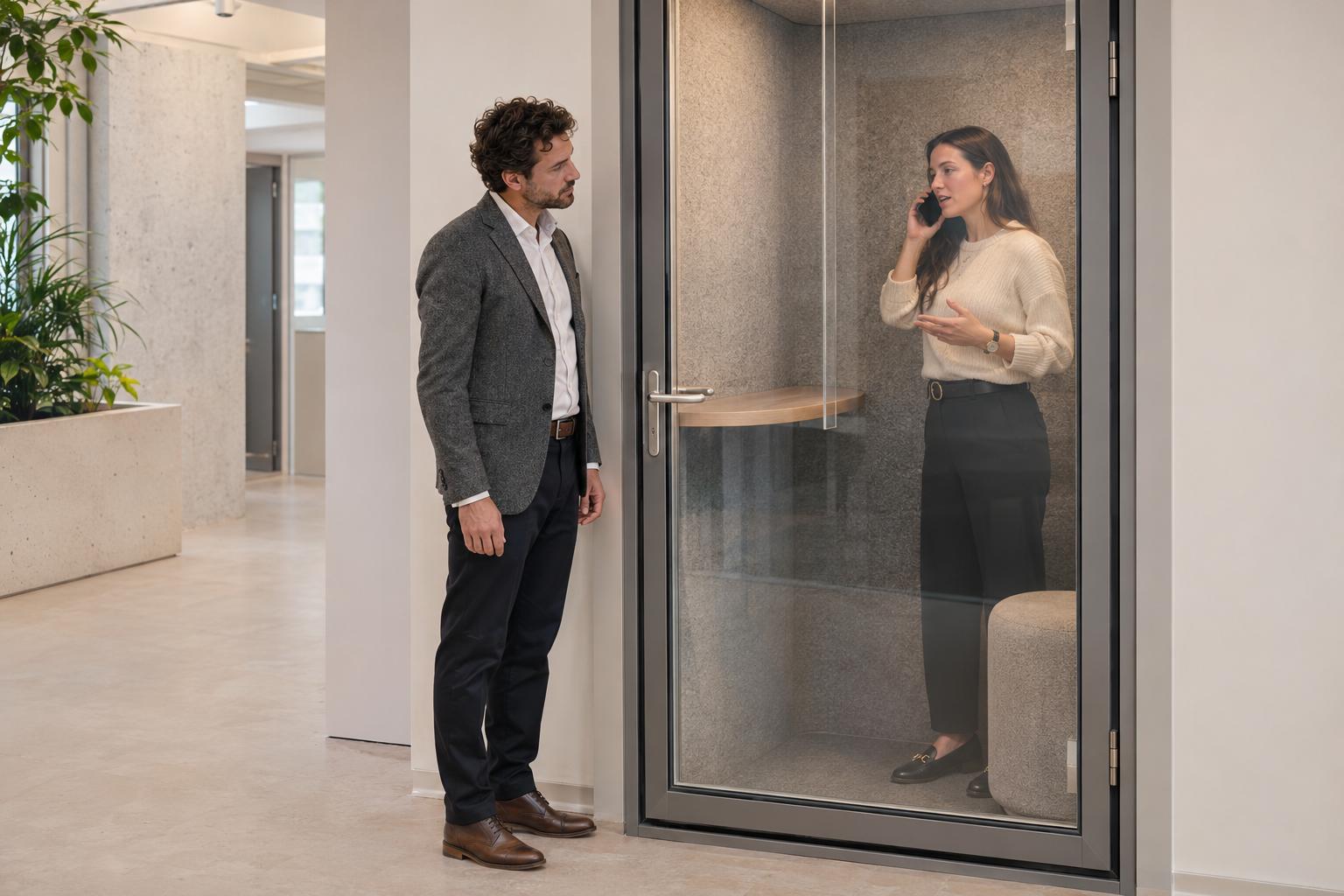
- Calls and confidentiality: Montréal CoWork advertises 20 soundproof booths available for unrestricted use [27]. These amenities help members meet their duty of professional secrecy [15], but do not guarantee it: voices carrying across an open space remain a risk to assess on site.
- Network and visitors: the Order recommends controlling access by clients and visitors and accompanying them [20].
- Continuing responsibility: entrusting personal information to a third party (a cloud service or workspace operator) does not release a business from its obligations, according to the Commission d'accès à l'information [28]. A privacy impact assessment has been required before communicating personal information outside Québec since September 2023 [29].
The insurance fund's basic policy does not cover cyberattacks, data theft or social engineering, according to the Order [30]. CPA Canada describes multifactor authentication as a common condition of cyber insurance [31], an issue that becomes more pressing when the workstation moves outside the home.
Option 3: A Private Office and a Suite for 2 to 12 People
Published Rates
An enclosed private office combines a lockable door, space to file records and, generally, access at any time. For one to five desks, published monthly prices (Table 3) range from $560 to $2,200 per month before taxes, excluding Nuage B's and Regus's daily rates; Halte 24-7's page does not specify how many desks the upper end of the range covers:
- Nuage B: $750 per month for one person, with acoustic phone booths [32], or $85 per day with no commitment [32].
- Coworking Alphard: enclosed offices from $600 to $1,600 per month [33].
- Montréal CoWork: all-inclusive monthly prices before taxes [27].
- Regus: private offices starting at $11 per person per day on a 24-month contract, with one-person offices costing more [34].
The cost of a private office in Montréal varies widely: contract terms (no commitment or 12 to 24 months), taxes and extras (access at any time, meeting rooms, storage) affect the total as much as the advertised price. ECTO specifies, for example, that all its rates are before taxes (Source: ecto.coop), and WeWork that its rates are based on a 12-month commitment [35].
Why a Private Office Best Addresses Confidentiality
An office with a lockable door directly meets the requirement for a room or storage unit that is not freely accessible to the public [4]. RezoMont, for example, states that all its offices and meeting rooms have code locks [36]. For an organization with several people, this model also simplifies file sharing among team members, along with the visitor access controls recommended by the Order. Access at any time, included as standard at Montréal CoWork [27], supports busy tax periods, but also broadens the question of who can enter the building: this is something to verify with the operator.
Accessibility deserves an in-person check. Montréal CoWork states that its space is accessible to people with reduced mobility [37], while several other operators consulted publish no information on the subject in the pages reviewed.
A Virtual Business Address: Useful, but Rarely Enough
A virtual address, or business address service, is the least expensive option: from $35 per month at Montréal CoWork (Bronze package, with mail receipt) [8] to $144 per month at WeWork (Table 3). RezoMont lists $40 per month [38], Domiciliation Montréal $500 per year with a 12-month commitment [39], and Regus specifies that mail forwarding incurs additional fees [25]. Regus's “Virtual Office Plus” package also includes five days per month of access to a private office or coworking space [25].
However, a virtual address does not, by itself, meet a firm's obligations. For one thing, the professional address in the enterprise register corresponds to the principal place of work or business [5]. For another, the Code of ethics requires CPAs to notify the Order of any change to the address of the place or places where they practise [15], and client files must be kept where the member practises [4]. One operator claims its address is recognized by tax and social security authorities [39], but this is a supplier's claim, not a position taken by the Order. A virtual address works as a complement (mail, public address) to an actual place of practice, such as a home office combined with rented rooms, rather than as a substitute.
The 2026 Regulation on Practice Within an Organization
What the Text Says
The Order states that the regulation on the practice of the profession within an organization was adopted on April 16, 2026 [2]. Official sources show two different milestones that need to be distinguished. The April 1, 2026 Gazette officielle publishes the Office des professions' decision of March 20, 2026 (Decision OPQ 2026-991) [40], and the text provides for it to come into force on the fifteenth day following publication [40]. This reading leads to April 16, 2026, which agrees with the date cited by the Order, but it is a calculation to be confirmed, rather than an explicit statement in the pages consulted. LégisQuébec indicates that the new regulation replaces the former regulation on practice within a partnership or company.
Who Is Affected
According to the Order, the regulation primarily applies to CPAs who provide services to third parties within an organization that provides public accountancy or assurance services, or presents itself as a CPA organization [2]. It does not apply to CPAs who provide professional services on their own account [2]. This exclusion covers CPAs working on their own account or through a sole proprietorship. A CPA practising alone through a company is, in principle, covered, depending on the nature of the services offered and how the company presents itself: the regulation then provides, among other things, for excess insurance of at least $500,000 when the CPA practises alone within an organization that employs no other CPA and in which they are the sole holder of ownership interests ($1,000,000 in other cases), as well as the declaration and annual update described below. An incorporated solo CPA should confirm their situation with the Order ([email protected]) before concluding that they are excluded or covered. For a practitioner working on their own account, the choice of premises mainly falls under the recordkeeping rules, the Code of ethics (including written notice to the Order before offering services to third parties) [15] and the member file.
Declaration, New Offices and Insurance
For an organization, the declaration is made when services begin, or by written notice before opening any new office [2]. Before starting within an organization covered by the regulation, the CPA completes the prescribed form, and an annual update is required no later than March 31 [3]. If a condition of the regulation is no longer met, the CPA must notify the Order in writing within 15 days, unless the situation has been remedied [3]. Excess insurance is mandatory: the regulation sets a minimum of $1,000,000 per occurrence for all claims, reduced to $500,000 when the CPA practises alone within an organization that employs no other CPA and in which they are the sole holder of ownership interests [3].
What the Sources Leave Unresolved
- « Nouveau bureau »: the pages consulted do not define whether an additional address, a regularly booked room or a second desk in a shared space constitutes a new office.
- Declaration process: the form for declaring practice within an organization is behind the member-file login and could not be read. The public pages consulted give neither a specific deadline nor fees for a new-office notice.
Recordkeeping, Confidentiality and Continuity: The Basic Assessment
Paper and Electronic Records
The Règlement sur la tenue des dossiers sets the framework: one file per engagement, kept at the place of practice [4], in a room or storage unit locked with a key or by an equivalent means. Records must be retained for at least five years from the end of the engagement [4], and destruction must preserve confidentiality [4]. For cloud computing, the Order points out that CPAs must ensure the confidentiality, integrity and availability of their data [16]. Québec's legislation on the protection of personal information in the private sector also requires reasonable security measures given the sensitivity of the information [41], and the Commission d'accès à l'information specifies that the more sensitive the information, the more robust the measures must be [28]. Among physical measures, it cites restricting access to premises or filing cabinets where paper documents are kept [28].
Privacy Within the Firm
Anyone operating a business is responsible for the personal information they hold [41], and the person with the highest authority remains accountable even when the privacy officer's role is delegated [42]. The law requires a register of confidentiality incidents [41], and notification to the Commission and the individuals concerned when an incident presents a risk of serious injury [41]. A firm must therefore be able to document who accessed what, making keys, access cards and shared printers practical concerns.
Continuity
The Order recommends appointing a transferee in advance (a CPA who takes responsibility for retaining the files), and the mandatory annual declaration includes a question on this subject [16]. If no CPA transferee has been appointed, the secretary of the Order takes possession of the files [43]. In the event of permanent cessation of practice, notice to the secretary of the Order is required 15 days before the planned date [4]. For the choice of premises, the implication is practical: where access to premises is controlled by a third party (the building or workspace operator), arrangements must specify how the transferee will retrieve physical records and obtain digital access.
Comparison Matrix
Table 1 below compares the three options against the assessment criteria. It summarizes the preceding sections; “to be verified” indicates that the sources reviewed do not settle the question.
| Criterion | Home office (with rooms rented as needed) | Coworking desk | Private office |
|---|---|---|---|
| Locked paper records | Possible with a lockable filing cabinet or room | Only with a lockable storage unit or filing cabinet | Lockable door, code lock possible [36] |
| Confidential calls | A private room must be provided | Booths or rooms to be booked | In the enclosed office |
| Receiving clients | Certificate of use and accessibility to be verified [7] | Hourly rooms, from $35 to $90 | In the office, with controlled access |
| Professional address | Home, or a virtual address as a complement [5] | Often offered with packages | Often included [27] |
| Monthly cost before taxes | Partly deductible home expenses [44] | From $250 to $400 for a dedicated desk | From $560 to $2,200 depending on the operator (monthly prices only; number of desks not published for the upper end of the range) |
| Continuity and transferee | Planning required: transferee's access to records | Depends on the contract and storage unit | Depends on the lease |
| Accessibility | To be verified; the OPHQ study covers small buildings open to the public, not home offices [22] | Varies; to be verified [37] | Varies; to be verified |
No option leads on every criterion. A home office is the most economical but presents the greatest challenges for receiving clients and accessibility; coworking is the most flexible but requires a storage unit and a room to protect confidentiality; a private office is the most expensive but meets the physical requirements most directly. Continuity depends more on contracts than on the type of premises.
Table 2 presents the distinction between an independent practitioner and an organization, based on the Order's and LégisQuébec's texts.
| Obligation | Practitioner working on their own account (sole proprietorship) | Organization (including a solo CPA practising through a company, or 2 to 12 people or more) |
|---|---|---|
| 2026 regulation | Does not apply to CPAs providing services on their own account [2] | Applies if the organization provides public accountancy or assurance services, or presents itself as a CPA organization [2] |
| Declaration to the Order | Update to the member file | Declaration at the outset or notice before any new office [2] |
| Annual update | Mandatory annual declaration (including transferee) | Prescribed form, update no later than March 31 [3] |
| Insurance | Fund coverage reflecting the situation | Excess insurance, minimum $1,000,000 ($500,000 for a CPA practising alone within an organization that employs no other CPA and in which they are the sole holder of ownership interests) [3] |
| Records and premises | Lockable room or storage unit | Same, for each office |
| Point to clarify | Declared address and places of practice | Definition of « nouveau bureau » (not specified in the pages consulted) |
The choice of premises therefore has regulatory implications mainly for organizations, because of the advance notice required for any new office; for a solo practitioner, the primary constraints are recordkeeping and the professional domicile address.
Data and Evidence
The Office Market as a Point of Comparison
In the third quarter of 2026, Greater Montréal's overall vacancy rate was 16.7%, down from 18.2% a year earlier, according to Cushman & Wakefield [11]. CBRE measured 17.3%, a drop of 70 basis points and a second consecutive quarterly decline [12], while Avison Young reported total availability down from 18.3% in the second quarter [45]. Definitions (vacancy, availability, geographic coverage) differ from one brokerage to another.
Asking rents show the gap with coworking prices, a comparison to interpret cautiously since minimum space requirements differ. Cushman & Wakefield reports an average gross asking rent of $36.21 per square foot in Greater Montréal [11] and $47.55 for downtown Class A space [11], and Avison Young an average net rent of $20.13 per square foot [45]. The premium segments are the tightest: downtown Class AAA vacancy is 7.7% (5.9% for direct vacancy) [11], and CBRE notes a record low of 3.0% for this class [12]. For a firm, a traditional lease means a minimum amount of space, a multiyear commitment and additional costs, but also full control over the layout. On the flexible side, CBRE reports that Spaces (IWG) occupies more than 65,000 square feet at its Square-Victoria Street location [46].
Published Rates from Montréal Operators
Table 3 below brings together the rates advertised on November 2, 2026. Prices are those on each operator's website, before taxes unless otherwise indicated; none is a market average.
| Operator (area) | Desk | Private office | Meeting room | Business address |
|---|---|---|---|---|
| Montréal CoWork (Plateau) | $275 per month [47] | From $595 per desk per month [27] | $60 per hour outside business hours [48] | $35 per month (Bronze) [8] |
| Nuage B (Saint-Henri) | $250 to $350 per month [23] | $750 per month, 1 person [32] | Not recorded | Not recorded |
| Espace Mile End | $275 per month with storage unit [10] | From $750 per month [10] | Not recorded | $50 per month [10] |
| Halte 24-7 (Plateau) | $399 per month, dedicated desk [9] | $850 to $2,200 per month [9] | From $35 per hour [49] | Not recorded |
| Walter (Old Montréal) | Not recorded | From $860 per month [26] | From $90 per hour [26] | $60 per month [26] |
| ECTO (Plateau, cooperative) | Dedicated desk, $400 per month (Source: ecto.coop) | Not recorded | Not recorded | $50 per month for members (Source: ecto.coop) |
| WeWork (Place Ville Marie) | Dedicated, no published price [35] | From $560 per month, 12-month commitment [35] | From $59 per hour [35] | $144 per month, 24-month plan [35] |
| Regus (Montréal) | From $8 per day, 24 months [24] | From $11 per person per day, 24 months [34] | From $35 per hour [25] | From $3 per day [25] |
| 2727coworking.com (publisher of this page, Griffintown) | Not recorded | Not recorded | Not recorded | Not recorded |
Figures for the last row are not cited here: the publisher's rates can be found on the operator's website and change faster than an article. Regus's and WeWork's “starting at” rates are expressed per day or conditional on a 12- to 24-month commitment, making them difficult to compare with local operators' monthly prices with no commitment. Business addresses cost from $35 to $144 per month, a fraction of the cost of a desk, and “not recorded” cells flag prices to request in writing.
Background Data on Remote Work
Working exclusively from home is declining, and regional data are older. About 45% of employed people in the Outaouais and Montréal regions worked remotely in 2022 according to the Institut de la statistique du Québec [19], and the share of people working mainly from home in Canada fell for a fourth year in May 2025 [50], a trend that continued in May 2026 [51]. No CPA-specific data were found: these figures provide context, rather than measuring firms' demand for offices.
Site Visit Checklist, Typical Weeks and Cost Worksheet
Site Visit Checklist
When visiting premises, the following checklist turns the assessment into verifiable questions. It does not guarantee compliance; it serves to document what was observed.
- Locking: does the office, storage unit or filing cabinet lock with a key or by an equivalent means?
- Public access: who can enter the room where records are kept, and when?
- Visitors: are clients welcomed and accompanied?
- Calls: is there a soundproof room or booth for speaking with a client?
- Printing: are printed documents collected immediately, and who has access to the print room?
- Mail: who receives mail and parcels, and is forwarding charged as an extra?
- Address: does the address correspond to an actual workplace, rather than simply a post office box? [5]
- Access at any time: is it included or charged as an option? [9]
- Taxes and commitment: do prices include taxes, and what is the minimum term?
- Accessibility: are the entrance, counter and washrooms accessible?
- Transferee: can the designated transferee retrieve physical records and obtain access?
- Incident register: who maintains it and where is it kept? [41]
- New office: must the addition of these premises be reported to the Order before opening?
- Cyber insurance: is multifactor authentication in place?
- Client portal: do sensitive documents pass through a secure portal rather than email? [52]
- Destruction: is there a way to destroy documents confidentially? [4]
- Departure: how do records leave the premises at the end of the contract?
Two Typical Weeks (Hypothetical Example)
Solo practitioner (Hypothetical example). A solo CPA sees four clients per week. They work from home three days a week in an enclosed room with a lockable filing cabinet, rent a room for six hours a week for meetings and use a business address for mail. Each week, they lock away files, check the client portal and record any incidents in the register. The main risk is receiving clients: if clients come to their home, the certificate of use and accessibility become decisive factors.
Five-person firm (Hypothetical example). A five-person firm occupies a private suite. On Monday, the team meets on site; from Tuesday to Thursday, two people receive clients, two work remotely and one manages incoming documents. The firm declares the organization when it begins providing services and reports any new office before it opens [2]. Control of keys and access cards, and the removal of records at the end of the lease, are governed by the lease and the operator.
Monthly Cost Worksheet
The following formula invents no benchmark price: each item is entered by the user based on a written quote.
- Monthly cost of the premises = desk or suite fees + room bookings + secure storage + mandatory extras (access at any time, mail, printing) + applicable taxes.
Hypothetical example for one person. With a dedicated desk at $399 and six hours of meeting room time at $35 per hour ($210), using the prices in Table 3, the monthly total before taxes is $609. With the address alone at $35 plus six hours of meeting room time at $35, it is $245, to which home expenses must be added, partly deductible [44].
Hypothetical example for five people. Assuming that the upper end of Halte 24-7's range ($2,200) is suitable for five desks, with access at any time at $30 [9] and six hours of meeting room time at $35, the total is $2,440 before taxes, or $488 per person. This example rests on an assumption about space: only a quote from the operator confirms the price applicable to five desks.
Frequently Asked Questions
Can You Open a Chartered Accounting Firm in Québec from Home?
Nothing in the Order's pages consulted prohibits working from home: the Order itself mentions the situation of a member providing services from their residence. However, recordkeeping requirements must be met, and the required occupancy certificate or permit must be checked with the borough [7].
Is a Virtual Address Enough for an Accounting Firm?
No, not on its own. A post office box does not constitute an address, the professional address corresponds to the principal place of work or business [5], and files are kept where the member practises. A virtual address works as a complement to an actual place of practice.
Does the 2026 Regulation Apply to a Solo Practitioner?
According to the Order, it does not apply to CPAs providing services on their own account. A solo practitioner remains required to update their member file. However, the regulation applies to a CPA practising alone through a company or another organization covered by it (Table 2), particularly for excess insurance.
How Much Does a Private Office in Montréal Cost?
Published monthly prices for a private office range from approximately $560 to $2,200 per month before taxes, depending on the operator, size and commitment (Table 3). This range excludes daily rates (Nuage B, Regus), and the number of desks covered by the upper end of the range is not published.
What Happens to Records if the Firm Closes?
The Order recommends appointing a transferee [16]; failing that, the secretary of the Order takes possession of the files.
Implications and Next Steps
Sourced Change Log
- 2026-04-16: date of adoption of the regulation on practice within an organization, according to the Order.
- 2026-04-01: publication in the Gazette officielle of Decision OPQ 2026-991 [40].
- 2026-11-02: collection of the operator rates and market data in this article; market figures are for the third quarter of 2026.
Questions to Ask the Order
- Does an additional address, a regularly booked room or a second desk in a shared space constitute a « nouveau bureau »?
- Which form of organization, in the firm's case, triggers the regulation's application?
- What deadline and format apply to written notice of a new office?
- Can a shared business address be declared as a place of practice, given the obligation to notify the Order of places of practice under section 80 of the Code of ethics?
- Does the chosen location change the situation to be declared to the insurance fund?
Conclusion
The choice between a home office, coworking and a private office is not settled by a statement from the Order, but it is governed by verifiable requirements: an up-to-date member file, insurance consistent with the professional situation, locked records, an address that corresponds to an actual location and a continuity plan. A solo practitioner working from home can meet these requirements with an enclosed room, a lockable filing cabinet, rooms rented by the hour and, if needed, a business address as a complement. A practitioner who regularly receives clients will find a more direct answer to confidentiality needs in a dedicated desk with a storage unit, or a private office. An organization of two to twelve people must obtain a written answer from the Order on the concept of a new office before signing anything.
The recommended process is simple: complete the cost worksheet with written quotes, work through the site visit checklist for each location under consideration, then submit the questions in the log above to the Order. The operators whose rates are reproduced here can be contacted directly; the publisher of this article, which operates a workspace in Griffintown, can be reached on its website, which presents its desk, office and business address offerings.
External Sources (52)
About
2727 Coworking
Find a practical home for your work at 2727 Coworking in Montreal. Explore private offices, day workspaces and meeting rooms, plus business-address and virtual-mailbox services for your company.
2727 Coworking is a Montreal workspace and business-address provider. We serve people who need a place to focus, meet, run a small business or establish a professional mailing presence. Our website offers English and French information about workspace options and services, alongside educational resources for operating a business in Canada.
A workspace that fits the day
Our workspace options include private offices, day passes and desks, and a conference room. These formats help individuals and teams compare a dedicated office with more flexible ways to work or hold a meeting. Prospective members can explore the virtual tour, review current pricing and book a visit before choosing a workspace.
Business addresses and mail
2727 Coworking provides business-address and virtual-mailbox services. Our resources explain the documents and practical questions involved, including guidance for people outside Canada. Service eligibility, included features, availability and access arrangements should be confirmed on the applicable service page or with our team.
Resources for Canadian small businesses
We publish guides, research and planning tools about workspace decisions, business addresses and starting a business in Canada. Our incorporation research includes information for people inside Canada and abroad, with jurisdiction-specific material to help readers identify the next questions to investigate. These educational resources complement our workspace and address services; they are not individualized legal, tax or immigration advice.
Visit or contact 2727 Coworking
Explore private offices, day passes and desks, the conference room, business addresses and virtual mailboxes. Book a visit or contact the team to discuss your needs.
A business address alone does not establish tax residence, immigration status, banking approval or eligibility for a government program.
Disclaimer
This document is provided for informational purposes only. No representations or warranties are made regarding the accuracy, completeness, or reliability of its contents. Any use of this information is at your own risk. 2727 Coworking shall not be liable for any damages arising from the use of this document. This content was generated with assistance from artificial intelligence tools, which may contain errors or inaccuracies. Readers should verify critical information independently. All product names, trademarks, and registered trademarks mentioned are property of their respective owners and are used for identification purposes only. Use of these names does not imply endorsement. This document does not constitute professional or legal advice. For specific guidance related to your needs, please consult qualified professionals.