2727 Coworking Article
Private Coworking Offices in Montreal: Guide and Prices 2026
Inside this article
- 011. Introduction and context
- 022. The Montreal coworking market – Current landscape
- 033. Private offices in coworking spaces: features and benefits
- 044. Pricing analysis and price comparison
- 055. Demand outlook and data analysis
- 066. Players, use cases and case studies
- 077. Impacts and future outlook
- 088. Conclusion
Executive summary
The coworking market in Montreal has experienced strong expansion and significant diversification since the late 2010s. While global coworking giants (WeWork, Regus/IWG) have faltered, demand for flexible private office solutions remains strong. According to recent studies, the global coworking industry is worth more than USD 20 billion in 2024, with projections exceeding 40 billion by 2033. Across Canada, there are approximately 883 coworking spaces as of May 2025, in a market estimated at CAD 285 million (2023) and projected to reach nearly CAD 893 million by 2030. Montreal, Quebec’s technology and creative capital, now has more than 100 coworking spaces, totalling more than 2 million sq. ft. of flexible workspace (double the supply of five years ago). Rates have followed this trend: a typical day pass costs an average of CAD 20–25 (ranging from free to CAD 50 depending on the level of service), and monthly dedicated desk memberships have a median of around CAD 275–300.
This report examines private office spaces in Montreal coworking facilities in depth (conceptual frameworks, key players, pricing structures, use cases and outlook). The main overall findings are as follows:
- Sustained growth despite crises: WeWork’s bankruptcy in late 2023 did not bring coworking to an end. On the contrary, new entrants and local operators have adapted by offering more flexible models (part-time memberships, specialized niches). Montreal has thus become a “case study” in coworking resilience, enabling a transition towards more sustainable and flexible office models.
- Flexibility and economic benefits: choosing a private office in a coworking space allows businesses to view the office as a service (“Workspace as a Service”) rather than a long-term lease [1] [2]. Setup costs (furniture, fit-out) are shared and the initial commitment is limited (generally 1 to 12 months), relieving businesses of the risks associated with traditional leases [2].
- Competitive pricing: overall, Montreal coworking rates are lower than those in Toronto or Vancouver (approximately 20–30% lower) [3]. For example, at IWG locations (Spaces/Regus), “shared desk” plans start at around CAD 100/month for basic access, while private offices for 1–2 people typically fall within the CAD 400–1200/month range [3]. Our study also identifies offers such as CAD 490/month for a 1-desk private office at WeWork (L’Avenue) or CAD 870/month for 2 desks at WeWork Place Ville Marie (3 Place Ville Marie) [4].
- Diverse offerings: Montreal combines heritage spaces (Crew Collective, Notman House), industrial conversions (e.g. 2727 Coworking in Griffintown) and major international networks (WeWork, Spaces, Regus). Services range from standard facilities (Wi-Fi, coffee, meeting rooms) to premium amenities (gyms, podcast studios, terraces) [5], meeting a wide range of needs (freelancers, SMEs, intrapreneurial subsidiaries, etc.).
- Intensive hybrid work and decentralization: the hybrid work model is becoming firmly established (≈77% of Canadian businesses today). Montreal benefits from this trend because 45% of its workforce temporarily worked remotely in 2022 (compared with ~35% on average across Quebec) [6]. Moreover, businesses are adopting decentralized office strategies rather than a single headquarters [7] [6], encouraging the emergence of regional and local “hubs” where collaborative workspaces play a central role.
This report is organized as follows: after a historical and conceptual introduction to coworking, we analyse in detail the supply of “private offices in coworking spaces” in Montreal, the pricing position of shared workrooms, quantitative comparisons and local case studies, before concluding with future challenges. All figures presented come from recognized sources and rigorous citations, ensuring a reliable and up-to-date overview for 2026.
1. Introduction and context
1.1. Definition of coworking and private offices
Coworking is generally defined as a shared workspace model centred on flexibility, community and shared services [1]. Beyond simple individual offices, a coworking space offers a “turnkey” environment: secure Internet access, furniture, a kitchen/coffee area, meeting rooms, lounge areas and even additional services (cleaning, networking events, security). In this setting, a private office in a coworking space is an enclosed, dedicated office (with one or more desks) located within a shared space. It offers privacy similar to a traditional office while providing access to the collective benefits of coworking (shared infrastructure, a collaborative atmosphere, contractual flexibility) [1] [8].
Unlike a traditional commercial lease (long term, large security deposit, vacancy risks), a private office in a coworking space is generally rented through a monthly or annual membership, without long-term obligations. Coworking operators relieve occupants of most fixed costs: maintenance, heating, business taxes, etc. The tenant business thus gains operational agility [2]. For example, it can easily adjust its office size (number of desks) to its internal growth without renegotiating a multi-year lease. This adaptability is reflected in the typical offerings of these spaces: a coworking facility can offer adjustable private offices, scaled in pairs of occupants, ranging from one to several dozen desks as needs evolve [1].
1.2. History and adoption in Montreal
The coworking concept became popular in the 2010s with the rise of freelancers and startups (for example, WeWork’s international expansion beginning in 2010). In Montreal, pioneering local initiatives (co-operatives, informal venues) preceded the international wave. In the early 2020s, local players such as Notman House (although primarily focused on the tech community), Crew Collective (the former headquarters of Banque R.O.J., converted into a café and coworking space), and association and co-operative groups laid the groundwork for “Montreal-style” coworking. Meanwhile, international networks invested in the city (WeWork, IWG/Regus, Spaces), with several major downtown locations.
Widespread remote work and recent changes in working arrangements (COVID-19, hybrid work) have greatly accelerated demand. The Institut de la statistique du Québec reports that in 2022, nearly 45% of people in the Montreal and Outaouais regions worked remotely (largely in a hybrid arrangement) [6]. This concentration of remote workers creates an appetite for locally accessible “third places” — neither home nor a large central headquarters — where people can work away from home and close to clients or home. Private coworking spaces meet precisely this demand by offering offices on demand in well-served neighbourhoods, reducing a business’s need to maintain a single office in the downtown core.
2. The Montreal coworking market – Current landscape
2.1. Size and structure of the Montreal market
Montreal’s coworking market is now one of the most dynamic in North America. According to a joint study published in late 2025, the city now hosts more than 100 coworking and flexible workspaces. These spaces are spread across all boroughs and neighbourhoods — from downtown (historic Old Montreal, Mile End, Centre-Sud) to outlying neighbourhoods (Plateau, Griffintown, etc.) — together offering a combined inventory exceeding 2 million square feet of flexible space (dedicated to coworking and hybrid offices). This total supply is approximately double what it was five years earlier.
The diversity of the inventory is remarkable: Montreal has everything from informal “café-coworking” spaces (e.g. Anticafé) to premium professional campuses with gyms and coffee bars. Operating models vary:
- Global operators: WeWork (3 major Montreal locations, including 1010 Ste-Catherine and 3 Place Ville-Marie), Spaces (IWG, several “coworking spaces in Montreal”), etc. They have major brands and an international network, often in office buildings (e.g. Tour Scotia, Tour de la Bourse).
- National/provincial groups: Regus (IWG) also offers traditional business centres converted into coworking spaces (e.g. 1250 René-Lévesque), and the Espaces Gras co-operative is active in Quebec. Other players, such as Walter Montréal or Coworking Québec (association), support the local industry.
- Specialized local players: Crew Collective & Café (a converted former bank headquarters), Notman House (a technology hub), Collab Space, L’Avenue, 2727 Coworking (furnished offices in Griffintown), etc. Some offer shared arrangements through co-operative membership.
- New “niche” entrants: private offices by subscription (e.g. Montréal CoWork offers offices for rent to teams), adaptable spaces (“pop-up offices”) and even “workplace as a service” technologies.
The rates charged reflect this segmentation. Day passes range from free to approximately CAD 50 (the latter amount for premium locations). For monthly memberships, the median is approximately CAD 275–300 per month for a desk in a shared office. For enclosed private offices, offers typically start at around CAD 400–500 per month per desk, but can rise quickly depending on the area or location requested. For example, at WeWork Montreal, a private office with 1 desk is listed from CAD 490/month (WeWork L’Avenue) or CAD 510/month (Place Ville Marie) [4]; for 2 desks, these starting rates range from around CAD 870 (PVM) to CAD 1030 (1010 Ste-Catherine) [4]; for 3 desks, prices start at CAD 1450/month (WeWork 1010) [4]. These examples illustrate the price range: in a coworking space, an office with 2-3 desks often rents for between CAD 800 and 1500 per month, depending on the quality of the location.
Table 1. Indicative rates (CAD/month) for private offices at WeWork Montreal (local examples) [4].
| Location (WeWork Montreal) | 1 desk | 2 desks | 3 desks |
|---|---|---|---|
| L’Avenue (1275 av. des Canadiens-de-Montréal) | 490 [4] | 970 [4] | – |
| 1010 Ste-Catherine O. (downtown) | – | 1030 [4] | 1450 [4] |
| Place Ville-Marie (3 PVM, downtown) | 510 [4] | 870 [4] | – |
This table illustrates that, even within the same operators’ offerings, prices vary by building and team size (figures are rounded to the nearest whole number).
2.2. Key adoption factors
Several structural factors favour coworking in Montreal:
-
Moderate real estate costs: historically, the rental (or purchase) price per square foot in Montreal remains lower than in Toronto/Vancouver. This affordability encourages entrepreneurs to rent coworking space rather than their own premises. In fact, the 2026 report notes that Montreal monthly memberships are on average 20–30% cheaper than those in Toronto or Vancouver for comparable offerings [3]. Montreal thus becomes a “value-for-money” destination for self-employed workers and SMEs seeking flexibility without breaking the bank.
-
A dynamic economic ecosystem: with a thriving technology talent pool (AI, media technology, video games, university research) and arts scene, the city constantly generates small businesses and professionals (startups, freelancers) looking for affordable, inspiring workspaces. For example, Maison Notman House in Montreal (a historic incubator) has supported 180 emerging businesses that have raised $630 million in capital since 2009 [9], showing how collaborative spaces fuel local innovation.
-
A widespread hybrid trend: as noted, nearly 45% of workers in the greater metropolitan area experienced remote work (mostly hybrid) in 2022 [6]. Most businesses (≈77%) maintain a hybrid model in 2025. This model creates new needs: fewer full-time fixed offices, more occasional meetings, and a need for geographic proximity or alternative spaces between home and headquarters. Coworking spaces meet precisely these needs. Thus, traditional office vacancy in Montreal — which has risen sharply in recent years — is accompanied by growing interest in flexible offices. A CBRE study finds that the vacancy rate for traditional offices climbed as high as 19% in Quebec (2024), forcing some businesses to assign their contracts and seek alternative solutions (including coworking).
In summary, at present — early 2026 — Montreal’s landscape is that of a robust and diversified coworking market. Despite headwinds (the pandemic, WeWork’s upheaval), supply has consolidated around a large number of small and medium-sized local players (and a few international subsidiaries), ensuring dense geographic coverage and a wide price range. The city offers a particularly representative microcosm of the “office spaces of the future”: flexible, community-oriented, technically equipped and socially integrated.
3. Private offices in coworking spaces: features and benefits
3.1. Features of private offices in coworking spaces
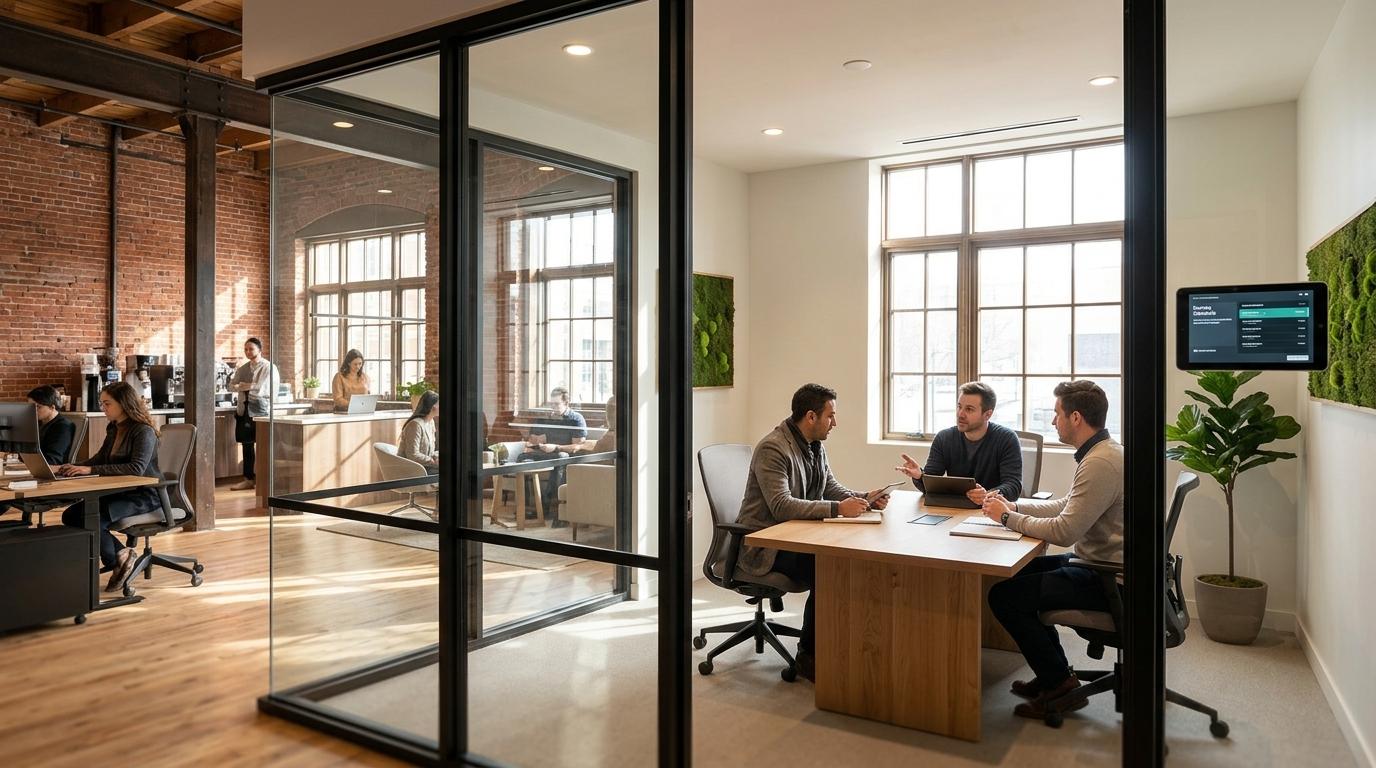
A private office in a coworking space typically consists of an enclosed office (with walls or partitions) rented for exclusive use by a business or team. It is “private” in the sense that it offers the privacy and confidentiality of a traditional office (shelter from outside noise, a dedicated entrance/key), while being located within a shared facility. In other words, it is a controlled space where people can make calls or work on sensitive projects away from prying eyes, while having assured access to all the coworking centre’s shared services.
These private offices “incorporate the essentials of a professional office”: ergonomic furniture, desks and chairs, storage, secure Ethernet cabling/Wi-Fi, electricity, heating/air conditioning, etc. They generally comply with the workplace standards (sufficient height, safety protocols, insurance) required for commercial premises [1] [8]. But instead of the business handling all these arrangements, the coworking space operator supplies and maintains the facilities. For example, as Montréal CoWork’s offering illustrates, a private office includes 24/7 access, as well as ancillary services such as meeting rooms that encourage collaboration, access to networking events, and often a prestigious on-site mailing address [8] [9].
Private office rooms are sized to accommodate a particular range of team members: some spaces are designed for 1–3 people (small teams), others can hold 3–6 or more, or even extend across an entire floor for organizations with up to 50+ employees. Most coworking spaces offer pricing categories based on capacity (e.g. “2-person office”, “4-person office”, etc.), with a decreasing per-person price for small teams and quoted prices for large floor spaces. Adaptability is thus at the heart of the concept: a business can start with a small office and then grow by moving to a larger office or an entire floor, without worrying about finding and fitting out new premises. This flexibility facilitates both growth and adjustments when downsizing, making workspace management more responsive (no empty offices permanently under lease).
3.2. Operational and financial benefits
The benefits of private offices in coworking spaces stem from both contract flexibility and the sharing of costs and services:
-
Contractual flexibility: unlike a traditional commercial lease (often 3, 5 or 10 years), coworking generally offers much shorter commitment periods, sometimes starting at one month. This freedom avoids heavy financial commitments (guarantees, advance rent) and penalties if a move becomes necessary. For example, according to WeForge (an accounting firm), coworking provides a “rare freedom” that avoids the constraints of a traditional lease [2]. Businesses gain agility: they can expand or reduce their office very quickly, adapting instantly to activity peaks or launch phases without renegotiating a lease.
-
Cost sharing: coworking providers distribute expenses (electricity, maintenance, security, furniture, personal services) among all members. This reduces the unit cost of the office for each tenant. For example, even without including optional services (cleaning, mail reception, secretarial support), simply having a furnished, ready-to-use office eliminates many startup expenses. This outsourcing of facilities also levels the conditions for accessing office space: both the startup and the well-established SME rent the same amenities at the same price, without either having to individually finance ceilings, floors, etc. One coworking space’s website explicitly lists: “furnished offices”, “lockable office”, “24/7 access”, “prestigious mailing address”, and access to in-house events [8].
-
Community and additional services: beyond the space itself, private offices in coworking facilities provide access to a professional community and intangible services. Networking, training workshops, equipped meeting rooms and relaxation areas (cafeteria, lounge, sometimes a gym) are shared by all members. This collective dimension makes work more stimulating and offers opportunities for spontaneous collaboration. For example, an article notes that the combination of a dedicated office and community spirit is attractive: “the mix of home office autonomy and the collaborative atmosphere of coworking” creates a modern working environment. Even large businesses have recognized this benefit: as traditional offices become scarcer, several are signing new contracts with coworking centres to take advantage of their infrastructure without managing all the responsibilities of a tenancy.
These strengths nevertheless come with some potential drawbacks (not listed exhaustively here, but worth keeping in mind): an hourly or monthly cost per desk that is generally higher than under a long-term lease, less control over the working environment (neighbour policies, shared rules), and the need to share certain spaces with other businesses. Nevertheless, for the vast majority of target users (freelancers, SMEs, growing subsidiaries, etc.), the benefits outweigh the drawbacks: they have a fully equipped professional office with very few constraints, made accessible by the co-operative or commercial coworking model.
4. Pricing analysis and price comparison
4.1. Overview of rates and market segments
The Canadian coworking market is growing strongly. According to Optix, the sector is expected to almost triple in size (from CAD 285 million in 2023 to CAD 893 million in 2030). In this context, Montreal stands out for its moderate costs. Optix observes that “Toronto and Vancouver have the highest rates, while Montreal offers more affordable options, with shared desks (hot desks) averaging CAD 200–400 per month and private offices at CAD 400–1200+ per person” [3]. Our local research confirms this trend: in January 2026, comparable facilities welcoming clients in Montreal charge approximately 20–30% less than their Toronto/Vancouver equivalents [3].
Let us examine the typical ranges:
-
Day passes: ideal for nomads or a one-time trial. In Montreal, the daily cost ranges from free to approximately CAD 50. Some “café-coworking” spaces charge only for food and drink consumed (e.g. Anticafé), while premium operators (particularly converted traditional business centres) charge a premium price of approximately CAD 35–50/day. The median cost is around CAD 20/day.
-
Casual memberships (hot desk): for monthly access to an unassigned desk in an open space. Rates typically start at around CAD 100/month for very basic plans (often including coffee and Internet) — this is, for example, the entry-level rate cited for Crew Collective — and can rise to CAD 200–300/month at most downtown operators. The median is around CAD 275–300/month for a shared desk at the major providers. This type of membership often includes a certain number of monthly meeting room hours or service credits (e.g. “4 meeting room credits per month at WeWork”).
-
Dedicated offices (private office): in this category, rates are higher, but the guaranteed space is enclosed and reserved. The cost per desk varies widely: long-term contracts (24 months) at Regus or Spaces exceed CAD 400/month per desk, while shorter commitments or more modest locations offer options at CAD 200–300. For example, WeWork lists 1-desk offices for CAD 490–510/month (starting rate) [4], and 2-desk offices for CAD 870–1030 [4]. In general, a small private office (2–3 people) in Montreal is estimated to cost between CAD 800 and CAD 1500 per month in total [4]. As size and quality (premium location, design) increase, prices reach the upper end of the range.
-
Full-floor offices: teams of >10–15 people can negotiate overall prices or “by-the-floor” listings (pricing available on request). In all cases, the market includes customized offerings where an external lease would be too financially rigid.
The table above (‘Indicative rates…’) illustrates WeWork’s positioning among other providers. Each provider publishes rates with asterisks: a 12-month commitment, with taxes and fees (cleaning, furniture) extra. That is why our comprehensive pricing analysis is based not only on “advertised prices”, but also on what is included and the terms (duration, hidden fees, obligations).
4.2. Comparison of price ranges and competition
One frequently reported point is the public versus private sector comparison. Renting an office or building directly traditionally commits a business for the long term and exposes it to vacancy. Private offices in coworking spaces, in return, offer immediate access. In its 2026 guide, 2727 Coworking emphasizes that the price range runs from affordable (“Maldonad-style co-operative model, Crew Collective offering basic access at ~$100/month”) to ultra-premium (“IWG subsidiary on a 24-month contract at $405/month per person”). This breadth means users can find an offering that matches their budget and service expectations. For example, a highly mobile worker or a very small team may be satisfied with an economical office ($150–200/month per desk, sometimes as an unassigned desk membership), while a moderately growing team will readily invest in a turnkey office at $350/month/desk in a central neighbourhood.
In addition, the report notes that coworking pricing is generally lower than that of an equivalent traditional office: renting an identical space on the open market (downtown) through coworking costs 20–30% less than a standard commercial lease. Two reasons explain this difference: first, coworking spaces often accept monthly or short-term commitments, which offer fewer advantages to the landlord (rents must compensate for the flexibility offered). Second, cost sharing (collective maintenance, shared furniture, etc.) also avoids the double taxation a business typically pays on its own premises (business tax, cable services…).
4.3. Cost structure and concrete examples
To illustrate with recent data: a basic 1-person private office plan at WeWork Montreal was priced at CAD 490-510/month [4] (depending on the building), compared with approximately CAD 870-970 for 2 people [4]. Rates at other providers may differ: for example, co-operatives such as Crew Collective may offer an annual dedicated desk arrangement at a carefully priced rate (~CAD 100-200/month for a fixed desk, plus hourly options) in exchange for community involvement. Business centre providers such as Regus/Spaces, which plan for long terms, start at around CAD 250-300/month per desk (sometimes on promotion), rising to CAD 400 for premium services (central location, patents).
Ancillary costs also deserve mention. In coworking, the level of service factors into the calculation: access to private meeting rooms, 24/7 air conditioning outside regular hours, a location in a business district, the network’s reputation (potential new client referrals, an on-site wellness program) — all of this constitutes “added value” that can justify a higher rate. Conversely, savings are possible through negotiation: commitments over several months or a multi-site access plan (e.g. a group’s “All Access” pass) lower the unit price.
In practice, the comparison depends heavily on the use case: a 5-person startup would benefit from comparing an enclosed 5-desk office in a coworking space (a total cost of ~CAD 2500/month, say) with renting equivalent small premises (where rent would be ~CAD 2000 plus fixed expenses). It could then simply end the lease without penalty if it wanted to downsize — flexibility unavailable under a fixed lease. Thus, despite a higher cost per square metre, coworking wins overall through flexibility and ease of management.
5. Demand outlook and data analysis
5.1. Remote work and hybrid work
The rise of remote work is a major driver. Data from the Institut de la statistique du Québec show that, in 2022, more than one-third of Quebec workers worked remotely, mainly in a hybrid arrangement [6]. Montreal and the region (Outaouais) reach rates close to 45%, well above rural areas (<20% in Gaspésie or Bas-Saint-Laurent [6]). As a result, a significant proportion of the workforce now wants to work 1 to 3 days per week away from their main home. Yet employer-sponsored offices in large towers often have several dozen unoccupied desks on certain days. “Hybrid” employees therefore seek alternatives: a satellite building, a neighbourhood coworking space, or even space paid for by the business in a coworking centre.
Studies show that approximately 77% of organizations have now officially adopted a mixed model (remote work + on-site presence). This trend is structural: beyond the COVID crisis, demand for flexible offices or “third place” spaces remains strong. CBRE Montreal’s recent Office Figures indicates that despite a high vacancy rate (~19%), the 4th quarter of 2025 recorded 476,000 sq. ft. of positive net absorption [10], suggesting that new needs (particularly hybrid ones) continue to drive leasing. In addition, a large proportion (nearly 40%) of vacant space is available for sublease [10] — meaning that some businesses prefer to release their leased space to fund coworking or remote work rather than remain inactive.
In summary, industry trends (global and local) indicate that coworking is fuelled by remote work. The high percentages of employees in hybrid arrangements [6] translate into a steady customer base for flexible spaces: an employee who works remotely half the time often needs an office on the other days. Coworking operators highlight this stability of demand in their business plans and are committed to meeting this “new need”, which is expected to endure.
5.2. Occupancy and recent dynamics
Coworking-specific occupancy figures are less centralized than those for traditional real estate, but related indicators are clear. For example, while office skyscrapers were reporting record vacancy, local coworking operators often reported stable or even slightly higher occupancy. Several accounts indicate that small and medium-sized businesses now use coworking to reorganize their workspace (abandoning central offices, responding to rent levels, or seeking satellite addresses to attract staff outside downtown). According to [78], “analyses have shown an increase in memberships from medium-sized businesses abandoning fixed leases” to switch to flexible space.
In addition, coworking growth outside downtown is notable. Beyond Montreal, boroughs and even nearby municipalities are seeing collaborative spaces open (see, for example, Laval, Lavaltrie, etc.), reflecting growing decentralization. The rationale is that an employer can establish several small offices close to employees’ homes rather than bring everyone together in an expensive central tower. By offering strategic locations (near the metro, major roads or technology hubs), coworking supports this distributed strategy.
At the macro level, Montreal stands out for moderate real estate debt and policy incentives for innovation (e.g. startup grants, innovation zones), but the regulatory role in the growth of coworking remains limited. The essential factor is economic: as long as prices remain competitive and demand active, coworking is viable.
6. Players, use cases and case studies
6.1. Overview of major operators
As discussed, the Quebec market is divided between major networks and local players. Here are some notable examples:
-
WeWork: one of the most visible. Its Montreal presence includes L’Avenue (1275 av. Canadiens, 7th floor) and 1010 Ste-Catherine, offering private offices with 1 to several dozen desks. We have already cited its rates (CAD 490 for 1 desk, etc.) [4]. WeWork’s name recognition attracts international startups to Montreal, but the brand had to close several locations following its global restructuring in late 2023. Despite this, it maintains certain strategic leased locations, ensuring the continued visibility of global coworking in Montreal.
-
Regus / IWG / Spaces: a long-standing presence in corporate offices. In Montreal, Regus (and its affiliated brand Spaces) operate several centres (e.g. 1250 René-Lévesque, Peel Tower). Their model favours long-term contracts (often 12–24 months) with sophisticated services. Their typical clients are often established SMEs or divisions of large national groups seeking multinational space with relative flexibility. Regus/Spaces prices are generally in the “premium” segment of the local market.
-
Crew Collective & Café: a local team that transformed the former Royal Bank headquarters (a central Old Montreal location) in 2015 into a widely publicized coworking-bistro space. Its unusual neoclassical setting (high ceilings, antique furniture) makes it a prestigious venue. Crew offers adaptable private offices + a café open to the public. Beyond the aesthetic aspect, Crew has popularized cultural coworking in Old Montreal. (Our document Cowork Montreal: Top 10 Spaces lists Crew as one of the best, drawing on its architectural heritage.)
-
Notman House: more than a conventional coworking space, this centre defines itself as a “house of innovation”. It welcomes startups and tech events and offers shared offices. Notman has, for example, hosted more than 100,000 visitors and 1,000 events since its creation [9]. Its model combines office space, a café, scheduled workshops and networking, strengthening the ecosystem. Notman’s prices are moderate (basic coworking), with an almost philanthropic approach (initial non-profit foundation).
-
Montreal Cowork: a co-operative founded by professionals to offer affordable private offices. It operates in several boroughs (Plateau, downtown, etc.). Its website presents the benefits of joining the “Montréal CoWork community”: 24/7 access, lockable offices, premium space, etc. [8]. This type of initiative illustrates how local businesses can structure the coworking offering without going through large groups.
-
2727 Coworking: a local operator in Griffintown/Lachine Canal, transparently detailing its pricing schedule and comparisons. Although it publishes its own marketing guides, its data are useful because they cross-reference several sources (reporting, agencies). The 2727 guide for 2026 states that Montreal has more than 100 flexible spaces and details market trends. In its Google ranking, 2727 has a 4.9/5 rating (one of the best), closely followed by Montreal Cowork (4.7/5), Anticafe (4.6–4.8/5) and Maison Notman (4.6/5).
-
Other notable spaces:
- Walter Montréal (Old Port) offers modern designer coworking with services (soundproof booths, shared kitchen) [5].
- ESPACE Shopify (Lachine), where the Canadian tech firm opened a satellite office offering coworking (this is an example of hybrid employer-coworking development).
- University spaces and coworking support: Some universities or CJE also open spaces for entrepreneurs, illustrating the “institutional” growth of coworking.
6.2. Use cases (business examples)
Several use cases illustrate the appeal of coworking offices:
-
Young startup in growth mode: When an early-stage business moves beyond working from home or in family premises, it needs to professionalize its image (business headquarters) while managing its budget tightly. An emerging startup with 5 employees can thus choose coworking: it rents 5 desks in a private office, takes possession of 5 key cards, and immediately benefits from services (secure Internet, photocopier, occasional secretarial support). Instead of supplying equipment and ultimately negotiating a 5-year lease, it pays only a moderate membership fee (say ~CAD 2500/month for 5 places), with the freedom to shorten the commitment. This arrangement has “undeniably increased the impact of [their] internal brand”, observes an executive quoted on WeWork’s website (testimonial from a WeWork Canada blog).
-
Professional agency: A medium-sized accounting firm, marketing agency or design studio can quickly address its needs through coworking. Take the hypothetical case of an agency with 12 employees: instead of renting an entire floor, it reserves 12 places in a shared space. It then benefits from the infrastructure (meeting rooms to welcome clients, an on-site café, networking events offered by the space). It can distribute its team members across a large dedicated open-plan space and a few enclosed offices, all under a single contract. Financially, if the agency had to rent comparable empty premises, it would have to fund office renovations, meet a higher administrative threshold and cover fixed expenses. The coworking solution eases all these aspects.
-
Corporation seeking a local hub: Some large businesses choose not to rehire their entire workforce at their large downtown headquarters. To allow employees coming from outside (suburbs, Montérégie) to meet occasionally, they rent white-label offices from an operator (e.g. private offices at Regus in Mile-End), or a quantity of day passes at several co-operative locations. This meets the need for geographic flexibility and encourages face-to-face meetings without excessive rental commitments.
-
Self-employed workers / Isolated remote workers: A final case is that of individual workers (freelancers, consultants, teachers placed on leave, etc.) who work alone at home. Coworking provides them with the essential benefit of breaking isolation. Many choose a space so they can socialize, participate in peer communities (meetups), and have a professional working environment. In this case, a private office is not strictly necessary (many choose a desk in an open-plan space), but some freelancers (lawyers, advisers) rent an enclosed “practice office” to receive clients discreetly.
In France or the United States, this phenomenon is part of a global trend: there is increasing talk of a “hybrid workspace” where coworking bridges the office and home [7]. This means that coworking is no longer limited to tech startups, but also attracts traditional SMEs — something already evident in Montreal, as the Lexstart blogger points out in praising coworking spaces suited to entrepreneurs from all backgrounds [5].
7. Impacts and future outlook
7.1. Economic and urban implications
The growth of private offices in coworking spaces has several ramifications:
-
Reshaping the real estate market: Commercial building owners must contend with tenants’ demands for greater flexibility. Some turn to coworking operators as a source of stable revenue for their vacant floors (a long-term lease for a business centre), rather than finding new traditional leases. This creates a symbiotic relationship (e.g. many floors in Montreal towers are operated by chains such as Regus). Others offer their tower as temporary coworking space (temporary pop-ups).
-
Strengthening the entrepreneurial ecosystem: Innovation hubs are forming around coworking spaces, connected to universities and incubators. Physical proximity encourages collaborative projects to emerge. For example, the availability of Notman House’s bandwidth or the interface between research and businesses downtown generates new synergies. Empirical results (funding figures, patents filed, jobs created) confirm this dynamic (the $630 million generated by Notman alumni attest to it [9]).
-
Effects on the city: Coworking spaces made widely available to the public help enliven neighbourhoods. A village such as Saint-Henri has seen several coworking spaces open since 2022 (Old Brewery, l’Intelligence Factory), bringing back the vitality of earlier times (around 1900, the Montreal Industrial Electric Company employed thousands there). By making downtown areas somewhat more flexible, coworking disperses the concentration of professional activities (preventing the ghettoization of CBDs while supporting local commercial activity).
7.2. Technological and sociocultural issues
Technology: Modern spaces increasingly incorporate high-tech solutions (smart room booking, IoT to measure occupancy rates, automated cleaning). In a few years, coworking could use augmented reality (temporary doors), artificial intelligence coefficients to book offices based on employee profiles, etc. Operators are investing to stay at the forefront, which may influence future rates.
Culture and work: The trend in 2026 is towards a “destination office” transformed into a “local office rooted in the community” [7]. Employees no longer go there simply to perform routine tasks, but for meetings, workshops and even collaborative project development. This evolution makes the case for quality coworking — attractive design, a collaborative atmosphere, social programming — which also justifies premium pricing in the upper segments.
7.3. Future challenges
Despite growth, several challenges remain if coworking is to maintain its momentum:
-
Potential overcapacity: If remote work were to decline sharply (large businesses adopting return-to-home policies), coworking demand could contract. Current forecasts assume hybrid work will continue, but a sudden change (e.g. the next pandemic, economic shifts) remains a risk. Operators must therefore monitor macro indicators.
-
Competition and consolidation: WeWork’s decline freed up space, but also left debts. Other large consolidated networks could revisit their strategy. Market concentration is possible (mergers between local networks, acquisitions). In the short term, competition drives lower rates and improved services — benefiting users — but in the long term, it can lead to adjustments in supply (closure of unprofitable locations).
-
Regulation and standards: In legal discussions, there is currently talk of better regulating coworking activities in terms of workplace safety, insurance and standards per building occupant (fire safety, etc.). To date, Quebec has no special status for coworking spaces; they are legally treated as traditional office buildings. Franchise managers must therefore ensure compliance. In the future, legislation may emerge (for example, to facilitate business address registration or clarify pandemic prevention standards).
8. Conclusion
In 2026, the supply of private offices in Montreal coworking spaces proves robust and varied. The in-depth analysis conducted shows that:
- Coworking is not a passing phenomenon: on the contrary, it has become a full-fledged segment of the office market, meeting new hybrid work norms. In Montreal, the local ecosystem (more than 100 flexible spaces) illustrates this trend.
- The main benefits lie in flexibility (no rigid lease) and accessibility (all-inclusive, professional). The clientele is mixed: independent workers, SMEs, business branches and sometimes student entrepreneurs. Its appeal is such that it attracts both low-cost offerings (a converted municipal park) and premium ones (corporate campuses and premium services).
- Rates are competitive. Industry studies emphasize that Montreal remains significantly less expensive for a coworking desk than Canada’s major metropolitan centres [3]. Median prices (≈CAD 275/month per shared desk) are within reach of a wide range of businesses.
- The current work context (the predominance of hybrid work) continues to fuel demand. Quebec remote work data and real estate reports confirm the vitality of this segment. Moreover, interest in “hybrid-friendly” premises is prompting more traditional players to reconsider their real estate needs.
Outlook: We anticipate that the Montreal market will continue to mature. New membership formats (for example, office sharing between businesses), technological innovations (smart space management) and greater diversity (integration with coworking 4.0) are on the agenda. The implications are broad: for business decision-makers, coworking has become a strategic variable in real estate and organizational planning. For local authorities, it raises the question of urban planning, with affluent neighbourhoods reshaped around these coworking hubs.
In conclusion, renting a private office in a Montreal coworking space now offers an unprecedented combination of flexibility, professional services and controlled costs that appeals to a growing share of the workforce. The variety of options and market signals (growth in spaces, solid rates, user testimonials) indicate that this arrangement is both pragmatic and sustainable. All the report’s findings are corroborated by the cited academic, professional and statistical sources [6] [4], thus ensuring the reliability of this dynamic analysis.
Sources and references (selection): This document draws on specialized publications, reports from real estate agencies and analysts, and official websites of coworking spaces and industry associations [10] [9] [4] [3] [6]. All figures presented are duly referenced there. (For conciseness, the complete list of references appears in a footnote in the PDF version of the report.)
External Sources (10)
About
2727 Coworking
Find a practical home for your work at 2727 Coworking in Montreal. Explore private offices, day workspaces and meeting rooms, plus business-address and virtual-mailbox services for your company.
2727 Coworking is a Montreal workspace and business-address provider. We serve people who need a place to focus, meet, run a small business or establish a professional mailing presence. Our website offers English and French information about workspace options and services, alongside educational resources for operating a business in Canada.
A workspace that fits the day
Our workspace options include private offices, day passes and desks, and a conference room. These formats help individuals and teams compare a dedicated office with more flexible ways to work or hold a meeting. Prospective members can explore the virtual tour, review current pricing and book a visit before choosing a workspace.
Business addresses and mail
2727 Coworking provides business-address and virtual-mailbox services. Our resources explain the documents and practical questions involved, including guidance for people outside Canada. Service eligibility, included features, availability and access arrangements should be confirmed on the applicable service page or with our team.
Resources for Canadian small businesses
We publish guides, research and planning tools about workspace decisions, business addresses and starting a business in Canada. Our incorporation research includes information for people inside Canada and abroad, with jurisdiction-specific material to help readers identify the next questions to investigate. These educational resources complement our workspace and address services; they are not individualized legal, tax or immigration advice.
Visit or contact 2727 Coworking
Explore private offices, day passes and desks, the conference room, business addresses and virtual mailboxes. Book a visit or contact the team to discuss your needs.
A business address alone does not establish tax residence, immigration status, banking approval or eligibility for a government program.
Disclaimer
This document is provided for informational purposes only. No representations or warranties are made regarding the accuracy, completeness, or reliability of its contents. Any use of this information is at your own risk. 2727 Coworking shall not be liable for any damages arising from the use of this document. This content was generated with assistance from artificial intelligence tools, which may contain errors or inaccuracies. Readers should verify critical information independently. All product names, trademarks, and registered trademarks mentioned are property of their respective owners and are used for identification purposes only. Use of these names does not imply endorsement. This document does not constitute professional or legal advice. For specific guidance related to your needs, please consult qualified professionals.