2727 Coworking Article
Coworking for Therapists in Quebec: A Privacy-First Guide
Summary
- 01Choose workspace around the intended work: administration, telepractice, occasional client visits and regular clinical practice require different evidence. A membership name or locking door does not establish suitability.
- 02Map professional authorization, confidentiality duties and the applicable privacy regime before choosing premises or record systems. Law 25 is not a workspace certification.
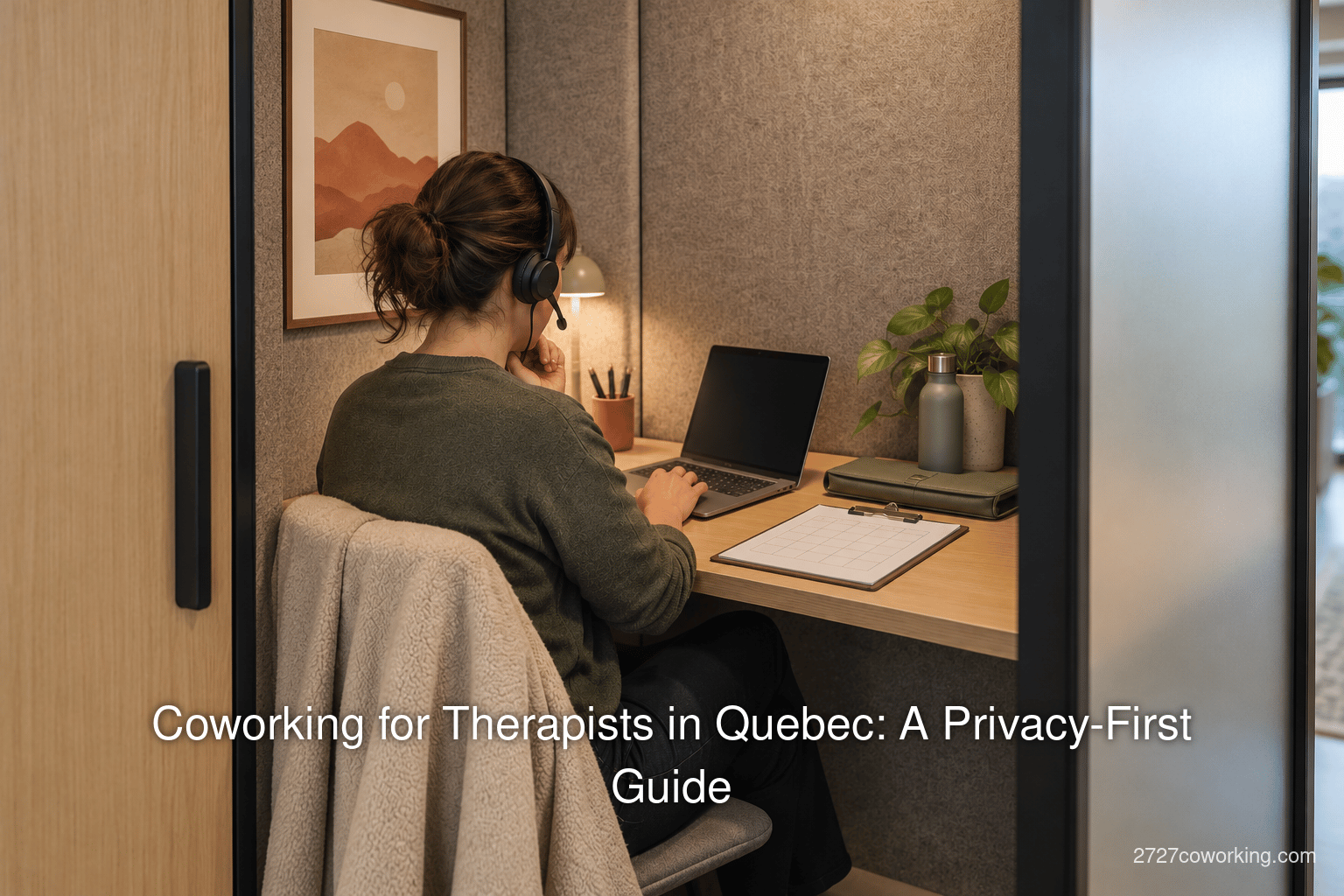
- 03Speech isolation, visual privacy and digital security address separate exposures. Inspect the exact room under intended session conditions; strong network controls cannot compensate for overheard conversations.
- 04Privacy extends through booking, reception, waiting, records, printing and departure. Psychologists generally retain records for at least five years after the last professional service, subject to the institutional exception.
- 05Compare advertised rents by access unit, taxes and commitments, then obtain written permitted-use and insurer answers. Keep unresolved protections visible as conditions before sessions start.
Inside this article
- 01Executive Summary
- 02Introduction and Background
- 03Four Work Patterns and the Go or No-Go Decision
- 04Regulatory Map and Professional Responsibilities
- 05Speech and Digital Privacy
- 06Records and the Client Journey
- 07Safety, Contracts and Insurance
- 08The Confidential Practice Workspace Evidence Matrix
- 09Data Analysis and Evidence
- 10Implications and Future Directions
- 11Frequently Asked Questions (FAQs)
- 12Conclusion
Executive Summary
Coworking for therapists in Quebec is a conditional workspace decision. An open membership may support administrative tasks that expose no confidential information, while telepractice and client visits need substantially more evidence. For psychologists, the professional code applies regardless of setting or contractual relationship. The consultation-room regulation requires that identities and conversations inside cannot be perceived from outside, and it requires a nearby waiting room. Those obligations make a locking door an incomplete answer to the workspace question. [1] [2]
The fastest screening method separates four work patterns: professional-only administration, telepractice without visitors, occasional in-person sessions, and regular clinical practice. For videoconferencing, the Ordre des psychologues du Québec (OPQ) expressly requires a private physical setting that preserves confidential exchanges. Its checklist also calls for a secure, password-protected connection and confirmation of the client's location. Consequently, an enclosed coworking office remains conditional until speech transmission, visual exposure, technology, interruptions and emergency arrangements have been examined. [3] [4] [5]
Privacy obligations extend beyond the session. Psychologists generally must retain records for at least five years after the last professional service, subject to the regulation's institutional exception [6]. The Commission d'accès à l'information (CAI) distinguishes legally defined health-sector organizations from other enterprises; the general privacy laws continue to govern their non-health personal information. The practitioner should establish the applicable regime before selecting record systems, reception arrangements or mail handling. Law 25 is not a workspace certification. [7] [8]
Public prices inspected on October 13, 2026 illustrate different rental models: Healing Tree advertises $20 per hour for one office [9]; Homathérapie advertises $125 monthly for a recurring four-hour weekly block [10]; and 2727 Coworking lists a one-seat office at $700 monthly plus taxes [11]. These are advertised dollar amounts, without an explicit currency code on the cited pages, and they do not establish clinical suitability. Before signing, obtain written permitted-use terms, profession-specific insurer confirmation and an evidence-backed decision on the exact room and schedule. This report provides due diligence, not legal or clinical advice; no professional-order or lawyer review was obtained for this publication. [12]
Introduction and Background
A therapist searching for office rental in Montreal is choosing a system of work, not simply furniture and an address. A consultation involves the room, the route clients take to it, the information visible during arrival, the devices carrying records and the people who can enter when the practitioner is absent. Quebec psychologists' confidentiality duties include not revealing that a client has used, or intends to use, professional services. This makes an exposed appointment list or a publicly announced arrival relevant even when the session itself is behind a closed door. [13]
Coworking here means workspace operated for multiple independent users, with some combination of desks, offices and shared facilities. A clinical shared suite is marketed around practitioner use, but its label is also only a starting point for inspection. For example, Montreal Therapy Centre publishes hourly, half-day and full-day room reservation options. That establishes a booking model; it does not independently establish acoustic performance or suitability for every service. [14]
The word therapist should not obscure professional differences. Psychologists, psychotherapy-permit holders, social workers, physicians and other confidential-service professionals must identify the rules governing their own practice. OPQ provides a directory for checking authorization to practise psychotherapy. An operator's acceptance of a booking cannot substitute for professional authorization, and a colleague's experience cannot establish another profession's obligations. [15]
This guide examines administrative work, confidential teletherapy, occasional visits and regular practice. It excludes treatment recommendations and provider rankings. Its proposed checks are practical synthesis, not a professional standard or a guarantee. The evidence matrix is intended for discussion with the practitioner's order, insurer and legal adviser before use.
The analysis also distinguishes an address service from a place to receive clients. A published mailbox offer describes correspondence handling, whereas consultation-room duties concern the physical setting of professional work. An address arrangement therefore requires its own review and supplies no evidence that a session room is available or suitable. [16] [2]
Four Work Patterns and the Go or No-Go Decision
The useful first question is what will actually happen in the space. A membership used for bookkeeping without client information presents a different decision from an office used for confidential video sessions. CAI's security guidance requires safeguards proportionate to the sensitivity, purpose, quantity, distribution and medium of the information. The screening framework below applies that principle to workspace selection. [17]
Table 1 gives a proposed decision rule for each pattern. These are analytical recommendations; the cited authorities establish the underlying obligations rather than endorsing the table.
| Work pattern | Initial decision | Evidence required before use | Reason to stop or change space |
|---|---|---|---|
| Professional-only administration | Conditional go for tasks exposing no client information | Screen positioning, device controls and a clear separation of confidential tasks | Client calls, identifiable files or sensitive printing would become visible or audible. [18] |
| Telepractice without client visits | Conditional go only in a verified confidential setting | Speech and visual privacy, protected connection, uninterrupted booking and a backup contact method | Adjacent users can follow the conversation, or confidentiality cannot be maintained during a connection failure. [3] [19] |
| Occasional in-person sessions | Conditional go after room and arrival checks | Consultation-room privacy, appropriate waiting arrangements, permitted visits and an emergency procedure | The exact room or client route does not support applicable professional requirements. [2] |
| Regular clinical practice | Choose the premises only after a complete practice review | Repeatable control of all session, record, arrival and access workflows | Necessary protections depend on informal favours or cannot be maintained on the actual schedule. [20] |
The table should be read by workflow rather than by membership name. A dedicated desk can still be exposed. An enclosed room can still transmit intelligible speech. A purpose-built clinical suite can still require changes to technology, records or access arrangements. The decision attaches to the particular use, room and operating conditions.
Administration is not automatically non-confidential. Sending invoices, viewing appointment calendars or reviewing notes can expose personal information even without a session. CAI says collection must be limited to information necessary for purposes established beforehand, and internal access must be restricted to authorized people who need it for their functions. The administrative workflow should therefore specify which tasks may occur at a shared desk and which require a controlled room. [21] [18]
For a practitioner starting slowly, occasional room rental may offer scheduling flexibility. However, the booking unit should leave time to manage arrival and departure privately; this is a planning recommendation, not a prescribed buffer. For regular practice, ask whether the same controls remain available during busy periods, evening appointments and operator absences.
Use three internal decision labels:
- Go: Applicable requirements are identified and supporting evidence is documented.
- Conditional: A specific unresolved item prevents sessions from starting.
- No-go: The proposed workflow cannot presently maintain a required protection.
A conditional label should identify an owner and an action. “Ask about sound” is incomplete; “inspect adjoining rooms and obtain a written acoustic assessment where needed” is reviewable.
Regulatory Map and Professional Responsibilities
Identify the practitioner and the applicable law
Professional secrecy and personal-information protection overlap, but they should be mapped separately. A psychologist's code governs professional conduct across settings. Its informed-consent provisions include confidentiality rules, limits and arrangements for transmitting confidential information. The workspace review should connect those obligations to room access, communication systems and the client's understanding of the service. [22]
Law 25 refers to Quebec's privacy-law modernization. For operational due diligence, use the regulator's current guidance on the applicable statute rather than treating the label as an all-purpose compliance claim. CAI identifies legally defined private professional practices among organizations covered by the health and social services information law. It also explains that general privacy laws continue to apply to non-health personal information held by covered organizations. Neither statement establishes that every self-described therapist or every coworking operator falls within the same category. [7] [8]
Quebec's health-information guidance states that covered information may be used or disclosed with express consent or as authorized by the health-information law. The practitioner must determine whether those provisions govern the records concerned. A coworking agreement should not be relied upon to answer that jurisdictional question. [23]
Translate obligations into ownership
Under CAI's enterprise guidance, the person exercising the highest authority is the default privacy officer, with written delegation possible. The officer's title and contact information must be publicly available on the enterprise's website, or through another appropriate public means if the enterprise has no website. These are enterprise-governance duties, not services automatically supplied by the landlord. [24] [25]
The same guidance identifies privacy impact assessment requirements for relevant information-system or electronic-service projects and for transfers or outsourced handling outside Quebec. Whether a contemplated booking, storage or videoconferencing arrangement triggers an assessment requires review of the actual project and applicable law; the existence of shared Wi-Fi alone does not answer that question. [26]
Create a responsibility map before evaluating premises:
- Practitioner: Identify professional duties and permitted services.
- Practice: Identify its privacy regime, governance and record custody.
- Operator: Explain room access, reception, networks and facility procedures.
- Technology provider: Document storage, access, security and service terms.
- Insurer: Confirm coverage for the described activities and premises.
- Professional adviser: Resolve statutory scope and ambiguous arrangements.
For psychologists, personal professional civil responsibility cannot simply be shifted to an organization. Their code also requires reasonable measures so collaborators and the organization respect professional rules. This supports requesting concrete operating procedures rather than accepting a general contractual promise of confidentiality. [20]
Keep profession-specific rules separate
Social workers' records-and-office regulation also addresses secure storage, consultation-room privacy and a nearby waiting room. These are useful examples of why a shared-office decision should start with the relevant order's rules, not a generic “therapist office” checklist. They should not be extended automatically to every adjacent profession. [27]
OPQ's public authorization guidance and older legal summaries can differ in their descriptions of professional categories. This report therefore directs readers to current authorization verification rather than presenting an unverified exhaustive exemption list. Professional title, permit status and the precise service must be confirmed before the workspace decision. [15]
Do not average strong digital controls against weak speech privacy; they address different exposures.
Speech and Digital Privacy
A closed door is the beginning of the acoustic review
The strongest Quebec psychologist-specific starting point is the consultation-room regulation: identities and conversations inside must not be perceived from outside. The wording concerns the achieved result, not whether the office has been described as private. OPQ's videoconference guidance likewise requires the psychologist's physical setting to preserve confidential exchanges. [2] [3]
Speech isolation means limiting sound transmission between spaces. Sound masking adds background sound; it should not be treated as proof of isolation. This distinction is practical synthesis. The National Research Council of Canada (NRC) explains that transmission combines direct paths through separating assemblies with flanking paths, routes through adjoining construction. A wall specification therefore does not describe the whole room. [28]
NRC also distinguishes testing an isolated building element from assessing insulation between rooms in a completed building, and notes that actual performance varies with construction details and workmanship. A Sound Transmission Class (STC) rating supplied for one product should consequently be examined for its test conditions and relevance to the installed room. This guide assigns no universal STC or decibel threshold for therapy. [29] [30]
Proposed inspection steps include:
- Adjacent spaces: Identify occupied offices, corridors and waiting areas.
- Doors: Examine seals, gaps and the effects of ordinary opening.
- Ventilation: Investigate ducts, grilles and other potential transmission routes.
- Representative conditions: Check during the hours intended for sessions.
- Synthetic speech: Use invented material, never a real client's session.
- Qualified testing: Commission an acoustic professional when inspection leaves uncertainty.
A listening check is a screening exercise, not a certified measurement or professional approval. Repeat the review after relevant changes to room configuration, adjoining use or construction.
For physicians, the Collège des médecins du Québec (CMQ) separately describes soundproof premises and recommends a headset for teleconsultation. Those are physician-specific instructions. As a practical observation, headphones can reduce loudspeaker output but do not contain the practitioner's speaking voice. [31] [32]
Connection quality is different from confidentiality
OPQ's checklist asks psychologist and client to use a secure, password-protected internet connection. “High-speed Wi-Fi” establishes neither the access controls nor the privacy of the devices using it. Request the operator's network description and evaluate it with competent technical support. [4]
The Canadian Centre for Cyber Security explains that encryption protects stored information as well as information in transit. It recommends multi-factor authentication (MFA), preferably using phishing-resistant factors, for virtual private network access. A virtual private network (VPN) protects a connection within its defined architecture; the Centre also cautions that it does not prevent unsafe link-clicking or downloads. These controls complement one another. [33] [34] [35]
The proposed digital checklist is straightforward:
- Devices: Use controlled, updated equipment with restricted access.
- Screens: Position displays away from doors, windows and shared sightlines.
- Accounts: Restrict credentials and evaluate MFA where supported.
- Connections: Avoid assuming a shared network is private because it has a password.
- Storage: Document encryption, backup access and recovery arrangements.
- Sessions: Inspect recording, transcription and screen-sharing settings.
For psychologists, recording an interview or activity in audio or video requires the client's written authorization under their professional code. [36]
CMQ explicitly requires locking unattended screens in its physician-office guidance. This is also a useful general safeguard to discuss with the practitioner's own order. A private connection cannot compensate for an exposed screen or an overheard conversation. [37]
- Assess sound transmission through the whole room, including adjoining construction.
- Review an STC product rating against its test conditions and relevance to the installed room.
- Use invented speech for screening and qualified acoustic testing when inspection leaves uncertainty.
- OPQ asks psychologist and client to use a secure, password-protected internet connection.
- Document encryption, backup access and recovery arrangements for stored information.
- Inspect recording, transcription and screen-sharing settings before sessions.
A listening check is a screening exercise. The guide assigns no universal STC or decibel threshold for therapy. A private connection cannot compensate for an exposed screen or an overheard conversation.
Records and the Client Journey
Storage, printing and disposal form one workflow
For psychologists, records generally must be retained for at least five years after the last professional service, with the regulation's institutional exception. Paper records must be kept in secured furniture inaccessible to the public. Renting a room occasionally does not itself create a safe place to leave files between bookings. [6]
Social workers have a separately sourced five-year minimum, also with an institutional exception. Their order's private-practice guidance connects destruction to the applicable regulatory retention period. Practitioners should verify additional requirements and preservation needs before applying a disposal schedule; the two professions' examples are not a universal rule for therapists. [38] [39]
The Office of the Privacy Commissioner of Canada (OPC) identifies locked cabinets and restricted office access as physical safeguards. Its federal guidance is useful technical context, but does not establish that federal private-sector privacy law governs every Quebec practice. CAI remains the relevant source used here for Quebec enterprise guidance. [40] [17]
Proposed record-handling checks are:
- Custody: Identify who controls originals, copies and backups.
- Keys: Identify everyone able to open the room or storage.
- Transport: Plan movement between the practice and rented premises.
- Printing: Inspect job release, collection, queues and retained data.
- Disposal: Use a documented confidential-destruction process.
- Departure: Define record retrieval and access when the rental ends.
OPC specifically identifies copier and printer hard drives as possible storage media and recommends accounting for associated copies and backups during disposal. A shared printer therefore deserves review even if paper is collected immediately. Where the workflow cannot be documented, avoiding confidential printing at the site is a defensible interim recommendation. [41] [42]
CAI says outsourcing storage does not remove the enterprise's confidentiality obligations. Ask who handles mail scanning, technical support and archived documents, and what authorization and access restrictions apply. These are recommended contractual inquiries, not evidence that a particular provider's service is appropriate for clinical records. [43]
Protect identity before the appointment starts
Protecting client identity should shape client arrival. The consultation-room regulation also requires a nearby waiting room. A general lounge should be evaluated against that requirement and the client's actual route; calling it a waiting area does not establish adequacy. [44]
Proposed arrival checks include:
- Booking: Avoid unnecessary clinical detail in operator-facing systems.
- Reception: Agree on a discreet identification and notification method.
- Waiting: Prevent clients from needing to explain their visit publicly.
- Movement: Inspect sightlines, signs, shared doors and appointment overlap.
- Departure: Consider payment, scheduling and conversations in common areas.
- Cameras: Ask what areas are covered and who can access footage.
CAI states that necessity takes precedence over consent, and that consent for sensitive information must be express. A client agreeing to treatment should not be treated as blanket justification for collecting extra information through the building's booking or visitor systems. The relevant purpose, necessity and authority need their own assessment. [45] [46]
Accessibility requires evidence along the whole route. Inspect the entrance, thresholds, lifts where needed, consultation space, waiting arrangement and washroom, and discuss communication or other accommodation needs. CDPDJ explains service providers' obligation to seek reasonable accommodation, subject to undue hardship. RBQ's building guide describes minimum accessibility requirements, but its cited edition does not determine the rules applicable to every existing building. Confirm the site-specific requirements rather than relying on “accessible” advertising. [47] [48] [49]
- 01Booking
Avoid unnecessary clinical detail in operator-facing systems.
- 02Reception
Agree on a discreet identification and notification method.
- 03Waiting
Prevent clients from needing to explain their visit publicly.
- 04Movement
Inspect sightlines, signs, shared doors and appointment overlap.
- 05Departure
Consider payment, scheduling and conversations in common areas.
Safety, Contracts and Insurance
Plan for interruption and emergency access
OPQ's telepsychology checklist calls for confirmation of the client's location and a reachable telephone number. Its videoconference guidance recommends an alternative contact method when technology fails. The workspace plan should describe how the practitioner maintains a confidential connection or ends and reschedules the encounter when privacy cannot be restored. [5] [19]
The American Psychological Association (APA) informed-consent checklist, linked by OPQ, recommends a crisis plan with an emergency contact and the emergency room closest to the client. This is guidance to adapt to the service and jurisdiction, not a substitute for Quebec professional judgment. Nursing guidance from OIIQ separately requires anticipating clinical and technical emergencies, illustrating the need to check the relevant profession's instructions. [50] [51]
For the practitioner working alone after hours, the Canadian Centre for Occupational Health and Safety (CCOHS) recommends check-in arrangements covering both normal and outside-core hours, plus a plan for missed check-ins. These workplace recommendations complement the client-specific plan rather than replacing it. [52] [53]
Proposed contingency questions include:
- Location: Can the practitioner identify the exact room to responders?
- Access: Who can admit assistance when reception is closed?
- Contact: What happens if the client cannot be reached after disconnection?
- Interruption: What happens if someone enters during a session?
- Backup: Is an appropriate alternative available, or must the session stop?
- Absence: Who receives messages and communicates urgent arrangements?
For psychologists, an absence exceeding five consecutive working days triggers a specific duty to inform clients trying to reach them about its duration and the emergency procedure. Include that duty in the practice plan where applicable. [54]
Obtain permission for the described activity
Montréal advises verifying whether an activity is permitted before renting premises. Its occupancy-permit guidance connects the permit with both the establishment and operator, and requirements vary by borough and use. Confirm the intended activity with the relevant municipal service; an existing coworking operation does not resolve every proposed clinical use. [55] [56]
Request written answers about permitted professional activities, visitor frequency, booking control, after-hours access, cleaning, keyholders, storage, signage and interruption procedures. Published Regus global terms illustrate why reading the actual contract matters: they address office-business use and visits from the public, and reserve provider access for purposes including cleaning and inspection. Their application to a specific Quebec agreement was not established here; they are a contractual example, not a finding about local availability. [57] [58]
Confirm the policy rather than a general insurance label
BMS's psychology insurance page describes telepsychology coverage subject to scope of practice and applicable professional rules where practitioner and patient are located. It also states that full exclusions and limitations belong to the policy wording. Readers should obtain a written determination for their own policy, activities, room and visitor arrangements. [59] [12]
Professional liability and premises-related coverage should be reviewed separately. BMS lists additional business insurance products; CNPS guidance for nursing businesses explains separate business protection and describes general-liability coverage for commercial operations or premises. Those sources do not establish mandatory coverage for every therapist. They identify questions to put to the actual insurer. [60] [61] [62]
The Confidential Practice Workspace Evidence Matrix
- 01Identify authorization and duties
Confirm the practitioner's authorization and applicable obligations before evaluating workspace.
- 02Describe the intended work
Give the operator a description of the intended work, visitor schedule, record handling and emergency needs.
- 03Inspect the exact room
Inspect speech transmission, screens, interruptions and backup arrangements before confidential sessions.
- 04Document records and arrival
Document record and arrival arrangements for the intended workflows.
- 05Obtain written confirmations
Obtain written contract and insurance answers for the proposed practice.
Go: Applicable requirements are identified and supporting evidence is documented.
Conditional: An unresolved item prevents sessions from starting. No-go: The workflow cannot presently maintain a required protection.
The proposed evidence matrix converts a tour into a reviewable record. Print it, identify the exact room and intended schedule, and attach documents or observations to each row. A blank row means evidence is outstanding; a provider's promise should be recorded as a claim pending confirmation.
Table 2 sets out the proposed matrix. Check means the row must be assessed for that workflow; conditional means it becomes relevant when that activity or exposure exists. Neither label indicates professional approval.
| Control | Evidence to inspect | Authority or source | Admin | Telepractice | Occasional client | Regular client | Professional confirmation |
|---|---|---|---|---|---|---|---|
| Speech isolation | Actual room, adjacent uses, doors and relevant acoustic assessment | Psychologist room duty; NRC transmission paths. [2] [28] | Conditional | Check | Check | Check | Order; qualified acoustician where needed |
| Visual privacy | Screens, glazing, doorway sightlines and waiting visibility | Confidentiality and screen guidance. [37] | Check | Check | Check | Check | Applicable order |
| Network | Connection controls, device security and encryption | OPQ network checklist; Cyber Centre. [4] [33] | Conditional | Check | Conditional | Conditional | Technical adviser and order |
| Records | Custody, secured storage, retention and recovery | Psychologist records regulation. [63] | Conditional | Check | Check | Check | Record custodian and order |
| Printing and disposal | Release, queues, retained data and destruction | OPC disposal guidance. [41] | Conditional | Conditional | Conditional | Conditional | Privacy officer |
| Access logs | Available logs, keyholders, retention and authorized review | CAI need-to-know access principle. [18] | Conditional | Check | Check | Check | Privacy officer; logs are a proposed control |
| Client arrival | Booking, reception script, waiting and departure | Psychologist waiting-room duty and CAI necessity principle. [45] [44] | No visits | No visits | Check | Check | Applicable order |
| Accessibility | Complete route and individual accommodation needs | CDPDJ; building-specific code review. [47] | Check | Check | Check | Check | Access specialist; adviser where needed |
| Emergency procedure | Location, contacts, responder entry and disconnection plan | OPQ and workplace guidance. [5] [53] | Check | Check | Check | Check | Practitioner and applicable order |
| Cleaning and third-party access | Entry timing, confidentiality arrangements and storage control | CAI continuing responsibility for outsourced storage. [43] | Check | Check | Check | Check | Privacy officer and operator |
| Contract permission | Intended services, visitors, address use and occupancy review | Municipal guidance and actual agreement. [55] | Check | Check | Check | Check | Operator, insurer and legal adviser |
The authority column identifies the basis for a review, while the proposed evidence may go beyond a source's explicit wording. For example, an access log is a possible control, not a universal requirement established by these sources. Likewise, a technical sign-off does not settle professional or statutory compliance.
Record the outcome as acceptable, action required, or not acceptable for this workflow, with the evidence date, reviewer and remaining action. Keep unresolved items visible. Do not average strong digital controls against weak speech privacy; they address different exposures.
A clinical suite becomes a useful alternative to investigate when ordinary workspace cannot support repeatable privacy, appropriate arrival or necessary storage. A conventional lease may provide more direct control, but also requires the practitioner to establish those arrangements. The matrix applies to both: neither rental category receives an automatic pass.
The defensible choice is the arrangement whose necessary protections can be demonstrated and sustained.
Data Analysis and Evidence
Compare billing models before comparing costs
Public prices were inspected on October 13, 2026. The following table is a small advertised-offer sample, not a representative market survey or provider ranking. None of the cited price pages explicitly labels its dollar currency with a currency code. Amounts are therefore reproduced as published; confirm currency, taxes, availability and the signed terms before budgeting.
Table 3 compares the access units and the outstanding evidence. It includes the publishing brand because it directly offers a comparable office category.
| Provider and advertised model | Published price and access unit | Tax or commitment information | What remains to verify for confidential practice |
|---|---|---|---|
| 2727 Coworking, general private office | One-seat office listed at $700/month [11] | Taxes extra; homepage describes month-to-month terms and notice | Clinical use permission, actual speech isolation, arrival, storage and emergency access. [64] |
| Healing Tree, Kirkland practitioner office | Office 1: $20/hour; recurring four-hour weekly block from $241/month [9] [65] | GST/QST extra; recurring schedules described as annual leases | Exact room availability, applicable service permission and evidence for each workflow. |
| Homathérapie, therapeutic-room blocks | Four hours weekly: $125/month; eight hours weekly: $225/month [10] [66] | $100 one-time registration; block taxes not stated. The rental contract includes the conditions and rates. | Eligibility, signed contract, room configuration, confidential use and total charges. [67] |
| Mouvement Humain, treatment-room rental | $40/90 minutes, $75/half-day, $100/day [68] | Taxes extra; recurring monthly prices discussed individually | Intended room, actual time windows and suitability for the practitioner's services. |
| Montreal Therapy Centre, therapy-room rental | Hourly, half-day and full-day options; price on inquiry | Tax status and commitment not published on the fetched page | Written current quote, availability and room-specific controls. [14] [69] |
The units prevent a meaningful lowest-price ranking. A weekly block billed monthly is not unlimited access, and an advertised day should not be converted into an assumed standard working day. Registration, annual commitment, taxes, record storage and scheduling constraints may change the decision.
The 2727 virtual tour describes furnished private offices. That is first-party evidence of an office offering, not clinical approval. The homepage describes furnished offices with locking doors and 24/7 access. This comparison uses its specific one-seat listing; obtain a current quote before budgeting. No site was independently tested in this research. [70] [11]
Quantified requirements are more useful than an invented acoustic score
The psychologist retention minimum and the separately verified social-worker minimum are both five years after the last professional service, with their respective institutional exceptions. These periods show why record continuity can outlast a room booking or rental arrangement. The practice needs a custody and exit plan, not merely storage during the appointment. [6] [38]
Acoustic evidence has a different limitation. NRC distinguishes isolated-element tests from completed-building room tests and identifies direct and flanking transmission. The sources reviewed do not establish a universal numerical threshold for Quebec therapy rooms. Assigning one would give false precision to a profession- and room-specific judgment. [29] [28]
The research therefore reports advertised prices and verified regulatory periods, while withholding unsupported suitability scores. It supplies no estimated number of qualified rooms, average Montreal therapy-office price or measured coworking demand. Those findings would require defined samples and evidence beyond the fetched pages. The decision matrix is a due-diligence method, not a validated prediction model.
Implications and Future Directions
The immediate implication is that workspace purchasing should become evidence-led procurement. A prospective renter can supply the operator with a plain description of the intended work, visitor schedule, record handling and emergency needs. The operator can then answer against the actual room and agreement, rather than the ambiguous phrase “private office.”
The strongest opportunities for general coworking may be administrative tasks without exposed client information, or telepractice in a setting that can maintain physical and digital confidentiality. This is an analytical possibility, not a tested finding about any listed site. OPQ's physical-space requirement remains central even when clients never enter the building. [3]
Regular client visits add repeatable arrival, waiting, room-control and access demands. Clinicians should compare purpose-built suites and conventional premises alongside coworking using the complete evidence matrix. A general office may be workable after review; a clinical label may still leave important evidence missing.
Remote services also require attention to jurisdiction. OPQ explains that many jurisdictions associate remote psychological services with the client's location, requiring local authorization, and that a psychologist physically outside Quebec must check that location's rules too. A Montreal address or office membership cannot resolve those authorization questions. [71] [72]
A future evidence base would benefit from room-specific acoustic assessments, documented access procedures and clear professional-use clauses. Providers could publish their booking and operational facts without claiming blanket clinical compliance. Practitioners could preserve dated assessments and revisit them when adjoining occupants, technology, room layout or access arrangements change.
Professional review is a remaining limitation. No order, insurer or lawyer approved this report, and no provider's therapy suitability was independently tested. Readers should obtain those determinations for their own proposed practice. The recommendations are deliberately framed so unresolved items remain visible rather than disappearing behind a membership label.
Frequently Asked Questions (FAQs)
Can therapists use coworking spaces in Quebec?
Potentially, after profession-specific and workflow-specific review. Psychologists' consultation rooms must protect identities and conversations from outside perception. The term coworking supplies no exemption or approval. [2]
Is a private coworking office enough for confidential teletherapy?
A door alone does not establish suitability. OPQ requires a private physical setting and a secure connection. Inspect speech transmission, screens, interruptions and backup arrangements before starting confidential sessions. [3] [4]
Does Law 25 require a particular office type?
The cited regulator guidance establishes privacy responsibilities and legal scope, not a coworking certification. Determine the applicable regime and the information involved before selecting controls. [7] [24]
Can a virtual office serve a Quebec therapist?
It may provide address or correspondence services under its agreement. That does not establish consultation space, professional authorization or secure clinical-record handling. Review permitted address use, mail access and scanning separately; published workspace terms can impose written-consent conditions. [73]
When should a practitioner choose a clinical suite?
Investigate one when required room privacy, client arrival, storage or operational control cannot be demonstrated elsewhere. Apply the same evidence matrix to the clinical suite, and obtain profession-specific confirmation rather than relying on its name. [2]
Conclusion
The workspace decision should follow the work. Administrative tasks, telepractice and in-person sessions create different exposures and require different evidence. An open membership, an enclosed office, a clinical shared suite and a conventional lease are therefore options to investigate, not categories that deserve automatic approval or rejection.
The practical sequence is to identify the practitioner's authorization and applicable obligations, describe the intended workflows, inspect the exact room, document record and arrival arrangements, and obtain written contract and insurance answers. The evidence matrix makes that sequence concrete. It also allows a practitioner to narrow an initial plan to administrative work while unresolved session requirements are addressed.
A locking door, fast internet or a therapeutic-room label can contribute useful information. None completes the assessment. Speech and visual privacy, access, records, accessibility, client arrival and emergency arrangements must work together on the intended schedule.
Published rental prices help frame a budget only after their access units and commitments are understood. The defensible choice is the arrangement whose necessary protections can be demonstrated and sustained. Where evidence remains incomplete, the appropriate outcome is a documented condition or a different workspace. This guide supports that due diligence; the final practice decision belongs with the practitioner and their professional, insurance and legal advisers.
External Sources (73)
About
2727 Coworking
Find a practical home for your work at 2727 Coworking in Montreal. Explore private offices, day workspaces and meeting rooms, plus business-address and virtual-mailbox services for your company.
2727 Coworking is a Montreal workspace and business-address provider. We serve people who need a place to focus, meet, run a small business or establish a professional mailing presence. Our website offers English and French information about workspace options and services, alongside educational resources for operating a business in Canada.
A workspace that fits the day
Our workspace options include private offices, day passes and desks, and a conference room. These formats help individuals and teams compare a dedicated office with more flexible ways to work or hold a meeting. Prospective members can explore the virtual tour, review current pricing and book a visit before choosing a workspace.
Business addresses and mail
2727 Coworking provides business-address and virtual-mailbox services. Our resources explain the documents and practical questions involved, including guidance for people outside Canada. Service eligibility, included features, availability and access arrangements should be confirmed on the applicable service page or with our team.
Resources for Canadian small businesses
We publish guides, research and planning tools about workspace decisions, business addresses and starting a business in Canada. Our incorporation research includes information for people inside Canada and abroad, with jurisdiction-specific material to help readers identify the next questions to investigate. These educational resources complement our workspace and address services; they are not individualized legal, tax or immigration advice.
Visit or contact 2727 Coworking
Explore private offices, day passes and desks, the conference room, business addresses and virtual mailboxes. Book a visit or contact the team to discuss your needs.
A business address alone does not establish tax residence, immigration status, banking approval or eligibility for a government program.
Disclaimer
This document is provided for informational purposes only. No representations or warranties are made regarding the accuracy, completeness, or reliability of its contents. Any use of this information is at your own risk. 2727 Coworking shall not be liable for any damages arising from the use of this document. This content was generated with assistance from artificial intelligence tools, which may contain errors or inaccuracies. Readers should verify critical information independently. All product names, trademarks, and registered trademarks mentioned are property of their respective owners and are used for identification purposes only. Use of these names does not imply endorsement. This document does not constitute professional or legal advice. For specific guidance related to your needs, please consult qualified professionals.