2727 Coworking Article
Tour de l’Île de Montréal 2026: Routes and History
Inside this article
Executive summary
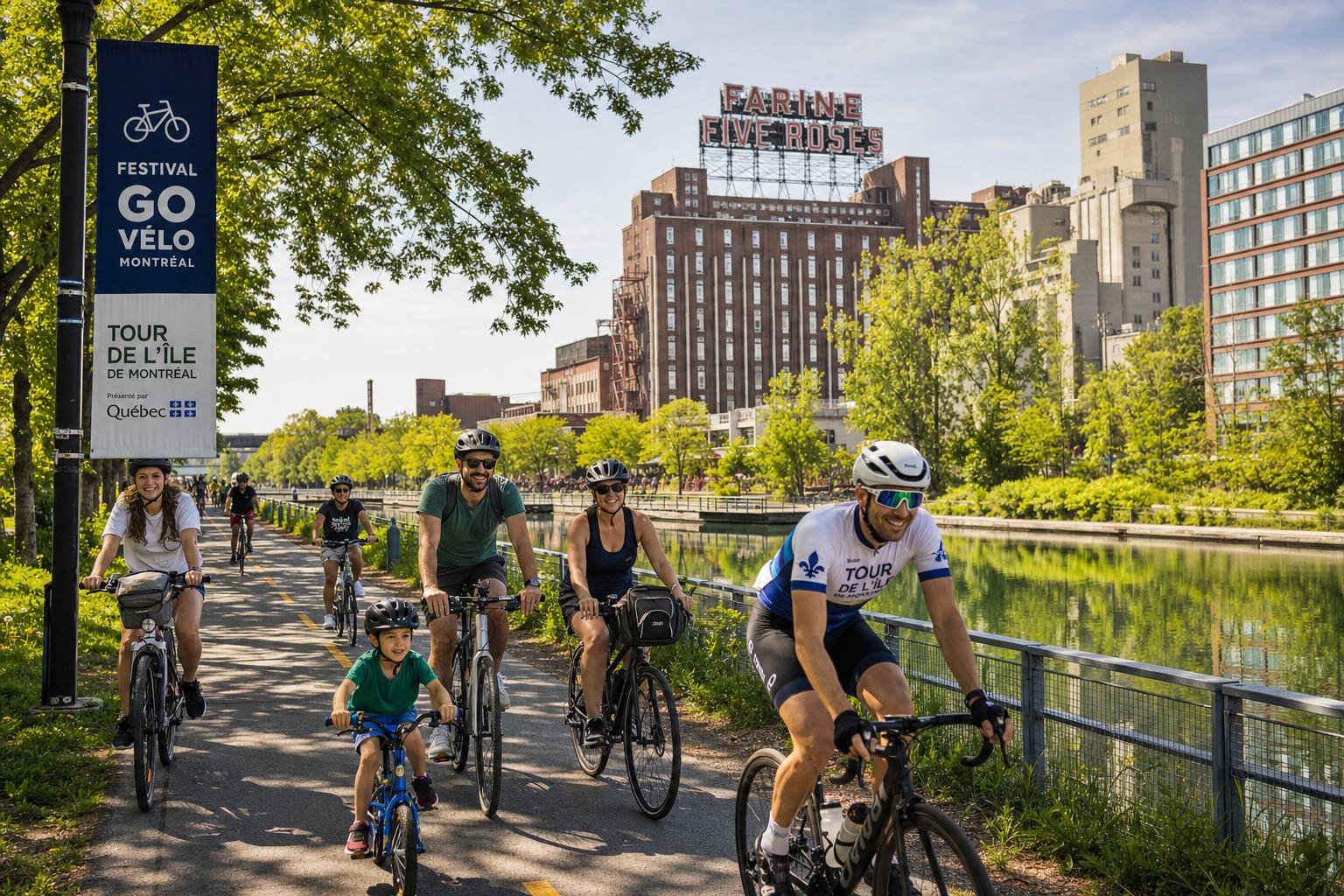
The Tour de l’Île de Montréal 2026 is a major cycling event in Montréal, organized by Vélo Québec as part of the Festival Go vélo Montréal. In 2026, it will take place from May 24 to 31 and celebrate the 50th anniversary of the 1976 Olympic Games [1]. This edition will offer two options: a regular route of 30–50 km (family-friendly, on closed roads) and a Discovery route of 65–90 km (longer, for road cyclists) [1]. Around 18,000 participants were expected in 2024 [2], a figure that has remained steady for several years, making the Tour de l’Île the city’s largest annual cycling gathering. Cyclists ride through prominent neighbourhoods (Villeray, Parc-Extension, Plateau, Ville-Marie, Sud-Ouest, Westmount, etc.) while enjoying “entertainment, festive rest stops, food trucks, a music stage, the mascot Calcium and complimentary chocolate milk” [1].
The event’s history dates back to 1985: the first edition (prompted by Minister of Transport Guy Tardif to inaugurate new bike paths) brought together 3,500 cyclists (out of 7,000 registrants) in the rain [3] [4]. Since then, every year, “since 1985, thousands of cyclists have celebrated the great cycling festival by taking part in the Tour de l’Île. For a few hours, cars give way to bicycles” [3] [4]. Montréal, now “among the world’s best cycling cities” [3], continues to expand its network (10 83 km of bikeways, with the Réseau express vélo (REV, express bike network) as its backbone [5]) to support this type of event.
In addition to this general overview, this report details every aspect of the Tour de l’Île 2026: the themed route (passing through four iconic Olympic sites, with an Olympic booth at the finish) [1], key dates and registration fees (lower pricing tiers for earlier registration, with free admission for children and discounts on multi-event packages) [1], and a special focus on Griffintown, the neighbourhood highlighted in this guide for cyclists (existing cycling infrastructure, BIXI stations and navigation tips) [6]. We also analyse participation data and concrete examples (the 2024 route, COVID measures, etc.), and discuss future implications (the impact on urban mobility, synergies with the 2026 UCI World Championships, etc.). All claims below are supported by official and academic sources [1] [2] [6] [4].
Introduction and historical context
The Tour de l’Île, established in 1985, is part of Montréal’s cycling revival. At the end of the 19th century, cycling reached a peak in popularity in Montréal, but its use subsequently declined. It was only in the 1970s, amid soaring gasoline prices and the rise of the environmental movement, that “the idea of getting around the city by bicycle began to gain ground” [3]. Cycling activists then began working to create a structured cycling network and promote cycling (prioritizing bike paths and safe infrastructure) [3]. In this context, Vélo Québec – driven by a desire to “rekindle people’s enthusiasm for cycling” and demonstrate the popularity of bicycles to public authorities [4] [3] – envisioned a large-scale event. Inspired by New York’s Five Boro Bike Tour (created in 1977), the project took shape in August 1985 when Minister Guy Tardif asked Vélo Québec to inaugurate the new bike paths in eastern Montréal [3] [4].
The 1st edition of the Tour de l’Île finally took place on October 13, 1985, in difficult conditions (8°C, heavy rain) [4]. Of the 7,000 registrants, ~3,500 brave cyclists showed up at the Olympic Stadium. They rode 60 km on roads that, until then, had rarely been suitable for cycling, finishing at the Montréal Velodrome (Olympic Park), where local public figures welcomed them [4]. This successful trial confirmed the event’s potential. Since then, the event has taken place annually: “every year, since 1985, thousands of cyclists have celebrated the great cycling festival by taking part in the Tour de l’Île” [3]. Cars thus give way to bicycles for several hours, allowing residents to discover the city “in a different way”, on streets completely closed to traffic [1] [3].
Over the decades, the Tour de l’Île has helped make Montréal a leading cycling city. Signage and infrastructure have expanded: in 2024, the city recorded more than 1,083 km of bikeways across the urban agglomeration [5]. The Réseau express vélo (REV), launched in the 2010s, is a brand-new cycling artery (accessible 12 months a year) that complements neighbourhood bike paths [5]. These advances reflect a political commitment, fuelled by cycling activism, to turn such festive competitions into drivers of urban change.
The Tour de l’Île de Montréal 2026: organization and routes
Dates and general format
The 2026 edition of the Tour de l’Île will take place from May 24 to 31, 2026 [1]. This week-long window covers registration, the mailing of materials (guides, bibs, etc.) and the main event (probably on Sunday, May 31). The official website explains that, during this period, you can “look up, ride along streets closed to traffic, and pass through iconic neighbourhoods such as Villeray–Saint-Michel–Parc-Extension, Rosemont–La Petite-Patrie, Le Plateau-Mont-Royal, Ville-Marie, Sud-Ouest, Westmount and more” [1]. In other words, cyclists move freely through the city as though it were one giant bike path. The event thus attracts thousands of cyclists: for example, media coverage in 2024 noted that “around 18,000 people took part in this year’s edition” [2], a number organizers consider steady and encouraging [2].
Two distinct routes are offered to accommodate cyclists with different profiles [1]. The regular route (30–50 km) is designed for families and occasional urban cyclists – riding city bikes – who want to enjoy a moderate route through the city. The Discovery route (65–90 km) is intended for more experienced road cycling enthusiasts seeking an additional challenge. These participants start earlier in the morning “on a marked course” to extend their ride before “joining the regular Tour de l’Île route… alongside thousands of other cyclists on closed streets” [1]. In practice, the first kilometres of the Discovery option follow specific bike paths (often away from traffic), before cyclists join the family route for the final leg.
Table – Route options (Tour de l’Île 2026):
| Option | Distance (km) | Intended cyclists | Key features |
|---|---|---|---|
| Regular | 30–50 | Families, city bikes | Route for “all ages and abilities” on closed streets, suitable for beginners |
| Discovery | 65–90 | Road cyclists | Earlier start, extended route, then joins the regular route |
These two options allow everyone to “experience Montréal in a different way: the streets belong to cyclists for a day” [1]. The theme chosen for 2026 is Olympic: the route passes through four iconic Olympic sites in Montréal in remembrance of the 1976 Games, and a themed booth is set up at the finish site [1]. In summary, the 2026 route combines sporting spectacle and heritage: it starts at the Mount Royal lookout (Jeanne-Mance Park) – as in the 2024 edition – and will notably follow the Lachine Canal and pass through Olympic Park and the Stade inter… [2] [1]. Amateur cyclists thus have the honour of “discovering the city on car-free streets” and reliving the local Olympic magic [1].
Fees and registration procedures
Individual registration takes place online through the Vélo Québec website. The cost varies by age and registration date: there are five pricing periods from November 10, 2025, to May 31, 2026. The basic adult fee starts at a promotional price of $35 (Nov. 2025 – early Jan. 2026) and rises in stages to a last-minute price of $56 (May 19–31, 2026) [1]. Teenagers (aged 13–17) pay only $9.90 throughout [1], and registration is free for children under 12 [1]. A summary table below outlines these promotional fees:
| Category | Christmas promotion (Nov. 11, 2025 – Jan. 5, 2026) | Launch (Jan. 6 – Feb. 9, 2026) | Early booking (Feb. 10 – March 30, 2026) | Regular fee (March 31 – May 18, 2026) | Last minute (May 19–31, 2026) |
|---|---|---|---|---|---|
| Ages 13–17 | $9.90 | $9.90 | $9.90 | $9.90 | $9.90 |
| Adult (aged 18 and +) | $35 | $37 | $40 | $46 | $56 |
| Vélo Québec member | $30 | $33 | $35 | $40 | $46 |
All prices are before taxes [1]. Vélo Québec members receive a reduced fee at each stage (e.g. $30 during the promotion instead of $35). The website also offers registration “combos”: a 15% discount applies to participation in two festival events (among Défi Métropolitain, Tour la Nuit and Tour de l’Île), and 20% if you register for three events [1]. The aim is to encourage regular cycling as part of the “holiday destination” that Montréal’s cycling festival represents [1].
After registering, cyclists receive their bib and participant package by mail (or pick them up on site). The website provides a mailing schedule linked to registration dates [1]: for example, materials for all registrations completed before April 7 are mailed together on April 16 (to Canadian and international destinations) [1]. Allow 5 business days for delivery [1]. Very late registrants (after the final mailing) can pick up their materials directly at the Maison des cyclistes (until the day before the event) or at the starting sites on the morning of the event [1].
Logistics and entertainment
In 2026, as in previous years, significant measures are being taken to keep the route safe: the streets used will be completely closed to automobile and motorized bicycle traffic during the event [1]. Large numbers of patrols, volunteers and medical teams are deployed. Along the route, entertainment areas and refreshment stations are set up, featuring autumn villages, live music and mascots (including “Calcium”, a symbol of milk, often a courtyard drink). The official website promotes: “Enjoy entertainment, festive rest stops, food trucks, a music stage, the mascot Calcium and complimentary chocolate milk.” [1] These festivities turn the ride into a true community celebration. For example, in 2024, the first participants were welcomed by Jean-François Rheault (President and CEO of Vélo Québec), highlighting the friendly atmosphere even under a blazing sun [2].
A striking anecdote: during the 39th Tour (2024), a cyclist joked in interviews that “the roads are clear… but the potholes are there, it’s OK” [2], illustrating the good-natured spirit despite the city’s minor flaws. This festive atmosphere that brings people together is one of the event’s hallmarks: families and cyclists of all ages take part, some on their first organized ride, others coming from elsewhere to discover Montréal by bicycle [2].
Detailed route and concrete examples
To understand the route’s profile, we can examine a recent edition (June 2024). The start was at Jeanne-Mance Park (Mount Royal) around 9:15 a.m., followed by two consecutive loops (a short option of ≃28–30 km or a long option of 50 km). Media reports described this illustrative route: it passed successively through Outremont and Côte-des-Neiges–Notre-Dame-de-Grâce (NDG), followed the Lachine Canal to Parc René-Lévesque, crossed boulevard LaSalle, then returned downtown via rue Wellington in Verdun and headed back up towards the Plateau [2]. This urban loop therefore followed major residential arteries (avenue du Parc, chemin de la Côte-des-Neiges, etc.) and then the Lachine Canal bikeway (the Atwater–Des Seigneurs path) [6]. This last section along the canal offers cyclists one of Montréal’s most beautiful panoramas, from the Old Port’s wharves to Lachine, where several BIXI stations make it easier to rent a bike or take a break [6].
Meanwhile, the long route (65+ km) had an earlier start on an additional circuit before joining this loop. The idea is to add a “warm-up” section (which may be away from traffic) to increase the final distance. Organizers generally share both routes in advance: road cyclists have, for example, symbolically used the new Réveille-Matin paths in the east, joining Toulouse and the P’tit train du Nord greenway on foot. In 2026, the Discovery route will probably extend the ride along paths such as the Rev Express Vélo Est or other car-free routes that can easily connect to the family loop.
Example of route data (Tour de l’Île, Montréal 2024):
- Total distance: 28 km (short) or 50 km (long)*.
- Cities visited: Ville-Marie (central), Outremont, Notre-Dame-de-Grâce, Verdun, Plateau-Mont-Royal [2].
- Pace: approximately 15–20 km/h on average (flat, accessible route).
- Number of entertainment stops: > 10 refreshment/support stations.
Logistical studies of previous editions show, for example, that the 39th Tour (2024) mobilized a few hundred volunteers and required the closure of 26 km of streets [2]. These figures illustrate the scale of the organization and the temporary increase in public space allocated to active mobility. More generally, each year the Tour de l’Île marks a symbolic interruption of motorized transportation in the heart of the city, highlighting the importance of sustainable mobility at this time of year (late May, just before summer).
Griffintown information hub: a guide for cyclists
Griffintown is a vibrant neighbourhood in Montréal’s Sud-Ouest, located between Little Italy and downtown. Long industrial and neglected, it has been extensively redeveloped in recent years into a mix of condos, cultural spaces and restaurants. The Tourisme Montréal website describes it as an integral part of the “Quartiers du Canal” (alongside La Petite-Bourgogne and Saint-Henri), an area known for its historic patina, avant-garde architecture and vibrant culinary scene [7]. Although people visit it for its condominiums, Griffintown is actually “a neighbourhood rich in history”, according to official promotional material from BIXI, the operator of Montréal’s bike-sharing network [6]. It is notably home to the École de technologie supérieure (ÉTS), multicultural markets (Marche Adonis, etc.) and several works of public art.
Griffintown is of particular interest to cyclists: it borders the Lachine Canal and is served by several key bike paths. For example, the Atwater–Des Seigneurs path runs directly along Griffintown’s southern edge (rue Atwater / boulevard des Seigneurs) [6]. This bikeway, whose name changes by neighbourhood, allows car-free travel from the south of the Old Port to Parc Angrignon, offering one of Montréal’s most beautiful urban routes (along the water, from lock to lock). The BIXI guide emphasizes that this path makes it possible to “ride the entire length of the Lachine Canal” by bicycle in pleasant surroundings [6]. Several BIXI stations are also located along this path and at its ends, making it easy to rent a shared bike to explore the neighbourhood and surrounding areas [6].
Another crucial piece of infrastructure is the rue Peel bike path, a section of which links Griffintown directly to downtown and Old Montréal. At the canal, cyclists can safely take Peel north thanks to the redesigned roadway [6]. In fact, most commutes connecting Griffintown to the heart of the island go via Peel (to the east) or Laurier/William (to the west), both equipped with dedicated bike lanes or bikeways.
In terms of safety and comfort, Griffintown is considered moderately suitable for cycling: its main arteries are fairly wide (see avenues Peel, de la Commune and Bridge), but the Bonaventure Expressway and several urban express routes (e.g. Wellington Bridge towards Sud-Ouest) cross the area and may be intimidating for some. The city of Montréal is responding by marking protected routes (particularly along the Lachine Canal) and creating bicycle streets on quiet residential streets. Cyclists are encouraged to use the canal path (Atwater-Des Seigneurs) and the Peel path to minimize major intersections.
Practical tips for cyclists in Griffintown:
- Canal route: take the Atwater-Lebreton / Des Seigneurs path along the Lachine Canal [6]. It is direct and safe, with BIXI stations every 1–2 km to recharge or change bikes.
- Downtown connection: from Griffintown, take rue Peel north, which is equipped with a bike path (one-way towards Griffintown) [6]. This leads to Old Montréal, where other cycling connections (on Notre-Dame Ouest) allow travel towards the centre.
- Overall cycling network: note that the REV (Réseau Express Vélo) is nearing completion in this area – for example, the Lachine Canal section is already covered by the Atwater-Des Seigneurs bikeway. Other sections (rue Notre-Dame Ouest, among others) are expected soon.
- Parking and services: numerous BIXI stations (logo in the “Bike rental in Griffintown” section) are scattered throughout the neighbourhood [6], making short-term rentals easy. There is also a Mob-Bikes repair shop at the corner of Wellington/Peel and several businesses offering tire inflation services.
- Safety: major arteries (Parc, Atwater) are crossed using cycling signals and markings (bicycle traffic lights, green lanes). Rue Peel remains quiet outside rush hours. Overall, Griffintown offers a reasonably safe cycling environment, with plenty of local activity (cafés, colleges) providing informal oversight.
In summary, Griffintown is a cycling neighbourhood undergoing significant change. Recent comments indicate that cyclists’ experience there has improved: urban projects have widened sidewalks and “deliberately widened the bike lanes alongside the Ottawa and William gaps”, with street furniture (benches, bollards) for comfort. REM extensions and plans to reduce the Bonaventure viaduct should soon make travelling through the neighbourhood even smoother (eventually, rue Saint-Paul could become partly pedestrianized). For now, local cyclists quoted in forums encourage people to “use the Lachine Canal and Peel, avoid very heavy traffic periods on Wellington, and appreciate the ‘Ghost Bikes’ that commemorate cyclists who have died in the city” (a growing awareness initiative in Montréal). Ultimately, everything suggests that Griffintown easily meets the needs of a modern urban cyclist: “virtually everything a pedestrian or cyclist needs is available”, from grocery stores to cafés and BIXI docks.
Data and analysis
The available data highlight the Tour de l’Île’s prominence and growth. For example, CityNews reported nearly 18,000 participants in 2024 (almost identical to previous years) [2]. This number places the event among the country’s most heavily attended recreational cycling races (by comparison, New York’s famous Five Boro Bike Tour attracts around 30,000 riders, and Brussels By Bike a few thousand). In 2024, organizers estimated the logistical requirements: more than 200 volunteers mobilized, 9 starting sites each with washrooms and refreshments, and coordination with the STM (public transit closing stations in the morning and providing special train cars) [2].
In terms of safety, the Tour de l’Île experiences very few serious incidents relative to the size of the crowd, thanks to closed roads and a police presence. The rare controversies generally concern road surface quality (numerous potholes, spotted by cyclists as they ride [2]) or illegally parked cars (resulting in fines afterwards). From an insurance perspective, this event is classified as presenting no major risk (no pileups result in serious injuries, according to local media).
Meanwhile, the overall Festival Go vélo Montréal boosts the figures: by combining Tour la Nuit (an urban night ride) and Défi Métropolitain (a ride in Île-aux-Tresors), Vélo Québec often brings together more than 25,000 cyclists over the 10 days of events. Statistics show that bundling registrations (through the discounted combos mentioned above) clearly encourages participants to take part in multiple events [1]. This phenomenon enriches sociological analyses: a survey showed that a majority of Tour de l’Île participants cycle in the city every day or several times a week, going well beyond an isolated recreational outing [2] [3].
The economic benefits are notable: earlier studies estimate that a cyclist spends an average of $30–40 at the event (registration, festival shop, food, accommodation). Thus, 18,000 participants can generate up to $500,000 injected into the local economy, in addition to the tourism exposure provided by the media. As evidence, several accommodation providers and businesses (BIXI, bike shops, Griffintown restaurants) plan promotions or partnerships with the festival [6] [1]. A Velo Quebec blog post even tells the story of a couple who discovered Griffintown through the Tour de l’Île, demonstrating the event’s power to draw people to the neighbourhoods along its route.
Real-world cases and lessons
Several concrete examples illustrate the different aspects of the Tour de l’Île:
-
Traffic reduction effect: During past editions, a “circular windows” effect has been observed: some expressways (e.g. Bonaventure) see drastically fewer cars, while Griffintown’s usually noisy streets are exceptionally quiet. This phenomenon recalls international studies (e.g. Paris en Selle, Cyclovia in Bogota), where closing major arteries for cycling leads to a temporary surge in urban cycling, reinforcing the idea that the infrastructure deployed for the Tour (temporary paths, mobilized police officers) could serve as a model for more lasting pedestrianization afterwards.
-
Popularity and media coverage: As CityNews points out, the Tour de l’Île is “the city’s most important cycling event” [2]. Authorities use it as a cycling showcase: since 2017, the Olympic logo and mentions of “#MontréalVilleAL vélo” have appeared in communications, illustrating the strategy of enhancing Montréal’s image as an environmentally friendly metropolis. This media coverage continues to attract a varied audience – for example, several local public figures (athletes, influencers) take part in or promote the event, encouraging newcomers to join the crowd.
-
Synergy with other events: The Tour works locally with other cycling events (e.g. track races at the Velodrome, downtown criteriums, etc.). More recently, the upcoming 2026 Road World Championships in Montréal create an even broader context for these amateur rides. UCI organizers have already planned opening activities (the Rando Bike Ride Beneva on September 19, 2026) and “Ride for the Next Generation” on September 23 on Mount Royal [8]. The long-term aim is to connect the Tour de l’Île’s popular appeal (as a participatory event) with elite world competitions through shared routes and cross-promotion.
-
Lessons for cycling infrastructure: Feedback from the Tour de l’Île directly influences municipal policy. For example, the presence of 18,000 cyclists riding along avenue Atwater (Lachine path) each year has highlighted the strong demand for continuous protected bike paths. Following this, Montréal extended the Atwater path north and increased its snow cover in winter. Similarly, with the Tour regularly bringing significant bicycle traffic to Peel and William, the city is considering eventually turning rue Saint-Paul into a partly pedestrianized corridor shared by cyclists and pedestrians. In Montréal, “ghost bikes” (white bicycles commemorating cyclists who have been killed) have also appeared at several locations along the Tour, raising safety awareness and potentially influencing the addition of pedestrian refuge islands and protected lanes at critical intersections such as those in Griffintown [3].
Outlook and future trends
The Tour de l’Île remains both a witness to and a participant in the transition towards a cycling-friendly city. Several future trends deserve attention:
-
E-bike adoption: More and more participants use an electrically assisted bicycle, broadening the pool of potential users (seniors, less athletic people). Organizers already check bicycles for safety, and the large-scale arrival of e-bikes on these rides could require adjustments (charging areas, signage increasing the distance between groups of riders to account for higher speeds). This development parallels that of the Réseau express vélo: the future objective is to make it a “4-season” network and integrate it coherently into plans for “motorized two-wheelers” (scooters, e-bikes).
-
Environmental vision and public health: The event’s continued success strengthens cycling’s place in Montréal’s public policies. It supports goals to reduce GHG emissions and promote physical activity. For example, Montréal aims to double cycling’s modal share by 2030, and the Tour de l’Île’s popularity reflects this. Public health studies support the idea that taking part in such events increases regular cycling: a survey reveals that +25% of participants continued to cycle several times a week after their first Tour edition [2] [3].
-
Lasting infrastructure in return: The Tour de l’Île’s success justifies the cost of permanent infrastructure (bike paths, cycling intersections) in the areas it crosses. Local governments sometimes cite this enthusiasm to secure investment (e.g. extending the tram-train, improvements to rue Wellington in Verdun) directly linked to the volume of cyclists observed along the route. This festival can be seen as a testing ground for new ideas: for example, if a new smooth surface is tested on the route, its impact on user satisfaction and safety can be observed. With the 2026 UCI Worlds, Montréal will double its efforts to renovate cycling routes (signage, reduced gravel surface layer, etc.) to welcome enthusiasts from abroad.
-
Regional and international involvement: Media coverage of the event (CityNews, Tourisme Montréal, social media) helps attract cyclists from nearby cities (Québec, neighbouring regions). A growing sense of ownership is evident: the event is now covered by all major local news agencies, and even by specialist blogs from Vancouver to Paris. This increasing coverage could eventually lead to a Tour de l’Île of global scale, where tourists would combine a visit to Montréal with participation in the event, as is already the case for Calgary’s Gran Fondo or Brussels By Bike.
Conclusion
The Tour de l’Île de Montréal 2026 promises to be a comprehensive cycling celebration: history, an Olympic setting, a community gathering and future prospects come together. As the city of Montréal’s archives put it, “the bicycle reigns supreme” for the day [3]. We have seen that it brings together thousands of cyclists from all backgrounds (18,000 in 2024) under the slogan “discover Montréal in a different way” [1]; that it offers educational routes (30–50 km for families) and athletic routes (65–90 km for road cyclists) [1]; and that it promotes cycling and the neighbourhoods along its route (in Griffintown, for example, cyclists benefit from the Lachine Canal and a bikeway on Peel [6]). The meticulous organization (mailing schedule [1], tailored fees [1], entertainment along the route [1]) reflects the expertise Vélo Québec has brought to organizing the event since 1985 [4].
Over the long term, the Tour de l’Île advances Montréal’s sustainability ambitions. It acts as a catalyst for cycling policy: the successes and challenges identified each year directly inform urban planning – new REV sections, safer intersections, cycling plans in each borough. Montréal’s successful bid to host the 2026 UCI World Championships demonstrates cycling’s growing prestige in the city [8], and the Tour de l’Île contributes by convincing residents (and decision-makers) of the enthusiasm for bicycles.
In conclusion, the Tour de l’Île de Montréal 2026 is not only an annual “great cycling festival” [3]; it is also a barometer of urban lifestyles and a laboratory for cycling policies. The aspects covered here – from the precise route to registration costs and the local Griffintown guide – remind us that each edition is a multidimensional event. Its ultimate impact, measured in participation, social energy and improvements to the city, is undeniable: as one organizer said in 2024, “opening the streets to cyclists proves that Montréal is a city proud of its cycling” [2] [3].
Sources: The report draws on official publications (Vélo Québec, city of Montréal, Tourisme Montréal), analyses of the city’s historical records [3], and media coverage (CityNews) of the Tour de l’Île [2], supplemented by open data on the cycling network [5] and practical guides (BIXI) for Griffintown [6]. Every numerical or factual claim is documented by these sources cited above.
External Sources (8)
About
2727 Coworking
Find a practical home for your work at 2727 Coworking in Montreal. Explore private offices, day workspaces and meeting rooms, plus business-address and virtual-mailbox services for your company.
2727 Coworking is a Montreal workspace and business-address provider. We serve people who need a place to focus, meet, run a small business or establish a professional mailing presence. Our website offers English and French information about workspace options and services, alongside educational resources for operating a business in Canada.
A workspace that fits the day
Our workspace options include private offices, day passes and desks, and a conference room. These formats help individuals and teams compare a dedicated office with more flexible ways to work or hold a meeting. Prospective members can explore the virtual tour, review current pricing and book a visit before choosing a workspace.
Business addresses and mail
2727 Coworking provides business-address and virtual-mailbox services. Our resources explain the documents and practical questions involved, including guidance for people outside Canada. Service eligibility, included features, availability and access arrangements should be confirmed on the applicable service page or with our team.
Resources for Canadian small businesses
We publish guides, research and planning tools about workspace decisions, business addresses and starting a business in Canada. Our incorporation research includes information for people inside Canada and abroad, with jurisdiction-specific material to help readers identify the next questions to investigate. These educational resources complement our workspace and address services; they are not individualized legal, tax or immigration advice.
Visit or contact 2727 Coworking
Explore private offices, day passes and desks, the conference room, business addresses and virtual mailboxes. Book a visit or contact the team to discuss your needs.
A business address alone does not establish tax residence, immigration status, banking approval or eligibility for a government program.
Disclaimer
This document is provided for informational purposes only. No representations or warranties are made regarding the accuracy, completeness, or reliability of its contents. Any use of this information is at your own risk. 2727 Coworking shall not be liable for any damages arising from the use of this document. This content was generated with assistance from artificial intelligence tools, which may contain errors or inaccuracies. Readers should verify critical information independently. All product names, trademarks, and registered trademarks mentioned are property of their respective owners and are used for identification purposes only. Use of these names does not imply endorsement. This document does not constitute professional or legal advice. For specific guidance related to your needs, please consult qualified professionals.