
2727 Coworking Article
Unpaid Invoice Quebec: Compare Your Collection Options
Summary
- 01Choose the next step by the obstacle to payment: negotiate a credible arrangement, document a formal demand, delegate follow-up to an agency, or seek an adjudicated outcome through Small Claims.
- 02Proof of the debt and proof of collectability are separate. Preserve the contract, service-delivery evidence, reconciled invoice and communications, and consider what information recovery will require.
- 03Check the claim amount, claimant eligibility and employee history before choosing Small Claims. The current headcount alone does not establish eligibility.
- 04A demand letter does not stop prescription, and a judgment does not automatically produce payment. Assess limitation dates and possible enforcement separately from the initial collection step.
- 05Compare actual quotations, official fees, owner time and possible enforcement costs. The article supplies no universal recovery probability; its expected-recovery worksheet uses reader-entered assumptions.
Inside this article
- 01Executive Summary
- 02Introduction and Background
- 03Negotiation and Payment Agreements
- 04Formal Demand Letter
- 05Collection Agency
- 06Small Claims and Civil Court
- 07Feature Comparison
- 08Performance and Benchmarks
- 09Data Analysis and Evidence
- 10Implications and Future Directions
- 11Frequently Asked Questions (FAQs)
- 12Conclusion
Executive Summary
For an unpaid invoice in Quebec, the practical choice is an escalation decision: negotiate while there is a credible payment proposal, send a formal demand letter when informal follow-up needs a documented deadline, consider an agency when outsourcing collection is worthwhile, and assess Small Claims when an adjudicated outcome is needed. Business Development Bank of Canada (BDC) recommends dialogue about the reason for delay and, where appropriate, a revised payment schedule. [1] [2] These options require different budgets and evidence; an agency mandate should be assessed separately from the decision to seek a judgment. [3]
The main court screens are $15,000 excluding interest and, for eligible entities, no more than 10 employees throughout the 12 months preceding the application. [4] [5] The official 2026 application fees range from $121 to $241 for natural persons, and $191 to $382 for legal persons, depending on claim size. [6] Eligible contested claims of $5,000 or less, excluding interest, enter mandatory mediation; above that threshold mediation is voluntary. [7] A court route also requires a recovery plan: winning does not automatically produce payment. [8]
Timing deserves attention before any prolonged negotiation. The Civil Code's default prescription period for enforcing a personal right is three years, subject to exceptions, and the starting point depends on when the right of action arises. [9] Sending a demand letter does not stop prescription. [10] Consequently, a creditor approaching a possible deadline should obtain advice promptly rather than wait for another reminder cycle. The business-startup guide hosted by the Barreau du Québec specifically emphasizes protecting rights against prescription. [11]
Agency due diligence starts with the mandate and applicable legal regime. The Office de la protection du consommateur (OPC) describes a general permit requirement with exceptions, including directors, partners and employees collecting their organization's own debts within their duties. [12] The collection statute also excludes specified merchant business debts from Chapter III, so permit applicability must be checked against the particular mandate. [13] The comparison below uses official fees and a reader-entered expected-recovery worksheet. It assigns no invented success rate to any option and treats owner time, external costs and eventual enforcement as separate decision inputs.
Introduction and Background
An overdue invoice is a balance to investigate before it becomes a procedural choice. For a freelancer, agency or microbusiness, the useful questions are whether the customer disputes the work, acknowledges the balance, needs a payment arrangement, or has simply failed to respond. BDC's receivables guidance recommends account statements, reminders and direct dialogue rather than assuming every late account has the same cause. [14]
This report starts after a completed client engagement and compares negotiation, a demand letter, an agency and Small Claims. It provides general process guidance, not an assessment of whether a particular debt is legally recoverable. Insolvency proceedings, construction hypothecs, employment wages, cross-border enforcement and contested professional-negligence claims fall outside its scope. A limitation-date question warrants professional attention; the Barreau-hosted entrepreneur guide encourages prompt consultation when prescription could affect a right. [11]
The first distinction is between proof of the debt and proof of collectability. A lawyer-authored Union des producteurs agricoles (UPA) guide explains that a service-payment claim needs evidence that services were actually rendered, such as the contract, invoice, photographs and messages. [15] By contrast, the Chambre des huissiers de justice du Québec explains that an income seizure needs the employer's complete name and address. That illustrates a different information problem after entitlement has been established. [16]
Publisher disclosure: This article is published by 2727 Coworking ( website; workspace information.
Negotiation and Payment Agreements
Capabilities
Negotiation can resolve an administrative issue or turn an acknowledged balance into a realistic schedule. BDC recommends opening a dialogue to understand the delay and describes renegotiating payment timing when the client faces temporary difficulties. [17] The federal Office of Consumer Affairs also describes delayed lump-sum payment and instalments as possible arrangements. [2] Neither source establishes that a payment proposal guarantees recovery.
Start with a neutral account reconciliation. The following is an operational checklist, not a statutory form:
- Balance: reconcile the invoice against payments, credits and any agreed adjustment.
- Delivery: identify what was supplied, when it was supplied and the acceptance evidence.
- Obstacle: ask whether the issue concerns approval, missing documentation, a disputed deliverable or payment timing.
- Proposal: request a concrete amount, payment date and responsible contact.
- Review point: choose when to reassess the arrangement if the promised payment does not arrive.
Retain evidence of the underlying service as well as the collection exchanges. [15] Keep the correspondence. The Office of Consumer Affairs recommends retaining collection communications, which also makes an account easier to hand over without reconstructing every exchange later. [18]
Adoption
Use this route when the client responds substantively and the proposed next step can be tested. A revised schedule should be recorded clearly. The Fondation du Barreau recommends a written agreement with its details and conditions, signed by the people involved. [19] The federal guidance also recognizes repayment through a deferred lump sum or instalments. [2] Operationally, record the balance being addressed, instalment amounts, dates and how payments will be identified. Obtain advice before using settlement or release wording that could affect substantive rights.
Strengths and Limitations
Negotiation preserves flexibility and lets the creditor compare a compromise against the cost of further recovery. Its main limitation is uncertainty: a promise must still become a payment. A dialogue-based review should test whether the proposed payment date and next action are concrete enough to justify further waiting. The creditor should therefore choose a review point and retain a separate limitation-date assessment.
A proposed payment plan should not be treated as automatically resolving prescription. The Civil Code recognizes interruption through acknowledgement of a right, but whether particular wording or conduct qualifies needs assessment. [20] Near a potential deadline, professional advice takes priority over another informal extension.
- 01Balance
Reconcile the invoice against payments, credits and any agreed adjustment.
- 02Delivery
Identify what was supplied, when it was supplied and the acceptance evidence.
- 03Obstacle
Ask whether the issue concerns approval, missing documentation, a disputed deliverable or payment timing.
- 04Proposal
Request a concrete amount, payment date and responsible contact.
- 05Review point
Choose when to reassess the arrangement if the promised payment does not arrive.
Formal Demand Letter
Capabilities
A mise en demeure, or formal demand letter, states the problem, the requested remedy and a deadline. Quebec Justice explains that a creditor can prepare it without a lawyer, while warning that it is mandatory in some proceedings. Its guidance describes 10 days as normally reasonable, rather than a universal deadline for every dispute. [21] A formal demand makes the request explicit and creates a record for the next decision.
The recommended drafting checklist is:
- Recipient: use the correct person or entity and an appropriate delivery address.
- Context: identify the contract, engagement and relevant delivery events.
- Amount: reconcile the unpaid balance and identify the invoice concerned.
- Remedy: state what payment or other action is requested.
- Deadline: provide a reasonable response period for the circumstances.
- Response route: include contact details and the sender's signature.
- Resolution: leave a practical way to discuss payment or settlement.
These elements follow Justice's guidance; they are not a promise that one template satisfies every proceeding. [22]
Adoption
Prepare the evidence file before sending the letter. An invoice records what was charged, but the UPA's service-payment guidance emphasizes proving that the services were actually provided. [15] Attach or clearly identify the material needed to understand the request, while retaining the complete file internally.
Choose delivery for its evidence, not merely convenience. For domestic Registered Mail purchased at a post office, Canada Post provides proof of mail registration. [23] Keep the exact letter sent alongside its delivery record.
Strengths and Limitations
A self-prepared letter avoids a drafting invoice from an outside professional, although delivery and owner time still have costs. Legal review or bailiff delivery requires a quotation appropriate to the assignment. The bailiffs' professional order distinguishes government-set judicial tariffs from complementary fees agreed with the client beforehand. [24]
Most importantly, the letter is not a prescription safeguard. The Fondation du Barreau's civil guide expressly states that sending one does not stop the clock. [10] Its general warning is relevant here, but its ordinary civil-procedure instructions should not be mistaken for Small Claims filing instructions. If timing is uncertain, consult counsel promptly. [11]
Sending a demand letter does not stop prescription.
Collection Agency
Capabilities
An agency takes on collection activity under a mandate. OPC describes the agent as an intermediary between creditor and debtor; the federal Office of Consumer Affairs describes agencies collecting overdue accounts from individuals or other businesses. [3] [25] This can reduce the owner's direct follow-up workload, but the quotation must be compared with the work and authority actually included.
The consumer and commercial distinction matters. Section 6(4) of Quebec's collection statute excludes from Chapter III the collection from a merchant of a debt arising from operating that merchant's business. This is a Chapter III exception, not an exemption from the entire Act. The Act separately prohibits false or misleading collection representations. [26] [13] It makes a blanket statement that every commercial collection mandate requires an OPC permit inaccurate.
Adoption
OPC presents a general permit rule with specified exceptions, including company directors, partners and employees collecting debts belonging to their organization within their duties. [27] For a proposed outside mandate, ask the agency to explain whether the permit regime applies and verify its status with OPC when applicable. OPC also identifies prescribed mandate contents under form N-42 for the regime it administers. [28]
Use this due-diligence checklist when requesting quotations. These are comparison questions, not a list of universal statutory obligations:
- Scope: is the mandate commercial collection, consumer collection, or a mixture?
- Pricing: what commission, fixed fee, minimum charge, tax or disbursement applies?
- Trigger: is commission payable on money the client later sends directly to the creditor?
- Authority: who may accept a discount or payment plan?
- Exit: what exclusivity, cancellation or file-return conditions apply?
- Reporting: when are statements issued and recovered funds remitted?
- Court work: does the quotation include any legal steps, or require a separate decision?
- Information: what debtor data is necessary for the mandate?
Strengths and Limitations
The principal potential benefit is delegated follow-up. The principal uncertainty is the net amount recovered after contractual charges. An agency's intermediary role should not be confused with the authority to decide the dispute. [3] Without a sourced universal fee or recovery benchmark, a written quotation is the proper input for comparison.
Data sharing also deserves discipline. Quebec's Commission d'accès à l'information identifies an exception permitting necessary personal information to be communicated for recovery of a business debt, while stating that consent exceptions must be interpreted restrictively. [29] [30] The practical recommendation is to provide the relevant file, not an unrelated collection of personal information. Retain the related communications when transferring the assignment. [18]
Small Claims and Civil Court
Capabilities
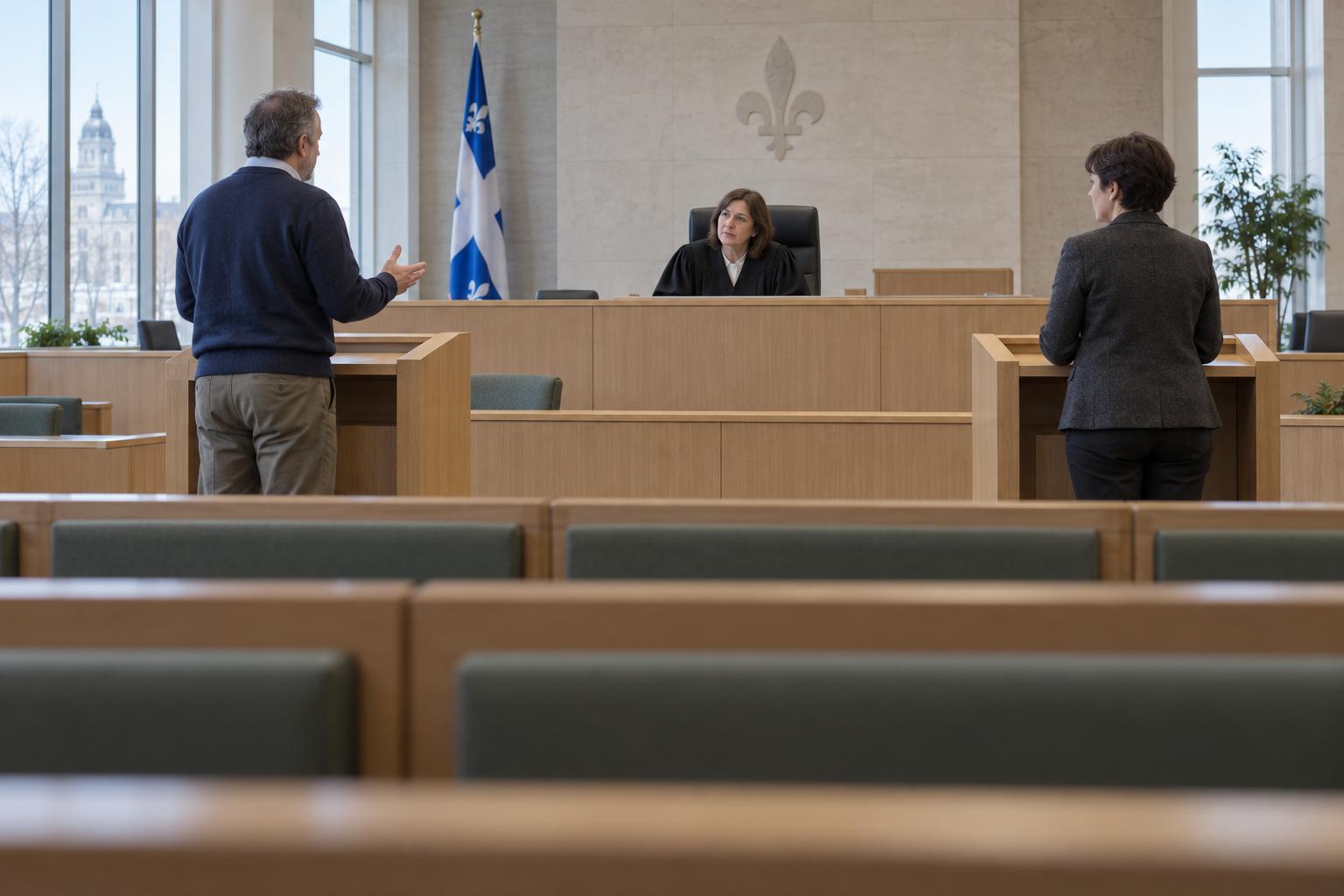
Small Claims offers an adjudication route when the amount and claimant qualify. The ceiling is $15,000 excluding interest. A larger claim may be reduced to qualify, with the reduction stated in the application; a creditor cannot divide a single larger debt into smaller proceedings to obtain access. [4] [31] Reducing a claim is a substantive decision that merits consideration before filing.
An individual can apply in their own name. Legal persons, partnerships, associations and other groups covered by Justice's guidance must meet the 10-employee test during the preceding 12 months. An entity that exceeded the threshold during that period cannot initiate its claim in this division. [5] Do not substitute today's headcount for the required lookback, or assume that every business claimant is a corporation.
Adoption
Complete the eligibility and file-preparation screens:
- Claimant: identify the individual or entity that owns the claim.
- Defendant: match the contracting party's correct legal name to the supporting documents.
- Amount: reconcile the balance and confirm whether the chosen route fits it.
- Entity eligibility: document the applicable employee history.
- Venue: check the appropriate judicial district before filing.
- Evidence: organize the contract, delivery proof, invoice and correspondence.
- Recovery: consider what will happen if payment does not follow a decision.
Justice warns that using the wrong defendant name can lead to rejection and directs claimants to business-register information. [32] Venue can depend on the defendant's domicile or last known residence, where the whole cause arose, or where the contract was formed. For a consumer contract, Justice identifies the consumer's domicile whether that consumer is claimant or defendant. [33]
Filing also creates deadlines for evidence. Justice specifies deposit within 10 days after the legal filing date of the application or defence, with additional evidence permitted until 30 days before the hearing. Keep copies and follow the instructions applicable to the file. [34]
Strengths and Limitations
A judgment and its enforcement are distinct stages. CHJQ identifies executing enforceable judicial decisions among bailiffs' functions. [8] SOQUIJ describes further enforcement when a judgment debtor does not pay. [35] Forced execution generally involves a bailiff, with a limited exception for certain income seizures; confirm the conditions before attempting that route. [36]
Filing also has public-record implications. SOQUIJ's Plumitifs service provides access to court files and progress information; civil registers and files are generally public, subject to restrictions and confidentiality exceptions. [37] [38] If the claimant or claim falls outside Small Claims eligibility, obtain advice about the appropriate civil route and its budget rather than assuming the same procedure applies.
Feature Comparison
Table 1 is an editable decision matrix. Replace the cost descriptions with actual quotations and the relationship assessments with the reader's own judgment. These assessments express the report's decision framework, not measured outcomes. The underlying distinction is between dialogue and scheduling, delegated collection, and a decision that may still need enforcement. [17] [3] [8]
| Option | Direct cost input | Time and effort | Relationship assessment | Evidence needed | Enforceability and best fit |
|---|---|---|---|---|---|
| Negotiation or payment plan | Enter owner time, any professional review and settlement discount. | Owner conducts follow-up and tracks promises. | Assess whether discussion remains productive. | Reconciled balance, delivery record, responses and proposed schedule. | Best when a concrete payment arrangement is plausible; record agreed conditions in writing. [39] |
| Formal demand | Enter drafting, delivery and owner-time costs. | Prepare a clear request and preserve delivery evidence. | Assess whether a formal deadline is proportionate. | Contract, invoice, delivery proof, exact letter and receipt. | Best when a documented request is needed; the letter does not stop prescription. [10] |
| Collection agency | Enter quoted commission, fixed charges, tax and disbursements. | Handover, mandate oversight and reconciliation remain. | Assess the impact of involving an intermediary. | Verified debtor identity, balance, underlying documents and relevant communications. | Best when outsourced follow-up has value; clarify mandate scope and legal regime. [25] |
| Small Claims | Enter the applicable filing fee and possible later enforcement costs. | Prepare, file, manage procedural steps and pursue payment. | Assess willingness to proceed in a public forum. | Eligibility, venue, service-performance evidence and collection information. | Best when an adjudicated outcome is needed and eligibility is met; a judgment still needs payment or execution. [24] |
The matrix should be used sequentially rather than as a rigid requirement to purchase every option. A credible payment proposal may justify negotiation; a disputed balance may require a different next step. Preserve the file throughout. The Office of Consumer Affairs' recommendation to retain communications is useful regardless of who performs the next follow-up. [18]
- Best when outsourced follow-up has value; clarify mandate scope and legal regime.
- Budget quoted commission, fixed charges, tax and disbursements.
- Handover, mandate oversight and reconciliation remain.
- Best when an adjudicated outcome is needed and eligibility is met; a judgment still needs payment or execution.
- Budget the applicable filing fee and possible later enforcement costs.
- Prepare, file, manage procedural steps and pursue payment.
Compare the work and authority included in each quotation. An agency mandate and the decision to seek a judgment require separate assessment.
Performance and Benchmarks
The official sources establish legal thresholds and charges, not comparable success rates for a freelancer's particular debt. This report therefore supplies no agency league table, universal collection percentage or claim-to-payment duration. Such figures would not determine whether this contract was performed or this debtor can pay. The UPA's guidance on proving service delivery and the bailiffs' guidance on information needed for seizure address those separate practical questions. [15] [16]
Use a file-specific scorecard instead:
- Proof quality: what contemporaneous material demonstrates agreement and delivery?
- Response quality: does the client identify an issue that can be resolved?
- Payment evidence: has any promised instalment actually arrived?
- External cost: what is payable even if nothing is recovered?
- Owner effort: what work remains after outsourcing?
- Timing: does any proposed delay threaten a limitation date?
For collection costs, distinguish the legal source of the charge from the commercial quotation. The bailiffs' order says judicial-function tariffs are set by government and cannot be negotiated, while other complementary fees are agreed beforehand. [40] For an amicable collection assignment before judgment, its FAQ also distinguishes the creditor's fee responsibility from the underlying debtor balance. Do not assume every outsourced expense can simply be added to an invoice. [41]
Keep the jurisdiction straight when comparing online advice. The Financial Consumer Agency of Canada's collection-rights page concerns federally regulated financial institutions. [42] Its discussion also explains the provincial or territorial protection that applies when such debt is sold to an agency. [43] It should not be imported wholesale as the rulebook for a Quebec freelancer's customer invoice. For that file, the Quebec mandate, statutory scope and applicable procedure need to be checked.
Evaluate each route against the same reconciled balance. A cheap first step can still consume substantial owner time or leave the file unprepared for escalation. Record why the chosen action changes the prospect of payment and what evidence would justify changing course.
Data Analysis and Evidence
Official 2026 costs and mediation
Table 2 reproduces the official 2026 Small Claims tariff, effective January 1, 2026. Fee refresh: October 15, 2026. This is the source-check date, not a prediction of future indexation. The application and contestation schedules use the same amount bands, and the listed court tariffs are not subject to federal or provincial taxes unless otherwise specified. [6] [44]
| Claim amount or service | Natural person | Legal person | What the figure covers |
|---|---|---|---|
| $0.01 to $5,000 | $121 | $191 | Application or counterclaim; the contestation tariff has the same amounts. [6] |
| $5,000.01 to $10,000 | $223 | $318 | Application or counterclaim; the contestation tariff has the same amounts. [6] |
| $10,000.01 to $15,000 | $241 | $382 | Application or counterclaim; the contestation tariff has the same amounts. [6] |
| First execution notice | $52 | $63.75 | Signing and filing; add the listed $6 SOQUIJ search charge and applicable bailiff costs. [6] |
| Small Claims mediation | Up to 3 free hours | Up to 3 free hours | Ministry-funded mediator time, not reimbursement of every party expense. [45] |
The filing fee is not an all-in recovery budget. Judicial bailiff services follow separate government tariffs. [40] A creditor pays the charge for its own procedural act; a defendant's contestation is not an extra automatic filing charge for the creditor. Confirm classification with the clerk for a partnership or unincorporated group rather than assuming every business uses the legal-person column. Complementary bailiff services also require a clear quotation. [24]
Eligible filed and contested claims of $5,000 or less, excluding interest, are subject to mandatory mediation across all judicial districts. Above the threshold, mediation is voluntary. [7] [46] When qualifying smaller claims remain unresolved, automatic referral to arbitration follows; a party preferring a judge has 30 days after receiving the arbitration notice to return a refusal. Arbitration services are free, and the decision is final without appeal, subject to specified annulment grounds. [47] Read every notice rather than assuming the next step is automatically a trial.
Reader-entered expected recovery
Use expected net recovery = claim × estimated recovery probability − external fees − owner time cost as a planning model. Every input is supplied by the reader; the probability is a scenario assumption, not an observed benchmark. If partial payment is plausible, use separate outcome scenarios rather than assuming every successful outcome pays the entire balance.
Table 3 is the editable calculation worksheet. The equations are analytical definitions, not sourced market statistics or advice about the merits of a claim.
| Input | Reader entry | Treatment |
|---|---|---|
| Claim, C | Enter the balance being evaluated. | Use the same balance across options, or explain any settlement discount. |
| Recovery probability, p | Enter a scenario assumption. | Choose a decimal between zero and one; do not treat an agency quotation as evidence of probability. |
| Fixed external costs, F | Enter quoted or official costs. | Include costs payable regardless of recovery. |
| Success-based commission, r | Enter the quoted decimal rate, if applicable. | Model separately as C × p × r when charged only on recovered money. |
| Owner hours, h, and hourly value, v | Enter both assumptions. | Owner time cost equals h × v. |
| Expected net recovery | Calculate C × p × (1 − r) − F − h × v. | Compare like-for-like scenarios; avoid deducting commission twice. |
Run alternative assumptions and note what would change the decision. Use the bailiff's distinction between fixed judicial tariffs and agreed complementary fees when assembling costs. [40] No numeric hypothetical is needed. Budget for possible execution and any complementary services agreed with the bailiff. [24] It is also not a substitute for a limitation-date assessment; delaying a decision can affect the right itself. [48]
Implications and Future Directions
The most useful improvement is an evidence pack that travels with the file. Contract terms, delivery evidence, the invoice, account reconciliation and client responses should tell a consistent story. The UPA's service-payment guidance supports retaining both contractual and performance evidence. [15] Written settlement conditions and retained communications then document what happened after default. The Fondation recommends clear conditions and signatures from everyone involved. [19] [39] [18]
Keep tax treatment separate from collection strategy. Revenu Québec states that a doubtful debt is not automatically a bad debt for Goods and Services Tax (GST) and Quebec Sales Tax (QST) purposes. [49] Eligible written-off arm's-length bad debts may permit return adjustments for taxes already reported and remitted, subject to requirements including recovery efforts and supporting records. [50] The stated return deadline is four years after the filing deadline for the period of write-off; later recovery can require remitting the associated taxes. [51] [52] Recovery efforts and the retained supporting documents belong in that accounting assessment. [53] Ask an accountant about the facts and any Quick Method implications rather than treating lateness alone as authority to reverse tax.
Stop routine escalation and obtain individualized advice when:
- Prescription is close or uncertain: determine the actionable date and any valid interruption.
- Identity is unclear: resolve which party contracted and owns the obligation.
- Eligibility is uncertain: check the entity test, claim size or appropriate court route.
- The dispute changes: obtain advice when substantial counterclaims or issues outside this report's scope arise.
- Collection information is inadequate: assess whether further spending is justified.
- Settlement changes rights: review releases, acknowledgements or disputed-interest wording before signing.
Info Justice offers free legal-information, orientation and support consultations, including a Small Claims pathway; associated expenses can still apply. [54] [55] That provides a starting resource, while time-sensitive rights require prompt professional attention. [11]
Frequently Asked Questions (FAQs)
How long is there to collect an unpaid invoice in Quebec?
The Civil Code's default for an action enforcing a personal right is three years, unless another period applies. The start is when the right of action arises, not automatically the latest reminder. [9] Filing before expiry can interrupt prescription subject to service requirements, including the Code's 60-day limit after expiry; applying that rule to a particular file warrants legal advice. [56] A demand letter alone does not stop prescription. [10]
Should a demand letter come before an agency?
A demand letter can clarify the request while the creditor retains control of follow-up. An agency introduces an intermediary under a mandate. [3] Compare the deliverables, applicable legal regime and quotations rather than assuming outsourcing replaces any required legal step. OPC's permit guidance includes exceptions, and the commercial-debt scope must also be checked. [12] [13]
What if the client refuses to pay?
Separate the stated reason from the evidence: identify the disputed deliverable, amount or term, and preserve the response. Keep collection communications and assess whether the available proof supports the next step. [18] Info Justice's Small Claims support can help readers understand preparation and settlement options. [55]
Is an agency or Small Claims better?
An agency delegates collection activity; Small Claims can determine an eligible dispute, but obtaining payment may require further action. [25] [35] Compare actual mandate charges, procedural eligibility, owner time and possible enforcement costs. Document the payment and settlement communications rather than reconstructing them later. [18] Retain necessary information only when handing over personal data. [30]
Conclusion
The appropriate response to an unpaid invoice depends on the obstacle to payment. Negotiation suits a concrete, credible arrangement; a demand letter makes a request and deadline explicit; an agency provides delegated follow-up; and Small Claims offers an adjudication route for an eligible claimant and claim. BDC's guidance supports dialogue and revised scheduling where appropriate, while OPC describes the agency's intermediary role. [17] [3]
The decision should be documented before additional money is spent. Reconcile the balance, preserve evidence of delivery, verify the debtor's identity and compare quotations against the work they include. Service-payment evidence needs to demonstrate the work, rather than relying on the invoice alone. [15] Written conditions help preserve the terms of any negotiated arrangement. [19]
Use the fee table as a budget input and the expected-recovery worksheet as a scenario tool. It supplies no universal probability or guarantee. Keep prescription and enforcement separate from the attractiveness of any initial step: a letter does not stop the limitation clock, and a judgment does not itself put money in the creditor's account. [10] [8] Where timing, identity, eligibility or settlement terms remain uncertain, obtain targeted help before the next commitment. Info Justice's legal-information and Small Claims services provide an accessible starting point for understanding the process. [55]
External Sources (56)
About
2727 Coworking
Find a practical home for your work at 2727 Coworking in Montreal. Explore private offices, day workspaces and meeting rooms, plus business-address and virtual-mailbox services for your company.
2727 Coworking is a Montreal workspace and business-address provider. We serve people who need a place to focus, meet, run a small business or establish a professional mailing presence. Our website offers English and French information about workspace options and services, alongside educational resources for operating a business in Canada.
A workspace that fits the day
Our workspace options include private offices, day passes and desks, and a conference room. These formats help individuals and teams compare a dedicated office with more flexible ways to work or hold a meeting. Prospective members can explore the virtual tour, review current pricing and book a visit before choosing a workspace.
Business addresses and mail
2727 Coworking provides business-address and virtual-mailbox services. Our resources explain the documents and practical questions involved, including guidance for people outside Canada. Service eligibility, included features, availability and access arrangements should be confirmed on the applicable service page or with our team.
Resources for Canadian small businesses
We publish guides, research and planning tools about workspace decisions, business addresses and starting a business in Canada. Our incorporation research includes information for people inside Canada and abroad, with jurisdiction-specific material to help readers identify the next questions to investigate. These educational resources complement our workspace and address services; they are not individualized legal, tax or immigration advice.
Visit or contact 2727 Coworking
Explore private offices, day passes and desks, the conference room, business addresses and virtual mailboxes. Book a visit or contact the team to discuss your needs.
A business address alone does not establish tax residence, immigration status, banking approval or eligibility for a government program.
Disclaimer
This document is provided for informational purposes only. No representations or warranties are made regarding the accuracy, completeness, or reliability of its contents. Any use of this information is at your own risk. 2727 Coworking shall not be liable for any damages arising from the use of this document. This content was generated with assistance from artificial intelligence tools, which may contain errors or inaccuracies. Readers should verify critical information independently. All product names, trademarks, and registered trademarks mentioned are property of their respective owners and are used for identification purposes only. Use of these names does not imply endorsement. This document does not constitute professional or legal advice. For specific guidance related to your needs, please consult qualified professionals.