
2727 Coworking Article
Working Through a Montreal Winter: An Office Guide
Montreal winter for office workers: snow-removal parking signs and towing, the Dec. 1 winter tire rule, commuting, lunch and a storm-day checklist.
Summary
- 01Temporary orange signs control snow-loading parking bans and can appear while you are at work. Check before leaving the office; towing and parking charges stack up.
- 02Quebec requires winter tires from December 1 to March 15. Book the swap in early November; compliant tires must carry the winter-tire pictogram or be studded.
- 03Clearing makes streets passable before loading removes the snow. Loading usually starts the day after a major storm, so parking bans can arrive after the snowfall ends.
- 04Choose a commuting mode for the season. The metro is the default winter option for a Griffintown office; buses slow down in snow, and indoor parking removes the street-sign question.
- 05Prepare for storms the evening before: check the forecast, loading operations and signs, charge devices, bring the laptop home if allowed, and agree on attendance and video meetings.
- 06Through December, leaving at 5 p.m. means going home in the dark. Front-load focused work, get outside at midday when sidewalks allow it, and keep a fixed start time on remote days.
Inside this article
- 01What actually costs you money in a Montreal winter
- 02Rule 1: Snow-removal parking bans and towing
- 03Rule 2: Winter tires from December 1 to March 15
- 04How the City sequences clearing, and what it means for your commute
- 05Commuting: pick a mode for the season, not the day
- 06Lunch without going outside (much)
- 07Storm days: a morning-of checklist
- 08Staying productive when it is dark at 4:15
- 09Winter-ready office checklist (November)
- 10Sources
What actually costs you money in a Montreal winter
Most winter advice is about boots and coats. For someone who works in an office, the expensive mistakes are different: a towed car on a snow-loading night, a fine for summer tires on December 2, or a lost morning because nobody planned for a storm. This guide puts the rules first, then the practical routine.
Some scale: the City says snow crews clear about 10,000 km of streets and sidewalks, Montreal receives about 190 cm of snow on average, and it takes about five snow-loading operations each winter to remove it. In ideal conditions, collecting 15 cm of snow takes at least 4 days and 4 nights once it has been pushed to the curb [1]. Plan for several multi-day loading cycles on your street and around your office every winter.
Rule 1: Snow-removal parking bans and towing
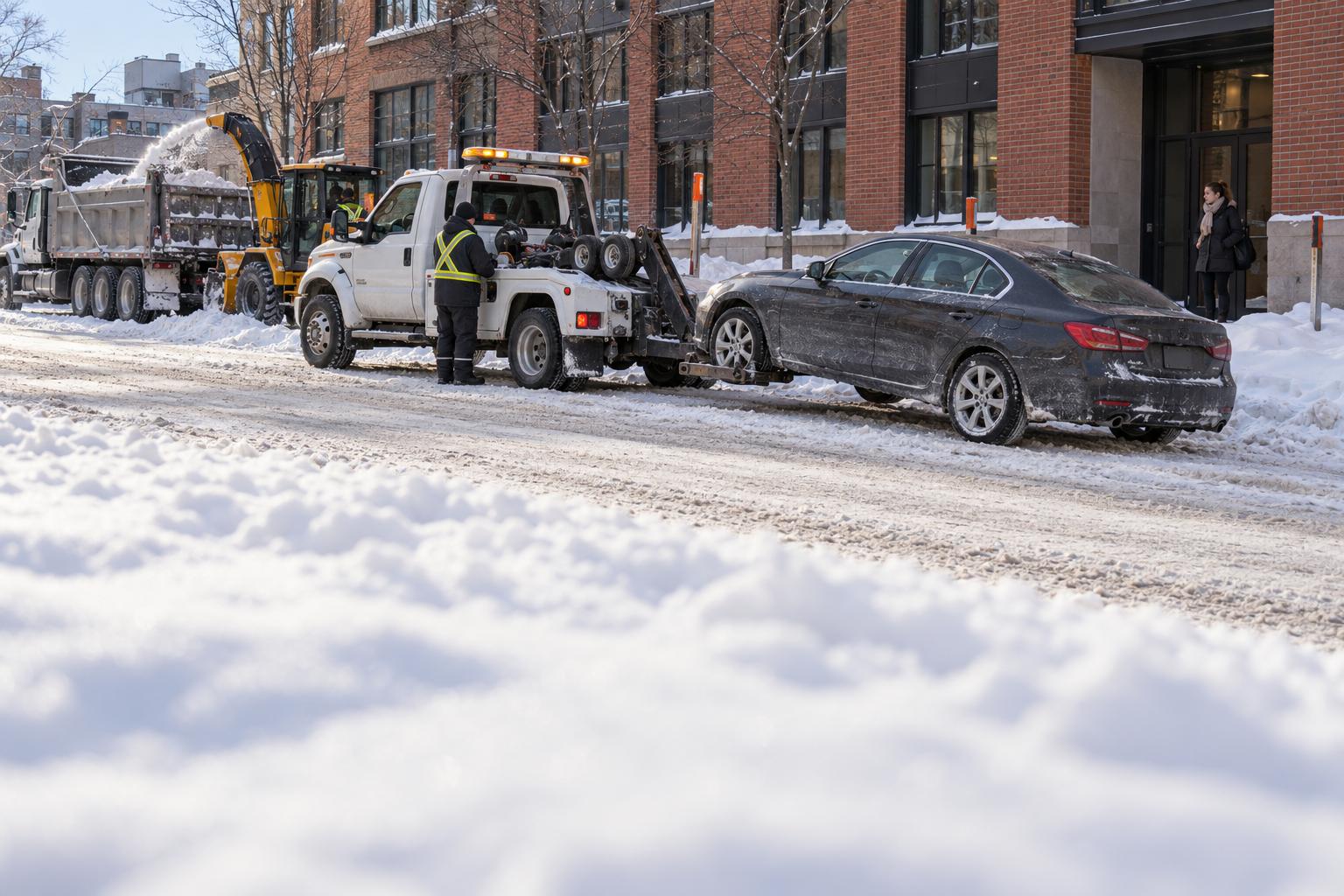
When the City loads snow onto trucks, it bans street parking with temporary orange signs. The two standard shifts [2]:
| Operation | No-parking period | When the signs go up |
|---|---|---|
| Daytime | 7 a.m. to 7 p.m. | The previous day, before 8 p.m. |
| Nighttime | 7 p.m. to 7 a.m. | The same day, before 3 p.m. |
Source for sign timing: Ville de Montréal, Signage for snow removal operations.
Read that table with an office schedule in mind. If you park on the street near work in the morning, a sign for a 7 p.m. ban can go up while you are at your desk. If you leave the car overnight, a sign for a 7 a.m. ban can appear in the evening after you go home.
Exceptions by borough (same City page):
- Anjou posts signs 8 hours before the ban begins.
- Saint-Laurent usually posts signs during the shift before the one when snow is cleared, sometimes only four hours before vehicles are towed.
- LaSalle, Pierrefonds-Roxboro and Verdun also show snow-loading bans on permanent signs. In LaSalle and Verdun, you must call the number on the sign to find out whether a ban is in effect.
- Pierrefonds-Roxboro has a parking ban every day from 1 a.m. to 7 a.m. from November 1 to April 1.
Two rules that apply everywhere:
- Temporary signs take priority over permanent signs, and the permanent signs still have to be obeyed.
- "If you do not comply with signage, your vehicle will be towed and you will be fined" [3].
What it costs. Two charges stack up:
- Towing fee: $99. The 2026 agglomeration tariff by-law sets $99 for towing a vehicle parked in breach of a parking rule during snow-removal operations [4].
- Parking ticket: $30 to $60, plus court costs. In Le Sud-Ouest, which includes Griffintown, parking where a sign prohibits it breaches art. 30 of the borough's traffic and parking by-law, and art. 83 sets the fine at $30 to $60 [5]. Other boroughs apply their own version of the by-law.
Worked example: a car left under a 7 p.m. sign near a Griffintown office costs up to $60 + $99 = $159 before court costs, plus the time spent finding where it was moved.
Tow trucks use audible warning devices as they pass to remind drivers to move [2]. Do not rely on hearing them from a fourth-floor office.
Tools that tell you before the sign does
- The snow removal operations map shows when streets are scheduled for loading and lists incentive parking lots where you can park for free during operations. The map is updated only during snow-loading periods, and street signs always take precedence over it [6].
- The 311 Montréal app lets you track operations in real time and get notifications to move your car [7].
- Free night parking: during snow-removal periods, free municipal spaces are available at night, in collaboration with the Agence de mobilité durable; the map shows where [2].
If your car was towed, the City has a page to find out where it was taken (same page).
How to park in winter
The City's own tips [2]:
- park 30 cm from the sidewalk;
- fold back your rear-view mirrors;
- never park at an angle.
- No parking from 7 a.m. to 7 p.m.
- Signs go up the previous day, before 8 p.m.
- An overnight car can face a morning ban posted after you go home.
- No parking from 7 p.m. to 7 a.m.
- Signs go up the same day, before 3 p.m.
- A car parked near work in the morning can face a ban posted while you are at your desk.
Borough exceptions apply. Temporary signs take priority over permanent signs, and street signs take precedence over the operations map.
Rule 2: Winter tires from December 1 to March 15
Quebec requires winter tires on passenger vehicles for a fixed period. "Your vehicle must be winter-ready from December 1 to March 15," and drivers who do not comply face a fine of $200 to $300 [8].
What office workers ask:
| Question | Answer |
|---|---|
| Does it apply to my rental or car-share vehicle? | Yes. It applies to all motor vehicles registered in Quebec, including rentals, and the regulation applies to anyone renting out a vehicle in Quebec regardless of where it is registered [9] |
| I drive in from Ontario with Ontario plates. | The requirement does not apply to vehicles registered outside Quebec [8] |
| Do all-season tires count? | No. A compliant winter tire must bear the winter-tire pictogram shown on Québec.ca or be studded (Québec.ca) |
| When can I use studded tires? | October 15 to May 1 for passenger vehicles, taxis and commercial vehicles up to 3,000 kg loaded mass (Québec.ca) |
| Can I take them off on March 16? | Legally yes, but Québec.ca recommends waiting a few weeks after the end of the period because spring conditions vary |
Tire shops get busy in late November. Book the swap in early November.
A big storm is a planning problem, not a surprise. Run through this the evening before and the morning of.
How the City sequences clearing, and what it means for your commute
Knowing the order of operations helps you predict which routes will be passable at 8 a.m.
- Streets are cleared by priority. After each snowfall, the City clears major streets and reserved public-transit lanes first, then collector streets that connect them, then residential streets [10]. A route that stays on main arteries is usually the safer bet on a storm morning.
- Clearing and loading are two different steps. During a major storm, the priority is to push snow aside so streets and sidewalks are passable; loading usually starts the day after the storm [11]. The parking bans come with that second step, often a day or more after the snowfall ends.
- Salt has limits. The City notes that salt works relatively well between 0 °C and -15 °C and loses effectiveness when it is colder, which is why gravel is mixed in [10]. On very cold days, expect slippery sidewalks even after treatment, and wear footwear with grip.
What counts as a major storm. The City treats a storm as severe when the forecast calls for more than 30 cm of heavy snow combined with freezing rain, high winds, intense cold or blizzard conditions. Its advice for getting around on those days is direct: "Choose to work from home if it is possible," opt for public transit, and if you must drive, slow down and favour main streets, which are usually cleared first [11]. A team rule that says "on a City-declared storm day, default to remote" saves a round of messages every time.
Commuting: pick a mode for the season, not the day
Transit. For a Griffintown office, the metro is the default winter option; 2727 Rue Saint-Patrick, for example, is near Charlevoix station on the Green Line. The STM runs no separate winter metro timetable: Green line trains come every 2 to 4 minutes at weekday peaks and every 3 to 8 minutes off-peak [12]. Buses are what slow down in snow, so check the STM service status page before you leave and allow buffer time on storm mornings.
The underground city. Downtown, the RÉSO links about 32 km of pedestrian galleries to metro stations, offices and shops [13]. It does not reach Griffintown, but if your meetings are downtown you can often get from the metro to the building without going outside. If you are new to the area, our Griffintown vs Plateau comparison covers how each neighbourhood connects to transit.
Cycling. Winter cycling is common in Montreal and has its own infrastructure and gear questions; see our winter cycling guide.
Walking. The City clears sidewalks as well as streets, which it notes is not the case in many other large cities [1]. Its safety advice for anyone near snow machinery: avoid earphones, keep your distance from equipment and make sure you are clearly visible (same page).
Driving. If you must drive, the real cost is not fuel but the ban cycle. A monthly indoor parking spot near the office removes the street-sign question entirely during loading weeks.
Lunch without going outside (much)
The best winter lunch strategy is boring: bring it. A shared office kitchen and a lunch you prepared on Sunday mean no trip across an icy intersection at noon.
When you do go out:
- choose places within a five-minute walk for the coldest weeks;
- in Griffintown, Atwater Market is within reach of the Lachine Canal offices for food shopping;
- keep a spare pair of indoor shoes at the office so you are not in wet boots all afternoon.
Client lunches can move indoors to a meeting room with catering instead of a restaurant across town. If you do take clients out, our business attire guide for Quebec winters covers what to wear without arriving soaked.
Storm days: a morning-of checklist
A big storm is a planning problem, not a surprise. Run through this the evening before and the morning of.
The evening before
- Check the forecast and the 311 Montréal app for loading operations on your street and near the office.
- If you parked on the street near work, check for orange signs before you leave the office.
- Charge your laptop and phone, and bring the laptop home if remote work is allowed.
- Agree with your team or clients: who comes in, who works remotely, which meetings move to video.
The morning of
- Check whether loading operations or signs affect your car before you move it.
- Decide on the mode: metro rather than driving on heavy-snow days.
- Leave earlier than usual; allow for slower walking and crowded transit.
- Keep warm layers, spare socks and indoor shoes at the office.
- If you are responsible for a small office, confirm the building entrance and parking access are cleared. The City requires owners to clear snow from a property's main entrance and parking entrance, and in most boroughs that snow may not be pushed onto the sidewalk or street [14]. If you rent, check who does this in your lease.
- 01Check the forecast and loading
The evening before, check the forecast and the 311 Montréal app for loading on your street and near the office.
- 02Check signs before leaving work
If you parked on the street near work, check for orange signs before leaving the office.
- 03Prepare devices and agree on plans
Charge your laptop and phone, bring the laptop home if remote work is allowed, and agree who comes in, who works remotely and which meetings move to video.
- 04Check the car and choose your mode
In the morning, check loading operations and signs before moving your car. Choose the metro rather than driving on heavy-snow days.
- 05Allow extra travel time
Leave earlier than usual to allow for slower walking and crowded transit.
- 06Confirm office access
If you are responsible for a small office, confirm that the building entrance and parking access are cleared.
Staying productive when it is dark at 4:15
The National Research Council's calculator for Montréal gives these times (Eastern Standard Time) [15]:
| Date | Sunrise | Sunset |
|---|---|---|
| December 8, 2026 (earliest sunset) | 7:22 a.m. | 4:11 p.m. |
| December 21, 2026 | 7:32 a.m. | 4:14 p.m. |
| January 15, 2027 | 7:31 a.m. | 4:37 p.m. |
| February 15, 2027 | 6:57 a.m. | 5:21 p.m. |
Through December, anyone who leaves at 5 p.m. goes home in the dark. Winter productivity is mostly about structure:
- Front-load focused work in the morning when you are freshest.
- Get outside at midday for ten minutes when the sidewalks allow it. The Lachine Canal path is a short walk from many Griffintown offices; our Lachine Canal guide covers the route.
- Keep a fixed start time even on remote days. Storm days easily turn into four-hour days.
- Mix office and home deliberately. Decide in advance which days you will be in, so a snowfall changes the plan less.
- Watch your shared calendar for loading weeks. Three in-person meetings on a loading night means three people looking for parking.
Sunrise is at 7:22 a.m.; sunset is at 4:11 p.m. Times are Eastern Standard Time.
Sunrise is at 7:32 a.m.; sunset is at 4:14 p.m. Times are Eastern Standard Time.
Sunrise is at 7:31 a.m.; sunset is at 4:37 p.m. Times are Eastern Standard Time.
Sunrise is at 6:57 a.m.; sunset is at 5:21 p.m. Times are Eastern Standard Time.
Winter-ready office checklist (November)
| Task | Done by |
|---|---|
| Winter tires booked, installed by December 1 | Each driver |
| 311 Montréal app installed, office address saved | Everyone who drives |
| Indoor shoes, spare socks and a scraper kept at the office | Everyone |
| Remote-work rule for storm days written down | Team lead |
| Contact list for clients if meetings move online | Account owner |
| Building entrance and parking snow clearing confirmed (owner or landlord) | Office manager |
| Laptops set up to work from home on short notice | IT or each person |
Sources
- Everything there is to know about snow removal in Montréal (Ville de Montréal)
- How to park your car in winter (Ville de Montréal)
- Signage for snow removal operations (Ville de Montréal)
- Snow removal operations map (Ville de Montréal)
- Snow Removal hub and 311 app (Ville de Montréal)
- Snow clearing on private property (Ville de Montréal)
- Requirements for winter tires (Québec.ca)
- Regulation respecting the use of tires specifically designed for winter driving, C-24.2, r. 45 (LégisQuébec)
- Seven myths about snow removal (Ville de Montréal)
- What to do in case of a major winter storm (Ville de Montréal)
- Règlement sur les tarifs de l'agglomération de Montréal (exercice financier 2026), RCG 26-003 (Ville de Montréal)
- Règlement sur la circulation et le stationnement (R.R.V.M. c. C-4.1), Le Sud-Ouest codification (Ville de Montréal)
- Line 1, Green (STM)
- Service status (STM)
- RESO, le réseau souterrain de Montréal (Ville de Montréal)
- Sunrise/sunset calculator (National Research Council Canada)
2727 Coworking is a short walk from Charlevoix metro in Griffintown, and its indoor garage has a few monthly parking spots for members who still need to drive.
External Sources (15)
About
2727 Coworking
Find a practical home for your work at 2727 Coworking in Montreal. Explore private offices, day workspaces and meeting rooms, plus business-address and virtual-mailbox services for your company.
2727 Coworking is a Montreal workspace and business-address provider. We serve people who need a place to focus, meet, run a small business or establish a professional mailing presence. Our website offers English and French information about workspace options and services, alongside educational resources for operating a business in Canada.
A workspace that fits the day
Our workspace options include private offices, day passes and desks, and a conference room. These formats help individuals and teams compare a dedicated office with more flexible ways to work or hold a meeting. Prospective members can explore the virtual tour, review current pricing and book a visit before choosing a workspace.
Business addresses and mail
2727 Coworking provides business-address and virtual-mailbox services. Our resources explain the documents and practical questions involved, including guidance for people outside Canada. Service eligibility, included features, availability and access arrangements should be confirmed on the applicable service page or with our team.
Resources for Canadian small businesses
We publish guides, research and planning tools about workspace decisions, business addresses and starting a business in Canada. Our incorporation research includes information for people inside Canada and abroad, with jurisdiction-specific material to help readers identify the next questions to investigate. These educational resources complement our workspace and address services; they are not individualized legal, tax or immigration advice.
Visit or contact 2727 Coworking
Explore private offices, day passes and desks, the conference room, business addresses and virtual mailboxes. Book a visit or contact the team to discuss your needs.
A business address alone does not establish tax residence, immigration status, banking approval or eligibility for a government program.
Disclaimer
This document is provided for informational purposes only. No representations or warranties are made regarding the accuracy, completeness, or reliability of its contents. Any use of this information is at your own risk. 2727 Coworking shall not be liable for any damages arising from the use of this document. This content was generated with assistance from artificial intelligence tools, which may contain errors or inaccuracies. Readers should verify critical information independently. All product names, trademarks, and registered trademarks mentioned are property of their respective owners and are used for identification purposes only. Use of these names does not imply endorsement. This document does not constitute professional or legal advice. For specific guidance related to your needs, please consult qualified professionals.