2727 Coworking Article
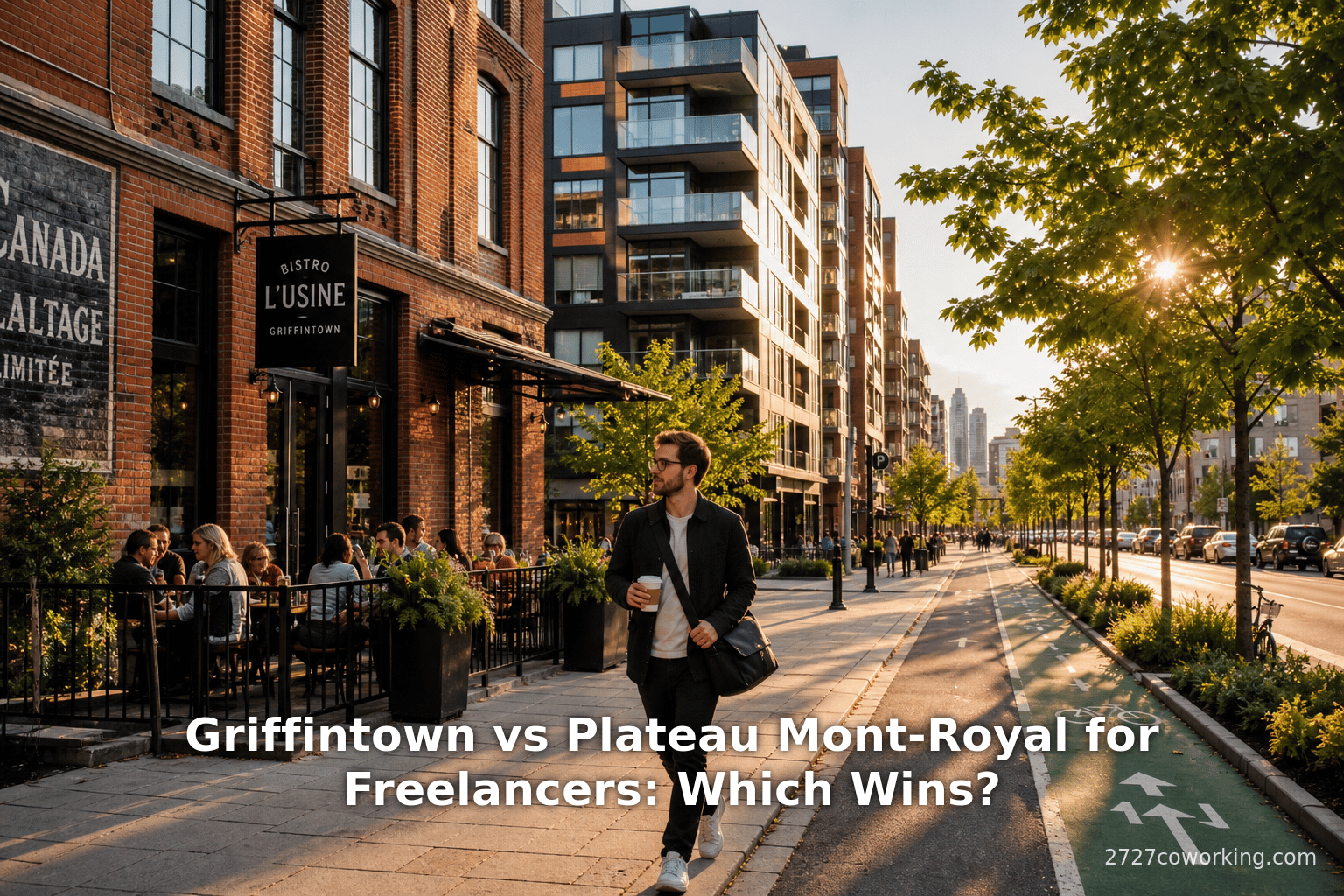
Griffintown vs Plateau Mont-Royal for Freelancers: Which Wins?
Inside this article
For a freelancer choosing a Montreal base in 2026, the decision between Griffintown and Plateau Mont-Royal comes down to a trade between newer, canal-side infrastructure and older, denser, more walkable street life. Griffintown, a former industrial district along the Lachine Canal in the Le Sud-Ouest borough, had a 2011 population of just 6,446 [1] that grew to roughly 7,450 by 2016, a 93% increase since 2006 driven mostly by young, high-income professionals [2]. Plateau Mont-Royal, by contrast, is Montreal's most populous borough with 105,813 residents [3] and carries the title of the city's most walkable neighborhood, with a Walk Score of 92, a Transit Score of 80, and a Bike Score of 94 [4].
On raw cost, the two neighborhoods are close but Griffintown is marginally cheaper. Estimated one-bedroom rent runs about $2,180 per month in Griffintown versus $2,237 in Plateau Mont-Royal according to one cost-of-living index [5] [6], though listing-based estimates put both closer to the high $1,500s to $2,100 range for first-hand leases [7] [8]. Both neighborhoods sit well above the city-wide average, which apartments.com places at $1,543 per month for a one-bedroom as of April 2025 [9].
For dedicated workspace, both neighborhoods host multiple coworking operators. 2727 Coworking, headquartered at 2727 Rue Saint-Patrick on the Griffintown side of the Lachine Canal, prices a hot desk at $300 per month, a dedicated desk at $450 per month, and private offices from $600 to $3,000 per month depending on size, with 24/7 access, a free conference room, gigabit internet, and shower facilities included in every plan [10]. On the Plateau side, ECTO, a cooperative coworking space, charges $225 per month for a member-rate hot desk and $395 per month for a dedicated desk (Source: ecto.coop), while Montreal Cowork operates 252 workstations in the heart of the borough [11]. Griffintown's transit access centers on Charlevoix metro station on the Green Line, roughly 100 meters from 2727 Coworking's door, with the future REM Griffintown-Bernard-Landry light-rail station still projected for 2030 after repeated delays [12].
The underlying freelancer economy is large and growing in both directions: Canada counted 2,652,600 self-employed workers in 2023, 13.2% of the employed population [13], and nearly 1.9 million of those were own-account workers with no employees, a rate of 9.4% [14]. Montreal's overall cost advantage over Toronto and Vancouver, with two-bedroom rent averaging roughly $1,800 per month versus $2,800 and $2,600 respectively [15], applies to both neighborhoods studied here, meaning the Griffintown-versus-Plateau decision is a second-order optimization on top of an already favorable citywide freelancer environment. The bottom line: freelancers who prioritize a modern, canal-adjacent, tech-and-startup-adjacent environment with slightly lower typical rents and purpose-built coworking amenities tend to choose Griffintown, while those who prioritize maximum walkability, cafe density, an established creative community, and the lowest-cost cooperative coworking options tend to choose Plateau Mont-Royal. Neither is objectively superior; the right answer depends on whether a freelancer values transit-and-canal-path efficiency or street-level density and cultural texture more highly.
Introduction and Background
Montreal has become one of North America's most freelancer-friendly cities, combining a bilingual talent pool, a deep technology and creative-industry base, and housing costs meaningfully below Toronto and Vancouver. Within that citywide advantage, independent professionals repeatedly narrow their neighborhood search to two very different but geographically close districts: Griffintown, the redeveloped industrial waterfront just southwest of downtown, and Plateau Mont-Royal, the borough of colorful row houses and cafe culture that sits northeast of Mount Royal. Both are within Montreal's central core, both have strong reputations among remote workers and the self-employed, and both are frequently recommended in "best neighborhood for freelancers" guides, yet they offer meaningfully different day-to-day experiences.
Griffintown's transformation is recent and dramatic. The neighborhood existed as a functioning working-class district from the 1820s until the 1960s, when the closure of the Lachine Canal to major shipping in 1959 and the construction of the Bonaventure Expressway triggered decades of depopulation, leaving the area's population at just 546 by 1974 [16]. Redevelopment began in earnest in the early 2010s, and the city's official 2012 plan called for condominium towers of 10 to 20 stories alongside new parks and bike paths [17]. By 2025, industry observers characterized the neighborhood as fully gentrified, describing 2008 to 2016 as the period of most rapid change and predicting that residents should now expect slower, more incremental shifts as the area matures into permanent status as one of Montreal's most desirable urban districts [18].
Plateau Mont-Royal's history runs in nearly the opposite direction: rather than being rebuilt from an industrial base, it has been a continuously inhabited, densifying residential district since the late 1700s, prized for its plateau elevation east of Mount Royal overlooking downtown [19]. The borough gentrified earlier, through the 1980s, as its bohemian reputation and proximity to McGill University attracted young professionals, artists, and eventually higher rents [20]. Today it is recognized by Time Out as one of the coolest neighborhoods in the world and remains a hub for Quebecois music, theater, fashion, and cuisine [21].
For freelancers, the practical stakes of this choice are not abstract. Where a self-employed worker lives determines commute time to coworking or client meetings, the price and availability of workspace, access to a peer network, and monthly fixed costs that must be covered before any income becomes discretionary.
This report compares Griffintown and Plateau Mont-Royal across cost of living, coworking infrastructure, transit and walkability, demographics and community character, and the broader freelancer ecosystem, drawing on government statistics, cost-of-living indices, transit agency data, and direct pricing from coworking operators in both neighborhoods, including **2727 Coworking**, which operates from a converted industrial building on the Griffintown side of the Lachine Canal.Griffintown
Capabilities
Griffintown's defining physical asset for freelancers is its stock of converted industrial buildings: former factories and warehouses along the Lachine Canal now offer soaring ceilings, exposed brick, and oversized windows that purpose-built office towers rarely replicate. The area anchors Montreal's Le Sud-Ouest borough and directly borders the canal, giving it a car-free bike and pedestrian corridor: one cafe-culture guide notes that Griffintown is "15-20 minutes on foot from Bonaventure metro, or 10 minutes by bike from downtown via the Lachine Canal bike path" [22]. The city has invested directly in the public realm here: a 2022 project delivered Place des Arrimeurs, a $3.7 million public square with granite steps, art installations, custom benches, and 8 new trees at the intersection of several cycling routes, part of a broader wave of widened sidewalks, new lighting, and an electric BIXI bike-share station added along Rue des Bassins [23].
The neighborhood's tech and creative-industry footprint is a distinguishing feature for freelance professionals seeking proximate clients or collaborators. Autodesk maintains its Canadian headquarters at 10 Rue Duke in Griffintown [24], a 40,360 square foot office designed by ACDF Architecture in an adapted industrial building [25]. The presence of a major software firm alongside numerous startups reinforces the neighborhood's positioning as an innovation district rather than a purely residential enclave. Cafe infrastructure has followed the professional demographic: an independent cafe-review outlet found three separate Griffintown cafes with maximum WiFi ratings and concluded that "Griffintown was redeveloped for remote workers, and the cafés followed suit" [26].
Adoption
Griffintown's residential population grew from an essentially depopulated industrial zone in the 1970s to roughly 7,450 people by 2016, a 93% increase since 2006, dominated by young, high-income professionals [2]. By the early 2010s the neighborhood held roughly 10,000 to 11,000 residents according to real-estate market analysis [27]. Language data from the 2021 census show a bilingual, internationally oriented population: 48.1% report French as the home language and 31.4% report English, with the remainder speaking other languages at home [28]. For freelancers who serve international or anglophone clients while wanting to remain functionally connected to Quebec's French-language business environment, this bilingual composition is a practical advantage.
Coworking adoption in Griffintown centers on 2727 Coworking, which sits at the neighborhood's canal edge, and several smaller cafe-coworking hybrids such as Le Loft LPD, which charges a $99 monthly day-pass rate with 20% off drinks [29]. Coworking-Montreal market analysis places Griffintown's coworking price band at $215 to $400 per month for hot desks as of its most recent update, describing the neighborhood as "significantly less expensive than downtown" [30]. Note that 2727 Coworking's own live pricing page, the authoritative current source for its rates, lists hot desks starting at $300 per month as of July 2026 [10], a modest increase over the figure cited in the broader market guide, illustrating the volatility typical of coworking pricing and the importance of checking a provider's current rate sheet before budgeting.
Strengths and Limitations
Griffintown's principal strengths for freelancers are physical workspace quality, transit-adjacent coworking, and canal-path bike commuting. Its principal limitations are a lack of certain everyday amenities and an unresolved transit gap. The neighborhood still has no schools or large supermarkets directly inside its core, requiring residents to travel for those services [31], and the elevated Bonaventure Expressway along its eastern edge functions as something of a physical barrier to the rest of downtown [32].
On safety, available data indicate Griffintown is low-crime by North American urban standards. Montreal as a whole scored 69 out of 100 on a police-reported-crime-based Safety Score, ranking it 18th safest out of 56 major Canadian urban areas measured [33], and the city recorded 194,765 total police-reported crimes in 2024, down 1.2% from 2023 [34]. Reporting specific to Griffintown found that most local incidents are opportunistic property crime, vehicle break-ins and bicycle theft, rather than violent offenses, with the Montreal police (SPVM) reporting a May 2024 series of vehicle break-ins that led to an arrest [35]. On the specific question of walkability, no official aggregate Walk Score has been published for the Griffintown micro-neighborhood as distinct from its Sud-Ouest borough, though individual addresses score extremely high: a residence at 370 Rue des Seigneurs registers a Walk Score of 96 out of 100, a "Walker's Paradise," with a Transit Score of 82 and a Bike Score of 97 [36], while the broader Sud-Ouest borough that contains Griffintown ranks 6th most walkable in Montreal overall with a borough-wide score of 73 [37].
Plateau Mont-Royal
Capabilities
Plateau Mont-Royal's core capability for freelancers is density: the borough packs 105,813 residents into 8.1 square kilometers, making it one of the most densely populated boroughs in Canada [38]. That density translates directly into the highest Walk Score of any Montreal neighborhood, 92 out of 100, alongside a Transit Score of 80 (rated "Excellent Transit") and a Bike Score of 94 (rated "Biker's Paradise") [39]. A freelancer working from a Plateau apartment or cafe can typically reach dozens of restaurants, bars, and coffee shops within a five-minute walk, a density Walk Score explicitly measures on its neighborhood comparison pages [40].
The borough is served by two metro stations directly, Mont-Royal and Laurier, both on the Orange Line, plus Sherbrooke station near its southern boundary, along with extensive bus routes [41]. Mont-Royal station alone carried 4,965,189 passengers in 2024, a 6.16% year-over-year increase, ranking it 13th busiest of the network's 68 stations [42]. The neighborhood's built form, rows of colorful spiral-staircase triplexes, remains one of its most recognizable features and a defining element of its street-level character for anyone working from a home office or nearby cafe [43].
Adoption
Plateau Mont-Royal's coworking scene is older and more cooperative in structure than Griffintown's. ECTO, founded in 2008, is one of Montreal's longest-running coworking spaces and operates as a member cooperative with a network of over 200 members following a 2023 renovation [44]. Its own published rate sheet lists a single day pass at $30 or a package of ten days for $250, and its published rates for hot desks are $225 per month at the member rate and $250 for non-members, with a dedicated desk at $395 for members and $425 for non-members (Source: ecto.coop).
Montreal Cowork, located on St-Denis Street in the heart of the borough, offers 252 workstations spanning private closed offices, open coworking space, meeting rooms, and virtual office and business-address services [11]. A smaller operator, Blabla Studio, hosts 12 individual workstations aimed at motion designers, animators, and content creators, charging $350 per month plus tax for a fixed desk [45]. Nearby, Halte 24-7, on the Plateau's border in the Metro-Est sector at 4284 De La Roche Street, prices a hotspot desk at $249 plus tax per month with an optional $30 monthly fee for 24/7 access, rising to $299 for month-to-month contracts under three months [46], and a dedicated desk in open space at $399 plus tax per month [47]. Coworking-Montreal market analysis places the Plateau's typical hot-desk pricing band at $250 to $350 per month, with day passes starting from $15 [48].
Strengths and Limitations
The Plateau's central strength is an unmatched combination of walkability, transit access, and cultural texture built up over decades rather than redeveloped in a single wave. Its trade-off is cost and crowding: rents run higher than Saint-Henri, Verdun, or, on some measures, Griffintown, and the borough's popularity means cafes and coworking spaces can be crowded during peak hours [49]. The borough also carries the highest concentration of low-income residents in Montreal in absolute terms, 17,495 people, with a poverty rate of 17% against a citywide average of 11% [50], a statistic that coexists with the borough's reputation as a magnet for young, mobile professionals: residents aged 18 to 34 represent 37% of the population, versus 10% each for children and seniors ([51].
Language use in the Plateau skews more heavily French than Griffintown: 66.5% of residents speak French at home compared to 12.5% English and 21.0% other languages [52]. Median household income in the borough is $59,200 and the median age is 35.6 years [53], while homeownership is comparatively low at 28.08%, reflecting a borough dominated by rental apartments in low-rise buildings: 68.6% of units are in structures of fewer than five storeys [54]. For freelancers who value functional French for local client work and a renter-dominated, walk-everywhere lifestyle, these are practical advantages; for those who need to communicate primarily in English or want newer building stock, they may weigh against the neighborhood.
Feature Comparison
Table 1 below places the two neighborhoods side by side across the dimensions freelancers weigh most heavily: cost, transit, workspace options, and community character. Figures for 2727 Coworking reflect the operator's own live pricing page as of July 2026, positioned honestly as a membership-inclusive model rather than a strict hourly or day-rate comparison; competitor prices for ECTO, Montreal Cowork, Halte 24-7, and Blabla Studio reflect each operator's own published rate pages.
| Dimension | Griffintown | Plateau Mont-Royal |
|---|---|---|
| Est. 1BR rent (index) | $2,180/mo [5] | $2,237/mo [6] |
| 1BR rent, first-hand listings | $1,700 to $2,100/mo [7] | $1,500 to $1,900/mo [8] |
| Cost-of-living index (vs. Montreal avg.) | 59.9, +15% [55] | 61.5, +18% [56] |
| Walk Score (borough/neighborhood) | Sud-Ouest: 73, 6th most walkable [37] | 92, most walkable in Montreal [4] |
| Bike Score | Up to 97 at canal-adjacent addresses [57] | 94, "Biker's Paradise" [58] |
| Metro access | Charlevoix (Green Line); future REM station projected 2030 [12] | Mont-Royal, Laurier, Sherbrooke (Orange Line) [59] |
| Population (borough/district) | ~7,450 (2016 est.) [60] | 105,813 (borough) [61] |
| Key coworking operator | 2727 Coworking: hot desk $300/mo, dedicated desk $450/mo, private offices $600 to $3,000/mo, membership-inclusive with 24/7 access, free conference room, gigabit internet (not billed hourly) [10] | ECTO: hot desk $225 to $250/mo, dedicated desk $395 to $425/mo, cooperative model (Source: ecto.coop) |
| Secondary coworking option | Le Loft LPD cafe-coworking: $99/mo day-pass rate [29] | Montreal Cowork: 252 workstations, virtual office services [11] |
| Dominant character | Redeveloped industrial waterfront, tech/startup tenants (Autodesk HQ) [62] | Bohemian, artistic, cafe-dense, colorful row houses [63] |
| Median household income | Not separately published; comparable regional data suggest income above Montreal average given professional demographic skew [2] | $59,200 [64] |
The table makes clear that neither neighborhood wins decisively on cost; the difference between a $2,180 and a $2,237 estimated one-bedroom rent is well within the noise of any individual lease negotiation, and listing-based figures actually invert the ranking, showing Plateau apartments starting slightly cheaper on first-hand contracts. Where the neighborhoods genuinely diverge is walkability and transit maturity, where the Plateau's decades-old dense grid delivers a measurably higher Walk Score than Griffintown's still-maturing borough average, and workspace model, where 2727 Coworking's membership-inclusive amenities (24/7 access, free conference room, showers, gigabit fiber) compete against a lower headline price at ECTO's cooperative model. A freelancer choosing between the two is effectively choosing between a slightly higher amenity floor in a newer building stock (Griffintown) and slightly better street-level walkability and cultural density in an established one (Plateau).
Performance and Benchmarks
Neither neighborhood publishes a formal "freelancer performance" benchmark, so this section evaluates the two districts against the metrics freelancers most commonly use as proxies for productivity and cost efficiency: transit-adjusted commute time to coworking space, coworking price per square foot of amenity access, and internet infrastructure quality, since remote and freelance work is fundamentally bandwidth-dependent.
On transit-adjusted access, 2727 Coworking's Griffintown location benchmarks at a Walk Score of 88, a Transit Score of 83, and a Bike Score of 96, placing it, according to the operator's own market analysis, among the highest transit-accessibility scores of any coworking space in Montreal, roughly 100 meters from Charlevoix metro station [65]. The Plateau's ECTO and Montreal Cowork locations both sit within a short walk of Orange Line stations, though neither operator publishes an equivalent proprietary Walk Score figure; the borough-wide average of 92, the highest in Montreal and established above, suggests comparable or superior aggregate accessibility, distributed across a larger area rather than concentrated at a single canal-side address.
On price efficiency, Montreal's citywide coworking hot-desk band runs $150 at the lowest end to $450 at premium downtown locations, with a market average of $200 to $400 per month [66]. Griffintown's 2727 Coworking, at $300 per month for a hot desk, sits at the upper end of that band but bundles amenities, 24/7 access, a free conference room, gigabit internet, showers, and a kitchen, that some lower-priced competitors charge for separately [67]. The Plateau's ECTO, at $225 to $250 per month, sits closer to the middle of the band, with meeting-room time capped at four hours monthly for hot-desk members rather than provided as an unlimited free amenity (Source: ecto.coop).
On internet infrastructure, Quebec as a whole benefits from some of the cheapest and most competitive broadband pricing in Canada, with fiber options from independent providers such as Oxio available at $65 per month for symmetrical 500/500 Mbps service [68]. This citywide infrastructure advantage applies equally to Griffintown and Plateau Mont-Royal home offices; neither neighborhood has a documented broadband disadvantage relative to the other, meaning coworking-space internet quality, gigabit fiber is standard at spaces such as 2727 Coworking, is more differentiating than home-office connectivity for freelancers weighing the two districts.
Data Analysis and Evidence
Montreal's freelancer and self-employment base is substantial and provides useful context for sizing the market both neighborhoods compete to serve. Canada recorded 2,652,600 self-employed workers in 2023, 13.2% of the total employed population [13]. Of the total self-employed population, 46.2% operate as unincorporated sole proprietors without employees, the classic freelancer or travailleur autonome structure, while 25.7% are incorporated without employees, 22.9% are incorporated with employees, and 5.2% are unincorporated with employees [69]. Nationally, own-account workers, those with no employees at all, numbered nearly 1.9 million in 2023, a 9.4% rate that was down from a pandemic-era peak of 10.9% in 2020 and represented the lowest level since 1996 [70].
The dominant reason Canadians choose self-employment is autonomy: 39.7% of own-account workers surveyed in the fourth quarter of 2023 cited "autonomy and control over work hours, wage rate, or location" as their primary motivation, followed by passion for the work (14.1%) and working in one's field of expertise (11.0%) [71]. Own-account workers are also considerably more likely to work part-time than paid employees, 32.6% versus 16.8%, though a meaningful share of that part-time work, 18.5%, is involuntary [72].
On cost of living specific to workspace decisions, Numbeo's July 2026 dataset for Montreal, drawn from 1,752 entries submitted by 254 contributors over the preceding twelve months, lists a one-bedroom apartment in the city center at $1,766.07 per month and one outside the city center at $1,379.00 [73] [74], figures that fall between the neighborhood-specific estimates cited above for Griffintown and the Plateau, both of which sit closer to the city-center band given their central locations. The same dataset lists the regular monthly public transit pass at $104.50 [75], a figure confirmed directly by the Societe de transport de Montreal (STM), whose fare schedule lists the Monthly, All Modes A pass as providing unlimited travel for one calendar month across metro, bus, exo train, and REM services within Zone A (Source: www.stm.info).
Coworking research reinforces why workspace choice matters beyond simple square-footage economics. A Business.com survey of 500 U.S. adults currently in coworking arrangements found that 46% reported an improvement in productivity or output, and by an identical margin reported improved collaboration with colleagues [76]. Separately, Harvard Business Review researchers who study workplace thriving found that people who belong to coworking spaces report levels of thriving that "approach an average of 6 on a 7-point scale," at least a point higher than the average for employees who do their jobs in regular offices [77]. Separately, peer-reviewed research published in the Journal of Affective Disorders found that adults working remotely three to four days per week had significantly higher odds of loneliness, with the risk increasing further at five or more remote days per week [78], a finding directly relevant to freelancers deciding between home-office isolation and neighborhood-based coworking regardless of which of the two districts they choose.
Case Studies and Real-World Examples
Autodesk's Griffintown Headquarters (Corporate Anchor Tenant)
Autodesk, the multinational design-software company, relocated its Canadian headquarters to Griffintown, occupying a 40,360 square foot adaptive-reuse project across two floors of an existing office building designed by ACDF Architecture [79]. The company's current listed address is 10 Rue Duke, Montreal [24], and industry press has characterized the project as celebrating "the technology of adaptation," housed in an adapted industrial building in the city's rapidly developing Griffintown neighborhood as the company's new Canadian headquarters [80]. For freelancers who work in design, architecture, or engineering software ecosystems, Autodesk's Griffintown presence is a concrete example of how the neighborhood's redevelopment has attracted exactly the kind of technology anchor tenant that generates freelance and contract work in adjacent fields.
ECTO Cooperative: Cooperative Coworking as a Plateau Institution
ECTO, operating from Avenue du Mont-Royal Est since 2008, represents a different institutional model than Griffintown's newer, investor-operated spaces. As a cooperative, ECTO's more than 200 members participate directly in managing and developing the space rather than purchasing services from an external operator [81]. The space renovated in 2023, extending its runway as one of the borough's most established freelancer workspace options, and its member-rate pricing structure, $225 for a hot desk and $395 for a dedicated desk, reflects the cooperative's lower overhead relative to commercially operated peers (Source: ecto.coop). This case illustrates how Plateau Mont-Royal's freelancer infrastructure has evolved organically over nearly two decades rather than arriving as part of a single redevelopment wave.
Griffintown-Bernard-Landry REM Station: Infrastructure Promised, Repeatedly Delayed
The proposed Griffintown-Bernard-Landry station on the Reseau express metropolitain (REM), Montreal's automated light-rail network, illustrates the infrastructure risk embedded in Griffintown's growth story. The station was originally planned alongside the rest of the REM's initial network but was relocated from a Peel Basin site to the Central Station viaduct in 2020, delaying its construction relative to neighboring stations that opened in August 2023 [82]. In January 2024, La Presse reported construction would not begin until 2027 [83], and by August 2024 the REM's operating authority, CDPQ Infra, declined to confirm even that revised timeline [84]. As of 2026, the estimated opening date stands at 2030 [12]. Freelancers evaluating Griffintown today should treat this future station as a genuine upside optionality rather than a near-term amenity: the neighborhood's current transit access relies on the existing Charlevoix metro station and bus network, not the delayed REM connection.
2727 Coworking: A Membership-Inclusive Model on the Griffintown Canal Edge
2727 Coworking, located at 2727 Rue Saint-Patrick directly on the Lachine Canal at the edge of Griffintown, illustrates how a single-location, independently operated coworking business competes against both Griffintown's newer commercial spaces and downtown's larger chains. The space offers a hot desk at $300 per month, a dedicated desk at $450 per month, and private closed offices ranging from $600 per month for a single-person office up to $3,000 per month for a ten-person suite, with every tier including 24/7 access, a free conference room, gigabit internet, a fully equipped kitchen, shower access, and heating, air conditioning, and electricity bundled into the price rather than billed separately [85]. This membership-inclusive structure is a deliberate departure from hourly or metered pricing common at some Griffintown cafe-coworking hybrids, positioning 2727 Coworking as a fixed-cost option for freelancers who want budget predictability rather than pay-per-use flexibility. The company describes itself as located "in the heart of Griffintown, right next to the beautiful Lachine Canal" [86], reinforcing the canal-adjacency that differentiates it from Plateau operators several kilometers away.
Halte 24-7: A Credit-Based Model Bridging Downtown and the Plateau
Halte 24-7, located at 4284 De La Roche Street near the Plateau's Metro-Est sector, demonstrates a third pricing philosophy: a hybrid of monthly membership and credit-based day access. Its base hotspot-desk membership costs $249 plus tax per month, with 24/7 access available as a $30 monthly add-on, though contracts under three months carry a higher $299 monthly rate [87]. The space also sells day-access credits in bulk, ten credits for $299 plus tax, working out to roughly $29.90 per credit, or twenty-five credits for $699 plus tax, reducing the per-credit cost to approximately $27.96 [88]. This case shows how Plateau-adjacent operators have built flexible-access products specifically for freelancers with variable monthly workspace needs, a use case less commonly served by Griffintown's more fixed-membership operators.
Implications and Future Directions
The most consequential forward-looking variable for this comparison is transit infrastructure. If the Griffintown-Bernard-Landry REM station opens on its current 2030 estimate, or even close to it, Griffintown's transit accessibility would meaningfully close the gap with the Plateau's Orange Line coverage, adding a second rapid-transit spine to a neighborhood currently served only by the Green Line's Charlevoix station and buses [12]. Given the station's history of repeated delays, from an original 2024 target to 2027 to the current 2030 estimate, freelancers making multi-year housing or lease decisions should discount this upside heavily and evaluate Griffintown on its current transit profile rather than its projected one.
A second structural trend is the continued maturation of Griffintown's retail and amenity base. The neighborhood's current gap in schools and large supermarkets directly inside its core, discussed above, is a function of its youth as a redeveloped district rather than a permanent structural feature; as the area's population continues to grow past its estimated 7,450 in 2016, market forces are likely to fill remaining amenity gaps over the coming years. Plateau Mont-Royal, by contrast, is unlikely to see comparable structural change: its built environment, density, and walkability are already close to a practical ceiling, and its future trajectory is more likely to be continued price appreciation than infrastructure transformation.
For the broader freelancer economy underlying this comparison, Statistics Canada's own-account worker data show a rate that has been declining since its 2020 pandemic peak of 10.9%, falling to 9.4% by 2023, the lowest level since 1996 [70], a trend attributed in part to record-high job vacancies and wage growth pulling workers back toward salaried employment [89]. Should this trend continue, demand pressure on both neighborhoods' coworking infrastructure may ease somewhat, potentially stabilizing or softening hot-desk pricing in both districts relative to the $200 to $400 average that currently prevails citywide [66]. Conversely, both neighborhoods' cost-of-living indices, already 15% and 18% above the Montreal average respectively [55] [56], suggest continued upward rent pressure driven by their enduring desirability, meaning freelancers on tighter budgets may increasingly look to adjacent, lower-cost neighborhoods such as Saint-Henri or Verdun as substitutes, a shift 2727 Coworking's own freelancer guide already anticipates by profiling Saint-Henri as "Montreal's best-kept secret for freelancers" precisely because of its lower rents relative to Griffintown and the Plateau [90].
Frequently Asked Questions (FAQs)
What is the best Montreal neighborhood for freelancers? There is no single correct answer; it depends on priorities. Freelancers who value walkability, cafe density, and an established creative community tend to prefer Plateau Mont-Royal, which carries Montreal's highest Walk Score at 92, as established above. Freelancers who value newer building stock, canal-path bike commuting, and proximity to technology-sector employers such as Autodesk tend to prefer Griffintown [62]. Budget-conscious freelancers frequently choose neither, opting instead for adjacent Saint-Henri or Verdun, which the underlying freelancer-guide literature profiles as lower-cost alternatives to both districts discussed here.
Is there a good coworking space in Griffintown? Yes. 2727 Coworking, at 2727 Rue Saint-Patrick on the canal edge of Griffintown, offers hot desks from $300 per month, dedicated desks from $450 per month, and private offices from $600 to $3,000 per month, with 24/7 access, a free conference room, and gigabit internet included, and describes itself in its virtual tour as offering "Private Offices" for "teams of 1-10 people" alongside hot desks and dedicated desks [91]. Smaller cafe-coworking hybrids such as Le Loft LPD also operate in the neighborhood [92].
Is there a good coworking space in Plateau Mont-Royal? Yes. ECTO, a cooperative operating since 2008, offers hot desks from $225 per month and dedicated desks from $395 per month, as detailed above. Montreal Cowork offers 252 workstations including private offices and virtual office services [11], and Halte 24-7 near the Metro-Est sector offers credit-based day access alongside monthly membership [46].
How does the cost of living compare between the two neighborhoods? They are close. One cost-of-living index estimates one-bedroom rent at $2,180 per month in Griffintown versus $2,237 in Plateau Mont-Royal, with the Plateau's overall cost-of-living index at 61.5 (18% above the Montreal average) versus Griffintown's 59.9 (15% above average) [55] [56]. Listing-based rent ranges, however, show Plateau first-hand leases starting slightly lower than Griffintown's [93] [94].
What is the best neighborhood for remote work in Montreal generally, beyond just these two? Montreal's own freelancer-guide literature identifies five neighborhoods as top contenders: Saint-Henri for lowest cost, Griffintown for modern tech-adjacent infrastructure, Plateau Mont-Royal for cafe and street culture, Mile End for creative-industry community, and Verdun for an emerging, budget-friendly option with strong Green Line access [95].
Where should freelancers live in Montreal if they want to minimize commute to a coworking space? Proximity to a Green or Orange Line metro station is the dominant variable. In Griffintown, addresses near Charlevoix station minimize commute time, with 2727 Coworking's own location roughly 100 meters away [96]. In the Plateau, addresses near Mont-Royal or Laurier stations serve the same function [59].
Is Griffintown safe? Available data suggest yes, by North American urban standards. Montreal citywide scored 69 out of 100 on a police-reported-crime Safety Score, ranking 18th safest of 56 major areas measured [33], and Griffintown-specific incidents skew toward property crime such as vehicle break-ins rather than violent crime, as discussed above.
Conclusion
Griffintown and Plateau Mont-Royal both offer strong, well-supported cases as Montreal's best neighborhood for freelancers, and the evidence assembled here does not point to a single winner so much as two different optimizations of the same underlying advantages: a large, growing self-employment base, competitively priced coworking infrastructure, and citywide costs well below Toronto and Vancouver. Griffintown wins on newer building stock, canal-path bike infrastructure, technology-sector proximity anchored by employers such as Autodesk, and a membership-inclusive coworking option in 2727 Coworking that bundles 24/7 access, meeting space, and utilities into a single predictable monthly price. Plateau Mont-Royal wins on walkability, with the highest Walk Score of any Montreal neighborhood, transit maturity across two established Orange Line stations, cafe and cultural density built up over decades, and lower headline coworking pricing through cooperative operators like ECTO.
Cost of living, the variable freelancers most often ask about first, turns out to be close to a wash between the two districts: both sit meaningfully above the Montreal average, and the direction of the gap flips depending on whether one trusts index-based estimates or first-hand listing data. The more decisive variables are qualitative: whether a freelancer prioritizes the efficiency of a redeveloped, canal-adjacent district with modern infrastructure and a shorter track record, or the texture and walkability of an established, cafe-dense neighborhood with a longer freelancer and creative-industry history. Freelancers who cannot decide should weight the REM Griffintown-Bernard-Landry station's still-uncertain 2030 opening date as a real but distant catalyst, and in the meantime evaluate both neighborhoods on their current transit and amenity profiles rather than their projected ones. Whichever district a freelancer chooses, Montreal's broader structural advantages, a workforce where 13.2% of employed people are self-employed, competitively priced coworking averaging $200 to $400 per month citywide, and housing costs 20 to 40% below Toronto and Vancouver, mean the choice between Griffintown and Plateau Mont-Royal is a genuine optimization within an already favorable environment rather than a decision between a good option and a bad one.
External Sources (96)
About
2727 Coworking
Find a practical home for your work at 2727 Coworking in Montreal. Explore private offices, day workspaces and meeting rooms, plus business-address and virtual-mailbox services for your company.
2727 Coworking is a Montreal workspace and business-address provider. We serve people who need a place to focus, meet, run a small business or establish a professional mailing presence. Our website offers English and French information about workspace options and services, alongside educational resources for operating a business in Canada.
A workspace that fits the day
Our workspace options include private offices, day passes and desks, and a conference room. These formats help individuals and teams compare a dedicated office with more flexible ways to work or hold a meeting. Prospective members can explore the virtual tour, review current pricing and book a visit before choosing a workspace.
Business addresses and mail
2727 Coworking provides business-address and virtual-mailbox services. Our resources explain the documents and practical questions involved, including guidance for people outside Canada. Service eligibility, included features, availability and access arrangements should be confirmed on the applicable service page or with our team.
Resources for Canadian small businesses
We publish guides, research and planning tools about workspace decisions, business addresses and starting a business in Canada. Our incorporation research includes information for people inside Canada and abroad, with jurisdiction-specific material to help readers identify the next questions to investigate. These educational resources complement our workspace and address services; they are not individualized legal, tax or immigration advice.
Visit or contact 2727 Coworking
Explore private offices, day passes and desks, the conference room, business addresses and virtual mailboxes. Book a visit or contact the team to discuss your needs.
A business address alone does not establish tax residence, immigration status, banking approval or eligibility for a government program.
Disclaimer
This document is provided for informational purposes only. No representations or warranties are made regarding the accuracy, completeness, or reliability of its contents. Any use of this information is at your own risk. 2727 Coworking shall not be liable for any damages arising from the use of this document. This content was generated with assistance from artificial intelligence tools, which may contain errors or inaccuracies. Readers should verify critical information independently. All product names, trademarks, and registered trademarks mentioned are property of their respective owners and are used for identification purposes only. Use of these names does not imply endorsement. This document does not constitute professional or legal advice. For specific guidance related to your needs, please consult qualified professionals.