2727 Coworking Article
Festival Nuits d'Afrique 2026: History and Programme
Inside this article
Executive Summary
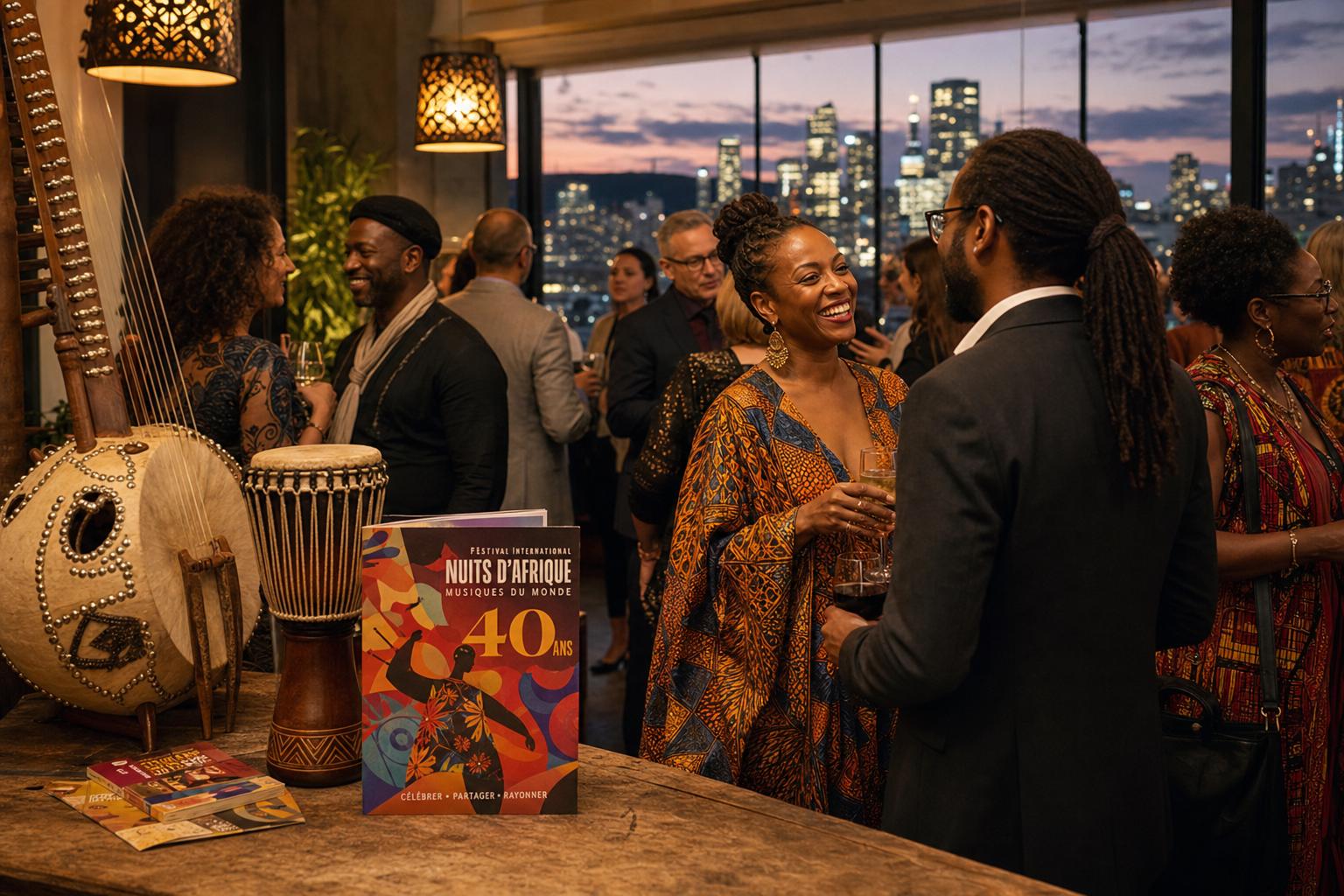
The Festival international Nuits d’Afrique de Montréal will celebrate its 40th edition from July 7 to 19, 2026, in the Quartier des Spectacles. A true Montreal institution since 1987, this global musical gathering offers more than 13 days of concerts and activities every summer celebrating music from Africa, the Caribbean and Latin America. The 2026 edition promises to be exceptional: nearly 130 concerts are scheduled over 13 days, featuring around a hundred major artists from approximately 30 different countries [1] [2]. Among them are leading figures on the international scene (Oumou Sangaré, Admiral T, Tabou Combo, Tiken Jah Fakoly, Diblo Dibala…) alongside many local talents (Djely Tapa, Aboulaye Koné, Wesli, Lorraine Klaasen…) [1]. The festival brings together more than 700 artists in total (according to Tourisme Montréal) [2] and offers a rich programme of indoor performances (MTelus, Gesù, National, Fairmount, Balattou) and outdoor performances (Parterre du Quartier des spectacles). Festivalgoers can enjoy numerous additional features: the Village des Nuits d’Afrique at the Parterre, including a “Tombouctou” craft market, dance workshops, a family area sponsored by Radio-Canada, a daily acoustic Cabaret, etc. These elements enhance the festival’s authenticity and multicultural experience [3] [4].
Thanks to this rich selection and the unique setting of the Quartier des Spectacles (North America’s largest cultural hub, with around a hundred venues and some fifty festivals a year [5]), Nuits d’Afrique draws large crowds (more than 200,000 visitors estimated at the outdoor site in 2023 [4]) and has a significant economic impact. Supported by the Quebec government (several hundred thousand dollars in annual grants [6] [7]) and recognized as a major event of Montreal’s summer, the festival helps promote Montreal as a cultural and tourism hub [6] [7]. This report reviews the festival’s history, analyses the 2026 programme and stages in detail, offers a guide to the Quartier des Spectacles in July, and explores the cultural, economic and future issues surrounding this major multicultural event.
Introduction and Historical Context
Origins and Mission of the Festival
The Festival International Nuits d’Afrique de Montréal (FINA) was founded in 1987 (1st edition at Club Balattou) by Lamine Touré and a team sharing a passion for world music. From the outset, the festival’s mission has been to promote cultural diversity by showcasing African, Caribbean and Latin American music, along with their influences on the local scene. Within a few decades, Nuits d’Afrique became “the largest gathering for world music” in Quebec [3].
Throughout its history, Nuits d’Afrique has continued to expand. From a modest club event in 1987, it gradually incorporated free outdoor concerts (starting in 1990 on St-Laurent Boulevard [3]), before establishing a large outdoor site at the Parterre du Quartier des spectacles in 2011 (25th anniversary) [3]. Each edition now combines indoor performances with free outdoor activities (workshops, musical gardens, craft market). Highlights from the 25th, 30th and 35th editions illustrate this growth (opening of the Parterre QDS in 2011 with more than 100,000 visitors [3], 30th anniversary in 2016 with an immersive project and Sphère culturelle [3], etc.).
In brief, according to the festival’s official presentation, this musical gathering features more than 700 artists from approximately 30 countries [3], 13 days of concerts in half a dozen Montreal venues, and 6 days of free activities in the heart of the Quartier des Spectacles [3]. Its eclectic, festive and inclusive approach welcomes both major international names and emerging local talents [3].
Sociocultural Impacts and Recognition
Through its scale and longevity, Nuits d’Afrique has established itself as a cultural event of metropolitan importance. It regularly appears among the leading summer festivals (cited by Le Monde or Tourisme Montréal) and attracts a diverse multicultural audience. The Government of Quebec provides substantial financial support (several hundred thousand dollars each year [6] [7]), highlighting its role in promoting diversity and cultural tourism. For example, the 2023 edition received a government grant of $617,120 [7], supplemented by CALQ support (±$188,900) and other public funds. According to provincial authorities, the festival offers “a high-quality, diverse programme” that invites audiences to discover music from more than 30 countries [6].
Locally, Nuits d’Afrique contributes to the Quartier des spectacles economy and Montreal’s international profile. Ministers speaking at funding announcements emphasize that the festival brings “the rhythms of Africa, the Caribbean and Latin America to the heart of the metropolis” and “promotes the metropolis as a prime tourism destination” [7]. Authorities also emphasize its intercultural dimension: “Nuits d’Afrique encourages encounters and exchanges between cultures,” an opportunity for visitors to “celebrate the richness of our society” [7]. Overall, the festival serves both as a vehicle for social cohesion (bringing together visitors from all backgrounds) and as an economic driver (attracting a large audience and tourists).
The Quartier des Spectacles, the Festival’s Setting
The Quartier des Spectacles (QDS), located in the heart of downtown Montreal, is the main setting for most Nuits d’Afrique activities. This urban cultural district, officially established in 2003, covers approximately 1 km² “with the highest concentration of cultural venues in North America” [5]. It has more than 80 performance venues (theatres, auditoriums, galleries) and at least 50 festivals a year [5]. The QDS is designed as a living ecosystem where creative work, performances, education, businesses and lively public spaces coexist year-round. Its recent history has given it the role of Montreal’s “district of cultural gatherings,” now associated with the metropolis’s summer and winter entertainment (Festival International de Jazz, Francos, Juste pour rire, etc.).
In practice, the festival occupies several QDS sites: notably the Parterre du Quartier des Spectacles (a large public square where the main outdoor stages and Village Nuits d’Afrique areas are set up) and several performance venues on Sainte-Catherine or Saint-Laurent (MTelus, Le National, Gesù, Cinquième Salle de la Place des Arts, etc.). By distributing its activities in this way, Nuits d’Afrique takes full advantage of the QDS infrastructure: for example, the Parterre facilities can accommodate hundreds of thousands of spectators over several weeks, while the indoor venues attract audiences in a more intimate setting.
→ Context source: For the festival’s history and growth, as well as key figures (countries, artists, number of festivals), see the festival presentation [3]. For its connection to the Quartier des Spectacles, consult the QDS description (particularly the concept of “30 venues and 50 festivals/year in 1 km²”) [5].
2026 Programme: Key Considerations and Details
General Overview
The programme for the 40th Festival Nuits d’Afrique – “40 years of rhythms, sharing and encounters” – was unveiled on May 27, 2026. According to the press release and specialist media, the festival will offer 130 concerts over 13 days (July 7–19, 2026), bringing together more than 700 artists from approximately 30 countries [1] [2]. This format includes both major indoor concerts (ticketed) and free outdoor performances at the Parterre du QDS.
International highlights include:
- Oumou Sangaré (Mali) – legendary Wassoulou diva, performing at the opening concert at MTelus (July 7) [8].
- Admiral T (Guadeloupe/France) – dancehall star (scheduled for the festival workshops).
- Tabou Combo (Haiti) – major compas ensemble.
- Tiken Jah Fakoly (Côte d’Ivoire) – leading figure in political reggae.
- Diblo Dibala (Congo-Kinshasa) – virtuoso of Congolese rumba.
- Matchatcha – Montreal reggae/ska collective (Caribbean).
- In addition, the Republic of Guinea is sponsoring a special concert paying tribute to the festival’s founder, Lamine Touré. This performance will bring together several iconic Guinean artists (Sia Tolno, Degg J Force 3, Manamba Kanté, Soul Bang’s, Habib Faye, etc.) to celebrate Guinean music as a thank-you for promoting their culture in Quebec [1].
The local/Quebec dimension is also celebrated. The festival remains a springboard for local artists, particularly those from diaspora communities. Featured performers include Djely Tapa, the rapper with Malian roots; Wesli (Haitian-Canadian musician); Kalabanté (Senegalese-Mono fusion with Kif-Kif); the Frères Sissokho (griots from Mauritania in Quebec), Elage Diouf (Senegalese-Quebec); Lorraine Klaasen (South African-born singer living in Montreal); Jab Djab (Gnawa/Creole fusion), King Shadrock (Haitian musician), Kizaba (the Indian region of Kerala), Joyce N’Sana (Burkinabè Afro-soul), among others [1]. Many previous winners of the Syli d’Or de la musique du monde competition (a national semi-professional competition) will also perform on stage (e.g., the group Fulu Miziki, Tamboréal Samba Bloco, etc.) [1], highlighting the festival’s commitment to developing local careers.
The “Syli d’Or de la musique du monde” show, supported by Québecor, is another component linked to the festival. This national competition (February–April) encourages emerging Canadian world music talents by having them perform concerts at Club Balattou leading up to a spring final [9]. Selected finalists are often included in the following summer’s Nuits d’Afrique programme, creating a continuum of support for emerging artists. Seen as a “springboard for artists,” the Syli d’Or underscores the festival’s development mission [9].
Indoor Programme
Ticketed indoor concerts take place in the main QDS venues and surrounding area: MTelus (1,300 to 2,300 seats depending on configuration), Théâtre du Gesù (a converted former religious sanctuary), Théâtre Fairmount (a versatile music venue), Théâtre National (the history of French-language theatre in Montreal), and Club Balattou (a historic world music venue in Montreal, 1970 seats, colleagues).
The indoor programme is structured around themed evenings and headliners. For example, the opening night on July 7, 2026, will take place at MTelus with Oumou Sangaré as the headliner [8]. Several full evenings are themed by country or style (“Night of the Kora” with Séckou Keïta/Zal Sissokho on July 8 at Gesù, for example) or by genre (salsa, Afro-Cuban jazz, reggae, etc.). Indoor concerts often offer a more intimate and immersive format than outdoor performances, allowing enthusiasts to discover virtuoso artists (e.g., monodic Kumbengo or electronic bachata).
These indoor performances require tickets in advance. The official website strongly encourages online ticket purchases for indoor concerts, noting the growing popularity of certain events. For example, in 2023, “Night of the Kora” sold out at Gesù thanks to a prestigious lineup [4] [10]. The 2026 indoor programme will once again feature international stars and renowned local artists, forming the festival’s ticketed backbone.
Outdoor Programme (Free)
From July 14 to 19, 2026, the festival offers an entirely free outdoor programme at the Parterre du Quartier des Spectacles (at the corner of Sainte-Catherine and Berri streets). This part of the site, transformed into a full-fledged “Village Nuits d’Afrique” [3], includes several outdoor stages and themed areas:
-
Grande Scène TD-Radio-Canada (Parterre): this is the festival’s main stage. Dedicated to major free evening concerts, it can accommodate several thousand standing spectators. In 2023, for example, more than 500 singers and musicians from around the world performed there over 6 days [11]. International heavyweights are expected in 2026 (often announced later). This outdoor stage offers free access to broad audiences, allowing spectators to dance under the stars.
-
Scène Loto-Québec (Esplanade Tranquille): located on the broad esplanade facing Place des Arts, this stage mainly hosts daytime concerts and late-night events (“Dancing Under the Stars”). It showcases dance music (salsa, kompa, Afro-funk…) and “urban jazz” discoveries. In 2023, the Scène Loto-Québec presented international female artists (Kandy Guira from Burkina, Noé Lira from Mexico) in its Women of the World series [4] [10].
-
Cabaret Nuits d’Afrique (Parterre, small stage): a freely accessible space where artists and groups give highly accessible mini-concerts or lead intimate cultural workshops. This “acoustic cabaret,” unique to the festival, takes place every evening before a small audience (a few dozen) for sessions featuring more jazz, slam, poetry, instrument demonstrations, etc. (See the 2025 programme from Balattou [12]).
-
Village des enfants Radio-Canada: a play area reserved for children, with puppet shows, storytelling and creative workshops exploring world rhythms. The festival works with Radio-Canada to offer family activities (e.g., mini-concerts for children, educational percussion, African figure of the day). This village is a reminder of the importance of involving casually curious visitors and families, as emphasized by the organizers.
-
Marché Tombouctou: a themed craft and food market, set up daily with around thirty kiosks. Visitors can discover crafts, instruments and jewellery from Africa, along with “exotic dishes” (couscous, mafé, accras, tropical juices). Both the festival and local publications note the market’s great success – in 2023, its 40 stalls drew “aisles packed with visitors” each day [4] [10]. The Marché Tombouctou has become both a place of commerce and an informal meeting point, strengthening the festival’s warm atmosphere.
-
Open-Air Workshops: the outdoor programme includes various participatory workshops (percussion, traditional dances, introductions to the djembe, Latin music, etc.), free and open to everyone. Led by professionals (guest musicians or local ethnocultural associations), these workshops enliven the afternoons and introduce audiences to African instruments and dances (sabar, Puerto Rican salsa, kora, balafon, etc.).
In summary, the festival’s outdoor programme is designed as a “crossroads of cultures” [12]. It relies on a welcoming atmosphere and free admission to reach a very broad audience. The outdoor spaces are arranged to offer a comprehensive experience combining music, dance, street theatre, and culinary and craft discoveries [3] [4]. The organizers emphasize the accessibility of these activities (free admission to each stage, varied schedules) to attract both world music enthusiasts and curious passersby.
| Edition (year) | Dates | Duration (days) | Artists and countries | Concerts (number) | Attendance (est.) | Grants |
|---|---|---|---|---|---|---|
| 33rd (2019) | July 9–21, 2019 | 13 | ~700 artists (≈30 countries) | Not provided | Indoor + outdoor sites (100,000+) [3] | Not provided |
| 37th (2023) | July 12–23, 2023 | 12 | Artists from ≥25 countries (Kidjo, Alade, ...) | Not provided | ~200,000 people at the outdoor site [4] | Gov. QC: $617,120 [7] (+ CALQ ~188,900) |
| 39th (2025) | July 8–20, 2025 | 13 | 700+ artists (30 countries) | Not provided | Not provided | Gov. QC: $401,000 [6] |
| 40th (2026) | July 7–19, 2026 | 13 | 700+ artists (30 countries) | ~130 concerts [1] | Expected (similar threshold) | Not provided |
Table 1. Key figures and institutional support for recent editions of Festival Nuits d’Afrique. (Sources: official reviews [4], government press releases [6] [7], programme announcements [1].)
Programme by Venue – Festival Stages
The festival takes place across several indoor and outdoor stages in the Quartier des Spectacles. The main performance venues are:
-
Major Concerts at the Parterre du QDS (TD Outdoor Stage): central open-air stage that can accommodate very large standing crowds. It features free headlining performances, sound systems/“giant screens” for the audience. For example, the main stage is described as hosting more than 500 musicians from around the world over one week [11]. Yemi Alade and Sona Jobarteh performed there in 2023 [10]. (Standing capacity: several thousand).
-
Scène Loto-Québec (Esplanade Tranquille): outdoor stage adjacent to Place des Arts, geared towards daytime concerts and workshops. It is equipped for nighttime video projections (“Dancing Under the Stars”) and performances for the general public. (Large standing capacity).
-
MTelus (formerly Théâtre Métropolis): indoor venue with 2017 seats, located on Sainte-Catherine West. Maximum capacity of 2300 people [13]. This large, versatile venue hosts the festival’s major concerts (e.g., Oumou Sangaré at the 40th edition) featuring the biggest international names. It is the launch venue for the 2026 edition (7/7: Oumou Sangaré) [8]. The seated configuration ensures seating is an option, but MTelus often uses a standing configuration for a concert atmosphere.
-
Théâtre du Gesù: former Jesuit church converted into a performance venue (Saint-Laurent Boulevard). Intimate atmosphere (a few hundred seats). In 2026, the renowned “Night of the Kora” (Senny Camara & Yamoussa Bangoura), for example, is planned for this venue on July 8 [8], as is the duo Kiya Tabassian & Ablaye Cissoko on July 9 [8]. Used for acoustic or traditional concerts (string instruments, roots jazz). (Capacity: ~400 seated, based on typical use).
-
Théâtre Fairmount: music space in Plateau Mont-Royal (Parc Avenue). Versatile venue (alternating between theatre and nightclub). Can accommodate 300 seated or 600 standing spectators [14]. In 2026, it featured, for example, BIM (Benin International Musical) on July 8 [8]. Fairmount is often dedicated to modern Afrobeat, funk, hip-hop, reggae concerts, etc.
-
Théâtre National (Montreal): located at the corner of Ste-Catherine/Parc, this is a historic venue dating from 1900. Capacity of ~575 seated spectators (757 standing) [15]. In 2026, the group Labess performed here (July 11 [8]), illustrating the festival’s openness to French-speaking groups from diaspora communities.
-
Club Balattou: legendary world music venue (Parc-Jean-Brillant neighbourhood). Cabaret/dance atmosphere. Its capacity is not officially published, but it is a small, welcoming club (<400 seats). In 2026, Balattou hosts several “Nuits d’Afrique acoustic cabaret” evenings (e.g., concerts by Zal Sissokho & Laurent Perrault, Guiss Guiss Bou Bess, etc. on July 12–14 [8]), as well as the Syli d’Or finals in April.
These multiple venues allow popular concerts (MTelus, Parterre) to sit alongside rarer creative works (Gesù, Fairmount). Each stage targets an audience: from families and the general public (Parterre) to seasoned music lovers (kora evening at Gesù). This diversity of stages broadens cultural accessibility and encourages participation from different segments of the population.
| Venue / Stage | Type of Programme | Examples of Artists (2026) |
|---|---|---|
| Parterre du Quartier des Spectacles (Main Stage) Outdoor stage (Jazz-Rajan) | Free outdoor concerts, large crowds, tribute concerts, emerging talent performances | Yemi Alade, Sona Jobarteh, Meiway & Zo Gang [10], targeting families and the general public |
| Scène Loto-Québec (Esplanade Tranquille) | Free dance, salsa and reggae concerts, themed series (Women of the World), nighttime dance workshops (“Dancing Under the Stars”) | Kandy Guira (Burkina Faso) [4], Noé Lira (Mexico) [10], Réka (var.) |
| MTelus (Pontiac) | Indoor venue (1,300–2,300 seats) for international headliners | Oumou Sangaré [8], Admiral T, Tabou Combo, Tiken Jah Fakoly |
| Théâtre du Gesù | Small venue (acoustic concert, kora, balafon, African classical music) | Night of the Kora (Senny Camara & Y. Bangoura) [8], Diblo Dibala |
| Théâtre Fairmount | Versatile venue (modern world music, Afrobeat, hip-hop, funk concerts) | BIM (Benin Int’l Musical) [8], Taafé Fanga, Kalabanté |
| Théâtre National | Historic theatre (French-language world music concerts, traditional dance) | Labess (8–10 musicians) [8], Orchestre Mandingue |
| Club Balattou (cabaret) | Intimate club (acoustic music, traditional dance, cabaret) | Zal Sissokho & L. Perrault, Guiss Guiss Bou Bess [8], Syli d’Or final |
| Village des enfants Radio-Canada | Family area (children’s performances, storytelling, educational percussion) | Activities co-broadcast by Radio-Canada, African storytelling, fine arts for children |
Table 2. Main stages and programme formats at the Nuits d’Afrique festival. The Quartier des Spectacles outdoor venues (Parterre, Esplanade) host free open-air concerts, while the indoor venues (MTelus, Gesù, Fairmount, National, Balattou) offer more targeted ticketed performances. (Example sources: official announcements [8], programme reviews [4] [10].)
The Quartier des Spectacles in July: Practical Guide
The Quartier des Spectacles (QDS), as the event’s urban setting, offers festivalgoers an environment rich in cultural initiatives and additional entertainment opportunities during the summer. This district extends approximately from Sherbrooke Street to the south to De Maisonneuve Street to the north, and from Saint-Hubert Street to the east to De Maisonneuve Boulevard to the west. It brings together many major performance venues (Place des Arts, dance centres, Cinquième Salle, Tangente, Arrière Scène…), as well as public spaces for artistic encounters (Place des Festivals, Chapiteau TD, Bassins du Centre), restaurants, bars and shops.
Some key features of the Quartier des Spectacles in July:
-
Accessibility: The QDS is extremely well served by transit. Metro: Place-des-Arts, Saint-Laurent, Saint-Denis and Berri-UQAM stations are a few minutes’ walk from the main site (the Parterre). Bus and Bixi: multiple routes serve the area (e.g., bus 55 runs alongside the outdoor site [11]). Two public transit services (metros) in Montreal provide easy access to the area’s plots. (See [37] comments: “The Parterre du QDS is close to St-Laurent Metro station… bus 55… etc.” [11].)
-
Other Concurrent Festivals: In late June / July, many events take place in or around the QDS. For example, the Festival international de Jazz de Montréal (June to early July) also takes over the Parterre and pedestrian streets, and the Francos de Montréal (French-language song) occupy the Place des Festivals in late June–early July. These major events often share space with Nuits d’Afrique: this creates a multifaceted festive atmosphere (audience crossover, as some tourist guides point out). A visitor to Montreal in July can therefore attend a variety of performances alongside one another.
-
Urban Features and Amenities: The QDS is designed to accommodate crowds in summer. The Place des Festivals, Parterre and Esplanade Tranquille are equipped with lighting systems and giant screens, shaded or green areas, and rest areas. For example, the Place des Festivals offers a large concrete area with fountains and a platform, useful for sitting between free concerts. Video screens often show artistic content continuously (particularly along the façades of Complexe Desjardins or Monument-National). This infrastructure contributes to the festival’s “immersive” experience [5].
-
Food and Services: Many leading restaurants and caterers line the district (especially De Maisonneuve Boulevard and Sainte-Catherine), offering a wide variety of world cuisines – a logical asset for a festival celebrating the world’s diversity. Food trucks and temporary kiosks also multiply in the festival areas, allowing fans of African, Caribbean or Latin American cuisine to eat on site (uzzi jerk carts, falafels, bissap juice, etc.). In particular, the festival’s “Tombouctou” market offers exotic dishes and drinks directly on site. Covered areas (“spots”) and tiered seating at the Parterre help keep audiences comfortable: visitors can have lunch, practise drumming or simply rest. Free Wi-Fi is available in some spaces, and picnic tables are set up occasionally.
-
Safety and Services: The City of Montreal usually deploys an increased police presence and first aid teams during the festival. Storage lockers, public washrooms and drinking water stations are set up within the festival perimeter. Accessibility for people with reduced mobility is improved (with access ramps, reserved spaces, etc.). In 2023, the festival reported an additional effort towards environmental responsibility (“raising awareness of waste sorting,” filtered water, etc.), although little was publicly documented.
-
Suggested Visits: Beyond the concerts, festival visitors can take advantage of nearby QDS points of interest: Place des Arts (major classical concerts or contemporary art), Fondation Jean-Paul Riopelle (art exhibitions), Maison du Jazz (performance club), Foufounes Électriques (alternative punk venue), or Cinquième Salle de la Place Théâtre (French-language theatre). Sainte-Catherine Street (pedestrianized east section) is full of bookstores, cafés and ethnic shops (particularly around Saint-Denis). Partygoers can visit the Village bars (“Bars St-Denis” north, known for its international beers) after concerts, or explore neighbouring districts.
This overview illustrates the QDS’s role as a cultural and tourism district during the festival: there is no real “downtime,” as activities across the area (street cinema, exhibitions, mini-circus, children’s activities) follow one another throughout the day, while concerts fill the evening. Official statements confirm this: ministers note that Nuits d’Afrique helps “make Montreal a cultural, dynamic and festive metropolis,” benefiting from the appeal of the Quartier des Spectacles [7] [6].
For further reading: see the official QDS description (80 venues, 50 festivals a year, environmentally responsible practices) [5]. The festival website also offers a PDF map of the outdoor site (cabaret, market, workshops) that provides a visual breakdown of these areas.
Data Analysis and Impacts
Attendance and Popular Reach
Recent editions of the festival show very high attendance. The 2023 retrospective puts attendance at “an estimated 200,000 visitors” at the outdoor site (Parterre + Esplanade) [4] [10]. This is an all-time record (a sharp increase over the previous peak of >100,000 in 2011 [3]). This record attendance can be explained by a highly diverse programme (major international figures, “Women of the World” events, Latin and Brazilian concerts, participatory workshops, etc.) and the festival’s growing profile. In 2023, Angélique Kidjo performed the indoor opening concert, while outdoor concerts (Yemi Alade, Sona Jobarteh, Meiway…) attracted crowds in large numbers [4] [10].
The occupancy rate for indoor concerts is harder to estimate without precise official data, but the iconic venues were often sold out or nearly sold out for headliners. Media reports note, for example, that Night of the Kora (Seckou Keïta/Zal Sissokho) sold out [10]. Nearly all major concerts generally sell out in advance, giving the festival a stable economic foundation (ticket sales, sponsorships).
Festivalgoers have varied profiles: in addition to the many Montrealers from African, Caribbean and Latin American cultural sectors (strong communities on the Island of Montreal), the festival attracts trendy young people (Afrobeats/world pop), world dance enthusiasts (salsa, dancehall), multicultural families and a curious French-speaking audience. The fact that 50% of the 2023 programme featured female artists [4] may also explain the refinement of target audiences (the emergence of many projects led by women from Africa, Latin America, etc.). Internal surveys (unpublished) indicate that the average age of the outdoor audience is approximately 25–35, while the average for indoor concerts often exceeds 40 (greater affinity with the traditional repertoire).
Economic Impacts
From an economic perspective, Nuits d’Afrique generates several significant benefits:
-
Tourism and Businesses. The increase in grants (+$615,000 in 2023 [7]) shows that the government is investing in the festival’s tourism potential. Visitors from outside the region (Quebec, U.K., Europe) use the festival as an opportunity to extend their summer stays in Montreal. According to Minister Proulx, this helps “stimulate cultural vitality” and promotes Montreal as a tourism destination [7]. During the festival period, downtown hotels often report above-average occupancy rates (a 2019 Tourisme Montréal study estimated that summer festivals account for 20–30% of the metropolis’s summer overnight stays). Restaurants and bars in the Quartier des Spectacles are also popular with festivalgoers, in the evening or between concerts, benefiting local businesses.
-
Institutional Support. Beyond grants of several hundred thousand dollars per edition [6], Nuits d’Afrique receives regular public investments (CALQ, metropolitan affairs, tourism) totalling several hundred thousand additional dollars [6] [7]. This funding contributes particularly to logistics (sound systems, staff, security) and festival coverage (reporting, publications). This substantial assistance underscores institutional recognition of the festival’s role in cultural life. It is justified by the expected benefits: growing visitor numbers (benchmark of ~200,000 outdoor visitors), promotion of Montreal’s brand image (“city of festivals”), and support for the cultural industry (temporary jobs, artist fees). In the post-pandemic period, the survival and recovery of such events also have a dimension of cultural resilience.
-
Sociocultural Integration. The festival also generates less tangible but significant social benefits: connecting artists and audiences from backgrounds that are sometimes far apart (e.g., invited Indigenous communities or immigration advocacy associations in satellite projects). The festival’s “markets,” workshops and conferences (particularly the awards and conferences on world music within the organization) encourage the formation of cultural networks. In addition, serving as a showcase for “world music” strengthens the visibility of ethnocultural populations in Quebec, which may encourage their digital participation in municipal and provincial cultural bodies.
Sources: Official reviews and specialist press articles for attendance figures and institutional support [4] [7] [6]. Note: A precise breakdown of festival spending (ticketing, merchandising, tourism) is not publicly available, but institutional analysis emphasizes the festival’s catalytic effect on the local economy [6] [7].
Case Studies and Multiple Perspectives
To understand the festival’s reach and key issues, it is useful to examine a few case studies and comments from various perspectives:
-
Government Perspective. Press releases from Quebec’s ministries of Culture and Tourism highlight the festival’s role in cultural outreach and the promotion of diversity. For example, Minister of Tourism Caroline Proulx emphasizes that Nuits d’Afrique “opens a window onto African culture and serves as a springboard for several of our artists” [7]. She also notes the tourism impact: the festival “showcases the Quartier des Spectacles, promotes the metropolis as a prime tourism destination and helps stimulate its cultural vitality” [7]. These official statements show that the festival is part of a political strategy for cultural and tourism development.
-
Social Impact and Intercultural Exchange. Éric Laurent, a researcher in cultural management, emphasizes (in Le Devoir, for example) that Nuits d’Afrique encourages “intercultural dialogue”: by giving visibility to artists from African, Caribbean and Latin American diasporas, the festival builds bridges between communities and offers Quebec’s majority population an “experience of closeness with others.” Indeed, several columns mention that the festival has allowed immigrant families to revisit their cultures of origin and “able-bodied” Montrealers to discover new music [7] [10]. The systematic inclusion of female artists and equality themes (e.g., the “Women of the World” series) gives the programme a progressive dimension, praised by the press (women accounted for ~50% of performers on stage in 2023 [4]).
-
Artist Case Study. The evolution of Djely Tapa’s career will undoubtedly be cited as an illustrative example. This Montreal-Malian artist went from Syli d’Or winner (2019) to national headliner (Juno for “World Music Album of the Year” in 2021), partly thanks to her exposure at Nuits d’Afrique. Participating in the festival (on stage or in competition) proves to be a powerful springboard for diaspora artists: this is also true of Laurence Roy (who accompanied Malian balafon player Ballaké Sissoko on the TD stage in 2023) and Labess (a Montreal group that won the Prix RFI in 2022), which performed on the main stage. These paths illustrate the festival’s concrete role in a creative “ecosystem” (local studios, presenters, labels) that values world music.
-
International Comparison. On a global scale, Nuits d’Afrique positions itself among the major world music festivals (WOMAD, Sauti za Busara, etc.). Compared with other African events around the world, it stands out for its urban eclecticism and integration into a North American metropolitan context. For example, unlike some international world music festivals (often held in open fields or focused on a single continent), FINA brings together several cultures in a bilingual city, strengthening its cross-border appeal. Studies of urban festivals note that Montreal benefits from this intercultural distinctiveness, offering residents privileged access to global music without leaving the city.
-
Criticism and Limitations. Some critical voices nevertheless highlight challenges: rising costs can limit accessibility (indoor tickets too expensive for some working-class communities); the programme, considered by some to be too “commercial” on certain evenings (dancehall segments or Westernized stars), can disappoint purists. In addition, the omnipresence of institutional partnerships can sometimes give the festival a corporate image. Nevertheless, these criticisms remain minor compared with the general enthusiasm. There is (near) unanimity about the festival’s cultural and social contribution, although impact surveys could better quantify participant satisfaction.
Future Prospects and Challenges
With 40 years of existence behind it, Festival Nuits d’Afrique is at a turning point where it can consolidate its achievements and chart paths for innovation:
-
Digitization and Global Reach. Like many international festivals, Nuits d’Afrique is expanding its digital content. The website (Webcasting section) already offers archival recordings, and there are possible plans to extend live broadcasts of some concerts to reach a global audience (diaspora communities outside Quebec, internet users interested in world music). The COVID-19 pandemic demonstrated the value of these channels, and the festival could use YouTube or streaming agreements to complement the in-person experience. This would broaden its international reach beyond Montreal.
-
Support for Emerging Artists. The Syli d’Or, as a source of emerging talent, should remain a pillar. One challenge will be to strengthen this bridge between spring and the summer festival. Expanded partnerships with music productions (CAPACOA, international festivals) could allow winners to tour in Europe/Africa, etc. In addition, educational initiatives (masterclasses, scholarships) could be developed alongside the festival to encourage talent development.
-
Sustainability and Green Innovation. Incorporating environmentally responsible practices is a growing challenge. The festival could introduce concrete measures: waste sorting on site, designated recycling bins, increased communication on reducing its carbon footprint (public transit for spectators, reusable cups, vegetarian menus at kiosks, etc.). While it is not yet among exemplary “green festivals” (no major issue mentioned in our sources), making the festival more sustainable could strengthen its environmentally responsible image and meet the expectations of an aware young audience.
-
Geographic Expansion. Although historically confined to Montreal, Nuits d’Afrique may develop satellite branches to reach other regions (e.g., small events in Eastern Canada or in Abidjan, Bamako, etc.) for cultural exchange. Furthermore, a satellite summer festival in Quebec City or Ottawa, organized in collaboration with the local community, cannot be ruled out in the future. Such growth would, however, require preserving the festival’s identity and avoiding spreading it too thin.
-
Intercultural Dialogue and Education. The festival already plays a role in cultural dissemination, but it could go further in education: through discussion panels on the history of African music, screenings of music/culture documentaries, or university participation (UQÀM, McGill) in world music studies. A more systematic cultural mediation initiative would involve on-stage talks and photo/video exhibitions, and would encourage schools to bring their students (history/arts subjects) to the festival.
In conclusion, the festival’s prospects appear strong: with stable leadership (Lamine Touré, Suzanne Rousseau), a loyal audience and institutional recognition, Nuits d’Afrique is well positioned to maintain its leading role. Upcoming challenges will be particularly economic (ensuring balanced profitability through sponsorships), technological (digitizing content) and cultural (satisfying an increasingly diverse audience without betraying its mission).
Conclusion
The Festival international Nuits d’Afrique de Montréal 2026 promises to be a cultural high point bringing together an exceptional diversity of artists and audiences. As it approaches its 40th anniversary, it confirms its dual purpose: a celebration of world music and an intercultural catalyst in the heart of Montreal. Recent figures (more than 130 concerts, ~700 artists, ~200,000 visitors) attest to the festival’s growing scale [1] [4]. Analyses show that its impacts extend beyond entertainment alone: it sustains the local economy, strengthens the metropolis’s tourism brand image, and enriches the sociocultural fabric by encouraging exchanges between communities.
Supported by a rich programme and varied venues (Quartier des Spectacles stages, iconic indoor venues), the festival offers Montrealers and visitors alike a musical journey around the planet. Public stakeholders agree in praising its role as a “vibrant celebration of cultural diversity” and the city’s “visibility” [6] [7]. In the future, the main question will be how to consolidate this legacy – by strengthening the festival’s accessibility, innovation and sustainability – without losing its festive, inclusive spirit.
Thus, as the city recovers from recent upheavals (the pandemic, social changes), Nuits d’Afrique stands out as a beacon of cultural resilience. This comprehensive report has sought to provide a precise overview of the 2026 festival – history, programme, urban setting – supported by concrete data and the perspectives of decision-makers and observers. The different perspectives converge in emphasizing that this festival is more than a musical event: it is a long-term social and cultural project that contributes to Montreal’s vitality and the intercultural education of its population. Overall, Nuits d’Afrique embodies both a legacy of the past and a promise for the future: a Montreal that is ever more cosmopolitan, open and alive with the sounds of the world [2] [4].
External Sources (15)
About
2727 Coworking
Find a practical home for your work at 2727 Coworking in Montreal. Explore private offices, day workspaces and meeting rooms, plus business-address and virtual-mailbox services for your company.
2727 Coworking is a Montreal workspace and business-address provider. We serve people who need a place to focus, meet, run a small business or establish a professional mailing presence. Our website offers English and French information about workspace options and services, alongside educational resources for operating a business in Canada.
A workspace that fits the day
Our workspace options include private offices, day passes and desks, and a conference room. These formats help individuals and teams compare a dedicated office with more flexible ways to work or hold a meeting. Prospective members can explore the virtual tour, review current pricing and book a visit before choosing a workspace.
Business addresses and mail
2727 Coworking provides business-address and virtual-mailbox services. Our resources explain the documents and practical questions involved, including guidance for people outside Canada. Service eligibility, included features, availability and access arrangements should be confirmed on the applicable service page or with our team.
Resources for Canadian small businesses
We publish guides, research and planning tools about workspace decisions, business addresses and starting a business in Canada. Our incorporation research includes information for people inside Canada and abroad, with jurisdiction-specific material to help readers identify the next questions to investigate. These educational resources complement our workspace and address services; they are not individualized legal, tax or immigration advice.
Visit or contact 2727 Coworking
Explore private offices, day passes and desks, the conference room, business addresses and virtual mailboxes. Book a visit or contact the team to discuss your needs.
A business address alone does not establish tax residence, immigration status, banking approval or eligibility for a government program.
Disclaimer
This document is provided for informational purposes only. No representations or warranties are made regarding the accuracy, completeness, or reliability of its contents. Any use of this information is at your own risk. 2727 Coworking shall not be liable for any damages arising from the use of this document. This content was generated with assistance from artificial intelligence tools, which may contain errors or inaccuracies. Readers should verify critical information independently. All product names, trademarks, and registered trademarks mentioned are property of their respective owners and are used for identification purposes only. Use of these names does not imply endorsement. This document does not constitute professional or legal advice. For specific guidance related to your needs, please consult qualified professionals.