
2727 Coworking Article
Home Office Occupancy Certificate in Montreal (2026)
Inside this article
- 01Executive summary
- 02Introduction and context
- 03What is an occupancy certificate, and when is it required?
- 04Municipal zoning and ancillary use: the rules applicable to working from home
- 05Maximum floor area and separate entrance: rules to check locally
- 06A borough example: Le Sud-Ouest
- 07Costs and procedures by borough: fee benchmarks
- 08Commercial signage for a home office: what the by-law permits
- 09Business domiciliation: the municipal occupancy certificate is not provincial registration
- 10Virtual offices, business addresses and coworking: alternatives to a home office
- 11Data and evidence
- 12Remote work and business structure
- 13The flexible office and coworking market
- 14Implications and outlook
- 15Frequently asked questions
- 16Conclusion
Home Office Occupancy Certificate in Montreal (2026)
Executive summary
In Montreal, operating a professional activity from your home, whether a consultant's office, an artisan's workshop or a personal care service, requires an occupancy permit, also called an occupancy certificate, before you even open for business [1]. The system is based on the concept of a use ancillary to residential use: the portion of the dwelling devoted to the activity must have a separate exterior entrance and cannot exceed the smaller of the following two areas, 50 square metres or one-third of the dwelling's total area [1]. However, the permit is not administered centrally: each borough sets its own fee and applies its own zoning by-law, so fees vary considerably from one area to another, from $100 in Outremont [2] to $275 in Le Sud-Ouest [3], with $230 in Verdun [4], $220 in Mercier-Hochelaga-Maisonneuve [5] and $218 in Rosemont-La Petite-Patrie [6].
This municipal certificate is a separate procedure from the provincial registration of a business with the Québec Enterprise Registrar (REQ). Quebec law does not prohibit using a residential address as a head office, but a post office box can never serve that purpose [7], and since the introduction of new transparency obligations, entrepreneurs can declare a separate business address to avoid publishing their personal address in the register [7]. Montreal's market for business addresses and virtual offices reflects this demand: advertised prices range from approximately $20 per month at the ECTO cooperative (Source: ecto.coop) to CA$129 per month, plus taxes and fees, at WeWork, subject to the availability of an address in Montreal [8], with $69 per month at iQ Offices [9]. Montreal provider 2727 Coworking, for its part, does not offer a standalone mailbox plan but includes an actual physical workstation and a freely accessible conference room starting at $300 per month as part of its membership.
Statistically, approximately 35% of Quebec's workforce worked remotely in 2022, a rate that rose to nearly 45% in the Montreal region [10], and Canada had 3.67 million businesses without employees in December 2025 [11], a context that explains the sustained growth in flexible office offerings, which now represent approximately 8% of Canada's office inventory according to Colliers [12]. This report details the applicable zoning rules, costs by borough, permitted commercial signage, the distinction from business domiciliation, and alternative virtual office solutions available to Montreal's self-employed workers and small businesses.
Introduction and context
Working from home is no longer a marginal phenomenon in Montreal. According to the Institut de la statistique du Québec (ISQ), approximately 35% of Quebec's workforce worked remotely in 2022, mostly on a hybrid basis, with rates reaching approximately 45% in the Outaouais and Montreal regions [10]. However, these remote work data do not measure the number of businesses operated from a dwelling in Montreal.
Turning part of your home into a place of business is not a simple administrative formality. The City of Montreal requires an occupancy permit, commonly called an occupancy certificate, whenever a commercial, industrial or professional activity is carried out, including within a dwelling [1]. This requirement falls under the zoning by-law, a tool the city delegates to each of its 19 boroughs to regulate the use of land and buildings within its territory [13]. The result is a regulatory patchwork in which floor area criteria, fees and processing times differ from one borough to another, making things difficult for entrepreneurs seeking a simple answer to the question “do I need a permit, and how much does it cost?”.
This report provides a structured answer to that question and the related questions that come up most often: how much of the dwelling's area can be devoted to the activity, what signs are permitted, how the occupancy certificate differs from business registration with the Québec Enterprise Registrar (REQ), and what alternatives, virtual offices, business addresses or coworking spaces, exist for workers who prefer not to disclose their residential address. The analysis draws on official sources from the City of Montreal, the Government of Quebec, Statistics Canada and the ISQ, as well as industry, secondary legal and commercial sources. Provider claims and market projections do not constitute regulatory findings. Municipal fees and commercial price lists change; confirming the applicable amount and category with the permit counter of the borough concerned before submitting an application is recommended.
What is an occupancy certificate, and when is it required?
The occupancy permit, which the City of Montreal also calls an occupancy certificate, is the document authorizing a commercial, industrial or professional activity in given premises [1]. It is a separate requirement from a construction or renovation permit: even without any work being done, anyone wishing to open a shop, workshop or professional office in a given space must first obtain this certificate.
Two features underpin the entire system:
- Dual attachment: the issued permit is attached both to the occupied establishment (the specific civic address) and to its operator (the person or business carrying out the activity there) [1].
- No automatic transferability: a new permit becomes necessary whenever the operator changes, the floor area of the premises changes, or activities are changed or added [1].
This framework explicitly covers home offices: the city specifies that the permit is required to “use part of your dwelling for professional purposes (home office, etc.)”, as noted in the previous section. The same applies to an artist's studio, an artisan's workshop or the provision of personal care services at home. For these uses, you must check with the borough whether the planned activity is permitted at that address and whether a permit or certificate is required; some local rules may set conditions or exclude certain home-based uses.
The system also includes a little-known expiry clause: an occupancy certificate becomes void if the authorized occupancy does not take effect within three months of its issuance [1]. An entrepreneur who obtains a permit but delays launching the activity by more than three months therefore risks having to repeat the process.
The occupancy certificate also serves as a prerequisite for other permits. For example, anyone wishing to operate a bar or restaurant must obtain the occupancy permit before even submitting a liquor permit application [1]. Although this particular case does not concern a home office, it illustrates the occupancy certificate's role as the cornerstone of municipal compliance, before any other sector-specific permit.
Processing times vary by borough, but as an example, one borough states that the person responsible for reviewing the file contacts the applicant within a maximum of 14 days after the application is submitted, with the final issuance time then depending on the file's nature, complexity and the season in which it is processed [1]. However, this figure is not guaranteed citywide because, as we will see in the next section, issuing permits is the responsibility of each borough.
Municipal zoning and ancillary use: the rules applicable to working from home
How the zoning by-law comes into play
The occupancy certificate can only be issued if the planned activity complies with the zoning by-law applicable to the property. This by-law allows each borough to regulate the use of land and buildings within its territory [13], and obtaining a permit or certificate is required for any project covered by these by-laws [13]. In practical terms, you must confirm with the borough that the planned activity is permitted at that address and determine the applicable permit, zoning and conditions. The city consistently recommends checking with your borough's permit counter before undertaking any project, precisely because the rules are not uniform from one area to another [13].
The concept of ancillary use itself is defined by the Government of Quebec in its urban planning decision-making guide as a use that is generally related to a property's principal use and helps improve its usefulness, convenience and enjoyment [14]. A home office is therefore treated as ancillary to the dwelling's principal residential use, rather than as a standalone commercial use, which explains why its authorization is subject to restrictive conditions rather than conventional commercial zoning.
Maximum floor area and separate entrance: rules to check locally
The city's general page describes the following conditions, but the applicable local by-law may clarify their scope:
- Separate exterior entrance: the section of the dwelling devoted to the office, artist's studio, artisan's workshop or personal care services must have an exterior entrance separate from the dwelling's entrance [1].
- Maximum floor area: this section must not exceed the smaller of the following two areas, 50 square metres or one-third of the dwelling's total area [1].
The city illustrates this rule with a concrete example: for a 90-square-metre dwelling, the section devoted to the activity cannot exceed 30 square metres (one-third of 90), rather than 50 square metres [1]. Only once the dwelling reaches 150 square metres does the fixed ceiling of 50 square metres become the limiting constraint rather than the one-third rule. These limits described on the city's general page must be checked against the borough's by-law and the practical details of the activity before an application is submitted.
A borough example: Le Sud-Ouest
Local zoning by-laws translate this general framework into more precise provisions. In the borough of Le Sud-Ouest, zoning by-law RRVM 01-280 explicitly names “home office” among the uses subject to a certificate of use authorization, alongside examples as varied as a performance venue or a car wash [3]. The borough also imposes an additional condition rarely mentioned elsewhere: the operator of the home-based activity must live on the premises [3]. In other words, owning or renting the dwelling is not enough: the home office is only recognized if it is truly the principal residence of the person operating the activity, which excludes subletting part of the dwelling to a third party operating a separate business.
This variation from one borough to another illustrates an essential point for anyone planning a home office in Montreal: the city's general rules provide a common baseline, but each borough may add conditions, exclusions or clarifications specific to its local zoning by-law. There is therefore no single, universal answer to “how much floor area am I allowed?” or “what activities are permitted?” without checking the by-law of the specific borough where the dwelling is located.
Costs and procedures by borough: fee benchmarks
Fees are administered by borough and also depend on the use category. The current municipal page must be consulted by selecting the borough concerned: it lists, among other amounts, a $317 review fee in Anjou, $348 for an office and other uses in Plateau-Mont-Royal, and $376 for “any other use” in another borough's fee schedule. These amounts do not constitute a uniform fee schedule for all home offices.
| Borough | Historical fees found in archived information sheets (do not use as 2026 rates) | Documented feature |
|---|---|---|
| Outremont | $100 [2] | Identification sign capped at 0.10 m² (10 cm projection) according to the borough's information sheet [2] |
| Rosemont-La Petite-Patrie | $218.00 (review fee, taxes included) [6] | The fees in the borough's Règlement sur les tarifs 2018 (fee by-law) take precedence over the general information sheet [6] |
| Mercier-Hochelaga-Maisonneuve | $220 [5] | Required for any establishment used for a purpose other than housing |
| Verdun | $230 for an additional use in a residential zone [4] | Separate from the general $225 fee applicable to a new commercial establishment [4] |
| Le Sud-Ouest | $275 (payment by cheque enclosed with the application) [3] | Home office is expressly listed in zoning by-law RRVM 01-280 |
| Ville-Marie | Not published in an online fee schedule consulted | Borough governed by its own by-law, the Règlement sur les certificats d'autorisation et d'occupation (CA-24-224) (by-law on authorization and occupancy certificates) [15] |
These historical fees cannot establish a current fee difference between boroughs. This difference is explained in part by the fact that each borough funds and structures its own urban planning service and adopts its own fee by-law, which can be revised independently of the rest of the city, as confirmed by Rosemont-La Petite-Patrie's clarification that its 2018 fee by-law takes precedence over any general information sheet [6]. The amounts above come from documents published between 2014 and 2018 for several boroughs; because municipal fee schedules are revised periodically, it remains essential to confirm the exact fee currently in effect directly with the permit counter of the borough concerned before submitting an application.
Beyond the amount, the types of documents required are generally similar from one borough to another: proof of lawful occupancy of the dwelling (lease or proof of ownership), the owner's authorization if the applicant is not the owner, and proof of the business's legal existence. Nevertheless, the process remains a local administrative procedure, rather than a simple, uniform online formality, which warrants allowing several weeks between submitting the application and obtaining the certificate.
Commercial signage for a home office: what the by-law permits
A home office authorized by an occupancy certificate does not automatically grant the right to install any type of exterior sign. Commercial signage in residential zones is particularly strictly regulated, with two recurring approaches observed in several boroughs: a very low size limit and a ban on illuminated signs.
In the borough of Ville-Marie, municipal documentation explicitly prohibits illuminated signs for a home office constituting an ancillary use in a residential zone [16], and limits the sign's area to less than 0.2 square metres (2.15 square feet) [16]. In Outremont, the limit is even more restrictive: the sign announcing the use must be limited to 0.10 square metres [2]. In Rivière-des-Prairies-Pointe-aux-Trembles, a non-illuminated sign with an area of 0.2 square metres or less per public road, such as a professional nameplate, is permitted without a separate signage authorization certificate [17].
Beyond these small identification plates that are allowed, any larger sign triggers a separate procedure from the occupancy certificate itself. On montreal.ca, a commercial sign permit application is only admissible if the applicant already holds, or has just applied for, a valid occupancy permit for a commercial or professional activity [18]. The sign permit therefore constitutes a second administrative and fee-related step, with fees in addition to those for the occupancy certificate. In the borough of Ahuntsic-Cartierville, for example, the fee is a minimum of $237 per sign, calculated at $15 per square metre of sign area, including taxes [18].
Rules concerning size, lighting and sign permits are not uniform across boroughs. The limits cited for Ville-Marie, Outremont and Rivière-des-Prairies–Pointe-aux-Trembles therefore apply only in the documented cases; before any installation, check with the borough concerned whether a separate sign permit is required.
Business domiciliation: the municipal occupancy certificate is not provincial registration
A common source of confusion is equating the municipal occupancy certificate with business registration. These are two legally separate procedures, managed by two different levels of government and serving different purposes.
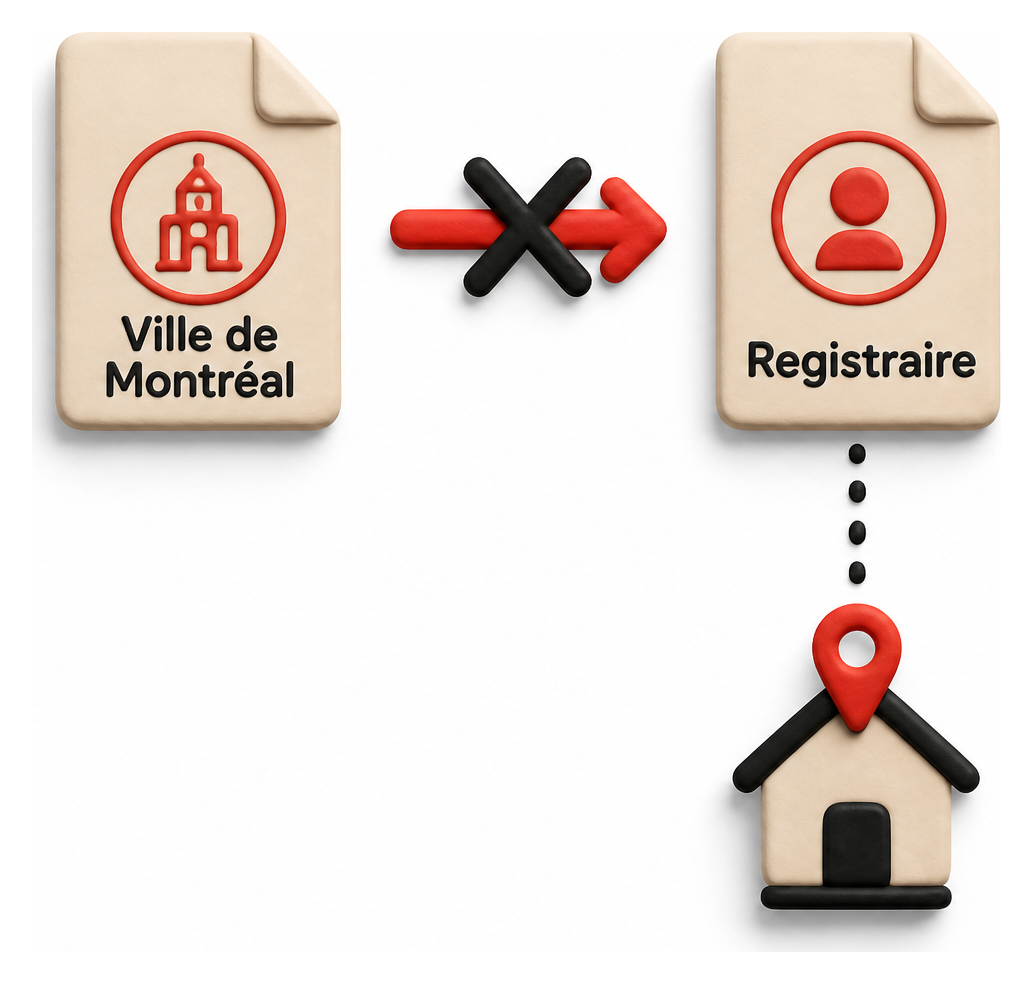
The occupancy certificate, as we saw in the previous section, is a City of Montreal requirement intended to enforce municipal zoning, a physical and territorial condition. Registration of a business with the Québec Enterprise Registrar (REQ) is a separate provincial requirement, described by the legal resource Éducaloi as a formality that most entrepreneurs must normally complete with the Enterprise Registrar to operate their business legally [19], and which is intended to officially identify the business and its representatives in a public register.
The REQ requires a business to declare an address in the register, and this requirement applies even when the business declares an elected domicile address rather than an actual physical establishment [20]. In fact, the threshold for a business to be considered to be carrying on activities in Quebec can be met simply by having an establishment or a post office box in the province [21], without necessarily involving physical premises that comply with zoning. A business with no business, residential or establishment address in Quebec must instead declare in the register an attorney who represents it in the province [20].
One point deserves particular attention: unlike the occupancy certificate, a post office box can never serve as a business address for the purposes of the enterprise register [7]. The register also requires businesses to declare the names and personal addresses of their shareholders and directors [22], but in return allows a replacement business address to be declared if the person concerned has one, to avoid publishing their residential address [7]. A business address is not a post office box: for a natural person, it corresponds to their principal place of work or business. Before declaring the address provided by a virtual office, you must therefore check that the plan, the business's legal form and the actual situation allow this declaration with the REQ.
Case law also confirms the specific nature of the address declared in the register: in a July 2024 decision, the Court of Appeal of Quebec examined whether the elected domicile appearing in the Québec enterprise register could, on its own, establish the Superior Court's territorial jurisdiction, a clarification that highlights that the address declared with the REQ is a formal legal registration concept, distinct from proof of an actual place of business [23]. In practical terms, an entrepreneur can therefore, in the same case, be fully compliant with the REQ while violating the municipal zoning by-law by carrying out a commercial activity at home without an occupancy certificate, and vice versa. The two procedures must be completed separately.
Virtual offices, business addresses and coworking: alternatives to a home office
For self-employed workers and small businesses wishing to avoid the floor area, separate entrance or signage constraints specific to a home office, or simply protect the privacy of their residential address, the Montreal market offers a range of business address and virtual office solutions. Such a service does not automatically make an address eligible to be declared as a business address with the REQ: you must confirm that the address corresponds to the information required for the person and legal form concerned. Nor does it replace the necessary municipal authorizations if the activity is actually carried out from a dwelling.
Several providers active in Montreal publicly advertise their prices:
- ECTO, a Montreal worker cooperative, offers a basic plan at $20 per month for members and $25 per month for non-members (Source: ecto.coop), and a higher-tier plan with document scanning at $40 (members) or $45 (non-members) per month (Source: ecto.coop).
- iQ Offices, operating from a downtown building, advertises a basic virtual office plan starting at $69 per month, including a business address and mail handling [9], with additional options such as a digital receptionist at $59 per month [9].
- Davinci Virtual offers an address in the same building starting at approximately $60 USD per month, with one-time setup fees [24], and explicitly states that the address can be used for a business licence, business cards and a website [24].
- Propulsio360 offers a plan starting at $69.99 per month (billed annually) or $79.99 per month on a month-to-month basis [25], and highlights using the address to receive official documents and as a head office in Quebec [25].
- Regus, a subsidiary of the international IWG group, advertises virtual office prices in Montreal starting at approximately $3 per day [26], including mail handling and telephone answering [26], while specifying that using the address for business registration remains subject to certain rules and regulations depending on the jurisdiction [26].
- WeWork advertises a business address at CA$129 per month, plus taxes and fees, on its page for Canada. The service is advertised in the United States and Canada, but the availability of an address in Montreal must be confirmed with the provider. WeWork states that the address can be used to register a business, subject to applicable laws, regulations and conditions [8].
Montreal's 2727 Coworking offering stands apart from this group through its business model: rather than selling a standalone mailing address, the business makes the commercial address a feature included in a physical workspace membership. Its entry-level plan, a shared workstation (“hotdesk”), is advertised at $300 per month, while an individual enclosed office is listed at $600 per month and an enclosed office accommodating up to ten people reaches $3000 per month. The membership includes free access to a conference room, which distinguishes this offering from the address-only plans described above, where access to a physical meeting room is generally charged extra or limited to a few hours per month.
Table 2 below summarizes these options.
| Provider | Advertised price | What is included | Declaration with the REQ |
|---|---|---|---|
| ECTO (cooperative) | $20 to $25/month (basic plan) | Commercial address, mail handling | To be confirmed with the REQ and the provider |
| iQ Offices | starting at $69/month | Business address, mail handling, high-resolution image | To be confirmed with the REQ and the provider |
| Davinci Virtual | ~$60 USD/month + setup fees | Business licence, business cards, website | To be confirmed with the REQ and the provider |
| Propulsio360 | $69.99 to $79.99/month | Receipt of official documents, head office | To be confirmed with the REQ and the provider |
| Regus | advertised starting at ~$3/day | Mail handling, telephone answering | To be confirmed with the REQ and the provider |
| WeWork | CA$129/month, plus taxes and fees; availability in Montreal to be confirmed | Business address, mail and parcel handling | To be confirmed with the REQ and the provider |
| 2727 Coworking | Included in the membership, starting at $300/month (not sold as a simple mailbox) | Physical workstation, freely accessible conference room, gigabit internet connection | To be confirmed with the REQ and the provider |
The table distinguishes plans centred on an address and mail handling from memberships that include a workspace. The included services, conditions for using the address and eligibility to declare it with the REQ must be confirmed with the provider and the REQ before subscribing.
Data and evidence
The available data place the Montreal home office within a broader context of changes in work and office real estate.
Remote work and business structure
According to the Institut de la statistique du Québec, approximately 35% of Quebec's workforce worked remotely in 2022, mainly on a hybrid basis [10], with rates reaching approximately 45% in the Outaouais and Montreal regions [10]. Statistics Canada, for its part, reports that 20.6% of Canada's working-age population worked exclusively from home in 2022 [27], a proportion that rose to 32.9% in the Québec City metropolitan area when workers who worked partly from home are included [28]. The professional, scientific and technical services sector, which most often supplies the consultants and self-employed workers likely to operate a home office, has an exclusive remote work rate of 39.6%, the highest of all sectors measured by Statistics Canada in 2024 [29].
The structure of Canadian businesses provides a separate indicator. In December 2025, Canada had 1.37 million businesses with employees and 3.67 million active location accounts without employees [11]. This category includes, among others, incorporated entities and businesses with annual revenues exceeding $30,000; it therefore measures neither the number of self-employed workers nor the number of home-based businesses. Canada's own-account worker rate had reached 11.1% of all employed people in 2020, at the height of the pandemic [30].
The flexible office and coworking market
The flexible office space market has developed alongside this rise in remote work and self-employment. According to Colliers, flexible office spaces now represent approximately 8% of Canada's total office inventory [12], and the global coworking market accounted for nearly 10% of office space leasing in major cities in 2022 [12]. A Quebec coworking operator, Hedhofis, illustrates this growth: launched in 2017 from a single location on Montreal's South Shore, it now has 10 locations in Greater Montreal and Québec City [12].
In Montreal specifically, CBRE notes that IWG, which owns the Spaces brand, operates more than 65,000 square feet of coworking space at its rue du Square-Victoria location [31], while WeWork's financial restructuring resulted in 60,000 square feet at its rue Sainte-Catherine Ouest location being put back on the market [31], a sign that Montreal's coworking sector remains in a phase of adjustment rather than simple linear growth. An estimate from market analysis firm Next Move Strategy Consulting values Canada's coworking space market at USD 285.1 million in 2023, with a projection of USD 893.0 million by 2030, representing a compound annual growth rate of 17.6% [32]; however, this is a projection from a commercial research firm, to be interpreted with the usual caution applied to market forecasts rather than as official data.
Table 3 summarizes these key indicators.
| Indicator | Value | Source |
|---|---|---|
| Share of Quebec's workforce working remotely (2022) | ~35% | Institut de la statistique du Québec |
| Remote work rate in the Montreal region (2022) | ~45% | Institut de la statistique du Québec |
| Canadian population working exclusively from home (2022) | 20.6% | Statistics Canada |
| Workers in Québec City (CMA) working exclusively or partly from home | 32.9% | Statistics Canada |
| Exclusive remote work, professional/scientific/technical services sector | 39.6% | Statistics Canada (2024) |
| Canadian businesses without employees (Dec. 2025) | 3.67 million | Statistics Canada |
| Share of flexible offices in Canada's office inventory | ~8% | Colliers |
| Canadian coworking space market (2023, estimate) | USD 285.1 million | Next Move Strategy Consulting |
These indicators describe different realities — remote work, business structure and flexible office offerings — at different dates and using distinct methods. They help put the subject in context, but demonstrate neither growth in the relevant population in Quebec nor a direct causal link with the supply of flexible spaces or business addresses.
Implications and outlook
Several structural trends suggest continued pressure on the current residential occupancy certificate system. First, the high proportion of businesses without employees, 3.67 million in Canada in December 2025 [11], combined with a Montreal remote work rate of around 45% [10], means that a growing number of Montreal residences host an economic activity, with or without a valid occupancy certificate. The boroughs, each of which manages its own permit counter, will have to contend with a structurally higher volume of applications than when remote work remained marginal.
Next, because fees and procedures may differ by borough, people considering a home office must check the information currently in effect for the borough concerned. Archived fee sheets alone cannot establish a current disparity or a lack of harmonization across the city.
Transparency rules allow a separate business address to be declared when the person has one, which can prevent their residential address from being published [7]. However, these rules alone cannot measure demand for virtual offices or predict how Montreal's flexible office market will evolve.
These trends align with similar findings observed among providers and real estate market observers. Virtual office providers themselves anticipate sustained demand for the business address function beyond simply receiving mail: Propulsio360 highlights using its address to receive official documents and as a head office in Quebec [25], while Davinci Virtual emphasizes that its Montreal address can be used for a business licence, business cards and a website [24]. In real estate, CBRE observes that Montreal's coworking market remains in a phase of adjustment, with spaces being put back on the market following operator restructurings [31], while a projection from Next Move Strategy Consulting anticipates sustained growth in Canada's coworking market through 2030 [32]. Finally, from a legal perspective, case law reminds us that the elected domicile appearing in the Québec enterprise register remains a registration concept distinct from an actual business presence [23], a nuance that will remain relevant as more entrepreneurs combine a virtual address with a home office.
Frequently asked questions
Is an occupancy permit required for a home-based activity in Montreal? Often, but you must check for the specific activity and address. The city states that a permit may be required to use part of a dwelling for professional purposes; however, permitted uses and conditions may differ by borough [1].
What is the maximum permitted floor area for a home office in Montreal? The city's general rule caps the section devoted to the activity at the smaller of the following two areas, 50 square metres or one-third of the dwelling's total area, but some boroughs impose additional conditions, such as the requirement for the operator to live on the premises in Le Sud-Ouest.
Does an occupancy permit cost the same everywhere in Montreal? No. The fee depends on the borough and the use category. Consult the municipal information sheet for the borough concerned and confirm the applicable amount before submitting the application.
Can I put up a sign for my home office? Rules vary by borough. Some local information sheets strictly limit the size or lighting of home office signs, but you must check the signage rules and whether a separate sign permit is required with the borough concerned.
Does the occupancy certificate replace registration of my business with the Québec Enterprise Registrar? No. These are two separate procedures: the occupancy certificate confirms compliance with municipal zoning, while registration with the REQ enters the business and its representatives in the provincial register [19].
Can I use a virtual business address instead of my residential address to register my business? Quebec law allows a business address separate from one's home address to be declared to avoid publishing one's personal address in the register [7], but a simple post office box can never be declared as a business address [7]. For a natural person, the business address must be their principal place of work or business; you must therefore confirm, case by case, that a virtual office address meets this requirement and is acceptable for the intended declaration.
How much does a virtual business address cost in Montreal? Advertised prices range from approximately $20 per month at ECTO (Source: ecto.coop) to CA$129 per month, plus taxes and fees, at WeWork; for the latter, the availability of an address in Montreal must be confirmed [8].
Conclusion
Operating a home office in Montreal involves dealing with two separate systems. On the one hand, the required municipal permit or certificate depends on the activity, address and borough rules; in particular, you must check permitted uses, physical conditions and the current fee. On the other hand, registration with the Québec Enterprise Registrar concerns the information to be declared in the register. A natural person can only declare a business address if it corresponds to their principal place of work or business; a post office box is not sufficient [7].
For the Montreal entrepreneur, the safest approach is to treat these two procedures as complementary rather than interchangeable: check with your borough's permit counter the precise floor area, separate entrance and signage rules applicable to your project, while separately confirming with the Enterprise Registrar the validity of the address you intend to declare. For those whose activity does not readily fit the constraints of a residential home office, whether because of the available floor area, the desire to protect the privacy of their address or the need for a physical location to receive clients, Montreal's market for virtual offices, business addresses and coworking spaces offers a range of solutions at various price points, each with its own trade-offs between cost, included services and physical presence.
External Sources (32)
About
2727 Coworking
Find a practical home for your work at 2727 Coworking in Montreal. Explore private offices, day workspaces and meeting rooms, plus business-address and virtual-mailbox services for your company.
2727 Coworking is a Montreal workspace and business-address provider. We serve people who need a place to focus, meet, run a small business or establish a professional mailing presence. Our website offers English and French information about workspace options and services, alongside educational resources for operating a business in Canada.
A workspace that fits the day
Our workspace options include private offices, day passes and desks, and a conference room. These formats help individuals and teams compare a dedicated office with more flexible ways to work or hold a meeting. Prospective members can explore the virtual tour, review current pricing and book a visit before choosing a workspace.
Business addresses and mail
2727 Coworking provides business-address and virtual-mailbox services. Our resources explain the documents and practical questions involved, including guidance for people outside Canada. Service eligibility, included features, availability and access arrangements should be confirmed on the applicable service page or with our team.
Resources for Canadian small businesses
We publish guides, research and planning tools about workspace decisions, business addresses and starting a business in Canada. Our incorporation research includes information for people inside Canada and abroad, with jurisdiction-specific material to help readers identify the next questions to investigate. These educational resources complement our workspace and address services; they are not individualized legal, tax or immigration advice.
Visit or contact 2727 Coworking
Explore private offices, day passes and desks, the conference room, business addresses and virtual mailboxes. Book a visit or contact the team to discuss your needs.
A business address alone does not establish tax residence, immigration status, banking approval or eligibility for a government program.
Disclaimer
This document is provided for informational purposes only. No representations or warranties are made regarding the accuracy, completeness, or reliability of its contents. Any use of this information is at your own risk. 2727 Coworking shall not be liable for any damages arising from the use of this document. This content was generated with assistance from artificial intelligence tools, which may contain errors or inaccuracies. Readers should verify critical information independently. All product names, trademarks, and registered trademarks mentioned are property of their respective owners and are used for identification purposes only. Use of these names does not imply endorsement. This document does not constitute professional or legal advice. For specific guidance related to your needs, please consult qualified professionals.