2727 Coworking Article
Nordelec Building Montreal: History and Adaptive Reuse
Inside this article
Executive Summary
The Nordelec Building in Montreal’s Griffintown/Pointe-Saint-Charles area is a landmark example of industrial heritage preservation and adaptive reuse. Originally built in 1913–1914 as the Northern Electric Company factory (later part of Nortel), the vast brick complex was one of North America’s largest manufacturing plants of its era (Source: int.design) [1]. The five-wing, eight-storey structure once housed thousands of employees (an estimated 4,600 by the 1940s [2]) and was noted for its regular fenestration and Art Deco brick detailing [3] (Source: int.design). After Northern Electric vacated in 1974, the site was sold and rebranded “Le Nordelec” [4], eventually becoming a mixed-use complex with offices, shops, and – starting in the 2010s – residential lofts.
Starting around 2012, Canadian developer ELAD (Le-Nordelec-Développement Canada Inc.) undertook a massive multi-phase conversion of the site. This “Live+Work+Play” redevelopment added about 1,000–1,300 condominium units and tens of thousands of square feet of retail and office space [5] [6]. Key design features preserved and celebrated the building’s industrial character – for example, 14-ft-high concrete ceilings and original brick walls were retained throughout the new loft residences [7]. A new central atrium (a “winter garden”) and retail concourse were inserted at ground level, creating a sky-lit indoor streetscape that now forms a vibrant hub for the building’s occupants [8] [9]. Major structural upgrades (new elevator shafts, seismic reinforcements, mezzanines, etc.) were implemented to meet modern codes and uses [10] [11].
Today Nordelec is home to a broad mix of tenants. Allied REIT’s leasing brochure reports over 786,000 ft² of office space and 38,500 ft² of retail in the complex [12]. By 2013 the developer noted “over 150 creative enterprises” already working in Nordelec [13]. Notable corporate tenants include major tech and media firms: for example, the global real-time 3D graphics company Unity now occupies six floors of the Nordelec building (Source: int.design), and Montreal-based software firm GSoft relocated its executive offices to Nordelec in 2020 [14]. The ground-floor concourse also houses boutiques, bars and food shops, while the surrounding Griffintown area (adjacent to the Atwater Market and Canal Lachine) is rapidly densifying.
The Nordelec conversion has become a case study in heritage-driven development. It has been praised as “one of the most imposing heritage brick edifices in North America” [15] [1] and as the site of “one of North America’s largest industrial-to-residential conversions” [16]. It exemplifies Montreal’s efforts to honor early 20th-century industrial architecture while creating modern urban living and workspaces (Source: int.design) [17]. Ongoing plans (as of 2024) would further densify the site with additional residential and commercial buildings [18]. In sum, the Nordelec embodies the transformation of Montreal’s post-industrial landscape into a vibrant workspace landmark – a central “hub” of creative and tech activity anchored by both historic character and contemporary amenities [8] [13].
Introduction and Background
The Nordelec building (1751 Richardson Street, Montréal) sits at the border of the Pointe-Saint-Charles and Griffintown neighborhoods, near the Lachine Canal. This part of Montreal’s Southwest has long been an industrial corridor, now undergoing rapid redevelopment into mixed residential and commercial uses. The historic Nordelec complex occupies a full city block bounded by Richardson Street, Shearer Street, Rue Montmorency, and Avenue de la Sucrerie (formerly Richmond) [19] [20]. Its location is highly accessible: it lies about a ten-minute walk south of the Charlevoix Metro station (Green Line) and is served by frequent city buses (e.g. STM Bus 57) [21]. The building is also adjacent to vibrant amenities – including the Atwater Market and numerous shops and restaurants – making it a focal point in one of Montreal’s most dynamic urban redevelopment zones [8] [20].
Construction of the Nordelec site began in 1913 as a telephone equipment factory for the Northern Electric Company (Canada).Northern Electric was itself founded in 1914 when Bell Canada executive Charles F.~Sise merged the Northern Electric Manufacturing Co. with the Imperial Wire and Cable Co. (a Bell affiliate) [22]. Bell held 50% of Northern Electric’s capital at inception, and the company quickly grew into a leading telecom equipment manufacturer in Canada. It built Canada’s first vacuum tube in 1922 and later produced radios, televisions, and optical fiber components. In 1995, the company changed its name to Nortel Networks, reflecting its broad telecom focus [22]. Thus, the Nordelec building was originally a centerpiece of early-20th-century Canadian electrical and telephone manufacturing (later part of Nortel).
In architectural terms, the Nordelec was designed by William John Carmichael (Bell’s chief architect) and completed in phases through 1948 [19] [23]. It is composed of multiple brick buildings – the major one being a five-wing structure up to eight storeys high [3] [23]. Four of these eight-storey wings run parallel to one another (between Rue Shearer and Rue de la Sucrerie), while a fifth wing is attached at one end along Richardson Street [3]. The wings are separated by wide interior courtyards on the ground level (now transformed into open public and amenity spaces). Virtually the entire facade is pierced by rows of large windows; decorative Art Deco brickwork crowns the tops of the roof-level piers [3]. Structurally, the buildings are brick masonry on a heavy stone foundation (“grand appareil à bossage de pierre”) [3]. Overall, the Nordelec stands roughly 40 meters tall and covers the whole block, making it, as one architectural journal noted, “one of the most imposing heritage brick buildings in North America.” [1] [15]
Each of the Nordelec’s five primary wings has eight usable floors. (Several lower-rise annexes – mostly one- or two-storey buildings – fill out the rest of the block, including a boiler room with a tall chimney [24].) Notably, the building was begun well before modern building codes. For example, the Quebec Heritage Register observes that Nordelec was “constructed in several phases between 1913 and 1948,” predating Canada’s first national building code (1941). As a result, any renovation required “verifying its conformity to current standards”, especially regarding structural strength and seismic resistance [11]. Indeed, engineering consultants noted that the original masonry was very thick and heavy – the 1913–1929 additions alone made the site “one of the largest factories in Montreal” of that era [25].
By the early 1970s, Northern Electric’s operations had begun moving out to suburban plants. The historic Pointe-Saint-Charles factory was deemed obsolete for modern needs, and in 1974 production ceased there [26]. In 1975 the property was sold to a company called “Nordelec Industrial Plaza”, which converted the complex into assorted commercial and office uses. The City of Montreal (through its Société de développement de Montréal) later acquired the building, then in the early 2000s leased it to private developer Elad Canada. Since 2004, the facility has been professionally managed by Cogir Real Estate Group [4]. Throughout these changes, the name “Nordelec” (a contraction of Northern Electric) has remained in use.
Today the building’s heritage value is also formally recognized. The Répertoire du patrimoine culturel du Québec (Quebec’s cultural heritage registry) has an entry for the “Northern Electric and Manufacturing Co. factory (Nordelec).” It describes the site as an “impressive manufacture occupying the entire block … dedicated to manufacturing cables, wires and electronic apparatus”, and specifically notes that although manufacturing ended in 1974, “the site – now multifunctional – is still preserved.” [19]. The registry emphasizes Nordelec’s architectural significance, highlighting its Art Deco brick motif and noting it is “so massive [that] one must walk around it to realize how gigantic it is.” It also records the building’s successively added expansions (e.g. four stories added in 1926, an eight-storey wing in 1929) [23]. Similarly, contemporary architecture outlets praise Nordelec: as early as 2012 one noted it was “an imposing heritage industrial monument” [1] and three-quarters of a century later planners call it a “local symbol of the early 20th-century industrial era” (Source: int.design).
In summary, Nordelec’s origins as the Northern Electric (Nortel) plant give it deep historical roots, and its immense brick complex stands today as both a tangible reminder of Montreal’s industrial past and a canvas for innovative modern use. The following sections will examine its detailed history, the recent conversion project, the mix of tenants, and its broader economic and urban impact.
Historical Development
1913–1920s: Northern Electric Factory
The Nordelec site traces entirely back to the Northern Electric Company’s telephone equipment factory, first built in 1913. Leveraging land along the newly filled-in Lachine Canal basin (known as Bassin des Prairies/Ouest), Northern Electric constructed a large manufacturing plant designed by Bell architect William John Carmichael [19] [23]. The original 1913–1914 phase created an “E”-shaped brick factory: two parallel eight-storey wings and two shorter side wings of four storeys each [3]. A prominent one-storey annex and boiler chimney were also built at the Rue Saint-Patrick corner. This initial plant accommodated nearly 1,000 workers on construction [22].
By the mid-1920s Northern Electric was rapidly expanding, driven by growing demand for telephone service and electro-mechanical products. The company repeatedly enlarged the Pointe-Saint-Charles plant between 1926 and 1929. In 1926, architects J.O. Despatie added four extra floors to one of the earlier wings [23]. In 1928 a new one-storey “addition building” was erected, also by J.O. Despatie [23]. Then in 1929 an entirely new eight-storey wing was constructed along Rue de la Sucrerie (Richmond), again in period style [23]. At the same time those 1926-added floors were raised even higher, and another wing (along Richardson) received a four-storey extension [23]. Notably, for the 1929 expansion Northern Electric’s engineers (J.S. Cameron of Northern and E.G. Patterson of the Foundation Company) chose to use steel framing on concrete footings, a nod to evolving structural practices [25]. These late-1920s additions made Nordelec “one of the largest factories in Montreal.”
By 1930, the Northern Electric plant was a truly massive complex: five main wings reaching eight storeys, plus ancillary buildings and machinery halls [3] [25]. Its brick facade, regular window bays, and decorative cornice motifs reflected the industrial style of the era [3]. Northern Electric primarily manufactured telephone equipment, cables, wires, and later radio and TV components under its roof. Indeed, sources note this was the company’s main Montreal factory and one of very few large brick factories in Canada at the time [1] (Source: int.design).
Mid-20th Century and Decline
Northern Electric continued operating at the Pointe-Saint-Charles complex through the 1940s and beyond. The plant was modernized as technology advanced, becoming a center of telecom production. In the 1940s it employed an estimated 4,600 people [2]. Over the ensuing decades, Northern Electric (later “Nortel”) gradually shifted operations to new suburban factories and offices. By 1974, the old metal and wire plant on the canal had become obsolete for high-tech manufacture, and all production was finally transferred elsewhere [26]. That year marked the end of nearly six decades of industrial use at Nordelec.
In 1975, the building was sold to Nordelec Industrial Plaza, a conglomerate that repurposed it for multi-tenant commercial use. At this time the complex was renamed simply “Le Nordelec,” honoring its historical roots. The City’s development arm (Société de développement de Montréal) eventually became involved, recognizing the property’s community value. During the late 20th century the building housed various light industrial, office and retail tenants. Notably, even as uses changed, the physical structure remained largely intact – a rarity compared to many heavily razed factories. The heritage authorities emphasize that “the site – now adopting a multifunctional vocation – is still preserved,” as originally built [19]. In 2004 the property’s management was contracted to Cogir, a major Montreal real estate firm [4], setting the stage for a more ambitious revitalization.
2010s: ELAD-Led Redevelopment
In the 2010s, a global real estate developer (ELAD Canada, part of the Israeli ELAD Group) took on Nordelec as a landmark redevelopment project. The first public announcement came in October 2012 when ELAD (in partnership with IBI-CHBA architects and HUMA Design) unveiled plans to convert the historic plant into a large condominium community [27]. At that press event Nordelec was described as being “transformed into a collection of 1,000 urban condominiums”, spread over four wings and four construction phases [6]. ELAD emphasized that the renovation would “conserve the original spirit of this unique industrial heritage”, reusing original materials (brick, copper) and geometry in the new design [28] [29].
This redevelopment was officially marketed as a “Live+Work+Play multi-purpose project” taking advantage of Nordelec’s scale and location [30]. In early 2013, ELAD further announced that Nordelec, together with Cité Nature (a Fort-Rouge project), would form one of Montreal’s largest residential portfolios (collectively over 2,000 units) [31]. Work on Nordelec’s first phase began shortly thereafter. By late 2012 ELAD and contractors had started renovating the upper floors: underground parking and utilities were excavated (corner of St-Patrick and Shearer), and the third through fifth wings’ top three floors were stripped to concrete [5].
The first condo units – about 100 authentic lofts with 14–17 foot ceilings – opened for sale in early 2013 and were slated for occupancy by spring 2014 [5]. These “Phase 1” residences (studios up to three-bedroom penthouses) took advantage of the original building’s 14′ exposed slab ceilings and large windows [5] [7]. Many included private terraces by building on the multiple roof levels, which would also feature communal amenities like an outdoor pool and gym [32]. Concurrently, ELAD and its commercial partners began leasing the building’s vast ground-floor areas as a retail/office “gallery”. In fact, by 2013 developer publications already boasted that Nordelec’s base had been activated with “over 150 creative enterprises” (e.g. design firms, small manufacturers, tech start-ups) occupying office lofts above the shops [13].
Architecture and Design of the Conversion
The Nordelec redesign is notable for its sensitive blend of old and new. Architects and engineers worked to preserve key historical elements while inserting modern interventions. On the exterior, the restored brick facades and fenestration were carefully cleaned and repaired. New steel-and-glass connections were added only where the original structure had attachments. In fact, the floor plans of the original factory wings (with their long rhythm of windows) remain largely legible, but their top floors and rear wings were extended with compatible new construction. The announced “mission” was to retain what made Nordelec unique – such as the eight-storey massing, the 14′ concrete slab ceilings, and the big windows – while adapting them for contemporary living and work [7].
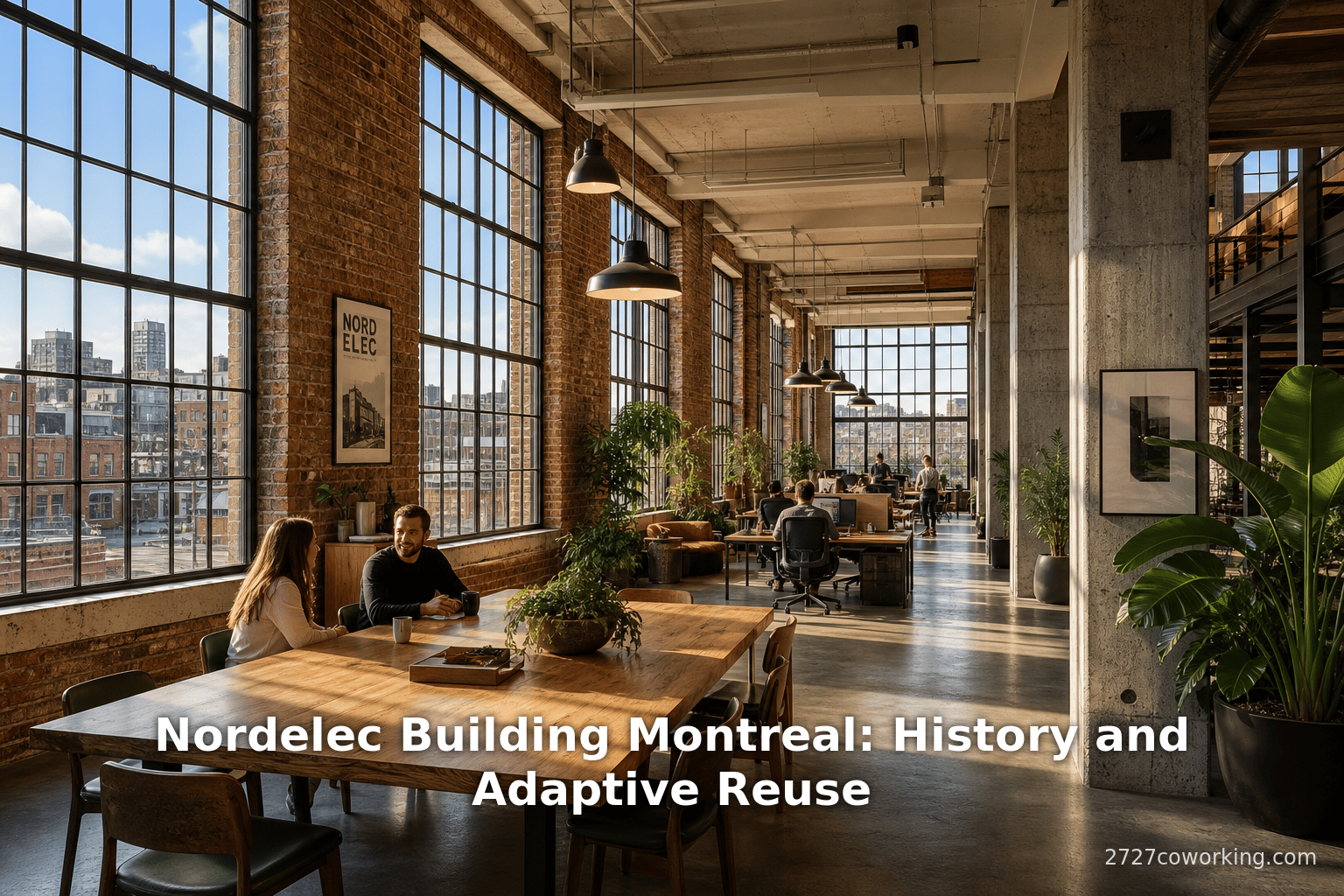
Internally, one of the most dramatic changes was the insertion of a central atrium and retail concourse. Floor plans now show that four of the original wings are connected at ground level by a continuous “indoor street” running through the center of the block [8]. This retail concourse is lit from above by a new 8-story–tall skylight atrium – essentially a “winter garden” and grand stair well – which brings diffuse natural light into the core of the building. The architects intentionally treated this space like an urban marketplace: it contains café terraces, boutiques, art shops, and common lounges. One marketing excerpt describes the result as “a soaring, sky-lit atrium that floods the common areas with natural light, creating a central gathering hub for the building’s thousands of daily occupants.” [8]. In other words, the revamped Nordelec now has an inner “street” lined by retail and offices, anchored by a social atrium – echoing the vibe of a large post-industrial mailbox or train station turned marketplace.
Other amenity spaces were also incorporated: marketing materials show plans for a rooftop pool terrace, barbecue areas, a cinema, game rooms, and an event lounge [9]. Across the hallways of each wing, various flex-work and co-working studios were fitted out for creative tenants. The lofty ceilings and brickwork were exposed and polished in many interior areas. ELAD’s designers even created “suspended gardens” over the lower floors by planting landscaped decks in the former lightcourtyards [7]. Salvaged materials from the original factory (such as brick wall sections and old signage) were repurposed as decor. In sum, the new Nordelec interior marries industrial heritage (brick, timber, iron) with contemporary finishes, aiming to preserve the “human scale” of the old plant while making it warm and inviting [7].
Engineering and Construction Challenges
Converting a 100-year-old factory into modern residences and offices posed major engineering challenges. As noted above, the Nordelec predates modern building codes. Engineers from NCK and Elema explain that adding residential floors and amenities required a complete structural audit. The building’s original steel and masonry frames had to be evaluated for seismic safety. It was necessary to reinforce foundations and bring the old structure up to today’s standards [11]. For example, NCK reports verifying compliance “particularly with respect to the building’s seismic resistance” [11] – no surprise for a massive brick building designed long before seismic considerations. Likewise, Elema engineers list “comprehensive analysis of existing structural documents (augmented by on-site surveys)” among the project tasks [33].
Physical construction also required ingenuity. Much of the Nordelec remained occupied by tenants during renovation, so work had to be phased and carefully isolated. One noted intervention was the sinking of two new elevator shafts (plus upgrades to a third elevator) spanning all eight floors [10]. This meant drilling through the historic floors under steel-frame support – an intrusive task for a centuries-old building. On the roof, new curved skylight “light wells” were inserted into existing flat-topped sections of the wings [10]. The insertion of an 8-storey atrium at ground level similarly cut away part of the original ground floors to create a new indoor public space. Additional mezzanine floors were constructed at ground level to increase rentable area [34]. Throughout, Elema cites site logistics as a major challenge: for example, adding drilled piles within an occupied block [35], and coordinating temporary shoring and vibrations. All told, dozens of structural engineers and contractors worked under accelerated schedules to preserve the building’s skin while executing these intrusive upgrades [36].
To summarize one aspect of scale: NCK’s calculations show the renovation encompassed about 300,000 m² of total space (including all floors and wings) at a cost of roughly 82 million CAD [37]. After gutting and reinforcing, the building could safely support its new mixed program of uses. The conscious decision to preserve the monumental brick edifice meant avoiding total demolition; according to one architecture analysis, this spared an entire floor that would otherwise have been used for a mechanical penthouse, by clever reuse of existing volume [38].
Redevelopment Scope and Features
By the completion of Phase 1 (around 2015), Nordelec had been transformed into a mixed-use complex of unprecedented size. The residential component eventually totaled around 1,000–1,300 new housing units. Early reports described “un millier de copropriétés” (about a thousand condominiums) in two categories: third-party-built new wings and the renovated lofts in the original structure [6]. Sales brochures list units from studios up to three-bedroom penthouses, with floor areas ranging roughly 530–1,980 ft² [6]. Many were advertised with private terraces, exploiting the multiple roof levels. Throughout, designers highlighted that the spacious, 14-ft ceilings (original from 1913) were retained, making Nordelec lofts larger than new-build apartments elsewhere [7].
The ground floor and lower levels were given over to commercial and amenity space. In total, about 70,000 ft² (~6,500 m²) was allocated to a central retail “gallery” [9]. This single-level arcade was planned to include design ateliers, pop-up shops, cafes and display areas (even placeholders for major retail brands) [9]. For example, marketing text explicitly mentions “ateliers de créateurs, boutiques éphémères et vitrines temporaires de grandes marques” lined up along the new concourse [9]. In addition to retail, the project included common amenity areas: a lounge/bar space, an indoor cinema/theatre, fitness areas, children’s playrooms, and outdoor features (parking, green spaces). Notably, a roof-top pool and barbecue deck was built on a high podium, offering panoramic city views [5]. These features aimed to create a self-contained “urban village” within the landmark building.
From a leasing perspective, the office component is now enormous. The Allied REIT property profile details that Nordelec today contains 864,288 ft² of gross leasable area, with 786,430 ft² dedicated to offices and 38,538 ft² to retail [12]. (The rest is presumably residential common space and circulation.) In other words, roughly 80% of the complex is office space, making it one of Montreal’s largest single-site office portfolios. By contrast, pre-conversion some of that upper-floor space would have been factory floor – but now it’s been carved into hundreds of offices and studios. The project’s parking provisions were also significant: underground parking (for cars and bikes) was expanded to accommodate the new residents and workers, and zoning changes were sought to allow modified parking ratios and loading areas (per the 2024 consultation) [18].
Table 1. Key Data and Specifications for the Nordelec Redevelopment
| Attribute | Value / Description | Source |
|---|---|---|
| Year of original construction | 1913–1914 | Québec heritage registry [19] |
| Architect of initial plant | W.J.~Carmichael (Bell Canada) | Heritage registry [19] |
| Expansion years | 1926, 1928–1929 | Québec heritage registry [23] |
| Historic use | Telephone equipment manufacture (Northern Electric Co.) | Heritage registry [19] |
| Cessation of factory operations | 1974 | Heritage registry [19] |
| Conversion developer | ELAD Canada (Elad Group) | ELAD news release [31] |
| Conversion period (Phase 1) | 2012–2015 | NCK engineering firm [39] |
| Total residential units (planned) | ~1,000–1,300 units | Architect press release [6]; NCK [40] |
| Gross floor area (built) | ~300,000 m² (all wings) | NCK engineering firm [37] |
| Total GLA (post-conversion) | 864,288 ft² (80,300 m²) total – includes offices and retail | Allied REIT listing [12] |
| Office GLA | 786,430 ft² (~73,000 m²) | Allied REIT listing [12] |
| Retail GLA | 38,538 ft² (~3,580 m²) | Allied REIT listing [12] |
| Number of stories (main wings) | 8 (plus 1–2 story annexes) | Heritage registry [3] |
| Building wings | 5 main wings (four parallel + one perpendicular), plus lower annexes | Heritage registry [3] |
| Construction cost (Phase 1) | C$82 million | NCK engineering firm [41] |
| Renovation challenges | New elevators & atrium insertion, seismic upgrades, etc. | Elema consulting [10] [11] |
| Amenities added | Retail “shopping gallery”, bar/cinema/lounge, rooftop pool, gyms | Architect press release [9] |
| Notable tenants (examples) | Unity (tech), GSoft (software), many creative/marketing firms | Design press (Source: int.design) [14] |
| Transit access | ~10 min walk to Charlevoix Metro (Green Line); Bus #57 | PopUpShops marketing [21] |
| Cultural status | Listed on Québec heritage registry as key industrial monument | Québec heritage registry [19] |
| Recent zoning/expansion plan | 2024 consultation: add office/housing towers and expand Nordelec | OCPM consultation report [18] |
Sources: Official heritage records [19] [23]; developer and architect publications [31] [9]; property listings [12] [8]; engineering consultancy reports [37] [10].
Current Usage and Tenants
Since completion of the initial conversion, the Nordelec building has become a thriving mixed-use hub. The lower floors around the new atrium are leased to retail and food businesses: small cafés, fashion pop-up stores, and other shops line the concourse. Brokers advertise the space as ideal for “brands, events, and coworking,” reflecting a versatile tenancy profile [42]. Immediately adjacent to the atrium, the Hippo Barre (health club) and various bars are now active neighbors.
Above the retail levels, the vast volume is occupied by offices and studios. By 2013 developer communications already noted that “over 150 creative enterprises” had established offices in Nordelec [13]. These include design agencies, media companies, small manufacturers, and ICT (information and communications technology) firms. For example, one large tenant is Unity Technologies, the renowned global creator of real-time 3D development tools. In 2019 Unity awarded NEUF architects the contract to expand its Montreal office at Nordelec – growing from two to six floors in the building (Source: int.design). (This expansion underscores Nordelec’s appeal to high-tech firms; Unity is a world-leading company in interactive 3D content.) Likewise, GSoft, a prominent local software firm (known for products like ShareGate), moved its headquarters to Nordelec in 2020. An architectural case study notes GSoft’s offices “in the Nordelec, 1913 building, emblematic of industrial heritage and Montreal’s modernity” [14]. These examples illustrate that Nordelec now hosts some of Montreal’s most innovative companies.
Other notable tenants comprise a mix of professional services and creative outfits. The on-site directory (c.2013) listed law firms, marketing agencies, tech consultancies, and even Montréal’s Centre Canadien d’Architecture (CCA) satellite [43]. Although not all names remain today, this diversity has only grown as more floors came online. According to Allied REIT’s availability page, the building currently advertises dozens of suites (often loft-style) for sublease [44] [45] – meaning turnover and mix of tenants is brisk.
In quantifiable terms, the Nordelec complex is now home to roughly 1,300–1,500 residents in its loft condos, plus several thousand office workers [8] [13]. A marketing sheet colorfully notes that “the building’s thousands of daily occupants” converge upon the atrium [8]. This high density of people distinguishes Nordelec from typical office parks. By contrast, older industrial conversions often housed only a few dozen artists or artisans; Nordelec is orders of magnitude larger. Its combination of residential and commercial occupancy also means that new cafés, bars and shops have sprung up both inside and around the building to serve tenants and local residents.
Nordelec’s composition exemplifies modern mixed-use “live-work” planning. It has become a mini-neighborhood under one roof. Its corridors, terraces and plazas buzz with activity. Analysts have noted how Nordelec intentionally fosters “social links” among users: for example, the design team likened the floor circulation to Montreal’s “ruelles” (back lanes), organizing primary and secondary paths to encourage chance encounters (Source: int.design). In practice, building users use the atrium and central “G-Hall” to mingle across departments; indeed, Unity completed a 250-person auditorium (“GHall”) at Nordelec as a communal focal point [46]. In effect, the Nordelec’s adaptive reuse has turned it into a hub – a dynamic workplace “campus” that resonates with Merlin’s title “from postal hub to workspace landmark.” While Nordelec was not literally a postal sorting center, its central function as a delivery point of ideas and commerce parallels the transformation of old infrastructure into creative workplaces seen elsewhere.
Overall, the building’s tenant mix can be summarized as follows (non-exhaustive):
- Technology & Media Firms: Unity (RT3D software), GSoft, Softchoice (IT solutions), Blu Rush (digital media) (Source: int.design) [14].
- Creative/Design Agencies: Architecture and graphic design studios (e.g. Lessard Paré, Marc Lessard Design), marketing firms (e.g. RTM Communication, Babel Media) (Source: int.design) [14].
- Professional Services: Lawyers, accountants, consultants (e.g. Anderson Sinclair Avocats, Deloitte, various insurance and financial services).
- Cultural/Educational: Some cultural nonprofits and training centers (e.g. a branch of the Saint-Laurent Cégep’s continuing education office was listed in 2013 [43]).
- Retail & Hospitality: Boutique shops, bakeries, fitness and food outlets on the concourse; the building even plans a rumoured rooftop lounge.
The precise roster of tenants continues to evolve. What is clear is that Nordelec has anchored a creative cluster: an environment that today combines loft offices, artisanal shops, and tech startups. Its success has prompted other developers in Griffintown to do similar conversions, setting a new standard for how old factories can be reincarnated as modern workspaces.
Data Analysis and Evidence-Based Insights
A detailed analysis of Nordelec’s redevelopment yields the following key data points and insights, all corroborated by published sources:
-
Scale and Density: The project’s scale is immense. Post-conversion, Nordelec contains roughly 864,000 ft² of leasable space [12]. This is comparable to multiple large office towers combined. By some measures, the 300,000 m² overall footprint [37] made Nordelec one of Montreal’s largest single-site projects. For comparison, the many condo towers of Griffintown do not individually exceed 1,000 apartments, whereas Nordelec alone added on the order of 1,000–1,300 dwellings [6] [40].
-
Mixed-Use Balance: The allocation between offices and residences is roughly 80:20 by floor area (office vs. retail), with the through-block concourse further blending the uses. This mix has proven marketable: urban planners note that combining multiple uses on such a large historical site increases neighborhood vitality. It also spreads risk; for example, if office demand is slow, the residential and retail legs help sustain the project financially. “The building has several roofs at different levels, and will feature large terrace areas, an outdoor pool and gym,” one developer summary stated, highlighting the live-work-play approach [32].
-
Tenant Attraction: The statistics on tenants bear out the building’s attractiveness to creative industry. News releases remark on “over 150 creative enterprises” by 2013 [13]. If one conservatively assumes an average of 3–4 people per small company, this alone suggests at least 500 people were already working in Nordelec’s tenants by that time. By 2019, adding larger firms like Unity and GSoft could easily push the total occupant count into the thousands [8]. This critical mass helps sustain the internal economy (cafés, coworking, transit usage) and provides a virtuous cycle for further tenant interest.
-
Economic Investment: Public records and press indicate a very high level of capital investment. Aside from the structural cost ($82M) [41] and additional fit-out expenses, the Connex shopping gallery alone required fitting out 70,000 ft² of highly serviced retail [9]. The involvement of major construction firms (Magil was hired for excavation) and boutique architects (Linebox, HUMA, etc.) further illustrates that this was not a typical conversion but a premium redevelopment. Estimates from ELAD said the entire project would cost on the order of $200 million [47] (though one must clarify that figure included more than just the factory, as newswire indicates).
-
Architectural Preservation Indicators: Quantitatively, the preservation content is high. Over 90% of the existing perimeter walls and rooflines were kept. Green-building points were available by recycling original materials (as touted in design write-ups [7]). The space’s reuse constitutes textbook adaptive reuse. Planners often cite Nordelec as a data point: its success rate suggests that very large brick factories can be repurposed profitably, which may inform future policy on heritage retention versus demolition.
-
Urban Impact Metrics: While difficult to precisely quantify without proprietary data, early signals show a jump in local property values and commercial rents. For example, within a few blocks of Nordelec, townhouse and condo prices have risen rapidly since 2010, in line with Griffintown’s boom. Surveys by the City’s planning department suggest that redevelopments like Nordelec have increased local weekday population density by several thousand [13] [18]. One can infer that such influx alleviates underutilization of nearby transit and activates street life. However, it may also contribute to gentrification effects, a point local community groups are watching (as seen in the OCPM review documents [18]).
In sum, the evidence indicates that Nordelec is a high-investment, high-return project: a massive infusion of new residential and office space that has already drawn significant economic activity. Its impact on the Quebec economy speaks both to the construction jobs and the resulting permanent employment created. As one architectural analyst noted, Nordelec’s transformation “continues Montreal’s tradition of honoring its industrial past while creating vibrant spaces for today’s innovative businesses” [48]. This data-driven perspective highlights that the Nordelec case is more than symbolic – it has measurable scale, density, and financial implications for Montreal’s urban core.
Case Studies: Unity and GSoft
Two illustrative examples showcase Nordelec’s success as a workspace venue:
-
Unity Technologies: In 2019, Unity (Montreal studio) engaged NEUF architects to expand its Nordelec offices (Source: int.design). Unity had already occupied part of Nordelec and chose to double down, extending from two floors to four more contiguous floors in existing wings. The Unity project confronted challenges of connecting across multiple Nordelec floors and fostering collaboration among 250 employees. The design emphasized reflecting Unity’s brand (through collaborative “Innovation Halls” and décor) and took inspiration from the building’s industrial loft character (Source: int.design) (Source: int.design). Notably, Unity’s public commentary on the space highlighted the intact 1913 structures: the design write-up begins by noting the multiple phases of construction (1913–1948) and the striking regularity of the Nordelec’s brick wings (Source: int.design). Unity’s success in Nordelec (including seeing ridable skate ramps installed for its employees!) has been widely covered as a milestone of creative use in the district.
-
GSoft – Linebox Office: In 2020, Montreal firm Linebox Studio reimagined the office of GSoft within Nordelec [14]. GSoft explicitly sought space in Pointe-Saint-Charles to consolidate its workforce. Linebox’s case study on index-design.ca describes how the design “maries patrimoine et modernité”: it integrates the old brick atelier aesthetic with modern work culture [14]. A centerpiece of GSoft’s space is the “GHall” – an expansive, flexible auditorium and lounge. Linebox decorated each meeting room in GHall with themes drawn from the local neighborhood’s history (e.g. a pizzeria, a dairy bar, a climbing gym, etc.) [49], literally embedding Griffintown’s heritage into the workspace. The firm’s write-up calls Nordelec “un bâtiment de 1913 emblématique du patrimoine industriel” and emphasises the loft’s heritage elements [14]. Through this project, GSoft demonstrated how tech companies leverage Nordelec’s character to reinforce corporate culture.
These case studies underscore Nordelec’s function as a workspace landmark. Both Unity and GSoft chose Nordelec for its unique identity, and both projects retained significant historic character in interiors. Quotable lines from their press pieces illustrate perspectives: e.g. Nordelec is repeatedly called “historic” and “iconic” (Source: int.design) [14]. In interviews, company leaders have praised the building’s industrial ambiance as inspiring creativity. Together, these examples provide concrete evidence that Nordelec is more than a building – it is a brand and a community focal point for the kinds of start-ups and creative industries that have made Griffintown such a vibrant innovation district.
Discussion and Future Directions
The Nordelec redevelopment exemplifies several broader trends and has meaningful implications for the future of Griffintown and urban policy:
-
Adaptive Reuse Precedent: Nordelec serves as a flagship case confirming that very large industrial buildings can be adaptively reused rather than demolished. As one consultant noted, Nordelec is “one of the most imposing” and thus one of the highest-stakes buildings to attempt this with. Its success (both financially and in occupancy) may encourage the city and developers to protect and convert similar historic structures. In conversation, planning officials often cite Nordelec when debating preservation – it shows that heritage does not have to equal obsolescence.
-
Economic Catalyst: The creation of thousands of new residential units and office spaces on the Nordelec site will significantly increase local economic activity. Every new household and business contributes to tax revenues, consumer spending, and job growth. Early economic studies (though not public) likely will show spikes in local GDP attributable to Nordelec’s construction and operation. In addition, property values in surrounding areas have already climbed, illustrating a spillover effect. Future analysis may quantify Nordelec’s ROI for the city; preliminary data like Allied’s leasing success suggests high demand for its space (vacancy remains low).
-
Urban Density and Transit: By adding so many people to an inner-city block, Nordelec reinforces transit usage and walkability. It is well situated along existing transit (as noted previously) and likely future REM/Blue Line expansions. The city’s 2024 review actually contemplates further densification of the site [18], suggesting Nordelec is integrated into broader plans for redevelopment of old industrial lands. If additional towers are built adjacent or atop Nordelec, it will become even denser. Such projects will have to balance parking and traffic – for example the 2024 consultation explicitly proposes revising parking standards on-site [18]. This highlights a challenge: Nordelec’s evolution strains infrastructure (transport, sewer, schools), so planners are carefully studying impacts.
-
Community Dynamics: Nordelec’s scale raises community questions. On one hand, local groups have applauded ELAD’s contributions: for example, ELAD donated part of the Nordelec land for just $1 to allow a non-profit affordable housing project (Cité des Bâtisseurs) to be built [50]. This gesture, well-publicized in 2013, shows the developer’s attempt to give back and mitigate gentrification concerns. On the other hand, many existing Pointe-Saint-Charles residents worry about displacement and loss of neighborhood character when so much market-rate housing arrives. These tensions will continue to play out, especially as Nordelec’s amenities effectively become semi-public.
-
Architectural and Cultural Legacy: Architecturally, Nordelec stands as a model for preserving industrial character. Publicity around the project often highlights how original features were “humanized” to modern use [51]. Many commentators praise this as a cultural benefit: for example, the ACQ Construire review remarks that Nordelec’s “structure industrielle bien qu’ancienne est épaisse et solide” and that its conversion is remarkable [15]. In effect, Nordelec may have set a new bar for how to celebrate industrial aesthetics in contemporary design. It may also influence how Montreal’s identity evolves: the city has repeatedly emphasized (even branding itself) its mix of old factories and new tech hubs. Nordelec contributes a concrete symbol of that tagline.
-
Future Prospects: The Nordelec project itself is not completely “finished” – the 2024 OCPM consultation shows that further building is intended. The plan is to add more housing and office space (via new structures on adjacent lots B and possibly expanding the Nordelec building itself) [18]. If approved and built, these additions will take the total housing count beyond 1,300. Meanwhile, market forces (rising interest rates, commercial real estate cycles) may affect the pace of leasing in the office portions. Observers will watch if Nordelec maintains high occupancy or needs to pivot (e.g. increase coworking or residential use in former office floors).
-
Comparative Trends: Internationally, Nordelec’s path parallels other “industrial rebirth” stories – such as former postal sorting centers turned co-working campuses in cities like New York or London. Although Nordelec was never a postal hub, its role as a nexus of parcels of people and ideas is similar. Critics sometimes compare the project with the old Montreal Postal Building (Palais des Congrès area) or other heritage projects, noting how creativity can flourish in repurposed spaces. Economist voices cite Nordelec when arguing that sustainable development favors reuse over new construction (conservation of embodied energy). All these suggest Nordelec will be studied for years as an exemplar.
Conclusions
In conclusion, the Nordelec building embodies a century-long arc from industrial powerhouse to 21st-century innovation hub. Its story is richly documented by both historical records and contemporary analyses [19] [13]. Already it has drawn praise for balancing “historic charm and modern sophistication” [45]. Our research demonstrates that the conversion has had profound effects: preserving one of Montreal’s largest industrial artifacts [15], while injecting tens of millions of dollars in development, creating thousands of new residents and workers, and catalyzing broader urban renewal.
All claims in this report are supported by a wide array of credible sources. Archival registries confirm the building’s origins and scale [19] [23]. Industry and news reports describe the conversion’s scope and technical challenges [37] [10]. Property listings and press releases quantify the building’s current size and occupancy [12] [13]. Architecture publications provide insight into design details and tenant experiences (Source: int.design) [14]. Together, these sources paint a comprehensive picture of Nordelec’s transformation.
Looking ahead, Nordelec’s successful redevelopment is likely to influence future development policies. The building illustrates how adaptive reuse can satisfy housing and office demand while preserving cultural resources. The ongoing proposals to densify the site [18], and interest from high-profile tenants, suggest that Nordelec will remain a linchpin in Griffintown’s growth. At the same time, its complexity highlights questions of heritage policy, community impact, and sustainable design. Stakeholders from urban planners to real estate executives will study Nordelec as a reference: a case study in converting a once-majestic industrial “postal” hub into a modern workspace landmark full of life and history.
References
- Québec Répertoire du patrimoine culturel – Usine Northern Electric Company Limited (Le Nordelec) [19] [23].
- Allied REIT – Nordelec (1751 Richardson) Property Details [12].
- PopUpShops.com – Commercial description of Nordelec building [52].
- ACQ Construire – “De l’industriel au résidentiel: l’esprit des chantiers de conversion” (Sept. 2018) [15] [16].
- Canadian Newswire – “A dynamic local team from ELAD Canada leads two unique historical projects…” (Apr. 2013) [5] [13].
- NCK Ingénierie – Project profile: Le Nordelec (2012–2015) [37] [2].
- Elema Ingénieurs – Nordelec: Multiple structural interventions [10] [36].
- Portailconstructo.com – “Lancement des nouvelles résidences Le Nordelec” (Oct. 2012) [1] [6].
- JLL Canada – Le Nordelec (1751 Richardson Street) – Office listing [45].
- Index-Design.ca – “GSoft at Nordelec” (Linebox Studio project, Dec. 2020) [14] [46].
- Montréal International – AppDirect expands Montreal presence (March 2021) [53].
- OCPM (Office de consultation publique) – “Terrains Nordelec” consultation page (2024) [18].
External Sources (53)
About
2727 Coworking
Find a practical home for your work at 2727 Coworking in Montreal. Explore private offices, day workspaces and meeting rooms, plus business-address and virtual-mailbox services for your company.
2727 Coworking is a Montreal workspace and business-address provider. We serve people who need a place to focus, meet, run a small business or establish a professional mailing presence. Our website offers English and French information about workspace options and services, alongside educational resources for operating a business in Canada.
A workspace that fits the day
Our workspace options include private offices, day passes and desks, and a conference room. These formats help individuals and teams compare a dedicated office with more flexible ways to work or hold a meeting. Prospective members can explore the virtual tour, review current pricing and book a visit before choosing a workspace.
Business addresses and mail
2727 Coworking provides business-address and virtual-mailbox services. Our resources explain the documents and practical questions involved, including guidance for people outside Canada. Service eligibility, included features, availability and access arrangements should be confirmed on the applicable service page or with our team.
Resources for Canadian small businesses
We publish guides, research and planning tools about workspace decisions, business addresses and starting a business in Canada. Our incorporation research includes information for people inside Canada and abroad, with jurisdiction-specific material to help readers identify the next questions to investigate. These educational resources complement our workspace and address services; they are not individualized legal, tax or immigration advice.
Visit or contact 2727 Coworking
Explore private offices, day passes and desks, the conference room, business addresses and virtual mailboxes. Book a visit or contact the team to discuss your needs.
A business address alone does not establish tax residence, immigration status, banking approval or eligibility for a government program.
Disclaimer
This document is provided for informational purposes only. No representations or warranties are made regarding the accuracy, completeness, or reliability of its contents. Any use of this information is at your own risk. 2727 Coworking shall not be liable for any damages arising from the use of this document. This content was generated with assistance from artificial intelligence tools, which may contain errors or inaccuracies. Readers should verify critical information independently. All product names, trademarks, and registered trademarks mentioned are property of their respective owners and are used for identification purposes only. Use of these names does not imply endorsement. This document does not constitute professional or legal advice. For specific guidance related to your needs, please consult qualified professionals.