

2727 Coworking Article
Coût du coworking ou d’un bail de bureau à Montréal (2026)
Inside this article
- 01Coût du coworking ou d’un bail de bureau à Montréal (2026)
- 02Introduction et contexte
- 03Location traditionnelle de bureaux à Montréal
- 04Coworking et espaces de travail flexibles à Montréal
- 05Bureaux virtuels : une troisième option moins coûteuse
- 06Comparaison des caractéristiques
- 07Rendement et données de référence
- 08Analyse des données et éléments probants
- 09Études de cas et exemples concrets
- 10Conséquences et perspectives d’avenir
- 11Foire aux questions (FAQ)
- 12Conclusion
Coût du coworking ou d’un bail de bureau à Montréal (2026)
Sommaire
Les petites entreprises et les entreprises en démarrage qui évaluent leurs options de bureaux à Montréal en 2026 font face à un écart de coûts considérable entre un abonnement de coworking et un bail commercial traditionnel, et les données recueillies pour ce rapport mettent cet écart en évidence. Le taux global d’inoccupation des bureaux à Montréal s’établissait à 18,0 % au deuxième trimestre de 2026, son plus bas niveau depuis le T2 2023, selon la société immobilière commerciale CBRE [1], tandis que Cushman & Wakefield évaluait ce taux à 17,9 % pour le même trimestre, avec un loyer brut demandé moyen global de 36,59 $ le pied carré [2] [3]. Les locaux de catégorie AAA du centre-ville, dans les tours de prestige, se louent à prix supérieur, les loyers nets demandés allant de 33,00 $ à 42,00 $ le pied carré [1], et les loyers bruts y atteignant 66,11 $ le pied carré [3].
Dans ce contexte, les exploitants d’espaces de coworking à Montréal vendent l’espace par poste plutôt que par pied carré, et leurs tarifs publiés représentent une fraction du coût d’un bail traditionnel une fois additionnés le loyer, les améliorations locatives, le mobilier et un engagement de plusieurs années. 2727 Coworking, un exploitant de Griffintown, affiche un poste flexible / hot desk pour une personne à 300 $ par mois et un poste attitré à 450 $ par mois, les deux comprenant les services publics, Internet haute vitesse et l’accès 24/7. Les exploitants concurrents proposent des tarifs dans une fourchette comparable, détaillée dans la comparaison des caractéristiques plus loin dans ce rapport : Crew Collective & Café, dans le Vieux-Montréal, ainsi que Spaces et Regus, qui appartiennent tous deux à International Workplace Group (IWG), vendent tous des postes au mois ou à la journée, bien que les marques d’IWG exigent des contrats de forfait d’accès de plusieurs années pour obtenir leurs tarifs journaliers publiés les plus bas. Pour les entreprises qui ont uniquement besoin d’une adresse professionnelle plutôt que d’un poste de travail, les forfaits de bureau virtuel à Montréal coûtent environ 50 $ à 95 $ par mois chez des fournisseurs comme Crew Collective, Davinci Virtual et Alliance Virtual Offices [4] [5].
Un scénario illustratif de coût total construit à partir de ces sources montre pourquoi l’écart est si important. Un bail traditionnel portant sur environ 750 pieds carrés pour une équipe de cinq personnes au loyer brut demandé moyen du centre-ville de Montréal, combiné à un coût d’aménagement ponctuel que Cushman & Wakefield évalue à 190,28 $ le pied carré à Montréal [6] et amorti sur une durée de bail habituelle de trois à dix ans [7], revient à environ 900 $ à 1 000 $ par personne par mois avant l’ajout du mobilier, des TI et des frais administratifs, soit bien au-delà de la fourchette de 300 $ à 675 $ par poste en coworking. Cet écart dans les besoins en capital, conjugué à une sous-utilisation structurelle des espaces (le taux moyen d’utilisation des bureaux à l’échelle mondiale n’est que de 54 %, contre une cible de 79 %, selon JLL [8]), explique pourquoi les espaces flexibles sont devenus une stratégie d’implantation par défaut pour des employeurs allant des entreprises en démarrage à Shopify et à la Banque Royale du Canada [8], et pourquoi JLL prévoit que 30 % des espaces de bureaux seront utilisés de manière flexible d’ici 2030 [8]. Ce rapport passe en revue le marché montréalais des baux traditionnels, les solutions de coworking et de bureau virtuel, une grille comparative des tarifs, un modèle illustratif du coût total d’occupation et des cas concrets à Montréal, dont l’ouverture en 2025 du pôle d’innovation Ax.c de 100 000 pieds carrés [9] et la vente forcée de Notman House en 2024 [10], afin de fournir aux décideurs montréalais une base entièrement documentée pour choisir entre le coworking et un bail.
Introduction et contexte
Choisir où installer une équipe à Montréal est devenu une décision véritablement quantitative. D’un côté, il y a le bail commercial traditionnel de bureaux : un engagement juridique de plusieurs années, un budget d’aménagement et une relation avec un propriétaire. De l’autre, il y a le coworking, un modèle dans lequel un exploitant loue ou possède un immeuble, l’aménage une seule fois et revend l’accès à des postes de travail, à des bureaux privés et à des salles de réunion selon des modalités flexibles, souvent au mois. Une troisième option, le bureau virtuel, élimine complètement le poste de travail physique et ne propose qu’une adresse professionnelle et la gestion du courrier. Ce rapport compare le coût réel et documenté de chaque option à Montréal en date de juillet 2026, et répond aux questions pratiques que se pose réellement un fondateur, un responsable de bureau ou un responsable des finances : combien coûte un poste par mois, combien coûte un bail lorsque l’aménagement et sa durée sont pris en compte, quels sont actuellement les taux d’inoccupation et les loyers sur le marché, et quelle place occupe le bureau virtuel pour une entreprise qui n’a aucunement besoin d’un poste physique. Les lecteurs qui ne veulent qu’un seul chiffre devraient retenir ceci : les postes en coworking à Montréal commencent à moins de 500 $ par mois, tout compris, tandis que le scénario illustratif de bail traditionnel modélisé plus loin dans ce rapport revient à environ 877 $ par personne par mois avant l’ajout du mobilier, des TI et des frais administratifs.
Le moment compte. Le marché montréalais des bureaux absorbe une transformation structurelle depuis 2023, le travail hybride ayant réduit la superficie dont les entreprises ont besoin par employé, même si le taux d’inoccupation publié est demeuré élevé. Les chiffres de CBRE pour le T2 2026 établissent le taux d’inoccupation des bureaux de la région métropolitaine de Montréal (GMA) à 18,0 %, bien que la société précise qu’en excluant les locaux « stagnants » offerts depuis longtemps, le taux ajusté descend à 12,4 % [1], signe que les locaux utilisables et concurrentiels sont moins disponibles que ne le laisse croire le chiffre publié. Le suivi d’Avison Young pour le T2 2026 montre que le taux de disponibilité total de la GMA est descendu à 17,9 %, poursuivant une tendance au resserrement depuis 18,4 % au T1 2026 [11], et Altus Group rapporte indépendamment que le taux de disponibilité de Montréal a reculé de 50 points de base pour atteindre 16,9 % au cours du même trimestre [12]. Parallèlement, le télétravail recule : Statistique Canada a constaté que la proportion de Canadiens travaillant principalement à domicile est descendue à 17,4 % en mai 2025, soit une quatrième baisse annuelle consécutive, tandis que les déplacements vers un lieu de travail physique ont augmenté pour atteindre 82,6 % [13]. Davantage de gens ont de nouveau besoin d’un poste de travail, mais moins d’entreprises souhaitent signer le bail de dix ans que signaient leurs prédécesseurs. Ce rapport s’articule autour de trois options : la location traditionnelle, le coworking et les bureaux virtuels, suivis d’une comparaison directe des caractéristiques et des tarifs, d’un modèle illustratif de coût total, d’une section de données de marché couvrant les taux d’inoccupation et les loyers par sous-marché, d’études de cas montréalaises nommées et de perspectives d’avenir. Chaque chiffre est accompagné d’une référence à la page où il a été vérifié, afin que le lecteur puisse comparer directement le chiffre actuel à la source. Parmi les exploitants de coworking présentés figure 2727 Coworking, un espace de Griffintown situé sur le canal de Lachine que ce rapport traite de la même façon que tous les autres exploitants : avec ses véritables tarifs publiés et sans angle promotionnel.
Location traditionnelle de bureaux à Montréal
Fonctionnalités
Un bail commercial traditionnel donne au locataire le contrôle exclusif à long terme d’un espace défini, généralement sous la forme, au Québec et ailleurs au Canada, d’un bail net, où le locataire paie un loyer de base ou « net », plus un loyer additionnel couvrant sa quote-part des frais d’exploitation du propriétaire, des taxes foncières et de l’entretien des aires communes [7]. Un document d’introduction du secteur immobilier montréalais décrit le loyer additionnel comme « les sommes payables par le locataire visant à rembourser le locateur » pour ces frais partagés [14], et le loyer additionnel est généralement facturé selon la quote-part du locataire dans la superficie de l’immeuble [15]. Les baux commerciaux peuvent aussi prendre la forme de baux bruts, double nets ou triple nets, selon le nombre de ces catégories de coûts que le propriétaire regroupe dans un seul loyer annoncé ou facture séparément [7]. Pour une entreprise qui prévoit occuper la même superficie pendant des années, cette structure offre une adresse stable, un contrôle complet sur l’aménagement et l’image de marque, et la possibilité de créer un environnement permanent, sécurisé et réservé à un seul locataire. Dans un marché où le taux d’inoccupation est élevé, les propriétaires ont aussi tendance à offrir des incitatifs aux locataires, comme des périodes de gratuité du loyer ou des allocations d’améliorations supérieures à la norme, bien que ces avantages varient selon l’immeuble et soient rarement annoncés publiquement, ce qui explique en partie pourquoi les loyers nets effectifs peuvent différer sensiblement des loyers demandés publiés cités tout au long de ce rapport.
Adoption
Les employeurs de plus grande taille et mieux établis demeurent les principaux utilisateurs des baux traditionnels à Montréal, particulièrement dans les tours de catégorie AAA et A, où les loyers nets demandés allaient de 33,00 $ à 42,00 $ le pied carré au T2 2026 [1]. Les immeubles de catégorie A et B du centre-ville avaient enregistré trois trimestres consécutifs d’absorption nette positive à l’approche du T2 2026, preuve que les locaux de qualité continuent d’être activement loués même si le marché global présente une inoccupation excédentaire [1]. Le loyer net demandé global de la GMA s’établissait à 19,79 $ le pied carré au T2 2026 selon les chiffres publiés de CBRE [16], tandis que le chiffre comparable d’Avison Young pour le T2 2026 était de 20,19 $ le pied carré [11], un écart modeste typique de la façon dont les différentes sociétés de courtage pondèrent leur échantillon d’immeubles suivis. L’adoption se polarise aussi selon le niveau de qualité : Avison Young décrit un marché « de plus en plus polarisé » entre les locaux haut de gamme et les locaux ordinaires, la contraction de la sous-location étant « la plus marquée dans les immeubles de prestige et de catégorie A » [17], ce qui signifie que les locataires ayant les moyens de louer des locaux de premier ordre se disputent une offre qui diminue, tandis que les locaux de catégorie B et C, de qualité inférieure, du secteur Midtown demeurent vacants, l’absorption nette négative s’y concentrant [3]. L’écart entre les locaux haut de gamme et les locaux ordinaires se creuse depuis plusieurs années, et pas seulement ce trimestre : les données d’Avison Young pour le T3 2025 montrent que l’écart entre les loyers nets demandés moyens des immeubles de prestige et de catégorie A est passé de 4,78 $ à 11,32 $ le pied carré depuis 2022 [18], signe que les locataires sont de plus en plus prêts à payer davantage pour les tours les plus récentes, au détriment de la demande pour les immeubles de catégorie A plus anciens. Cette réévaluation des prix est allée si loin que les loyers de catégorie A en banlieue dépassent maintenant ceux de catégorie B du centre-ville de 0,55 $ le pied carré [18], ce qui signifie que les immeubles plus anciens du centre-ville, autrefois le choix par défaut pour maîtriser les coûts, ne constituent plus automatiquement l’option la moins chère sur le marché.
Forces et limites
La principale force de la location traditionnelle est le contrôle : une entreprise obtient un espace dédié qu’elle peut aménager à son image, sans commodités partagées et sans être exposée à la croissance ou au roulement d’un autre locataire. Sa principale limite est sa structure de coûts et son manque de souplesse. Un bail commercial au Québec engage généralement le locataire pour trois à cinq ans, et parfois jusqu’à dix ans [19], un guide pour petites entreprises d’une banque canadienne confirmant que les durées initiales « vont de trois à dix ans » [7]. En plus de cet engagement de plusieurs années, le locataire doit financer son propre aménagement : le guide des coûts d’aménagement 2026 de Cushman & Wakefield établit le coût total d’aménagement des bureaux à Montréal à 190,28 $ le pied carré, contre 201,17 $ l’année précédente [6], tandis que la référence plus large de JLL pour l’Amérique du Nord révèle que les coûts moyens d’aménagement atteignent 295 $ le pied carré pour un espace de qualité moyenne dans 50 villes, les coûts canadiens ayant augmenté de 3 à 4 pour cent en 2026 seulement [20]. Un document d’introduction à l’immobilier montréalais souligne sans détour que, pour de nombreuses entreprises, « le bail est la dépense la plus importante après les salaires des employés » [14]. C’est précisément cette structure fixe et exigeante en capital que le coworking et les bureaux virtuels visent à éviter, et c’est aussi pourquoi les locaux loués sous-utilisés sont devenus un problème visible sur le marché : l’étude comparative mondiale de JLL sur la planification de l’occupation a constaté que les entreprises réduisent leurs superficies à une moyenne de 132 pieds carrés par personne, contre 165 pieds carrés par personne auparavant [21], les locataires cherchant à réduire les coûts fixes auxquels ils sont liés.
Coworking et espaces de travail flexibles à Montréal
Fonctionnalités
Les exploitants de coworking vendent le même produit de base, soit un poste de travail ou un bureau, sous une forme qui retire l’engagement du bail et la facture d’aménagement des charges du client. L’exploitant assume une seule fois le coût en capital de l’espace et revend l’accès par poste, par mois ou par jour. À Montréal, les offres vont des postes flexibles / hot desks en aire ouverte aux bureaux entièrement privés et verrouillables pour des équipes de dix personnes ou plus. 2727 Coworking, à Griffintown sur le canal de Lachine, affiche un poste flexible / hot desk pour une personne, un poste attitré pour une personne et des bureaux privés fermés pour des équipes d’une à dix personnes, dont les tarifs complets figurent au tableau 1 ci-dessous ; ces abonnements regroupent les services publics, Internet et les commodités communes dans les frais d’abonnement plutôt que de les facturer séparément. La page de visite virtuelle de l’exploitant décrit des bureaux privés entièrement meublés pour des équipes d’une à dix personnes, ainsi que des postes flexibles / hot desks, des postes attitrés et des salles de conférence dotées d’équipement audiovisuel, avec des commodités comprenant des douches et l’accès 24/7.
D’autres exploitants montréalais utilisent une structure tarifaire semblable, mais des montants différents. Crew Collective & Café, installé dans un ancien immeuble bancaire patrimonial du Vieux-Montréal, affiche un « poste flexible » (accès à un poste non attitré / hot desk) à 300 $ par mois, un poste attitré avec accès 24/7 à 675 $ par mois, et des bureaux privés à partir de 6 000 $ par mois [22]. Spaces, la marque d’IWG destinée aux entreprises en croissance, annonce un poste attitré à partir de 11 $ par personne par jour et des bureaux pour petites équipes à partir de 119 $ par personne par jour à son emplacement du square Victoria [23], ainsi qu’un « forfait de coworking tout accès » proposant 5 ou 10 jours d’accès par mois, ou un accès illimité, partout au Canada et dans le réseau mondial élargi d’IWG [23]. Regus, l’autre marque d’IWG à Montréal, propose un poste attitré à partir de 8 $ par personne par jour et l’accès journalier au coworking à partir de 49 $ par personne par jour [24], bien que les tarifs de ses postes attitrés et de ses forfaits d’accès soient explicitement fondés sur des contrats de 24 mois [24], ce qui réduit l’avantage de souplesse par rapport aux exploitants proposant des abonnements au mois. iQ Offices, près de la Gare Centrale au centre-ville de Montréal, ne publie pas ses tarifs de postes ou de bureaux privés en ligne, mais affiche un accès par laissez-passer journalier à partir de 99 $ par jour [25].
Adoption
Les espaces de travail flexibles ont largement dépassé le stade d’un produit de niche destiné aux travailleurs autonomes. Les données de JLL sur les bureaux au Canada au T2 2026 montrent que le volume national de location a augmenté de 28,3 % sur un an, même si le taux d’inoccupation demeurait près de 18 %, et attribuent à Montréal, avec Vancouver et Edmonton, une contribution à la baisse du taux national d’inoccupation de 30 points de base, à 17,7 % [26]. Pour la superficie de bureaux flexibles, Montréal se classe deuxième parmi les principaux marchés canadiens avec environ 1,8 million de pieds carrés, derrière les 4,5 millions de Toronto, mais devant Vancouver, Calgary et Ottawa [8], et IWG, la société mère de Regus et de Spaces, est le plus grand exploitant d’espaces flexibles au Canada selon le nombre d’emplacements [8]. L’adoption ne se limite pas aux petites entreprises : JLL souligne que de grands employeurs comme Shopify et la Banque Royale du Canada donnent à leur personnel accès à des réseaux d’espaces de coworking haut de gamme plutôt que de s’appuyer uniquement sur un siège social unique [8], et que des multinationales comme Stripe et TikTok utilisent des suites de bureaux flexibles comme stratégie d’implantation par défaut dans de nouvelles villes [8]. JLL précise toutefois que les espaces flexibles occupent encore une part minoritaire au sein de la plupart des grandes organisations : seulement 3 % des grandes entreprises utilisent des espaces flexibles pour plus de 10 % de leur portefeuille immobilier, et 42 % des organisations y affectent 1 % ou moins de leur effectif [8], ce qui signifie que ce sont encore principalement les petites entreprises, les entreprises en démarrage et les équipes satellites, plutôt que les sièges sociaux, qui alimentent la demande quotidienne de postes de travail à Montréal.
Forces et limites
La principale force du coworking est de transformer un engagement fixe en capital sur plusieurs années en une dépense d’exploitation variable au mois, l’aménagement, le mobilier, les services publics, Internet et la réception étant intégrés au tarif de l’exploitant. La couverture de cette évolution par la presse spécialisée décrit directement l’arbitrage : « Les loyers et les frais d’occupation sont moins élevés, mais les nouveaux environnements procurent les avantages » des commodités partagées et des modalités flexibles [27], ce qui contribue à la croissance de 17 % de la superficie du secteur du coworking sur l’ensemble de 2025 décrite dans le même article [27]. La limite est qu’une entreprise partage un immeuble, et parfois un étage, avec d’autres locataires, exerce moins de contrôle sur son image de marque et son aménagement à long terme, et peut être exposée à la stabilité financière de l’exploitant lui-même. Ce risque n’est pas hypothétique à Montréal : WeWork a fermé sept emplacements canadiens en 2024 pour se libérer de baux non rentables, selon les recherches de JLL sur les espaces flexibles [8], tandis que les exploitants utilisant des modèles de partenariat et d’entente de gestion peu exigeants en actifs, comme IWG et Industrious, ont poursuivi leur expansion pendant la même période [8], une différence structurelle de résilience qu’un futur membre devrait soupeser en plus du prix.
Bureaux virtuels : une troisième option moins coûteuse
Fonctionnalités
Un bureau virtuel est un service qui fournit à une entreprise une adresse postale professionnelle, la gestion du courrier et parfois la réponse aux appels, sans aucun poste de travail. La définition de Wikipédia le présente comme un service d’espace de travail flexible qui permet à une entreprise d’obtenir des fonctions de bureau « sans que ces entreprises assument les dépenses en capital liées à la propriété ou à la location d’un bureau traditionnel » [28]. Il s’adresse généralement aux « travailleurs autonomes et aux petites entreprises qui n’ont pas besoin d’un espace de bureau traditionnel ou n’ont pas les moyens de se le permettre » [28]. En pratique, cela signifie qu’une entreprise inscrit une véritable adresse municipale, plutôt qu’une adresse résidentielle, dans ses déclarations publiques et sa correspondance, reçoit et fait réacheminer son courrier à partir de cette adresse et bénéficie, dans la plupart des forfaits, d’un nombre déterminé d’heures d’accès par mois à un bureau privé ou à une salle de réunion.
Adoption
Montréal compte plusieurs fournisseurs actifs. Crew Collective & Café vend un forfait d’adresse de base de type case postale à 50 $ par mois et un « forfait de services complets » permettant d’établir le domicile de l’entreprise à 80 $ par mois [22]. Davinci Virtual affiche un emplacement précis à Montréal, au 1200, avenue McGill College, au tarif promotionnel de 95 $ par mois (en dollars américains), plus des frais d’activation uniques de 50 $ [4], dans une gamme plus large de forfaits au Québec commençant autour de 95 $ US/mois, plus des frais d’activation réduits [29] ; son forfait montréalais comprend la réception du courrier et des colis avec une boîte aux lettres verrouillable sur place [4], avec des options de réacheminement du courrier, comme le réacheminement hebdomadaire, facturées séparément à 50 $ par mois [4]. Alliance Virtual Offices annonce sur sa page promotionnelle que ses forfaits montréalais « commencent à seulement 79 $ par mois » [5], bien que la page de son emplacement montréalais précis affiche ce forfait d’entrée de gamme à 79 $ par mois, plus des frais d’activation uniques de 200 $ [30], un écart à signaler lorsqu’on compare les annonces promotionnelles au prix réellement payé à la commande. L’emplacement montréalais d’Alliance propose aussi, dans ses forfaits supérieurs, un service optionnel de réceptionniste répondant en direct, notamment un « forfait Platinum Plus avec réceptionniste répondant en direct » [30], ce qui illustre que les tarifs de bureau virtuel dépassent largement le forfait d’entrée de gamme limité à l’adresse dès qu’on ajoute la réponse aux appels par une personne. Regus vend aussi une offre de bureau virtuel à Montréal, avec des tarifs « à partir de 3 $ par jour » au bas de la gamme pour une simple adresse professionnelle [31], jusqu’à son forfait « Virtual Office Plus », qui ajoute un numéro de téléphone local ainsi que des services de gestion et de transfert des appels à l’adresse professionnelle [31] ; Regus précise que son forfait de base limité à l’adresse exclut explicitement les services de réponse aux appels [31] et propose des options de réacheminement du courrier ponctuelles, hebdomadaires ou mensuelles moyennant des frais supplémentaires [31].
Forces et limites
Pour un fondateur travaillant seul, un consultant ou un exploitant de commerce électronique qui n’a pas besoin d’un accès quotidien à un poste de travail, un bureau virtuel peut constituer une option moins coûteuse pour la gestion du courrier et une adresse postale professionnelle, souvent bien en deçà de 100 $ par mois. Il ne remplace pas nécessairement une adresse résidentielle et ne constitue pas forcément une adresse admissible à l’enregistrement pour toute entité ou déclaration ; confirmez d’abord le forfait du fournisseur et les exigences québécoises applicables en matière d’immatriculation et de fiscalité. Sur le plan fonctionnel, un bureau virtuel ne fournit aucun espace de travail ; une entreprise qui a besoin de rencontres en personne, de collaboration en équipe ou d’un endroit pour prendre des appels à l’extérieur du domicile peut donc avoir besoin de laissez-passer journaliers ou d’un abonnement de coworking.
Comparaison des caractéristiques
Le tableau 1 ci-dessous compare les tarifs et les modalités publiés des exploitants montréalais étudiés pour ce rapport, 2727 Coworking étant inclus sur la même base que ses concurrents, selon ses véritables tarifs d’abonnement plutôt qu’un tarif horaire, puisque 2727 regroupe les services publics et l’accès dans des frais mensuels fixes au lieu de facturer à la journée.
| Fournisseur | Quartier | Poste flexible / hot desk / accès journalier | Poste attitré | Bureau privé (entrée de gamme) | Contrat / durée |
|---|---|---|---|---|---|
| 2727 Coworking | Griffintown | 300 $/mois, poste flexible / hot desk | 450 $/mois | 600 $/mois, 1 personne | Abonnement, services publics et Internet inclus dans le forfait, sans facturation horaire |
| Crew Collective & Café | Vieux-Montréal | 300 $/mois, poste flexible | 675 $/mois | 6 000 $/mois | Abonnement |
| Spaces | Square Victoria (centre-ville) | À partir de 8 $/personne/jour [23] | À partir de 11 $/personne/jour | À partir de 119 $/personne/jour, bureau pour petite équipe | Forfaits d’accès de 5 ou 10 jours/mois, ou accès illimité |
| Regus | Plusieurs emplacements au centre-ville | À partir de 49 $/personne/jour | À partir de 8 $/personne/jour | Prix sur demande | Contrat de 24 mois pour les postes attitrés et les forfaits d’accès |
| iQ Offices | Rue Metcalfe (centre-ville) | 99 $/jour, laissez-passer journalier [25] | Non publié | Non publié | Prix sur demande |
| Bureau virtuel (adresse seulement) | Divers | S. O., aucun poste inclus | S. O. | 50 $ à 95 $/mois pour l’adresse et la gestion du courrier [4] | Confirmer les modalités du fournisseur et si le forfait précis répond aux exigences québécoises d’immatriculation et de fiscalité de l’entité |
La tendance qui se dégage est que les tarifs par poste en coworking chez les exploitants montréalais se regroupent dans une fourchette de 300 $ à 700 $ par mois pour les postes flexibles / hot desks et les postes attitrés, les coûts des bureaux privés augmentant de façon à peu près linéaire selon l’effectif. Les marques d’IWG (Regus et Spaces) proposent des tarifs inférieurs à cette fourchette lorsqu’ils sont exprimés à la journée, mais exigent des engagements de plusieurs mois ou années dans des forfaits d’accès pour obtenir leurs tarifs publiés les plus bas, ce qui réduit leur avantage de souplesse par rapport aux exploitants proposant des abonnements au mois, comme 2727 Coworking et Crew Collective & Café. Les bureaux privés entièrement fermés présentent les plus grands écarts entre exploitants, de 600 $/mois pour une seule personne chez 2727 Coworking à un prix d’entrée de 6 000 $/mois dans l’immeuble patrimonial de Crew Collective dans le Vieux-Montréal, ce qui reflète des différences de prestige de l’emplacement et de caractère de l’immeuble plutôt que des différences dans le poste de travail lui-même.
Rendement et données de référence
Pour rendre l’écart de coûts concret, cette section construit un scénario illustratif du coût total d’occupation pour une équipe de cinq personnes qui choisit entre un bail traditionnel au centre-ville de Montréal et un abonnement de coworking, en utilisant uniquement les chiffres documentés recueillis ci-dessus. Il s’agit d’une illustration modélisée, et non d’un devis provenant d’une source unique, et les coûts à Montréal varient selon l’immeuble précis et les modalités négociées.
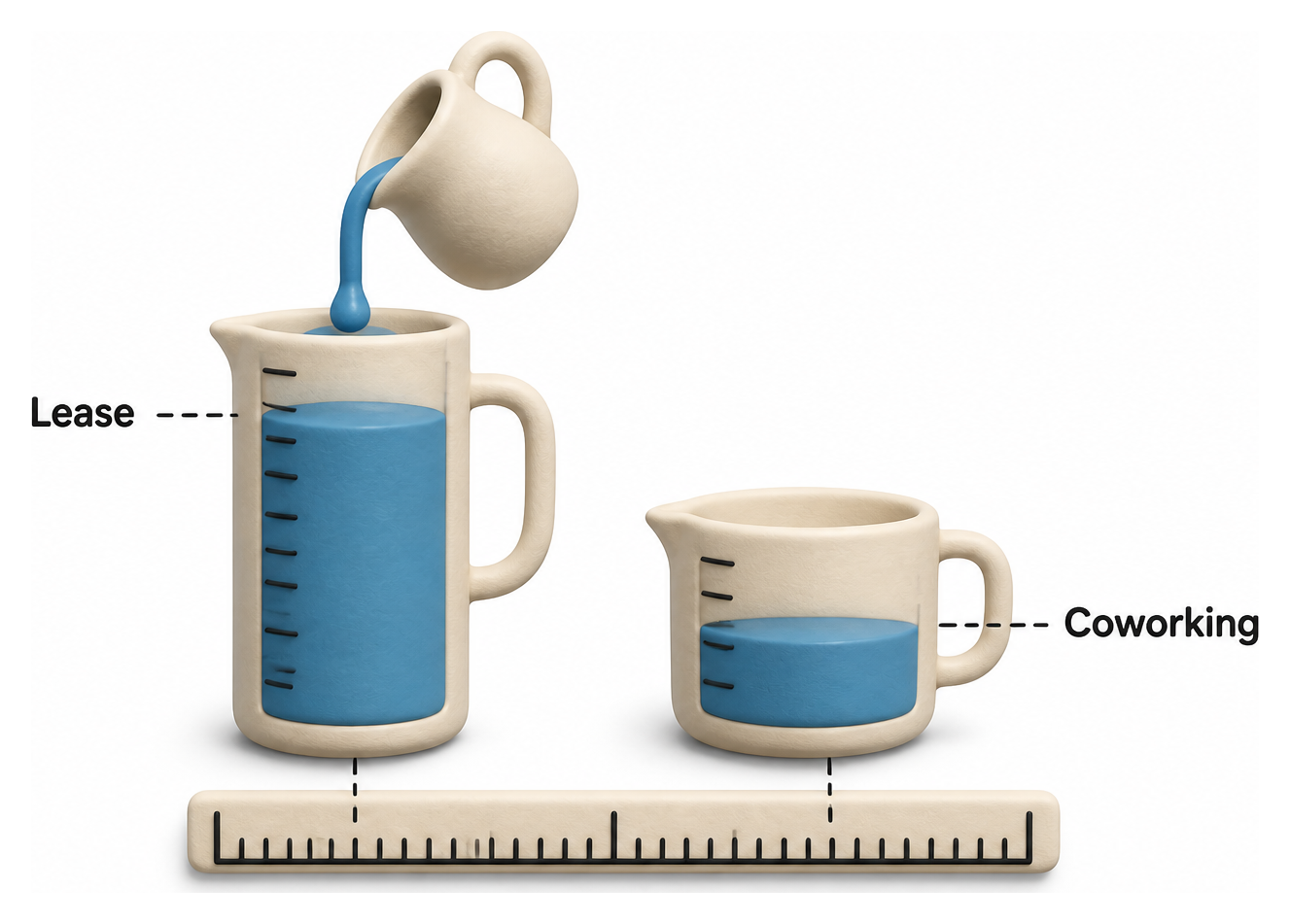
Le tableau 2 compare les deux options par personne et par mois.
| Composante du coût | Bail traditionnel (illustratif, centre-ville de Montréal) | Coworking (2727 Coworking, poste attitré) |
|---|---|---|
| Coût d’occupation de base | Le loyer brut demandé moyen du secteur central du centre-ville, de 41,62 $/pi²/an [3], pour environ 150 pi²/personne, ce que laisse entendre la référence de JLL sur la diminution de la superficie par personne [21], revient à environ 520 $/personne/mois | 450 $/personne/mois, tout compris |
| Aménagement ponctuel, amorti | Le coût d’aménagement montréalais de 190,28 $/pi² [6], amorti sur une durée habituelle de 5 ans, représente environ 450 $ à 480 $/personne/mois | 0 $, assumé par l’exploitant |
| Services publics, Internet, chauffage, ventilation et climatisation | Généralement facturés dans le loyer additionnel, séparément du loyer de base [7] | Inclus dans le tarif d’abonnement (voir le tableau 1) |
| Engagement minimal | 3 à 10 ans [7] | Abonnement mensuel |
| Coût mensuel total approximatif par personne | 950 $ à 1 000 $ et plus, avant le mobilier, les TI et les frais administratifs | 450 $, tout compris |
Même en tenant compte de l’imprécision inhérente à tout modèle illustratif, l’écart est structurel plutôt que marginal : il découle du fait qu’un exploitant de coworking amortit son propre coût d’aménagement sur de nombreux locataires et plusieurs années, tandis qu’un seul locataire titulaire d’un bail amortit l’ensemble de la facture d’aménagement uniquement sur son propre effectif et la durée de son propre bail. Les coûts de réaménagement des immeubles montréalais plus anciens peuvent être encore plus élevés pour les locaux nécessitant une modernisation importante, Avison Young citant des « coûts d’aménagement haut de gamme atteignant 150 $ le pied carré » comme facteur dans l’équation économique actuelle du réaménagement [18], en plus du loyer de base. Le guide d’aménagement de JLL distingue lui-même un « aménagement structuré (traditionnel), axé sur les postes attitrés, les bureaux privés et les salles de réunion fermées » comme modèle de construction plus exigeant en capital que les aménagements ouverts et flexibles [32], ce qui correspond essentiellement à l’aménagement que réalise un locataire titulaire d’un bail et qu’un exploitant de coworking vend par unités. La comparaison omet aussi un coût que les locataires sous bail traditionnel assument souvent, contrairement aux membres d’un espace de coworking : le stationnement. Le stationnement sur rue dans Ville-Marie, l’arrondissement du centre-ville, coûte 4,25 $ l’heure en date de février 2026 [33], une vignette mensuelle de stationnement pour résidents à Griffintown coûte 120 $, taxes comprises [34], et un garage commercial privé du centre-ville comme Alexis Nihon facture 230 $ à 320 $ par mois pour le stationnement réservé [35], des coûts qui s’ajoutent à tout modèle d’occupation choisi par une entreprise, mais qui sont plus susceptibles d’être négociés dans les frais fixes d’un immeuble de coworking.
Un deuxième scénario, à plus petite échelle, illustre la même dynamique pour une personne travaillant seule. Un travailleur autonome qui a uniquement besoin de la gestion du courrier peut obtenir un forfait à partir de seulement 50 $ par mois avec le forfait de case postale de Crew Collective & Café, ou à environ 95 $ par mois chez Davinci Virtual, sans poste de travail inclus. Avant d’utiliser un forfait à des fins d’immatriculation ou de fiscalité, le travailleur autonome devrait confirmer que le service précis est autorisé pour son entité et sa déclaration. Le passage à un poste flexible / hot desk avec un véritable accès à un espace de travail commence à 300 $ par mois chez plusieurs exploitants montréalais, comme le montre le tableau 1, soit un supplément d’environ 250 $ par mois par rapport à une simple adresse pour pouvoir réellement s’installer et travailler dans un espace partagé où les commodités sont incluses. Pour un fondateur travaillant seul qui hésite entre le travail à domicile, un bureau virtuel et un poste flexible / hot desk, le coût marginal du passage d’une adresse virtuelle à un véritable accès à un espace de travail est faible par rapport au coût de tout bail traditionnel, qui, de façon réaliste, ne propose aucune option en deçà de plusieurs centaines de pieds carrés et d’un engagement de plusieurs années.
Analyse des données et éléments probants
Les données sous-jacentes du marché montréalais des bureaux expliquent à la fois le niveau de coût de la location et la croissance des espaces flexibles. En matière d’inoccupation, les sources convergent vers un taux publié dans la tranche haute des dix et quelques pour cent au milieu de 2026 : CBRE a rapporté 18,0 % pour le T2 2026 [1], Cushman & Wakefield a rapporté 17,9 % pour le même trimestre, attribuant cette légère hausse au fait que « plusieurs grands occupants ont libéré des locaux, tandis que les immeubles haut de gamme du centre-ville ont continué de se démarquer » [3], et Altus Group a établi le taux de disponibilité en baisse à 16,9 %, soulignant aussi « une réduction notable des sous-locations actives » [12], liée en partie à des projets de conversion comme celui de l’immeuble Du Canal [12]. Les locaux offerts en sous-location, un indicateur avancé de difficultés, diminuent : CBRE a enregistré une baisse trimestrielle de 12,4 % de la superficie vacante offerte en sous-location dans la GMA, à 1,4 million de pieds carrés [1], et Avison Young a constaté que les locaux offerts en sous-location ne représentaient plus que 10,9 % de la disponibilité totale au T1 2026, leur plus faible part depuis 2021 [17]. Une partie de ce resserrement est structurelle : plus d’un million de pieds carrés de bureaux désuets à Montréal ont été convertis ou démolis depuis 2023 [17], et 1,5 million de pieds carrés supplémentaires de locaux de catégorie B et C ont été retirés par la conversion de bureaux en logements jusqu’au T2 2026 [11].
Le tableau 3 présente le marché par sous-marché, à partir des chiffres les plus détaillés vérifiés indépendamment auprès de Cushman & Wakefield et d’Avison Young.
| Sous-marché | Inoccupation / disponibilité | Loyer brut demandé moyen (par pi²) |
|---|---|---|
| Centre-ville / secteur central | 19,3 % d’inoccupation (C&W, T2 2026) [3] | 41,62 $ (C&W, T2 2026) [3], atteignant 66,11 $ pour la catégorie AAA [3] |
| Vieux-Montréal | 19,5 % de disponibilité (Avison Young, T3 2025) [18] | Aucune ventilation distincte par C&W/Avison Young dans les sources examinées |
| Quartier international | 10,2 % de disponibilité, la plus faible dans le cœur du centre-ville (Avison Young, T3 2025) [18] | Aucune ventilation distincte |
| Midtown | 16,9 % d’inoccupation (C&W, T2 2026) [3] | 27,32 $ (C&W, T2 2026) [3] |
| Banlieue | 15,5 % d’inoccupation (C&W, T2 2026) [3] | 31,34 $ (C&W, T2 2026) [3] |
Le tableau des sous-marchés montre que le centre-ville et le Vieux-Montréal, où se concentrent la plupart des exploitants de coworking, notamment 2727 Coworking, Crew Collective et iQ Offices, sont aussi les secteurs où la location traditionnelle présente les loyers les plus élevés et des taux d’inoccupation parmi les plus élevés, une combinaison qui indique une offre abondante à un prix annoncé élevé. Le taux de disponibilité beaucoup plus faible de 10,2 % du Quartier international montre que les micromarchés du centre-ville ne sont pas tous aussi peu tendus, et que le pouvoir de négociation réel d’un locataire dépend fortement des îlots précis comparés, et pas seulement de l’arrondissement. Même à l’intérieur du centre-ville, les données montrent des écarts significatifs : le taux de disponibilité de 19,5 % du Vieux-Montréal se situe près de la moyenne de la ville, tandis que celui de 10,2 % du Quartier international représente moins de la moitié de ce chiffre, ce qui souligne que l’adresse exacte d’un locataire ou d’un membre d’un espace de coworking au centre-ville de Montréal peut compter autant que les moyennes par arrondissement citées tout au long de ce rapport. Du côté de la demande, les données sur le travail hybride aident à expliquer pourquoi les espaces flexibles continuent de gagner du terrain malgré un taux d’inoccupation élevé : l’Institut de la statistique du Québec a constaté qu’environ 35 % de la population active du Québec pratiquait le télétravail sous une forme hybride, le taux de télétravail atteignant 45 % dans les régions de Montréal et de l’Outaouais précisément [36]. Une analyse distincte de Statistique Canada portant sur le Recensement de 2021 a révélé qu’un quart (25,8 %) des 2,1 millions de travailleurs de la région métropolitaine de Montréal déclaraient travailler à domicile, soit près de quatre fois la proportion de 2016, le taux étant sensiblement plus élevé chez les anglophones (35,3 %) que chez les francophones (23,9 %) [37]. Cette combinaison, soit une inoccupation élevée mais en baisse et un important effectif hybride qui souhaite encore un poste de travail certains jours, mais pas cinq, correspond au profil de demande pour lequel le coworking est conçu, et rejoint l’écart d’utilisation des bureaux que JLL documente à l’échelle mondiale : une utilisation moyenne de 54 % contre une cible de 79 %, un écart qui atteint 29 points en Amérique du Nord précisément [8]. Enfin, le bassin d’entreprises qui pourraient raisonnablement choisir l’une ou l’autre option est vaste : le Québec comptait 281 230 emplacements d’entreprises actives avec employés et 732 881 emplacements d’entreprises sans employés (travailleurs autonomes) en juin 2025 [38] [39], dont la grande majorité est précisément de la taille d’entreprise pour laquelle un bail de plusieurs années au centre-ville est disproportionné par rapport aux besoins réels en espace.
Études de cas et exemples concrets
Ax.c : un pôle de coworking soutenu par les gouvernements comble le vide laissé par Notman House
En juin 2025, l’écosystème technologique montréalais a inauguré Ax.c, un pôle d’innovation et de coworking de 100 000 pieds carrés aménagé sur l’ancien parquet de la Bourse de Montréal, occupant deux étages donnant sur la place Victoria près du centre-ville [9]. Pendant sa période d’ouverture, l’espace comptait déjà 40 entreprises en démarrage ayant réservé des bureaux en location, et des dizaines d’autres sur une liste d’attente [9]. Sa construction a été financée par 48 millions de $ provenant des gouvernements fédéral, provincial et municipal [9], un exemple du secteur public montréalais considérant les espaces de travail flexibles et partagés comme une infrastructure de développement économique plutôt que de laisser cette catégorie uniquement aux exploitants privés.
Notman House : ce qui arrive lorsqu’un pilier du coworking fait défaut
Notman House, longtemps le lieu emblématique de coworking pour entreprises en démarrage le plus connu de Montréal, illustre le risque lié à l’exploitant dans le bilan des espaces flexibles. Son propriétaire, OSMO Foundation, a fait défaut sur ses dettes envers la Banque de développement du Canada et Investissement Québec [10], ce qui a entraîné la vente de l’immeuble sous supervision judiciaire à un prix demandé d’environ 5 495 000 $ CA à la fin de 2023 [10]. Une offre de rachat de l’immeuble financée par la communauté, menée par l’entreprise immobilière en démarrage Guiker, a été dépassée par celle d’une autre partie en avril 2024 [10]. Le nouveau propriétaire de Notman House, Trottier Family Foundation, a ensuite proposé de transformer l’immeuble en pôle axé sur la philanthropie plutôt que d’en faire un espace de coworking commercial [40], déclarant que « Notman House pourrait devenir une maison de la philanthropie axée sur la communauté » et invitant les entreprises en démarrage déjà locataires à se renseigner sur la possibilité d’y rester [40]. Cet épisode rappelle que même une marque de coworking appréciée et vieille de plusieurs décennies n’est aussi durable que le bilan financier qui la soutient, un risque qu’un propriétaire occupant traditionnel ne supporte pas de la même façon.
Une agence de publicité montréalaise troque 85 000 pieds carrés de locaux loués contre un étage chez WeWork
L’un des cas documentés les plus clairs de réduction de superficie sur le marché montréalais concernait une agence de publicité qui occupait environ 85 000 pieds carrés de bureaux traditionnels en vertu d’un bail à long terme avant de déménager dans 30 000 pieds carrés, soit un étage entier, à l’emplacement de WeWork du 1010, Sainte-Catherine [41]. À l’époque, les quatre emplacements montréalais de WeWork totalisaient 294 983 pieds carrés de superficie locative dans la ville [41], ce qui illustre l’ampleur qu’avaient déjà atteinte les exploitants d’espaces flexibles sur le marché avant même que l’ère du travail hybride postpandémique arrive à maturité.
Plusgrade utilise le coworking comme espace transitoire pendant la construction de son siège social
L’entreprise montréalaise de technologies du voyage Plusgrade a occupé temporairement des locaux chez iQ Offices pendant la construction de son siège social permanent, selon une analyse du secteur montréalais du coworking, un cas d’utilisation qui n’exige pas de choisir le coworking de façon permanente : il montre que les espaces flexibles comblent un besoin auquel un bail traditionnel ne peut structurellement pas répondre, puisqu’un bail ne peut être signé et résilié au cours des quelques mois nécessaires à l’aménagement d’un bureau permanent. La même analyse caractérise la proposition centrale du secteur comme étant « le changement, la souplesse et l’adaptabilité », ce qui correspond au rôle d’espace transitoire que lui a donné Plusgrade. La consolidation plus large du secteur du coworking autour d’exploitants peu exigeants en actifs s’est aussi poursuivie à l’échelle mondiale : l’acquisition de l’exploitant de coworking Industrious par CBRE en 2025 a été conclue à une évaluation de 800 millions de $, signe que les capitaux de l’immobilier commercial traditionnel considèrent maintenant l’exploitation d’espaces flexibles comme une activité durable plutôt que comme une expérience de l’époque pandémique.
Conséquences et perspectives d’avenir
La trajectoire de Montréal laisse entrevoir que les espaces flexibles, le coworking et les bureaux virtuels continueront de gagner progressivement des parts de marché sur la location traditionnelle, sans la remplacer pour les grands occupants établis. Les recherches mondiales de JLL prévoient que 30 % des espaces de bureaux seront utilisés de manière flexible d’ici 2030 [8], une part qui représenterait une forte expansion par rapport aux quelque 1,8 million de pieds carrés de locaux flexibles actuellement disponibles à Montréal seulement [8]. Plusieurs facteurs vont dans la même direction. Premièrement, les conditions macroéconomiques favorisent actuellement la conservation du capital plutôt que son immobilisation dans de longs baux : la Banque du Canada a maintenu son taux directeur à 2,25 % jusqu’au milieu de 2026, son sixième maintien consécutif [42], un contexte dans lequel un bail fixe de plusieurs années et le financement de l’aménagement qui y est associé comportent un véritable coût d’opportunité par rapport à un abonnement mensuel variable. Deuxièmement, la conversion continue de bureaux en logements réduit structurellement l’offre de locaux de catégorie B et C plus anciens et moins chers, le segment historiquement le plus accessible aux petits locataires sensibles aux prix, avec environ 1,5 million de pieds carrés déjà retirés par conversion à Montréal au milieu de 2026 [11] ; à mesure que ces locaux disparaissent, les exploitants de coworking qui louent ou acquièrent des étages entiers et les revendent par poste deviennent une façon relativement plus efficace d’accéder à l’offre restante. Troisièmement, la tendance au retour au bureau qui a fait remonter la proportion de Canadiens se déplaçant vers leur lieu de travail à 82,6 % en mai 2025 [13] se produit parallèlement au maintien de taux élevés de travail hybride à Montréal précisément, et non à leur place, ce qui signifie que les entreprises ont de nouveau besoin d’espace physique, mais pas nécessairement cinq jours par semaine pour chaque employé, un profil qui favorise une capacité flexible plutôt que fixe. Cet élan était déjà visible à la fin de 2025 : le suivi d’Avison Young pour le T3 2025 montrait que le taux de disponibilité total de la GMA s’était replié à 18,6 %, contre 18,8 % au trimestre précédent [18], un resserrement graduel qui s’est poursuivi au premier semestre de 2026 selon toutes les sociétés de courtage citées dans ce rapport, même si la composition des occupants de ces espaces continue de se déplacer des titulaires de baux à long terme vers les exploitants d’espaces flexibles et leurs membres. Les entreprises qui évaluent aujourd’hui cette décision devraient considérer le choix entre location traditionnelle et coworking moins comme une décision permanente que comme une fonction de la stabilité de leur effectif : une équipe qui prévoit maintenir une taille stable pendant cinq ans ou plus peut tirer davantage de valeur du coût à long terme par pied carré moins élevé d’un bail, tandis qu’une équipe qui prévoit croître, réduire sa taille ou demeurer dans l’incertitude peut valoriser la souplesse de capacité du coworking. Examinez la convention d’abonnement applicable pour connaître les modalités de préavis et de résiliation.
Foire aux questions (FAQ)
Le coworking est-il moins cher que la location de bureaux à Montréal ? Dans le modèle illustratif pour cinq personnes présenté dans ce rapport, un poste attitré à 450 $ coûte moins que les quelque 877 $ par personne par mois d’un bail lorsque le loyer brut et l’aménagement amorti sur cinq ans sont combinés, avant le mobilier, les TI et les frais administratifs (voir le tableau 2). Les comparaisons réelles varient selon le loyer négocié, l’aménagement, l’étendue des travaux, la durée et la taille de l’équipe. La location peut devenir plus concurrentielle en matière de coûts à plus grande échelle et sur des horizons plus longs, où un loyer moins élevé par pied carré peut compenser le supplément associé à la souplesse du coworking.
Quel est le coût moyen des bureaux à Montréal en 2026 ? Les données de Cushman & Wakefield pour le T2 2026 établissent le loyer brut demandé moyen global, toutes catégories d’immeubles confondues, à 36,59 $ le pied carré [3], tandis que le loyer net demandé moyen d’Avison Young pour la même période était de 20,19 $ le pied carré [11] ; les deux chiffres ne sont pas directement comparables puisque l’un est brut (tous les coûts inclus) et l’autre est net (avant le loyer additionnel).
Combien coûte l’aménagement d’un bureau privé à Montréal ? Le guide 2026 de Cushman & Wakefield établit le coût total d’aménagement des bureaux à Montréal à 190,28 $ le pied carré, contre 201,17 $ l’année précédente [6], un coût en capital qu’un membre d’un espace de coworking ou d’un bureau virtuel ne paie jamais directement puisque l’exploitant l’amortit sur l’ensemble des membres. Pour un petit bureau loué d’environ 750 pieds carrés, cela représente une facture d’aménagement ponctuelle de l’ordre de 140 000 $, avant le mobilier et avant même qu’un locataire emménage.
Combien coûte un bureau virtuel à Montréal ? Les forfaits de bureau virtuel publiés à Montréal vont d’environ 50 $ par mois pour une simple adresse postale chez Crew Collective & Café à environ 95 $ par mois chez Davinci Virtual, Alliance Virtual Offices et Regus se situant entre les deux, à environ 79 $ à 79 $ plus les frais par mois [5].
Quel est le taux d’inoccupation des bureaux à Montréal en 2026 ? Au T2 2026, le taux publié d’inoccupation des bureaux de la GMA allait de 16,9 % (Altus Group) à 18,0 % (CBRE), selon la méthodologie et les immeubles suivis par chaque société [12] [1].
Puis-je obtenir une adresse professionnelle à Montréal sans louer de bureau ? Oui. Un forfait de bureau virtuel, offert notamment par Crew Collective & Café, Davinci Virtual, Alliance Virtual Offices et Regus, fournit une adresse d’entreprise enregistrée et la gestion du courrier sans aucun poste de travail physique, généralement pour bien moins de 100 $ par mois [28].
2727 Coworking ou un autre exploitant montréalais propose-t-il un accès journalier sans engagement mensuel ? Plusieurs exploitants vendent un accès à la journée séparément des abonnements mensuels : iQ Offices propose des laissez-passer journaliers à partir de 99 $ par jour [25], tandis que les marques Regus et Spaces d’IWG proposent l’accès journalier au coworking à partir de 49 $ et de 8 $ par personne par jour, respectivement, selon l’emplacement et le niveau du forfait [24] [23]. Les tarifs des laissez-passer journaliers permettent utilement d’essayer un espace avant de s’engager dans un abonnement mensuel.
Un bureau privé ou le coworking est-il moins cher pour une petite équipe ? Cela dépend de la taille de l’équipe et du degré d’intimité souhaité. Chez les exploitants montréalais étudiés au tableau 1, un petit bureau privé fermé coûte généralement un peu plus que la somme des postes attitrés individuels pour le même effectif, ce qui signifie que le supplément pour l’intimité est modeste pour les petites équipes et n’augmente que graduellement à mesure que les équipes grandissent.
Quel est le moyen le moins cher d’établir une présence professionnelle à Montréal sans bail traditionnel ? Pour la plupart des petites entreprises, l’option la moins chère est un bureau virtuel ou une simple adresse professionnelle, à environ 50 $ à 95 $ par mois, suivi d’un abonnement à un poste flexible / hot desk ou à un poste non attitré à environ 300 $ par mois, puis d’un poste attitré dans la fourchette de 450 $ à 675 $, et enfin d’un petit bureau privé à partir d’environ 600 $ par mois pour une seule personne. Chaque passage au niveau supérieur échange un prix plus bas contre davantage d’accès physique, d’intimité et de permanence, et une entreprise peut généralement passer d’un niveau à l’autre avec un préavis de 30 jours ou moins plutôt que de renégocier un bail de plusieurs années.
Conclusion
Les éléments probants recueillis pour ce rapport appuient une conclusion plus circonscrite : dans le modèle illustratif pour cinq personnes, le coworking coûte sensiblement moins cher par poste qu’un bail traditionnel une fois le loyer brut et l’aménagement amorti sur cinq ans inclus dans un montant mensuel comparable. Le marché montréalais des bureaux présente une réelle inoccupation, dans une fourchette de 16,9 % à 18,0 % selon les principales sociétés de courtage suivies ici, mais les loyers demandés dans les immeubles de qualité du centre-ville demeurent élevés, reflet d’un marché polarisé entre un segment ordinaire en suroffre et un segment haut de gamme cher où l’offre est limitée. Les exploitants de coworking, dont 2727 Coworking à Griffintown, Crew Collective & Café dans le Vieux-Montréal et les marques Regus et Spaces d’IWG dans l’ensemble du centre-ville, proposent des postes à environ 300 $ à 700 $ par mois, services publics, Internet et commodités inclus, une structure qui transforme l’importante dépense fixe en capital d’un bail traditionnel en une petite dépense d’exploitation variable. Les bureaux virtuels abaissent encore davantage le coût d’entrée, à environ 50 $ à 95 $ par mois, pour les entreprises qui ont uniquement besoin d’une adresse professionnelle. Rien de tout cela ne rend la location traditionnelle désuète : elle demeure le choix le plus économique sur une base strictement par pied carré pour les organisations dont l’effectif est plus important et stable et dont l’horizon est de plusieurs années, et elle procure un niveau de contrôle et de permanence qu’aucun immeuble partagé ne peut égaler. Mais pour les centaines de milliers de petites entreprises et d’entreprises de travailleurs autonomes qui constituent l’essentiel du tissu entrepreneurial québécois, ainsi que pour toute équipe dont la taille ou les projets demeurent véritablement incertains, les calculs du coût total présentés dans ce rapport désignent le coworking, ou un bureau virtuel lorsqu’aucun poste n’est nécessaire, comme point de départ financièrement rationnel, un bail traditionnel ne devenant la meilleure décision économique qu’une fois la croissance et la stabilité démontrées.
Sources externes (42)
À propos de
2727 Coworking
Trouvez un lieu de travail pratique chez 2727 Coworking à Montréal. Découvrez les bureaux privés, les espaces à la journée et la salle de réunion, ainsi que les services d’adresse d’affaires et de boîte postale virtuelle pour votre entreprise.
2727 Coworking est un espace de travail et un fournisseur d’adresse d’affaires à Montréal. Nous accueillons les personnes qui ont besoin d’un endroit pour se concentrer, se réunir, gérer une petite entreprise ou établir une présence postale professionnelle. Notre site présente de l’information en français et en anglais sur les formules de travail et les services, en plus de ressources éducatives sur l’exploitation d’une entreprise au Canada.
Un espace qui s’adapte à la journée
Les formules comprennent des bureaux privés, des passes journalières et des postes de travail, ainsi qu’une salle de réunion. Ces formats permettent aux personnes et aux équipes de comparer un bureau dédié avec des façons plus souples de travailler ou de tenir une réunion. Les membres potentiels peuvent explorer la visite virtuelle, consulter les tarifs en vigueur et réserver une visite avant de choisir.
Adresses d’affaires et courrier
2727 Coworking offre des services d’adresse d’affaires et de boîte postale virtuelle. Nos ressources expliquent les documents et les questions pratiques en jeu, y compris pour les personnes établies à l’extérieur du Canada. L’admissibilité au service, les fonctionnalités incluses, la disponibilité et les modalités d’accès doivent être confirmées sur la page de service applicable ou auprès de notre équipe.
Ressources pour les PME canadiennes
Nous publions des guides, des recherches et des outils de planification sur les choix d’espace de travail, les adresses d’affaires et le démarrage d’une entreprise au Canada. Nos recherches sur l’incorporation couvrent les personnes établies au Canada comme à l’étranger, avec du matériel propre à chaque juridiction pour aider les lecteurs à cerner les prochaines questions à approfondir. Ces ressources éducatives complètent les services d’espace de travail et d’adresse; elles ne constituent pas un avis juridique, fiscal ou en immigration personnalisé.
Visitez ou contactez 2727 Coworking
Découvrez les bureaux privés, les passes journalières et postes de travail, la salle de réunion, les adresses d’affaires et les boîtes postales virtuelles. Réservez une visite ou contactez l’équipe pour discuter de vos besoins.
Une adresse d’affaires ne confère à elle seule ni résidence fiscale, ni statut d’immigration, ni approbation bancaire, ni admissibilité à un programme gouvernemental.
Avis de non responsabilité
Ce document est fourni à titre informatif uniquement. Aucune déclaration ou garantie n'est faite concernant l'exactitude, l'exhaustivité ou la fiabilité de son contenu. Toute utilisation de ces informations est à vos propres risques. 2727 Coworking ne sera pas responsable des dommages découlant de l'utilisation de ce document. Ce contenu a été généré avec l'aide d'outils d'intelligence artificielle, qui peuvent contenir des erreurs ou des inexactitudes. Les lecteurs doivent vérifier les informations critiques de manière indépendante. Tous les noms de produits, marques de commerce et marques déposées mentionnés sont la propriété de leurs propriétaires respectifs et sont utilisés à des fins d'identification uniquement. L'utilisation de ces noms n'implique pas l'approbation. Ce document ne constitue pas un conseil professionnel ou juridique. Pour des conseils spécifiques liés à vos besoins, veuillez consulter des professionnels qualifiés.