2727 Coworking Article
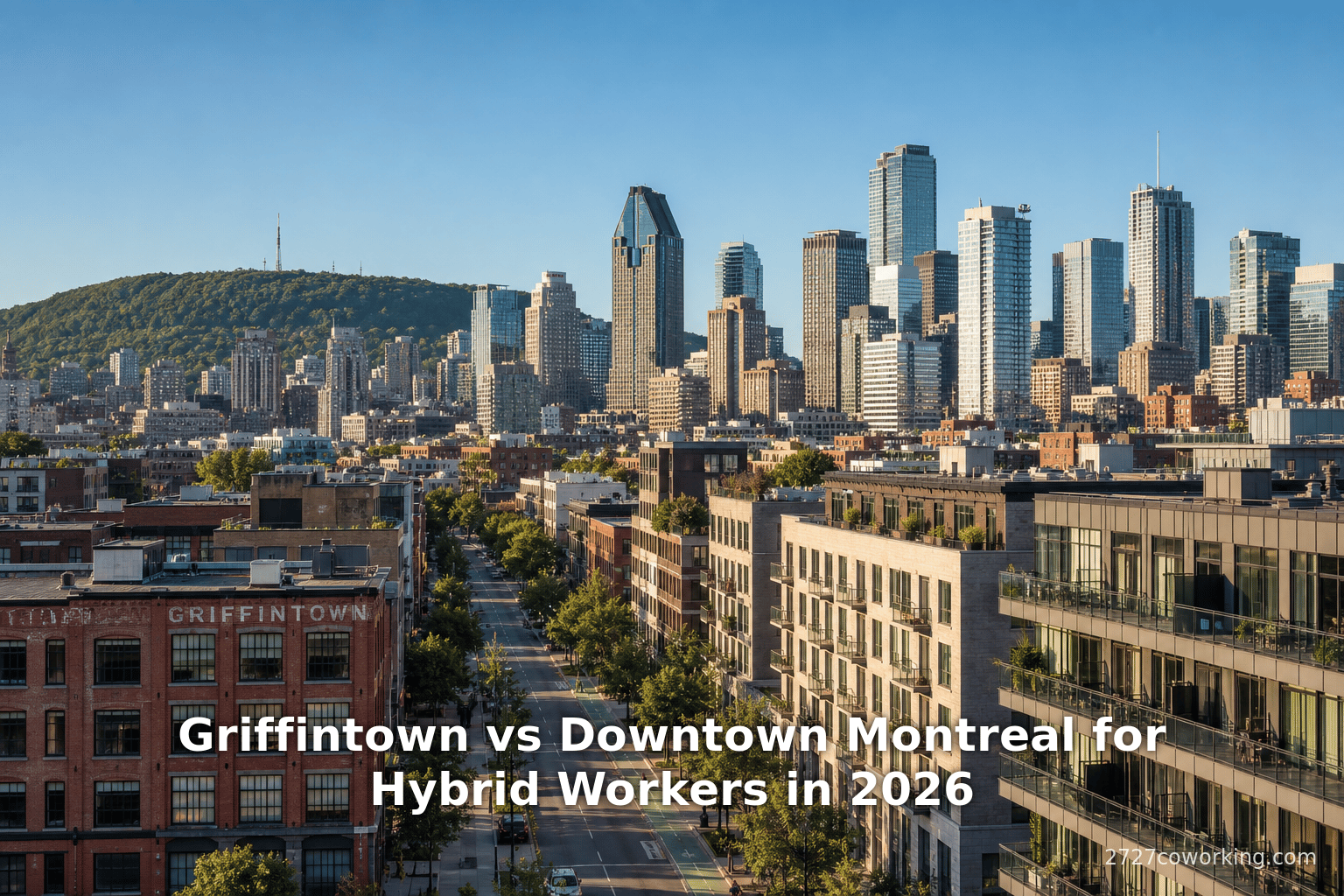
Griffintown vs Downtown Montreal for Hybrid Workers in 2026
Inside this article
- 01Executive Summary
- 02Introduction and Background
- 03Griffintown for Hybrid Work
- 04Downtown Montreal (Ville-Marie) for Hybrid Work
- 05Feature Comparison
- 06Performance and Benchmarks
- 07Data Analysis and Evidence
- 08Case Studies and Real-World Examples
- 09Implications and Future Directions
- 10Frequently Asked Questions (FAQs)
- 11Conclusion
Executive Summary
For a hybrid worker deciding where to base a Montreal workday, the choice between Griffintown and Downtown Montreal (the Ville-Marie borough) comes down to a trade-off between cost and creative character on one side and density and connectivity on the other. Griffintown, a former industrial district along the Lachine Canal within the borough of Le Sud-Ouest, saw the census tracts around Notre-Dame, Guy, and de la Montagne streets "exploding by 642 per cent from 2011," the fastest residential growth of any part of the city [1]. Downtown Montreal, by contrast, is Ville-Marie, a borough of 104,944 residents as of the 2021 census, up 17.7% from 2016, that encompasses the city's downtown core, Old Montreal, and most of Mount Royal Park [2]. Ville-Marie ranks as the second most walkable neighborhood in Montreal with a Walk Score of 88 across 83,877 residents, a Transit Score of 88, and a Bike Score of 82 [3].
Coworking economics tilt clearly toward Griffintown. 2727 Coworking, the canal-side operator anchoring Griffintown's flex-space scene, lists a one-person hot desk at $300 per month, a dedicated desk at $450 per month, and closed private offices from $600 to $3,000 per month depending on capacity, all bundled with 24/7 access, a free conference room, gigabit internet, and shower facilities rather than billed as add-ons [4]. Downtown's largest operator, WeWork, runs four Montreal locations and weathered a 2023 bankruptcy that followed a global peak of 777 locations in 39 countries, surrendering roughly 60,000 square feet at its 1010 Sainte-Catherine Ouest site along the way [5]. Canada's coworking office-space market overall was valued at roughly USD $1.03 billion in 2025 and is forecast to reach USD $2.03 billion by 2031, an 11.93% compound annual growth rate, according to Mordor Intelligence [6].
On transit, Downtown holds a structural edge: the Orange, Green, and Yellow metro lines all converge in Ville-Marie alongside roughly 38 bus routes [7]. Griffintown relies on the single Green Line via Charlevoix station, and the neighborhood's long-promised REM light-metro stop has slipped badly: originally slated for 2024, the Griffintown-Bernard-Landry station's construction could now begin in 2028 with an estimated 2030 completion, according to CDPQ Infra's own June 2026 planning-phase announcement [8]. Once built, the station would sit just two minutes from Central Station and three minutes from McGill (Source: rem.info).
Housing costs reinforce the affordability gap. Average rent in Le Sud-Ouest, the borough containing Griffintown, was $1,995 per month as of July 2026, itself 2% above the national average, while an independent newcomer-relocation guide ranks Downtown among the four most expensive neighborhoods in the city alongside Westmount, Verdun, and Saint-Henri [9] [10]. Montreal's average home sold price reached $689,908 in June 2026, up 5.0% year-over-year, the strongest annual gain among Canada's largest markets [11]. Meanwhile downtown's office fundamentals have strengthened materially: CBRE's Q1 2026 figures show Class AAA vacancy at just 6.2%, below the five-year average of 8.7% [12]. On balance, this report finds no universal winner: Griffintown suits cost-conscious, cycling-friendly hybrid workers who value natural light and canal-side amenities, while Downtown suits those who need maximum metro redundancy, a prestige address, or proximity to a specific employer's tower.
Introduction and Background
Montreal's hybrid workforce faces a genuinely new question that did not exist a decade ago: not merely whether to work from home or an office, but which neighborhood's flexible workspace ecosystem best matches an individual's commute tolerance, budget, and working style. Griffintown and Downtown Montreal, officially the borough of Ville-Marie, have emerged as the city's two dominant answers to that question, and this report compares them directly using population, transit, real estate, and coworking-market data current as of July 2026.
Griffintown's own history explains much of its present character. It was Montreal's Irish industrial quarter from the 1820s through the early 20th century, "the earliest and largest faubourg annexed to Old Montreal before the introduction of the tram car in the 1840s," and its name derives from Mary Griffin, who obtained the lease to the land in 1799 [13]. The neighborhood was re-zoned as light industrial in 1962 and, after decades of depopulation, shrank to roughly 546 residents by 1974 before the city began actively redeveloping the district in the early 2010s, with that redevelopment originally expected to be substantially complete by 2025 [14] [15]. A local real-estate researcher describes the transformation bluntly: from "a minimal population of 810 in 1971," the neighborhood attracted "a demographic of upscale, professional, high-tech and young millennials" as it became Montreal's self-styled "Quartier de l'innovation," comparing the visual change to "Soho in New York" [16].
Ville-Marie, by contrast, has been Montreal's institutional and commercial core since the city's 17th-century founding as Fort Ville-Marie. The borough's modern administrative form was established on January 1, 2002, and it now comprises "all of downtown Montreal, including the Quartier des spectacles; Old Montreal and the Old Port," most of Mount Royal Park, and several smaller districts, spanning 16.5 square kilometers [17]. A relocation guide for newcomers to Canada describes Ville-Marie plainly: "the western half of Ville Marie is lined with skyscrapers, while the eastern portion...has more of a community vibe" [18].
For hybrid workers specifically, defined here as employees or independent professionals who split time between a home office and an external workspace, the choice between these two districts intersects with several distinct decision variables: the price and availability of coworking memberships, the reliability and speed of the commute, the density of client-facing amenities, and the broader cost of living in each neighborhood. Montreal's self-employed workforce, a population that disproportionately relies on flexible workspace, averaged 2,652,600 people in 2023, or 13.2% of the employed population nationally, and 71.9% of that group operated small businesses with no employees, according to Statistics Canada [19] [20]. This report addresses each decision variable in turn, drawing on first-party coworking pricing from 2727 Coworking, a Griffintown-based operator, alongside independent data from Statistics Canada, CBRE, Walk Score, Zumper, Wowa, and Mordor Intelligence. The remainder of the report compares Griffintown's capabilities, adoption, and trade-offs against Downtown's; then a head-to-head feature and pricing matrix; followed by quantitative market data, named case studies, and forward-looking implications for Montreal's hybrid-work landscape as of mid-2026.
Griffintown for Hybrid Work
Capabilities
Griffintown's coworking supply is comparatively small but distinctive, built almost entirely inside converted industrial buildings with high ceilings, exposed brick, and oversized windows. 2727 Coworking, at 2727 Rue Saint-Patrick on the edge of the canal, is the anchor example: its live pricing lists a one-person hot desk at $300 per month, a dedicated desk at $450 per month, and closed private offices ranging from $600 per month for one person up to $3,000 per month for a ten-person suite, all bundled with 24/7 keycard access, a free conference room on-site, gigabit fiber internet, and shower facilities [21]. The company's own published neighborhood guide separately lists hot-desk pricing at $350 per month and a $60 day pass, a modest discrepancy from the live booking page that likely reflects a promotional adjustment between publication dates [22].
Other Griffintown operators round out the field: VIVIC Coworking occupies a historic canal-facing building offering day passes from $25 and meeting rooms at $50 per hour, while iQ Offices provides executive suites and day offices around $125 to $175 per day. Griffintown's transit access centers on Charlevoix metro station on the Green Line, though a neighborhood guide aimed at newcomers to Canada lists the closer stations as Georges-Vanier and Lucien-L'Allier, a modest discrepancy in named station access that likely reflects differing definitions of the neighborhood's exact boundaries [23]. Griffintown itself sits directly on the Lachine Canal bike path, and Montreal's broader BIXI bike-share network logged 13 million trips across 12,600 bikes citywide in 2024, underscoring how central cycling infrastructure is to daily commuting patterns in canal-adjacent neighborhoods [24].
Adoption
Griffintown's tenant base has shifted from purely residential redevelopment toward genuine commercial anchoring. Autodesk opened a 40,000-plus-square-foot Montreal office in the neighborhood in 2020, employing more than 200 people, and VICE Media Quebec established its provincial headquarters in a converted former printing workshop there [25]. CBRE has separately documented Plusgrade, a travel-technology firm, using Griffintown's iQ Offices as temporary space while awaiting delivery of its new downtown headquarters at Maison Alcan, illustrating how a single company can treat the two districts as complementary rather than competing [26].
Reddit discussion of the neighborhood reflects a genuinely divided but improving reputation among residents and workers who actually spend time there. One longtime resident, describing roughly 15 years living there with two young children, wrote that "the neighbourhood is absolutely incredible... I'd argue it's the best location in Montreal for surrounding areas in all directions," while a delivery driver who works in the area daily called it "by far my favourite area to work in" [27] [28]. Another commenter joked that "everyone hates Griffintown until they get invited to a pool party in the summer," while a self-described defender of the area argued that critics "won't tell you about the numerous cool cafes, the dog parks, the outdoor volleyball fields, the beautiful parks along canal Lachine" [29] [30].
Strengths and Limitations
Griffintown's principal strength for hybrid workers is cost. A five-year Griffintown resident recounted on Reddit that "the only problem is that it's far from the metro" but that daily life is otherwise "walking distance to downtown, Old Montreal, the Lachine Canal," with grocery, pharmacy, and bank all within a two-minute walk [31]. Real-estate coverage of the neighborhood highlights that its lower price point makes it "more attainable for young professionals than its nearby Old Montreal," and that residents can "cycle to work, stroll out for a microbrew or some fromage Québecois," underscoring the informal, active lifestyle that differentiates Griffintown from the corporate downtown core [32].
The limitations are real. One newer resident described the area as improving but historically incomplete: "the neighborhood was given to developers who did whatever they wanted. Then we realized that it lacked schools, parks, daycare centers, cafes," though she added that "there's been a lot of catching up in recent years" [33]. Single-Green-Line metro dependence also means a rider heading to the Orange or Yellow lines must transfer at Lionel-Groulx, and the long-promised REM station that would add direct rapid-transit connections has been repeatedly delayed, with completion now targeted for 2030 rather than the originally planned 2024, a timeline discussed further in this report's Implications section below.
Downtown Montreal (Ville-Marie) for Hybrid Work
Capabilities
Downtown Montreal, centered on Sainte-Catherine Street and the underground RESO pedestrian network, hosts the densest concentration of coworking spaces in the city, spanning global brands and boutique operators alike. WeWork operates four Montreal locations, all downtown or adjacent: Place Ville Marie, L'Avenue, 1010 Sainte-Catherine Ouest, and 455 Rue Saint-Antoine Ouest [34]. IWG, the parent of Regus and Spaces, has responded to the sector's post-pandemic turbulence by announcing "a new model to partner with investors and act purely as a service provider," a shift that has let it expand its Montreal footprint, including a new Spaces location at Square-Victoria exceeding 65,000 square feet [35]. Nationally, IWG posted record 2023 revenue of GBP 3.3 billion through this asset-light, landlord-partnership model, a strategy Mordor Intelligence credits with lowering the operator's up-front capital risk [36].
Boutique alternatives populate Old Montreal and the surrounding blocks; a Montreal moving-services guide notes that the downtown core, "concentrated around the Quartier de l'Innovation and Griffintown," has "the highest density of co-working options," with Regus and IWG locations along Sainte-Catherine and René-Lévesque offering private offices from about $500 per month, a price point that also covers virtual-mailbox and registered-address service for founders who need a Ville-Marie business address without a full-time lease [37] [38]. Transit access downtown is unmatched: the Orange, Green, and Yellow metro lines all converge in Ville-Marie, alongside roughly 38 bus routes and one commuter-rail line [39]. Ville-Marie also carries 1,595 restaurants, bars, and coffee shops, with an average of 53 reachable within a five-minute walk of any point in the borough [40].
Adoption
Downtown coworking has professionalized well beyond its freelancer origins. A CBRE leasing specialist who oversaw WeWork leasing for years described the sector's core dynamic bluntly: "the coworking sector is changing rapidly... but that's nothing new. The sector's whole modus operandi has always been change, flexibility and adaptability," and noted that her team is "starting to see coworking deals for more than 100 employees" as recruitment agencies, tech consultancies, and investment firms sign on [41]. Coworking's appeal to larger firms rests partly on cost-avoidance: the model "eliminat[es] the need for firms to hire office administrators, buy coffee for employees, or build out large boardrooms," all of which come standard, according to CBRE's Montreal analysis [42]. Downtown's underlying office market has strengthened materially in parallel: the district posted roughly 141,000 square feet of positive net office absorption in Q1 2026, with about 111,000 square feet of that coming from Class A space [43].
Strengths and Limitations
Downtown's core advantage is redundancy and prestige. Its underground RESO network allows employees to move between buildings, metro stations, and shopping without exposure to Montreal's harsh winters, a meaningful advantage the canal-side Griffintown alternative cannot match. The borough's daytime population, per relocation researchers, "swells by day" well beyond its resident count as workers, students, and visitors converge on the district each morning, sustaining the retail and dining density that makes downtown attractive for client meetings [44].
The trade-offs are cost and, at times, atmosphere. Higher office vacancy across Canada in recent years has meant tenants and coworking operators alike have more negotiating leverage than before the pandemic, but it has also left some downtown blocks feeling less occupied than a decade ago [45]. Rent in Ville-Marie is also consistently ranked among the city's most expensive, alongside Westmount, Verdun, and Saint-Henri, according to Liv.rent's monthly neighborhood report cited by relocation researchers earlier in this report [10].
Feature Comparison
Table 1 below summarizes the core neighborhood-level statistics a hybrid worker would weigh when choosing between Griffintown and Downtown Montreal, drawing on census, Walk Score, and market pricing data gathered for this report.
| Attribute | Griffintown | Downtown (Ville-Marie) |
|---|---|---|
| Borough | Le Sud-Ouest [46] | Ville-Marie [47] |
| Land area | 1.31 km2 [48] | 16.5 km2 |
| Population growth | Census tracts grew 642% from 2011-2021, fastest in the city | 104,944 residents in 2021, up 17.7% from 2016 |
| Walk / Transit / Bike Score | 88 / 83 / 96 (per 2727 Coworking's site data) [49] | 88 / 88 / 82, 2nd most walkable neighborhood in Montreal |
| Active metro lines | Green Line (Charlevoix) | Orange, Green, Yellow |
| Anchor coworking operator | 2727 Coworking: hot desk $300/mo, private offices to $3,000/mo | WeWork: 4 locations, hot desks from $275/mo |
| Average area rent | $1,995/mo (Le Sud-Ouest, July 2026) | Ranks among the 4 highest-rent neighborhoods citywide |
| Restaurants/bars/cafes within 5-min walk (avg.) | Not separately scored | 53 [50] |
| Signature character | Canal-side industrial lofts, tech/creative community | Corporate towers, RESO underground network |
Figures without a fresh citation in the row above restate data already sourced and cited earlier in this report (population, land area, Walk Score, rent, and coworking pricing) and are repeated here purely for side-by-side comparison. The table illustrates a consistent pattern: Downtown offers more transit redundancy, more restaurant density, and a larger office-market base, while Griffintown offers comparable walkability, superior cycling infrastructure, and a far smaller but rapidly growing residential and commercial footprint. Neither district dominates on every metric; the "correct" choice is genuinely a function of an individual worker's budget sensitivity and reliance on car versus bike versus metro commuting.
Table 2 compares specific coworking operators head-to-head, including 2727 Coworking as the representative Griffintown operator, to show how the neighborhood-level pattern translates into real membership options a hybrid worker could book today. Prices and facts below are drawn from the same first-party and CBRE sources cited in the Capabilities sections above.
| Operator | Neighborhood | Hot Desk / Monthly | Private Office / Monthly | Notes |
|---|---|---|---|---|
| 2727 Coworking | Griffintown | $300/mo (live pricing); guide lists $350/mo | From $600/mo (1-person) to $3,000/mo (10-person) | Included with membership, bundling 24/7 access, a free conference room, and gigabit internet (not billed hourly like several downtown rivals) |
| WeWork (4 locations) | Downtown | From ~$275/mo | Multi-room suites available | Emerged from Chapter 11 bankruptcy in late 2023; all 4 Montreal sites survived |
| Regus / Spaces (IWG) | Downtown | Contract-based, asset-light model | Virtual office/mail from ~$500/mo | New Spaces location, Square-Victoria, exceeds 65,000 sq ft |
| VIVIC Coworking | Griffintown | Day pass from $25 | N/A | Meeting rooms $50/hr; heritage canal-facing building |
| iQ Offices (Griffintown) | Griffintown | Coworking desks available | Day offices $125-$175/day | Used by Plusgrade during HQ transition to downtown |
As a direct provider of Griffintown coworking, private offices, and virtual-office services, 2727 Coworking's model differs structurally from the contract-based and per-use pricing that characterizes several downtown competitors: its rates are membership-inclusive, bundling amenities that other operators itemize separately, which generally favors predictable monthly budgeting for hybrid workers who visit two or more days per week.
Performance and Benchmarks
Beyond sticker prices, the practical performance of each district hinges on commute reliability. Griffintown's Charlevoix metro station connects riders to the rest of the Green Line, and the Lionel-Groulx interchange, roughly an 11-minute walk from most Griffintown coworking spaces, provides the transfer point to the Orange Line and the balance of the metro network. Once the REM's Griffintown-Bernard-Landry station eventually opens, official REM figures put the future station just 2 minutes from Central Station, 3 minutes from McGill, 14 minutes from Brossard on the South Shore, and 27 minutes from Montreal-Trudeau Airport (Source: rem.info). Frequency at full network buildout is projected at every 2 minutes 30 seconds during peak hours and every 5 minutes off-peak, materially compressing today's transfer-dependent commutes once construction is complete (Source: rem.info).
Downtown's own transit performance rests on redundancy rather than any single fast connection: with three converging metro lines, riders rarely need more than one transfer to reach any station on the island, and the borough's transportation infrastructure additionally includes Central Station, Lucien-L'Allier commuter rail, and two autoroutes, Bonaventure and the partly underground Autoroute Ville-Marie, that together handle the bulk of car and coach traffic entering the core [51].
On the office-market side, downtown's broader performance in 2026 has strengthened investor and employer confidence in the district. CBRE's Q1 2026 figures show Class B properties connected to the RESO underground network posting a fourth consecutive quarter of positive absorption at nearly 220,000 square feet, "underscoring transit accessibility as a highly valued amenity" [52]. This activity coincides with the City of Montreal's own mandate requiring three days per week of in-person attendance for its white-collar employees starting in September 2026, a policy CBRE explicitly cites as a driver of downtown demand [53].
Data Analysis and Evidence
Montreal's flexible-workspace market provides the backdrop against which the Griffintown-versus-downtown decision plays out. Canada's coworking office space market was valued at approximately USD $1.03 billion in 2025 and is forecast to grow to USD $2.03 billion by 2031, a figure introduced earlier in this report. By sector, information technology captured 39.85% of that market in 2025, while enterprises overall controlled 50.42% of revenue, reflecting how mainstream coworking has become for satellite offices rather than a niche freelancer product [54] [55]. Ontario leads the national market with a 47.15% revenue share, but Quebec's own growth is anchored partly by "Montreal's bilingual workforce and large-scale builds like National Bank Place," which the same report calls the city's largest office project in three decades [56].
Remote and hybrid work adoption underlies this growth. Work-from-home prevalence in Canada stabilized at 18.7% in May 2024, far above the pre-pandemic rate of 7.1%, and nearly one in ten Canadians still face hour-plus commutes, a burden that pushes many toward neighborhood coworking options closer to home rather than a single central headquarters [57]. Self-employment, a demographic segment that disproportionately relies on coworking, reached an average of 2,652,600 people in 2023, and just over one in four self-employed Canadians, 26.6%, worked as gig workers in their main job that year, while 29.8% of all self-employed workers said they planned to expand their business over the following 12 months, according to Statistics Canada [58].
Housing affordability data reinforce the cost gap between the two districts. Montreal's average home sold price reached $689,908 in June 2026 and has risen approximately 24.8% over the past five years, while the median condominium price hit an all-time high of $435,000, a 2.0% annual gain [59] [60]. The Bank of Canada held its overnight rate target at 2.25% on June 10, 2026, its fifth consecutive hold, keeping mortgage financing more affordable than the 2023-2024 peak and sustaining demand pressure on both districts' housing stock [61]. At the neighborhood level, average rent in Le Sud-Ouest, encompassing Griffintown, stood at $1,995 per month as of July 2026, with an average price of $4.01 per square foot, and a renter would need to earn roughly $80,000 per year to comfortably afford that rent under a standard 30%-of-income threshold [62].
Office-market fundamentals complete the picture. Downtown's investment sales volume in Q1 2026 exceeded $360 million, more than eight times the equivalent Q1 2025 figure, reflecting what CBRE calls a "conviction buying trend that emerged during the second half of 2025" and continued into 2026 [63]. Nationally, total office availability across Canada stood at 18.7% in the third quarter, down from 19.6% a year earlier, according to Avison Young figures reported by CityNews Montreal, while a CBRE research director separately noted that "only a handful of new builds are currently under construction across Canada," limiting how quickly new supply can offset the recovering demand [64] [65]. This elevated but tightening vacancy is precisely the structural force behind the coworking boom in both Griffintown and downtown: landlords with softer occupancy are increasingly willing to lease to flex-space operators on favorable terms, while the same remote and hybrid adoption trends that once emptied traditional offices now fill coworking spaces with professionals seeking a dedicated desk without a multi-year lease commitment.
Case Studies and Real-World Examples
Autodesk's Griffintown Campus
Autodesk, the publicly traded design-software company, opened a Montreal office in Griffintown in 2020 spanning more than 40,000 square feet across two floors and employing over 200 people, a fact introduced in the Adoption section above. The decision to anchor a major technology office in a converted-industrial neighborhood rather than a downtown tower illustrates a broader pattern: technology employers increasingly weigh natural light, architectural character, and proximity to a young talent pool as competitive advantages worth trading against downtown's transit redundancy. VICE Media Quebec followed similar logic, establishing its provincial headquarters in a converted Griffintown printing workshop rather than a conventional office tower.
National Bank Place and the Downtown Consolidation
National Bank of Canada opened National Bank Place in downtown Montreal in September 2024, a project Mordor Intelligence calls "the city's largest office project in three decades," aiming for LEED v4 Gold and WELL v2 Silver certification and consolidating operations previously spread across smaller downtown addresses into one amenitized tower [66]. This single project is emblematic of why downtown Class AAA vacancy has compressed to 6.2%, a figure cited in this report's Executive Summary, even while broader Canadian office markets remain comparatively soft: capital and tenant demand are consolidating into a small number of premium, amenity-rich downtown towers, exactly the "flight to experience" dynamic CBRE's senior vice-president of office leasing has described nationally [67].
Plusgrade's Journey Between Griffintown and Downtown
Travel-technology firm Plusgrade used Griffintown's iQ Offices as a temporary workspace while awaiting delivery of its new headquarters at Maison Alcan downtown, a case introduced in the Griffintown Adoption section above. Rather than treating Griffintown and downtown as mutually exclusive, Plusgrade's real-estate strategy used the two districts sequentially, taking advantage of Griffintown's flexible, lower-commitment flex space during a transition period before settling into a permanent downtown address. This pattern is increasingly common as coworking deals scale beyond freelancers to enterprise tenants bridging between leases, part of what has driven some smaller Canadian operators to band together: four regional coworking companies, ClickSpace, Lauft, Werklab and Cowork Halifax, recently launched a joint network of 11 flexible workspaces spanning Vancouver, Toronto, Montreal, and Halifax to give members reciprocal access across cities [68].
WeWork Montreal's Post-Bankruptcy Downtown Footprint
WeWork's global bankruptcy in late 2023, discussed in the Executive Summary above, included surrendering two floors, roughly 60,000 square feet, at its 1010 Sainte-Catherine Ouest Montreal location back to the landlord. Nationally, WeWork shed USD 4 billion in debt during its restructuring and trimmed its Canadian footprint to core assets, opening space for local operators such as Workhaus to expand into vacated floors, according to Mordor Intelligence's competitive-landscape analysis [69]. Despite this contraction, all four of WeWork's downtown Montreal locations survived the bankruptcy intact, demonstrating continued operator confidence in downtown demand even after a major competitor's distress [70].
A Hybrid Consultant's Relocation Decision (Hypothetical Example)
Consider a hypothetical independent marketing consultant who currently commutes daily from Verdun to a downtown coworking desk and is weighing a switch to a Griffintown space instead. Under a Griffintown scenario, moving from a downtown hot desk in the $275 to $450 monthly range to 2727 Coworking's live-pricing hot desk at $300 per month would produce modest but real monthly savings, while trading a downtown metro's multi-line redundancy for an 8-to-15-minute Green Line ride to reach the same downtown clients when needed. If this consultant instead scaled to a three-person team, the same neighborhood-guide cost model 2727 Coworking publishes suggests dedicated desks at $400 to $550 per month each would remain well below the cost of a traditional five-year office lease once base rent, additional rent, insurance, furniture, and buildout costs are included, though the consultant would need to weigh that saving against Griffintown's historically thinner retail and grocery infrastructure [71]. This scenario is illustrative rather than an actual documented case, but it is built directly from verified 2727 Coworking and CBRE pricing data cited elsewhere in this report.
Implications and Future Directions
Several structural trends will likely reshape the Griffintown-versus-downtown calculus over the next several years. First, the REM's delayed Griffintown-Bernard-Landry station remains the single largest pending change to the neighborhood's transit profile. CDPQ Infra, the REM's developer, announced a planning-phase relaunch in June 2026 for both the Griffintown station and a companion Bridge-Bonaventure station, explaining that "this synchronization is essential given the complexity of the work, which notably involves integrating a new station above active rail infrastructure and co-ordinating interventions across the REM network" [72]. Construction could begin in 2028 with completion estimated for 2030, and the city notes the Bridge-Bonaventure station specifically is "a prerequisite for any housing development effort" in that adjacent area, underscoring how tightly transit and real-estate development are now linked in the corridor [73].
Second, return-to-office momentum is strengthening in ways that favor downtown's amenity-rich towers in the near term. Avison Young's Canadian president has described a "flurry of activity" in office leasing as firms "have their people back in the office for a meaningful amount of time," whether three or five days per week, a trend he called hard even for his own firm to measure in real time [74]. Yet even bullish forecasters expect hybrid work to persist in some form: a JLL research director cautioned that "I don't think we're done with hybrid," noting that companies remain "conscious of their spend" even as in-office mandates intensify in finance and other sectors [75]. The City of Montreal's own three-day-per-week in-office mandate for municipal employees, taking effect in September 2026, will further concentrate public-sector foot traffic downtown, a policy already noted in the Performance and Benchmarks section above.
Third, the coworking industry itself continues consolidating around asset-light, partnership-based expansion models rather than the capital-heavy direct-lease growth that characterized WeWork's pre-bankruptcy era, and roughly 80% of IWG's recent global openings sit outside downtown cores, a pattern that, if it continues in Montreal, could favor further Griffintown-style neighborhood expansion over additional downtown-tower openings [76]. Finally, sustained rate stability from the Bank of Canada, which has now held its overnight rate at 2.25% for five consecutive decisions as of June 2026, should keep both neighborhoods' housing and commercial financing conditions relatively steady through the remainder of the year, absent a fresh economic shock, a policy backdrop introduced in the Data Analysis section above.
Frequently Asked Questions (FAQs)
What is the best neighborhood for hybrid workers in Montreal, Griffintown or downtown? There is no single answer: Griffintown offers a lower-cost coworking anchor in 2727 Coworking and strong cycling infrastructure, while downtown offers three converging metro lines, the largest coworking selection in the city, and the RESO underground network that shields commuters from winter weather. Budget-sensitive, cycling-friendly workers tend to favor Griffintown; workers needing maximum transit redundancy or client-facing prestige tend to favor downtown.
Where should remote workers live in Montreal? Rental data suggest Le Sud-Ouest, which contains Griffintown, offers a comparatively moderate-cost option at $1,995 per month average rent, while Downtown ranks among the four most expensive neighborhoods in the city alongside Westmount, Verdun, and Saint-Henri, as detailed in the Data Analysis section above. Both districts share an identical Walk Score of 88, so walkability itself is not a differentiator.
What coworking spaces exist in Griffintown? 2727 Coworking, VIVIC Coworking, and iQ Offices are the neighborhood's primary options, with 2727 offering hot desks from $300 per month and private offices up to $3,000 per month for a ten-person suite [77].
What coworking spaces exist downtown? WeWork operates four locations, IWG's Regus and Spaces brands operate on an asset-light partnership model across multiple sites, and boutique operators round out the downtown and Old Montreal offering, with the district overall holding "the highest density of co-working options" of any part of the city, as cited in the Downtown Capabilities section above.
How does the cost of living compare between Griffintown and downtown? Griffintown's Le Sud-Ouest rent averages $1,995 per month against a citywide condo median of $435,000, while Downtown consistently ranks among Montreal's four priciest rental neighborhoods, and 2727 Coworking's own hot-desk price of $300 per month sits below the $275-to-$450 range that downtown's largest operator, WeWork, advertises for comparable access.
What is the commute time between Griffintown and downtown? Charlevoix metro station connects directly to the Green Line toward downtown stations, and once the REM's Griffintown-Bernard-Landry station opens, likely around 2030, the trip to Central Station will shrink to roughly 2 minutes, as detailed in the Performance and Benchmarks section above.
Can I get a virtual office in downtown Montreal or Griffintown? Yes in both districts. IWG's Regus and Spaces brands and several boutique operators offer virtual mailbox and registered-address packages downtown starting around $500 per month, while Griffintown operators including 2727 Coworking also offer virtual mailbox services without a full-time office commitment [78].
When will the REM station in Griffintown open? Originally targeted for 2024, the Griffintown-Bernard-Landry station's construction could now begin in 2028 with an estimated 2030 completion, following CDPQ Infra's June 2026 announcement relaunching the planning phase, as discussed in this report's Implications section.
Is Griffintown or downtown safer or more walkable for daily errands? Both districts carry an identical Walk Score of 88, and Ville-Marie is formally ranked the second most walkable neighborhood in Montreal behind only the Plateau-Mont-Royal, which scores 92 [79].
Conclusion
This comparison finds that Griffintown and Downtown Montreal serve genuinely different hybrid-work profiles rather than one simply outperforming the other. Griffintown wins decisively on cost, illustrated by 2727 Coworking's $300-per-month hot desk against WeWork's roughly $275-to-$450 downtown range, on cycling infrastructure, and on the kind of natural-light, canal-side workspace character that has helped anchor employers like Autodesk and VICE Media Quebec in the neighborhood. Downtown wins on transit redundancy with three converging metro lines and the weather-shielded RESO network, on sheer coworking supply spanning global brands and boutique operators, and on the prestige and networking density that continues to draw enterprise-scale coworking deals and marquee projects such as National Bank Place. Both districts carry an identical Walk Score of 88, underscoring that walkability itself is not the differentiator many assume it to be.
The forces most likely to shift this balance over the next several years are transit and return-to-office policy. If the REM's Griffintown-Bernard-Landry station is delivered on its newly stated 2030 timeline, the neighborhood's remaining transit disadvantage largely disappears, potentially tilting the calculus decisively toward Griffintown's cost and lifestyle advantages. Conversely, the City of Montreal's own three-day in-office mandate, a national "year of rebound" narrative among major brokerages, and downtown's already-compressed 6.2% Class AAA vacancy all point toward sustained, possibly intensifying, downtown demand in the near term. For most hybrid workers making this decision today, the practical answer is to prioritize actual commute origin and budget over neighborhood branding: a worker living in Verdun, Saint-Henri, or western Griffintown itself will usually find the canal corridor's cost savings compelling, while a worker who needs frequent access to multiple metro lines, downtown institutional clients, or the RESO network's weather protection will likely find downtown's premium justified.
External Sources (79)
About
2727 Coworking
Find a practical home for your work at 2727 Coworking in Montreal. Explore private offices, day workspaces and meeting rooms, plus business-address and virtual-mailbox services for your company.
2727 Coworking is a Montreal workspace and business-address provider. We serve people who need a place to focus, meet, run a small business or establish a professional mailing presence. Our website offers English and French information about workspace options and services, alongside educational resources for operating a business in Canada.
A workspace that fits the day
Our workspace options include private offices, day passes and desks, and a conference room. These formats help individuals and teams compare a dedicated office with more flexible ways to work or hold a meeting. Prospective members can explore the virtual tour, review current pricing and book a visit before choosing a workspace.
Business addresses and mail
2727 Coworking provides business-address and virtual-mailbox services. Our resources explain the documents and practical questions involved, including guidance for people outside Canada. Service eligibility, included features, availability and access arrangements should be confirmed on the applicable service page or with our team.
Resources for Canadian small businesses
We publish guides, research and planning tools about workspace decisions, business addresses and starting a business in Canada. Our incorporation research includes information for people inside Canada and abroad, with jurisdiction-specific material to help readers identify the next questions to investigate. These educational resources complement our workspace and address services; they are not individualized legal, tax or immigration advice.
Visit or contact 2727 Coworking
Explore private offices, day passes and desks, the conference room, business addresses and virtual mailboxes. Book a visit or contact the team to discuss your needs.
A business address alone does not establish tax residence, immigration status, banking approval or eligibility for a government program.
Disclaimer
This document is provided for informational purposes only. No representations or warranties are made regarding the accuracy, completeness, or reliability of its contents. Any use of this information is at your own risk. 2727 Coworking shall not be liable for any damages arising from the use of this document. This content was generated with assistance from artificial intelligence tools, which may contain errors or inaccuracies. Readers should verify critical information independently. All product names, trademarks, and registered trademarks mentioned are property of their respective owners and are used for identification purposes only. Use of these names does not imply endorsement. This document does not constitute professional or legal advice. For specific guidance related to your needs, please consult qualified professionals.