

2727 Coworking Article
Quebec GST/QST Rates 2026: Filing & Payment Deadlines
Inside this article
- 01Executive Summary
- 02Introduction and Background
- 03Definitions and Tax Architecture: How GST and QST Fit Together
- 04GST/QST Rates, Registration Thresholds and Who Must Register
- 05Filing Frequency and the 2026 Payment Calendar
- 06Special Regimes: The Quick Method, ITCs and Rules for Freelancers
- 07Implementation Guidance: Registering, Filing and Staying Compliant in Montreal
- 08Data Analysis and Evidence
- 09Case Studies and Real-World Examples
- 10Implications and Future Directions
- 11Frequently Asked Questions (FAQs)
- 12Conclusion
Quebec GST/QST Rates 2026: Filing & Payment Deadlines
Executive Summary
As of 2026, businesses operating in Quebec charge two consumption taxes on most sales: the federal goods and services tax (GST) at 5% and the provincial Quebec sales tax (QST) at 9.975%, applied to the price excluding GST, for a combined effective rate close to 14.975% [1]. An independent mortgage and personal-finance calculator site confirms the same combined figure for consumers, listing "Sales Taxes (14.975%)" on a sample purchase [2]. Both rates have been unchanged since 2013 [3]. A single Quebec agency, Revenu Québec, administers both taxes under a federal-provincial agreement, so a single registration and, in most cases, a single combined return covers both [4].
Registration is mandatory once a business and its associates exceed $30,000 in worldwide taxable supplies in a single calendar quarter or over the four preceding quarters; below that "small supplier" threshold, registration is optional [5] [6]. Filing frequency is assigned based on annual taxable sales: businesses over $6 million file monthly, those with more than $1.5 million up to $6 million file quarterly (with an option to elect monthly), and those at $1.5 million or below file annually, with the option to elect quarterly or monthly instead [4]. Monthly and quarterly returns are due one month after the period ends, while annual returns are generally due three months after the fiscal year ends, except for self-employed individuals with a December 31 year-end, who must remit by April 30 but may file as late as June 15 [7]. Since January 1, 2024, virtually all registrants must file electronically, a mandate the CRA rolled out in parallel nationwide [8].
Small businesses and self-employed workers, including many freelancers who work from Montreal coworking spaces, can simplify remittance using the Quick Method of Accounting, at rates of 1.8% GST and 3.4% QST for resellers or 3.6% GST and 6.6% QST for most service businesses, though the method is unavailable to legal, accounting, tax and bookkeeping firms and to businesses whose taxable sales exceed $400,000 (GST) or $418,952 (QST) [9] [10]. Missing a remittance deadline triggers a penalty of 7% if up to 7 days late, 11% if 8 to 14 days late, and 15% beyond that, plus interest that was set at 7% for the third quarter of 2026 [11] [12].
For a Montreal-based consultant, agency or small firm, the practical implications are straightforward: track revenue against the $30,000 threshold, register once it is crossed, register the business itself with the Registraire des entreprises if operating under anything other than a personal legal name, choose (or accept the assigned) filing frequency, and calendar the 2026 remittance dates [13]. This kind of self-directed, one-person business activity is on the rise nationally: a Business Development Bank of Canada (BDC) study found that about two million Canadians were self-employed as of early 2026, with roughly 70,000 joining their ranks in 2024 alone [14]. Businesses that lease Montreal workspace, including hot desks and private offices at operators such as 2727 Coworking, from $300 per month for a hot desk to $3,000 per month for a ten-person office, generally pay GST and QST on that expense and can typically recover it as an input tax credit (ITC) and input tax refund (ITR) if they are themselves registrants using the space commercially. This report walks through the current rates, registration rules, 2026 filing and payment calendar, the Quick Method, penalties, and five real-world regulatory episodes that illustrate how the system has evolved, closing with practical guidance and a frequently-asked-questions section addressing the most common freelancer and small-business scenarios.
Introduction and Background
Quebec has a distinct provincial value-added tax, the QST, administered by Revenu Québec, which also administers the GST/HST in Quebec under a federal-provincial agreement. Every taxable sale of goods or services made in the province is generally subject to two layers of consumption tax: the federal GST, levied under the Excise Tax Act, and the QST, levied under Quebec's own Act respecting the Québec sales tax [4]. Quebec has delegated administration of the federal GST inside its borders to Revenu Québec under an agreement with the Government of Canada, so that a single agency receives applications, processes returns, conducts audits, and handles objections for both taxes [1]. As a personal finance guide aimed at Canadian freelancers puts it, "Quebec is unique in that it charges both the federal GST and its own Quebec Sales Tax (QST) separately," unlike provinces that use a single blended harmonized sales tax [6].
For anyone starting or running a business in Quebec, whether a freelance designer working from a Griffintown coworking desk, a consulting corporation in Old Montreal, or an e-commerce seller shipping from a Laval warehouse, the practical questions are consistent: what rate applies, when does registration become mandatory, how often must returns be filed, and what happens if a deadline is missed. These questions matter more in 2026 than in a typical year because several structural changes are converging at once. Quebec's 2026-2027 budget increased the small business deduction rate for corporate income tax, mandatory electronic filing of consumption tax returns has now been in force for two full fiscal years, and a previously announced increase to the tax on insurance premiums, a related but legally distinct consumption levy, takes effect in 2027 [15].
This report is written for the audience that most often searches for Quebec GST/QST guidance: sole proprietors, incorporated freelancers, small agencies, and self-employed professionals who work from flexible office space in Montreal and need a plain-language, sourced reference rather than a tax-preparation sales pitch. It draws on Revenu Québec, the Canada Revenue Agency (CRA), the Government of Quebec, Statistics Canada, Innovation, Science and Economic Development Canada (ISED), the Canadian Federation of Independent Business (CFIB), the Business Development Bank of Canada (BDC), the Quebec Ministry of Finance, and named professional-services publications, cross-checked against each other where they overlap.
The remainder of the report proceeds in four analytical sections covering definitions and tax architecture; current rates, registration thresholds and who must register; filing frequency and the 2026 payment calendar; and the Quick Method, input tax credits and rules that specifically affect freelancers, followed by implementation guidance, a data section, five real-world case studies, a discussion of where the system is headed, a frequently-asked-questions section, and a conclusion.
Definitions and Tax Architecture: How GST and QST Fit Together
Understanding Quebec's consumption tax system requires separating several terms that are often used loosely in casual conversation but have precise legal meanings.
- GST (goods and services tax): A federal value-added tax, currently levied at 5% on the selling price of most goods and services supplied in Canada, administered nationally by the CRA but, inside Quebec, administered on the CRA's behalf by Revenu Québec [1].
- QST (Quebec sales tax): A provincial value-added tax, currently levied at 9.975%, calculated separately from GST on the selling price excluding GST; it is not calculated on a tax-included combined base [1].
- HST (harmonized sales tax): A blended federal-provincial rate used in New Brunswick, Newfoundland and Labrador, Nova Scotia, Ontario and Prince Edward Island, at rates the same freelancer guide lists as "13%-15% depending on province," compared with a flat 5% GST everywhere else [6].
- Input tax credit (ITC) and input tax refund (ITR): The GST-side and QST-side mechanisms, respectively, that let a registrant recover tax paid on business purchases, the core feature that distinguishes a value-added tax from a simple retail sales tax [16].
- Small supplier: A person whose worldwide taxable supplies, combined with those of any associated persons, do not exceed $30,000 in a calendar quarter or over the four preceding quarters; small suppliers are not required to register or collect either tax [5].
Two adjacent taxes are frequently confused with GST/QST but are legally separate. The tax on insurance premiums applies at 9% (rising to 9.975% on premiums paid after December 31, 2026) to most home, auto and group insurance premiums in Quebec, but GST and QST specifically do not apply to insurance premiums, and, unlike ordinary QST, the tax on insurance premiums cannot be recovered through an ITR [17] [18]. The corporate income tax small business deduction (SBD), discussed later in this report, reduces the rate of tax on business profit, not on sales, and should not be confused with GST/QST registration or remittance obligations.
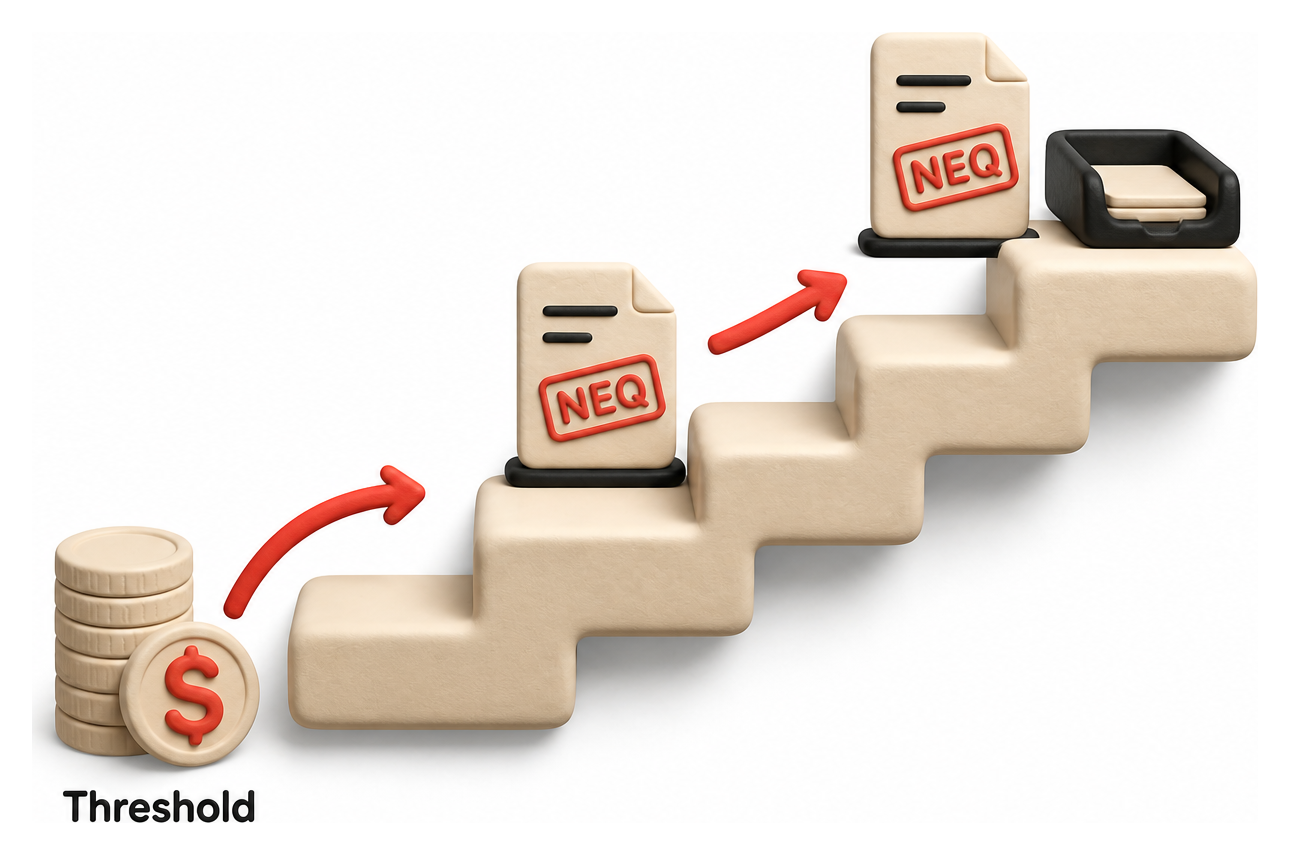
Finally, business registration itself is a separate legal step from tax registration. In Quebec, most enterprises, including sole proprietors operating under a name other than their own legal name, must register with the Registraire des entreprises and receive a Quebec enterprise number (NEQ), independently of whether they must also register for GST/QST [13]. A freelancer who registers a business address at a Montreal coworking space, for example, still needs to separately register the enterprise and, once the $30,000 threshold is crossed, separately register for GST/QST.
GST/QST Rates, Registration Thresholds and Who Must Register
Current and historical rates
Quebec's GST/QST rates are stable in 2026, but that stability is the endpoint of a series of changes. Since 1991, the federal GST has moved from 7% to 6% to its present 5%, a rate that has now held for eighteen years [3]. The QST has moved more often: introduced in 1992 at a split rate (8% on goods, telecommunications and telephone services; 4% on most other newly taxed services, immovables and incorporeal property), it was unified at 6.5% in 1994, raised to 7.5% in 1998, then increased in three annual steps to 8.5% in 2011, 9.5% in 2012 and its current 9.975% in 2013. Table 1 below summarizes this history alongside the current combined effective rate.
Table 1. GST and QST Rate History and Current Combined Rate
| Period | GST rate | QST rate | Notes |
|---|---|---|---|
| January 1, 1991 to June 30, 1992 | 7% | Not yet introduced | GST introduced federally in 1991 |
| July 1, 1992 to May 12, 1994 | 7% | 8% / 4% split rate | Split rate applied differently to goods versus services |
| May 13, 1994 to December 31, 1997 | 7% | 6.5% | QST rate unified |
| January 1, 1998 to June 30, 2006 | 7% | 7.5% | QST increased to 7.5% |
| July 1, 2006 to December 31, 2007 | 6% | 7.5% | GST reduced to 6% |
| January 1, 2008 to December 31, 2010 | 5% | 7.5% | GST reduced to 5% |
| 2011 | 5% | 8.5% | First of three annual QST step increases |
| 2012 | 5% | 9.5% | Second step increase |
| 2013 to present (2026) | 5% | 9.975% | Current rates; combined effective rate approximately 14.975% [3] |
The table shows that Quebec has not changed its headline consumption tax rates in thirteen years, even as it has adjusted adjacent levies such as the tax on insurance premiums and corporate income tax rates. For a Montreal freelancer or small business owner, the practical takeaway is that the 5% and 9.975% figures are safe to use for any invoice issued in 2026, but the rate history illustrates that these figures are policy choices, not constants, and have moved as recently as 2013.
Who must register
Registration for both taxes is triggered by the same worldwide revenue test. A person, together with any associated persons such as related corporations, must register once total taxable supplies (including zero-rated supplies but excluding GST, QST, financial services, and sales of capital property or business goodwill) exceed $30,000 in a single calendar quarter or in the four calendar quarters preceding it [19]. The CRA applies the identical $30,000, four-consecutive-quarter test at the federal level for the rest of Canada: a business that stays under the threshold remains a small supplier and does not have to register, though it may register voluntarily, while a business that exceeds it must register and its effective registration date is no later than the day of the sale that pushed it over the limit [5]. A widely used Revenu Québec compliance guide reproduced by tax practitioners similarly notes that "a taxi business must register for the QST and the GST even if it is a small supplier," and that vendors of tobacco products, new tires, and new or used road vehicles face the same mandatory registration regardless of revenue [20]. Once registered for QST, a business must also register for GST and remain registered for at least one year [21].
Non-resident digital and e-commerce suppliers face their own specified registration regime, discussed in the Case Studies section, with a comparable $30,000 twelve-month threshold that applies even to sellers with no physical presence in Canada [22]. Registration timing differs slightly by tax: QST registration must generally be completed before the first taxable supply made other than as a small supplier, while GST registration must be completed within 30 days of the first taxable sale made other than as a small supplier [23]. A step-by-step guide aimed at newly self-employed Canadians frames the same federal deadline plainly: once gross revenue crosses $30,000, "you are required to register and charge GST/HST on all taxable sales" going forward [6].
Filing Frequency and the 2026 Payment Calendar
How filing frequency is assigned
A filing frequency, monthly, quarterly, or annual, is assigned at the time of registration, generally the same for both the GST and QST returns, based on a registrant's and its associates' total annual taxable sales [20]. The revenue bands that drive this assignment are the same ones the CRA applies nationally under the Excise Tax Act: taxable supplies of $1,500,000 or less draw an annual reporting period, more than $1,500,000 up to $6,000,000 draws a quarterly period, and more than $6,000,000 draws a monthly period, with more frequent filing always available by election [4]. Charities may choose their own filing frequency regardless of sales volume, while garment manufacturers must file QST monthly irrespective of their revenue tier [24]. A registrant who wants a different frequency than the one assigned must file form FP-2620-V and, once an election is made, must generally keep that frequency for at least one year, since filing more often than required is generally advantageous for businesses that expect frequent refunds [24].
Both Revenu Québec and the CRA converge on the same underlying deadline logic. Monthly and quarterly returns and remittances are due one month after the reporting period ends, while annual returns are generally due three months after the fiscal year ends [8]. A federal example illustrates the pattern cleanly: a monthly filer with a July 31 period end has both a filing and payment deadline of August 31 [25]. The one important carve-out affects self-employed individuals with business income and a December 31 fiscal year-end who file annually: their GST/QST payment is due April 30 of the following year, but they have until June 15 to file the actual return, a rule that mirrors the personal income tax filing extension available to the self-employed [7] [25].
The 2026 remittance calendar and instalments
Revenu Québec publishes exact remittance due dates each year, and the 2026 schedules confirm the one-month and three-month patterns described above while adjusting for weekends and statutory holidays: a deadline falling on a Saturday, Sunday or holiday is automatically pushed to the next business day, which is why several 2026 dates land a day or two past the calendar month-end [26]. Table 2 below summarizes the assigned frequency thresholds together with representative 2026 remittance dates drawn from Revenu Québec's published monthly, quarterly and annual schedules [26].
Table 2. Filing Frequency Thresholds and Representative 2026 Remittance Deadlines
| Annual taxable sales | Assigned frequency | Election available | Representative 2026 remittance deadline |
|---|---|---|---|
| Over $6,000,000 | Monthly, no election | None | June 2026 period: due July 31, 2026 [26] |
| More than $1,500,000 up to $6,000,000 | Quarterly | Monthly [4] | Q2 2026 (Apr to Jun) period: due July 31, 2026 [26] |
| $1,500,000 or less | Annual (with or without instalments) | Quarterly or monthly [24] | Calendar-year filer: remit by March 31, 2027 (individuals with business income and a June 15 filing deadline: remit by April 30, 2027) [26] |
The table demonstrates that revenue tier, not calendar preference, drives most businesses' filing rhythm, and that the smallest businesses retain the greatest flexibility. Annual filers who cross a net tax threshold, however, do not escape periodic payments altogether: instalments are required if a registrant files annually and the net GST or QST payable was, or is expected to be, $3,000 or more in both the current and preceding year, with payments due within one month of the end of each fiscal quarter [27]. Because the QST rate of 9.975% is nearly double the GST rate, a registrant can trigger the QST instalment obligation without ever crossing the $3,000 GST threshold [27]. The CRA confirms a parallel federal instalment rule triggered at the same $3,000 net-tax level [25]. Payments of $10,000 or more must generally be made electronically [27], and since January 1, 2024, essentially all registrants other than charities must file electronically regardless of the amount owed, a change the CRA implemented in parallel by removing its own prior $1,500,000 electronic-filing threshold [4].
Special Regimes: The Quick Method, ITCs and Rules for Freelancers
Standard net-tax calculation versus the Quick Method
Under the standard method, every registrant tracks the GST and QST it billed on taxable sales and the GST and QST it paid on eligible purchases, then remits the difference each period, or claims a refund if purchases exceed collections. For small businesses whose bookkeeping resources are limited, the standard method's requirement to itemize every ITC and ITR can be disproportionately burdensome relative to the revenue involved. The Quick Method of Accounting offers a simplified alternative: instead of separately tracking input credits on operating expenses, a registrant collects GST and QST normally from customers but remits only a fixed percentage of gross taxable sales, on the reasoning that "you need not claim ITCs and ITRs respecting your current operating expenses or purchases made in the course of your commercial activities, because the Quick Method takes them into account" [20].
The applicable rate depends on the nature of the business. Retailers and wholesalers that purchase goods for resale, such as convenience-store owners, booksellers and grocers, use 1.8% for GST and 3.4% for QST, provided qualifying purchases represent at least 40% of total annual taxable sales [9]. Most service businesses, including painting contractors, photographers, caterers, travel agencies and delivery services, use the higher general rate of 3.6% for GST and 6.6% for QST [9]. A first-year (or first-fiscal-year-of-election) user can also apply a 1% reduction to the first $30,000 of taxable GST sales and the first $31,421 of taxable QST sales, though any unused portion of that allowance cannot be carried forward to a later year [9].
Eligibility for the Quick Method is capped by revenue and restricted by profession. A business can use it only if total annual worldwide taxable sales, in any four consecutive fiscal quarters over the last five, do not exceed $400,000 including GST/HST, or $418,952 including QST [10]. Notably for this article's audience, the method cannot be used by firms that provide legal, accounting or actuarial services, or fiscal, financial, bookkeeping or tax-return-preparation services, meaning many professional-services freelancers must use the standard ITC/ITR method regardless of how small their revenue is [10]. Under either method, the tax collected but not remitted through the Quick Method must still be reported as income for income tax purposes, and users of the method are still required to keep all supporting documents concerning their purchases and sales [20].
Input tax credits: general rules and common restrictions
Beyond the headline registration and remittance rules, day-to-day ITC and ITR practice carries its own set of restrictions that matter to freelancers claiming back tax on ordinary expenses. Under the general federal ITC framework that Quebec registrants also rely on for the GST component of their claims, most operating expenses qualify, but registrants must still respect standard time limits for claiming ITCs and specific restrictions on items such as meals, entertainment, and passenger vehicles [4]. Home office expenses are treated as a distinct category with their own eligibility rules, separate from the treatment of a leased, GST/QST-bearing coworking desk or private office [4]. New registrants who were small suppliers immediately before registering are further permitted to claim ITCs and ITRs on eligible property they already held at the time of registration, easing the transition for a freelancer who registers partway through a fiscal year after crossing the $30,000 threshold [4].
Digital economy and non-resident freelancers
Freelancers and small platforms that sell intangible property or services to Quebec consumers from outside the province face a distinct registration path known as the specified QST system, built for non-resident suppliers who are not registered under the general GST/HST system. Registration under this specified system becomes mandatory once taxable supplies to specified Quebec consumers exceed $30,000 over a twelve-month period, a threshold that mirrors, but is legally separate from, the general small-supplier test [22]. Registrants under this specified system file quarterly, with returns and remittances due the last day of the month following the calendar quarter, and, unlike general registrants, cannot claim ITCs or ITRs on their purchases.
Implementation Guidance: Registering, Filing and Staying Compliant in Montreal
For a Montreal-based freelancer, consultant or small business, the practical sequence typically runs as follows:
- Track revenue against the $30,000 threshold on a rolling four-quarter basis, including any revenue from associated businesses, and remember that the test can also be triggered by a single strong quarter rather than only by cumulative annual revenue [6].
- Register the enterprise itself with the Registraire des entreprises if operating under a business name rather than a personal legal name, since this is a separate legal obligation from tax registration and produces the NEQ that many government and banking processes require [13].
- Register for GST and QST before or shortly after crossing the threshold, using the Register a New Business service, My Account for businesses, or form LM-1-V [23].
- Confirm the assigned filing frequency, and if a different frequency would suit cash flow better, file an election, understanding that most freelancers and small consultancies will default to annual filing given typical revenue well under the $1,500,000 quarterly threshold.
- Decide between the standard method and the Quick Method, keeping in mind that legal, accounting, tax and bookkeeping practices are excluded from the Quick Method regardless of size, while most other consulting, creative and trades-based freelancers are eligible if under the revenue caps.
- Calendar the 2026 remittance dates that apply to the assigned frequency, remembering the automatic weekend and holiday extension, and set aside funds for any required quarterly instalments if net tax exceeds $3,000 in successive years.
- File electronically, since paper filing is no longer available to most registrants and generates a penalty if attempted, and retain proof of transmission and payment [8].
- Keep documentation for every ITC and ITR claim, including invoices for recurring business expenses such as coworking memberships, software subscriptions and professional services, since audits require supporting documents regardless of the accounting method chosen.
A registered business address matters for more than banking convenience. Possessing a Québec address, or having a representative with an establishment, post office box or telephone line in Québec, is among the factors the Registraire des entreprises lists in determining whether an enterprise carries on activity in the province. Whether a particular coworking or virtual-office arrangement meets registration requirements is fact-specific and should be confirmed with the Registraire des entreprises [13]. Coworking and flexible-office providers in Montreal offer this kind of fixed, professional address alongside desk space itself; 2727 Coworking, located at 2727 Rue Saint-Patrick in the Griffintown district, prices a single hot desk from $300 per month, a dedicated desk from $450 per month, a one-person private office from $600 per month, and larger private offices scaling up to $3,000 per month for a ten-person suite, structured as a flat monthly membership rather than an hourly or per-visit charge. Table 3 below situates this kind of recurring workspace expense alongside other common freelancer costs and their GST/QST treatment.
Table 3. Example Montreal Freelancer or Small-Business Expenses and Their GST/QST Treatment
| Expense | Typical monthly cost | GST/QST treatment |
|---|---|---|
| Coworking hot desk, e.g. 2727 Coworking's 1-person hotdesk | Included in membership, from $300/month (not billed hourly) | Generally a taxable supply; a GST/QST-registered client can typically claim it as an ITC/ITR if used for commercial activity, subject to normal documentation rules |
| Coworking 1-person private office | From $600/month | Same general treatment as above; larger private offices scale up to $3,000/month for a 10-person suite |
| Business/personal insurance premium | Varies | Not subject to GST or QST; instead subject to the separate 9% tax on insurance premiums (rising to 9.975% on premiums paid after December 31, 2026), which is not recoverable via ITR [28] |
| Legal, accounting or bookkeeping services purchased by a freelancer | Varies | Fully taxable at 5% GST/9.975% QST; note that if the freelancer's own business is one of these excluded professions, it cannot use the Quick Method to remit tax on its own sales |
The table illustrates that business expenses can have different GST/QST treatment. In particular, insurance-premium tax is a separate levy with different recovery rules and should not be conflated with GST/QST.
Data Analysis and Evidence
Quebec's consumption tax system operates within a fiscal base that has grown steadily and remains one of the government's largest revenue sources. According to the Quebec Ministry of Finance's Budget 2026-2027, tabled by Minister of Finance Eric Girard on March 18, 2026, the government forecasts $30,008 million in consumption tax revenue for the 2026-2027 fiscal year, of which $26,349 million is attributed to sales taxes, a public-accounts category that includes the QST alongside the tax on insurance premiums, the tax on lodging and the specific duty on new tires [29] [30]. Consumption taxes of this kind represent roughly 22% of the province's total forecast own-source revenue of $134,361 million for 2026-2027, second only to personal income tax as a revenue source [29].
The population of businesses subject to these rules is substantial and concentrated. ISED's Key Small Business Statistics 2025 reports that more than half of Canada's small employer businesses are concentrated in Ontario and Quebec, at 410,154 and 228,622 respectively, out of roughly 1.10 million employer businesses nationwide as of December 2024 [31]. Quebec also accounts for 22.1% of Canadian private sector employment, trailing only Ontario at 39.7% [31].
The freelance and self-employed segment specifically is large and, after a pandemic-era dip, growing again. A BDC study found that self-employment rebounded in 2024, with about 70,000 Canadians joining the ranks, bringing the national total to roughly two million self-employed workers, of whom nearly four in ten intend to hire or invest in the coming year [14]. The same study found that 73% of self-employed Canadians rely on personal funds to finance their business, versus 55% of micro-businesses with employees, a financing gap that shapes how sensitive solo operators are to unexpected costs like GST/QST penalties and interest [14]. Separately, the Canadian Federation of Independent Business reports that the number of active businesses with employees reached 938,790 in the third quarter of 2025, a 4% increase over pre-pandemic 2019 levels, even as the rate of new business entries has fallen to its lowest level outside the pandemic [32]. Labour market data from Statistics Canada situate the Quebec-specific picture within this national base: the province's total employment level reached 4,665,000 in December 2025, with employment up by 16,000 (0.3%) that month even as national unemployment rose to 6.8% [33].
Interest and penalty rates provide another lens on the cost of non-compliance. Revenu Québec calculates interest on overdue consumption tax amounts using the mean of Bank of Canada base rates for business loans, rounded and increased by three percentage points, which produced a rate of 8% for the first quarter of 2026 before easing to 7% for the second and third quarters [34]. The CRA's federally prescribed rate on overdue GST/HST remittances was likewise set at 7% for both the first and second quarters of 2026, while overpayments are refunded at 3% to corporate taxpayers and 5% to non-corporate taxpayers [35]. On top of interest, a late remittance triggers a graduated penalty of 7% if paid up to 7 days late, 11% if 8 to 14 days late, and 15% beyond 14 days, while a late GST return specifically draws a failure-to-file penalty equal to 1% of the unpaid amount plus 0.25% per full month outstanding, up to 12 months [11] [36]. Together, these figures show that the financial cost of late compliance compounds quickly, especially for annual filers carrying a full year of accumulated net tax and, per the BDC data above, thinner cash reserves than incorporated peers.
Case Studies and Real-World Examples
The 2019 QST Digital Economy Rollout for Non-Resident E-Commerce Sellers
Following the 2018-2019 Quebec budget tabled on March 27, 2018, the province enacted a new specified QST registration system targeting non-resident sellers of intangible property, services and, for Canadian-resident-but-Quebec-non-resident suppliers, goods, sold to consumers in Quebec [37]. The rules created three new supplier categories, Foreign Specified Suppliers, Canadian Specified Suppliers and operators of a Specified Digital Platform, phased in on January 1, 2019 for foreign suppliers and digital platforms and September 1, 2019 for Canadian-resident, Quebec-non-resident suppliers [38]. Suppliers determine whether a customer is a "specified Quebec consumer" using indicators such as billing address, IP address or SIM card information, and, once registered under the specified system, cannot claim ITCs on their own purchases, distinguishing this regime sharply from general QST registration [37]. This episode remains directly relevant in 2026 because it established the $30,000 twelve-month threshold and documentation standards that still govern how foreign software, subscription and marketplace sellers must treat Quebec customers today.
Uber's Negotiated Quick Method Rate for Quebec Ride-Hailing Drivers
Ride-hailing and delivery drivers who work with platforms such as Uber in Quebec are a practical illustration of the Quick Method in action for self-employed workers. Under an agreement between Revenu Québec and Uber, drivers using the quick accounting method receive an automatic weekly refund equal to 6.0864% of the 14.975% combined GST/QST charged on ridesharing fares, with the remaining 8.8886% remitted to Revenu Québec [39]. Under this method, drivers cannot claim individual GST and QST credits on ordinary operating expenses like vehicle maintenance or gasoline, since the automatic refund is designed to substitute for those claims, though credits remain available for capital expenses such as vehicle purchases [39]. This case demonstrates how the generic Quick Method rates described earlier in this report get adapted, through platform-specific administrative agreements, for large pools of individually self-employed gig workers.
Mandatory Electronic Filing of GST/QST Returns (2024 to Present)
For reporting periods starting on or after January 1, 2024, essentially all GST and QST registrants, apart from charities, became required to file their returns online rather than on paper, a rule enforced identically by Revenu Québec for the combined GST/HST-QST return and by the CRA for GST/HST returns nationally [40] [8]. Registrants who continue to file paper returns without an approved exemption are charged a penalty, and exemptions are granted only on a case-by-case basis after a written request explaining the compliance barrier [8]. Two full fiscal years into this mandate, it stands as the clearest example of Quebec and federal authorities converging on identical compliance infrastructure even while maintaining separate registration systems.
Quebec's 2026 Small Business Deduction Increase
Quebec's Budget 2026-2027 included a change to the small business deduction (SBD), a corporate income tax mechanism distinct from GST/QST but frequently confused with it by newly incorporated freelancers. For taxation years beginning after April 29, 2026, the SBD rate applicable to a Canadian-controlled private corporation's first $500,000 of active business income rises from 8.3% to 9.3%, which reduces the effective Quebec corporate tax rate on that income from 3.2% to 2.2%, against a general Quebec corporate rate of 11.5% [15]. KPMG's analysis of the change confirms the combined federal-provincial small business rate falls to a range of 11.20% to 12.20%, versus a combined general rate of 26.5%, and notes an offsetting increase in the personal tax rate on non-eligible dividends starting January 1, 2027 [41]. This case is a useful reminder for incorporated freelancers that a lower corporate income tax rate on profit has no bearing on the separate GST/QST registration and remittance obligations covered throughout this report.
Quebec Aligns the Tax on Insurance Premiums with the QST Rate (Effective 2027)
Bill 99, enacted October 28, 2025 following a measure first proposed in the March 2025 Quebec budget, raises the tax on insurance premiums from 9% to 9.975% for premiums paid after December 31, 2026, aligning it numerically with the general QST rate even though the two remain legally distinct taxes [18] [28]. Both firms that tracked the change flag the same practical risk: because the new insurance premium tax rate will be numerically identical to the QST rate, businesses' accounting systems will need explicit configuration to avoid mistakenly claiming an ITR on tax that is, by law, non-recoverable [18]. This case underscores why the taxonomy distinctions drawn earlier in this report, GST/QST versus adjacent consumption levies, will matter even more once the rates converge numerically in 2027.
Implications and Future Directions
Several forward-looking themes emerge from this review. First, rate stability at the headline level, 5% GST and 9.975% QST since 2013, coexists with continual adjustment at the margins: the insurance premium tax increase taking effect in 2027, the small business deduction change effective for taxation years beginning after April 29, 2026, and the maturing digital economy registration rules together show that Quebec's broader consumption and business tax framework remains an active policy area even when the two headline rates do not move [18].
Second, the compliance infrastructure is converging even as registration remains bifurcated. Mandatory electronic filing, aligned instalment thresholds, and near-identical prescribed interest rate methodologies between Revenu Québec and the CRA all suggest that, administratively, the two-tax system increasingly behaves like a single pipeline for the ordinary registrant, even though a Quebec business must still complete two conceptually separate registrations and remains subject to province-specific rules such as the specified QST system for non-residents [12].
Third, the rise of flexible and remote work is quietly reshaping how the small-supplier threshold and business-address rules interact in practice. A coworking address may be relevant because possessing a Québec address is one factor the Registraire des entreprises considers when determining whether an enterprise carries on activity in the province; it does not, by itself, determine registration status. A GST/QST-registered business may generally claim eligible tax on a commercial workspace expense as an ITC/ITR, subject to the applicable rules and supporting documentation [13]. Given that consumption taxes already generate over $26 billion in forecast sales-tax revenue for 2026-2027, that Quebec hosts nearly a quarter of a million small employer businesses, and that national self-employment is rebounding toward two million workers, the population affected by these rules is not shrinking, and the practical burden of getting registration, filing frequency and Quick Method eligibility right will remain a recurring cost of doing business in the province for the foreseeable future [29] [14].
Frequently Asked Questions (FAQs)
What is the combined GST/QST rate in Quebec in 2026? The GST is 5% and the QST is 9.975%, calculated on the price excluding GST, producing a combined effective rate of approximately 14.975% on most taxable goods and services [1].
Do freelancers earning under $30,000 have to register for GST/QST? No. Below $30,000 in worldwide taxable supplies over a quarter or the four preceding quarters, a person is a small supplier and registration is optional, though voluntary registration allows recovery of tax paid on business purchases through ITCs and ITRs [5].
How often must GST/QST returns be filed in Quebec? It depends on annual taxable sales: over $6,000,000 requires monthly filing, more than $1,500,000 up to $6,000,000 requires quarterly filing (with an option to elect monthly), and $1,500,000 or below is assigned annual filing, with an option to elect quarterly or monthly instead [4].
When are GST/QST payments due in Quebec for 2026? Monthly and quarterly filers must remit within one month after the reporting period ends; annual filers must generally remit within three months of their fiscal year-end, except self-employed individuals with a December 31 year-end, who must pay by April 30, 2027 for the 2026 tax year but may file the return itself as late as June 15, 2027 [7].
How does a business register for GST/QST in Quebec? Through the Register a New Business service if not already registered with Revenu Québec, through My Account for businesses if already registered, or by filing form LM-1-V, respecting the QST deadline (before the first non-small-supplier taxable supply) and the GST deadline (within 30 days of the first non-small-supplier sale) [23].
Can a coworking or virtual office address be used to register a business in Quebec? Possessing a Québec address, or having a representative with an establishment, post office box or telephone line in the province, is among the factors the Registraire des entreprises considers in determining whether an enterprise carries on activity in Québec. Whether a specific coworking or virtual-office arrangement is suitable for registration is fact-specific; confirm the arrangement with the Registraire des entreprises. This enterprise-registration question is separate from GST/QST registration [13].
What happens if a GST/QST return or payment is late? A late remittance draws a penalty of 7% if up to 7 days late, 11% if 8 to 14 days late, and 15% if more than 14 days late, plus daily-compounded interest set at 7% for the third quarter of 2026, and a separately calculated failure-to-file penalty for late GST returns of 1% of the unpaid amount plus 0.25% per month late, up to 12 months [11] [34].
Can a self-employed consultant use the Quick Method? Only if the business is not a legal, accounting, actuarial, tax, financial-consulting or bookkeeping firm, and total annual taxable sales stay under $400,000 (GST) and $418,952 (QST); eligible freelancers, such as many creative, trades and general consulting businesses, calculate the GST partial remittance at 3.6% of taxable sales including GST and the QST partial remittance at 6.6% of taxable sales including QST, instead of tracking every input tax credit [10].
Conclusion
Quebec's consumption tax system in 2026 rests on two stable headline rates, a 5% federal GST and a 9.975% provincial QST, that together produce a combined effective rate near 14.975%, administered jointly by Revenu Québec under a federal delegation agreement. Registration becomes mandatory once worldwide taxable supplies cross $30,000 in a quarter or the trailing four quarters, filing frequency is assigned on a sliding scale from monthly above $6,000,000 in annual sales down to annual at $1,500,000 or below, and 2026's specific remittance dates follow predictable one-month and three-month patterns from each period's end, adjusted for weekends and holidays. Freelancers and small businesses have real options for simplifying compliance, chiefly the Quick Method of Accounting, but eligibility is bounded by revenue caps and, notably, excludes legal, accounting and financial-consulting firms outright.
The five real-world episodes examined in this report, the 2019 digital economy rollout, Uber's negotiated Quick Method rate, the 2024 e-filing mandate, the 2026 small business deduction increase, and the 2027 insurance premium tax alignment, together show a system that keeps its headline rates fixed while continuously refining registration mechanics, adjacent levies and enforcement infrastructure. For a Montreal-based freelancer or small business, the practical path is unchanged by any of this complexity: track revenue against the $30,000 threshold, register the enterprise and its tax accounts on time, confirm the correct filing frequency, choose the accounting method that fits the business type, and calendar the relevant 2026 deadlines well in advance of the automatic penalties and interest that apply to late remittances.
External Sources (41)
About
2727 Coworking
Find a practical home for your work at 2727 Coworking in Montreal. Explore private offices, day workspaces and meeting rooms, plus business-address and virtual-mailbox services for your company.
2727 Coworking is a Montreal workspace and business-address provider. We serve people who need a place to focus, meet, run a small business or establish a professional mailing presence. Our website offers English and French information about workspace options and services, alongside educational resources for operating a business in Canada.
A workspace that fits the day
Our workspace options include private offices, day passes and desks, and a conference room. These formats help individuals and teams compare a dedicated office with more flexible ways to work or hold a meeting. Prospective members can explore the virtual tour, review current pricing and book a visit before choosing a workspace.
Business addresses and mail
2727 Coworking provides business-address and virtual-mailbox services. Our resources explain the documents and practical questions involved, including guidance for people outside Canada. Service eligibility, included features, availability and access arrangements should be confirmed on the applicable service page or with our team.
Resources for Canadian small businesses
We publish guides, research and planning tools about workspace decisions, business addresses and starting a business in Canada. Our incorporation research includes information for people inside Canada and abroad, with jurisdiction-specific material to help readers identify the next questions to investigate. These educational resources complement our workspace and address services; they are not individualized legal, tax or immigration advice.
Visit or contact 2727 Coworking
Explore private offices, day passes and desks, the conference room, business addresses and virtual mailboxes. Book a visit or contact the team to discuss your needs.
A business address alone does not establish tax residence, immigration status, banking approval or eligibility for a government program.
Disclaimer
This document is provided for informational purposes only. No representations or warranties are made regarding the accuracy, completeness, or reliability of its contents. Any use of this information is at your own risk. 2727 Coworking shall not be liable for any damages arising from the use of this document. This content was generated with assistance from artificial intelligence tools, which may contain errors or inaccuracies. Readers should verify critical information independently. All product names, trademarks, and registered trademarks mentioned are property of their respective owners and are used for identification purposes only. Use of these names does not imply endorsement. This document does not constitute professional or legal advice. For specific guidance related to your needs, please consult qualified professionals.