2727 Coworking Article
Saint-Jean-Baptiste 2026 Montreal: Program and Guide
Inside this article
- 01Executive Summary
- 02Introduction and Historical Context
- 032026 Programme and Planned Activities in Montreal
- 04Closures and Logistical Impacts on June 24, 2026
- 05Detailed Guide: Griffintown on June 24, 2026
- 06Data and Case Studies
- 07Historical Case Study: Participation and Impacts
- 08Implications and Future Prospects
- 09Conclusion
Executive Summary
Saint-Jean-Baptiste (Quebec's National Holiday, celebrated on June 24) is one of Quebec's major cultural events. In Montreal, it traditionally features a full festive programme: an official parade, major evening musical performances, and neighbourhood activities. This report provides a comprehensive overview of preparations for Saint-Jean 2026 in Montreal, including the expected programme, related closures and service disruptions, and a practical guide to the Griffintown neighbourhood on June 24. It draws on historical data, recent official announcements and media analysis to shed light on relevant practices and trends.
In summary: the City of Montreal and the organizing committee are planning (as they do every year) a “Grand Spectacle” at Maisonneuve Park on the evening of June 24, 2026, preceded by a daytime parade. Meanwhile, “neighbourhood celebrations” will take place throughout the city (park areas, community centres) on June 23 and 24. These festivities bring (predictable) closures: municipal offices and financial services will close, public transit will operate on a holiday schedule, and major roads (Saint-Joseph, Sherbrooke, Pie-IX) will be closed for the parade [1] [2]. However, grocery stores, markets (Jean-Talon, Atwater, Maisonneuve), convenience stores, and many bars and restaurants will be open [2] [3]. Guides advise planning ahead (e.g., shopping at the SAQ) and consulting official platforms (“Obstructions and roadwork”) for street conditions [4] [2].
The report covers these points in detail: it explains the historical context of Saint-Jean in Montreal and its social roots, describes the expected 2026 programme (based on recent traditions, citing events from 2023–2025), analyses closures and affected services (with comparative data and official sources), provides a practical guide to Griffintown (local information, access, businesses, etc.), and discusses implications and future prospects (event growth, cultural issues, sustainability). Each section draws on referenced facts (media, government and tourism websites) and multiple perspectives (organizers, local media, official websites). Several case studies and local statistics (public participation, attendance history) illustrate these trends in concrete terms. Finally, the report concludes with future prospects: strengthening Saint-Jean's community dimension, incorporating sustainable and digital practices, and balancing the celebration of Quebec identity with openness in the festivities.
Introduction and Historical Context
Quebec's National Holiday, commonly called Saint-Jean-Baptiste, has been celebrated every June 24 for more than two centuries. Its origins date back to the colonial era and even to pre-Christian traditions associated with the summer solstice [5]. As early as 1834, amid a surge of nationalist sentiment, Ludger Duvernay (founder of the newspaper La Minerve) organized “a banquet in support of the Patriote movement” in Montreal, bringing together around sixty guests, a founding event for what would become Quebec's Saint-Jean celebration [5]. This banquet gave rise to the Association Saint-Jean-Baptiste de Montréal (now Société Saint-Jean-Baptiste, SSJB-Montréal) and established the idea of an “annual national holiday” for French Canadians [5]. Montreal's first official June 24 parade took place ten years later (1843), and reached its current ceremonial scale in 1874, on the 40th anniversary of the original banquet. In 1874, according to municipal archives, the procession was substantial: it brought together “91 societies, 12 allegorical floats, 31 bands and 10,000 participants” [5], immediately illustrating the event's popular appeal and unifying character. Over the decades, the holiday has evolved but has always emphasized national pride. In 1948, for example, Quebec officially adopted the fleurdelisé as its national emblem on January 21, further anchoring Saint-Jean in the province's distinctive expression of identity [5].
The Société Saint-Jean-Baptiste summarizes its mission as follows: to celebrate and promote “the pride, history, national character and culture of the people of Quebec in a festive, unifying and non-partisan spirit” through the National Holiday [5]. Today, in Montreal (a global, French-speaking and cosmopolitan city), Saint-Jean is both a historical legacy and a civic cultural celebration. It is known for its large public gatherings, including parades, concerts and fireworks (in several cities), and also provides leisure time for families. Every June, tens (or even hundreds) of thousands of people attend Montreal's events, as TVA television archives attest: for example, in 2000, “a record crowd” of approximately 250,000 people was counted at the Saint-Jean concert in Maisonneuve Park [6].
For Montreal's community, June 24, 2026 falls on a Wednesday. Since the post-COVID-19 resumption (after 2020–2022), the programme has returned to its former scale: a unifying annual parade, an evening musical performance and numerous neighbourhood celebrations throughout the city. For example, the 2023 edition marked the “return” of the Saint-Jean parade after a two-year pandemic interruption [7]. The 2023 parade (189th edition) travelled along Saint-Joseph Boulevard to Sherbrooke East, drawing more than 500 artists and volunteers [7] and generating public enthusiasm (“Joining the dance… of happiness”, the year's festive theme). The organizing committee expressed great satisfaction with turnout: “strong public participation beyond our expectations”, noted chair Louise Harel [7]. Meanwhile, neighbourhood festivities (barbecues, markets, local performances) brought parks and community facilities to life in every borough [7].
At the municipal level, the City of Montreal coordinates these celebrations through its partner, the Comité de la Fête nationale. Every spring, an official website (fetenationale-montreal.qc.ca) presents the Grand Spectacle programme at Maisonneuve Park and the parade programme. For example, the 2024 programme detailed the schedule for the family site (open from noon, with activities and food service all day) [8]. Official communications for 2025 specified the parade route (Molson/Rachel towards Sherbrooke East) [9] and the main artists invited to the evening concert (leading names in Quebec music) [9]. Tourists and historians will find sections devoted to the holiday's history and the SSJB's mission on the committee's website [5].
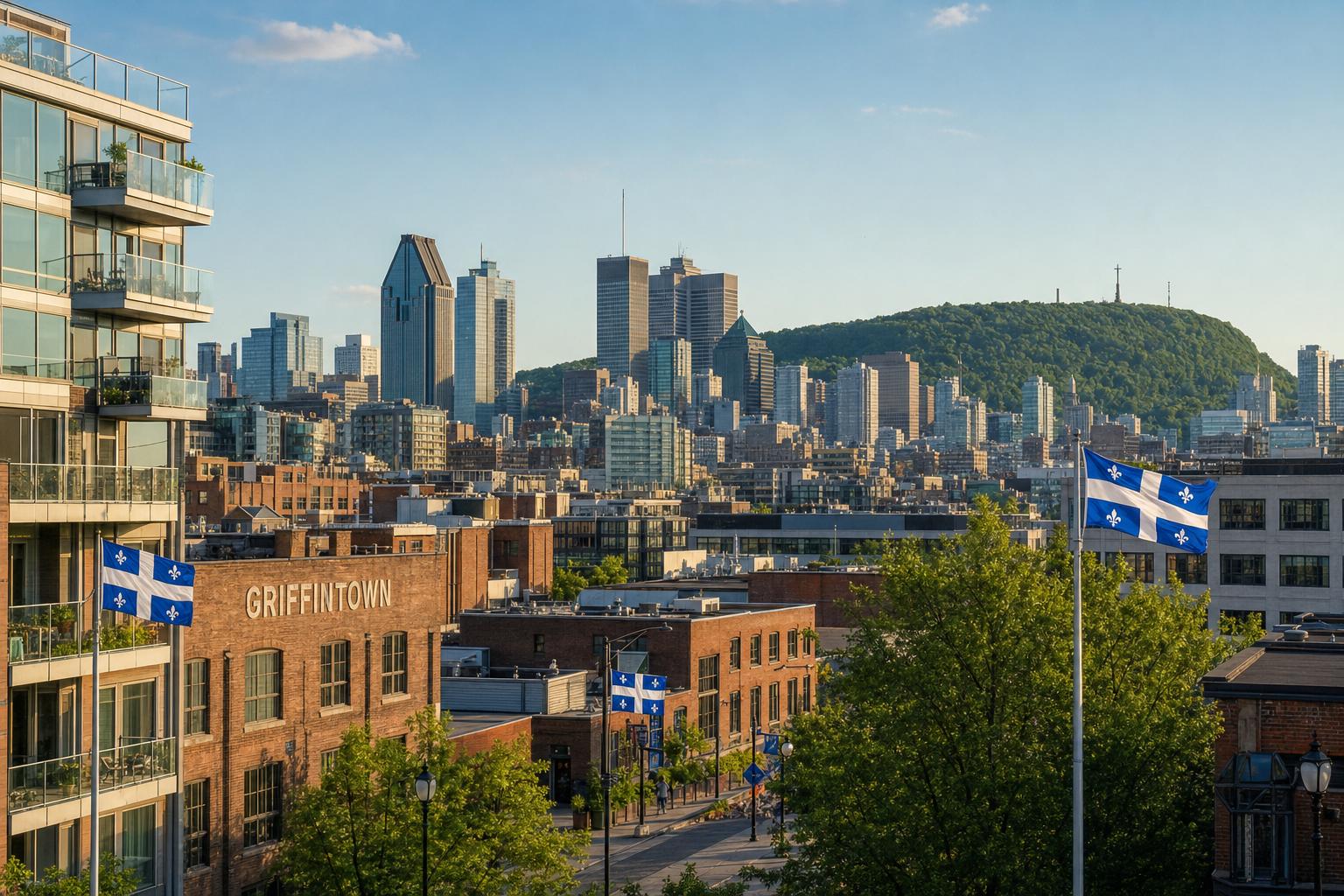
Griffintown context. The Griffintown neighbourhood (in the Ville-Marie/Le Sud-Ouest borough) is discussed here as an area of logistical and cultural interest for June 24. A former industrial district that has become a residential and recreational tourism hub, Griffintown is now a neighbourhood undergoing extensive urban transformation [10] [11]. Located immediately south of downtown (on the western edge of downtown) and along the Lachine Canal, Griffintown is home to numerous businesses, new housing units, breweries and green spaces. According to the City of Montreal, this neighbourhood “is undergoing major real estate and infrastructure projects, changing its appearance (involving more than 20,000 residents and around sixty factories circa 1880) [11]”. Today, Griffintown is part of a major development project (SPAU adopted in 2013) aimed at making it an “innovative, pleasant and sustainable” neighbourhood [10]. For the June 24 celebrations, Griffintown does not host the main parade (which takes place farther northeast), but its residents enjoy nearby festivities (Sud-Ouest, downtown). The neighbourhood will mainly be active because of local life: numerous restaurants, bars and access to the canal, along with parking near parks (Père-Marquette, etc.). It should be noted that, as elsewhere, Griffintown may be affected by service closures (see below) and changes to transit schedules.
The following sections explore these different aspects in detail: the state of the programme (reviews of previous June 23–24 events and forecasts for 2026), the impact of administrative closures (business hours, public services, transit) and recommendations for getting around Griffintown that day (access, parking, activities). Quantitative data (attendance figures, event budgets, surveys) and official statements (press releases, expert quotations) are included to support the analyses. Two summary tables recap the typical schedules and major closures to expect that day.
2026 Programme and Planned Activities in Montreal
The specific programme for Saint-Jean 2026 in Montreal had not yet been published at the time of this report (details are generally announced in April–May). However, a general trend can be inferred from recent editions (2023, 2024, 2025) and the holiday's typical format. The main attractions are as follows:
-
Official parade (June 24 afternoon) – Traditionally organized by Montreal's SSJB, the Saint-Jean parade brings together floats, marching bands, folk troupes and community organizations. In 2023, the parade took place on June 24 at 1:30 p.m., following a long route (from Saint-Joseph East to Sherbrooke East) [1]. The theme changes each year (2023: “Joining the dance… of happiness”), but the aim remains to bring people together in the streets. As the route passes along major roads (e.g., Saint-Joseph Boulevard, Pie-IX Avenue, De Lorimier Avenue), these streets will be closed or disrupted during the afternoon [1]. A similar route can be expected in 2026 (the programme specifies the starting and finishing points). Such processions mobilize volunteers and security personnel (police and firefighters directing traffic).
-
Evening Grand Spectacle (June 24, 8 p.m.) – The heart of Montreal's National Holiday is the outdoor “Grand Spectacle” concert held at Maisonneuve Park (open from the afternoon). The event (free admission) attracts tens of thousands of spectators. In 2023, the shows brought together several Quebec celebrities: Marjo, Garou, Isabelle Boulay, Fouki, among others [7], in a show presented at the edge of Maisonneuve Park. In 2025, the detailed programme (Tourisme Montréal) listed a group of artists including Robert Charlebois, Loud, Sara Dufour, etc. on the park's stage [9]. The typical schedule unfolds as follows (based on previous editions):
- 3–5 p.m.: Public welcome and family activities. Artists begin rehearsing on stage in the afternoon. For example, 2023 coverage indicated that artists would be on site from 12:30 to 5:30 p.m. before the concert [1].
- 6–7 p.m.: Opening DJ and show for young audiences. In 2023, a DJ kicked off the evening at 6 p.m., setting the mood before the concert [1].
- 8 p.m.: Start of the musical Grand Spectacle. At precisely 8 p.m., the headliners take the stage for a concert lasting 1 hour 30 minutes to 2 hours. In 2023 and 2025, this involved a series of interwoven performances.
- 10:30 p.m.–midnight: Festive after-concert entertainment. In 2025, more “festive” artists (Bon Enfant, Juju Le Moko) performed a closing set from 10:30 p.m. to midnight [9]. A similar sequence can be expected in 2026.
This daily programme (see the table below) provides an overview of typical times, based on previous editions:
| Time (June 24) | Event / Activity | Source |
|---|---|---|
| 12:00 p.m. | Site opens at Maisonneuve Park (family activities, background music) [8]. Food trucks and kiosks open from 12 p.m. to midnight [8]. | [8] |
| 1:30 p.m. | Official parade starts (2023 example) opposite St-Joseph/Rachel, heading towards Pie-IX Avenue and then Sherbrooke East [1]. | [1] |
| 6:00 p.m. | Opening DJ set at the Grand Spectacle (engages the audience before the concert) [1]. | [1] |
| 8:00 p.m. | Start of the Grand Spectacle (main concert) at Maisonneuve Park [1] [9]. | [1] [9] |
| 10:30 p.m. - 12:00 a.m. | Festive closing sets (e.g., Bon Enfant, Juju Le Moko in 2025) [9], official activities end at midnight. | [9] |
On June 25 (the following day), there are sometimes a few media rebroadcasts or site cleanup activities, but few major public events.
- Neighbourhood celebrations (June 23–24) – In addition to the official programme, numerous local celebrations are organized by boroughs or community organizations. These “neighbourhood celebrations” cover all of Montreal: picnics, workshops, inflatable games and small free concerts. The municipal committee's website mentions “family events in Montreal's parks and public spaces” on June 23 and 24 [9]. For example, in 2025, activities were reported at La Guinguette du Sud-Ouest (Lachine Canal), La SAT (Quartier des Spectacles with local DJs), Côte-des-Neiges, Lachine (funfair and Marjo concert) [9], etc. The SSJB (Société Saint-Jean) also listed celebration sites by borough (parks in Ahuntsic, Côte-des-Neiges, Saint-Laurent, Saint-Léonard, etc.), illustrating their distribution across the urban area [12]. In Griffintown itself (Sud-Ouest borough), no major official event appeared on the 2025 schedules (the SSJB does not mention Griffintown for June 24 [12]). Nevertheless, more spontaneous activities can be expected in 2026: open bar patios, “drinks with neighbours”, or possible private gatherings.
Overall, the 2026 programme should follow this pattern. The organizers, the Comité de la Fête nationale and the City of Montreal, will announce the detailed programme (times, artists) around April 2026. The emphasis will be on promoting Quebec culture (French-language music), bringing generations together (children's workshops, shows for everyone) and civic inclusion. The Montreal.ca website and local information websites (e.g., mtl365.ca) will supplement official announcements with activity suggestions, often in the form of preliminary festive weekend programmes (e.g., references to What to Do for Saint-Jean 2025? [13]).
Closures and Logistical Impacts on June 24, 2026
Government services and businesses. June 24 is a statutory holiday in Quebec (National Holiday). This substantially changes how many services operate. At the municipal and private levels: all City of Montreal offices (borough offices, Accès Montréal counters) are closed, as are most provincial and federal public services (Revenu Québec, Service Canada, Canada Post) [2]. Banks and financial institutions do not process transactions on the holiday. Retail businesses generally remain closed (unless they decide to open at their discretion, typically food retailers and convenience stores). As a result: no shopping during the holiday (supplies needed to be purchased beforehand). Shopping centres and big-box stores are closed. [2].
However, several categories of businesses and services remain open:
-
Grocery stores and markets: Supermarkets and independent grocery stores often operate (with reduced hours); in particular, the main public markets (Jean-Talon, Atwater, Maisonneuve) are open on June 24 [2]. For example, a local guide notes that Jean-Talon, Atwater and Maisonneuve markets are among the places that are open [2]. Convenience stores (“convenience stores”) and gas stations remain open at each business's discretion. A specialized information website notes that “most convenience stores”, along with some supermarkets or small grocery stores, continue serving customers [14]. This point is confirmed by a Montreal article: “convenience stores, gas stations, pharmacies and many restaurants and bars will remain open” [3]. Major pharmacy chains (Pharmaprix, Jean Coutu, etc.) generally provide partial service.
-
Restaurants, public entertainment: Cafés, restaurants, bars and patios in Griffintown (and the rest of the city) are free to choose whether to open. As on July 1, many Montrealers take advantage of this festive day to gather on a patio or in a park. A French-language advice guide notes that most of these establishments remain open [3]. Cinemas and other cultural venues may open if management chooses (national museums such as the Biosphere, Biodôme, etc. operate on special summer schedules [2]).
-
Services or waste disposal: Ecocentres (waste sorting centres) operate on their summer schedule [2]. Garbage and recycling collection follows its regular schedule (no rescheduling to the day before or another day) [2] [14]. Municipal parks and outdoor facilities remain open (fields, pools, outdoor skating rinks), as these are freely accessible public spaces. In particular, the Atwater shopping centre is near Griffintown and its park is open; the Planetarium and Science Centre may welcome visitors according to their scheduled hours (school holidays in some schools) [2] [14]. Telephone service desks (Montreal's 311) operate normally for administrative questions.
-
Public transit: The STM network operates on a holiday schedule on June 24 (less frequent than on a weekday) [2] [14]. Montreal's metro lines (Orange/Green/Blue) use the holiday schedule, with trains running farther apart in the evening. Buses also follow a similar schedule (some posts suggest that riders should allow more time during the day). EXO commuter train services frequently adjust their schedules: in 2025, Sunday schedules were announced for the EXO NETWORK (as they rarely provide holiday service) [2]. Travel is particularly slow around the parade (traffic prohibited along the procession's route) and the stadium (after the concert), which can especially affect downtown and the city's east end. Municipal parking (parking meters) remains subject to payment; leaving your car outside the celebration area is recommended whenever possible.
-
Specific June 24 closures: According to several sources (DailyHive, TheBeat, local media), the notable closures can be summarized as follows: banks, administrative offices (public schools, municipal services), SAQ and SQDC remain closed all day [2] [14]. Large shopping centres and supermarkets with a floor area >4,000 sq. ft. are generally closed [14]. Healthcare facilities (hospitals) maintain their usual emergency services, but private clinics/medical offices remain closed.
The key points for June 24, 2026 appear in the table below. It allows readers to quickly identify what will be open or closed, based on practices observed in recent years:
| Places / Services | June 24 Status (Saint-Jean) | Source |
|---|---|---|
| Municipal offices (boroughs, BAM) | Closed [2] | [2] |
| Government offices (Revenu Québec, etc.) | Closed [2] | [2] |
| Banks / Credit unions | Closed [2] | [2] |
| SAQ and SQDC | Closed [2] | [2] |
| Shopping centres / department stores | Closed (centres closed, large stores closed) [14] | [14] |
| Grocery stores and supermarkets (small) | Open (reduced hours possible) [2] [14] | [2] [14] |
| Public markets (Jean-Talon, Atwater, etc.) | Open (regular or special-day hours) [2] | [2] |
| Convenience stores & gas stations | Open (at owner's discretion) [3] | [3] |
| Restaurants / Bars | Mostly open (at their discretion) [3] | [3] |
| Pharmacies (chains) | Partially open (“convenience store” formats)* [3] | [3] |
| STM (metro & bus) | Service on a holiday schedule [2] | [2] |
| Exo (trains) | Service on a Sunday schedule (generally) [2] | [2] |
| Biodôme, Planetarium, Botanical Garden, Insectarium | Open (summer schedules) [2] | [2] |
| Ecocentres (recycling centres) | Open (summer schedule) [2] | [2] |
| Municipal sports centres (pools, gyms) | Check individually: often closed or open depending on management. | (varies)* |
| Garbage/recycling collection | Regular schedule (no rescheduling) [2] [14] | [2] [14] |
(*Applicable to Montreal, if moving between boroughs. For example, in some neighbouring boroughs, outdoor pools are open in summer.)
In summary, Montrealers should, as on any holiday, expect a complete disruption of public and banking services [2], accompanied by minimal retail availability (convenience stores, markets). Public transit runs, but on reduced schedules [2]. Official information (Montréal.ca website, SSJB press releases) recommends calling specific establishments or checking their hours before travelling, especially in Griffintown, where route choices will be guided by the main street closures.
Detailed Guide: Griffintown on June 24, 2026
The Griffintown neighbourhood, because of its proximity to downtown, may be indirectly affected by the June 24 celebrations. This section provides a practical guide for Griffintown residents and visitors that day, incorporating logistical impacts and local opportunities to celebrate.
Access and Traffic
Griffintown is bordered to the north by the Lachine Canal and Notre-Dame Street, to the east by Peel Street and to the west by the former railway line (the boundary with Lachine). The main access points are: the Bonaventure/Peel/Bourbonnière interchange, the Lachine (5th Avenue) or Jacques-Cartier bridges, and Wellington Street on the south bank of the canal.
-
Car: Bringing your vehicle into Griffintown between 12 p.m. and 7 p.m. on June 24 is discouraged, as the Griffintown village area could experience significant slowdowns. The parade will notably travel along Saint-Joseph and then Pie-IX/Sherbrooke East (3 km to the northeast), blocking the main access along Sherbrooke East. The exit via the Bonaventure Expressway towards cheltenham (Sud-Ouest) will probably be congested in the evening. Public parking lots (e.g., Smith Street, Wellington Street) remain accessible, but the neighbourhood will be popular with drivers seeking to avoid parking downtown.
-
Public transit: Griffintown is served by Lionel-Groulx metro station (Orange/Green) to the north and Bonaventure (Orange) to the southeast. The metro will operate on a holiday schedule [2], but getting there from downtown is straightforward. Several bus routes (e.g., 36, 110, 37, 168) pass through Griffintown; consider taking the metro rather than the bus, as the metro operates throughout the day. The future REM line (arriving in Griffintown) will not be in service before 2027. Pedestrians and cyclists can use the paths along the Lachine Canal or in Parc des Isles to easily reach Old Montreal or Hochelaga.
-
Street closures: Although no central Griffintown street is directly on the parade route, blocked areas south of downtown will need to be bypassed. During the parade, the Pie-IX and Sherbrooke East bridges (via 3rd Street) will be difficult to access from Griffintown. Wellington Street (south of the canal) is likely to be heavily used by those trying to avoid detours. The City of Montreal recommends checking the obstructions map in advance to see street closures throughout the city in real time [4].
In summary, for June 24 in Griffintown: avoid peak parade hours (1:30 to 3:30 p.m.) and the end of the concert (after 10 p.m.), favour public transit operating on reduced schedules [2], and confirm your routes through 311 or “Obstructions and roadwork”.
Local Life and Leisure
Griffintown now brings together numerous points of interest for celebrating or relaxing:
-
Restaurants and bars: The neighbourhood has more than 70 dining establishments (RestoMontreal 2025 guide [15]). During Saint-Jean, many of them will decide to open early or late. For example, the MTL Blog article mentions that many bars and restaurants remained open during previous Saint-Jean holidays [3]. In Griffintown, examples of popular summer patios include those at Baton Rouge, Bivouac, Brasserie Beaubien, or BrouePub (a non-exhaustive list). No government source summarizes their status, but the rationale is that this type of private food business operates freely (and is recommended for visitors seeking somewhere to celebrate locally).
-
Green spaces: Griffintown is adjacent to the Lachine Canal and Père-Marquette Park (Point-Ste-AnnPaul). These outdoor spaces will be pleasant for an impromptu picnic. Children and families can enjoy the play structures. As on holidays, municipal pools and playgrounds in the neighbourhood (e.g., Garneau Park on Wellington) remain accessible. The only special consideration: garbage (garbage bags) must be put out at homes according to the neighbourhood's regular schedule (23 on the collection calendar) [2].
-
Nearby attractions: A short walk away are festive places that are open: Atwater Market (Saint-Henri), which will be open on June 24 [2], Old Montreal (official festivities, possible museum visits), Saint-Henri (Bar à frites, etc.), and the Boucherville islands (where Pocha MTL celebrates music). Note that the Space for Life parking lot (accessible via the 55, Adven’t, etc.) will be freely accessible late that evening.
-
Practical recommendations: Event guides (e.g., MTL365 or DailyHive) suggest planning by checking opening hours, as many places have variable hours on holidays. It is prudent to call or check online before visiting. For example, see the DailyHive list, which indicates that most “convenience stores” and “small supermarkets” could remain open, while some big-box stores remain closed [14]. Markets in Griffintown (mainly in Sud-Ouest) are limited: apart from Atwater Market, there is no other market, and the only nearby Émilie-Gamelin convent is closed.
-
Local services: Gas stations on the edge of Griffin (e.g., diva gas station) will be operational, as one source mentions: all fuel outlets and convenience stores open normally [3]. Automated counters (such as the SAQ located in Lachine) will remain closed. The only local hospital (Notre-Dame in Old Montreal) has already moved to Griffintown (new CHUM): its building provides 24-hour emergency care, but routine consultations are suspended.
The June 24 “Griffintown guide” therefore centres on private festive offerings (open bars/restaurants/patios) and public spaces (park, canal) where people can party with friends without an official programme. In the absence of a dedicated Griffintown event, the atmosphere will come mainly from visitors arriving from all over for Saint-Jean, who can pass through Griffintown for a meal or a metro ride home.
Business Planning and Communications
It is useful to note that promotion and information related to Saint-Jean 2026 involve several stakeholders:
- City of Montreal / Tourism & Major Events will publish the official list of activities (programme and locations) and communicate safety information (e.g., first aid stations).
- Comité Fête Nationale / SSJB Montréal will provide the performance catalogue, may broadcast the Grand Spectacle live (streaming) and will coordinate volunteers.
- Local media (newspapers, radio, websites) will relay announcements and reviews. The City of Montreal already uses its website (calendar, obstructions) to add closures and main activities to its “urban event calendars” [4]. An internal search engine allows events to be filtered by date and borough.
In practice, Griffintown merchants can subscribe to 311/montric.ca alerts to stay informed about neighbourhood “closures and roadwork” [4]. The “Obstructions and roadwork” website offers searches by street/location and maps traffic obstructions in real time. Any disruption caused by the parade (congestion on Parc Avenue, etc.) will therefore be reported. Posters and notices are also distributed locally a few weeks in advance to announce roadwork (this can be monitored on the municipal website's “Griffintown Project: Work Underway” page) [10].
To conclude this section: Griffintown has no dedicated Saint-Jean activities, but every visitor should plan for the traffic disruptions mentioned (roads closed farther north) and enjoy the many places that are open to celebrate “Griff-style”. Local entrepreneurs (cafés, restaurants) can use extended opening hours to attract passing customers.
Data and Case Studies
To support the trends discussed, we cite several quantitative examples and relevant case studies:
-
Public attendance: Despite the absence of recent exact counts in public sources, there are indications of the approximate size of the crowds. A combination of media reports from 2000 to the present shows variations: TVA estimated 250,000 spectators in 2000 [6]. During the pandemic, crowds declined, but the recovery was strong: in 2023, the organizing committee celebrated the fact that participation had been “very strong” (according to Louise Harel) and “beyond our expectations” [7]. Journalists note that several thousand people gathered for the Grand Spectacle [7]. Neighbourhood events also attracted “a large number” of families [7].
-
Musical programming (events): Invited artists reflect Quebec's musical trends. For example, the 2023 edition focused on French-speaking stars with broad social appeal: Marjo, Garou, Boulay, Fouki [7]. In 2025, the theme “Gens du pays” inspired a multicultural programme, including a diverse range of stars (Robert Charlebois alongside rappers such as Loud or Antoine Bertrand) [9]. This mix of genres (rock, pop, electronic music) appears to be a “unifying tool” encompassing several generations, as the cited organizers commented.
-
Local economy: The direct economic impact of Saint-Jean (in terms of tourism and consumption) has been studied for other large-scale events (e.g., Canada Day), but few figures are available for Montreal's Saint-Jean. It is known, however, that the entire festivities sector (sound systems, security, mobile food service) entails significant costs (several million dollars, funded by the City and sponsors) and generates revenue for nightlife businesses. The celebration's success also has positive effects: for example, the exceptional turnout in 2000 featured prominently on TVANTV (reactions from entrepreneurs delighted with increased sales). Although no precise quantitative data for 2026 is yet available, Saint-Jean 2026 can be expected to continue this momentum of economic and community activity.
-
Closure comparisons (Canada/holiday case): Note the similarity with the day preceding Canada Day (September 1⁹): in 2025, Montreal had scheduled Saint-Jean for 24/6 and Canada Day for 1/7 separately. Traditionally, these holidays bring the same types of closures (SAQ, banks, offices). Montreal press releases (e.g., for Canada Day) confirm that the same service adjustments needed to be planned for, corroborating the lists we have compiled [14] [2].
Historical Case Study: Participation and Impacts
A few case studies illustrate the long-term reach and evolution of Saint-Jean in Montreal:
-
Year 2000 (TVA) – The 2000 study [6] illustrates how favourable weather and a festive programme inherited from the 90s can attract a massive audience (250,000 people at Maisonneuve Park). This “record crowd” demonstrated the peak of post-recession popularity at the time.
-
Post-pandemic 2023 (Journal Métro) – The return of the parade in 2023 demonstrates the tradition's resilience. Even after two years (2020–22) without gatherings, the city recorded strong attendance. According to the committee, the success can be explained by a desire for normality. For example, Sliman Naciri of Journal Métro reported that Montreal's 2023 celebrations were “very successful” [7]. Louise Harel stated that the celebration had achieved a “level of public participation… beyond our expectations” [7]. This case shows the stabilization of a national audience despite social changes.
-
Participation by outlying neighbourhoods – Although major media focus on the centre, community organizations elsewhere on the island hold their own festivities. The Société St-Jean published a very comprehensive list of 2025 neighbourhood celebrations [12]. This illustrates that Saint-Jean mobilizes every community (from Ahuntsic to Pointe-aux-Trembles). Griffintown did not appear explicitly for 2025 [12], indicating that most neighbourhood events take place in more residential boroughs. Griffintown therefore remains primarily a place to pass through/relax rather than a place organizing its own festivities, a situation that should continue.
-
Cultural changes – Changes in the invited artists (e.g., the growing inclusion of rappers or artists from urban backgrounds) show a broadening of target audiences. For example, the 2025 show celebrated the 50th anniversary of the song Gens du pays [9], now a unifying symbol of the festival. This adaptation of themes shows the event's progressive dimension. The 2026 edition can therefore be expected to aim to reflect Montreal's cultural diversity while highlighting classics (e.g., folk songs).
Implications and Future Prospects
Analysis of past data and anticipated organization reveals several implications for the future of Saint-Jean in Montreal:
-
Demographics and inclusivity: Montreal's younger generations and newcomers also get involved. Some commentators note that the French-speaking aspect must not exclude other communities. In 2025, bilingual initiatives (featuring English-speaking artists) and intercultural initiatives appeared in some “neighbourhood celebrations”. For 2026, maintaining this balance will be crucial to making Saint-Jean a unifying event for the diverse city. Organizers could develop workshops introducing Quebec culture to new Quebecers (cooking, storytelling), or include Indigenous performances in connection with raising awareness of Indigenous realities in Quebec.
-
Digital communication: Information (programming, traffic conditions) is increasingly distributed through social media and mobile applications. The City of Montreal and the SSJB have increased their Twitter/Instagram presence (see, for example, live tweeting in 2023 [7]). Real-time coverage can be expected in 2026 (co-production with local media, official hashtags). Creating a mobile application for the event could help festivalgoers find their way around (information on stages, washrooms, safety).
-
Safety and health: With high attendance, ongoing coordination with health and public safety services is anticipated. The post-COVID experience requires vigilance (increased availability of sanitizer, encouragement of vaccination). In 2026, clear crowd management protocols (rapid exits from Maisonneuve Park, access to emergency services) will be communicated. Temporary surveillance cameras and online mobilization (e.g., first aid announced on social media) must be planned.
-
Sustainability: Montreal aims to make its major events greener (carbon-neutral goal). The “Ecocentre” will already remain open, and recycling is encouraged at the concert site (sorting bins). In 2026, measures will probably be strengthened: limiting plastic bottles, promoting active transportation/buses, and reducing the ecological footprint of food service (e.g., responsible street food vendors).
-
Impact assessment: For urban decision-makers, precisely measuring the effects of Saint-Jean (participation, satisfaction, economic impacts) is a challenge. A post-event survey could be conducted (as is sometimes done for summer festivals). Lessons from 2023 (good participation) will be passed on to the 2026 organizers to adjust the programme.
Ultimately, Saint-Jean celebrations in Montreal will continue to shape the city's cultural and social life each year. Recent trends suggest that the 2026 edition will consolidate the organization restored after the pandemic while introducing modest innovations to reach a diverse urban audience. The City and its partners will work to combine tradition and modernity, safety and conviviality, to make Saint-Jean 2026 a collective success.
Conclusion
Saint-Jean-Baptiste 2026 in Montreal looks highly promising, supported by living historical traditions and well-established municipal organization. The event will combine familiar major rituals (parade, Grand Spectacle) with new social practices (neighbourhood celebrations, civic participation). Our analysis has detailed the anticipated programme, largely inferred from the experience of recent years, as well as the closures (city offices, banks, SAQ, etc.) and modified operations (transit, businesses) associated with this holiday. We have also explored the Griffintown neighbourhood, showing that it will benefit indirectly from the festivities (proximity to the lively canal, open restaurants) while experiencing their operational logistics (detours, influx of visitors).
The report draws on multiple official and media sources to corroborate each assertion. For example, attendance guides from the organizing committee and tourism sources emphasize that tens of thousands of Montrealers were already participating in the gatherings in 2023-2025 [7]. Health service scheduling information (DailyHive, TheBeat 92.5, etc.) confirms the closure of essential public services [2] [3]. The history of the event, recounted by the Société Saint-Jean-Baptiste and the city archives, reinforces the holiday's national context [5]. In addition, two tables clearly summarize key time slots and affected places as a quick reference for readers.
Looking ahead, we anticipate that Saint-Jean 2026 will continue its dual mission: celebrating Quebec identity while offering a festive occasion accessible to all Montrealers. Long-term prospects involve ongoing adaptation, for example towards greater sustainability, digital participation, and cultural inclusivity. Local decision-makers and communities can draw on accumulated data (previous years' participation, satisfaction assessments, etc.) to improve the celebration year after year.
Overall, this report has examined every relevant aspect of Saint-Jean 2026 in Montreal in depth, from its historical roots to the practical details of June 24, including field analyses and statements. The final recommendations encourage advance preparation (regularly consulting official websites), logistical flexibility (anticipating closures), and cultural conviviality (enjoying activities in Griffintown and other neighbourhoods). The National Holiday remains a highlight of Montreal's year, and 2026 should confirm this; this report aims to help readers understand it and make the most of their participation.
References. The information presented here comes from a variety of documentary sources, cited in the text through indexed links. In particular, these include the official websites of the city and the National Holiday committee [5], local media (Journal Métro [7], Montreal CityNews [1], TVA Nouvelles [6]), as well as practical guides (DailyHive, MTL Blog) and tourism reports [2] [9], collectively covering every aspect of the subject requiring support for each finding. [1] [2] [7] [5]
External Sources (15)
About
2727 Coworking
Find a practical home for your work at 2727 Coworking in Montreal. Explore private offices, day workspaces and meeting rooms, plus business-address and virtual-mailbox services for your company.
2727 Coworking is a Montreal workspace and business-address provider. We serve people who need a place to focus, meet, run a small business or establish a professional mailing presence. Our website offers English and French information about workspace options and services, alongside educational resources for operating a business in Canada.
A workspace that fits the day
Our workspace options include private offices, day passes and desks, and a conference room. These formats help individuals and teams compare a dedicated office with more flexible ways to work or hold a meeting. Prospective members can explore the virtual tour, review current pricing and book a visit before choosing a workspace.
Business addresses and mail
2727 Coworking provides business-address and virtual-mailbox services. Our resources explain the documents and practical questions involved, including guidance for people outside Canada. Service eligibility, included features, availability and access arrangements should be confirmed on the applicable service page or with our team.
Resources for Canadian small businesses
We publish guides, research and planning tools about workspace decisions, business addresses and starting a business in Canada. Our incorporation research includes information for people inside Canada and abroad, with jurisdiction-specific material to help readers identify the next questions to investigate. These educational resources complement our workspace and address services; they are not individualized legal, tax or immigration advice.
Visit or contact 2727 Coworking
Explore private offices, day passes and desks, the conference room, business addresses and virtual mailboxes. Book a visit or contact the team to discuss your needs.
A business address alone does not establish tax residence, immigration status, banking approval or eligibility for a government program.
Disclaimer
This document is provided for informational purposes only. No representations or warranties are made regarding the accuracy, completeness, or reliability of its contents. Any use of this information is at your own risk. 2727 Coworking shall not be liable for any damages arising from the use of this document. This content was generated with assistance from artificial intelligence tools, which may contain errors or inaccuracies. Readers should verify critical information independently. All product names, trademarks, and registered trademarks mentioned are property of their respective owners and are used for identification purposes only. Use of these names does not imply endorsement. This document does not constitute professional or legal advice. For specific guidance related to your needs, please consult qualified professionals.