Coworking in Griffintown Montreal: The Complete Guide to Working in Montreal's Innovation District
Griffintown is Montreal's most dramatic example of urban reinvention. In barely two decades, this former industrial district has transformed from abandoned warehouses and empty lots into one of the city's most vibrant neighborhoods for living, working, and building businesses. For professionals seeking coworking space, Griffintown offers a combination of qualities that no other Montreal neighborhood can match: converted industrial buildings with soaring ceilings and massive windows, direct access to the Lachine Canal and its network of bike paths and green spaces, proximity to the Atwater Market, excellent transit connections, and a growing community of tech workers, creatives, and entrepreneurs who have made the canal corridor their professional home.
This guide examines why Griffintown has become Montreal's premier coworking destination, profiling the neighborhood's history, character, and infrastructure in the context of what matters most to professionals choosing where to work.
Executive Summary
Griffintown's evolution from industrial relic to innovation district has created one of Montreal's most compelling coworking environments. Key findings:
Griffintown's population grew by an astonishing 642% between 2011 and 2021, making it the fastest-growing neighborhood in the Montreal metropolitan area and bringing a young, professional demographic that fuels demand for flexible workspace [1]
The neighborhood is home to major technology companies including Autodesk (40,000+ sq ft office opened in 2020), former VICE Media Quebec headquarters, and a growing cluster of AI, fintech, and creative industry startups [2]
Coworking pricing in Griffintown ranges from $20-$25/day for budget operators to $60/day at premium spaces, with monthly hot desk memberships from $215-$400, representing a 15-25% discount compared to equivalent downtown Montreal workspace [3]
Transit accessibility is strong: Charlevoix metro station (Green Line) is within a 5-minute walk of most Griffintown coworking spaces, and the future REM Griffintown-Bernard Landry station will add rapid transit connections to the South Shore, airport, and West Island [4]
The Lachine Canal bike path provides year-round active transportation infrastructure, complemented by dense BIXI bike-share coverage throughout the neighborhood [5]
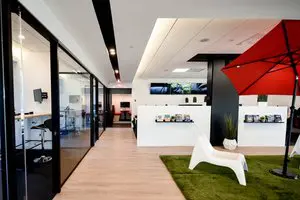
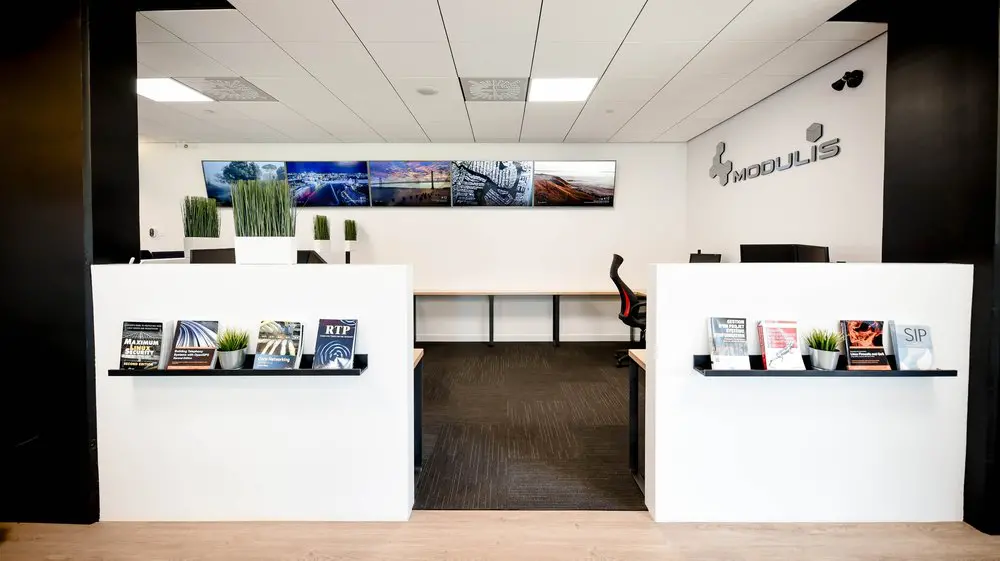
2727 Coworking space, 2727 Saint-Patrick, Montreal
The History of Griffintown: From Industrial Powerhouse to Innovation District
The Irish Roots (1800s - Early 1900s)
Griffintown's story begins with immigration. In the early 19th century, Irish immigrants settled along the Lachine Canal, drawn by construction jobs on the canal itself and employment in the factories that sprang up along its banks. By the mid-1800s, Griffintown was Montreal's Irish quarter, a working-class neighborhood of modest row houses, churches, and community institutions that formed the backbone of the city's industrial economy.
The Lachine Canal, opened in 1825 to bypass the Lachine Rapids on the St. Lawrence River, was the catalyst for Montreal's industrial revolution. Factories, foundries, breweries, flour mills, and warehouses lined both banks, using the canal for transportation and hydropower. Griffintown, positioned at the eastern entrance to the canal, became the epicenter of this industrial activity [6].
The Industrial Decline (1950s - 1990s)
The opening of the St. Lawrence Seaway in 1959 rendered the Lachine Canal obsolete for shipping. Factories closed, residents left, and Griffintown entered a long period of decline. By the 1980s, much of the neighborhood was abandoned or underutilized, its magnificent industrial buildings sitting empty and deteriorating.
Paradoxically, this period of neglect preserved exactly what makes Griffintown valuable today: a stock of industrial buildings with architectural characteristics, large windows, high ceilings, heavy timber frames, exposed brick, that are perfectly suited to contemporary workspace but could never be economically reproduced in new construction.
The Renaissance (2000s - Present)
Griffintown's transformation began in earnest in the early 2000s, when the City of Montreal reopened the Lachine Canal to recreational navigation (2002) and began developing the canal-side bike paths and green spaces that now form one of the city's most beloved public amenities.
Residential development followed quickly. Between 2006 and 2021, Griffintown's population exploded as condominium developments attracted a demographic of young professionals, many working in technology, creative industries, and professional services [1].
The commercial transformation lagged the residential boom by a few years but has accelerated dramatically since 2015:
Autodesk opened a major Montreal office in Griffintown in 2020, occupying 40,000+ square feet across two floors for 200+ employees
VICE Media established its Quebec headquarters in a former printing workshop in Griffintown
Lightspeed POS (now Lightspeed Commerce, a publicly traded company) operated from the neighborhood during its growth phase
Dozens of startups in AI, fintech, gaming, and creative services have established themselves in converted industrial spaces throughout the corridor [2]
Today, Griffintown is recognized as Montreal's premier innovation district: a neighborhood where industrial heritage, creative energy, and technological ambition converge in a setting defined by the Lachine Canal and its green spaces.
Why Griffintown for Coworking: The Environmental Advantages
Natural Light at Industrial Scale
The single most impactful advantage of Griffintown's coworking spaces is natural light. The neighborhood's industrial buildings were designed to illuminate manufacturing floors, which meant massive windows, often floor-to-ceiling, on multiple facades. These windows provide a quality of natural light that purpose-built office towers cannot replicate.
Research on workplace daylight exposure has documented significant benefits: workers in well-lit environments sleep 46 minutes more per night, report 15% higher wellbeing, and demonstrate measurably better cognitive performance compared to those in artificially-lit offices [7]. For coworking members who spend 6-10 hours per day at their desks, this environmental advantage is not trivial.
At 2727 Coworking, the building's canal-side position means that western-facing windows provide afternoon light and views of the Lachine Canal, while the industrial scale of the building's original design ensures that light penetrates deep into the workspace rather than being limited to window-adjacent desks [8].
The Lachine Canal: Blue Space as Workplace Amenity
The Lachine Canal is Griffintown's defining feature, and its impact on the coworking experience extends far beyond aesthetics. Research in environmental psychology has documented the "blue space effect": proximity to bodies of water is associated with reduced stress, enhanced mood, and improved cognitive function [9].
For coworking members in Griffintown, the canal provides:
Lunchtime exercise: The canal-side bike path and walking trail provides a car-free corridor for running, walking, or cycling during breaks. A 20-minute lunchtime walk along the canal provides both exercise and the cognitive reset that enhances afternoon productivity
Seasonal variety: In summer, the canal comes alive with boats, kayakers, and waterside dining. In autumn, the tree-lined banks provide spectacular foliage. Even in winter, the frozen canal and snow-covered paths offer a serene landscape that transforms the lunchtime walk into a distinctly Montreal experience
BIXI connectivity: The canal path connects to the broader BIXI bike-share network, making it easy to cycle to meetings, restaurants, or other destinations throughout the city [5]
Mental health buffer: The green space along the canal provides a visual and psychological buffer between the intensity of focused work and the urban environment. Being able to step outside and see water, trees, and sky within 30 seconds of your desk is a luxury that downtown office towers cannot offer
Architectural Character and Creative Inspiration
The aesthetic environment of a workspace influences creativity, mood, and professional identity. Griffintown's converted industrial buildings offer an aesthetic that is qualitatively different from conventional office space:
Exposed brick and timber: Raw materials that convey authenticity and permanence
High ceilings: 12-16 foot ceilings that create a sense of space and openness, and that research links to more abstract, creative thinking [10]
Open floor plans: The factory-floor origins of these buildings naturally lend themselves to open, collaborative workspace layouts
Industrial details: Freight elevators, loading dock doors, steel columns, and original hardware that add character without requiring maintenance
This aesthetic is not merely decorative; it has functional implications. Professionals who work in environments they find inspiring and authentic report higher job satisfaction and creative output than those in generic, standardized office settings.
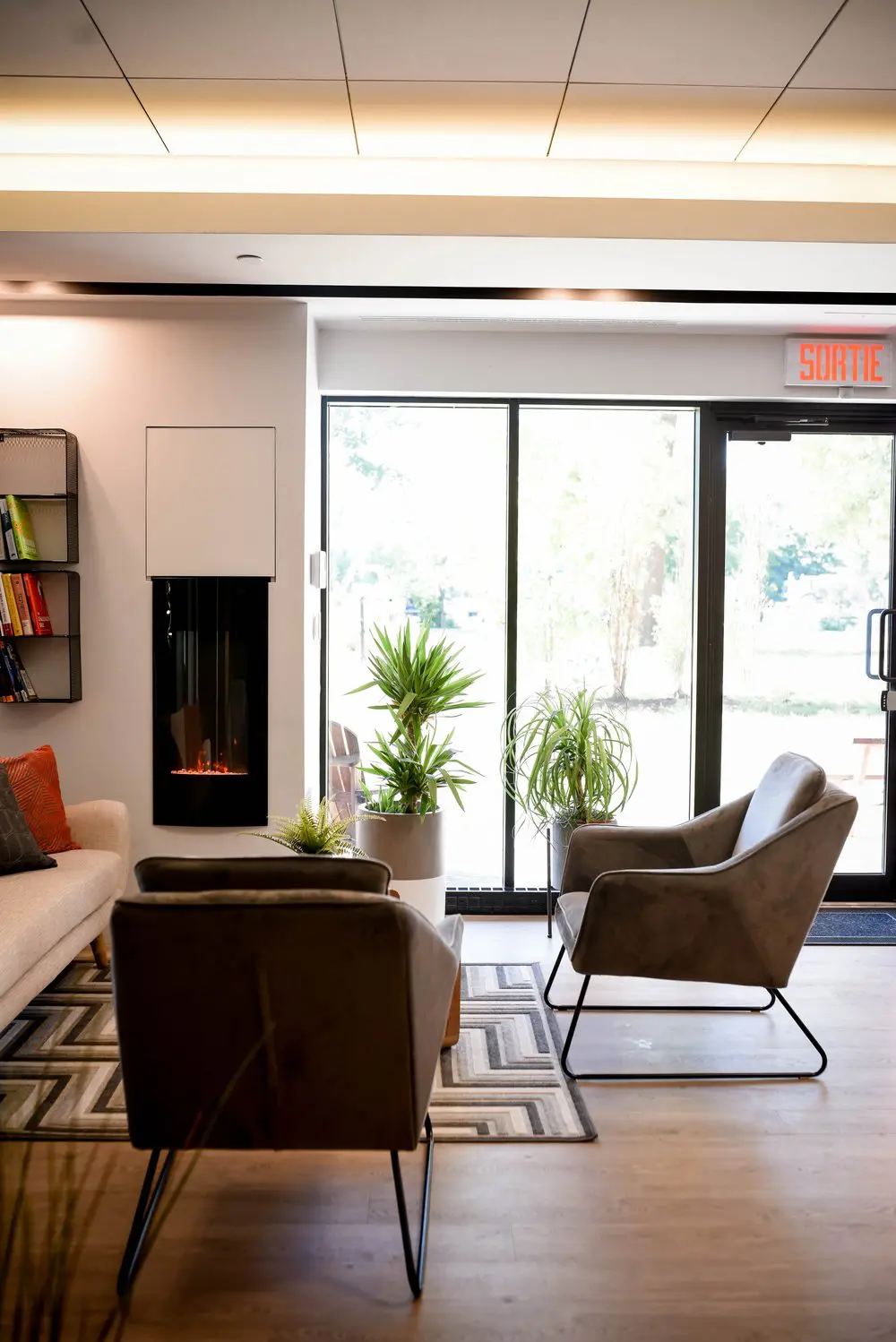
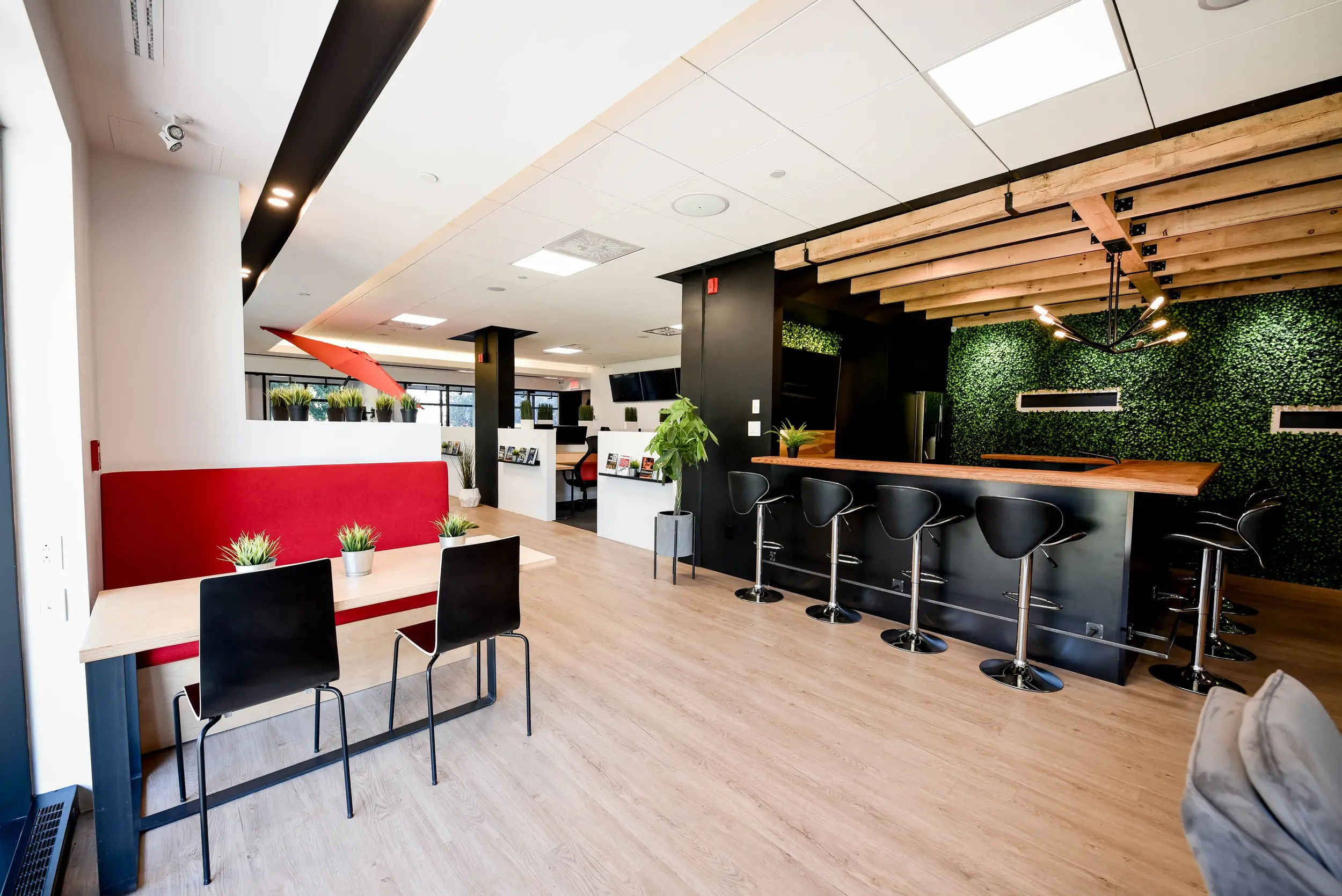
2727 Coworking space, 2727 Saint-Patrick, Montreal
The Science of Working Near Water: Blue Space and Cognitive Performance
What Research Says About Waterside Work Environments
The relationship between water proximity and human wellbeing is one of the most robust findings in environmental psychology. Griffintown's canal-side coworking spaces benefit from a body of research that extends far beyond simple aesthetics.
A landmark study published in Health & Place analyzing data from 18 European countries found that living closer to the coast was associated with better self-reported health, even after controlling for socioeconomic factors, green space access, and other environmental variables [14]. While the Lachine Canal is not an ocean, subsequent research has confirmed that inland waterways, rivers, canals, and lakes produce similar psychological benefits.
The BlueHealth research project, a pan-European initiative funded by the EU's Horizon 2020 program, conducted the most comprehensive investigation to date of how blue spaces affect human health. Their findings, published across multiple peer-reviewed journals, documented that:
Spending time near water reduces cortisol levels (the primary stress hormone) by 15-20% compared to equivalent time in urban environments without water [9]
Visual exposure to water through windows provides measurable psychological benefits even when individuals are not physically outdoors
The combination of water and green space (exactly what the Lachine Canal corridor provides) produces synergistic benefits greater than either element alone
Attention Restoration Theory and the Canal Corridor
Attention Restoration Theory (ART), developed by psychologists Rachel and Stephen Kaplan at the University of Michigan, provides the theoretical framework for understanding why canal-side coworking spaces enhance productivity [15]. ART posits that directed attention, the cognitive resource used for focused work, is a finite resource that becomes depleted through sustained use. Natural environments, particularly those containing water, provide "soft fascination" that allows directed attention to recover.
For coworking members in Griffintown, this translates to a practical advantage: a 15-minute walk along the Lachine Canal during a break provides measurably more cognitive restoration than a 15-minute walk through downtown streets. The canal path's combination of water, trees, birdsong, and reduced traffic noise creates an optimal restoration environment that is literally steps away from the workspace.
Seasonal Light and Circadian Health
Montreal's northern latitude (45.5 degrees north) creates dramatic seasonal variation in daylight hours: from 15.5 hours in late June to just 8.5 hours in late December. This variation has significant implications for workplace wellness, as insufficient daylight exposure during winter months is associated with Seasonal Affective Disorder (SAD), reduced cognitive performance, and disrupted circadian rhythms [16].
Griffintown's industrial architecture provides a meaningful advantage in this context. The massive, multi-pane windows that were designed to illuminate factory floors allow significantly more natural light to enter the workspace than the standard office window. At 2727 Coworking, the canal-side orientation provides western exposure that captures afternoon and golden-hour light, extending usable daylight deeper into the winter months [8].
A study published in the Journal of Clinical Sleep Medicine found that workers with optimized daylight exposure slept an average of 46 minutes more per night and reported 15% higher quality of life scores than those in poorly lit offices [7]. Over the course of a Montreal winter, this advantage compounds significantly.
Urban Planning and Transit-Oriented Development
How Griffintown Became a Model for Mixed-Use Urbanism
Griffintown's transformation did not happen by accident. The neighborhood's renaissance was guided by a series of urban planning decisions that created the conditions for a vibrant, walkable, mixed-use district that now serves as a model for transit-oriented development across Canada.
The City of Montreal's decision to reopen the Lachine Canal to recreation in 2002, after decades of closure, was the catalyst. By investing in canal-side bike paths, green spaces, and pedestrian infrastructure, the city created a public amenity that increased land values and attracted both residential and commercial development [17].
The planning framework that guided subsequent development emphasized:
Mixed-use zoning: Rather than separating residential, commercial, and retail uses into distinct zones, Griffintown's planning allowed buildings to combine ground-floor commercial space with upper-floor residential or office uses. This creates the street-level vitality that makes the neighborhood attractive for coworking: restaurants, cafes, and services within walking distance of any workspace
Height restrictions that preserve character: Building height limits in parts of Griffintown prevent the construction of glass towers that would overwhelm the neighborhood's industrial-heritage character and block the natural light that canal-side buildings depend on
Active transportation infrastructure: Dedicated cycling infrastructure, wide sidewalks, and traffic-calming measures create an environment where walking and cycling are the most convenient modes of transportation
Transit investment: The existing Charlevoix metro station and the planned REM station reflect a commitment to transit-oriented development that reduces car dependency
The 15-Minute City in Practice
Griffintown closely approximates the "15-minute city" concept popularized by Franco-Colombian urbanist Carlos Moreno, in which all essential services, including work, shopping, healthcare, recreation, and culture, are accessible within a 15-minute walk or bike ride from home [18].
For coworking members, this means:
Grocery shopping: Atwater Market (5-10 minute walk from most Griffintown locations)
Restaurant lunch: Dozens of options within a 5-minute walk along Notre-Dame West and surrounding streets
Transit: Charlevoix metro (5-minute walk), bus routes (2-minute walk)
Banking and pharmacy: Multiple options along Notre-Dame West
Entertainment: Breweries, bars, galleries, and seasonal events throughout the neighborhood
This concentration of services eliminates the time-wasting errands that fragment the workday in less walkable neighborhoods, allowing coworking members to accomplish personal tasks during brief breaks without losing significant work time.
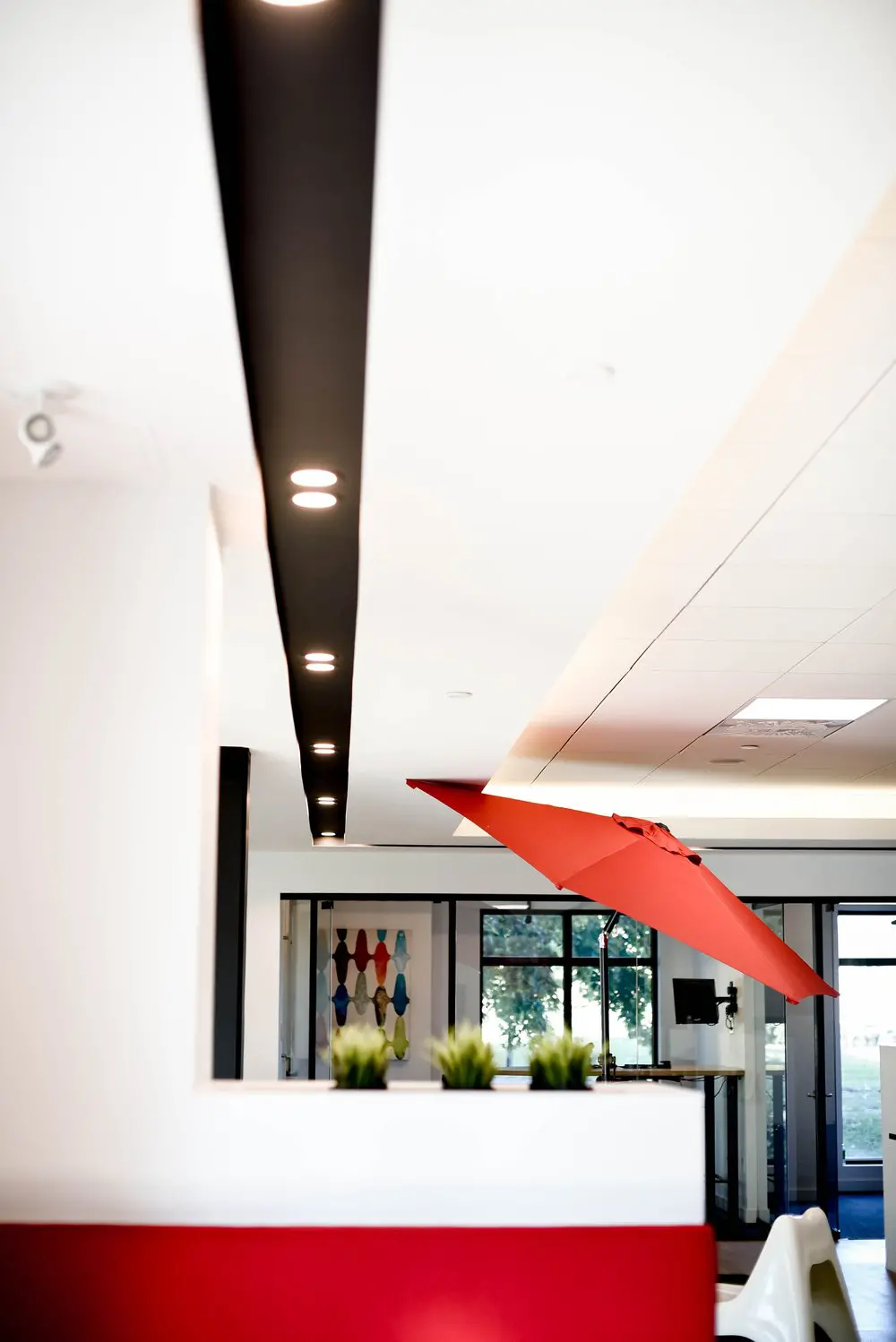
2727 Coworking space, 2727 Saint-Patrick, Montreal
The Economics of Coworking in Griffintown
Traditional Lease vs. Coworking: A Financial Comparison
For small businesses and startups considering workspace in Griffintown, the choice between a traditional commercial lease and coworking membership involves a complex financial calculation. Here is a detailed comparison for a hypothetical 3-person team:
Traditional Office Lease (Griffintown, 500 sq ft):
Furniture and equipment (amortized): $200-$400/month
Cleaning: $100-$200/month
Insurance: $50-$100/month
Kitchen supplies, coffee: $50-$100/month
Total: $1,800-$2,767/month
Plus: 5-year lease commitment, 3-6 months security deposit, and buildout costs of $20,000-$50,000
Coworking (3 dedicated desks in Griffintown):
3 dedicated desks at $350-$400/month: $1,050-$1,200/month
Meeting room credits (included or $20-$50/hour as needed): $0-$200/month
All utilities, internet, furniture, cleaning, coffee included
Total: $1,050-$1,400/month
Plus: Month-to-month commitment, no security deposit, no buildout costs
The financial advantage of coworking for small teams is clear: 30-50% lower monthly costs, zero capital expenditure, and the flexibility to scale up or down as the business evolves. For a startup in its first 2-3 years, this flexibility can be the difference between survival and failure [19].
The Hidden Costs of Working from Home
Many Griffintown residents work remotely, and some consider working from their condominiums as the most cost-effective option. But the hidden costs of working from home often make coworking the better financial decision:
Space cost: The portion of condo rent or mortgage attributable to a home office. In Griffintown, where condo prices average $550-$700/sq ft, a 75 sq ft home office represents $41,250-$52,500 in purchase price, or roughly $200-$300/month in carrying costs [20]
Energy: Additional heating, cooling, and electricity for all-day home occupancy adds $50-$100/month
Isolation tax: The productivity loss from social isolation, estimated by researchers at Stanford at 10-15% of output for fully remote workers without regular in-person professional contact [21]
Professional development opportunity cost: The networking, mentoring, and serendipitous learning that happens in coworking environments but not in home offices
When these hidden costs are included, a coworking membership at $350-$400/month often represents a net savings compared to working from a Griffintown condo, while providing a dramatically better work environment.
Remote Work and the Rise of Neighborhood Coworking
The Post-Pandemic Shift
The global shift toward remote and hybrid work, accelerated by the COVID-19 pandemic, has fundamentally changed the geography of professional work. The traditional model, in which workers commute to a central downtown office, has been partially replaced by distributed models in which professionals choose workspaces based on proximity, quality, and community rather than corporate dictate [22].
This shift has been particularly beneficial for neighborhood coworking spaces in areas like Griffintown. Instead of commuting downtown, professionals who live in or near Griffintown (including the large population of condo dwellers in the neighborhood itself, as well as residents of adjacent Saint-Henri, Little Burgundy, and Verdun) can walk or bike to a coworking space that is closer, cheaper, and often higher quality than their former downtown office.
Statistics Canada data shows that as of 2023, approximately 25% of Canadian workers work from home at least part of the time, up from 4% pre-pandemic. Among knowledge workers (the primary demographic for coworking), the figure is closer to 40-50% [22]. This structural change has created sustained demand for neighborhood coworking spaces that serve as "third places" between home and the traditional office.
The Third Place Concept
Sociologist Ray Oldenburg's concept of the "third place", a social environment distinct from home (first place) and work (second place), provides a useful framework for understanding Griffintown's coworking appeal [23]. Oldenburg argued that third places, traditionally cafes, pubs, barbershops, and community centers, are essential for social cohesion and individual wellbeing.
Coworking spaces function as modern third places, providing the social infrastructure that remote workers lose when they leave traditional offices. In Griffintown, the coworking spaces amplify this third-place function through:
Community events: Regular social gatherings, lunch-and-learns, and networking events
Shared amenities: Kitchens, lounges, and outdoor spaces that encourage interaction
Canal-side location: The canal path provides a shared outdoor "common room" that extends the coworking community beyond the building's walls
Neighborhood integration: Unlike downtown coworking spaces that exist in isolation within office towers, Griffintown spaces are embedded in a neighborhood with restaurants, markets, and cultural venues that form part of the community fabric
2727 Coworking space, 2727 Saint-Patrick, Montreal
Griffintown's Creative Economy
Arts, Design, and Media in the Canal Corridor
Griffintown's industrial heritage has attracted a concentration of creative professionals that extends beyond the tech sector. The neighborhood's combination of affordable studio space, architectural character, and creative community has made it a hub for:
Architecture and design firms: Several architecture and interior design studios have established offices in converted Griffintown spaces, drawn by the same qualities, natural light, high ceilings, open floor plans, that they design for their clients
Photography and video production: The industrial spaces, with their dramatic natural light and textured surfaces, double as shooting locations. Multiple photography studios and video production companies operate in the neighborhood
Graphic design and branding agencies: The neighborhood's visual culture, street art, industrial aesthetics, and canal-side beauty, provides daily creative inspiration
Writers and journalists: The quiet intensity of canal-side coworking spaces, combined with ready access to the city via metro, attracts freelance writers, journalists, and content creators
This creative concentration creates a virtuous cycle: creative professionals attract creative businesses, which attract more creative professionals. For coworking members, the result is a community where a graphic designer might sit next to a software developer next to an architect, creating the interdisciplinary connections that drive innovation [24].
Montreal's AI and Tech Corridor
Griffintown's position within Montreal's broader technology ecosystem deserves special attention. Montreal has emerged as one of the world's leading centers for artificial intelligence research and development, anchored by institutions like MILA (the Quebec AI Institute, co-founded by Turing Award winner Yoshua Bengio), and by the presence of major AI labs from Google, Meta, Microsoft, Samsung, and others [25].
While the densest concentration of AI companies is in the Mile Ex / Little Italy area around MILA, the broader tech ecosystem extends throughout the city, and Griffintown has captured a significant share:
Proximity to ETS: The Ecole de technologie superieure (ETS), one of Canada's top engineering schools, is located adjacent to Griffintown. ETS students and graduates represent a talent pipeline for tech companies in the neighborhood
Startup affordability: For AI and tech startups that are well-funded but not yet profitable, Griffintown's lower commercial rents allow runway to be extended
Quality of life recruiting: Tech companies competing for global talent find that Griffintown's canal-side environment, cultural vibrancy, and lifestyle quality make recruitment easier than a generic downtown office tower
Environmental Sustainability: The Case for Adaptive Reuse
Why Converting Old Buildings Beats Building New Ones
Griffintown's coworking spaces occupy buildings that are 80-150 years old, and this is an environmental advantage. The concept of "embodied carbon", the carbon emissions associated with manufacturing, transporting, and installing building materials, means that a significant portion of a building's lifetime carbon footprint is locked in before the first occupant moves in.
A study by the Preservation Green Lab (a program of the National Trust for Historic Preservation) found that reusing and retrofitting existing buildings almost always yields fewer environmental impacts than demolition and new construction, even when the new building is built to high efficiency standards [26]. The study estimated that it takes 10-80 years for a new energy-efficient building to overcome the carbon debt of construction.
Griffintown's industrial buildings, with their heavy masonry walls, thick timber frames, and massive thermal mass, are particularly well-suited to adaptive reuse:
Thermal mass: Heavy brick and stone walls moderate temperature swings, reducing heating and cooling energy
Durability: These buildings were designed to support industrial loads and are structurally sound for centuries of additional use
Ventilation: Original designs often include operable windows and natural ventilation features that reduce reliance on mechanical HVAC
Coworking as Shared Resource
The coworking model itself is inherently more sustainable than the traditional office model. By sharing space, energy, equipment, and amenities among many users, coworking spaces achieve higher utilization rates than conventional offices, which are typically occupied at only 40-60% of capacity on any given day [27].
A Global Coworking Survey found that coworking members reduce their individual carbon footprint by an estimated 31% compared to traditional office workers, primarily through reduced commuting (neighborhood coworking eliminates long commutes), shared energy use, and higher space utilization [28].
For environmentally conscious professionals, choosing coworking in Griffintown represents a double sustainability win: adaptive reuse of heritage buildings plus the inherent resource efficiency of the shared workspace model.
2727 Coworking space, 2727 Saint-Patrick, Montreal
A Day in the Life: Working from Griffintown
To illustrate the practical experience of coworking in Griffintown, here is what a typical day might look like:
7:30 AM - Cycle from home in Verdun along the Lachine Canal path. The 15-minute ride is flat, car-free, and scenic. Lock your bike in the indoor storage at 2727 Coworking and grab a coffee from the communal kitchen.
8:00 AM - Settle into your desk. The morning light floods through the industrial windows, illuminating the exposed brick and timber interior. Put on headphones for two hours of deep focus work.
10:00 AM - Quick break. Walk to the canal bank (30 seconds from the front door) for fresh air and a few minutes of waterside decompression.
10:15 AM - Video call from a soundproof phone booth. Your client in Toronto comments on how good your lighting and background look.
12:00 PM - Walk to Atwater Market (10 minutes along the canal). Pick up a sandwich from Premiere Moisson, fresh fruit from a seasonal vendor, and a coffee for the walk back. Total: $14.
12:45 PM - Eat in the common area. Chat with a UX designer who works for a local agency and an environmental consultant who is starting her own firm. Exchange LinkedIn profiles.
1:15 PM - Afternoon work session. Book a meeting room for a 2:00 PM team call with colleagues across three time zones.
3:30 PM - Step out for a 20-minute run along the canal path. The endorphins and fresh air provide the energy to push through the afternoon slump.
4:00 PM - Final work sprint. The afternoon sun creates long shadows through the western windows, painting the workspace in golden light.
5:30 PM - Pack up. Bike home along the canal, stopping at the Atwater Market to grab ingredients for dinner. Door-to-door: 20 minutes, zero emissions, zero transit fares.
This daily rhythm, integrating focused work, physical activity, quality food, and professional community within a compact, walkable neighborhood, is what distinguishes Griffintown coworking from both traditional office work and remote work from home.
Griffintown for International Workers and Digital Nomads
Montreal as a Digital Nomad Hub
Montreal has emerged as one of North America's most attractive destinations for digital nomads and international remote workers. The city offers a rare combination of affordable cost of living (relative to Toronto, Vancouver, New York, or San Francisco), rich cultural life, excellent food, and a bilingual environment that appeals to workers from both English-speaking and French-speaking countries [29].
Griffintown is particularly well-suited for international visitors:
Walkability: With a Walk Score of 88 and excellent transit, international workers without cars can navigate easily
English and French: The neighborhood's bilingual character means that both English and French speakers will feel comfortable
Canal-side community: The canal path and its green spaces provide the social and recreational infrastructure that international workers need to avoid isolation
Short-term flexibility: Coworking spaces in Griffintown offer day passes and weekly rates that accommodate visitors on tourist visas or short-term stays
Immigration and Talent Attraction
Montreal's position as a tech hub has been strengthened by federal and provincial immigration programs that attract international talent. The Global Talent Stream, the Quebec Skilled Worker Program, and various startup visa programs bring thousands of technology professionals to Montreal each year [30].
Many of these newcomers begin their Montreal careers in coworking spaces while they establish their businesses or find permanent employment. Griffintown's combination of affordable coworking, proximity to tech employers and ETS, and vibrant neighborhood life makes it a popular landing zone for international tech workers.
2727 Coworking space, 2727 Saint-Patrick, Montreal
The Bilingual Advantage
Working in Two Languages
Griffintown occupies a unique linguistic position in Montreal. Historically an English-speaking neighborhood (the Irish community), it sits within the broader French-speaking context of Quebec. Today, the neighborhood is thoroughly bilingual, with residents and businesses operating comfortably in both English and French.
For coworking members, this bilingual environment provides practical advantages:
Client service in both languages: Professionals serving both English and French-speaking clients can operate seamlessly
Broader networking: Community events and casual conversations happen in both languages, expanding professional networks beyond linguistic boundaries
Quebec compliance: Quebec's language laws (Bill 96) require businesses with 25+ employees to use French as the working language. For smaller businesses and freelancers in coworking, the bilingual environment provides a natural context for meeting language obligations without losing English-language capabilities [31]
International appeal: For international companies establishing a Canadian presence, Griffintown's bilingual coworking community reflects Montreal's unique position as a North American city where both English and French are working languages
Coworking Spaces in Griffintown: A Comparative Guide
2727 Coworking
Address: 2727 Saint-Patrick Street, Montreal
Transit: 5-minute walk from Charlevoix metro (Green Line); 11-minute walk from Lionel-Groulx (Green/Orange interchange)
Walk Score: 88 | Transit Score: 83 | Bike Score: 96
Pricing:
Day Pass: $60/day
Hot Desk: $350/month
Assigned Desk: from $400/month
Private Offices: available (contact for pricing)
Differentiators:
Canal-side location with direct views of the Lachine Canal
24/7 access for desk and office members
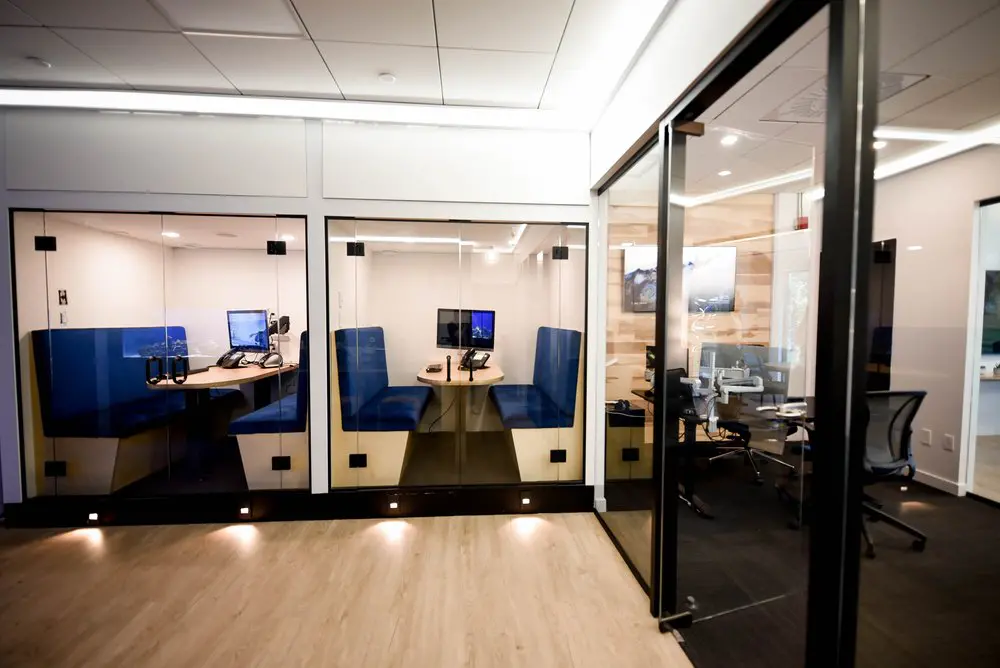
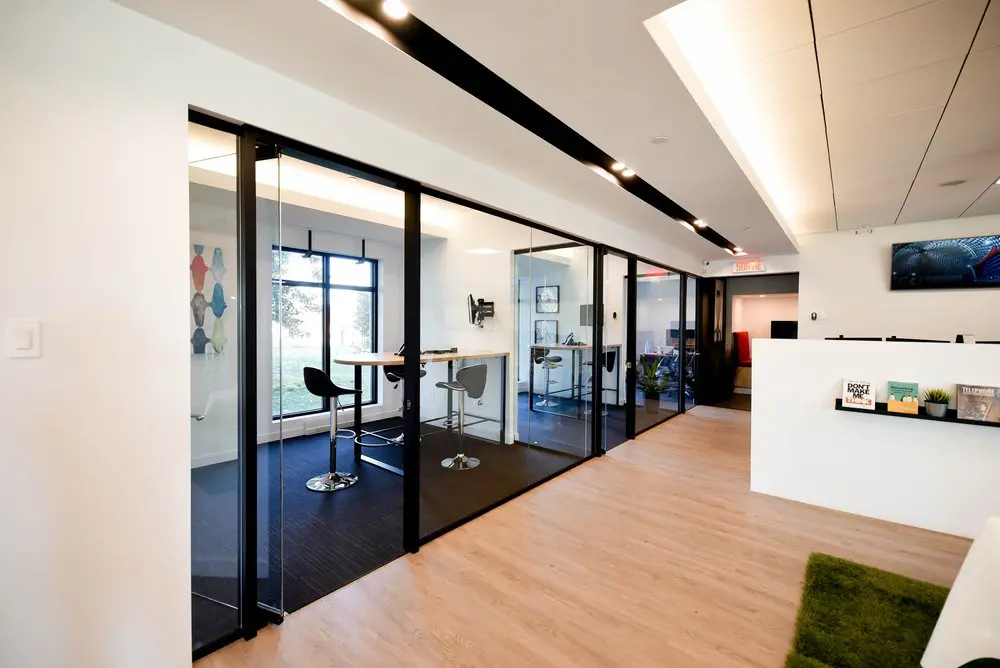
Soundproof phone booths for private calls and video meetings
High-speed Gigabit internet with redundant connections
Full kitchen with complimentary coffee and tea
Bilingual community of tech workers, creatives, and professionals
Meeting rooms with modern AV equipment
Virtual mailbox services available
Best for: Professionals who prioritize natural light, canal-side environment, transit accessibility, and a diverse professional community [4].
VIVIC Coworking
Address: Historic building across from Lachine Canal, Griffintown
Pricing: $25/day, $100/week
Meeting rooms: $50/hour
Differentiators:
Exposed brick, high ceilings, large windows in a heritage building
Affordable entry-level pricing
Proximity to Atwater Market
Best for: Budget-conscious professionals who want Griffintown's canal-side environment at a lower price point.
IDEAL Coworking (Adjacent Saint-Henri)
Address: 4035 Rue Saint-Ambroise, Montreal (Chateau Saint-Ambroise complex)
Pricing: $20-$25/day, monthly from $215-$250 (24/7 access)
Differentiators:
Located in the historic Chateau Saint-Ambroise industrial complex
Among the most affordable options in the canal corridor
Terrace access
Kitchen, printer/scanner, coffee and tea included
Best for: Freelancers and early-stage startups seeking the most affordable entry into the canal corridor community [11].
Nuage B (Adjacent Saint-Henri)
Address: Saint-Henri, near Lachine Canal
Pricing: $25/day (9am-6pm weekdays), $400/month hot desk
Differentiators:
Former factory converted to modern commercial loft
Ultra-fast fiber WiFi
Unlimited coffee/tea, printing, mail reception
Strong community focus
Best for: Professionals who want the Saint-Henri/Griffintown vibe with a strong community orientation.
2727 Coworking space, 2727 Saint-Patrick, Montreal
Transit and Accessibility
Metro Access
Griffintown is served by the Green Line of the Montreal metro, with Charlevoix station providing the most direct access. Key connections:
From
To Griffintown (Charlevoix)
Route
Downtown (McGill)
12 minutes
Green Line direct
Guy-Concordia
8 minutes
Green Line direct
Berri-UQAM
15 minutes
Green Line direct
Plateau (Mont-Royal)
20 minutes
Orange to Lionel-Groulx, Green to Charlevoix
NDG (Vendome)
15 minutes
Green Line direct
South Shore (Longueuil)
25 minutes
Yellow to Berri, Green to Charlevoix
Laval (Montmorency)
35 minutes
Orange to Lionel-Groulx, walk or Green Line
Lionel-Groulx station, an 11-minute walk from the core of Griffintown, provides the critical Green/Orange Line interchange that connects the neighborhood to virtually every part of the metro network [4].
The REM: Future Rapid Transit
The Reseau express metropolitain (REM), Montreal's new automated light metro system, will include a station at Griffintown-Bernard Landry, providing direct rapid transit connections to:
South Shore (Brossard, Rive-Sud): A commute-shifting connection for the large population of professionals living south of the river
Montreal-Trudeau Airport: Direct service to YUL, eliminating the current multi-transfer journey
West Island: Service to Sainte-Anne-de-Bellevue and intermediate stations
The REM station will dramatically expand Griffintown's accessibility catchment, making coworking spaces in the neighborhood accessible to a much larger population of potential members.
Cycling Infrastructure
Griffintown is one of Montreal's most bike-friendly neighborhoods, with a Bike Score of 96 (out of 100):
Lachine Canal path: A dedicated, car-free cycling corridor that runs the length of the canal from Old Port to Lachine, passing directly through Griffintown
BIXI stations: Dense coverage throughout the neighborhood, with multiple stations within a 2-minute walk of any point in Griffintown
Year-round BIXI: Montreal's bike-share system now operates year-round, with 2,300+ bikes available in winter, making cycling a viable commute option even during cold months [5]
Bike parking: Most Griffintown coworking spaces offer indoor bike storage, and some provide showers for cycling commuters
Driving and Parking
While Griffintown is well-served by transit and cycling, it is also more accessible by car than downtown Montreal:
Autoroute 15: Direct access from the Decarie Expressway
Street parking: More available and less expensive than downtown, particularly in the western portion of Griffintown
Indoor parking: Several public parking garages serve the neighborhood
Client accessibility: For professionals who receive clients who drive, Griffintown's parking availability is a meaningful advantage over downtown or Old Montreal
Food, Lifestyle, and the Griffintown Ecosystem
Atwater Market
The Atwater Market, operating since 1933, is one of Montreal's premier public markets and a defining feature of the Griffintown lifestyle. Located at the western edge of Griffintown along the canal, the market provides:
Fresh produce, meats, cheeses, and bakery items: Affordable, high-quality lunch ingredients that enable coworking members to eat well without the expense of restaurant meals
Prepared foods: Several vendors offer ready-to-eat meals, sandwiches, and salads perfect for a quick coworking lunch break
Seasonal products: The market's offering rotates with the seasons, connecting the lunch experience to Quebec's agricultural calendar
Social gathering point: The market's outdoor terraces (in season) are popular spots for informal meetings, phone calls, and breaks
For coworking members at 2727 Coworking, Atwater Market is a short walk along the canal path, providing a daily lunch option that no downtown food court can match for freshness, variety, and value [12].
Notre-Dame West Restaurant Corridor
Rue Notre-Dame Ouest, which runs through Griffintown, has become one of Montreal's most dynamic restaurant corridors. From casual lunch spots to acclaimed fine dining, the street offers:
Diverse cuisines (Italian, Japanese, Vietnamese, Mexican, contemporary French-Canadian)
Price points ranging from $10 lunch specials to $100+ tasting menus
Many establishments with terraces that face the canal or the street
A growing number of specialty coffee shops and bakeries
Fitness and Wellness
Griffintown's young, active population has attracted a concentration of fitness options:
Canal-side running and cycling: Flat, traffic-free paths ideal for pre-work, lunchtime, or after-work exercise
Gym and fitness studios: Several boutique fitness studios (yoga, CrossFit, spinning) have opened in the neighborhood
Outdoor exercise: The canal banks provide space for outdoor fitness activities in warmer months
For coworking members, the ability to integrate physical activity into the workday without leaving the neighborhood is a significant quality-of-life advantage that contributes to sustained productivity and wellbeing.
2727 Coworking space, 2727 Saint-Patrick, Montreal
The Tech and Startup Ecosystem
Why Tech Companies Choose Griffintown
Griffintown has attracted technology companies for the same reasons that make it attractive for coworking: natural light, architectural character, proximity to talent, and a cost advantage over downtown. Notable technology presences include:
Autodesk: Opened its Montreal office in Griffintown in 2020, a 40,000+ sq ft space that employs 200+ people working on 3D design and manufacturing software
VICE Media Quebec: Established its provincial headquarters in a converted Griffintown printing workshop
Numerous AI, fintech, and gaming startups: The neighborhood's affordable commercial rents (relative to downtown) and its proximity to McGill, Concordia, ETS, and UQAM campuses make it a natural incubator for early-stage technology companies [2]
The Coworking-Startup Pipeline
Coworking spaces in Griffintown serve as informal incubators for the neighborhood's startup ecosystem. The progression is familiar: a founder starts with a hot desk, grows to a small team on dedicated desks, transitions to a private office, and eventually graduates to a standalone space in the neighborhood. At each stage, the coworking community provides networking, mentorship, and the serendipitous connections that fuel startup growth [13].
This pipeline effect creates a self-reinforcing ecosystem: successful companies that grow out of coworking spaces stay in Griffintown, hire talent from the neighborhood, and contribute to the community that supported them in their early days.
Working in Griffintown: Practical Considerations
The Winter Experience
Griffintown's coworking experience changes with the seasons, and Montreal's winter deserves honest treatment:
The Challenges:
The canal-side location means wind exposure during winter months
The walk from Charlevoix metro to coworking spaces, while short (5 minutes), is fully exposed to weather
Outdoor lunch options (Atwater Market terraces, canal-side walking) are less appealing from November through March
The Compensations:
Griffintown's industrial buildings retain heat well (heavy masonry construction)
The massive windows that provide summer light also provide winter light, which is critically important during Montreal's short winter days (8.5 hours of daylight in late December)
The neighborhood's indoor amenities (restaurants, cafes, Atwater Market's indoor section) provide winter alternatives
The canal and its snow-covered banks create a visually serene winter landscape that many find more appealing than the grey canyons of downtown
Cost of Living and Working
Griffintown offers a meaningful cost advantage compared to downtown Montreal:
Coworking: 15-25% lower than equivalent downtown space
Lunch: Atwater Market meals and local restaurants are generally 20-30% less expensive than downtown equivalents
Transit: The same STM pass works everywhere; no premium for Griffintown access
Parking: Significantly cheaper and more available than downtown ($10-$15/day vs. $25-$35/day downtown)
Who Thrives in Griffintown Coworking
Based on the community profiles at Griffintown coworking spaces, the professionals who find the best fit here tend to share several characteristics:
Value natural light and aesthetic environment: If you care about the quality of your physical surroundings, Griffintown's industrial spaces deliver
Active lifestyle: If you cycle, run, or walk as part of your daily routine, the canal corridor integrates exercise into the workday
Creative or technology-oriented: The neighborhood's community skews toward creative and tech professionals, creating networking opportunities in these fields
Value-conscious: Professionals who want premium workspace quality at below-downtown pricing
Community-oriented: Griffintown's coworking spaces tend to have stronger community cultures than downtown corporate operators
2727 Coworking space, 2727 Saint-Patrick, Montreal
Choosing the Right Coworking Membership in Griffintown
Matching Workspace to Work Style
Not every professional needs the same type of workspace, and choosing the right membership level is important for both productivity and budget. Here is a guide to matching your work style with the right Griffintown coworking option:
Day Pass ($20-$60/day) - Best for professionals who need occasional access: freelancers who work from home most days but need a professional environment for focused projects, remote workers whose company requires occasional in-office presence, or visitors to Montreal who need a workspace for a few days.
Hot Desk / Flexible Desk ($215-$400/month) - Best for professionals who need regular workspace but value variety: freelancers and consultants who work 3-5 days per week outside of home, remote employees of companies that do not provide office space, and early-stage founders who are still testing their business concept [34].
Dedicated Desk ($400-$550/month) - Best for professionals who need a consistent, personalized workspace: individuals who work full-time from coworking (5+ days/week), professionals who need to leave equipment (monitors, docking stations) set up, and workers who are most productive with a consistent spatial routine.
Private Office (pricing varies) - Best for teams and professionals who need privacy: companies with 2-10 employees who need their own space, professionals who handle confidential information (lawyers, financial advisors), and teams that need to hold frequent internal meetings or phone calls without disturbing shared workspace.
The Trial Period Approach
Most Griffintown coworking spaces offer day passes or trial periods that allow prospective members to experience the workspace before committing to a monthly membership. This approach is highly recommended: spend at least 2-3 days working from a space before signing up for a monthly plan. Pay attention to:
Noise levels at different times of day
Natural light quality at your preferred desk area
Internet speed during peak usage hours (10 AM - 2 PM)
Community vibe: Do you feel comfortable and energized, or isolated and distracted?
Commute experience: How does the actual commute (not the Google Maps estimate) feel during rush hour?
A few days of testing will save months of regret if the space is not the right fit [35].
Frequently Asked Questions
How do I get to Griffintown by public transit?
The most direct route is via the Green Line metro to Charlevoix station, which is a 5-minute walk from most Griffintown coworking spaces. From the Orange Line, transfer at Lionel-Groulx (Green/Orange interchange) and ride one stop to Charlevoix. Multiple bus routes (36, 57, 71, 107) also serve the neighborhood.
Is there parking in Griffintown?
Yes, Griffintown has significantly better parking availability than downtown Montreal. Street parking, metered lots, and several indoor parking garages serve the neighborhood. Daily rates are typically $10-$15, compared to $25-$35 downtown.
What is the Atwater Market and why does it matter for coworking?
The Atwater Market is one of Montreal's historic public markets, located at the western edge of Griffintown on the Lachine Canal. For coworking members, it provides fresh, affordable lunch options (produce, bakeries, prepared foods) that are superior in quality and price to typical office-area food options [12].
Is Griffintown safe?
Yes, Griffintown is one of Montreal's safest neighborhoods. The influx of residential development and the active canal-side pedestrian traffic create a well-populated, well-lit environment throughout the day and evening.
Are there restaurants and cafes near Griffintown coworking spaces?
Yes, Griffintown and the adjacent Notre-Dame West corridor offer a growing selection of restaurants, cafes, bakeries, and specialty food shops, ranging from casual lunch spots to fine dining.
When will the REM station in Griffintown open?
The Griffintown-Bernard Landry REM station is part of the REM network currently under construction. Check the official REM website for current timeline updates. When operational, it will provide rapid transit connections to the South Shore, airport, and West Island.
Can I cycle to Griffintown year-round?
Yes, the Lachine Canal bike path is maintained year-round, and BIXI bike-share operates throughout the winter with 2,300+ bikes and 234 stations. Many coworking spaces in Griffintown offer indoor bike storage.
How does Griffintown coworking pricing compare to downtown?
Griffintown coworking is typically 15-25% less expensive than equivalent downtown space. A hot desk that costs $350/month in Griffintown might cost $450-$550 in downtown Montreal, while offering superior natural light and canal-side environment.
Can I use a Griffintown coworking address for my business registration?
Yes. Most coworking spaces in Griffintown, including 2727 Coworking, offer virtual mailbox services that allow you to use the coworking address for business registration with the Registraire des entreprises du Quebec (REQ). This provides a professional Griffintown business address without requiring a full-time office commitment [32].
Is Griffintown a good location for client meetings?
Excellent. The neighborhood's central location (12 minutes from downtown by metro), available parking, architectural character, and restaurant options make it an impressive setting for client meetings. Meeting rooms in Griffintown coworking spaces provide professional environments with modern AV equipment, and you can impress clients with a lunch at one of Notre-Dame West's acclaimed restaurants or a walk along the canal.
What is the internet speed like in Griffintown coworking spaces?
Griffintown's commercial buildings have been upgraded with modern fiber infrastructure. 2727 Coworking offers Gigabit internet with redundant connections, ensuring reliable high-speed connectivity for video calls, large file transfers, cloud computing, and other bandwidth-intensive tasks [33].
Are there networking events in Griffintown?
Yes. Griffintown coworking spaces regularly host community events, lunch-and-learns, and networking mixers. The broader neighborhood also hosts events at the Atwater Market, local galleries, and breweries. The ETS campus adjacent to Griffintown hosts tech meetups, hackathons, and startup events that are open to the community.
Can I bring my dog to coworking in Griffintown?
Pet policies vary by space. Some Griffintown coworking spaces are dog-friendly, reflecting the neighborhood's young, pet-owning demographic. The canal path provides excellent dog-walking opportunities during breaks. Check with individual spaces for their pet policies.
How do Griffintown coworking spaces handle bilingual needs?
Griffintown is one of Montreal's most naturally bilingual neighborhoods. Coworking communities here include both English and French speakers, and most spaces operate comfortably in both languages. Signage, contracts, and community communications are typically available in both languages.
What is the demographic profile of Griffintown coworking members?
Griffintown coworking communities tend to skew younger (25-40), with a concentration of technology professionals, creative workers (designers, photographers, writers), consultants, and startup founders. The demographic reflects the neighborhood itself: cosmopolitan, bilingual, active, and entrepreneurial.
For professionals seeking coworking space in Griffintown, 2727 Coworking at 2727 Saint-Patrick Street offers hot desks, dedicated desks, and private offices with canal-side views, industrial-scale natural light, and Gigabit internet, just 5 minutes from Charlevoix metro.
2727 Coworking space, 2727 Saint-Patrick, Montreal
References
[1] Griffintown Montreal: A Neighborhood On The Rise - Discover Montreal Real Estate
[2] Griffintown: Montreal's Premier Innovation District - 2727 Coworking
[3] Coworking Pricing US and Canada - 2727 Coworking
[4] Montreal Coworking Spaces: Analysis of Metro Proximity - 2727 Coworking
[5] Bike like a Montrealer with BIXI - Tourisme Montreal
[6] Lachine Canal History and Economic Development - 2727 Coworking
[7] Impact of Workplace Daylight Exposure on Sleep and Quality of Life - Journal of Clinical Sleep Medicine