Coworking in Mile End: Prices, Vibe & How It Compares to Griffintown
Mile End is Montreal's most storied creative neighborhood: the place where a Jewish garment district gave way to Greek and Portuguese immigrant communities, where Arcade Fire and Godspeed You! Black Emperor built Canada's most celebrated indie rock scene out of converted lofts, and where Ubisoft's first Montreal studio helped turn Quebec into a global video game hub. For professionals shopping for coworking space, Mile End offers a genuinely different experience than the city's other flexible-workspace clusters, most notably Griffintown, the canal-side innovation district roughly 15-20 minutes away by metro. This guide breaks down what coworking actually costs in Mile End, what the neighborhood feels like day to day, and how it stacks up against Griffintown on price, transit, and community.
Executive Summary
Mile End has held its own dedicated Walk Score neighborhood page since the service began tracking Montreal, scoring a perfect 100 ("Walker's Paradise") alongside a 100 Bike Score and 79 Transit Score, reflecting a commercial core built at pedestrian scale [1]
Coworking hot desks in Mile End run from roughly $275/month at Espace Mile End to as little as $250-350/month at longer-established spaces like La Gare and Temps Libre, broadly comparable to, and at the low end slightly below, Griffintown's $300-$350/month range [2]
The neighborhood's creative reputation is not marketing gloss: a 2006 census found that Mile End's H2T postal code had the highest concentration of creative-occupation workers in Canada, and Ubisoft's Mile End studio grew from roughly 50 employees in 1997 to more than 4,000 by 2022, making it the company's largest studio worldwide [3][4]
Getting from Mile End to Griffintown for a client meeting or a look at an alternative coworking space takes roughly 15-20 minutes by metro, via the Orange Line to Lionel-Groulx and a transfer to the Green Line, a real but manageable commute rather than a cross-town ordeal [5]
Median condo prices in Mile End's borough (Le Plateau-Mont-Royal) reached $600,000 in Q2 2026, roughly $110,000 above the median in Griffintown's borough (Le Sud-Ouest) at $488,650, a real cost-of-living gap that shows up in coworking pricing too [6]
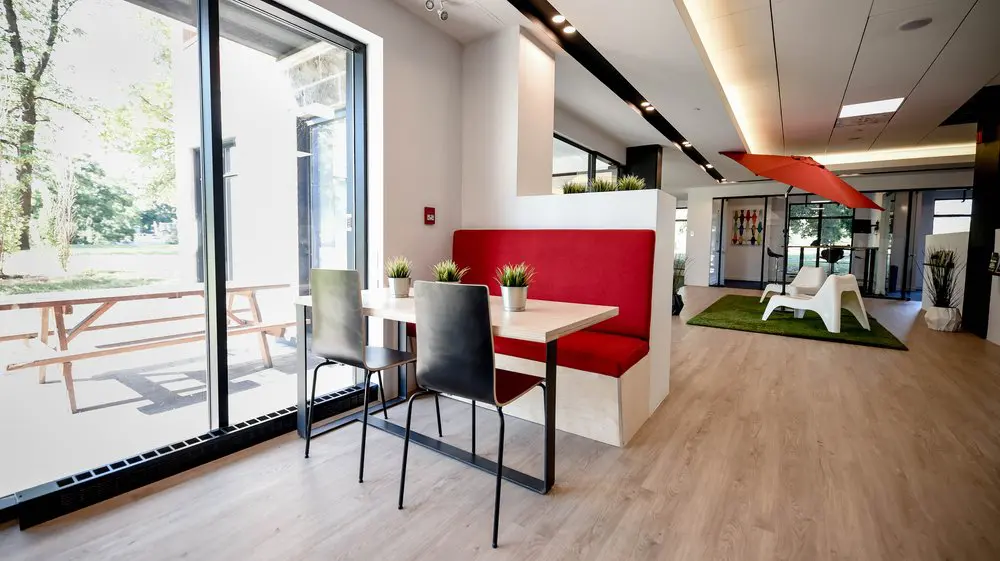
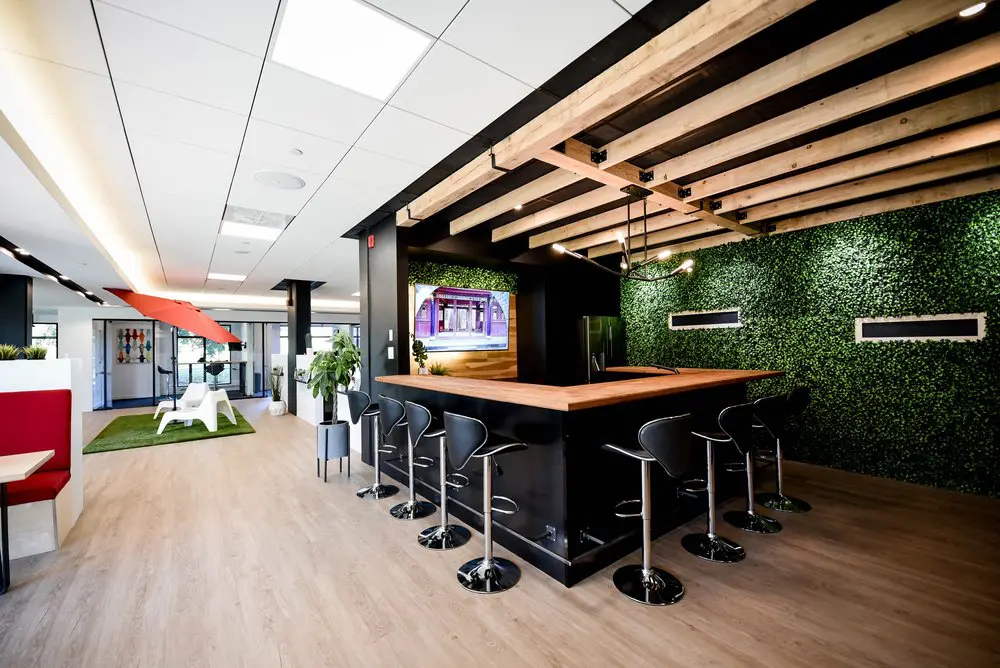
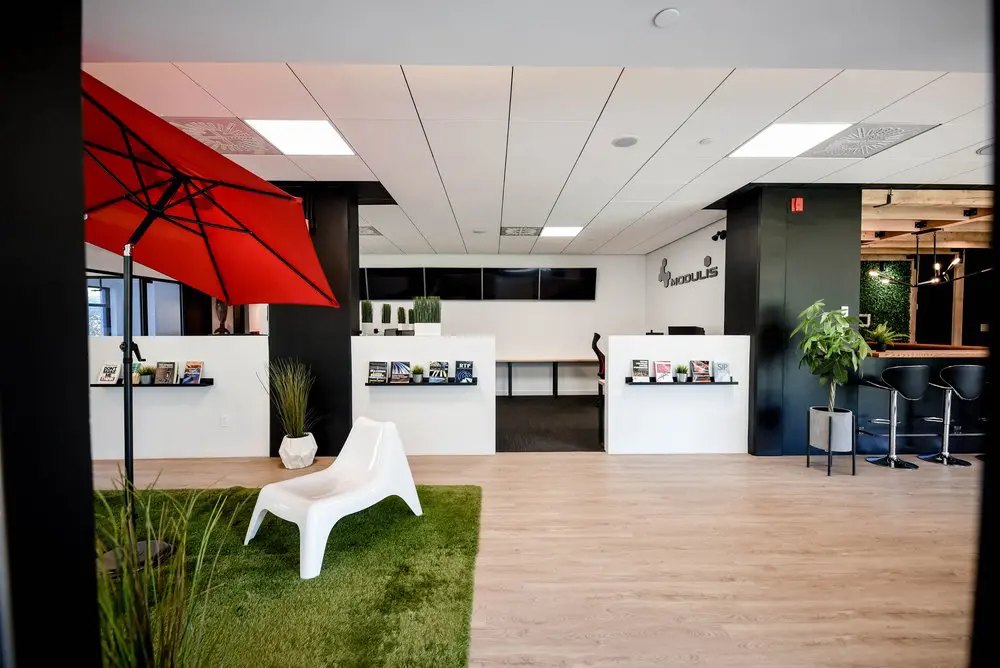
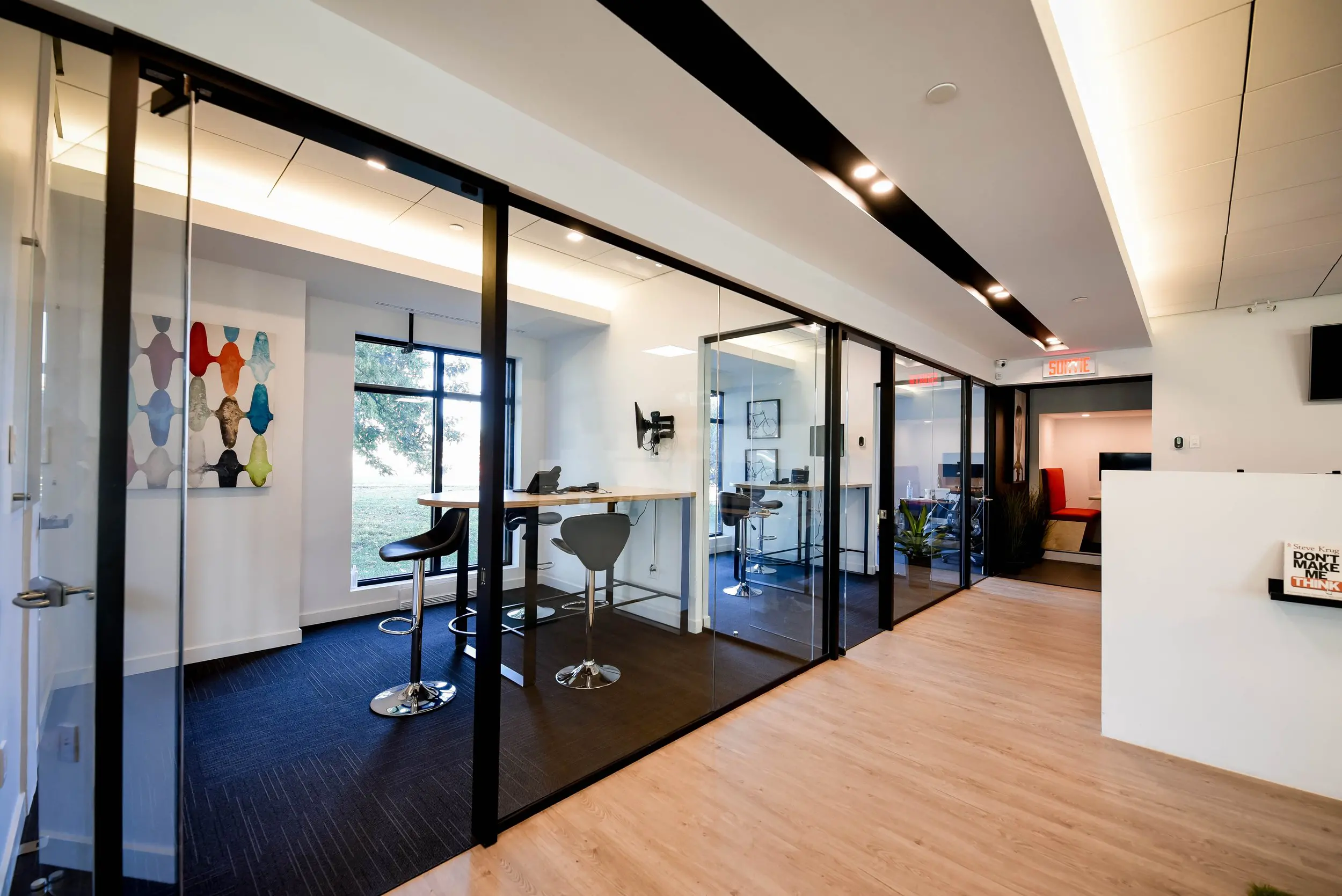
2727 Coworking space, 2727 Saint-Patrick, Montreal
A Neighborhood Built by Waves of Immigration: The History of Mile End
From Crossroads Village to Industrial Boomtown
Mile End takes its name from a 19th-century coaching inn, the Mile End Hotel, that once marked the distance from Old Montreal along Saint-Laurent Boulevard. What began as a rural crossroads became a formally incorporated village, Saint-Louis-du-Mile-End, in 1878, home to just 1,319 residents. The arrival of the railway and the factories that followed changed everything: by 1911, the village's population had exploded to roughly 37,000, and in 1909 the City of Montreal annexed it outright, absorbing it the following year as the Laurier Ward [7].
The Jewish Garment District and "The Shmata Trade"
The neighborhood's southwest section became Montreal's principal Jewish quarter for much of the 20th century, so densely settled along Saint-Urbain Street that it earned the nickname "the St. Urbain Street ghetto," peaking at an estimated 22,000 Jewish residents alongside waves of Irish, Italian, Ukrainian, Polish, and Russian immigrants [8]. Novelist Mordecai Richler, whose fiction chronicled this world, was born in the neighborhood [7].
The garment trade, known colloquially in Yiddish as the "shmata" (rag) business, was Montreal's single largest employer in the early 1900s, with a workforce that was roughly 40% Jewish and centered squarely on Saint-Laurent Boulevard [9][10]. The tension of that labor system boiled over in the 1912 Garment Workers' Strike, centered on Harris Vineberg's Progress Brand factory, a building that still stands in the neighborhood today [9]. One sewing shop, H. Fisher et Fils, operated continuously in Mile End from 1922 until 2022, a full century of manufacturing history that the Museum of Jewish Montreal has since preserved as an exhibit [11].
A Postwar Mosaic: Greek, Portuguese, and Hasidic Communities
As the Jewish community gradually moved north and west in the postwar decades, new waves of immigration reshaped Mile End. Greek immigrants settled along Parc Avenue in numbers substantial enough to earn the strip the nickname "Little Athens" [12]. Portuguese immigrants concentrated around Roy, Rachel, Saint-Urbain, and de Bullion streets, leaving behind decorative tilework and community gardens that remain visible today [7]. A visible Hasidic Jewish community, largely of the Belz, Tosh, and Satmar sects, has remained in the neighborhood continuously since the mid-20th century. Tourisme Montreal's own guide to the area describes the result as a layered, still-visible mosaic: "synagogues next to Italian social clubs and Portuguese bakeries," alongside a more recent influx of young professionals and LGBTQ+ residents [13][14].
Deindustrialization, the Artist Influx, and the Gentrification Debate
The garment industry that had built Mile End began to collapse in the mid-1970s as manufacturing offshored to lower-cost jurisdictions, leaving behind a stock of vacant factory floors with exactly the qualities, high ceilings, large windows, open plans, that artists and musicians could not otherwise afford in a growing city [15]. Cheap rents and abundant studio space, in other words, were the accidental foundation of the creative reputation Mile End enjoys today.
That reputation has come with real costs. A first-person CBC essay published in 2021 argued that speculative real estate pressure had left Mile End no longer feeling like "a real neighbourhood," and the closure of the beloved S.W. Welch used bookstore in July 2023, despite a public campaign to save it just two years earlier, became a widely cited symbol of that pressure [16][7]. For anyone considering coworking in the neighborhood, this history is worth knowing: Mile End's creative identity is authentic and deeply rooted, but it exists in active tension with rising commercial rents.
The Vibe: Why Mile End Is Considered Montreal's Creative Capital
Indie Rock's Ground Zero: Arcade Fire, Godspeed, and Hotel2Tango
No Montreal neighborhood is more closely associated with a specific era of North American music than Mile End is with the 2000s indie rock explosion. Arcade Fire's Brendan Reed lived alongside bandmates Win Butler and Régine Chassagne in the neighborhood from 2001 to 2003, and the band recorded parts of its breakthrough album Funeral at Hotel2Tango, a studio at 110 Avenue Van Horne, in August 2003 [17][18].
Hotel2Tango itself is central to the neighborhood's musical mythology. It began in 1995 as a loft occupied by future Godspeed You! Black Emperor member Mauro Pezzente, and by around 2000 had grown into a 24-track analog recording studio where Godspeed tracked its landmark 1997 album F♯A♯∞[19][20]. Its house engineers, Efrim Menuck and Thierry Amar, are themselves members of Godspeed and Thee Silver Mt. Zion, and the studio has hosted sessions for Wolf Parade, Basia Bulat, and the Sam Roberts Band, among others [21].
Constellation Records, the influential experimental label co-founded in 1997 by Ian Ilavsky and Don Wilkie specifically to showcase their Mile End neighbors, remains headquartered in the area alongside labels Arbutus and Bonsound [22][23]. Casa del Popolo, opened in 2000 by Pezzente and Kiva Stimac, hosted Arcade Fire's first club show and remains, alongside its sister venue La Sala Rossa, one of the neighborhood's key live venues [21]. Since the 1980s, Mile End has also been home at various points to Bran Van 3000, Ariane Moffatt, Grimes, and Mac DeMarco, and both Spin and Pitchfork identified it as the heart of Montreal's indie scene as early as 2005 [7].
This is not simply nostalgia. A 2025 feature-length film, Mile End Kicks, directed by Chandler Levack and premiered at TIFF in 2025 ahead of a wider April 2026 release, dramatizes the neighborhood's 2011 indie scene for a new audience, and NPR's World Cafe ran a dedicated 2025 "Sense of Place: Montreal" episode featuring Hotel2Tango co-founder Howard Bilerman [24][25].
A Verified Creative-Class Concentration
The music scene is one visible symptom of a broader pattern: Mile End's 2006-census postal code (H2T) recorded the highest concentration of creative-occupation workers anywhere in Canada [3]. That concentration has been actively protected rather than left to market forces alone: a 30-year lease negotiated with landlord Allied Properties preserves roughly 208,000 square feet of studio and gallery space in the neighborhood, home to galleries including articule and Galerie Mile-End (operating since 1997) [26]. Drawn & Quarterly, the celebrated comics publisher and bookstore, opened its flagship location on Bernard Street in 2007 and remains a neighborhood anchor [7].
For coworking members, this translates into a genuinely different professional community than Griffintown's tech-and-startup mix: expect to share a kitchen with musicians, illustrators, documentary filmmakers, and game writers as often as with software developers.
Ubisoft Montreal and the Birth of Quebec's Video Game Industry
If music built Mile End's cultural reputation, Ubisoft built its technology one. Ubisoft Montreal was founded on April 25, 1997, in the historic 1904 Peck Building at 5505 Saint-Laurent Boulevard, at the corner of Saint-Viateur, right in the heart of the neighborhood [4][27]. The studio's arrival was heavily subsidized: Quebec's 1996 multimedia tax credit program, alongside direct per-employee grants worth roughly $25,000 (split between Quebec and federal contributions) for the studio's first 500 employees over five years, was explicitly designed to seed exactly this kind of investment [28]. The multimedia tax credit alone, covering up to 37.5% of eligible labor costs, cost the province an estimated $253 million in 2021 [28].
The bet paid off. Ubisoft Montreal grew from roughly 50 employees in 1997 to about 1,600 by 2007, approximately 3,000 by 2017, and more than 4,000 by 2022, making it Ubisoft's single largest studio anywhere in the world and the engine behind titles including Splinter Cell, Prince of Persia, Assassin's Creed, Far Cry, and Watch Dogs[4]. The studio's success is widely credited with pulling Montreal into the top tier of global game-development hubs, subsequently attracting Electronic Arts, Eidos, and Warner Bros. Games, and today more than 200 game studios operate in the metropolitan area [29].
It is worth noting precisely which studios sit in Mile End itself. WB Games Montreal (888 Boulevard De Maisonneuve) and Eidos-Montreal (400 Boulevard de Maisonneuve Ouest) are both located Downtown, not in Mile End [30][31]. Behaviour Interactive occupies 6666 Rue Saint-Urbain, a building actually situated in the adjacent district of Mile-Ex, not Mile End proper [32]. Ubisoft's Saint-Laurent Boulevard studio remains the one major game developer genuinely embedded within Mile End's boundaries.
Mile End vs. Mile-Ex: A Distinction Worth Getting Right
The neighborhood immediately north of Mile End, across Van Horne Avenue, is Mile-Ex, a name coined in 2012 by restaurateur Grégory Paul to describe an area sitting "between Mile End and Parc-Ex" [33]. Mile End's own boundaries, per its Wikipedia entry, run from Mont-Royal Avenue in the south to Van Horne in the north, and from Hutchison Street in the west to Saint-Denis Street in the east: the neighborhood ends squarely at Van Horne [7].
This distinction matters because Montreal's celebrated AI research cluster, anchored by MILA (the Quebec Institute for Learning Algorithms), sits at 6666 Rue Saint-Urbain in the "O Mile-Ex" complex, a location MILA's own communications explicitly describe as being in Mile-Ex, following the facility's January 2019 inauguration [34][35]. Anyone searching for "coworking near Montreal's AI hub" is really searching for Mile-Ex, not Mile End, even though the two are frequently and understandably conflated given their shared border and shared creative-tech reputation.
The Bagel Wars: St-Viateur vs. Fairmount
No discussion of Mile End's identity is complete without its most famous rivalry. St-Viateur Bagel was founded on May 21, 1957, by Holocaust survivor Myer Lewkowicz on the street that gives it its name; the shop survived a 1985 fire with its original wood-fired oven intact, and current owner Joe Morena worked there for 15 years before taking over the business [36]. A block away, Fairmount Bagel traces its lineage to 1919, when Isadore Shlafman opened the "Montreal Bagel Bakery," which moved to its current address at 74 Fairmount Avenue West in 1949 and has since passed down through three generations of the Shlafman family [37].
The two shops' rivalry has become a minor institution of its own: a taste test conducted by The Atlantic found a narrow 46% to 44% edge for St-Viateur, while Serious Eats scored it 60% to 40% in Fairmount's favor, and the debate remains genuinely unresolved [38]. Around the corner, Wilensky's Light Lunch, founded in 1932 by Moe Wilensky and operating from its current Fairmount and Clark location since 1952, remains famous for the grilled salami-and-bologna "Wilensky Special" and its cameo in the 1974 film adaptation of Mordecai Richler's The Apprenticeship of Duddy Kravitz, which was shot on location [39]. The Fairmount corridor rounds out with Drogheria Fine's takeout gnocchi window and the acclaimed restaurant Lawrence, both fixtures of the neighborhood's food scene [40].
For coworking members, this matters practically: a work-from-Mile-End lifestyle means genuinely excellent, historic, walkable food options within minutes of any desk in the neighborhood.
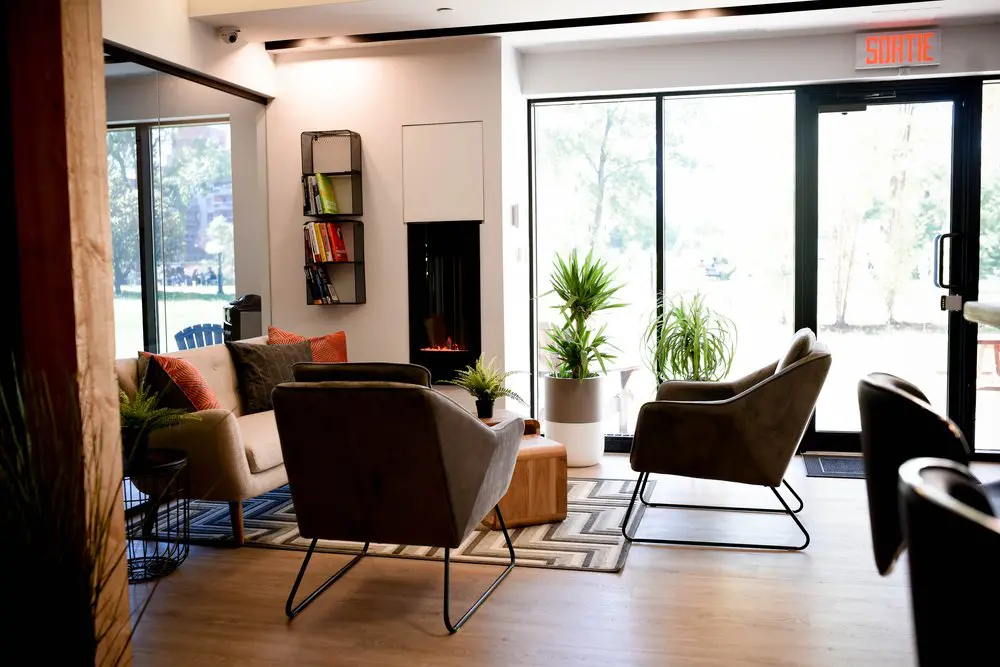
2727 Coworking space, 2727 Saint-Patrick, Montreal
Who Lives in Mile End: Demographics
Mile End itself is not a recognized census geography, but it sits primarily within the borough of Le Plateau-Mont-Royal, with its northern edge touching Rosemont-La Petite-Patrie. Le Plateau-Mont-Royal recorded a population of 105,813 in the 2021 Census, up from roughly 104,000 in 2016, at a density of 13,063 people per square kilometer, among the densest boroughs in the city [41]. Rosemont-La Petite-Patrie, the borough bordering Mile End's northern edge, recorded 141,813 residents in 2021 across 15.9 square kilometers [42].
The Plateau-Mont-Royal population skews young and single: residents aged 18-34 make up 37% of the borough, compared to just 10% each for children and seniors, and 53% of households consist of a single person, with an average household size of just 1.7 [43]. The borough's low-income rate sits at 17%, notably above the Montreal-wide average of 11%, a reminder that Mile End's creative-class reputation coexists with a meaningful population of lower-income residents, including many of the artists whose presence defines the neighborhood [43]. Average two-bedroom rent in the borough reached $1,460 in 2024, well above the citywide average of $1,145 [43].
Linguistically, the Plateau-Mont-Royal borough is 67% French-at-home and 23% English-at-home, with 17.4% identifying as a visible minority, while Rosemont-La Petite-Patrie is more heavily French (83% at home, 6% English) with a slightly higher 19.2% visible-minority share [41][42]. For coworking members serving English-speaking clients, Mile End's Plateau side offers a somewhat more bilingual working environment than its Rosemont fringe.
Coworking Spaces in Mile End: A Complete, Verified Guide
Mile End's coworking market is smaller and more independent than Griffintown's, dominated by long-established, community-oriented operators rather than global chains, with one notable exception. Because several older directories and even other Montreal coworking guides mislabel one or two nearby spaces as being "in Mile End" when they are not, the list below is limited to spaces genuinely located within the neighborhood's boundaries.
La Gare
Address: 5333 Avenue Casgrain, Suite 102, Montreal
Founded in November 2015 by Christian Bélair, Marie-Eve Boisvert, and LP Maurice, La Gare occupies roughly 10,000 square feet and hosts a community of 45-50 members [44]. It has built a reputation as a genuine startup incubator, with founding corporate partners including Deloitte, Ubisoft, and Telus, and offers day passes, private offices from roughly $275/month, and conference rooms at approximately $40/hour, based on the most recent published third-party listings [45]. Prospective members should confirm current rates directly with the space, since pricing can shift and is not always kept current across third-party directories.
Temps Libre (Mile End)
Address: 5605 Avenue de Gaspé, Suite 106, Montreal
Temps Libre is a cooperative coworking space combining a free public common area with a paid coworking section that includes meeting rooms, a rooftop terrace, showers, and bike storage [46]. It has billed itself as one of the first coworking spaces in Canada designed to be genuinely accessible to parents working alongside their children, a distinctive community focus that sets it apart from more conventional operators [46]. Located at the corner of de Gaspé and Saint-Viateur, it sits roughly a 10-minute walk from Laurier metro.
Espace Mile End
Address: 368 Avenue Fairmount Ouest, Montreal
A smaller, boutique operator directly on the Fairmount restaurant corridor, Espace Mile End offers desks from approximately $275/month (or $95/week) and private offices from roughly $750/month [2]. Its location puts members within a two-minute walk of both St-Viateur and Fairmount bagel shops.
Spaces Mile End (IWG)
Address: 5455 Avenue de Gaspé, Suite 710, Montreal
The one global-operator presence in the neighborhood, Spaces (a brand of the IWG group that also operates Regus) runs a location in Mile End with day passes around $65/day and meeting rooms at approximately $49/hour [47]. It offers a more corporate, polished alternative for professionals who want Mile End's address without sacrificing the amenities of an international network.
Other Options
Coworking Alphard (5570 Avenue Casgrain) and Nomad Life (129 Avenue Van Horne, at the edge of the neighborhood, with dedicated workspace from roughly $300-360/month) round out the smaller end of the Mile End market [48]. As with any smaller, independently run space, confirm current availability and pricing directly before visiting.
A Correction Worth Flagging
Several Montreal coworking round-ups, including older versions of comparison content on other sites, list "Ideal Coworking" at "8815 Avenue du Parc" as a Mile End option. This is inaccurate on two counts. Ideal Coworking's actual location, per its own site, is 4035 Rue Saint-Ambroise, which the operator itself describes as being "in the middle of St-Henri right by the water," with pricing of $275/month for a hot desk, $350/month for a dedicated desk, and private offices from $580/month [49]. That puts it in Saint-Henri, immediately adjacent to Griffintown, not in Mile End at all; our companion guide to coworking in Saint-Henri covers it properly. Separately, 8815 Avenue du Parc is actually the address of Le 402, a coworking space located in the Ahuntsic-Cartierville/Chabanel district, also unrelated to Mile End [50]. If you are specifically looking for Mile End coworking, the five spaces above are the ones that actually meet that description.
Compared to Griffintown, where 2727 Coworking publishes hot desks at $350/month and other operators publish from about $300/month, Mile End's genuinely-in-neighborhood options skew slightly smaller in number and slightly less transparent on pricing, several operators require a direct inquiry rather than publishing a rate card, which is itself a useful signal about the maturity of each market [51].
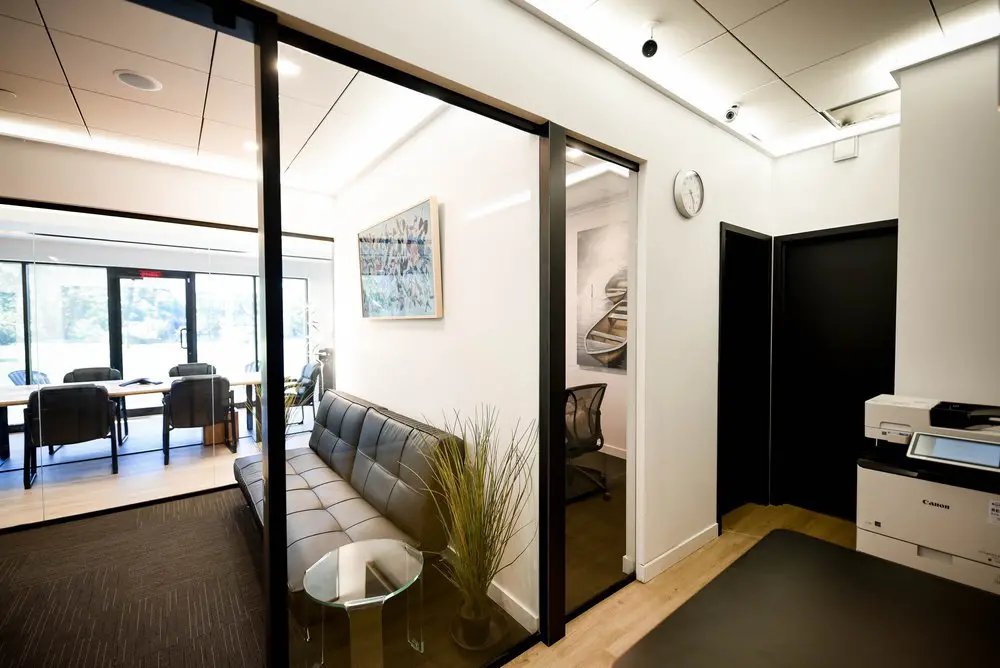
2727 Coworking space, 2727 Saint-Patrick, Montreal
Getting to and Around Mile End
Metro Access: Laurier vs. Rosemont
Mile End is served, somewhat imperfectly, by two Orange Line stations on its periphery. Laurier station, at 495 Rue Gilford, opened in 1966 and sits just east of the neighborhood; it is commonly identified as the closest metro stop to Mile End's commercial core, roughly a 15-minute walk from the Saint-Laurent and Saint-Viateur intersection, though it is not currently wheelchair-accessible [52][53]. Rosemont station, at 420 Boulevard Rosemont, also opened in 1966 and has been wheelchair-accessible since 2017, but sits roughly 1.4 kilometers, about a 19-minute walk, from the neighborhood's core, meaningfully farther than Laurier [54].
In practice, most Mile End coworking members either walk 10-15 minutes to Laurier or rely on surface buses, which cover the neighborhood's commercial spine more directly than either metro station.
Bus Routes
Bus 55 runs the full length of Saint-Laurent Boulevard, stopping at Fairmount, Saint-Viateur, and Bernard, effectively serving Mile End's entire commercial core directly [55]. Bus 80 provides a parallel route along Parc Avenue, with stops at Bernard and Fairmount, and Bus 51 connects Laurier metro station to the Saint-Laurent/Saint-Urbain corridor for those making the walk-in from the Orange Line.
Comparing Transit Access: Mile End vs. Griffintown
Griffintown's transit anchor is Charlevoix station on the Green Line, at 2600 Centre Street, opened in 1978 and notable for having the deepest platform in the entire metro network at 29.6 meters below street level [56]. Traveling between the two neighborhoods requires a transfer between the Orange and Green lines, most commonly at Lionel-Groulx, and third-party routing estimates put the trip from Laurier to Charlevoix at approximately 18 minutes, covering nine Orange Line stops before a single Green Line stop to the destination [5]. That is a real but entirely manageable commute, closer to a cross-town errand than a genuine relocation, useful context for anyone weighing whether to switch coworking neighborhoods or simply visit both.
Walk Score, Bike Score, and Transit Score
Mile End is one of the relatively small number of Montreal neighborhoods with its own dedicated Walk Score listing, rather than being folded into a borough-wide figure, scoring a perfect 100 for walkability and bikeability alongside a 79 Transit Score [1]. Its containing borough, Le Plateau-Mont-Royal, ranks as Montreal's single most walkable borough with a 92 Walk Score, an 80 Transit Score, and a 94 Bike Score [57].
Griffintown does not have its own dedicated Walk Score neighborhood page; the borough-level figure for Le Sud-Ouest, which also includes Saint-Henri, Little Burgundy, and Pointe-Saint-Charles, comes in at 73 Walk Score, 76 Transit Score, and 81 Bike Score, though a specific-address lookup for 2727 Saint-Patrick Street, on the canal itself, scores a 96 Walk Score directly from Walk Score's own database [58][59]. The honest takeaway: Mile End's walkability is remarkably consistent across the entire neighborhood, while Griffintown's varies more by exact address, canal-adjacent blocks score extremely well, while streets farther from the water pull the borough-wide average down.
Cycling and Parking
Both neighborhoods reward cyclists. Mile End sits on Montreal's dense north-south bike lane network along Saint-Urbain and de l'Esplanade, while Griffintown benefits from the dedicated, car-free Lachine Canal bike path [51]. Parking is tight in both neighborhoods relative to the suburbs, though Griffintown's newer mixed-use developments have generally built in more off-street and garage parking than Mile End's older, denser housing stock.
The Winter Experience
Both neighborhoods change meaningfully with Montreal's seasons, and the differences are worth planning around. Mile End's tight grid of narrow streets and low-rise buildings offers more wind shelter in winter than Griffintown's more open, canal-facing blocks, where wind off the water can make the short walk to a coworking desk feel considerably colder than the thermometer suggests. On the other hand, Mile End's older building stock is more variable in insulation and heating quality than Griffintown's converted industrial buildings, which tend to retain heat well thanks to heavy masonry construction. Both neighborhoods benefit from Montreal's dense, well-maintained sidewalk snow-clearing network, and both remain fully walkable and bikeable through the winter months, though Griffintown's canal path is more exposed to wind than Mile End's interior streets.
In summer, the comparison flips: Griffintown's canal corridor becomes genuinely spectacular, with kayakers, waterside restaurant terraces, and a bike path that draws cyclists from across the city, while Mile End's advantage is its density of outdoor cafe terraces along Saint-Laurent, Saint-Viateur, and Fairmount, arguably a livelier scene for an after-work drink than Griffintown's more residential canal-side stretch.
The Real Estate and Cost-of-Living Picture
Housing costs are a meaningful, if indirect, driver of coworking pricing, since commercial rents in a neighborhood generally track residential demand. Le Plateau-Mont-Royal, Mile End's home borough, posted a median condo price of $600,000 in the second quarter of 2026, with a trailing four-quarter median of $594,375, up 4% year-over-year [6]. Le Sud-Ouest, Griffintown's home borough, recorded a median condo price of $488,650 in the same quarter, with a trailing four-quarter median of $495,162, up a more modest 2% year-over-year [60]. That is a gap of roughly $100,000-$110,000 in median condo pricing between the two boroughs, a meaningful real-world signal that Mile End commands a premium over Griffintown across the broader real estate market, even if coworking rate cards do not always reflect it one-for-one.
A 2021 industry report from the Quebec real estate professionals' association similarly placed Le Sud-Ouest's median condo price per square foot at $637, the second-highest among Montreal boroughs after Westmount's $668, underscoring that Griffintown itself is not a "cheap" neighborhood in absolute terms, it is simply less expensive than Mile End's borough on a relative basis [61]. No source currently publishes a precise, up-to-date, Mile-End-specific or Griffintown-specific commercial rent figure per square foot; the borough-level residential comparisons above are the best publicly available proxy.
2727 Coworking space, 2727 Saint-Patrick, Montreal
How Mile End Compares to Griffintown for Coworking
Musicians, game developers, writers, artists, indie founders
Tech founders, canal-side lifestyle seekers, teams wanting a Griffintown address
Price: A Narrow but Real Gap
On paper, the two neighborhoods' coworking price ranges overlap substantially, both cluster around $250-350/month for a hot desk. In practice, Griffintown's published rates sit at the top of that band (2727 Coworking publishes hot desks at $350/month and dedicated desks from $400/month, with private offices from $700/month), while Mile End's smaller, more independent operators are less consistent about publishing rate cards at all, several genuinely require a direct inquiry [62]. Combined with the roughly $100,000 borough-level real estate premium documented above, the reasonable expectation is that Mile End's published private-office rates will trend at or slightly above Griffintown's, even though its independent hot-desk rates currently come in below them.
Vibe: Two Very Different Professional Communities
This is where the neighborhoods diverge most sharply. Mile End's community skews toward musicians, illustrators, game writers and designers, documentary and film professionals, and independent creative freelancers, a legacy of the neighborhood's decades as Montreal's de facto arts district [3]. Griffintown's community, by contrast, skews toward software developers, startup founders, and consultants, drawn by proximity to Autodesk's Montreal office, the École de technologie supérieure engineering school, and a wave of AI, fintech, and gaming startups that have moved into the canal corridor's converted industrial buildings [63]. Neither community is objectively better; the right choice depends entirely on which kind of collaborator and conversation you are hoping to find at the next desk.
Natural Light, Green Space, and the Canal Advantage
Griffintown holds one advantage Mile End cannot match: direct, daily access to the Lachine Canal, a car-free, tree-lined waterway that our own research on Griffintown's coworking scene documents in detail, including its measurable effects on stress and cognitive restoration during breaks. Mile End has no equivalent blue space within the neighborhood itself; the nearest comparable green space, Parc Lafontaine, sits a 15-20 minute walk to the east, on the Plateau side of the borough. For coworking members who value a canal-side walk or a bike ride along the water as part of their workday, Griffintown offers something Mile End structurally cannot.
Which Founders and Freelancers Fit Where
Choose Mile End if your work is creative in the traditional sense (music production, illustration, writing, game narrative design, documentary film) and you want to be embedded in the neighborhood most closely associated with that identity in Montreal. Choose Griffintown if you are building or working at a technology company, want canal-side natural light and outdoor breaks built into your daily routine, or want the specific cost and transit profile that 2727 Coworking and its neighbors offer at $300-$350/month with direct Green Line access [51]. Many Montreal professionals genuinely use both: a Mile End membership for creative-industry networking, paired with an occasional Griffintown day pass for meetings on the tech side of town, a roughly 18-minute metro ride apart [5].
A Day in the Life: Mile End vs. Griffintown
The abstract comparisons above become more concrete side by side. Here is what a typical Tuesday looks like in each neighborhood.
Mile End: 8:15 AM, walk or bike five minutes to a desk at La Gare or Espace Mile End, past the Saint-Viateur storefronts that have anchored the block for decades. 10:00 AM, step out for a coffee and, inevitably, a bagel, still warm from the wood-fired oven a block away [36]. Noon, lunch at one of the Fairmount corridor's restaurants, likely sharing a table with a game designer from Ubisoft's studio a few blocks north or a musician between studio sessions. 3:00 PM, a walk past Drawn & Quarterly's Bernard Street storefront or one of the neighborhood's small galleries clears the head before an afternoon push. 6:00 PM, home is a five-to-fifteen-minute walk in almost any direction, since Mile End's Walk Score of 100 means daily errands rarely require leaving the neighborhood at all [1].
Griffintown: 7:45 AM, cycle in along the Lachine Canal path from Verdun or Saint-Henri, a flat, car-free ride with water on one side the whole way. 10:00 AM, a 30-second walk to the canal bank for a break between focus blocks. Noon, walk to Atwater Market for a fresh lunch, then eat it at a canal-side picnic table if the weather allows. 3:30 PM, a 20-minute run or bike ride along the water resets the afternoon. 5:30 PM, a two-minute walk to Charlevoix metro, or straight home by bike along the canal, zero transit fare, zero emissions.
Neither day is objectively better. The Mile End day is denser with cultural and food texture packed into a smaller radius; the Griffintown day is built around water, movement, and open sightlines. Professionals who have worked from both neighborhoods often describe the choice less as "which is nicer" and more as "which kind of break do I want between meetings", a walk past a record store and a bagel oven, or a walk along a canal.
Remote Work in Montreal: Why Neighborhood Choice Still Matters
Canada's return-to-commuting trend has been more pronounced than many professionals expect. Statistics Canada's Labour Force Survey found that as of November 2024, just 12.5% of employed Canadians worked exclusively from home, with a further 11.5% in a hybrid arrangement, and by May 2025 the share of employed Canadians commuting to a workplace had risen for a fourth consecutive year, reaching 82.6% [64][65]. Among hybrid workers specifically, 55.8% now spend at least half their working hours in an office setting, up 4.2 percentage points year-over-year [64].
Montreal itself sits below the national curve for full remote work: as of May 2024, just 20.6% of employed people in the Montreal metropolitan area worked mostly from home, compared to 34.2% in Ottawa-Gatineau, 24.7% in Toronto, and 22.4% in Vancouver [65]. In practical terms, this means the pressure to have some kind of dedicated workspace, whether a home office, a traditional lease, or coworking, is not going away in Montreal, and neighborhood choice, walk time to a desk, proximity to lunch and errands, and the character of the professional community you will actually spend your day around, remains one of the most consequential decisions a freelancer or small team can make [66].
2727 Coworking space, 2727 Saint-Patrick, Montreal
The Economics of Coworking vs. a Mile End Home Office
For Mile End residents specifically weighing coworking against working from a condo in the neighborhood, the math is shaped by that same $600,000 median condo price. A 75-square-foot home office carved out of a Plateau-Mont-Royal condo represents a meaningfully larger share of housing cost than the same footprint would in Griffintown's less expensive Sud-Ouest borough, even before accounting for the isolation and lack of professional community that working alone at home entails [6]. A Mile End hot desk at $250-350/month, by comparison, delivers dedicated internet, a change of scenery, and a professional community for a fraction of what that same square footage costs to carry as home-office space [46]. Our broader analysis of private office versus coworking economics walks through the same calculation in more depth for teams considering a step up from a single desk.
Who Thrives in Mile End Coworking
Based on the neighborhood's demographic and creative profile, the professionals who tend to find the best fit in Mile End coworking share a few characteristics:
Creative-industry professionals: musicians, illustrators, game writers, documentary filmmakers, and independent publishers will find the densest concentration of peers anywhere in Montreal, a legacy of the same 2006-census finding that placed Mile End's postal code at the top of the country for creative-occupation density, and a community that shows up daily in the coworking kitchen, not just at industry events [3]
Independent and freelance workers: the neighborhood's smaller, cooperative-leaning spaces (Temps Libre in particular) suit solo professionals over larger teams, and the absence of a dominant global operator means the culture stays closer to a shared clubhouse than a corporate satellite office
Bilingual professionals comfortable in a French-majority environment: with 67% French-at-home in the Plateau side of the borough, day-to-day neighborhood life leans more French than Griffintown's more bilingual canal corridor, which suits professionals actively looking to build or strengthen their French-language client base [41]
Food-motivated professionals: anyone who wants a legitimately world-class bagel and an espresso within a two-minute walk of their desk, and who considers a lunch break spent debating the merits of St-Viateur versus Fairmount a genuine perk of the job [38]
Those already living in Mile End, the Plateau, or Rosemont: the value of neighborhood coworking is maximized when the commute itself disappears, and with the borough's 53% single-person household rate, a large share of nearby residents are precisely the kind of solo professional who benefits most from a short walk to a desk rather than a spare room at home [43]
2727 Coworking space, 2727 Saint-Patrick, Montreal
Choosing the Right Coworking Membership in Mile End
Day Pass (~$65/day at Spaces, less at smaller operators) — Best for occasional visitors, remote employees whose companies require occasional in-person presence, or anyone testing the neighborhood before committing to a monthly plan [47].
Hot Desk (~$250-350/month) — Best for freelancers and consultants working several days a week outside the home, particularly those drawn to Temps Libre's cooperative, family-friendly model or Espace Mile End's boutique, Fairmount-corridor location [46][2].
Private Office (from ~$275-750/month depending on operator) — Best for small creative studios, game-development micro-teams, or growing consultancies that want their own door within La Gare's or Espace Mile End's community, without a multi-year commercial lease [45].
No. Mile End and Mile-Ex are adjacent but distinct neighborhoods, separated by Van Horne Avenue. Mile-Ex sits to the north and is home to Montreal's MILA AI research institute; Mile End sits to the south and is the neighborhood with the deep music, arts, and Ubisoft history described in this guide.
What is the best metro station for Mile End coworking?
Laurier station on the Orange Line is generally the more useful stop, roughly a 15-minute walk from the neighborhood's commercial core along Saint-Laurent Boulevard. Rosemont station is technically closer to accessible-transit standards but sits farther from most coworking spaces, at roughly a 19-minute walk.
How much does coworking cost in Mile End?
Published rates for genuinely-in-neighborhood spaces run from about $95/week or $275/month for a desk at Espace Mile End up to roughly $65/day for a day pass at Spaces Mile End. Several smaller, independent operators do not publish full rate cards and should be contacted directly for current pricing.
Is Ideal Coworking actually in Mile End?
No. Despite appearing in some older directories and guides under a Mile End listing, Ideal Coworking is located at 4035 Rue Saint-Ambroise in Saint-Henri, based on the operator's own site. It is worth considering if you are comparing Saint-Henri and Griffintown options rather than Mile End specifically; see our guide to coworking in Saint-Henri.
How do I get from Mile End to Griffintown?
By metro, expect roughly 15-20 minutes: take the Orange Line from Laurier toward Lionel-Groulx, transfer to the Green Line, and ride one stop to Charlevoix, Griffintown's primary metro station.
Is Mile End coworking more expensive than Griffintown?
The published price ranges overlap, but Mile End's home borough (Le Plateau-Mont-Royal) has a roughly $100,000 higher median condo price than Griffintown's home borough (Le Sud-Ouest), and Mile End's smaller operators are less likely to publish discount or entry-level rates. Where a direct comparison is possible, Griffintown tends to offer more transparent, and often slightly lower, published pricing.
What is Mile End known for?
Mile End is known as Montreal's creative and arts district, home to the 2000s indie rock scene (Arcade Fire, Godspeed You! Black Emperor), Ubisoft's original and largest Montreal video game studio, the famous St-Viateur and Fairmount bagel bakeries, and a layered immigrant history spanning Jewish, Greek, and Portuguese communities.
Does Mile End have canal or waterfront access like Griffintown?
No. Mile End has no direct water access; its nearest significant green space is Parc Lafontaine, roughly a 15-20 minute walk east. Griffintown's direct Lachine Canal frontage is a genuine, structural advantage that Mile End cannot replicate.
Are there private offices available in Mile End?
Yes. La Gare offers private offices from approximately $275/month, and Espace Mile End offers private offices from approximately $750/month, based on the most recently published rates. Confirm current availability directly with each operator.
Is Mile End walkable?
Extremely. Mile End carries a perfect 100 Walk Score and 100 Bike Score on Walk Score's own neighborhood-level listing, one of the highest ratings of any neighborhood in Montreal.
Can I bring my kids to a Mile End coworking space?
Temps Libre in Mile End has specifically positioned itself as accessible to parents working alongside their children, a distinctive offering not widely available at other Montreal coworking spaces.
What is the MILA AI institute's relationship to Mile End?
MILA is located at 6666 Rue Saint-Urbain, in the Mile-Ex district immediately north of Mile End, not within Mile End itself. The two neighborhoods are frequently confused because of their shared name and adjacent borders.
Which is better for a tech startup: Mile End or Griffintown?
Griffintown, generally. It has a denser concentration of technology companies (anchored by Autodesk's Montreal office and proximity to the École de technologie supérieure), direct canal access, and coworking spaces like 2727 Coworking built specifically around a tech and startup community. Mile End remains the stronger choice for creative-industry and game-development professionals specifically.
Is there a French-language version of Montreal's coworking market analysis?
What is Ubisoft Montreal's connection to Mile End specifically?
Ubisoft Montreal was founded in 1997 in the historic Peck Building at 5505 Saint-Laurent Boulevard, at the corner of Saint-Viateur, directly in Mile End. The studio grew from roughly 50 employees to more than 4,000 by 2022, making it Ubisoft's largest studio worldwide and a defining part of the neighborhood's identity, alongside its music and arts history.
Does Mile End have good winter access to coworking spaces?
Yes, though with different trade-offs than Griffintown. Mile End's narrower, low-rise streets offer more wind shelter than Griffintown's canal-facing blocks, but its older building stock varies more in insulation quality than Griffintown's converted industrial buildings, which tend to retain heat well. Both neighborhoods maintain walkable, well-cleared sidewalks through the winter.
For professionals who decide the canal-side, tech-oriented alternative to Mile End is the better fit, 2727 Coworking at 2727 Saint-Patrick Street in Griffintown offers hot desks, dedicated desks, and private offices with direct Lachine Canal views, 24/7 access, and a two-minute walk to Charlevoix metro.
2727 Coworking space, 2727 Saint-Patrick, Montreal