Day Pass vs Monthly Coworking Membership in Montreal: The Total-Cost Guide
Compare day passes and monthly coworking by attendance, setup fees, notice, access hours and real work needs, not the headline price alone.

Compare day passes and monthly coworking by attendance, setup fees, notice, access hours and real work needs, not the headline price alone.

A day pass and a monthly hot-desk membership can provide the same basic kind of workspace, but they create very different cash commitments. A pass turns attendance into a variable cost. A membership turns it into a recurring fixed cost. The right choice depends on how many days you will actually use, how predictable those days are, what the first invoice contains, and how quickly you can stop paying when your schedule changes.
Start with three inputs: day price D, monthly price M, and one-time setup charge S. In a normal month, passes cost visits × D; membership costs M. The first visit count at which membership is strictly cheaper is floor(M ÷ D) + 1; if the quotient is an integer, that integer is only a tie. With illustrative values D = $55 and M = $350, six passes cost $330 and seven cost $385. Membership becomes cheaper at the seventh visit in an ordinary month.
The first month differs. If the $350 membership has a $350 setup charge, checkout is $700 before taxes, or 12.73 passes at $55. The first-month cash crossover is thirteen visits. Over a longer horizon, spread the setup charge across the months you realistically expect to remain.
Use three attendance scenarios, low, expected and high. Confirm access hours for the exact product. Price any room, travel and equipment need separately. Read notice as a cash-flow term: “month-to-month” does not mean an agreement ends instantly. Employer reimbursement and tax treatment also depend on the payer and facts.
The worked example uses a $55 day price, a $350 monthly price and an illustrative one-time $350 setup charge, as some providers charge. 2727's hot desk checkout has no setup charge. Those inputs produce a seven-visit recurring crossover and a thirteen-visit first-checkout crossover. The verified operator terms behind the example appear together in the short 2727 section below.
A pass normally buys one person shared seating for a defined day and window. A monthly hot desk buys recurring access to shared seating during stated hours, but does not necessarily reserve the same station. A dedicated desk reserves one workstation. A private office and meeting room are separate products. The OQLF’s terminology record describes coworking as sharing workspace among workers from different organizations or self-employed workers [35]. Establish these boundaries before doing arithmetic; the hot-desking overview supplies useful background on the shared-seat model without setting current prices.
| Question | Day pass | Monthly hot desk | Dedicated desk |
|---|---|---|---|
| What is reserved? | One day of shared access | Recurring shared access | One assigned workstation |
| Can equipment remain? | Only if expressly permitted | Only if expressly permitted | Confirm permitted equipment |
| Is a room included? | Verify | Verify | Verify |
| What is due at signup? | Pass and taxes | First month, setup, deposits | First month, setup, deposits |
| How does it end? | Booking cancellation rule | Agreement and notice | Agreement and notice |
Any blank is an unresolved requirement or cost. Do not enter zero because a page is silent. A $30 pass with six hours is not equivalent to a $55 pass with ten hours. A monthly plan without weekend access is not interchangeable with a dedicated desk usable around the clock. Normalize entitlements before declaring a winner.
Let D be pass price, M monthly price and n visits. Then passes = n × D; membership = M. If the same tax applies to both, tax changes totals but not the crossover. Quebec’s general rates are 5% GST and 9.975% QST, subject to the actual supply and invoice calculation [5].
| Visits | Passes at $55 | Membership at $350 | Lower headline cost |
|---|---|---|---|
| 1 | $55 | $350 | Passes by $295 |
| 3 | $165 | $350 | Passes by $185 |
| 5 | $275 | $350 | Passes by $75 |
| 6 | $330 | $350 | Passes by $20 |
| 7 | $385 | $350 | Membership by $35 |
| 8 | $440 | $350 | Membership by $90 |
| 10 | $550 | $350 | Membership by $200 |
| 15 | $825 | $350 | Membership by $475 |
This proves only headline arithmetic. At six visits, one different trip or room booking can exceed the $20 gap. At seven, membership is cheaper on paper but may still be wrong if next month’s use is zero or its hours do not fit.
Add setup S: first membership month = M + S. With M = $350 and S = $350:
| Visits | Passes at $55 | Membership plus setup at $700 |
|---|---|---|
| 5 | $275 | $700 |
| 7 | $385 | $700 |
| 10 | $550 | $700 |
| 12 | $660 | $700 |
| 13 | $715 | $700 |
| 15 | $825 | $700 |
The threshold is (M + S) ÷ D: $700 ÷ $55 = 12.73, so thirteen visits. Keep setup separate. Calling the first invoice “$700 per month” misstates the recurring rate; ignoring it misstates the initial cash requirement.
Over Q months, calculate each month’s visits rather than multiplying one average: pass total = Σ(nq × D) and membership total = S + Q × M + any exit cost.
At eight visits monthly for three months, passes cost $1,320. The illustrative membership costs $1,400 including setup, so passes remain $80 lower. Over six months, passes cost $2,640 and membership $2,450, making membership $190 lower before other differences. A plan can cross the ordinary monthly line at seven visits yet take months to recover setup.
A joining credit lowers the membership invoice after a qualifying trial; it does not erase money already spent. If a customer pays $55 for a pass and then receives a $55 credit against a $700 checkout, the remaining checkout is $645, but combined cash paid is still $700. From the moment after the trial, $645 equals 11.73 additional passes, so membership becomes lower at twelve additional visits. Counting the trial too, the combined first-month crossover remains thirteen total visits under this model. Compare the same access dates: a trial outside the membership billing period cannot simply be counted as a day of that membership.
Apply a credit only when its conditions are met. Record the payment date, signing deadline, eligible plan and invoice line. Do not describe the trial as free or reduce future monthly fees.
Forecast low, expected and high use. A worker planning Tuesdays and Thursdays may lose dates to travel, client visits, holidays, illness or employer-office days. Membership stays fixed when attendance falls; pass spending falls automatically.
| Scenario | Example visits | Pass cost at $55 |
|---|---|---|
| Low | 3 | $165 |
| Expected | 6 | $330 |
| High | 9 | $495 |
At M = $350, passes win in low and expected cases, membership in high. If probabilities are 30%, 50% and 20%, expected pass spending is 0.30 × 165 + 0.50 × 330 + 0.20 × 495 = $313.50. This is a planning estimate, not a prediction.
Repeat by month. December, summer travel and project sprints rarely resemble a flat annual average. The pass has option value because a skipped month can cost zero. Membership has continuity value because each visit does not require a new buying decision. Those values belong to the buyer; do not invent universal dollar figures.
“Monthly” describes billing, not cancellation timing. Record the minimum term, renewal date, notice, delivery method, final proration, deposits and unused credits. With 30 days’ notice, another payment may be due depending on when notice arrives and the agreement wording. Add an exit month to the model.
Stopping a pre-authorized debit does not cancel the underlying contract, as the Financial Consumer Agency of Canada explains [15]. Under Payments Canada Rule H1, the ordinary recourse period for a disputed business PAD is ten business days; claims based on the absence of a PAD agreement follow different rules [16].
Quebec’s Civil Code defines adhesion contracts and contains rules on external, illegible, incomprehensible and abusive clauses, plus service-contract termination [1]. A coworking agreement may have service, licence, lease or mixed elements, so do not classify every plan categorically. The Consumer Protection Act defines a consumer as a natural person, except a merchant obtaining goods or services for business purposes [2]. Whether it applies therefore depends on the buyer and transaction. Some consumer online purchases can be cancelled only in specified cases and deadlines; there is no universal cooling-off right for every workspace contract [3]. For covered adhesion contracts, Quebec’s French-language rules generally require the French version to be provided first; the parties may then expressly choose another language. Exceptions and rules for online or telephone contracting apply, as the OQLF explains [4]. Seek advice for a material dispute over the actual agreement.
Compare earliest entry, latest exit, weekdays, weekends, holidays, start date, check-in method, room hours, closures and guest entry. Map real work. A Thursday visitor from 9:00 to 17:00 may fit a pass. Someone with 7:00 calls may need another plan even four days monthly. Someone requiring Saturdays cannot fix closed-weekend access by buying more weekday passes.
Calculate from each actual calendar. An annual average can hide holiday closures and uneven demand. Confirm whether “24/7” belongs to the product being purchased rather than the building or another membership tier.
Neither repeated passes nor monthly shared seating creates confidentiality. Assess acoustic and visual privacy, visitors, equipment, storage, lighting and work duration. For sensitive conversations, verify an enclosed space and apply the organization’s safeguards.
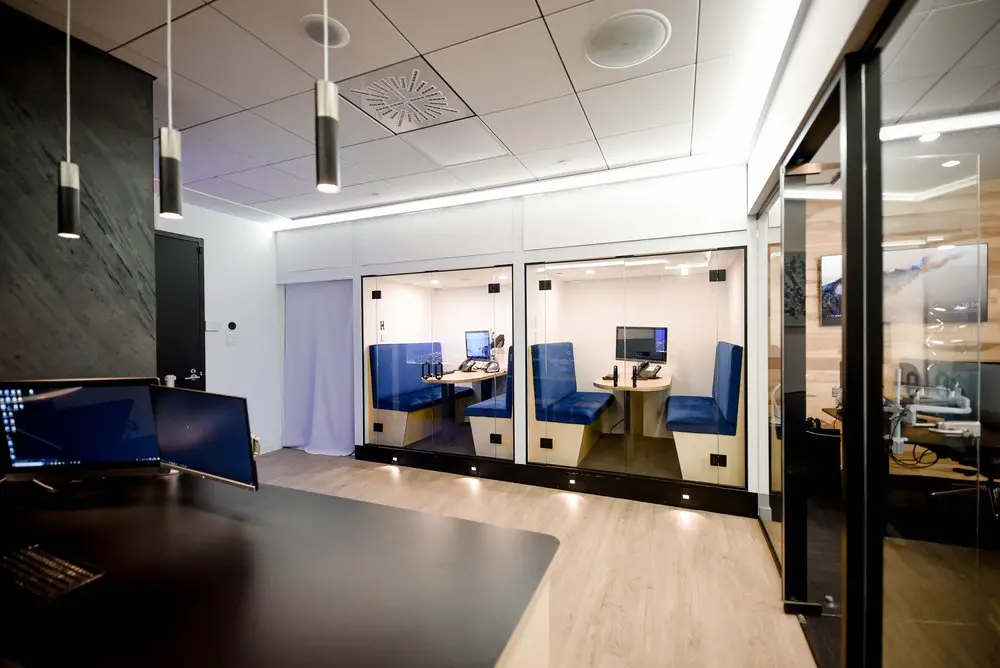
Routine calls may fit shared space if etiquette allows. Client, HR, health, legal and financial conversations usually require verified enclosure and safeguards. Add separately booked rooms to both scenarios unless the agreement expressly includes use, with booking rules, duration and overages. A booth may help with ordinary calls; do not call it soundproof without evidence.
For a deeper test, use the privacy and acoustics guide rather than duplicating it here.
A pass fits best when the workstation travels easily. A monthly hot desk can still require setup every visit. A dedicated desk matters when continuity and permitted equipment storage justify its price.
List laptop, adapter, mouse, keyboard, headset, stand, documents and accessibility equipment. Time setup and removal. Fifteen minutes twice daily over eight visits is four hours monthly, but value that time according to your own work rather than assuming it becomes billable income.
Check chair and screen adjustability, glare, lighting, power and surface size. A stylish chair does not fit every person. Use the ergonomic workstation guide and multiple-monitor guide for the detailed test. If continuity matters, compare a hot desk with a dedicated desk rather than assigning storage rights to a shared plan.
Add round-trip transit, parking, fuel and equipment burden. If the trip and attendance are identical, travel does not alter the crossover. If providers differ in location or membership changes attendance, it can.
Pass total = n × (D + pass trip)
Membership total = M + n × membership trip
Record door-to-desk time at the actual commute hour, including winter variability and transfers. A neighbourhood label is not a travel measurement. For 2727’s area, use the Griffintown parking guide for current local detail.
Keep the purchasing decision separate from tax treatment. A price is not cheaper merely because someone hopes to deduct it.
For a self-employed person, CRA guidance allows reasonable rent incurred for property used in the business, limited to the business portion and subject to rules on prepayments and input tax credits [11]. For an employee, office rent follows narrower conditions, including requirements arising from employment, non-reimbursement and employer certification such as Form T2200 [10]. Ask the employer about approval and reimbursement before purchase.
GST and QST registrants can generally recover eligible tax on commercial inputs through input tax credits and refunds, subject to use and restrictions [7]. Office-space rent is listed among operating expenses for this purpose [8]. Small-supplier rules affect whether registration and collection are required [6]. None of this makes every workspace charge automatically deductible. A possible QST rebate for an employee or partner has conditions, including deductibility and employer or partnership registration [13].
Keep a contract, itemized invoices and proof of payment. Revenu Québec requires specified invoice information for tax support [9]. CRA’s general rule is to retain records for six years from the end of the last tax year they relate to, with some exceptions [12]. Employer reimbursement can have its own input-tax treatment and documentation method [14].
As of October 2026, 2727 Coworking lists a day pass from $55 before taxes and a monthly hot desk from $350 before taxes; both use the shared area Monday to Friday from 8:00 to 18:00 and close on weekends and holidays. Monthly hot desks are month-to-month with no minimum, can be cancelled anytime, and have no setup fee at online checkout.
There is no free trial, pass pack or part-time plan. A paid $55 pass is credited toward a monthly plan signed within 14 days after the pass. In the illustrative hot-desk model with a $350 month and $350 setup fee (2727's own hot desk checkout charges no setup fee), the later payment is $645 before taxes and combined cash is $700 before taxes. All amounts here are CAD. Check the booking site for current prices and terms.
Each membership is for one person. Office and desk members can book the conference room free as available; phone booths are open to members and day-pass users, first come first served. Dedicated desks and private offices have 24/7 access. Day passes can be cancelled or rescheduled free until 48 hours before the booking; afterwards there is no refund.
Suppose attendance may be two days one month, nine the next and zero during travel. Calculate each month. Passes preserve the zero month and avoid notice exposure. Membership becomes compelling only if the high-use pattern persists long enough to recover setup. Tax treatment depends on reasonable business use, records and the person’s facts.
An employee expecting two remote days weekly might forecast eight visits, but employer-office days and holidays can reduce the total. First ask whether coworking is approved, which providers qualify, who pays, and what invoice is required. Compare out-of-pocket cost after reimbursement rather than assuming personal tax relief.
For three or four dates in Montréal, passes usually match the duration even if their per-day price seems high. Verify time zone, entry, cancellation, luggage, network policy and sensitive calls. A recurring agreement rarely makes sense unless the stay continues or repeats; the short-term office guide covers the separate case where shared seating does not meet the work requirement.
Do not choose between shared products before pricing private call space. If two visit days require rooms, add those rooms to both pass and membership totals. If rooms are included for members, confirm that booking is available at the required time. Enclosure, not frequency, may drive the decision.
A worker carrying a monitor, keyboard and specialist input device may accept fewer visits because setup is burdensome. Compare hot desk with dedicated desk, not only pass with hot desk. Confirm what may remain, liability, surface dimensions and power before assigning value to continuity.
Multiply pass cost by people and days. Five people for two days at $55 is $550. Then compare an appropriate room or office as a separate product, including capacity, layout and privacy. One pass cannot be shared, and five open seats are not equivalent to one enclosed team room.
Remote and hybrid work turned occasional workspace from a niche purchase into a recurring planning problem. Statistics Canada reported that the share of Canadians working most of their hours from home rose from 7% in May 2016 to about 40% in April 2020, then settled near 20% in November 2023 [36]. Those national figures describe a historical shift, not the current schedule of any Montréal worker and not a forecast of coworking demand.
The practical consequence is that many people no longer need a workplace five days every week, yet still need one on particular days. An employee may need separation from home for calls. A self-employed person may need a professional setting during a delivery sprint. A traveller may need one reliable workday between meetings. A small business may need a place before committing to a private office. These are different jobs, even if each person searches for “coworking.”
The French term cotravail describes workspace sharing by self-employed workers or workers from different organizations, according to the terminology record maintained by the Office québécois de la langue française and the Translation Bureau [35]. The definition helps identify the category. It does not establish that shared work improves networking, concentration or revenue for every user.
Historically, a conventional office decision began with square footage and a lease. The pass-versus-membership decision begins with time: which days, which hours and for how many months? That shift explains why an annual average is weak evidence. A person can average six visits monthly while actually using twelve in one month and zero in the next. Passes and membership respond very differently to that pattern.
There is no stable “average Montréal day-pass price” that can decide the purchase. Public offers mix single days, multi-visit plans, recurring memberships, long contract equivalents and “from” prices. A useful market scan identifies the model and conditions behind each number. An older Canada and United States pricing overview can supply historical context, but it is not evidence of a current quote.
The following examples were checked on first-party pages on October 3, 2026. They illustrate structures, not a permanent ranking. Taxes, availability, location and final checkout terms must be verified.
| Provider | Public model observed | What the number can show | What it cannot show |
|---|---|---|---|
| Nuage B | $35 day; five monthly visits $100; ten $175 | A local operator can offer limited-visit monthly products | That unused visits roll over, or that the plan matches another provider’s hours |
| ECTO | $30 day; ten visits $250; monthly hot desk $200 | Day, bundle and monthly options can coexist | That the monthly price has no term condition |
| Metspace | Drop-in from $35/day; monthly coworking from $180 | Entry prices can be presented as “from” amounts | The bookable price for a particular location, date or entitlement |
| Regus Montréal | Day coworking from $49 per person per day; a lower daily equivalent on a long access-plan term | Contract length can make a displayed daily equivalent look low | That the equivalent is a one-day product or monthly invoice |
Nuage B’s first-party page lists a $35 day, a five-access monthly plan at $100 and ten accesses at $175, with weekday 9:00 to 18:00 access and unused visits expiring [18]. This is a real middle category between ad hoc passes and unlimited monthly use. It does not support a general claim that all Montréal operators sell pass packs.
ECTO lists a $30 day pass, ten visits for $250 with passes valid for six months, and a $200 monthly hot desk [19]. Its published terms qualify the monthly rate with a six-month commitment and a 20% surcharge for shorter use. Comparing $200 directly with another provider’s flexible monthly plan would therefore omit commitment.
Metspace advertises drop-in access from $35 per day and monthly coworking from $180 [20]. “From” is a starting point, not a quote. Regus lists day coworking from $49 per person per day in Montréal, while its access-plan equivalent from $11 per person per day depends on a 24-month contract [21].
These examples show why the old shortcut, “passes are best below four days and monthly is best above eight,” is unreliable. At Nuage B’s displayed structure, five visits have a distinct product. At ECTO, term changes the monthly comparison. At Regus, a daily equivalent belongs to a long contract. A provider with no limited-visit bundle and a setup charge creates a different early-month calculation.
Use a comparison table with these columns:
| Field | Why it matters |
|---|---|
| Exact product name | Prevents a long-contract equivalent from being treated as a pass |
| Location | Chain prices and hours can vary by centre |
| Price and currency | Avoids mixing CAD, USD and stale snippets |
| Tax status | Makes cash totals comparable |
| Access dates and hours | Tests whether the product can support the work |
| Included visits | Distinguishes capped bundles from recurring access |
| Expiry and rollover | Prices unused capacity correctly |
| Setup and deposits | Captures the first invoice |
| Minimum term and notice | Captures the total commitment and exit |
| Seat role | Separates shared, assigned and enclosed products |
| Room and guest terms | Exposes costs hidden by a desk-only headline |
| Source and date | Makes later verification possible |
Never average unlike products merely because each contains the word “coworking.” The correct comparison can conclude that two offers are not substitutes.

The most reliable worksheet separates unavoidable cash, usage-dependent cash and non-cash requirements.
Include the first monthly payment, setup charge, required deposit, mandatory access device and every payment likely to fall inside the notice period. A refundable deposit affects cash flow even if it is not a final expense. Record when and under what conditions it is returned.
Do not silently amortize setup before showing it. Display the first invoice, then show an analytical monthly average over the planned stay. For example, a $350 setup charge allocated across three months is $116.67 per planned month; across twelve months it is $29.17. These are planning allocations, not invoices and not evidence that the customer can buy a month at those amounts.
Include travel, parking, paid rooms, printing beyond allowances, food bought only because of the trip, equipment transport and any guest passes. Apply a cost only where the option causes it. Lunch is not automatically a coworking cost if the same food would be purchased at home.
Team cost requires headcount. If P people attend N days at day price D, the pass cost is P × N × D. Then compare the right team product. A room may cost less than individual passes but may provide a boardroom table rather than ergonomic individual stations. A monthly hot-desk plan for one named person should not be multiplied or shared without confirming its user terms.
Privacy, accessibility, required hours and employer security policy often operate as pass/fail conditions. If a plan cannot meet a required condition, a low price does not rescue it. Treat the option as unsuitable rather than inventing the “cost” of violating policy.
Comfort and community can matter, but observe them. Record whether you could focus, whether the chair adjusted correctly and whether useful interaction actually happened. Do not convert a pleasant tour into a promised productivity or networking return.
A decision is robust when reasonable changes do not reverse it. Test at least five variables.
Move attendance two days below and above the forecast. At $55 and $350, a forecast of seven is fragile because six favours passes by $20 and eight favours membership by $90. A forecast of fifteen is less sensitive in a recurring month, though setup and exit still matter.
Compare one, three, six and twelve months. Setup has maximum effect in month one. Notice has maximum effect near exit. A membership that wins over twelve months can lose for a two-month contract project.
Passes may be refundable only before a deadline, while bundles may expire and memberships remain payable. Estimate the number of purchased but unused days in each option. Do not assume a pass is risk-free merely because it is not recurring.
Add zero, one and four required room sessions. If membership room access is included but available only by booking, run a fallback cost for the occasion when the required slot is not free. “Included as available” is not a reservation guarantee.
Compare a normal commute, a winter commute and an alternate provider. If a $35 pass requires $20 more travel than a $55 pass, the headline difference disappears. Use live routes for the actual origin and time.
Create a small decision register:
| Variable | Base case | Low case | High case | Does the choice change? |
|---|---|---|---|---|
| Visits | 7 | 5 | 9 | Yes |
| Planned months | 6 | 3 | 12 | Possibly |
| Room sessions | 0 | 0 | 4 | Depends on plan terms |
| Trip cost | $8 | $0 | $20 | Possibly |
| Exit payments | 0 | 0 | 1 month | Possibly |
When several plausible cases reverse the result, prefer the option with manageable downside or delay commitment until one more month of attendance data is available.

Workspace frequency can interact with how transit is purchased. STM’s live fare grid showed a regular Zone A 24-hour pass at $11.25 and a monthly Zone A pass at $110 on October 3, 2026 [22]. Those fares cover transit, not coworking, and the best transit product depends on all travel in the month, not only workspace visits.
A person already holding a monthly transit pass for commuting or personal travel should not charge its full $110 to coworking. The marginal transit cost of another workspace visit may be zero. Someone buying a ticket only for each visit should include that fare. Someone cycling in summer and using transit in winter needs seasonal scenarios.
Trips from Laval or Longueuil can require an All Modes AB fare rather than a Zone A fare. STM’s fare-reform guidance explains that travel between Montréal in Zone A and Laval or Longueuil in Zone B needs a fare valid in both zones [23]. Check the current grid for the exact route.
Route-planner results are planned schedules, not promises of a real-time arrival. STM states that its trip calculator uses planned schedules [25]. Test the journey during the hour you will travel and preserve buffer for transfers.
Accessibility also requires day-of verification. STM advises riders to check elevator status before a métro trip that depends on elevators [24]. Do not describe a complete journey as step-free solely because a station appears on an accessibility list.
BIXI lists a monthly membership at $24 before taxes every 30 days and a separate seasonal membership covering April 15 through November 15. E-bike use and overtime incur additional charges [26]. A 45-minute included regular-bike period does not prove that every origin-to-workspace route fits.
Drivers should read the actual sign. Montréal notes that posted on-street parking prohibitions can apply on public holidays [27]. Never infer free or legal parking from a holiday, an old marketplace listing or an empty curb.
Quebec statutory-holiday rules for employment do not determine whether a private coworking product is open. CNESST notes that employers may ask employees to work on a statutory holiday subject to compensation rules [28]. The workspace’s own access policy still governs entry.
Frequency increases the importance of a repeatable setup. On a single day, adjusting a chair and raising a laptop may be enough. Across fifteen days monthly, a poor arrangement becomes a repeated exposure. Yet a fixed desk is not automatically ergonomic.
CCOHS warns that one chair does not fit everyone and recommends evaluating adjustability and the user’s dimensions [29]. On each shared visit, reset the seat height, back support and armrests. Position the monitor and input devices for the actual task. If the available chair cannot fit, that can be a product mismatch rather than a small inconvenience.
A sit-stand desk is also not a cure by label. CCOHS says the key is alternating position according to need, while prolonged standing can create its own problems [30]. Confirm the adjustment range and whether you will actually use it.
Compare three equipment strategies:
Price the real items and replacement cycle. Do not assume every supplied monitor has the needed resolution, ports or stand. Confirm the exact workstation before assigning any value to supplied equipment.

Workspace Wi-Fi speed is not a security certification. Ask the employer or client which network controls are required. Verify the network name with the operator, disable automatic connection to similarly named networks, keep devices patched and use approved protection.
The Canadian Centre for Cyber Security advises organizations to avoid public Wi-Fi for business needs where possible and describes controls such as secured networks and VPN use [31]. Its remote-work guidance advises against sending sensitive information over public Wi-Fi and emphasizes device and screen protection [33]. This guidance does not prove that every coworking network is public or unsafe. Ask how the actual network is configured and follow organizational policy.
Enable multi-factor authentication on valuable accounts where possible, as the Cyber Centre recommends [32]. MFA reduces account risk but does not prevent a neighbour from viewing a screen or hearing a call.
Organizations handling personal information must use safeguards appropriate to the context. The Commission d’accès à l’information describes physical, administrative and technical measures for protecting personal information [34]. A workspace choice is only one layer. Policies for screens, paper, calls, visitors, device locking and incident response remain necessary.
Security can change the product comparison in two ways. First, a required control may exclude shared seating for particular work. Second, a separate room, cellular data or approved connectivity can add cost. State which is a hard requirement and which is a priced workaround.
Before the first day, save the agreement, hours, cancellation policy, arrival instructions and support contact. Confirm whether identification is required and whether the access app works on the device you will carry. Do not schedule the most sensitive client call as the first test of an unfamiliar workspace.
On the first visit, record arrival-to-desk time, chair and screen setup, network connection, ordinary sound, booth or room workflow, lunch options and departure steps. The goal is to test the process, not rate the décor. Never photograph or record other users.
After the first week, compare planned and actual attendance. Note unused bookings, extra trips, room needs and equipment friction. If joining credit has a deadline, make the decision before the deadline using the remaining cash comparison, while keeping the already paid pass visible in the combined total.
Before the first billing anniversary, verify the next charge and notice deadline. If usage is below plan, calculate the cost of leaving now versus another month. If usage is above plan, check whether a dedicated desk or room need has emerged. Do not let a recurring payment replace active review.
Consider a hypothetical independent consultant choosing for six months. The consultant expects six visits in a quiet month, eight normally and ten during a delivery month. The day price is $55, membership is $350, setup is $350, and both are taxed equally. Travel costs $8 per visit under either choice, so it does not affect the headline crossover but does affect cash.
The planned sequence is 6, 8, 10, 8, 6 and 4 visits, or 42 total. Pass fees are 42 × $55 = $2,310; travel is 42 × $8 = $336; total before taxes is $2,646. Membership fees are 6 × $350 = $2,100, plus $350 setup, plus the same $336 travel, for $2,786. Passes are $140 lower before taxes.
If the final four-visit month disappears, passes fall by $220 in fees and $32 travel. Membership may still owe that month depending on notice. The pass advantage grows. If instead the final month rises from four to twelve visits, pass fees add $440 relative to the forecast while membership stays fixed. Membership then becomes lower.
Now add two sensitive meetings monthly. If both options require the same separately paid room, add the same amount and the comparison does not change. If the membership explicitly includes bookable room use and the required slots are available, apply that documented value to membership. If availability is uncertain, model a fallback rather than treating inclusion as guaranteed.
Finally, suppose the consultant already used one $55 trial and can apply it within the credit window. The remaining membership checkout drops by $55, but total combined first-month cash remains unchanged because the trial was paid. The credit improves the decision from this moment forward without rewriting history.
This example shows the central discipline: revise one input at a time, keep sunk cash separate from future cash, and never bury a product mismatch inside an average.
Two people can each average seven visits per month and still need different products. The sequence matters because passes respond immediately to low-use months, while setup and notice make membership costs sticky.
Assume seven visits every month, D = $55, M = $350 and S = $350. Passes cost $385 × 12 = $4,620. Membership costs $350 setup + $350 × 12 = $4,550. Membership is only $70 lower before taxes across the entire year. Although every recurring month favours membership by $35, it takes ten months of that $35 advantage to recover the $350 setup charge. The eleventh month is the first point at which cumulative membership spending becomes lower.
| End of month | Cumulative passes | Cumulative membership including setup | Difference |
|---|---|---|---|
| 1 | $385 | $700 | Passes lower by $315 |
| 3 | $1,155 | $1,400 | Passes lower by $245 |
| 6 | $2,310 | $2,450 | Passes lower by $140 |
| 10 | $3,850 | $3,850 | Equal |
| 11 | $4,235 | $4,200 | Membership lower by $35 |
| 12 | $4,620 | $4,550 | Membership lower by $70 |
This is a much more cautious conclusion than “seven visits means membership.” Seven visits makes the recurring fee lower. The accumulated decision breaks even only after ten complete months under these assumptions. If the agreement creates one additional payment at exit, membership would cost $4,900 and passes would remain lower over twelve months.
Now distribute the same 84 annual visits unevenly: 14 visits in each of six project months and zero in the other six. Passes still cost 84 × $55 = $4,620. A membership held for all twelve months still costs $4,550. But if the customer can start and stop without extra setup each time, which cannot be assumed, six active monthly charges plus one setup would cost $2,450. Conversely, if every restart triggers setup, six isolated memberships would cost $700 × 6 = $4,200 before notice complications.
The purpose of this scenario is not to suggest repeated joining. It shows why one annual average cannot select the product. The real contract decides whether pausing, restarting or re-paying setup is possible. If a 30-day notice makes it impossible to avoid the zero month following every sprint, six two-month payment blocks plus setup could cost $350 setup + $350 × 12 = $4,550 again.
Suppose a temporary project needs ten visits in each of three months. Passes cost 30 × $55 = $1,650. Membership costs $350 setup + 3 × $350 = $1,400, a $250 advantage before taxes. If notice timing causes a fourth monthly charge, membership becomes $1,750 and passes are $100 lower. One sentence in the cancellation clause reverses the result.
At eight visits per month for the same three months, passes cost $1,320 and membership costs $1,400. At twelve visits, passes cost $1,980 and membership $1,400. The correct answer depends on attendance density, not simply project length.
Suppose the customer expects eight visits in ten working months and zero visits in two travel months. Passes cost 80 × $55 = $4,400. Membership costs $4,550 including setup. Despite eight visits being above the recurring crossover, passes are $150 lower across the year because the two zero months preserve cash.
If the customer instead attends four times in each travel month, total visits rise to 88 and passes cost $4,840. Membership becomes $290 lower. The eight added visits change the conclusion. Before signing, put known vacation, parental leave, seasonal shutdown and extended travel on the calendar.
Assume each month has a 25% chance of three visits, a 50% chance of seven visits and a 25% chance of eleven visits. Expected visits equal seven, but expected pass spending is also $165 × .25 + $385 × .50 + $605 × .25 = $385. Over twelve independent months, expected pass spending is $4,620. Membership is $4,550 including setup, only $70 lower, as in the steady calendar.
The distributions still differ. Pass spending ranges with actual use; membership fixes most workspace spending. Someone with limited cash may value the lower downside in a three-visit month more than the small expected annual membership advantage. Someone who needs predictable invoices may prefer the fixed amount. The arithmetic informs that preference without deciding it.
Create three dates: the last day you need access, the date notice must arrive, and the last paid day. If the agreement requires 30 days’ notice and bills on the first, notice given on June 20, 2026, may not make June 30, 2026, the last paid day. The actual result depends on the contract, but the model should be ready to include July 2026.
Let E be unavoidable exit-period payments. Then:
membership horizon = setup + active-month fees + E
For a three-month project at ten visits per month, the earlier membership total was $1,400. If E = $350, it becomes $1,750. If the last month is partially prorated by written agreement, enter that actual amount instead of a full month. If no extra payment is due, enter zero. Never decide in advance that 30 days always equals one extra month.
Notice also affects the decision date. A member who waits for month-end attendance data may already have passed the deadline to prevent the next charge. Schedule the review before notice is due. The review should ask whether the following paid period is likely to cross the recurring line, not whether the month that just ended did.
Day passes have their own exit exposure at a smaller scale. A non-refundable booking after its cancellation deadline is an unused cost. If four future dates are booked at $55 and plans change after the deadline, $220 may be lost. Compare realistic cancellation behaviour, not the ideal flexibility of an unpurchased pass.

A project calendar and a billing calendar answer different questions. The project calendar shows when work happens. The billing calendar shows when money becomes due. A three-month assignment can create four monthly payments if the customer signs early, misses a notice deadline, or needs access for a few days after the third calendar month. Conversely, a five-week assignment may fit inside two billing periods. Write both calendars before comparing totals.
Consider a project running from September 14 through November 20, 2026. The worker expects four visits in the partial September period, nine in October and six in November. Passes cost 4 × $55 + 9 × $55 + 6 × $55 = $1,045. If monthly membership begins September 14 and bills $350 immediately, the first payment with setup is $700. Two further monthly payments on October 14 and November 14 bring membership cash to $1,400. Membership costs $355 more even though October alone is above the recurring crossover.
Now increase October to fourteen visits and November to ten while keeping September at four. Passes become 4 × $55 + 14 × $55 + 10 × $55 = $1,540. The same three membership charges plus setup remain $1,400, so membership is $140 lower. This conclusion still depends on the final paid day. If notice creates a December 14 payment, membership becomes $1,750 and passes regain a $210 advantage.
The example shows why the date of the first charge belongs beside the date of first access. Ask whether a billing month means a calendar month, thirty days, or a cycle anchored to signup. Ask whether the first period is prorated. Ask whether notice must arrive a fixed number of days before renewal or merely before the next invoice. Enter the written answer rather than choosing the interpretation that makes one option look cheaper.
Already-paid transport also needs careful treatment. Suppose the worker has an STM monthly pass for personal and employer-office travel before considering coworking. That sunk transit purchase adds no incremental fare to either workspace option during its valid period. Charging the full transit pass only to coworking would overstate both choices. If the day-pass provider is outside the covered fare zone while the monthly provider remains inside it, only the additional zone fare belongs in the comparison.
The same rule applies to equipment. A laptop and headset already owned for work are not new costs caused by a day pass. A second power adapter bought solely to make frequent visits easier is incremental. A monitor purchased for a dedicated desk belongs to that scenario only if it would not otherwise be bought. If equipment remains useful after membership ends, record its purchase separately and, if useful to the decision, note a reasonable residual value without pretending the provider will refund it.
Employer reimbursement can change timing without changing the invoice. A worker may pay $700 at checkout and receive reimbursement thirty days later. The economic burden may ultimately fall on the employer, but the worker still needs $700 of temporary cash. Record gross payment, expected reimbursement, approval status and reimbursement date on separate lines. Do not treat an unapproved expense policy as cash received.
Use a small ledger for each option:
| Date | Event | Pass path cash | Membership path cash | Evidence |
|---|---|---|---|---|
| September 14, 2026 | Access begins | $55 for first used pass | $700 first checkout | Booking confirmation or agreement |
| October 14, 2026 | Next cycle | Actual passes bought | $350 | Invoice |
| November 14, 2026 | Next cycle | Actual passes bought | $350 | Invoice |
| Notice deadline | Cancellation decision | Future bookings at risk | Possible next $350 | Contract clause |
| Reimbursement date | Employer repays approved amount | Actual approved amount | Actual approved amount | Expense approval |
The ledger prevents three common errors. First, it stops a setup charge from being quietly spread across months before the initial cash need is shown. Second, it prevents a pass bought but not used from disappearing from the pass total. Third, it separates a future reimbursement from money already received.
Run the ledger under a base case and two reversals. One reversal should reduce attendance, such as a cancelled client trip. The other should extend the paid horizon, such as notice arriving one day late. If the recommendation changes under either plausible event, describe it as conditional. A narrow cost difference does not support a confident universal answer.
When the project has a hard end date, obtain the cancellation mechanics before signup. When the need is open-ended, place a review reminder early enough to act before notice. In both cases, compare future avoidable cash from the review date. Setup already paid is then a sunk cost; it should remain in the historical total but should not force continuation of an otherwise unsuitable membership.
At the standard 5% GST and 9.975% QST rates, a $55 taxable base is approximately $63.24 after tax, a $350 base approximately $402.41, and a combined $700 base approximately $804.83. Separate invoice lines can differ by a cent because of rounding. Treat these as planning amounts and use checkout totals for payment.
When the same rates apply to both options, pre-tax break-even remains the easiest explanation. Seven taxable $55 passes and one taxable $350 membership preserve the same relative ordering as their pre-tax amounts. Setup still changes the first-month threshold because it changes the taxable base, not because tax favours one plan.
A registrant’s possible input tax credits or refunds should be shown after gross cash, not used to erase tax from the comparison. Eligibility, commercial-use share, documentation and time limits apply. Revenu Québec says claims can generally be made within four years, while shorter periods can apply in some cases [17]. This timing rule does not change the guide’s core pricing model.
For one isolated day, compare passes with another genuinely one-day product. Monthly pricing is usually irrelevant unless there is already an active membership.
For one month, compare the entire first checkout with passes. At the illustrative prices, membership needs thirteen total visits to beat passes in cash. Also confirm that notice will not extend payment.
For two or three months, calculate every month separately and keep setup fully visible. Moderate attendance may not recover it. Dense attendance can. Obtain the cancellation date before signing.
For six months, setup matters less but remains material. At eight visits monthly, membership is $190 lower before other costs. A single unwanted exit payment would make it $160 higher.
For twelve months, test vacations and seasonal zeros. Consider any documented long-term discount as a separate scenario, including the commitment it requires. Do not apply a discounted monthly price while preserving flexible cancellation in the same model unless the contract offers both.
For an indefinite need, set a review rhythm. Compare the most recent three months with the next three-month forecast. A membership should not continue solely because setup was already paid; setup is sunk once incurred. Future choice compares avoidable future payments with future pass spending and product fit.
A useful recommendation states conditions. For example: “Passes cost less for the expected three-month pattern after including setup, but membership becomes lower if attendance reaches ten days monthly and no extra exit payment is due.” This tells the reader what would change the decision.
A weak recommendation says: “Monthly is best for regular users.” It leaves regular undefined, ignores setup and assumes the products match.
Another good recommendation is: “The dedicated desk costs more than the hot desk, but it is the only compared product that documents a reserved station and equipment continuity, both required for this workflow.” Price does not override a hard requirement.
For uncertain data, use a range: “If room use costs between $0 and $200 monthly, passes remain lower in the base case but membership may become lower if room access is documented and available.” Do not fill an unknown with zero.
The final decision record should fit on one page: chosen product, comparison date, expected calendar, total first payment, total planning-horizon cost, required entitlements, cancellation deadline, sources and the two assumptions most likely to reverse the choice. That record is more useful than a generic claim about which type of coworking is cheaper.

After matching entitlements, calculate floor(monthly price ÷ day price) + 1 for the first visit count at which membership is strictly cheaper. If the quotient is already an integer, that visit count is a tie and the next visit is the first cheaper one. At illustrative prices of $350 and $55, the recurring crossover is seven visits.
Setup charges increase initial cash. A $350 monthly price plus $350 setup equals $700, which is lower than thirteen $55 passes at $715.
No. A credit reduces the later invoice. If $55 was already paid and $55 is credited against $700, total combined cash remains $700.
No. It can still require notice. Read when cancellation takes effect and whether another billing date occurs.
If both products have the same tax rate, the basic ratio is unchanged. Taxes still matter for cash and must be shown consistently.
It depends on payer, business use, employment conditions, reimbursement and tax status. Keep invoices and ask a qualified adviser about your facts.
Usually it provides recurring shared access, not one assigned station. Confirm the agreement. Choose a dedicated desk when reservation is required.
Do not assume so. Confirm storage and equipment rules. A dedicated desk is generally the relevant comparison for equipment continuity.
Policies vary. Confirm access, whether booths are reservable, and whether they meet the call’s privacy needs.
Only if the exact plan says so. Check booking availability, duration, overages, guest rules and cancellations.
Generally not without additional safeguards and verified private space. A headset does not stop neighbours hearing your voice.
Record money and time. Add a dollar value to time only if it reflects your own decision, not a promised productivity gain.
Use low, expected and high monthly scenarios. Passes often have greater value when low-use or zero-use months are plausible.
Some operators may offer bundles or limited plans, but never assume one exists. Compare only current, documented products and include any expiry or rollover rule.
Do not assume transferability. Workspace access is commonly tied to a named person. Ask whether every user needs a plan or pass.
Only if that product’s hours permit it. Check weekends, holidays, earliest entry and latest exit for the exact pass.
Read the booking policy before paying. Record the cutoff, refund rule and whether rescheduling preserves the booking value.
No. Confirm the exact product rather than relying on a building-level or higher-tier access claim.
A paid pass can be a practical evaluation visit, but it is not free. If the provider offers a conversion credit, confirm its deadline and keep the paid pass visible in combined cash.
Test entry, realistic arrival time, seat setup, ordinary noise, call workflow, screen glare, network requirements, lunch and the trip. Record observations without collecting information about other users.
Calculate people × days × pass price, then compare a suitable room’s total. Also compare capacity, enclosure, desk ergonomics and call needs because the products are not equivalent.
Keep the signed agreement, plan terms, itemized invoices, payment records, cancellation notice and any employer approval or reimbursement evidence.
Recalculate when prices, work schedule, employer policy, commute, room needs or notice timing changes. Review before the next cancellation deadline.
Choose passes when use is genuinely occasional or uncertain and the booked hours fit. Choose monthly when repeated attendance, the complete entitlement and the commitment horizon justify both setup and exit exposure. Consider a dedicated desk when equipment continuity or a reserved station matters.
Do not let the recurring crossover hide the first invoice. In the illustrative $55 versus $350 comparison, seven visits cross the ordinary monthly line, while a one-month setup fee moves the first-month line to thirteen visits. Model actual calendars, keep product differences beside the totals, and verify the live contract before paying.